Research demonstrates that child- and parent-reported maladaptive parenting behaviors are associated with increased occurrence of psychiatric disorders later in life, including personality disorders (PD), in offspring (Johnson et al., Reference Johnson, Cohen, Kasen, Smailes and Brook2001, Reference Johnson, Cohen, Kasen, Smailes and Brook2002). In this way, the parenting received in childhood or adolescence may serve as an antecedent to psychopathology, and more specifically personality pathology. Further, the literature on families has noted the importance of integrating family research with behavior genetics (Moore & Neiderhiser, Reference Moore and Neiderhiser2014) because behavior genetic methods have the potential to identify specific etiologic influences, going beyond documenting associations. Accordingly, we conducted a longitudinal twin study to understand the etiology of associations between parenting in adolescence and personality pathology in adulthood.
Retrospective recollections of parenting and personality disorders
Most literature on how parenting impacts the development of PDs is retrospective in nature, meaning that adult participants are reporting on recollections of the parenting they received in childhood or adolescence. Retrospective studies suggest that recollections of adverse childhood experiences, such as neglect, abuse, and maltreatment, are related to the development of PDs (Carr & Francis, Reference Carr and Francis2009; Battle et al., Reference Battle, Shea, Johnson, Yen, Zlotnick, Zanarini, Sanislow, Skodol, Gunderson, Grilo, McGlashan and Morey2004; Zanarini et al, Reference Zanarini, Ruser, Frankenburg and Hennen2000). Further, recollections of unpredictable and intrusive caregiving have been linked to the development of PDs (Steele et al., Reference Steele, Townsend and Grenyer2019; Reich & Zanarini, Reference Reich and Zanarini2001; Patterson et al., Reference Patterson, DeBaryshe and Ramsey1989; Reich, Reference Reich1986; Head et al., Reference Head, Baker and Williamson1991).
Nevertheless, adult recollections of parenting behaviors have been found to show only modest associations with parenting as assessed in childhood and adolescence. In a longitudinal study, Nivison et al. (Reference Nivison, Vandell, Booth-LaForce and Roisman2021) found that retrospective reports from 26-year-old participants about parental emotional availability in early life were weakly associated with observations of parenting from their childhood. Further, current closeness with their parents and current depressive symptoms accounted for more variance than the prospective observations did in the adult recollections of parenting, suggesting that retrospective reports are particularly biased by the participant’s current life circumstances (Nivison et al., Reference Nivison, Vandell, Booth-LaForce and Roisman2021). Thus, it is imperative that the literature on parenting and PDs moves towards prospective, longitudinal studies if a goal is to understand how parenting experienced in childhood and adolescence relates to adult outcomes. This is an important goal because such research provides a more accurate account of the potential utility of intervening in childhood and adolescence to deflect the development of PDs in adulthood.
Prospective studies of parenting and personality disorders
Few studies focused on the link between parenting and PD have used longitudinal designs, in which parenting was assessed in childhood and personality was assessed in adulthood. A key longitudinal study in this domain is the Children in the Community Study (CIC; Cohen et al., Reference Cohen, Crawford, Johnson and Kasen2005), which is a prospective study focused on the developmental antecedents of personality pathology. Results from this study demonstrate that reported maladaptive parenting, low nurturing and parental affection, harsh punishment in childhood, and early separation from one’s mother were associated with an increased risk for PDs in adulthood (Johnson et al., Reference Johnson, Cohen, Kasen, Smailes and Brook2002; Cohen et al., Reference Cohen, Chen, Gordon, Johnson, Brook and Kasen2008; Crawford et al., Reference Crawford, Cohen, Chen, Anglin and Ehrensaft2009; Johnson et al., Reference Johnson, Cohen, Chen, Kasen and Brook2006). In addition, Johnson et al. (Reference Johnson, Liu and Cohen2011) found that reported positive parenting practices are inversely correlated with PDs. While CIC has been the most prominent study engaged in understanding parenting and PD development, other studies have also tackled this topic. Using a small longitudinal prospective study of low-income families (n = 56 families), Lyons-Ruth et al. (Reference Lyons-Ruth, Bureau, Holmes, Easterbrooks and Brooks2018) found that disrupted maternal communication at 18 months old predicted Borderline PD development in early adulthood. Using a population-based family study in Germany (n = 381 adolescents), Reinelt et al. (Reference Reinelt, Stopsack, Aldinger, Ulrich, Grabe and Barnow2014) found that maladaptive mother child interactions reported at age 15 years predicted Borderline PD symptoms at age 20 years. Although these studies do utilize a prospective longitudinal design, they do not make use of behavior genetic methods, precluding the ability to model the etiology of observed associations between parenting and PD outcomes. The present study builds on these groundbreaking studies that have paved the way by showing that parenting earlier in life is associated with later maladaptive personality trait outcomes. Specifically, we made use of a genetically informative and prospective design.
Behavior genetics of parenting and personality disorders
Past behavioral genetic studies that have looked at parenting factors have suggested that reported poor parenting acts as both an environmental and genetic risk for the development of offspring disruptive behaviors in childhood and adolescence, as well as an environmental risk for Borderline PD in adolescence (Bornovalova et al., Reference Bornovalova, Cummings, Hunt, Blazei, Malone and Iacono2014; Elam et al., Reference Elam, Harold, Neiderhiser, Reiss, Shaw, Natsuaki, Gaysina, Barrett and Leve2014; Lipscomb et al., Reference Lipscomb, Laurent, Neiderhiser, Shaw, Natsuaki, Reiss and Leve2014; Stover et al., Reference Stover, Zhou, Kiselica, Leve, Neiderhiser, Shaw, Natsuaki, Scaramella and Reiss2016; Fatimah et al., Reference Fatimah, Wiernik, Gorey, McGue, Iacono and Bornovalova2020). At the phenotypic level, Elam et al. (Reference Elam, Harold, Neiderhiser, Reiss, Shaw, Natsuaki, Gaysina, Barrett and Leve2014) found that parent-reported childhood peer disruptive behavior was associated with hostility in the mother-child relationship at r = 0.24 and in the father-child relationship at r = 0.19. Notably, much of this work has focused on how parenting reported in adolescence impacts behaviors and PD symptoms in adolescence and thus does not span different developmental periods. Further, the studies focus on symptoms of PD or PD diagnosis, rather than underlying maladaptive traits. To our knowledge, no studies have looked at how parenting reported in adolescence, from the perspective of multiple reporters, impacts the development of maladaptive personality traits associated with PD in adulthood. A study of this nature has the potential to elucidate whether genetic and environmental risk for reported parenting and maladaptive personality meaningfully overlaps, allowing for a better understanding of the mechanism underlying the parenting and personality relationship. Further, by investigating outcomes in terms of a comprehensive model of maladaptive traits (rather than the individual diagnosis level), we may better understand how parenting received impacts diverse outcomes, which potentially allows for more effective intervention with a wider range of potential outcomes.
Etiology of parenting
Parenting is moderately heritable, yet there are also significant shared and nonshared environmental influences. Klahr and Burt (Reference Klahr and Burt2014) conducted a meta-analysis of behavioral genetic studies on parenting, inclusive of parenting reports and recollections of parenting. They found, in child-reporter and parent-reporter studies, that additive genetic effects explained a significant portion of parental behavior and shared and nonshared environmental effects were also significant contributors. In the context of child-reported data, the shared environmental component represents influences of the child’s shared family context, such as parent characteristics and neighborhood factors. The nonshared environment indicates the influences of the child’s unique environment on parenting, such as peer groups or physical illness. At the child-reporter level, the largest components of reported parenting are additive genetic effects (A) and the nonshared environment (E), but the shared environment (C) did make up a small proportion (Klahr & Burt, Reference Klahr and Burt2014). For example, in the meta-analysis by Klahr and Burt (Reference Klahr and Burt2014), child-reported Parental Warmth demonstrated the following estimates: A2 = 0.41, C2 = 0.19, E2 = 0.40. Parent report estimates of Parental Warmth were as follows: A2 = 0.23, C2 = 0.56, E2 = 0.20. Additionally, child-reporters who were adults and gave recollections of parenting tended to have larger genetic contributions and smaller shared environmental contributions to the parenting domains studied than did prospective reports (Klahr & Burt, Reference Klahr and Burt2014), further demonstrating the importance of prospective reports for achieving unbiased estimates. In the developmental literature, it has been noted that parent-reports and child-reports of parenting often differ (Tein et al., Reference Tein, Roosa and Michaels1994), and as demonstrated above these perceptions of parenting do impact ACE estimates. Thus, for a more complete picture, both reporters (i.e., children and their parents) were used in the present study so that findings regarding how reported parenting in adolescence impacted maladaptive personality traits in adulthood can be confirmed across reporters.
Etiology of personality disorders
PDs and dimensional accounts of traits also contain a genetic and nonshared environment component. Typically, PDs have been found to be anywhere from 28% to 79% heritable (South & DeYoung, Reference South and DeYoung2013). For the Personality Inventory for the DSM-5 (PID-5; Krueger et al., Reference Krueger, Derringer, Markon, Watson and Skodol2012) traits, heritability across domains has been found to range from 19% to 37% (South et al., Reference South, Krueger, Knudsen, Ystrom, Czajkowski, Aggen, Neale, Gillespie, Kendler and Reichborn-Kjennerud2017). Further, across studies, only nonshared environmental influences (as opposed to shared environmental influences) emerge as important for PDs and related maladaptive traits (South & DeYoung, Reference South and DeYoung2013; Livesley & Jang, Reference Livesley and Jang2008). This suggests that those experiences unique to the individual play a role in PD development, rather than experiences shared between twins. In the present study, if an overlap in additive genetic effects is found it would suggest those genetic effects are contributing to the manifestation of both phenotypes (pleiotropy). By contrast, an overlap in nonshared genetic effects would indicate factors unique to each twin contribute to the parenting received and maladaptive personality traits.
Dimensional models of personality pathology
Traditionally, PD has been diagnosed with categorical models consisting of a checklist of criteria that must be met for an individual to receive a binary diagnosis. However, the validity of these categorical rubrics of PD has been brought into question (Krueger & Hobbs, Reference Krueger and Hobbs2020) and there has been an increased focus on dimensional or trait-based models of PD in more recent nosologies (e.g., Tyrer et al., Reference Tyrer, Mulder, Kim and Crawford2019; Reed, Reference Reed2018; Skodol et al., Reference Skodol, Morey, Bender and Oldham2015). Along these lines, the Alternative Model for Personality Disorders was incorporated into Section III: Emerging Measures and Models of the DSM-5 (American Psychiatric Association, 2013). This model consists of two components: personality functioning (Criterion A) and maladaptive personality traits (Criterion B). Criterion B maladaptive traits are often assessed with the Personality Inventory for the DSM-5 (PID-5; Krueger et al., Reference Krueger, Derringer, Markon, Watson and Skodol2012). The PID-5 consists of five trait domains: Negative Affectivity, Detachment, Antagonism, Disinhibition, and Psychoticism. These traits reflect the maladaptive poles of the Five Factor Model trait domains: Emotional Stability vs. Negative Affectivity, Extraversion vs. Detachment, Agreeableness vs. Antagonism, Conscientiousness vs. Disinhibition, and Lucidity vs. Psychoticism (Gore & Widiger, Reference Gore and Widiger2013). The PID-5 traits have been found to account for a substantial portion of variance of the DSM-IV-TR categorical PD diagnoses (Fossati et al., Reference Fossati, Krueger, Markon, Borroni and Maffei2013; Rojas & Widiger, Reference Rojas and Widiger2017) and provide incremental validity over categorical models (Fowler et al., Reference Fowler, Patriquin, Madan, Allen, Frueh and Oldham2017). As dimensional models of PD and associated traits become more popular for assessing PD, it is imperative to understand how developmental antecedents, such as parenting, impact the development of these traits and the underlying etiology between associations so that we better understand where intervention and prevention efforts should be placed.
Current study
The present study sought to elucidate the etiology of the association between parenting in adolescence and maladaptive personality in adulthood via the use of a twin design. We aimed to extend upon the extant literature in several specific ways. First, we used a longitudinal design in which parenting behaviors were reported by parents and target participants in adolescence and maladaptive personality traits were reported via self-report by the target participants in adulthood. The longitudinal nature of the present study, in which parenting was assessed in adolescence via multiple reporters (i.e., adolescent and parent), overcomes biases that may result from retrospective reporting or from only using a single reporter. Second, the present sample is composed of twins which allows an investigation into how genetic and environmental factors may contribute to observed associations. Additionally, we extend the literature by studying specific maladaptive traits that have been associated with all classical PDs and represent a dimensional approach to investigating PD. We hypothesized that parenting as assessed in adolescence would be associated with maladaptive personality traits in adulthood and that there would be an additive genetic overlap between phenotypes, as suggested by the literature on both PDs and parenting.
Methods
Participants
Data for the present set of studies were drawn from the Minnesota Twin and Family Study (MTFS). MTFS is a longitudinal community-based study of twins and their families. Twins were identified via Minnesota birth records. Families were included if they lived within a day’s drive of Minneapolis, Minnesota. Exclusion criteria included if the twins were adopted or had an intellectual disability which would prohibit them from engaging in a day long assessment. Two cohorts of twins were utilized: the Younger Cohort and the Enrichment Sample Cohort. See Wilson et al. (Reference Wilson, Haroian, Iacono, Krueger, Lee, Luciana, Malone, McGue, Roisman and Vrieze2019) for further details on recruitment.
Participants were 1,094 twin pairs (MZ = 694 pairs, DZ = 400 pairs). Parenting data were collected at a mean age of 14.90 years (ages ranged between 13.57 and 17.02). Personality data from the Enrichment Sample cohort (n = 775 individuals) was collected at a mean age of 24.50 while data from the Younger Sample cohort (n = 862 individuals) was collected at a mean age of 33.97. Lower sample size in the Younger Cohort at the time the personality data was collected is because only a subset of participants participated in this assessment wave. Specifically, only young adult twins who lived close to the University of Minnesota were asked back as the research protocol at this specific time point also included an MRI. Different time points were used for the personality data as the cohorts were different ages at the most recent assessment wave when personality measures were administered. Further, two samples t-tests were done with sex and age effects regressed out to confirm that the samples were not statistically different on personality domains so that they could be combined. Results demonstrated that all t-tests were nonsignificant and the two cohorts could be combined. The overall sample is similar in racial demographics to Minnesota at the time of recruitment. See Table 1 for details.
Demographic information

Note. ES = Enrichment Sample; Younger = Younger sample. These samples were combined for analyses.
Measures
Parenting environment questionnaire (PEQ)
The Parenting Environment Questionnaire (PEQ) was developed for the purpose of assessing perceived aspects of parenting in the Minnesota Twin and Family Study. In the present study, the PEQ was assessed around 14 years of age. Five major domains are assessed for each parent: Conflict, Structure, the Child’s regard for the Parent, the Parent’s regard for the Child, and Involvement. For every domain, each participant rated their own relationship on the scale for each parent. Parents (from the Enrichment Sample only) also rated domains pertaining to their relationship with the child which are labeled by reporter (e.g., Mother reported domains are labeled with “Mother” such as “Conflict with Mother”). In the present study, for adolescents only, scores across parents were averaged such that for each domain the participant’s perception of their relationship with their mother and their father were averaged together to form a Parent variable rather than using separate ratings for mother and father. Past studies using this measure have found that the adolescent’s perception of their relationship with their mother and their father are highly correlated at about 0.80 (Elkins et al., Reference Elkins, McGue and Iacono1997), which was also found in present analyses. Scores were not averaged between parent reporters, as those were not highly correlated. Parental Structure, the Child’s regard for the Parent, the Parent’s regard for the Child, Parental Involvement, Maternal Structure, Paternal Structure, the Child’s regard for the Mother, the Child’s regard for the Father, the Mother’s regard for the Child, the Father’s regard for the Child, Maternal Involvement, and Paternal involvement were reverse-scored such that higher scores indicated lower structure, lower regard, and lower involvement. Internal consistency measured via Cronbach’s Alpha ranged from 0.74 to 0.94. Omega total values ranged from 0.75 to 0.94.
Personality inventory for the DSM-5 (PID-5)
The Personality Inventory for the DSM-5 (PID-5; Krueger et al., Reference Krueger, Derringer, Markon, Watson and Skodol2012) is a measure of maladaptive personality traits consisting of 220 items. Each trait is assessed with between four to fourteen items. Items are rated from 0 (very false or often false) to 3 (very true or often true). Five overall domains and 25 lower order facets are assessed. In the present study, all five domains (i.e., Antagonism, Negative affect, Detachment, Disinhibition, and Psychoticism) were utilized. Domains were scored by averaging scores across three major facets that contribute to each domain. Internal consistency, as measured by Cronbach’s alpha, ranged from 0.88 to 0.94. Omega total values ranged from 0.90 to 0.95. Both Cronbach’s alpha and Omega total demonstrate adequate internal consistency for the overarching domains. The PID-5 was collected between age 24 and 34. The PID-5 is freely available and can be found at https://www.psychiatry.org/psychiatrists/practice/dsm/educational-resources/assessment-measures.
Statistical procedure
All data analysis was conducted in R Version 4.2.2. Biometric analysis was conducted using the OpenMx package (Neale et al., Reference Neale, Hunter, Pritikin, Zahery, Brick, Kirkpatrick, Estabrook, Bates, Maes and Boker2016). Data analysis occurred in three parts: (1) data cleaning, (2) preliminary analysis, and (3) bivariate ACE modeling.
Data cleaning
Domains of the PID-5, as well as domains of the PEQ, were transformed if they had a skew value greater than one. All variables that demonstrated skew were in a positive direction, as such a natural log was used in correcting for skew. Additionally, all domains were converted to T-scores for ease of interpretability. Next, Age, Sex, Age2, Age*Sex, and Age2*Sex were regressed out of all personality and parenting domain scores following guidelines laid out by McGue and Bouchard (Reference McGue and Bouchard1984). This was to account for any potential differences that were driven by age and sex or the interaction between the two, rather than by the underlying genetic and environmental variance. Data analysis was then performed on residuals.
Preliminary analysis
We estimated zero-order correlations between all PID-5 and PEQ domains. Further, univariate ACE models were fit. Traditional behavioral genetic analysis leverages the difference between species-specific genetic variation in monozygotic twins (100% genetically similar) and dizygotic twins (50% genetically similar, on average) to estimate additive genetic effects (A), shared environment effects (C), and non-shared environment effects (E). Thus, for each variable variance can be composed into A, C, and E effects which allows understanding the etiology of phenotypes. Intraclass correlations were also computed. Biometric models were fit for all variables via OpenMX Version 2.20.6 using the SLSQP optimizer, which is the program’s default optimizer. All confidence intervals were bootstrapped using 1000 iterations using a resampling unit of individuals. Other variations (e.g., AE) were also fit due to past work finding that the nonshared environment contributed minimally to maladaptive personality (South & DeYoung, Reference South and DeYoung2013). Model fit indices of AIC and the likelihood (logged and multiplied by negative 2) were used to determine best fitting models.
Bivariate ACE modeling
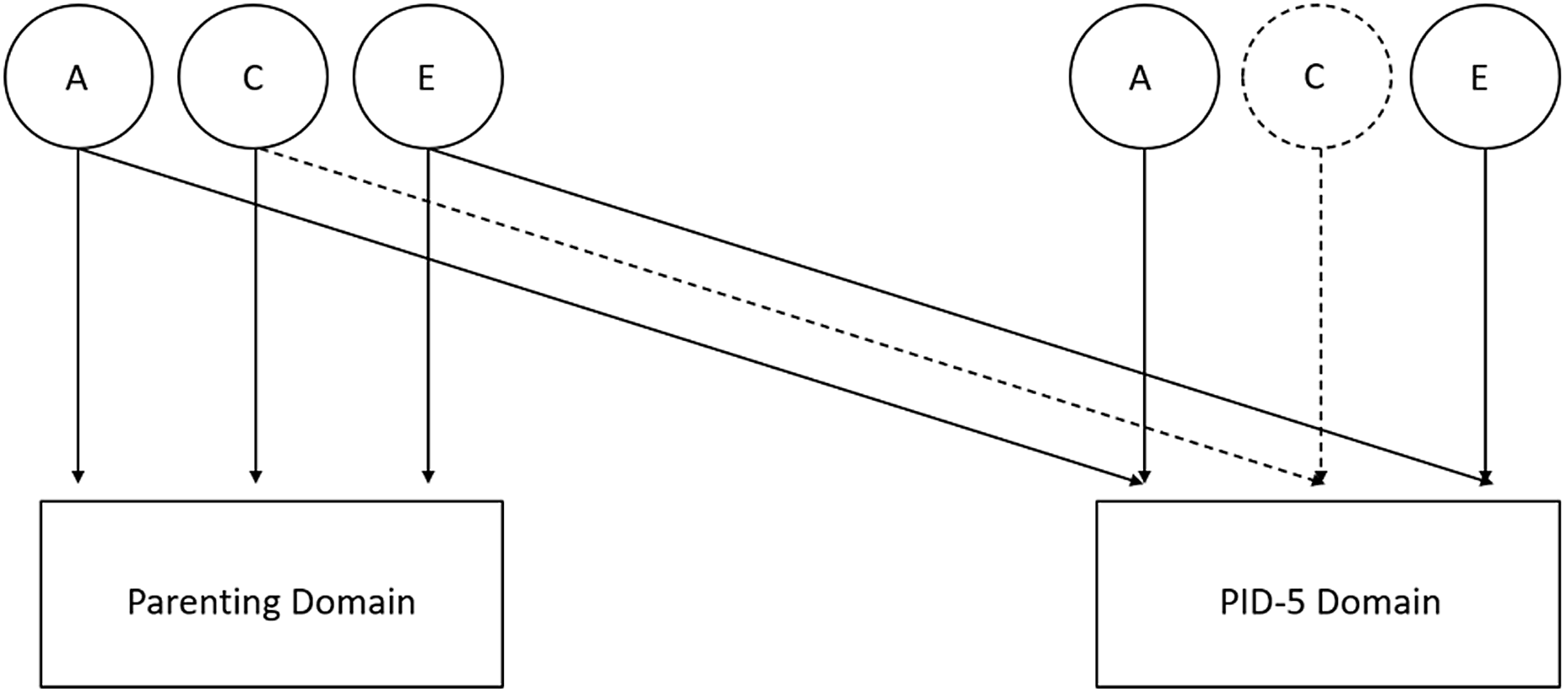
Associations between PEQ and PID-5 variables were decomposed into a bivariate ACE Cholesky if correlations between the two variables were r = 0.15 or greater. This arbitrary threshold was set, as for variance to be decomposed into a bivariate model there needs to be a meaningful association. Bivariate ACE models were also fit in OpenMx Version 2.20.6 using the same optimizer and bootstrapped confidence intervals as mentioned above. Full information maximum likelihood was used to account for missing data. Bivariate ACE models provide the ACE decomposition for the variance of each variable, as well as a decomposition of the covariance (and correlation) between the two variables. We additionally ran bivariate models in which C, the shared environment, was constrained to zero for the personality domain and for the cross path due to the literature suggesting that PID-5 domains are largely best fit to an AEFootnote 1 model and not an ACE model (Wright et al., Reference Wright, Pahlen and Krueger2017). Figure 1 provides a conceptual path model for both ACE-ACE models and ACE-AE bivariate models. As can be seen in Figure 1, ACE paths are given for each phenotype (e.g., PEQ domain and PID-5 domain). Further, there are cross paths from the ACE components for the PEQ domain to the corresponding ACE components for the PID-5 domain which indicate if there are shared genetic and environmental factors for between the two variables. Bivariate Cholesky results were transformed to report genetic and environmental correlations (Loehlin, Reference Loehlin1996).
Bivariate cholesky model.

Results
Preliminary analysis
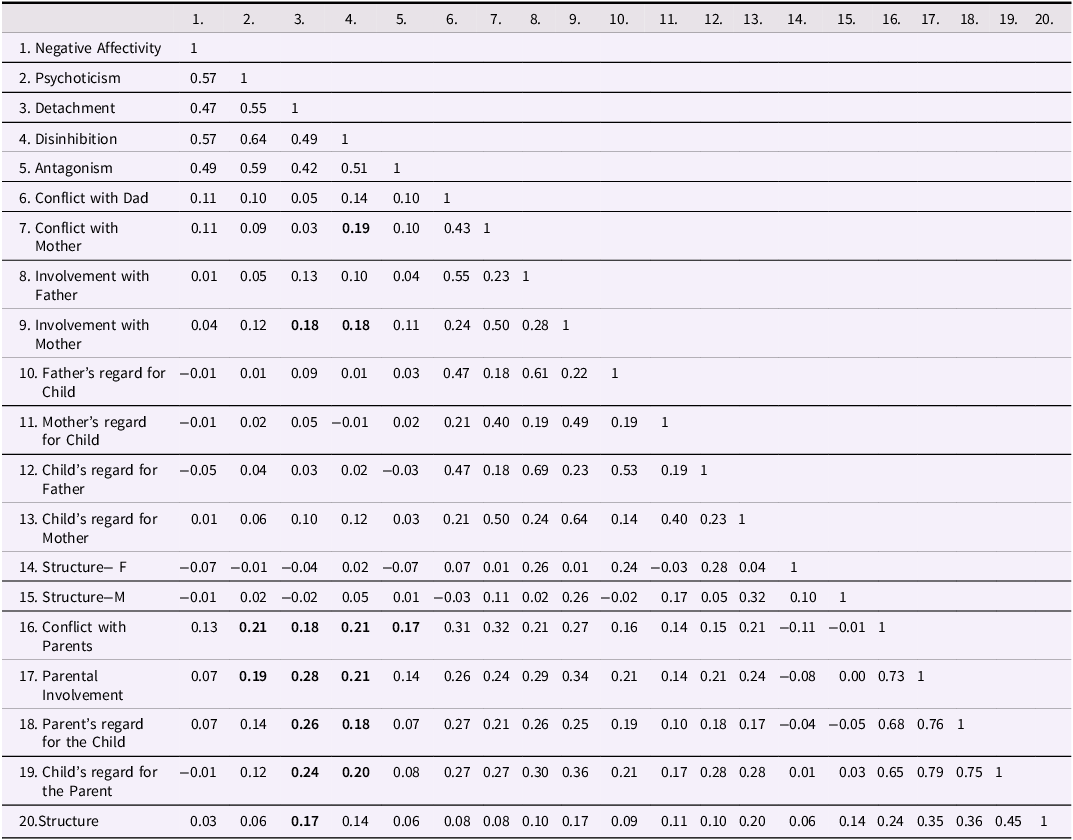
Table 2 reports zero-order correlations between constructs, and Table S1 shows descriptive statistics. Notably, parent perceptions of parenting and adolescent perceptions of parenting are not highly correlated. This is to be expected and has been previously noted in the literature (Tein et al., Reference Tein, Roosa and Michaels1994). Further, Conflict with Parent was associated above r = 0.15 with four PID-5 domains (i.e., every domain except Negative Affectivity). Parental Involvement was associated with Detachment, Psychoticism, and Disinhibition greater than the p = 0.15 threshold. The Parent’s regard for the Child and the Child’s regard for the Parents demonstrated relationships with Detachment and Disinhibition. Parental structure was also associated with Detachment above the r = 0.15 threshold. Regarding parent reported parenting, three domains were above the r = 0.15 threshold: Conflict with Mother and Disinhibition, Maternal Involvement and Detachment, and Maternal Involvement and Disinhibition. Table S2 depicts intraclass correlations. MZ and DZ twins largely have similar strength correlations for the PEQ variables which is likely suggestive of a smaller genetic component as compared to the PID-5 domains.
Zero−order phenotypic correlations

Note. Correlations were conducted on residuals in which Age and Sex effects were regressed out. Parenting domains with the word “Mother” for “M” were reported by mothers. Domains with “Father” or “F” were reported by fathers. Domains with “Parent” or “Parental” were reported by the adolescents. Bolded values are above the r = 0.15 threshold.
Univariate models
PID-5
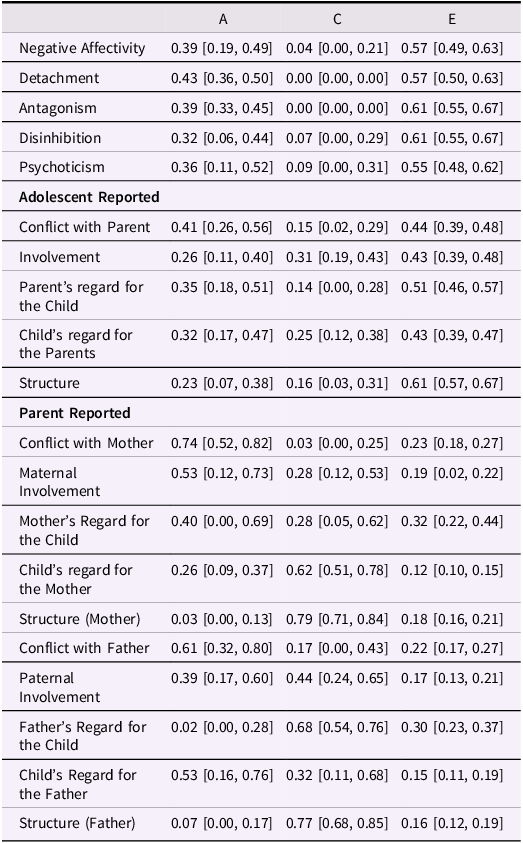
Table S3 and Table 3 contain univariate estimates and proportions of variance for all variables, respectively. Largely, the variance for the personality domains is decomposed into additive genetic factors (A), accounting for 32%–40% of the variance for the domains and nonshared environmental factors (E) ranging from 55% to 61% of the variance for domains. Most of the PID-5 domains have shared environment components that are zero or have confidence intervals that contain zero. Upon doing model comparisons, the PID-5 domains examined were typically best fit to an AE model. Table S4 in the supplemental material contains fit criteria for univariate models.
ACE proportion of variance from univariate models

Note. A = additive genetics; C = shared environment; E = nonshared environment. A,C,and E represent a proportions of each phenotype’s variance and can be thought of as percentages. 95% CI are given in brackets. Parenting domains with the word “Mother” were reported by mothers. Domains with “Father” were reported by fathers. Domains with “Parent” or “Parental” were reported by the adolescents.
PEQ
See Table S3 for ACE estimates and Table 3 for proportions of variance. Table S4 displays fit statistics for both adolescent and parent reported domains.
Adolescent reported
A full ACE model was typically the best fit for the adolescent reported domains. However, Conflict with Parents, Parental Structure, and Parents’ Regard for the Child were better fit to an AE model. Since the fit parameters were close between the two models and past research supports inclusion of the shared environment in perceived parenting domains, the full ACE models were retained.
Parent reported
A full ACE model was also the best fit for the majority of the parent reported domains. Only two variables, Conflict with Mother and Conflict with Father, had fit indices that suggested an AE model was the best fit. Again, ACE models were retained due to the small differences in fit and support for the shared environment in past research.
Bivariate ACE cholesky models
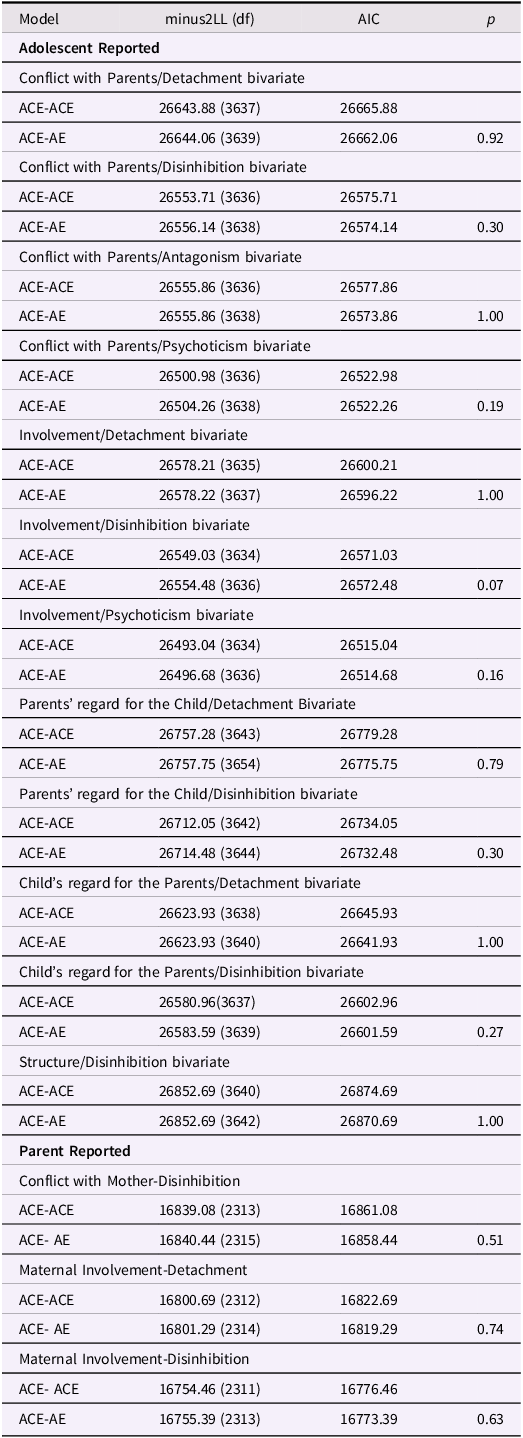
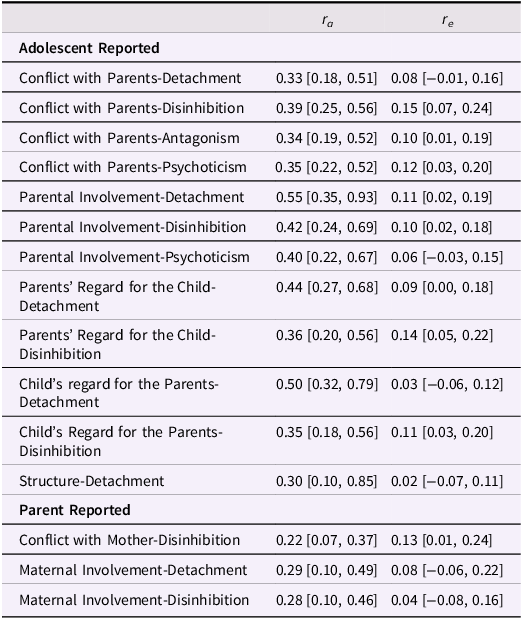
Bivariate ACE models were conducted for associations between PEQ and PID-5 variables of r = 0.15 or greater. When comparing between ACE-ACE models and ACE-AE models in which the C cross path is eliminated, the ACE-AE models were always a better fit (see Table 4). The results of the ACE-AE models are described below and are also presented in Table 5 in the form of genetic and environmental correlations.
Model fit for bivariate models

Note. Two fit indices, AIC and minus2LL, are presented. The p value represents if the ACE-ACE model is a better fit than the ACE-AE model. A significant p value would indicate to retain the ACE-ACE model. Parenting domains with the word “Mother” were reported by mothers. Domains with “Father” were reported by fathers. Domains with “Parent” or “Parental” were reported by the adolescents.
Genetic and environmental correlations for ACE−AE model

Note. r a = genetic correlation. r e = environmental correlation. 95% confidence intervals are given in brackets. Parenting domains with the word “Mother” were reported by mothers. Domains with “Father” were reported by fathers. Domains with “Parent” or “Parental” were reported by the adolescents.
Negative Affectivity
Negative Affectivity was not correlated with any parenting (adolescent or parent reported) domains above the r = 0.15 threshold.
Detachment
Five ACE-AE models were fit to various domains of both adolescent and parent reported perceived parenting and detachment.
Adolescent reported
The four ACE-AE models that included adolescent reported perceptions of parenting (i.e., Conflict with Parents and Detachment, Parental Involvement and Detachment, Parents’ regard for the Child and Detachment, Child’s regard for the Parents and Detachment) demonstrated additive genetic overlap between phenotypes. Further, two of the models (i.e., Parental Involvement and Detachment and Parents’ regard for the Child and Detachment) also demonstrated significant nonshared environmental overlap.
Parent reported
The ACE-AE model for Maternal Involvement and Detachment demonstrated only additive genetic overlap between the two phenotypes.
Disinhibition
Six ACE-AE models were analyzed between perceived parenting (both adolescent and parent reported) and disinhibition.
Adolescent reported
All four ACE-AE models that included adolescent reported perceptions of parenting (i.e., Conflict with Parents and Disinhibition, Parental Involvement and Disinhibition, Parents’ regard for the Child and Disinhibition, the Child’s regard for the Parents and Disinhibition) demonstrated the importance of both additive genetic effects and nonshared environmental effects in explaining the relationship between the phenotypes.
Parent reported
For the models using parent reported perceptions of parenting, Conflict with Mother and Disinhibition demonstrated the importance of both additive genetic effects and nonshared environmental effects in explaining the relationship between the phenotypes. Maternal Involvement and Disinhibition only demonstrated additive genetic effects.
Antagonism
Only one ACE-AE model was estimated containing Antagonism and an adolescent reported domain of perceived parenting. Conflict with Parents and Antagonism demonstrated both additive genetic and nonshared environmental overlap.
Psychoticism
Two ACE-AE models including Psychoticism were evaluated: (1) Conflict with Parents (adolescent reported) and Psychoticism and (2) Parental Involvement (adolescent reported) and Psychoticism. For Parental Involvement and Psychoticism, only additive genetic effects emerged as demonstrating overlap between the phenotypes. However, for Conflict with Parents and Psychoticism both additive genetic effects and nonshared environmental effects accounted for the relationship between the phenotypes.
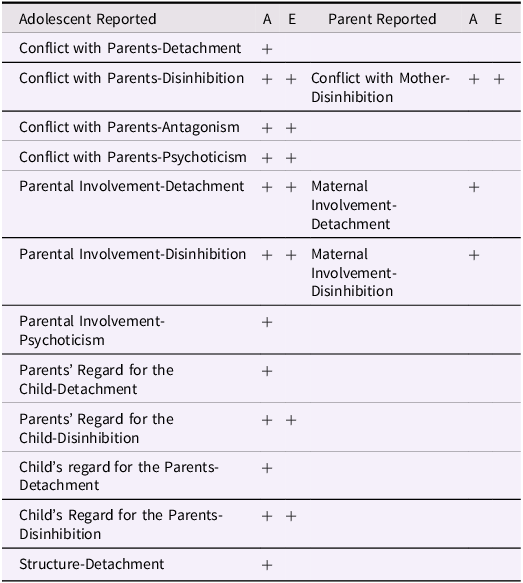
Table 6 displays a summary of bivariate findings and demonstrates associations that replicated across reporters.
Summary table of bivariate cholesky results

Note. + indicates a significant finding in the bivariate cross paths.
Discussion
The present study investigated how perceptions of parenting reported by both adolescents and their parents related to maladaptive personality traits in adulthood, and if genetic and/or environmental factors accounted for these associations. This study makes use of a large longitudinal twin sample in which perceptions of parental relationships were reported in adolescence via adolescent and parent reports and maladaptive traits were measured in adulthood which circumvents bias that could arise during retrospective reporting.
Univariate modeling of the PID-5 domains is consistent with past research (Wright et al., Reference Wright, Pahlen and Krueger2017). Largely, univariate modeling indicates that maladaptive personality traits are accounted for by additive genetic effects and nonshared environment effects. The shared environment was not found to contribute to the etiology of the domains. Regarding parenting, aspects of the parent-child relationship, in particular Conflict with Parent, Parental Involvement, Child’s regard for the Parent, and Structure, were found to contain additive genetic, shared environmental, and nonshared environment effects, consistent with the literature (Klahr & Burt, Reference Klahr and Burt2014; McGue et al., Reference McGue, Elkins, Walden and Iacono2005).
The ACE-AE models indicated that largely additive genetic effects and nonshared environmental effects account for the association between parenting in adolescence and maladaptive personality traits. Regarding the overlapping additive genetic variation, this finding indicates that certain pleiotropic effects are occurring meaning some of the same genetic variance is accounting for two distinguishable phenotypes (i.e., personality traits and parenting domains) across distinct developmental phases (i.e., adolescence and adulthood). Further, nonshared environment influences, which accounted for a large proportion of the variance of the parenting constructs, could be any unique experience that is impacting how the child perceives their parenting, such as a child experiencing chronic illness or being influenced by an antisocial peer group. Further, the parent reported findings support that for some associations, such as the association between Conflict with Parents and Disinhibition, the additive genetic effect is confirmed from the parents’ perspective as well. Taken together, these findings indicate that aspects of reported parenting in adolescence and adulthood maladaptive traits may be developmentally specific manifestations of the same underlying genetic and nonshared environmental variation, confirmed by both adolescent reports and parent reports.
Differences in the associations across perceived parenting dimensions can also be compared. Phenotypic associations demonstrated that Conflict with Parents was related to all but one (i.e., negative affectivity) of the overarching personality domains studied. Of the parenting domains, Conflict and (low) Involvement were most highly related to maladaptive personality in adulthood. In fact, these two domains were the only ones in which parental perceptions were significantly related to adulthood maladaptive traits. This suggests that there may be pleiotropy between perceptions of conflict and involvement in the parent-adolescent relationship and adulthood maladaptive personality traits. These findings expand on the literature in which conflict in the parent-child relationship has been related to psychopathology outcomes and aspects of warmth in the relationship, such as involvement, have been related to better outcomes (Zhang et al., Reference Zhang, Buchanan, Piehler, Gunlicks-Stoessel and Bloomquist2022; Xu & Zheng, Reference Xu and Zheng2023). The present study provides evidence that that these effects last into adulthood and that a degree of shared additive genetic overlap accounts for part of these associations.
Specific personality dimensions also emerged as more related to perceptions of parenting. In particular, Detachment and Disinhibition elicited the strongest associations with majority of the parenting constructs studied. This finding is consistent with the developmental literature in which parenting has been associated with childhood traits such as impulsivity and social inhibition, both of which are related to the personality dimensions studied within this study (Maccoby et al., Reference Maccoby, Snow and Jacklin1984; Webster-Stratton & Eyberg, Reference Webster-Stratton and Eyberg1982). Thus, this study extends the literature in finding that perceived parenting in adolescence is associated with these traits in adulthood. Further, all bivariate biometric models for Disinhibition demonstrated overlap in not only additive genetic effects, but also nonshared environmental effects suggesting that a multitude of factors contributing to the adolescent’s unique environment contribute to both the parenting perceptions in adolescence and Disinhibition in adulthood.
Regarding associations with parent reporters compared to adolescent reporters, at the phenotypic level much fewer parent reported domains were associated with adult maladaptive personality. Notably, of the parent reported domains that did emerge, only mother reported domains were significantly related to the child’s adult personality. At the etiological level, bivariate models that included parent reported parenting (i.e., Conflict with Mother and Involvement with Mother) demonstrated less evidence of the influence of the nonshared environment. Overall, adolescent perceptions of parenting were more often associated with adulthood maladaptive traits and more consistently evidenced effects of both additive genetics and the nonshared environment. This finding is likely in large part since both the adolescent reports of parenting and personality variables are reported by the same informant. However, this finding could also partly demonstrate how adolescent perceptions of parenting may differ from parent perceptions which could result in differences in nonshared environmental overlap between adolescent and parent reporters.
Etiological overlap in additive genetic effects and nonshared environmental effects between adult maladaptive traits and adolescent reported parenting could have important implications for avenues of prevention and early intervention. For example, intervention on the parent-child relationship in adolescence, particularly those characterized by high conflict or low involvement, may be beneficial. Although parenting received in adolescence is not the sole determinant of adulthood maladaptive personality, perceptions of parenting (from both adolescents and parents) do share genetic and, to a lesser degree, nonshared environmental overlap. Thus, an intervention that increases warmth and reduces conflict may impact perceptions of parenting which could potentially have downstream effects on maladaptive personality in adulthood. Future research looking at gene by environment interaction or gene-environment correlation (rGE) could provide further insight into how interventions could be tailored to address these potential effects. For example, it is possible that a child’s personality in adolescence could influence strategies (evocative or active rGE) employed by parents which then further impact the development of those same personality traits.
Although this study had many strengths, there are also a few key limitations. First, the sample is largely comprised of White/non-Hispanic individuals raised in the American Midwest with mostly intact two-parent households, which means these results may not be generalizable to other populations and variance in both personality and perceived parenting may be restricted. Future research should make use of more representative samples. Second, although results indicate an overlap it does not indicate if an interaction exists between the phenotypes in which a parent’s level of personality pathology is interacting with their parenting style and in turn impacts the child. Future research should aim to look at interactions between these phenotypes. Similarly, conclusions about rGE cannot be drawn from the present study as parenting and personality were not measured at both time points. Future work should investigate the possibility of gene-environment correlation as a mechanism via which these constructs may be related. Additionally, parenting data collected was self-report from both the parents and the adolescents and was not collected via observational assessments of parent-child interactions (see, e.g., Roisman & Fraley, Reference Roisman and Fraley2006; Reference Roisman and Fraley2012). Future research should make use of observation assessments of parenting as it is considered an important complementary approach to assessing parenting. Finally, in the current study, only half of the sample had parent-reported perceptions of parenting. Thus, the sample size for the parenting report is much smaller than the adolescent reported perceptions of parenting. A larger sample size would add additional confidence in the estimates.
This study was the first, to our knowledge, to use a longitudinal behaviorally genetic informative sample to investigate how perceived parenting in adolescence, constructed from adolescent and parent reports during adolescence, predicts the development of maladaptive personality traits in adulthood. We found that aspects of parenting were associated with maladaptive traits and that these associations are accounted for by an overlap in additive genetic effects between the phenotypes, as well as nonshared environmental effects suggesting common etiological factors driving these associations.
Supplementary material
The supplementary material for this article can be found at https://doi.org/10.1017/S0954579424001329.
Acknowledgments
This paper is derived from part of the first author’s doctoral thesis.
Funding statement
KAH received support from T32DA050560. The data used were collected at the University of Minnesota. Grants supporting the data collection come from the National Institutes of Health R37DA005147-30, R01DA036216, R01DA042755, and R01DA054087.
Competing interests
RFK is a coauthor of the PID-5 and provides consulting services to aid users of the PID-5 in the interpretation of test scores. PID-5 is the intellectual property of the American Psychiatric Association, and he does not receive royalties or any other compensation from publication or administration of inventory.