Introduction
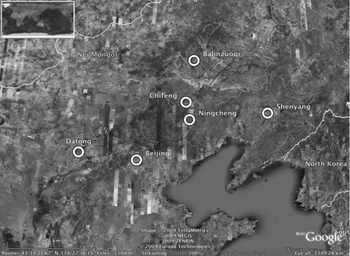
It has been a basic premise of museum studies that the Enlightenment invention of the museum was an integral aspect of the projects of modernity and nation buildingFootnote 1 and that, in consequence, present-day museums continue to be about national identity.Footnote 2 And it is true that at the level of national museums, institutions in places as far apart as Scotland and Korea reflect anxieties about national identity and accordingly try to impose or direct it.Footnote 3 Regional and local museums, however, can demonstrate bolder approaches to similar problems, encouraging their audiences to draw their own conclusions, as in Spain.Footnote 4 Regional and local museums can—and often do—support the goals of national museums, but sometimes their agendas differ because of an increased focus on local issues at a local level. Such divergences may create tensions between institutions at the two levels. Sometimes this is as simple as not inserting the local narrative into the national one, leaving the visitor with an impression that the local is untethered to the broader national story. But in other cases, particularly in the People's Republic of China (hereafter PRC), a convergence of conditions has created an environment in which subnational entities vie for economic and political supremacy over their other regional competitors through claims to be the ‘most Chinese’. Such claims are made by means of historical and archaeological evidence that ‘proves’ the claimants to be the origin point or earliest example of traits thought to be characteristic of the Chinese nation.Footnote 5 A major venue for the display and playing out of these claims is in provincial and local museums. However, at museums that cover locations or periods for which there is no ready association with historical ‘Chinese’ characteristics, new narratives are being written. These new interpretations can downplay the marginality of the location or period in the national narrative and instead emphasize other locations or periods that better exemplify the region's historical claims to belonging to the nation. When this option is not available, many museums in this situation are now boldly inserting themselves into newer narratives of the nation which are attempting to integrate these traditionally ‘non-Chinese’ locations, people, and periods into a new national narrative that emphasizes the multicultural, multiethnic composition of the PRC.Footnote 6 Here we examine the range of possible interpretations that can be observed in the provincial and city museums in the north and northeast of the PRC (see Figure 1 below), using their portrayal of the Liao dynasty (907–1125) to compare the museums’ role in the national project as seen in 1982–1996 and 2007–2009.
Locations of the museums discussed in this paper in the northeastern PRC. Source: GoogleEarth/Naomi Standen.

The choice of the Liao follows from our research interests, as we are currently engaged on a joint project that uses regional archaeological survey to investigate political, social, and economic arrangements in the Chifeng region, in which the Liao period forms an important part. The museums we consider here are also in or close to the five Liao capitals: the Supreme Capital (Shangjing) was at Balinzuoqi in Inner Mongolia and the Central Capital (Zhongjing) was in the environs of what is now Chifeng City, the Southern Capital (Nanjing) was at Beijing, the Western Capital (Xijing) was at Datong in Shanxi, and the Eastern Capital (Dongjing) was close to Shenyang at Liaoyang in Liaoning (where the museum was closed during 2007–2009). The Liao period was the first time these places had become imperial capitals and, in fact, for all but Beijing, the only time. For most of these cities the Liao represents the one moment at which imperial glory can be claimed for the local area. We were intrigued to observe how local uses of that singular opportunity had evolved from the early reform era of Deng Xiaoping, when little had yet changed in terms of cultural policy and orthodox interpretations of the PRC's history, to the ‘new China’ of the late 2000s, with its competing pulls of politics and economics, regulation and autonomy, orthodox national interpretations and local variations.
China background: politics and museums
The history of museums in the PRC parallels that of the West: ownership and appreciation of cultural objects were long the purview of the social elite, who, following a long-established tradition of connoisseurship, collected art and other objects of cultural importance for their private family collections. China's first public museums were natural history museums opened in Shanghai by the French Jesuits in 1868 and the Royal Asiatic Society in 1874, with the same civilizing missions as European museums of the time.Footnote 7 After the fall of the Qing dynasty in 1911, the necessity of deciding what to do with imperial possessions and property fell to the Republic, which sparked new possibilities for state-run museums in China. The Beijing Palace Museum, established in 1925 inside the Forbidden City, is one result.Footnote 8 With the 1949 Communist victory over the Nationalists in the civil war, state ownership of cultural properties expanded by means of confiscation or involuntary donations from previously private collections.Footnote 9 These new state-organized museums had specific responsibilities from 1950 to the late 1980s: historical sites such as the Forbidden City were intended to educate the public about the evils of the feudal past, and archaeological site museums such as the Neolithic Banpo site were intended to illuminate the correctness of Marxist unilineal social evolutionary theory as well as to highlight the achievements of the ancient proletariat. More conventional museums, in dedicated buildings, were there to do both, and all were to educate the public in the legitimacy of Communist Party rule. Such detailed requirements provided indications of overall cultural policy, even when it was not explicitly stated.Footnote 10
Throughout this period, contradictions between the ideological pulls of revolution—the view that historical time did not really begin until the Communist Party took over—and nationalism, with its claims to the timeless existence of a Chinese-people-in-waiting, were present in many museum exhibitions. Objects exemplifying China's undeniable past cultural achievements were used to denounce its feudal era, but were also used as examples of the greatness to which a future PRC could return under Communist rule. This duality sometimes produced confusion for foreign observers, who were perhaps less inured to these contradictions than Chinese visitors, who, in any case, rarely attended museums. While the new museums of the new China may have amazed visitors in their first couple of decades of existence, by the 1980s general audiences, if they went to museums at all, often did so on educational outings sponsored by their work units. Most workers, however, sought to enjoy these outings for what they were—officially sanctioned holidays—rather than concentrate on the educational opportunities that the visit might provide.Footnote 11 Visiting museums was not discouraged, but due to the price of tickets, frequent unannounced closures, the puritanical approach that museums took to their educational goals, and the possible political dangers inherent in taking too much interest in the feudal past, they were not often chosen as places to spend free time.
Starting with Deng Xiaoping's economic reforms of the late 1980s, partial freedom was given to the provinces to determine their affairs in accordance with local concerns. The opportunities this gave for the expression of regional identities may be traced in, among other things, the rising publication of regional histories aimed at a popular market. These now typically align themselves with state-sanctioned narratives in their introductions and conclusions, while offering a more nuanced and undogmatic approach in the main text.Footnote 12 Museums also benefited from this loosening of control. Most still belonged to the provincial- and city-level governments, and these museums began to be able to shape their missions around the central concern of portraying the regional past. More localized control has also allowed museums to retain possession of their best archaeological and historical treasures, instead of often having to surrender them to museums at higher administrative levels.
In the late 1990s and early 2000s several new phenomena began to impact on museums. Communism as a ruling ideology lost much of its legitimacy after the 1989 Tiananmen killings, and has been largely replaced by nationalism and capitalism. The Chinese Communist Party institutionalized nationalism as a unifying ideology through the Patriotic Education campaign, which started in 1991.Footnote 13 This affected the dominant historical narrative taught in schools and presented in public education venues such as museums. Until 1991, this narrative accentuated the achievements of the Communist Party by giving it the credit for the PRC's attainment of liberation and a classless society through constant class struggle. These were the ‘victor’ and ‘class struggle’ narratives. The new Patriotic Education programme, taught to every student in every grade for the last 20 years, discards these narratives of Communist Party achievements and focuses instead on the ill-treatment and resultant suffering that China experienced from the Western powers and Japan in the century before 1949. As Wang points out, this ‘victimization’ narrative relocates the cause of China's troubles to external sources.Footnote 14
The efficacy of using antiquities and historical sites to promote the new patriotic education goals was quickly realized in a 1991 directive from the Communist Party Central Propaganda DepartmentFootnote 15 and 100 museums and historical sites were established by the central government as model ‘Patriotic Education Bases’. Following this central lead, provinces, cities, and counties rapidly followed suit and established local Patriotic Education Bases, many of which are also museums. Wang estimated that in 2008 there were more than 10,000 of these institutions around the country, intended to complement the patriotic education received in schools. Where this component has been added to museums, some interpretations have changed, but at many museums the result has been an exhibition room devoted to hagiographical displays of actors and events in local history, which are then tied into the national communist story. Perhaps the most interesting aspect of these exhibitions for the foreign observer is that they are commonly the only exhibition rooms that do not offer English translation.
In addition to the institutionalization of nationalism, China's economic development and capitalist reforms have had just as many implications for museums. Rising wealth has created a segment of the population with enough money to pursue antiquities collecting and connoisseurship as a serious pastime. Furthermore, some of these collectors regard this hobby as fulfilling a patriotic duty to guard China's heritage from loss to collectors abroad.Footnote 16 Books and other media covering all facets of antiquities collecting are popular, and dedicated organizations meet to discuss their objects and hold exhibitions. An unfortunate and unrecognized consequence of this hobby's popularity is the need to provide objects for collectors, which has driven a phenomenal increase in the looting of archaeological sites, an upsurge in theft from both domestic and international museums, and a thriving industry in fakes. The collection of looted antiquities by ‘patriotic protectors of the past’ has destroyed uncounted archaeological sites, and may be nearly the equal of unmonitored land development in its destruction of China's cultural heritage.
Museums have also been affected by the rise of a middle class, which has demanded more cultural venues where they and their children can enjoy their leisure. In response, the State Administration of Cultural Heritage issued a directive in 2002 to create more museums, and an additional directive in 2008 to abolish entrance fees for state-supported museums.Footnote 17 A significant number of new institutions have been built and filled by counties and towns that previously did not have their own museums, and collectors have also opened private museums, although the motives behind these openings might differ from those of the central government.
Economic development has brought an astonishingly rapid development of domestic tourism. That this happened at the same time as the creation of new museums has been beneficial to both. The expanding middle class seeks new sights and new experiences, and disposable income is willingly expended in this quest. Travel operators regularly include museums and historical sites on itineraries, tour groups led by banner-carrying guides are common sights at museums, and some institutions have had to control the crowds with entrance quotas or a requirement to reserve tickets in advance.Footnote 18
Open-air archaeology and historical-site museums are as important to public education in China, past and present, as brick and mortar museums. Archaeology has been used to provide material evidence to support the transmitted historical texts that bolstered the idea of China's unilineal development, as well as supplying outstanding examples of China's past glory.Footnote 19 In 1961 the National Cultural Relics Bureau devised and implemented a system to rank archaeologically recovered sites and artefacts. Sites deemed of the greatest importance were designated national-level protection units, while artefacts of the highest significance were sent to the National History Museum in Beijing. Sites of lesser importance were classed as provincial-level protection units, and artefacts at this level were sent to the provincial museums. Some sites also have city- and county-level protection status, but most sites have no protection status at all. Exceptional artefacts from these sites might have been selected to be exhibited at their local museum, often alongside plaster casts or photographs of those sent off to higher level museums. Protection rankings are still given to archaeological and historical sites, but growing independence from the centre, along with tourism and its economic rewards, mean that most local governments now jealously refuse to send any artefacts to the higher level cultural-administration units. However, local governments are amenable to artefacts being included in travelling exhibitions, for a fee. Different administrative rankings also affect the degree of latitude that museums have to incorporate particular narratives into their interpretation. Those below the provincial level often appear freer to interpret their materials without the patriotic educational overlays found in provincial museums.
Museums goals, displays, and changing interpretations of the past
Education was, and still is, one of the prime roles of Chinese museums. While most seek to enlighten their audiences about the historical development of a local or provincial region, this is often realized through a combination of approaches that blur traditional functional distinctions found in Western museums. Historical, artistic, and environmental displays are all commonly located in one institution to provide an encyclopedic treatment.
Since the Deng Xiaoping era, many regional museums have attempted to insert their local historical trajectory into that of the greater nation of China. This is simple in areas where their inclusion in the national history is unproblematic, such as Henan or Shaanxi, but it is more difficult in regions outside the Central Plains region of the Yellow River valley. This was because up until the mid-1980s, the Central Plains developmental sequence was the normative chronological model for China's development, and it was imposed upon all regions of the PRC. This model proposes a core-periphery relationship in which cultural development, or ‘civilization’ in Chinese terms,Footnote 20 gradually radiated outwards from the Central Plains to the less developed outlying areas. The distance from the core region, along with the time that it took ‘civilization’ to spread, was supposed to have explained the ‘less developed’ nature of these societies.Footnote 21 Understandings from historical texts which originated in the Central Plains formed the basis for this model, and helps to explain its emphasis. However, it was also politically convenient to posit origins for a unified historical China which mirrored the modern nation-state that the Communist Party was trying to establish, and this may be seen as one way of trying to resolve the tension between ‘revolutionary time’ starting in 1949 and ‘national time’ starting as far back as possible.
The difficulties that this model created in understandings of local developmental trajectories have only recently been recognized. Even though regional archaeological discoveries since the mid-1980s indicate that what we call China—or, perhaps more specifically, Chinese culture—was clearly the product of interaction between different regions, using local terminology to label local developments has not yet been uniformly adopted. Central Plains terminology is still used in most museum displays, catalogues, and reference works. For instance, in the Inner Mongolia cultural-relics atlas, which provides maps of known archaeological and historical sites, those belonging to the Liao period are subsumed under the category labelled ‘Song-Yuan’.Footnote 22 While Yuan (1260–1368) makes sense in terms of the region having been part of the Mongol empire, the Song (960–1276) never controlled Inner Mongolia. Central Plains categories were reified for all of China, even when they were not appropriate.
Such issues become most important when considering those peoples designated by the Chinese state as minorities, a category also applied to historical groups that no longer exist, such as the Kitans who provided the leaders of the Liao dynasty. Museums, as so often elsewhere, were directed towards naturalizing the nation-state by demonstrating—or helping to create—a continuous and ancient past for it. Since the PRC extends over large areas without indigenous Han Chinese populations, ‘minorities’ had to be incorporated into the antique origins of the nation-state, while at the same time preserving its ethnic Han Chinese character. The solution has been to permit historical ‘minorities’ a limited agency which allowed them to make local contributions to the dominant Han Chinese culture, always conceived of here as the senior partner, graciously receiving small modifications while generously bestowing ‘advanced’ technological, cultural or moral advances on its implicitly backward beneficiaries. For instance, general understandings of the Han dynasty's commanderies include their bringing Chinese civilization to the northeast of China and to the northern Korean peninsula, without the Han-dynasty culture that they represent being changed through contact with local cultures.Footnote 23 Work on the later historical periods, like the Liao, has treated archaeology as a supplement to historical work, but the time may soon come when material culture will not just complement but challenge interpretations drawn from written sources.
This paper considers how some of these issues play out in museums visited by the authors for the first time between 1982 and 1996 and again between 2007 and 2009, with reference to their portrayal of the Liao dynasty. Our early visits were as interested observers or students still in the early stages of our training, and our later visits were made after we had become academics. This meant that the degree of our background knowledge differed between visits, and in the later period our interests were more focused on particular issues. The paper is based on what we observed as visitors in each period, with a greater emphasis on the effects and possible readings of the displays than on the intent that might be divined to lie behind them. Without introductions it was not possible to enquire into curatorial methods or debates; in any case, these exhibitions are all designed by committee and have to go through several levels of vetting. Interviews with a nominal curator would have been likely to produce little more than an official line of little analytical value. A ‘close reading’ approach therefore suited our purposes and acknowledged the practicalities of the situation. We were able to make extensive photographic records of our later visits since photography (without flash) is now usually allowed in exhibitions, and digital cameras can produce usable images even when relying on available light. In the early period, however, photography inside museums was almost always completely banned, and even where it was possible, low light levels and the limits and cost of film technology made it extremely hard to obtain a usable record.
The Liao dynasty
The Liao empire is problematic for China's national project. It was the dominant power of its day and the strongest successor to the great Tang dynasty (618–907). It controlled people who inhabited a large territory, including parts of Mongolia and Korea, and within the borders of the PRC it ranged across Inner Mongolia and Manchuria, and south to the region around Beijing and Datong (in Shanxi). Although it coexisted with a series of short-lived regimes in the Yellow River basin and North China—the Five Dynasties (907–960)—and then the larger and longer-lasting Song (960–1276), the Liao was at first unrivalled and subsequently never less than the equal of these neighbours. The empire developed administrative structures to cope with multicultural populations whose modes of economic organization included both pastoralism and agriculture, and it became a leading Buddhist society of the region. The Liao was led by a non-Han group, the intermarried ruling clans of the Kitan and their allies. That these ‘barbarians’ ruled a population over half of whom were Han Chinese exacerbated the frustration of the Song—the Liao's greatest rival—at their inability to recover the Beijing-Datong region ‘within the passes’ that Song elites believed was rightfully theirs.Footnote 24
Orthodox Chinese historiography, both past and present, traces the line of legitimate dynastic succession from the Tang through the Five Dynasties to the Song, omitting the Liao. However, it has an official history and is a predecessor of the Yuan dynasty, which united not only China proper but also made China the dominant unit of the Mongol world empire. Consequently, the Liao has been shoehorned into the list of China's dynasties, although very much in a marginal position. There is, for example, no consensus as to when the Liao empire began. Some choose 907, when the official Liao shi (Liao History) states that the founder, Abaoji, held a ceremony to accept an imperial title.Footnote 25 There are problems with this dateFootnote 26 and so many choose 916, when Abaoji apparently accepted an augmented title and declared a reign era,Footnote 27 implying imperial status. Still others prefer 936 or 938, when Abaoji's successor received control of the ‘Sixteen Prefectures’ and their administrative systems from the Later Jin (936–947) regime to the south, but still others delay full recognition until 947, when major reorganization (following the brief conquest of Later Jin) resulted in a mature administrative system. The later dates tend to be associated with interpretations that minimize the Liao's role in and impact on China's history, while views granting more historical agency and significance to the Kitan and their dynasty generally use the earlier dates. Before the early tenth century, most of the Inner Mongolian and Manchurian parts of the Liao empire had not previously come under centralized imperial rule, and the Kitan, as a people with their own ethnonym, disappeared from recorded history by around 1400.
Apart from the Liao official history, there are few other written records. Twentieth-century historians scarcely acknowledged the Liao,Footnote 28 but archaeologists have worked at urban sites, including the two Liao capitals in Inner Mongolia, where dozens of Liao tombs have been excavated, as well as in Liaoning, Shanxi, Hebei, and the Beijing region. Reports highlight finds such as wooden coffins, wall paintings, glazed ceramics, and finely crafted metalwork in gold and silver, along with distinctive Liao artefacts such as ceramic vessels with ‘cockscomb’ handles or phoenix heads on their necks. Such material has been displayed in museums across the former Liao territories, including in Beijing, and more recently has become the subject of international exhibitions such as that held in 2006 at the Asia Society in New York and in 2010 at the National Palace Museum in Taipei.
It was not easy to fit the Liao into the ‘legitimate’ historical narratives sponsored by the Chinese Communist Party. The whole Middle Period (c. 750–1400) proved a difficult time to absorb into the standard national narrative of a superior Han Chinese civilization which spread its beneficence outwards from the Yellow River valley and held back the barbarian hordes.Footnote 29 The Five Dynasties and Song carry the orthodox line of legitimate Chinese imperial rule, but they were widely regarded as weak—and even embarrassing—for their inability to fulfil their basic nationalist duties of defence, first against the Kitan founders of the Liao, then the Jurchen (who established the Jin dynasty, 1115–1234), and ultimately the Mongols (Yuan dynasty, 1260–1368). The Five Dynasties handed over the Beijing-Datong region to the Liao (938), the Jin took over the northern third of the Song dynasty down to the River Huai (1126), and the Mongols conquered and overthrew the southern Song and their lands down to the south coast (1276). Such a powerful and long-lasting riposte to the official line was met largely with silence.Footnote 30 Historical discussions of the Song period before the Cultural Revolution were notable chiefly for their absence, and if this was true of the legitimate Han Chinese dynasty, it was even more so for its pastoralist enemies.Footnote 31
These subjects only began to be broached again in the People's Republic of China from the late 1970s, when the official line incorporated the contributions of non-Han Chinese into the national narrative by declaring that all ‘minorities’ past and present had been part of China's history from the start.Footnote 32 This included the Kitan, but it was hard for Chinese historians to see them as anything but a ‘barbarian’ threat to the Song, which meant that they could not simultaneously be part of China.Footnote 33 The solution was the idea of ‘ethnic integration’ (minzu ronghe, usually translated in China as ‘national integration’, which is somewhat confusing in English). This allowed that the minorities had contributed to the overall development of Chinese civilization which, being more advanced, provided models and encouragement to help lift its non-Chinese neighbours to the same higher level. The classic statement was Bai Shouyi's general history published in 1989–1999, and this view found specific expression regarding the Liao and Song in a number of articles published in the 1980s, which essentially argued for the sinicization of the Kitan.Footnote 34 Chinese historians’ interest in the Liao died off again during the 1990s, while archaeologists were busy excavating and publishing marvellous Liao finds, chiefly from tombs. When historical attention returned to the Liao in the 2000s, the range of topics covered was much more diverse. Although there appears to have been a general revival or continuation of the minzu ronghe approach, this is now only one topic among many, and in Liao studies forms only a tiny proportion of published works.Footnote 35
Liao displays 1982–1996
In the post-liberation period up until administrative reorganization in the late 1980s, regional museums came under the administration of the provincial or city cultural affairs bureaus, as they still do today. Provincial-level museums such as Liaoning’s, and most city-level museums, were responsible for research, conservation, display and preservation of the objects in their collections as well as for education about them. Most of these objects were purchased or appropriated from collectors, or reverted to the museum for safe-keeping from former ‘feudal’ contexts such as temples, rich landowners’ estates, or even, in the case of Liaoning, royal palaces. Such materials are mostly without provenance. These more traditional museums exist alongside other institutions responsible for the recovery and researching of objects whose provenance is known from below-ground archaeological excavation. These are generally provincial-level cultural relics and archaeology research institutes and select provincial universities with archaeological training programmes. In smaller, more rural districts, many of these functions were the responsibility of the local museum or even the library. These work units were responsible for collecting and managing the cultural resources in their areas and often also had limited rights to conduct emergency salvage excavations when buried objects or buildings were uncovered during construction work. In the 1990s, additional reorganization strictly limited the right to initiate archaeological excavation to the provincial cultural relics and archaeology institutes, a few specified city institutes such as Shanghai, Chengdu or Beijing, or to the universities that had archaeology departments. However, the local units were still essential to investigations led by these higher-level institutions.Footnote 36
The lack of trained personnel in museology became apparent at this time, with exhibitions at many museums taking the ‘curiosity cabinet’ approach to display: jumbled, unrelated objects were placed together in cases with little or no interpretation, although the overall organization of rooms and displays within museums tended to adhere to both revolutionary and national narratives, as noted above. While some sites of national importance, such as the Mogao Grottos at Dunhuang, were quite early to invite foreign specialists, such as the Getty Conservation Institute, to collaborate (1990–1995), most museums were only able to rely on home-trained personnel.
Gwen Bennett has been a frequent visitor to the Liaoning Provincial Museum in Shenyang since 1984; she also first visited the Capital Museum in Beijing (the Liao Southern Capital) in 1982, and in 1990 went to the Huayan Temple in Datong (the Liao Western Capital) in Shanxi province (see map in Figure 1). She has also been a frequent visitor to the city-level Chifeng and county-level NingchengFootnote 37 (the Liao Central Capital) museums since 1996, which was the latest of our initial visits to the museums in this study. Naomi Standen saw all of these in 1991, as well as the Inner Mongolian museums at Balinyouqi and Balinzuoqi (the Liao Supreme Capital). Our account of these museums in this period rests upon notes made at the time, pamphlets and guides, a handful of photographs, and our memories, and the analysis is accordingly briefer and less detailed than our discussions of the later period.
These regional museums were situated in old temples, historical structures or older modern buildings that had little funding for maintenance or improvement. Those occupying old temples had often been installed as a means of preserving the building by giving it a new function. At all these museums the exhibitions lacked interpretation, and exhibit labels often lacked provenance or were sometimes missing altogether. Objects were commonly identified only by artefact type and dynastic period, for which specific dates were rarely given. The text accompanying the exhibits was exclusively in Chinese, though pamphlets and postcards occasionally included some in English, Japanese or Mongolian. Cases had smudged glass, rooms were typically dusty and poorly lit, and external courtyards were resting grounds for untended stone inscriptions, figures, and architectural elements. The assembly and maintenance of exhibitions in the 1980s and 1990s reflected the lack of money in the PRC at the time, as well as years of isolation from museological developments in other parts of the world. It may not be coincidental that Eastern European museums of the same vintage, several of which Standen visited in 1983, could be described in exactly the same way.
The northeastern museums of Inner Mongolia and Liaoning reflected Chinese archaeological trends in that they emphasized the Neolithic over the historical. Liao objects were sparse even at the Supreme Capital Museum. Here, incoherent displays—comprising pottery, gaming pieces, a spindle whorl, bone carvings, dice, a comb, cast bronze pieces and figures in stone and in clay—did not provide context for understanding these objects, even to the extent of grouping together the dice and gaming pieces. Several ‘cockscomb’ pots were dated more closely, as ‘mid- to late Liao’, and two of these, along with a flower-painted plate, were from a tomb (Baiyin’aobao M1) where skeletons and wall paintings had also been found, but the significance of tomb and finds went unexplained. Placed in a revolutionary narrative, these materials were simply relics of a time before history began, and accordingly did not require considered interpretation unless they were clear evidence of feudalism and other earlier stages of history on the road to 1949.
The northeastern museums considered the Liao within the conventional chronology of Chinese history that has been co-opted for nation-building purposes throughout the PRC. In each museum Liao displays were therefore preceded by sections on each period from the prehistoric through to the ancient and medieval dynasties, thus effectively claiming the region as eternally part of China and suggesting a trajectory towards the Revolution. The Capital Museum traced Beijing's history through the same sequence, but omitted its time as the Liao Southern Capital (938–1122), mentioned only one Liao artefact in its guide, and did not give any dates for the dynasty.Footnote 38 Incorporating the Liao into the overall national story meant that the dynasty's significance as a non-Chinese historical power in northeast Asia and as an independent territorial antecedent of the northeast region within the PRC was implicitly downplayed. More explicitly, Shenyang's exhibition guide made the then-standard observation that the region's distinctive character developed from a historically multicultural mix in which the Kitan (with the Liao dated to 916) were one among many and that the Han nationality took the principal role,Footnote 39 while Balinyouqi's introductory leaflet simply claims the region as an important ancient place of origin for ‘the peoples of China’.Footnote 40 These gross generalizations, plus the combination of an effort to cover all periods with an indifference to actual dates, help to suggest that these regional museums were speaking more to a revolutionary than to a national agenda.
Unlike the sidelining of the Liao in the other museums, in Datong's Huayan temple in northern Shanxi, a region desired but never controlled by the Song dynasty, there was an exhibition of Liao art and architecture. The temple is a Liao structure within the empire's Western Capital that, despite extensive rebuilding by the Jin dynasty, retains numerous original wall paintings and Buddhist statuary in its Lower Temple. The Upper Temple contains largely Ming (1368–1644) and Qing (1644–1911) statues, frescoes, and ceilings. Instead of labels, a one-page, image-heavy, Chinese-English pamphlet focused on the Liao (dated to 907) and described the Buddhist imagery, but did not mention the Ming and entirely ignored any wider context.Footnote 41 Since neither Liao nor Jin feature in the main sequence of China's dynasties, the temple was left hanging in a temporal and political vacuum, implicitly set aside from China's ‘proper’ history. Huayan thus could not contribute to a national narrative. The glories of the temple and its importance for the study of China's architectural and artistic heritage could not be ignored, but neither did it or its full historical context fit readily into the model of backward minorities guided towards civilization by the Han. Yet the almost ahistorical representation of Huayan did fit the revolutionary narrative by providing an example of the irrelevant glories that the Revolution would replace.
Whereas the Huayan temple was characterized as an overwhelmingly Liao monument, every other museum considered here clearly expressed the Party's policies on minorities. Overall, regional museums in the north and northeast were alike in offering a largely domestic audience, whether Han or minority, a consistent presentation of a national past framed by a conventional dynastic chronology that focused on the Han majority as the leading group. At the same time, the vague chronologies, omissions, and occasional lack of context in these displays contributed to a revolutionary narrative wherein the past was a necessary precursor to 1949 but lacked importance in its own right.
Liao displays 2007–2009
In October 2007 we jointly visited all the same museums, except those at Shenyang and Balinyouqi, to which we returned in 2009. Not unexpectedly, changes in infrastructure, museum practices, and interpretation had been made at all institutions. The cultural, economic, and political factors behind these changes have been noted above. Museums in 2007–2009 and up to the present are still administratively controlled by national, provincial, and city cultural affairs bureaus but their roles are now strictly limited to exhibition, preservation, conservation, research, and education. Almost all of them were partially dependent on entrance fees for revenue, but a national directive issued in January 2008 proclaimed that all museums, memorial halls, and national patriotism education bases would offer free admission by 2009.Footnote 42 Archaeological and historical sites, such as the Forbidden City, are excluded from this ruling. Free entrance to museums was implemented to meet the public's desire for greater access to cultural activities, and the entrance fee revenue has been replaced by government funding. In theory, state financial support also frees public museums from the need to sensationalize their exhibition design and content as a way of competing for visitors with other recreational attractions, but it remains to be seen if enough funding will be made available to enable museums to retreat from this approach.
Different also is that museum staff are now trained in modern museological approaches. Many university archaeology departments offer two tracks: field archaeology and research, and museum studies. While China now has over 2,300 museums, as early as 2002 the government called for an increase to 3,000, and for all large and medium-sized cities to have museums,Footnote 43 thus providing a steady stream of jobs for the new museology graduates. International collaboration and consultation have also become more common between Chinese and foreign museums for exhibitions, research, and conservation projects.
When we made our joint visits to these museums in 2007–2009 and compared their exhibitions to those we had seen in our earliest visits, we found that they had undergone staggering changes. The Ningcheng and Datong museums had been refurbished with new cases and displays, but the others had been rehoused in gigantic new buildings. These gleaming edifices stand in the heart of their cities, with all but the Capital Museum occupying one side of a spacious plaza facing the local government offices.Footnote 44 Every exhibition is housed in clean, well-lit cases, and benefits from modern museological methods. In these museums the provenance of objects is usually stated if possible; indeed, the extensive interpretation frequently includes photographs, maps, and other information about excavations. Most labels and much interpretive text include translations into English and sometimes Japanese and Mongolian. External courtyards at some museums continue to provide storage for large stone monuments, but often some effort has been made to label them. As to interpretations, these no longer present revolutionary narratives emphasizing the role of the Chinese Communist Party, but instead reflect the rising wave of Liao excavations conducted since the 1980s and engage in complex negotiations with the current stress on nationalism.
Chifeng MuseumFootnote 45
Chifeng, China's largest city in territorial extent but a minor player in political-economic terms, is located in southeastern Inner Mongolia, for the most part north of the Great Wall. At the time of our 2009 visit the city-level Chifeng Museum was still in its old building, which stood on a civic plaza in the heart of the old city centre's commercial district.Footnote 46 It displayed archaeological and ethnographic collections formerly held by the Chifeng Library, the city's original cultural-relics administrative unit. The three-storey building was built of concrete slabs and had a skylight in the shape of a large cupola-like pagoda structure. Inside, a central atrium dominated, with a spiral staircase at one end. Balconies ringed the atrium on the second and third levels, each of which offered two exhibition rooms. The ground floor had a small gift shop at the building entrance and changing exhibitions of calligraphy and painting on its walls. Wall cases and vitrines were used throughout the second- and third-level rooms, and wall texts and labels were in both Chinese and English.
As with the other museums we examine, the curatorial choices made at the old Chifeng Museum offer a glimpse into the cultural politics involved in interpreting a region's history, and how they differ by location. Each of the four exhibition rooms emphasized one culture within its time frame—Neolithic, Bronze Age, Liao, and Mongol-Qing—displaying the most characteristic examples of artefacts collected or excavated within the large Chifeng territory. The Neolithic and Bronze Age displays on the second floor had small dioramas and models that put pottery production and artefact use into a cultural context, with the Hongshan culture (approximately 4000--2800 BCE) dominating the Neolithic room and the Lower Xiajiadian culture (approximately 2000--1600 BCE) dominating the Bronze Age room.
The Kitan-Liao exhibitions on the third level included porcelains, wooden tomb furniture, wall-mural fragments, photographs of murals and sites, ornaments, and stone tomb epitaphs. The fourth room included objects from the Yuan, Ming, and Qing periods but chiefly offered ethnographic displays of Mongolian cultural artefacts which made clear the Mongols’ ‘minority’ status and distinguished them from the Chinese. While the exhibitions were by no means comprehensive, they did provide a general overview of cultural developments in the region. However, the visitor was left with the overwhelming impression that only four cultures and periods matter in this region—the Hongshan, the Xiajiadian, the Kitan-Liao, and the Mongol. The intermediary periods were not important; they merely provided the links between the times when the Chifeng region was at one of its peaks of cultural florescence. This is no different from any of the other museums we look at, but of these four cultures, only the earliest—the Hongshan—was given any notable claim to being, or at least contributing to, ‘Chinese’ culture. The interpretation was thus rather confusing in terms of its contribution to the national story.
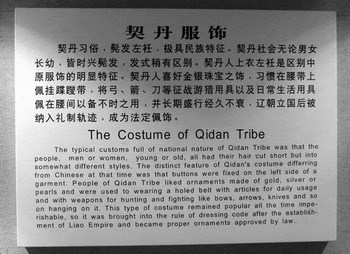
Unlike some other regional museums that situate the Kitan people and Liao empire within the official ‘minority contributions to the motherland’ category, the Kitan people and their political manifestation in the Liao empire were given a rather more autonomous history in the old Chifeng Museum. We saw this approach in the museums at lower administrative levels like Chifeng, which seem to be given more latitude in interpretation, while those at the provincial level and above more often seem to frame their holdings according to officially sanctioned interpretations. At Chifeng, an interpretation panel briefly described Kitan ethnogenesis, the political development of the empire, and its defeat by the subsequent Jin empire. The Liao founder, Abaoji, united the tribes in 907 and declared himself emperor in 916. The Kitan were located in ‘ancient North China’ but were otherwise not claimed overtly for the multicultural Chinese nation. One secondary interpretation panel described everyday utensils with reference to trade with surrounding peoples and Central Asia, but not the Central Plains, and took this as a demonstration of the power of the Kitan state. Another secondary panel described Kitan dress and hairstyles in contrast to Central Plains dress (see Figure 2), thus tacitly recognizing the Kitans as non-Chinese, while never overtly claiming such. This fell within the ethnographic approach that is often seen in the official interpretation. However, here the Kitans’ ‘exotic’, non-Chinese nature was combined with a mention of their political strength. It was also, paradoxically, placed alongside the Hongshan culture. While the Liao's identification as ‘ethnic’ could be seen to fit the standard national narrative, when combined with the Hongshan exhibition, it also contributed to providing a regional identity for Chifeng self-promotion.
Chifeng Museum: panel noting that Kitan clothing differs from Chinese clothing by fastening on the left. This trope dates back at least to the Analects of the Confucian school. Source: Naomi Standen.

The standard ethnographic approach to the Kitan, in conjunction with other holdings, served the Museum's mission to bolster Chifeng's claim to uniqueness. Chifeng officials, by siding with Liaoning Province and promoting the Hongshan culture as a civilization, had already participated in the original challenge to traditional understandings that Chinese civilization radiated out from a start in the Yellow River valley. The Liao displays did not offer a further serious challenge to orthodoxy, but neither did they emphasize the Kitan contribution to the national story.
The Central Capital Museum in Ningcheng
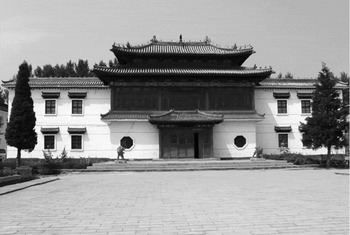
The region administered by Chifeng City contains two of the Liao capital cities—the Supreme Capital at Balinzuoqi and the Central Capital at Ningcheng. The Nincheng museum is the site museum for the Central Capital, which was founded in 1006 and also used by the subsequent Jin, Yuan, and Ming dynasties, though never again serving as a capital. The task of archaeological museums at this level is to display, preserve, conserve, research, and to use for educational purposes material from the site and nearby. The museum at Ningcheng remains in its previous Chinese-roofed, high-ceilinged structure (see Figure 3), now given a more airy feel by cleaning and better lighting. The building stands within the pounded-earth walls of the Central Capital's inner imperial city, which is now on the edge of a market village serving an agricultural countryside. The exhibition displays Bronze Age and Liao finds from excavations within the site and from the Ningcheng region, with the Liao exhibition being used as a window onto mid- to late Liao society, economy, and culture. According to an introductory panel, the Liao exhibition is divided into four sections: ‘Clues from Liao tombs’, ‘The magnificent old city’, ‘A close study of the temple’, and ‘Life in the city’, although these divisions are not marked out within the display hall and are cross-cut by freestanding and wall-mounted cases displaying a selection of Liao pottery forms. These include ox-leg bottles, cockscomb flasks, and phoenix-head jars, which are so characteristic of the dynasty that they must be included, even though they do not fit into the four-section interpretive scheme. Ceramics are the best understood materials in Chinese archaeology, and here the interpretive text offers detailed analysis, noting the continuation of the ‘turtle pot’ form from the Eastern Zhou (770–221 BCE), distinguishing ‘Central Plains’ from ‘Kitan’ forms, and listing five types of cockscomb pot. Observing the borrowing of sancai ‘three-colour’ glazed decoration from the Tang dynasty, one interpretation board emphasizes how an existing technique used on a new form produced a distinctive result. The Liao are thus given credit for creativity, but only within the context of interactions with the implicitly more advanced Chinese society of the Tang dynasty.
The Liao Central Capital Museum in Ningcheng county. The Museum is in the same building now as it was in the 1990s. Source: Naomi Standen.

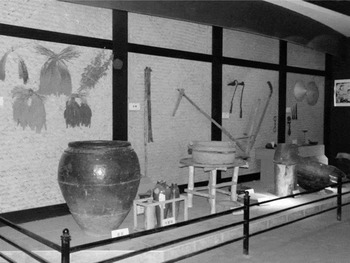
Unlike at the Chifeng Museum, at Ningcheng the pastoralist character of the Liao rulers is only one aspect of what is portrayed as a rather mixed society. The exhibition begins with a selection of tomb epitaphs that include examples in both Kitan and Chinese scripts. A large diorama of the city includes what are clearly intended to be representative yurts in certain areas, but also shows many more permanent buildings, both administrative and residential. Further hints of nomadic culture may be found in some features of the gold jewellery and pottery forms displayed, although many of these are also found in objects from the Tang dynasty. The emphasis is much more on the agriculture that took place in the capital's surrounding areas. There is a striking open display—almost a life-sized diorama (see Figure 4)—of farming implements and the ‘five grains’ associated with Chinese agriculture, as well as several examples of the very large ceramic storage jars held by the Museum. Exhibiting the presence of agriculture in a society which is often regarded as simply ‘nomadic’ is a useful corrective, and seems to fit well with the available archaeological data from this site and the surrounding area. These exhibitions do a good job of discharging the Museum's duty of interpreting the site, and in doing so, offer an appropriately complex representation of a culturally and economically mixed local society.
Ningcheng Museum: display of agricultural items, including samples of the five grains classically associated with Chinese agriculture. Source: Naomi Standen.

Such a depiction threatens to complicate the approved national narrative of an advanced China holding back ‘barbarian’ hordes. The presence of so many artefacts associated with agriculture can create an element of cognitive dissonance when they appear in an exhibition dedicated to a group generally believed in historical writing (albeit somewhat simplistically) to have been nomads, and to whom the approach is broadly ethnographic, with all the problems of power differentials that this entails.Footnote 47 In China, agriculture frequently continues to be equated with ‘civilization’ and as intrinsically Chinese. Thus, displays that demonstrate the widespread practice of agriculture in the supposedly ‘nomadic’ Ningcheng region have, alongside their simply representative role, raised the possibility of a domesticating function, which might make it easier to incorporate supposedly pastoralist ‘barbarians’ into the long-standing (albeit increasingly challenged) conventional narrative of a multicultural society under Han Chinese tutelage. The possibility of reading these displays as either challenges or supports to the approved interpretation seems to stem from the Museum's tight focus on the site itself, which simultaneously provides the basis for complex stories and justifies the lack of direct engagement with the national narrative, while still allowing a more politically comfortable understanding to those who want one.
These ambiguities are reinforced by a curious lack of dates. Labels and panels refer to dynasties—which provide a basic sequence of events within a culture that routinely divides history in this way—but the actual years associated with those dynasties are absent. The only date appearing in our photographs refers to the excavations of the city site in 1959–1960. The issue of dating the Liao is thus elided and, perhaps because the Liao stands outside the main sequence of Chinese history, experience suggests that many of the largely Chinese audience who visit the Museum will be somewhat hazy about exactly when the Liao existed. The effect, intended or not, is to push the capital, and the dynasties with which it was associated, out of historical time and to relocate them in an unspecified past. This offers possibilities to see in this display a locally based, multicultural history of indeterminate yet notable length, but one that does not directly challenge the kind of national narrative that we see negotiated in some higher level museums.Footnote 48 Indeed, it is even possible to read some of the Ningcheng displays as much more ‘Chinese’ than might be expected of ‘nomads’, enabling the appropriation to the national narrative, by those so inclined, of the Kitan-Liao and—perhaps more importantly—the territoryFootnote 49 administered by the Central Capital. Whatever the curatorial intentions, the ambiguities set up at the museum in Ningcheng effectively allow each visitor to interpret this exhibition in accordance with their own preferences.
The Supreme Capital Museum in BalinzuoqiFootnote 50
The Supreme Capital Museum offers an interesting comparison to the Central Capital Museum, as they are at the same administrative level and of the same type. The site of the Liao Supreme Capital lies in the highly fertile grasslands of the Shira Muren river valley some 190 kilometres north of Chifeng. The Liao took over the city site from the Balhae/Parhae (Korean language romanization) or Bohai (Chinese language romanization),Footnote 51 and transplanted sizeable populations to farm the surrounding lands,Footnote 52 but the capital was destroyed by the Jin,Footnote 53 and the landscape is now predominantly grassland. The remains are located in Lindong, the tiny town that is the administrative centre for the Banner of Balinzuoqi. Beside the city site is an enormous new four-storey museum with themed rooms displaying Liao finds from the city and surrounding area, including some from excavations of nearby tombs.
The ground floor is devoted to the Supreme Capital itself, with a diorama of the city showing Liao administrative divisions and the wider geographical context, maps including tomb- and other sites, and large stone sculptures. Here, the Chinese introductory text places the Kitan within multicultural China by proclaiming Shangjing the first capital to be established in the grasslands by one of ‘China's (woguo or ‘our country’) northern minority peoples’. The English translation of this text faithfully reproduces the further claim that Liao culture came primarily from the grasslands, with support from Confucian (that is, Chinese) culture, which marks the ethnographic difference between Kitan and Han Chinese.
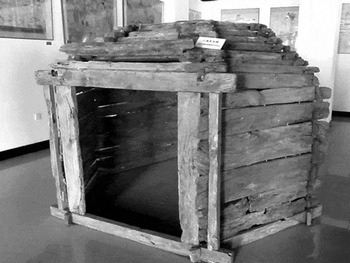
The rest of the exhibition focuses on the specifics of a Kitan-led multicultural society that enjoyed exchanges in selected fields. Moving upstairs there are rooms focusing on ceramics, burial, and religious paraphernalia, including textiles, and wall murals and furniture from tombs. As at Ningcheng, but unusual in Liao displays elsewhere, the ceramics include numerous complete examples of the unglazed wares that dominate—as broken sherds—Liao-period surface survey finds. There are also architectural ceramics such as roof tiles, along with the usual glazed wares. Most dramatic is the top-floor display of three large wooden coffin chambers in different shapes (see Figure 5), with original and reproduction tomb mural-paintings hung around the walls of the exhibition hall. In 2009 a reproduction of a camel cart excavated from a tomb was added to this room.
The Liao Supreme Capital Museum in Lindong in Balinzuoqi banner: one of the wooden outer coffins exhibited on the top floor. Source: Naomi Standen.

The vast majority of artefact labels do not specify that the items date from the Liao, which seems to be presumed by the context of the Museum as a whole, although in most cases we are told when and where objects were found. Extensive Chinese-only interpretive text in bite-sized chunks presents a good deal of straightforwardly factual evidence in a scientific tone; for instance, applying a deductive method to an exhibit of lead ingots to suggest possible products of an associated smeltery, and describing the state of the Baiyin’aobao tomb (noted above) and its contents. In the explanatory panels the regime's start date is given as 907 and there is no shying away from the strengths of the Liao. In one panel it is noted that Abaoji used Tang Taizong's award of position (implicitly to Abaoji's ancestors) as the basis for unifying the ‘northern minorities’, several of whom ‘submitted’ to Abaoji in the same period that he was fighting wars of conquest against the Xi (Tatabï) people of the grasslands, the Balhae, and the Yan-Yun region of northern China (the Beijing-Datong region known as the Sixteen Prefectures). Further on, excavated Persian glass allows the Liao to be presented as an essential link in the Silk Roads, through which the Song gained access to long-distance overland trade. Multicultural phenomena are also noted, such as entertainers being drawn both from among the Kitan and imported from the western regions, Central Plains, and the Balhae Kingdom to the east; and the mixed nature of burial customs and of the wall paintings in the tombs of those bearing the Han surname group (a Han Chinese family that served the Liao rulers for generations). The Kitan and Liao are treated in their own right, rather than simply as elements in overarching narratives.
Similarities to Song culture are sometimes spelled out, for instance in comparisons of agricultural tools and calligraphy, although the latter is suggested to be because most of the calligraphers were Han Chinese. Differences from Han Chinese culture are often left implicit, several times through observations of Liao borrowing. For instance, one description of a coffin explains how the Kitan adopted underground burial in place of their earlier practice of exposing the corpse in a tree deep in a mountain range. The adoption of agriculture and the spread of weaving are attributed to Abaoji's relocation of captured Han and Balhae households to the Supreme Capital region, and Song coins are taken as evidence of heavy Han Chinese influence on the commercial development of the capital, although the same panel also notes the large amounts of silver paid annually to the Liao by the Song after the Treaty of Shanyuan (1005). Other panels relate the end of urban settlement at the capital and scholarly attention to the site, and there is one reference to the Neolithic cultures found in the region. Several panels trace the Kitans’ origins to the Xianbei confederation in the fourth century, and include the strangely precise claim to 629 years of nomadic life in the Shira Muren region—implicitly by the Kitan—before the foundation of the Liao dynasty. The Liao is thus shown as sometimes borrowing from Chinese culture, and although this fits the narrative of the expanding civilizing influence of Central Plains society, the presentation of these elements is so diluted by observations of Liao strength, origins, and independent achievements that the approved story is largely inaudible.
As at Ningcheng, this variety of approaches is led by the objects presented rather than being driven by any ideological or political position. There are implicit and explicit assertions of territorial occupation, which are a regular staple of nationalist claims. However, in the absence of a consistent narrative of ‘multicultural China’, the beneficiary is less the PRC and more the Balinzuoqi region and perhaps—implicitly and to a limited extent—Inner Mongolia. Certain exhibitions at Ningcheng offer ambiguities or even generate dissonance that allow for both local and ‘patriotic’ readings of the materials. At the Supreme Capital it is harder to see a clear option for a patriotic reading of the displays. The Liao empire is portrayed as a multicultural one, but it is not claimed as part of a Chinese nation nor as simply adopting Chinese civilization.
Liaoning Provincial Museum in Shenyang
Moving on to Liaoning province, the difficulties of presenting a multicultural regional history are readily apparent at the Liaoning Provincial Museum. The Museum, located in Shenyang, the provincial capital, began in 1948 as the Northeast Museum. First housed in a warlord's abandoned mansion, it then moved to a new, purpose-built building within the same compound in 1989. Outgrowing this building, it is now located on a public plaza opposite the Shenyang City Government (rather than the Liaoning Provincial Government, as one might have expected).
Liaoning's shifting political boundaries and different political identities over the past 200 years mean that displaying a unified history within the Provincial Museum would be a complicated task, and it is not really attempted. While the presentation of an encyclopedic regional history is the role of provincial museums in China, equal coverage is impossible. In contrast to Inner Mongolia, Liaoning claims a prominent role in the national narrative during five periods: the early Palaeolithic, the Neolithic period Xinle and Hongshan cultures, Kitan-Liao, Manchu-Qing, and the Manchukuo-Republican-Revolutionary era. Several of these periods are better represented by major sites elsewhere, and by objects not found in the Museum. The Xinle site has its own separate museum in Shenyang and the premier Hongshan culture sites are in Liaoxi. The Qing imperial palace and imperial tombs still stand within the city and serve as museums for the Qing period. The 9–18 Memorial Museum recounts events relating to the Japanese invasion and colonization of Manchuria in the early twentieth century. The Republican-era mansion of the warlord Zhang Xueliang has become a museum, but there are not many other Revolutionary period sites associated with Shenyang. Thus, the Provincial Museum has galleries for changing exhibitions on calligraphy, painting and other popular themes, and provides a cursory overview of all periods of Liaoning's history, but its most intense focus in 2008Footnote 54 was on the Liao and, to a lesser extent, the Hongshan culture. In choosing this emphasis the Museum has co-opted many locations in Liaoning that have much stronger associations with the Liao than does Shenyang, which in Liao times was merely the prefectural seat of Shenzhou, not a capital city. However, the Liao Eastern Capital was located approximately 70 km south of Shenyang at what is now Liaoyang, which has a surviving Liao pagoda but made no further claim to associations with the dynasty.
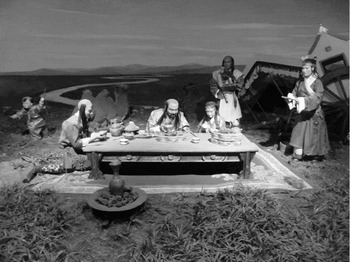
At Shenyang in 2008 the Kitan and Liao were the subjects of several large galleries, which include displays of porcelain and other ceramics, exhibited by type and subtype, and one on the Kitan as an ethnic group. The latter is arranged chronologically, and, while having some overlap with the porcelain exhibition, it allows the Museum to display non-ceramic objects associated with the Kitan in their implicitly pre-dynastic state of existence. Overall, the Kitan-Liao exhibitions, like others in the Museum, mix modes of display commonly used in both art- and more anthropologically oriented museums. Standard wall-niche display cases focus attention on multiple objects of the same type, such as cockscomb pots or a set of potter's tools; and solitary vitrines in the centre of a room isolate and spotlight objects to highlight their uniqueness or artistic merit. Dioramas portray objects as they might have been used in Kitan everyday life, such as a family eating and drinking from porcelain as they break their camel-cart journey through the grasslands (see Figure 6); and full-scale models recreate the context within which objects were found, such as the Faku Yemaotai tomb model which provides a setting for copies of wall murals.
The Liaoning Provincial Museum in Shenyang: diorama showing a Kitan family in the grasslands. Source: Gwen Bennett.

Plaques with introductory information in both Chinese and English are mounted at the gallery entrances. Interpretive placards with specific information, sometimes in both languages, but often with Chinese-English titles over Chinese-only text, hang closer to the exhibitions. Display cases have labels in Chinese and English that describe objects by material and, where appropriate, by other categories such as form and glaze. Provenance information is given when known, but many objects are part of the general museum collection. Wall maps indicate where pottery kilns were located and routes for textually known migration patterns, while charts indicate relationships between groups. Much of this information is descriptive, but the more interpretive panels situate the Kitan and the Liao within the multicultural-multiethnic discourse as a way to emphasize their accomplishments without having to acknowledge that they were considered foreign or barbarian throughout much of later Chinese history and into the present day. This can be seen in the positioning of the region up to the Liao River valley as part of the Sui and Tang empires in the information plaques in the Huaxia Yitong (‘Unity under the Chinese’) exhibition hall, and in the labelling of the Liao empire as a regional culture in the plaques introducing the Liaohe Wenhua (‘Cultures of the Liao River’) exhibition hall. The Liao lands become a region of ‘China’ and Liao culture is thus ‘Chinese’ in the preferred nationalist sense of ‘found within the boundaries of the PRC'.
Removing the ‘barbarian’ aspect from the Kitan ethnic group and the Liao dynasty is a necessary accomplishment for the Museum as this alone allows it, as an organ of the Liaoning Provincial Government, to situate the events and people of this region as important contributors to the development of the modern Chinese nation-state and thus justify Liaoning's inclusion in the national historical narrative. Here again we see the importance of cultural heritage in forming modern Chinese regional identities—but also the choices that have to be made in doing so. The Neolithic Hongshan culture came to prominence in 1984, and has since played a major role in the reformulation of the Central Plains unitary-origins model for Chinese civilization. But when Liaoning Province started to forge its own identity a few years after the Civil War ended in 1949, the spectacular Hongshan finds at Niuheliang and Dongshanzui had not yet been discovered. Manchu Qing material culture is even more abundant than that of the Liao, but while Qing objects verify the sophisticated cultural attainment of the Manchu court, they must have provided a still too raw and now impolitic memory of the recent imperial past. The Liao, on the other hand, shows abundant evidence of very high cultural achievement, combined with a historical memory sufficiently distant that it could successfully serve as a nucleus around which a regional identity could be formed. Its one inconvenient aspect—its non-Han Chinese ‘barbarian’ nature—has been ameliorated by incorporation into a conventional national narrative designed just for this purpose.
Huayan Temple and the City Museum of Datong
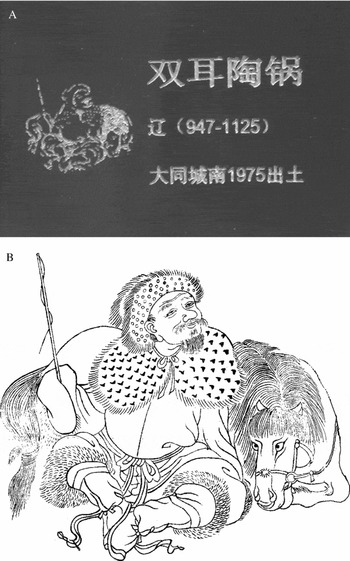
Datong in Shanxi Province was the site of the Liao Western Capital, and at Huayan the Lower Temple itself is little changed from the 1990s: there are still few labels in the worship halls and although explanation is now found in a glossy, bilingual, large-format book with good new photographs, which gives the Ming its due, the focus is still on description and religious background, with only a few attempts at contextualization such as: ‘In its long history, Datong is a town of strategic importance.’Footnote 55 However, several of the Lower Temple's other buildings have now been given over to house the Datong City Museum, displaying a professional-looking exhibition on ‘The culture of the Western Capital under the Liao, Jin and Yuan’. This begins with numerous interpretive panels dealing with hunting, agriculture and pastoralism, daily life, burial customs, and porcelain. Exhibits are chiefly ceramic items. As background we learn that these three peoples shared the Datong region with the Han Chinese, so ‘consolidating China's northern frontier’. Subsequent rooms have panels on religion (one each for Liao, Jin, and Yuan), and on tomb wall paintings, both illustrated chiefly with photographs (of religious buildings and of wall paintings) and the occasional statue. A final display on burial urns and funerary figures presents ceramic examples. Panels regularly note the characteristic styles of each dynasty, and developments that follow different trajectories for each category of object. ‘Cultural collision’ between grasslands and Central Plains is observed several times in the earlier rooms, illustrated by tomb forms and wall paintings. The ceramics exhibition begins by noting porcelain as ‘China's invention alone’ and places Liao, Jin, and Yuan products in a Chinese tradition from which they borrowed (frequently stated) and which they also influenced (expressed once). Panels are almost entirely descriptive, but where there is contextual material it offers conventional assertions such as ‘the pastoralist economy and culture could not avoid imbibing components of the ancient agricultural economy and culture’. Some of the labels give only the dynastic name, but many have the Liao commencing in 947, the latest possible date (see Figure 7A). These labels include a widely reproduced image of a Kitan tribesman that dates from the seventeenth century (see Figure 7B). Even as this repetition reinforces the ‘barbarian’ nature of the Kitan and Liao, numerous references to Song influences in the Western Capital elide the fact that this city was never part of the Song empire. There are no dynastic maps nor discussion of how cultural elements might have travelled (or not).
The Datong City Museum in Huayan Lower Temple: label from a ceramic display. The caption shows the Liao dynasty as commencing in 947, the latest possible date. Source: Naomi Standen.
Figure 7b. Although widely represented as simply a ‘Kitan’ horseman, the original image appears to be an impression of a man from the Qara Khitai, the Liao's successor state in Central Asia, and is found in Wang Qi's Sancai tu hui (1607). Source: See Michal Biran, The Empire of the Qara Khitai in Eurasian History: Between China and the Islamic World (Cambridge: Cambridge University Press, 2005), p. 134. (Image reproduced courtesy of the East Asian Library and the Gest Collection, Princeton University.)

The exhibition's effect is to downplay the significance of the Liao by relentless stylistic comparison that eschews not only politics but even the broader cultural context such as the Liao's role in the wider Buddhist world. The Museum counterbalances the undeniable significance of the Huayan Lower Temple as one of the rare surviving examples not just of Liao, but also pre-Song period architecture, with interpretations that bring the Liao back into the orthodox model where the superior Han Chinese culture took the leading role in creating a blend with outside influences. Whereas the more obviously ‘peripheral’ museums of Inner Mongolia and Liaoning have modified or even come close to sidestepping the conventional narrative to develop their own regional interpretations of the Liao, the Datong Museum, located in Shanxi Province closer to the traditional heartland of Chinese civilization, has pursued a more conventionally nationalist interpretation that emphasizes the role of the ethnically Chinese Song dynasty even at a site that they never ruled.
The Capital Museum in Beijing
The Capital Museum started life at Beijing's Confucius Temple in 1981, located in the northeast corner of the original walled city district. When Bennett first visited this temple in 1982, numerous large steles engraved with the Confucian classics and the names of those who had passed the Imperial examinations stood in its courtyards, but there was little else to be seen. By the late 1980s one of its halls housed a small exhibition, consisting almost exclusively of photographs and diagrams, tracing out the historical development of Beijing city. Neither Bennett nor Standen have returned to this temple since the early 1990s, but the Capital Museum moved to a new, purpose-built building on the Fuxingmen section of western Chang’an Avenue in 2005, which the authors visited in 2007.
This six-storey, glass-faced, rectangular building has its primary aspect punctured by a slanting bronze-sheathed column that erupts from its body and extends above the massively eaved roof line. Although this is a city-level museum, it outshines most provincial-museum buildings with its sophisticated design, amenities, and up-to-date technology. Beijing is, after all, not just any city; it is the country's capital and the Museum may be read as a ‘calling-card’ for Beijing's arrival at an internationally comparable level of sophistication.Footnote 56 Perhaps not coincidentally, the builders broke ground for the Museum just six months after Beijing was granted the 2008 Summer Olympics. The preceding two-year planning stage was surely influenced by the Beijing City Government's desire to impress the Olympic Organizing Committee. We will probably never know if there was a ‘Plan B’ proposal with fewer frills, to be used had Beijing not been awarded the Games.
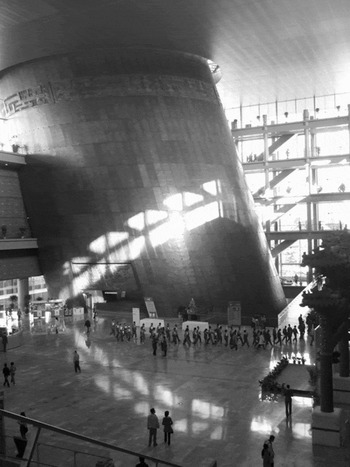
According to the Museum's official website, nothing about the design was unplanned. Its symbolism starts with its location on Chang’an Avenue—the ‘very first street in China’—and its design is meant to ‘underline the harmonious integration of past and the present, history and modernism, art and nature’.Footnote 57 The massive roof and gradient of the entrance square is influenced by traditional architecture. Inside, the bronze column dominates a cavernous entrance hall (see Figure 8), with exhibition halls on all floors. The introduction to the English website says that the permanent displays are intended to show visitors ‘the splendid and glorious culture of Beijing’, allowing them ‘to deepen their understanding of the Chinese and Beijing culture’, whereas the equivalent section on the separately designed Chinese website—the welcome from the museum director—says that visitors will ‘get to know Beijing, get to know China’, which is not quite the same thing.Footnote 58 Temporary exhibitions ‘serve as a stage to study and appreciate the exchange relations between cultures of Beijing and the other regions and that of China and the world’.Footnote 59
The Capital Museum in Beijing: entrance foyer with bronze-sheathed column. Source: Gwen Bennett.

The Museum has several halls dedicated to particular themes, such as Buddhist art or ceramics, and cannot be viewed completely in a single visit. In 2007 we saw only the permanent exhibition on ‘Ancient capital: chapter on the history and culture of Beijing’. This exhibition provides a strong narrative that presents traces of apparently unbroken human activity in the Beijing region since Palaeolithic times. Unlike the other museums studied, the Museum covers all historical periods, each with roughly equivalent amounts of detail until the Ming and especially the Qing periods, when the treatment expands greatly. The pre-Ming period is presented in a single long display case that wraps around half of the hall, with later periods in subsequent rows. The outside walls of the hall provide maps, panels, and a comparative timeline dealing with world history, here understood as primarily the history of the West. There is much English in labels and text, but not everything is translated, and there is often more detail in the Chinese versions.
The Liao established their Southern Capital at Beijing (then called Youzhou) in 938, and the dynasty receives due attention as the first regime of the imperial period to make the site of Beijing a state capital. However, this primacy is undercut in several ways. By the time the visitor reaches the Liao capital, they have already seen several detailed panels highlighting the ancient fiefdom and state of Yan (dated to the Zhou period, circa mid-eleventh century to 221 BCE), located just south of Beijing, and implicitly representative of the Chinese cultural core of the Central Plains. The Liao Southern Capital was a secondary capital, and its significance appears to be downplayed accordingly as a ‘prologue’ to the history of Beijing as a supreme or sole capital in later periods. A small selection of impressive Kitan cultural artefacts is displayed, although these are silently diluted by their interspersed placement with items from the Tang, from one of the two Five Dynasties regimes that controlled Youzhou, and from the Song dynasty, which never did control the region. Representatives of the Han Chinese majority who lived under Liao rule are given slightly less space than the Kitan themselves, with special attention given to the tomb of a man called Han Yi. Here the Chinese label explains that Han Yi was a member of one of the four great Chinese families of the Beijing region, but the English labels give the mistaken impression that ‘Hanyi’ is a category of burial rather than an individual.
This balance between Chinese and Kitan artefacts supports an interpretation of harmonious cultural mixing based on separate governance for the two groups, much in accord with current governmental emphases on creating a ‘harmonious society’. Consequently, the Kitans’ distinctiveness becomes almost an exotic curiosity, an impression reinforced by a looped video showing a modern recreation of historical Kitan life on a large screen hung from the ceiling. The domestication of the city is completed when it becomes the main capital for the first time under the Jin, whose sinicization receives considerable attention.
A city history will obviously focus on local finds from the earliest possible times, but Beijing plays a central role in the narrative of the modern Chinese nation-state as the singular capital of a united China, and as such the Museum seeks to create a history for the city that is traceable back to the same antiquity claimed for the nation as a whole. This is a task with many challenges. The Yan fiefdom at Beijing is a good start, but then the displays show the city having a long period as a peripheral frontier town, known as Youzhou, before coming under Kitan control. According to the exhibition, this initiates over 400 years of non-Chinese control of Beijing, which is also the period during which the city first became, rather problematically, not the sole capital but one of several, before its elevation—the displays give a strong sense of ‘At last!’—to be the main, central capital. Beijing's frontier location means that a non-Chinese presence is unavoidable, but this is subsumed under the standard line that ‘national minorities’ (a potent term in itself) interacted, largely harmoniously, with the Han Chinese in the region. The eventual sinicization of the Jurchen rulers of the Jin dynasty implicitly brought them into the Han majority and its historical trajectory towards a nation-state, while Beijing is seen to become once again a Chinese city and, once the Mongols’ Yuan dynasty had ended, again the capital of a Chinese-dominated polity: the Ming.
Some concluding thoughts
Compared to the uniformly conventional—as well as often dull and uninformative—presentations of the Kitan and Liao dynasty in the 1980s and early 1990s, what we now have is a variety of attractive and engaging portrayals offering a surprising range of interpretations. The differences do seem to broadly follow a centre–periphery pattern, but it is not quite the one that might be expected. The Liaoning Provincial Museum, the Datong Huayan Temple and its museum, and the Beijing Capital Museum all serve regions that are regarded as integral parts of the PRC, with important roles in the revolutionary narrative. Shenyang and Datong saw strategically important fighting during the anti-Japanese and civil wars; Beijing was home to crucial intellectual and revolutionary movements, as well as some key events. Accordingly, these cities and their hinterlands are regarded as necessary components of the modern Chinese nation. However, during the Liao period—and indeed, precisely because of the Liao—none of these areas was controlled by the states based in the Central Plains which are held to carry the main line of succession from one Chinese dynasty to the next. The Liao controlled the Shenyang region and governed the Beijing and Datong regions from 936 or 938. From them, governance passed to the Jin. The Song dynasty never held these lands, which only came under the same ruler as the Central Plains after another non-Chinese group, the Mongols, conquered the Jin piecemeal in early thirteenth century.
By contrast, although parts of Inner Mongolia occasionally came under the influence or even the rule of the most powerful Central Plains dynasties, the region was always marginal to the Chinese empire and continued to be so during the revolutionary period. What is now Liaoning saw extensive and important military action, but Chifeng, just over the provincial border, played only a minor role, as it still does today. Historically usable by both farmers and pastoralists, the region around Chifeng was, and still is, sparsely populated, with few administrative centres—and those existing only sporadically. That the most powerful dynasty in tenth-century East Asia should have founded not one but two of its five capitals within the administrative reach of Chifeng City is a coincidence that offers the municipality an unlikely opportunity to stake its claim to a piece of the history of the modern Chinese nation-state. In the city itself, however, this was trumped by the more malleable properties of the Hongshan culture. This culture's Neolithic dating both increases the antiquity of Chinese claims to this region and avoids the political complexities attendant upon the Kitan's vaunted ethnic distinctiveness and the Liao's uncomfortable place in the dynastic sequence. This enables the various museums of the region to make the most of the undoubted glories of the Liao, but in doing so, the local interpretations of specific elements of the Liao story diverge not only from China's nationalist grand narrative but also from each other.
The Chifeng Museum, at a higher level administrative position and with its prominent, privileged, but also more scrutinized urban location, is able to encompass the ambiguities of emphasizing the ethnic distinctiveness of the Kitan because its display on the Hongshan culture does the work of incorporating the region into the national historical narrative. The site-specific museum of the Supreme Capital at Balinzuoqi can, with remarkable straightforwardness, celebrate the achievements and distinctiveness of the Kitan and Liao on more of their own terms. The exhibition is framed within conventional requirements, but the great weight of the displays and explanations focus on factual information about artefacts, without attempts to force interpretation into the standard narrative. The outcome is a sophisticated presentation of a complex society. The equivalent museum of the Central Capital at Ningcheng is a more complicated case. Its displays offer a representative overview of the archaeological remains of its region in Liao times, predominantly showing agricultural inhabitants living under a ruling class with their roots in the pastoralist lifestyle. Yet the resulting emphasis on agriculture in a display labelled ‘Liao’, with all that this name is liable to conjure up in terms of images of nomads and even ‘barbarians’, also readily permits a reading of the exhibits as intended to locate Ningcheng within the agricultural zone, which would implicitly claim this region for Chinese civilization rather than non-Chinese pastoralism.
The curatorial process behind this variety cannot be known, so we must divine what we can from the displays themselves. Perhaps one element contributing to the differing approaches in interpretation could be the administrative levels of the various museums and the size of the likely audiences. As the new Chifeng city goes up beside the old one, the local government in 2009 was focusing on tourism and business connections, with, for instance, two tabs out of nine on their Chinese language website dealing with culture and tourism,Footnote 60 and three out of four tabs on the English language website devoted to culture, history, and tourist attractions.Footnote 61 As the hub of the region, the city will clearly receive the most visitors, and it has positioned itself to be attractive to the new car owners and other middle-class residents of Beijing—and maybe even a few foreigners—who, with the improved road system, can now consider Chifeng as a weekend destination. The site also clearly aimed to direct some of these tourists to outlying destinations like the two Liao capital museums. Lindong (Balinzuoqi), location of the Supreme Capital, was in 1991 a nondescript village in a largely pastoralist area, reached by driving along dry riverbeds. Accordingly, its lower level administrative status and the few visitors it received may have been reflected in a lack of scrutiny of its museum displays. The town has now been transformed by extensive, newly built apartment and commercial blocks which, though still largely empty in 2009, indicate hopes for a boom. This would be facilitated by the brand-new highways (see Figure 9) that connect Chifeng not only to the south, but also to other urban centres to the east and west. If this brings more visitors, directed from Chifeng, one wonders whether the patrons’ understandings or the museum's interpretations will change first.
One of the new Inner Mongolian highways. Source: Gwen Bennett.

The Central Capital, located on the road to Tianyi, Ningcheng County's administrative town, receives much through-traffic, hosts a district market, and the locals farm everywhere they can around and within the city's extensive remains. The Liao pagoda within the Museum grounds draws regular visitors and pilgrims because of its Buddhist associations, but most of them do not visit the Museum: when we went in 2007 the exhibition rooms were unlocked and the lights turned on especially for us. The Museum grounds also include an archaeological work-station belonging to the Inner Mongolia Cultural Relics and Archaeology Research Institute, which is not open to the public, but whose scholars advise the Museum on interpretive content. In 2009 we found a new exhibition of life-size dioramas showing historically significant moments such as the signing of the Treaty of Shanyuan in 1005, which may suggest an attempt to appeal to a larger audience. But, as with the Supreme Capital Museum, the relationship between the low visitor numbers and the relative freedom of presentation cannot yet be ascertained.
Whatever the reasons, the overall result seen in the museums of Inner Mongolia, Datong, Shenyang, and Beijing is disjuncture: representations of a past that is unavoidably heterogeneous, both ethnically and temporally, and not always well integrated into ‘multicultural China’; a fragmented picture of local history, with—except in Beijing—large gaps. Different parts of China are portrayed as having history at different periods—of which the Liao is an important one in these regions—and almost not having any history at all in the intervening time. Whereas in 1982–1996 it seems likely that one goal of all these museums was the national one of reinforcing the timelessness and inevitability of the nation through a focus on regional specificities,Footnote 62 now the effect in all but the Capital Museum in Beijing is to create temporal disjunctures in each place that are specific to that location. So cultural autonomy in the provinces and playing to local strengths has led to chronological fragmentation, one effect of which is to create a discomfiture regarding the unity and historical time-depth of the nation, and also its spatial extent. And this is the case regardless of whether a museum's displays take a ‘patriotic’ line or not.
This additional effect follows if we accept Christopher Hill's argument that a national history will acknowledge the occurrence of history only in a space claimed by the modern nation-state.Footnote 63 Thus, spaces represented as lacking history in certain periods are, for those times, placed outside the range of national history altogether, regardless of what general claims may be made to national ownership of those spaces. This may fit into what is rapidly becoming a superseded narrative of revolution, but it does not sit very well with the ongoing and intensifying nationalist claims to the timeless existence of a Chinese people, practising a culture that was—and in some border regions is still seen as—a model for their less advanced neighbours.
The problem is that the Liao never fitted comfortably into the Chinese grand narrative—not in imperial times, not in revolutionary times, and not today either. It may still be convenient for the Chinese state to seek to embrace the Kitan and Liao for territorial reasons, with all the contradictions that this entails, but in terms of museum displays, the people and dynasty could only be an effective part of a coherent national project when museology was undeveloped in China, interpretations were correspondingly vague or non-existent, and museums had unequivocally political goals. As provincial autonomy and the quest for local economic prosperity have increased, along with academic freedom and engagement with international scholarship, interpretations of the Liao have begun to diverge along a number of different paths. Some of these still pull towards a national identity dominated by Han Chinese culture. There are some, for example, who claim museums and their holdings as central contributors to the ‘new Chinese nationalism’.Footnote 64 However, it may also be possible to see a more nuanced, ‘modest’ national storyFootnote 65 being portrayed where the evidence exists. In some museums—especially where they attract less attention from national agencies—exhibitions seem to be adopting a more academic than political approach that can sometimes suggest a sense of regional identity, arising out of scholarly indications of local agency in the past. As in other countries,Footnote 66 such varied and complex roles have the potential to generate debate, and may intimate more active questioning in the future of China's national project as currently conceived.