Introduction: the political context
In the UK and many other European countries, there continue to be concerns about a range of social issues including the position of immigrants, the educational attainment of marginalised groups and the persistence of the gender pay gap. Increasingly, governments and NGOs assert that the promotion of equality and human rights policies are central to addressing these issues, with a view to creating societies which are both more equitable and more efficient. Over the past decade and a half, a period of economic growth followed recently by a major recession, the equality and human rights agenda enjoyed a high political profile. However, as we discuss in this review article, the social and economic optimism of the late nineties and early to mid noughties has been followed by economic retrenchment, a commitment to the shrinking of the state and the public sphere across Europe and a general move to the political right. In this article, we first review the political context which led to the rise of the equality and human rights agenda. Subsequently, we examine competing conceptualisations of equality and their operationalisation within British social policy. Finally, we assess the progress which has been made towards achieving a more equal society in the UK over recent years drawing on data gathered and analysed by the National Equality Panel (NEP, 2010).
One of the interesting features of the past decade and a half has been the decision by the UK government to draw together the equality and human rights agendas. Whereas equality policies have traditionally focused on gaps between different social groups, human rights policies focus on absolute thresholds, often informed by legal precedents. Thus the principles of human rights, enshrined in the European Convention on Human Rights (ECHR), provide a guarantee that the state will not fall below a specified threshold in the protection and treatment of its citizens. The ECHR has had a major impact in EU member states, as well as those countries seeking accession to the EU. Democracy and legitimacy, it is asserted, cannot be fully realised unless there are opportunities for all to participate as equal citizens. The duty to enact the letter and spirit of the convention is with governments and many have established equality and human rights commissions to align their responses to the ECHR and EU directives on equal treatment and discrimination (Rees, Reference Rees1998; Fredman, Reference Fredman2000). In Great Britain, the Equality and Human Rights Commission (EHRC) was established in 2007, taking over the responsibilities of the existing commissions dealing with gender, race and disability and adopting responsibility for religion/belief, age and sexual orientation, the other three grounds protected under EU equality directives and regulations. In addition, human rights became part of the EHRC's remit, although in Scotland there is a separate Commission dealing with human rights with regard to devolved matters.
A further key element within the equality and human rights landscape in the UK has been the growing importance of devolution and its associated politics (see the article by Rees and Chaney for further discussion). Devolution has provided a new political and administrative settlement for Northern Ireland, Wales and Scotland. Over the last decade, new ways of working have been created through the Scotland Act and the Government of Wales Act. The political complexities of Northern Ireland have led to a new settlement there too. These developments recognise the differing social, economic and political environments contained within the UK, but at the same time are underpinned by provisions for the promotion of equality of opportunity for the UK as a whole.
The traditional approach to enforcing anti-discrimination legislation was to wait until an individual complained of a failure to provide equal treatment by an employer or the provider of goods and services. Cases of discrimination were dealt with through the civil courts, and an individual might receive backing from one of the Equality Commissions if it was felt that a legal precedent could be established. Over time, the approach has shifted and there is now a greater emphasis on the active promotion of equality through the enactment of a series of public sector duties (see the articles by Arshad and Riddell and Pearson et al., which analyse the implementation of the Disability Equality Duty in Scotland and England). However, a further interesting dimension has been the growing emphasis on the role of business in the creation of inequalities, but also as a champion of new ways of working to promote equality and human rights. In the competitive environment of the knowledge, or skills based, economies, organisations and businesses may aim to become what is commonly termed as an ‘employer of choice’. In this context, equality and human rights principles and precepts may be drawn upon as positive elements of employment policies and practices. However, it is clear that groups traditionally suffering labour market disadvantage, such as women, have been attracted to work in the public rather than the private sector, partly as a result of more positive approaches to equality in the former. The extent to which the private sector will promote equal treatment in the post-crisis economy is extremely uncertain.
Whilst the previous UK Labour administration placed high priority on the promotion of equality and human rights, a number of loose ends remain. For example, as noted in the article by Walby and Armstrong, the status of social class is somewhat ambiguous within the new institutions governing equality and human rights. The Scotland Act stipulates that an individual may not be discriminated against on grounds of social background, and the Equality Act 2009, which applies in England, Wales and Northern Ireland, places a duty on public sector bodies to promote equality in relation to socio-economic status. However, social class does not fall directly within the remit of the EHRC since it is not a protected characteristic. Whereas an individual can claim legal protection with regard to discrimination relating to one of the six protected equality strands or with regard to human rights infringements, it is not possible to bring a case to court on the grounds of social class discrimination. The enthusiasm with which the new Conservative-Liberal Coalition Government will implement the provisions of the Equality Act 2009 remain to be seen. However, the Coalition Agreement of the Conservative-Liberal Westminster Government (Cabinet Office, 2010) is very clear about its commitment to a small state, in which individuals take responsibility for their own actions and choices with minimal state intervention, suggesting that government-driven equality policy will not be a priority.
There has also been considerable policy turbulence around the human rights agenda. Following the passage of the Human Rights Act (1998), which incorporated the principles of the European Convention on Human Rights into UK domestic legislation, there has been ongoing discussion about the balance between the rights of the individual and those of the wider community. In July 2006, a report was published entitled Rebalancing the Criminal Justice System in Favour of the Law-Abiding Majority (Home Office, 2006) and in November 2006 a review of the operation of the Human Rights Act was published by the House of Lords and House of Commons Joint Committee on Human Rights (House of Commons, 2006). Whereas the Labour Government expressed the view that more needed to be done to promote community integration and cohesion, to foster a positive view of human rights and to debate the meaning of multi-culturalism, the Conservative Election Manifesto included a commitment to repeal the Human Rights Act, although this commitment does not feature in the Coalition Agreement. Human rights activists maintain that the Equality and Human Rights Commission has failed to devote sufficient attention to its human rights remit, focusing instead on equality issues.
To summarise, whilst the past decade and a half have witnessed much activity in the field of equality and human rights, a number of uncertainties persist, particularly with regard to the status of social class as an equality strand and the nature and priority of the human rights agenda. There are also ongoing tensions between competing conceptualisations of equality, which we consider in the following section.
Competing understandings of equality: economic, cultural, affective and representational dimensions
Many theorists have acknowledged the need to pay attention to both and economic and cultural injustices in order to understand and remedy the situation of socially marginalised groups (for example, Fraser, Reference Fraser1997; Sen, Reference Sen1985; Young, Reference Young1990). Young (Reference Young1990) argued strongly that it was no longer defensible to pay attention solely to economic inequality and the politics of social class, as had been the case in the 1970s, since such an analysis inevitably served the interests of the dominant sex or ethnic group. Whilst Young always maintained in her writing that there was a need to balance concerns with redistribution with those of recognition, other theorists, such as Honneth (Reference Honneth1995), went much further, maintaining that recognition is the fundamental concept of justice and can encompass distribution. The shift towards the politics of identity, which was a major feature of the 1980s, produced a counter-reaction, with writers such as Fraser (Reference Fraser1997) maintaining that the politics of social class had been displaced by the politics of recognition. This, she argued, was extremely concerning, since the rise of identity politics in the 1980s coincided with the rapid growth of free market ideology and inequality in the US. Celebrating the difference of the black or gay community might serve to reinforce, rather than challenge, their economic marginalisation. In general, Fraser believed that the politics of redistribution and recognition were fundamentally contradictory, the former seeking to remove differences between groups, and the latter seeking to celebrate them.
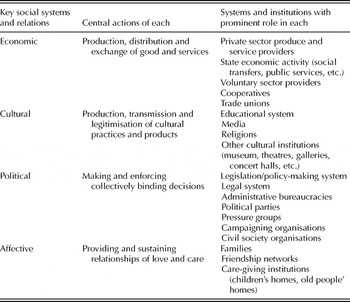
Baker et al. (Reference Baker, Lynch, Cantillon and Walsh2004) argue for an extended understanding of the nature of in/equality and the domains in which power relation are experienced and reproduced (see Table 1).
Key social contexts for the generation of equality and inequality

Source: Adapted from Baker et al. (Reference Baker, Lynch, Cantillon and Walsh2004: 57–72).
They argue that the affective dimensions of power relations, specifically the implications of deeply embedded structural and cultural assumptions about which individuals will provide and receive care, have been ignored by political philosophers such a Rawls (Reference Rawls1999) and Fraser (Reference Fraser1997). Feminist theorists, on the other hand, such as Nussbaum (Reference Nussbaum2001) and Kittay (Reference Kittay1999), have argued that the need for care, particularly, in the early and later stages of life, are fundamental human characteristics, and the ability to give or receive care is thus a key dimension of equality. However, there is clear evidence to suggest that women are penalised economically for their greater engagement in caring, for example data gathered by the National Equality Panel in the UK (NEP, 2010) illustrated the ongoing impact of the motherhood penalty, whereby women's pay is approximately equal to that of men until the birth of the first child, after which it declines. Part of the reason for this is that women, unlike men, often cease to work full-time after having a child, and part-time work is very often associated with inferior pay and conditions.
It is important to note that feminist and disability activists and academics have frequently clashed in their analysis of the politics of caring. At the dawn of community care policy in the UK during the 1970s, Land (Reference Land1978) argued that ‘care in the community = care in the family = care by women’. The implication of this was that institutional care was preferable, since a reliance on care in the family would inevitably involve the emotional exploitation of women, with negative consequence for their economic independence. Feminist researchers such as Ungerson (Reference Ungerson1997) drew attention to the exploitative relationships, low pay and lack of benefits which may characterise the labour of (mainly) women employed as personal assistants. Disabled people, on the other hand, maintained that the caring relationship was oppressive for both the provider and receiver of care, and the principles of independent living required the payment of funds directly to the disabled person to purchase their own care, so that they could adopt the role of employer (Priestley, Reference Priestley1999). Writers connected to both the disability and women's movements such as Thomas (Reference Thomas1999) and Morris (Reference Morris1993) attempted a rapprochement between the different positions, pointing out that it was dangerous and simplistic to ignore the part played by love in many caring relationships, which could and should not be reduced to a commodified financial transaction. Shakespeare (Reference Shakespeare2000) argued for the recognition of inter-dependence and reciprocity which characterise most social relationships. Despite theoretical and political efforts to find a way forward (Hughes et al., Reference Hughes, McKie, Hopkins and Watson2005; Parker and Clarke, Reference Parker and Clarke2002), tensions between the carers and disability movements persist. As argued by David three decades ago (David, Reference David1980), education continues to play a central part in reconstituting and regulating gender and family relationships, although its influence in this domain is rarely acknowledged.
Finally, Baker et al. (Reference Baker, Lynch, Cantillon and Walsh2004) draw attention to the salience of voice and representation in the creation of in/equality. This arena is closely linked to the cultural dimension of equality, since the absence of voice and political presence is indicative of a marginalised social identity (Phillips, Reference Phillips1998). Part of the struggle for voice centres on the visibility and power of diverse groups within political and public institutions, such as education. As noted by Barnes (Reference Barnes2002) and Armstrong (Reference Armstrong2002), giving voice to service users may require a radical rethinking of the mechanism for governance of public sector institutions, since a variety of groups such as older people, people with learning difficulties and children may have great difficulty in using exiting mechanisms of representation.
To summarise thus far, it is evident that power relations are played out in a variety of inter-connected domains, including the economic, the cultural, the political and the affective. Traditional conceptualisations of equality have tended to emphasise the economic and cultural domains, but it is evident that the affective and representational are also of great importance. There are potential tensions between policies designed to promote particular aspects of equality, for example attempts to enhance the social status and cultural recognition of some groups may ignore the fact that lack of social respect is often based on economic inequality (poor people are unlikely to be accorded some status irrespective of their other characteristics). The challenge is clearly to devise policies which recognise the inter-connections of different aspects of equality and in the following section we consider the focus of recent British equality policy.
Operationalising equality in British social policy
As noted earlier, the Labour Government of 1997–2010 pushed equality and human rights up the political agenda, passing a raft of equalities and human rights legislation and establishing the Equality and Human Rights Commission. The Equalities Review (Cabinet Office, 2007), which prepared the conceptual ground for the EHRC, drew on the capabilities approach developed by the economist and philosopher Amartya Sen (Sen, Reference Sen1985, Reference Sen1992). An equal society was defined as one which ‘protects and promotes equal, real freedom and substantive opportunity to live in the ways people value and would choose’, whilst recognising people's ‘different needs, situations and goals’ (Cabinet Office, 2007: 16).
This definition draws on diverse understandings of equality, including those connected with equality of opportunity, process and outcome, and implicitly, if not explicitly, recognises that inequality may occur across a number of domains, including the economic, cultural, representational and affective spheres discussed above. The Equalities Review recommended that an Equality Measurement Framework (EMF) should be established to capture these various dimensions of equality, allowing progress to be charted over time (Burchardt and Vizard, Reference Burchardt and Vizard2007a, Reference Burchardt and Vizard2007b). The EMF identifies 48 quantitative indicators covering ten domainsFootnote 1 in relation to the ‘protected grounds’ (gender, transgender, ethnicity, disability, sexual orientation, age, religion/belief), as well as socio-economic status. Although the EMF has been under development since 2007, at the time of writing it has not yet been populated with data, and in the present political and economic climate in the UK there are concerns about the project's future.
Whilst the EMF clearly has potential to inform the tracking of progress towards equality in Great Britain over time, in addition to the technical problems mentioned above there are also a number of conceptual problems, particularly with regard to the centrality of the concept of capabilities. Dean (Reference Dean2009) argued that capabilities should be seen as essentially a ‘liberal-individualist concept’, which tends to ignore the nature of human inter-dependency, the problematic nature of the public realm and the exploitative nature of capitalism. The EMF, he suggests, would be stronger if it were couched within a discourse of rights rather than one of capabilities.
Conceptual problems within the EMF are particularly apparent with regard to competing interpretations of inequalities in outcomes. For example, the EMF includes data on health, education and employment outcomes with regard to the protected equality strands and social class, providing the basis for an analysis of different types of inequality, including those rooted within the economic and cultural spheres. At the same time, the emphasis on the importance of individual choices and individuals’ ‘different needs, situations and goals’, poses a danger that unequal outcomes may be blamed on individuals making the wrong choices with regard to their diet, schooling or jobs. As noted by Fraser (Reference Fraser2001), there are inherent dangers in assuming that people have the insight and power to make meaningful choices throughout their lives. For example, boys from socially disadvantaged backgrounds may actively reject academic achievement and adopt ‘laddish’ styles of behaviour because this accords with their performance of masculinity, without recognising that this rejection of schooling is socially structured and may well reinforce their long-term social disadvantage. In general, the EMF tends to over-emphasise individual agency and the politics of identity, and under-emphasise the immense power of structural forces which make autonomous choice impossible for the vast majority of citizens. However, this conceptualisation fits well with the growing emphasis on individualism within European societies, including the newly elected Conservative-Liberal Coalition Government within the UK.
Finally, and connected with the points made in the previous paragraph, there are operational problems in measuring equality of process and autonomy, since both depend on individual perception. Compared with socially marginalised groups, those enjoying relative advantage may have more exacting standards for public sector services and may be more likely to complain of inequalities of process and treatment (see the article by Walby and Armstrong). For example, greater perceived discrimination is reported by the white population than by minority ethnic groups in access to housing (Walby et al., Reference Walby, Armstrong and Humphreys2008), a finding at odds with the actual allocation of social housing (Rutter and Lattore, Reference Rutter and Lattore2009). According to Walby, data on outcomes, rather than perceptions, are much more reliable in measuring inequality, and it is interesting that most of the statistics proposed by Akire et al. (Reference Akire, Bastagli, Burchardt, Clark, Holder, Ibrahim, Munoz, Terrazas, Tsang and Vizard2009) to populate the EMF are based on outcomes. Further work is being commissioned to consider the extent to which it is possible to have any meaningful measure of autonomy.
Equality and human rights: progress and challenges
Given this ferment of activity in the field of equality and human rights over the past decade and a half, it is important to consider what has been achieved in terms of tackling existing inequalities. The National Equality Panel (NEP, 2010) was set up in Autumn 2008 to examine how people's economic outcomes, in terms of earnings, incomes and wealth, are related to their characteristics and circumstances, such as gender, age or ethnicity. It found that economic inequality in the UK is high compared with other developed countries and compared with the situation 30 years ago. Over the most recent decade, earnings inequality has narrowed a little and income inequality has stabilised on some measures, but the large growth in inequality in the 1980s has not been reversed.
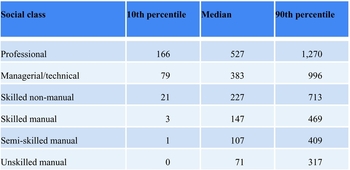
Some of the gaps in outcomes between social groups have narrowed over the last decade, for example between the earnings of women and men and in the educational qualifications of different ethnic groups. Significant differences remain between all of the social groups examined, but differences within groups are much larger than differences between groups. For example, the differences in earnings between the highest and lowest paid women is almost as large as the differences between the earnings of the highest and lowest paid men (and much greater than the difference between men and women overall). This underlines the centrality of social class in understanding the nature of social inequality in contemporary Britain. Life cycle issues are also important, as inequalities tend to intensify as people get older. So for example, the median total household wealth in the UK is £205,000, with 10 per cent of households having wealth below £8,800 and 10 per cent having wealth above £853,000. In households including people over 50, the differences are even more stark, with the top 10 per cent of professional households having wealth above £1,270,000 whilst the bottom 10 per cent of professional households have wealth of £166,000. This contrasts with households including unskilled manual workers, where the richest tenth have wealth above £317,000, whilst the poorest tenth have no wealth at all, reflecting the fact that they do not own a house, have no private pension and no savings or other assets (see Figure 1, drawn from Banks and Tetlow, Reference Banks and Tetlow2009).
Total household wealth (including housing and non-state pensions, £000s).

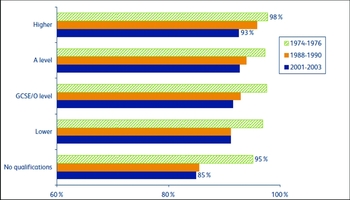
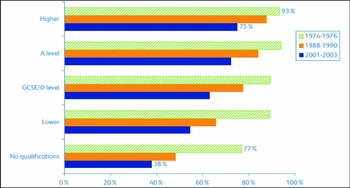
Whilst differences have blurred for some groups, for others economic differences have become more entrenched over time. Figures 2 and 3, for example, draw comparisons over time between the employment outcomes of disabled and non-disabled men (defined in terms of long-term limiting illness) with different levels of education qualification. Figure 2 shows that at the earlier time point (1974–76), there were very high employment rates for non-disabled men (over 95 per cent) irrespective of level of qualification. At the later time point (2001–03), the employment rate for non-disabled men with higher level qualifications was slightly reduced (93 per cent), but for those with no qualifications, the drop in employment rate was much more marked (85 per cent were in employment). For disabled men, however, the decline in employment prospects, particularly for those with no qualifications, was much more marked. Whilst just over three quarters of disabled men with no qualifications were in employment in 1974–76, by 2001–03 their employment rate had fallen to just over a third. There was also a drop in the employment rate of disabled men with higher level qualifications over the same period of time, but this was somewhat less marked (from 93 per cent to 75 per cent). Given the close association between social class and educational qualifications, this suggests that disability is having an increasingly negative impact on the lives of socially disadvantaged men.
Proportion of UK men without limiting long-standing illness who are in work, by highest educational qualification.

Proportion of UK men with limiting long-standing illness who are in work, by highest educational qualification.

Overall, the National Equality Panel report drew attention to the impact of specific government policies on levels of inequality, for example the positive impact of the national minimum wage was highlighted. At the same time, the report drew attention to areas where social inequalities appear to be intensifying (e.g. for those living in socially disadvantaged areas, social housing tenants and children of travellers). Furthermore, whilst it was hoped that the devolved nations might achieve some success in narrowing inequality, this does not appear to be the case, with levels of inequality in Scotland, Wales and Northern Ireland being very similar to those found in England.
Conclusion
In this article, we began by outlining the political context which has fostered the development of policy and practice in the field of equality and human rights over the past decade and a half. We discussed competing understandings of equality, suggesting the need for attention to be paid to a range of dimensions, including the economic, the cultural, the representational and the affective. Subsequently, we explored the way in which equality and human rights policies have been incorporated into British social policy, highlighting some of the unresolved tensions, including the relative importance attached to the equality and human rights parts of the agenda, and the somewhat ambiguous position of social class in the lexicon of equality strands. We also questioned the prominence of the capabilities discourse, which places great importance on facilitating individual choices, but does not fully acknowledge the power of social structures shaping these choices.
Drawing on the work of the National Equality Panel, we considered the extent to which progress has been made over the past decade in making Britain a more equal society. Despite the implementation of fiscally redistributive policies by the previous Labour Government and the large spending increases in public services such as health and education, the rise in inequality which took place in the 1980s was halted rather than reversed. This is partly because, as demonstrated by Iannelli in this themed section, the middle classes have been extremely adept in accruing maximum advantage from public services, including, for example, access to higher education. So whilst the performance of the bottom 20 per cent of children has improved, the gap between this group and the other 80 per cent has failed to narrow significantly. Similarly, children from working-class backgrounds have only recently begun to benefit from the expansion of higher education, since middle-class participation is at saturation point. There is clearly a danger that Britain is locked in a high inequality equilibrium, which can only be disrupted by massive state-driven redistribution, prompted by severe social unrest. The present Coalition Government is locked into the idea that individual choice in market-driven systems is the best way of improving services in a time of austerity, but lessons from the 1980s suggest that markets rarely benefit socially marginalised consumers. On a more optimistic note, the popularity of Wilkinson and Pickett's recent book (Reference Wilkinson and Pickett2009) The Spirit Level: Why More Equal Societies Almost Always Do Better suggests that, at the very least, there is an openness to the idea that high levels of inequality are toxic both for individuals and the social collectivity. The challenge is to translate these ideas into action, so that there is a much wider recognition of the need for adults to combine concerns for their own children with equal concern for the well-being of children as a whole, so that collective, rather than individual strategies are adopted.