


The pace of change and social acceleration in society has put continuous pressure on organizations to be agile and efficient. This trend of work intensification has made employees’ ability to adapt indispensable (Baard et al., Reference Baard, Rench and Kozlowski2014). Proactively dealing with organizational change requires energetic resources from employees in order to adapt successfully (Parker et al., Reference Parker, Bindl and Strauss2010). Continuous technological developments and digital working have triggered changes in work processes. New ways of working (NWW) focus on flexibility, technology and connectivity to achieve highly efficient working processes (Kotera & Correa-Vione, Reference Kotera and Correa-Vione2020). This includes more efficient use of office space by using flexible or ‘non-territorial’ workspaces, a practice also known as ‘hot-desking’. The success of such initiatives is highly dependent on employees’ attitudinal and behavioral adaptation. However, there is a need to understand the ‘how’ of adaptation to such changes in more depth (Jundt et al., Reference Jundt, Shoss and Huang2015). This study therefore aims to examine the micro-level process of employee adaptation. We focus on a positive workrelated state, consisting of vigor, dedication and absorption, i.e., work engagement (Bakker et al., Reference Bakker, Schaufeli, Leiter and Taris2008). Work engagement has not been studied extensively as a predictor of change adaptation, which is surprising, since it may provide the energy and motivation needed to deal with change. Further, we include meaning-making, which is a resource that enables employees to makes sense of challenging events, as a predictor of work engagement during change (Park, Reference Park2010; van den Heuvel et al., Reference van den Heuvel, Demerouti, Schreurs, Bakker and Schaufeli2009). We combine conservation of resources theory (Hobfoll et al., Reference Hobfoll, Halbesleben, Neveu and Westman2018) with individual change transition models (Elrod & Tippet, Reference Elrod and Tippett2002; Lewin, Reference Lewin1947) and literature on change and performance adaptation (Baard et al., Reference Baard, Rench and Kozlowski2014; Rafferty et al., Reference Rafferty, Jimmieson and Armenakis2013; Vakola et al., Reference Vakola, Oreg, Armenakis, Oreg, Michel and By2013), to propose a microlevel process of successful adaptation (self-reported and supervisor-rated) during the first phase of change implementation. In this process, we propose work engagement as a pivotal contributor to adaptive performance. We aim to contribute to knowledge of intraindividual factors that can promote employee adaptation from the onset of organizational change.
The present study contributes to the literature in at least three ways. First, we add to the literature on work engagement by focusing on its individual antecedents and outcomes in a change context. We examine whether work engagement represents a key employee experience that may influence adaptation during change implementation. Work-related states such as work engagement hold potential as facilitators of employee adaptation due to their energetic properties which can facilitate resilience in times of change (Frese, Reference Frese2008). Despite its motivating and health-protective properties, work engagement is relatively unexplored in organizational change studies, as well as in the adaptive performance literature (Jundt et al., Reference Jundt, Shoss and Huang2015). We examine whether work engagement trajectories predict and are predicted by attitude-to-change and meaning-making (Sonenshein & Dholakia, Reference Sonenshein and Dholakia2012). Second, we contribute to the organizational change and flexible working literature by providing insights on adaptation to a specific type of change, i.e., flexible work spaces. Rather than focusing on specific effects of flexible work spaces, we use a longitudinal design which allows us to focus on processes that help employees to adapt to such office design changes, which has been called for (Ashkanasy et al., Reference Ashkanasy, Ayoko and Jehn2014). Related to this, we study a distinct change in office environment using multiple measurements. The fact that this change had a distinct starting point, meant that all employees were exposed to the change from the same point in time. We focus on employee adaptation during the first five weeks of change, a crucial transition stage of change adaptation (Elrod & Tippett, Reference Elrod and Tippett2002). This allowed us to examine dynamic processes at the employee level and how these may predict adaptive performance using the assumptions of COR theory. Jundt et al. (Reference Jundt, Shoss and Huang2015) state that the adaptive performance literature needs studies to focus on how individuals adapt and what processes they must engage in after being confronted with the change. Our study helps to answer these questions by using a longitudinal design that allows for a combination of growth and longitudinal analyses. Finally, by linking self-reported data to supervisor-rated adaptive performance, we add to knowledge on how self-reported attitudes are linked to leader perceptions of adaptive behaviors that are crucial for the success of organizational change. Adapting successfully does not only mean that the individual is positive towards the change, but also that others (supervisors) observe that individuals behave appropriately given the change requirements.
Conservation of Resources Theory and Adaptation to Change
Conservation of resources (COR) theory is a motivational theory that aims to explain human behavior by focusing on innate tendencies of individuals to retain, protect and foster valued resources (Hobfoll et al., Reference Hobfoll, Halbesleben, Neveu and Westman2018). Resources have been categorized as (a) tangible objects (e.g., money, tools, technology), (b) conditions related to the psychosocial environment (e.g., autonomy, support, time etc.), (c) valued psychological states or energies or (d) malleable personal characteristics, i.e., personal resources such as self-efficacy, optimism or capabilities (Hobfoll, Reference Hobfoll1989). Recently, resources have been grouped together in a broad goal-directed definition; “anything perceived by the individual to help attain his or her goals” (Halbesleben et al., Reference Halbesleben, Neveu, Paustian-Underdahl and Westman2014, p. 1338). COR theory states that potential resource loss is more salient than resource gain, and that people must invest resources in order to protect themselves against losses. In an organizational change setting, this could mean that employees first see potential losses associated with change. Meaning-making could thus be an important resource to invest early on, to see potential gains and stay engaged during change (van den Heuvel et al., Reference van den Heuvel, Demerouti, Bakker and Schaufeli2013). Another tenet of COR theory is that those who possess greater resources, are less vulnerable to losses and more able to organize resource gains. During organizational change, this would mean that employees who possess valued resources (such as meaning-making and work engagement), have a better chance to reap benefits from organizational changes and thus a better chance of successful adjustment. Although COR theory holds potential for studying employee adaptation to change, not many studies have done so. The principles of COR theory seem conducive to be applied to any (organizational) change setting, and in the current study we particularly focus on how a valued and limited energetic employee resource, work engagement, can be protected and may be related to subsequent adaptive performance. Following Shirom (Reference Shirom2011), work engagement can be seen as an internal, energetic resource that facilitates goal-directed behaviors such as job performance. Indeed, many studies confirm the link between work engagement and general performance on the job. However, despite a growing need to deal with change, not many studies have focused on the relationship between of work engagement and adaptation to change.
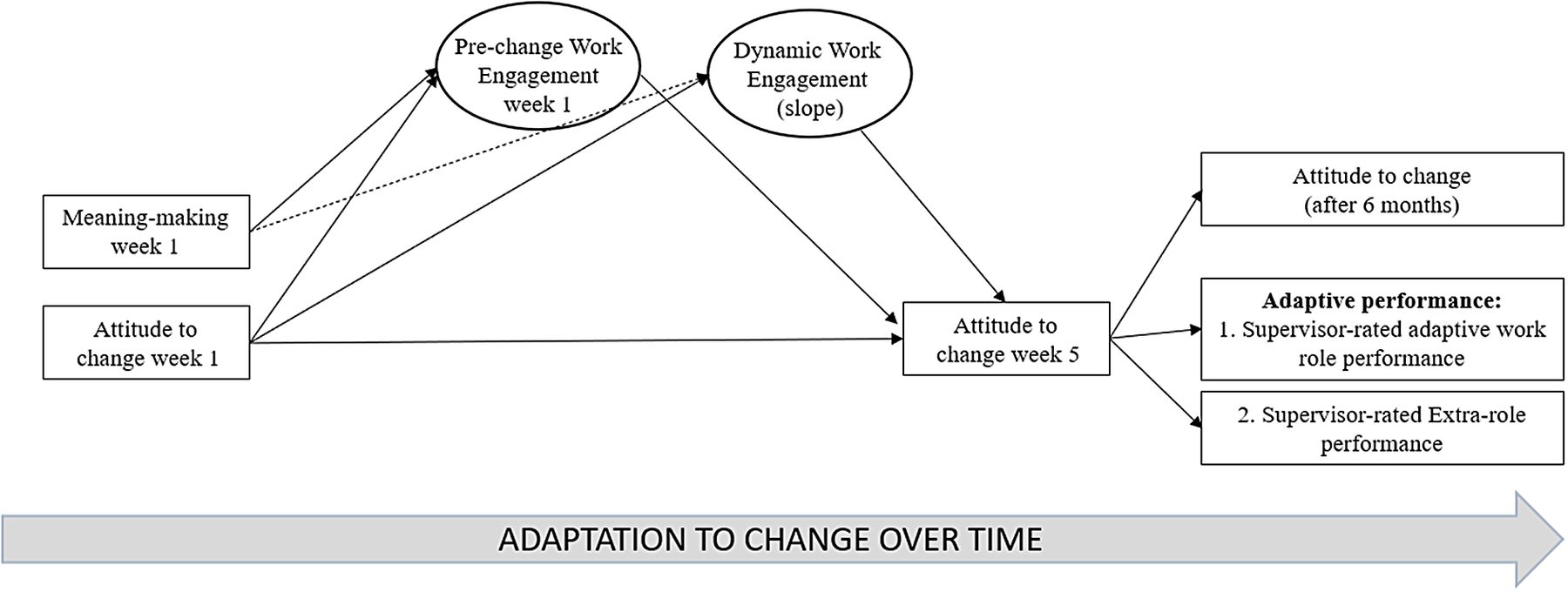
What exactly is adaptation to change? There is a lack of consistency in definitions of constructs related to change adaptation (Jundt et al., Reference Jundt, Shoss and Huang2015). In this study, we use ‘adaptation to change’ as an umbrella-term that includes a number of specific adaptive constructs in the change context. Adaptation to change on the employee level is defined as: The behavioral and attitudinal adjustments and modifications, necessary to adapt to changes in the work environment. The purpose of this adaptation is to maintain and restore the equilibrium in well-being and performance (Cameron, Reference Cameron1984). Based on this, we aim to predict domain-specific behavioral and attitudinal components of adaptation (Baard et al., Reference Baard, Rench and Kozlowski2014, Pulakos et al., Reference Pulakos, Arad, Donovan and Plamondon2000). First, adaptive performance refers to the behavioral expressions of employee adaptation to change (Shoss et al., Reference Shoss, Witt and Vera2012; Van den Heuvel et al., Reference van den Heuvel, Demerouti, Schaufeli, Bakker, Houdmont and Leka2010). These behavioral expressions depend on the type of change in the context of our study (Baard et al., Reference Baard, Rench and Kozlowski2014). The introduction of flexible workspaces meant that employees lost their personal desks and offices and this required adaptive work role behaviors i.e., constructive and positively dealing with change. The change also required extra-role behaviors, i.e., discretionary, interpersonal behaviors in order to work effectively in the new office set-up. Adaptive performance occurs when employees have to modify existing work behaviors in order to respond to work-related changes or to maintain performance during change (Jundt et al., Reference Jundt, Shoss and Huang2015). Second, besides behaviors, adaptation also consists of employees’ positive attitude to change (Oreg et al., Reference Oreg, Vakola and Armenakis2011). We include positive attitude-to-change after change implementation as an attitudinal indicator of adaptation to change. Figure 1 shows our conceptual research model for adaptation to change.
Adaptation to Change Research Model
Work Engagement during Change Transitions
Organizational change typically aims to improve organizations. However, for employees it can be associated with uncertainty and perceived resource-loss (Hobfoll & Shirom, Reference Hobfoll, Shirom and Golembiewski2000). Thus, it may trigger stress responses and negative affect (Eldor & Harpaz Reference Eldor and Harpaz2015; Vakola & Nikolaou, Reference Vakola and Nikolaou2005). Changes to the physical work environment can have mixed effects on work processes, behavior, well-being and performance (Ashkanasy et al., Reference Ashkanasy, Ayoko and Jehn2014; Oreg et al., Reference Oreg, Vakola and Armenakis2011). Employees who manage to maintain their work engagement during crucial change phases, may have an adaptive advantage (Hobfoll et al., Reference Hobfoll, Halbesleben, Neveu and Westman2018). According to several individual transition models, individuals go through different phases when adjusting to change. Elrod and Tippett (Reference Elrod and Tippett2002) compared the most prominent change transition models and concluded that these models share the three change phases proposed by Lewin (Reference Lewin1947). These phases are ‘unfreezing’, ‘moving’ or ‘transition’, and ‘re-freezing’ (‘equilibrium’). Unfreezing entails preparing for change and removing obstacles (Schein, Reference Schein1996). The transition phase is when change unfolds and the system is pushed through turmoil towards a new equilibrium. During transitions, building change acceptance and motivation is required for successful behavioral change. During the re-freezing phase, the change needs to be reinforced, in order to be fully integrated into everyday working life. The transition phase is when employees experience most upheaval or negative affect, and this phase requires most effort from employees (Elrod & Tippett, Reference Elrod and Tippett2002).
The present study is set in this transition phase, during change implementation. We study work engagement and other variables while change is implemented. Work engagement has been shown to fluctuate from week-to-week (Bakker & Bal, Reference Bakker and Bal2010; Sonnentag et al., Reference Sonnentag, Dormann, Demerouti, Bakker and Leiter2010). We argue that when employees manage to maintain high levels of engagement during the transition, they will be better at adapting their behavior to the change. Work engagement is likely to be important during change (Frese, Reference Frese2008) because it may provide energy needed to deal with changes (Demerouti & Cropanzano, Reference Demerouti, Cropanzano, Bakker and Leiter2010). Eldor and Harpaz (Reference Eldor and Harpaz2015) showed that engagement mediated the positive impact of learning climate on adaptivity and extra-role behaviors. Building on this, we focus on how work engagement may facilitate the micro-process of change adaptation during a five-week transition, and how meaning-making as a personal resource may facilitate this. Our central tenet is that work engagement may provide the energy and motivation necessary to behave in ways that are required for the change to be successfully implemented.
During change, employees need to be self-reliant, willing and able to go the extra mile, since extra effort is needed to integrate the change into daily work-practices. Work engagement is a malleable state, that can grow under the influence of certain psychosocial working characteristics, e.g., support and autonomy (Bakker et al., Reference Bakker, Demerouti and Sanz-Vergel2014). During change however, such characteristics also tend to change, and such changes may have adverse effects on well-being (Vahtera et al., Reference Vahtera, Kivimäki, Pentti and Theorell2000). Therefore, we focus on meaning-making, a potential individual-level predictor of work engagement, that is independent of the changing psychosocial work environment.
How Meaning-making Predicts Work Engagement during Change
Meaning-making is the ability to integrate challenging or ambiguous situations into a framework of personal meaning, using value-based reflection (Park, Reference Park2010; van den Heuvel et al., Reference van den Heuvel, Demerouti, Schreurs, Bakker and Schaufeli2009). It is a malleable resource, that fluctuates over time and can be differentiated from trait-like constructs (van den Heuvel et al., Reference van den Heuvel, Demerouti, Schaufeli, Bakker, Houdmont and Leka2010). Finding meaning is prominent in stress & coping theories (Folkman, Reference Folkman2008) and is beginning to emerge in organization research (Sonenshein & Dholakia, Reference Sonenshein and Dholakia2012). It resembles a positive reinterpretation process (Park, Reference Park2010). From a COR theory perspective, resources can be objects or work conditions, but can also be less tangible, e.g., personal characteristics, attitudes, or energies that are valuable to the individual or that act as facilitators to gaining or preserving goals or other resources (Hobfoll, Reference Hobfoll1989, Reference Hobfoll2001). Meaning-making is such a personal resource and pertains to the ability to constructively reflect and process ambiguous or challenging events, which results in a sense of meaningfulness (Park, Reference Park2010; van den Heuvel et al., Reference van den Heuvel, Demerouti, Schreurs, Bakker and Schaufeli2009).
We expect that employees will stay engaged, when they understand the ‘why’ of the change and how it may be meaningful to them at the onset of change (Sonenshein & Dholakia, Reference Sonenshein and Dholakia2012). Meaning-making is a self-initiated cognitive process that may facilitate growing levels of work engagement (van den Heuvel et al., Reference van den Heuvel, Demerouti, Schreurs, Bakker and Schaufeli2009), because it helps to interact constructively with the change and to stay positive about the new way of working in the long term. Finding meaning results in positive energy and resilience, and this facilitates access to other resources, which resembles the gain spiral process inherent in COR theory (Salanova et al., Reference Salanova, Schaufeli, Xanthopoulou, Bakker, Bakker and Leiter2010). For example, one employee in our sample saw the change as meaningful, in that it supported her interest in learning from colleagues, to which she was now exposed via the new office design. As she met new colleagues, she built relationships which was energizing to her and others. These new connections formed a source of information and support that she didn’t have before. Meaning-making goes beyond understanding the content of change, it also includes being able to link the change to personal goals and values.
Meaning-making may help to work positively during workplace change (George & Jones, Reference George and Jones2001) and the ability to find meaning can support work engagement (Geldenhuys et al., Reference Geldenhuys, Laba and Venter2014; Hirschi, Reference Hirschi2012) and intrinsic motivation (Thomas & Velthouse, Reference Thomas and Velthouse1990). Therefore, meaning-making at the onset of the change may be positively related to initial work engagement. In the longer term, it may help to build a flexible mindset that can handle change on an ongoing basis (Sonenshein & Dholakia, Reference Sonenshein and Dholakia2012; van den Heuvel et al., Reference van den Heuvel, Demerouti, Bakker and Schaufeli2013). Based on the above, we expect that meaning-making will help work engagement to grow over the first weeks of change. Hence, out first hypothesis is as follows:
Hypothesis 1: Week 1 meaning-making is positively related to (a) initial levels of work engagement (intercept) and (b) increasing levels of work engagement (slope) during change.
Reciprocal Relationship: Attitude-to-change and Work Engagement
In the present study, ‘attitude-to-change’ is defined as the overall cognitive evaluation of how (un)favorable the organizational change is perceived (Fugate et al., Reference Fugate, Kinicki and Prussia2008; Wanberg & Banas, Reference Wanberg and Banas2000). Negative change attitudes are related to negative states and have been shown to predict withdrawal behaviors (Fugate et al., Reference Fugate, Harrison and Kinicki2011). In order to understand employee adaptation, it is important to capture variables at more than one point in time (Piderit, Reference Piderit2000). Figure 1 shows our longitudinal research model and how attitude-to-change is captured at different time-points during transition phase. Attitude-to-change is included as a predictor of work engagement in the short-term (Week 1) and as an outcome of work engagement trajectories (Week 5). Work engagement focuses on how employees experience the content of their work, regardless of the content of the change.
Over time, we expect a reciprocal relationship between attitude-to-change and work engagement, whereby a more positive attitude-to-change will maintain initial levels of work engagement. This is because positive attitudes will prevent negative affect and rumination about the change (Harding et al., Reference Harding, Hudson and Mezulis2014) and may thus support employees in maintaining their levels of engagement with work. Further, an initially positive attitude may form a basis for employees to explore potential change benefits (Chen & Bargh, Reference Chen and Bargh1999). Thus, when employees start with a positive attitude, they are more likely to continue to experience the change as something that can add to their work engagement, and thus work engagement may grow over time, while the change is integrated into everyday working life. This may translate to employees perceiving more positive aspects of their work, as a consequence of the new environment. For example, the change meant more interaction and knowledge-sharing with colleagues. Also, the change made it possible to create a fit between the type of tasks and the type of workspace. Further, negative attitudes are associated with change resistance (Oreg, Reference Oreg2006; Wanberg & Banas, Reference Wanberg and Banas2000) and we expect the opposite for positive attitudes to change. This interplay between positive attitudes to change and positive attitudes to work (i.e., work engagement), may form a gain spiral, where work engagement, in turn, will be positively related to positive change attitudes over time (Salanova et al., Reference Salanova, Schaufeli, Xanthopoulou, Bakker, Bakker and Leiter2010). This reciprocal relationship between attitudes-to-change and work engagement is reflected in Hypotheses 2 and 3 below.
First, we expect that Week 1 attitude-to-change will be positively related to work engagement trajectories. Positive attitudes may reduce energy loss and the cognitive burden of resistance such as rumination or complaining (Harding et al., Reference Harding, Hudson and Mezulis2014). Such behaviors may prevent a state of flow or absorption, which is part of work engagement (Fritz & Sonnentag, Reference Fritz and Sonnentag2006). Taken together, more positive attitudes increase resources, approach behaviors and perceived change benefits for optimizing work engagement. During the transition phase, a more positive attitude may also mean being less bothered by downsides of the change, and thus more attentional resources to focus on work and maintain work engagement. Therefore, we expect:
Hypothesis 2: Week 1 attitude-to-change is positively related to (a) initial levels of work engagement (intercept), and (b) increasing levels of work engagement (slope) during change.
Reciprocal Relationship: How Work Engagement Predicts attitude-to-change
Work engagement may also be positively related to attitude-to-change over time. According to transition models, attitudes-to-change may evolve once change recipients are exposed to the change and learn about potential positive or negative change aspects. Combining this with COR theory, we expect that the more employees manage to protect and build their work engagement at the onset, the more energy they will have to perceive positive sides to the change, and the more they will be protected against resources-draining elements of the change. Further, the vigor-component of engagement implies resilience and perseverance in the face of adversity and may result in a higher willingness to expend effort in line with the change (Shirom, Reference Shirom2011). Absorption supports employees to stay focused and experience less change-related distraction. Therefore, we expect that more engaged employees will have more positive attitudes at the end of the transition:
Hypothesis 3 (a) Initial values and (b) increasing values of work engagement are positively related to Week 5 attitude-to-change.
Meaning-making Starts the Adaptation Process: Indirect Effects
Our research model (Figure 1) includes antecedents of attitude-to-change and adaptive behaviors, which provides an inclusive view of the employee change transition (Oreg et al., Reference Oreg, Vakola and Armenakis2011; Vakola et al., Reference Vakola, Oreg, Armenakis, Oreg, Michel and By2013). Based on this sequential process, we expect two indirect adaptation processes. First, an intra-individual process from meaning-making to short-term attitude-to-change via work engagement. Secondly, a more visible, interpersonal process, in which the resilience and enthusiasm inherent in engagement will translate into observable adaptive performance and longer-term positive attitude-to-change. Meaning-making helps employees to reflect and find benefits in the change, and thus to maintain or grow levels of engagement. Work engagement trajectories will function as a key positive employee experience facilitating a positive outlook on the change. Thus, we hypothesize the first indirect effect as follows:
Hypothesis 4: The relationship between Week 1 meaning-making and Week 5 attitude-to-change is mediated by (a) initial levels (intercept) and (b) increasing levels (slope) of work engagement.
Attitude-to-change Translates into Adaptive Performance
Combining conservation of resources theory and transition models, we expect that those employees who are most successful in maintaining work engagement at the start of the change, are also most successful in forming positive attitudes and showing adaptive performance over time. The link between attitudes and adaptive behavior, is rooted in established behavior change perspectives (TPB, Ajzen, Reference Ajzen2011; Glasman & Albarracín, Reference Glasman and Albarracín2006). We expect that Week 5 attitude-to-change will translate into domain-specific adaptive performance, i.e., behavioral expressions of adapting to the changed job requirements (Baard et al., Reference Baard, Rench and Kozlowski2014; Shoss et al., Reference Shoss, Witt and Vera2012). In order to predict successful organizational change, it is crucial to measure adaptive performance in terms of the domain-specific adaptive behaviors envisaged by the workplace change (Baard et al., Reference Baard, Rench and Kozlowski2014; van den Heuvel et al., Reference van den Heuvel, Demerouti, Schaufeli, Bakker, Houdmont and Leka2010). The hot-desking in our study profoundly impacted interpersonal dynamics and a central objective was to increase social interaction and employee extra-role performance. Therefore, domain-specific adaptive performance in this study is captured using two indicators (also see Figure 1). First, adaptive work role performance, this form of adaptive performance (Griffin et al., Reference Griffin, Neal and Parker2007) refers to the extent to which an individual copes with, supports and responds positively to change. Second, extra-role performance, i.e., discretionary, interpersonal behaviors that go beyond the formal job description (Podsakoff & MacKenzie, Reference Podsakoff and MacKenzie1994). Together, these constructs reflect the adaptive performance envisaged for the new working environment. Based on the link between attitudes and behavior, we expect that employees with positive attitudes to change, will show observable work behaviors that support the change. Thus, we expect that:
Hypothesis 5: Week 5 attitude-to-change is positively related to (a) adaptive work role performance and (b) extra-role performance.
In order to realize longer-term successful organizational and behavioral change, employees should ideally maintain positive attitudes, also after the transition. According to most transition models, change recipients enter a phase of relative stability after the transition (Elrod & Tippett, Reference Elrod and Tippett2002). In order to capture this longer-term adaptation, we measure attitude-to-change six months after the onset. We expect that initial work engagement positively impacts long-term attitudes via initially formed attitudes (Week 5). To our knowledge, there are no studies that draw conclusions regarding the time span it takes for employees to adapt to change. However, at the end of week five, it is likely that employees have had enough change exposure to have formed their views or ‘schema’ of the change, i.e., a cognitive framework that structures knowledge of change attributes and guides change attitudes (Lau & Woodman, Reference Lau and Woodman1995). The first month of change in the department was used to optimize the change and make adjustments where necessary. The most tumultuous phase is during these initial interactions with change (Elrod & Tippett, Reference Elrod and Tippett2002). Hence, we expect a positive relationship between short-term attitudes (Week 5) and attitudes six months later. Further, we expect that when employees are able to maintain high work engagement levels early on, this will positively influence their short-term and, in turn, long-term change attitudes (after 6 months).
Hypothesis 6: Short-term (Week 5) attitude-to-change is positively related to long-term attitude-to-change (6 months later).
Hypothesis 7: The relationship between work engagement trajectories -(a) intercept and (b) slope- and long-term attitude-to-change (6 months later) is mediated by short-term (Week 5) attitude-to-change.
In a similar way, we expect that work engagement trajectories translate in better adaptive performance via short-term attitude-to-change. Work engagement is an important factor in building adaptive behaviors needed to deal with change (Frese, Reference Frese2008). Previous studies have shown that engagement is related to extra-role performance (Christian et al., Reference Christian, Garza, A and Slaughter, J2011), active learning (Bakker et al., Reference Bakker, Demerouti and ten Brummelhuis2012), proactivity (Salanova & Schaufeli, Reference Salanova and Schaufeli2008), and creative performance (Bakker & Xanthopoulou, Reference Bakker and Xanthopoulou2013). The relationship between engagement and adaptive performance may be explained by a more effective allocation of attentional and energetic resources. This is in line with resources theories (Hobfoll, Reference Hobfoll2001) and literature on the positive states and performance link (Cropanzano & Wright, Reference Cropanzano and Wright2001; Demerouti & Cropanzano, Reference Demerouti, Cropanzano, Bakker and Leiter2010). Work engagement may provide additional resources and attention needed to deal with uncertainty during change. This may help employees to be more positive about the change, which in turn translates in change-supportive adaptive behaviors observed by supervisors. Thus, we hypothesize:
Hypothesis 8: The relationship between the work engagement trajectories -(a) intercept and (b) slope- and adaptive work role performance is mediated by Week 5 attitude-to-change.
Hypothesis 9: The relationship between the work engagement trajectories; (a) intercept and (b) slope; and extra-role performance, is mediated by Week 5 attitude-to-change.
Method
Sample and design
This study was conducted in an engineering firm that introduced hot-desking in one of its departments. Starting the first week after the hot-desking was introduced, employees were invited to complete a weekly on-line survey for 5 consecutive weeks. During Weeks 6 and 7 supervisors rated employees on adaptive performance outcomes. To encourage participation, employees were entered into a draw to win an IPad and we emphasized that feedback on the change would be considered by management. Response rates ranged from 45% in Week 1 to 35% in Week 5. Analyses were conducted on a sample consisting of 296 observations across 71 employees (total response 45.2%) who completed at least two weekly surveys (on average 4.17 weeks per participant). Although 59 observations were missing at random, growth curve modeling is flexible in that it does not assume an equal number of observations. Therefore respondents with missing observations pose no problem and can be included in the analysis (Collins et al., Reference Collins, Schafer and Kam2001). The final sample consisted of 59 males (83%) and 12 females, with an average age of 42 years (SD = 10.41). Average tenure was 8.1 years (SD = 8.21). We compared Week 1 means of our study variables for participants who dropped out after Week 1 with those who continued with the rest of the weeks and found know significant differences in mean scores for meaning-making, work engagement, attitude-to-change, and ratings of extra-role performance and adaptive work role performance. The majority of respondents were highly-educated (81.3%) and full-time employed (60.9%). Supervisor-ratings of adaptive performance were obtained for all employees after Week 5. The first author met face-to-face with all supervisors during Weeks 6 and 7. After explaining the purpose of the ratings and emphasizing confidentiality, supervisors gave ratings for each of their employees in an excel-spreadsheet.
Context
The study took place in a Dutch engineering firm, providing consultancy to public transport companies, local authorities and others. Participants fulfilled different roles in large civil engineering-projects such as project management, design consultancy, and technical support such as drafting, electric engineering etc. One department introduced flexible workspaces, which meant that 157 employees -used to having their own personalized office- would no longer have personal desks. The objective for flexible workspaces was primarily to increase social interaction, knowledge sharing and cooperation in the department. The initiative was part of a larger social innovation project in the organization.
Measures
Validated scales were used for all constructs. Since our design required weekly measures, it was necessary to use shortened scales to minimize survey fatigue. Item wording was adjusted to apply to the preceding week. Weekly items were scored on a rating scale ranging from 1 (strongly disagree) to 7 (strongly agree) unless otherwise indicated.
Meaning-making was measured with three items from the meaning-making scale (van den Heuvel et al., Reference van den Heuvel, Demerouti, Schreurs, Bakker and Schaufeli2009). Example item: “Last week, I actively took time to reflect on events that happened around me” and “last week, self-reflection helped me to make sense of situations that are occurring” (Mean α was .84; range: .78 to .88). We used data of (Van den Heuvel et al., Reference van den Heuvel, Demerouti, Schreurs, Bakker and Schaufeli2009) to check the validity of this shortened scale; it was found to correlate strongly and positively (r = .90, p < .001) with the full seven-item scale.
Work engagement was measured with six items of the UWES (Schaufeli et al., Reference Schaufeli, Bakker and Salanova2006). Two items per subscale were used, e.g.: “Last week, I felt bursting with energy at work” (vigor), “Last week, I was proud of the work that I do” (dedication), and “Last week, I was immersed in my work” (absorption). Cronbach’s alpha was .94 (range: .92 to .96). The two-item scales were highly correlated (r = .97, p < .001 for vigor; r = .98, p < .001 for dedication; and r = .95, p < .001 for absorption) with the original three-item scales in the dataset of (Xanthopoulou et al., Reference Xanthopoulou, Bakker, Demerouti and Schaufeli2007; N = 714).
Attitude-to-change was assessed weekly (short-term) and six months after the introduction of the change (long-term, to establish the longer term adjustment), with a single item: “Last week, taking everything together, how positive or negative would you say you were about the change?” In line with recommendations for single-item measures (Cummins & Gullone, Reference Cummins and Gullone2000), we used a ten-point scale ranging from 1 (very negative) to 10 (very positive).
Adaptive performance was captured using supervisor-ratings of two behavioral constructs, adaptive work role performance (Griffin et al., Reference Griffin, Neal and Parker2007) and extra-role performance. Based on existing rating-methods (cf. Barrick et al., Reference Barrick, Stewart and Piotrowski2002), supervisors were provided with short descriptions of the scales used, which included the wording from the items (see Appendix).
The first descriptions captured subscales of adaptive work role performance (Griffin et al., Reference Griffin, Neal and Parker2007), i.e., adaptive behaviors during change, such as; supporting the new rules of working and a constructive attitude towards the change as observed by the supervisor. Example: Did the person adapt their behavior in order to be able to cope with the new environment? Is the person dealing effectively with the changed environment? Is the person responding constructively to problems caused by the introduction of hot-desking? (Griffin et al., Reference Griffin, Neal and Parker2007). Together, these constructs capture adaptive behaviors that are needed for successful change implementation. The second description captured Extra-role performance behaviors (Goodman & Svyantek, Reference Goodman and Svyantek1999). It included the extent to which an employee is willing to take on things that are in the interest of a larger group (the team, department or organization). Examples are: Voluntarily taking on extra tasks, helping co-workers when their workload increases. Supervisors were asked to rate descriptions of adaptive work role performance and extra-role performance for each of their team members on a 100-point scale, where “0” indicated extremely poor performance and “100” indicated extremely strong performance. A 100-point scale was used in order to increase the sensitivity of the scale (Cummins & Gullone, Reference Cummins and Gullone2000). Instructions were to base ratings on the previous 5-week period, starting from the introduction of the change up to the moment of the ratings.
Strategy of Analysis
In order to test hypotheses, we applied a latent growth curve framework using AMOS 25.0. Prior to this, we performed preliminary analyses in order to examine the adequacy of modeling the trajectories in work engagement across the five weeks. First, we tested for equality of means across the weekly measurements (i.e., means should be inequal) by comparing a model with imposed equality constraints across the means with a just-identified model allowing the measurements of work engagement to correlate and freely estimated their means. Second, we tested the appropriateness of a two-factor linear growth curve model in representing developmental patterns in work engagement, and further determined whether there was sufficient between-person variance in these growth-trajectories to include them in subsequent structural models. To test hypothesized paths, we modeled two structural models including the growth-trajectories of work engagement (intercept and slope), Week 1 meaning-making, Week 5 attitudes, and adaptation outcomes (supervisor-rated adaptive work role performance, extra-role performance, and long-term attitude-to-change after 6 months). In the initial model, we included all direct and indirect effects. In the second model (Mediated model) all mediated, direct effects were excluded from the analysis. Model fit was determined using the following goodness of fit indices: Chi-square, Comparative Fit Index (CFI), Tucker-Lewis coefficient (TLI), and Root Mean Square Error of Approximation (RMSEA). Finally, we calculated Monte Carlo-estimated confidence intervals for all hypothesized indirect effects using Selig and Preacher’s (Reference Selig and Preacher2008) tool to formally test their significance. Missing cases were treated by full-information maximum likelihood (FIML). The FIML assumes multivariate normality and maximizes the likelihood of the model in the light of the observed data (Wothke, Reference Wothke, Little, Schnabel and Baumert2000).
Results
Descriptives
Table 1 shows the means, standard deviations, and correlations between all study variables.
Means, Standard Deviations, and Correlations among Study Variables

Note. N = 71.
* p < .05. ** p < .01.
Preliminary Analyses
In order to examine the adequacy of modeling latent growth trajectories using the five weekly work engagement measurements, we first tested for equality of means. We compared a just-identified model, strictly including correlations between measurements, with a model imposing equality constraints on the means of the weekly measurements. The model assuming mean equality across the five measurements resulted in a significant increase of chi-square relative to the change of degrees of freedom ( $ \Delta df $ = 4,
 $ \Delta {\unicode{x03C7}}^2= $ 11.6, p < .05), indicating inequality of means. Next, a linear two-factor latent growth curve model was tested for the five measurements of work engagement, including a latent intercept and a latent slope factor. Factor loadings connecting the five measurements to the intercept factor were all fixed to 1, while the factor loadings connecting the measurements to the slope factor were fixed to 0,1,2,3, and 4, representing linear growth. Supporting the existence of the two growth trajectories in work engagement, the model showed reasonable good fit to the data (
 $ {\unicode{x03C7}}^2 $= 29.69, df = 10, CFI = .94, TLI = .91, RMSEA = .168). Monte Carlo simulations (Kenny et al., Reference Kenny, Kaniskan and McCoach2015) showed that when cut-off values are used to assess the fit of the properly specified models with small df and small sample size, the RMSEA too often falsely indicates a poor fitting model. The factor loadings for the intercept factor were .98, .91, .94, .87, and .90, while the obtained factor loadings for the slope factor were .00, .15, .30, .42, and 57. Moreover, the model revealed a significant intercept factor mean (
 $ \hat{\unicode{x03BC}} $ = 5.79, p < .001) that was characterized by significant variance (
 $ {\hat{\unicode{x03C3}}}^2 $ = 4.75, p < .001), implying a significant initial value and inter-individual variation around this starting point. In contrast, the model revealed an insignificant mean for the slope factor (
 $ \hat{\unicode{x03BC}} $ = .021, ns) implying that there is not an overall significant positive linear change in work engagement across the five weeks. However, we found significant variance characterizing the slope factor (
 $ \hat{\unicode{x03BC}} $ = .122, p < .001) indicating inter-individual difference in growth captured by the slope factor. Hence, we decided to model both growth trajectories in the subsequent models testing our hypotheses.
Hypothesis Testing
In order to test hypotheses, we ran two models: An initial model including all direct and indirect effects (Model 1) and an indirect effect model excluding mediated direct effects (Model 2). In the initial model, growth trajectories of work engagement (intercept and slope) were predicted by meaning-making and attitude-to-change Week 1, while attitude-to-change Week 5 was predicted by the growth trajectories of work engagement. Moreover, short-term (supervisor-rated adaptive work role performance and supervisor-rated extra-role performance) and long-term outcomes (Attitude-to-change after 6 months) were predicted by meaning-making Week 1, the growth trajectories of work engagement, and attitude-to-change. As can be seen in Table 2, the initial model showed an acceptable fit to the data ( $ {\unicode{x03C7}}^2 $= 59.14, df = 32, CFI = .95, TLI = .89, RMSEA = .11). In the model, the direct paths from meaning-making and the growth trajectories of work engagement to the short-time and long-time outcomes were not significant, qualifying the exclusion of these paths in the indirect effects model (Model 2). Excluding these direct paths in the indirect effect model (Model 2) did not result in a significant deterioration of model fit (
 $ \Delta df $ = 9,
 $ \Delta {\unicode{x03C7}}^2= $ 6.6, ns), and the model showed an overall better fit than the initial model (
 $ {\unicode{x03C7}}^2 $= 65.79, df = 41, CFI = .95, TLI = .92, RMSEA = .09).
Model fit and Model Comparisons for Hypothesis Testing Structural Equation Models

Note. * p < .001.
Figure 2 presents estimates from the indirect effect model. Note that indicators and factor loadings for the growth trajectories are left out for simplification. In Hypotheses 1 and 2 we hypothesize positive relationships between meaning-making and attitude-to-change at Week 1 and both the initial value (intercept) and rate of change (slope) in work engagement. In support of Hypothesis 1a and 2a we found a significant positive prediction from both meaning-making ( $ \unicode{x03B2} $ = .24, p < .01) and attitude-to-change (
 $ \unicode{x03B2} $ = .64, p < .01) on the intercept of work engagement. However, corresponding predictions of the slope trajectory of work engagement were not significant. Hence, Hypotheses 1b and 2b were not supported.
Parameter Estimates for Indirect Effect Model.
Note. Dashed lines represent non-significant parameters in the model.

Hypothesis 3a and 3b postulate a positive relationship between the initial value (intercept) and the increase (slope) of work engagement and Week 5 attitude-to-change. In support of both hypotheses, we found a significant positive path from the intercept factor ( $ \unicode{x03B2} $ = .20, p < .05) as well as the slope factor (
 $ \unicode{x03B2} $ = .17, p < .05) of work engagement to Week 5 attitude-to-change. Noteworthy, these relations exist after controlling for attitude-to-change Week 1, and the predicted relationships therefore explain variance beyond stability in attitude-to-change from Week 1 to Week 5. Hypothesis 4 proposed that the relationship between Week 1 meaning-making and Week 5 attitude-to-change is mediated by (a) initial levels (intercept) and (b) increasing levels (slope) of work engagement. In support of Hypothesis 4a, the analysis showed a significant indirect effect from Week 1 meaning-making to Week 5 attitude-to-change via the intercept of the work engagement trajectory,
 $ \unicode{x03B2} $ = 06, p < .05, 95% CI [.000, .114], but not via the slope. Hypothesis 5 proposed a positive relationship between attitude-to-change Week 5 and (a) supervisor-ratings of adaptive work role performance, (b) supervisor-rated extra-role performance.
Hypothesis 6 states that there is a positive relationship between attitude-to-change at Week 5 and (c) long-term attitude-to-change (6 months later). In support of these hypotheses, the model revealed positive relationships between attitude-to-change at Week 5 and all of the outcomes ( $ \unicode{x03B2} $ = .42, p < .01,
 $ \unicode{x03B2} $ = .30, p < .01, and
 $ \unicode{x03B2} $ = .80, p < .01), for supervisor-ratings of adaptive work role performance and extra-role performance, as well as long-term attitude-to-change, respectively). Then, Hypothesis 7 postulates that the relationship between work engagement trajectories; (a) intercept and (b) slope, and long-term attitude-to-change (6 months later) is mediated by Week 5 attitude-to-change. We tested these indirect effects by obtaining Monte Carlo estimated confidence intervals for the estimates using Selig and Preacher’s (Reference Selig and Preacher2008) interactive tool. In support of Hypothesis 7a and 7b, results showed confidence intervals above zero for the indirect effect through attitude-to-change at Week 5 from the intercept and slope of work engagement to long-term attitude-to-change after 6-months, Intercept:
 $ \unicode{x03B2} $ = .06, 95% CI [.007, 1.624], and Slope:
 $ \unicode{x03B2} $ = .13, 95% CI [.000, 1.868]. The indirect effects accounted for the total effect of both associations.
Similarly, we tested the indirect effects proposed in Hypotheses 8 and 9. Hypothesis 8 stated that the relationship between work engagement trajectories; (a) intercept and (b) slope; and adaptive work role performance is mediated by Week 5 attitude-to-change. Hypothesis 9 tested a similar indirect effect with extra-role performance as the adaptation outcome. Hypothesis 8a-b and 9b were not supported by the results. However, we did find support for Hypothesis 9a; results showed confidence intervals above zero for the indirect effect of the intercept of work engagement to supervisor-rated extra-role performance,  $ \unicode{x03B2} $ = .16, 95% CI [.012, .320], via attitude-to-change Week 5. Indirect effects accounted for the total effect in respective associations.
Discussion
This multi-wave and multi-source study investigated how office workers adapt to a specific organizational change, namely, a new office environment with flexible workspaces.
The change in this study had a clear starting point and we captured employee attitudes and behaviors at multiple moments in time. We examined an adaptation process model in which meaning-making and attitudes at the onset of the change would predict work engagement trajectories. In turn, work engagement would predict longer term attitude-to-change and supervisor-rated adaptation outcomes. Our findings indicate that during the transition phase in which change is implemented, work engagement can support employees to adapt successfully. Further, when employees actively used meaning-making during the first week of change, they also maintained higher initial levels of work engagement. This was also the case for initial attitude-to-change.
As expected, work engagement seems to be a key employee experience during the first weeks of change, in that both initial and increasing levels of engagement predicted attitude-to-change at the end of the transition phase (Week 5), and longer-term positive attitude-to-change (6 months later). We found no overall growth in work engagement over the five weeks, but there was significant variance around the slope, meaning that individuals have their own unique trajectory during the transition phase of change. The first part of the adaptation process followed a sequence, where Week 1 meaning-making positively predicted Week 5 attitude-to-change via initial levels of work engagement. Then, focusing on the outcomes of the first few weeks, Week 5 attitude-to-change was predictive of longer-term outcomes, i.e., adaptive work role and extra-role performance (supervisor-rated), as well as attitude-to-change 6 months later. Finally, initial levels, but not increasing levels of work engagement, predicted supervisor-rated extra-role performance (via Week 5 attitude-to-change), but this was not the case for adaptive work role performance. In what follows, we discuss theoretical contributions of our study in more detail.
The present study contributes to the literature on work engagement by showing it is a key employee experience with potential to influence organizational change success. Work engagement was positively related to positive attitude-to-change, which in turn, translated into observable adaptive performance. Including work engagement as an individual-level predictor of change adaptation, complements studies where organizational-level resources are studied as a starting point for change adaptation (Eldor & Harpaz, Reference Eldor and Harpaz2015).
Further, building on conservation of resources theory, the ability to perceive meaning at the onset of the change seems to be an important individual-level resource, because it is related to work engagement and indirectly predicts attitude-to change after the first transition weeks. The idea that meaning-making is a relevant resource during change is in line with work by Sonenshein and Dholakia (Reference Sonenshein and Dholakia2012). Meaning-making wasn’t related to growth in work engagement, we did find that higher levels of meaning-making at the start of the change were positively related to work engagement at the start, and in turn, this translated to more positive attitudes. This underscores the perspective on employees as self-regulating agents who proactively craft meaning and self-regulate their motivation in order to thrive (Wrzesniewski et al., Reference Wrzesniewski, LoBuglio, Dutton, Berg and Bakker2013). These findings are consistent with conservation of resources theory (Hobfoll et al., Reference Hobfoll, Halbesleben, Neveu and Westman2018), which stipulates that if people manage to maintain resources in response to losses, (here: Loss of personal workspace), they will be better able to adapt to the loss. In line with this, when employees in the present study used meaning-making they also reported higher initial levels of work engagement during the transition phase (the first five weeks of adapting to hot-desking). This is also in line with literature on the beneficial effects of meaning-based coping during stress (Folkman, Reference Folkman2008). Meaning-making and work engagement were positively related and both may provide positive energy which can be instrumental for changing behavior in line with the proposed change. In that sense, work engagement can be regarded as an energetic resource during change. These findings expand previous studies emphasizing the importance of personal resources for change adjustment. Terry and Jimmieson (Reference Terry and Jimmieson2003) found that self-efficacy predicted change readiness, well-being, and job satisfaction. Similarly, Amiot et al. (Reference Amiot, Terry, Jimmieson and Callan2006) found that employees were more likely to engage in problem-focused coping during change, when they scored higher on self-efficacy. Problem-focused coping, in turn, was positively related to adaptation outcomes. Personal resources (e.g., self-efficacy, hope and optimism), have been found to be positively related to engagement and citizenship behaviors during change, via positive emotions (Avey et al., Reference Avey, Wernsing and Luthans2008). Further, personal resources can predict behavioral outcomes, such as extra-role behaviors, over and above traits and person-organization/job fit (Avey et al., Reference Avey, Luthans and Youssef2010). Our findings expand these studies on the role of personal resources by showing that meaning-making at the onset of the transition contributes to change adaptation via work engagement.
Change transition models (Elrod & Tippett, Reference Elrod and Tippett2002) emphasize the need to use multiple measurements in order to capture change adaptation processes. Thus, another contribution of our study is the use of change trajectories in work engagement over five weeks. These were used as a predictor and as an explanatory mechanism in the adaptation process including supervisor-rated adaptive performance. This study suggests that managing engagement during transitions is helpful and may accelerate successful adaptation and implementation of organizational change. Findings showed that, as an outcome of initial and increasing levels of work engagement, employees were more positive towards the change, not only at the end of the transition phase, but also 6 months after implementation (refreezing phase). This finding is important for the organizational change literature, since it shows that work engagement as a key employee experience, is not only important to study as an outcome of change (cf. Vakola et al., Reference Vakola, Oreg, Armenakis, Oreg, Michel and By2013), but that it can also function as a driving force for change readiness (cf. Rafferty et al., Reference Rafferty, Jimmieson and Armenakis2013). During workplace change, employees often have to deal with resource loss (Mishra et al., Reference Mishra and Spreitzer1998), particularly in the current forced working-from-home situation. Enthusiasm about the work itself (work engagement) may supply the necessary positive energy to access other (job) resources required to deal with change or adversity (Fredrickson, Reference Fredrickson2001; Salanova et al., Reference Salanova, Schaufeli, Xanthopoulou, Bakker, Bakker and Leiter2010). Also, work engagement helps to allocate resources more effectively (Bakker, Reference Bakker2018), which may lead to reduced anxiety and increased sense of control during change.
A final contribution is that our study shows that sustaining work engagement during change has important ramifications for adaptive performance. More specifically, we found an indirect effect of initial and increasing levels of work engagement on extra-role performance and longer-term attitude-to-change through Week 5 attitude-to-change. This means that work engagement may facilitate employees’ positive attitudes and also their willingness to invest effort in the change process, i.e., going beyond their regular tasks and helping others adapt. When employees continue to feel enthusiastic about their work, even during the uncertainty of change, it helps them to remain positive and open-minded, and to respond constructively. This positive attitude to change, in turn, translated into observable adaptive extra-role performance. These findings contribute to the literatures on organizational change and adaptive performance, and also expand knowledge on work engagement and various performance outcomes (Christian et al., Reference Christian, Garza, A and Slaughter, J2011; Demerouti & Cropanzano, Reference Demerouti, Cropanzano, Bakker and Leiter2010). We did not find this relationship for adaptive work role performance, which was not predicted by work engagement trajectories. Perhaps adaptive work role behaviors in relation to hot-desking (cleaning-up after one-self, sticking to the new rules) were less visible to supervisors. While extra-role performance is typically inter-personal and thus visible during meetings and shared assignments, adaptive work role performance may possibly be less visible to others. Another explanation could be that the positive energy that accompanies work engagement, may transfer (possibly via contagion, Bakker et al., Reference Bakker, Demerouti and Sanz-Vergel2014), more easily into acts of kindness towards others (extra-role performance), rather than into rule-abiding behavior or not disturbing others (part of adaptive work role performance).
A number of limitations of this study should be mentioned. First, our sample consisted of employees from one single organization, which limits the generalizability of our findings to other occupations and organizational changes. It is therefore important to replicate the findings in other settings. Further, our sample size was small, which could pose a threat to the generalizability of findings. However, it has been argued that smaller sample sizes from about 30 to 80 are still acceptable in SEM procedures (Sideridis et al., Reference Sideridis, Simos, Papanicolaou and Fletcher2014; Wolf et al., Reference Wolf, Harrington, Clark and Miller2013) and growth models have been successfully fitted to samples even smaller than 30 (Curran et al., Reference Curran, Obeidat and Losardo2010). Another limitation refers to the ‘unmeasured third variable’ problem. There are numerous variables that could have explained adaptation outcomes and that ideally we would have controlled for. For example, future studies could include trait-like constructs such as openness to change or adaptability, that may also act as ‘adaptive resources’ to further explain adaptive performance outcomes (cf. Brandtstadter et al., Reference Brandtstadter, Wentura and Greve1993). The focus of this project was on individual-level transition processes guided by meaning-making, attitude to change and work engagement. However, future studies could build on this by including (a) organizational-level change context resources, e.g., organizational change support, change leadership, (b) other change properties, e.g. planning and impact (cf. Rafferty & Griffin, Reference Rafferty and Griffin2006), (c) change-related stressors (e.g., noise, workspace availability, lighting etc.). These factors may be directly predictive of adaptation, and may also form predictors of change-related personal resources (Chen et al., Reference Chen, Kirkman, Kanfer, Allen and Rosen2007). Including contextual factors would allow studying interactions between change resources and stressors in predicting adaptation. Particularly, demands (e.g., workload), may function as a condition that may explain when work engagement translates into adaptive behaviors or not (cf. Schmitt et al., Reference Schmitt, den Hartog and Belschak2016). Recent work on attitudes has suggested a typology of shifts in attitude-to-change, where some employees are persistently positive (i.e., champions) and others are first negative, later positive (i.e., converts). Focusing on such different patterns in change responses and linking them to engagement and adaptive performance is an innovative avenue for future research (Jansen et al., Reference Jansen, Shipp and Judd2016). Also, adaptive performance at the team and organizational level could be included. This allows for examination of cross-level processes that predict performance (Kozlowski et al., Reference Kozlowski, Gully, Nason, Smith, Ilgen and Pulakos1999). Another limitation was our 1-item operationalization of the attitude-to-change variable (positive or negative), this was done to keep the weekly surveys as short as possible. Future studies could include broader dimensions of attitudes, e.g., the activation dimension (Oreg et al., Reference Oreg, Bartunek, Lee and Do2016). Employees may be positive about change, yet not willing or able to act upon it. A third limitation refers to study design. We have argued that the implementation of workplace change requires effort and may cause strain, and that meaning-making and work engagement are therefore particularly important during change. Ideally, we would have also included impact measures via a quasi-experimental design, to compare similar departments where only one was undergoing change. Unfortunately, it was not feasible for the organization to involve employees that were not exposed to the change. Still, our analyses do reveal unique information, because we examined the change process over time, and tested the impact of short-term meaning-making and attitudes on longer-term change attitudes and adaptive performance via work engagement trajectories. This type of micro-level knowledge supporting the process of introducing changes in office designs has been called for (Ashkanasy et al., Reference Ashkanasy, Ayoko and Jehn2014).
A practical implication is that in order to adapt to flexible workspaces successfully, it is important to foster work engagement. Engaged employees are vigorous, focused, and dedicated; and this may provide the necessary positive energy needed to cope with change (Oreg et al., Reference Oreg, Vakola and Armenakis2011). One factor that might be fruitful to focus on may be employee meaning-making as it is positively related to work engagement. The introduction of flexible workspaces may simultaneously trigger positive and negative attitudes towards different aspects of the change (Piderit, Reference Piderit2000). Therefore, in early change phases, organizations and leaders could focus on facilitating meaning-making by helping employees to see change benefits via clear communications (van den Heuvel et al., Reference van den Heuvel, Demerouti, Bakker and Schaufeli2013). These communications may also be transferred via coaching or engaging leadership (Schaufeli, Reference Schaufeli2015), which may facilitate meaning-making regarding how the change aligns with employee work-goals. These discussions, as well as building mutual trust, will become increasingly important in changes that include increased space-and-time flexibility for employees, including working from home.
We used a multi-wave, multi-source approach and modeled levels of meaning-making, attitude-to-change and work engagement during a change transition phase, to predict supervisor-ratings of adaptive performance outcomes. Our study suggests that -besides the importance of measuring change attitudes over time- focusing on variables such as meaning-making and work engagement as adaptive resources is fruitful during change. This is particularly the case in the early phases of the change process and it may also benefit successful adaptation in the longer run. Engagement helps employees to be resilient, to stay positive and to allocate energy that is needed during challenging transitions, also to benefit others. Organizations can facilitate adaptation to changing work environments by providing change resources such as support, information, and opportunities for participation (Oreg et al., Reference Oreg, Vakola and Armenakis2011). We contribute to these findings by showing that, in addition, employees themselves have the potential to self-regulate their own positive change transition using meaning-making to reflect on how change may support their goals and values, which positively relates to work engagement. Work engagement in turn, provides the energy for employees to continue to positively adapt to change over time.
Appendix
Supervisor-rated Adaptive Performance
For each of your employees, please rate to what extent the person shows the behaviors in the description. 0% indicates “extremely poor performance on this aspect.” 100% indicates “performs extremely well on this aspect”. Please think of employee behavior since the introduction of the hot-desking environment.
Adaptive Work Role Performance
The extent to which a person is adequately coping with and responding positively to changes in the department, and the extent to which this person supports these changes. Think of behaviors such as taking co-workers’ needs into account, supporting the new rules of working, and a constructive attitude. For example: did the person adapt or learn new things in order to be able to cope with the new environment? Is the person dealing effectively with the hot-desking environment, emptying desks etc.? Is the person responding constructively to problems or issues caused by the introduction of hot-desking?
Extra-role Performance
The extent to which an employee is willing to take on things that are not part of the formal job description, but that are in the interest of the team, department or the organization as a whole. For example; voluntarily taking on extra tasks, helping co-workers that are under pressure, or helping those who are returning to work after illness or absence, or helping to get new co-workers started in their work. (This concerns discretionary behavior, behavior that one cannot be reprimanded for if one does not show it).


 Open access

