Introduction
This paper looks at the financial dimension of the Northern Expedition (1925–1928) in China from the perspective of the northern warlords’ (beiyang junfa).Footnote 1 Specifically, it discusses the failure of Zhang Zuolin (1874–1928), the leader of the north and the Fengtian Clique (fengxi junfa) of Manchuria,Footnote 2 to overcome the financial limitations imposed by regional and international factors during the Northern Expedition. Although it has been overlooked in the accounts of the war, Hans van de Ven aptly suggested that the ability to pay for the war was of paramount importance for the Kuomintang's victory.Footnote 3 Studies on the economic history of Manchuria portrayed Zhang Zuolin's attempt to finance the war from 1925 to 1928 as a failure that led to economic disruption and social unrest.Footnote 4 The centre of this narrative was hyperinflation caused by depreciation of the Chinese currency of the area, fengpiao (the Chinese name for the Fengtian Dollar, hōhyō in Japanese).
As this paper argues, the difficult financial situation determined the course Zhang and the Fengtian Clique followed. Rather than blindly printing money to pay for the war, the Clique used the state-controlled bank to mobilize Manchuria's resources to fund its strategic design in Northeast Asia that would eventually solve its financial predicament. The Clique took this risk, as its leaders believed that Chinese and foreign financial support would be forthcoming once the north appeared to be winning. It was the failure of a similar strategy in China that led to the collapse of the fengpiao. Other contenders for power in China at that time faced different degrees of financial problems, and all saw war as one of the solutions. Hans van de Ven suggests that one of the motives for the Kuomintang to launch the Northern Expedition was what he called the ‘military-fiscal cycle’: they had to obtain additional financial resources, which would be used to support the military, by military and territorial expansion.Footnote 5 Likewise, Feng Yuxiang turned to the Soviets and sought to control North China because the northwestern provinces could not feed his army.
Before Zhang Zuolin decided to fight in China in 1926, he faced a difficult and complex financial situation over which he had little control. The situation was caused by limited income and high military expenditure, a decline in the price of silver after the First World War, and Japanese attempts to control the Manchurian economy. These factors forced Zhang to seek new sources of revenue. Although Zhang controlled the Beijing Government after 1926, it received no revenue from the provinces and its only source of funds were the Customs income and the Salt Gabelle, which were hypothecated to foreign and domestic loans as well as indemnities. Even though the Tariff Conference of 1925 promised China that it could collect additional tariff (known as the Customs Surtax), the Chinese Maritime Customs Service prevented the Beijing Government from actually collecting it, fearing such a move would antagonize the Kuomintang, which had threatened to dismantle the Service.
In the face of this volatile financial situation, Zhang Zuolin had several options such as increasing tax in Manchuria, issuing internal bonds, borrowing internationally, or seizing areas or institutions which had a steady income. The reasoning behind Zhang's policy was to buy beans from the peasants with newly issued Fengtian Dollars to earn foreign exchange that could then be used to fund the war in China—ostensibly to help the Clique financially. With a significant part of the Manchurian economy under Japanese control, Zhang could hardly raise more revenue there without alienating the Japanese, who were opposed to Zhang's move into China. It was impossible for him to issue internal loans through the Beijing Government, as it lacked credibility. The Chinese banking community turned to the Kuomintang, especially after it had captured Shanghai. Zhang could not borrow from an increasingly hostile Japan, whilst Britain was willing to commit only until the situation was clearly favourable to the north. Thus, in order to convince the British, the only viable option left to Zhang was to seize revenue centres such as Beijing, Tianjin and Shanghai and thereby control a greater share of the Customs revenue as well as the Salt Gabelle.
Whilst the northern leaders were trying to secure additional income to fight the war and stabilize the fengpiao, the political-military situation not only affected the value of the currency but also the confidence of the Powers and the Chinese towards the Mukden-Beijing regime. The inability of the northern army to hold Shanghai was a fatal blow, as it deprived the north from a steady stream of income that could have boosted the confidence of the people towards Zhang and the fengpiao. More important, as most of the trade between China and the Powers was conducted in the South, especially in Shanghai, the Powers and the Chinese Maritime Customs Service quickly turned to the Kuomintang once it was apparent that the north was unable to retake the city. This explained the perpetual financial difficulty of Zhang's Generalissimo Government from 1927 to 1928.
To illustrate Zhang Zuolin's attempt to deal with the financial problem between 1925 and 1928, and the relationship between the fengpiao and Fengtian strategy, this paper first briefly describes the economic contexts of Manchuria, the fall of the fengpiao, and its impact. It then discusses the financial difficulties faced by the Fengtian Clique and its attempts to overcome them. It finally analyses the financial implication of the north's inability to hold Shanghai and the warlords’ failure to use the Customs issue to bring about a negotiated peace in early 1928.
The contexts
The Manchurian economy before 1890
Despite the Qing's policy of fengjin,Footnote 6 Manchuria was an integral part of the regional economic system that centred on China until the late nineteenth century. Trade, mainly conducted by Han Chinese, grew in the next century as a result of prolonged peace, population increase, and increased agricultural production.Footnote 7A trading network based on on soybean, an excellent fertilizer for the sugarcane and cotton fields in South China, emerged between Manchuria, the coastal provinces, and North China in the eighteenth and nineteenth centuries. When the British consul of Niuzhuang first arrived in Manchuria in the mid nineteenth century, he found that bean trading was ‘an ancient and flourishing institution’.Footnote 8 The volume of trade between Manchuria and South China was so large that there were over 10,000 Fujianese households stationed in Liaodong conducting trade in 1791. Through huiguan (會館), trade links were established between Manchuria and Shanxi, Tianjin, Shandong, Fujian, Shanghai and Guangzhou;Footnote 9 trade on a considerable scale was also conducted between Manchuria and Korea.Footnote 10
From the mid eighteenth century, Manchuria became a major breadbasket for the empire, exporting foods such as kaolin and bean to the southern and southeastern provinces. According to Christopher Isett, an annual surplus of soybeans increased from 2.6 to 3.9 million dan (50 kilograms) in the late eighteenth century to 7.8 million in 1875.Footnote 11 Before 1906, the majority of this surplus went to South China. Beans and grains from Manchuria freed agricultural land in Southeast China which could then produce cotton. Thus, even before the coming of the western nations, Manchuria played a role similar to that of a colony by providing cheap food, raw material, and a market on the one hand, and on the other, by releasing land in the Jiangnan area for more profitable agricultural production.
Reorientating the Manchurian economy
As a result of Japanese and Russian expansion into the area in the late nineteenth century, Manchurian economy developed at the expense of the trade pattern described above. First, the Taiping and Arrow wars of the 1860s had devastated the bean trade with the lower Yangzi region. Then, the opening of the treaty ports along the China coast turned Manchuria into one of the hinterlands of a trading network that centred on the great treaty port cities and later on Japan.Footnote 12
After the opening of Yingkou in 1872, trade between China and Manchuria steadily declined, as foreign imports replaced Chinese goods and Manchurian agricultural products found new markets in the outside world. Customs figures show that the ratio of foreign import to Manchuria via Yingkow rose from 65 per cent in 1872 to 78 per cent in 1899.Footnote 13 The establishment of Dairen as a major seaport in 1905 and the emergence of the railways dealt a fatal blow to the Manchuria-China trade. Duty-free Japanese goods from Dairen drove out Chinese products, whilst Japan became the major consumer of Manchurian beans because the railway to Dairen now shipped the beans much quicker at lower cost.Footnote 14 There was a similar pattern in North Manchuria after the Chinese Eastern Railway was built by the Russians in the 1880s. Bean cakes for South China now went to Japan and Russia; bean oil was shipped to Europe and the United States as an industrial material (bean oil was a raw material used in the chemical industry, the locomotive of the Second Industrial Revolution). The volume of beans exported to Japan and Europe was 160,000 tons in 1907, 930,000 tons in 1909, and 2,720,000 tons in 1929.Footnote 15 Chinese refineries, which previously produced oil for local consumption, joined the South Manchuria Railway's concession to produce oil for the international market.
Competing currencies
To facilitate the above-mentioned interregional and international commodity trade, there emerged a sophisticated but unstable financial network that became the contesting ground between China, Japan and Russia, which all three tried to control by introducing a dominant currency. In Manchuria, currency policy was driven not by a neutral ‘market force’ but by diplomatic and political considerations.
The Russians introduced the first foreign currency in Manchuria. After signing the Sino-Russian Secret Treaty with the Qing government in 1896, the Russians built the Chinese Eastern Railway and obtained the right to develop the area along the railway. From 1896 to 1917, rubles issued by the Russo-Chinese Bank were widely used by Russian traders to buy commodities from the local peasants, although the Russo-Japanese War of 1904–1905 had limited the scope of Russian penetration in North Manchuria.Footnote 16
The first Japanese attempt to unify the currencies in Manchuria started soon after the Russo-Japanese War. First established in Yingkou in 1899, the Yokohama Specie Bank (YSB) established branches in major cities in Manchuria and issued silver-backed banknotes. When the Japanese government was controlled by the ‘Korean Clique’ led by Prime Minister Terauchi Masatake, the Bank of Korea introduced the gold yen to replace the YSB silver-notes as the Japanese spearhead of financial encroachment.Footnote 17 The gold yen was circulated not only within the Japanese-leased territories along the South Manchuria Railway, Lushun and Dalian, but was also widely used in international trade in Manchuria.
In response to the Japanese moves, the Chinese issued the ‘small-value silver notes’ (xiaoyangpiao), exchangeable for silver specie (yinyuan) in Chinese banks in Manchuria only, in 1905. They were issued by the Fengtian Provinces State Bank (dongsansheng guanyinhao), formed by the late-Qing reformers. Due to their popularity, the amount of small silver notes in circulation reached 153 million yuan in 1917.Footnote 18 However, the value of these notes against the Japanese currencies declined sharply in that year. The Japanese claimed that the Chinese lacked silver specie to back the notes, but the Chinese accused the Japanese of destabiliszng the currency through rumours and amassing xiaoyangpiao to exchange silver specie from the Chinese banks.Footnote 19 The Chinese decided to make xiaoyangpiao inconvertible, but the Japanese protested against this. China only backed down when Japan lent them money to restore financial stability in 1917.Footnote 20
To stabilize the financial situation and circumvent the Japanese demand to make xiaoyangpiao convertible, Mukden recalled xiaoyangpiao and introduced the ‘currency exchange note’ (huiduiquan) backed by yinyuan in 1917. The new huiduiquan could not be exchanged for silver in Manchuria, but technically it could be used as an exchange note in Shanghai.Footnote 21 As the Japanese noted, the Chinese had out-manoeuvred them by introducing a de facto inconvertible note.Footnote 22 The Chinese claimed that the issue of huiduiquan was only a temporary measure, but huiduiquan stayed. It was known as the fengpiao thereafter.
During the Russian Civil War, Russian economic power in the region declined, and rubles issued by the Tsarist Government and successive White governments were rendered worthless. In response, the Chinese issued the ‘Harbin Silver Notes (xiadayang)’, which was fully backed by silver specie. Although its value remained relatively stable, it was mainly used for small-value transactions and its circulation was limited to North Manchuria.
Greatly profited from the war, Japanese businessmen filled the gap left by the Russians. By 1918, Japan's total investment in Manchuria reached 845 million yen, tripling the pre-war value.Footnote 23 By 1923, there were 17 Japanese banking corporations operating in Manchuria.Footnote 24 The extraordinary increase in credit also channelled money to unprofitable business ventures and real estate speculation in Manchuria. Even the Bank of Korea was heavily involved in these activities.Footnote 25 An economic bubble quickly developed.
Tighter credit after the war brought an immediate recession that continued throughout the 1920s. Postwar recession and the collapse of real-estate prices in Manchuria left the Bank of Korea with a large amount of bad debt. As it was Japan's major bank in Manchuria and Korea, it had to lend money to other smaller banks with similar problems. The Bank's decision to continue to send gold specie to Japan further destabilized its banknotes.Footnote 26 The problem was exacerbated when Japan was hit by the Kanto Earthquake in 1923, which forced the Japanese government to issue the ‘Earthquake bonds’ to speed up recovery.Footnote 27 These bonds were the trigger for the financial crisis of 1927, when the banks and companies in Japan could no longer repay their debts. This development partly explained the volatile financial situation in Manchuria during the late 1920s, and the attitude of the Japanese regarding the fengpiao in Manchuria, who wanted to replace it with Japanese gold yen.
Thus, during the Northern Expedition, there were at least two currencies circulating in different parts of Manchuria: the Chinese currency (fengpiao and xiadayang) issued by Chinese authorities, and the Japanese gold yen issued by the Bank of Korea. The existence of these two competing currencies caused much difficulty for Zhang Zuolin when he was trying to mobilize the resources of Manchuria through currency manipulation.
The fall of the fengpiao and its effects, 1926–1928
When describing the fall of the fengpiao between 1920 and 1928, Gavan McCormack wrote:
. . .although the Fengtian p'iao [the fengpiao] may be described as having weakened or declined through the fluctuation of 1920–1925, the Kuo Sungling (Guo Songling) rebellion marks a watershed, after which it can only be described as collapsing, somewhat in the manner of the French and German currencies after World War I. Early in 1927 it broke the 1,000 mark. By early 1928, it had sunk to 2,000, and 4,000 in February.Footnote 28
Others too have described the fall of the fengpiao as one continuous, uncontrolled and irreversible process that speeded up over time.Footnote 29 Before discussing the reasons for the fall, it is instructive to look at the ‘fall’ itself; a closer look suggests that the fall was by no means as uncontrollable and irreversible as it appeared.
As mentioned, the fengpiao was practically inconvertible. Its value was not entirely determined by the ability of the issuing banks to exchange the notes for specie. Thus, the immediate effect of the decrease of gold and silver specie held by the State Bank on the fengpiao's price was limited. However, as it was exchangeable with gold yen, it could be affected by the long term changes in the price of gold and silver. Confidence in the currency, affected by the major events during the war, was of utmost importance. McCormack has pointed out that the performance of the Fengtian currency had close links with the fortune of the Fengtian Army.Footnote 30 The price of the fengpiao reflected the people's reaction towards specific events and showed their expectations regarding the future of Zhang Zuolin's regime. Since future trade (14 and 28 days) of fengpiao was also available, rumours and speculations also played a major role in the fluctuation of the fengpiao during these turbulent years.
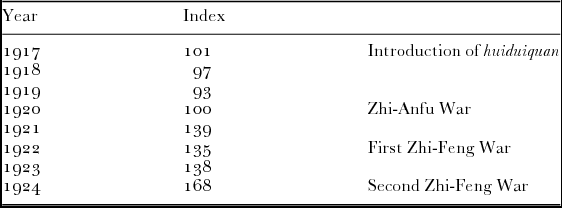
Soon after the introduction of the fengpiao in the late 1910s, Manchuria and China entered a period of political upheaval. This was reflected in, and led to, the fluctuation of the currency. There were intermittent falls and recoveries of the currency before and after the First and Second Zhili-Fengtian Wars, but the first significant fall occurred during the anti-Fengtian War which started in late 1925, when Sun Chuanfang attacked the Fengtian garrison in Jiangsu and Anhui. In October, the price of the fengpiao fell from around 160 yuan (fengpiao) to 200 yuan per 100 gold yen. In mid-December, when Guo Songling's troops were approaching Mukden, it reached the unprecedented low of 226 yuan.Footnote 31 After the rebellion, the fengpiao's price stood at around 200,Footnote 32 but gradually fell to 430 by the end of May.Footnote 33 At that time, the Fengtian forces had moved into North China again; Wang Yongjiang, the civilian governor who was seen as the man behind the Fengtian Clique's finance, resigned in protest at Zhang Zuolin's decision to continue the war. The fall in value continued, and at one point in July the price reached 573 yuan.Footnote 34 The expectation that the ‘impetuous warlords’ would mismanage the economy contributed to this fall.Footnote 35 Currency speculation was another cause: it was not until Zhang Zuolin imposed a fixed exchange rate and shot several currency exchange dealers working in the Leased Territory in August that the rapid fall was checked. After this, the price stabilized at 400 yuan by the end of the year (see Figure 1).
Monthly Average Exchange Rate between Fengpiao and 100 Gold Yen in Mukden, 1.1926–1.1927.
Source: Kantōchō zaimubu (1929). Tōsanshō kangingō ron (A Discussion on the Finance of the Eastern Three Provinces), slides 237–239.]

The depreciation of the fengpiao in 1926 supposedly had a very adverse effect on both the Chinese and the Japanese in Manchuria. Japanese businessmen believed that the shrinking of Chinese purchasing power would lead to a decline in Japanese exports to Manchuria.Footnote 36 However, Customs figures from the ports in South Manchuria (Dairen, Niuzhaung, Andong, and Harbin) show that there was a 13 per cent increase in imports, offsetting a slight decrease in the import of textile products.Footnote 37 As for the Chinese, the fall in the fengpiao's value in 1926 mainly affected the lives of those who received fixed wages, such as clerks, factory workers and soldiers. However, the number of strikes recorded did not increase.Footnote 38 In August, an imminent strike of the workers in the Mukden Arsenal was avoided when the authorities agreed to raise salaries by 20–30per cent; similar measures were introduced throughout Manchuria.Footnote 39 The soybean trade was little affected. Although the export of raw beans decreased from 54,204,000 HK tael in 1925 to 47,314,000 HK tael in 1926, this decrease was more than compensated for by an increase in the export of bean cakes and oil from 77,078,000 HK tael to 100,833,000 HK tael.Footnote 40
The impact of the fall in the first half of 1926 might have been limited, but the value of the fengpiao plummeted again towards the end of the year. This falling phase continued until April-May 1927 and witnessed a price drop from around 400 yuan in November 1926 to 600 yuan in January 1927, then from 600 yuan to 1,000 yuan from February to May. Unlike the fall in the previous year, which persisted throughout the summer, the fall at this point checked and remained stable. From 7 April to 4 December, the price was never outside the range of 800 yuan to 1,200 yuan and for most of the time it stayed around 1,000 (see Figure 2). After a brief panic following a northern defeat in late May, the military situation improved; when the Anguojun defeated Chiang Kai-shek in Xuzhou in August, the price rose to 800 yuan.Footnote 41 The relative stability of the north during the war was reflected in the price of the fengpiao. Nonetheless, as the northern army was defeated in Longtan, the fengpiao's price soon returned to 1000, and remained stable until December.Footnote 42
Daily Exchange Rate between Fengpiao and 100 Gold Yen in Mukden, 4/1/1927–29/12/1927.
Source: Sai Hōten sōryōji dairi Hachiya (1927). Hōhyō sōba nikansuru ken (A report on the fengpiao's exchange rate), 15/1/1927, GK, JACAR, B08060893600, slide 52; Yoshida sōryōji (1927). Hōtenhyō sōbahyō sōfu no ken (Attached chart on the fengpiao's exchange rate), 14/3/1927, GK, B08060893600, slides 87–92; Yoshida sōryōji (1927). Hōhyō sōba nikansuru ken (A report on the fengpiao's exchange rate), 22/4/1927, GK, JACAR, B08060893700, slides 138–141; Yoshida sōryōji (1927). Hōhyō sōba nikansuru ken, 8/6/1927, GK, JACAR, B08060893700, slides 162–164; Yoshida sōryōji (1927). Hōhyō sōba nikansuru ken, 4/7/1927, GK, JACAR, B08060893700, slides 165–167; Yoshida sōryōji (1927). Hōhyō sōba nikansuru ken, 5/8/1927, GK, JACAR, B08060893700, slides 167–169; Yoshida sōryōji (1927). Hōhyō sōba nikansuru ken, 6/9/1927, GK, JACAR, B08060893700, slides 175–178; Yoshida sōryōji (1927). Hōhyō sōba nikansuru ken, 5/10/1927, GK, JACAR, B08060893700, slides 191–194; Yoshida sōryōji (1927). Jūgatsu naka Hōhyō sōba nikansuru ken (A report on the fengpiao's exchange rate in October),” 5/11/1927, GK, JACAR, B08060893700, slides 198–200; Yoshida sōryōji (1927). Hōhyō sōba nikansuru ken, 12/12/1927, GK, JACAR, B08060893700, slides 202–204; Yoshida sōryōji (1927). Hōhyō sōba nikansuru ken, 22/4/1927, GK, JACAR, B08060893700, slides 138–141; Yoshida sōryōji (1927). Hōhyō sōba nikansuru ken, 16/1/1928, GK, JACAR, B08060893800, slides 235–237.]
As Keynes had predicted before the First World War, the printing of money in wartime might not immediately lead to uncontrollable inflation. Although the buying power of the fengpiao declined, the negative impact was offset by wage increases. By March 1927, commodity prices had increased by 222 per cent from early 1926, but the average wage of the workers had increased by 268 per cent.Footnote 43 It was not until early 1928 that the rise of commodity prices finally rose above those of wages.Footnote 44 However, although the currency remained ‘stable’ throughout 1927, it was only one-third of its previous year's value. As credit decreased, trade declined. From the Customs figures, the five major categories of imported goods (cotton textile, raw cotton, wheat flour, metal, and machinery) declined between 10 and 71 per cent. Imports from Japan declined, and exports became stagnated.Footnote 45 The population was unhappy about Zhang's handling of Manchuria's finances.Footnote 46 Nonetheless, compared with the severe economic dislocation in South and Central China and famine or near-famine in Hunan, Shandong, and northwestern China, the situation in Manchuria was considerably better. In August 1927, the British even noted a ‘slight improvement’ in the economic outlook.Footnote 47 Major John Magruder of the United States’ Army observed in November 1927:
Coming from the widespread pessimism among businessmen and officials in China Proper, which increases progressively as one goes south, one is immediately struck with the optimism among businessmen, foreign and Chinese, in Mukden. As to the prosperous conditions in Manchuria I heard of no dissenting voice. The atmosphere is infectious with high business adventure comparable to our own West. Even the Chinese masses on the streets look well nourished. Animals have replaced human transport, and the numerous cart animals are noticeably well fed. There is no unemployment in Manchuria [original underline]. The senseless inflation of the fengpiao is well known and causes immense difficulties to trade. Everybody condemns the fengpiao, but business thrives and men are prosperous in spite of this stupid device for financing Chang Tso-lin's military venture south of the Wall.Footnote 48
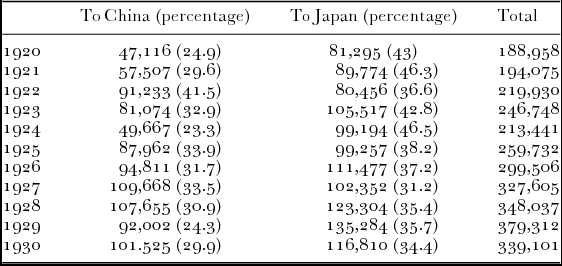
In contrast to the decline of trade with Japan, trade between China and Manchuria actually increased during these years despite the difficulties. Dependence on Japan declined from 1925 onwards. Trade figures suggested that whenever Manchuria was at peace with Beijing (or actually controlled it after 1927), the volume of trade between China and Manchuria increased (see Table A). Still, since Manchuria traded as much with Japan as with China, the war was not seen as one that could bring benefit to the business community. Because Zhang Zuolin failed to end the war in 1927, the economic situation in Manchuria began to deteriorate.
Manchuria's export to China and Japan, 1920–1930 (in thousand HK teal)
Source: Kantōchō zaimubu (1929), Tōsanshō kangingō ron, slides 237–239.
The real collapse of the fengpiao happened between December 1927 and early 1928, when the war was entering its final stage (see Figure 3). The first three exchange days in 1928 witnessed the fall of the currency from 1,360 yuan per 100 yen to an unprecedented low of 2,000 yuan: it then stayed at 2,000 for the rest of the month, and plunged to over 3,000 in early February.
Daily Exchange Rate between Fengpiao and 100 Gold Yen in Mukden, 1/12/1927–30/6/1928.
Source: Yoshida sōryōji (1928). Hōhyō sōba nikansuru ken, 16/1/1928, GK, JACAR, B08060893800, slides 235–237; Sai Hōten sōryōji dairi Hachiya (1928). Hōhyō sōba nikansuru ken, 17/2/1928, GK, JACAR, B08060893900, slides 336–338; Sai Hōten sōryōji dairi Hachiya (1928). Hōhyō sōba nikansuru ken, 13/3/1928, GK, JACAR, B08060893900, slides 372–374; Sai Hōten sōryōji dairi Hachiya (1928). Hōhyō sōba nikansuru ken, 13/4/1928, GK, JACAR, B08060893900, slides 402–405; Sai Hōten sōryōji dairi Hachiya (1928). Hōhyō sōba nikansuru ken, 10/5/1928, GK, JACAR, B08060894000, slides 423–426; Sai Hōten sōryōji dairi Hachiya (1928). Hōhyō sōba nikansuru ken, 12/6/1928, GK, JACAR, B08060894000, slides 430–433; Sai Hōten sōryōji dairi Hachiya (1928). Hōhyō sōba nikansuru ken, 9/7/1928, GK, JACAR, B08060894000, slides 451–454.
The impact of the collapse of the fengpiao in early 1928 on the lives of the Chinese in Manchuria was profound. This time, the sudden decline in purchasing power did not correspond with wage increases. Food prices tripled once more, but this time in less than a month (Figure 4).Footnote 49 People refused to use the fengpiao for daily transactions and turned either to the yinyuan or gold yen, both of which were forbidden by the government for transactions.Footnote 50 With limited credit, trade was brought to a halt.Footnote 51 As many as 700 shops, most of them small businesses, went bankrupt between January and February, and as many as 5,000 shops suspended their businesses.Footnote 52 Most importantly, this time the peasants could not bear the fall. In early 1928 it had a limited effect on large enterprises as they had stockpiled yinyuan or gold yen beforehand, but small businesses and peasants had little means to weather the storm.Footnote 53 Rural unrest became more apparent from January onwards, and the Small Sword Society (xiaodaohui) emerged.Footnote 54 The most serious incident of all was the mutiny of a company of Heilongjiang cavalrymen in March because of the drastic fall in their real wages.Footnote 55 These disturbances were not serious enough to bring down the Mukden regime, but they certainly undermined Zhang's claim to be a stabilizing force in North China and Manchuria.
Daily Exchange Rate between Fengpiao and 100 Gold Yen in Mukden, 4/12/1926–30/6/1928. Source: See Figures 1–3 above.
In sum, the fengpiao experienced four slumps: January–August 1926, December–April 1927, December–February 1928, and throughout the first half of 1929 (Figure 4). Although in general the fengpiao was undoubtedly falling, it was not a continuous fall. A similar pattern can also be identified in the falls during these years. Major falls started at the end of each year, and then the price would stabilize throughout the following year. This suggests that Mukden's measures to control the price of the currency did not fail entirely. This pattern also had much to do with the trade pattern of Manchuria and with Mukden's financial mobilization for war to be discussed below.
Financial limitations faced by the Fengtian Clique
The fall of the fengpiao has been attributed to the ‘unrestricted issuing’ (lanfa in Chinese, ranhatsu in Japanese), which became a catchphrase for the misrule of warlords. However, few looked at the financial situation faced by Zhang Zuolin and the Fengtian Clique before the war. It was because those who studied the issue, including many contemporaries, assumed that without Zhang's military build up and his ventures in ‘China Proper’, a healthy economy could be built in Manchuria. This view was famously held by the governor of Fengtian, Wang Yongjiang, who argued that Manchuria should dissociate itself from China Proper and concentrate on economic development.Footnote 56 This section argues that such a view wrongly detached the economic issue from political and international relations and that it was the difficult financial situation in Manchuria that prompted Zhang to seek more revenue from outside.
Limited internal revenue and high expenditure
To deal with internal and external threats, the Fengtian Clique had to maintain a high level of military build-up that Manchuria and the area under the north's control found difficult to sustain. It was unrealistic to discount the threats and focus on economic development: for example, in late 1925, one of the Fengtian generals, Guo Songling, allied with the warlord Feng Yuxiang and invaded Manchuria; during the war, the Soviets aided both Feng and Guo and threatened North Manchuria.
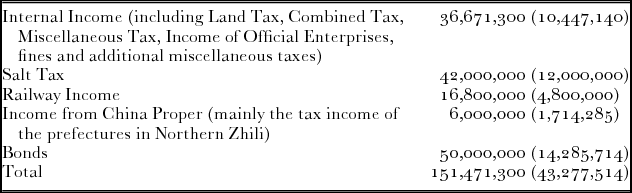
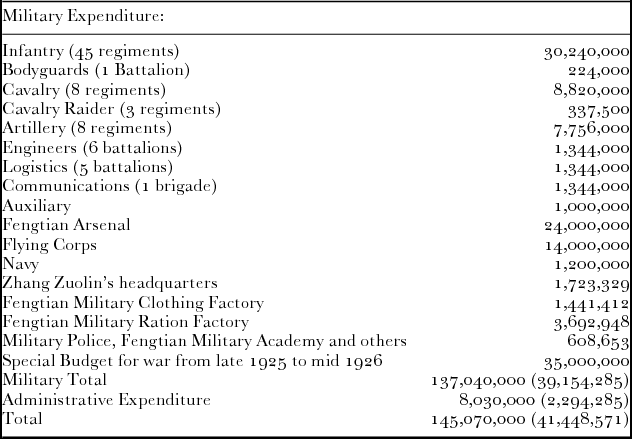
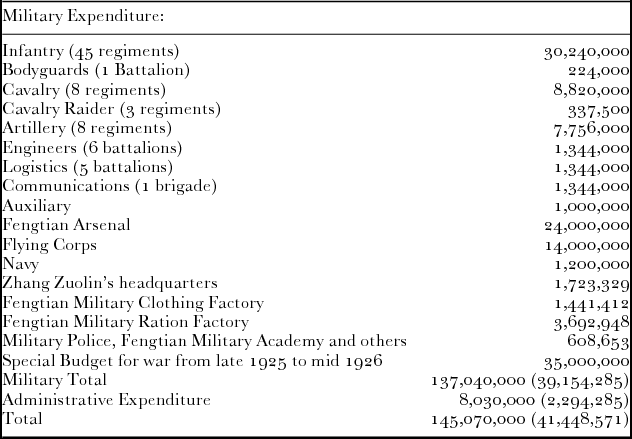
Obtaining precise figures for the revenue of Manchuria is difficult as Mukden's budget was kept secret after 1923.Footnote 57 Moreover, most of the statistics were recorded in fengpiao, which witnessed a drastic fall throughout this period. Based on multiple sources and rough evaluations, the Financial Section of the Kwantung Territory authority estimated the regular income of the Fengtian Province in 1926 as 101.47 million fengpiao, or 29 million yinyuan using the exchange rate of October-November 1926 (1:3.5). Another 50 million should be added as the Fengtian Clique issued a bond to ‘recollect’ fengpiao. The total income of the Fengtian province was 151,471,300 fengpiao, or 43,277,514 yinyuan (Table B). The estimated expenditure, including the wars in 1925 and Guo Songling's rebellion, was 145.07 million fengpiao or, 41.45 million yinyuan (Table C).Footnote 58
Estimated Annual Income of Fengtian Province, 1926 in fengpiao and yinyuan (blanket, exchange rate 1 yinyuan to 3.5 fengpiao)
Source: Kantōchō zaimubu (Financial Section, Kwantung Leased Territory) (1927). Hōtenshō zaisei no genjō (The Current State of Fengtian Province's Finance), 3/1927, GK, JACAR, B02031788000, slides 12–32.
Estimated Annual Expenditure of Fengtian Province, 1926 in fengpiao and yinyuan (blanket, exchange rate 1 yinyuan to 3.5 fengpiao)
Source: Kantōchō zaimubu (Financial Section, Kwantung Leased Territory) (1927). Hōtenshō zaisei no genjō (The Current State of Fengtian Province's Finance), 3/1927, GK, JACAR, B02031788000, slides 12–32.
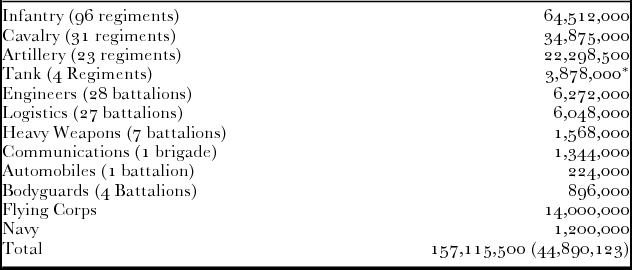
The statistics of the State Bank show that its total draft for military expenditure in 1926 was considerably larger, between 52 and 73.6 million yinyuan.Footnote 59 The figure for 1927 was between 581 million and 1.2 billion fengpiao, or 93 to 193 million yinyuan. Since the end of the year debt was much smaller than the total processed drafts, much of the draft during the year of 1927 was repaid, particularly those pertaining to the Arsenal.Footnote 60 According to the figure presented by the Financial Reorganization Committee in 1929, the military expenditure of the province in 1927 was 663 million fengpiao (87.4 per cent of the total expenditure), or 106 million yinyuan.Footnote 61 The yearly upkeep of the Fengtian forces in China (including the Jilin and Heilongjiang contingents) was around 45 million yinyuan, almost the same as the income of the entire Fengtian Province in 1927 (Table D). The rest of the military spending went to the Fengtian forces staying in Manchuria, the Mukden Arsenal (spending between 7 to 55 million yinyuan, close to the latter figure), the Anguojun's navy, Beijing's Metropolitan Police and Gendarmes, and Zhang's allies in China.Footnote 62 As a result, the debt increased steadily from 274 million to 1.1 billion fengpiao between March 1926 and January 1928.Footnote 63 This figure should be viewed with caution as it does not take into account the fall of the fengpiao. In sum, it is safe to conclude that in late 1927 the military expenditure of Fengtian Province at least doubled after early 1926, and Mukden was able to cover less than half the cost of the war by its normal income.
Estimated Expenditure of the Fengtian Field Forces in China based on its strength in November 1927 in fengpiao and yinyuan (blanket, exchange rate 1 yinyuan to 3.5 fengpiao)
Source: ‘Hoku Shina guntai chōsa ni ken (Investigation of the Northern Chinese Army)’, 20/1/1928, JACAR, C01007465200, slides 20–31.
* The expenditure of tank regiment unknown; each regiment currently counted as the same as an artillery regiment. The Japanese report only suggested that the tanks costed “several million fengpiao” but did not provide exact figure.
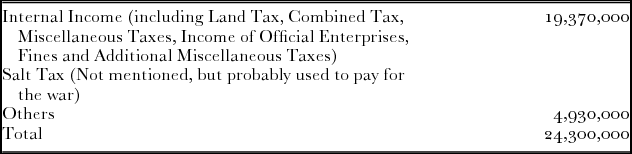
The exact military expenditure on the entire Anguojun is almost impossible to estimate since the records are patchy. The other two provinces in Manchuria were much smaller and less committed to the war: Jilin's annual income in 1929 was 18.8 million yinyuan, whereas its military expenditure was 10 million; military spending in 1929 was probably lower than the previous two years. In Heilongjiang, annual military expenditure was 6.3 million Harbin dayang (hadayang) in 1926.Footnote 64 In contrast, Shandong was overburdened (Table E). The income of Shandong between April 1926 and March 1927 was 24 million yinyuan, but 20 millions were spent on the war.Footnote 65 In comparison, the South was financially better off as the southern provinces were far richer. The Guangdong province alone was able to yield 79.2 million yinyuan between November 1925 and October 1926.Footnote 66
Annual Income of the Shandong Province, April 1926 to March 1927 in yinyuan
Source: Sai Sainan sōryōji Fujita (1927). Santōshō zaisei jōkyō hōkoku no ken, 10/6/1927, GK, JACAR, B02031840700, slides 138–139.
Decline of the value of silver
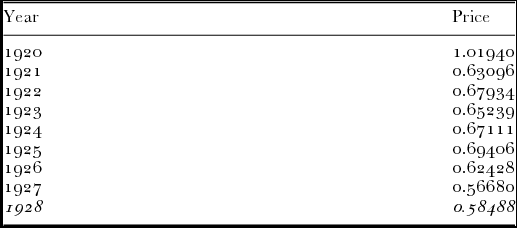
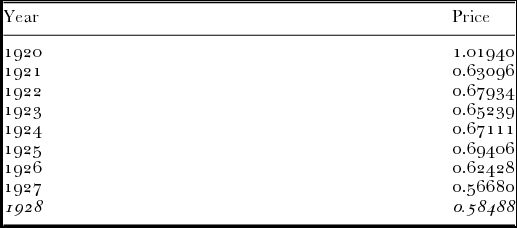
Since the fengpiao was convertible in theory, its exchange rate with gold-based currencies such as the Bank of Korea's yen was affected by the international silver price, which steadily declined after the First World War. Backed by silver, the fengpiao's value was unusually high when it was introduced as a result of the high silver price during the First World War.Footnote 67 Thus, its value stood on a par with the gold yen in the first few years of its circulation (Tables F and G):
Yearly Average exchange rate between kinds of fengpiao and 100 gold yen, 1914–1924
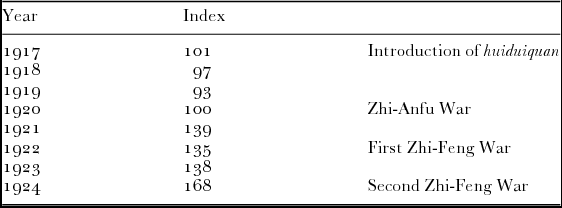
Year Average Silver Price in New York, 1920–1928 (US Dollar per 1 oz)
Source: Nishimura Shigeō, Kindai Nippon niokeru tai manshū tōshi no kenkyū (A Study on the Regional History of Modern Northeast China), p. 154.
After the war, the silver price dropped, and consequently so did the exchange rate of the fengpiao. The silver price fell around 30 per cent from 1919 to 1920, and continued to decline throughout the 1920s. This partly explains the depreciation of the fengpiao between 1920 and 1930. Although the silver price remained stable from 1921 to 1925, it fell by 40 per cent from August 1925 to August 1926, the period when the fengpiao experienced its first crisis of confidence.Footnote 68 Thus, besides the anti-Fengtian War, the fall in the price of silver was another cause for the fall of the fengpiao during 1925–1926.
Foreign presence and their financial policies in Manchuria
Foreign presence in Manchuria, particularly Japanese activities, inevitably affected the fengpiao. When its valuedropped rapidly after 1926, the Japanese in Manchuria encouraged the use of gold yen. As early as mid 1926, the Consul General of Fengtian, Yoshida Shigeru, openly claimed that it had already lost any credibility.Footnote 69 The Japanese Chamber of Commerce in Fengtian was a strong advocate of a positive policy in Manchuria as well as of the use of gold yen.Footnote 70 In 1927, the Japanese Chamber of Commerce of Manchuria urged the Japanese government to establish a central bank in Manchuria.Footnote 71 The Japanese currencies undoubtedly weakened the authority of the fengpiao as they provided readily available replacements. As Governor Liu Shangqing complained to the British Minister to China, Sir Miles Lampson, the reason why the fengpiao could not recover like the Franc was because the French did not have to deal with a competing currency like the gold yen.Footnote 72 The Chinese accused the Japanese of circulating rumours to undermine the stability of the fengpiao and of engaging in speculation.Footnote 73 During this period, currency speculation was rampant, particularly after Japan had issued the Earthquake Bonds; much of this money went into speculation in Manchuria and Shanghai.Footnote 74
The fengpiao issue was also closely linked to the reorganization of international finance during the 1920s. As the United States became the largest creditor and holder of gold specie after the First World War, American financiers, such as Thomas Lamont, were determined to take advantage of their situation to restructure international finance. Japan too, benefited from the Great War, and financial bureaucrats such as Inoue Junnosuke wanted to emulate the Americans in East Asia and tried to use Japan's gold reserve to expand Japanese influence in China. In 1919, the Finance Minister Takahashi Korekiyo envisaged a plan of lending a gigantic loan of 500–600 million yen to China to dominate the country economically.Footnote 75 The plan did not materialize because of the post-war financial situation, but the plan was not entirely abandoned.
In late 1926, a similar idea on a smaller scale was put forward and endorsed by diplomats, such as Yoshida Shigeru and Kimura Eiichi, the head of the Asia Bureau of the Foreign Ministry. Similar to J. P. Morgan's scheme in the European countries such as Italy, the Japanese would lend money to the Chinese to reorganize their finance. In exchange, a central bank would be established in Manchuria ‘with Japanese involvement’ and Japanese financial experts would participate in the reform.Footnote 76 Zhang Zuolin rejected the plan, as he feared this would facilitate more Japanese influence in Manchuria.
Japan's intermittent attempts to return to the Gold Standard also affected the financial stability of Manchuria. As a result, from 1924 to late 1925 the value of the Japanese Yen increased by 25 per cent, and continued to rise throughout 1926.Footnote 77 As the gold yen issued by the Bank of Korea were converted to Japanese Yen in Dairen on a 1 to 1 basis,Footnote 78 the rise of the Japanese yen inevitably contributed to the fall of the fengpiao. Japan's exports to Manchuria suffered as a result of the government's strong-yen policy, which in turn exacerbated the banks’ bad debt problem since the enterprises were losing money. This resulting financial disruption threatened to burst the economic bubble built up in Manchuria during the First World War and explained the eagerness of the Japanese in Manchuria to replace the fengpiao with Japanese currencies.
After all, the Japanese and Russian presence deprived the Manchurian authority of a large part of the income that could have been used to stabilize the fengpiao. Zhang Zuolin could not tap the revenue of the South Manchuria Railway and Chinese Eastern Railway, tax the Japanese businesses in the railway zone, or raise loans from Dairen's Customs revenues. He could not effectively punish the speculators who found refuge in the railway zone; Chinese businessmen also set up branches in the railway zones in order to evade taxes.Footnote 79 Despite Mukden's continuous urge to close it, the Japanese exchange house in the railway zone became a hub of currency speculation, with its volume of trade exceeding a million yuan a day.Footnote 80 Although the Fengtian Clique expected to use the Customs surtax income to stabilize the fengpiao, this was never available (discussed in detail below).Footnote 81 Unlike the Kuomintang in the South, it was impossible for Zhang to take overt action against Japan or Russia, which were both willing and able completely to take over Manchuria. Although it was difficult to substantiate the Chinese accusation that the Japanese had systematically plotted to bring down the fengpiao, the very fact that Japanese currencies were circulated in Manchuria had certainly undermined the people's confidence in the fengpiao.
The Fengtian Clique's attempts to overcome financial difficulties
In the face of a volatile financial situation that the Fengtian Clique could hardly control, Zhang Zuolin attempted to increase tax revenue in Manchuria, issue internal bonds, borrow internationally, and to seize areas and institutions that had a steady income. In essence, Zhang risked the stability of the fengpiao to support a war that had the potential to solve his financial problems in Beijing and Manchuria. In the second half of 1927, Mukden was close to success, but the failure to end the war forced it to continue a policy that was detrimental to the confidence in the fengpiao. Despite the difficulties, however, the Northern Coalition financial mobilization worked until early 1928.
Issuing fengpiao
Narratives on the fengpiao usually focused on ‘the problem of unrestricted issuing’; some even suggesting that it was the ‘worst example of inconvertible notes’.Footnote 82 There was no consensus among contemporaries as to how many fengpiao were actually issued during these years. In March 1926, the head of the Bank of Korea reported to Tokyo that there were as many as 400 million fengpiao being circulated after Guo Songling's rebellion, compared with less than 200 million the previous year.Footnote 83 He had no concrete proof of his estimation except his distrust towards the Chinese official statistics. Contemporary estimations based on exchange rate, issue number on the banknotes, and the projected expenditure of the provincial government produced figures from 300 million to a staggering 2.8 billion between 1925 and 1928.Footnote 84
According to the statistics obtained from the Eastern Three Provinces State Bank, the Financial Section of the Kwantung Leased Territory confirmed in 1929 that the actual amount of fengpiao issued was much less than was estimated between 1926 and 1928, especially in 1926. Whereas the head of the Bank of Korea claimed that the Chinese had issued over 400 million, the Financial Section quoted a figure of 181 million. The Financial Reorganization Committee of the Eastern Three Provinces (dongsansheng caizheng zhengli weiyuanhui), organized by the Chinese in 1929 to settle the fengpiao issue, suggested a slightly higher figure (208 million in March 1926).Footnote 85 The same committee suggested that the amount of fengpiao issued by the State Bank reached 325 million in January 1927.Footnote 86 Whilst the Kwantung Government stated 338 million as the figure for the end of 1927, the Reorganization Committee's figure for January 1928 was 470 million. The disparity could only be explained by the increase of the fengpiao issued by the end of each year; this largely matched the pattern of the fall of the fengpiao presented above.
Although it can be safely assumed that the printing of the fengpiao was the cause of its fall, it does not entirely explain the persistent fall in the summer of 1926, the rise and fall during a large part of 1927, its general downward trend since the early 1920s, and the intense fluctuations overall during this period. The relationship between the fengpiao's printing and Mukden's financial mobilization for the war also needs to be clarified.
Increasing tax and manipulating currencies
To sustain the war, the Fengtian Clique employed various ways to raise money in the area under its control. In Manchuria, the proportion of composition tax (tax other than land tax) in Fengtian Province's revenue increased from 41 per cent in 1925 to 64.8 per cent in 1927, showing a large increase in taxation on goods and services.Footnote 87 In late 1927, Mukden even abandoned the ban on opium in the Three Provinces and Rehe.Footnote 88
The allegation that the northern warlords simply printed money to pay for the war was not without substance. As early as in the Zhili-Anfu War in 1920, Fengtian troops carried with them new banknotes specially to be used outside Manchuria.Footnote 89 Since these notes could not be used in Manchuria and its exchange with yinyuan was limited, they had little impact on the value of the fengpiao (huiduiquan). Still, their issue undoubtedly affected the overall confidence in the fengpiao and stained the image of the Fengtian warlords.
As the warlords clearly understood the damage of these ad hoc measures to their reputation, they made considerable efforts to reclaim these notes. Since military scrip was unwelcome to civilians and soldiers alike, the idea of printing them to cover the cost of war was not feasible. The warlords only saw military scrip as an emergency measure and a necessary evil to shift the cost of war to the neighbouring provinces. Throughout 1926, Zhang Zongchang re-collected and burned much of the military scrip circulating in Zhili and Shandong; the Fengtian forces also had to allow the exchange of fengpiao in order not to alienate the population.Footnote 90 However, military scrip was never abandoned as there were no alternatives. For example, when Zhang Zongchang reinforced Sun Chuanfang in Jiangsu in late 1926, 10 million yuan in military notes were issued.Footnote 91
To an extent, Zhang Zuolin's subordinates in Zhili and Shandong did see money-printing as a means to cover the cost of the war. Zhang Zongchang had issued over 23 million banknotes of the Shandong Provincial Bank by mid-1927, and he issued another 15 million bonds.Footnote 92 As these currencies were more sensitive to the changing military situation, their collapse was as much the result of the political-military failure of the northern warlords as it was of over-printing. When Shandong was largely cleared of National Revolutionar Army and Kuominchun troops in September 1927, the price of the Shandong banknotes was almost on a par with yinyuan.Footnote 93 When the military situation deteriorated again in early 1928, the price suddenly decreased by 60 per cent, effectively bringing an end to their value in commercial activities.Footnote 94
Although the Fengtian Clique was also compelled to print money to ease its financial problem, the scheme was carried out carefully to maximize gain and minimize economic disruption. The practice of using the bean trade to fund the war and stabilize the fengpiao started as early as 1920 and increased significantly between 1926 and 1929.Footnote 95 By the end of each year, the State Bank printed new banknotes to buy future produce from the peasants through both official and private dealers, who in turn sold the produce to Japanese exporters in Dairen in exchange for Bank of Korea gold yen, yinyuan or YSB silver notes. Mukden then used the revenue to pay for the war or to re-collect the depreciated fengpiao. For example, from mid January to early March 1927, Mukden allowed an exchange of fengpiao, yinyuan and gold yen on a limited scale, and this immediately led to a rise in the price of fengpiao.Footnote 96 However, as only part of the revenue was used to stabilize the fengpiao and the rest went to Zhang's war chest, the fall continued.Footnote 97
By issuing new notes, manipulating commodity trade in Manchuria, and allowing controlled depreciation, Mukden was levying a kind of indirect tax from the Chinese in Manchuria. This method also allowed the state to expand its control over the economy through the State Bank. Mukden's measures also forced the Japanese to pay for its war as long as they needed raw material from Manchuria. Unlike the British during the American Civil War, who found an alternative source of cotton to those of the Confederate States, the Japanese could not find an alternative source of soybean. Even the Japanese observers from the Financial Department of the Kwantung Bureau (Kantōchō) admitted that Mukden's method was ‘rational’ and ‘effective’.Footnote 98 In fact, the Fengtian leaders had little choice—blindly printing money or forcing the banking community to accept bonds would have backfired. It was impossible for Zhang to cover his debts by printing money even if he wanted, as the people in Manchuria could switch to other currencies, as they had done in 1928 despite the government's threat of punishment.
Throughout the war, Mukden tried to control the fall of the fengpiao by measures ranging from raising bonds to executing speculators. When the fengpiao fell substantially in 1926, Mukden blamed the ‘speculators’ operating in the South Manchuria Railway zone and had several of them arrested and shot. This move soured Mukden-Tokyo relations; Japanese Consulate-General in Mukden, Yoshida Shigeru, accused Zhang of perpetuating ‘Terrorism’.Footnote 99 Zhang also issued a bond of 50 million in mid 1926 in Manchuria, ostensibly in order to ‘reorganize’ the fengpiao. Although 70 per cent of the bonds were purchased (many under compulsion), a large portion of the funds collected was used to fund war.Footnote 100 The government also forbade the use of yinyuan and gold yen for transactions and private exchange, but the Japanese, who believed that the Chinese were trying to drive their currency out of Manchuria, opposed the ban.Footnote 101
In late 1927 to early 1928, fengpiao was sacrificed in a gamble to achieve the grand-strategic goal of the Fengtian Clique, when the Fengtian leadership tried to muster all available resources for the campaign of 1928. Their confidence in their ability to obtain money from China Proper was shown by Zhang's promise in February 1928 to limit Fengtian Province's military expenditure to 30 million yinyuan (one-third of the figure in 1927), or 50 million yinyuan in total for the Eastern Three Provinces. Zhang also promised to detach Manchuria financially from North China, as he expected that if the 1928 campaign were successful, the Beijing Government would thereafter be able to hold its own.Footnote 102
Thus, from late 1927 to early 1928, Mukden again used the fengpiao to mobilize the provinces’ resources for war. In January 1928, the government even decreed the use of yinyuan in tax collection, a move that signed the death warrant of the fengpiao. Mukden also abandoned the exchange control between yinyuan and fengpiao in Tianjin. They started to sell fengpiao in bulk by the end of 1927 in order to extract any single yinyuan or gold yen they could gather to pay for the 1928 Offensive.Footnote 103 It was these measures that led to the collapse of the fengpiao in January-February 1928. During the collapse, even the staff of the State Bank and officials engaged in speculative trading of the currency. Since people were expecting the fengpiao to fall, they first sold those in their possession then bought more from the futures market. As the futures price of the fengpiao fell further, the collapse became irreversible.Footnote 104 Still, Mukden had not yet abandoned the fengpiao, probably fearing widespread social unrest. In January 1928, the governor of Fengtian Liu Shangqing told the British of his determination to maintain the fengpiao and asked them for loans to stabilize it.Footnote 105
Issuing bonds or borrowing
Another option for the Fengtian leaders was to issue internal bonds in Beijing, but it was no easier than raising money in Manchuria. When Wu Peifu and Zhang Zuolin took Beijing in early 1926, he expected to obtain internal and external loans to maintain the central government and end the civil war. Instead of acquiring loans, however, he inherited the government's previous debts and a bad credit history.Footnote 106 Even before the Fengtian Clique was in control of Beijing, the Chinese banking community had been unwilling to service any loans or bonds issued by the Beijing Government. This also had much to do with the manager of the Bank of China Zhang Jia-ao (Chang Kia-ngao). Zhang came from a wealthy family in Jiangsu. He was educated in Japan before serving in the Bank from 1915. Armed with modern banking knowledge and connections in the banking circle, he became politically powerful. Through Huang Fu, who played an important role in linking Chiang Kai-shek and the Japanese, Zhang turned to Chiang and financed his Northern Expedition.Footnote 107
The Chinese Maritime Customs Service was also increasingly unwilling to cooperate with Beijing. A report submitted in 1927 by Leonard Arthur Lyall, the Inspector of Customs in Shanghai from 1919 to 1925, represented the Service's view. Lyall complained that the Inspector General Sir Francis Aglen:
by giving his guarantee for the repayment of internal loans secured on the revenue, [Aglen] has enabled the Peking Government to use for its own purposes not only the current year's revenue, but also the revenue that will be collected by the Customs throughout China for some years to come.Footnote 108
He believed that the loans only brought more wars to China:
[the] vast majority of the money borrowed has not been spent on any useful object. Much of it has been wasted, and much more has been spenton armaments, which have been employed in civil war generally, and inattempting to conquer South China in particular [original highlights].Footnote 109
Working in Shanghai throughout his career, Lyall held a very low opinion of the Beijing Government. He wrote:
this Government has, for a number of years, been undeserving of any credit, and has used its credit merely to enrich its friends and promote civil war, [and] the improvement of its credit has not been a benefit to China.Footnote 110
This view was shared by other staff in the Customs Service. To preserve China's credit rather than the Beijing Government's, Aglen was determined not to allow the Chinese government to set up new loans, internal or foreign, with Customs revenue.Footnote 111 In late 1926, Aglen refused to ratify the cheque signed by Pan Fu, the new Minister of Finance.Footnote 112 When he rejected Pan's proposed loan to pay the interest of the 96 million Bond, its price fell substantially, causing a small financial panic in Beijing and further undermined the authority of the Beijing Government.Footnote 113
Thus, when Premier Wellington Koo proposed to arrange a new internal loan in the summer of 1926, it was opposed by both the Customs Service and Zhang Jia-ao.Footnote 114 In early September, another proposed bond issue was axed by the Customs Service, which argued that the Beijing Government was beyond any hope of revival.Footnote 115 The Chinese banking community in Beijing was equally uncooperative. When Koo met the head of the Chinese banks to discuss a loan of two to three million yuan for the Mid-Autumn Festival after the failed attempt to issue bonds, the bankers refused, saying they could only offer 500,000.Footnote 116 Still, the bank refused to pay when the metropolitan garrison went to the Bank of China with the cheque issued by the government, on the pretext that the contract between the bank and the government had not been signed. According to Koo, the Bank of China breached convention, which was that of signing the contract after money had been paid. This almost led to a mutiny, and was resolved only because Koo had previously arranged another loan with an American bank.Footnote 117
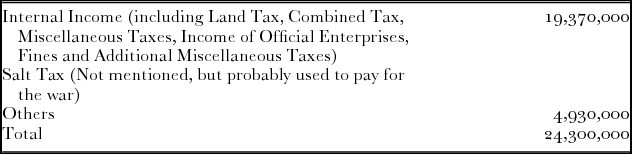
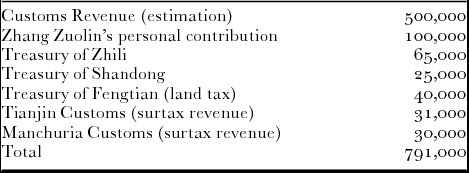
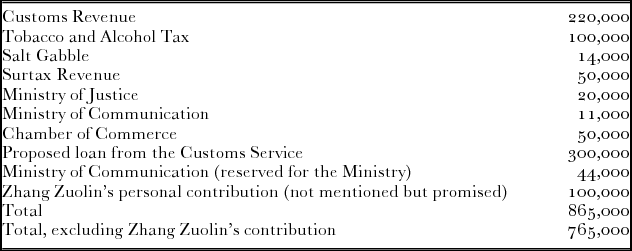
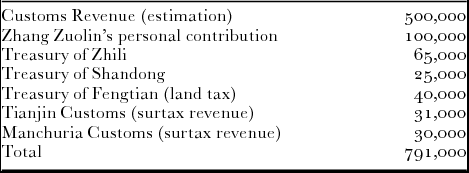
Zhang Zuolin's attempt to seek foreign loans also met with little success. He first approached the Japanese for a loan in late 1926, but he abstained from borrowing from the Japanese because they demanded that he stop his campaigns in China.Footnote 118 When Yang Yuting approached the British in November 1927, the British Minister to China Sir Miles Lampson told him that it was possible, but only when the North was able to end the war with the Kuomintang.Footnote 119 Without new sources of revenue and foreign support, throughout the period when the Fengtian Clique controlled Beijing, it was unable to raise any internal or external bonds and had to rely on its Customs and Salt revenues (which could not be used as collateral for loans), tax income from the area under Anguojun's control (which were mostly used for military purposes), and Zhang Zuolin's own contributions (see Tables H and I).
Income of the Beijing Government, July 1927 (in yinyuan)
Source: SR, 21/6/1927.
Income of the Beijing Government, April 1928 (in yinyuan)
Source: SR, 29/4/1928.
The Customs Surtax
The source of revenue that the Anguojun leaders saw as the life saving straw was the Customs Surtax. Its origin was the Powers’ decision to fix China's tariff through the unequal treaties acts during the nineteenth century. After the establishment of the Republic in 1912, restoring tariff autonomy had been a major diplomatic objective of successive governments in Beijing.Footnote 120 During the Washington Conference in 1921, it was agreed that after the signatories ratified the Nine Power Pact, a Tariff Conference would be held to discuss the Chinese tariff issue. Nonetheless, the conference was delayed by the ‘gold franc’ dispute, which was solved after the Chinese accepted the French demand in 1925.Footnote 121 After three invitations, the Tariff Conference was finally scheduled to be held on 26 October in Beijing .Footnote 122 Although subsequent wars in North China brought the Tariff Conference to a halt, it was agreed that China would have full tariff autonomy in 1929, and before that China could collect a surtax of 2.5 per cent of the value of the imported goods. The conference was supported by America and Japan, who both wanted to use the new surtax to secure their loans such as the gigantic Nishihara Loan.Footnote 123 On the other hand, the British wanted to stop the Conference, and withdrew their representatives in April 1925.Footnote 124 Aglen supported the postponement, and suggested to the Customs office in London that Britain could use the seizure of the salt revenue in Tianjin by Zhang Zuolin's forces as an excuse to postpone the Conference indefinitely.Footnote 125
When the Beijing Government was seemingly about to collapse in late 1926, the only objective of Aglen and his second-in-command, Edwardes, was the preservation of the Customs Service, but both found it increasingly difficult to do this as the Powers, including Britain, were no longer willing to back the Service with force. Alarmed by the Kuomintang's decision to collect the surtax, Aglen urged the Powers to protect the Service by stressing its importance in maintaining trade and servicing foreign loans.Footnote 126 Aglen argued that the Service could ‘weather any political changes that may come’ if the Powers were willing to act.Footnote 127 He threatened the British Government with a possible Japanese takeover of the Service, and in December even wanted to mobilize the press in Britain to pressure the Foreign Office to take action to protect the Service.Footnote 128
As the support of the Powers was unavailable, Aglen adopted an ‘opportunistic’ attitude as Chen Shiqi put it.Footnote 129 When the Kuomintang appeared to be winning and was determined to collect the surtax by itself, he was ready to compromise in order to protect the Service's position. In mid-November, he asked the Foreign Office for support in working out a solution that would ‘regularize new taxation and enable Maritime Customs to function in connexion with it if Powers determined not to resist’.Footnote 130 As Hankow had fallen to the National Revolutionary Army and the fall of Shanghai was probable, the British government also became more conciliatory towards the Kuomintang. Aglen, still officially an employee of the Beijing Government, supported the move. In a telegraph to the Foreign Office, he suggested that:
[the]opinion of [the] Chinese here interested in maintaining stability and avoiding catastrophe is that [a] more defined form of recognition of [the] Nationalist Government by Foreign Powers [is] inevitable in [the] near future and that meanwhile contact other than through Canton Consular representatives [is] very desirable.
He also argued that Britain's recognition of the Kuomintang government would ease the ‘inferiority complex’ of the Kuomintang and make them more conciliatory.Footnote 131
Perhaps to justify his turn to the South, Aglen became increasingly critical of the northern government. In early December, he cabled London that ‘[the] so called [Beijing] Government [is] approaching collapse and I believe Japanese recognition of South [is] imminent.’Footnote 132 He also argued that his refusal to remit the revenue of the surtax to the Beijing Government was an ‘impartial’ act that placed the Service above politics.Footnote 133 By then, Aglen was determined to preserve the Service by working with the Kuomintang government. Although it is difficult to evaluate how much the Customs Service affected Britain's attitude towards the situation in China, both shared the same idea that they had to work with the Kuomintang to protect their interests in China.
After using strike action to force the Powers to allow it to collect the surtax, the Kuomintang threatened to dismantle the Customs Service to paralyse the Beijing Government. In December 1926, the Nationalist's Foreign Minister, Eugene Chen, told Aglen that if the Services complied with Beijing's instruction to collect the surtax, it might lead to a ‘disruptive effect on [the] Service’. Anxious to protect the Service, Aglen accepted Chen's demand once the Kuomintang promised to leave the Customs Service alone. In the same telegraph, to justify his action, Aglen noted that ‘Chang Tso-lin [Zhang Zuolin] here [is] trying to galvanise [the] Government into [a] semblance of reality but unless he can produce funds there will be no real change’.Footnote 134 This attitude partly undermined Zhang's efforts to raise money in Beijing.
When the Beijing Government decided to collect the Customs surtax in the area under its control in early 1927, the north was controlling Shanghai, Tianjin, and other major ports in Shandong and Manchuria. Thus, Zhang was in an equal, if not better, position to threaten to dismantle the Customs Service. However, Beijing was unwilling to act unilaterally, as Zhang Zuolin wanted to present his approach as an alternative to the Kuomintang's ‘revolutionary diplomacy’ to enlist external support. Whilst Beijing was planning to issue a bond secured by the surtax revenue, Aglen was in Hankow, seeking an understanding with the Kuomintang. Supported by Zhang Jia-ao, Aglen ignored Beijing's order to return.Footnote 135 Aglen was in a difficult position. On the one hand, Beijing was determined to collect the surtax.Footnote 136 On the other hand, Eugene Chen threatened to dismantle the Customs Services if the Service collected the surtax for the Beijing Government.Footnote 137 As Aglen did not follow Beijing's order, he was dismissed by Premier Wellington Koo on 1 February. The Diplomatic Corps was astonished by the dismissal and urged Koo to retract his order.Footnote 138 Koo refused, and was backed by the public who opposed foreign intervention in what was seen as an internal affair of the Chinese government.Footnote 139 The British Minister, Sir Miles Lampson, tried to force Koo to retract his order by preventing Edwardes from assuming Aglen's post, but backed down when Beijing threatened to appoint Frederick Maze, the inspector of Shanghai, as Aglen's successor.Footnote 140 The dispute was temporarily solved when Beijing granted Aglen a one-year sick-leave instead of dismissing him.
Throughout 1927, the Japanese and the Customs Service tried to sabotage the North's attempt to collect the surtax. In early February, the acting Inspector General Edwardes ordered the inspectors in the northern ports not to collect the surtax despite Beijing's order.Footnote 141 The Japanese government claimed the surtax was a violation of the Washington Treaty of 1921.Footnote 142 In Februray, the Japanese Minister to China, Yoshizawa Kenkichi, declared that Japan opposed the collection of the surtax no matter how it was collected, and called for a new Tariff Conference.Footnote 143 This Japanese opposition delayed the collection of surtax in the north. Among the major ports in the north, Andong and Harbin started to collect surtax in April, and Fengtian in May.Footnote 144
As the Japanese dominated the trade which was conducted in North China and Manchuria, Japanese resistance against the surtax was fatal. Although leaders of the Fengtian Clique expected that the surtax would enable them to stabilize the currency and fund the war in mid 1927, they were to be disappointed.Footnote 145 Since then, the fall of the fengpiao had become more difficult to reverse. Japanese opposition persisted throughout the war. In January 1928, the Clique tried to persuade the Japanese to cooperate on the surtax issue in exchange for a new Japanese consulate in Maoershan, but they refused.Footnote 146
The military situation also made it difficult for the North to collect the surtax. After the loss of Nanjing and Shanghai in March, the North could not claim a larger share of the surtax revenue.
Financial collapse of the Fengtian Clique
The loss of Shanghai and the north's failure to retake it decided the outcome of the financial contest between the Kuomintang and the northern warlords. In late 1927, the situation was similar to that of 1911, when the Southern forces were in control of most of the commercially developed areas in South China. However, the South's control was more complete in 1927, as Wuhan was also in the Kuomintang camp. It was a major reason for the Powers, in particular Britain, to turn to the South. In 1911, when the North and the South were negotiating peace, the British Minister to China, Sir Arthur Jordan, suggested that Britain could not ignore southern opinion because they controlled the area where British commercial interests were prominent. The German Minister, von Haxthausen, went further and suggested that Britain's China policy was driven by the commercial interest in Shanghai.Footnote 147 The South's better financial position in late 1927 was reflected by its ability to borrow: in September, the Beijing Government could only issue 5 million bonds secured by the surtax; at the same time the Kuomintang issued 24 million bonds backed by surtax revenue, and an extra 16 million bonds were issued in January 1928.Footnote 148 Without adequate money or credit, Zhang Zuolin could do little to exploit the infighting of the Kuomintang and compete with it politically (see Tables H and I).
The succession crisis and North-South peace, January to June 1928
In 1928, the Beijing Government tried to settle the Customs issue and use it as an opening for a north-south peace conference. However, the April Campaign of 1928 ended not only this effort but also the Beijing Government itself. On 27 January 1928, the Finance Minister of the Nanjing Government, T. V. Soong, declared that China had achieved ‘tariff autonomy’. Soong claimed that the Kuomintang had already controlled 16 provinces and 65 per cent of the Customs revenue.Footnote 149 The press in North China questioned Soong's claim, and suggested that the Nanjing Government was no stronger than the Beijing Government.Footnote 150 Lampson also dismissed the Kuomintang's claim as ‘absurd’.Footnote 151
It was in this context that the Nanjing Government invited Edwardes to go to Shanghai in January, an action that revealed their conciliatory attitude. According to Wang Kemin, the North's representative to Nanjing, the Kuomintang was ready to negotiate with the north and would ‘raise no objection to his [Edwardes’] appointment nor nominate a Southern Inspector-General with the object of splitting the Customs’. Even if Edwardes did not go, they would ‘allow things to stay as they are’.Footnote 152 The Kuomintang also approached the Chinese Minister to the United States, Alfred Sze, for a possible ‘diplomatic rapprochement’ with the Beijing Government, so that a united diplomatic delegation could be formed to discuss treaty revision with the Powers.Footnote 153 Encouraged by Wang's information, Edwardes decided to go to Shanghai. On 19 January, Lampson reported that Nanjing was willing to negotiate with the North on the Customs issue on ‘non-political lines’.Footnote 154
The Americans believed that Zhang Zuolin also wanted peace with Nanjing to ‘bring about an appearance of political unity in China sufficient to persuade the Powers that they are warranted in commencing negotiations for tariff adjustment and treaty revision’.Footnote 155 In fact, Beijing was thinking the reverse—it was hoping to use the issue of treaty and tariff revision as a starting point to end the civil war. Premier Pan Fu intimated to Lampson that the North was trying to bring about an understanding with Chiang Kai-Shek, whose position was affected by the success of the Guangxi Clique in Hunan and Hubei. According to Pan, although Chiang could not openly abandon his Northern Expedition, he desired to reach an understanding with the north. Lampson promised to urge Kuomintang leaders to ‘do the common sense thing and make peace’.Footnote 156 Lampson also met Liang Shiyi, who suggested that a united diplomatic delegation could be the starting point of a peace negotiation.Footnote 157
Lampson probably shared Liang Shiyi and Beijing's views. In reply to Chamberlain's query on the issue, he wrote that as other governments in China would repudiate any national tariff put forward by one government, it is important to have a meeting of all parties in China to discuss the issue. Lampson went on to suggest that after a commission had been formed to compile the tariff, a similar commission could be set up to negotiate with the Powers about this new tariff, therefore taking ‘the rights and functions of a united Foreign Affairs Commission so far as the tariff and its allied questions are concerned’.Footnote 158 Lampson did not mention the peace negotiation to Chamberlain as the latter might have considered Lampson's involvement to be intervening in Chinese politics. Without the blessing of Chamberlain, any attempt to mediate between the warring parties had little chance of success.
With the probable support of the Beijing Government, the northern press also advocated using the tariff negotiation as a prelude for a national peace conference. The Peace Conferences of 1912 and 1919 may well have been in people's minds. In January, Shijie ribao reported that ‘sensible men’ proposed to use the tariff issue as a means to unify the country's foreign relations.Footnote 159 A commentator of the Dagongbao was more direct. He criticized Edwardes for not using the opportunity of the negotiation to facilitate a ceasefire between north and south.Footnote 160 Beijing soon formed a committee headed by Premier Pan Fu and consisting of Wellington Koo, Liang Shiyi, and other experts.Footnote 161 The active participation of these people suggested that those in the north did see the new conference as a possible breakthrough of the political deadlock in China.
However, the north's attempt to bring about a peace settlement in China foundered as Chiang Kai-Shek continued the Northern Expedition in late March. Pan Fu probably miscalculated when he said that Chiang actually wanted peace; in fact, Chiang was the strongest proponent of a northern advance in 1928. Chiang's allies, such as Feng Yuxiang, also opposed the tariff conference, claiming that it would only help the Beijing Government.Footnote 162 As Chiang had to counter the growing power of the Guangxi Clique, he could not lose Feng as an ally, and in order to contain internal dissension, he decided to continue the war. In mid-January, to pay for the military campaign to unify China, the Nanjing Government issued an additional 16 million yuan bonds secured by the surtax.Footnote 163 By early March, according to Lampson, Nanjing's programme was already ‘either Peking or bust’.Footnote 164
Conclusion
The ‘collapse’ of fengpiao was more the result of the political-military failure of the Anguojun between 1926 and 1928 than a failure of fiscal policy. Zhang had to sustain his war effort amidst the powers’ imperial presence, the volatile interwar international economic environment, the fall of the silver price, and Japan's effort to restore the Gold Standard and expand her financial control in Manchuria. These factors also affected the fengpiao, an inconvertible currency heavily dependent upon faith in Zhang Zuolin's military success.
To finance the Anguojun, the north stretched the banking system and commodity trade in Manchuria to its limits, but the pressure of war forced Zhang Zuolin to adopt measures that were detrimental to his financial and political positions. These actions were taken because it was expected that a Fengtian victory in China Proper would eventually free Zhang Zuolin from the above mentioned constraints. However, Mukden had to pay a political price for its financial mobilization. By allowing the depreciation of the fengpiao, Zhang weakened his people's buying power. This might not have been a problem in other societies as the state could have stepped in to maintain the subsistence of the population through price control. However, as Japanese business interests saw Manchuria as a vital outlet for their products and investment, Mukden's policy was seen as deliberately obstructive to ‘free trade’. The Japanese in Manchuria used the case to urge their government to act decisively in Manchuria.Footnote 165 Although Shidehara was unmoved by these urgings and even argued that Japan should give up its interest in Manchuria in exchange for a bigger market in China,Footnote 166 he was replaced by Tanaka, who favoured strong Japanese action.
The failure of Zhang Zuolin and the northern warlords to secure enough financial support was an important factor in their defeat and the collapse of the fengpiao. The Customs Service and the Powers played an important role in these intertwined issues. Although Zhang somehow managed to mobilize its financial resources in Manchuria to support his war machine, he needed more money to reform the Beijing Government in order to compete with the Kuomintang politically and to minimize the impact of his financial mobilization in Manchuria. Without controlling Shanghai, Zhang could not enlist the support of the Powers and the Customs Service, and had to delay the introduction of the necessary reforms in the North, a prerequisite for foreign recognition and further help, and had to stretch the finance of Manchuria to its limit. Worse still, the inability to end the war prevented the Northern Coalition from obtaining new sources of revenue and from borrowing money from internal and external sources in order to stabilize the fengpiao. This pushed the Fengtian Clique into a vicious circle of worsening financial and political situations.
The Kuomintang's success in Hankow, Shanghai and Nanjing and their threats to split up the Customs Service in late 1926 convinced the British Government as well as the Chinese Maritime Customs Service and the Chinese bankers to turn to the them. To protect its image as a potentially competent central government, Beijing could not take extreme measures despite its desperate financial situation. It was in this context that Zhang Zuolin tried to levy the surtax and solicit foreign support. Japanese opposition against the surtax and the loss of Shanghai deprived Beijing of much of the surtax income. On the other hand, after capturing Shanghai, the Kuomintang was able to use the surtax to issue bonds to fund its war effort.
By 1928, the future of the Kuomintang was hardly promising, but the Powers did not change its attitude since the former was still controlling Shanghai and nominally Canton and Hankow. In contrast, Beijing had little to offer besides its success in maintaining relative peace and stability in Beijing, Tianjin and Manchuria. Although Beijing was successful in persuading Lampson to agree to use the tariff conference as an overture for a negotiated peace, the political deal between the major Kuomintang warlords had finally encouraged Chiang Kai-Shek to renew the Northern Expedition, thus sealing the fate of the Beijing Government.