


1. Introduction
How has the European Union been integrated in the past? The Union has historically pursued a dual strategy: negative and positive integration.Footnote 1 Institutionally, negative integration here refers to the removal of national obstacles to trade by the European Court, whereas positive integration means the adoption of European law by the Union legislature. With regard to positive integration, few will doubt that a dramatic rise of EU legislation has taken place over the past 50 years, but has there been a rise or fall in negative integration? Three competing academic views on this question can be distinguished. One asserts that there has been a decline in negative integration; another argues that negative integration has instead intensified, while a third view contends that there has been neither a fall nor a rise, because the normative degree of negative integration has remained stable over time.
According to the first view, most forcefully expressed by Joseph Weiler,Footnote 2 negative integration has been in steady decline ever since Dassonville.Footnote 3 Having started with the radical vision to create ‘a transnational market-place which is identical to a national market-place’,Footnote 4 the Court is here portrayed to have continuously lowered its integrationist activism in favour of ever-increasing political deference towards the Member States. This European ‘fall’ from what might be called the ‘national’ ideal of negative integration is best symbolised by the Cassis invention of an unlimited number of Member State justifications and the subsequent re-emergence of an international discrimination rationale in Keck. Footnote 5 Following Weiler, the history of negative integration in the internal market is thus a story of decline and reconvergence with classic international economic law.
A second view, by contrast, has argued that the EU internal market has historically moved into the opposite direction.Footnote 6 Having started from an international market model, still present in Dassonville, the Court is seen to have only abandoned that model in favour of a federal one in Cassis.Footnote 7 And despite Keck, this federal solution for negative integration was never abandoned; on the contrary, the later Court even returned to a ‘national’ market model in some areas.Footnote 8 Following this view, the Member States have progressively lost more and more political power – even if compensatory doctrines, such as an unlimited number of public policy justifications, were created to soften that loss.
Finally, a third view, best expressed by Kaupa, has argued that ‘the normative substance of the EU Treaty freedoms was not subject to any significant qualitative change’.Footnote 9 Ever since Dassonville, the scope of negative integration was fixed as ‘broad in formal terms, and open in substantive terms’.Footnote 10 And with the formal scope of negative integration stable after 1974, the sole doctrinal tool to give substantive meaning to the EU internal market was ‘proportionality balancing’.Footnote 11 Yet, according to this view, the proportionality principle is itself a ‘pluralist instrument’ and ‘open’ in that it does ‘not give preference to any specific socio-economic paradigm or regulatory concern’.Footnote 12 In the absence of any normative pre-commitment through the EU Treaties, the internal market is governed by the Court ‘on a case-by-case basis’Footnote 13 and, on a systemic level, negative integration has therefore neither risen nor fallen – is has remained static over the years.
Who is right, who is wrong and what are the judicial ‘facts’ to back up which academic view? In the last five years, Jan Zglinski has published a number of thought-provoking pieces that have come to defend a modified version of the declining integration view.Footnote 14 Negative integration, he claims, has become increasingly weaker over time due to four complementary developments. First, the Court has made some efforts to limit the scope of negative integration, best symbolised by Keck.Footnote 15 Second, since Cassis, it has opened up new justifications for the Member States.Footnote 16 Third, and most importantly, there has been a systematic rise of political deference towards the Member States within these justifications.Footnote 17 Meanwhile, fourth, the dramatic numerical decline of Treaty-based free movement cases has meant that negative integration is reaching an end.Footnote 18
The third development especially appeared to Zglinski, originally, as the most significant one. It constitutes the subject-matter of his well-received ‘Europe’s Passive Virtues’ thesis, according to which ever since Cassis, negative integration has assumed ‘a stronger national flavour’ with the internal market therefore reflecting a ‘greater regulatory diversity’ today.Footnote 19 This sounds much like the Weiler thesis; but Zglinski’s argument is more subtle and complex. For unlike his former EUI supervisor, he ultimately admits that the formal scope of negative integration does not really matter, because – like Kaupa – he claims that any substantive meaning of negative integration solely depends on the proportionality principle.Footnote 20 Yet unlike Kaupa’s view presented above, he rejects the pluralistic ‘case-by-case’ proportionality reading, because – like Weiler – he thinks that, on a systemic level, the Court has offered ever-increasing deference towards the political powers of the Member States in the past 50 years.Footnote 21
Importantly, and innovatively, Zglinski arrives at his endorsement of the declining integration thesis by means of an ‘empirical’ or, better, quantitative method. This empirical-quantitative method, which was recently celebrated – including by himself – as best-practice for expert coding in legal research,Footnote 22 aims to settle the debate. Indeed, in the absence of any engagement with alternative views, his ‘numbers, figures and graphs’ come across as an unquestionable QED: empirical proof beyond dispute.Footnote 23 For an ardent defender of the second view of the evolution of the internal market and a practising devotee of an historical-conceptual approach to European Union law, this poses a tricky question: did Zglinski’s ‘data’ really meet the ‘law’ better than all qualitative-doctrinal views that preceded him? This academic encounter tries to answer this question in a critical yet constructive way.Footnote 24
The article thereby proceeds as follows. Section 2 aims to offer a short account of Zglinski’s ‘passive virtues’ thesis and its methodological approach. The next two sections then move to scrutinise the key ingredient in all empirical-quantitative approaches: the data coding method. Section 3 here looks into one sample year – ‘1974’ – to explore how a coder’s subjective choices may hugely influence his ‘numbers, tables and graphs’. This microscopic exploration is complemented by a macroscopic analysis of the Court’s changing proportionality conceptions in Section 4. Section 5 brings a new aspect to Zglinski’s thesis. It analyses the extent to which the rise of Union legislation influences the negative integration sphere. The final section offers some more general reflections on Zglinski’s declining-ending negative integration thesis and the emerging ‘empirical legal studies’ (ELS) movement in European Union law.
2. ‘Europe’s Passive Virtues’: substantive argument and formal method
How can we qualitatively ‘conceptualise’ and quantitatively ‘measure’ the political freedom of the Member States in the internal market? An easy way to do this could be to look at the existence of exclusive national competences; yet these competences have been in constant decline in the Union legal order – both in the positive and the negative integration sphere.Footnote 25 The only alternative way is to analyse the manner in which the Union exercises its competences; and, with regard to negative integration, this means an analysis of the type of judicial scrutiny vis-à-vis national justifications in the internal market. Yet how can one prove that the Court has, over the past 50 years, ‘gradually lowered its level of scrutiny over Member State action’ to the effect that EU free movement law has assumed ‘a stronger national flavour’ reflecting an ever ‘greater regulatory diversity’ in the Union today?Footnote 26
Zglinski’s key to answering this question lies in his empirical method. Discarding all those philosophic-doctrinal studies that are merely ‘based on a small number of hand-picked rulings only’ and that pose a ‘problem of robustness and selection bias’,Footnote 27 Zglinski’s study is ‘based on an original data set of every complete fifth year of free movement case law between 1974 and 2013’.Footnote 28 This limitation to snapshot years (1974, 1979, 1984, 1989, 1994, 1999, 2004, 2009, 2013) was ‘a trade-off between having a dataset which is sufficiently large yet manageable’.Footnote 29 Zglinski feels that the total sample of 247 judgments, while ‘still modest in size’, represents ‘around 20 per cent’ of the free movement cases ‘ever decided’, so it is seen as ‘enough to draw conclusions about the Court’s activity in this field’.Footnote 30
These 247 cases are subsequently analysed and coded with two main dependent variables in mind: the ‘margin of appreciation’ and ‘decentralised judicial review’.Footnote 31 The former stands for the degree of political deference to national legislatures, because the Court here grants substantive discretion to the domestic standard a Member State wishes to apply. For Zglinski, the best historical example in that context is the 1974 judgment of Van Duyn.Footnote 32 Analysing whether a Member State could use a public policy justification to restrict the free movement of persons, the Court in that case found that ‘the particular circumstances justifying recourse to the concept of public policy may vary from one country to another and from one period to another, and it is therefore necessary in this matter to allow the competent national authorities an area of discretion within the limits imposed by the Treaty’.Footnote 33
This political deference must, however, be categorically distinguished from situations where the ECJ offers judicial deference to national courts. This occurs when, due to the federal organisation of the judicial function under Article 267 TFEU, the European Court leaves the ultimate application of European law to the national judiciary. Instead of centrally deciding, for example, on the proportionality of a national law itself, the Court chooses to ‘delegate’ that assessment to a national court. Importantly, however, whenever the European Court defers to the national application of the proportionality test, this has no intrinsic connection with the degree of political autonomy left to the Member State legislatures because the relevant national court simply acts in place of the European Court. Judicial deference is thus not concerned with the level of judicial scrutiny applied to national legislative choices; it is, Zglinski underlines, only about the place where judicial review is conducted.Footnote 34
The core thesis behind ‘Europe’s Passive Virtues’ is now this: both forms of deference have risen between 1974 and 2013. Zglinski’s historical benchmark for the earlier non-deference period thereby is Cassis, because under the ‘Cassis model’, neither political nor judicial deference is given. Indeed, ‘the essence of the Cassis model is as simple as it is consequential: the ECJ fully assesses all questions relating to the justification and proportionality of a Member State’s act under ‘full’ or ‘strict’ judicial scrutiny.Footnote 35 The key strategy of ‘Europe’s Passive Virtues’ is, consequently, to show ‘the gradual demise of the Cassis model’ over the period under discussion.Footnote 36 It does so in three steps.
Zglinski begins with an analysis of political deference in the form of the ‘margin of appreciation’ doctrine. The latter stands for all judicial formulas that grant a Member State political discretion within the sphere of negative integration. Out of all his 247 judgments, Zglinski finds 47 political deference cases and, when looking at the statistical distribution of these cases over four decades, a relatively modest increase is identified: ‘Whereas the 1970s show application rates of less than 15 per cent, we find rates of 20 per cent or more for 1984, 1999, 2004, and 2009’.Footnote 37 Zglinski’s first interim conclusion is therefore that ‘the frequency with which the ECJ defers to national political actors has grown’ – albeit, we might add, by a very slim margin. Indeed, only a single additional case for 1974 might here undermine the statistical tendency that he has found.
Leaving political discretion behind, Zglinski moves on to an analysis of decentralised judicial review. It will be recalled that this second type of deference has nothing to do with the political discretion that is granted to Member States, as it solely concerns which judicial institution – the European Court or a national court – decides on proportionality. The picture here is now that, in absolute terms out of a total of 182 cases,Footnote 38 an impressive 135 show no form of discretion. This means that ‘in almost three out of four free movement cases the Court opts against decentralising judicial review’.Footnote 39 Deference has thus, overall, not been typical, because in the vast majority of cases the ECJ ‘conclusively determines whether a national measure was justified and proportionate’.Footnote 40 Yet, when translated into a historical distribution pattern, a very different picture emerges. Whereas in 1974,‘national courts were not asked once to assess, or help assess, the justification or proportionality of Member State action’, by 2013 ‘the ECJ deferred to Member State courts in two out of five free movement disputes’.Footnote 41 Judicial deference is consequently, and much more than political deference, ‘on the rise’.
But behold, once the two deference forms – political and judicial deference – are combined, an even more impressive numerical result emerges: ‘While only one out of eight ECJ judgments used to be marked by deference 40 years ago, now almost every other one is’.Footnote 42 For anyone in favour of deference, 50 per cent is a good result, yet it still does not quite justify the conclusion that deferential review ‘has practically turned into the new standard form of scrutiny’.Footnote 43 For this, Zglinski needs even more statistical prevalence, and he finds it when the two forms of deference are finally correlated with the principle of proportionality.
The proportionality principle, now analysed in a third step, has been on a particularly steep rise. For while there was, apparently, not a single case in which proportionality was decided in 1974, the judicial use of proportionality has today increased to about 60 per cent. And with proportionality and deference being ‘interdependent’,Footnote 44 the rise of the former will, according to Zglinski, further drive the rise of the latter. Focusing on the second half of his empirical sample (1999–2013) only, he thus finds: ‘In over two-thirds of cases, the Court exercises deferential proportionality review’ today.Footnote 45
This result ends the statistical crescendo within the book. The contemporary deference rate for internal market cases has now risen from 20 per cent (margin of appreciation) and 40 per cent (decentralised application) to 50 per cent (both forms combined) to 66 per cent (when correlated with proportionality). Deference, Zglinski concludes, has become prevalent and, through its impressive rise, Member State institutions are today ‘more heavily involved in the making and shaping of the internal market’. Negative integration has ‘acquire[d] a stronger national flavour’ since it has become ever more infused ‘with domestic legislative [!] preferences’; and this, in turn, has created ‘the potential for greater regulatory [!] diversity and interpretative pluralism in the EU’.Footnote 46 The decline of the ‘Cassis model’, he confidently finishes, has meant that ‘the ECJ is more willing than ever to defer to domestic regulatory and judicial choices’.Footnote 47
But alas, this overall – constitutional – conclusion is, like Weiler’s ‘declining-integration’ thesis,Footnote 48 as intriguing as it is wrong! For not only does it disregard the philosophical-qualitative changes in the historical evolution of negative integration after 1979 (Section 4); it also neglects the dramatic rise of Union legislation and its influence on judicial behaviour in the sphere of negative integration (Section 5). However, before we even come to these macroscopic criticisms, let us probe a bit deeper and microscopically analyse Zglinski’s data for one particular year: 1974. That year represents Zglinski’s starting point and, as such, determines greatly whether there has been a statistical rise or fall of political deference and negative integration over time.
3. Concepts and codes I: a microscopic analysis of ‘1974’
1974 was an important year for the internal market – not so much because it was the year of the first ‘margin of appreciation’ case,Footnote 49 but rather because it was when all fundamental freedoms (apart from one) were announced to be fully directly effective.Footnote 50 It is, without question, the best year to start a quantitative analysis of free movement law.
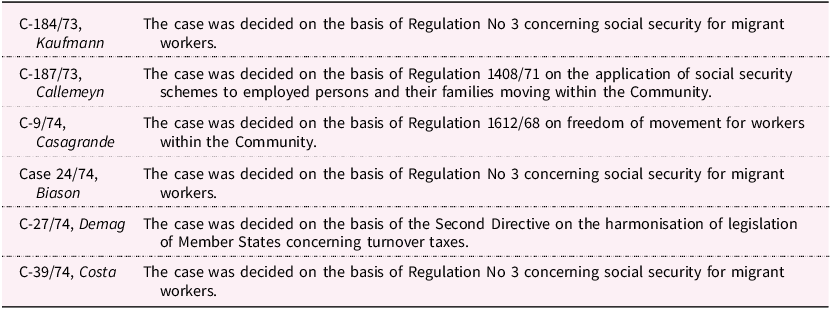
But how do we count our 1974 ‘free movement cases’? Zglinski offers a two-step algorithm. In a first step, he selects all cases that quote a core EU Treaty provision (Articles 34, 45, 49 and 63 TFEU) in the operative part (the ‘grounds’) of the judgment; and he then subtracts, in a second step, all cases that – in his view – do not concern negative integration.Footnote 51 This excludes from the start all cases under the Common Agricultural Policy (CAP);Footnote 52 but it also removes an important number of free movement cases that were, according to him, ‘in substance’ decided under Union legislation (Table 1).Footnote 53
1974 Legislation-based free movement cases

Table 1. Long description
A table titled 1974 Legislation-based free movement cases. The table has six rows and three columns. The columns are labeled Case, and Regulation. Each row lists a different case and the regulation it was decided on. Row 1: Case C-184/73, Kaufmann, Regulation No 3 concerning social security for migrant workers. Row 2: Case C-187/73, Callemeyn, Regulation 1408/71 on the application of social security schemes to employed persons and their families moving within the Community. Row 3: Case C-9/74, Casagrande, Regulation 1612/68 on freedom of movement for workers within the Community. Row 4: Case 24/74, Biasion, Regulation No 3 concerning social security for migrant workers. Row 5: Case C-27/74, Demag, Second Directive on the harmonisation of legislation of Member States concerning turnover taxes. Row 6: Case C-39/74, Costa, Regulation No 3 concerning social security for migrant workers.
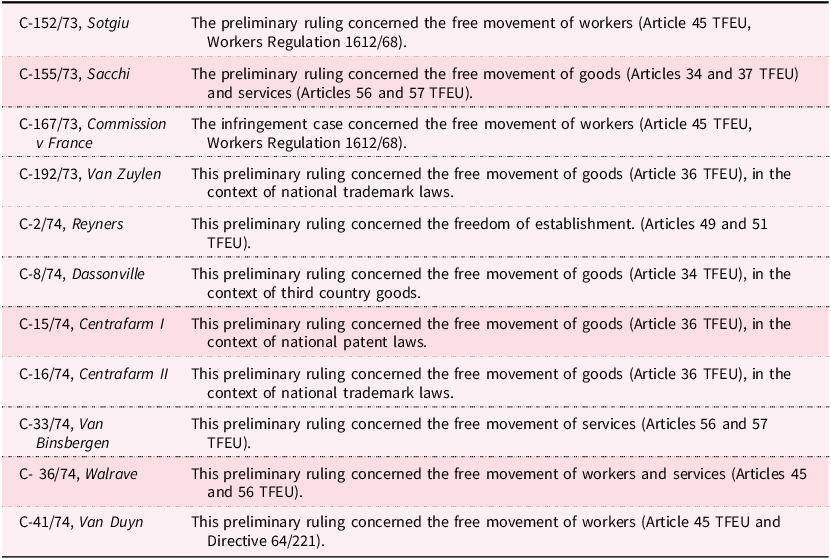
Yet, even if one agrees with these choices,Footnote 54 where are Articles 30, 35 and 110 TFEU in this picture? Is it correct to exclude fiscal and export restrictions for goods – whereas these two types of measures are included as regards the other three fundamental freedoms (as Articles 45, 49 and 63 TFEU cover ‘regulatory’ and ‘fiscal’ as well as ‘import’ and ‘export’ restrictions)? Luckily for Zglinski, this exclusion appears to have no immediate effect on his 1974 free-movement cases,Footnote 55 yet having looked at that year again myself, three additional Treaty-based cases (shaded) might still have to be added to the eight cases that Zglinski identified (Table 2).
1974 Treaty-based free movement cases

Table 2. Long description
A table listing legal cases related to free movement within the European Union in 1974. The table has 10 rows and 3 columns. The columns are labeled ‘Case’, ‘Subject’, and ‘Description’. Row 1: Case C-152/73, Sotgiu, The preliminary ruling concerned the free movement of workers (Article 45 TFEU, Workers Regulation 1612/68). Row 2: Case C-155/73, Sacchi, The preliminary ruling concerned the free movement of goods (Articles 34 and 37 TFEU) and services (Articles 56 and 57 TFEU). Row 3: Case C-167/73, Commission v France, The infringement case concerned the free movement of workers (Article 45 TFEU, Workers Regulation 1612/68). Row 4: Case C-192/73, Van Zuylen, This preliminary ruling concerned the free movement of goods (Article 36 TFEU), in the context of national trademark laws. Row 5: Case C-2/74, Reyners, This preliminary ruling concerned the freedom of establishment (Articles 49 and 51 TFEU). Row 6: Case C-8/74, Dassonville, This preliminary ruling concerned the free movement of goods (Article 34 TFEU), in the context of third country goods. Row 7: Case C-15/74, Centrafarm I, This preliminary ruling concerned the free movement of goods (Article 36 TFEU), in the context of national patent laws. Row 8: Case C-16/74, Centrafarm II, This preliminary ruling concerned the free movement of goods (Article 36 TFEU), in the context of national trademark laws. Row 9: Case C-33/74, Van Binsbergen, This preliminary ruling concerned the free movement of services (Articles 56 and 57 TFEU). Row 10: Case C-36/74, Walrave, This preliminary ruling concerned the free movement of workers and services (Articles 45 and 56 TFEU). Row 11: Case C-41/74, Van Duyn, This preliminary ruling concerned the free movement of workers (Article 45 TFEU and Directive 64/221).
Leaving Centrafarm I aside,Footnote 56 Zglinski’s omission of Sacchi and Walrave is really puzzling. In Sacchi,Footnote 57 the Court dealt with an Italian law that clearly touched upon the free movement of goods and services, even if the ‘grounds’ of the judgment did not expressly quote the relevant Treaty articles.Footnote 58 Was there a violation of Article 34 TFEU in particular? According to the Court, this was conditional on whether the national measure was ‘used to favour, within the [Union], particular trade channels’; and this was the case ‘where the restrictive effects are out of proportion to their purpose’.Footnote 59 This proportionality question was, however, not a question the Court wished itself to answer; it implicitly deferred it to the referring national court.
The omission of Walrave from Zglinski’s 1974 list is equally debatable.Footnote 60 Walrave concerned a private regulatory body that had imposed a nationality rule on cyclist sports teams competing in international championships. The Court found that the question of whether a sporting activity was an economic activity was a matter of fact to be decided by the national court, yet it nonetheless ruled on the interpretation of the free movement of workers (Article 45 TFEU) and services (Article 56 TFEU). In that context, it expressly held that both fundamental freedoms would have to ‘be taken into account by the national court in judging the validity or the effects of a provision inserted in the rules of a sporting organisation’.Footnote 61 The case was surely an EU Treaty-based internal market case and, while it did concern the legality of a private party action, it undoubtedly involved a national court and had limiting consequences for the political powers of the national legislature too.Footnote 62
Critically, my point about these three missing cases is not that one ‘dataset’ is necessarily more correct than the other; rather, it is the subjective variance in producing ‘data’ by two expert academics. Indeed, our qualitative differences here lead to a 30 per cent variance! And crucially, these reasonable disagreements about data are even more likely to occur in the selection of ‘proportionality cases’ and ‘margin of discretion cases’ because the underlying legal concept is even more complex than what straightforwardly (or not) counts as ‘free movement cases’.
For example, according to Zglinski there is not a single 1974 case that applies a proportionality analysis – yet this can surely be challenged. All here depends on what is meant by ‘proportionality’. Yet, despite devoting an entire chapter to the principle, we are told very little about the conceptual choices that motivated Zglinski in adopting his coding for the principle.Footnote 63 His conceptual benchmark is clearly Cassis de Dijon. There, the Court held, without naming the principle expressly, that national restrictions to free movement ‘must be accepted insofar as those provisions may be recognized as being necessary in order to satisfy mandatory requirements’.Footnote 64 After a detailed analysis of the impugned German law, the Court rejected this because it did ‘not serve a purpose which is in the general interest and such as to take precedence over the requirements of the free movement of goods’.Footnote 65
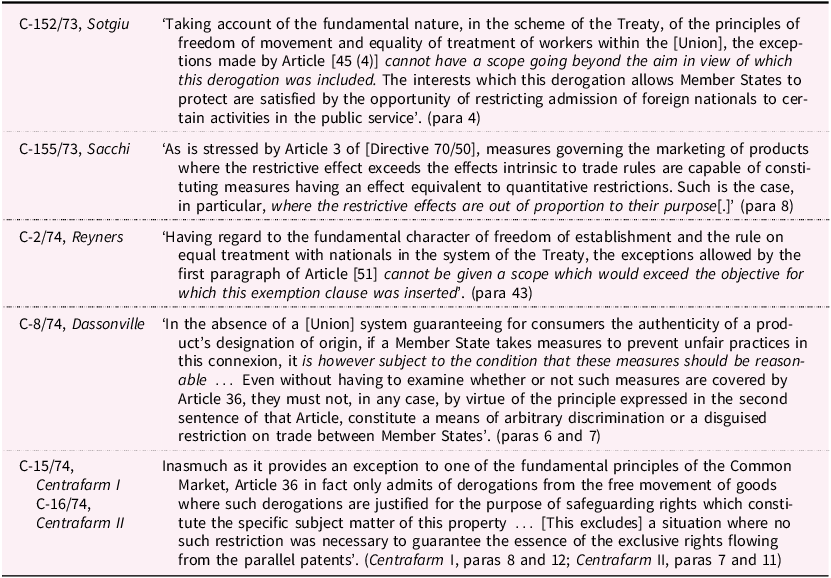
Now compare this Cassis-formulation of the proportionality principle with similar statements we find in the 1974 free movement case law (Table 3). According to Zglinski, none of these cases uses ‘true’ proportionality. But why not? It goes without saying that none of these cases uses the elaborate proportionality test that today’s Court has come to mechanistically employ.Footnote 66 Yet nor did Cassis! And once more, my argument here is not to say that all these cases are unquestionably proportionality cases – rather it is that the coding of highly complex qualitative concepts involves a high degree of subjectivity. A more generous definition of proportionality might thus suddenly get you a proportionality rate of around 60 per cent – as opposed to the 0 per cent identified by Zglinski for 1974.Footnote 67
1974 Proportionality cases (with emphasis added)

Table 3. Long description
A table summarizing 1974 proportionality cases with case identifiers, references, and key legal principles. The table has 6 rows and 2 columns. Column headers are Case and Description. Row 1: Case, C-152/73, Sotgiu; Description, Taking account of the fundamental nature, in the scheme of the Treaty, of the principles of freedom of movement and equality of treatment of workers within the Union, the exceptions made by Article 45 (4) cannot have a scope going beyond the aim in view of which this derogation was included. The interests which this derogation allows Member States to protect are satisfied by the opportunity of restricting admission of foreign nationals to certain activities in the public service. (para 4). Row 2: Case, C-155/73, Sacchi; Description, As is stressed by Article 3 of Directive 70/50, measures governing the marketing of products where the restrictive effect exceeds the effects intrinsic to trade rules are capable of constituting measures having an effect equivalent to quantitative restrictions. Such is the case, in particular, where the restrictive effects are out of proportion to their purpose. (para 8). Row 3: Case, C-2/74, Reyners; Description, Having regard to the fundamental character of freedom of establishment and the rule on equal treatment with nationals in the system of the Treaty, the exceptions allowed by the first paragraph of Article 51 cannot be given a scope which would exceed the objective for which this exemption clause was inserted. (para 43). Row 4: Case, C-8/74, Dassonville; Description, In the absence of a Union system guaranteeing for consumers the authenticity of a product‘s designation of origin, if a Member State takes measures to prevent unfair practices in this connexion, it is however subject to the condition that these measures should be reasonable. Even without having to examine whether or not such measures are covered by Article 36, they must not, in any case, by virtue of the principle expressed in the second sentence of that Article, constitute a means of arbitrary discrimination or a disguised restriction on trade between Member States. (paras 6 and 7). Row 5: Case, C-15/74, Centrafarm I; Description, Inasmuch as it provides an exception to one of the fundamental principles of the Common Market, Article 36 in fact only admits of derogations from the free movement of goods where such derogations are justified for the purpose of safeguarding rights which constitute the specific subject matter of this property. Row 6: Case, C-16/74, Centrafarm II; Description, This excludes a situation where no such restriction was necessary to guarantee the essence of the exclusive rights flowing from the parallel patents. (Centrafarm I, paras 8 and 12; Centrafarm II, paras 7 and 11).
The same coding subjectivity can, finally, also be found in the context of Zglinski’s margin-of-appreciation cases, where he identifies only one 1974 case to fulfil his conceptual criteria: Van Duyn. The Court here held, as already mentioned in Section 2, that ‘the particular circumstances justifying recourse to the concept of public policy may vary from one country to another and from one period to another, and it is therefore necessary in this matter to allow the competent national authorities an area of discretion within the limits imposed by the Treaty’.Footnote 68
Yet is this judicial formulation really so different from the Court’s 1974 statement in Reyners?Footnote 69 There, the Court reviewed a national restriction that seemed to conflict with the freedom of establishment, but that could potentially be justified under Article 51 TFEU on the ground that the national law concerned the exercise of official authority. And the Court here specifically held:
In the absence of [Union legislation] … the practice of such professions remains governed by the law of the various Member States. The possible application of the restrictions on freedom of establishment provided for by the first paragraph of Article [51] must therefore be considered separately in connexion with each Member State having regard to the national provisions applicable to the organization and the practice of this profession.Footnote 70
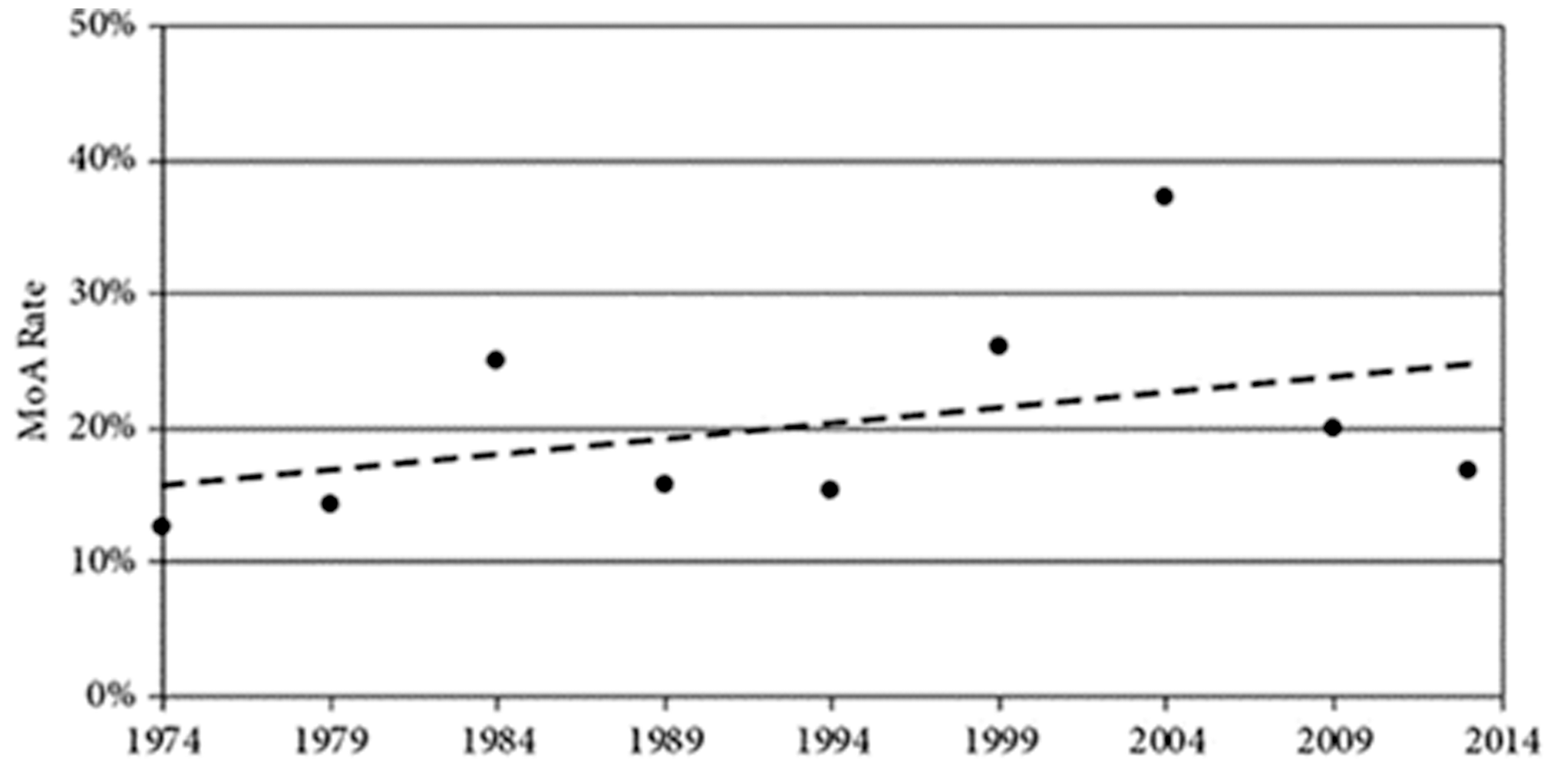
One can, of course, dispute that the two judicial formulas in Van Duyn and Reyners are functionally similar, but in my view, one could also, very reasonably, claim that both formulations do essentially express the same thing; and that, as a result, there is a second 1974 case that politically deferred to the Member States. But if that is accepted, then this single additional margin-of-appreciation case radically undermines Zglinski’s first statistical result about political deference.Footnote 71 For once the 1974 rate for deference goes up to 20 per cent (and excluding 2004 as an outlier year in which surprisingly many ‘public health’ cases were decided),Footnote 72 the relevant diagram in ‘Passive Virtues’ (Figure 1) would suddenly feature a stable horizontal line around 20 per cent – the average rate we have today.Footnote 73
Margin of appreciation in free movement cases, 1974–2013.

Yet even if we were to accept, following Zglinski, that there has been a (slight) increase in the margin-of-appreciation rate over time, my main critical objection to his empirical-quantitative approach goes much deeper. For, as the next section aims to show, what Zglinski ultimately counts in 1974 or 1994 or 2014 are totally different forms of political deference towards the Member States, because the conception and meaning of the proportionality assessment have fundamentally changed over time. Let us look at this macroscopic point next.
4. Concepts and codes II: a macroscopic analysis of ‘proportionality’
Textually, the EU primary law on the internal market has remained remarkably stable over time. The Rome version of Article 34 is thus (almost) identical to the Lisbon version of the provision; and the Treaty rules on the free movement of workers are essentially governed by the same text today as in 1974. Yet, when we read judgments interpreting the relevant EU primary law in 1974 as opposed to 2024, we must never forget that the historical context and the normative frame around that stable text have dramatically changed over time. In the evolution of negative integration, three such frames, contexts or models can be distinguished.Footnote 74
Within the international frame, which was still in place in 1974,Footnote 75 the Union generally used its internal market provisions as a limit to the external sovereignty of the Member States. This international frame is governed by the principle of ‘host state’ control: the host state is here allowed to impose all its domestic laws on foreign goods or persons, but it must not discriminate against them. This prohibition of discrimination generally means that states must not establish a set of international trade rules that distinctly apply to foreign situations – unless this can be justified. The external powers of the Member States are thus curbed but, as regards their internal rules, they can do whatever they like – as long as they do not substantively discriminate.
What does this mean for the proportionality assessment of national measures that fall inside the negative integration sphere? Within an international frame, discriminatory restrictions that serve special legitimate policy aims can be justified as long as they do not represent an arbitrary discrimination or a disguised restriction of trade when assessed against the host state standard. Take, for example, Van Duyn – a case decided in 1974. A Dutch secretary had been refused entry into the United Kingdom on the ground that she was a member of the Church of Scientology. This restriction was distinctly applicable to foreigners – as, in the United Kingdom, ‘no similar restriction [was] placed upon its own nationals’.Footnote 76
Could that discriminatory measure nonetheless be justified on public security grounds? The Court indeed thought so, and granted ‘the competent national authorities an area of discretion’.Footnote 77 But this margin of discretion concerned the distinct and stricter standard for foreigners – and not the internal standard that applied inside Great Britain.Footnote 78 Within the international model, then, the object of the proportionality analysis is the host state’s refusal to apply its own internal rules to external situations. The question here is whether it is necessary and proportionate to apply a distinct external standard to foreigners or foreign goods, despite the fact that they do fulfil the host state’s own internal standards.
This international law logic, which accepts the internal sovereignty of the Member States, fundamentally changes when the Cassis revolution introduces a ‘federal’ frame to negative integration in 1979.Footnote 79 This federal frame replaces the old ‘host state’ baseline with a new ‘home state’ baseline under the principle of mutual recognition. The federal model is thus no longer concerned with the question whether or not the host state discriminates against foreign goods or persons (by not offering them national treatment). On the contrary, it examines whether the extension of the host state’s own internal laws to imports creates a ‘restriction’ or ‘obstacle’ to intra-Union trade. In Cassis, the question was indeed not whether Germany had adopted a higher (external) standard for French liqueurs when compared with the German host standard; instead, it was whether Germany could impose its own internal laws on French products.
Within the federal model, not only will the scope of negative integration expand to capture non-discriminatory measures; the very object of the proportionality test here changes. For the Court will henceforth evaluate whether the extension of the host-state standard to foreign goods or persons is proportionate. Post-Cassis, the proportionality assessment is consequently not conducted in relation to whether or not a Member State may discriminate (Van Duyn), but whether it can justify imposing its own non-discriminatory standards on foreign goods, persons or services (Schindler).Footnote 80 However – and importantly – the proportionality assessment is still never in relation to the host-state standard as such, because the federal model constitutionally protects each national standard in ‘purely internal situations’.Footnote 81 If proportionality is thus denied, it is only the extension of the domestic law to ‘foreign’ situations that is unjustified.
This dramatically changes once a ‘national’ frame is given to negative integration.Footnote 82 Under the national model, a host-state standard can violate Union law even when this standard is applied to a state’s own goods or population. (An infamous pre-Keck illustration of this is Torfaen,Footnote 83 and a famous post-Keck example is Italian Trailers.)Footnote 84 In these cases, the object of the Court’s proportionality assessment is not whether the extension of the host-state standard to foreign goods or persons can be justified; it is rather the legality of the national standard as such.Footnote 85 A finding against the state will thus cut deep into its internal sovereignty – much deeper than under the federal model that, as mentioned above, protects the political powers of Member States in purely internal situations.
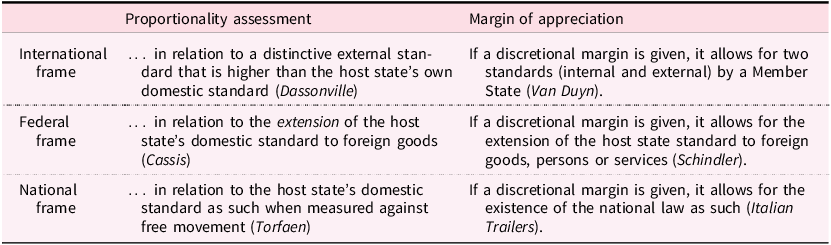
Alas, after all this conceptual talk, the reader might impatiently ask: what is the broader point about this framing-typology for proportionality cases? The point is that in the history of the internal market, the Court has moved away, albeit in an unsynchronised and imperfect manner,Footnote 86 from the international model over time; any political deference given in the 1970s under the international model will, consequently, be very different from political deference in the 1990s under the federal model and the latter will, again, be very different from deference in the 2010s or 2020s wherever a national model is applied. In sum: three different doctrinal frames, three different proportionality objects, three different forms of deference (Table 4).
Framing typology for proportionality and deference

Table 4. Long description
A table with three rows and two columns compares proportionality assessment and margin of appreciation across international, federal, and national frames. The columns are labeled ‘Proportionality assessment’ and ‘Margin of appreciation’. The rows are labeled ‘International frame’, ‘Federal frame’, and ‘National frame’. Row 1: International frame, Proportionality assessment: in relation to a distinctive external standard that is higher than the host state‘s own domestic standard (Dassonville). Margin of appreciation: If a discretionary margin is given, it allows for two standards (internal and external) by a Member State (Van Duyn). Row 2: Federal frame, Proportionality assessment: in relation to the extension of the host state‘s domestic standard to foreign goods (Cassis). Margin of appreciation: If a discretionary margin is given, it allows for the extension of the host state standard to foreign goods, persons or services (Schindler). Row 3: National frame, Proportionality assessment: in relation to the host state‘s domestic standard as such when measured against free movement (Torfaen). Margin of appreciation: If a discretionary margin is given, it allows for the existence of the national law as such (Italian Trailers).
Within the international frame, since the Court will never assess the proportionality of the internal ‘host state’ standard at all, any margin of appreciation here given will be in relation to a separate national rule that distinctly applies to foreign situations (Van Duyn). Under the federal model, by contrast, the Court potentially defers to the extension of the ‘host state’ standard to foreign goods or persons (Schindler), whereas under the national model, the Court may grant a margin of appreciation as regards the proportionality of the host-state standard vis-à-vis free trade (Italian Trailers).Footnote 87
Two interim conclusions follow from this. First, counting and aggregating three conceptually distinct forms of proportionality and deference into one number is not helpful; on the contrary, it is unhelpful because that number hides more than it reveals. Indeed, Zglinski’s quantitative analysis brusquely counts deference cases that simply cannot be compared; it adds apples to oranges and pears, and the result is a number salad that has little nutritional or heuristic value for European law.
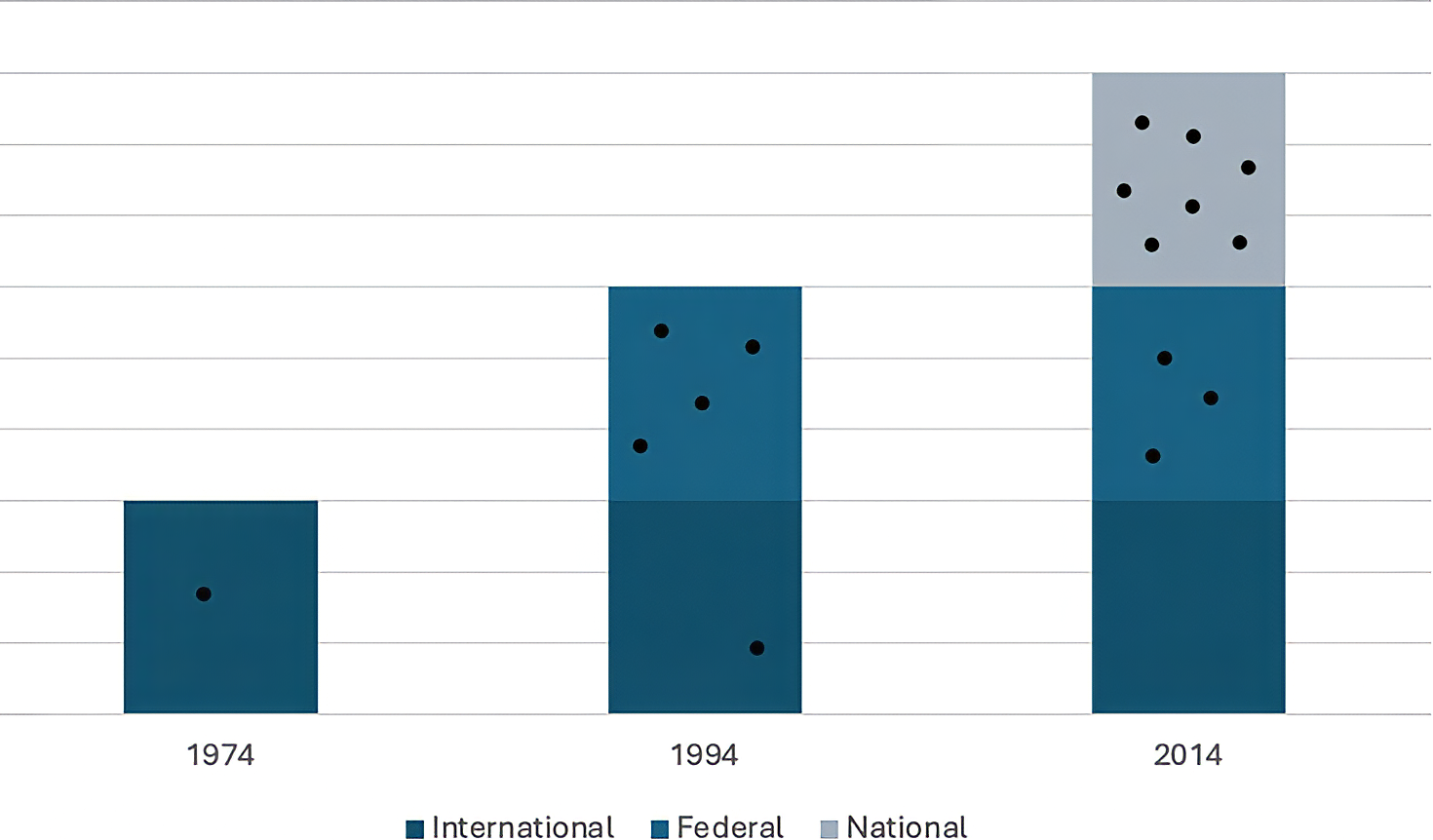
Second, and more importantly, we might also expect the margin-of-appreciation rate to be higher within the federal and national models of negative integration because the very essence of what is being balanced changes. This counter-thesis turns Zglinski’s argument on its head, as it would suggest that the more activist the Court is in aggressively pushing negative integration towards a federal (or national) model, the more it must employ the margin-of-appreciation doctrine as a softening device to allow for at least some national political choices and host state control within a newly conquered field.Footnote 88 Any quantitative rise in the number of deference cases (Figure 2) ought, therefore, not be mistaken for more political freedom, more national choice or more legislative plurality in the internal market. Indeed, quite the opposite is true: more negative integration, more deference cases but less political freedom!
Changing levels of integration and deference cases (dots)

In conclusion, therefore: even if one were to reject my micro-objections to Zglinski’s coding choices in Section 3, any numerical rise in the margin of appreciation cases over time would still not translate into more political ‘freedom’ for Member States because what is being counted as ‘freedom’ by Zglinski changes over time. It is this lack of a historical-qualitative sensibility that I believe represents the fatal flaw in Zglinski’s declining negative integration thesis.
5. External critique: negative integration and the rise of Union legislation
Yet, by building on and radicalising his original thesis, Zglinski has recently come to even proclaim that ‘judicially driven market integration has come to an end’!Footnote 89 This is, according to him, due to the engine of negative integration – the ECJ – running out of ‘fuel’: ‘Negative integration crucially depends on legal disputes being brought, so that the Court of Justice can lay down the principles governing free movement law and subject national trade barriers to judicial review’.Footnote 90 And because the number of ‘Article 34 cases’ – this is his primary law reference area – has dramatically declined to pre-Dassonville levels,Footnote 91 the end of negative integration is nigh. But this conclusion is, again, doubly misleading, namely both from an institutional and a functional perspective.
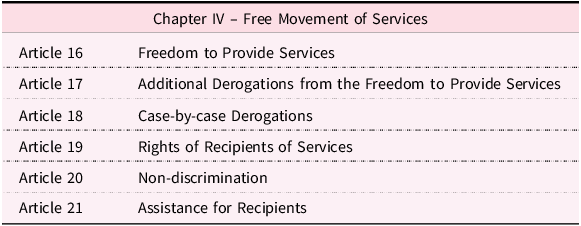
Institutionally, negative integration is best defined as market liberalisation by the Court – regardless of whether the Court acts on the basis of primary or secondary Union law. Take, for example, the free movement of workers. Early on, Union legislation was here meant to take over the function of market liberalisation from EU Treaty law.Footnote 92 After this happened, the Court often never reached Article 45 TFEU in its judgment; instead, it interpreted the respective free movement articles in the relevant Union act. Or take the free movement provisions within the Services Directive, which aim to liberalise the internal market for that freedom (see Table 5). Any case law interpreting especially Article 16 must surely be seen as part of the negative integration sphere, because it is the Court – not the legislature – that interprets and liberalises here judicially.Footnote 93 Many, if not most, free movement disputes are nowadays conducted under internal market legislation.Footnote 94 In fact, these legislation-based free movement cases have fully compensated the decline of Treaty-based free movement cases over time.Footnote 95 Overall, then, the Court has not run out of litigious ‘fuel’ – it just ‘tanks’ differently.
Free movement provisions in the Services Directive

Long description
A table titled ‘Chapter 4 - Free Movement of Services’ with two columns and seven rows. The first column lists articles from 16 to 21, and the second column provides descriptions of each article. Row 1: Article 16, Freedom to Provide Services. Row 2: Article 17, Additional Derogations from the Freedom to Provide Services. Row 3: Article 18, Case-by-case Derogations. Row 4: Article 19, Rights of Recipients of Services. Row 5: Article 20, Non-discrimination. Row 6: Article 21, Assistance for Recipients.
From a functional perspective, it is equally wrong to assume that legislation-based negative integration is less liberalising than Treaty-based negative integration. For there are at least two aspects in which free-movement legislation can go beyond the liberalising power of EU primary law. At the scope level, EU legislation can generally penetrate purely internal situations, even where the underlying EU primary law still cannot do so.Footnote 96 And, at the justification level, EU legislation can also legitimately remove public policy justifications still eligible under EU primacy law.Footnote 97 The decline of free movement litigation regarding EU primary law therefore does not mean less negative integration – functionally, the impressive rise of legislation-based free movement cases may rather signal more negative market integration, not less.Footnote 98
But there is more bad news for Zglinski: because once we include legislation-based free movement cases into an analysis of how much political freedom the Court leaves to the Member States (Section 4), Zglinski’s ‘rising deference’ argument receives a second fatal blow if it can be shown that the Court grants less political discretion in the presence of Union legislation – as opposed to when dealing with EU primary law alone. This is because the dramatic rise of EU internal market legislation and legislation-based litigation would, overall, mean a decline of national discretion.
The key question, therefore, is whether there is more or less political discretion that the Court grants the Member States in the presence of Union legislation?Footnote 99 Zglinski’s own analysis of this point is unusable, due to the way he has selected his data,Footnote 100 and in the absence of time and space, I can only scratch the surface of this problem here. My commonsense starting position, however, is that Union legislation has always been meant to concretise and complement Treaty-based negative integration, and once the Union harmonises diverse national laws, national discretionary power should be reduced. Such a negative correlation between Union legislation and national power can already be seen in Van Duyn;Footnote 101 so one could expect that ever more detailed Union rules (through legislation) translate into less proportionality balancing and less discretion.Footnote 102
One of the most symbolic illustrations of this development is the adoption of the ‘absent’ piece of Union legislation featured in Cassis. Footnote 103 Here, in the absence of Union legislation, the Court famously solved the case on the basis of Article 34 TFEU and the question of proportionality. But through Regulation 1576/89, the Union subsequently laid down detailed legislative rules on the definition, description and presentation of spirit drinks.Footnote 104 Among other things, it thereby set the minimum alcohol content for spirit drinks to 15 per cent, with special classes of drinks having its alcohol content set much higher.Footnote 105 A drink that did not reach that minimum level – for whisky this was set at 40 per cent – would not be allowed to mention its main ingredient; instead it had to be generically designated as ‘spirit drink’.
In Scotch Whisky Association I,Footnote 106 the question arose of whether a 30 per cent whisky blend was nonetheless entitled to use the designation ‘blended whisky spirit’. The defendant claimed that whisky was clearly the main ingredient, which had only been slightly watered down – a fact that was also clearly labelled so as to fully protect the consumer. The national measure seemed proportionate, à la Cassis. Yet the Court categorically rejected this view. Instead of engaging in any proportionality balancing – whether strict or not – it simply looked at the text of Articles 5 and 6 of the Union act; and that was that: ‘The use of an additional indication such as “whisky” in the sales description is thus precluded by Article 5 of Regulation No 1576/89, subject to any derogations based on Article 6 thereof – and, in the present instance, there are none’.Footnote 107
This uncompromising non-deference stance was repeated in Scotch Whisky Association III.Footnote 108 The case involved Regulation 110/2008 (the successor to Regulation 1576/89); and to some extent – albeit remotely – mimicked the Dassonville scenario. A German whisky producer had made use of the designation ‘Glen’, despite his whisky obviously not coming from Scotland. The question arose whether he had violated Regulation 110/2008, which protected geographical indications of origins, including ‘Scotch Whisky’.Footnote 109 Yet, unlike Dassonville, the Court made no reference to the ‘reasonableness’ of the situation at all: the entire judicial analysis was conducted via a close interpretation of Article 16 of the Union act. And while there was judicial deference to the ‘referring court’ with regard to the facts,Footnote 110 no political deference to the apparently more liberal German regime was given.
The same non-deferential textualism – formal rules over judicial balancing – can also be encountered in Tänzer & Trasper.Footnote 111 Here, the Court held against the defendant (and any residual powers of the Member States) that the designation ‘egg liqueur’ should only be used for products that exactly followed the list of ingredients set out in Regulation 110/2008. The addition of milk – hardly unreasonable when it comes to egg liqueur (and which had, again, also been clearly labelled on the bottle so as to protect consumers) – still ran against the strict construction of Union legislation.Footnote 112 There was no proportionality, no balancing, no margin of discretion – all the Court looked at was the express text and the internal logic of the Union act.
All of this, of course, is only anecdotal process-tracing, but it nonetheless seems to strongly suggest that more legislative rules mean more textual precision; and with it, less proportionality balancing and less national discretion. In the past 50 years, this trend for ever-more detailed Union rules appears to have continued to track upwards, from 16 words for Article 34 TFEU to 17 pages in the 1989 ‘Cassis regulation’; with its 2008 legislative successor already rising up to 39 pages and its 2019 contemporary replacement having risen to 54 pages – three times the size of the original legislation!Footnote 113 There is, then, a good chance that the rise of EU legislation is negatively correlated with any remaining political discretion for the Member States (unless the Union legislator has expressly granted it), and this negative correlation would mean that the more legislation-based internal market cases come to the Court, the less deference the Court would offer towards national authorities.
Let us test this preliminary finding for goods by means of two more examples from the free movement of persons. Among all the main cases dealing with Regulation 492/2011 on the free movement of workers that today translates Article 45 TFEU,Footnote 114 it seems that really only one case – out of 28 cases – offers any meaningful margin of discretion.Footnote 115 This extreme non-deference result is, of course, unlikely to be reproduced by those pieces of Union legislation that themselves codify the proportionality principle. Take Article 27 of the Citizenship Directive,Footnote 116 which allows Member States to restrict the free movement of Union citizens ‘on grounds of public policy, public security or public health’, but immediately adds that, as regards the first two grounds, any such restriction ‘shall comply with the principle of proportionality and shall be based exclusively on the personal conduct of the individual concerned’.
This limitation had already existed in an earlier version since 1964 and was the subject of Van Duyn,Footnote 117 yet comparing the 1964 legislative text with the 2004 legislative text reveals a much stricter textual framing of any political discretion that the Member States still enjoy. In its subsequent jurisprudence, the Court has even held that any remaining national discretion in this context will not be political-legislative but administrative–executive discretion, demanding ‘a case-by-case assessment by the competent national authorities’.Footnote 118 (This is, admittedly, less demanding for public health measures, where the Court has allowed for general – political – measures.)Footnote 119 Nonetheless, the key point behind this section continues to hold: more European legislation = more European rules = less judicial balancing = less national discretion = more market integration.Footnote 120
6. Conclusion
Let us return to our opening question: has there been a rise or a fall in negative integration in the last 50 years? Three opposing views were distinguished. A first view believes that the level of negative integration has declined since Dassonville; a second view, in contrast, holds that negative integration has increased since Dassonville, while a third view insists that the normative commitment imposed by the EU Treaties has remained the same since Dassonville.
Jan Zglinski’s recent work on the internal market comes closest to the first view. Yet, unlike the Weiler thesis, he locates the main reason for his declining integration theory not at the scope level (Keck) but at the justification level (proportionality). Accordingly, ‘the ECJ has, over the past four decades, gradually lowered its level of scrutiny’ to the effect that the Member States enjoy ever more legislative freedom today.Footnote 121 In essence, ‘discretion is on the rise’, negative integration is in decline. But not just that: negative integration ‘has come to an end’ because ever fewer Treaty-based free movement cases come to the Court today.
This article has tried to show that this declining or ending negative integration thesis is radically ill-constructed and misleading.Footnote 122 Leaving my micro-criticisms of Zglinski’s case-coding and his questionable data arrangements aside,Footnote 123 the thesis is especially problematic when it implies that if any of the 1974 or 1979 free movement cases were to be relitigated today, the contemporary Court would be more deferential to the Member States. This, in my view, is categorically wrong. Yet, even in more relative terms, Zglinski’s thesis is open to a radical critique because his empirical-quantitative analysis neglects the philosophical-qualitative changes that have restructured the negative integration sphere since 1979. For not only has the Court significantly expanded the scope of the latter, but through its changing doctrinal ‘frames’, the very object of what is being judicially reviewed has also changed.
We indeed saw in Section 4 that in each of the three historical contexts and conceptual frames discussed there, the idea of proportionality and political deference to the Member States assumes a different meaning: deference in an international frame (you are allowed to discriminate) is qualitatively different from deference in a federal frame (you are allowed to extend your own rules) or a national frame (you are allowed to keep your own rules). And from this qualitative perspective, any quantitative rise in the rate of deference cases over time – if it really exists – might not at all mean that more political powers are returned to the Member States. On the contrary, the rise of passive virtues could rather be a sign of an activist court that places its jurisprudence into a double-movement that has also structured the positive integration sphere.Footnote 124
This dynamic may even be stronger, as Section 5 attempted to show, once the Union legislates for its internal market. Deregulation and reregulation today take place primarily through Union legislation,Footnote 125 and the Court indeed appears to offer less political deference to the Member States under EU free movement legislation when compared with EU primary law. The margin of appreciation doctrine thus appears to be negatively correlated with the presence of Union legislation, and the rise of the latter will consequently mean a fall of deference and higher levels of judicial scrutiny, not less. Moreover, the dramatic rise of Union legislation may, functionally, also mean more market integration because the potential liberalising power of EU legislation is higher than that of EU primary law, especially in its ability to penetrate purely internal situations.
What, then, has gone wrong in Zglinski’s end-of-negative-integration thesis? In my view, the main culprit is his ahistorical and under-theorised method. This is, of course, not a general critique of the empirical method as such: on the contrary, for law – as for any field with a scientific aspiration – data should be the most important ingredient of any theory. Yet empirical jurisprudence without philosophical concepts is blind, and Zglinski’s work is the perfect example of an imperfect empiricism that arrives at a questionable quantitative result because of its blindness towards deeper qualitative changes in the structure of European law – changes that cannot easily be counted, measured or quantified.
Lies, damned lies and statistics? No, not all data and all statistics are inherently subjective, but they are only as good as the concepts one uses to get them – and a better concept might here often lead to a change in data.Footnote 126 Any attempt at an empirical analysis of the internal market is laudable, yet Zglinski’s work is – in the end – marred by errors, shortcuts and distortions.Footnote 127 This negative result offers a cautionary tale for the emerging ELS movement. For when confidently claiming more objectivity and systematicity than traditional non-quantitative research,Footnote 128 a little more modesty might seem to be in order. That modesty should acknowledge the – irreducibly – subjective qualitative assessments that ‘code’ complex concepts into ‘data’.Footnote 129 And modesty must also, and above all, mean transparency: all coding and selection choices should, as a very minimum, be easily accessible and properly explained in order to be externally verifiable.
This is, once more, not to generally indict ELS, whose scientific programme and interdisciplinarity have already produced fascinating insights and enriched the EU law literature enormously.Footnote 130 Yet, at the heart of EU legal scholarship still lies a qualitative understanding (Weber) of the EU Treaties, EU legislation and EU cases – an understanding that must be based on a constructive synthesis of empirics (content) and philosophy (concepts). The most promising way to understand the meaning of European Union law, and indeed law in general, is therefore to return to the Kantian insight that all concepts without empirical data are empty, while all empirical data without concepts are blind. That heuristic motto might well stand behind the broader ELS project, but its concrete execution in the context of the internal market has so far – and beyond Zglinski – spectacularly failed.
Acknowledgements
For critical comments on this ‘critical’ article, warm thanks go to Johan Lindholm, Niamh Nic Shuibhne, Urška Šadl, Susanne Schmidt, Jukka Snell, Martijn van den Brink, Barend van Leeuwen, Jan Zglinski and especially Tommaso Pavone.
Competing interests
The author has no conflicts of interest to declare.

 Open access

