

First—you have ears; hearing is the first step. Second, your body senses rhythm—you can be a receptor for musical vibrations if you attune yourself. But to know music is to know how to hear and express it. You have a body that moves to sound. If you are blessed with a voice, learn where it is within you, discover how to bring it out to express yourself in song. If you play an instrument, make that a part of your musical self—use it to sing in ways your body and voice cannot. When all these aspects of yourself are coordinated in the mediating influence of a song, a melody, a musical idea, then you can begin to know that music and to make it your own.
—The Jewish Catalog, 1973Footnote 1
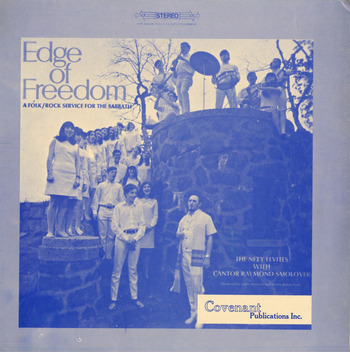
In 1967, Cantor Raymond Smolover and a group of Jewish teenagers identified as the “NFTY Levites” released a full-length LP titled Edge of Freedom; it was a “folk/rock service for the Sabbath” (see Figure 1). Underwritten by the youth department of the Union of American Hebrew Congregations (better known by its organizational title, the National Federation of Temple Youth [NFTY]) and composed by Smolover and his son, David, Edge of Freedom offered a sharp departure from the sound of most Jewish sacred music at the time. Although Smolover's contributions showcased his classically trained vocal skills, the album's other elements, by comparison, sounded more like the kinds of music that the young “Levites” would have heard on the radio.Footnote 2 It featured electric guitars, keyboards, and drum kits, and its arrangements and song styles drew directly on American popular music of the middle to late 1960s, including references to folk, funk, and psychedelic rock. Although the description of the album foregrounded its fashionable musical style, Edge of Freedom also suggested a much larger, although more subtle, shift, not just in what congregational prayer might sound like, but what this shift meant for Jews, their synagogues, and their understandings of prayer more generally.Footnote 3
National Federation of Temple Youth Levites with Cantor Raymond Smolover, Edge of Freedom (White Plains, NY: Bell Records Bell 6021, ND, LP).

Whereas changes in musical style are most clearly audible on recordings such as Edge of Freedom, the music can be understood as evidence for larger changes in expectations and meanings of congregational prayer that began to emerge during the 1960s. Until then, the music of Jewish congregational prayer in the United States had been dominated by cantorial music in one form or another. Cantors were often professionally and sometimes classically trained musicians and, because of religious strictures on the use of musical instruments on the Sabbath, they were known primarily as vocalists. As performers of sacred repertoire, they understood their role to be one of interpretation of a long-running tradition of sacred music.Footnote 4 As evidenced by their memoirs, the countless recordings they left behind, and the trove of writings about the form, cantors strove to create synagogue music that matched Jewish liturgy with a sense of grandeur, beauty, and power. The classical cantorial approach was organized around the understanding that the combination of the liturgy and music, thoughtfully presented with appropriate virtuosity, would raise the spirits of worshippers, who may or may not have been encouraged to sing along.
This approach to cantorial performance can be traced, in part, to the professionalization of the clergy and, specifically, to the famed nineteenth-century Viennese cantor Salomon Sulzer. Sulzer committed himself to the idea that “the old traditional tunes … should be improved, selected and adjusted to the rules of art.”Footnote 5 Often, his “rules of art” implied an adherence to the rules of Western art music and the decorum of the concert hall. In the Sulzerian model, congregational singing was not the point, nor was it a major element in the conceptualization of congregational prayer. Instead, he outlined an approach to cantorial performance that framed Jewish sacred music in terms of its aesthetic qualities, using adjectives such as sublime or transcendent to signal that intention and that understanding.
Edge of Freedom and the nearly fifty albums of similarly oriented reworkings of Jewish prayer services that emerged in the decade or so that spanned the mid-1960s to the mid-1970s took a decidedly different approach.Footnote 6 They drew on American popular musical styles to offer a more open, accessible, often amateurish, and engaging approach to the music and practice of congregational worship that they hoped would displace the cantorial emphasis on inspiration, virtuosity, and polish. They highlighted their interpellations of new musical styles in new descriptive terms such as “folk/rock service” or “Jazz Rock service” or simply “folk service”; these designations evidenced a deeper change in how people understood the nature and purpose of congregational prayer.Footnote 7 These new styles were symptomatic of more fundamental, almost existential, changes in the expectations and meaning of Jewish congregational prayer, and these albums suggested that the ritual and its practice should not be defined by its aesthetics but by the experiences it enabled. This article examines the articulation of that shift among the majority of American Jews and American congregations in that period: those who belonged to the Reform and Conservative movements.
Of course, the sound of the music shifted, as well; the compositions of Louis Lewandowski and Yossele Rosenblatt did not sound like those of Shlomo Carlebach or Debbie Friedman.Footnote 8 Generally, this change has been understood primarily in terms of the sound of the music, as if the change in music ushered in a change in prayer practice from “presentational” to “participatory.” The focus on the music as the effective change agent, however, misses a larger account of changes in the culture and expectations of prayer itself. Situating the changing sounds of Jewish sacred music within this larger cultural context reveals the ways in which the music emerged alongside and, perhaps, in response to changes in conceptions of what prayer is and what it should be.
Methods and Definitions
The mid-1960s and the late 1970s saw releases of approximately fifty albums that explicitly sought to reimagine the sound of Jewish congregational prayer. Whether elaborately staged and arranged or recorded simply in a sanctuary with a single microphone, these albums asserted themselves with the strong sense that they were new, youthful, and full of spirit and, simultaneously, that they were true and authentic interpreters of ancient tradition, recapturing and renewing what had been submerged beneath the impenetrably formal sounds of previous generations. By emphasizing their youthfulness and the current sound of their songs, the artists behind this wave of new Jewish liturgical music both differentiated themselves from their predecessors and tried to define themselves.
Much of this explanatory effort took place in liner notes and on album jackets of the albums in question. These material and literary elements of the albums provide important insights into the ways in which the artists hoped their music would be heard, and they often presented lengthy explications of what they hoped listeners might hear. Albums of cantorial music also relied on lengthy album notes to help prepare listeners for what they would encounter when they dropped the needle. In contrast to the new music of the late 1960s and early 1970s, cantorial albums tended to emphasize the aesthetic qualities of the music, regularly drawing comparisons between cantorial music and opera in order to emphasize the musical universe in which listeners ought to hear and understand it. This approach meant to set expectations both about how to listen and how to appreciate the music, directing audiences to encounter it, following Sulzer, as “high culture.”
This discussion was most pronounced in the liberal religious movements of American Jewish life: Reform and Conservative Judaism. Both embraced innovations in Jewish life and practice, although only insofar as they fit commitments to Jewish law more broadly. Modern Orthodoxy and ultra-Orthodoxy did not entertain the interpellation of rock-influenced music in their worship practices, although their music has certainly responded to cultural changes.Footnote 9 The Reform and Conservative movements, however, actively wrestled with ways to update and change their practices in order to align with both taste and politics of the time. A number of the albums included in this study—such as Edge of Freedom—were produced, underwritten, or even commissioned by the youth education arms of those movements.
This article approaches both the albums’ sonic content and their literary representations as sites of cultural production that helped to prime listeners for hearing the music and orienting their expectations about what it might mean. In this way, it takes a sonic-material approach to understanding the dynamics of this moment in American Jewish life and in the cultures of American Judaism, more generally. It focuses on record albums as a “trail of vinyl” and as a crucial material and sonic record of synagogue life in America.Footnote 10 To be clear, this article does not weigh in on whether or not any of this music had its desired effect on congregations, nor does it attempt to engage, ethnographically, in an account of the practices of cantors. Instead, it amplifies some long-silenced music and the muted conversations about it, paying specific attention to the ways in which those responsible for making the music tried to frame their musical endeavors through a new understanding of Jewish congregational prayer.Footnote 11
Sociologist Erving Goffman explains how these explanations create “frames” around cultural phenomena that initiate the meaning-making process even before people engage with the phenomenon in question. “I start,” he writes, “with the fact that from an individual's particular point of view, while one thing may momentarily appear to be what is really going on, in fact what is actually happening is plainly a joke, or a dream, or an accident, or a mistake, or a misunderstanding, or a deception, or a theatrical performance, and so forth.”Footnote 12 Frames help people make sense of cultural phenomena by predigesting them so that they can be metabolized with relative ease. Goffman argues that aspects of life that seem self-evident are already encoded with meaning by their larger contextual or cultural frames. Frames set up expectations and, in the process, make meaning possible. Composers of Jewish sacred music used their album covers to frame their music, directing their listeners’ attention toward particular modes and terms of meaning-making. These rhetorical frames helped audiences understand what they were hearing and helped them to make sense of the sonic changes in American Jewish sacred music. To use Goffman's terms, “what is really going on” can be heard in the music, but it can also be credited to the framing devices that helped audiences learn to listen and understand what they heard.
Using Goffman, we argue that the most significant shift in Jewish music can be detected in the framing of the music on album covers and in other written forms. Reading those sources as Goffmanian “frames” reveals a strong shift away from a perspective that focused on the power of the music's “aesthetics” to one that understands congregational prayer as an “experience.” This is not to suggest that cantorial music did not constitute an “experience,” nor is it to argue that the music of the late 1960s and early 1970s did not have an “aesthetic.” Aesthetics and experience are by no means mutually exclusive categories; listeners can have an experience of aesthetics, and music, no matter how participatory and amateurish, certainly has an aesthetic.Footnote 13 An examination of how those categories were experienced by either prayer leaders or by congregations would require a different kind of method and a different kind of article. So, too, would a more thorough engagement of the philosophical relationship between aesthetics and experience. Nevertheless, and given the complexities of the relationship between the two terms, both emerge from the predominant discourse of practitioners of both cantorial and new Jewish congregational music, and they adequately represent the discursive shift to which we attend in this article.
From Aesthetics to Experience—Framing the Changes in Jewish Sacred Music
Why these changes happened at the moment they did is part of a set of larger historical shifts in American culture and in American religious culture. Scholars such as Jeffrey Summit have noted how synagogue liturgy in America has been approached by Jews as a means “to establish control over their Jewish lives, wresting it from the older generation by manipulating style, space, and the structures of congregational authority.”Footnote 14 Just as synagogue architecture has changed to reflect American Jewish values, so has the sound and practice that characterized those spaces.Footnote 15 As American Jews adapted to their status in the postwar American middle class, so, too, did their political and cultural concerns.Footnote 16 In the middle to late 1960s, changes in prayer practice emerged in conversation with these larger cultural shifts, which took on a particularly strong form during the heyday of the counterculture.Footnote 17
The desire for more immediate engagement with expressive forms in religious contexts has been well documented, and the appearance of these albums parallels the development of folk- and rock-informed worship music in American evangelical Christianity and the emergence of the Catholic “folk mass.”Footnote 18 These, too, marked breaks from more traditional forms and sounds of sacred music and unabashedly brought new instrumentation and new approaches into congregational worship. Among American evangelicals, the emergence of new songs gestured toward new possibilities in expressive worship even as some songs fell out of fashion and were replaced by successive generations of worship music.
The experience of American Jews is similar insofar as new formulations of liturgical music emerged concurrently and shared references to the same popular cultural sources. Yet, American Jews, unlike their evangelical counterparts, remained largely committed to traditional Jewish liturgy, which was almost universally rendered in Hebrew. A few songwriters and composers such as Jeff Klepper and Debbie Friedman wrote settings for English translations of Jewish prayers or wrote translingual versions of traditional prayers, and others wrote new melodies for excerpts of longer liturgical texts, but composers of new Jewish music for prayer tended to stick closely to the text of classical Jewish prayer. They usually wrote new musical settings for classical prayers, and they largely avoided writing entirely new songs for congregational or ritual purposes. Thus, even when musically innovative, the new sounds of sacred music remained, for the most part, firmly grounded in the text of classical Hebrew prayer. This continuity meant that the composers were covering the same textual and ritual ground as the generation that preceded them even if the music sounded different.
Published in 1973, The Jewish Catalog, one of the most enduring documents of Jewish life in the early 1970s, included a short section on music. The epigraph of this article is taken directly from the introduction to this section, and it captures the way in which the authors and editors understood music to be something that is not just heard or sung or played but also fully experienced and “known.” The section divides Jewish music up into subgenres: Hasidic, Yiddish, Ethnic (sic), Dance, Israeli, and Jewish Religious Music. It mentions a band called The Rabbi's Sons, but it does not note any of the music emerging contemporaneously from the Reform movement, including that of Smolover or Friedman, whose first album had been released the year before publication. Despite these omissions, which likely reflect the Jewish perspectives of the book's editors, the entry still captures the emerging sentiment that music is supposed to serve prayer and not stand on its own. “By being aware of new songs, one can try to implement a theology of shir hadash [Hebrew: new song], a new song into our prayer life. … New songs can rejuvenate a familiar prayer or verse in such a way as to re-create the original moment in which that prayer was conceived.”Footnote 19 For the Catalog, which promoted itself as a guide to “do-it-yourself” Judaism, the sound of sacred music is only one register for a deeper engagement with and experience of Jewish prayer.
In tracking the changes in Jewish liturgical music, most conventional analyses focus too closely on the sound and style of the music and, consequently, fail to reckon more deeply with how people hoped the music would function as a vehicle for congregational prayer. Most attempts to understand this period of change deploy the tension between what musicologist Thomas Turino has called “presentational” music and what he has regarded as “participatory” music.Footnote 20 Although Turino was not writing specifically about liturgical music, his terms are useful here. The former, he explained, is organized around the performance of music for the benefit of an audience of listeners. This approach, he argues, relies on fairly clearly delineated roles among the various people involved in making music while acknowledging that audiences play an important role in how music is made. By contrast, the participatory approach is organized around a commitment to collective processes in which people are encouraged to share more actively in making sound that becomes music, often blurring lines between composers, performers, and audience. Presentational music is governed by stricter conventions of musical performance, while the goal of participatory music is “to involve the maximum number of people in some performance role.”Footnote 21
Musicologist Mark Slobin presaged Turino's framework in his history of the American cantorate, highlighting “the problems” and the “dilemma” that these competing frameworks of music-making presented American cantors. Although he uses a framework that plays on the tension between “the music of participation” and “the music of presentation,” he acknowledges that the categories are not entirely mutually exclusive. “From the hazzan's point of view,” he writes, “whether dealing with a composer's vision or writing for the synagogue, you must constantly think of others’ demands before your own. Viewed in this way, presentation is not that different from participation.”Footnote 22 Presentational music, he observes, is still presented with a consideration of some human congregation in mind and not just as an abstract set of aesthetic commitments. Thus, the performances of “presentational” music is always infused with a concern for its “participatory” aspects, even when participation is enacted largely as listening. The fluidity in these terms and their meanings lead Slobin to argue that American cantors felt deeply conflicted about how to manage expectations of presentational and participatory music and that the shift from the former, which characterized American cantorial music for the majority of its history, to the latter was neither smooth nor simple.
The sonic and cultural changes that resulted, however, were unmistakable. The Reform movement, Lawrence Hoffman observed, “replaced the highly dramatic orchestration of the organ-choir-reader-cantor complex and adopted informal, congregationally active modes of worship, emphasizing simple songs of American and Israeli youth.”Footnote 23 Slobin summarized the entire phenomenon in a similar fashion. “Thus, right across mainstream American Judaism, the laity has insisted on raising their voices and cutting back the sacred singer's contribution.” He goes on to note that the cantors he interviewed during the course of his research regarded this change and the new styles of music they invited into the sanctuary as “a threat.”Footnote 24 Given their responsibilities for orchestrating and choreographing the congregational prayer services, cantors faced the question of how to manage what they understood to be the changing desire of the congregation for music that afforded greater levels of participation when the cantors themselves understood their role in terms of music whose presentation they could control.
Differentiating between a musical culture dominated by presentational music to one characterized by participatory music works well for ethnomusicologists like Turino, but it does not adequately capture the complex cultural meanings of music in a worship setting. Liturgical music does not exist in a musical vacuum, tied as it is to the practice of worship. In the context of worship, music is never made for its own sake; it is composed and deployed to serve the purpose of prayer, however one might define it.Footnote 25 Thus, the shift from presentational to participatory music may adequately address a change in how to characterize the music of congregational worship by focusing on who is involved in making music and what roles they assume in the process, but it does not explain the larger questions of what people believe the music of worship ought to do, or what kind of worship it ought to enable.
A partial response to these issues can be found in Cantor Smolover's notes on the record jacket for Edge of Freedom. Of his encounter with his younger counterparts, he reflects, “I realized after almost twenty years of teaching them the sound of my God, that I must listen to the sound of theirs.” Smolover found the “sound of God” in his musical tradition, and he assumed that if he just performed or taught well enough, the younger generation would hear what he always heard in the music. “It may be,” he surmised, “that the Folk/Rock Service is not completely their sound nor my own. It may be what happened when their God met mine.” He is exactly right about the album being neither his nor theirs, as it contains many, often dissonant, encounters between Smolover's fairly classical-sounding vocals and the more contemporary arrangements and instruments. More importantly, however, is Smolover's assertion that the resultant album is “what happened” in his encounter with his children's generation. If his prior training taught him that he could encounter “his God” in the music, then his engagement with popular music of the late 1960s showed him that things were changing. He came to believe that the music that he knew and loved was no longer sufficient to speak to the younger generation. He had to think more broadly—both about the music and about “what happened” when he made music for prayer.
At issue here is not whether any of the songs on this album became standards of congregational prayer. None did.Footnote 26 His rhetorical shift from a focus on music as the vehicle for prayerful expression to something less sonically specific but more existentially capacious (“what happened when …”), however, reveals a deeper logic. The music, in a sense, matters less than what he understood the music to mean, and how he marshaled the record album to intimate broader changes not just with respect to music but also with respect to the expectations of what worship is and what people seemed to believe it ought to be.
Cantorial Music: the Aesthetics of Prayer
To more fully appreciate this shift, we must first examine the ways in which cantorial music was described and understood for the majority of the twentieth century. Cantorial music was deeply influenced both by traditions of Jewish nusach (modes of Jewish liturgical music) and by the conventions and aspirations of European classical music. Many stories about nineteenth-century and early twentieth-century cantors, some of which are apocryphal, included claims that they received invitations to perform in some of Europe's most famous opera houses, only to decline them to instead serve their synagogues and communities. Versions of the story often have the cantors meeting with initial success only to be laid low eventually by great misfortune. This stock anecdote, which features in a number of cantorial biographies and fictional accounts, often served to validate cantors’ musical talent as well as their piousness.Footnote 27 It also established some musical continuities between cantorial music and opera, further validating the “cantor's art” through a translatability with the “highest” forms of European culture.Footnote 28
Comparisons to opera also served to further establish the social and cultural status of both cantors and their repertoire. Many recordings of cantorial music from the mid-twentieth century mention opera stars in their descriptions of the cantors themselves and distributed monikers such as “The Jewish Caruso,” which was assigned to both Gershon Sirota and Yossele Rosenblatt.Footnote 29 Popular discourse around cantorial music further bolstered the association through repeated emphasis on the sonic similarities and overall aesthetic qualities common to opera and cantorial music. This kind of appreciation fit well into popular discourse about the kinds of music that was “worth” hearing (classical, art music) and that which was not (jazz), and it cast cantorial music as an unmistakably Jewish and irrefutably worthy contribution to “high” status cultural music.
This kind of aesthetic exuberance in comparisons with “high art” or “art music” was typical for cantorial record liner notes during the second half of the twentieth century, regardless of whether they were internationally recognized or served small congregations around the United States with little to no name recognition outside of their communities. With the advent of the long-playing record after World War II, multisong albums replaced 78-rpm discs and the larger size of the LP record jacket afforded cantors and their congregations more space to wax poetic about their music. Descriptions ranged from the syrupy to the clinically didactic, although they generally focused on the artistic and aesthetic quality of the music and the cantor's mastery of the musical idiom in ways that drew comparisons with his counterparts in the opera.Footnote 30 For example, the 1965 reissue of recordings by cantor Gershon Sirota, Cantor Gershon Sirota Sings a Holiday Service, features an extensive tribute to the artistry of the famed early twentieth-century cantor. The notes focus on his vocal prowess and his aesthetic achievements in his day. “His phenomenal robosto [sic] tenor voice of extensive range and facile coloratura won him acclaim as one of the greatest voices of the twentieth century. Critics considered him the only cantor who could be compared with the famous opera soloists. Indeed, he was often compared with the great Enrico Caruso.”
Cantor Eliezer Rubinstein Sings (1964) gave a long explanation of his connection to “the Romanische Shul” on New York's Lower East Side, where, according to the album cover, “the most famous cantors of our time made their debutes [sic] in America.” Yet, even without comparisons to opera greats or to particular congregations with important pedigrees, descriptions of cantorial performances often emphasize a cantor's mastery of his musical form and offer evaluative statements about the aesthetic quality of his art. Cantor Moshe Stern's 1971 album, Cantor Moshe Stern Sings Cantorial Masterpieces, offers this kind of appreciation of Stern's efforts.
Cantor Moshe Stern is firmly established as one of the chazonim greats and is hailed by many of his followers as the greatest cantor in living memory. He descends from a family of renowned chazonim whose name has been associated with liturgical music for many generations. … The applause and ovation shown by his vast audiences throughout the world, show how much people cherish his heartwarming renderings, his versatile artistry and remarkable voice, a lyric dramatic tenor which is unusual in quality and range, brilliant in tone and in emotional warmth tempered with dignity. Certainly his skill and talent put him amongst the truly great cantors of all time.
Descriptions such as these are part appreciation of the cantors’ art and part assessment of their lineage, both of which come to define their ability to perform cantorial music with fidelity to a musical tradition and, almost as importantly, their commitment to exceptional aesthetic quality.
Traditional Prayers and Chants (ca. 1970), by Cantor Benjamin Siegel of Temple Israel of Great Neck, New York, includes his versions of classic pieces by Zawel Kwartin and Israel Alter. The liner notes extol Siegel's vocal power and his connection to the cantorial tradition. “His interpretation is soulful and full of love and understanding. His flexibility of style is manifested in the way he sobs as an old Bal Tefiloh in Quartin's [sic] TIHAIR.” Similarly, the notes for Cantor David Bagley Sings Great Liturgical Masterpieces (ca. 1980) gushed, “Cantor Bagley has endeared himself to Synagogue and concert goers alike, enthralling all who hear him with what has been described as ‘A Golden Voice.’” Bagley was the cantor of Beth Sholom Synagogue in Toronto, “where he is greatly loved and held in the highest esteem.” Cantor Harold Orbach's 1980 Masterpieces of the American Synagogue offers much of the same, amplifying his expertise, popularity, and the power of his performance. “He has been chosen for many world premieres, and continues to make musical history with outstanding performances of the standard repertoire, new innovative works, and his distinguished service as Cantor of Temple Israel in Detroit.”
The tendency to focus on a cantor's artistry, quality, and pedigree focus attention on the aesthetics of the performance. Almost every one of the albums emphasize a cantor's interpretive abilities, vocal qualities, or mastery of a repertoire as justifications for why their recordings are worth their audience's attention. Even if one reads the liner notes merely as promotional rather than strictly descriptive, their shared discourse of performative power and aesthetic quality indicates that those were the terms in which cantors promoted themselves and framed their music for their audience. Whether or not those descriptions were accurate to the cantors’ individual performances, they speak to a desire to define cantorial music and cantorial performance in terms of their aesthetic qualities.
Yet, technical prowess and cultural status were not enough to explain a cantor's greatness. Musical excellence could account for part of the story, but artistry was only a vehicle for the performance of a wealth of fairly technical religious knowledge, known as nusach. Nusach is the generic term for the set of liturgical musical modes that correspond to different holidays or times in the liturgical calendar.Footnote 31 Knowledge about which modes could be sung under which conditions and at which times was the sign of someone who not only had appropriate aesthetic orientation but also deep Jewish knowledge.
Influential cantorial scholar and theorist A. W. Binder articulated this view in his description of the cantor's art. Binder, who helped establish the Reform cantorial school at Hebrew Union College, saw the role of the cantor as an artist whose primary goal was preservation of esoteric and uniquely Jewish knowledge. The music, he believed, was fundamentally bound to the meaning of prayer, its practice, and its practitioners. He asserted, “If this musical tradition is wrong or absent, a service loses its sacred and traditional spirit. The sacred spirit of our people and its prayers are enshrined in our nusach ha-tefillah.”Footnote 32 In Binder's view, which deeply influenced the emergent cantorial establishment, knowledge and artistry made cantorial music a particularly powerful register for religious leadership and expression. Not everyone, he believed, could be a cantor.
Rabbi Abraham Joshua Heschel extended this vision in his essay “The Vocation of the Cantor,” noting the power of music to aid in the facilitation of community. Heschel writes, “It is the task of the Cantor to create the liturgical community, to convert a plurality of praying individuals into a unity of worship.” Heschel imagines a spiritual reciprocity between the cantor, steeped in the old ways of nusach and virtuoso artistry, and the congregation, inspiring prayerful receptivity in the congregants. “Often he must first be one who awakens those who slumber, before he can claim to be a sheliah sibbur [literally, a representative of the community, used to refer to a person leading a congregation in prayer]. And yet we must not forget that there is a heritage of spiritual responsiveness in the souls of our people.” Heschel revered cantorial music and considered the aesthetics of the genre to be a conduit to transcendence. “Listening to great music is a shattering experience, throwing the soul into an encounter with an aspect of reality to which the mind can never relate itself adequately. … I spend my life working with thoughts. And one problem that gives me no rest is: do these thoughts ever rise to the heights reached by authentic music?”Footnote 33 Heschel's vision of the role of music in prayer allows for an aesthetic experience to be the prayer experience and for a loose flow between listening to performance and participating in prayer. One can worship, it seems, not only by singing, but also by listening.
Writing in the middle of the twentieth century, Binder and Heschel both seem to appreciate the ways in which cantorial music can create opportunities for prayerful attention, which they both attribute to the aesthetic qualities of the music. Binder locates the “sacred spirit of our people” only in music that is mindful of “tradition,” while Heschel adores his “great music.” Both of these assessments turn on evaluations of the kinds of music that can turn listening into worship. Although they problematize the notion of presentational music by attending to its communal elements, they nevertheless retain their fidelity to and preference for music that they would characterize as holding “high” aesthetic quality because, they reason, only music with those qualities can bear the responsibility for the “shattering” experience that Heschel describes. Thus, in Binder and Heschel's view, presentational music does not prevent congregants from worshipping; rather, worshipping comes through listening and will most likely be facilitated by music that can match the grandeur of both prayerful intention and attention.
Heschel and Binder's perspectives were consonant with an emerging consensus about how synagogue music ought to sound and how people ought to attend to it. In fact, listening could be understood as a practice of Jewish communal experience, in what Barry Truax calls an “acoustic community.” If cantorial music was prized for its ability to uplift and inspire listeners based on its aesthetic qualities, then the best way to achieve that effect would be by listening intently to cantorial performances. Cantorial music, with its high standards of virtuosity and aspirations toward classical ideals of compositional sophistication, was part of the “ordinary” of Jewish culture, to use Raymond Williams’ turn of phrase, that captures forms of knowledge that are commonly held within an identity group. As cultural historian Lawrence Levine notes in his work on popular consumption of the arts in the nineteenth century, opera “was simultaneously popular and elite. That is, it was attended both by large numbers of people who derived great pleasure from it and experienced it in their normal everyday culture.” Like opera, cantorial music was both a form of high culture and a form of popular culture that audiences participated in through deeply engaged listening.Footnote 34
The development of this attitude toward participation trailed the development of decorous public audition in concert halls and theaters in Europe and America as forms of listening that took shape in the concert hall found their ways into other venues.Footnote 35 According to Yiddish author and musician Mordecai Yardeini, the relationship between the community and its music extended beyond the synagogue. He argued that a collection of cantorial records was an integral part of the Jewish home in the early twentieth century and formed an essential aspect of Jewish folk religion.Footnote 36 The experience of auditing virtuosic, musically rich cantorial synagogue prayer leading and records was a form of prayer experience that Jews deeply desired and that fulfilled some portion of their need for community. Listening, following Christopher Small, was part of the way that Jews made sacred music, both in and beyond the synagogue.Footnote 37
The result was a kind of disciplined listening that looked very much the same in both synagogues and classical music halls. As cantors aspired to make music that could be considered in the same breath as opera, they approached their congregations as opera performers might have. In fact, for Jews in Europe and in America, the popularity of cantorial music was matched by the popularity of opera, an affinity that was still very active into the twentieth century.Footnote 38 Similarities in expectations and listening practices resonated, drawing strong comparisons between cantorial and classical music with all of the appropriate cultural hierarchies that such a parallel could bear. As with opera, cantorial performances during this era required a great mastery of a body of sacred music that often required significant skill and training, to say nothing of the particular social demands of singing in synagogue.
Amid the hyperbole and praise for cantorial music and the cantors who sang it, the cantors all recognized their role as leaders of congregational prayer. Although many bristled at the notion that their musical skill and ambition should be limited to such a narrow frame, they understood their relationship to their congregations and were deeply committed to them. Their high-cultural comparisons and aspirations were central to their understanding of sacred music and what made it suitable for congregational worship. Cantors saw themselves as performers, and, although they performed a sacred function and repertoire, they both understood themselves and were understood by others as masters and interpreters of a tradition of sacred music that could inspire and elevate their congregations. They gained fame for their particular mastery of and contribution to this tradition, and there was little room in the sometimes competitive ranks of cantors for the sounds of untrained voices to sing along. The midcentury consensus around cantorial music held that fidelity to a music steeped in tradition, with appropriate quality and performed by appropriately trained people, was virtually the only way to summon the power of the liturgy and inspire a congregation in prayer.
Experiential Worship
In the late 1960s, a cadre of composers, led by Raymond Smolover, Debbie Friedman, Michael Isaacson, and Shlomo Carlebach, began exploring a different approach to Jewish liturgical music. Their music was influenced, in part, by trends in American folk and rock music, and these (mostly) younger composers tried to bring those sounds into the synagogue. The change in sound, however, only captured one dimension of a larger shift in expectations for congregational prayer. Descriptions of new synagogue music largely avoided claims about aesthetic quality and omitted references to European classical art music. Instead, they amplified contemporary genres as part of a larger depiction of prayer as something that should not just be heard but also experienced. Performing beautiful music for an attentive congregation no longer seemed sufficient to those moved to compose and record music. The emergent vision for worship captured on these records configured participation around a more accessible, expressive version of congregational prayer that could be experienced, not only appreciated.
The album notes to Charles Davidson's Hush of Midnight (1968) are quite explicit in this regard, calling out instrumentation, accessibility, and the overall experience it was intended to elicit:
Technically, this service would fall into the Folk-Rock category, but more accurately, it is a “Rock-Cantorial Prayer Experience.” … This is a service for our time. It calls for an assembly youthful in spirit, Cantor, guitars, piano and drums. While true to the prayer experience from which it springs, it is contemporary and popular in that it is readily accessible both to the vocal equipment and to the musical understanding of the average worshipper.
Although he acknowledged that his musical choices were “contemporary and popular,” Davidson still couched his effort in terms of a notion of a “prayer experience” that would be both easily accessible and consistent with traditional definitions of prayer.
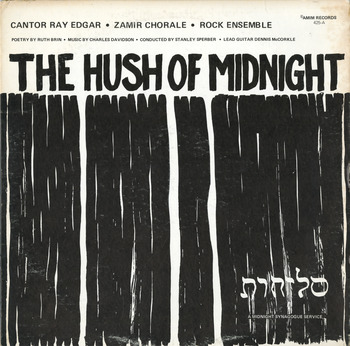
Hush of Midnight was one of a raft of albums, beginning in the middle to late 1960s, that framed its musical innovations in this way. References to “today,” “youth,” and “contemporary” pepper the liner notes, as do references to and images of guitars and drums, alongside some light psychedelia (see Figure 2). Album titles from this period abound with promises of a new start to the sonic experience of being Jewish: Beginnings, The New Jewish Sound, Shabbat for Today, and Sing a New Song are among the many albums that pronounce that they are ready to break with the past and promote revivified sounds of worship. Often, they explicitly sought to reimagine synagogue services, presenting themselves as readymade recordings of songs or of whole worship services that could be reproduced in congregational settings. Song selection was regularly guided by the order of prayers in Jewish prayer books, as if the albums themselves could provide new sonic templates for synagogue services. The music of these albums referenced rock and folk, Broadway and psychedelic rock, and they included songs in both English and Hebrew. Regardless of which musical genres they interpolated, these albums adapted and experimented with sound and form, as in Davidson's Hush of Midnight, which reimagined the midnight “selichos” service (an annual service held on the Saturday night before Rosh Hashana, the Jewish new year) as a rock opera, and Gerson Kingsley's Shabbat for Today (1969), which presented a new musical setting for a Friday night service in a Reform congregation.
Cantor Ray Edgar, Zamir Chorale, Rock Ensemble, The Hush of Midnight (Elkins Park, PA: Amim Records 425-A, 1970, LP).

Cantors who were paying attention to these albums heard within them the strains of a shift that might threaten their professional position and musical commitments. Achieving “professional” status had been a struggle for American cantors vying for prestige with their Rabbi colleagues and only fairly recently had the cantorial seminaries and their system of accreditation begun to legitimate cantors with “phenomenological markers of a profession.”Footnote 39 Cantors were loath to relinquish their status as institutionally affirmed leaders and make way for a new generation, many of whom were not trained in nusach or lacked formal training in music. Change was in the air—change in sound, to be sure, but the changes ran far deeper than that. In 1970, Cantor David Tillman wrote to his colleagues in the pages of the Journal of Synagogue Music, the journal for cantors affiliated with American Judaism's Conservative movement, about his displeasure with the overemphasis on older cantorial repertoire and the lack of attention to the needs and desires of congregants. “My friends” he wrote, “our profession is indeed changing because the needs of our communities are changing.” The change, he noted, was not only musical. He expressed his disappointment with colleagues who were too caught up in musical perfection and presentation, but he did not think that the answer lay in changing the sound of worship. Instead, he argued that the focus on repertoire and execution had distracted them from the purpose of ritual music. There is nothing sacred about style, he explained, and “no inherent kedusha [Hebrew for “holiness”] in putting one note next to another.” He criticized them for focusing too intently on the aesthetics of their performing, calling them “musical jewelers” who make beautiful ritual objects but do “absolutely nothing to insure this [their] work will be used properly.” He approvingly quoted the Executive Vice President of the Cantors Assembly, the union of cantors associated with the Conservative movement, who chided his members for similar reasons. “Too many of us care more about the sounds of our prayers than their relevance or meaning.”Footnote 40
Tillman contrasted this situation to the success of a “Hasidic [music] Festival,” about which he remarked, “they must be doing something to touch some souls,” referencing the burgeoning Israeli pop-folk sound that held a powerful influence on American Jewish conceptions of Jewish music.Footnote 41 Tillman was not necessarily advocating for less professional attention to synagogue music, nor was he arguing that folk music or participatory worship held the antidote for what ailed American congregations. Instead, he pointed to the experience of music more generally and to his sense that synagogues should strive to incorporate music that people have “been moved by.” The problem with synagogue music, Tillman intimated, may not have been the music but the lack of context for what kinds of experience the music was supposed to enable or encourage. “How can we doven [pray] for people who do not know how to doven?” he asked his colleagues.Footnote 42 Whereas the answer for his predecessors would have emphasized their role as inheritors and interpreters of a sacred musical tradition and their responsibility to bring worshippers into that tradition by inspiring them with tour de force performances, Tillman sensed that the ground had shifted and that the cantorial approach was not likely to suffice in this new era.
One of the most prominent voices of this new era was an ex-Hasidic folksinger named Shlomo Carlebach, who gained recognition in New York's folk revival during the late 1950s.Footnote 43 Carlebach was not, at this point, writing songs expressly for congregational prayer, although he frequently composed melodies for biblical texts that figured in the Jewish liturgical canon. Yet, the music he made in the 1960s had begun eliciting reactions about what Jewish music could sound like and, more importantly, how it could move people. The liner notes to his 1963 album, Live at the Village Gate, featured a glowing description that emphasized how it felt to experience the music:
With smoldering simplicity the revivalist rabbi captures and communicates the warmth and the wonder, the intensity, the immensity, the anguish and the ecstasy of Jewish life on many levels, as he himself has experienced it. For these are no ordinary songs. They are new dimensional folksongs, soulsongs, flame-lit melodies. They are prayers, are paeans, are poems, are impassioned outpourings of faith and hope and yearning. They are moods that are mirrored in the rhapsodic response of kindled participants.Footnote 44
In a stark departure from some of the more formal descriptions of cantorial music, this rapturous description of Carlebach's work emphasizes the affective dimensions of the music, not its formal aesthetics. The litany of terms refers not to the style of music but to how the author feels the music might be experienced and understood. Although it would take decades for Carlebach's songs to be adopted by communities across the spectrum of Jewish life, the description of this early recording suggested that his music contained elements of an emergent sensibility with respect to Jewish music drawn from sacred and liturgical texts that could draw people in without gesturing to the cantorial or high art traditions.
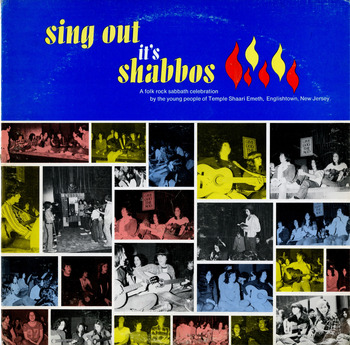
Without mythologizing, it is still fair to say that Carlebach was, in many ways, an anomalous figure. A more common approach to reimagining congregational music was to give the sanctuary over to synagogue youth groups and encourage them to write and record music that drew on their musical tastes. Albums such as Sing Out It's Shabbos (ca. 1971) or Shiru Shir Chadash—Sing a New Song (1973) fall into this genre (Figure 3). “Prepare yourself for an incomparably unique listening experience” announces the album jacket for Sing Out It's Shabbos. The album is presented as the work of “The Young People of Shaari Emeth, Englishtown, New Jersey,” and it has the flavor of a field recording, as if it were made by setting up a tape recorder in front of the pulpit during an actual service on a Friday evening. The youth performers play and sing with abandon, chugging their way through Debbie Freidman's “Vahavta” and elementary synagogue standards such as “Hinei Ma Tov,” alongside a version of Neil Young's “Down by the River” with revamped lyrics. The liner notes explain, “From the bounce and beat of their opening song, through their rock version of adon olam, they probe deep into the soul of Jewish experience as it relates to the lives of today's young people.” The result is an album that celebrates the exuberance of the teenagers who performed on it and does not waste a moment thinking about technical perfection or musical mastery. “Any lack of technical perfection is overshadowed by the mood and joy and almost magical spirituality created by these young people,” the album jacket continued. The enthusiasm of the young performers turns the lack of aesthetic polish into a feature rather than a bug, as the album cover declares that the musicians’ enthusiasm enables them to tap into “the soul of Jewish experience,” which animates the album.
The Young People of Shaari Emeth, Englishtown, New Jersey, Sing Out It's Shabbos (Englishtown, NJ: self-release, TSE-1, ND, LP).

Chants for Peace (1970), another youth-driven album, shared this sensibility. The project was underwritten by United Synagogue Youth, the youth education wing of the Conservative movement, and it, too, featured young musicians and singers whose enthusiasm for psychedelic music and existential concern about nuclear war can be heard on nearly every track. Timely cultural references aside, the album's liner notes do not reference youthful enthusiasm but point, instead, to the ways in which the singers channel tradition and renew it. “One fundamental reason Judaism has always been a vibrant religious culture,” it read,
is its capacity, throughout history, to glean from the secular world meaningful expressions and to give those expressions a character that was particularly Jewish. It is precisely this process that is operative in folk/rock liturgical music. Chants for Peace is meant to be a contribution to meaning in contemporary Jewish prayer expression.
Folk-rock, they argue, should not be understood as a departure from more traditional approaches to prayer; rather, it shares Judaism's eternal ethos and commitment to engagement and expression. The sound might change, the album suggests, but the impulses behind it remain consistent. In contrast to cantorial music, this reimagined worship service was organized around a notion of “prayer expression” rather than aesthetic perfection.
Cantor Raymond Smolover, the driving force behind “Edge of Freedom” and other albums with his own congregation's youth group, calls the music best suited for this new approach to prayer “religious rock.” In his own words,
“Religious Rock” is a new term, chosen to express a tradition as ancient as the chanting of scripture, as joyful as a chassidic nigun [a wordless melody] and as contemporary as folk and jazz/rock. It is an attempt to add the rhythmic beat of the heart to the restless yearning of the soul: enable the earthbound flesh to take melodic flight with the spirit.
Smolover describes this new music in terms of its ability both to echo and express the life experiences of the listener. His characterization emphasizes continuities between this new form and older ones, and, at the same time, it acknowledges that the intention of the music is largely experiential and expressive, not only aesthetic.
The liner notes for “Sim Shalom,” Pittsburgh Congregation Rodef Shalom's 1970 “Jazz-Rock service,” echo this approach. The album, featuring compositions by “Cantor Raymond Smolovar [sic]” was recorded live and was described by one observer as “simple, moving and heavy with traditional liturgical music, set to a modern rock accompaniment.” “‘Sim Shalom,’” the liner notes begin,
is no mere show utilizing the gimmick of nice, clean-cut Jewish kids singing Jewish prayer. … Here is a service that created an environment and molded the worshippers into a community. … The melodies … are an attempt to find music and rhythms from the “new generation” to heighten the worshippers’ emotional experience without destroying the sanctity of prayers.
Again, emphasizing its connection to tradition, the album offers a notion of congregational prayer oriented around experience rather than aesthetic appreciation.
One of the most notable efforts to formulate a rock approach to prayer was Gershon Kingsley's liturgical album titled Shabbat 68 (1968). Shabbat 68 was the second in a trio of efforts to “probe … contemporary and futuristic expression.”Footnote 45 It grew out of an earlier composition for a Sabbath Eve service that featured John Cage in the role of “Rabbi,” and it received a later treatment under the more versatile title Shabbat for Today.Footnote 46Shabbat 68 captured the debut performance, at Temple Sharay Tefilo-Israel in East Orange, New Jersey. Kingsley had already achieved some mainstream success as a composer of pop tunes and advertising jingles, and he brought this aesthetic to his foray into Jewish liturgical music by featuring his use of the MOOG synthesizer, a new instrument then at the cutting edge of musical technology. As a result, Shabbat 68 sounds like a high-concept reconceptualization of the Friday-night liturgy, with a sonic palate reminiscent of 1960s psychedelic film scores resulting in sounds that are, by turn, jarringly percussive, sticky sweet, and lugubriously bizarre. The recording juxtaposes a self-serious rabbi reading English translations from the prayer book and a cantor singing his melodic figures with operatic vocal production, topped off with a pop-gospel choir. The stylistic pastiche is disjunct, confusing, and fascinating.
Yet, for all its sonic strangeness, Shabbat 68 was still a product of established suburban Jewish life. It was commissioned by the congregation with the financial support of some thirty-five congregants (all of whom are listed on the back of the album jacket), and the album featured liner notes from the rabbi (“This is the spirit of our congregation”). Nevertheless, comments by the congregation's own Rabbi Charles Akiva Annes on a later performance of Shabbat for Today described Kingsley's effort in terms consistent with the emerging wave of new music for Jewish prayer. “It may well be that we have exhausted this [traditional, older] mode of worship and should begin a serious study of other forms which express our faith in communal prayer. … I believe that Shabbat for Today comes close to fulfilling this new experience in prayer as emotion.”Footnote 47 As if the rabbi's word was not enough, the entertainment industry weekly Variety offered a similar sentiment in its review of Shabbat for Today in “Religioso Rock Scores”: “An audience that entered the temple with doubts left with the impression that they had experienced a sincere contemporary and exciting contribution to religion.”Footnote 48
The commission approach that supported Kingsley's liturgical records also extended to youth movements and summer camps. Judah Cohen has noted that summer camps in the Reform movement had been supporting a musical culture based on singing and group participation since the 1950s, “developing a vibrant culture that shared less and less with the values of Jewish life at home.” This youth-oriented music making was facilitated by professional and semiprofessional song leaders and composers who were employed as music specialists at camp, some of whom, such as Debbie Friedman and Jeff Klepper, would become some of the more influential composers of Jewish liturgical music, first in the Reform movement and later beyond it. As Cohen has stressed in recent scholarship on the period, these musical shifts were supported and sustained by a “dynamically shifting landscape of communal resources” that sought both to respond to youth culture and to shape its future directions through supporting innovative musical programs. Michael Isaacson composed his Avodat Amamit: A Folk Service with a commission from NFTY in 1972, and his songs also appeared on side two of the first “Songs NFTY Sings” album (1974). Isaacson, who wrote Avodat Amamit at one of the Reform Movement's summer camps, epitomized the emerging value placed on access and expression, imagining his composition as an invitation to anyone who wanted to make music for prayer. In the introduction to the printed score of Avodat Amamit, Isaacson wrote, “The particular design of this service insures both beginning guitarists and more advanced classical guitarists of finding joy in the accompaniment material. With increased emphasis in congregational singing, it is my hope that these folk-like tunes will give pleasure and new meaning to worshippers of all ages.” Isaacson is clearly reaching out to musicians with less formal training whom he hopes will capitalize on the new ways in which he imagines that congregational music is taking form. The score even includes an “explanation of guitar symbols” for those who are trying to play it note-for-note.Footnote 49
Yet, even as he pursued a populist approach, Isaacson considered himself a serious musician and composer who took his responsibility so seriously that, just as his Avodat Amamit was being recorded and published, he penned an article for the Cantors’ Assembly Journal that critiqued the lay of the musical landscape. “Synagogue music has had it,” he pointedly concluded, blaming musical “sentimentalists” and their preoccupation with “nostalgia” and “preservation.” As a voice of the new generation of composers, he criticized the “bizarre interest of late in hassidic niggunim [wordless melodies that came out of the Eastern European Chassidic tradition]” as “‘Uncle-Tom’-ing it,” and he critiqued the “Frenzy over congregational participation [which] has discouraged the serious composer and encouraged every congregation's amateur folk singer. Everyone is a composer today and the result is no one is.” Isaacson, who has contributed some of what are arguably still among the most popular melodies for worship in the Reform movement, sharply criticized participation as a value while blaming musical innovations he found both retrogressive and amateurish. Isaacson wanted sophisticated composers writing for synagogues because, he believed, Jews faced a choice that hinged on their ability to change conceptions of what prayer could be. “Either we re-create contemporary meaning from our traditions and values or we must seriously reexamine them.” Central to Isaacson's critique and reframing was his sense that commitments to older musical practices frustrate people's desire for meaning.Footnote 50
Debbie Friedman's work emerges as one of the most fully articulated attempts to reexamine liturgical practices and position them in a culture of experience. In the words of musicologist Tina Frühauf, Friedman's innovative approach to liturgy “compelled her audience to sing and dance, connect with each other, and create spiritually elevated moments no matter the context. As such, her work defies simple division between liturgical and non-liturgical music and rather creates a general feeling of spiritual togetherness perceived as profound and pressing.”Footnote 51 As Judah Cohen has documented, Friedman came out of the Reform Movement's youth wing, and, against critiques that she broke with Jewish musical traditions, she identified as a “great lover of nusach” and understood her music to be “rooted in a tradition that is Russian and Hungarian, and influenced by Israel.”Footnote 52 As was the case with her contemporaries, her songs are decidedly geared toward prevailing musical tastes among young people, with primary referents in folk and folk-rock. Her musical styles made her songs readily appealing to communities of younger American Jews. As they aged, they brought it with them into more established synagogues and temples, making it a feature of the normative sound of non-Orthodox congregational worship. Musicologist Sarah Ross connects Friedman's work to Jewish music traditions where
musical innovators now considered traditional were once challengers. For example, Salomon Sulzer and Louis Lewandowsky revolutionized synagogue music in German-speaking countries in the nineteenth century by following the example of European church music. In fact, Friedman's music is now considered traditional. In spite of the criticism, she knew how to connect Jews to each other.Footnote 53
Certainly, one ingredient in her success was her skill as a composer and her ability to write accessible music. The elements of her music that made it accessible, however, developed within an emergent culture of congregational prayer that tilted toward an understanding of prayer as fundamentally experiential.
Friedman's albums helped to facilitate this transition. Her first record, Sing unto God (1972), shares hallmarks with other albums from the time: It features a choir of untrained (if well-practiced) teenage voices singing new compositions in folk-style choral arrangements. Friedman's voice is only heard on a few tracks, but her compositions are sung throughout, making plain the emphasized role of participants over auteur. She juxtaposed Hebrew texts with their English translations and offered her vision for what prayer should or could be, a vision that was largely in line with the emerging consensus.
Sing Unto God is a new experience in worship that emphasizes through song the importance of community involvement in worship. This music carries a solid message in simple, easily understood form. It enables those who are willing to join together as a community in contemporary songs of prayer.
Although she is responsible for some of the most popular new melodies to enter into the repertoires of American congregations, Friedman's influence on the culture of American Jewish congregational prayer can be more accurately assessed alongside the contributions of her counterparts. She and her music may stand alone, but they both emerged from a moment in American Jewish life when many people were thinking and writing about both how prayer should sound and about what they thought it should be. Distancing themselves from their cantorial predecessors by trading in organs for guitars and opera for folk-rock, these composers contributed songs and albums that aspired to retune expectations and understandings of congregational prayer. Shifting the descriptive frames of sacred music from claims about virtuosity and comparisons with opera to those that emphasize the experience of prayer shaped the evolution of American Jewish congregational practice as much, if not more so, than the music could manage on its own.
Conclusion
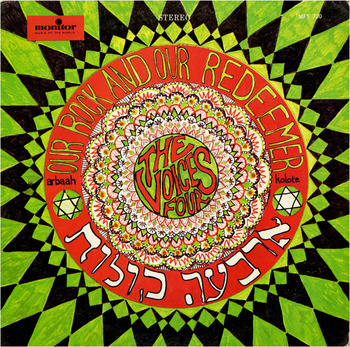
These albums’ collective lack of success is evidence for this claim. Very few of the songs written and recorded during this period ever made it into the regular worship repertoires of American Jews, save a small number by Friedman, Isaacson, Klepper, Carlebach, and a handful of others, such as Baruch Chait, Merri Lovinger Arian, Craig Taubman, and Moshe Rothblum. The reasons for the songs’ failure to catch on in congregational life likely vary from album to album, from song to song, and from congregation to congregation. Some may simply not have contained melodies that drew people to sing them. Others, such as Saul Zim's Broadway-obsessed David Superstar, were likely too complicated to sing or too complex for synagogue musicians to manage (Figure 4). There was also some institutional resistance on the part of cantors and rabbis. Yet, the lack of general success in this regard should not be understood to mean that either the songs themselves or the larger trend they shared in were cultural or religious failures. In fact, the songs represent a larger, emergent vision for what congregational music could and should be that has become normative among non-Orthodox American congregations. Just because their music is not sung widely (or ever) should not invalidate the cultural and even theological work that the albums undertook. The fact that their vision for prayer has outlasted their music indicates that their significance can be appreciated beyond their sound.
The Four Voices, Our Rock and Our Redeemer (New York: Monitor Records MFS 720, ND, LP).

Tracing this arc of musical change over the latter half of the twentieth century reveals some significant changes in the culture of American Jewish prayer that is partially obscured by persistent attention to its music. The sounds of prayer changed, but those sounds were only one part of a larger set of shifting concerns with respect to the meaning of prayer and what people imagined it ought to be. Thus, to characterize the shift in congregational style in terms of presentational music to participatory music does not fully account for the context in which those changes took place. To call a form of music “presentational” is to suggest a certain approach to how liturgies should be performed in a congregational setting. The same is true of calling some music “participatory.” Yet, those terms obscure larger concerns about how people participating in a prayer service might try to enter into, encounter, and express prayer.
Understanding the sonic shift in terms of a transition from a framework that emphasized formal aesthetics to one that emphasized experience attends with greater fidelity to the context of congregational music making. If midcentury cantorial music was supposed to impress upon congregations the awesome power of the liturgy (and, perhaps, of God) by presenting cantors whose high-art bona fides could help to transmit the sublimity of the European classical musical tradition, then the music that followed inverted the logic of prayer (and, perhaps, of God). If cantorial music aspired to transcendence through aesthetics, then the music that followed aspired for immanence through experience.
Whether or not audiences shared the cantors’ and composers’ ideals is a different question for a different day, as is the question of why this change emerged when it did. Nevertheless, tracking the musical changes and how they were described reveals a powerful shift not just in the sounds of worship but also in its expectations and meanings. In liner notes and album jackets, and in journals and other scholarly writing, composers and clergy sought to direct attention toward particular elements of the music, framing both the sound and its meaning, even before people heard the first note. Attending to the construction of these frames reveals a counterpoint to prevailing histories of American Jewish sacred music, offering an account in which experience overtook aesthetics and whose influence has persisted even as the music has faded away.