


International organizations (IOs) have come under increasing pressure in recent years. Rising powers, such as China, India, and Russia, have challenged established IOs, contesting their legitimacy and raising fears of an “autocratization” of global governance. Nationalist populists such as Marine Le Pen and Javier Milei have mobilized against multilateral cooperation in the name of “regaining control,” while United States (US) President Donald Trump has taken aim at dozens of IOs in his second presidency. Contestation has also come from civil society groups such as Fridays for Future and Global Justice Now, which have demanded reforms of IOs in the direction of higher ambitions and fairer outcomes. Taken together, these developments have led observers to conclude that IOs are contested like never before.
This contestation has inspired a rich and diverse research program because it bears directly on the viability, legitimacy, and effectiveness of IOs. Scholars disagree on whether contestation primarily threatens IOs,Footnote 1 signals IO relevance and political importance,Footnote 2 or helps to expose institutional problems and sustain IO efficacy and legitimacy.Footnote 3 Understanding these divergent implications requires closer attention to different types of contestation, the forces that drive them, and the ways IOs respond. This essay therefore takes stock of scholarship on the patterns and drivers of IO contestation, as well as responses to it, while identifying critical areas for future inquiry. We define contestation broadly as any (in)action that seeks to change an IO’s policies, politics, or polity, and include research on deeply political processes such as protest,Footnote 4 discontent,Footnote 5 opposition,Footnote 6 backlash,Footnote 7 delegitimation,Footnote 8 and politicization of international institutions.Footnote 9
In the literature on IOs, the word contestation is increasingly used as an umbrella concept for these diverse kinds of challenges. The value of conceptualizing these challenges as forms of IO contestation lies not in treating them as identical, but in highlighting their common core: they challenge an IO or its policies and justify that challenge as a means of improving, replacing, or nullifying existing arrangements. This perspective reveals broader patterns that remain obscured when phenomena such as reform demands, politicization, backlash, obstruction, withdrawal, and institutional replacement are studied in isolation. It directs attention to how challenges travel across arenas, shift from criticism and reform demands to rejection and outright hostility, and accumulate in ways that jointly shape larger systemic trends. Our review therefore builds on research on distinct forms of IO contestation to develop a framework that clarifies what these challenges share, how they differ, and why and how their interactions matter for IOs.
To facilitate such an assessment, we distinguish between “internal contestation,” which criticizes the institutions or policies of an IO with the aim of reform, and “external contestation,” which challenges an IO’s foundational principles and very existence. We use this distinction to map variation, interpret findings, and identify gaps for future research. We also argue that this conceptualization helps us to better capture the changing nature of contestation: while criticism of how IOs function has long been a staple of world politics, it recently appears to have shifted toward a more fundamental questioning of IOs themselves.
We review scholarship on three key themes: patterns, drivers, and responses to contestation. The first theme discusses core patterns in the contestation of IOs. We show how our typology helps understand historical and contemporary challenges to IOs by exploring how state and societal actors engage in internal and external contestation. Using newly available measures, we show that contestation varies considerably across IOs and over time. In contrast to expectations voiced by many pundits and scholars, however, it does not appear to have increased over the period between 2000 and 2020. We discuss potential explanations for this discrepancy, including incomplete coverage of recent developments, limitations of existing measures, and a potential shift from internal to external contestation beneath stable aggregate levels of contestation.
Second, we highlight three profound processes that drive IO contestation: expanded international authority and deepened value conflicts; global power shifts and a resurgence of autocracy; and societal transformations and rising anti-globalist populist pressure. All three appear to contribute to both internal and external contestation. A key task for future scholarship is to theorize the conditions under which these factors give rise to one form of contestation rather than another—and under which one form of contestation morphs into another.
Third, we discuss how IOs as strategic actors react to contestation through communicative action, institutional reform, and policy change. We suggest that the growing salience of external contestation requires a wider repertoire of justifications and responses. Yet while communicative responses can address both internal and external contestation, institutional and policy responses are more easily directed toward internal rather than external contestation. We also highlight the need for more research on how effective IOs’ responses are in countering contestation and shoring up support.
We conclude by outlining key implications for future research on IO contestation. Further theory development is needed to explain when drivers generate internal criticism and when they escalate into external rejection, and how movement occurs between these modes—questions that call for greater attention to dynamic effects and causal interaction. Empirical progress is constrained by data and measurement gaps: prevailing indicators struggle to capture informal and obstructionist forms of contestation, and data often end before recent systemic assaults on the liberal international order. Finally, we suggest that research on contestation is well positioned to address emerging questions about organizational robustness, hegemonic contestation, and the relationship between IO contestation and the broader contestation of global governance.
Conceptualizing Contestation
We focus on the contestation of IOs, which we understand as any action or inaction that challenges an IO or its policies with the intention to improve, replace, or nullify existing arrangements. To qualify as contestation, the challenge thus must be based on a justification that explains why change is desirable.Footnote 10 This definition includes both civil society protests demanding fairer outcomes from International Monetary Fund (IMF) programs and the US government’s refusal to permit reappointment to (and thus paralyzing) the World Trade Organization’s (WTO) Appellate Body.
At the same time, while contestation is integral to IO politics, many political interactions in IOs do not constitute contestation. We focus on those instances in which actors justify challenges to existing arrangements by invoking an impetus for change. Because IO institutions and policies create winners and losers, it is unsurprising that IOs generate contestation. Such contestation often reflects struggles between those who incur losses and seek to mitigate them, and those who benefit and aim to maintain their advantages.Footnote 11 Reflecting its deeply political character, IO contestation encompasses not only competing interests, power, and resources, but also a wide range of substantive demands, from heated but arcane policy discussions to fundamental questions about an IO’s legitimacy. IO contestation is therefore not a new phenomenon, but one that has been a feature of the politics surrounding IOs since their inception.
To capture qualitative differences in the nature of contestation, we distinguish between internal and external contestation, based on the justification used.Footnote 12 Internal contestation challenges an IO’s institutions or policies and demands reform, while accepting its fundamental principles and continued existence. External contestation, by contrast, challenges an IO at a deeper level, questioning its principles, legitimacy, or even existence. The terms internal and external therefore do not distinguish between contestation by actors inside or outside the member states of a challenged IO. Rather, they refer to the depth of the challenge: internal contestation criticizes an IO while accepting it in principle, whereas external contestation questions that commitment itself. Internal and external contestation are best understood as ideal types that serve as analytical heuristics. In practice, manifestations of contestation often fall along a continuum from predominantly internal to predominantly external, rather than into clear binary categories.
This distinction is inspired by similar conceptual constructions in the study of laws, norms, and institutions. Research in law, for instance, distinguishes between legal contestation of laws and rulings within the parameters of the legal system and illegal contestation, which includes any effort to abolish courts or other legal institutions.Footnote 13 Scholarship in philosophy distinguishes between applicatory contestation and validity contestation, and in norm research, scholars draw a line between contestation aimed at the application of a norm and contestation aimed at the validity of a norm.Footnote 14 Recent scholarship in international relations has invoked a related distinction between normal and deep contestation of the liberal international order.Footnote 15
Internal and external contestation may be carried out by a variety of actors. We distinguish between contestation by state actors, such as governments, political leaders, and bureaucratic elites, and contestation by societal actors, such as nongovernmental organizations (NGOs), political parties, and ordinary citizens. Governments occupy a dual position in this framework. On the one hand, they are contestants that challenge IOs through internal and external contestation. Such contestation comes from governments in both member states and non-member states.Footnote 16 It includes demands by member governments that an IO’s institutions or policies be revised, as in calls for IMF or UN reform, but also challenges of an IO from non-member governments, as in Russian rejection of the North Atlantic Treaty Organization (NATO) or US criticism of the European Union (EU). On the other hand, member governments are principals of IOs that can work with the bureaucratic branch to respond to contestation, for example, when government officials publicly defend IOs.Footnote 17
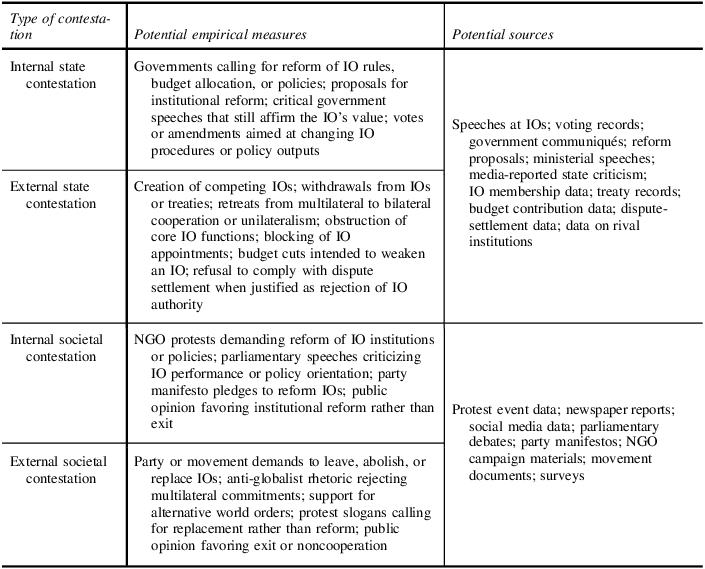
These two dimensions—internal versus external contestation and state versus societal actors—yield a typology with four broad ideal types of contestation (Table 1). Neither dimension reflects a clear-cut binary. Demands for reform may go so far as to challenge the underlying principles of an IO, just as political parties may shift from societal to state actors when they move from opposition into office. To show how existing measures map onto this two-by-two distinction, and to help future research apply it, Table 2 presents an inventory of potential empirical measures and data sources.
Internal and external contestation

TABLE 1 Long description
A table categorizing types of contestation based on internal versus external and state versus societal actors. The table has two rows and two columns. The row labels are State actors and Societal actors. The column headers are Internal (reform IOs) and External (reject IOs). The table cells describe the types of contestation: Internal state contestation, External state contestation, Internal societal contestation, and External societal contestation.
Empirical measures and data for studying IO contestation

TABLE 2 Long description
A table categorizing types of contestation, empirical measures, and potential sources. The table has four rows and three columns. The columns are labeled ‘Type of contestation’, ‘Potential empirical measures’, and ‘Potential sources’. Row 1: Internal state contestation, Governments calling for reform of IO rules, budget allocation, or policies; proposals for institutional reform; critical government speeches that still affirm the IO’s value; votes or amendments aimed at changing IO procedures or policy outputs, Speeches at IOs; voting records; government communiques; reform proposals; ministerial speeches; media-reported state criticism; IO membership data; treaty records; budget contribution data; dispute-settlement data; data on rival institutions. Row 2: External state contestation, Creation of competing IOs; withdrawals from IOs or treaties; retreats from multilateral to bilateral cooperation or unilateralism; obstruction of core IO functions; blocking of IO appointments; budget cuts intended to weaken an IO; refusal to comply with dispute settlement when justified as rejection of IO authority, Speeches at IOs; voting records; government communiques; reform proposals; ministerial speeches; media-reported state criticism; IO membership data; treaty records; budget contribution data; dispute-settlement data; data on rival institutions. Row 3: Internal societal contestation, NGO protests demanding reform of IO institutions or policies; parliamentary speeches criticizing IO performance or policy orientation; party manifesto pledges to reform IOs; public opinion favoring institutional reform rather than exit, Protest event data; newspaper reports; social media data; parliamentary debates; party manifestos; NGO campaign materials; movement documents; surveys. Row 4: External societal contestation, Party or movement demands to leave, abolish, or replace IOs; anti-globalist rhetoric rejecting multilateral commitments; support for alternative world orders; protest slogans calling for replacement rather than reform; public opinion favoring exit or noncooperation, Protest event data; newspaper reports; social media data; parliamentary debates; party manifestos; NGO campaign materials; movement documents; surveys.
Patterns of IO Contestation
Using the typology developed earlier, we first review research on the four types of IO contestation. We then examine how contestation has varied across IOs and over time, drawing on newly available measures of state and societal contestation.
Four Types of IO Contestation
When engaging in internal state contestation, member state representatives typically target the institutional arrangements or the substantive policies of IOs. Such contestation is particularly common among states that historically have been less well-positioned within existing organizations. Demands for reform of IO policies are common among countries in the Global South and calls for a New International Economic Order in the 1970s are an early example.Footnote 18 Such demands include proposals for alternative approaches to climate governance,Footnote 19 financial stability,Footnote 20 human rights,Footnote 21 and international criminal justice.Footnote 22 Demands for reform of IO institutions often originate with countries that have recently moved up the power hierarchy.Footnote 23
But internal state contestation also comes from the established powers that originally created the liberal international order and have profited from it.Footnote 24 Some reform demands arise from perceived deficiencies in how existing IOs function and aim at improving their performance.Footnote 25 Others call for more far-reaching changes to the institutions and policies of IOs, such as reforms of the United Nations Security Council (UNSC) or NATO.Footnote 26 Historical examples include France’s challenge to US dominance in NATO in the 1960s and the United Kingdom’s (UK) demand for a rebate in the European Community (EC) budget in the 1980s.
External state contestation involves government-led efforts to fundamentally challenge or replace existing IOs. One form is “contested multilateralism”Footnote 27 or “counter-institutionalization,”Footnote 28 where dissatisfied rising powers and illiberal states create competing bodies based on alternative foundational principles,Footnote 29 such as the BRICS grouping (Brazil, Russia, India, China, and South Africa) and the New Development Bank (NDB) as alternatives to the Group of Seven (G7) and the World Bank.Footnote 30 Some established Western powers have also explored alternatives to the liberal institutions they once pioneered,Footnote 31 for instance, moving cooperation out of universal organizations and into exclusive bodies they can more easily control.Footnote 32 Trump’s Board of Peace is a case in point.
External contestation can also take other forms. Member states may withdraw from IOs,Footnote 33 allow IOs and international treaties to decay,Footnote 34 expire,Footnote 35 or die,Footnote 36 or retreat from multilateral frameworks into bilateral or unilateral approaches. Such shifts have been especially pronounced in trade, where states have partially sidelined the WTO in favor of bilateral arrangements.Footnote 37 A move toward unilateralism is illustrated by US foreign policy under the second Trump administration, which includes significant funding cuts to IO budgets and exits from a very large number of IOs and treaties.Footnote 38
Internal societal contestation includes demands by NGOs, movements, firms, parties, and citizens to reform IO institutions or policies. NGO contestation directed against multilateral economic institutions was particularly intense during the anti-globalization protests of the late 1990s and early 2000s.Footnote 39 Today it is particularly prominent in areas such as climate change,Footnote 40 development,Footnote 41 and trade and finance.Footnote 42 NGOs often call for institutional reforms that make IOs more democratic and just, and for greater IO attention to environmental and social concerns.Footnote 43 Business contestation of IOs, by contrast, traditionally targets IO policies, especially the regulatory details that matter greatly for those who win and lose from such policies. Firms tend to influence IO policies through inside lobbyingFootnote 44 or by seeking to dilute the national implementation of IO policies.Footnote 45 However, sometimes businesses also contest IO policies publicly, such as with European digital regulation which has come under open pressure from US tech firms.Footnote 46
As global governance has gained greater salience in domestic politics and the tone of societal debates about multilateral cooperation has become more negative,Footnote 47 political parties and individual politicians have emerged as important societal contestants of IOs.Footnote 48 While mainstream parties tend to be relatively supportive of IOs, those on the fringes are typically more critical.Footnote 49 Reflecting internal contestation, much of the criticism is directed at the institutions or policies of existing IOs. Parties on the right often criticize IOs for restricting national sovereignty and for promoting gender equality, environmental protection, and multiculturalism, whereas parties on the left and green parties blame them for weak democratic accountability, North–South power asymmetries, and neoliberal economic policies.Footnote 50 IO criticism is also a core component of the populist playbook used by politicians and parties around the world.Footnote 51 While populists have typically painted IOs as representatives of an international elite serving its own interests rather than those of the people,Footnote 52 they have often engaged productively with IOs once in office.Footnote 53
External societal contestation goes beyond its internal counterpart in that it calls for fundamental transformations rather than reforms of IO institutions and policies. External societal contestation can be found at both ends of the political spectrum, though it is particularly common on the far right,Footnote 54 where politicians and parties often question core principles of existing IOs and the very idea of multilateralism in the name of “taking back control.” Examples include demands to withdraw from institutions such as international courts and human rights treaties,Footnote 55 and proposals to dismantle IOs such as the EU.Footnote 56 These voices are sometimes amplified by societal actors, businesses, and organizations that fund efforts to change domestic discourse about international cooperation.Footnote 57
On the far left, external contestation is advanced under banners such as “Another world is possible” and “Globalization from below.”Footnote 58 Consistent with traditions of leftist internationalism, radical-left actors tend to support cooperation as a means of tackling global problems in a fair and inclusive way, but are skeptical of existing IOs as vehicles for achieving this goal.Footnote 59 They have therefore sought to develop alternative arrangements, such as the World Social Forum as a counterpoint to the World Economic Forum, and the Global Citizens Assembly as an alternative to the Conference of the Parties of the United Nations Framework Convention on Climate Change (UNFCCC).
Contestation Across Time and Space
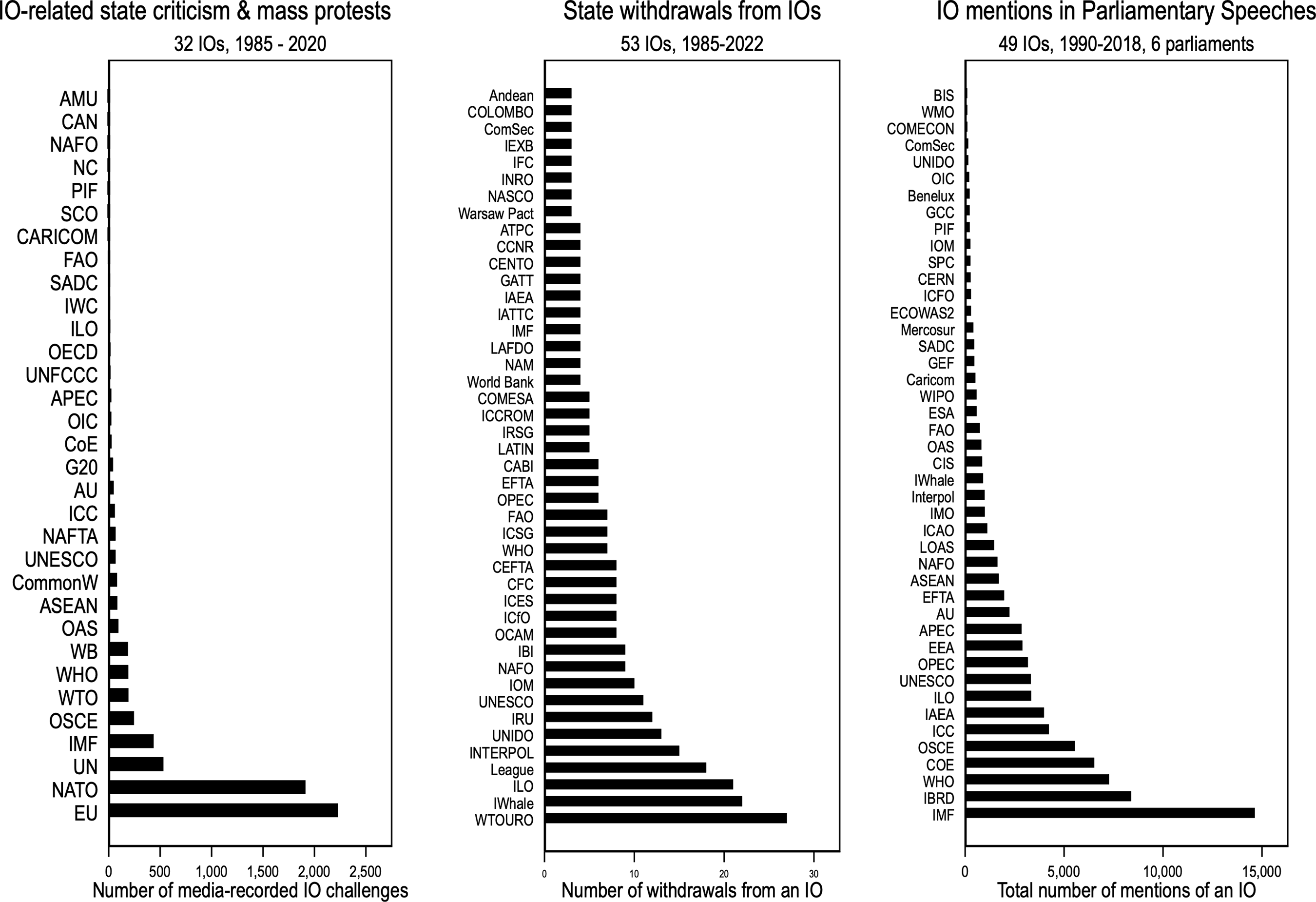
We next document key empirical patterns of contestation across IOs and over time. For these purposes, we use complementary measures of IO contestation from three recent studies, exploiting a growing availability of empirical data.Footnote 60
The most comprehensive coverage is provided by Sommerer and colleagues, who examine state and societal contestation of thirty-two prominent IOs over the period of 1985–2020, measuring contestation as the frequency of public challenges to IOs reported in worldwide news coverage.Footnote 61 However, they do not allow us to differentiate between internal and external contestation. Von Borzyskowski and Vabulas capture a prominent form of external state contestation: member state withdrawals from IOs over the period of 1985–2022.Footnote 62 Such withdrawals entail a rejection of the IO in question, even when they are informed by an ambition to negotiate IO reform. Hunter and Walter, by contrast, focus on a particular form of internal societal contestation: the frequency and sentiment of party discourse about IOs in parliamentary debates in six Western countries between 1990 and 2018.Footnote 63 Over this period, such discourse generally focused on the functioning and reform of existing IOs rather than their abandonment.
Figure 1 shows that the exposure to contestation varies significantly across IOs. Whereas IOs such as the IMF and the World Health Organization (WHO) show high levels of contestation across all indicators, organizations such as the Caribbean Community (CAN) and the Nordic Council (NC) are not much contested in any data set. Other IOs are contested on some measures, but not on others. For example, the EU and NATO confront high levels of state criticism, mass protest, and parliamentary debates, but few or no member state withdrawals. Conversely, the International Whaling Commission (IWC) faces few media-reported state challenges and mass protests, but is frequently discussed in parliaments and has experienced extensive member state withdrawal. Overall, contestation is concentrated on a relatively small number of IOs—the EU, IMF, NATO, UN, World Bank, and WTO—while most others face only isolated challenges.
Contestation across IOs
Note: The left-hand panel shows the overall number of media-recorded public challenges of thirty-two IOs each over the period of 1985–2020. The middle panel shows the overall number of state withdrawals from fifty-five IOs who experienced two or more withdrawals. The right-hand panel shows the salience of forty-nine IOs in national parliamentary debates, measured as the total number of mentions of each IO across six national parliaments. Twenty-three IOs that received less than one hundred mentions overall and the EU, which was mentioned more than 26,000 times, are not shown.
Source: Data from Sommerer et al. Reference Sommerer, Agné, Zelli and Joachim Bes2022a (left-hand panel); von Borzyskowski and Vabulas Reference von Borzyskowski and Vabulas2025 (middle panel); and Hunter and Walter Reference Hunter and Walter2026 (right-hand panel).

FIGURE 1 Long description
Panel A: A vertical bar graph titled ‘IO-related state criticism & mass protests’ shows the number of recorded IO challenges from 1985 to 2020 for 32 IOs. The x-axis represents the number of recorded IO challenges, while the y-axis lists the IOs. Notable IOs with higher challenges include the EU, NATO, and UN. Panel B: A vertical bar graph titled ‘State withdrawals from IOs’ displays the number of withdrawals from 53 IOs between 1985 and 2022. The x-axis represents the number of withdrawals from an IO, and the y-axis lists the IOs. Significant withdrawals are seen in IOs like UNESCO and WHO. Panel C: A vertical bar graph titled ‘IO mentions in Parliamentary Speeches’ illustrates the total number of mentions of 49 IOs in parliamentary speeches from 1990 to 2018 across 8 parliaments. The x-axis represents the total number of mentions of an IO, and the y-axis lists the IOs. The EU has the highest number of mentions, followed by the UN and WTO.
Contestation of IOs is not limited to actors within an organization’s membership. For some salient IOs with non-universal memberships, much of the contestation comes from the outside. For example, Figure 1 shows that one of the most frequently mentioned IOs in parliamentary speeches is the Organization of the Petroleum Exporting Countries (OPEC), even though none of the six Western countries covered is an OPEC member. Similarly, while public challenges of some IOs, such as WHO, IWC, and Organization of American States (OAS), mostly come from state and societal actors in member countries, the opposite is true for IOs such as NATO, the EU, and the ICC.Footnote 64 At the same time, membership size affects how contestation should be interpreted, since similar volumes might have different implications across organizations. For instance, when estimates of withdrawals account for membership size, smaller regional organizations with several exits, such as the European Free Trade Association (EFTA) and the Central Commission for the Navigation of the Rhine (CCNR), rise to the top.Footnote 65
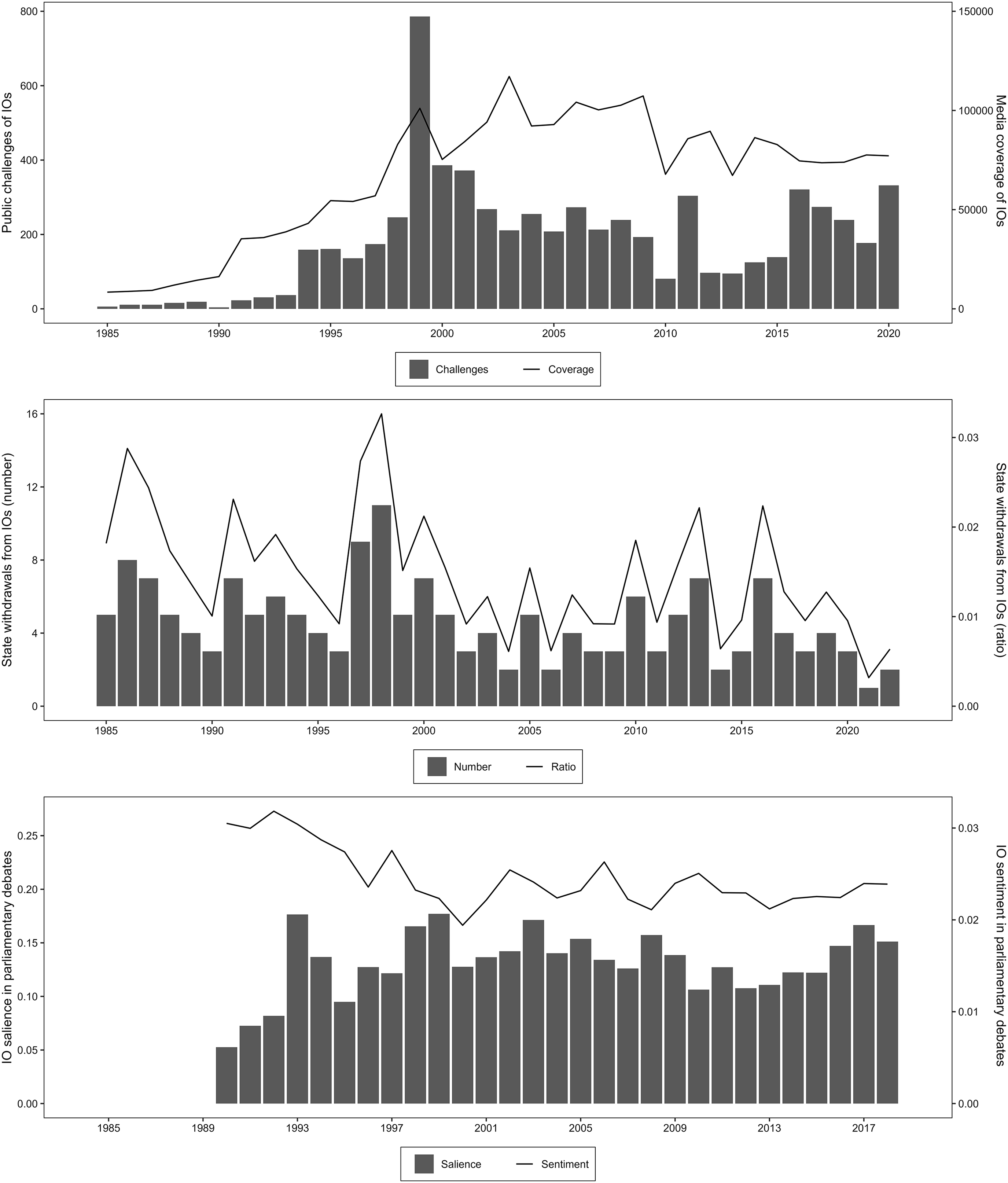
We next explore how IO contestation has evolved over time. Figure 2 uses the three data sources to plot aggregate contestation across all IOs on a yearly basis. It reveals a surprising pattern. Contrary to the dominant narrative in academic and policy circles that contestation of IOs is on the rise, none of the three measures show linear growth over the full period. Public state challenges and mass protests directed against IOs grew rapidly from the early 1990s to the early 2000s with a peak in 1999, driven mainly by criticism of NATO during the Kosovo crisis and widespread mobilization against the global economic IOs. Thereafter, public challenges to IOs on average remained at a relatively stable level, noticeably higher than before the 1990s. Member state withdrawals from IOs likewise did not become more frequent during the 1985–2022 period, despite prominent cases such as Brexit, although the recent, broad-based announcement of US withdrawal from multiple IOs is outside of this observation period and will likely result in a dramatic peak in 2025 and 2026. Finally, parliamentary rhetoric about IOs in six Western countries overall became more negative in the 1990s, but has since fluctuated modestly around a fairly stable, slightly positive mean. Overall, these data suggest that state and societal contestation of IOs increased during the 1990s and has been a stable feature of global governance ever since. However, it has not experienced a steady rise over the past two decades.
Contestation of IOs over time
Note: The top panel shows the yearly number of public challenges to thirty-two IOs, as well as the general media coverage of these IOs. The middle panel shows the yearly number of state withdrawals from fifty-five IOs with two or more withdrawals, as well as the ratio of state withdrawals to the number of IOs. The bottom panel shows the yearly average of IO salience in national parliamentary debates, measured as the yearly share of all mentions of seventy-five IOs across six national parliaments relative to all parliamentary communication in a given year, and the yearly average net sentiment, reflecting the difference between positive to negative sentiment in statements about these IOs.
Source: Data from Sommerer et al. Reference Sommerer, Agné, Zelli and Joachim Bes2022a (top panel); von Borzyskowski and Vabulas Reference von Borzyskowski and Vabulas2025 (middle panel); and Hunter and Walter Reference Hunter and Walter2026 (bottom panel).

This picture resonates with evidence from other studies. Focusing on state contestation, Eilstrup-Sangiovanni finds that the ratio of IO terminations to IO creations rose in the 1990s, only to decline in the 2000s, whereas Gray documents a similar pattern for “zombie IOs.”Footnote 66 Other studies find relatively small changes over time or even reductions in state contestation as expressed through speeches in UN General Assembly debates.Footnote 67 These debates also reveal that the general attention paid by states to IOs increased throughout the 1990s but has since declined to pre-1990s levels.Footnote 68 Media-based studies similarly suggest a peak in contestation around 2000. Schmidtke shows that state and societal contestation of the EU, G8, and UN from 1998 to 2013 peaked in the early 2000s and concentrated on the EU.Footnote 69 Likewise, studies of newspaper-reported NGO protests over the periods 1950–2010,Footnote 70 1992–2012,Footnote 71 and 1995–2018Footnote 72 find that societal contestation of key economic IOs peaked around the same time and declined afterwards.
The finding that the quantity of contestation has remained broadly constant over the past two decades seems at odds with the frequent narrative that IO contestation is on the rise. One possibility is that stable aggregate levels mask a qualitative shift from internal contestation to more fundamental forms of external contestation. While existing measures and data do not yet permit a systematic evaluation of such a shift, selective evidence points in this direction.
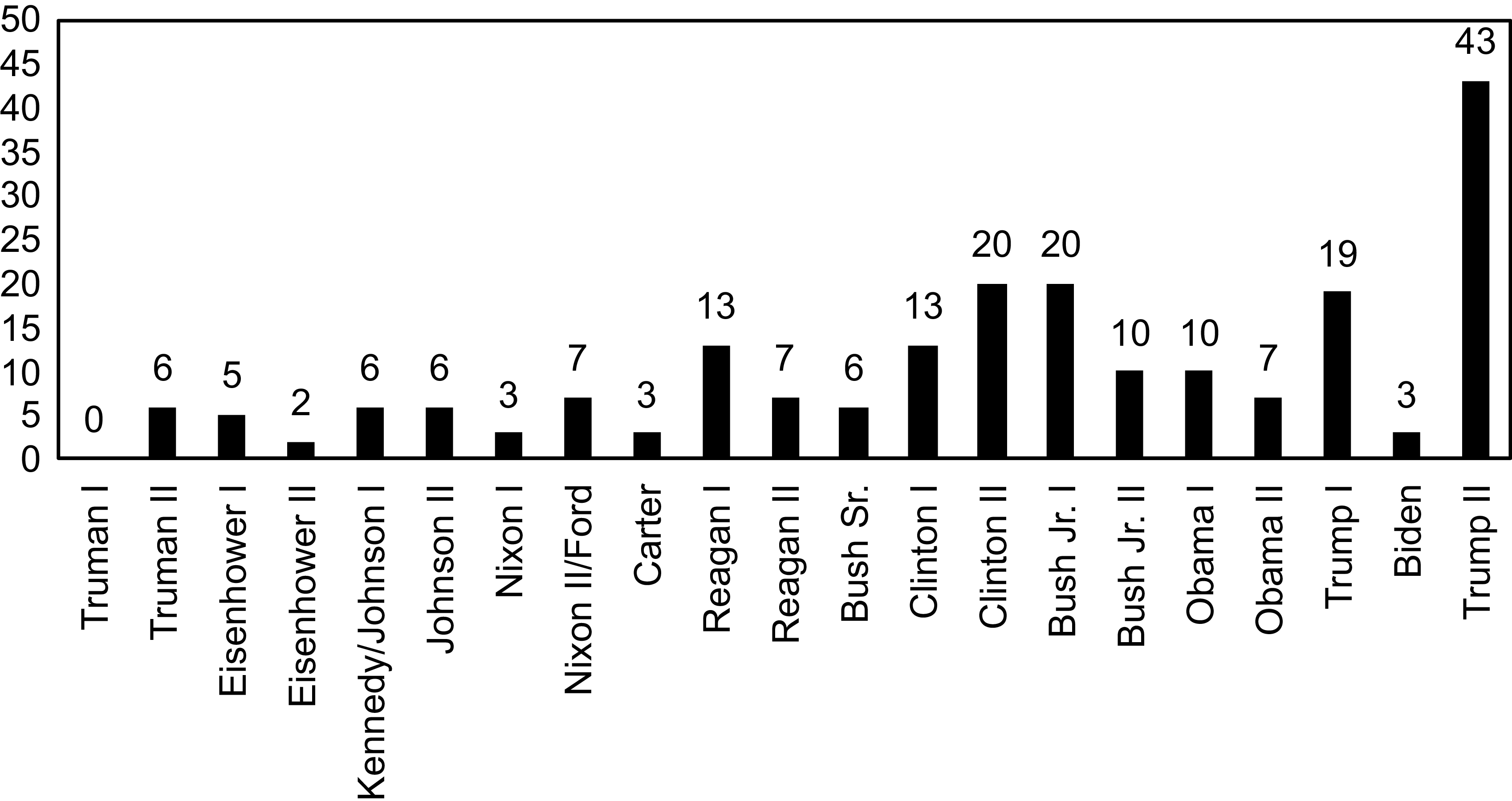
First, research on US foreign policy under Trump highlights a pattern of hegemonic disengagement, in which the United States challenges existing IOs and their core principles by withdrawing from agreements, exiting multilateral institutions, obstructing decision making and dispute-settlement, and cutting funding for core activities.Footnote 73 Drawing on research by Heinkelmann-Wild, Figure 3 illustrates US disengagement from IOs over time, measured as announced withdrawals of membership, withholding of all voluntary or assessed funding, or withholding of ratification.Footnote 74 While most of the withdrawal decisions of the second Trump administration have yet to take effect, the data nevertheless illustrate the extraordinary extent to which the United States—the main pillar of the liberal international order—has externally contested IOs in recent years.
US disengagement from IOs
Note: The figure reports US disengagement from international organizations and multilateral agreements, measured as announced withdrawals of membership, withholding of all voluntary or assessed funding, or withholding of ratification. Cases are coded by year of announcement and include announcements through January 2026, excluding committees and similar bodies. Trump II observations should be treated as provisional.
Source: Heinkelmann-Wild Reference Heinkelmann-Wild2024, Reference Heinkelmann-Wild2025.

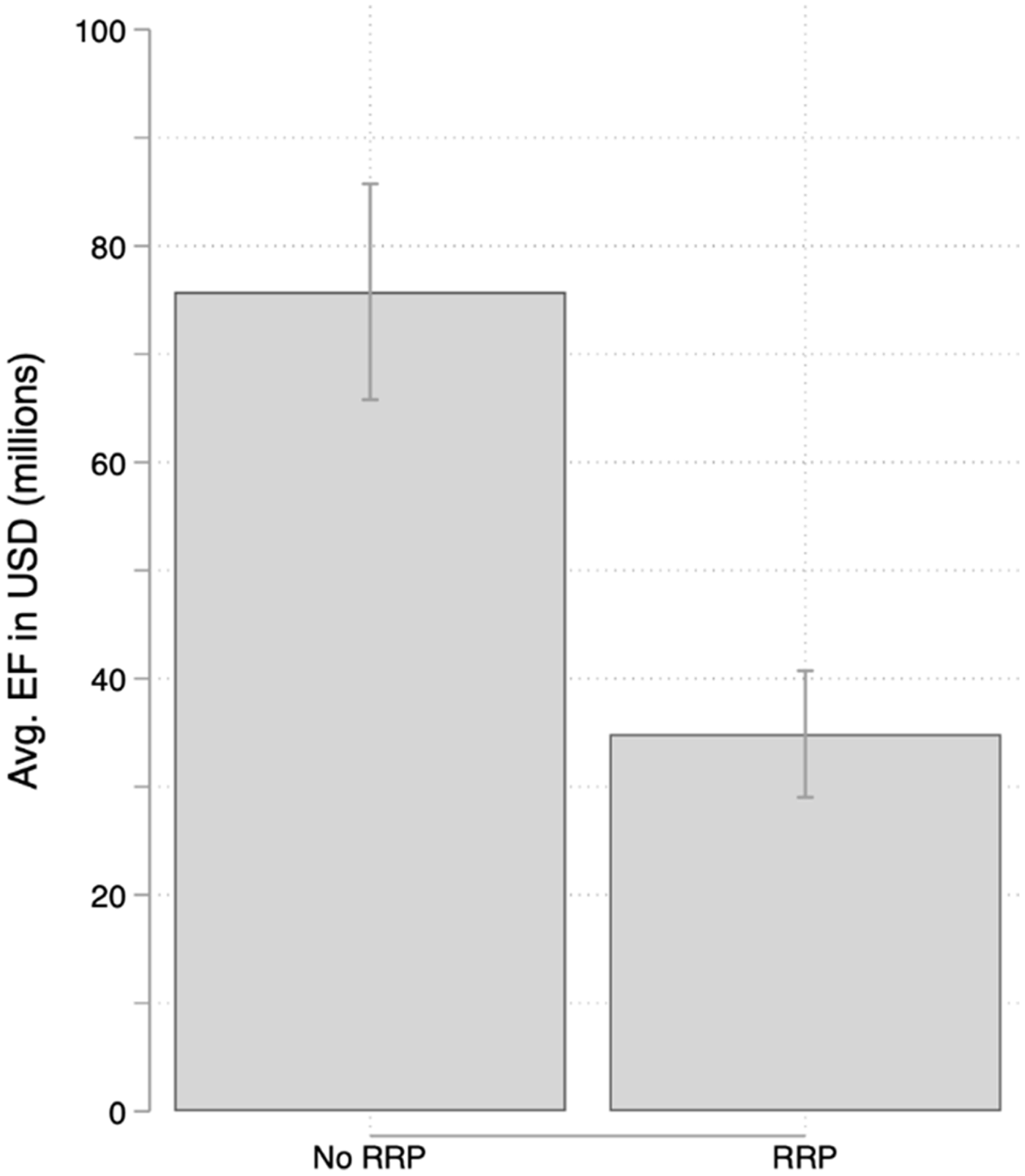
Second, the past ten to fifteen years have seen the emergence of a larger pattern of external contestation of IOs from far-right and populist-nationalist governments. Studies show that governments with a populist radical-right orientation challenge core liberal principles of IOs by reducing multilateral funding, reorienting foreign aid, rejecting international court authority, and repurposing organizations for illiberal ends.Footnote 75 Drawing on Tokhi and Zimmermann’s analysis of thirty-seven OECD donor states over the period of 1990–2020, Figure 4 illustrates this pattern.Footnote 76 When controlling for other factors that influence multilateral aid funding, radical-right participation in government is associated with an almost 30 percent decrease in earmarked funding for IO projects. This research shows how external contestation by far-right and populist-nationalist governments may take the form of efforts to capture, redirect, or hollow out IOs from within, thereby changing these institutions in fundamental ways.
Funding of IO aid projects
Note: The figure shows average annual earmarked funding for multilateral aid projects by thirty-seven OECD donor states, distinguishing between governments with and without radical right parties in office over the period of 1990–2020.
Source: Reproduced from Tokhi and Zimmermann Reference Tokhi and Zimmermann2025, Figure 2.

Taken together, these findings point to a central puzzle: aggregate levels of contestation appear to have remained broadly stable over the past two decades, even as there is some evidence that more fundamental challenges to IOs and their core principles are growing. The volume of contestation may thus have changed less than its character, with contestation shifting from internal criticism toward more fundamental forms of external challenge. Assessing this possibility is an important avenue for future research.
Ways Forward
Our discussion documents considerable variation in contestation across organizations and over time. Given widespread narratives of growing pressure on IOs, the most surprising finding is the limited evidence that contestation has increased over the past two decades. This gap between expectations and patterns presents a puzzle to scholarship on IO contestation, and points to three priorities for future research.
First, existing studies may not capture the most recent empirical developments. Most do not yet include developments such as the Russian attack on Ukraine, the wars in the Middle East, and the second Trump administration, all of which present profound challenges to IOs and their core principles. Nor do they capture the responses these attacks have triggered, such as NATO enlargement, deeper European defense cooperation, and efforts to develop new trade partnerships. Future research should therefore examine whether these patterns hold once newer data become available.
Second, existing measures may not adequately capture more subtle or informal types of contestation. Consequential challenges may take forms that are hard to measure quantitatively, including obstruction, lobbying, disregard, or the creation of competing forms of cooperation by rising or authoritarian states. For instance, states’ blockage of decision making in the UNSC, or disregard for dispute-settlement in the WTO, would not count as instances of contestation in most existing measures, yet may strongly affect the functioning of these bodies.
Third, existing data pay insufficient attention to the distinction between internal and external contestation. Recent developments suggest a possible shift from contestation aimed at reforming IOs to contestation aimed at rejecting, undermining, or redirecting them. Yet most available measures do not allow us to distinguish systematically between these forms, limiting our ability to assess how the nature of contestation varies across IOs and over time. As a result, aggregate levels of contestation may remain stable even as its character changes fundamentally. Future research should therefore develop measures that capture not only how much contestation exists, but also what kind of contestation is taking place.
Drivers of Contestation
What factors and processes lead actors to contest IOs, and when do they produce internal or external contestation? We identify three broad drivers: growing international authority and associated value conflicts in society; global power shifts and the resurgence of autocracy; and societal transformations and the rise of populist politics. These drivers combine systemic and domestic sources of pressure, which jointly shape both the level and character of contestation. They tend to generate internal contestation when actors direct their objections at IO performance, distributional effects, procedures, or policy outputs while accepting the IO’s basic principles. By contrast, they are more likely to generate external contestation when actors come to view IO authority, norms, or institutional design as illegitimate, sovereignty-violating, or unreformable.
International Authority and Value Conflicts
The 1990s saw a rise in the authority of IOs, understood as a recognized right to issue binding decisions and make competent judgments that states are expected to obey, and usually measured as delegation, pooling, and bindingness.Footnote 77 Authority has been linked to contestation in two ways. First, IOs are often criticized for being ineffective at solving transnational problems and disputes.Footnote 78 Effective problem solving tends to be particularly difficult for low-authority IOs, which lack recourse to majority voting, autonomous bodies, and binding rules.Footnote 79 Such ineffectiveness may fuel internal contestation, although dissatisfaction is not always directed at the weak IOs themselves, but often at the powerful states with the resources to solve problems.
Most scholarship instead argues that greater authority leads to more contestation of IOs.Footnote 80 This expectation builds on the idea that authority requires legitimation, which in turn leads to debate and contestation.Footnote 81 High-authority IOs tend to be particularly contested by states and groups on the losing end of their exercise of authority.Footnote 82 Such grievances may find expression in internal contestation, such as in public protests against IMF programs in crisis countriesFootnote 83 or criticism of the judgments of international courts.Footnote 84 More fundamentally, high IO authority may also provoke external contestation, as state and societal actors raise concerns about limitations on national sovereignty and engage in more principled rejection of IOs. Some scholars even suggest that the increase in IO authority may ultimately lead to the demise of the international order.Footnote 85
Several studies support the expectation that high-authority IOs are more heavily contested than IOs with lower levels of authority.Footnote 86 This is also reflected in the cross-IO evidence provided earlier, where the IOs most exposed to contestation tend to be high-authority organizations. Yet another large-scale study finds no strong and consistent evidence that increased IO authority is associated with more or fewer member-state criticisms or withdrawals.Footnote 87 Unfortunately, these studies do not distinguish between internal and external contestation.
The effects of rising international authority on IO contestation are exacerbated by broader societal value conflicts. Contestation often reflects tensions between universal, often liberal, principles and the IOs that embody them, on the one hand, and diverse national perspectives, on the other.Footnote 88 Societal criticism frequently stems from dissatisfaction with the values that IOs promote. Actors on the right usually engage in external contestation, lamenting the “liberal intrusiveness” of IOs in areas such as human rights, rule of law, and environmental protection,Footnote 89 and emphasizing the importance of national sovereignty.Footnote 90 Actors on the left, by contrast, tend to accept the desirability of IOs in principle and engage more often in internal contestation. Criticism of the (neo)liberal orientation of many IOs has a long tradition in both the Global NorthFootnote 91 and the Global South.Footnote 92 Left-wing social movements have mobilized against IOs, usually demanding greater attention to environmental concerns and social justice.Footnote 93
Contestation is also related to perceptions of hypocrisy: the sense that certain norms and values, such as equality, universal rights, or access to public goods, are applied selectively by IOs.Footnote 94 In the global human rights regime, for example, some issues and states receive more attention and criticism than others.Footnote 95 Especially in the Global South, the realization that the liberal international order is deeply hierarchical has fueled disillusionment and contestation.Footnote 96 Overall, contestation driven by value conflicts is likely to contain a significant share of external contestation.
Global Power Shifts and Autocratic Advances
Global power shifts are another prominent driver of IO contestation. They initially tend to generate internal demands for voice but may produce external contestation when reform is blocked or rising powers build alternative institutions. The design of IOs usually reflects the balance of power between states at the time of an organization’s creation.Footnote 97 Subsequent power shifts, however, seldom translate into immediate institutional change. Rising powers therefore often begin engaging in internal contestation aimed at expanding their voice in an IO.Footnote 98 China, for example, has repeatedly demanded a reform of IMF voting weights to better reflect its increased economic importance. Established powers, seeking to preserve their privileges, often resist such reforms or establish new multilateral institutions that better reflect their interests.Footnote 99 The rejection of reform demands may then lead to greater external contestation.
Power shifts may also foster IO contestation by strengthening autocratic states. A large body of research has documented a tight reciprocal relationship between democracy and international cooperation.Footnote 100 Yet the key development over the past fifteen years has been the decline of democracy worldwide, with especially large and powerful states at the forefront of autocratization.Footnote 101 Autocratic governments typically oppose international intervention in domestic affairs and are therefore often skeptical of IOs that promote liberal norms or support domestic actors committed to these norms.Footnote 102 When liberal norms, such as human rights protection, conflict with the principle of national sovereignty, autocratic and backsliding actors tend to prioritize the latter.Footnote 103
These dynamics generate both internal and external forms of contestation. Autocratic strategies of internal contestation aimed at influencing IOs and their policies include changing procedures, exploiting voting rules, staffing IOs strategically, and building coalitions with like-minded states.Footnote 104 As with power shifts, such autocratic strategies may in turn trigger further contestation, as democratic states and IOs push back through actions that illiberal actors often portray as illegitimate interference in domestic affairs.Footnote 105 When successful, autocratic strategies may also shade into external contestation by transforming formerly liberal IOs into vehicles for the expansion of autocratic ideals.Footnote 106 When unsuccessful, rising autocratic powers may instead engage in competitive institutional creation,Footnote 107 even if access to this option varies by policy area.Footnote 108 Likewise, autocratic countries may create their own, often regional, IOs to protect and advance illiberal ideals.Footnote 109 One implication of these developments is that autocracies increasingly have reason to defend some IOs, rather than contest IOs as such. At the same time, the prospect of external contestation may work to the advantage of dissatisfied member states, as established powers sometimes make concessions in order to mollify these actors and prevent their disengagement from an IO.Footnote 110
Societal Transformations and Populist Politics
Finally, IO contestation is also driven by developments in member states’ domestic politics. These developments may generate internal contestation when IOs are blamed for specific policies or distributional effects, and external contestation when they are portrayed as illegitimate elite projects that violate popular sovereignty. By promoting globalization and open economies, IOs have contributed to societal transformations that foster IO contestation. While globalization has created opportunities, it has also produced labor dislocations, financial crises, environmental degradation, and cultural homogenization.Footnote 111 These developments have fueled the success of populist entrepreneurs who challenge IOs and their policies through both internal and external forms of contestation.Footnote 112 Such entrepreneurs contest IOs in both the Global North and the Global South,Footnote 113 operating at the societal level when they lead political parties that call for IO reform or rejection,Footnote 114 and at the state level when they hold the reins of government and seek to change or undermine IOs.Footnote 115 State withdrawals from IOs, for example, tend to be more likely under nationalist leaders.Footnote 116
The rise of populist entrepreneurs who contest IOs has been facilitated by the emergence of a second, “GAL-TAN,” dimension of political competition in many countries, which distinguishes progressive, environmentalist, and cosmopolitan values from traditionalist, authoritarian, and nationalist ones.Footnote 117 Nationalist citizens oppose IOs, while cosmopolitan citizens tend to support them.Footnote 118 The shift to a two-dimensional political space provides incentives for political entrepreneurs to politicize border and sovereignty issues and engage in IO contestation to satisfy their base, even when the substantive concerns are limited.Footnote 119 As a result, nationalist and populist messages have been on the rise.Footnote 120 Such messages often generate external contestation because claims to sovereignty and national control tend to get greater traction with citizens than efforts to explain the benefits of cooperation.Footnote 121
Ways Forward
Scholarship has made important progress in explaining contestation, but existing theories fall short in two respects. First, they do not sufficiently explain when factors produce internal rather than external contestation and when internal contestation transforms into external contestation. Second, they struggle to explain why increases in IO authority, value conflicts, power shifts, autocratic resurgence, economic globalization, and populist entrepreneurship have not led to a sustained and general rise in the volume of contestation. Part of the answer may be that these drivers have produced a qualitative shift toward external contestation. Another part, however, lies with the theories themselves, which need further refinement.
First, while conventionally presented as sources of contestation, the factors we have discussed may have more ambiguous effects. Consider global power shifts and the empowerment of autocracies, which not only have contributed to external contestation of established IOs by rising powers, but also to the creation of new IOs and a defense of a specific form of multilateralism in the face of growing US unilateralism. Or consider IO authority, which not only is contested by sovereigntists, but also desired by actors—liberals and illiberals alike—who covet its tools for purposes of advancing their preferred causes.Footnote 122
Second, the drivers we have identified interact with each other, thus generating dynamics across different levels of analysis. For example, global power shifts are particularly likely to matter for the contestation of high-authority IOs. Likewise, the combination of cosmopolitan IOs and far-right populism appears particularly likely to lead to external contestation, while economic globalization and leftist internationalism together may make calls for IO reform more likely. Studying how different dynamics combine to mitigate or strengthen the contestation of IOs will be an important task for future research.
Finally, as we discuss in the next section, IOs are sticky social organizations that resist formal change and weakening. Their resilience increases with higher replacement costs, more extensive institutional assets, and greater capacity to reform and adapt to demands.Footnote 123 At the same time, when faced with contestation, IOs may be better at preserving themselves as organizational forms than at ensuring the continued effectiveness of their norms and rules.Footnote 124 Processes of layering, drift, and conversion may produce changes that are not formally registered, yet are significant in terms of deviations from initial principles and purposes.Footnote 125 Going forward, research should explore how institutional stickiness and responsiveness affect the relationship between drivers of contestation and observed contestation, with particular attention to the relative balance between external and internal contestation. This point connects the drivers of contestation to the responses discussed in the next section.
Responses to Contestation
Whether contestation affects the authority, legitimacy, and effectiveness of IOs depends partly on how IOs and their defenders respond. These responses—fighting back, appeasing challengers, remaining silent, or adapting to pre-empt contestation—are deeply political. They are shaped by the type of contestation, the distribution of bargaining power between contestants and defendants, and the internal qualities of the defenders themselves.Footnote 126 The decision whether to accommodate challenges or not confronts IOs with an “accommodation dilemma” because punitive responses may jeopardize valuable cooperation gains, while accommodation may invite further contestation.Footnote 127 IOs thus need to weigh the actual or expected consequences associated with accommodation and non-accommodation against each other and design their response based on that comparison. High-profile instances of IO contestation, such as Brexit, often become politically salient precisely because they present a pronounced accommodation dilemma: whatever the IO’s response, the consequences are likely to be serious.Footnote 128
We distinguish three broad categories of IO responses: communicative, institutional, and policy responses. Communicative strategies are a component of any response to contestation and can target both internal and external contestation. Institutional reforms and policy changes, by contrast, typically respond to internal contestation because they address demands for reform, whereas they are less effective in resolving fundamental challenges to an IO. Responses also vary in whether they are implemented primarily by government principals or by bureaucratic agents. This variation is partly a function of institutional design and partly a function of the type of strategy. More supranational IOs tend to grant greater autonomy to IO bureaucracies than do more intergovernmental organizations.Footnote 129 Moreover, IO bureaucracies can often implement communicative strategies on their own, whereas institutional reform and policy change usually require support from member governments.
Communicative Responses
Communicative responses are the broadest type of IO response to contestation and can be used in response to both internal and external contestation. Public contestation of IOs by state and societal actors often prompts IOs and their defenders to intensify their legitimation efforts.Footnote 130 Studies show rising legitimation across IO reports and communiqués,Footnote 131 media statements,Footnote 132 and speeches by government leaders, although legitimation intensity varies extensively across IOs.Footnote 133 The most comprehensive study to date, covering twenty-eight IOs in different world regions, identifies rising legitimation intensity during the 1980s and 1990s, followed by stabilization at a high level from the early 2000s onward.Footnote 134 Whether IOs have intensified their self-legitimation in anticipation of, or in response to, public criticism remains an unresolved question.Footnote 135
Rising contestation has expanded the repertoire of narratives and justifications that IOs believe will resonate with critics.Footnote 136 Technocratic justifications, which emphasize IOs’ functional capabilities and contributions, remain dominant, especially in response to internal contestation. Yet other types of justifications have also grown in prominence, including appeals to IOs’ promotion of democracy and their procedural qualities, which may also help to address external contestation.Footnote 137 IOs have also expanded, centralized, and adjusted their public communication strategies.Footnote 138 The rise of social media presents IO bureaucracies with new possibilities and challenges because they must choose between using communication as a tool for public information aimed at institutional transparency or as a tool for political advocacy aimed at normative change.Footnote 139
It is generally difficult for IOs to boost their own popularity through communication. The structural conditions for IO communication are challenging, since negative criticism both tends to be more common and more effective than positive endorsements,Footnote 140 even if self-legitimizing communication can help neutralize otherwise negative effects of contestation.Footnote 141 Mobilizing allies appears more promising: messages from supportive national governments and civil society organizations are often more effective than communication by IO officials themselves, who are perceived as less credible.Footnote 142 Communicative responses may therefore help neutralize criticism, especially internal criticism, but are likely to be less effective against external contestation by actors that reject the IO’s authority in principle.
Institutional Responses
Institutional reforms often emerge in response to internal contestation because they promise to reform the institutional arrangements of IOs that are frequently the target of internal contestation, without abandoning an IO’s basic principles. They offer a way for IO member states and their bureaucratic agents to take the edge off criticisms from both societal and state actors. IO reforms have often promoted more democratic procedures, such as accountability mechanisms,Footnote 143 expanded civil-society access,Footnote 144 strengthened parliamentary bodies,Footnote 145 improved staff representativeness,Footnote 146 and increased majority voting.Footnote 147 This pattern suggests that democratic standards have achieved a status in the post-Cold War period that makes them broadly attractive for legitimation purposes, regardless of whether actors are genuinely committed to them.
However, such reforms are always sensitive and conflictual, since they invariably create winners and losers. Not surprisingly, IOs are often reluctant or unable to enact significant institutional reforms even in the face of extensive contestation. For example, institutional adjustment to global power shifts rarely emerges spontaneously. Instead, it tends to involve protracted negotiations between member governments that challenge and defend the status quo.Footnote 148 Accommodation is more likely when challengers have strong bargaining power, possess outside alternatives, such as the creation of competing institutions,Footnote 149 or ask for concessions that can be granted without creating large contagion risks.Footnote 150 For example, withdrawal threats are most likely to result in institutional reforms when made by powerful states and demand relatively limited reforms.Footnote 151
Research on the effectiveness of institutional reforms in countering contestation is more limited and focuses mainly on effects on public opinion. Survey experiments show that reforms to expand civil society involvement tend to improve perceptions of IO legitimacy.Footnote 152 Experimental studies also indicate that people generally are sensitive to democratic, technocratic, and fair procedure and performance in IOs, suggesting that institutional reforms which strengthen these features could yield a legitimacy dividend.Footnote 153 Whether these effects extend from survey experiments to real-world contestation remains an open question.
Policy Responses
A third way in which IOs address contestation—predominantly internal contestation—is through policy reforms. Studies indicate that contestation of IOs has contributed to policy changes across a range of issue areas. Criticism of selective justice has been followed by efforts by the ICC to broaden investigations beyond African leaders,Footnote 154 and public opposition to the free movement of people has been associated with European Court of Justice rulings that are more in line with such concerns.Footnote 155 Contestation by states and NGOs over unequal burden sharing in the context of the UNFCCC has reinforced arrangements for shared but differentiated responsibility.Footnote 156 In the realm of development finance, the IMF and the World Bank have partly adjusted their orientation in response to criticism of neoliberal policies,Footnote 157 and IOs appear to have provided aid and loans on terms more favorable to populist leaders.Footnote 158 In Europe, the European Commission is more likely to withdraw legislative proposals when faced with backlash,Footnote 159 and member-state governments in the Council are responsive to domestic contestation of the EU.Footnote 160 Finally, studies show that IOs have undertaken significant policy reforms in response to major challenges by the United States. For example, long-standing US criticism of unequal burden sharing in NATO eventually led allies to increase their budget contributions when the United States threatened to withdraw from the alliance.Footnote 161 Similarly, Trump forced Canada and Mexico to renegotiate the North American Free Trade Agreement (NAFTA) on terms more favorable to the United States.
The effectiveness of policy change as a response to contestation has been evaluated less systematically. Survey experiments show that people respond positively to IO policies that distribute benefits evenly, such as balanced trade agreements, suggesting that reforms that promote greater equality may benefit IO legitimacy.Footnote 162 Some of the policy reforms discussed earlier, such as ICC decisions and possibly NATO funding adjustments, also appear to have helped secure continued commitment to these IOs from key critics. At the same time, policy reform involves an obvious dilemma: while initial contestants may prefer the new policy, other actors may come to view the IO more critically after reform.
Ways Forward
This discussion shows that IOs are not merely objects of contestation but also subjects with political agency and the capacity to respond to contestation through communications, institutions, and policies. We see three promising avenues for future research.
The first avenue is to develop a more systematic and general understanding of how IOs respond to contestation, how IO bureaucracies and their principals—the member states—interact in shaping such responses, and how different drivers of contestation are linked to different responses. Studies comparing responses across a larger set of IOs would be particularly useful. In addition, future research should examine more systematically the extent to which responses to internal and external contestation differ.
A second promising avenue is to examine the effectiveness of IO responses in greater depth. While much existing scholarship has focused on conceptualizing, mapping, and understanding responses to contestation, we know much less about their effects. Can IOs and their supporters influence the level and type of contestation to which an organization is exposed? If so, which responses are most effective and under what conditions?
The third promising avenue is to examine the relationship between short-term IO responses and their long-term consequences. Responses that appear effective in the short term may have unintended long-term consequences that undermine their initial effectiveness. For instance, if an IO accommodates demands for better representation by rising powers, it may increase the risk of deadlock over time. Similarly, an IO that responds to calls for policy change may provoke further contestation if the resulting reforms are perceived as insufficient or misaligned with global norms. Understanding IO resilience therefore requires tracing the cumulative and sometimes unintended effects of responses over time.
Conclusion
This essay has surveyed the rich research program on IO contestation that has emerged over the past two decades. Our analysis of scholarship on patterns, drivers, and responses generates four main insights. First, contestation varies significantly across IOs: while the most authoritative IOs are frequently targeted, less well-known IOs often fly beneath the radar of state and societal criticism. Second, IO contestation stems from a combination of systemic and domestic drivers, ranging from power shifts and international authority to democratic decline and populist entrepreneurship. Third, contestation has prompted communicative, institutional, and policy responses from IOs, though whether these measures can effectively counteract its effects remains an open question. Fourth, after a rise of contestation around the turn of the century, existing measures provide little evidence that contestation has become more pervasive in recent years. Yet there are indications of a shift from internal toward external contestation, as some actors move from proposing IO reforms to rejecting these organizations or their core principles outright. Taken together, these patterns suggest that recent pressures on IOs may have changed the character of contestation more than its overall volume.
We conclude by outlining key implications of these findings for future research. First, existing approaches do not specify sufficiently well when different factors and processes produce internal contestation in the form of criticism and reform demands, and when they instead lead to external contestation aimed at rejection and undermining of IOs. Nor do they adequately explain when and how internal contestation morphs into external contestation, or vice versa.
Second, theorizing on IO contestation would benefit from greater attention to dynamic effects and causal complexity. Much existing research expects linear effects of factors such as IO authority, power shifts, and far-right populism. However, contemporary developments point to the need for nonlinear theories that can capture how singular events—such as the second Trump presidency—may have accelerating and disproportionate consequences.
Better empirics is a third avenue. We need new and more precise measures of internal and external contestation, including indicators that can capture more informal and subtle forms of contestation, such as obstruction, blockage, and disregard. The potential measures we have suggested provide a starting point, but future research will require new data collection, both to cover more recent developments and to enable systematic comparisons. The observation periods of many existing quantitative studies ended five to ten years ago, before several recent assaults on the liberal international order. And while many existing studies focus on a few prominent individual organizations or issue areas, more systematic comparative data across IOs and over time will enable more comprehensive assessments.
Fourth, future research needs to address a range of new questions that emerge from existing scholarship and real-world developments. One critical question concerns IO robustness. For all the contestation IOs have faced over the past twenty-five years, they appear surprisingly resilient. While certainly not unscathed, IOs in general have not experienced a wave of terminations. They continue to attract more new members than they lose, remain active policy producers, and retain levels of legitimacy comparable to those of most national governments. Part of the explanation might be that IOs have been responsive to internal contestation, adjusting their policies and institutions to demands from member states and societal actors.
Are IOs likely to cope equally well with a more profound shift toward external contestation, involving a rejection of IOs themselves? This question is particularly important in light of hegemonic contestation. While hegemons have conventionally protected the international structures they helped build, the United States illustrates how hegemons may also turn on their own creations. Future research should theorize whether and how hegemonic contestation differs from other types of contestation, and whether it is especially likely to generate dynamic effects that upend or transform international orders.
More generally, future research needs to explore the relationship between IO contestation and contestation of the international order more broadly. Contemporary governance operates through a dense web of authority that includes not only IOs but also transgovernmental networks, multistakeholder initiatives, private regulatory schemes, international norms, and multilateral treaties. These sites of international authority are deeply intertwined, meaning that contestation directed at one element can reverberate across the wider governance architecture. Strong IOs have historically been embedded in a broader script of liberal governance that has itself become a target of contestation, particularly in the context of democratic backsliding. Understanding how internal and external contestation of IOs maps onto this wider architecture is therefore essential for assessing the robustness or fragility of global cooperation. Research on IO contestation can provide a springboard for this larger agenda.
Acknowledgments
We would like to thank Inken von Borzyskowski, Tim Heinkelmann-Wild, Tom Hunter, Thomas Sommerer, Alex Tokhi, Felicity Vabulas, and Lisbeth Zimmermann for sharing data with us. We also thank Tyler Pratt, Tuuli-Anna Huikuri, Thomas Malang, Johannes Scherzinger, Carl Vikberg, and participants at APSA 2025 annual meeting, the IPZ publication seminar, the LSE IPE workshop, the SU Global and Regional Governance seminar, and the WZB GG colloquium for helpful comments.
Data Availability Statement
Replication files for this essay may be found at <https://doi.org/10.7910/DVN/TMMQ8P>.
Supplementary Material
Supplementary material for this article is available at <https://doi.org/10.1017/S0020818326101477>.
Funding
This project received funding from the European Research Council (ERC) under the European Union’s Horizon 2020 research and innovation programme grant agreement no. 817582 (ERC Consolidator Grant DISINTEGRATION) and grant agreement no. 101097437 (ERC Advanced Grant DEMCOOP), as well as Swedish Research Council grant no 2021-01047, Knut and Alice Wallenberg Foundation grant no. KAW 2023-0360, and Deutsche Forschungsgemeinschaft (DFG) Excellence Cluster Grant “Contestations of the Liberal Script” (EXC 2055, no. 390715649).
Authors
Jonas Tallberg is Professor of Political Science at Stockholm University. He can be reached at Jonas.tallberg@statsvet.su.se.
Stefanie Walter is Full Professor for International Relations and Political Economy at the Department of Political Science at the University of Zurich. She can be reached at walter@ipz.uzh.ch.
Michael Zürn is Director of the Global Governance research unit at the WZB Berlin Social Science Center. He can be reached at michael.zuern@wzb.eu.



 Open access

