Ebola virus has caused a series of outbreaks since it was first discovered in 1976. 1 The largest outbreak to date is occurring in West Africa. 1 Healthcare workers (HCWs) are at increased risk during Ebola virus disease (EVD) outbreaks owing to their close contact with sick EVD patients. Hospital preparation for EVD management is ongoing in West Africa as well as in countries caring for EVD patients transported from West Africa. In the United States, on October 8, 2014, the first patient with EVD in the United States died. 2 Within a week, 2 nurses caring for this patient were diagnosed with EVD. 2 After the 2 nurses and an HCW from Spain contracted EVD, planning for identification, management, and prevention in hospitals outside West Africa expanded dramatically. 1
Although the World Health Organization 3 and US Centers for Disease Control and Prevention 4 have provided guidance, individual hospitals must adapt such guidance into individual policies for identification and management of patients with suspected or confirmed EVD, and they must additionally ensure that their institutions are prepared to implement such policies. Challenges to such preparation have included varying guidance on isolation precautions, laboratory testing, patient transport, waste disposal, quarantine concerns for exposed individuals, and widespread anxiety over EVD.Reference Sifferlin 5 – 9
To understand costs and challenges associated with hospital Ebola preparation, including the approximate amount of effort and time being expended for EVD preparedness, we conducted a survey of Society for Healthcare Epidemiology of America (SHEA) members.
METHODS
An invitation to participate in the survey was sent to all SHEA members using Real Magnet Surveys (Real Magnet), via email. SHEA is an international society of experts in hospital epidemiology and infection prevention. A primary email was sent on October 21, 2014, with a follow-up reminder email on November 7, 2014.
Responses were recorded as Likert scales from 1 to 10, proportions, continuous outcomes (hours of effort), ordinal ranking, and open-ended free text (where appropriate). Data were maintained in a spreadsheet application (Excel; Microsoft) and analyzed in SAS, version 9.3 (SAS Institute). For questions relating to hours of work and proportion of effort, the survey specified answers for the week immediately prior to the first day the survey was mailed—that is, the week of October 13–19, 2014. The entire survey is available at the SHEA Research Network site and as an online appendix. This study was deemed non–human subjects research by the University of Maryland Institutional Review Board.
RESULTS
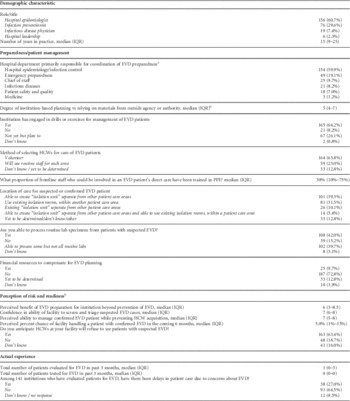
The email was delivered to all 1,973 SHEA members, many of whom are hospital affiliated. A total of 257 members completed the survey (221 US, 36 international). These represented institutions in 41 US states, the District of Columbia, and 18 countries. The 221 US respondents represented 158 (43.1%) of 367 major medical centers that have SHEA members and included 21 (60%) of 35 institutions recently defined by the US Centers for Disease Control and Prevention as Ebola virus disease treatment centers. 10 See Table 1 for results. Respondents identified their primary role as being hospital epidemiologists (60.7%, 156/257), infection preventionists (29.6%, 76/257), infectious disease physicians (7.4%, 19/257), or involved in hospital quality/leadership (2.3%, 6/257).
Summary of 257 Responses to Survey of Society for Healthcare Epidemiology of America Members

NOTE. Data are number (percent) of responses unless otherwise indicated. EVD, Ebola virus disease; HCW, healthcare worker; IQR, interquartile range; PPE, personal protective equipment.
a Some respondents reported co-leadership so % does not add to 100%.
b Based on a 10-point scale with 1=being completely generated by institution and 10 = relying on outside authority, or scale of 1 to 10 with 1=not prepared at all and 10=completely prepared.
Preparedness/Patient Management
Respondents reported that EVD patient management preparedness was coordinated primarily by infection control/hospital epidemiology (62.1%), followed by emergency preparedness (19.8%) and chief of staff offices (10.1%). Respondents reported relying equally on outside guidance for material related to planning (from Centers for Disease Control and Prevention primarily) and institution-generated material. Overall, respondents felt moderately prepared to screen and triage suspected cases while preventing healthcare worker (HCW) acquisition (7 of 10 on Likert scale). Drills or exercises for the management of Ebola patients had occurred at the hospitals of 64.7% of respondents. See Table 1 for details.
At 64.1% of hospitals, HCWs who would care for EVD patients were selected primarily from among those who volunteered to provide such care. Of note, 64.7% of respondents anticipated some HCWs would refuse to see patients with suspected EVD. Of frontline providers, only 30% had been trained in appropriate use of personal protective equipment (PPE). Full routine laboratory testing of patients with suspected EVD could be processed by less than half (42.0%) of hospitals.
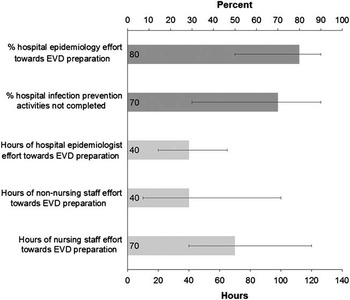
During the 1 sampled week, EVD preparation was the dominant activity for most respondents (Figure 1). Overall 80% of hospital epidemiology time was spent on EVD preparation, with 70% of other hospital infection prevention activities not being completed during that time (interquartile range, 30%–90%). Overall this required a median (interquartile range) of 160 (92–320) hours of staff time. Only 9.8% of respondents reported increased financial resources to compensate for EVD preparation. There were no substantial differences in responses between US and non-US sites (data not presented).
Amount of time devoted to Ebola virus disease preparation by hospital epidemiologists and other infection prevention staff during 1 sample week (October 13–20, 2014). Results are represented in terms of median % effort devoted to EVD and median hours by type of staff, with lines representing interquartile range.

The open-ended question, What has been your biggest challenge in Ebola preparedness?, was answered by 237 of the 257 respondents. These responses were organized into 10 major themes/categories. The most common response related to issues with PPE, with 88 respondents (37%) stating this as their biggest challenge. Obtaining PPE, training HCWs, and managing changing guidelines were the 3 biggest challenges related to PPE. Other challenges included inconsistent/changing recommendations (26%), dealing with fear/hysteria (25%), and lack of time (24%). Other issues mentioned were training (9.9%), leadership/administration (5.5%), communication (5.1%), and staffing (3.4%). Respondents identified potential benefits to EVD preparation including greater awareness of the importance of infection prevention and proper use of PPE, as well as improved preparedness for other infectious outbreaks (eg, pandemic influenza and Middle East respiratory syndrome coronavirus) and bioterrorism.
Actual Experience
Sites estimated their chance of handling a patient with EVD in the coming 6 months was a median of 5.0%. In the 3 months prior to the survey, a median of 1 patient (interquartile range [IQR] 0–3) had been evaluated for EVD with 0 (IQR 0–0) being tested for EVD. A total of 141 hospitals had evaluated patients for EVD, although only 2 had diagnosed unrecognized EVD. Five hospitals had cared for patients with confirmed EVD.
Owing to concerns for EVD, of 141 respondents who had evaluated patients for EVD, 38 (27%) reported patients had delays in care. Of these, 7 respondents reported adverse consequences including longer wait times in the emergency department; patient anxiety; and delays in initial care, discharges, and admitting other non-EVD patients who require isolation rooms; as well as inability to test patients for other diseases. One patient was reported to have died after failing to receive a necessary procedure owing to EVD precautions.
DISCUSSION
Hospital preparation for EVD has required a tremendous resource investment, diverting time and effort from other infection prevention activities. During a sample week of preparations, 80% of hospital epidemiology time was reported as committed to EVD, amounting to a median of 160 hours of staff time per hospital. During the time that such effort was focused on EVD, only 30% of routine infection prevention activities were completed. It is not known how other infection prevention delays will be handled. Although 141 hospitals had evaluated patients for EVD, only 2 had diagnosed unrecognized EVD. Of those having evaluated patients for EVD, many reported delays in care with patient care concerns including patient anxiety, delays in patient evaluation, inability to test patients for other diseases, delays in discharges, delays in admitting non-EVD patients who required isolation rooms, and inability to perform necessary procedures on patients being evaluated for EVD. Primary barriers to evaluating patients for potential EVD included training HCWs on changing guidelines for PPE, dealing with fear and hysteria, and lack of time.
Respondents reported substantial difficulty preparing for EVD. Efforts were generally led by hospital epidemiology followed by emergency preparedness and chief of staff offices, relying equally on external guidance and individual hospital planning. Despite EVD preparation taking precedence over all other infection prevention activities, hospitals felt only moderately well prepared for EVD (7/10). Respondents anticipated HCW refusal to see patients would be a problem and only 30% of HCWs had been trained in PPE use as of October 20, 2014. Limited training with PPE use raises concerns for preparedness for other pathogens. The perceived amount of time dedicated to EVD preparation notably did not include estimates of time for laboratory staff, procurement, environmental services, clinicians, or others. Given so few cases being evaluated for EVD and much fewer confirmed, national leaders should consider whether a general emerging pathogen preparedness may be more cost-effective.
This survey is limited by being a convenience sample of SHEA members during a period of intense EVD preparation with a moderate response rate. Furthermore, results may not be generalizable to smaller hospitals that were not as well represented in the study. However, survey respondents included 41 US states and the District of Columbia and all US facilities that have cared for patients with EVD.
In summary, hospital EVD preparations required extraordinary resources, which were diverted from routine infection prevention activities. Patients being evaluated for EVD faced delays and potential limitations in management of other diseases that are more common in travelers returning from West Africa. Given the complexity and expense involved in preparedness for, and care of, EVD patients, additional state and federal funding should be designated to support hospitals. Such funding should vary on the basis of the tiered approach recommended by Centers for Disease Control and Prevention, because different resources are required by “frontline,” “assessment,” and “treatment” hospitals. 10 Providing these resources not only will improve EVD readiness but also will ensure that hospitals are prepared for future emerging infectious threats.
Acknowledgments
Laure Herzog and Kristy Weinshel assisted in survey preparation and dissemination.
Financial support: None reported.
Potential conflicts of interest: All authors report no conflicts of interest relevant to this article.