

Introduction
A growing number of public authorities, including the European Union, are promoting corporate social responsibility (CSR) though public policy, sustainability disclosure regulations, and hard law.Footnote 1 These laws can advance corporate accountability and improve social and environmental outcomes, which leads Vogel to stress that CSR “should be about more than going ‘beyond compliance’; it must also include efforts to raise compliance standards. … Responsible firms … need to support public policies that establish minimum standards for their less virtuous competitors.”Footnote 2 But to what extent do responsible firms—firms with high CSR performance—support more far-reaching regulation? So far, we know little about the willingness of businesses and governments to support more stringent compliance standards and promote a “race to the top.”
This paper aims to help fill this gap in the literature by examining to what extent companies, business associations, and governments from countries with high levels of CSR performance support more stringent supranational (EU-level) regulation. Companies in Scandinavia are widely acknowledged to be CSR and sustainability leaders.Footnote 3 A recent country sustainability ranking refers to a “Scandinavian phalanx at the top” and finds that Sweden, Denmark, Finland, and Norway were ranked in four of the top five spots out of sixty-five countries.Footnote 4 Scholars describe Nordic companies as “global pioneers” in CSRFootnote 5 that are focused on cooperation with stakeholders, “consensus building, participation, power sharing, consideration of the well-being of stakeholders beyond just shareholders.”Footnote 6
Sustainable companies may support more stringent compliance standards “in order to gain competitive advantages, harmonize divergent national regimes, or level the playing field against less-regulated competitors.”Footnote 7 In this vein, in a previous issue of this journal, Gjølberg has argued that stricter regulations sharpen the competitive advantage of Nordic CSR leaders. Gjølberg's analysis, based on a survey of seventy-nine Nordic companies “with the highest scores on CSR performance,” “reveals a very strong preference for increased international regulation of social and environmental issues.” Gjølberg finds that her respondents have clear “pro-regulation attitudes”: nearly 80 percent of the companies she surveyed “think their government should strive for binding rules and laws,” and over 60 percent “want their government to raise social and environmental standards to increase pressure on laggards.” Over 70 percent “recommend that their governments increase efforts to achieve global minimum standards related to CSR.”Footnote 8
Proponents of Scandinavian Cooperative Advantage (SCA)Footnote 9 advance similar arguments. Midttun suggests that Nordic countries push for a social and environmental upgrading of the international economy. Stringent government regulation supports Nordic companies’ high-road strategies. Where traditional governance cannot be mobilized to bring “international market regulation up to the social and environmental standards of their advanced welfare states,” CSR is used to civilize global capitalism. “The soft CSR approach could be seen as a stepping stone towards hard law.”Footnote 10 “The increased role of CSR internationally may fill a regulatory gap in the global market economy, where the Nordics have not had the power to win through in international political negotiations.”Footnote 11 In a related vein, Acemoglu, Robinson, and VerdierFootnote 12 characterize Nordic capitalists as “cuddly,” which suggests that they are open and receptive to the need for regulation, in contrast to their “cutthroat” Liberal Market Economy counterparts.
Others are skeptical that businesses prefer more stringent regulation: “The bottom line is that business organizations want to keep private governance private … existing literature is excessively optimistic about business's willingness to support regulation.”Footnote 13 While the rationale and justification for business resistance to regulation remains unclear, it is possible that “the institutional re-embedding of CSR will cannibalize the business case that currently legitimates its adoption … as regulation increases, the very rationale for the business case becomes weaker.”Footnote 14 Many of these claims are advanced at an abstract theoretical level; at best, they rely on survey responses.
In this paper, I seek to move the debate forward and place it on a more solid empirical foundation. In order to assess whether Nordics are very supportive of more stringent supranational regulation, I examine the roles played by Nordic governments, business associations, and companies in the negotiations over the European Union's corporate transparency Directive 2014/95/EU, which requires firms to report on their social, environmental, and human rights impacts.Footnote 15
The passage of this Directive, which mandates non-financial / CSR / sustainability reporting for public interest entities in the EU, has been called “a historic date in the transition to business sustainability for all.”Footnote 16 Companies must report not only on their profits and losses, but also on their social and environmental and human rights impacts and the risks that their business activities pose for third parties. While it is too early to know the impact of this legislation on firms’ social and environmental performance,Footnote 17 it represents a clear break with a policy voluntarism: a growing number of firms are now required to track their performance on social and sustainability metrics, not just financial ones.
This legislation represents a meaningful step towards more stringent supranational regulation, and it provides an opportunity to examine the validity of claims that Nordic governments and companies play a leading role in the push for more stringent legislation. If Nordic CSR leaders have a very strong preference for more stringent supranational/transnational regulation, we would expect that Nordic business representatives and governments led the push for the European Union's sustainability reporting Directive. As we will see, the reality is quite different. Apart from Denmark, Nordic governmentsFootnote 18 only provided tepid or lukewarm support for the Directive.
Explaining Nordics lukewarm support for 2014/95/EU: An outline of the argument
The evidence from the negotiations over the European Union's non-financial reporting Directive does not support the claim that Nordic CSR leaders and business representatives have a very strong preference for stringent supranational regulation. One possible explanation for Nordic governments’ failure to play more of a leading role in supporting this legislation is that Nordic companies’ CSR performance is, in fact, lower than has been claimed. In that case, it would not be in their interest to support binding regulations promoting transparency. In the section below, I examine several CSR indices. While Nordic countries are not undisputed global or European leaders in all indices, the CSR performance of large Nordic companies is strong. This suggests that strong sustainability performance does not necessarily entail strong support for more stringent supranational regulations.
What explains the notable gap between Nordic companies’ strong CSR performance and Nordic governments’ weaker-than-expected, lukewarm support for the EU NFR Directive? My research aims to resolve this puzzle and contribute towards our understanding of the politics of raising regulatory standards. I follow Bartley'sFootnote 19 suggestion to investigate the mix of different roles—sponsors, providers, and inhibitors—simultaneously played by corporations in global governance. Existing literature highlights corporations’ role as sponsors but tends to neglect business organizations’ role in inhibiting more stringent regulation.
My key theoretical contribution is to highlight the importance of business associations as inhibitors of upward regulatory harmonization. Recent scholarship on the Nordic caseFootnote 20 makes selective use of firm-level data but neglects the role of organized business. This is problematic. While some CSR managers in sustainable companies support more stringent regulation, their CEOs are generally unwilling to fight and invest political capital to ensure that these preferences are realized in government policy and in their governments’ negotiating stances, which is what we would expect to see if they had a very strong preference for regulation. The result is an asymmetry between soft support and hard opposition—proponents of binding regulation (CSR, front-runner firms and responsible business organizations) are less politically assertive and influential than opponents.
Business associations oppose upward regulatory harmonization for several reasons. This paper draws attention to one particular facet of their opposition: they represent large numbers of small and medium-size firms with lower CSR reporting rates and lower CSR performance than large companies.Footnote 21 To gain a full understanding of the politics of upward regulatory harmonization, it is necessary to move beyond a focus on CSR leaders to include business associations and the broader business community.
Business associations are a significant obstacle towards to upward regulatory harmonization on CSR in the European UnionFootnote 22 and more generallyFootnote 23—unless domestic regulations are in place, as was the case in Denmark. I suggest that Denmark's strong support for 2014/95/EU had relatively little to do with sustainability performance or SCA: instead, Denmark sought to have its domestic regulations adopted by the European Union, and Danish business associations supported supranational regulations to level the playing field.Footnote 24
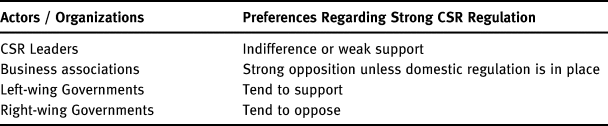
In addition to pre-existing national legislation, partisan politics are also a predictor of support for increased supranational regulation: center-right governments tend to be less supportive of business-constraining regulation and corporate-transparency laws than center-left governments.Footnote 25Table 1 summarizes the preferences and responses of different actors regarding CSR regulation:
Actors, Organizations, and Their Preferences Regarding CSR Regulation

Before proceeding, a note on method. This paper builds on in-depth fieldwork, key government documents, information from Brussels insiders, and firm-level data. I approach the research questions by way of elite interviews with senior business, public, and civil society officials.Footnote 26 Interviews are an appropriate method for reconstructing the negotiations over 2014/95/EU and for shedding light on the interests and motivations of different actors regarding this Directive. I conducted forty interviews in total, over a five-year period (see appendix for a full list).
The organization of this paper is as follows. The third section discusses the positions of Nordic and other countries in the negotiations over the EU's non-financial reporting Directive. The fourth section surveys Nordic countries’ CSR performance. The fifth section explains the paradox of weak political support for regulation despite strong CSR performance. The sixth section discusses the significance of domestic regulations and the positions of CSR Leaders and responsible business organizations. And the seventh section extends the argument and applies it to the transposition of 2014/95/EU. I suggest that party politics explains Sweden's ambitious and Finland's minimalist transposition of the Directive. I also discuss how my argument applies to current discussions of mandatory human rights due diligence. The eight section concludes the paper.
The politics of support for binding CSR regulation: Nordic countries and the negotiations over 2014/95/EU
The negotiations over the European Union's non-financial disclosure Directive were difficult and conflictual.Footnote 27 The European Commission's proposal faced opposition from several member states and many major business associations. BusinessEurope, which represents employers and industry federations from across the European Union, feared that the Directive would create a “competitive disadvantage for European companies on global markets” since “their international competitors, for example the USA and China, face more limited reporting obligations” and “many countries do not have any legal requirements in place.”Footnote 28
As a result of this hard-core opposition, the stringency and scope of the reporting requirements was watered down significantly. The scope was reduced from ~18,000 companies, in the Commission's original proposal, to ~6,000 companies, in the final text. As a consequence, a number of governments that had sought to kill this legislation did not oppose it in the final votes in COREPER and in the Council of the EU. Shortly after the conclusion of the negotiations, the Director of the European Coalition for Corporate Justice, a coalition of leading civil society organizations that sought to strengthen the Directive, exclaimed “The text is so weak they're fine with it.”Footnote 29
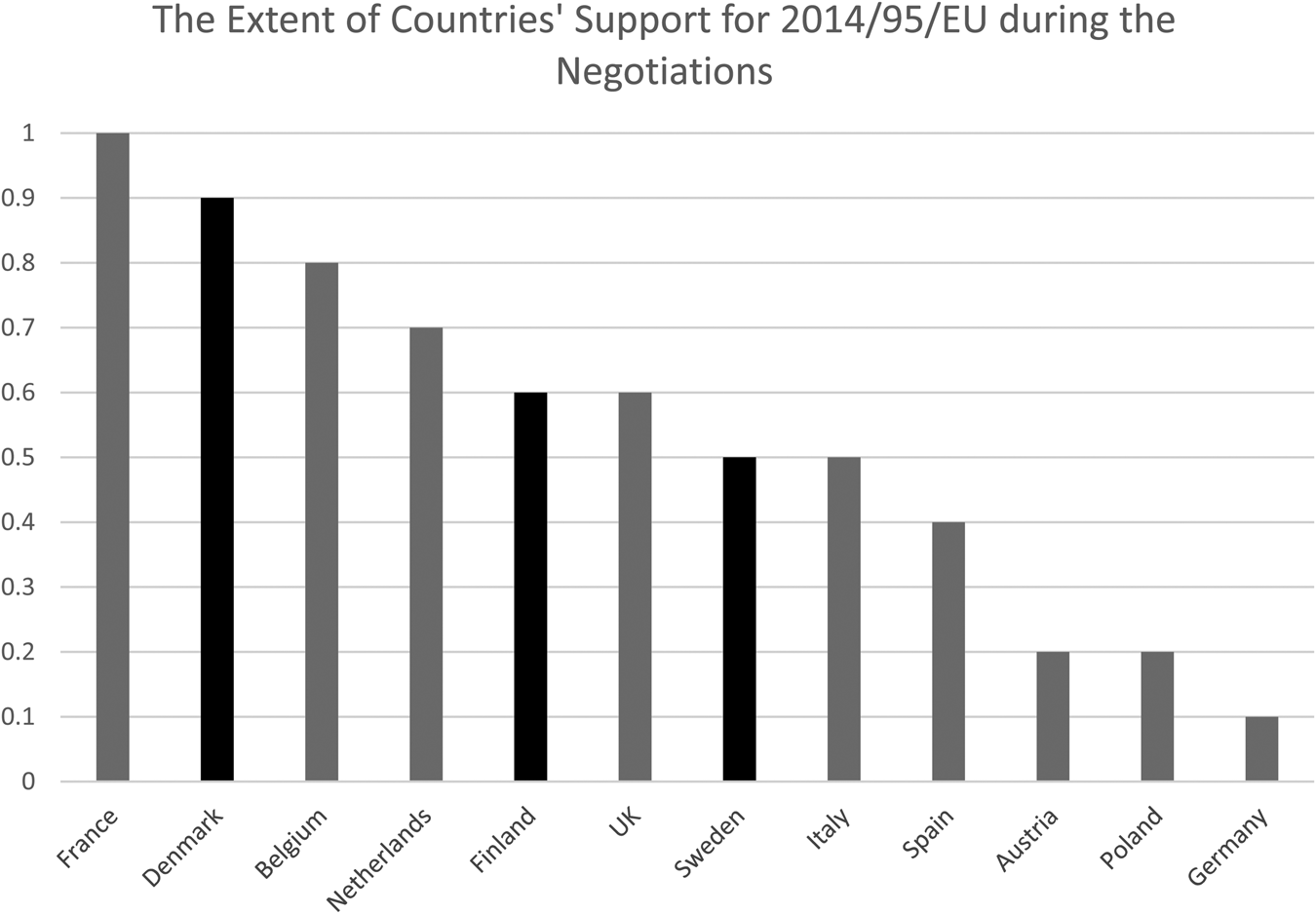
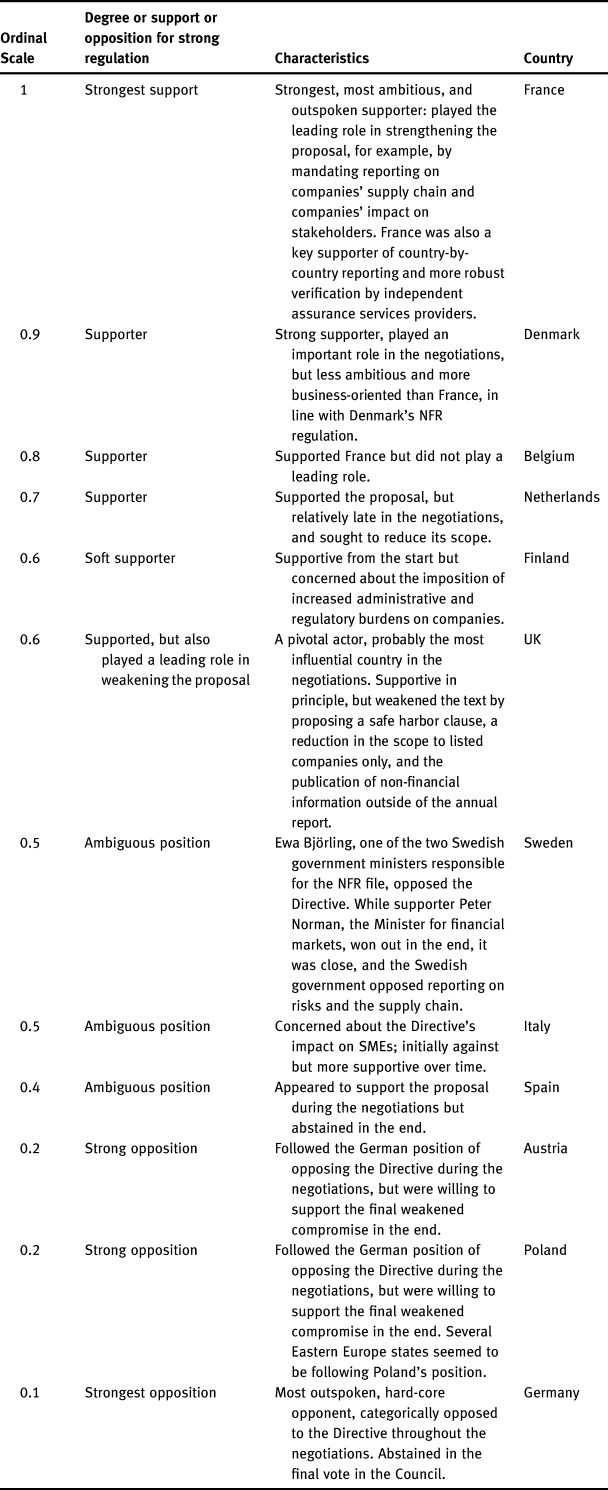
Figure 1 below assigns a quantitative score to the position of each government in the negotiations; a brief description of each country's position follows in table 2. This sample contains the largest EU member states, all Nordic EU members, and the countries that were most influential during the negotiations. I have chosen twelve countries based on data availability, and I have constructed these scores on the basis of government position papers, as well as discussions with Brussels insiders.Footnote 30 The empirical accuracy of this coding has been confirmed by Stefanos Komninos and Gerasimos Georgopoulos, who negotiated the Directive for the Greek Council presidency,Footnote 31 as well as Jerôme Chaplier, who served as Director of the European Coalition for Corporate Justice (ECCJ) at the time.Footnote 32
Countries’ positions in the negotiations over the NFD directive

Countries’ Positions in the Negotiations over the EU-NFR Directive

Scandinavia is not a negative predictor of support for the legislation: none of the Nordic countries opposed the Directive as clearly as did Germany, Poland, or Austria. But the three Nordic EU member states were not unambiguously supportive either. Denmark, in second place with a score of 0.9, is the only Nordic EU member that provided strong support, while Sweden and Finland are towards the middle of the distribution. Finland comes in fifth place at 0.6, and Sweden, the largest Nordic country, comes in seventh place at 0.5.
Table 2 presents these countries’ positions in greater detail. The ordinal scores in figure 6 and table 2 should be interpreted as follows: 1 indicates the highest level of support for stringent reporting requirements and a broad scope; 0.1 refers to the most hardline opposition. These scores do not refer simply to countries’ votes on the final, watered-down version of the Directive. They refer to the extent to which a country supported a broad scope and stringent reporting requirements throughout the negotiations over 2014/95/EU. Scores between 0.4–0.6 reflect the range from ambivalent opposition to ambivalent support.
Next, we examine the positions of Nordic governments in the negotiations. Here we observe the following pattern: Denmark provided strong (though not unqualified) support, while Finland and Sweden were more ambivalent.
The Danish government endorsed a position that closely resembles Denmark's domestic NFR regulations. In 2008, Danish parliament passed an amendment to the Danish Financial Statements Act. Section 99a requires ~1100 large businesses to disclose their CSR policies in their annual report or state that they do not have a CSR policy.Footnote 33 In the negotiations over the Directive, the Danish government reportedly wanted their comply or state regulations to be EU-wide. This is very soft and flexible legislation and it is unclear whether it qualifies as a preference for “hard law,” as Susanne Stormer, a leading sustainability practitioner and scholar, acknowledges.
In 2004, Stormer combined Novo Nordisk's financial and sustainability reports into one—a so-called Triple-Bottom-Line report.Footnote 34 When queried about Denmark's NFR framework, Stormer is “a bit critical.” While the Danish legislation “has brought companies to the table to do some kind of non-financial reporting,” she notes that “the framing of the Danish requirement is so loose or open to interpretation that it doesn't really drive the quality of the reporting.”Footnote 35 Even after its 2012 amendment, the Danish Financial Statements Act only required concrete reporting on human rights and climate change. However, the fact that a legal, sustainability reporting mandate was in place ensured that Denmark played a leading role in supporting the Directive in the negotiations.
Finland, by contrast, was a “soft” supporter.Footnote 36 This means that the Finnish government was, in principle, supportive but had problems with more ambitious proposals. Marja Hanski, who represented the Finnish government in the negotiations, describes Finland's position as follows:
We support openness and transparency but at the same time we do not support the increase of administrative burden. The Finnish companies already report on non-financial items, so it is not an issue for us. The government has made a clear statement that it supports openness and transparency. Finland wants to be a forerunner in the field of social responsibility. At the same time in order to maintain cost efficiency and competitiveness the administrative burden and any increases thereto are carefully scrutinizedFootnote 37
The Swedish government was split on the Directive: Peter Norman, the Swedish Minister for Financial Markets, supported the EU proposal, while Ewa Björling, the Swedish Minister for Trade, opposed it.
Although the Swedish government voted in favor of the watered-down proposal in the end, it was close, and Björling took a position that was hostile to the proposal and very close BusinessEurope's hardline opposition. Kristin Pålsson, who was one of Björling's representatives in the Swedish Ministry of Foreign Affairs, summarizes her position as follows:
issues on CSR should be driven by companies themselves and not by binding legislation. It is also important not to put too many burdens of regulations on companies. CSR should be business-driven and business-owned. Companies tend to work with sustainability as they themselves see the benefits of it and can be drivers for changeFootnote 38
While Peter Norman, the Swedish Minister for Financial Markets, won the debate with Björling, their clash shows that anti-regulation positions can be found at the highest levels of policymaking in Nordic countries. Moreover, even though the Swedish government was willing to back the proposal, it nevertheless sought to limit its scope to listed companies, and it opposed the strengthening of reporting on risks and the supply chain.
What position would Norway have likely taken if it had been an EU member? Gunhild Ørstavik, Senior Advisor for the Norwegian Forum for Environment and Development, offers the following reflections: “I think Norway would have been very reluctant here. Despite being a generous funder of progress on the international level such as John Ruggies work, Norway has not been a pioneer on any mandatory ‘restrictions’ of business nationally or internationally the last 15–20 years, no matter if we have had a Labour or Conservative Government.” Norwegian governments have, she writes, “fought hard against anything they fear may impair the state-owned enterprises’ international competitiveness.”Footnote 39
Nordic CSR performance
This section surveys the CSR performance of Nordic countries to assess the claim that “by pretty much any measurement, Scandinavian countries lead the world in strong CSR and sustainability performances.”Footnote 40 Overall, the evidence in this section supports this statement. Nordic companies and countries’ CSR and sustainability performance is strong, well above average for advanced industrial countries and above the rest of the European Union in all but one CSR index.
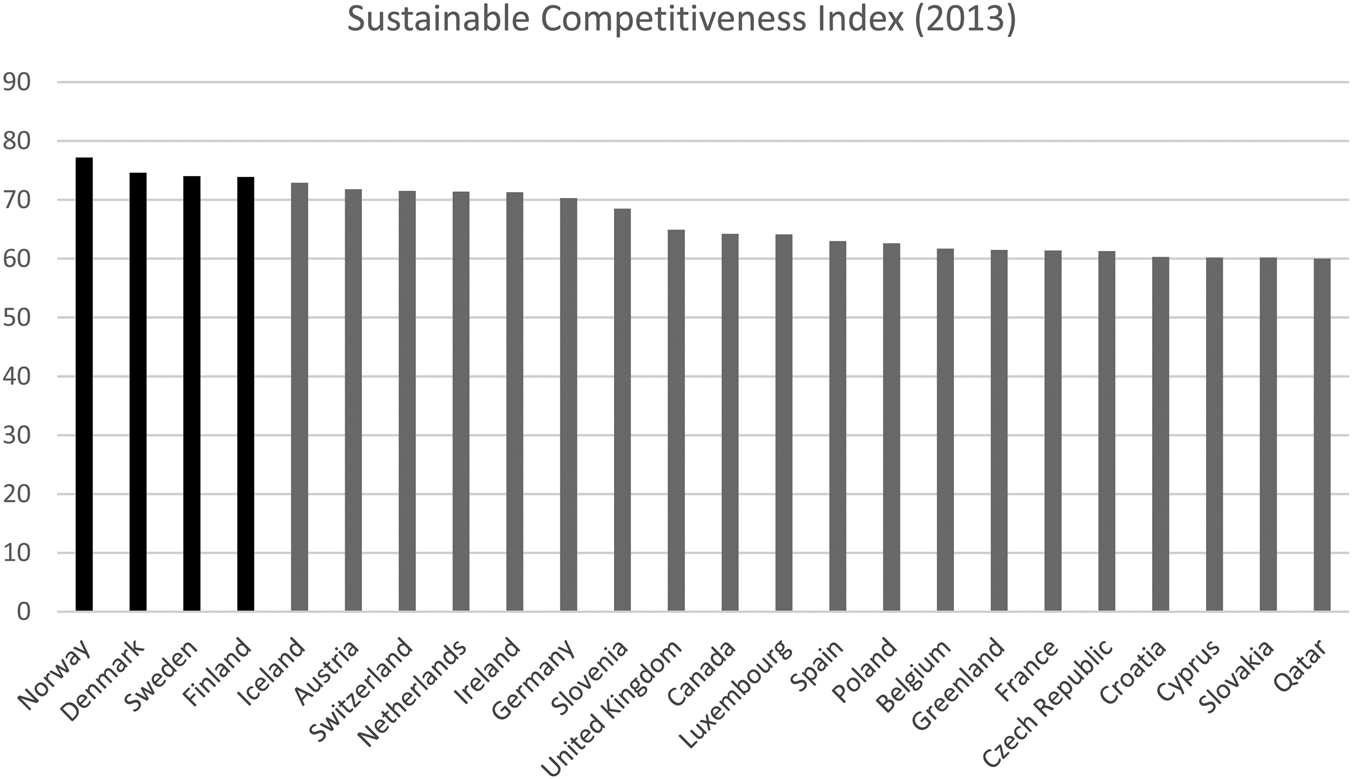
The data in this section are from the year 2013, when negotiations on 2014/95/EU began. They allow us to assess the extent to which Nordic countries out-perform other countries when it comes to CSR performance. We begin with the Global Sustainability Competitiveness Index.Footnote 41 To facilitate interpretation, in each figure, Nordic countries or companies are black while the other countries and companies are shaded grey.
Figure 2 suggests clear Nordic dominance: Norway scores, by far, the highest, and Denmark, Sweden, and Finland are clustered closely together in the second, third, and fourth places.
Nordic CSR performance

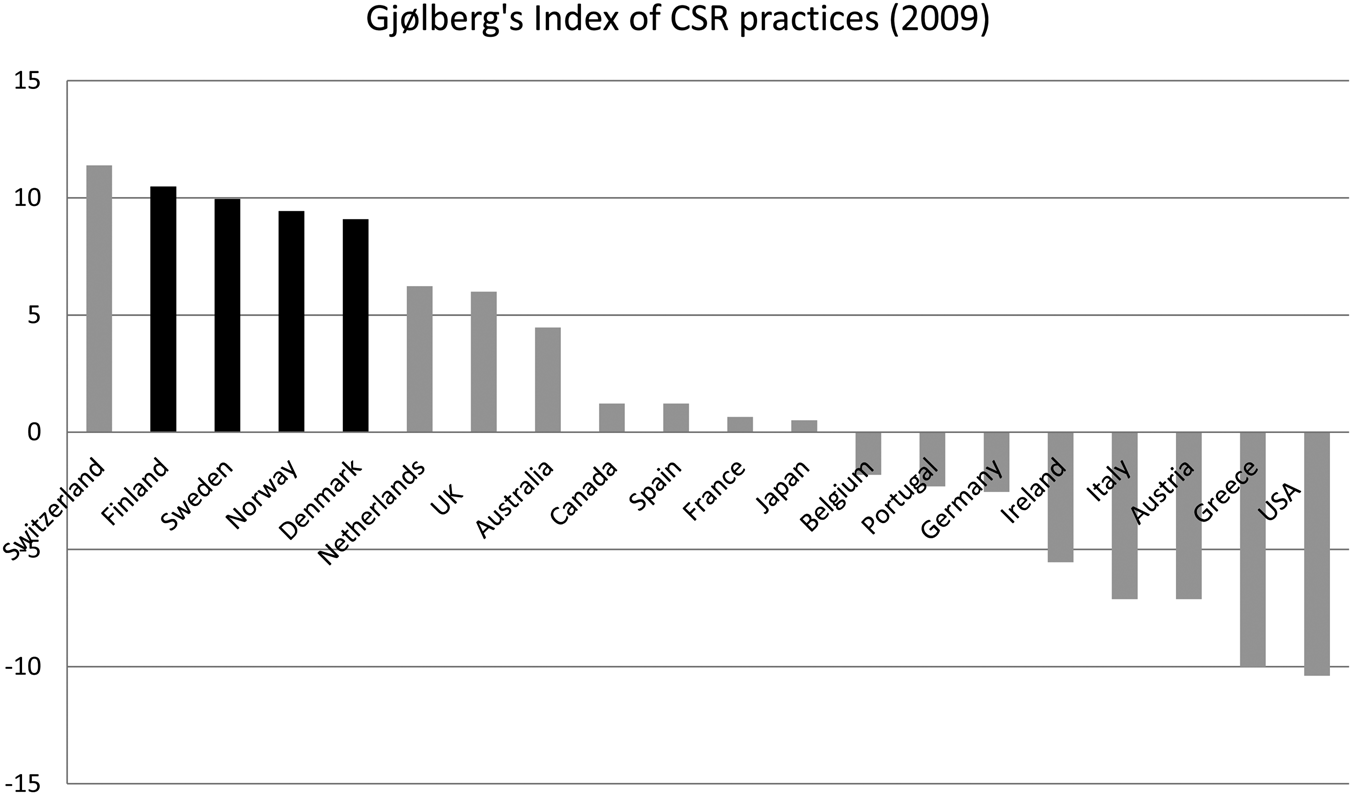
Figure 3 replicates Gjølberg's data from her 2009 CSR index. This index has Switzerland in first place, followed by Finland, Sweden, Norway, and Denmark, far ahead of the Netherlands in sixth place.
Nordic CSR performance

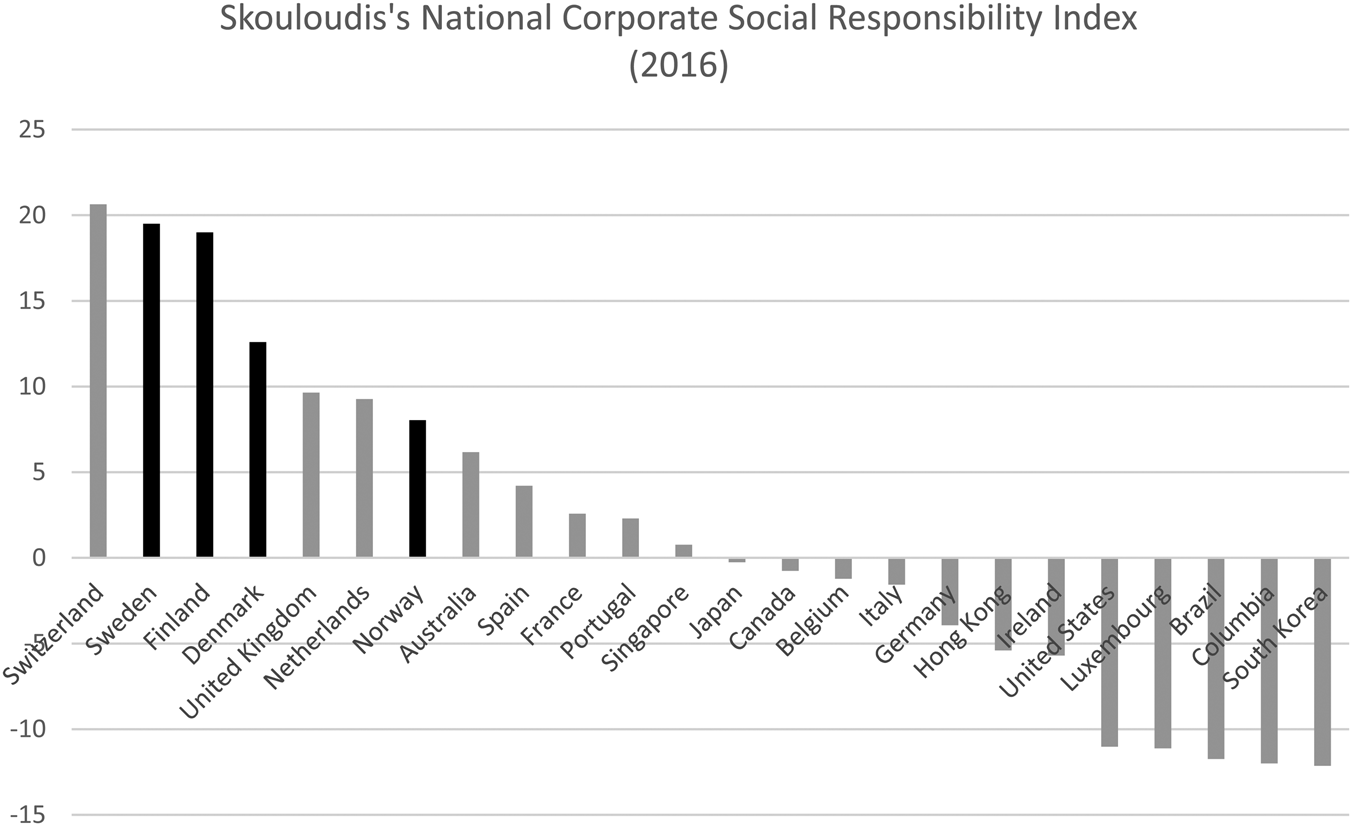
Skouloudis has updated Gjølberg's CSR index (using data from 2012) and added more countries.Footnote 42 The results can be seen in figure 4.
Nordic CSR performance

In first place, we again have Switzerland, followed by Sweden and Finland, clustered closely together in second and third place, Denmark further back in fourth place, and Norway lagging behind the other Nordic countries in seventh place.
The magazine Corporate Knights produces an index of the most sustainable corporations in the world. Nordic companies occupied fourteen of the top ninety-nine spotsFootnote 43 in 2013: Sweden has five, and Denmark, Norway, and Finland each have three companies on this list. Moreover, all but one of these Nordic companies score in the top two-thirds of the distribution. Nordic dominance is not as unequivocal here as it is in the aforementioned indices, but Nordic companies’ performance is strong, particularly when one takes into account Nordic countries’ status as small states.
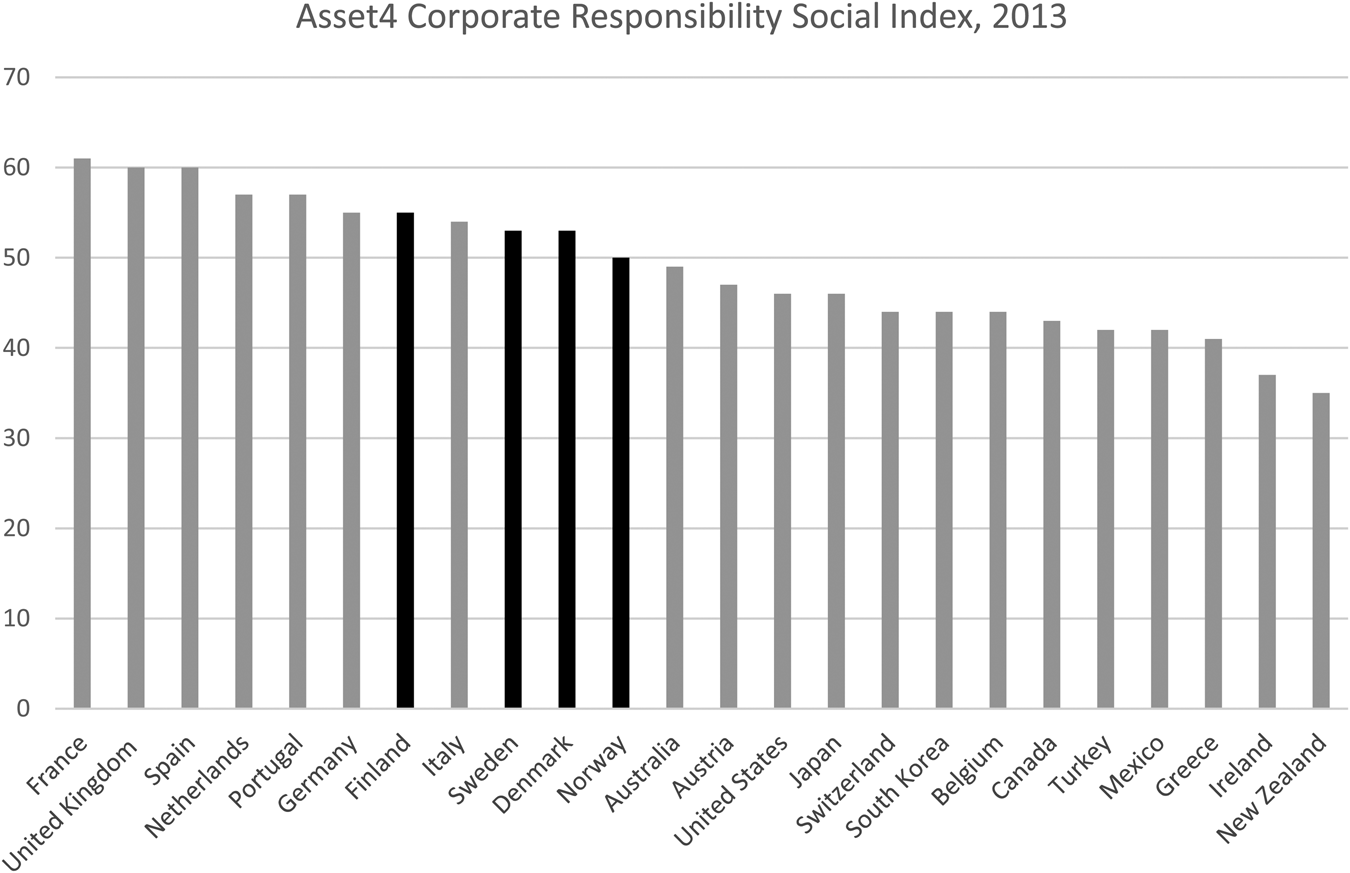
We now examine the Corporate Responsibility Social Index compiled by Jackson and Bartosch using ThomsonReuters’ Refinitiv/Asset4 data set. For many scholars, Refinitiv, based on nuanced and fine-grained annual company-level data from over five thousand companies across the world, now sets the standard for global CSR indices. The data upon which figure 5 is based focus on the social dimension of corporate responsibility: “product responsibility, human rights, community, employment quality, health and safety, training and development, and diversity and opportunity.”Footnote 44
Nordic CSR performance

These figures suggest that Denmark's support of 2014/95/EU was not driven by its CSR performance. Other, more recent sustainability indices rank Sweden higher than Denmark,Footnote 45 which suggests that CSR / sustainability performance is at best insufficient for explaining support for more stringent supranational regulation. And considering figure 5, advocates of SCA should exercise caution when claiming that “Scandinavian countries lead the world in strong CSR and sustainability performances.” But even in the Asset4 database, Nordic countries are in the upper half of the distribution, and in the other indices, Nordic companies outperform those from any other region.Footnote 46
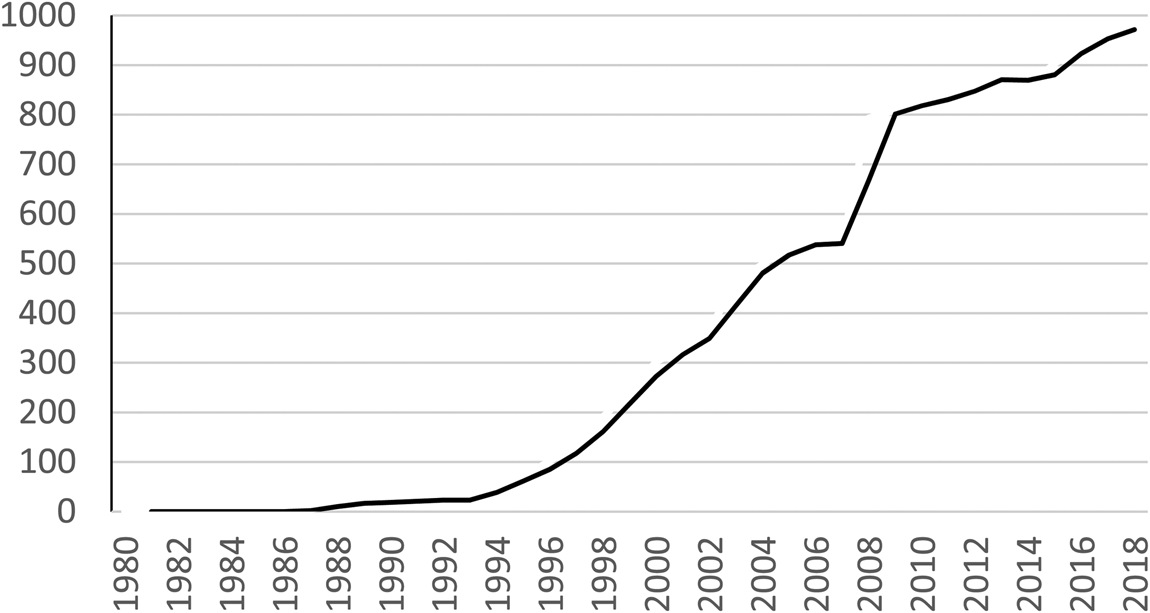
Figure 6 provides an alternative glimpse into the level of Nordic CSR engagement by aggregating the corporate membership numbers of national-level CSR organizations. Existing scholarship is heavily oriented towards global CSR initiatives (such as the United Nations Global Compact) and it tends to ignore national-level CSR organizations.Footnote 47
Membership in national CSR organizations in Denmark, Finland, Sweden, and Norway

Membership in national CSR organizations has declined in many countries over the past decade, since the Great Recession. Not so in Scandinavia, where the overall trend is steadily upwards. On balance, Nordic countries have strong CSR performance and high levels of CSR engagement—yet this did not translate into strong support for more stringent supranational regulation. To find out why, the next section discusses the positions of business associations and the role of firm size in explaining business association resistance.
Explaining the paradox of weak political support for regulation in spite of strong CSR performance
The roles and positions of mainstream business associations
Business associations are the key to resolving the paradox of weak support for regulation in spite of strong CSR performance. Some Nordic CSR leaders have been willing to speak out in favor of regulation, but most have not. While even progressive businesspeople have tended to keep quiet on this issue, Nordic business associations are politically powerful, assertive, vocal, and outspoken in their hostility to the regulation of CSR and non-financial reporting. They maintain that these issues must remain voluntary and left up to the companies themselves to decide. The result is an asymmetry between hard opposition and soft support for regulation in the Nordic business community. This points to an important omission in Gjølberg's survey, which includes Nordic CSR leaders but excludes business associations that speak on behalf of a vastly larger number of companies.
The Confederation of Swedish Enterprise (Svenskt Näringsliv) has 49 member organizations representing ~60,000 member companies and 1.5 million people. Företagarna, The Swedish Federation of Business Owners, represents the interests of around 70,000 business owners. In Denmark, the Confederation of Danish Industry (DI) represents 10,000 companies within manufacturing, trade, and the service industry. The Confederation of Finnish Industries (EK) represents 27 member associations and 16,000 member companies. The Confederation of Norwegian Enterprise (Næringslivets Hovedorganisasjon) represents over 24,000 companies in Norway. In comparison to these numbers, the 79 Nordic sustainability leaders surveyed by Gjølberg, who prefer hard law, are a drop in the ocean.
The positions of Nordic business associations concerning the regulation of CSR and non-financial reporting are remarkably uniform. Sverker Rudeberg of Svenskt Näringsliv states: “our position [concerning 2014/95/EU] is no different from the one of BusinessEurope.”Footnote 48 The position paper of Svenskt Näringsliv (Andersson and Norberg, Reference Andersson and Norberg2015) underlines this categorical opposition to the Directive: the Confederation “rejects the proposal on which companies must provide a sustainability report.”Footnote 49 During the negotiations, Finnish firms were concerned about administrative burdens, and Tuuli Mäkelä of the EK states, “Our position on the directive is rather in line with that of BusinessEurope.”Footnote 50
Hannu Ylänen of the EK writes, “In general companies are of the opinion that CSR -issues should be left for companies themselves to decide. Finnish companies in general are not in favour of the ‘regulationization’ of CSR and self-regulative standards.”Footnote 51 Since Norway is not an EU member, it did not participate in negotiations over 2014/95/EU. Norway did, however, amend its Accounting Act to mandate non-financial reporting (§3–3, 2013). Næringslivets Hovedorganisasjon did not support this legislation.Footnote 52 In the words of the NHO's legal expert Henrik Munthe, “NHO was in fact rather hesitant to support the changes in the Accounting Act when they were proposed.”Footnote 53
As these examples show, Nordic business associations assert that CSR should remain voluntary: non-financial reporting and CSR itself should be matters of corporate discretion, not state regulation. The next section explores the underlying rationale for Nordic business associations’ opposition to more stringent supranational regulation.
The importance of firm size in explaining business association resistance
Mandatory disclosure requirements do not threaten the reputations of Nordic companies with strong CSR performance. In light of this evidence, the opposition of Nordic business associations with the exception of the Danish DI to the corporate transparency law 2014/95/EU is puzzling. In this section, I suggest that firm size is important for explaining business opposition. Business associations represent a large number of small and medium-size enterprises (SMEs). As we will see, many of them are not at the forefront of sustainability / CSR. It is rational for these smaller companies with lower CSR performance to mobilize business associations against corporate transparency laws, which may be extended to smaller companies over time, affecting these companies in the not-too-distant future.
My argument in this section is not just that mandatory non-financial disclosure requirements impose administrative costs on SMEs. This is widely known and commonly accepted: “For small companies this is a problem as they in most cases do not have the resources to work on it,” explains Marja Hanski, who represented the Finnish government in the negotiations.Footnote 54 Hanna Cederqvist from Företagarna, remarks that “larger companies generally have bigger administrative resources … [and] better established processes than smaller ones.”Footnote 55 Philip Thunborg, also from Företagarna, believes that “it should indeed be business driven rather than forced by legislation. Forced legislation would possibly be counterproductive since this would require resources that many small enterprises simply do not have.”Footnote 56 An official with close connections to DI stated that smaller companies were more concerned “as the larger companies are already living up to most of the requirements.”Footnote 57
In addition to administrative costs related to data collection and the publication of CSR reports, smaller companies tend to have lower CSR performanceFootnote 58 than larger ones. This is important because as Johan Genneby remarks, “Rather than pushing the boundaries it [the Directive] will raise the floor, forcing the companies which have yet to adhere to sustainable business principles to move forward.”Footnote 59 It is difficult to get systematic data on the CSR performance of small and medium-size companies that comprise the majority of business association members. However, it is possible to get data on listed companies that make up the indices in section 3 of this paper.
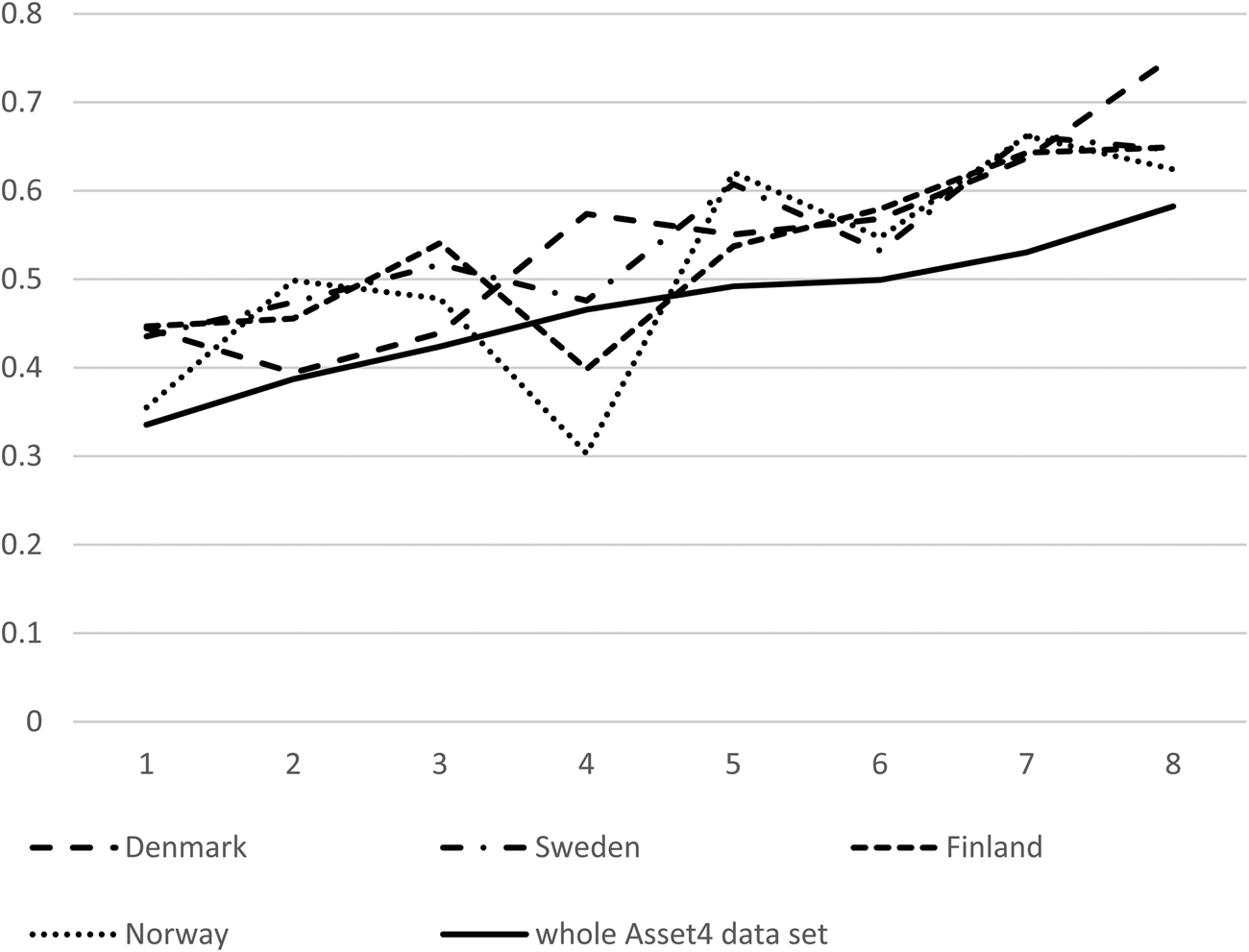
Figure 7 draws on the Refinitiv data shown in figure 5. I grouped firms into 10 deciles based on employees for the entire OECD sample. Since this left several Nordic countries without companies in the largest (9th and 10th) deciles, this figure shows the breakdown for the first eight deciles for the four largest Nordic countries and the sample as a whole.
CSR performance of listed companies by decile of size/number of employees, Asset4 Corporate Responsibility Social Index, 2013

There is a substantial gap between the CSR performance of firms in the 1st decile and the 8th decile. In Finland and Sweden, scores of the 8th decile are, on average, ~45 percent higher than the 1st decile. In Denmark, this gap is even larger, at ~70 percent, and in Norway, firms in the 8th decile have CSR scores that are ~76 percent higher than those in the 1st decile.
Since the Asset4 sample includes only listed companies, one can only speculate about the CSR scores of the small and medium-size companies that comprise the bulk of business association members. However, since there is a clear correlation between firm size and CSR performance for listed companies, it seems reasonable to assume that the CSR scores of smaller, unlisted companies are around, if not below those of the 1st decile in figure 7.
To sum up this section, corporate transparency laws, such as 2014/95/EU, do not just threaten to impose administrative burdens on SMEs—they may also lead to reputational damage by exposing their lower levels of CSR performance. In light of this evidence, Nordic business association opposition to 2014/95/EU seems rational and justified, and notions of SCA seem problematic. Researchers should focus not only on CSR leaders but also on the larger number of firms excluded from these indices, as well as the business associations that represent their interests. Next, I discuss the importance of domestic regulations and the positions of CSR leaders and responsible business organizations.
Towards a better understanding of the determinants of support and opposition for more stringent supranational regulations
The importance of domestic regulations
Denmark is the only Nordic EU member that strongly supported the Directive in the negotiations. Both the Danish government and the major Danish business association endorsed a position that closely mirrors Denmark's existing domestic regulations. The DI endorsed the “flexible and business-oriented reporting model that Danish companies have embraced” but was critical of the elements of the Commission's proposal that went beyond the Danish requirements.Footnote 60 What sets the DI apart from the Svenskt Näringsliv and the EK is its overall support: “We have been supportive of the Directive because we were interested in a level playing field in the EU,” remarked the DI's Sara Krüger Falk.Footnote 61
This does not mean that the DI was initially keen on mandatory CSR reporting. When this idea was first discussed, the DI opposed it: “for DI it was central that the new legislation would maintain that CSR reporting was flexible and voluntary.”Footnote 62 In the end, the DI's preference for soft and flexible requirements was reflected in §99a of the Danish Financial Statements Act, and the DI did not take a strong position against these requirements. Perhaps the DI's support was also a reflection of the fact that the reporting requirements were “flexiblized to the point of being almost voluntary.” If the regulations had been more stringent, the DI's resistance would likely have been fierce.Footnote 63 Once the law was in place, CSR reporting became a “sunk cost,” and CSR was perceived as providing Danish companies with competitive advantages.Footnote 64 This is how the DI gradually became supportive and the Danish government ended up a strong supporter of 2014/95/EU.
The two other EU member states with corporate transparency laws—France and the United Kingdom—also sought to upload their regulations to the EU level to “level the playing field.” In the United Kingdom, the Companies Act 2006 mandated non-financial reporting for ~1300 publicly listed companies on the main board of the London Stock Exchange. The Confederation of British Industry supported a watered-down version of the Directive in line with the sustainability reporting requirements in the UK Companies Act.Footnote 65
Article 116, Paragraph 4 of France's 2001 Nouvelles régulations économiques established detailed reporting requirements for listed companies, and these were expanded and extended to non-listed companies by the 2010 Grenelle II law. While stressing that the EU “should not be overly ambitious and should not go beyond what is provided for by French law,”Footnote 66 the French employers’ association MEDEF supported the French government's attempts to enact EU legislation close to, but not more ambitious than, French domestic CSR legislation. The fact that France had the most ambitious non-financial reporting requirements explains France's support for strong regulation in negotiations over the Directive.
As we have seen in the third section, Sweden, Finland, and Denmark have comparable levels of CSR performance. The absence of pre-existing domestic legislation, not lower levels of CSR performance explains Finland's and Sweden's weaker support for more stringent supranational regulation.
Positions of CSR leaders and responsible business organizations
This section surveys the positions of Nordic CSR leaders. I begin with officials who speak out in favor of regulation, in line with Gjølberg.Footnote 67 Here is Andreas Rydell, in charge of CSR at the Nordic IT infrastructure company Atea ASA:
Atea ASA supports the stricter legislation due to various reasons. First and foremost because the fact that more companies have to put “sustainability” on the corporate agenda, moving from charity based CSR to CSV. I personally think that the legislation gradually will help companies working in a more systematical way.…Yes, it provides competitive advantage for companies that have reached a certain level in maturity with regards to “CSR”Footnote 68
Together with Unilever, IKEA wrote a letter in support of the Directive. On behalf of the IKEA group, Camilla Ohlsson stated:
For IKEA, our sustainability report is a way of monitoring and communicating our progress in relation to our sustainability strategy.…We write it for our co-workers, our customers, our partners, our supply chain and other stakeholders. We want to be open and transparent with our achievements, and as it sometimes happens, difficulties to reach our targets.… It's correct that we submitted a letter with Unilever in support of the directive, since we believe transparency and openness is a good thing.… [We] welcome the increased transparency that the directive will lead to, as it may enable consumers, investors and other stakeholders to make more informed choicesFootnote 69
Magnus Enell, who has worked as a sustainability / CSR consultant for the past several decades in Sweden, observes: “There is an increasing interest from all business sectors…in the sustainability/CSR area. And the reason for this is that they have understood the business value of being proactive in the environmental and social areas.…It is cheaper to work with it, than not to work with it.”Footnote 70
In the words of Lene Bjørn Serpa, head of sustainability research at the Danish company AP Møller–Maersk, the world's largest container ship operator:
We are generally supportive of stricter regulation of CSR and non-financial reporting to the extent that it is applied in EU and Danish law, i.e allowing for flexibility on the part of companies to decide the details of reporting and thereby ensure relevance to the business. Long lists of mandatory criteria for reporting are not useful, in our view, as they will not be equally material to all sectors and companies. So an approach that combines required reporting with flexibility on details would be the best one, and we find that the current Danish regulation accomplishes that.Footnote 71
According to Alestig, “there are businesspeople who say that regulations will sharpen their comparative advantage.”Footnote 72 In light of this preference for regulation in the CSR and sustainability business community, Nordic governments’ comparatively weak political support for regulation seems puzzling. In order to resolve this puzzle, the following observation is useful: most Nordic CSR leaders do not forcefully advocate for regulation. The quietness of many CSR leaders contrasts with the assertive, if not aggressive, stance of business associations. In the above case of Atea, for example, Rydell states that “We have not discussed or debated this [issue of support for regulation] in public yet.”Footnote 73 Next, we examine Nordic responsible and sustainable business organizations.
While Nordic business associations, with the exception of the DI, opposed mandated sustainability reporting, it is certainly possible that Nordic responsible and sustainable business associations were supportive. This would make sense if these organizations’ members are CSR leaders. However, as we will see, many Nordic responsible and sustainable business organizations either explicitly support voluntarism or are unwilling to publicly oppose it.
Finnish responsible business representatives stress the importance of voluntarism: “on a general level, we are believers into voluntary actions by the industry, unless there is a clear breach of some key concept like human rights or grave environmental damages. The legal framework in Finland is generally quite tight on key issues, which might be voluntary elsewhere, narrowing the room for CSR.”Footnote 74
Mikko Routti, Director of Finnish Business and Society (Finland's leading business-led CSR network), explains that support for the Directive among FIBS's member companies is “probably on the same level [of support as CSR Europe] as many are members of Finnish EK, which is affiliated with BusinessEurope.”Footnote 75 The chair of CSR Sweden was unwilling to speak out publicly in favor of the Directive because the Confederation of Swedish Industry was negative. For this reason, he said: “let us say nothing in support of the legislation.”Footnote 76 The failure of company representatives to take an independent position—Volvo representative Eva Lindebäck states that “we do not have a separate Volvo position on this”Footnote 77—leaves Svenskt Näringsliv to call the shots.
While members of the responsible business community express frustration and characterize associations, such as the Svenskt Näringsliv, as “dinosaurs,”Footnote 78 their continued influence on government policy suggests that these associations are alive and well, in comparatively good health and far from extinction. Moreover, pro-regulation CSR managers often speak in a personal capacity and not on behalf of their companies as a whole. In the words of Bengt Johansson, who served as Sweden's CSR Ambassador for three years, “the formal position of the business community is voiced by the large organizations and they listen to the CEOs, not the CSR managers.”Footnote 79
Before concluding this section, I wish to point out that some CSR leaders, who do not feel represented by the associations’ opposition to regulation, are willing to bypass their confederations and publicly express support of the Directive. Among them is Marie Baumgarts, previously head of CSR at the Swedish telecommunications company Tele2 and now head of sustainability at SEB. Baumgarts took the lead among Swedish businesses when it came to expressing support for the Directive: she published a debate article in support of the Directive with approximately a dozen signatories from Swedish companies of various sizes.Footnote 80
When asked why the Directive is needed, Baumgarts responded that the status quo is not working: “Companies are having impacts which will show in the [companies’ financial] figures. We need these [non-financial] figures!” The background is the aforementioned debate between Norman, the Swedish Finance Minister, and Björling, the Swedish Minister for trade. Baumgarts describes this clash as “a huge political debate in Sweden” but “behind the scenes.” While Norman ended up winning in the end, Baumgarts feared that Björling could win, which would have led Sweden to vote against the Directive: it was “very close” or even “a tie. Will it get enough votes or not? Now is the chance to speak out or it will take another ten years!”
Baumgarts felt compelled to speak out when Björling claimed to oppose the Directive on behalf of all Swedish businesses: “that is not the case!” Eleven businesspeople signed her letter of support, and ~10 more expressed interest but were unwilling to sign in the end.Footnote 81 Here it is important to note that the signatories expressed their support as individuals rather than on behalf of their respective companies. In the end, the number of CSR leaders who are willing to take a stand is small in comparison to the membership of Svenskt Näringsliv. This also draws our attention to intra-corporate conflict. As Sweden's former CSR Ambassador Bengt Johansson remarks, “I noticed that CEOs often have other views than the CSR managers. In CSR discussions here only the CSR managers take part so I was a bit shocked when I realized that they spoke for themselves, not for the company.”Footnote 82 Support for regulation from CEOs and CFOs will generally be far more meaningful, and politically consequential, than support from CSR managers alone.
Extending and applying the argument to other cases
Partisan politics and the transposition of the directive
Political parties matter for upward regulatory harmonization. Belgium provides the clearest example of the importance of political partisanship in the negotiations over 2014/95/EU. As we can see in figures 2–4 and 5, Belgian firms’ lower levels of CSR performance suggests that the Directive will not be an unmitigated blessing for Belgian businesses. The Belgian government actively supported the Directive despite business opposition: political partisanship and the political initiative by a leftist government minister played a decisive role. Johan Vande Lanotte, a green social democrat who represented Belgium in the negotiations, describes his motivations as follows: “It was a quite typical left position I think.…The federation of enterprises was not very happy about that, but that was not a reason to drop our support.”Footnote 83
Returning to this paper's central argument, one may wonder if the negotiations over 2014/95/EU are an outlier case or more generally representative of Nordic attitudes towards more stringent regulation. To extend my argument and increase confidence in my findings, I discuss the transposition of the Directive 2014/95/EU into national law in the three Nordic EU member states.Footnote 84 Perhaps the ambitious transposition of the Directive 2014/95/EU in Sweden casts doubt on my argument and supports SCA after all? Although Denmark stayed on the level of their own legislation (which already went beyond the Directive's minimum requirements), Sweden used the transposition to jump forward. As a result, this legislation applies to ~1600–2000 companies in Sweden and ~1100 companies in Denmark, which is a substantial increase from the ~100–200 and ~50 companies that would have been affected by the legislation if the Directive had been implemented on a 1:1 basis in these countries.
Finland, however, transposed the Directive in a minimalist way: the Finnish law is just as limited and restrictive as it is in countries that were hardcore opponents of the Directive (such as Germany), and only ~100 Finnish companies are covered by the Finnish law. Gjølberg and SCA cannot explain this substantial variation within Scandinavia. As we have seen in section 4, Finland has strong CSR performance – there is no indication that Finland's CSR performance is inferior to Denmark's or Sweden's. Strong sustainability performance does not necessarily translate into strong support for more stringent regulation.
Political partisanship explains the different ways in which governments transposed the Directive into national law: “political difference” matters.Footnote 85 Center-left politicians tend to support more ambitious and expansive regulations while center-right politicians tend to oppose them.Footnote 86 Sweden's former CSR ambassador Johansson expressed: “There is of course a clear division where the right wing parties dislike legislation and want the business sector to decide over its own issues and the left wing parties that see legislation as a way of deciding on important issues in a democratic way.”Footnote 87
Given the opposition of business associations, the absence of domestic legislation and the divide within the Swedish government regarding 2014/95/EU, we would not necessarily expect the Swedish government to transpose the Directive in an ambitious way. Yet Stefan Löfven's red-green coalition government did just that.
Two organizations lobbied to support the ambitious transposition of 2014/95/EU in Sweden: the Swedish Consumers Organization and the Haga Initiative, a progressive business organization oriented towards a low carbon society. Nina Ekelund, Executive Director Haga Initiative, contacted members of the Swedish Riksdag who seemed to be undecided and encouraged them to support this legislation. Ekelund noted that “Svenskt Näringsliv were opposed but we have our opinion, we supported it anyway. Yes, it would be easier without Svenskt Näringsliv.”Footnote 88
Svenskt Näringsliv pointed that there was a lack of clarity about costs that this reporting requirement would impose on Swedish companies. In addition, it would harm Swedish enterprises’ competitiveness in the European internal market. In order to get a sense of how active these organizations were in support or opposition to an ambitious transposition of 2014/95/EU, I contacted members of the Swedish Riksdag. While my sample of intervieweesFootnote 89 is too small to be representative the three responses are nonetheless revealing: one parliamentarian had been contacted by the Haga Initiative and another by the Swedish Consumers Organization, but all three had been contacted by Svenskt Näringsliv. Business associations are a force to be reckoned with.
In Finland, Juha Sipilä’s right-wing government transposed the DirectiveFootnote 90 so that it will apply only to public interest entities with >500 employees. This minimalist transposition of the Directive reflects the center-right coalition's support for self-regulation and for minimizing the administrative burdens on business. The Finnish opposition Greens, Social Democrats and the Left Alliance stated that they would have gone further with CSR reporting.Footnote 91 If the Swedish center-right Moderate Party had transposed the Directive, it would likely have done so in accordance with the preferences of the Svenskt Näringsliv and in line with Finland. Partisan politics were also at play when it came to Sweden's position in the new EU regulation on trade in conflict minerals.Footnote 92 To sum up this section, left-wing governments are more likely to support stringent supranational regulation and corporate transparency laws, while right-wing governments are more likely to follow the recommendations of business associations.
Nordic business associations were remarkably uniform in their opposition to ambitious transpositions of 2014/95/EU. In the case of Sweden, evidence suggests that the ambitious transposition of this law may be burdensome and costly for some small and medium-size enterprises that make up the vast majority of Svenskt Näringsliv's membership. While virtually all large-cap companies disclose sustainability information, smaller companies are less likely to produce a sustainability report, according to Nora Sandahl, co-author of a recent KPMG Sweden report on sustainable reporting.Footnote 93 This study found that 14 percent of the smaller companies that were sampled, all of which were legally required to publish a CSR report, had not done so.Footnote 94 By contrast, basically all large-cap companies disclose sustainability information.Footnote 95
Despite the ambitious transposition of the Directive, there have been no noisy complaints in response to these sustainability reporting requirements in Sweden. While this may seem surprising, it is understandable if one considers the societal legitimacy of sustainability in the homeland of Greta Thunberg: “there are few people who argue against sustainability,”Footnote 96 in Sweden today. In an environment in which complaining about sustainability reporting requirements could result in scorn or reputational damage, it may be prudent for unhappy businesspeople to remain silent on this issue and leave it to Svenskt Näringsliv to represent their interests.
Mandatory human rights due diligence requirements
Discussions are underway in European countries and at the EU level to require businesses to undertake due diligence for their human rights and environmental impacts in their own operations and in their supply chains. Attempts to move forward with mandatory human rights due diligence requirements must grapple with business association opposition—they cannot focus only on CSR leaders that are willing to speak out in favor of regulation.
Established in late 2018, the #Ykkösketjuun* campaign calls for a Finnish law on mandatory human rights due diligence that would legally mandate companies to map their human rights impacts and prevent possible negative impacts. This campaign is supported by civil society organizations, trade unions, citizens, and seventy companies, and it is coordinated by Finnwatch, a corporate accountability organization. At the time of writing, the EK had not officially reacted to the campaign.
Nina Elomaa, Director of Corporate Responsibility at the Fazer Group, a privately-owned Finnish food and food service company that supports this campaign, stresses the need for a level playing field: regulations “should be EU wide or global.” When asked about the role of EK, she remarks that “EK have reacted negatively. It is a delicate issue. We got negative feedback from them.”Footnote 97 A CSR manager from a Norwegian CSR leader echoes these sentiments: “on a general basis, we support initiatives that level the playing field among business actors, and we already commit to a range of international standards.” But this official also stresses the positive contribution made by the Norwegian business organization NHO: “We have a good dialogue with NHO, and our experience is that they contribute positively in processes related to new legislation impacting businesses.”Footnote 98 All businesses, including CSR leaders, have an interest in a level playing field, and business associations play an important role by articulating these interests.
Finally, a CSR manager from a Danish CSR leader explains that their company practices human rights due diligence and supports mandatory due diligence. But they “have not taken this specific question to the CEO and the Board of Directors … this is not really something we discuss with them.”Footnote 99 Scholars and civil society activists who are interested in more stringent regulatory standards should devote more attention to positions articulated by CEOs, as well as the interactions between CSR leaders and business associations.
In this section, I have suggested that my core argument about business associations extends to mandatory human rights due diligence requirements and beyond. Cases vary, but business associations’ opposition to regulation is remarkably uniform. Some CSR leaders, and some left-wing governments are willing to break ranks with these associations, but many others are unwilling to do so. Those who seek to advance causes, such as mandatory human rights due diligence, may find it useful to pressure the CEO and Board of Directors of CSR Leaders to support regulation, in order to increase the chance of business association support. In any case, the fact that comparatively few Nordic CSR Leaders have so far been willing to fight for regulation in the face of business association opposition suggests that most of them do not have a very strong preference for regulation.
Conclusions
At first glance, Nordic companies’ high CSR performance suggests that Nordic businesses should have nothing to fear from stricter supranational regulations, such as the EU's corporate transparency law 2014/95/EU. If anything, this Directive could allow high-performing Nordic companies to showcase their superior performance, enhancing their competitive advantage. Yet Nordic governments provided only tepid support for binding supranational regulation in the negotiations. This paper contributes to literature that provides a corrective to uncritical praise of the “Nordic Model”Footnote 100 and derives five theoretical lessons from this case.
First, high sustainability performance by CSR leaders does not necessarily imply strong support for more stringent supranational regulation.Footnote 101 Although Nordic governments were not opposed to this legislation, only Denmark provided strong support for 2014/95/EU. France, Belgium, and the Netherlands provided stronger support than Sweden or Finland, in spite of the fact that these two Nordic countries out-perform these other countries, according to most CSR indices.
Second, this paper underlines the importance of business associations in contemporary governance. Business associations are essential for resolving the paradox of weak political support in spite of strong CSR performance. Scholars rely increasingly on data sets with impressive firm-level data, and scholars of responsible business focus on CSR leaders, companies with high CSR performance, and CSR managers who prefer binding regulation. However, they neglect mainstream business associations, which represent thousands of companies, many of which have lower levels of CSR performance, and are politically powerful, assertive, and averse to regulation. Scholars who ignore the role of business associations commit a serious and costly error, which can lead to mistaken inferences. Almost two decades ago, Greenwood and Webster claimed that business associations’ “future role in EU governance seems assured.”Footnote 102 This paper supports their assertion, not only for conventional areas of economic regulation, but also in areas of “new governance,” such as CSR and corporate transparency laws.
Third, while opposition to regulation is business associations’ default position, their interests are politically constructedFootnote 103 rather than static or invariant. My analysis shows that if domestic regulations are already in place, business associations tend to support binding transnational/supranational regulations to level the playing field. This explains why, despite comparable levels of CSR performance, Denmark provided strong support for the EU sustainability reporting Directive 2014/95/EU, while Sweden and Finland did not. The same logic led business associations in France and the United Kingdom to support 2014/95/EU.
Fourth, partisan politics is important: left-of-center politicians tend to support ambitious legislation, while conservative and right-of-center politicians tend to oppose it. This motive led the Belgian government to provide strong support for the Directive despite weaker CSR performance. It also led Stefan Löfven's red-green coalition government in Sweden to transpose 2014/95/EU in an ambitious way despite opposition from the Svenskt Näringsliv. Finland's conservative government transposed the EU sustainability reporting Directive in a limited, restrictive way. Partisan politics, more than CSR performance, helps us to explain these outcomes.
Fifth, we should focus on conflict rather than consensus when studying the political economy of CSR and sustainability reporting regulation. The concept of SCA suggests consensus, which can lead us to lose sight of conflicts, battles, diversity, and variation within and between Nordic countries. Researchers shouldn't neglect the large number of firms that are excluded from the CSR indices and datasets they use. For some companies, CSR and transparency can be a source of competitiveness; for others, it is costly and burdensome. This ambivalence affects the motivations of companies to engage in CSR and support corporate transparency laws. It affects all companies, but especially small ones, for whom CSR and mandatory reporting requirements are often costly. In sum, Nordic countries are much more heterogeneous than what the literature often suggests. It does not make much sense to speak of the Nordic countries as a homogeneous unit in the field of CSR.
It is not hard to find other evidence that contradicts the image of Nordic business having a very strong preference for increased regulation: many Nordic companies have established financial or holding companies in Benelux countries to reduce their tax obligations. Although Swedish companies are reportedly “not afraid of regulations,”Footnote 104 nor are they necessarily supportive of them.Footnote 105 A glance at the political economy literature suggests that there is nothing cuddly about Nordic capitalists: in recent decades, they have pushed aggressively for liberalization and cuts to unemployment insuranceFootnote 106 and profit-making in the welfare sector.Footnote 107 Swedish employers have deployed “ideas as weapons”Footnote 108 and have sought to push free market reforms “as far as possible, whenever possible.”Footnote 109
Looking into the future, it is possible that Sweden, in spite of its lack of leadership in the negotiations over 2014/95/EU, will assume more of a leadership role now that it has adopted an ambitious transposition of the Directive.Footnote 110 But it is also possible that business associations will persist with their hardline opposition and continue to defend the “business case for CSR” against regulatory encroachment. Will 2014/95/EU usher in a new era of corporate accountability and a break with the business and managerial capture of CSRFootnote 111? To what extent do the insights from this paper travel to other cases—mandatory human rights due diligence, health and safety requirements, climate negotiations, CO2 tax etc.? Future work should also examine the conditions under which the preferences of various actors can align in favor of stricter regulations, as has been the case in Denmark. One thing is certain: we need further, systematic research to come up with a theoretically and empirically rigorous explanation for business's regulatory preferences in Nordic countries and beyond.
Interviews:
Alestig, Peter, 10 January 2017.
Anonymous, 20 August 2018.
Anonymous, 7 February 2019.
Anonymous, 26 April 2019.
Baumgarts, Marie, 3 July 2014.
Beslik, Sasja, 13 January 2017.
Bogle, Marianne, 9 July 2016.
Borges, Sanne, 14 July 2014.
Chaplier, Jerôme, 18 March 2014.
Ekelund, Nina, 5 March 2019.
Elomaa, Nina, 21 March 2019.
Enell, Magnus, 15 June 2016.
Eskilandersson, Mikael, 5 February 2019.
Falk, Sara Krüger, 21 January 2017.
Georgopoulos, Gerasimos, 9 April 2016.
Hannah, Robert, 7 February 2019.
Hanski, Marja, 20 August 2018.
Hanski, Marja, 11 February 2015.
Johansson, Bengt, 23 August 2016a.
Johansson, Bengt, 14 December 2016b.
Johansson, Bengt, 13 February 2019.
Lerpold, Lin, 22 August 2016.
Lindebäck, Eva, 18 August 2016.
Mäkelä, Tuuli, 22 April 2014.
Munthe, Henrik, 22 August 2016.
Norberg, Claes, 4 August 2016.
Ohlsson, Camilla, 22 August 2016.
Ørstavik, Gunhild,, 10 August 2018.
Pålsson, Kristin, 27 March 2014.
Routti, Mikko, 16 January 2014.
Rudeberg, Sverker, 1 April 2014.
Rydell, Andreas, 15 August 2016.
Sandahl, Nora, 11 February 2019.
Serpa, Lene Bjørn, 7 September 2016.
Sharma, Parul, 9 July 2016.
Skagen, Christina, 2 September 2016.
Stormer, Susanne, 1 September 2014.
Thunborg, Philip, 4 February 2019.
Van de Lanotte, Johann, 13 March 2015.
Ylänen, Hannu, 1 July 2016.