Dilated cardiomyopathy is a significant cause of morbidity and mortality in children worldwide, with more than one-third either dying or requiring heart transplantation in the first 2 years after diagnosis. The reported annual incidence of paediatric cardiomyopathy varies from 1.13 to 1.24 per 100,000 children, 50% of which represent dilated cardiomyopathy.Reference Lipshultz, Sleeper and Towbin 1 , Reference Nugent, Daubeney and Chondros 2 Dilated cardiomyopathy is the underlying diagnosis of the majority of children who undergo heart transplantation. The aetiology of dilated cardiomyopathy in children is diverse; several genetic, inflammatory, metabolic, and neuromuscular syndromes affect the heart and predispose these children to develop cardiomyopathy.Reference Holmgren, Wahlander, Eriksson, Oldfors, Holme and Tulinius 3 , Reference Wilkinson, Landy and Colan 4
In dilated cardiomyopathy of diverse aetiologies, pathologic stimuli of the myocardium leads to a complex cascade of events including metabolic derangements and activation of the renin–angiotensin–aldosterone and adrenergic systems that results in myocardial fibrosis and myocyte dysfunction. This process referred to as cardiac remodelling is progressive and maladaptive often leading to ventricular dysfunction and symptomatic heart failure. Deposition of collagen type III in the extracellular matrix is an intrinsic component of cardiac remodelling.
Procollagen type III amino-terminal propeptide is a collagen cleavage product that can be measured in the circulation and serves as a serologic marker of cardiac remodelling. The use of procollagen type III amino-terminal propeptide serum concentration to reflect the presence of fibrosis and extracellular matrix turnover has been well established in adult cardiology and in other fields.Reference Xie, Yao, Zheng, Yao and Zheng 5 Studies in adults have demonstrated that serum procollagen type III amino-terminal propeptide levels: (1) are significantly higher in those with dilated cardiomyopathy than in healthy controls, (2) correlate with collagen type III content of explanted hearts, and (3) have prognostic associations with dilated cardiomyopathy progression, cardiac hospitalisation, and mortality.Reference Lijnen and Petrov 6 – Reference Lin, Lin and Lo 16
Procollagen type III amino-terminal propeptide has been measured in children as part of studies on bone turnover and growth in various settings including after chemotherapy,Reference Crofton, Ahmed and Wade 17 – Reference Crofton, Wade, Taylor and Holland 19 malnutrition,Reference Doherty, Crofton and Sarkar 20 and growth disorders.Reference Trivedi, Hindmarsh, Ristell, Ristell, Mowat and Brook 21 , Reference Spagnoli, Branca and Spadoni 22 Correlation of procollagen type III amino-terminal propeptide level with cardiac remodelling and ventricular function has not been previously reported in children. On the basis of the direct relationship of procollagen type III amino-terminal propeptide to quantity of collagen type III synthesised, the role of cardiac fibrosis in the pathophysiology of congestive heart failure in dilated cardiomyopathy of all aetiologies, the findings of adult studies that demonstrate the prognostic importance of serum procollagen type III amino-terminal propeptide, as well as the correlation of serum procollagen type III amino-terminal propeptide with evidence of cardiac remodelling on standard imaging techniques, we hypothesised that serum procollagen type III amino-terminal propeptide level would serve a similar function in children and correlate with evidence of left ventricular dilation in children with dilated cardiomyopathy.
Materials and methods
This was a single-centre prospective longitudinal study of children with dilated cardiomyopathy of various aetiologies enrolled consecutively from an outpatient paediatric cardiomyopathy clinic or as they presented to an inpatient cardiac care unit from December, 2005 to July, 2010. Study visits occurred approximately every 3 months in the first year and then every 6 months for up to 4 years. Study visits were coordinated with clinical care.
Inclusion criteria included age ≤21 years, and dilated cardiomyopathy as defined by echocardiogram with shortening fraction <28% – which was <2 standard deviations from normal – and/or left ventricular end-diastolic diameter Z-score >2 for body surface area, criteria similar to that of the Pediatric Cardiomyopathy Registry.Reference Grenier, Osganian and Cox 23 Patients whose previous echocardiogram met the inclusion criteria within 2 years of enrollment were also included. Exclusion criteria included the presence of any condition known to alter collagen turnover, including muscular dystrophy, collagen vascular disease, growth disorders, and/or active myeloproliferative disorders. Patients with other types of cardiomyopathy, such as hypertrophic or non-compaction, or the presence of any other congenital cardiac anomalies were excluded from the study population. This study was approved by The Children’s Hospital of Philadelphia Institutional Review Board. Informed consent for all patients was obtained.
Clinical data including medical history; diagnosis, that is, the underlying aetiology of dilated cardiomyopathy; New York Heart Association (NYHA) or Ross Heart Failure Class; medications that may alter cardiac remodelling or fibrosis, for example angiotensin-converting enzyme inhibitors, β blockers, or aldosterone blockade, subsequently referred to as medications; and clinical events, for example hospitalisations, mechanical circulatory support, transplant, or death, were recorded during the study period.
All patients presenting with dilated cardiomyopathy at our institution underwent complete diagnostic evaluation to attempt to identify dilated cardiomyopathy aetiology. The patients were grouped on the basis of the underlying diagnoses for subset analyses: myocarditis, familial or idiopathic dilated cardiomyopathy, mitochondrial or metabolic, and ischaemic – left coronary artery anomaly or left coronary ostial stenosis/atresia, enrolled after surgical repair. The diagnosis of myocarditis was based on the pathology report of endomyocardial biopsy or high clinical suspicion defined as: patient admitted to hospital with suspicion for myocarditis, treated with intravenous immunoglobulin, diagnosed with myocarditis consistently on progress notes, and discharged with the same presumed diagnosis, despite the lack of biopsy. Evidence of viral infection by polymerase chain reaction from respiratory or blood specimens or fulminant presentation with rapid recovery were common factors in making this clinical diagnosis.
Procollagen type III amino-terminal propeptide
Procollagen type III amino-terminal propeptide levels were measured at the time of enrollment and approximately every 3 months for the subsequent 12 months, and then every 6 months for up to 4 years. Procollagen type III amino-terminal propeptide measurement was obtained at the time of the echocardiogram, or cardiac magnetic resonance imaging, and was correlated with measurements of left ventricular size and function for each patient.
Blood was centrifuged, serum was separated, aliquotted, and frozen at −80°C. Procollagen type III amino-terminal propeptide assays were performed at the Biochemistry Core Lab, Institute for Translational Medicine and Therapeutics, Perelman School of Medicine, University of Pennsylvania according to the manufacturer’s instructions (Orion Diagnostica, FI-02101 Espoo, Finland). 24 Procollagen type III amino-terminal propeptide was measured by radioimmunoassay. The intra- and inter-assay coefficients of variation were 5.6% and 7.5%, respectively. The minimum detection limit for the assay was 1 μg\L.
Owing to the fact that procollagen type III amino-terminal propeptide serum level varies with age and growth in normal populations, all statistical analyses with procollagen type III amino-terminal propeptide were adjusted for covariates of age and gender unless normalised procollagen type III amino-terminal propeptide values were utilised. Normalised procollagen type III amino-terminal propeptide was calculated as the difference between the patient’s measured procollagen type III amino-terminal propeptide and the expected normal value for age- and gender-matched control based on published reports by the manufacturer and other investigators.Reference Trivedi, Hindmarsh, Ristell, Ristell, Mowat and Brook 21 , 24
Blood sample for B-type natriuretic peptide was collected at the same time as procollagen type III amino-terminal propeptide. B-type natriuretic peptide was measured by the Children’s Hospital of Philadelphia Clinical Chemistry Laboratory by method of fluorescence polarisation immunoassay according to standard clinical protocol.
Echocardiogram
All echocardiograms were performed in the same paediatric echocardiography laboratory. Standard protocols for measurement of left ventricular dimensions, as well as indices of left ventricular systolic and diastolic function derived from two-dimensional M-mode including spectral Doppler and tissue Doppler techniques, were obtained from parasternal short-axis and apical four-chamber views. Changes in these same echocardiographic variables were assessed on patients with serial studies. Measurements were made by the paediatric echocardiography faculty and abstracted from clinical reports.
Cardiac magnetic resonance imaging
Cardiac magnetic resonance imaging was performed in a cohort of study patients at enrollment and after 1 year in follow-up. Patients with contraindications for magnetic resonance imaging, for example pacemakers; those requiring sedation for imaging because of age, typically <7 years old; claustrophobia; and/or anxiety; were excluded from this part of the study protocol. The study included standard cine ventricular volume measurement for quantification of left ventricular end-diastolic volume, end-systolic volume, and ejection fraction. Post intravenous administration of gadolinium (0.2 mmol/kg) inversion recovery imaging was utilised for assessment of myocardial viability and identification of fibrosis. Procollagen type III amino-terminal propeptide and B-type natriuretic peptide were measured at the time of cardiac magnetic resonance imaging and correlated with the presence of fibrosis, as well as ventricular volume and mass measurements. All of the cardiac magnetic resonance imaging studies were reviewed by a single cardiologist who was blinded to the procollagen type III amino-terminal propeptide level, underlying diagnosis, and any other clinical information about the patient.
Statistical analysis
Cross-sectional and longitudinal statistical analyses were performed. Means and standard deviations were used to describe the procollagen type III amino-terminal propeptide and normalised procollagen type III amino-terminal propeptide overall and for different diagnoses. After checking the distribution of procollagen type III amino-terminal propeptide, normalised procollagen type III amino-terminal propeptide, and B-type natriuretic peptide with histograms, log transformation was applied to the skewed procollagen type III amino-terminal propeptide and B-type natriuretic peptide in order to achieve approximate normal distribution.
Linear mixed-effects models, which account for differential follow-up time, and within-subject correlation, were used to examine change of log-transformed procollagen type III amino-terminal propeptide and normalised procollagen type III amino-terminal propeptide over time. The covariates included in the models were age, gender, medication status, and time of visit from diagnosis.
For the patients with myocarditis or familial/idiopathic dilated cardiomyopathy, linear regressions were used to examine the association of diagnosis and procollagen type III amino-terminal propeptide (or normalised procollagen type III amino-terminal propeptide) at baseline, adjusting for medication use at the time of visit from diagnosis. Linear mixed-effects models were used to explore those relationships over time, adjusting for age, gender, medication, and time of visit from diagnosis.
The relationship between log-transformed procollagen type III amino-terminal propeptide and echocardiogram measurements at baseline were evaluated by linear regressions. Subsequently, the relationship between log-transformed procollagen type III amino-terminal propeptide and echocardiogram measurement over time was evaluated by linear mixed-effects models. Diagnosis was added as a covariate, as well as age, gender, medication, and time of visit from diagnosis. The same analyses were performed for normalised procollagen type III amino-terminal propeptide and B-type natriuretic peptide.
In order to compare the ability of normalised procollagen type III amino-terminal propeptide to distinguish myocarditis and familial/idiopathic dilated cardiomyopathy with that of B-type natriuretic peptide, receiver operating characteristic curves were derived. The area under curve for the two receiver operator curves was compared using the test of Hanley and McNeil for receiver operator curves obtained from the same patients. Furthermore, the predictive capacity was described by sensitivity, specificity, positive predictive value, and negative predictive value, along with their corresponding 95% confidence intervals.
For the subgroup of the study population who underwent cardiac magnetic resonance imaging, t-test was used to compare normalised procollagen type III amino-terminal propeptide between patients who had evidence of fibrosis on cardiac magnetic resonance imaging with those who did not. Wilcoxon’s rank-sum test was used to compare procollagen type III amino-terminal propeptide and B-type natriuretic peptide values between these two groups. Pearson’s correlation coefficient was applied to analyse correlations between procollagen type III amino-terminal propeptide, normalised procollagen type III amino-terminal propeptide, and B-type natriuretic peptide with magnetic resonance imaging measurements of left ventricular volume, left ventricular mass, and ejection fraction independently.
Results
Study population
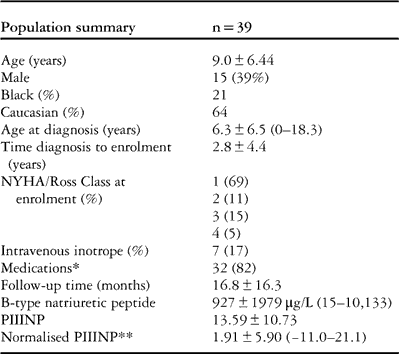
The study population consisted of 39 patients, mean age 9.0±6.4 years, who were followed up for a mean of 16.8±16.3 months (range 0.3–50.4 months) Table 1. Procollagen type III amino-terminal propeptide was measured from 149 serum samples, with serial measurements (n=140) obtained in 30 out of 39 patients. Of these patients, only nine had a single study visit and procollagen type III amino-terminal propeptide measurement because of the following factors: progression to mechanical circulatory support (four), end of study period (three), death (one), lost to follow-up (one). The mean number of study visits and samples per patients was 3.8±2.5.
Study population characteristics at enrolment (n=39).

PIIINP=Procollagen type III amino-terminal propeptide
* Medications=β blocker, angiotensin-converting enzyme inhibitor, or aldosterone blockade
** Normalised procollagen type III amino-terminal propeptide is measured procollagen type III amino-terminal propeptide minus published expected PIIINP of age- and gender-matched normal child
The patients were divided into four diagnostic groups for analysis based on the underlying aetiology of dilated cardiomyopathy: myocarditis 31%, familial or idiopathic dilated cardiomyopathy 51%, mitochondrial or metabolic 10%, and ischaemic 8%. A major cardiac event occurred in nine patients (23%) during the study period: two patients died, one underwent heart transplant, four required mechanical circulatory support, and four had congestive heart failure exacerbations – some patients had more than one event).
General population procollagen type III amino-terminal propeptide
Procollagen type III amino-terminal propeptide measured serially in study patients (n=149 samples) was significantly higher than normal values for children matched for age and gender (11.2±7.9 versus 9.3±5.6, p=0.017). Procollagen type III amino-terminal propeptide and normalised procollagen type III amino-terminal propeptide decreased with age in our population consistent with previously reported variation with growth and gender (R=−0.51, p=0.001). When measured concurrently, procollagen type III amino-terminal propeptide directly correlated with serum B-type natriuretic peptide (R=0.547, p<0.001), and this correlation remained significant when controlling for age (R=0.434, p=0.009).
Procollagen type III amino-terminal propeptide measured in the 39 patients at study enrolment – at different stages of disease – was significantly higher in patients with congestive heart failure hospitalisation within 1 year before enrolment, (hospitalised n=23, 16.4±12.9 versus no previous heart failure admission 9.5±3.9, p=0.02), and need for mechanical circulatory support during the study period (n=8, 20.2±13.7 versus no mechanical circulatory support 11.8±9.4, p=0.049). Procollagen type III amino-terminal propeptide did not significantly correlate with death (n=2) or heart transplant (n=1) during the study period, race, gender, clinical heart failure stage, or use of β blocker, angiotensin-converting enzyme inhibitor, or aldosterone blockade medications.
Procollagen type III amino-terminal propeptide and Echocardiograms
On longitudinal analysis of patients with serial echocardiograms and measurements of procollagen type III amino-terminal propeptide (n=30), procollagen type III amino-terminal propeptide significantly correlated with the echocardiographic measurements of left ventricular size and function on multivariate analyses in models adjusted for: age, gender, underlying diagnosis, medications, time of visit from initial diagnosis, and length of follow-up. Procollagen type III amino-terminal propeptide increased as left ventricular end-diastolic diameter index (p<0.0001) and left ventricular end-diastolic diameter Z-score increased (p=0.0003) or shortening fraction decreased. Similarly, procollagen type III amino-terminal propeptide decreased as shortening fraction increased over time (p=0.001) or left ventricular end-diastolic diameter index and left ventricular end-diastolic diameter Z-score diminished.
Procollagen type III amino-terminal propeptide and cardiac magnetic resonance imaging
In all, 19 cardiac magnetic resonance imaging studies were performed in 14 patients; five patients had serial studies 1 year apart. Serum procollagen type III amino-terminal propeptide and B-type natriuretic peptide were assessed at the time of magnetic resonance imaging. On cross-sectional analysis of the initial magnetic resonance imaging’s of the 14 patients, those with evidence of myocardial fibrosis by delayed enhancement following gadolinium injection had higher normalised procollagen type III amino-terminal propeptide levels than those without fibrosis (median 6.5, range −1.8 to −9.5 versus median −1.8, range −3.4–1.32, p=0.04). B-type natriuretic peptide level was also higher in patients with myocardial fibrosis (p=0.03). The average time from the diagnosis of dilated cardiomyopathy to cardiac magnetic resonance imaging in the patients with fibrosis was 12.8±18.5 months, which was not significantly different from those without fibrosis (11.7±16.2 months). There were no statistically significant correlations between procollagen type III amino-terminal propeptide or B-type natriuretic peptide levels and indexed left ventricular end-diastolic volume, left ventricular mass, or ejection fraction on cardiac magnetic resonance imaging at enrollment (n=14). For the five patients who underwent serial magnetic resonance imaging studies a year apart, the small n limited statistical analysis.
Procollagen type III amino-terminal propeptide and diagnosis
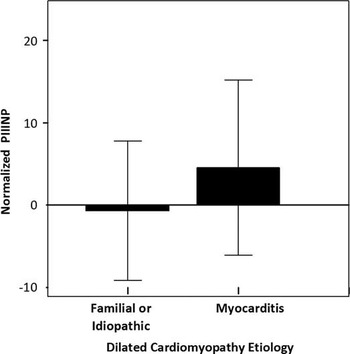
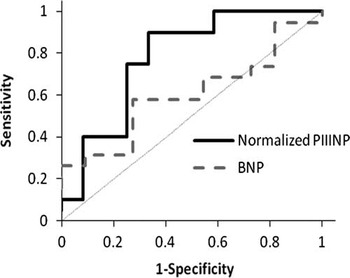
Both measured serum procollagen type III amino-terminal propeptide and normalised procollagen type III amino-terminal propeptide obtained at the time of study enrollment varied significantly in patients based on their underlying aetiology of dilated cardiomyopathy (procollagen type III amino-terminal propeptide p=0.007, normalised procollagen type III amino-terminal propeptide p=0.001). Patients with myocarditis (n=12, six biopsy proven, six by clinical criteria alone) had higher normalised procollagen type III amino-terminal propeptide values as compared with those with familial or idiopathic dilated cardiomyopathy (n=20) after adjusting for gender, age, medications, and time since diagnosis (myocarditis mean 4.5±5.3 versus familial/idiopathic dilated cardiomyopathy −0.71±4.2, p=0.0083) Fig 1). This difference was significant at the time of enrollment and on longitudinal multivariate analysis. On the basis of multivariate analysis of 119 serum samples from 30 patients over a mean follow-up time of 16.8±16.3 months, the higher the elevation of serum procollagen type III amino-terminal propeptide from expected normal value, the more likely was the diagnosis of myocarditis rather than idiopathic or familial dilated cardiomyopathy (p=0.018). Normalised procollagen type III amino-terminal propeptide had an area under curve of 0.78 (95% confidence interval 0.59–0.97) on receiver operating curve analysis to distinguish myocarditis from familial/idiopathic dilated cardiomyopathy (Fig 2). A normalised procollagen type III amino-terminal propeptide value of >1 had a sensitivity of 75% (95% confidence interval 43–95%), specificity of 75% (95% confidence interval 51–91%), positive predictive value of 64% (95% confidence interval 35–87%), and negative predictive value of 83% (95% confidence interval 59–96%) to identify myocarditis.
Patients with myocarditis (n=12) had higher normalised procollagen type III amino-terminal propeptide values as compared with those with familial or idiopathic dilated cardiomyopathy(n=20) after adjusting for gender, age, medications, and time since diagnosis (myocarditis mean 4.5±5.3 versus familial/idiopathic dilated cardiomyopathy −0.71±4.2, p=0.0083).

Procollagen Type III amino-terminal propeptide as a predictor of myocarditis as underlying aetiology of dilated cardiomyopathy. Receiver operating curve analysis for normalised procollagen type III amino-terminal propeptide compared with B-type natriuretic peptide. Area under curve: Normalised procollagen type III amino-terminal propeptide=0.78 (95% confidence interval 0.59–0.97). B-type natriuretic peptide (BNP)=0.60 (95% confidence interval 0.39–0.8); p=0.18.

Although the ability of procollagen type III amino-terminal propeptide to distinguish between myocarditis and dilated cardiomyopathy was not statistically superior than B-type natriuretic peptide measured at the same time as procollagen type III amino-terminal propeptide [area under curve of 0.78 (confidence interval 0.59–0.97) versus area under curve of 0.60, (confidence interval 0.39–0.81) p-value 0.18], both procollagen type III amino-terminal propeptide and normalised procollagen type III amino-terminal propeptide significantly varied between all four diagnostic groups on univariate analysis (p=0.007, 0.001 respectively), whereas B-type natriuretic peptide did not (p=0.997).
Discussion
Procollagen type III amino-terminal propeptide as a biomarker of cardiac remodelling in paediatric dilated cardiomyopathy
The primary finding of this prospective longitudinal study was that serum procollagen type III amino-terminal propeptide independently correlates with evidence of cardiac remodelling over time in children with dilated cardiomyopathy. This study represents a unique application of this biomarker of extracellular matrix turnover to paediatric cardiomyopathy. Serum procollagen type III amino-terminal propeptide, although characterised and utilised as a biomarker in children with diseases related to bone turnover and growth hormone therapy,Reference Crofton, Ahmed and Wade 17 – Reference Trivedi, Hindmarsh, Ristell, Ristell, Mowat and Brook 21 has not been previously described in children with dilated cardiomyopathy or heart failure of any aetiology.
The utility of procollagen type III amino-terminal propeptide with regard to correlation with indices of cardiac remodelling, clinical status, prognosis, and response to medical interventions has been demonstrated in several studies of cardiomyopathy and heart failure in adults.Reference Berry, Murphy and De Vito 7 – Reference Radauceanu, Ducki and Virion 9 , Reference Zannad, Dousset and Alla 11 , Reference Zannad, Alla, Dousset, Perez and Pitt 12 , Reference Struthers 15 , Reference Lin, Lin and Lo 16 , Reference Cicoira, Rossi and Bonapace 25 – Reference Zile, Desantis and Baicu 29 Regardless of the aetiology of dilated cardiomyopathy – ischaemic or idiopathic – serum procollagen type III amino-terminal propeptide levels were significantly higher in adults with dilated cardiomyopathy than in healthy controls and correlated with the amount of myocardial collagen type III detected on histologic examination of explanted hearts (r=0.8, p=0.001).Reference Klappacher, Franzen and Haab 14 Patients after myocardial infarction have also been found to have elevated serum procollagen type III amino-terminal propeptide levels, which correlate with cardiac collagen synthesis and the presence of chronic heart failure.Reference Hayashi, Tsutamoto and Wada 26 , Reference Poulsen, Host, Jensen and Egstrup 28 , Reference Hayashi, Tsutamoto and Wada 30
Findings in this study of children with dilated cardiomyopathy of diverse aetiologies and relationship of procollagen type III amino-terminal propeptide with cardiac remodelling were consistent with those of adults. The measured procollagen type III amino-terminal propeptide in the study population with dilated cardiomyopathy was higher than that of healthy children, though varied with age proportionally, as expected in a growing population. Procollagen type III amino-terminal propeptide increased with evidence of left ventricular dilation over time and decreased with improvement in systolic function. Despite a relatively small number of clinically significant events, procollagen type III amino-terminal propeptide was significantly increased in patients with a previous heart failure hospitalisation and in those who required mechanical circulatory support. These trends were all similar to those reported in larger studies of adults. Collagen deposition and extracellular matrix changes are important components of the pathophysiology of cardiac remodelling. The change in collagen deposition and correspondingly procollagen type III amino-terminal propeptide with age that is related to normal slowing of growth rate presents a challenge for studies of extracellular matrix turnover in children as compared with adults with cardiomyopathy. Nonetheless, whether multivariate analyses performed were controlled for age and gender, or normalised values were used, procollagen type III amino-terminal propeptide still correlated with left ventricular dilation and function on echocardiogram in our cohort. The lack of significant correlation of procollagen type III amino-terminal propeptide with magnetic resonance imaging measures of remodelling is most likely related to the relatively small number of magnetic resonance imaging studies (n=14 patients, 19 magnetic resonance imaging studies) performed for this analysis. The study protocol was powered based on echocardiographic measurements as the main outcome variables, as cardiac magnetic resonance imaging was not standard clinical practice for children presenting with heart failure or dilated cardiomyopathy in our institution at the time of the study. Recruitment into this arm of the study was therefore limited to patients who did not require sedation for the procedure.
Only one other published study has examined the role of extracellular matrix biomarkers in children with dilated cardiomyopathy. In a study of seven children with idiopathic dilated cardiomyopathy, Hsia et alReference Hsia, Ringewald and Stroud 31 studied plasma matrix metalloproteinase and tissue inhibitor of metalloproteinase profiles, markers related to extracellular matrix remodelling changes, and compared them with 26 normal children. Their study subjects were similar to our study population in that the majority were minimally symptomatic (71% NYHA Class II), and were a mean of 2.7±1.4 years from initial diagnosis. In contrast to our serial measurements of procollagen type III amino-terminal propeptide, blood samples were obtained at a single point in time and no correlation to clinical evidence of cardiac remodelling on echocardiograms or changes over time were investigated. Similar to our findings, they reported alterations in extracellular matrix remodelling pathways in children with dilated cardiomyopathy as compared with normal children.
B-type natriuretic peptide and procollagen type III amino-terminal propeptide
B-type natriuretic peptide, which reflects an acute and dynamic process related to neurohormonal status and acute loading of the ventricles, has long been used as a biomarker in both adults and children with heart failure. In contrast, procollagen type III amino-terminal propeptide is a component of the cardiac extracellular matrix and thus reflects the underlying pathophysiology of cardiac remodelling, directly related to the molecular state of the myocardium and progressive disease process.Reference Lijnen and Petrov 6 , Reference Radauceanu, Ducki and Virion 9 This is likely the explanation of the finding in this study of B-type natriuretic peptide and procollagen type III amino-terminal propeptide both correlating with changes on echocardiograms, but procollagen type III amino-terminal propeptide being better able to differentiate between the underlying diagnosis of patients with dilated cardiomyopathy, reflecting the chronic process of remodelling and extracellular matrix changes.
Procollagen type III amino-terminal propeptide may differentiate the aetiology of dilated cardiomyopathy
Procollagen type III amino-terminal propeptide was significantly higher than age- and gender-matched normals in patients with myocarditis than those with dilated cardiomyopathy of either idiopathic or familial aetiology. This is a unique and important finding of this study revealing potential diagnostic utility of procollagen type III amino-terminal propeptide in paediatric dilated cardiomyopathy.
In contrast to dilated cardiomyopathy in adults, the aetiology of dilated cardiomyopathy in children is quite heterogeneous and the consequent prognosis and clinical course frequently determined by the aetiology of left ventricular dysfunction. Often, acute myocarditis cannot be distinguished from chronic dilated cardiomyopathy at the time of presentation in congestive heart failure. If a biomarker can distinguish acute myocarditis from other aetiologies of dilated cardiomyopathy, then the need for an invasive myocardial biopsy with the associated risks of catheterisation and anesthesia may be obviated. Clinical management may also differ because of the increased likelihood for myocardial recovery in the setting of myocarditis compared with end-stage chronic dilated cardiomyopathy.Reference Foerster, Canter and Cinar 32 The potential of having other affected family members must be raised and genetic counselling performed in the case of familial or idiopathic dilated cardiomyopathy, which is much less likely with an isolated case of myocarditis. Therefore, procollagen type III amino-terminal propeptide as a non-invasive biomarker of myocarditis may have clinical utility on prognosis, clinical management, and family counselling.
Important potential confounders in the study of procollagen type III amino-terminal propeptide, such as age, gender, time from diagnosis, and medications such as angiotensin-converting enzyme inhibitors and aldosterone blockers that directly affect extracellular matrix turnover and may alter collagen deposition and procollagen type III amino-terminal propeptide, as demonstrated in previous studies of adults, were included in all multivariate analyses. There were no other systemic diseases to account for variability and no other significant differences between the myocarditis and dilated cardiomyopathy cohorts to explain this observation.
Limitations
This study was limited by the number of patients and variability in the stage of disease and time from presentation. Although this variable was included in multivariate analysis, this study was not powered to determine the utility of procollagen type III amino-terminal propeptide as a biomarker of acute congestive heart failure. The majority of the study population was non-acute NYHA Class I–II and therefore had infrequent adverse clinical events such as death and heart transplant, which limited the ability to correlate procollagen type III amino-terminal propeptide with these important outcomes. Heterogeneous aetiology of dilated cardiomyopathy, limited population size, and relative infrequency of adverse outcomes during the period of observation are challenges in all paediatric heart failure investigations. The inability to obtain cardiac magnetic resonance imaging for all study patients was anticipated during study design because of constrictions regarding the relative risk benefit assessment of sedating children with cardiac dysfunction for a research-related procedure. Therefore, the study was powered on the basis of echocardiographic variables, with a subgroup undergoing cardiac magnetic resonance imaging and procollagen type III amino-terminal propeptide analysis.
Study findings regarding association between procollagen type III amino-terminal propeptide and diagnosis of myocarditis are limited by the relatively small number of patients in this cohort. Owing to the fact that it was not standard of care to obtain myocardial biopsies on all patients with a high clinical suspicion for myocarditis, 50% had a clinical diagnosis of myocarditis, whereas the others had myocarditis diagnosed on biopsy. These findings should be validated with a prospective study sampling procollagen type III amino-terminal propeptide at the time of presentation for all children presenting with new-onset heart failure and then correlated with biopsy or other diagnostic testing.
Summary
In this prospective longitudinal study, serum procollagen type III amino-terminal propeptide increased with evidence of left ventricular dilation over time and decreased with improvement in systolic function in children with dilated cardiomyopathy. A unique finding was the potential diagnostic role of serum procollagen type III amino-terminal propeptide to distinguish between myocarditis and dilated cardiomyopathy revealed by subgroup analysis. The findings of this pilot study demonstrates proof of concept that procollagen type III amino-terminal propeptide may have clinical utility as a biomarker of cardiac remodelling in paediatric dilated cardiomyopathy and warrants further investigation to validate these findings.
Acknowledgements
The authors thank Shiv Kapoor, Ph.D., Penn Technical Director, Biochemistry Core Lab, Institute for Translational Medicine and Therapeutics, Perelman School of Medicine, University of Pennsylvania, for performing PIIINP radioimmunoassays. Radioimmunoassay kits for PIIINP were donated by Orion Diagnostica, OY Espoo, Finland.
Financial Support
This study was funded by the Clinical & Translational Research Center grant number UL1-RR-024134 and the Children’s Hospital of Philadelphia Cardiac Center Research Grant programme.
Conflicts of Interest
None.
Ethical Standards
The authors assert that all procedures contributing to this work comply with the ethical standards of the relevant national guidelines on human experimentation and with the Helsinki Declaration of 1975, as revised in 2008, and has been approved by The Children’s Hospital of Philadelphia Institutional Review Board. Informed consent for all subjects was obtained.