Various treatment options for pulmonary hypertension have emerged in recent years. In adults, evidence-based treatment strategies leading to improved quality of life and survival have been introduced.Reference Oudiz, Galie and Olschewski 1 – Reference Hoeper, Markevych and Spiekerkoetter 3 In children with pulmonary vascular disease, however, the efficacy of these treatments is insufficiently known. Smaller open-label or postmarketing studies are certainly available,Reference Barst, Ivy and Dingemanse 4 – Reference Humpl, Reyes and Holtby 6 but randomised controlled trials in children are virtually non-existent. Only one larger trial in paediatric pulmonary arterial hypertension has been completed – using sildenafil – with inconclusive results.Reference Barst, Ivy and Gaitan 7
Despite similarities, pulmonary vascular disease in children differs from adults in several aspects. In adults, mostly idiopathic pulmonary arterial hypertension, hereditary pulmonary arterial hypertension, pulmonary arterial hypertension related to drugs and toxins, and pulmonary arterial hypertension related to connective tissue disease are prevalent. In children, the epidemiology is different as associated conditions primarily include pulmonary arterial hypertension related to CHD, pulmonary developmental, maladaptive diseases, and other co-morbidities.Reference Cerro, Abman and Diaz 8 – Reference del Cerro Marin, Sabaté Rotés and Rodriguez Ogando 10
Notwithstanding the lack of evidence for efficacy of pulmonary hypertension-targeted drugs in children, these drugs are currently widely used in children, and current paediatric cohort studies suggest improved survival in the era of pulmonary hypertension-targeted therapies.
Treatment choices and strategies used in children are not sufficiently defined, and until very recently there were no guidelines for children.Reference Ivy, Abman and Barst 11 Optimal dosing and possible toxicity are unknown and leaves the paediatric population understudied. In the absence of evidence, recently paediatric treatment goals and treatment suggestions have been proposed; 12 , Reference Tissot, Ivy and Beghetti 13 however, treatment choices are influenced by experiences of individual centres, the availability and approval status of pulmonary hypertension-targeted therapies, and economical conditions, which obviously vary in different countries. Current treatment patterns and choices in paediatric pulmonary hypertension are insufficiently known.
The Tracking Outcomes and Practice in Pediatric Pulmonary Hypertension registry, a worldwide, observational study in children with different forms of pulmonary hypertension, collected data on contemporary treatments in these children.Reference Berger, Beghetti and Humpl 9 This study aimed to describe real-world initial treatment choices in different age groups, aetiologies, and clinical conditions of paediatric pulmonary hypertension from a global perspective.
Methods
Tracking Outcomes and Practice in Pediatric Pulmonary Hypertension registry design
The design of the Tracking Outcomes and Practice in Pediatric Pulmonary Hypertension registry has been previously reported.Reference Berger, Beghetti and Humpl 9 In brief, patients in Venice Group 1, 3, 4, or 5,Reference Simonneau, Galie and Rubin 14 between 3 months and 18 years of age at the time of diagnostic right heart catheterisation, and patients diagnosed with pulmonary hypertension on or after January, 2001, either newly diagnosed – incident or diagnostic right heart catheterisation within 3 months of enrolment – or previously diagnosed – prevalent or diagnostic right heart catheterisation more than 3 months before enrolment – were eligible.
To minimise selection bias, all sites screened consecutive patients presenting with suspected or confirmed pulmonary hypertension. Patients with corrected CHD who had persistent pulmonary hypertension in the absence of residual obstruction – that is, mean pulmonary capillary wedge pressure ⩽12 mmHg – confirmed by right heart catheterisation at ⩾1 year after repair were also eligible and were included in Venice Group 1. The study did not include classically defined Venice Group 2 – that is, pulmonary venous hypertension regardless of pulmonary vascular resistance – as treatment for these patients is directed towards relieving left-sided heart disease as opposed to reducing pulmonary vascular resistance.
Pulmonary hypertension was confirmed by right heart catheterisation – defined as mean pulmonary arterial pressure ⩾25 mmHg at rest, pulmonary vascular resistance index ⩾3 Wood units×m2, and mean pulmonary capillary wedge pressure ⩽12 mmHg. Consistent with real-world practice, if right heart catheterisation was unavailable or not performed for clinical reasons, patients were included on the basis of their echocardiography or histopathology or if anonymised, independent review by the Executive Board validated the diagnosis and agreed with why the right heart catheterisation was not performed.
The registry was initiated in January, 2008, and at the time of data cut-off 31 centres from 19 countries in four continents were included. The Venice ClassificationReference Simonneau, Galie and Rubin 14 was used, as this was the most current published classification for pulmonary hypertension at the time of study design and start of enrolment.
Treatment for patients was initiated according to the decision of their local physicians. Patients in clinical trials were eligible.
The study was designed and supervised by the Executive Board of the Pediatric Pulmonary Hypertension Association. Data management and analyses were performed by a contract organisation working with the Executive Board. The Executive Board wrote the manuscript and made the decision to submit for publication. All authors contributed to the writing or reviewing of the manuscript and had full access to data and analyses. The Executive Board vouches for the accuracy and completeness of this report.
The study was approved by local Ethics Boards, and patients/guardians consented to data collection.
Study population
For the purpose of the present study, only incident patients – diagnosed after January, 2008 – were analysed in order to minimise bias related to retrospective data collection and drug availability. The data cut-off point for the current analysis was February, 2012.
Treatment
Treatment options were defined as “supportive therapy” and “pulmonary hypertension targeted therapy” (Table 1) and relate to the first treatment initiation during the diagnostic window. In addition, a distinction was made between “treatment started prior to diagnostic right heart catheterization” and “treatment started at diagnosis” – that is, start of therapy within a time window of 4 weeks after diagnostic right heart catheterisation.
Medical treatment options for pulmonary hypertension.

ACE=angiotensin-converting enzyme
Subgroup analyses were performed for therapy initiated in treatment-naïve patients in the following subgroups:
-
∙ Age groups (3 to <24 months, 2 to <6 years, 6 to <12 years, and 12 to <18 years)
-
∙ Pulmonary hypertension aetiology according to Venice Groups
-
∙ NYHA functional class
-
∙ Response to acute vasodilatory testing
Statistical methods and analysis
Continuous data are summarised using standard descriptive statistics, including means, standard deviations, and medians, minimum, maximum, and 25th and 75th percentiles, where appropriate. Categorical data are summarised using counts and percentages. The denominator for percentages was the total number of patients with non-missing data for each parameter analysed. Differences in percentage of patients receiving a treatment between subgroups were tested using Fisher’s exact test for heterogeneity. In the case of ordered subgroups – age and NYHA Functional Class – a χ2 test for trend was also performed. Analyses were calculated using SAS statistical software package (version 8.2 or higher; SAS, Cary, North Carolina, United States of America).
Results
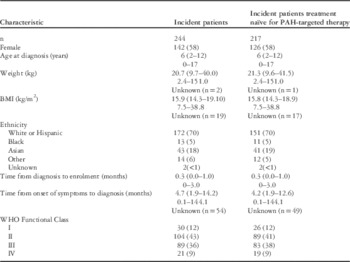
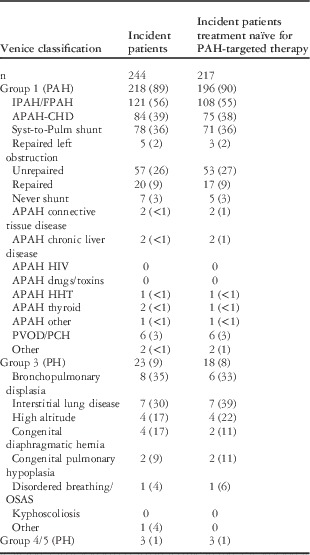
A total of 568 patients were enrolled in Tracking Outcomes and Practice in Pediatric Pulmonary Hypertension between January, 2008 and February, 2012. Of these, 244 were incident cases, and their patient characteristics and distribution according to the Venice Classification are presented in Tables 2 and 3. As there were only three patients in Groups 4 and 5, data for these Groups are shown in relevant tables but not discussed in the manuscript.
Patient characteristics

BMI=body mass index; PAH=pulmonary arterial hypertension; WHO=World Health Organisation
Summaries of classification variables are frequency (% of n). Summaries of numeric variables are medians (inter-quartile range) and minimum–maximum.
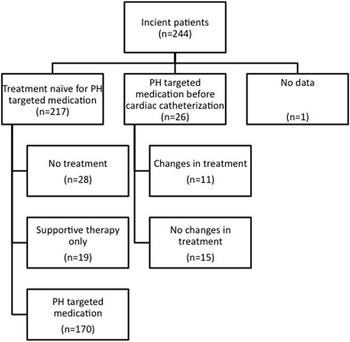
Figure 1 provides an overview of the utilisation of the different supportive and pulmonary hypertension-targeted therapies.
Utilization of supportive and pulmonary hypertension-targeted therapies.

At diagnostic right heart catheterisation, 217 out of 244 patients (88.9%) were treatment naïve for pulmonary hypertension-targeted therapy. Pulmonary hypertension-targeted therapy was initiated after right heart catheterisation in 170 (78.3%) treatment-naïve patients. A total of 19 patients were started on supportive therapy only – one patient (5.3%) in NYHA Functional Class I, six patients in NYHA Functional Class II (31.6%), eight patients NYHA Functional Class III (42.1%), and four patients (21.1%) in NYHA Functional Class IV. Regarding aetiology, 11 patients (57.9%) were diagnosed with associated pulmonary arterial hypertension, CHD, seven (36.8%) with idiopathic or familial pulmonary arterial hypertension, and one patient (5.3%) belonged to Venice Group 3.
In all, 28 patients were not started on any therapy. The majority of patients (n=12, 42.9%) were diagnosed with associated pulmonary arterial hypertension, CHD, followed by patients with idiopathic or familial pulmonary arterial hypertension (n=10, 35.7%), five patients (17.9%) belonged to Venice Group 3, and one patient (3.5%) to Venice Group 5.
A total of seven patients were in NYHA Functional Class I, 10 patients in NYHA Functional Class II, eight patients in NYHA Functional Class III, and three patients in NYHA Functional Class IV.
Only four patients with idiopathic pulmonary arterial hypertension and two patients with associated pulmonary arterial hypertension – not related to CHD – were included without right heart catheterisation.
Of 244 patients, 26 (10.9%) received pulmonary hypertension-targeted treatment before diagnostic right heart catheterisation. In 10 of these patients (38.5%), this treatment was changed after right heart catheterisation by the treating physician (Tables 3 and 4). In nine patients (34.6%), treatment was escalated by adding another type of pulmonary hypertension-targeted medication; in one patient the drug was changed to a different class of drug. No data were available for one patient (Fig 2).
Treatment status for complete cohort.

Distribution of patients according to Venice classification.

APAH = associated pulmonary arterial hypertension; FPAH = familial pulmonary arterial hypertension; HHT = hereditary hemorrhagic telangiectasia; IPAH = idiopathic pulmonary arterial hypertension; OSAS = obstructive sleep apnea syndrome; PAH=pulmonary arterial hypertension; PCH = pulmonary capillary hemangiomatosis; PH=pulmonary hypertension; PVOD = pulmonary veno-occlusive disease
Summaries of group classifications are frequencies (% of n), and summaries of subgroup classifications are frequencies (% of Group n)
In the majority of treatment-naïve patients (112/217, 51.6%), treatment was initiated with one pulmonary hypertension-targeted drug, monotherapy; in 39 patients (18.0%), treatment was initiated using dual therapy, and in five patients (2.3%) this was done using triple-therapy. Calcium channel blockers with one other pulmonary hypertension-targeted medication were prescribed for only one patient (0.5%) in the overall cohort, and not at all for patients on dual- or triple-therapy (Tables 4 and 5).
Modification of treatment for patients on targeted therapy before right heart catheterisation (n=26).

CCB=calcium channel blockers; PDE=phosphodiesterase; PH=pulmonary hypertension
Initiated therapies stratified according to the Venice Classification are shown in Tables 5 and 6: 73% of patients in Venice Group 1 versus 55.6% of children in Venice Group 3 received pulmonary hypertension-targeted therapy, although the difference across all subgroups was not statistically significant (p=0.23; Table 6). Of note, there was no patient on continuous oxygen in Venice Group 3.
Treatment modality.

PH=pulmonary hypertension
* P-value from χ2 trend test
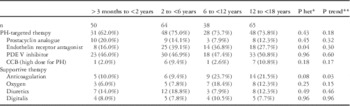
When stratified for age category, pulmonary hypertension-targeted therapy was less used in the younger age group (62.0%), whereas a comparable pattern with a slightly higher use was observed within the other age groups (p=0.43), but not reaching significance. Endothelin receptor antagonist use was significantly different across age groups (p=0.04). Endothelin receptor antagonists were less used in children under 2 years of age, whereas there was a non-significant trend to use calcium channel blockers in high dose for pulmonary hypertension in older children. With respect to supportive treatment, anticoagulation is less used in younger compared with patients over 6 years of age (p=0.03) and also oxygen seems to be more utilised in older children (p=0.15), digitalis appears in about 8–10%, and slightly more frequently used are diuretics (Tables 6 and 7).
Targeted and supportive therapy by aetiology.

CCB=calcium channel blockers; PDE=phosphodiesterase; PH=pulmonary hypertension
* P-value from Fisher’s exact test for heterogeneity. Venice Groups 4 and 5 were combined for testing
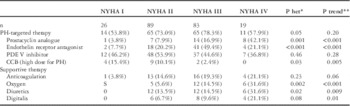
When stratified for NYHA Functional Class, pulmonary hypertension-targeted therapy was used in the majority of children in all NYHA Functional Class (Tables 7 and 8). Prostacyclin and its analogues were more frequently used in higher NYHA Functional Classes (p<0.001). In contrast, phosphdiesterase type 5 inhibitors were used more frequently in NYHA Functional Class I and II compared with NYHA III and IV (p=0.46), although not significantly. Supportive therapies, oxygen, digitalis, and anticoagulation were used more frequently with increasing NYHA Functional Class (p<0.06).
Targeted and supportive therapy by age.

CCB=calcium channel blockers; PDE=phosphodiesterase; PH=pulmonary hypertension
* P-value from Fisher’s exact test for heterogeneity
** P-value from χ2 trend test
When stratified for response to acute pulmonary vasodilator testing, patients without positive response to acute vasodilatory testing were less frequently treated with high-dose calcium channel blockers (p<0.001); however, only 14 of 72 patients regarded as responders to acute vasodilatory testing were treated by calcium channel blockers, with high dose for pulmonary hypertension. More non-responders than responders were treated with pulmonary hypertension-targeted therapies other than calcium channel blockers (Tables 8 and 9). A higher number of patients with a negative response to acute vasodilatory testing were on supportive therapy (p=0.04).
Targeted and supportive therapy by functional class.

CCB=calcium channel blockers; PDE=phosphodiesterase; PH=pulmonary hypertension
* P-value from Fisher’s exact test for heterogeneity
** P-value from χ2 trend test
There seems to be a trend over the more recent years to initiate therapy more often in the form of combination therapy (Table 4).
A total of eight (3.3%) patients were enrolled in clinical trials at diagnosis.
Discussion
This is the first report on treatment initiation for pulmonary hypertension in children encompassing dedicated pulmonary hypertension centres from around the world. Although there was no specified treatment protocol, the data suggest that pulmonary hypertension-targeted drugs are used in high frequency in children with pulmonary hypertension, whereas supportive therapy is used to a lesser account. Regarding patients in Venice Group 1, 73.0% received pulmonary hypertension-targeted medication after diagnostic right heart catheterisation and 55.6% of patients in Venice Group 3. Only a small number of patients (11.1%) were already treated with pulmonary hypertension-targeted medication before diagnostic right heart catheterisation. Approximately 13% of patients with the diagnosis of pulmonary hypertension did not receive treatment for the disease at all.
The most commonly used drugs are phosphodiesterase inhibitors type 5 within a 4-week window after confirmation of diagnosis by right heart catheterisation, yet there are regional differences across continents, despite availability of all therapeutic categories in the respective areas.
Roughly one-third of the patients (26.9% dual therapy, 1.8% with triple therapy) were started upfront with combination therapy at diagnosis, whereas 67.1% were commenced on one pulmonary hypertension-targeted drug. No larger outcome studies are available for children, but this approach has been used in adult patients in the BREATHE-2 trial with non-conclusive results,Reference Humbert, Barst and Robbins 15 where patients have been commenced on intravenous epoprostenol and after 2 days were randomised to add-on bosentan or placebo. More recently, an initial combination therapy in sicker adult patients showed improvement in Functional Class, exercise capacity, and haemodynamics.Reference Kemp, Savale and O’Callaghan 16 A different algorithm is followed with “goal-oriented” treatment and combination therapy.Reference Hoeper, Markevych and Spiekerkoetter 3 Interestingly, there is a trend towards more combination therapy over the past few years, embarking upon three key pathways involved in the pathophysiology of pulmonary hypertension; however, for the purpose of analysis regarding initiation, the focus of this report was not on assessment of outcomes.
Barst et alReference Barst, McGoon and Elliott 17 recently reported data from the REVEAL registry, but this study included only Venice Group 1 patients and pulmonary hypertension centres from the United States of America. It may be related to different methodology, but there is a considerable discrepancy when comparing the REVEAL data with the present data set: prostacyclin analogues were used in 42.2% in REVEAL compared with only 14.8% in Tracking Outcomes and Practice in Pediatric Pulmonary Hypertension Venice Group 1, endothelin receptor antagonists in 42.7 versus 32.1.%, phosphodiesterase inhibitors type 5 in 57.4 versus 47.4%, and calcium channel blockers at a higher dosage for pulmonary hypertension in 20.4 versus 6.6%. Overall, 95% of the patients were treated with pulmonary hypertension-targeted therapy, which represents a higher treatment rate compared with our patient cohort, but may be related to inclusion criteria.
According to data from the Tracking Outcomes and Practice in Pediatric Pulmonary Hypertension registry, interestingly none of the patients diagnosed with pulmonary hypertension associated with lung diseases and/or hypoxaemia (Venice Group 3) received oxygen shortly after diagnosis. More than half of the patients in this group were started on pulmonary hypertension-targeted medication, and again in half with phosphodiesterase inhibitors type 5, along with calcium channel blockers, endothelin receptor antagonists, and prostacyclins without evidence provided in the literature that these drug classes are indicated in this patient population. To what extent the younger age at diagnosis of patients in Venice Group 3 plays a significant role in therapy initiation needs further study.
More than two-thirds of patients in NYHA Functional Class I and II are treated with pulmonary hypertension-targeted therapy, which suggests overall relative easy access to the drugs.
Of note, calcium channel blockers – high dose for pulmonary hypertension – were prescribed for 15 patients (6.9%), either as mono or combination therapy, more frequently used in patients with NYHA Functional Class I and II, and may be switched to other pulmonary hypertension-targeted therapy with progression of disease or loss of acute vasoreactivity. Calcium channel blockers are clearly not indicated in patients with overt right heart failure given their possible negative inotropic effect.
Digoxin has shown a mild increase in cardiac output and a reduction in circulating norepinephrine in adult patients with pulmonary hypertension and right heart failure,Reference Rich, Seidlitz and Dodin 18 but overall the role of cardiac glycosides in pulmonary hypertension remains controversial. Digoxin was prescribed more in NYHA Functional Class III and IV, assuming that these patients show more frequently signs of right ventricular failure. Larger, long-term studies are needed to better define its role in children.
Data supporting the use of anticoagulation in children with pulmonary hypertension are sparse, and the overall risk–benefit especially for infants and toddlers remains uncertain. This may reflect that anticoagulation is only used in the minority of patients in Tracking Outcomes and Practice in Pediatric Pulmonary Hypertension. Anticoagulation is indicated by consensus in overt right heart failureReference Galie, Hoeper and Humbert 19 and in chronic thromboembolic pulmonary hypertension, which is rare and/or under-diagnosed in children. Previous reportsReference Fuster, Steele and Edwards 20 and more recent evidence suggest that the use of anticoagulation is associated with a survival benefit in adult patients with idiopathic pulmonary arterial hypertension, but less apparent for other forms of pulmonary arterial hypertension;Reference Fuster, Steele and Edwards 20 , Reference Olsson, Delcroix and Ghofrani 21 however, it remains unclear how these findings can be translated to children.
As individual compounds from each therapeutic pathway were accessible for all centres, the complete spectrum of pulmonary hypertension-targeted drugs is not available everywhere in the world, thus the results of this study reflect the different approaches worldwide. As pulmonary hypertension classifies as an orphan disease, individual access to pulmonary hypertension-targeted drugs despite general availability is not guaranteed as reimbursement or co-payment vary across countries. Blankert et alReference Blankart, Stargardt and Schreyogg 22 indicated high between-country variations in authorised indications for pulmonary hypertension-targeted drugs compared with other orphan drugs. Drug prices are also different, with the United States of America and Germany at the higher price level and countries with centralised price control or commissioning mechanism – for example, Australia, Canada, England – at the lower price level.Reference Blankart, Stargardt and Schreyogg 22 In addition, trial activity and influence by pharmaceutical companies may impact on individual physician decisions on specific treatment to some extent. The recent warning against the use of sildenafil in children with pulmonary hypertension launched by the United States Food and Drug administration on 30 August, 2012 23 and the subsequent modification on 31 March, 2014 24 did not influence the data presented here, as the data cut-off happened earlier.
The less frequent use of endothelin receptor antagonists in younger children may be related to the absence of adequate dosage recommendation and availability of appropriate dosage forms in several parts of the world.
It needs to be highlighted that any delay of initiation of appropriate treatment in children with diagnosed pulmonary hypertension is inadequate. Very recent guidelinesReference Ivy, Abman and Barst 11 clearly suggest the use of calcium channel blockers in vasoreactive patients and prostacyclin derivatives for the sicker adult patient with pulmonary artrial hypertension, especially at presentation. Further studies are required to understand the impact of dual or triple therapy immediately after diagnosis compared with a more step-wise adding drug approach for all forms of pulmonary hypertension.
Outcome on different treatment modalities was not studied in this analysis and will be looked at separately.
Limitations of these data include the pure observational, non-interventional nature of the study, but, in contrast, the results mirror for the first time initial treatment choices in different age groups, aetiologies, and clinical conditions of paediatric pulmonary hypertension from a global perspective.
In conclusion, the results of this observational study show a diverse approach to treatment in children with pulmonary hypertension – for example, not all patients diagnosed with pulmonary hypertension undergo treatment within 4 weeks of diagnostic right heart catheterisation – and a relatively high use of pulmonary hypertension-targeted drugs in Venice Group 3 patients. This underlines the need of better-defined treatment algorithms for children with pulmonary hypertension based on paediatric consensus for different aetiologies and including the best possible diagnostic workup to achieve this goal (Table 9).Reference Ivy, Abman and Barst 11 , Reference Beghetti, Berger and Schulze-Neick 25
Targeted and supportive therapy by response to acute vasoreactivity testing.

CCB=calcium channel blockers; PDE=phosphodiesterase; PH=pulmonary hypertension
* P-value from Fisher’s exact test
Acknowledgements
Robyn J. Barst (College of Physicians and Surgeons, Columbia University, New York, United States of America) has significantly contributed to the blueprint of the registry and initial data analysis, but he died in 2013. The authors thank Katherine Hutchinson, Jeremy Wheeler, and Emily Wood, Quanticate UK, for statistical analysis and Rita Locher, Project Manager, for continuous organisational support.
Financial Support
The Tracking Outcomes and Practice in Pediatric Pulmonary Hypertension registry is supported by a research grant from Actelion Pharmaceuticals Ltd. Actelion does not participate in the management of the Registry, nor does it have access to the database, the individual sites, and patient data. All decisions related to the Registry lie solely with the Executive Board Association for Pediatric Pulmonary Hypertension. Dr Humpl has served as an advisory board member for Actelion Pharmaceuticals Ltd. and participated in a clinical trial with Eli-Lilly. Dr Berger reports that his institution (UMCG) received fees for Dr Berger’s advisory board activities from Actelion, Pfizer, GSK, Lilly, Novartis, and Bayer. Dr Austin and Dr Fasnacht Boillat have nothing to declare. Dr Bonnet has received fees for consulting from Actelion, Eli-Lilly, and Bayer. The M3C Necker Hospital has received fees for consultancy activities of Dr Bonnet for Actelion, Pfizer, GSK, Lilly, and Bayer. Dr Ivy: The University of Colorado contracts with Actelion, Bayer, Gilead, Lilly, and United Therapeutics for Dr. Ivy to be a consultant. Dr Zuk has been an investigator in clinical trials sponsored by Pfizer and Actelion and is now involved in clinical trials with Eli-Lilly and Bayer-Schering and has attended scientific conferences sponsored by Actelion. Dr Beghetti has served as a consultant or advisory board member for Actelion Pharmaceuticals Ltd, Bayer, Eli-Lilly and Co., GlaxoSmithKline, Novartis, and Pfizer; he has received research grants from Actelion Pharmaceuticals Ltd and Bayer HealthCare, lecture fees from Actelion Pharmaceuticals Ltd, Bayer HealthCare, and Pfizer, and has developed educational material for Actelion Pharmaceuticals Ltd and Pfizer.
Conflicts of Interest
None.
Ethical Standards
The authors assert that all procedures contributing to this work comply with the ethical standards of the local national guidelines on human experimentation and with the Helsinki Declaration of 1975, as revised in 2008, and has been approved by the local institutional committees.