

Introduction
Managing risks is a particularly complex problem for governments because there is little agreement about the magnitude of risks or the costs of strategies for mitigation. Whether risks stem from technologies, social practices or financial markets, heterogeneous risk perceptions carry important challenges for policy makers. Excessive regulation can prevent or delay the adoption of useful technologies and can also, in the case of economic or social risks, demonize marginalized populations or create massive costs. Thus it is imperative that we understand the dynamics of risk perception in order to settle on the most effective risk management practices.
One theory of variable risk perception that has produced important empirical insights across domains and in different countries is the cultural theory (CT) of risk. This theory, rooted in Mary Douglas's anthropological studies, posits that there are a fixed number of ways of cooperating together. Organizations, be they small- or large-scale, can be distinguished in terms of the extent to which they operate with strict rules about proper roles for members and by the extent to which they maintain a strong boundary with the external world. Groups that are high on the grid dimension are regimented and hierarchical with clear role delineations, while groups that are low on the grid dimension are flatly organized and egalitarian. Groups that are high on the group dimension limit individual autonomy for decision making, while groups that are low on the group dimension offer individuals a great deal of autonomy. The intersection of these two dimensions gives rise to four clearly delineated ways of life: hierarchy (high grid, high group), egalitarianism (low grid, high group), individualism (low grid, low group) and fatalism (high grid, low group).
Beginning with Wildavsky and Dake (Reference Wildavsky and Dake1990) and Dake (Reference Dake1991,Reference Dake1992) and continuing more recently with research conducted in the United States (Jones, Reference Jones2011; Ripberger et al., Reference Ripberger, Jenkins-Smith and Herron2011), Canada (Krewski et al., Reference Krewski, Slovic, Bartlett and Flynn1995), Norway (Oltedal and Rundmo, Reference Oltedal and Rundmo2007) and cross-nationally (Carriere and Scruggs, Reference Carrière and Scruggs2001), scholars have applied and tested CT using cross-sectional survey data. These authors have developed four separate scales of questions to measure the extent to which a respondent affiliates with each of the four cultural types.Footnote 1 This approach distinguishes between the actual interpersonal relationships that make up institutions such as markets, hierarchies and egalitarian organizations (social relations) and the beliefs about forms of organization that are shared by citizens (cultural biases). The latter are separate from the former, but—crucially—they are also functional to them, in that they sustain the forms of the social relations to which they are related. “Cultural biases are defined as shared beliefs and values that justify different ways of behaving—that is as worldviews that correspond to different patterns of social relations” (Dake, Reference Dake1992).
There have been several attempts to apply survey questions derived from CT in Canada. In 1995, Krewski et al. (Reference Krewski, Slovic, Bartlett and Flynn1995) applied variations of Dake and Wildavsky's initial survey questions to measure the four different cultural biases. More recently, Dragojlovic and Einsiedel (Reference Dragojlovic and Einsiedel2014), Lachapelle et al. (Reference Lachapelle, Montpetit and Gauvin2014) and Perrella and Kiss (Reference Perrella and Kiss2015) applied a variant of CT, cultural cognition theory (CCT) (Kahan et al., Reference Kahan, Jenkins-Smith and Braman2011), which conceptualizes group and grid affiliation as constituting two distinct continuous and underlying predispositions. Thus, rather than adhering to one of four different cultural biases, individuals possess predispositions on the grid and group latent variables, leading to one possible position for each respondent in two-dimensional space. Kahan's battery of questions has been used to explain a wide variety of social phenomena in the field of risk perception and public opinion, including how people interpret scientific consensus (Kahan et al., Reference Kahan, Jenkins-Smith and Braman2011), the risk perception of nanotechnologies (Kahan et al., Reference Kahan, Braman, Slovic and Gastil2009) and HPV vaccines (Kahan et al., Reference Kahan, Braman, Cohen, Gastil and Slovic2010).
We argue that analyzing Canadian public opinion, particularly as it relates to risk perception, through the lens of CT can offer insights that improve on existing approaches to public opinion in Canada. The analysis proceeds as follows. First, we summarize two dominant approaches to studying mass public opinion in Canada—namely, regionalism and ideology, and describe their limitations. Second, we describe our methodology used to operationalize CT in a Canadian context and provide evidence that justifies the validity of our measures. Third, we present a series of ordinary least squares (OLS) models that test whether cultural biases predict variation in risk perception, while controlling for measures of left-right ideology and regional political culture. Finally, we present the results of a survey experiment that demonstrate the importance of cultural biases over regional economic self-interest in shaping risk perceptions of oil pipelines.
We are not arguing that ideology and regional political culture have no effect on people's risk perceptions. Rather, we argue that culture—or cultural bias as conceptualized by CT—shapes citizens’ attitudes, particularly perceptions of risk, independent of standard measures of left-right ideology and regional political culture.
Region and Ideology in Canadian Public Opinion
Although there is a long tradition of comparisons between the political cultures of Canada and the United States (Lipset, Reference Lipset1964, Reference Lipset1986, Reference Lipset1990; Adams, Reference Adams2003; Grabb and Curtis, Reference Grabb and Curtis1988; Crawford and Curtis, Reference Crawford and Curtis1979; Baer and Curtis, Reference Baer and Curtis1984), CT has rarely been applied to the Canadian context. Instead, scholars of mass opinion have drawn on other theoretical explanations to explain Canadian attitudes. Two common explanations emphasize the role of regional political culture and of ideology. Both schools of thought paint very different pictures of the nature of Canadian politics.
As a country with a party system that formed prior to industrialization but where religious, linguistic and geographic divisions were present at its founding, Canada has historically been seen as a country with minimal class (and hence minimal left-right ideological voting) (Lijphart, Reference Lijphart1979; Clarke, Reference Clarke1984). One reason for limited class conflict was the development of relatively distinct regional political economies across the country. Many have argued that the interaction between local resource endowment, class structure and geography has produced long traditions of vastly different political systems and economic development strategies across Canadian regions (Richards and Pratt, Reference Richards and Pratt1979; Brodie, Reference Brodie1990). This has led to a tradition of brokerage politics, where the federal government has been called on to distribute national largesse evenly across regions to address the uneven development of the country. Voters, it is argued, vote not on the basis of individual self-interest but on what they perceive to be good for their province or region.
In addition, much of the work on Canadian regional politics has emphasized the different regional political cultures that exist, which are attributed by some to the historical nationalities of the first colonial settlers who established jurisdictional boundaries and regional (that is, provincial) governments (Wiseman, Reference Wiseman1981, Reference Wiseman2007). In this vein, a first tradition locates Canadian and American political culture in the “fragments” of people who founded each country. Thus, differences in the composition of settlers across the Canada–U.S. border have been identified as crucial to the emergence of two distinct political cultures (Lipset, Reference Lipset1990). Puritan settlers founded the United States in a Lockean moment of social contract to protect individual property rights. This fragment imparted core assumptions into American political culture, which presented a formidable barrier to socialism in the wake of the industrial revolution. By contrast, the loyalists who migrated to Canada after the American Revolution brought with them a belief in the importance of deference to established state authority. When later British settlers emigrated in the wake of the industrial revolution, this dominant Burkean belief intermingled with a feudal, agricultural and Catholic society in French Canada. What was crucially important was that these ideologies were both opposed to Lockean contract liberalism, making Canada more amenable to socialist ideas brought by later British settlers during the industrial revolution. These trends help to explain policies in Canada such as its embrace of multiculturalism, union density, publicly funded universal health care (Lipset, Reference Lipset1990), stricter gun laws (Taylor, Reference Taylor1991) and state-owned broadcasting (Raboy, Reference Raboy1990). Later, Wiseman extended this “fragment theory” to account for variations in public policy at the subnational level (Wiseman, Reference Wiseman1981), particularly on the prairies. For example, he showed there were more Americans who settled Alberta than the other prairie provinces. Supposedly, this populist and individualistic fragment in Alberta helped to explain that province's history of business-friendly governments and hostility to social democracy.
Recently, however, many scholars have observed the increasing importance of a left-right division in Canadian politics (Carroll and Shaw, Reference Carroll and Shaw2001; Carroll and Little, Reference Carroll and Little2001; McBride, Reference McBride2005). This has especially been the case since the 1980s, as the postwar Keynesian welfare state consensus dissolved and governments at provincial and federal levels sought to implement a new approach to governing, using market-based policies and shifting away from universalism and government management of the business cycle. One analysis of the election platforms published by Canadian political parties shows that the dominant liberal and conservative parties traded space in the centre through much of the post–World War II period. However, in the 1980s, the Progressive Conservative party veered sharply to the right (Cochrane, Reference Cochrane2015: 154). This left-right distinction—often measured in public opinion surveys by asking respondents to place themselves on a left-right scale—remains a common measure to assess the role that ideology plays in structuring attitudes. For example, Noel et al. (Reference Noël, Thérien and Dallaire2004) found a strong correlation between Canadians’ left-right self-placement, their partisan identification and their support for international development. More recently Bell et al. (Reference Bell, Schermer and Vernon2009) used this single measure of ideology in a Canadian twin study of the heritability of attitudes and found that self-reported ideology was highly correlated with environmental attitudes.
Each of these approaches has important limitations. For example, while fragment theory helps explain some of the regional variation observed in Canadian subregional cultures, it has difficulty explaining dramatic swings in public policy within a province. For example, Quebec evolved very quickly from an authoritarian and religious society to one that is egalitarian and secular, yet it was built from the same fragment (McRoberts and Posgate, Reference McRoberts and Posgate1983). The key to this transition was that the feudal, Catholic fragment in Quebec society shared a hostility to liberal individualism, with egalitarianism enabling a transition to social democracy (Wiseman, Reference Wiseman2007: 176). While it might be argued that historical events such as the French Revolution serve as a symbolic resource in an egalitarian political project, this too is unconvincing. After all, immediately after the French Revolution, the Catholic Church in Quebec eagerly proscribed revolutionary literature to prevent the spread of egalitarian ideas (Lamonde, Reference Lamonde2000). Alberta also presents a challenge to fragment theory's explanations of regional policy differences. The early American settlement of Alberta is supposed to have led to a profoundly individualistic and frontier mentality. Yet the province was the first to overthrow the traditional Canadian party system, adopting a version of guild socialism under the United Farmers of Alberta in 1921 before veering to a series of business-friendly technocratic governments that were not shy of using the state to intervene in the economy (Richards and Pratt, Reference Richards and Pratt1979).
The standard left-right measure of ideology also suffers from limitations. For example, many survey respondents understand left and right very differently because they are such abstract concepts (Bauer et al., Reference Bauer, Barberá, Ackermann and Venetz2017). As a consequence, many choose not to answer the survey question. Compared to citizens in other countries, Canadians are particularly unlikely to provide a response to this question compared to people in other countries (Cochrane, Reference Cochrane2015: 128).
CT can improve on current thinking on the left-right distinction in at least two ways. First, it offers an account of the origins of ways of thinking. Scholars of the left-right distinction have no account of the roots of left and right, although some argue that left-right adherence is partly inherited (Hibbing et al., Reference Hibbing, Smith and Alford2013). By contrast, according to CT, the roots of cultural biases are in the needs of particular forms of organizations and in people's experience with social relations. Cultural biases are functional to particular forms of social organization, including hierarchical bureaucracies, decentralized markets and flatly organized collectives. According to Wildavsky, CT takes issue with the tendency of rational choice scholars to take preferences as given and tries to provide a theoretical account of where those preferences come from. “Preferences are endogenous—internal to organizations—so that they emerge from social interaction in defending or opposing different ways of life” (Wildavsky, Reference Wildavsky1987). In other words, cultural biases emerge out of, go along with and justify viable ways of life. A theoretical understanding of the origins of human belief systems, which can be found in CT, is less well developed in traditional conceptualizations of left and right ideology.
Second, CT can offer an explanation for one of the puzzles of current thinking on the nature of left-right ideology. Cochrane (Reference Cochrane2015) argues that the left-right distinction is enduring, real and “in the world.” However, he also acknowledges that a single left-right dimension usually does not capture the different structure of opinions on the left and the right. There are “social” and “economic” dimensions of the left-right distinction—to use common terms. However, he notes that this split only occurs on the right side of the spectrum. For people on the left, the distinction between economic and social issues is less evident, as attitudes on the left appear to be anchored by a deeper commitment to equality (whether social or economic). “A deep commitment to the free market is not the same thing as a commitment to moral conservatism. In country after country, however, moral conservatives and free-market supporters find themselves working in common opposition to a political ‘left’ for whom morality and economics are inseparable” (Cochrane, Reference Cochrane2015: 181). Thus, the social and economic distinction is not a feature of the multidimensionality of ideology; it is a product of one end of the ideological spectrum. However, Cochrane also finds that there is an enduring and widespread pattern whereby both free-market adherents and social conservatives tend to clump together in right-wing conservative parties and that these parties tend to adopt a common position. There are rational reasons for why political disagreement might coalesce into two poles (Downs, Reference Downs1957), but scholars of the left-right distinction are at a loss to explain why free-market adherents and social conservatives (for example, adherents of religion) routinely join together in one party or a party family.
CT can potentially provide an answer. Douglas and Wildavsky (Reference Douglas and Wildavsky1983) and Wildavsky (Reference Wildavsky and Swedlow2006) suggested that individualism and hierarchy have a natural affinity because markets and bureaucracies are capable of sustaining organizations at national-level scales. Egalitarianism and fatalism cannot operate at such a scale. As such, although there are important differences between individualism and hierarchism, there are also commonalities that produce an enduring coalition opposed to egalitarianism. In addition, they have joint interests. From hierarchies, markets receive long-term stability and authoritative force to enforce contracts. From markets, hierarchies receive long-term wealth and innovation that can be conscripted for central plans. Both filter out long-term risks (Wildavsky, Reference Wildavsky and Swedlow2006). By contrast, egalitarianism, which suffers from collective action problems, emphasizes long-term risks as a way of motivating and maintaining membership. As such, CT can explain the pattern, identified by Cochrane, whereby economic liberals and social conservatives repeatedly cohere into conservative parties.
Methodology
To adapt CT measures to the Canadian context, our research group conducted four focus groups—two in French and two in English. Focus-group participants were asked to describe their interpretations of a series of Likert items drawn from both existing CT and CCT surveys. The focus groups yielded a number of insights, including the finding that French and English Canadians offered similar interpretations to the survey questions they were presented. In addition, it was clear that survey items developed by Kahan et al. (Reference Kahan, Braman, Slovic and Gastil2009, Reference Kahan, Braman, Cohen, Gastil and Slovic2010, Reference Kahan, Jenkins-Smith and Braman2011) to measure a single scale for the hierarchism–egalitarian dimension were not valid in the Canadian context. One reason for this was that three of the CCT grid survey items explicitly refer to race relations, and race does not structure attitudes as strongly in Canada as it does in the United States (Andersen and Heath, Reference Andersen and Heath2003).
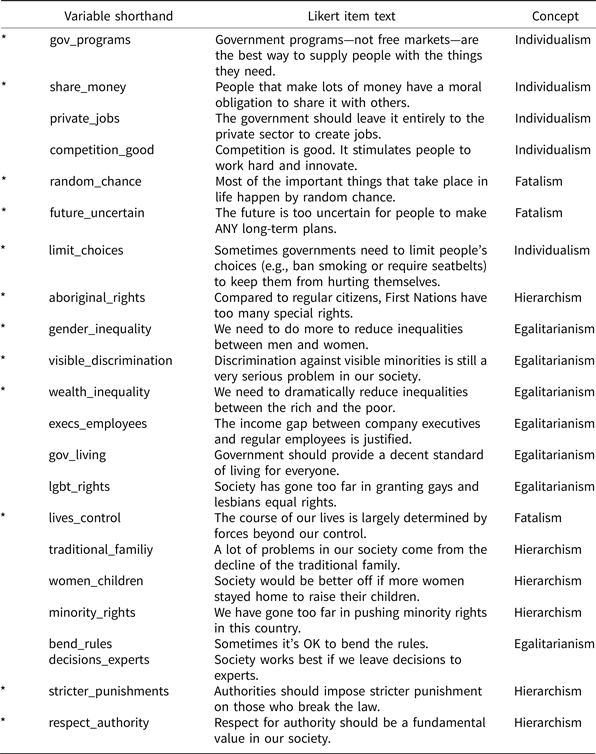
Feedback from these focus groups was integrated into the final questionnaire, which included 23 group and grid survey questions drawn from a variety of sources, including existing CCT and CT items (some of which were revised, given insights from the qualitative research). These questions were part of a survey administered to a large (N = 5,087) representative sample of English-Canadians and French-Canadians. The survey was conducted online between March 17, 2015, and April 9, 2015, using Léger Marketing's panel of over 400,000 Canadians (61% of which were recruited using random digit dialling).
These survey questions are included in the appendix. We extracted 12 items with high inter-item correlations and explored the resulting correlation matrix with exploratory factor analysis (Table 1).Footnote 2 A four-factor model fit the data best (RMSEA 0.05).Footnote 3
Principal Axis Factoring of 12 CT Likert Items, Oblimin Rotation (only loadings above or below +/−0.3 are reported for readability)
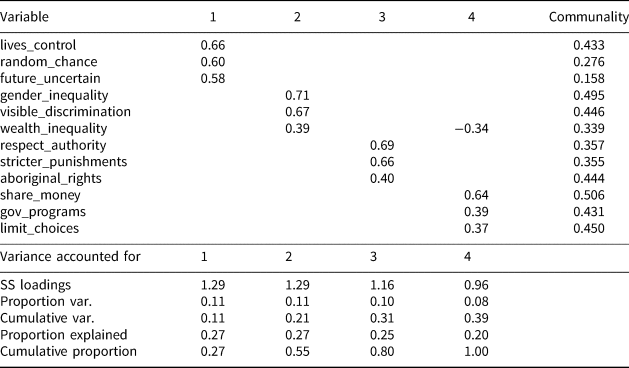
These results suggest that four factors can be extracted that correspond to the cultural biases CT proposes.Footnote 4 For example, the three items (lives_control, random_chance, future_uncertain) that load most strongly on the first factor reflect fatalist concerns. The three items (gender_inequality, visible_discrimination, wealth_inequality) that load on the second factor reflect egalitarian sentiment. Importantly, each of these items asked respondents about some concern with inequalities between different social groups (that is, rich vs. poor, men vs. women, and white vs. visible minorities). The three items (respect_authority, stricter_punishments, aboriginal_rights) that load on the third factor reflect a hierarchical cultural bias that deals primarily with a well-defined and rigid legal structure that cannot tolerate exceptions—for example, in the case of Indigenous peoples. Lastly, the four items (wealth_inequality, share_money, gov_programs, limit_choices) that load on the fourth factor, while less clearly distinguished from the other three factors, partially reflect an individualist cultural bias. Gov_programs and limit_choices clearly tap individuals’ views on whether decisions are best made collectively or individually. But wealth_inequality and share_money share a great deal with egalitarianism; while the former is clearly about egalitarianism (which is why it also loads highly on the second factor), the latter also taps an important characteristic of individualist sentiment—namely, that individuals should be allowed to reap the rewards of their own effort (Thompson et al., Reference Thompson, Ellis and Wildavsky1990). That said, it is clear that our measure of individualism does share some overlap with egalitarianism.
Table 2 shows the correlations between the scores derived from this model. Hierarchism and individualism are correlated, while egalitarianism is inversely correlated with hierarchism and individualism. Fatalism is inversely correlated with individualism but positively correlated with hierarchism. These data suggest that hierarchism and individualism are correlated but distinct cultural biases, supporting the proposition outlined above that they form a “core” of modernity.
Correlations of CT Bias Measures

We can extend this analysis and examine how self-reported left-right ideology is related to each of the four cultural theory biases. The results are presented in Table 3 and demonstrate that hierarchism and individualism are both strongly correlated with self-reported right-wing ideology, fatalism weakly correlated with self-reported right-wing ideology, and egalitarianism strongly correlated with self-reported left-wing ideology.
OLS Regression of Ideology on CT Bias Scores, Controlling for Region, Sex, Age and Post-secondary Status
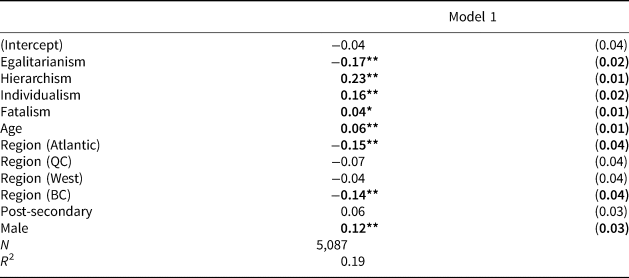
Note: Coefficients standardized (beta) coefficients. P-values are marked as follows to connote statistical significance: **p < 0.01; *p < 0.05. Coefficients with p-values < 0.05 are also bolded for readability. Standard errors are in parentheses.
As a final test of the validity of our measures, we examine the extent to which cultural biases are linked to particular myths of nature. As argued by Thompson et al. (Reference Thompson, Ellis and Wildavsky1990), competing myths of nature serve as important links between cultural biases and perceptions of risk. Nature benign holds that that the natural world is robust and resilient to human interventions. Nature ephemeral is the myth that nature and the world are fragile and vulnerable to human intervention. Nature perverse/tolerant holds that nature is resilient to human intervention, but only up to a point. Lastly, Nature capricious is the myth that the natural world is unpredictable and surprising. According to CT, these myths of nature link the ways of life that cultural biases reproduce, on the one hand, and perceptions of risk, on the other. Ripberger et al. (Reference Ripberger, Gupta, Silva and Jenkins-Smith2014) argue that cultural biases form deep core beliefs that structure more specific attitudes by way of a middle tier of policy core beliefs, including beliefs about the fragility of nature.
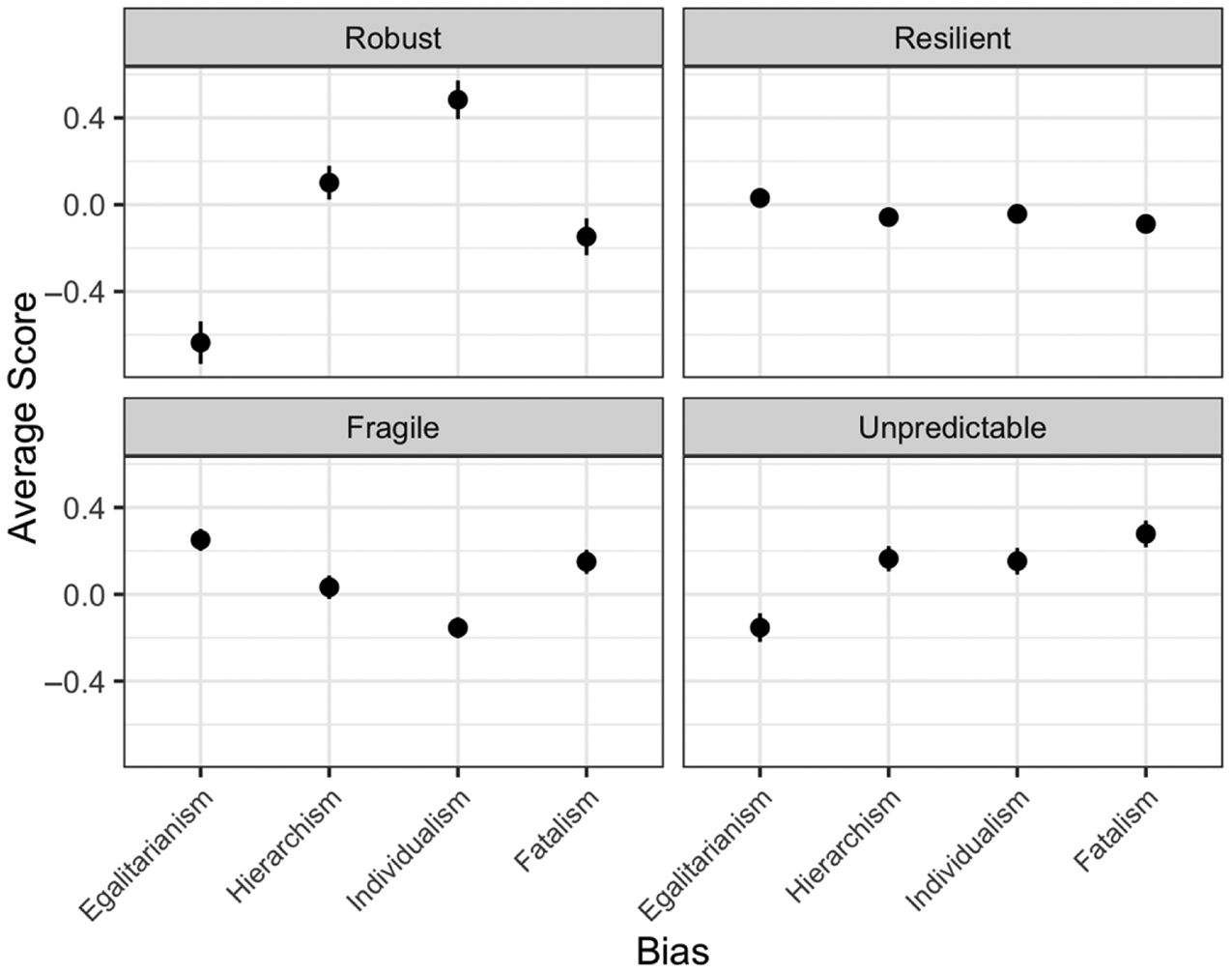
Figure 1 plots the average cultural bias score among respondents selecting a particular understanding of nature. The results are mostly consistent with what CT predicts. Respondents who define nature as extremely fragile and vulnerable to human intervention show a higher egalitarian cultural bias than any other. Respondents who understand nature as resilient, but only up to a point, have only slightly higher egalitarian scores than other cultural biases—though the difference is negligible, which is contrary to what Thompson et al. (Reference Thompson, Ellis and Wildavsky1990: 28) predicted. However, consistent with CT, those who perceive nature as robust are primarily individualistic (while also exhibiting high scores on the measure for hierarchism). Lastly, and consistent with CT predictions, those who understand nature as fundamentally unpredictable score highest on fatalism, just ahead of egalitarianism. These results suggest that there is a sort of continuum whereby cultural ways of life view nature in ways that justify their cultural biases. For instance, egalitarians see nature as fragile, which justifies the conflict with their cultural rivals, the individualists, who, in turn, see nature as robust and therefore a resource to be used in unfettered capitalist development. While hierarchs are somewhere in the middle, fatalists stand off this continuum, and fatalism's way of life is further justified by emphasizing nature's fundamental unpredictability. Beyond the expectation that four distinct ways of life and cultural biases correspond to four distinct myths of nature, the results have a great deal in common with the earlier work by Douglas and Wildavsky (Reference Douglas and Wildavsky1983), which hypothesized that hierarchist and individualist worldviews tend to cohere because of a shared anti-egalitarianism. This makes sense, then, in that those who picked nature as robust were more likely to score high on individualism, followed closely with high scores on hierarchism, while egalitarians and fatalists are most likely to perceive nature as fragile and unpredictable; it also makes sense of why there is no clear relationship between cultural bias and the myth of nature that combined resilience and fragility.
Cultural Theory Bias Scores by Myth of Nature
There are numerous ways to operationalize core concepts in CT. Building on existing measures found in previous work, we developed survey items broadly consistent with this literature and appropriate to the Canadian context. These were validated in a factor analysis to show that they measured hypothesized latent variables in predicted ways. Moreover, they are related in predicted ways to one of the core mechanisms of CT—namely, respondents’ preferred myths of nature. In the next two sections, we report on two separate studies to test the extent to which these measures are related to risk perceptions in Canada.
Study 1: Cultural Bias and Risk Perceptions in Canada
Given that one of the primary motivations behind the development of CT was to explain the protracted battles over the extent and nature of risks, we first test CT's applicability in the Canadian context by examining the extent to which cultural bias can predict risk perceptions, controlling for ideology and regional political culture. There are clear hypotheses that can be directly derived from CT (Wildavsky and Dake, Reference Wildavsky and Dake1990).
H1 Hierarchism is associated with greater perceived risk from criminal and socially proscribed behaviours.
H2 Egalitarianism is associated with greater perceived risk related to technology and the environment.
H3 Individualism is associated with lower perceived risk related to technology and the environment.
H4 Individualism is associated with lower perceived risk from criminal and socially proscribed behaviours.
To measure risk perceptions, respondents were asked to rate a series of 11 items, where 0 represented no risk and 10 represented an extreme risk. Ideology was measured with a standard question used in the Canadian Election Studies: “In politics people sometimes talk about left- and right. Where would you place yourself on a scale of 0 to 10, where 0 is left and 10 is right?” Lastly, we construct a variable for region from the respondent's self-declared province of residence and grouped into five larger regions: Atlantic Canada, Quebec, Ontario, the West (prairie provinces) and British Columbia.
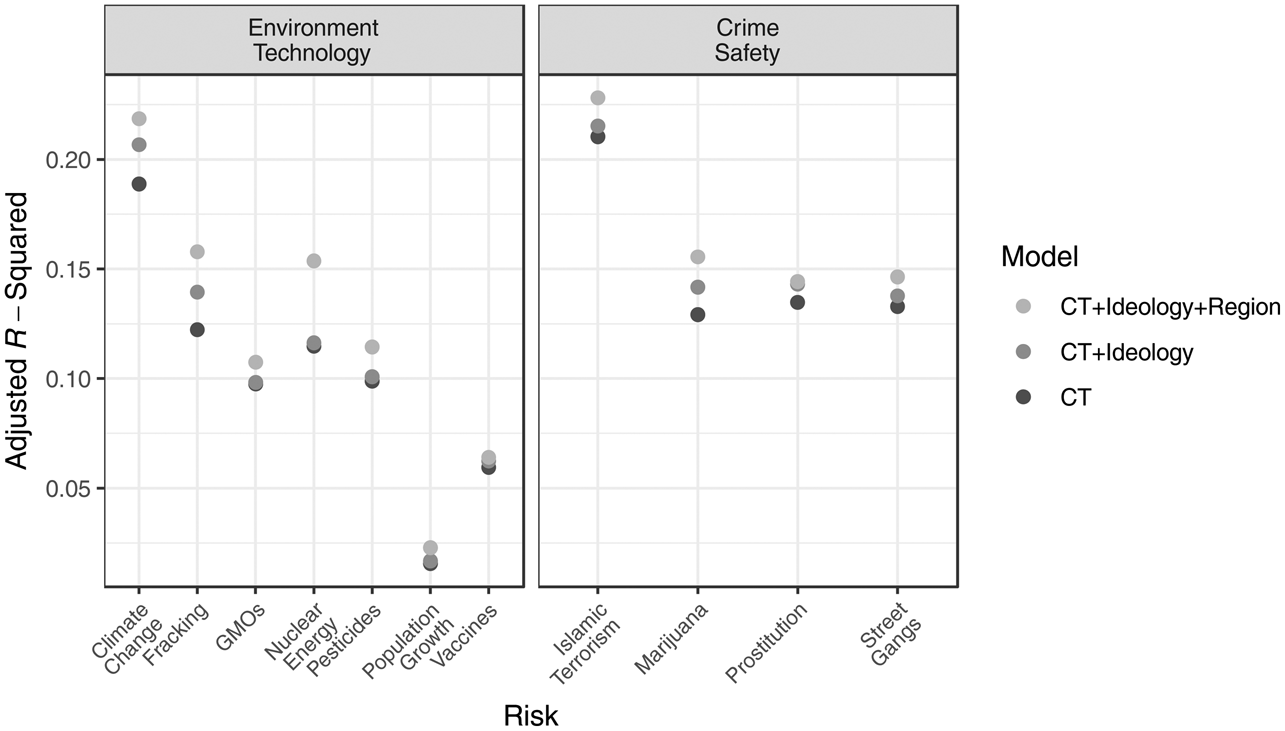
To test the hypotheses, we fit a series of OLS models, with each of 11 risk ratings as dependent variables and with ideology, region, hierarchism, egalitarianism, individualism and fatalism as independent variables. To start, we show the adjusted R-squared values that emerge from three models for each of the 11 risk ratings. The first model includes only the CT bias scores, the second model adds self-reported ideology and the third model adds region of residence. The adjusted R-squared is a measure of explained variance that accounts for the greater number of covariates in the first model. These results are presented in Figure 2. It is clear that CT bias scores alone explain a far greater amount of the variance in risk perception than including self-reported ideology and region. At the high end, models including only CT variables explain approximately 20 per cent of the variance in risk perceptions of climate change and Islamic terrorism. At the low end, they explain less than 1 per cent of the variance in risk perceptions associated with population growth, vaccines and prostitution. This suggests that risks are not automatically assigned cultural meanings that divide mass opinion along the lines of cultural biases; instead, cultural divisions over risk are amplified by organized political actors (Kahan, Reference Kahan2012). However, cultural biases tend to explain much more variance than either ideology or region.
Adjusted R-squared Values for Three Successive OLS Models of 11 Different Risk Ratings
Turning to Table 4, we examine precisely how CT biases are related to patterns of risk perception. The table shows that after controlling for self-reported left-right ideology and region, all four CT variables are related to different risk ratings. This suggests that the cultural bias measures we developed measure something other than self-reported left-right ideology and region. Second, the cultural bias scores are mostly related in predicted ways to the risk items. For example, hierarchism is strongly related to greater perceived risk from socially proscribed behaviours such as Islamic terrorism, street gangs, marijuana use and prostitution, with standardized coefficients ranging from 0.19 (prostitution) to 0.35 (Islamic terrorism). Second, egalitarianism is also strongly related to higher perceived risk related to technology and the environment, with coefficients that range from 0.17 (nuclear energy) to 0.27 (climate change). Third, individualism is moderately, even weakly, associated with lower risk perceptions related to the environment and technology, with coefficients ranging from −0.05 for fracking to −0.10 for climate change. There is an exception here, in that individualism is positively related to perceived risks from genetically modified organisms (GMOs) (0.06), which is contrary to our hypotheses. Lastly, individualism provides a slightly mixed picture in terms of how it relates to criminal or unsafe behaviour. As predicted, it is moderately associated with lower perceived risk from marijuana use (−0.07) and prostitution (−0.04) but moderately associated with greater perceived risk from Islamic terrorism (0.11) and street gangs (0.07). These mixed results suggest that individualism in Canada brings with it its own unique portfolio of risks. Note, for example, that the two behaviours that are either negatively or not related to individualist cultural biases are marijuana use and prostitution, both of which might be linked to libertarian ideas of individual autonomy and freedom of choice.
OLS Regressions of 11 Risk Ratings on CT Bias Scores, Ideology and Region, Controlling for Sex, Age and Post-secondary Status
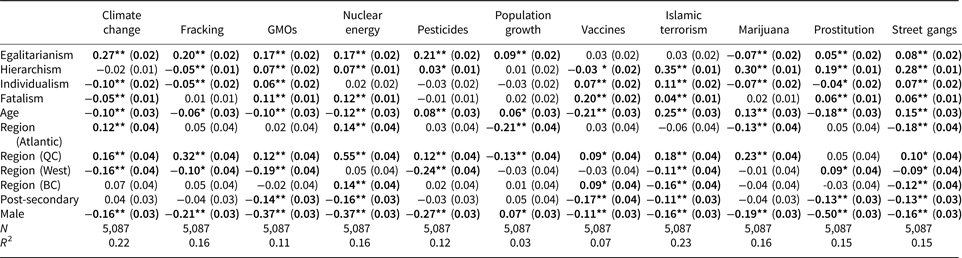
Note: Coefficients standardized (beta) coefficients. P-values are marked as follows to connote statistical significance: **p < 0.01; *p < 0.05. Coefficients with p-values < 0.05 are also bolded for readability.
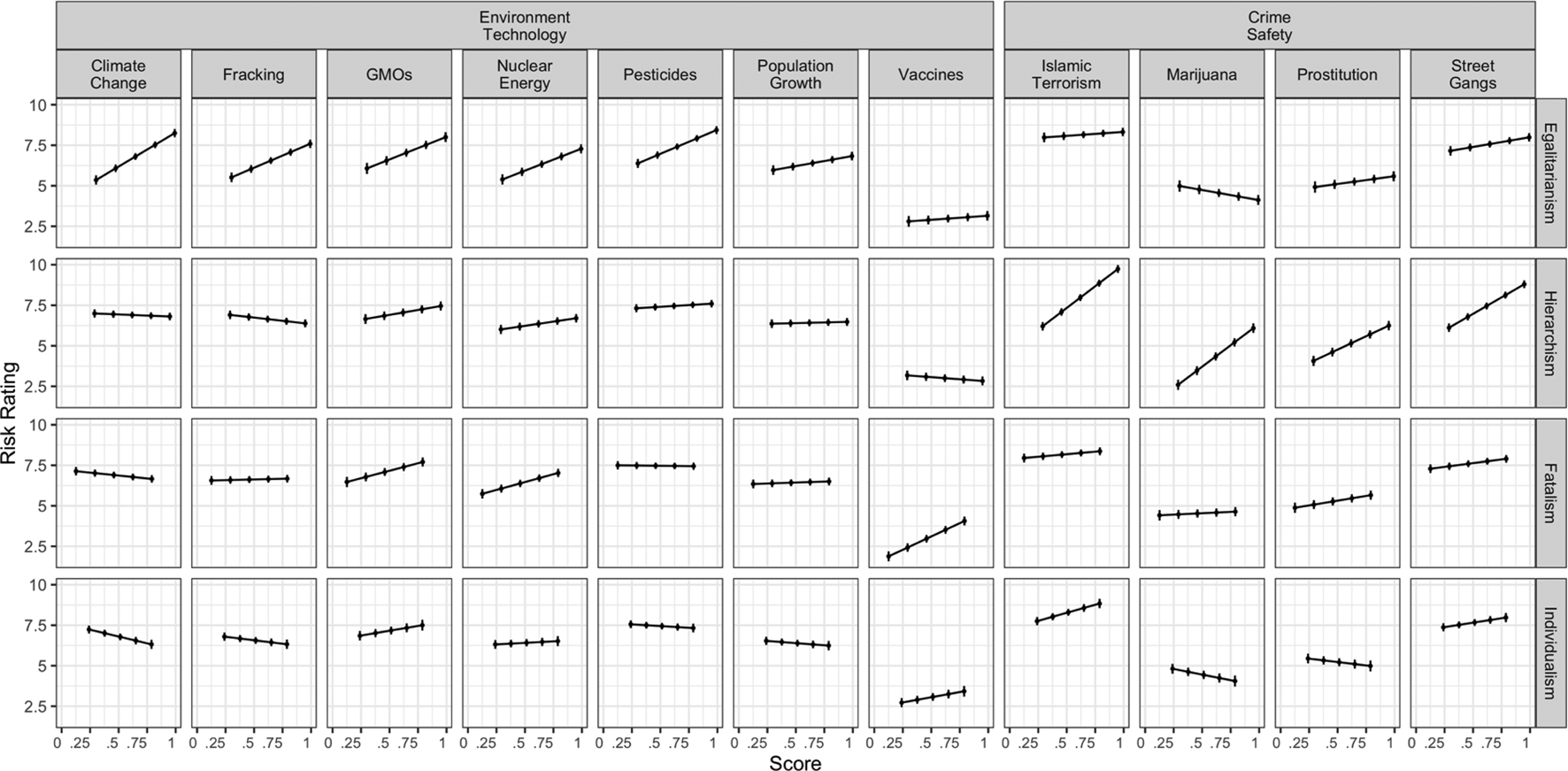
To more clearly illustrate these patterns, predicted values for each risk rating are presented in Figure 3. To generate these, ideology was set at the sample mean (0.5, after scaling to 0 and 1), the reference category for the region variable was set to Ontario (the most populated region in Canada) and the three cultural bias variables that were not examined were set at their mean values. The remaining cultural bias variable (successively: hierarchy, egalitarianism, individualism and fatalism) was scaled such that the mean was set to zero. Predicted values were generated for values ranging from two standard deviations below zero to two standard deviations above zero. This effect plot shows the impact of a particular cultural bias on risk ratings, controlling for self-reported ideology and region much more clearly. For example, risk ratings for criminal and unsafe behaviours clearly show significant increases along with hierarchism, while risk ratings for environmental and technological issues clearly increase along with egalitarianism. In general, individualism has much smaller effects on risk ratings, but there are effects evident for climate change, marijuana use, prostitution and Islamic terrorism. In addition, one final finding of interest that was not hypothesized is reported here—namely, the strongest predictor of risk perception from vaccines was with fatalism. This is significant because in other contexts vaccine hesitancy is commonly associated with both egalitarian and hierarchical views, particularly within religious communities (see Larson et al., Reference Larson, Jarrett, Eckersberger, Smith and Paterson2014; Mnookin, Reference Mnookin2012; Thompson, Reference Thompson2004). The relationship with fatalism here reflects a finding found in the United States (Song et al., Reference Song, Silva and Jenkins-Smith2014; Song, Reference Song2014). The relationship between a fatalistic cultural bias and vaccine risk perception is perhaps more widespread than is currently recognized.
Predicted Values of Ratings from OLS Models including CT, Ideology and Region, with Age, Sex and Post-secondary Status as Controls
Together, these results demonstrate that CT contributes a great deal more than self-reported ideology and region as an explanation for variable perceptions of risk in the Canadian context. Controlling for self-reported ideology and region, measures of cultural bias are correlated with measures of risk perception in theoretically predicted ways. In addition, variables that measure cultural biases explain substantially more variation in patterns of risk perception than do variables that measure ideology and region.
Study 2: Cultural Bias versus Regional Identity
Lastly, we analyze data from an online experiment conducted in the same survey, in order to explore how measures of cultural bias interact with perceptions of regional self-interest. One of Wildavsky's goals was to critique rational choice theory in political science for taking preferences as given. Instead, he tried to theorize where preferences come from (Wildavsky, Reference Wildavsky1987). To test the applicability of CT as a rival to rational choice, we conducted an experiment about how people perceive the risks and benefits associated with a recent controversial pipeline proposal in Canada, where pipelines have emerged as a highly controversial and divisive issue, producing high-profile public debate and pitting oil-producing provinces such as Alberta and Saskatchewan against residents of other provinces. One of the arguments that has been used to win over local opposition to pipeline expansion is that economic benefits—in the form of long-term refinery jobs and short-term construction jobs—accrue to local communities and host provincial governments.
We wanted to test whether appeals that combine economic self-interest and regional identity can overwhelm the perceptions of risk derived from cultural biases. In the experiments, respondents were reminded about the Energy East pipeline intended to transport oil from Alberta to Quebec and New Brunswick and asked to rate the project's benefits. Respondents were then randomly assigned to one of four groups, each with a different emphasis: a control group with no emphasis; a group that emphasized the benefits of the project to Alberta; a group that emphasized the benefits of the project to New Brunswick and Quebec; or a group that emphasized the benefits of the project to Canada, as a whole. Lastly, they were asked to rate the environmental risks of the project.
What is manipulated across experimental groups is what region will be a beneficiary of some of the economic benefits associated with a pipeline from Alberta to the East Coast. Essentially, we hypothesized that when respondents were told of economic benefits that could accrue to a region within which they reside, their risk perceptions would drop. Formally, these can be set as follows:
H5 Residents of provinces not directly impacted by the Energy East pipeline (for example, Newfoundland) will have a lower risk perception than do residents in the same province, when exposed to information that Canada, as a whole, will benefit.
H6a Residents of Quebec who are exposed to information suggesting that Energy East will create jobs in Quebec and New Brunswick will have a lower risk perception of the Energy East pipeline than do Quebeckers in the control group.
H6b Residents of New Brunswick who are exposed to information suggesting that Energy East will create jobs in Quebec and New Brunswick will have a lower risk perception of the Energy East pipeline than do New Brunswickers in the control group.
H7 Residents of Alberta who are exposed to information suggesting that Energy East will create jobs in their province will have a lower risk perception of the Energy East pipeline than do Albertans in the control group.
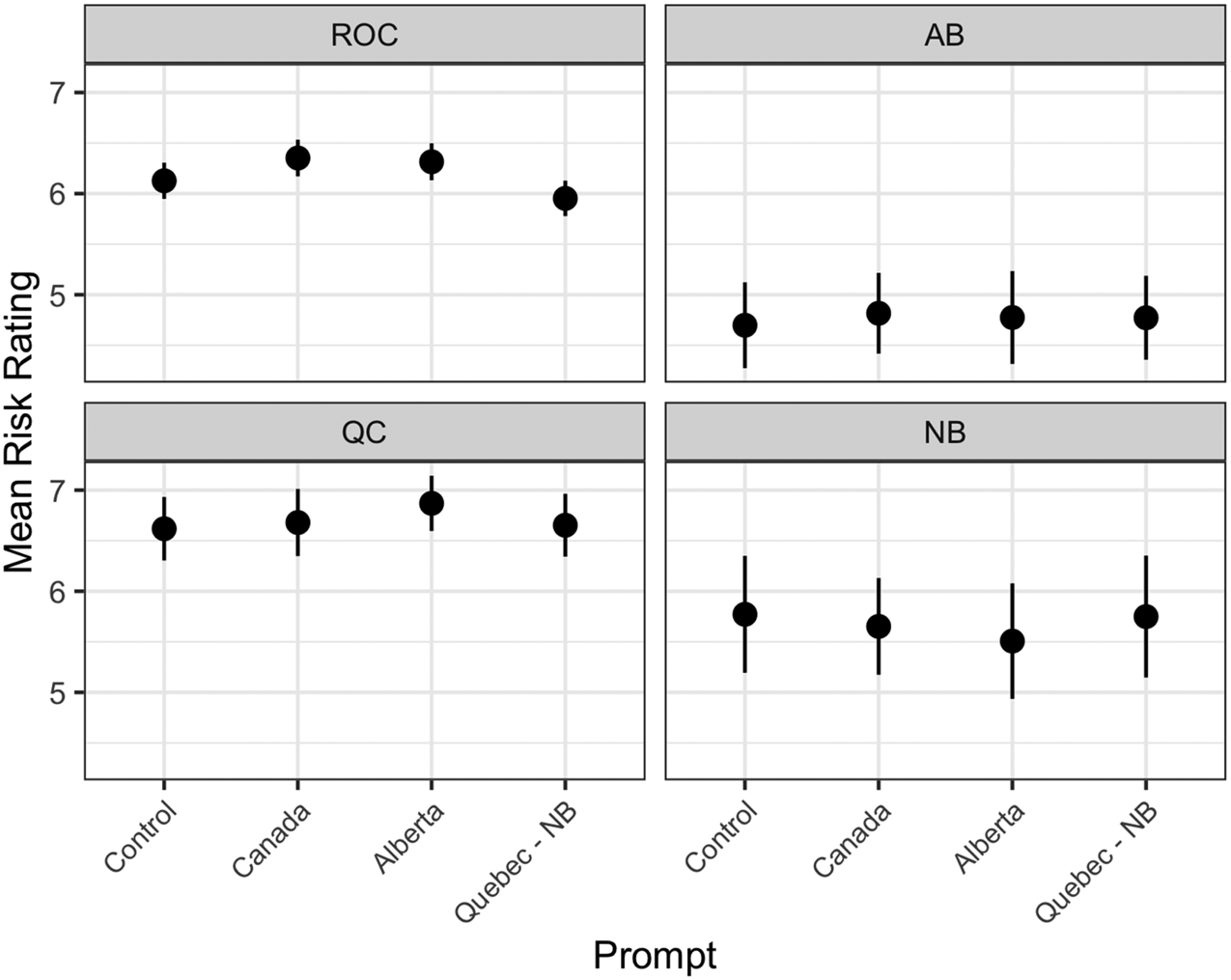
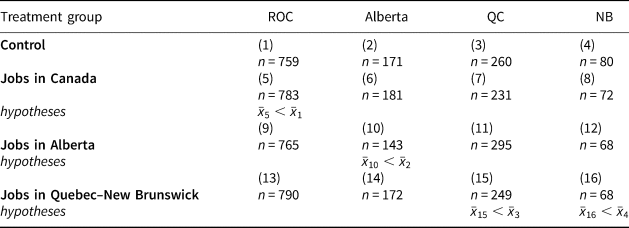
Table 5 shows the sample sizes and hypotheses for the experimental groups. The raw means from each experimental group are shown in Figure 4. Visually, there are no significant differences in the risk perceptions across the treatment groups. A model fit by OLS is shown in Table 6 and confirms this. None of the terms representing the interaction of experimental group with region of residence are significant. To compare the impact of an appeal to regional self-interest, we fit a second model, where variables representing the four CT cultural biases are included. All four are statistically significant. Consistent with theoretical predictions, hierarchy and individualism are inversely related to a perception of risks from Energy East, while egalitarianism is positively related to a perception of risks. Moreover, the variance explained increases substantially (from about 5% to 15%) after the CT measures are included. These results suggest that CT offers important explanatory power in what was at the time a high-profile debate in Canada. With respect to the survey items on pipelines, results further suggest that appeals to regional self-interest are less influential than durable cultural biases in shaping risk perception in mass public opinion.
Effect of Promises of Regional Development on Risk Perception of Energy East
Experimental Design, Sample Sizes and Hypothesized Relationships
OLS Models of Risk Rating of Energy East on Province, Then Province and CT Bias Scores
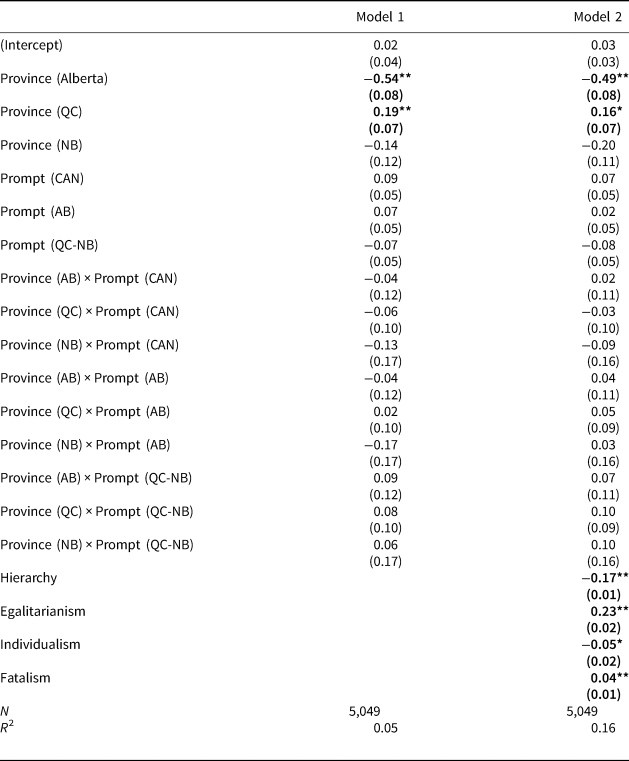
Note: Coefficients standardized (beta) coefficients. P-values are marked as follows to connote statistical significance: **p < 0.01; *p < 0.05. Coefficients with p-values < 0.05 are also bolded for readability.
This finding is consistent with other work (for example, Montpetit et al., Reference Montpetit, Lachapelle and Kiss2017) that suggests that policy advocates in domains such as pipelines might frame their support or opposition to policies in terms of cultural biases, rather than in ways that appeal to regional cultures. This is a profound shift in how Canadian leaders have historically attempted to win over the support of Canada's diverse regions. Much of Canadian political history has been dominated by the practice of brokerage politics, whereby competing and economic interests have been carefully balanced and accommodated. These data suggest that cultural biases, independent of regional self-interest, can be powerful sources of public opinion formation on highly salient, controversial issues involving risk.
Conclusion
The foregoing results present three contributions to the literature on public opinion in Canada. First, we present measures of cultural biases that have been designed for and tested successfully in Canada. These were developed in a multistage process that involved reviewing the existing literature and conducting qualitative research in English and French, followed by large-scale survey research; this work expands the range of countries where CT has been thoroughly tested and also expands the range of theories that have been used to explore public opinion in Canada. Second, these results improve our understanding of debate about risks in Canada. Cultural biases meaningfully predict variation in risk perception in Canada, even controlling for two important drivers of mass public opinion in Canada: ideology and region. Thus, our analysis provides important value in explaining why people have different perceptions of risks in Canada: fundamentally, risks can take on cultural meanings that people invoke to reinforce their preferred cultural bias. In addition, experimental evidence presented here shows that even appeals to regional self-interest do not counteract the way that cultural biases shape perceptions of risk. Third, these results provide some insight into current thinking about the nature of left-right ideology. The correlation between hierarchism and individualism demonstrated here reflects what Wildavsky and Douglas (Reference Douglas and Wildavsky1983) hypothesized, which is that these two cultural biases have a natural affinity based on their capacity to sustain large-scale economic activity. These results may also provide an explanation for observations about the routine and enduring alliances in left-right parties, despite the fact that attitudes in public opinion do not always reduce to a single left-right dimension. While these results will not end debate about the extent to which “culture” and “political culture” shape Canadian political life or whether such phenomena can be measured with survey data, future conversations can be enriched by integrating CT in studies of Canadian politics, while also allowing for more fruitful cross-national study.
Supplementary material
To view supplementary material for this article, please visit https://doi.org/10.1017/S0008423920000177.
Appendix