I. INTRODUCTION
Nitrite  ${\rm{NO}}_2^ -$, a typical additive and corrosion inhibitor, has been recognized as a harmful substance to the human health and environmental system, owing to the formation of carcinogenic nitrosamines.Reference Li, Hu, Wang, Weng, Chen and Feng1 Hence, it is necessary to develop a reliable method for its quantitative analysis. Up to now, many analysis approaches including electrochemical sensor,Reference Wang, Li, Huang, Li and Wang2 fluorescent spectrophotometry,Reference Zhang, Su, Li, Zhang, Fan and Ma3 chemiluminescence,Reference Lin, Xue, Chen and Lin4 and high performance liquid chromatographyReference Ferreira and Silva5 have been applied in the detection of nitrite. Among these methods, the electrochemical technology is known as a powerful tool with the advantages of low cost, convenience, high sensitivity, and selectivity. In recent years, the various electrochemical modified electrodes such as GNPs/graphene/MCE, ZnP/C60, Au/choline chloride, Au/graphene, PPyox/MWNTs, and PtAu/choline chloride have been synthesized based on electrochemical modified electrodes.Reference Wang, Wang, Zhou, Yang, Qu and Miao6–Reference Wang, Zhou, Wang, Lai and Han11 However, it is still a big demand to explore more efficient sensors for daily analysis of nitrite.
As a typical layered semiconductor, CsTi2NbO7 has attracted much attention in electrochemical field on account of its layered structure, favorable charge transfer, superior thermal stability, and easy modification characters.Reference Shibata, Takanashi, Nakamura, Fukuda, Ebina and Sasaki12,Reference Takagaki, Yoshida, Lu, Kondo, Hara, Domen and Hayashi13 However, the pure CsTi2NbO7 shows the relatively low electrochemical activity due to small specific surface area and the poor electroconductivity. In consideration of the advantageous characters of layered semiconductor, some efforts have been made in our groups to enhance the electrochemical activities of layered semiconductor-based composites. For example, the electrocatalytic performance as biosensors in detecting ascorbic acid (AA),Reference Wang, Xu, Zhang, Fan and Tong14 H2O2,Reference Zhang, Liu, Ma, Yang, Xu and Tong15 hydrazine hydrate,Reference Pan, Xu, Zhang, Li, Wang, Ma, Liu, Zhang and Tong16 nitrite,Reference Wang, Fan, Yi, Xu, Zhang and Tong17 etc., has been improved by the intercalation of metalloporphyrin into the interlayers of layered materials. The enhanced electrochemical activity may be attributed to the superior electricity activity of metalloporphyrin, leading to the efficient charge transfer ability, whereas the complicated preparation process and high cost will limit their application. Recently, the construction of the heterojunction electrocatalyst has been regarded as an efficient approach to enhance the electrocatalytic activity due to speeding up the separation and efficient transfer of electrogenerated charge carriers.Reference Wang, Nemoto and Yamauchi18 For example, the Co3O4/g-C3N4 heterojunction has an excellent electrocatalytic ability toward phenolic hormones than Co3O4 and g-C3N4 due to synergistic effects of the heterojunction structure, narrower band gap, and higher donor density.Reference Sun, Jiang, Liu, Wu and Zou19 Based on the 2D layered structure of CsTi2NbO7 and the advantages of heterojunction, it is feasible to construct CsTi2NbO7-based heterojunction to gain the enhanced electrochemical activity.
Graphite-like carbon nitride (g-C3N4), a polymeric semiconductor nanomaterial, has caused great concern in catalysis, due to its nontoxicity, low cost, easy preparation, outstanding thermal, and chemical stabilities.Reference Wen, Xie, Chen and Li20–Reference Liang, Wu, Wang, Liou, Liu and Ehrman33 Besides, great efforts have been made to further improve the efficiency and selectivity of catalysts based on g-C3N4 and expand application areas. Generally, (i) constructing porous structureReference Su, Mathew, Lipner, Fu, Antonietti, Blechert and Wang34 or nanosheetsReference Schwinghammer, Mesch, Duppel, Ziegler, Senkerand and Lotsch35 to increase the surface areas of g-C3N4 and (ii) forming a synergistic system by utilizing g-C3N4 as a substrate to fabricate heterojunction composite with other materialsReference Liu, Zhu, Zhu, Dong, Hou, Xu, Chen, Xi and Hou36 are the two powerful methods. Up to now, g-C3N4-based sensing materials have been successfully synthesized, such as α-Fe3O4/g-C3N4,Reference Zeng, Zhang, Wan, Song and Lv37 Mn3O4/g-C3N4,Reference Hu, Li, Zhang and Lv38 graphene/g-C3N4,Reference Hang, Zhang and Yang39 chromogenic probe/g-C3N4,Reference Yang, Wang, Liu, Ge, Yan, Yu and Song40 and so on. In addition, the nitrogen-rich precursor of g-C3N4 can be used to tune the energy band structure of semiconductors by N-doping, which will narrow the band gap by the creation of doping energy levels above the valence band (VB), leading to an enhanced electrochemical response.Reference Wu, Hu, Liu, Zhao, Chen, Whoehling, Plesse, Nguyen, Vidal and Chen41 Besides, heterogeneous semiconductor materials have attracted wide attention in catalysis.Reference Liang, Guo, Cao, Tian and Lui42 However, it is still a challenge to construct an efficient heterojunction electrocatalyst via a facile method to gain the enhanced electrocatalytic performance by the synergistic effects of morphology engineering, N-doping, and layered heterojunction.
In this work, a facile one-step calcination method has been performed to obtain N-doped CsTi2NbO7@g-C3N4 core–shell nanobelts, in which CsTi2NbO7 layers were in situ doped by N atoms and the g-C3N4 exists on the external surface and within the interlayers of CsTi2NbO7 simultaneously. With large electrocatalytic active areas and fast electron transfer rate, the NTCN modified electrode shows an excellent analysis for electrochemical detecting of nitrite. This study may broaden the application of semiconductor heterostructure materials in daily nitrite sensing with outstanding stability and sensitivity.
II. EXPERIMENTAL DETAILS
A. Synthesis of N-doped CsTi2NbO7@g-C3N4 core–shell nanobelts
All reagents were purchased from Sinopharm Chemical Reagent Co., Beijing, China, without further purification. To synthesize layered CsTi2NbO7, a stoichiometric mixture of Cs2CO3, Nb2O5, and TiO2 in the molar ratio of 1.1:1:4 was continuously heated at 750, 950, and 1050 °C for respective 12 h. The as-prepared CsTi2NbO7 (2.0 g) was mixed with melamine (2.0 g), and then heated at 450 °C for 5 h in a covered crucible. The obtained solid sample was treated by distilled water for several times. The resulted yellow powder was denoted as NTCN. The weight ratio of g-C3N4 in the NTCN composite is calculated to be 32.8% by TG analysis (Fig. S1). For comparison, the bulk g-C3N4 was prepared by thermally decomposing melamine at 550 °C with a rate of 5 °C/min for 5 h in in a covered crucible according to the previous literature.Reference Wei, Liang, Liu, Luo, Wang, Yao and Zhu43
B. Apparatus
Thermogravimetry and differential thermal analyses (TG-DTA; STA449F3 JUPITER) were carried out in a flow of air (10 mL/min) at a heating rate of 10 °C/min. X-ray diffraction patterns (XRD) were recorded on a RINT 2000 diffractometer (Rigaku, Tokyo, Japan) using Cu Kα radiation (λ = 0.154 nm) with 2θ ranging from 1.5° to 50° at a scan rate of 1°/min. Fourier transformed infrared (FT-IR) spectra were recorded on the Shimadzu FTIR-8400S apparatus spectrometer with KBr pellets (Shimadzu, Kyoto, Japan). UV-vis diffuse reflectance spectra were recorded on a UV-vis spectrophotometer (Shimadzu, UV-3600) using BaSO4 as reference. The microstructure images of the materials were obtained by scanning electron microscopy (SEM) and transmission electron microscopy (TEM) technologies with a high-angle annular dark-field (HAADF) detector (SEM, JEOL JEM-6300F; TEM, JEOL JEM-2100F, operating at an accelerating voltage of 200 kV, JEOL Ltd., Tokyo, Japan). The Brunauer–Emmett–Teller (BET) specific surface areas were measured by N2 adsorption–desorption isotherms at liquid nitrogen temperature, using a Micromeritics ASAP 2020 surface area and porosity analyzer (Micromeritics instrument (Shanghai) Ltd., Shanghai, China).
C. Electrochemical tests
To fabricate the NTCN/GCE electrode, 2.0 mg of the NTCN composite was first dispersed in 1.0 mL of distilled water for ultrasonic treatment, and then 8.0 μL of the resulted uniform suspension was casted on the surface of bare GCE for the further air-dry at room temperature.
The electrochemical tests were all performed on a CHI660E electrochemical workstation (Chenhua, Shanghai, China) with a three-electrode system, in which NTCN/GCE, the platinum wire, and the saturated calomel electrode were severed as the working electrode, the counter electrode, and the reference electrode, respectively. The electrocatalytic behaviors of the modified electrodes were conducted in N2-saturated 0.1 mol/L PBS (pH = 7.0) at room temperature. The representative nitrite of NaNO2 was chose to study the electrocatalytic oxidation. The differential pulse voltammetry (DPV) measurements were carried out in the DPV mode with an amplitude of 0.025 V, a pulse width of 0.05 s, a sampling width of 0.0167 s, and a pulse period of 0.2 s.
III. RESULTS AND DISCUSSION
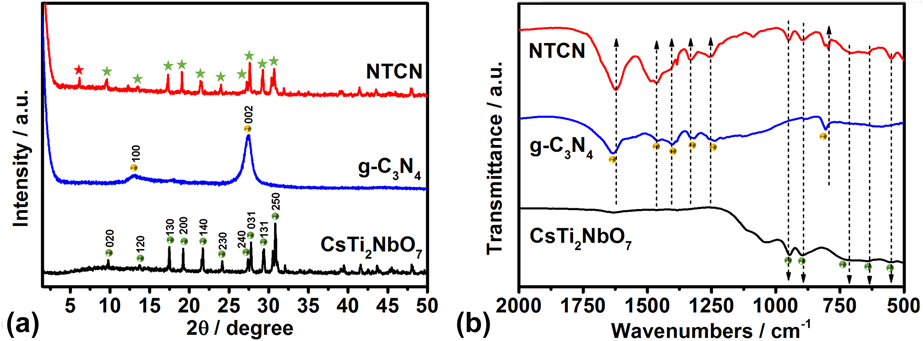
As displayed in Fig. 1(a), the characteristic peaks of CsTi2NbO7 can be clearly observed, which is in line with JCPDS Card (No. 73-0680),Reference Liu, Zhang, Wang, Xu, Chen, Wang, Xi and Hou44 indicating the highly crystalline nature and purity of CsTi2NbO7. After calcinating CsTi2NbO7 with melamine, the characteristic peaks of CsTi2NbO7 are still retained in the resulted NTCN, confirming the maintenance of the layered structure. It is worth noting that a new peak located at 6.16° (d = 1.25 nm) can be clearly seen in NTCN due to the intercalation of g-C3N4 into the interlayers of CsTi2NbO7 to form layer-by-layer stacking structure between g-C3N4 layers and CsTi2NbO7 layers.Reference Gunjakar, Kim, Kim, Kim and Hwang45 Besides, the characteristic peaks of g-C3N4 are not found in the XRD pattern of NTCN, which may be due to the overlapped peaks. Considering the thickness of the [Ti2NbO7]− layer to be 0.58 nm,Reference Liu, Zhang, Wang, Xu, Chen, Wang, Xi and Hou44 the gallery height is calculated to be 0.67 nm resulting from the intercalation g-C3N4. As the thickness of the single-layer g-C3N4 nanosheet is 0.325 nm,Reference Xu, Zhang, Shi and Zhu46 it can be inferred that two-layered g-C3N4 nanosheets is in situ intercalated into the interlayers of CsTi2NbO7 owing to the space-confined effect, leading to the formation of the CsTi2NbO7/g-C3N4 heterojunction structure.
XRD patterns (a) and FT-IR spectra (b) of CsTi2NbO7, g-C3N4, and NTCN composite.

The local structure of the samples was investigated by FT-IR spectra shown in Fig. 1(b). In the spectrum of pure g-C3N4, the bands at 1637, 1460, 1403, 1323, and 1241 cm−1 are assigned to the typical stretching modes of C–N heterocycles.Reference Liu, Wu, Ji, Zhu, Hou, Yang, Jiang, Wang, Tian, Chen and Hou47 Besides, the representative band at 805 cm−1 of g-C3N4 is attributed to the characteristic breathing mode of s-triazine.Reference Xia, Ji, Di, Wang, Yin, Zhang, He and Li48 For CsTi2NbO7, the bands at the range of 950–550 cm−1 are characteristic Ti–O and Nb–O stretching vibrations.Reference Park, Shin, Song, Park and Paik49 After combing g-C3N4 with CsTi2NbO7, a significant shift of the characteristic bands can be observed in the resulted NTCN composite in comparison with g-C3N4 and CsTi2NbO7, owing to the presence of a strong interaction between these two compounds, resulting from the formation of the CsTi2NbO7/g-C3N4 heterojunction structure.Reference Zhang, Huang, Zhang, Yuan and Dong50
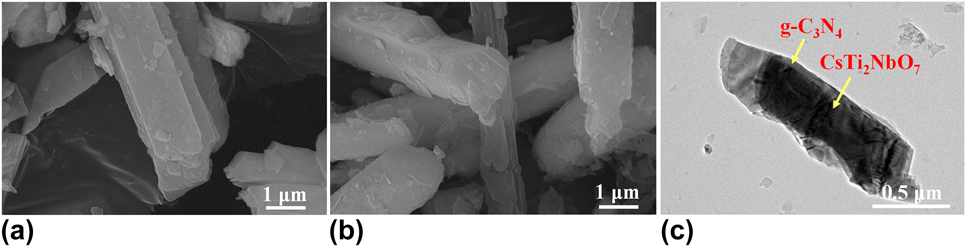
The morphology of samples is examined by SEM and TEM. It can be clearly observed that CsTi2NbO7 possesses smooth surface and displays a typical nanobelt structure with a width size of 1–2 μm [Fig. 2(a)]. After heating CsTi2NbO7 with melamine, the nanobelt structure is still maintained in the resulted NTCN composite shown in Fig. 2(b). The unique long nanobelt structure can act as a channel for transport of charge carriers, which is beneficial for facilitating the separation of electron–hole pairs, and then transferred to different reaction sites for further reactions.Reference Liang, Guo, Cao, Tian and Lui42 Besides, CsTi2NbO7 can be doped by the nitrogen atoms to form N–CsTi2NbO7 during this process, due to the ammonia-based gas released from pyrolysis of melamine. From the TEM image [Fig. 2(c)], a core–shell nanobelt structure can be clearly seen in the NTCN composite, in which g-C3N4 is densely assembled on the surface of N–CsTi2NbO7. As shown in Fig. S2, the HRTEM image of NTCN confirmed the formation of heterojunction between g-C3N4 and CsTi2NbO7. The interplanar spacing of lattice fringes is about 0.32 nm, in line with the (031) plane of CsTi2NbO7. Combined with XRD results, the formed g-C3N4 is located on both the interlayers and surface of CsTi2NbO7 to form CsTi2NbO7/g-C3N4 heterojunction, which is favor of the separation of electron–hole pairs.Reference Liu, Sun, Wu, Liang, Huang, Chen and Hou51
SEM photograph of (a) CsTi2NbO7, (b) NTCN composite, and (c) TEM image of the NTCN composite.

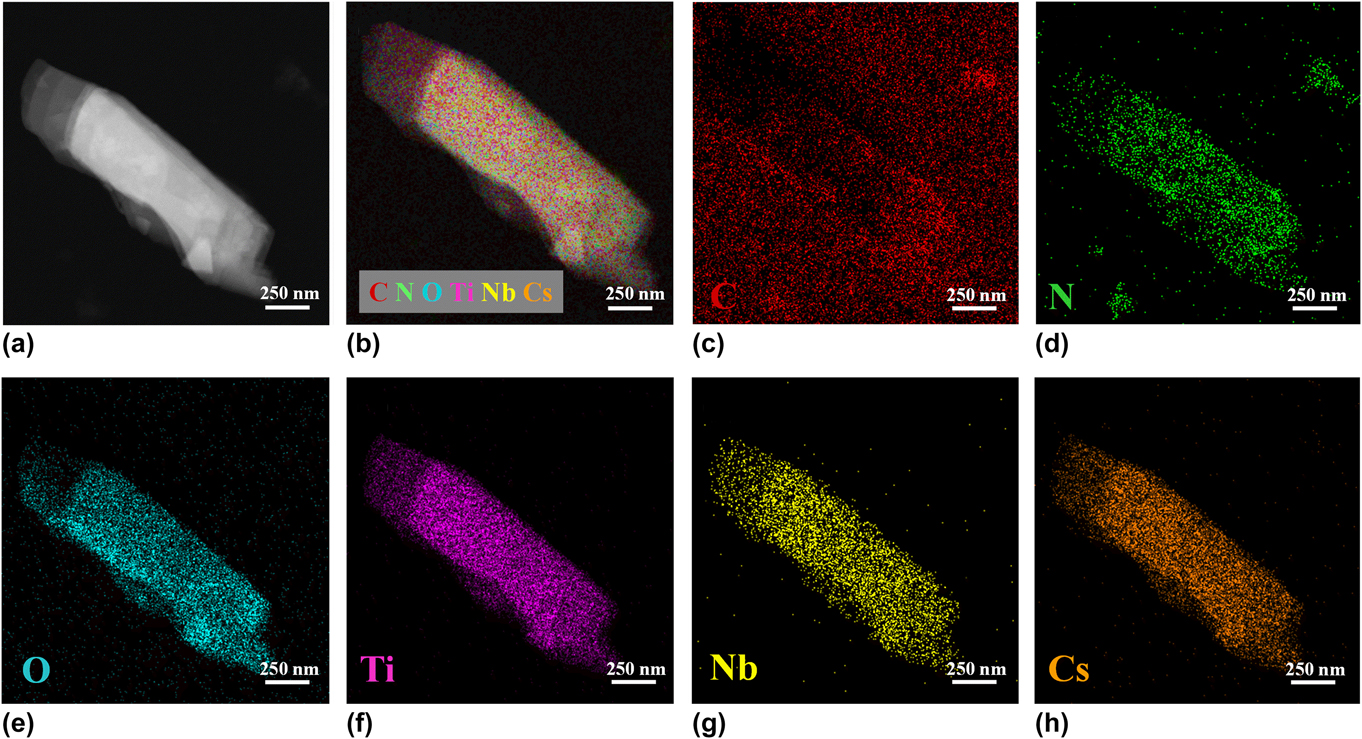
The morphology and distribution of elements in NTCN composite are further investigated through high-angle annular dark-field scanning transmission electron microscopy (HAADF-STEM) and elements mapping. In Fig. 3(a), the nanobelt with layered structure can be clearly observed. For a deep insight of the nanostructure, the element mappings are measured. In the merged image [Fig. 3(b)], the different colors of C, N, O, Ti, Nb, and Cs regions are highly coincident, indicating that g-C3N4 is successfully assembled with CsTi2NbO7. However, C, N, O, Ti, Nb, and Cs elements are uniformly dispersed in the NTCN composite.
Element map of the NTCN composite by HAADF–STEM. (a) HAADF–STEM image of the NTCN composite. (b) Combined C/N/O/Ti/Nb/Cs chemical maps of the NTCN composite. The distribution of (c) C, (d) N, (e) O, (f) Ti, (g) Nb, and (h) Cs in the NTCN composite.

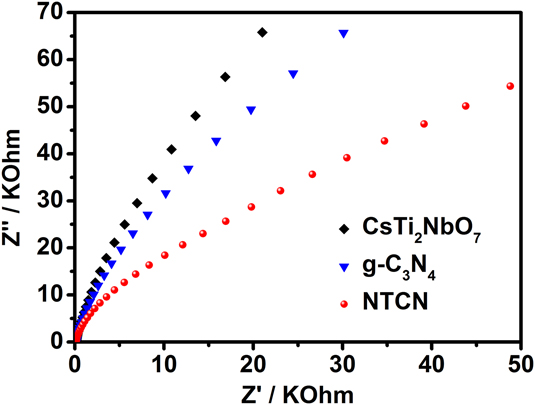
Figure 4 shows the electrochemical impedance spectroscopy (EIS) of CsTi2NbO7, g-C3N4, and NTCN electrodes. It shows that the diameter of the Nyquist circle of the NTCN/GCE is smaller than CsTi2NbO7 and g-C3N4 in the high frequency region, indicating a promoting charge transfer behavior at the interface of electrode–electrolyte.Reference Hou, Zuo, Dagg and Feng52 The reasons might be due to the fact that the construction of CsTi2NbO7/g-C3N4 heterojunction can promote the separation of electron–hole pairs and reducing the recombination rate of electro-induction electrons and holes.Reference Xiang, Yu and Jaroniec53
EIS of CsTi2NbO7, g-C3N4 and NTCN in 0.5 mmol/L K3Fe(CN)6 containing 0.1 mol/L KCl at open potential.

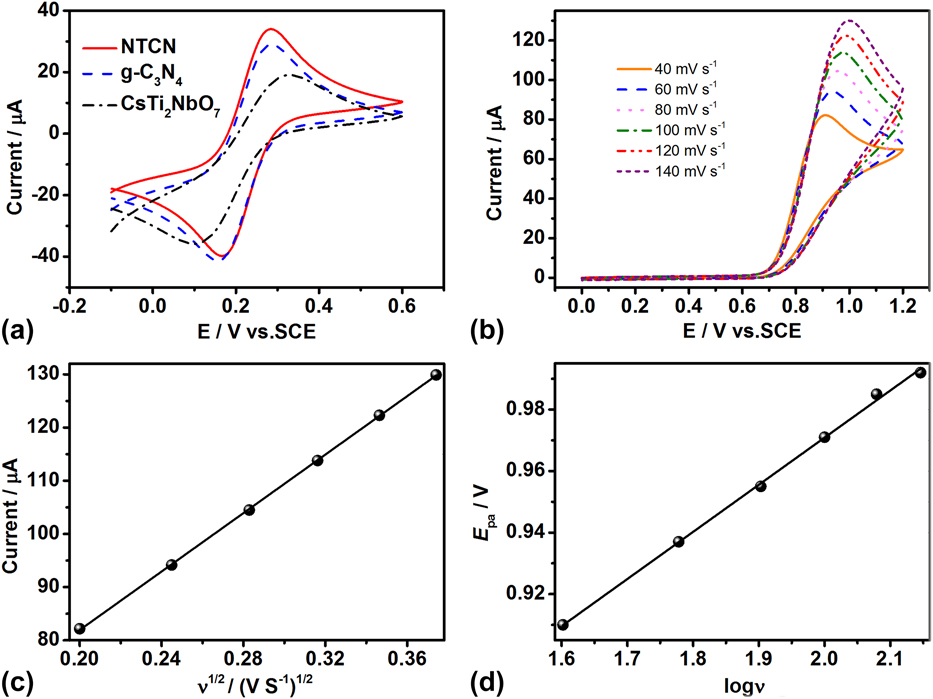
The electrochemical performances of the samples are also investigated by CVs [Fig. 5(a)], which were measured in 5.0 mmol/L K3Fe(CN)6 containing 0.1 mol/L KCl solution at 50 mV/s. A pair of quasi-reversible redox peaks can be clearly seen in NTCN/GCE with a higher ampere response, demonstrating an increased electroactive surface area and effective acceleration of electron transfer rate in NTCN/GCE. Furthermore, the corresponding peak-to-peak separation value in NTCN/GCE (ΔE p = 0.117 V) is smaller than that of CsTi2NbO7/GCE (ΔE p = 0.224 V) and g-C3N4/GCE (ΔE p = 0.129 V). It is supposed that the reasons are due to that (i) the inserted g-C3N4 has broaden the distance of layered CsTi2NbO7, leading to larger surface areas and more active sites of the NTCN composite so as to enhance the diffusion rate of nitrite molecules on the electrode. The nitrogen adsorption–desorption isotherms for the samples are shown in Fig. S3. The BET surface area of NTCN is larger than those of CsTi2NbO7 and g-C3N4. Thus, the larger surface areas contribute to the higher electrocatalytic activity. (ii) The construction of the heterojunction structure will speed up the separation and efficient transfer of electrogenerated charge carriers.
(a) CVs of CsTi2NbO7/GCE, g-C3N4/GCE, and NTCN/GCE recorded in 5.0 mmol/L K3Fe(CN)6 containing 0.1 mol/L KCl solution at 50 mV/s (b) CVs of NTCN/GCE in 0.1 mol/L phosphate buffer solution (PBS; pH = 7.0) containing 3.28 mmol/L nitrite at different scan rates. (c) The plots of oxidation peak current to the square root of scan rates. (d) The linear relationship of E pa versus log v.

For NTCN/GCE, the influence of scan rates on the oxidation of nitrite (3.28 mmol/L) is also evaluated by CVs [Fig. 5(b)]. It is found that the oxidation peak current increases gradually with the increase of scan rates. An excellent linearity between peak current and square root of scan rates (v) in 40–140 mV/s can be found in Fig. 5(c) with the linear relationship of I pa (μA) = 275v 1/2 (V/s) + 27.0 (n = 6, R = 0.9995), indicating a classical diffusion-controlled electron transfer process.Reference Pan, Xu, Zhang, Li, Wang, Ma, Liu, Zhang and Tong16 Here n and R represent the linear equation from six groups of data and linear correlation coefficient, respectively. Additionally, the anodic potentials of nitrite shift slightly along with the increase of scan rates, and the regression equation can be expressed as E pa (V) = 0.153 log v + 0.664 (n = 6, R = 0.9993) [Fig. 5(d)], which suggests a kinetic limitation in the reaction between the NTCN/GCE and nitrite. For an irreversible process, the number of electron transfer can be calculated according to the Laviron’s equationReference Laviron54,Reference Afkhami, Soltani-Felehgari, Madrakian and Ghaedi55 :
 $${E_{{\rm{pa}}}} = {{2.303RT} \over {2(1 - \alpha )n\alpha F}}\log v + K\quad ,$$
 $${E_{{{\rm{p}} \over {\rm{2}}}}} - {E_{{\rm{pa}}}} = {{1.857RT} \over {\alpha F}}\quad ,$$
where α is the electron transfer cofficient, which can be obtained from Eq. (2). E p/2 is the potential when the current is the half of the peak value. n is the number of electron transferred in the rate-determining step. R, T, and F correspond to the gas constant, temperature, and Faraday constant, respectively. From the slope of E pa − log v, the n value is estimated to be 0.83. It means that the rate-determining step in the reaction is a single electron transfer process. This indicates that there are two successive reactions of nitrite oxidation on the modified electrode with the oxidation of NO2− to NO2 as well as the rapid disproportionation of NO2 into NO2− and NO3−, respectively [Eqs. (3) and (4)].Reference Pham, Li, Han, Huynh-Nguyen, Le, Ko, Kim and Seong56
 $${\rm{NO}}_2^ - - {{\rm{e}}^ - } \to {\rm{N}}{{\rm{O}}_2}\quad ,$$
 $$2{\rm{N}}{{\rm{O}}_2} + {{\rm{H}}_2}{\rm{O}} \to {\rm{NO}}_3^ - + {\rm{NO}}_2^ - + 2{{\rm{H}}^ + }\quad .$$
A. Mechanism of the electrocatalytic enhancement
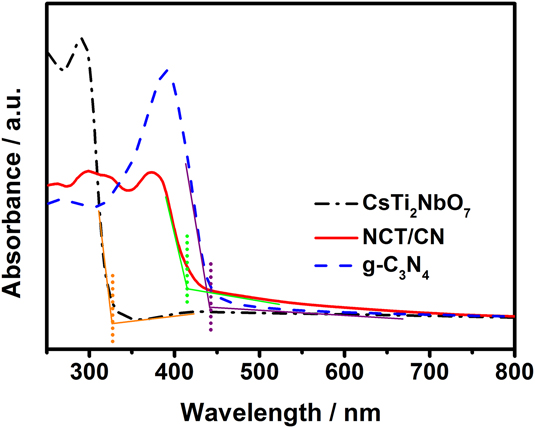
The UV-visible diffuse reflectance spectra are investigated for further understanding the electrocatalytic enhancement of the NTCN nanocomposite (Fig. 6). The absorption edges of CsTi2NbO7, CsTi2NbO7/g-C3N4 heterojunction, and g-C3N4 are around 330, 414, and 445 nm, corresponding to the band-gap value of 3.75, 2.99, and 2.78 eV, respectively. For CsTi2NbO7, there is an only absorption band in the UV region owing to the band-to-band transition.Reference Liu, Liang, Han, Wang, Zhao, Huang, Chen and Hou57 Thus, the introduction of narrow-band-gap g-C3N4 and in situ N-doping will lead to the relatively stronger absorption edge in the visible light region of CsTi2NbO7.
Diffuse reflectance UV-visible of different samples.

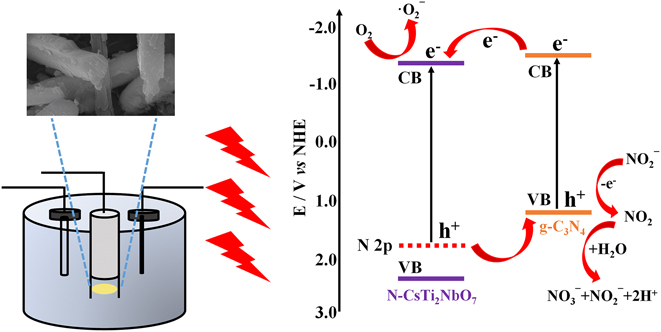
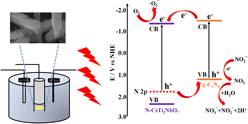
The conceivable mechanism of the enhanced electrocatalytic performance on the NTCN/GCE is proposed in Fig. 7. The analogous layered structures between CsTi2NbO7 and g-C3N4 will minimize the lattice mismatch and facilitate the planar growth of g-C3N4 slabs over CsTi2NbO7 layers.Reference Liu, Zhu, Zhu, Dong, Hou, Xu, Chen, Xi and Hou36 Once the NTCN modified electrode was put into electric field, the CsTi2NbO7/g-C3N4 heterojunction could be excited and then produce electrogenerated electron–hole pairs. The generated electrons in the conduction band of g-C3N4 will move to that of N–CsTi2NbO7, which would react with the absorbed O2 to yield •O2− on the surface of the electrode. On the other hand, the electrogenerated holes from N 2p states of N–CsTi2NbO7 can shift to the valence band (VB) of g-C3N4. Because of the enhanced active area and nanobelt structures, the nitrite can easily diffuse on the surface of CsTi2NbO7@g-C3N4 heterojunction, and then quickly oxidized by holes and •O2−.
A schematic illustration of the possible electrocatalytic mechanism for charge transfer in the NTCN heterojunction composite.

It is well known that the pH value had a great influence on the electrochemical signals of the modified electrodes.Reference Zou, Yang, Bin, Wang, Li, Yang, Wang, Shiraishi and Du9 The CVs of NTCN/GCE in the different pH values were recorded in Fig. S4(a). The plot for the relationship between pH values and peak currents are shown in Fig. S4(b). It is found that the oxidation peak current is first increase and then decrease in the alkaline solution with a maximum current at pH 7.0. It was reported that the generation of N2O at low pH value may result in decreased peak currents.Reference Brylev, Sarrazin, Roué and Bélanger58 Therefore, the pH 7.0 is selected as the optimal condition for our experiment.
B. Electrocatalytic behavior of NTCN/GCE toward the detection of nitrite
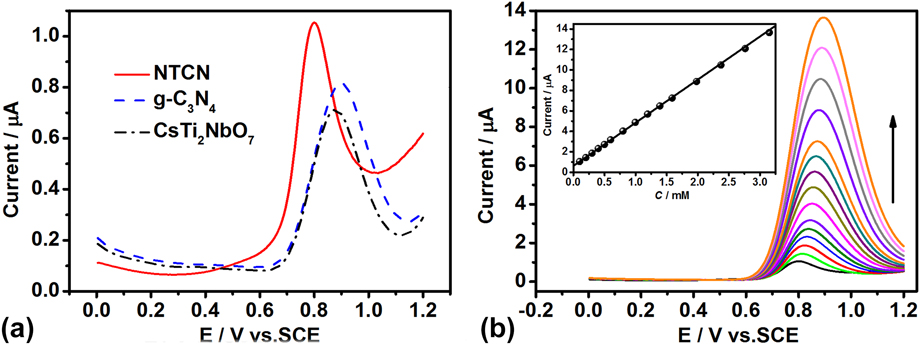
DPV was carried out to test the electrochemical behaviors of different modified electrodes. The DPVs of CsTi2NbO7/GCE, g-C3N4/GCE, and NTCN/GCE were conducted in N2-saturated 0.1 mol/L PBS (pH = 7.0) containing 0.999 mmol/L nitrite, and the results are shown in Fig. 8(a). It is obvious that the NTCN/GCE shows a higher current response and a lower oxidation potential compared to CsTi2NbO7 and g-C3N4 modified electrodes. This is owing to the great synergetic effect of CsTi2NbO7 and g-C3N4 in the heterojunctions structure that provides more electron channel and shorten the diffusion distance between reactive sites. As a lower detection limit and higher sensitive electrochemical method, the DPV technology was selected for the detection of nitrite on the NTCN/GCE. The calibration curve in the range of 0.0999–3.15 mmol/L by nitrite concentration and peak current is presented in Fig. 8(b). The linear regression equation was I pa (μA) = 4.21C (mmol/L) + 0.636 (n = 15, R = 0.9997), with a detection limit of 2.63 × 10⁻⁵ mol/L (S/N = 3). Therefore, the NTCN is an excellent sensor for sensitive detecting of NaNO2.
(a) DPVs of CsTi2NbO7/GCE, g-C3N4/GCE, and NTCN/GCE recorded in 0.1 mol/L PBS (pH = 7.0) containing 0.999 mmol/L nitrite. (b) DPV curves of NTCN/GCE in 0.1 mol/L PBS (pH = 7.0) containing different concentrations of nitrite. The inset is the linear relationship between peak current and the concentration of nitrite.

C. Stability, reproducibility, and interference of NTCN/GCE
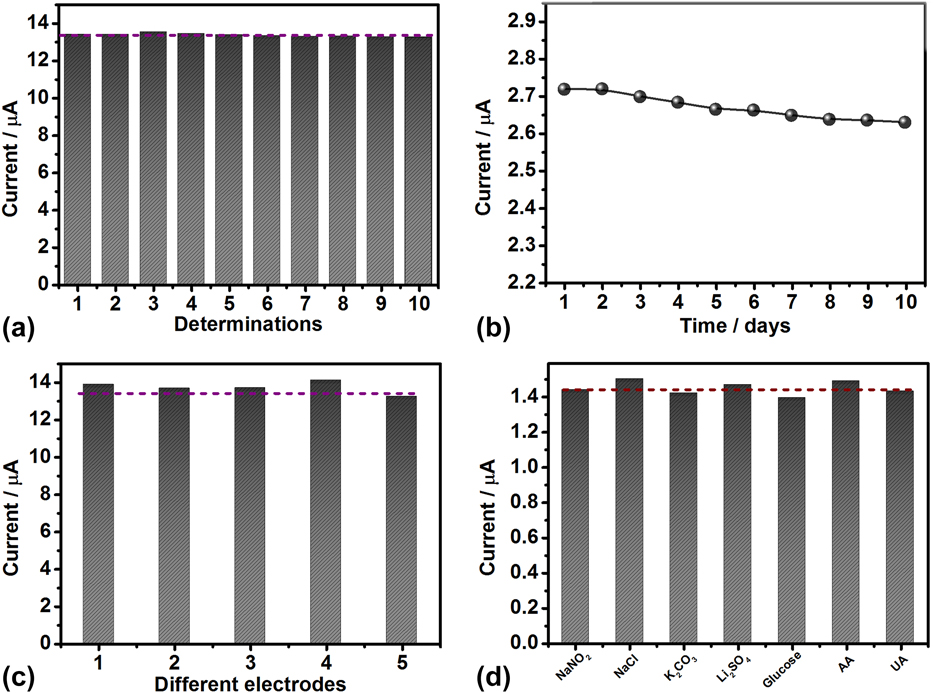
The stability of NTCN/GCE was investigated by successively DPV detections. From Fig. 9(a), the oxidation peak current for ten determinations of 2.85 mmol/L nitrite is nearly constant, with a relative standard deviation (RSD) of 0.67%. Besides, the prepared NTCN/GCE was used to detect nitrite (0.558 mmol/L) for the long-time stability tests. As shown in Fig. 9(b), in the first three days, the decrease of the peak current is 0.76%. And the current response is retained 96.7% for ten days later. These results indicate that the stability of NTCN/GCE is good enough for continuous analysis. The outstanding stability of the NTCN electrode can be attributed to the unique core–shell structure that reinforced the tight accumulation between layered CsTi2NbO7 and g-C3N4, which lead to powerful acting force for building the stable structure. In addition, its reproducibility is evaluated with independent electrodes [Fig. 9(c)]. When five parallel sensors are applied for detecting nitrite (2.85 mmol/L), the RSD is 2.3%, suggesting the NTCN/GCE is a reliable nanocomposite for fabricating sensors. To detect the selectivity of the sensor, the interfaces for the detection of nitrite is measured by adding possible coexisting substances into 0.1 mol/L PBS (pH = 7.0) containing 0.199 mmol/L nitrite. As shown in Fig. 9(d), the concentrations of NaCl, K2CO3, Li2SO4, glucose, AA, and uric acid (UA) are 10 times than that of nitrite, but negligible effects are observed, with RSD values of 4.30, 1.32, 2.01, 3.19, 3.46, and 0.56%, respectively. It is demonstrated that the biosensor with strong anti-interface ability is effective and dependable for daily operation.
(a) The oxidation peak currents for ten successive determinations of 2.85 mmol/L nitrite at NTCN/GCE in 0.1 mol/L PBS (pH = 7.0). (b) The oxidation peak currents of 2.85 mmol/L nitrite detected at different storage times. (c) The oxidation peak currents of 2.85 mmol/L nitrite detected at different electrodes. (d) The oxidation peak currents of 0.199 mmol/L nitrite detected with 10-fold interference species of NaCl, K2CO3, Li2SO4, glucose, AA, and UA.

D. Real sample analysis
To examine the feasibility and accuracy of NTCN/GCE, the fabricated sensor is used to analyze the concentration of nitrite in waste water by standard addition technology. The water samples are first filtered for removing particle materials and then diluted with 0.1 mol/L PBS (pH = 7.0) for five times. As shown in Table I, the recovery range is from 96.9% to 103.0%, and the RSD are both lower than 1.5%. The results indicate that this biosensor can afford high precision for practical application.
Determination of nitrite in waste water.

IV. CONCLUSION
In summary, we designed and synthesized N–CsTi2NbO7@g-C3N4 (NTCN) core–shell nanobelts by a facile calcination method. The resulted NTCN composite showed an excellent electrochemical ability toward the oxidation of nitrite due to the synergistic effects of increased electroactive area, N-doping, and layered heterojunction. The in situ intercalated two-layered g-C3N4 nanosheets enlarged the interlayer spacing of CsTi2NbO7 so as to enhance the diffusion rate of nitrite molecules on the electrode. CsTi2NbO7 was doped by nitrogen atoms to narrow the band gap, resulting from the creation of doping energy levels above the VB of CsTi2NbO7, leading to the decrease of the electron-excited energy. The formed CsTi2NbO7/g-C3N4 heterojunction will speed up the separation and efficient transfer of electron-generated charge carriers. Additionally, the possible electrocatalytic mechanism for the detection of nitrite was proposed based on the experimental results. The N–CsTi2NbO7@g-C3N4 electrochemical sensor would have the prominent applications in the rapid analysis of environmental nitrite.
FUNDING INFORMATION
This work was supported by Natural Science Foundation of Jiangsu Province (BK20161294), HHIT Research Project (Z2015011), Lianyungang Science Project (CG1602), Natural Science Foundation of Jiangsu Province (BK20160434), and University Science Research Project of Jiangsu Province (15KJB430004).
Supplementary Material
To view supplementary material for this article, please visit https://doi.org/10.1557/jmr.2018.354.