Introduction
The term ‘schizo-obsessiveness’ was coined by Hwang & Opler (Reference Hwang and Opler1994) and refers to a dual diagnosis of schizophrenia and obsessive compulsive disorder (OCD) or obsessive compulsive symptoms (OCS). Although large variance exists in the documented prevalence rates of schizo-obsessive disorder, higher-than-expected co-morbidity rates for OCD and schizophrenia have ignited a controversy (Huppert & Smith, Reference Huppert and Smith2005). The prevalence of OCD in the general population remains quite controversial; however, it is certainly much lower (with estimates from 0.08 to 2.5%; e.g. Fireman et al. Reference Fireman, Koran, Leventhal and Jacobson2001; Crino et al. Reference Crino, Slade and Andrews2005) than the prevalence of OCD in schizophrenia, which has estimates ranging from 0.5 to 59.2% both in first-episode and in chronic schizophrenia (Bland et al. Reference Bland, Newman and Orn1987; Karno et al. Reference Karno, Golding, Sorenson and Burnam1988; Berman et al. Reference Berman, Kalinowski, Berman, Lengua and Green1995; Eisen et al. Reference Eisen, Beer, Pato, Venditto and Rasmussen1997; Poyurovsky et al. Reference Poyurovsky, Fuchs and Weizman1999a, Reference Poyurovsky, Dorfman-Etrog, Hermesh, Munitz, Tollefson and Weizman2000, Reference Poyurovsky, Kriss, Weisman, Faragian, Kurs, Schneidman, Fuchs, Weizman and Weizman2003, Reference Poyurovsky, Fuchs, Faragian, Kriss, Weisman, Pashinian, Weizman and Weizman2006; Bermanzohn et al. Reference Bermanzohn, Porto, Arlow, Pollack, Stronger and Siris2000; Kruger et al. Reference Kruger, Braunig, Hoffler, Shugar, Borner and Langkrar2000; Niehaus et al. Reference Niehaus, Koen, Muller, Laurent, Stein, Lochner, Seedat, Mbanga, Deleuze, Mallet and Emsley2005; Mukhopadhaya et al. Reference Mukhopadhaya, Krishnaiah, Taye, Nigam, Bailey, Sivakumaran and Fineberg2009) and for OCS in schizophrenia the estimated prevalence is similarly between 3.5 and 46% (Rosen, Reference Rosen1957; Myers et al. Reference Myers, Weissman, Tischler, Holzer, Leaf, Orvaschel, Anthony, Boyd, Burke and Kramer1984; Fenton & McGlashan, Reference Fenton and McGlashan1986; Berman et al. Reference Berman, Kalinowski, Berman, Lengua and Green1995, Reference Berman, Merson, Viegner, Losonczy, Pappas and Green1998; Lysaker et al. Reference Lysaker, Marks, Picone, Rollins, Fastenau and Bond2000; Tibbo et al. Reference Tibbo, Kroetsch, Chue and Warneke2000; Fabisch et al. Reference Fabisch, Fabisch, Langs, Huber and Zapotoczky2001). It remains unclear if this reflects a true co-morbidity, more severe illness or perhaps a unique diagnostic subcategory of schizophrenia.
A distinct neuro-anatomical profile has also been associated with schizophrenia and co-morbid OCD (schizo-OCD). Magnetic resonance imaging studies have identified significantly reduced volumes in the left hippocampus, frontal lobes (Aoyama et al. Reference Aoyama, Iida, Inoue, Iwasaka, Sakiyama, Hata and Kishimoto2000) and anterior horn of the lateral and third ventricle (Goldstein et al. Reference Goldstein, Goodman, Seidman, Kennedy, Makris, Lee, Tourville, Cavines, Faraone and Tsuang1999) for schizophrenia patients with OCS when compared with their schizophrenia counterparts without OCS. Additionally, schizo-obsessive patients show more neurological signs (Sevincok et al. Reference Sevincok, Akoglu, Topaloglu and Aslantas2004), motor symptoms including catatonia, loss of motor ability or hyperactive motor activity (Tibbo et al. Reference Tibbo, Kroetsch, Chue and Warneke2000) and extrapyramidal symptoms (Kruger et al. Reference Kruger, Braunig, Hoffler, Shugar, Borner and Langkrar2000; Ohta et al. Reference Ohta, Kokai and Morita2003; Mukhopadhaya et al. Reference Mukhopadhaya, Krishnaiah, Taye, Nigam, Bailey, Sivakumaran and Fineberg2009) compared with schizophrenia subjects; and more tics when compared with patients with OCD (Poyurovsky et al. Reference Poyurovsky, Fuchs, Faragian, Kriss, Weisman, Pashinian, Weizman and Weizman2006). However, not all studies have found more neurological or motor symptoms in schizo-OCD compared with OCD (Poyurovsky et al. Reference Poyurovsky, Faragian, Pashinian, Levi, Viosburd, Stryjer, Weizman, Fuchs and Weizman2007). Schizophrenia patients with OCS have higher levels of positive and emotional discomfort symptoms on the Positive and Negative Syndrome Scale (PANSS) compared with patients without OCS (Hwang et al. Reference Hwang, Morgan and Losconzcy2000; Lysaker et al. Reference Lysaker, Marks, Picone, Rollins, Fastenau and Bond2000; Tibbo et al. Reference Tibbo, Kroetsch, Chue and Warneke2000), they tend to have a poorer prognosis (Fenton and McGlashan, Reference Fenton and McGlashan1986), poorer treatment outcomes (Lysaker et al. Reference Lysaker, Lancaster, Nees and Davis2004) and more severe impairment of social functioning (Poyurovsky et al. Reference Poyurovsky, Hramenkov and Isakov2001; Lysaker et al. Reference Lysaker, Lancaster, Nees and Davis2004). Although, not all studies have found a poorer prognosis in terms of global functioning and illness severity (Rajkumar et al. Reference Rajkumar, Reddy and Kandavel2008) or more positive and negative symptoms on the PANSS compared with patients without OCD (Byerly et al. Reference Byerly, Goodman, Acholonu, Bugno and Rush2005; Poyurovsky et al. Reference Poyurovsky, Fuchs, Faragian, Kriss, Weisman, Pashinian, Weizman and Weizman2006; Rajkumar et al. Reference Rajkumar, Reddy and Kandavel2008). With the addition of selective serotonin re-uptake inhibitors (SSRIs), symptoms such as agitation and psychosis have been observed in schizo-obsessives (Lindenmayer et al. Reference Lindenmayer, Vakharia and Kanofsky1990; Zohar et al. Reference Zohar, Birkett and Wood1993; Berman et al. Reference Berman, Kalinowski, Berman, Lengua and Green1995; Bermanzohn et al. Reference Bermanzohn, Porto, Arlow, Axelrod, Sastri, Stronger, Pollack and Siris1997; Poyurovsky et al. Reference Poyurovsky, Isakov, Harmonikov, Modai, Rachberger, Schneidman and Weizman1999b) suggesting that in this sub-group the symptoms of OCD may be more difficult to treat with pharmacotherapy. Furthermore, Mukhopadhaya et al. (Reference Mukhopadhaya, Krishnaiah, Taye, Nigam, Bailey, Sivakumaran and Fineberg2009) reported that schizo-OCD cases treated with SSRIs showed greater levels of extra-pyramidal side effects compared with untreated counterparts. Finally, schizo-obsessives are greater health service users compared with subjects with schizophrenia (Berman et al. Reference Berman, Kalinowski, Berman, Lengua and Green1995) and have a longer duration of hospitalizations (Fenton & McGlashan, Reference Fenton and McGlashan1986; Berman et al. Reference Berman, Kalinowski, Berman, Lengua and Green1995; Hwang et al. Reference Hwang, Morgan and Losconzcy2000). Clarification of the neuro-biological status of schizo-OCD may prompt modification of existing treatment strategies or even the development of new targeted treatments for this prominently disabled group.
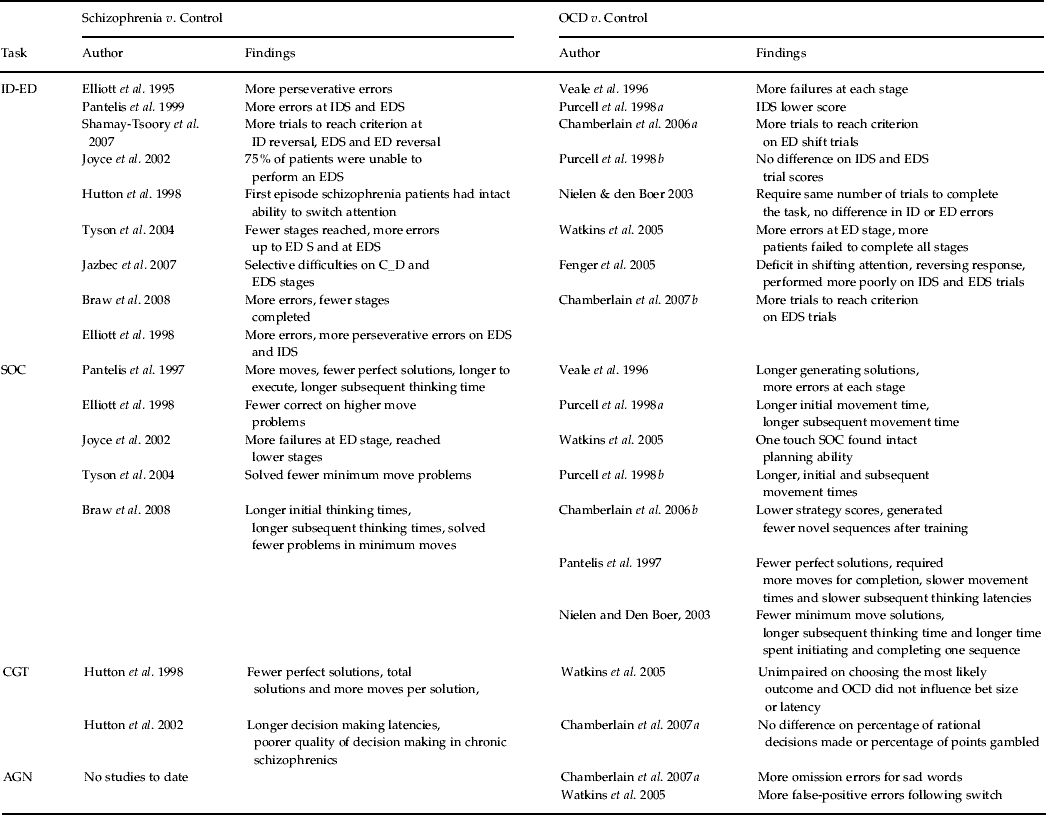
Neuropsychological assessment using standardized neuro-cognitive tasks with well understood neural underpinnings may be one way of evaluating the different neural contributions to schizophrenia with OCD. Patients with schizophrenia show deficits relative to controls across a wide range of neuropsychological domains including memory, language, attention and executive function (Fioravanti et al. Reference Fioravanti, Carlone, Vitale, Cinti and Clare2005). The Cambridge Automated Neuropsychological Test Battery (CANTAB) is a well-established computerized neuropsychological touch-screen test battery that examines a range of neuro-cognitive functions, including tests tapping the frontal lobes and their sub-cortical connections. To date no published literature exists on the use of CANTAB in schizo-OCD; however, patients with ‘schizophrenia only’ and ‘OCD only’ have been found to be impaired on tasks derived from the CANTAB (see Table 1), implying this battery has utility in evaluating this patient group.
Neuropsychological performance on CANTAB tests in patients with schizophrenia and OCD

CANTAB, Cambridge Automated Neuropsychological Test Battery; OCD, obsessive compulsive disorder; ID-ED, intra-extra dimensional set-shift task; IDS, intra-dimensional shift; EDS, extra-dimensional shift; ID, intra-dimensional; ED, extra-dimensional; SOC, Stockings of Cambridge; CGT, Cambridge Gamble Task; AGN, Affective Go-NoGo tasks.
The intra- and extra-dimensional (ID-ED) phases of the ID-ED set-shift test assess reversal learning and set-shifting respectively. In humans, the former task is thought to depend upon the integrity of orbitofrontal neuro-circuitry and, the latter, ventro-lateral prefrontal cortex circuits (Hampshire & Owen Reference Hampshire and Owen2006). Compared with healthy controls, patients with schizophrenia exhibit significant deficits that include high levels of perseverative errors on both elements of the task (Elliott et al. Reference Elliott, McKenna, Robbins and Sahakian1998; Tyson et al. Reference Tyson, Laws, Roberts and Mortimer2004; Ceaser et al. Reference Ceaser, Goldberg, Egan, McMahon, Weinberger and Gold2008). The Stockings of Cambridge (SOC; computerized version of Tower of London) task assesses planning and thinking and is thought to involve the dorsolateral prefrontal cortex. Patients with schizophrenia typically make fewer perfect solutions and more moves on the SOC task (Pantelis et al. Reference Pantelis, Barnes, Nelson, Tanner, Weatherly, Owen and Robbins1997; Elliott et al. Reference Elliott, McKenna, Robbins and Sahakian1998; Hutton et al. Reference Hutton, Puri, Duncan, Robbins, Barnes and Joyce1998; Tyson et al. Reference Tyson, Laws, Roberts and Mortimer2004; Braw et al. Reference Braw, Bloch, Mendelovich, Ratzoni, Gal, Harari, Tripto and Levkovitz2008). The Cambridge Gamble Task (CGT) of decision making and impulsivity is sensitive to the integrity of orbitofrontal neuro-circuitry (Rahman et al. Reference Rahman, Sahakian, Hodges, Rogers and Robbins1999; Rogers et al. Reference Rogers, Everitt, Baldacchino, Blackshaw, Swainson, Wynne, Baker, Hunter, Carthy, Booker, London, Deakin, Sahakian and Robbins1999; Murphy et al. Reference Murphy, Rubinsztein, Michael, Rogers, Robbins, Paykel and Sahakian2001). Patients with schizophrenia exhibit longer decision-making latencies and poorer decision making (Hutton et al. Reference Hutton, Murphy, Joyce, Rogers, Cuthbert, Barnes, McKenna, Sahakian and Robbins2002). The Affective Go/NoGo (AGN) task is also sensitive to orbitofrontal cortex function and assesses information-processing biases for positive and negative stimuli and response inhibition (Murphy et al. Reference Murphy, Sahakian, Rubinsztein, Michael, Rogers, Robbins and Paykel1999). We are not aware of any studies that have used the AGN task in patients with schizophrenia (for a review of the use of CANTAB in schizophrenia, see Levaux et al. Reference Levaux, Potvin, Sepehry, Sablier, Mendrek and Stip2007). The specificity of the purported relationships between task performance and the frontal lobes requires further examination in schizophrenia using imaging techniques. However, a meta-analytic review of imaging studies has confirmed the presence of ‘hypofrontality’ in schizophrenia patients, both for resting and cognitive challenge studies (see Hill et al. Reference Hill, Mann, Laws, Stephenson, Nimmo-Smith and McKenna2004).
OCD patients also show impaired performance on tasks associated with frontostriatal function. On the ID-ED set-shift task, deficits have been reported both on the intra- (Veale et al. Reference Veale, Sahakian, Owen and Marks1996; Purcell et al. Reference Purcell, Maruff, Kyrios and Pantelis1998a) and extra-dimensional set-shift phases (Veale et al. Reference Veale, Sahakian, Owen and Marks1996; Chamberlain et al. Reference Chamberlain, Blackwell, Fineberg, Robbins and Sahakian2006a). In the study by Chamberlain et al. (Reference Chamberlain, Fineberg, Menzies, Blackwell, Bullmore, Robbins and Sahakian2007b), extra-dimensional (ED) impairment was unrelated to symptom severity and endured despite treatment. Moreover, non-affected relatives exhibited the same abnormalities, suggesting a trait marker reflecting genetic vulnerability to OCD. Chamberlain et al. (Reference Chamberlain, Fineberg, Menzies, Blackwell, Bullmore, Robbins and Sahakian2007b) proposed that the inability to shift attentional focus may result in cognitive inflexibility and contribute to the generation of compulsive symptoms. Purcell et al. (Reference Purcell, Maruff, Kyrios and Pantelis1998a, Reference Purcell, Maruff, Kyrios and Pantelisb) found that compared with controls, OCD patients spent more time engaged in movements on the SOC test, suggesting motor initiation and execution problems, but they showed no increase in thinking latencies nor increased error rates. In contrast, Veale et al. (Reference Veale, Sahakian, Owen and Marks1996) reported that OCD patients spend more time generating alternative strategies following an incorrect move on the same task. Similarly, Chamberlain et al. (Reference Chamberlain, Fineberg, Blackwell, Clark, Robbins and Sahakian2007a) found the OCD group made more attempts to correct solution on the SOC task. A functional magnetic resonance imaging (fMRI) study using the SOC found poorer planning in OCD patients, which was associated with decreased dorsolateral prefrontal cortex and caudate nucleus activity when compared with controls (van den Heuvel et al. Reference van den Heuvel, Veltman, Groenewegen, Cath, van Balkom, van Hartskamp, Barkhof and van Dyck2005). Unlike patients with schizophrenia, however, individuals with OCD do not exhibit abnormal performance on the CGT (Watkins et al. Reference Watkins, Sahakian, Robertson, Veale, Rogers, Pickard, Aitken and Robbins2005; Chamberlain et al. Reference Chamberlain, Fineberg, Blackwell, Clark, Robbins and Sahakian2007a), although they make more omission errors for sad words than matched controls, suggesting a selective attentional bias toward negative stimuli (Chamberlain et al. Reference Chamberlain, Fineberg, Blackwell, Clark, Robbins and Sahakian2007a).
Given the literature outlined above, we might expect that compared with patients with schizophrenia, schizo-obsessive patients would perform significantly poorer on tasks tapping frontostriatal function (known to be impaired in OCD such as the ID-ED and SOC tests). We also expected to find no differences between schizo-obsessives and schizophrenics on tasks linked to orbitofrontal function (such as the CGT and AGN tests). Our secondary aim was to investigate if the degree of cognitive impairment correlated with clinical measures. Consistent with neuro-cognitive impairment holding trait rather than state marker status, we hypothesized that no correlation would emerge with severity of schizophrenia, OCD or depressive symptoms. Nonetheless, we did expect a positive correlation between neuro-cognitive impairment and severity of neurological signs as we hypothesized that the latter also represented a trait marker of illness.
Method
Participants
A total of 28 patients (22 male, six female) with a primary DSM-IV diagnosis of schizophrenia were recruited from a local National Health Service Trust. The patients were aged between 20 and 67 years [mean 37.7, standard deviation (s.d.)=11.7]. All had chronic schizophrenia and were medicated with the atypical antipsychotic clozapine. Patients who were unable to give informed consent or had current alcohol or illicit drug dependence or a history of head injury were specifically excluded. The 28 patients were categorized into two groups based on diagnosis using the Mini International Neuropsychiatric Inventory (MINI; Sheehan et al. Reference Sheehan, Lecrubier, Sheehan, Amorim, Janavs, Weiller, Hergueta, Baker and Dunbar1998) and careful screening for OCS by a psychiatrist experienced in the recognition and treatment of OCD using a detailed clinical interview supplemented by the Yale Brown Obsessive Compulsive Scale and Checklist (YBOCS; Goodman et al. Reference Goodman, Price, Rasmussen, Mazure, Delgado, Heninger and Charney1989a, Reference Goodman, Price, Rasmussen, Mazure, Fleischmann, Hill, Heninger and Charneyb). Patients who formed the schizo-OCD group (n=12) fulfilled DSM-IV criteria for schizophrenia and OCD; the remaining 16 patients had only a DSM-IV diagnosis of schizophrenia. The study was approved by the local ethics committee and all participants gave written consent to participate.
Clinical measures
All participants were administered the following clinical scales: MINI (Sheehan et al. Reference Sheehan, Lecrubier, Sheehan, Amorim, Janavs, Weiller, Hergueta, Baker and Dunbar1998); YBOCS (Goodman et al. Reference Goodman, Price, Rasmussen, Mazure, Delgado, Heninger and Charney1989a, Reference Goodman, Price, Rasmussen, Mazure, Fleischmann, Hill, Heninger and Charneyb); Clinical Global Impression Scale for schizophrenia (CGI-Sch; Haro et al. Reference Haro, Kamath, Ochoa, Novick, Rele, Fargas, Rodriguez, Rele, Orta, Kharbeng, Araya, Gervin, Alonso, Mavreas, Lavrentzou, Liontos, Gregor and Jones2003); Sheehan Disability Scale (SDS; Sheehan et al. Reference Sheehan, Harnett-Sheehan and Raj1996) and the Montgomery–Åsberg Depression Rating Scale (MADRS; Montgomery & Åsberg, Reference Montgomery and Åsberg1979).
Neurological measures included: Abnormal Involuntary Movement Scale (AIMS; Guy, Reference Guy1976); Simpson Angus Scale (SAS; Simpson & Angus, Reference Simpson and Angus1970); Neurological Evaluation Scale (NES; Buchanan and Heinrichs, Reference Buchanan and Heinrichs1989); Yale Global Tic Severity Scale (YGTSS; Leckman et al. Reference Leckman, Riddle, Hardin, Ort, Swartz, Stevenson and Cohen1989), Meta-cognition Questionnaire (MCQ-30; Wells & Cartwright-Hatton, Reference Wells and Cartwright-Hatton2004).
The MCQ-30 measures individual differences in a selection of meta-cognitive beliefs, judgements and monitoring tendencies.
Neuropsychological measures
Patients were administered the National Adult Reading Test (NART) (Nelson, Reference Nelson1982) and four tests from the CANTAB (see below), two of which were chosen to evaluate neuro-cognitive functioning believed to depend upon frontostriatal neuro-circuitry (ID-ED, SOC) and two to measure neuro-cognitive function subserved by orbitofrontal circuits (CGT, AGN). The order of the neuropsychological tasks was counterbalanced in each group.
Intra–extra dimensional set-shift task
During the conceptually crucial extra-dimensional shift (EDS) stage, divergent thinking is required in order to shift attention away from a previously correct stimulus dimension to a novel (previously irrelevant) one. The total number of errors on the ID-ED and the number of errors at the EDS stage were used as the principal measures of attentional set-shifting.
Stockings of Cambridge
The SOC assesses spatial planning and motor control and is essentially a version of the Tower of London task. The trial evaluates executive planning that involves placing balls in sockets to match a given pattern within a specified number of moves. A low score on the measure ‘number of problems solved in minimum moves’ reflects an individual's inability to plan ahead.
Cambridge Gamble Task
This task assesses impulse control, risk-taking behaviour and decision making. The participant is presented with a row of boxes across the top of the screen, some of which are coloured red and others blue. Participants start by guessing whether a token is hidden in a red or blue box. In the gambling stages, subjects are given 100 points and can place a bet on the location of the token (either rising or falling offers) based on their confidence. The ratio of red:blue boxes is manipulated to present different levels of uncertainty of winning and the aim is to accumulate as many points as possible. A higher score on the CGT risk-taking measure is indicative of more risk taking. The task also measures the average latency to make the decision when placing bets.
Affective Go-NoGo Task
The AGN assesses mood-processing bias. A series of words, either positive or negative, are rapidly presented in the middle of the screen. The participant is given a target category, e.g. positive, and is asked to respond whenever they see a word that matches the category. The AGN total omissions measure (e.g. failure to respond to sad words in sad word blocks) was used to measure response inhibition, where more errors would be indicative of motor impulsivity, i.e. an inability to inhibit motoric responses; mean correct latency was also recorded.
Statistical analyses
The distributions for all data were examined using the Kolmogorov–Smirnov statistic. Where normality could not be assumed, suitable transformations were applied (arcsine, log and square root) for proportional measures from the CGT and latency measures for the SOC and AGN tasks. All analyses were run with and without clozapine dose entered as a covariate; however, it made no difference to the pattern of results and the latter are reported here. The statistical tests were conducted with multivariate analysis of variance (MANOVA) using SPSS version 16 (SPSS Inc., USA). A conventional alpha value of 0.05 was used throughout our analysis.
Results
Clinical measures
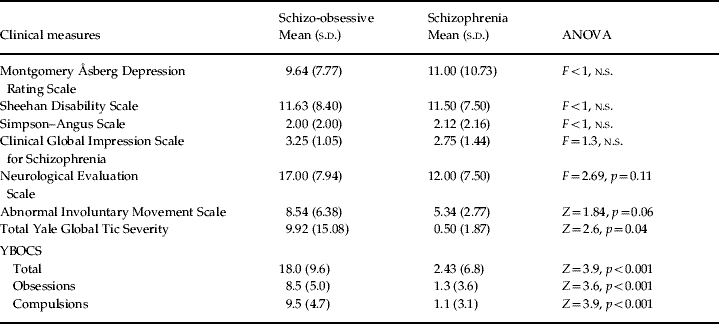
According to the CGI-Sch, the global severity of schizophrenia was assessed as mild–moderate in both groups with no between-group differences (values are given as mean±s.d.) (3.25±1.05 v. 2.75±1.44, F=1.3, n.s.). The YBOCS revealed a moderate severity of OCD in the schizo-OCD group when compared with the patients with schizophrenia alone (18±9.6 v. 2.4±6.7). The schizo-OCD group scored significantly higher than the schizophrenia patients for both their obsessive and compulsive ratings (see Table 2). MADRS (Montgomery & Åsberg, Reference Montgomery and Åsberg1979) scores (9.64±7.77 v. 11.0±10.73) indicate that neither patient group was clinically depressed. Patients with schizo-OCD were prescribed more SSRI, 50% v. 33.3%, but this was not significant [χ2=0.77(1), n.s.]. Similarly, there was no difference in usage of other anti-psychotics [χ2=0.13(1), n.s.], mood stabilizers [χ2=0.791(1), n.s.] or anti-muscarinics [χ2=0.05(1), n.s.] between groups.
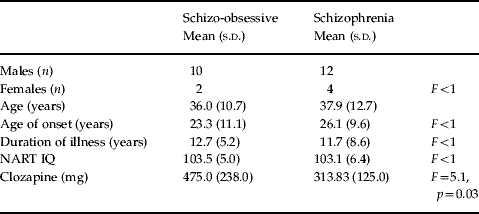
Clinical characteristics in schizo-obsessive disorder and schizophrenia

s.d., Standard deviation; NART, National Adult Reading Test.
The YGTSS score was significantly higher in schizo-obsessives than schizophrenia counterparts [YGTSS: F (1, 25)=5.84, p<0.02, ηp2=0.18]. No significant differences were revealed on the MADRS, SDS, SAS or NES (see Table 3).
Clinical measures for schizo-obsessive and schizophrenia groups

ANOVA, Analysis of variance; n.s., non-significant; YBOCS, Yale Brown Obsessive Compulsive Scale and Checklist.
Where variables had non-normal distributions, Mann–Whitney U tests were used.
Neuropsychological differences
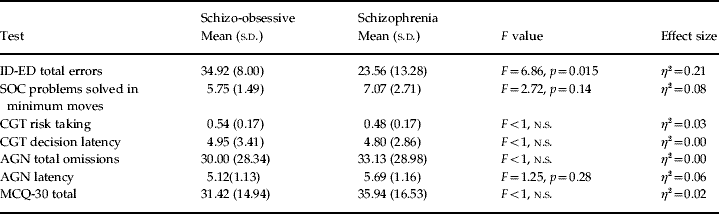
A MANOVA revealed one significant group difference (see Table 4) with schizo-obsessives, making significantly more total errors on the ID-ED task (F 1,26=6.86, p=0.015, ηp2=0.21: mean 34.92 v. mean 23.56).
Intra- and extra-dimensional performance
To investigate which elements of the ID-ED task were more difficult for schizo-obsessives, a MANOVA was conducted to test for differences in the number of errors made at each stage of the task between the schizo-obsessive and the schizophrenia groups (Fig. 1). We found a significant difference between the number of errors made specifically at the ED stage with significantly more errors made by the schizo-obsessive group (F 1,26=4.03, p=0.05, η2=0.13). There was no significant difference between the number of errors on the extra-dimensional shift reversal (EDSR) stage between the two groups (F 1,26=2.96, p=0.09).
(a) Mean intra- and extra-dimensional errors on each block for schizo-obsessive (sz-obs; –•–) and schizophrenia (sz; - - -□- - -) groups (error bars are standard error); (b) percentage of sz-obs (–•–; n=12) and sz (–▪–; n=16) patients passing each stage of the intra- and extra-dimensional task. sd, simple discrimination; sr, simple reversal; cda, compound discrimination adjacent; cds, compound discrimination superimposed; cr, compound reversal; ids, intra-dimensional shift; idsr, intra-dimensional shift reversal; eds, extra-dimensional shift; edsr, extra-dimensional shift reversal.

Performance on neuropsychological measures for schizo-obsessive and schizophrenia groups

For definitions of abbreviations, see Table 1; MCQ-30, Meta-Cognition Questionnaire.
Relationships between neuropsychological function and clinical symptoms
Correlational analyses revealed no evidence of a relationship between neuro-cognitive performance on the ID-ED and measures of schizophrenia symptom severity (CGI), depression (MADRS), or OCD (YBOCS) – all r <0.2, all n.s.
Relationships between neuropsychological function and neurological symptoms
In the schizo-obsessive group, correlational analysis revealed that increased severity of motor tics, as measure d by the YGTSS, positively correlated with CGT decision latency (r=0.65, n=11, p=0.03). There was no further evidence of a relationship between neuro-cognitive measures (ID-ED, SOC, CGT, AGN) and neurological measures (YGTSS, SAS, Barnes Akathisia Determination Scale, AIMS) in either group.
Discussion
As predicted, schizo-obsessive patients performed significantly poorer on the ID-ED set-shift task, which is thought to reflect frontostriatal function, though not on the SOC task, whereas no difference in performance was found between schizo-obsessives and schizophrenics on tasks thought to probe orbitofrontal function (CGT and AGN). Also, as expected, there was no correlation between ID-ED impairment and severity of schizophrenia, OCD or depressive symptoms, consistent with neuro-cognitive impairment holding trait rather than state-marker status. The two groups were well matched in terms of severity of schizophrenia, demographics, treatment and other clinical features, apart from motor tics. The absence of clinically relevant depression in either group minimized another possible confound. Thus, the observed differences in neuro-cognitive performance are probably attributable to the fact that one group had co-morbid OCD and the other did not. Motor tics were over-represented in the schizo-OCD group and were related to longer decision latencies on the CGT. We were unable to demonstrate a correlation between performance on other neuro-cognitive measures and severity of motor or neurological signs. A single significant correlation may simply reflect a chance finding. However, considering the results from the study by Watkins et al. (Reference Watkins, Sahakian, Robertson, Veale, Rogers, Pickard, Aitken and Robbins2005), in which patients with Tourette's syndrome showed greater impairment on decision-making tasks, compared with OCD and normal controls, such a result could have been expected and may represent a neuro-cognitive marker related to the presence of motor tics.
The patients in this study were taking clozapine, which is less likely than other antipsychotics to induce extra-pyramidal adverse effects that might confound neuro-cognitive performance. We judge that these factors are likely to have enhanced the validity and thus the generalizability of our results for this group of schizophrenia patients. Nevertheless, it is important to acknowledge that our results refer to antipsychotic-resistant cases that are receiving clozapine and they therefore cannot necessarily be generalized to all cases of schizophrenia. Additionally, an intriguing literature suggests that antipsychotics may actually induce obsessive symptoms in patients with schizophrenia (see reviews by Fineberg et al. Reference Fineberg, Gale and Sivakumaran2006; Mukhopadhaya et al. Reference Mukhopadhaya, Krishnaiah, Taye, Nigam, Bailey, Sivakumaran and Fineberg2009) and has been estimated to occur in as many as 46.4% of those treated with clozapine (Anil et al. Reference Anil, Turgut, Kabakci, Rezaki and Gogus2002, Galvez-Buccolini et al. Reference Galvez-Buccollini, Fiestas, Herrera, Vega-Dienstmaier, Guimas and Mazzotti2004). If this were to be the case, then we might infer that the obsessions and compulsions in our cases were not representative of archetypal OCD. This hypothesis, however, has yet to be substantiated in the context of a prospectively designed, controlled longitudinal study and is hard to integrate with other published data showing that antipsychotics produce anti-obsessional effects in schizophrenia and that adjunctive antipsychotics are clinically effective in treatment-resistant OCD. Moreover, we note that OCS were noted in patients with schizophrenia long before the advent of psychotropic medications (Berrios, Reference Berrios1989) and, as far back as Bleuler (Reference Bleuler1911), the similarities of delusions and obsessions were noted. All of our patients were medicated with clozapine (i.e. regardless of whether or not they exhibited OCD symptoms).
Other explanations for the high rates of OCD observed in clozapine-treated patients have also been put forward, including: that OCD is a naturally occurring sub-syndrome within the schizophrenia spectrum, i.e. schizo-obsessives who have a genetic liability for both schizophrenia and OCD (Poyurovsky et al. Reference Poyurovsky, Kriss, Weisman, Faragian, Kurs, Schneidman, Fuchs, Weizman and Weizman2003, Reference Poyurovsky, Weizman and Weizman2004; Kayahan et al. Reference Kayahan, Ozturk, Veznedaroglu and Eraslan2005); that treatment with atypical antipsychotics (such as clozapine) may unmask OCD previously hidden by schizophrenic symptoms (Ertugrul & Demir Reference Ertugrul and Demir2005); or that some, as yet unidentified, factor may predispose individuals both to OCD and to schizophrenia. Thus, greater levels of illness co-morbidity might be predicted in such patients. In a cross-sectional survey of 59 cases of clozapine-treated illness, Mukhopadhaya et al. (Reference Mukhopadhaya, Krishnaiah, Taye, Nigam, Bailey, Sivakumaran and Fineberg2009) did not find that the point prevalence of OCD (24%) was elevated in clozapine-treated cases compared with other antipsychotics. We note that inclusion of a matched OCD control group in this study might have shed light on this question by helping tease apart different neuro-cognitive aspects of these disorders.
Schizo-obsessives made significantly more ID-ED errors compared with a matched group with schizophrenia. Inspection of ID-ED errors at each of the nine stages showed schizo-obsessives separated from schizophrenics at the two most difficult stages of attentional set-shift, i.e. EDS, in which the relevant stimulus dimension alters, and EDS reversal, in which a rule learnt needs to be inhibited and reversed. The EDS stage is the critical stage of the ID/ED and is thought to represent the category shift in the Wisconsin Card Sorting Test (WCST) (Downes et al. Reference Downes, Roberts, Sahakian, Evenden, Morris and Robbins1989). The number of errors made at this stage represents attentional set-shifting ability.
There was no evident relationship between ED impairment and schizophrenia or OCD symptom severity, and the deficits endured despite treatment with SSRI in 74% of cases with schizo-OCD, implying trait rather than state-marker status. fMRI research evidence suggests ED shifting in normal volunteers involves ventro-lateral prefrontal cortex circuits, which are believed to subserve ‘cognitive flexibility’ or ‘cognitive inhibition’ (Hampshire & Owen, Reference Hampshire and Owen2006). One can hypothesize how deficits in cognitive flexibility are linked to OCD phenomenology (i.e. obsessions or compulsions) as OCD patients are unable to shift from one thought or action to another or stop thoughts entering their head unbidden. Hence, cognitive inflexibility may represent a candidate endophenotype, i.e. an inherited vulnerability factor for schizo-OCD. Evidence that set-shifting may act as a neuro-cognitive endophenotype for schizophrenia per se comes largely from the WCST and is somewhat mixed, with unaffected relatives of individuals with schizophrenia not consistently manifesting poorer WCST performance than controls (Kremen & Hoff, Reference Kremen, Hoff, Stone, Faraone and Tsuang2004). Similar negative findings from the ID-ED task in schizophrenic patients without documented OCD, recently reported by Ceaser et al. (Reference Ceaser, Goldberg, Egan, McMahon, Weinberger and Gold2008), cast further doubt on ED shift deficits representing a familial trait marker for schizophrenia and imply such impairment relates to the co-occurrence of OCD.
This is the first study to examine ID-ED shifting in schizo-OCD. Impairment in ED set-shifting has been identified in tic-free OCD patients with predominantly washing and checking rituals and their unaffected first-degree relatives (Chamberlain et al. Reference Chamberlain, Blackwell, Fineberg, Robbins and Sahakian2006b, Reference Chamberlain, Fineberg, Blackwell, Clark, Robbins and Sahakian2007a, Reference Chamberlain, Fineberg, Menzies, Blackwell, Bullmore, Robbins and Sahakianb) and in patients with OCD plus obsessive compulsive personality disorder (Fineberg et al. Reference Fineberg, Sharma, Sivakumaran, Sahakian and Chamberlain2007). Our findings are also consistent with results reported by Watkins et al. (Reference Watkins, Sahakian, Robertson, Veale, Rogers, Pickard, Aitken and Robbins2005), who identified selective ED deficits in OCD outpatients, and Veale et al. (Reference Veale, Sahakian, Owen and Marks1996), who found that OCD in-patients made more errors than controls on multiple stages of the ID-ED task. Further exploration of ID-ED performance in unaffected relatives of schizo-OCD probands may help clarify whether ED shifting represents an inherited vulnerability factor for an obsessive compulsive syndrome occurring in combination with schizophrenia.
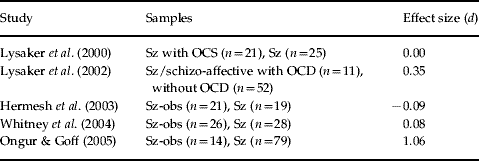
Previous neuropsychological studies into schizo-OCD have used the WCST as a test of attentional set-shifting. A survey of the literature identified five relevant studies (totalling 80 schizo-obsessives and 149 schizophrenics; see Table 5) and the effect sizes reveal that schizo-obsessives sort fewer WCST categories than schizophrenics. Nevertheless, the mean effect size was small (d=0.20, 95% confidence interval −0.02 to 0.50) and non-significant, almost certainly because of the limited number of studies (K=5) in the meta-analysis and because only one study produces a large effect (Ongur & Goff, Reference Ongur and Goff2005).
Mean effect sizes of WCST categories completed from neuropsychological studies in schizo-OCD

WCST, Wisconsin Card Sorting Test; schizo-OCD, schizophrenia and co-morbid obsessive compulsive disorder.
The WCST can be criticized for its non-specific nature, tapping a wide range of other neuro-cognitive processes aside from attentional set-shifting, such as error-based learning, feedback processing and working memory (Laws, Reference Laws1999). In this respect, we believe the ID-ED task represents a more specific test of attentional set-shifting that has been anatomically localized, at least in normal volunteers, to circuits involving the ventro-lateral prefrontal cortex (Hampshire & Owen, Reference Hampshire and Owen2006). The findings from this small meta-analysis, however, suggest a similar pattern of deficits to that found in our study, thereby providing further support for a more severe set-shifting deficit signifying a cognitive marker in schizo-OCD patients. Nevertheless, we also note that like WCST performance, performance on the ID-ED set-shifting task is related to current intellectual functioning (for a review, see Laws Reference Laws1999). Although our two patient groups were matched on estimated pre-morbid NART IQ, we cannot eliminate the possibility that the schizo-obsessive group had undergone a greater deterioration in current IQ.
Tics, which commonly occur together with OCD, were a clinical sign that differentiated schizo-OCD from schizophrenia with higher scores for motor tics observed on the YGTSS, representing greater severity of tic-related disorder compared with the schizophrenia group. Additionally, we found a trend difference for abnormal involuntary movements being greater in the schizo-obsessive group. Our findings, therefore, accord with previous studies that have found evidence for more severe motor impairment in the schizo-OCD profile (Kruger et al. Reference Kruger, Braunig, Hoffler, Shugar, Borner and Langkrar2000; Ohta et al. Reference Ohta, Kokai and Morita2003; Mukhopadhaya et al. Reference Mukhopadhaya, Krishnaiah, Taye, Nigam, Bailey, Sivakumaran and Fineberg2009).
What do our results say about the nosology of schizo-OCD? Compared with patients with schizophrenia, patients with schizo-OCD showed more severe deficits limited to domains previously reported for non-co-morbid OCD. Our study, therefore, suggests a neuro-cognitive overlap between OCD and schizophrenia and a ‘true’ co-morbidity of two separate disorders. Application of a wider range of tests in future studies may identify additional neuro-cognitive features that are unique to schizo-OCD, which would challenge this concept. Our results also suggest that the neuro-cognitive profile associated with tic-related OCD co-morbid with schizophrenia resembles that reported for the ‘archetypal’ form of OCD (washers and checkers without tics) (Chamberlain et al. Reference Chamberlain, Blackwell, Fineberg, Robbins and Sahakian2006a, Reference Chamberlain, Fineberg, Blackwell, Clark, Robbins and Sahakian2007a, Reference Chamberlain, Fineberg, Menzies, Blackwell, Bullmore, Robbins and Sahakianb), i.e. ED shifting appears a fundamental aspect of OCD in a variety of phenotypic forms. Such an overlap has important implications for understanding the neurobiology of this complex, disabling disorder and generating new pharmacological and psychological treatment targets. Future research, using larger cohorts, may further tap the richness of schizo-OCD pathology by expanding into other key neuropsychological areas known to be implicated in schizophrenia and OCD, such as memory, motor impulsivity and affective processing.
Conclusion
Using specific tests of neuro-cognitive processing, we have demonstrated that schizophrenia patients with OCD exhibited significantly greater impairment on a task of attentional set-shifting (extra-dimensional set-shift) compared with a matched group of schizophrenia patients without OCD. Consistent with previous studies, our findings implicate impaired set-shifting, representing cognitive inflexibility, as a candidate trait marker for schizo-OCD.
Acknowledgements
We would like to thank senior nurse Karen Reddy and administrators Chris O'Brien and Kim Fox from the Clozapine clinic in Welwyn Garden City for their contribution to the smooth running of the study; and to Dr David Hart and Cambridge Cognition for their support in providing CANTAB for the project. Devina Patel conducted this research in part fulfilment of the MSc Research Methods in Cognitive Neuropsychology at the University of Hertfordshire.
Declaration of interest
None.