1. Introduction
A large literature, both theoretical and empirical, looks at informal contract governance in historical contexts and developing country settings (Dixit, Reference Dixit2003; Reference Dixit2009). A central concern is identifying conditions under which relation-based governance, ‘whereby most transactions are based on personal and implicit agreements, and the state is generally not able to enforce contracts impartially’ (Li, Reference Li2003), allows effective enforcement of contractual or specified rights. In contrast to relation-based governance stand rule-based governance systems, ‘when most transactions are based on impersonal and explicit agreements, and the state can impartially enforce contracts’ (Li, Reference Li2003: 655).
An important finding in both the theoretical and empirical literature is that there are limits to the size of the market within which relationship-based forms of contract governance are effective (Dixit, Reference Dixit2003; Kandori, Reference Kandori1992). Dixit (Reference Dixit2003) and Li (Reference Li2003) explain this through small or negligible fixed costs: Start-up costs for a business are next to nothing because the earliest partners are close acquaintances, even family. At the same time, the marginal costs of relation-based systems are high and increase with network size. Transaction costs and costs of monitoring second-party activity increase disproportionately as trade expands to incorporate unknown, more distant, agents. Dixit (Reference Dixit2009) and Landa (Reference Landa1981) generalize these ideas to the concept of distance, howsoever understood as geographic, ethnic or socio-economic. In this theoretical framework, honesty is self-enforcing only if agents are sufficiently close neighbors.
Although ‘self-enforcement’ of implicit contracts (Dixit, Reference Dixit2009) can occur through bilateral mechanisms between contracting parties, multilateral reputation-based mechanisms have received far more attention. Summarizing evidence from several studies from Sub-Saharan Africa, Fafchamps (Reference Fafchamps, Aoki and Hayami2001) shows that personal trust, often based on long-standing relationship-based networks of various kinds, helps facilitate exchange. One of the earliest studies of this phenomenon proposes an especially pure form of such networks in terms of ethnically homogeneous middleman groups (Landa, Reference Landa1981).
Against the backdrop of this literature, this paper studies an urbanized and expanding market setting with pervasive entry of new agents, in this case, migrants from rural areas, that illustrate how new agents are incorporated into trust networks. The cycle-rickshaw rental market serves as a useful case study to consider questions surrounding contract enforcement under the conditions that favor relationship-based contract governance. The question arises: How does relationship-based contract governance function when new agents must be incorporated into exchange networks?
In many cities in India, the cycle-rickshaw is a ubiquitous form of local public transport. While few rigorous estimates of sector size as a whole are available, either on a national or city level, the workforce it employs appears to be sizeable.Footnote 1 The driver either owns the rickshaw he drives, or rents it from a garage, a roadside establishment that owns anywhere from 5 to 500 cycle-rickshaws and rents them out for nominal daily fees. The driver retains his earnings, while the garage maintains the rickshaw and may store it overnight.
The contract enforcement issues that obtain in this rental market belong to the larger class of problems of ‘enforcing claims in exchange’ (Bowles and Gintis, Reference Bowles and Gintis1993). However, the market has some peculiar features that taken together call into question the mechanisms of contract enforcement described in the new institutional economics literature. First, central to the puzzle presented by the rickshaw rental market is the non-viability of rule-based third-party enforcement of contracts. Municipal regulations in many Indian cities, including those applicable at the site of this study, restrict ownership to drivers alone, weakening the property rights regime for the rental market (Sood, Reference Sood2012). This means that rule-based, third-party enforcement of contracts through the state is not possible, because the market is illegal under existing municipal laws.
Multilateral mechanisms such as community sanctions where community members are able to share ‘local’ information and punish defaulters also represent one of the ‘forms of relation-based third-party enforcement’ (Li, Reference Li2003: 656). Reputation mechanisms are key to third-party enforcement of this kind. However, existing studies of multilateral self-governance through community sanctions generally highlight information flows.Footnote 2 In the empirical setting of Kenyan–Asian businessmen, Biggs et al. (Reference Biggs, Raturi and Srivastava2002) note information sharing even among putative competitors. However, we found little evidence of such information sharing in the case of the Bilaspur cycle-rickshaw rental market, and thus reputation-based multilateral mechanisms for contract enforcement are also rendered ineffective.
Thus, the cycle-rickshaw rental market offers a useful case study of how bilateral mechanisms of relationship-based contract governance function as markets expand to incorporate new agents. In particular, in contrast to previous studies of similar rental markets, which have focused on contract choice, this paper focuses on partner choice in issues of bilateral relationship-based contract governance.
Our approach can be contrasted for example to the context of the jeepney market in the Philippines, where Hayami et al.’s (Reference Hayami, Kikuchi and Otsuka1986) pioneering paper showed that, as community relationships enforcing contracts become weaker, contracts shift from share to pure rental contracts. Another study of agricultural land rental markets in the Dominican Republic showed that insecure property rights favor matching along socio-economic lines, limiting the size of the market and choice of rental partners (Macours et al., Reference Macours, de Janvry and Sadoulet2010). Due to municipal laws that limit ownership, the rickshaw market under study shares features of a weak property rights regime with the Macours et al. (Reference Macours, de Janvry and Sadoulet2010) study. However, our focus is on the resulting effect on partner choice in rental contract enforcement.
Given the risk of default on principal, i.e., theft, as well as on rental payment, it is also useful to understand this market in comparison with informal credit markets. Indeed, informal credit markets offer a useful real-world illustration of the contract governance issues that arise in the context of relationship-based exchange. Information imperfections and asymmetries tend to be rife in informal credit transactions, especially in agrarian settings. The literature suggests that this leads to various forms of credit rationing and limitations on market size (Aleem, Reference Aleem1990; Hoff and Stiglitz, Reference Hoff, Stiglitz, Hoff, Braverman and Stiglitz1993). Being informationally ‘opaque’ (BenYishay, Reference BenYishay2012), migrants are especially liable to face credit rationing. In a rare study of credit access for migrants in developing countries, BenYishay (Reference BenYishay2012) shows how formal markets ration credit to migrants in Guatemala. Moreover, the predominance of relationship-based forms of contract enforcement in informal credit markets is also well known to favor incorporation of ‘near’ agents, regardless of whether distance is measured in geographic, ethnic or socio-economic terms (Dixit, Reference Dixit2009; Landa, Reference Landa1981). La Ferrara (Reference La Ferrara2003), for instance, has shown that kin groups are central to the operation of credit markets in Ghana.
In contrast to this literature, we find that the cycle-rickshaw sector registers the large presence of migrant drivers, many of whom are temporarily or seasonally engaged in the occupation (Kishwar, Reference Kishwar2006; Sood, Reference Sood, Sridhar and Wan2013). It is possible to parse a number of different mechanisms to comprehend this seeming empirical anomaly. From the perspective of the migrant cycle-rickshaw driver, the rental transaction provides a cheap form of productive capital that is in many ways superior to ownership. Not only does it help bypass the need for formal or informal sources of credit, it also helps minimize storage and maintenance costs that are disproportionately higher for migrants.
However, we argue that given the informal credit nature of the rental transaction, the migrant driver's preference for rental contracts is not sufficient to explain the higher rates at which migrants select into the rental contract. From the point of view of the cycle-rickshaw owner, severe contract enforcement issues, similar to those found in credit transactions, affect the rental market. The rickshaw owner faces risk of default both with respect to principal, i.e., theft, as well as on rental payment. Even though cases of actual theft are not very common, its possibility is a guiding factor in the garage owner's decisions. Thus, we should expect to find that as in informal credit markets, distant agents such as migrants are rationed out of the market.
In contrast to this literature, the central and surprising finding of our study is that migrants, especially temporary migrants, are far more likely to participate in rental contracts than local, resident drivers, a feature that has been noted in previous accounts of the market (Kishwar, Reference Kishwar2006). Our analytical framework relies on a differential penalty for default that is higher for migrants than for locals. In light of this differential, garage owners prefer to rent to migrants, especially those with stronger attachment to their place of origin.
We draw on primary data collected from a sample of rickshaw drivers and garage owners in the central Indian city of Bilaspur to corroborate our analysis. We develop a multidimensional measure of migrant status, recognizing the variation in degree of affiliation with local networks. Qualitative interviews suggested the noticeable impact of seasonal and commuter migrants in the cycle-rickshaw rental market. So we take the multiple aspects of migration seriously and analyze the migrants’ distance from the place of origin, the frequency of visits home and the length of time since migration as distinct measures of migration status, since each has different implications for rental and ownership behavior. We specify a test for the determinants of renting with particular attention to these multiple dimensions of migrant characteristics.
Note that since our analytical approach incorporates both demand-side and supply-side aspects of differential migrant and local resident behavior through differential costs of ownership and a differential penalty for default, the reduced form empirical specification does not aim to distinguish between these explanations. Instead, we build an analytical narrative arguing that migrant status indeed determines rental participation, with reasonable controls for other possible explanations such as access to credit. Our econometric tests and associated findings strongly suggest that garage owners are indeed more likely to rent cycle-rickshaws to migrants compared to locals.
This paper contributes to a number of literatures. The role of social networks in incorporating rural migrants into urban informal activities has been widely documented (Banerjee, Reference Banerjee1983; Mitra, Reference Mitra, Guha-Khasnobis and Kanbur2006; Schmidt-Kallert, Reference Schmidt-Kallert2009). Yet, the precise mechanisms through which migrants access credit and productive capital remain little understood. Our findings introduce a new perspective into current understandings of how relationship-based contract enforcement works.
Finally, this paper fills gaps in a number of policy-relevant literatures. We offer an explanation for the widely recognized presence of migrants in urban informal self-employment (Fields, Reference Fields1975; Mitra, Reference Mitra2002), by pointing to the role of rental markets for productive assets such as the cycle-rickshaw in helping ease credit access constraints for migrants.
The paper is organized as follows. The next section presents an analytical framework that explains the incorporation of migrants into rental market using key stylized facts about the market. Section 3 describes the setting and presents findings from a bivariate analysis on the participation of migrants in rental markets. Section 4 explains the empirical specification and strategy used in this analysis. Section 5 discusses the findings and their implications, offers conclusions and suggests directions for future research.
2. Participation in rental markets
This section lays out an analytical framework outlining the mechanisms that allow migrants, and especially temporary and seasonal migrants, to be incorporated into the cycle-rickshaw rental market. The key feature of this framework is that it accounts for the conditions on both sides of the market. As with Greif (Reference Greif1993), this framework uses a parsimonious set of assumptions that do not depart substantially from the empirical evidence.
So how do relation-based contract enforcement mechanisms operate in an urban context with the influx of new agents without pre-existing network affiliations (Fafchamps, Reference Fafchamps1996)? We argue that the penalty for default is higher for migrants than for locals, and recognizing this, garage owners prefer to rent to migrants, especially those with stronger attachment to their place of origin. Rickshaw drivers that are more ‘migrant’ are more likely to participate in the cycle-rickshaw rental contract. The Appendix contains a formalization of the model described here.
Three stylized facts or features of the cycle-rickshaw rental market inform this analysis. First, migrant status is seen as a multidimensional (continuous) variable to allow for variation in the degree of attachment to the place of origin seen in the data. Second, we argue that ownership of the rickshaw imposes costs, and these are higher for migrants than locals. Most important, our framework distinguishes between an ex ante and ex post concept of risk through a differentiated penalty on default for migrants and locals. We argue that contrary to intuition, migrant drivers represent a lower ex post risk of default to garages. Each of these features and the associated empirical patterns seen in the qualitative and quantitative data are discussed in greater detail below.
Migrant status and costs of ownership
The empirical evidence presented below indicates that migrant status is a multidimensional variable that reflects a matter of degree rather than kind. For example, while some long-time local residents retain village ties, other recent migrants have severed all connections to their place of origin. Closer ties to the place of origin may increase storage costs during visits home for instance, as well as allow a continuing connection to the rural and agricultural economy. In practical terms, the cost of ownership can represent the cost of storing the cycle-rickshaw, which is higher for migrants. Appendix A presents a formalization of this idea.
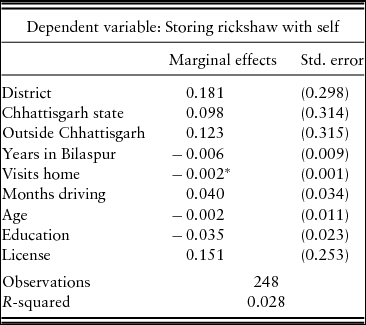
Table 1 reports results from a probit specification that examines the determinants of the likelihood of storing the rickshaw with the driver himself, with the sample limited to renters in our dataset. We find that the frequency of trips home is the only significant driver of storage decisions, with more trips negatively correlated with the likelihood of self-storing rickshaws. An interesting observation is that place of origin per se is not significantly correlated with self-storage.
Rickshaw storage

Notes: This table shows the determinants of self-storing rickshaws obtained from estimation of the following equation:storage i = β0 + β1Ω i + β2migrantyears i + β3visitshome i + β4monthsdriving i + β5 X i + μ i . The dependent variable is 1 if the driver stores the rickshaw overnight with himself and 0 otherwise. The duration of migration (migrantyearsi), the number of months spent driving each year (monthsdrivingi) and whether the driver holds a license show the driver's attachment to the profession and might affect storage. *p < 0.10, **p < 0.05, ***p < 0.01.
Source: Primary survey data.
Risk of default
Interviews with the garage owners as well as the garage study revealed the levels of prevalence of theft as well as rental default. Theft was not common, but most interviewed garage owners could recall instances of their cycle-rickshaws, or parts thereof, being stolen. The owner of one of the larger garages said that he operated on the assumption that a cycle-rickshaw would be stolen every 2 years. Resort to third-party enforcement mechanisms, i.e., the police or court of law, was rarely an option in these situations. As this garage owner noted, ‘whatever our loss may be, it won't get recompensed; instead more expenses might be added, whether donating to the policeman, expenditure on petrol and our own headache’.
Rental default was far more common. Once again, appeal to police was not an option. One garage owner reported, ‘say, if the driver hasn't paid rent for a month or two, the police will say, did you ask [us] before renting it out?’ It is notable that the process of referral by which new drivers were introduced to garage owners entailed no ‘guarantee’ or liability. One garage owner described the process this way: ‘Say I have an old driver, and he brings in someone and says this is someone I know. So I give the rickshaw. They drive the rickshaw for a month or so, and then leave it somewhere, in the railway station for example and run away. I turn to the old driver, but he will say, I knew this guy, he seemed fine’.
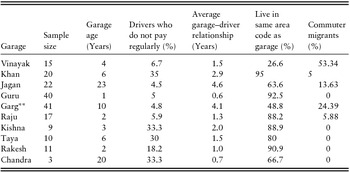
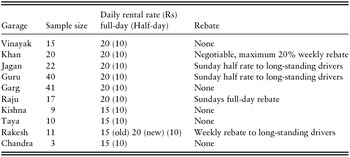
Moreover, interviews with garage owners, as well as garage study data reported in Table 2, suggested that some of them were willing to overlook default in hope of a promise for future payment. One garage owner described the lack of options this way, ‘We give about two to three chances. If they are more than Rs 1,000 in default, then we won't give them the rickshaw. Sometimes they come with reasons, say wife fell sick, or didn't have enough to eat, or some reason and we have to forgive. . .Beating is against the law so we'll get into trouble. The police will come after us, because we are better off. Same with verbal abuse, they are illiterate, they'll say anything’.
Rickshaw drivers and garages

Notes: Names of the garages have been anonymized. **Garg provides residential facilities for migrants drivers.
Source: Garage study data, Sood (Reference Sood2008).
Here, some of the patterns seen in Table 2, which presents data from the garage study described in the next section, become relevant. Interestingly, garages that catered in larger measure to drivers who lived in close proximity reported higher rates of default than those that catered to commuter and seasonal migrants.
Ex ante and ex post trust
To disentangle the relationship of risk of default with migration status, note that a priori the garage owner can be expected to have a higher level of trust with the local resident, given multiple direct and indirect personal links through the neighborhood network. As discussed above, evidence from studies of contract enforcement in a variety of developing markets suggests that exchange tends to be limited to such personalized network connections in relation-based contracting due to the advantages of information sharing and monitoring (Landa, Reference Landa1981).
In the urban environs of this market, the most salient networks are those of locality. To a large extent, networks of caste overlap with spatial or neighborhood networks. In a large study of Delhi slums, Mitra (Reference Mitra, Guha-Khasnobis and Kanbur2006) evaluated the role of different kinds of networks in the urban labor market, including caste, kinship and ethnicity bonds as well as more formal NGO and employment exchange networks. He showed that these networks tend to be localized, leading to the labor market becoming segmented.Footnote 3
We argue that the risk associated with migrant rickshaw drivers is moderated by countervailing factors. Indeed, as Table 2 shows, a number of garages in our study catered specifically to commuter and seasonal migrants. To understand this seeming contradiction, note that a migrant rickshaw driver's entry into the rental contract, to a far greater extent than the local driver's, is regulated through referrals by mutual acquaintances.
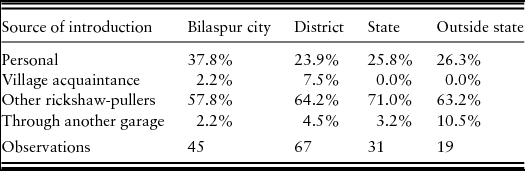
Drawing on data from the garage study, Table 3 shows that compared to Bilaspur city drivers, much smaller percentages of drivers from outside Bilaspur city were personally acquainted with the garage owner before renting. Equally reliance on other drivers for introduction to the garage was reported by larger percentages of migrant drivers. Thus, to the extent that migrant rickshaw drivers have a smaller network of such acquaintances, they are restricted to a much smaller set of garages from where they may hire a rickshaw.
Introduction to garages

Note: This table shows the correlation between migration source and how rickshaw drivers are introduced to their current garage.
Source: Garage study data.
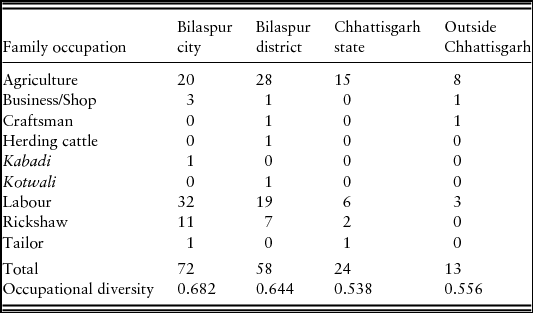
Moreover, migrants also have far fewer outside occupational options compared to residents. As one proxy, consider the range of family occupations for city residents compared to migrants. Table 4 shows much greater occupational diversity among city residents, primarily because city residents also have the option of working as laborers (distinct from agriculture laborers).
Family occupation by migrant type

Notes: Occupational diversity is 1 − ∑ N i sij 2, where sij is the share of occupation i for migrant status j. If occupational diversity is 0, then all drivers of that migrant-type have the same family occupation, and vice versa.
Source: Driver survey data.
As a result, defaulting at any given garage may bar the migrant's access to the rickshaw rental market more comprehensively than it would a local rickshaw driver with a larger network of potential referrals.
This cost is a differential penalty based on migrant status that is known to both garage owners and rickshaw drivers. Our conceptual framework combines these ex ante and ex post notions of default risk.
Rental rate and selection
The mechanism by which migrants can potentially access fewer garages in our case study can be understood as a form of ‘lock-in’ (McMillan and Woodruff, Reference McMillan and Woodruff1999). This lock-in is determined not by specialization or number of competitors, but by the size of the network each driver can access and their occupational options.
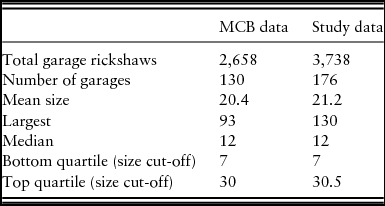
Note that our explanation does not rely on information sharing that underlies multilateral contract enforcement. Indeed, we have argued that information sharing channels in this market remain weak. Part of the explanation may be found in Table 5, which shows the long left tail of the garage size distribution. The median garage owns only about 12 rickshaws. Moreover, these garages are widely dispersed across the city (Sood, Reference Sood2008), and in the absence of an organizational platform, deter information sharing.
Garage data

Note: Differences between MCB and study data are explained partly by underreporting of rickshaws at garages listed with MCB, and partly by garages located outside the municipal boundaries of the MCB.
Source: 2002–03 data from the Municipal Corporation of Bilaspur combined with study data.
Migrant drivers who have fewer outside options thus face a higher penalty for default, and thus are more likely to participate in the rental contract. While our data pertains to only one period of time, the qualitative evidence from our garage study does suggest that this initial segmentation is overcome as migrants are absorbed into the market and can move between garages. Our findings closely parallel the theoretical model proposed by Basu and Bell (Reference Basu and Bell1991) of fragmented duopoly with local drivers representing a contested segment and migrants representing the captive segment (Basu, Reference Basu1997; Mishra, Reference Mishra1994).
However, while these models predict price discrimination, given the stylized features described above, our framework predicts a single rental rate in the presence of default risk and migrants. Once again, this finding flows from the evidence on explicit price discrimination on the basis of migrant status, which is decidedly mixed. This is not because the migrant status of the rickshaw driver is not ex ante evident to the garage owner, which would make price discrimination difficult. Interview data shows that garage owners indeed have prior information about the migration status of the rickshaw drivers they transact with, though it is not perfect. To the extent that migrant status is not a binary indicator, the degree of ‘migrantness’ may not be easily gauged. For instance, a local may not disclose the number of visits he makes to the place of origin. Nonetheless, garage owners do appear to be broadly informed about which drivers are commuters or seasonal participants in the cycle-rickshaw market.
While explicit rental rates are often fixed by rental period, garage owners do in fact allow for bargaining on a range of other parameters that may indicate some form of price discrimination, for instance, rebates, payment periods and rental periods, as Table 6 shows. But even garage owners who admitted to offering rebates on the basis of length of association did not list migrant status as a factor in price discrimination. One possible explanation is that given the pattern of referral for new drivers, it is difficult for the garage owner to discriminate given the possibility of information sharing between the introducer and the new driver.
Price variation

Source: Garage study data.
With these conditions, the formalization of this framework presented in the Appendix suggests that for any given rental rate, migrants are more likely to rent than locals. Although our simple one-period model does not explicitly take account of the migrant driver's decision to make return visits to the place of origin, it is worth noting that our model takes account of incentives on both sides of the rental transaction, i.e., the factors that may encourage migrants to prefer renting over owning, but also the garage-owner's contract enforcement problem. Furthermore, our analysis below addresses and controls for other channels that may affect the selection of migrants into rental contracts, such as differential access to formal credit channels.
3. Market context
Setting and study design
The field study that informs the findings in this paper was conducted in the central Indian city of Bilaspur. Situated in the state of Chhattisgarh, which was carved out of the larger state of Madhya Pradesh in November 2000, Bilaspur is the second largest city in the state. It is the seat of the state's High Court, as well as headquarters of a district by the same name.Footnote 4
Like much of the urban informal sector, baseline data on the cycle-rickshaw sector in Bilaspur was difficult to obtain. Matters were complicated by the de jure illegality of the market. As in several other Indian cities (Singh, Reference Singh2000), the Madhya Pradesh Ordinance 20 of 1984 (applicable at the time of the study) mandated that subject to certain minor exceptions, ‘No person shall keep or ply or hire a cycle rickshaw. . . unless he himself is the owner thereof’.
The law was weakly enforced, however, and the Officer-in-charge of the Rickshaw and Tonga department of the Municipal Corporation of Bilaspur (MCB) issued permits for rickshaw ownership for a small fee and thereby maintained a limited register of garages. We supplemented this data with a census of garages, whose findings are summarized in Table 5 above.
Given the absence of baseline data, semi-structured interviews with garage owners and rickshaw drivers as well as discussions with rickshaw drivers helped establish key institutional features and stylized facts about the market (Rao, Reference Rao2002; Udry, Reference Udry2003). We were then able to follow-up on these in the design of the quantitative survey component of the study. In all, the study included four components: (1) semi-structured interviews with garage owners and rickshaw drivers, (2) focus group discussions with cycle-rickshaw drivers in two major slum settlements in the city, (3) a garage study of rental transactions at a randomly selected sample of ten garages and (4) a survey administered to rickshaw drivers chosen through an intercept sampling approach. Such a mixed methods design was key to uncovering features of market governance and migration patterns as well as building an analytical narrative (Sood, Reference Sood2008).
A key issue to emerge from the qualitative data was the numerical strength of temporary migrants. Both small and large garage owners reported seasonal migration patterns from nearby states such as Madhya Pradesh and Orissa. A subset of garages rented predominantly to commuter migrants from rural areas surrounding Bilaspur.
Capturing such transient populations in household surveys is notoriously difficult (Dasgupta, Reference Dasgupta2003). Instead, intercept point sampling methods, also called time-and-space sampling methods, can be more successful and cost effective at reaching such hidden populations (Kalton, Reference Kalton2001; McKenzie and Mistiaen, Reference McKenzie and Mistiaen2009). In an intercept point survey, individuals in the target group are sampled during set time periods at a pre-specified set of locations where they are likely to congregate. In this case, we approached drivers at different times of the day over a week at the railway station, the interstate bus terminal and a sample of randomly selected rickshaw stands as they waited for customers. We then surveyed a randomly selected sample of congregated drivers.Footnote 5
Using this approach, we obtained data from 645 drivers in December 2003. In January 2004, the same team of investigators administered a longer survey to a smaller sample of some 176 respondents. The questions in this round were taken from a large-scale survey of rickshaw drivers in the entire National Capital Region (which includes Delhi and the larger surrounding area) conducted over 2000–02 by the Jan Parivahan Panchayat (JPP) (2003). The combined sample yields 821 independent observations.
We also conducted a garage study of rental transactions at 10 garages, stratified by size and type. This garage study focused on rental transactions in a random sample of 10 garages, stratified by size. Using a listing of garages provided by the MCB, four categories were defined: large (over 30 rickshaws), medium (16–30 rickshaws) and small (less than 15 rickshaws). An additional category of ‘residential’ or ‘hostel’ garages provided boarding and lodging to commuter migrants. An independent census of garages provided the final sampling frame, given the incompleteness of the MCB list. Table 5 describes the sampling frame used and the size distribution of garages.
Obtaining survey responses from both the cycle-rickshaw driver as well as the garage owner to a specially developed questionnaire at the time of the transaction helped pick up and probe less tangible aspects of the garage functioning that were not revealed in response to survey questions, such as attitudes to use of coercion, as well as variations in payment period and default rates. Data from this garage study is described in Tables 2, 6, 8, 9 and 10.
Not discussed in this data summary are a rich array of family and personal variables such as schooling, marital status, children's schooling, housing, health status, work effort and fatigue threshold that capture subjective measures of drivers’ welfare.
Data and descriptive statistics
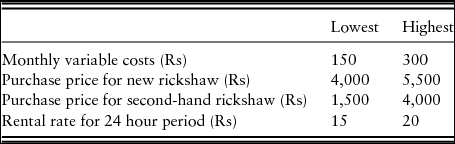
Table 7 provides an estimate of rickshaw purchase prices and costs of ownership obtained from these interviews. The rental rate ranges between Rs 15 to Rs 20 for a 24-hour rental period.
Capital requirements

Notes: (1) Monthly variable cost include spare part maintenance and replacement costs but does not include mechanic's salary or labor charges, even where applicable. Per month salary for mechanics hired by garage owners range from Rs 1,500–3,000. (2) Garages do not report the implicit cost of storage since most of the garages operate on encroached land owned by the government. (3) In absence of accounts, garage owners reported rounded numbers in all cases.
Source: Interview data from Bilaspur.
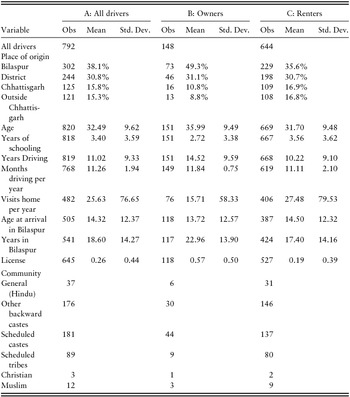
Column A in Table 8 reports summary statistics pertaining to the entire rickshaw driver sample, with Columns B and C reporting the summaries for subsamples of drivers who own their rickshaw (owners) compared to those who rent from a garage (renters). A key empirical feature of our study is that migrant status is not a binary variable. Instead, our preliminary fieldwork indicated that rickshaw drivers differed widely, not only in their place of origin, but also in the strength of their ties to it, as well as how long they had spent in the city.
Summary statistics

Notes: Visits home per year, Age at arrival in Bilaspur and Years in Bilaspur reported only for migrant drivers. Source: Primary survey data.
Less than 40% of all rickshaw drivers claim the city of Bilaspur as their place of origin. Another 31% come from villages within Bilaspur district. Being one of the largest cities in Chhattisgarh state, it is not surprising that Bilaspur attracts migrants from within the state. What is significant is that out-of-state migrants comprise almost 17% of rickshaw drivers.
Migrant drivers return on average nearly 26 times to their place of origin every year, or once every two weeks. The pattern of travel is significantly different for drivers whose place of origin is outside Bilaspur city but within Bilaspur district. The number of visits home is influenced by non-resident rickshaw drivers who travel daily by train, by bus or by foot from their place of residence to the city. This difference also shows up in comparisons between owners who visit home nearly 16 times a year, and renters who visit home more than 27 times a year.
This circulation is consistent with individuals driving rickshaws less than 12 months a year. Nearly 16% of all individuals in this sample drive less than 12 months and a further 11.4% drive fewer than 10 months in a year. Within the sample, owners drive 11.84 months a year whereas renters drive 11.11 months a year. In fact, informal discussions with garage owners as well as unhired rickshaws standing at the garages reveal that these figures may overstate the numbers engaged in rickshaw-driving year round. Many rural migrants retain links to the agricultural economy and return during the sowing and harvesting seasons.
The variable Years driving in Table 8 represents the number of years that the rickshaw drivers has been in the sector. While the average owner has been driving for 14.5 years, the average renter has been driving for 10.2 years. At the same time, not surprisingly, owners drive 0.72 months more than renters. Both these variables indicate that drivers with greater attachment to the profession are less likely to be renters, although the direction of causality cannot be conclusively determined.
Given the preponderance of migrants, the long average length of stay in Bilaspur for the sample appears surprising. A clue why this might be is obtained by contrasting this to the average migrant's age of arrival to the city, 19 years. The sample of current rickshaw drivers reports long periods of residence in Bilaspur, despite their migrant status.
The Officer-in-charge of the Rickshaw and Tonga Department of the MCB issues a driving license that is required for all rickshaw drivers. As of September 2003, 4,624 licenses had been issued. To provide a context for the figure, in our survey data, only about 26% of all drivers said they had a driving license. The difference between rickshaw owners and renters on this measure is large – 57% of owners possess a license whereas only 19% of renters do so.
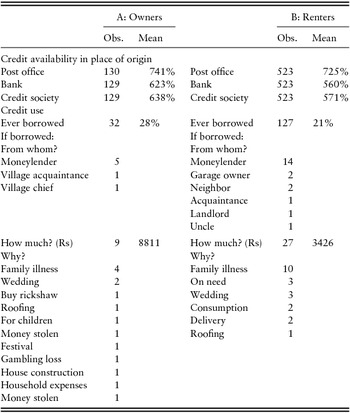
Finally, we also look at three indicators relating to access to formal sources of credit at the place of the driver's origin. These are important variables to examine since differences in access to credit might explain the driver's ability to own their rickshaw. Table 9 reports variables representing credit constraints for owners (Column A) and renters (Column B).
Access to credit

Source: Village directory of Census of India (2001) and driver survey data.
The first category of variables is from the village directory of the Census of India (2001), representing formal sources of credit such as post offices, banks and credit societies that are potentially available to drivers at their place of origin.
While credit access as measured by these variables is not complete, Table 9 does not show large differences depending on whether the driver is a renter or owner. For instance, 74.1% of owners have a post office in their place of origin, as do 72.5% of renters.
In addition, we asked surveyed rickshaw drivers about any loans they may have taken and for what purposes. Credit is deployed for a wide range of consumption and production needs, but only one driver reported buying a rickshaw with borrowed funds.
4. Empirical analysis
Section 3 details the key stylized facts of the cycle-rickshaw rental market that help explain how it accommodates new migrants and presents the associated empirical evidence for these features. In this section, we highlight the econometric evidence for our prediction that migrants enter into rental contracts at rates higher than locals.
Specification
An empirical issue we face is that those drivers who cannot rent a cycle-rickshaw cannot be tracked. However, we are able to see another facet of rental contract participation: The decision to rent rather than own, which is formally modeled in the Appendix. While we frame the problem as one of rental contract participation, it can also conversely be seen as one of the distribution of ownership. A priori, we expect that owners and renters would differ significantly in terms of their migration status. We also control for factors such as access to credit, as well as socio-economic characteristics that might influence renting versus owning.
How does the probability of renting vary with different measures of migration? The following probit specification tests the determinants of renting.
 $$\begin{eqnarray}
{\varphi _i} &=& {\gamma _1} + {\gamma _2}{{{\bf \Omega }}_i} + {\gamma _3}{\rm{visitshom}}{{\rm{e}}_i}\,{}^*\,{{\rm{\Omega }}_i} + {\gamma _4}{\rm{migrantyear}}{{\rm{s}}_i}\,{}^*\,{{\rm{\Omega }}_i}\nonumber\\
&& + {\gamma _5}{\rm{monthsdrivin}}{{\rm{g}}_i} + {\gamma _6}{\rm{yearsdrivin}}{{\rm{g}}_i} + {\gamma _7}{{{\bf Z}}_i} + {\gamma _8}{\rm{credi}}{{\rm{t}}_i} + {\xi _i}.
\end{eqnarray}$$
In this specification, φ i is a binary variable which is 1 if the driver rents the rickshaw he was driving at the time of the survey and 0 otherwise.
The specification shows the relationship between renting a rickshaw (φ
i
) and the various measures of migration –
 ${{{\bf \Omega }}_{\bm i}}\ $
(the location of the rickshaw driver's place of origin and a proxy for the distance of migration; residence in Bilaspur city is the omitted category), migrantyearsi, visitshomei as well as the interaction of Ω
i with migrantyearsi and visitshomei, respectively. The specification also controls for the rickshaw driver's age, education, caste and religious community affiliation (Z
i
). Finally, credit
i
controls for whether the driver's village of origin has a bank, a post office or a credit society, as proxies for access to formal sources of credit.
Findings and discussion
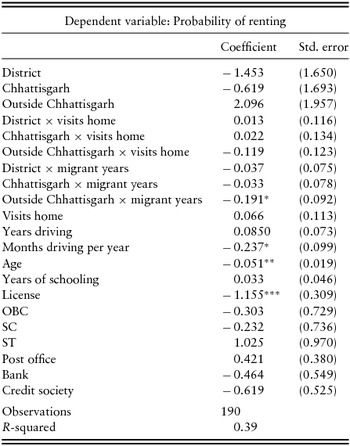
Table 10 reports probit marginal effects from estimation of equation (1). Our findings, as represented by the point estimates, are consistent with expectations. The results show that, as expected, city locals are least likely to rent their rickshaw with the probability of renting increasing as the attachment to the city decreases. Comparing with those drivers who are from Bilaspur city, renting rates increase by 1.3% as the number of their annual visits home increase for those drivers from Bilaspur district, by 2.2% for those from the state of Chhattisgarh but outside the district. Also consistent are coefficients on the terms that interact place of origin and the years since migration. Longer tenures since migration decrease the probability of renting, since the ownership patterns of long-time migrants start to mimic residents.
Renting vs. ownership

Notes: *p < 0.10, **p < 0.05, ***p < 0.01. Standard errors are reported in parentheses. Source: Primary survey data.
The coefficients associated with age, possession of a license and the number of months spent driving the rickshaw every year are negative, large and statistically significant, suggesting that attachment to the profession is strongly associated with rickshaw ownership.
We have included the access to credit variables listed in Table 9 as controls in our specification. The coefficients associated with ‘Post office’, ‘Bank’ and ‘Credit society’ do not show any consistent pattern, which suggests that the impact of access to credit on the probability of renting is empirically ambiguous.
5. Discussion
In this paper, we have drawn on primary data from the cycle-rickshaw rental market in a city in central India to build an analytical narrative that explains how new agents are incorporated into market exchange under relationship-based contract governance, ‘transactions. . .based on personal and implicit agreements, [such that] the state is generally not able to enforce contracts impartially’ (Li, Reference Li2003). We have shown that neither rule-based enforcement by the state nor multilateral mechanisms for contract enforcement obtain in this market. We have argued that the problem of partner choice is key to such a regimes of bilateral contract governance. This paper takes account not only of the benefits of owning versus renting for drivers but also the risk of default faced by the cycle-rickshaw owner. The findings of our study show that migrant drivers are selected into the rental market at higher rates than local drivers, even controlling for variables such as differential credit access.
As Allen (Reference Allen1983) shows, if default means exclusion from the capital market, contracts are enforceable. In our site, such exclusion is more credible for migrants relative to local drivers. Thus, the possibility of self-enforcing contracts through personal exchange allows migrants to enter the rickshaw rental market.Footnote 6
These findings have important policy implications. Combining agricultural labor or cultivation with off-season work in predominantly urban, informal settings, such livelihood strategies are associated with various forms of circular, seasonal and temporary migration. There is relatively limited direct evidence on credit access for rural to urban migrants in developing country settings, especially for those who engage in multilocational livelihood strategies. This is despite increasing interest among researchers on the use of such livelihood strategies (Deshingkar and Farrington, Reference Deshingkar and Farrington2009; Schmidt-Kallert, Reference Schmidt-Kallert2009).
Estimates for the numbers of temporary rural migrants, who stay ‘away from the village or town for a period of 30 days to six months’, in Indian cities range from 12.5 million (Keshri and Bhagat, Reference Keshri and Bhagat2012:82) and above. At the same time, over 80% of urban employment remained informal even in 2011–12, and informal self-employment continued to grow (Chen and Raveendran, Reference Chen and Raveendran2014). Despite the numerical and policy significance of these labor flows, few studies have examined how temporary migrants incorporated into urban self-employment activities. Studies on informal credit markets and the relation-based contract enforcement mechanisms that predominate there suggest that migrants may face various forms of credit rationing. Given this context, this paper highlights the role of rental markets for productive capital such as the cycle-rickshaw in helping ease these credit constraints.
This paper attempts to fill the gaps between these policy-relevant literatures. On the one hand, it speaks to the large literature on partner choice under personalized contract governance regimes described above. More specifically, the paper adds to the smaller set of studies on rental markets for productive assets. Our findings also provide new evidence on how relationship-based forms of contract enforcement function in urban settings where there is a multiplicity of agents and community sanctions and third-party enforcement do not work.
From a policy perspective, this study sheds light on little understood informal rental markets and the importance of these markets in accommodating worker mobility. These findings assume significance in light of the punitive regulatory frameworks that have hitherto characterized the policy environment for informal services in India and elsewhere (Sood, Reference Sood2012; Sood, Reference Sood, Sridhar and Wan2013). In the cycle-rickshaw sector, in particular, we have discussed how the rental market remains illegal in many cities. This paper suggests that informal markets are critical as sources of livelihood for migrants engaging multilocational livelihood strategies and deserve greater policy support.
Appendix A. Analytical model
A.1 Rickshaw driver's problem
First, we consider the rickshaw driver's problem. Given a rental contract, the rickshaw driver functions essentially as an entrepreneurial agent, i.e., the comparative returns from renting versus an alternative occupation determine his participation in the contract, the relevant alternative for this purpose being ownership of the cycle-rickshaw. Following Hallagan (Reference Hallagan1978), we focus our attention on the relative returns from owning versus renting, assuming labor input or effort choice is fixed.
In addition to the purchase price P, the rickshaw driver who buys the cycle-rickshaw incurs a cost C(m), where m is a measure of the migrant status of the rickshaw driver.
Assume that 0 ≤ m ≤ 1, with m = 1 representing the pure migrant and m = 0 representing the pure local. We expect that C(0) > 0 and C′(.) ⩾ 0, and C″(.) ⩽ 0.
The cost C(m) can be conceptualized in several ways. Most directly, it can be seen as the cost of storing the cycle-rickshaw, which is higher for migrants. It can also be seen as the rupee cost equivalent for the psychic attachment to the cycle-rickshaw market, foregoing possibilities of alternative employment.Footnote 7
The per-period rental rate of the cycle-rickshaw is R. If the cost of ownership is incurred in the present period, the rickshaw driver will choose to buy the cycle-rickshaw if
 $$\begin{equation}
P + C\left( m \right) \le R.
\end{equation}$$
We argue that since C(1) > C(0), an equilibrium can exist with an R * such that P + C(0) < R* and P + C(1) > R*.
Further, if C″(.) ⩽ 0, there exists a uniquem* > 0 such that P + C(m*) = R*.
A.2 Garage owner's problem
Consider that risk of default is perceived to be a function of the rickshaw driver's type, θε[0, 1], where higher θ corresponds to higher levels of dishonesty. While the garage owner can observe m, he cannot observe θ. Instead, he conditions his expectations of θ on m, i.e., θ(m).
It is reasonable to assume that θ is an increasing monotonic transformation of m with θ'(m) ⩾ 0. This captures an ex ante notion of risk where migrants are believed to be more likely to be dishonest.
Alternatively, consider the benefit from defaulting, which is also the corresponding loss to the garage owner, written as B(θ(m)). Arguably, the benefits from defaulting would be higher for a migrant because he can take a stolen rickshaw to a market in another city. On the other hand, the universe of possibilities available to the local resident is more limited since he is restricted to the local market. B(.) can be expected to be a non-decreasing function of θ such that B(0) = 0 and B(1) = b > 0.
If the rickshaw driver is caught, he suffers a penalty L(m), a monotonically increasing function of ‘migrantness’, where L’(m) ≥ 0. Without loss of generality, assume that L(0) = 0.
In effect, L(m) is the discounted present value of future losses. Like Lindbeck, Nyberg, and Weibull (Reference Lindbeck, Nyberg and Weibull1999), we express this loss in the present period.
We assume that L(m) is known by both garage owner and rickshaw driver. It is evident that L(m) represents a differential penalty, based on ‘migrantness’.
Note that we need not assume that L(m) is imposed by the garage owner; indeed it is socially incurred and includes the transaction costs of finding a new garage and establishing a relationship with the new garage owner, which can be expected to be higher for migrants. Thus, L(m) does not require information-sharing or collective action since it can be a decentralized outcome of the introduction mechanism that mediates entry into the market (Fafchamps Reference Fafchamps, Aoki and Hayami2001; Fafchamps Reference Fafchamps2002).
The rickshaw driver then faces two sets of decisions:
-
1. Participation constraint: He rents if
(2) $$\begin{equation}P + C\left( m \right) \ge R.\end{equation}$$
-
2. No-default constraint: If he has rented, he does not default if
(3)
$$\begin{equation}L\left( m \right) \ge B\left( {\theta \left( m \right)} \right).\end{equation}$$


Then, knowing the rickshaw driver's problem, the garage owner maximizes his expected profits:
 $$\begin{equation}
\mathop {{\rm{max}}}\limits_R R - EB\left( {\theta \left( m \right)} \right),
\end{equation}$$
such that the participation constraint (2) and the no-default constraint (3) hold.
Assuming that all second-order conditions for equilibrium hold, note that if the no-default constraint holds, the garage-owner earns R*.
Solving these equations for equilibrium yields R* = P + C(m*), i.e., the optimal rental rate and the migrant who is just indifferent between renting and owning is simultaneously determined.
First, consider the polar cases. Say the garage owner chooses R* such that m* = 0, i.e., the rickshaw driver is a local. Then, the associated penalty incurred by the driver L(0) is 0
However, in this case, R = P + C(0) which is weakly less than P + C(1) by the monotonicity condition on C(.). With these conditions, an optimum R* will obtain, which will be low enough to attract both migrants and locals.
Now, consider the case where the garage owner chooses R* high enough such that m * = 1, i.e., the rickshaw driver is a perfect migrant. Then,
 $$\begin{equation}
R = P + C\left( 1 \right) &\ge& P + C\left( m \right)\;{\rm{for}}\;{\rm{all}}\;m,\\
\end{equation}$$
 $$\begin{equation}
P + C\left( 1 \right) &\ge& P + C\left( 0 \right).
\end{equation}$$
In this case, the stable optimum R* excludes locals, with only perfectly migrant rickshaw drivers participating. Therefore, for any m = m *, and given the penalty function L(.), an R * can be found such that m > m * participate in the rental contract, and m < m * do not participate.
There are three notable caveats to this model. First, our simple one-period model does not explicitly take account of the decision to return to the place of origin.
Second, our static, one-period framework captures repeated interactions in the penalty function. Learning about types in the rental transaction may occur over time, changing perceptions of trustworthiness and possibly the differential penalty.
Finally, perceptions of trust-worthiness beliefs about the risk of default based on migrant type, θ(m) may also differ among garage owners. This would allow for sorting of migrant types across garages. The empirical evidence, discussed in Sood (Reference Sood2008), suggests that garages do indeed sort in this way, with some catering exclusively to migrants, and others predominantly to local residents. However, this model and empirical analysis does not aim to explain such patterns of sorting of migrant types.