Introduction
Grandparenthood is a central role in later life, with people rating grandparenthood as highly important even before experiencing it (Mahne and Motel-Klingebiel, Reference Mahne and Motel-Klingebiel2012). Contact with grandchildren and emotional closeness to them have been found to be beneficial for grandparents’ wellbeing (Drew and Silverstein, Reference Drew and Silverstein2007; Mahne and Huxhold, Reference Mahne and Huxhold2015), whereas losing contact with grandchildren is a harmful experience (Drew and Silverstein, Reference Drew and Silverstein2007). In answer to the increasing opportunities that rising life expectancy has been offering, one major strand of research on ageing has investigated behavioural aspects of grandparenthood, highlighting that the provision of supplementary grandparental child care is positively associated with grandparents’ health and wellbeing (Hughes et al., Reference Hughes, Waite, LaPierre and Luo2007; Di Gessa et al., Reference Di Gessa, Glaser and Tinker2016a, Reference Di Gessa, Glaser and Tinker2016b).
However, once fixed-effects approaches are used, controlling for unobserved heterogeneity, only limited evidence for causal associations between grandparental child care and grandparents’ wellbeing is found (Ates, Reference Ates2017; Bordone and Arpino, Reference Bordone and Arpino2019; Danielsbacka et al., Reference Danielsbacka, Tanskanen, Coall and Jokela2019). We contribute to the existing literature in this area, by examining an intermediate aspect in the relationship between grandparental child care and health and wellbeing: participation in leisure activities.
Both theoretical and empirical studies emphasise the importance of social engagement for ageing well (Lemon et al., Reference Lemon, Bengtson and Peterson1972; Adams et al., Reference Adams, Leibbrandt and Moon2011). Therefore, we consider leisure activities as a comprehensive and general indicator to measure engagement in life and analyse how starting to provide grandparental child care affects participation in leisure activities. Adding to previous literature, and in order to offer a more complete picture, we consider three aspects of participation in leisure activities: (a) the number of regular and frequent activities in which a person engages, (b) with whom they do such activities, and (c) the subjective evaluation of satisfaction with participation in leisure activities.
The aim of this study is to answer three research questions:
• Does providing grandparental child care compete with or add to participation in leisure activities?
By considering the number of leisure activities carried out regularly (i.e. at least monthly) and those carried out frequently (i.e. at least several times a week) we account for the possibility that people might remain engaged in the same number of activities when they start looking after their grandchildren, but adapt the frequency of engagement. In a similar vein, a few studies have investigated the relationship between grandparental child care and social participation (Bulanda and Jendrek, Reference Bulanda and Jendrek2016; Arpino and Bordone, Reference Arpino and Bordone2017). However, these investigations were limited to a narrow scope of productive activities (mostly with a focus on volunteering), which are usually carried out by selected groups (e.g. more often by men than women and by those with higher socio-economic status) (Burr et al., Reference Burr, Mutchler and Caro2007; Hank and Erlinghagen, Reference Hank and Erlinghagen2010; Musick and Wilson, Reference Musick and Wilson2010). Our study adds knowledge by considering a broader range of 13 different leisure activities.
• Does providing grandparental child care affect with whom people engage in leisure activities (i.e. relatives versus friends/others)?
While being active in general has been shown to be a modifiable risk factor for cognitive decline and to play a decisive role in influencing health and survival (Hultsch et al., Reference Hultsch, Hertzog, Small and Dixon1999; Scarmeas and Stern, Reference Scarmeas and Stern2003; Engelhardt et al., Reference Engelhardt, Buber, Skirbekk and Prskawetz2010), social networks research has provided evidence that such a positive effect holds especially when people are embedded in complex and diverse networks (Ellwardt et al., Reference Ellwardt, van Tilburg, Aartsen, Wittek and Steverink2015, Reference Ellwardt, Aartsen and van Tilburg2017). In addition to engagement within the family, having (frequent) contact with non-family members, such as neighbours or friends might therefore be a valuable resource. Yet grandparental child care might modify with whom these activities are carried out, limiting in particular the engagement outside the family.
• Does providing grandparental child care affect grandparents’ satisfaction with their participation in leisure activities?
In line with research on economic wellbeing (Fletcher and Lorenz, Reference Fletcher and Lorenz1985) and on health (Lindau and McDade, Reference Lindau and McDade2008), where it is common to differentiate between objective and subjective dimensions of a construct, we consider the number of activities and with whom they are carried out as objective or structural dimensions of leisure participation. However, if leisure behaviour changes due to engagement in grandparental child care, only an investigation of how it is subjectively perceived will provide a more complete picture on the effects of grandparental child care. An alteration of grandparents’ satisfaction with their leisure activities due to grandparental child care might, in turn, have consequences for wellbeing more in general. Although in the literature there is no unique definition of wellbeing, there is agreement on referring to wellbeing as a latent construct that is formed by multiple dimensions (Naidoo, Reference Naidoo2019), one being satisfaction with leisure (Newman et al., Reference Newman, Tay and Diener2014).
This study adds to the existing literature in multiple ways. In particular, using data from the German Ageing Survey (DEAS), we are able to consider a wide range of 13 leisure activities. Moreover, for the first time to our knowledge, we consider with whom (family versus friends/others) grandparents engage in leisure activities as well as how grandparental child care affects individuals’ evaluation of their own participation in leisure activities. These aspects are central to understand both the objective and subjective benefits and harms of child-care provision. Furthermore, methodologically, a fixed-effects panel approach allows us to account for within-individual variation over time, controlling for unobserved time-constant variables. Longitudinal analyses are still scarce in the relevant literature, mainly due to the unavailability of large datasets.
The rest of the paper is structured as follows: the next section presents previous empirical evidence on the provision of grandparental child care in Germany, followed by a consideration of the concept of multiple roles occupation (role strain versus role enhancement) and its gendered structure. The subsequent section provides an outline of the data and methodology used in the analyses. This is followed by the presentation of results, with the final section discussing the findings of the paper.
Background
Grandparenting in Germany
Grandparenthood plays an important role in Germany, with 91.8 per cent of the grandparents rating their grandparental role as important or very important (Mahne and Motel-Klingebiel, Reference Mahne and Motel-Klingebiel2012). Moreover, 69.7 per cent of German grandparents state that they have a close or very close relationship with their adult grandchildren (Mahne and Klaus, Reference Mahne, Klaus, Mahne, Wolff, Simonson and Tesch-Römer2017).
Grandparental child care might be distinguished between primary and supplementary. As primary care-givers, grandparents hold the major responsibility (sometimes custody) for their grandchildren, taking on the role of parents. As this is usually not expected at later lifestages (Jendrek, Reference Jendrek1993), it is often associated with enormous stress (Hayslip and Kaminski, Reference Hayslip and Kaminski2005; Musil et al., Reference Musil, Warner, Zauszniewski, Wykle and Standing2009). The literature therefore discusses primary grandchild care under the scope of role strain, focusing on stress and conflicts emerging from involvement in multiple roles (Goode, Reference Goode1960). Different from the United States of America, where primary care-giving in skipped-generation households is a common arrangement, grandparents in Germany usually have a supplementary care function (Ates, Reference Ates2017).
Research on the same data that we use in this paper shows that over the last two decades a quite stable proportion of about 30 per cent of grandparents have reported looking after their grandchildren in Germany (Mahne and Klaus, Reference Mahne, Klaus, Mahne, Wolff, Simonson and Tesch-Römer2017). Less than 3 per cent of them reported caring for their grandchildren for more than eight hours a day, a threshold for what can be considered as beyond supplementary care. Due to the limited size of this sub-group, our analyses will focus on supplementary grandparental child care and refer to this when we talk about grandparental child care from now on. In contrast to primary care, grandparental child care within a supplementary care arrangement is considered to be a source of role enhancement that might rather be beneficial for grandparents (Coall and Hertwig, Reference Coall and Hertwig2010). However, following previous research showing that the frequency of grandparental child care also matters for health, wellbeing and productive activities within a supplementary care arrangement (Di Gessa et al., Reference Di Gessa, Glaser and Tinker2016a; Arpino and Bordone, Reference Arpino and Bordone2017), we will differentiate between non-intensive and intensive supplementary grandparental child care.
Grandparental child care and participation in leisure activities: number of activities
Grandchildren might affect grandparents’ participation in leisure activities in various ways. Grandparents providing grandparental child care may, for example, engage in new activities (e.g. going for a walk in the park, taking their grandchildren to the zoo) or they might continue to take part in the same activities as before (e.g. attending sporting events), thereby reducing the frequency of engagement and/or altering with whom these activities are carried out.
Concerning the relation between grandparental child care and number of attended activities, two hypotheses could be formulated. The role enhancement theory assumes that social roles come along with role privileges, resources for status security and enhancement, ego gratification, and personal growth (Sieber, Reference Sieber1974). This theoretical perspective has been used to explain why social roles may produce positive effects on wellbeing. The grandparental role can offer rewards in many forms and for different reasons. Grandparents’ wellbeing, for example, might be increased by the recognition of care provision to grandchildren and caring for a grandchild can additionally give the grandparents an increased purpose for living (Silverstein and Giarrusso, Reference Silverstein and Giarrusso2013). Therefore, looking after grandchildren might foster grandparents’ engagement in leisure activities not only by creating new activity opportunities, but also by stimulating grandparents’ sense of purpose in life and by increasing their psychological wellbeing. These arguments would favour a cumulation hypothesis: grandparents involved in supplementary child care might experience joy and appreciation, thus gaining the motivation, resources and energy to cumulate this activity with leisure activities.
In line with this reasoning, we would expect that providing grandparental child care would increase the number of activities carried out. However, a positive correlation might simply indicate a selection effect based on personal characteristics. Previous research has interpreted the positive correlation between engagement in various activities as the result of a general motivation for being active (Hank and Stuck, Reference Hank and Stuck2008). Furthermore, recently published studies where selection effects have been controlled for have shown that the effects of grandparental child care on a variety of grandparents’ outcomes have been overestimated in cross-sectional analysis (Danielsbacka et al., Reference Danielsbacka, Tanskanen, Coall and Jokela2019; Sheppard and Monden, Reference Sheppard and Monden2019). Individuals with certain observed and unobserved characteristics tend to cumulate engagement in activities more than others. However, Bulanda and Jendrek (Reference Bulanda and Jendrek2016) found that non-residential grandparental child care leads to more non-family activities, such as volunteering, also after accounting for possible selection by applying treatment effect models. Net of the person-specific general motivation and other unobserved characteristics, such as values or abilities, grandparental child care might therefore have indeed a positive effect on participation in leisure activities.
It is, however, also possible that provision of grandparental child care competes with engagement in leisure activities, e.g. due to limited time available. From a theoretical perspective, the role strain theory (in contrast to role enhancement) poses that multiple social roles can be time-consuming (due to role overload), and physically and psychologically demanding (due to emerging role conflicts) (Goode, Reference Goode1960). From a role strain perspective one could argue that individuals do not have enough resources to allocate among multiple roles. Thus, grandparental child care can be taxing and it might take away willingness, energy and time resources from older adults to engage in leisure activities (Jendrek, Reference Jendrek1993). As a result, care-giving grandparents may be more selective in their choice of leisure activities, especially when they engage in intensive grandparental child care. Evidence in favour of the role strain hypothesis has been found by previous studies even after taking selection effects into account, especially for grandmothers. Arpino and Bordone (Reference Arpino and Bordone2017), using an instrumental variable approach, found that regular provision of grandparental child care has a significant negative effect on the number of activities carried out and on engagement in some specific activities (volunteering, educational or training courses, and participation in political or community-related organisations), for grandmothers only. Additionally, using latent class analysis accounting for different types of activities, Arpino and Bordone (Reference Arpino, Bordone, Zaidi, Harper, Howse, Lamura and Perek-Białas2018) provided additional evidence of competition between care-related and other productive activities for women but not for men. Net of the person-specific general motivation and other unobserved characteristics, such as values or abilities, (intensive) grandparental child care might therefore have a negative effect on participation in leisure activities.
Drawing on the presented theoretical background, we therefore cannot derive a single hypothesis supporting either cumulation or competition mechanisms. Empirical evidence so far has also been mixed. Furthermore, no previous study focused on the causal link between starting to look after grandchildren and changes in number of leisure activities. Therefore, we consider our work as explorative and refrain from formulating specific hypotheses. However, we notice that given the supplementary trait of grandparental child care in Germany, effects suggested by the cumulation hypothesis might prevail. Additionally, role overload and conflict are more likely to emerge when a given role, such as that of grandchild care-giver, is combined with demanding and/or stressful roles. Thus, role strain might arise for specific sub-groups of grandparents, such as those involved in other care activities (Arpino and Gómez-León, Reference Arpino and Gómez-León2020), but not for the whole group of grandchild care-givers. We therefore expect a positive effect of grandparental child care on the number of leisure activities, after controlling for person-specific characteristics.
Grandparental child care and leisure activities: with whom and how satisfied?
Over the lifecourse, individuals engage in various activities, both within and outside the family. While family members and intimate friends form a person's ‘primary social groups’ (Cooley, Reference Cooley1912), people with whom one interacts at clubs, organisations and the workplace form an individual's ‘secondary social groups’. In line with the social convoy model (Kahn and Antonucci, Reference Kahn, Antonucci, Baltes and Brim1980), social networks change across the lifecourse, not only in size but also in composition in ways that are shaped through linked (family) events (Antonucci and Akiyama, Reference Antonucci and Akiyama1987). For example, Lubben and Gironda (Reference Lubben, Gironda, Berkman and Harootyan2003) showed that partner, children and grandchildren usually account for the majority of social ties in later life. Due to traditional gender-related role models in family and society (e.g. male breadwinner and female care-giver), gender plays a fundamental role in how such processes may affect social networks of men and women. As kin-keepers, women tend to have more contact with relatives than men do (Dubas, Reference Dubas2001; Bracke et al., Reference Bracke, Christiaens and Wauterickx2008; Danielsbacka et al., Reference Danielsbacka, Tanskanen, Coall and Jokela2019), and tend to increase their family-oriented network in different stages of life, e.g. after transition into motherhood (Tanskanen, Reference Tanskanen2017) but also grandmotherhood, with grandmothers providing more grandparental child care than grandfathers do (Leopold and Skopek, Reference Leopold and Skopek2014). Previous studies also showed that spousal care (Choi et al., Reference Choi, Burr, Mutchler and Caro2007) and grandparental child care (Arpino and Bordone, Reference Arpino and Bordone2017) are not competing with volunteering or engagement in other social activities among grandfathers.
Within the role strain framework, the higher centrality of the role as child-care provider for grandmothers implies stronger conflicts between family and extra-family activities for women as compared to men. We therefore expect especially women to face a change regarding with whom they carry out leisure activities when they start providing grandparental child care. Thus, grandparents who look after their grandchildren, and grandmothers in particular, might reduce the number of leisure activities with friends and others, and increase those together with family members.
But do these changes improve or worsen people's satisfaction with leisure when they provide grandparental child care? To answer such a question, we will further investigate the subjective satisfaction with leisure. We expect that the consequences of grandparental child care on satisfaction with leisure will also depend on how grandparental child care affects (increase versus decrease) the number of leisure activities and with whom they are carried out. Therefore, we do not assume any direction of the concerned effect at this stage.
Research design
Data and sample selection
DEAS is a nationwide survey of the population aged 40 and older in Germany (Klaus et al., Reference Klaus, Engstler, Mahne, Wolff, Simonson, Wurm and Tesch-Römer2017). It is designed as a cohort sequential survey currently consisting of four baseline samples (1996, 2002, 2008 and 2014) and several follow-ups. Since 2008, follow-up surveys are conducted every three years, with the latest available from 2017. For this study, we use two baseline–follow-up sub-samples. We consider: (a) interviews from 2008 as baseline and those from 2011, 2014 and 2017 as follow-up, and (b) interviews from 2014 as baseline and 2017 as follow-up. We do not use data collected in 1996 and 2002 because of the longer gap (six years) between waves, and because central control variables (e.g. physical functioning) were not included in the 1996 questionnaire.
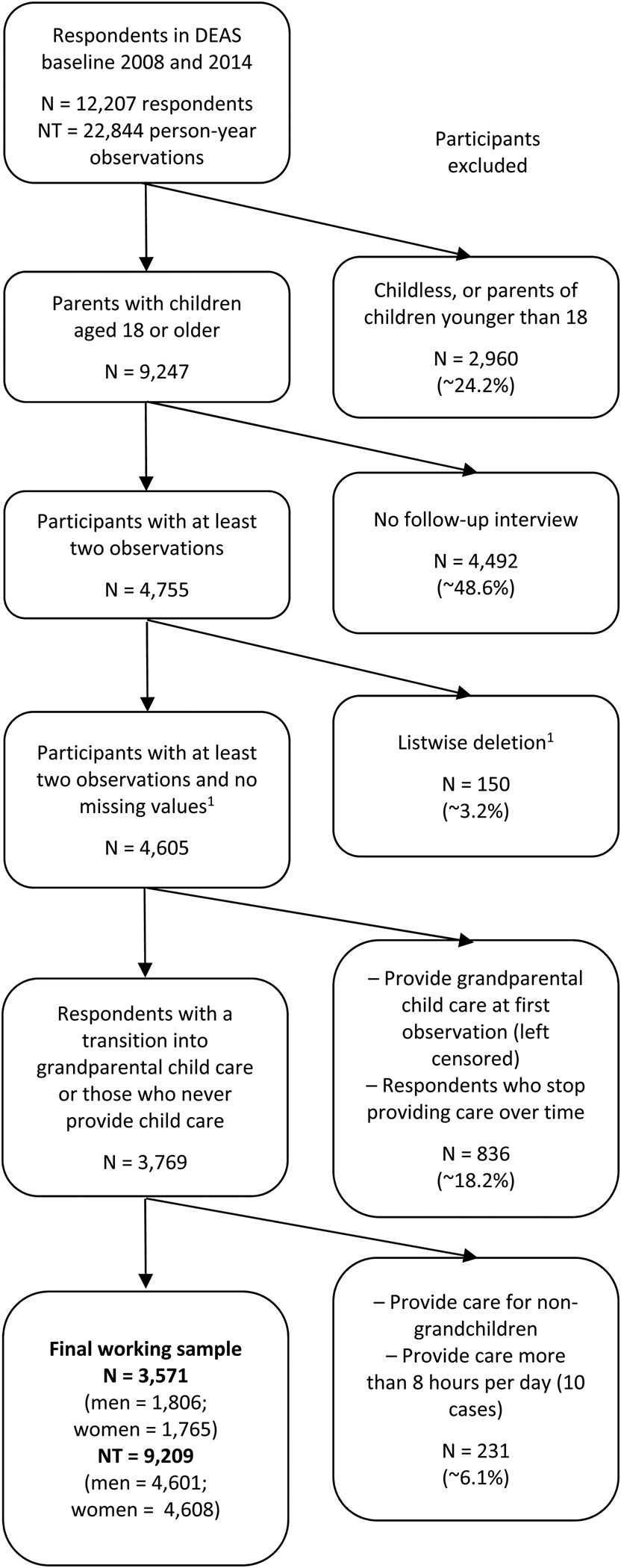
After merging the two sub-samples, the sample include N = 12,207 individuals (NT = 22,844 person-year observations). We exclude 2,960 participants who were either childless at the time of interview, as they were not exposed to the likelihood of engaging in grandparental child care, or had only children younger than 18, to rule out that children of care age might bias the effect of grandchildren. We also do not consider 4,492 participants due to panel attrition (no follow-up) and 150 participants due to item non-response (listwise deletion). At this stage, the sample consisted of N = 4,605 individuals.
We then identify grandparents never providing grandparental child care (0, 0), those starting (changing from 0 to 1), stopping (changing from 1 to 0) or continuing (1, 1) to provide care to their grandchildren over two consecutive waves. In order to estimate coefficients that genuinely capture the effect of the transition into grandparental child care (change from 0 – no grandparental child care to 1 – provision of grandparental child care), we exclude respondents who stopped providing grandparental child care between baseline and follow-up or continued providing grandparental child care over the entire observation period. By keeping only respondents who do not provide grandparental child care at baseline and either start or continue to provide grandparental child care to their grandchildren at follow-up, we address the issue of a left-censored data structure (i.e. we exclude respondents who may have already been providers of grandparental child care at baseline). Indeed for these observations the event of our interest (and the related effect on leisure activities) had already occurred before our observation period. Those who never provide care (0, 0) remain in the sample though and are considered as the reference category. Keeping this group in the sample will not bias the results because fixed-effects models only estimate the effects for those who experience a change over time in the explanatory variables. Rather, keeping the non-care-givers will help to estimate more consistent and unbiased effects for our control variables as the sample will not be too selective. For the same reason, we keep those participants in the sample who have no grandchildren. At this stage, the sample consists of N = 3,769 individuals.
Among care-giving grandparents, we exclude those who provide more than eight hours per day of grandparental child care, assuming this might indicate a primary care arrangement. We additionally exclude respondents who provide exclusively care to non-grandchildren (e.g. children of siblings, friends or neighbours) because we want to focus on the effects of grandparental child care. Furthermore, for those who provide care for grandchildren and non-grandchildren, DEAS does not allow how many hours grandparents spend providing care to grandchildren and how many hours for other children to be distinguished. The final working sample includes N = 3,571 respondents (1,806 men and 1,765 women) and NT = 9,209 person-year observations (4,601 men and 4,608 women). The sample selection is illustrated in Figure 1.
Study sample flowchart based on data from the German Ageing Survey (DEAS), 2008–2017.
Note: 1. For the income variable, we have grouped cases with a missing value into one category, because of the high proportion of missing values (6.5%).

Grandparental child care
DEAS asks: ‘Do you look after or supervise other people's children privately, e.g. your grandchildren or the children of siblings, neighbours, friends or acquaintances?’ Participants were able to report multiple answers. The explanatory variable grandparental child care takes value 1 if the respondent mentions looking after grandchildren ( = 0 for non-grandparents or grandparents who do not provide grandparental child care). Similar to Di Gessa et al. (Reference Di Gessa, Glaser and Tinker2016a), we further create the variable intensity of grandparental child care to capture the average hours spent on grandparental child care: none (reference category); non-intensive child care defined as 15 hours of care or less per week; and intensive care defined as more than 16 hours of grandparental child care per week.
Leisure activities
We consider all leisure activities that are included in the related module in DEAS: doing arts and crafts, using computers, doing crossword puzzles, gardening, playing board games, meeting friends, going to political meetings, going for a walk, doing sports, artistic activities, visiting cultural events, visiting sporting events and attending classes/lectures.
For each activity, respondents were asked how often they carry it out, with possible answers being ‘never’, ‘seldom’, ‘1–3 times a month’, ‘once a week’, ‘several times a week’ and ‘daily’. Following Wetzel and Huxhold (Reference Wetzel and Huxhold2016), we recode the original variables into dummy variables with 0 = ‘never–seldom’ and 1 = ‘at least 1–3 times a month’. We then build a summary index of all activities that captures the number of activities carried out on a regular basis (from now on number of regular activities). Similarly, we build the index number of frequent activities, setting the following threshold: 0 = ‘never–once a week’ and 1 = ‘at least several times a week’. In this way we aim to test whether there is a change in the frequency other than in the number of activities carried out when people engage in grandparental child care.
For six of the above-listed activities (going for a walk, doing sports, artistic activities, visiting sporting events, playing board games, attending classes), respondents were additionally asked with whom they engage in each activity. The response categories are ‘alone’, ‘with partner’, ‘with relatives’, ‘with friends’, ‘with a club’ and ‘with others’. Multiple answers were allowed, if the activities are not predominantly executed alone. We used the available information to generate two outcome variables. The variable with friends or others counts the number of activities carried out with friends, with a club or with others (i.e. the number of activities for which at least one of these categories is mentioned). The variable with relatives is a binary indicator that equals 1 if at least one of the activities is carried out with relatives ( = 0 otherwise). We categorise this variable as dummy rather than count because of the small number of within-person changes. It should be noted that the two created variables are not mutually exclusive. Therefore, over the observation period, respondents might at the same time engage in more (or fewer) activities with friends or others and activities with relatives.
Satisfaction with leisure activities
The subjective evaluation of satisfaction with leisure activities is measured with a single item: ‘Generally speaking, how would you rate your leisure time activities at present?’ Respondents could elect one of the following answers: ‘very bad’, ‘bad’, ‘average’, ‘good’ and ‘very good’.
Control variables
With fixed-effects panel models (for more details on this method, see the section below on analytical strategy), it is neither possible nor necessary to consider time-invariant variables. Therefore, we only control for a set of time-varying variables. Becoming a grandparent and number of grandchildren are captured by four dummy variables considering whether the respondent is grandchildless (reference category), has one grandchild, two grandchildren, or three or more grandchildren. The models include a dummy variable that identifies if participants are in a romantic relationship ( = 1 if respondent is in a relationship regardless of whether or not they live together; = 0 otherwise), and a categorical variable to account for working status: working (reference category), not working or retired. Participants in DEAS evaluate their physical impairment from 1 (severely limited) to 3 (not limited at all) in relation to ten daily activities (e.g. climbing stairs, walking several blocks, bending). We use the standardised score, ranging from 0 to 100 where higher values indicate better performance, to capture physical functioning. Socio-economic status (low, middle, high) is measured by a generated DEAS variable on needs-adjusted monthly per head income of the household.Footnote 1 The tertiles division is calculated for each wave separately. Because of the high proportion of missing values in the income variable, we have grouped these cases in a separate category instead of dropping them. To capture age and period effects, all models include age categories (40–49, 50–59, 60–69, 70–79, 80+) and interview year dummy variables. To test for possible gendered effects of grandparental child care, the analyses are carried out separately for men and women.
Analytical strategy
We exploit the longitudinal dimension of DEAS and estimate linear fixed-effects panel models that allow us to rule out possible selection effects, where unobserved individual characteristics might cause a selection into both the independent and the dependent variables. This approach eliminates all time-invariant (unobserved) factors, thus exploiting only within-person variability, i.e. changes over time experienced by each individual. Therefore, fixed-effects models are considered to be a better approach, compared to standard regression models or random effects panel models, to address selection effects, which are caused by time-invariant factors (Brüderl and Ludwig, Reference Brüderl, Ludwig, Best and Wolf2015).
In addition to the main analyses, we will run several robustness checks to further validate our empirical findings.
First, as our operationalisation of the outcome includes 13 different activities, the results might be driven by some of the activities considered. Thus, we generate 13 different summary indices of number of activities (once considering activities carried out regularly and once accounting for those carried out frequently). In each of them, we in turn exclude one activity. For example, the index variable ‘arts and crafts excluded’ is calculated considering 12 of the 13 activities, excluding ‘arts and crafts’. We re-run the regression models with these indices instead of the one including all activities and compare the results to those of Models 1 and 2 reported in Tables 3 and 4. For the sake of comparability of the coefficients between models, we transform the indices to have the same range of values, following the equation: (new index × maximum value of the original index)/maximum value of the new index.
Second, we carry out Poisson and logit models, instead of linear models, to account for the count and dummy nature of the variables ‘number of regular/frequent activities’ and ‘at least one activity carried out with relatives’, respectively. We prefer linear models in the main analyses, because the corresponding coefficients are simpler to interpret and to compare between models.
Third, longitudinal analyses are affected by panel attrition (Vandecasteele and Debels, Reference Vandecasteele and Debels2006). Although a longitudinal approach – as applied in the present study – is still rare in the relevant literature that deals with the consequences of grandparental child care for grandparents and it should therefore be considered as a major strength of the paper, previous attrition analyses on DEAS data showed that ‘panel participants tend to be younger, healthier and better educated, and to have larger incomes and larger informal networks than respondents who drop out’ (Klaus et al., Reference Klaus, Engstler, Mahne, Wolff, Simonson, Wurm and Tesch-Römer2017: 1105b). This selection pattern bears the potential to bias the effect of grandparental child care on leisure activities. As a robustness analysis, we therefore address selectivity due to panel attrition with inverse probability weighting (IPW), a common strategy that tackles selective panel attrition by weighting participants by the inverse of their probability of participation in all follow-ups. To do so we first need to adapt our working sample. In the main analysis, we generated an unbalanced panel where participants should be observed at least twice (see Figure 1) in order to retain as many participants (cases) as possible, but IPW requires a balanced panel with full cases (i.e. participating in each wave) (Seaman and White, Reference Seaman and White2013). Using logistic regression models (see Tables SM5–SM8 in the online supplementary material), we estimate conditional probabilities for being a full case, we generate their inverse and standardise them to have a mean value of 1. Thus, the number of observations in the weighted regression analysis equals the number of observations in the unweighted full-case analysis. As in the main analyses, we estimate separate models for men and women, and include all control variables listed above. In addition, we control for education and network size, because these factors affect panel participation (Klaus et al., Reference Klaus, Engstler, Mahne, Wolff, Simonson, Wurm and Tesch-Römer2017). As we merged two sub-samples of DEAS, for the baseline sample 2008, we first estimate the probability of participating in the 2011 follow-up under the condition that the person participated in the baseline survey 2008. Second, we estimate the probability of participating in the 2014 follow-up under the condition that the person participated in 2011. Third, we estimate the probability of participating in the 2017 follow-up under the condition that the person participated in 2014. Furthermore, we used the DEAS cross-sectional sample design weight, which is calculated to adjust for the stratified sampling strategy in DEAS (Klaus et al., Reference Klaus, Engstler, Mahne, Wolff, Simonson, Wurm and Tesch-Römer2017). For the baseline sample 2014, we estimate the probability of participating in the 2017 follow-up under the condition that the person participated in the baseline survey 2014. In the next step – for both baseline samples – all weights were multiplied to calculate the final longitudinal weight. In the robustness check we will re-estimate the main analysis based on the full-case sample both without and with the generated longitudinal weights.
Findings
Sample characteristics
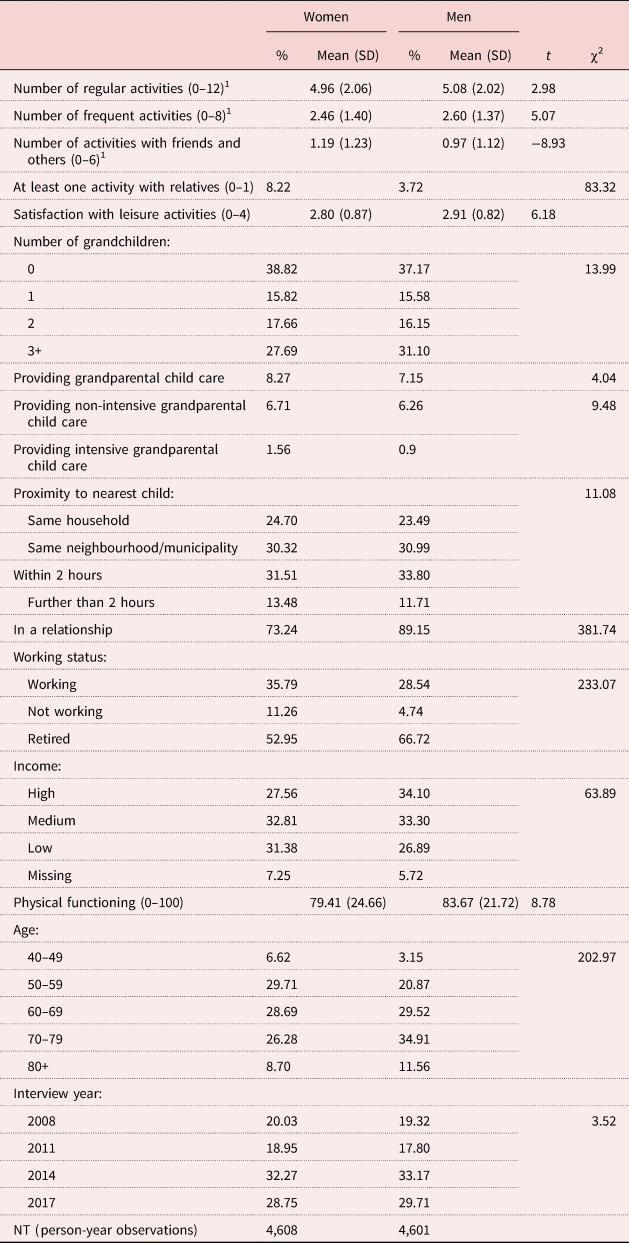
In Table 1, we summarise the sample characteristics. Some gendered patterns can be observed: women provide on average more grandparental child care and more intensive grandparental child care than men do. While both men and women engage regularly in about 5 activities and frequently in 2.5–2.6 activities, respectively, a more than double proportion of women carry out at least one leisure activity with relatives as compared to men (8.22 versus 3.72%, respectively). Nevertheless, women carry out also more activities with friends/others (mean = 1.19) as compared to men (mean = 0.97). Although very small, this difference is statistically significant (t = −8.93). The level of satisfaction with leisure activities is slightly below 3 (on a scale from 0 to 4) among both women and men.
Sample characteristics by gender on the pooled sample

Notes: 1. Values refer to the empirical range and not to the theoretical possible range. SD: standard deviation.
Source: German Ageing Survey (DEAS), authors’ elaboration.
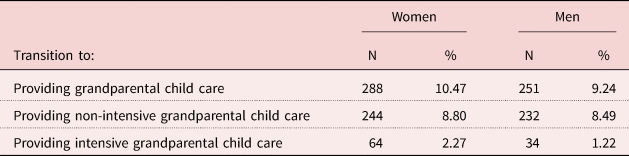
As fixed-effects panel models only consider person-specific changes over time, Table 2 reports the number of transitions to grandparental child care on which the coefficients estimated in the regression models will be based. We see, for example, that 288 grandmothers and 251 grandfathers face the transition from not providing to providing grandparental child care between two waves. We also notice that most respondents transitioning into grandparental child care do so towards non-intensive grandparental child care.
Number and proportion of within-person changes in grandparental child-care provision

Results of the main analyses: fixed-effects models
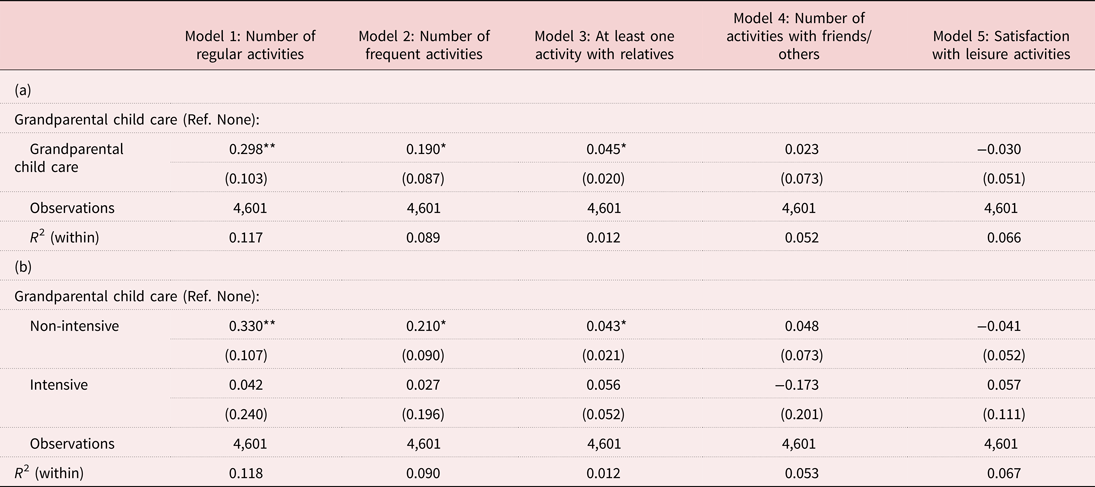
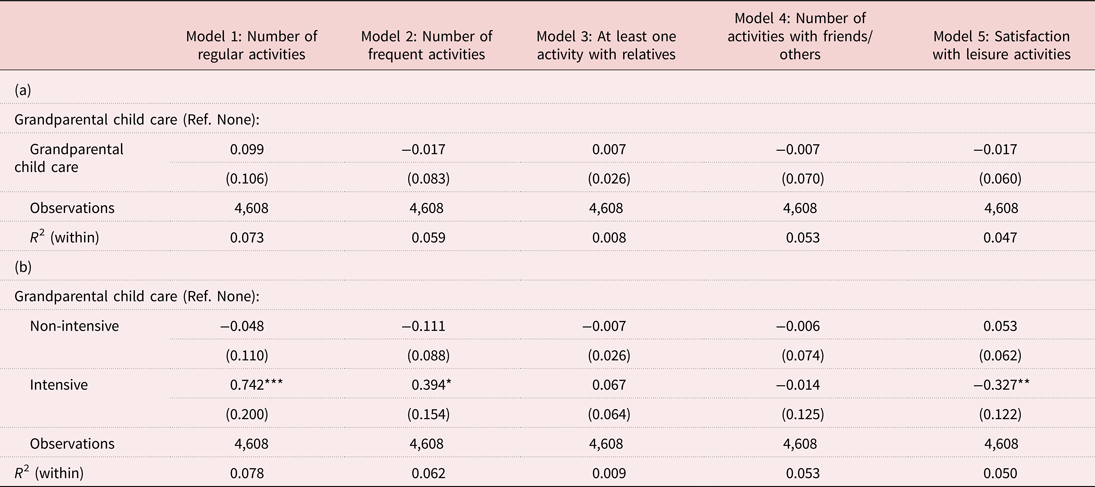
Tables 3 and 4 present the results of the main regression analyses for men and women, respectively. To allow for an easier interpretation of the results, we show only the effects of grandparental child care. All models include all control variables described above (full tables are presented in Tables SM1–SM4 in the online supplementary material). Coefficients are obtained from a genuine within-unit estimation, thus representing the effect of a within-person change in the respective variable on the outcome. It should also be noted that the coefficient of grandparental child care captures the change from not providing to providing grandparental child care. The reference category indicates both respondents without grandchildren and grandparents not engaging in grandparental child care. For those who have no grandchildren at first observation, a transition can only be observed if they become grandparents and provide grandchild care over consecutive waves. As we control for the transition into grandparenthood in a separate variable (i.e. the change in the number of grandchildren from 0 to 1), the grandparental child-care variable exclusively captures the effect of transition into grandchild care.
Estimated effect of (a) grandparental child-care provision and (b) grandparental child-care provision by intensity from linear fixed-effects models for all leisure activity outcomes for men

Notes: Values are beta coefficients with cluster robust standard errors in parentheses. All control variables are included. Ref.: reference category.
Significance levels: * p < 0.05, ** p < 0.01.
Estimated effect of (a) grandparental child-care provision and (b) grandparental child-care provision by intensity from linear fixed-effects models for all leisure activity outcomes for women

Notes: Values are beta coefficients with cluster robust standard errors in parentheses. All control variables are included. Ref.: reference category.
Significance levels: * p < 0.05, ** p < 0.01, *** p < 0.001.
Number of regular and frequent activities
Providing grandparental child care changes the leisure behaviour of men. Grandfathers who start looking after their grandchildren carry out more leisure activities (Table 3a), both regularly (Model 1) and frequently (Model 2). No statistically significant effect for grandparental child care on number of activities is found for women (Table 4a, Models 1 and 2).
Once we consider separately non-intensive and intensive grandparental child care among men (Table 3b, Models 1 and 2), it appears that the above-mentioned positive effects on number of regular and frequent activities are driven by non-intensive grandparental child care. The corresponding coefficients for intensive grandparental child care become much smaller and are not statistically significant. Among women, the coefficients for non-intensive grandparental child care are very small and remain not statistically significant (Table 4b, Models 1 and 2). However, grandmothers who start providing intensive grandparental child care carry out a higher number of leisure activities both on a regular (Table 4b, Model 1) and on a frequent basis (Table 4b, Model 2).
With whom activities are done
Model 3 in Table 3a shows that taking on the role of grandchild care-givers slightly increases the likelihood of grandfathers carrying out at least one leisure activity with their relatives. This holds in the cases of both non-intensive and intensive grandparental child care (Table 3b, Model 3), although the corresponding coefficient for intensive grandparental child care is not statistically significant, most likely due to the small number of cases. Looking after grandchildren (independently from its intensity) does not affect the likelihood of women engaging in at least one leisure activity with relatives (Tables 4a and 4b, Model 4). The results also show that providing grandparental child care does not alter the number of activities carried out with friends/others for either women or men (Tables 3b and 4b, Model 4).
Satisfaction with leisure activities
For men, there is no statistically significant effect of grandparental child-care provision on satisfaction with leisure activities (Table 3, Model 5). Among women, satisfaction with leisure activities decreases when they provide intensive grandparental child care (Table 4, Model 5). As hinted by the relatively large regression coefficient (β intensive child care/women = −0.327) as compared with the standard deviation of the corresponding outcome variable (SDwithin = 0.52), we interpret this finding not only as statistically significant, but also as a substantial change.
Results of the robustness checks
As mentioned above, we conducted sensitivity analyses to test the robustness of our results. First, we re-ran all regression models by replacing the original summary index of leisure activities with the rotating indices. The estimated coefficients of this rotating analysis (see Figures S1–S8 in the online supplementary material) are scattering closely around their total effect, suggesting that the results of our main analysis are not driven by single activities. The only exception is the positive effect of grandparental child care on activities carried out by grandmothers with relatives, which is mainly driven by ‘going for a walk’.
Second, as our outcome ‘at least one activity carried out with relatives’ is a dummy variable, we estimated the related models using fixed-effects logit regressions. Similarly, for the outcomes ‘number of regular activities’ and ‘number of frequent activities’ we estimated Poisson models in order to account for the measurement characteristic of the outcome variables. The results (available upon request) follow the same pattern as the main findings presented, although we find that the Poisson coefficients show larger standard errors.
Third, to address panel attrition we generated a full-case sample and calculated sample weights to use IPW. For both men and women, t models using IPW (presented in Tables SM9 and SM10 in the online supplementary material) show that the unweighted models do slightly underestimate the effect of grandparental child care on leisure activities due to selective panel attrition. The negative effect of intensive grandparental child care on women's satisfaction with leisure activities is slightly overestimated. However, the weighted analyses mostly confirm the main findings shown in this paper.
Conclusion and discussion
Using data from Germany, this paper investigated the effects of non-intensive and intensive supplementary grandparental child-care provision on participation in leisure activities. Drawing on the theoretical framework of the role enhancement and role strain theories, we tested whether grandparental child care cumulates or competes with leisure activities. To offer a more complete picture of this association, we considered different aspects of leisure: number of activities carried out regularly, number of activities carried out frequently, with whom they are carried out and how satisfied grandparents are with their leisure behaviour. Acknowledging that grandparental engagement is gendered, we carried out our analyses separately for men and women.
Our results showed that grandfathers providing non-intensive grandparental child care increase the number of leisure activities in which they participate, although to a small extent. Thereby, they become more likely to carry out at least one leisure activity with relatives while maintaining their engagement in activities with friends and others. These results suggest that grandfathers’ role as grandchild care-givers might involve carrying out leisure activities together with relatives (most likely with their children and grandchildren). Grandfathers’ engagement in grandparental child care does not alter their satisfaction with leisure activities.
Compared to grandfathers, grandmothers increase the number of leisure activities in which they participate to a greater (but still small) extent once they provide intensive grandparental child care. They engage in about one additional regular activity compared to when they did not provide grandparental child care (β intensive child care/women = 0.742). However, such an increase does not correspond to a higher likelihood of carrying out activities with relatives. This might be due to the fact that we use a dummy variable to measure participation in leisure activities with relatives and women are more likely than men to carry out at least one leisure activity with family members throughout their whole lifecourse, thus already before providing grandparental child care. At the same time grandmothers providing intensive grandparental child care report a lower satisfaction with their leisure behaviour.
Strength and limitations
Our study comes with some limitations. Due to the longitudinal approach used and our focus on the transition into grandparental child care, we could rely on a small number of within-person changes. This must be taken into account when interpreting the results. Also, this did not allow us to stratify the effects of grandparental child care further, e.g. by grandparents’ resources. Another limitation posed by the data used relates to the relatively long periods between survey waves in DEAS. Shorter periods would be more appropriate to capture the transition into grandparental child care.
We, however, believe that the strengths of this study largely contribute to the existing literature in several ways. First, we considered an important dimension of active ageing, that of leisure activities, which is still overlooked in the literature on the effects of grandparenthood/grandparenting. Second, recognising the importance of considering not only general wellbeing but also domain-specific wellbeing, we examined satisfaction with leisure. Third, by using DEAS we were able to consider both objective aspects of leisure for a wide range of activities and the subjective dimension of leisure. This distinction is central to an appropriate interpretation of the results discussed below. Furthermore, our longitudinal within-person (fixed-effects models) analysis is superior to previous cross-sectional studies because it controls for selection effects due to time-constant unobserved heterogeneity. Additionally, with IPW we tackle panel attrition that could have biased the results. To the best of our knowledge this has been done rarely in previous research on grandparental child care.
Discussion and implications
Our results show that both grandfathers and grandmothers tend to engage in more leisure activities when they provide grandparental child care. This may have positive implications for grandparents’ health and wellbeing, as previous studies found leisure activities and social engagement more generally to be crucial for ageing well (Adams et al., Reference Adams, Leibbrandt and Moon2011).
However, our results also point to possible negative and gendered consequences of grandchild care provision. In this respect, we found a decline in subjective satisfaction with leisure for grandmothers who provide intensive grandchild care, whereas this is not the case for grandfathers. One explanation for this result could be that grandmothers would like to spend more time outside the family context but their care duties act as a (time and/or resources) obstacle.
A second, related, explanation for our gendered results could refer to the gendered responsibilities in child care, with grandmothers more engaged in the welfare of the child (e.g. feeding, changing clothing/nappies and bathing) and grandfathers more involved in entertaining the grandchildren. This may imply that grandparental child care is more stressful for women than for men and, in turn, it differently affects their engagement in leisure activities. Along these lines, a qualitative study showed that while ‘the pleasure of spending time with grandchildren and developing a close relationship is cherished by grandmothers and grandfathers alike, it was also clear that grandmothers assumed responsibilities for domestic chores alongside childcare’ (Horsfall and Dempsey, Reference Horsfall and Dempsey2015: 1082). This gendered pattern might explain why grandmothers may experience grandparental child care (and leisure activities carried out with grandchildren) as role strain. Domestic and schooling tasks of grandparental care might not only be more demanding but also act as a source of conflict with (grand)children.
These findings can be also interpreted in light of the role strain and role enhancement theories. Role cumulation leads to role enhancement if activities are balanced between the family and extra-family spheres and if the added role, i.e. grandchild care provision in our case, does not interfere too strongly with other commitments, subtracting too much time and energy. The fact that overall the effect of grandchild care on leisure activities is positive for both men and women indicate that this additional role is not incompatible with other roles grandparents may have (e.g. paid work). Instead, grandchild care provision might increase grandparents’ wellbeing and offer them more opportunities to engage also in leisure activities. However, the negative effect on satisfaction with leisure activities that we found for grandmothers points in the other direction, suggesting that it is consistent with the predictions of the role strain theory: grandchild care provision for women may be generally rewarding also for grandmothers, but at the same time may be more demanding and focused on certain activities that do not impact on engagement in leisure activities per se but rather reduce how pleasant they are.
Further research is needed to shed more light on these findings. One possible further step of research in this area would be, for example, to account for grandparents’ resources that might shape the association between grandparental child care and participation in leisure activities. Grandparents with a higher income may be able to arrange the time with their grandchildren differently than grandparents with a lower income. Unfortunately, due to the small number of within-person changes of grandparental child care in our sample, we could not do so in the present study. Ideally this research should be based on a study with a larger sample that combines time-use data, to have a more precise measure of time invested in each activity, with expenditures information, to assess the resources dedicated to leisure and other activities.
Especially the results for grandmothers show how important it is to consider not only the quantity of leisure activities (objective/structural dimension of leisure) but also its quality, here measured in terms of satisfaction (subjective dimension of leisure) in order to understand fully the meaning behind the results (e.g. an increase in the number of activities as a consequence of grandparental child-care provision). In fact, our results indicate that more in quantitative terms (i.e. engagement in more activities) does not necessarily mean more in qualitative terms (i.e. more satisfaction with leisure activities). In a review of 36 studies, Newman et al. (Reference Newman, Tay and Diener2014) conclude that satisfaction with leisure is one of the most important factors for wellbeing. In this sense, providing intensive grandparental child care could be understood as a risk factor for grandmothers’ wellbeing, which should be considered in the debate about the positive and negative consequences of supplementary grandparental child care. Because grandmothers provide care for grandchildren more often and more intensively than grandfathers, one could argue that active grandparenting might be a source of gender inequality in wellbeing in later life.
Supplementary material
The supplementary material for this article can be found at https://doi.org/10.1017/S0144686X2100009X
Acknowledgements
We want to thank Karsten Hank, Lea Ellwardt and Christof Wolf for commenting on earlier versions of the manuscript.
Author contribution
All authors together developed the research questions. MA and VB worked on the theoretical part of the manuscript. MA prepared the data for analysis, conducted the analysis and drafted the manuscript. VB and BA contributed to the writing of the manuscript and commented on all different versions of the manuscript. BA supervised the analysis.
Financial support
The research was partly conducted while Merih Ates was a member of the Graduate School GROW – Gerontological Research on Well-Being, University of Cologne, Germany, which is supported by the North Rhine-Westphalian Ministry of Culture and Science. The German Ageing Survey is funded by the German Federal Ministry for Family, Senior Citizens, Women and Youth (grant number 301-1720-2/2).
Conflict of interest
The authors declare no conflicts of interest.
Ethical standards
Ethical approval is not required.