I. INTRODUCTION
Due to the high strength, excellent wear resistance and low thermal expansion, eutectic Al–13% Si piston alloys (all alloy compositions in the present work are in wt% unless indicated otherwise) are widely used as automobile components, such as pistons and cylinder heads.Reference Haque and Sharif1,Reference Belov, Eskin and Avxentieva2 In recent years, the increasing demands in the legislation about exhaust emissions place higher requirement on the performance of materials, especially at elevated temperature, such as 250–350 °C.Reference Joyce, Styles and Reed3 Therefore, how to improve the elevated-temperature properties of piston alloys is becoming the significant concern in industries.
Up to now, the enhancement of elevated-temperature properties of Al–Si piston alloys are principally derived from the addition of alloying elements (i.e., Fe and Ni) to form a large volume fraction of various intermetallics during solidification,Reference Asghar, Requena and Kubel4–Reference Zamani, Morini, Ceschini and Seifeddine9 which can establish the three-dimensional rigid networks with Si particles.Reference Zamani, Morini, Ceschini and Seifeddine9 For instance, the elevated temperature properties of an Al–12% Si alloy was improved by addition of 2% Ni, while the combined addition of Ni and Fe could further improve the elevated-temperature properties by forming Al–Fe–Ni aluminides.Reference Asghar, Requena, Degischer and Cloetens10 In addition, the transition alloying elements, such as Cr, Zr, and V, were also reported to benefit the elevated-temperature properties of Al–Si alloys by the formation of various intermetallics.Reference Li, Yang, Wu, Wei and Liu7,Reference Zamani, Morini, Ceschini and Seifeddine9 In the above cited studies, all the various intermetallics are formed in the interdendrite regions and grain boundaries to form the 3-D rigid networks and then enhance the elevated-temperature properties. However, the networks can be weakened during the solution treatment and after long-time service at elevated temperatures, especially the fragmentation of Si particles.Reference Asghar, Requena and Boller6,Reference Eidhed11 Very little literature studies can be found on strengthening the aluminum matrix to improve their elevated-temperature properties of Al–Si piston alloys. Recently, the dispersoid strengthening is found to be an efficient way to improve the elevated-temperature properties by forming the thermally stable dispersoids in the aluminum matrix,Reference Li, Muggerud, Olsen and Furu12–Reference Liu, Ma and Chen14 providing the potential avenue to further improve the elevated-temperature properties of Al–Si piston alloys.
In the present work, the formation of dispersoids by the Mn addition (0.5%) in an Al–13% Si piston alloy was studied by characterizing the dispersoids during various heat treatments. The influence of dispersoids on the yield strength (YS) and creep resistance at 300 °C was investigated. The appropriate heat treatment for dispersoid precipitation which is compatible with conventional T6/T7 heat treatment of Al–Si piston alloys was discussed.
II. EXPERIMENTAL
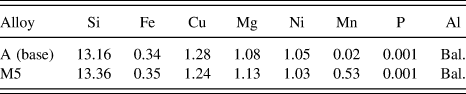
Two Al–13% Si alloys were prepared in the present work; Alloy A was the base Al–13% Si alloy while 0.5% Mn was added in the base alloy to form Alloy M5. For other alloying elements, such as Fe, Ni, Cu, and Mg, they were the same in both alloys and designed according to the literature.Reference Li, Yang, Wu, Wang and Liu5 The chemical compositions of experimental alloys analyzed with an optical emission spectrometer are listed in Table I.
Chemical composition of experimental alloys used (wt%).

In each test, approximately 3 kg of materials were prepared in a clay–graphite crucible using an electric resistance furnace. The temperature of the melt was maintained at ∼750 °C for 30 min. An Al–3.5% P master alloy was added to modify the Si particles. The melt was degassed for 15 min and then poured into a permanent mold preheated at 250 °C. The dimension of the cast ingots was 30 × 40 × 80 mm.
After casting, the heat treatment was carried out at 375, 425, and 500 °C with various holding times up to 24 h followed by water quenching. The precipitation behavior of dispersoids after heat treatments was evaluated by electrical conductivity (EC) and Vickers microhardness at room temperature (RT) as well as the compression YS and creep resistance at 300 °C. EC was recorded as an average value of 5 measurements. Microhardness tests were performed with a load of 25 g and a dwell time of 20 s on polished samples. The locations of indentations were on the aluminum matrix to determine the influence of dispersoids rather than the intermetallics on the boundaries. The average value of 20 measurements was recorded for each sample. The YS at 300 °C was obtained from compression tests with the strain rate of 10−3 s−1. In addition, creep tests at 300 °C were also performed under compression with a constant load of 45 MPa. For each condition, three tests were repeated to confirm the reliability of the results. More details of the experiments can be found in the literature studies.Reference Liu and Chen13,Reference Liu, Ma and Chen14 All the compression tests and creep tests were performed after the samples were held at 300 °C for 100 h to remove the influence of the aging effect of experimental alloys.Reference Wang, Hui and Chen8,Reference Qian, Liu, Zhao and Zhang15
The microstructural features of experimental alloys were observed by using optical and electron microscopes. The intermetallics were characterized by using a scanning electron microscope (SEM; JSM-6480LV) equipped with an energy dispersive X-ray spectrometer (EDS) and by X-ray diffraction (XRD), Japan Electron Optics Ltd., Tokyo, Japan. To reveal the dispersoids clearly, the polished samples were etched in 0.5% HF for 30 s. In addition, the dark-field mode on the optical microscope (OM) was used to observe the fine dispersoids. A transmission electron microscope (TEM; JEM-2100, Japan Electron Optics Ltd., Tokyo, Japan) operated at 200 kV was used to observe the distribution of dispersoids in details.
III. RESULTS AND DISCUSSION
A. As-cast microstructure of experimental alloys
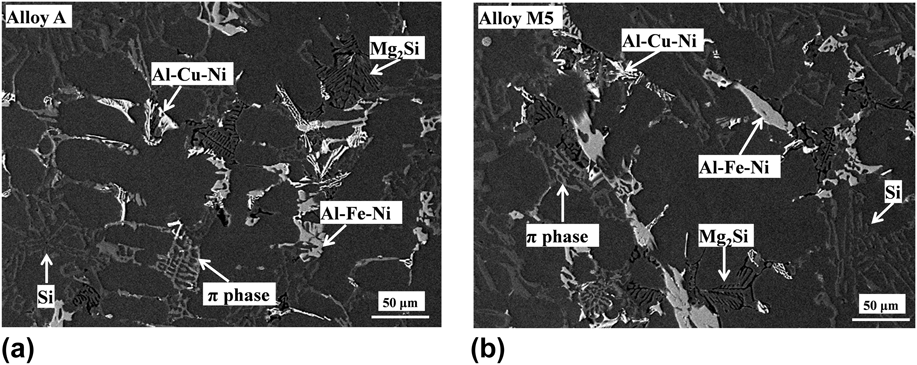
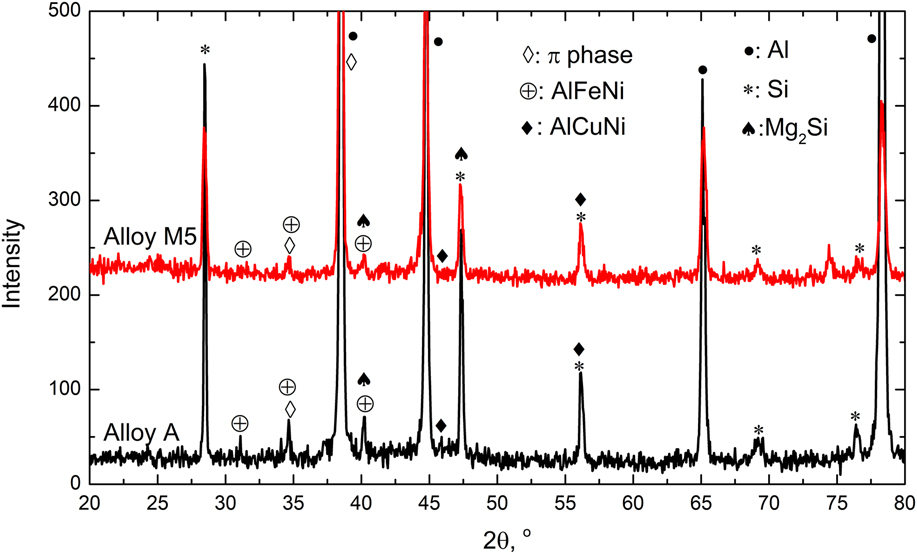
Figure 1 shows the as-cast microstructure of two experimental alloys. It can be seen that the formed phases are similar in both Alloys A and M5, which are composed of dark gray eutectic Si, dark primary Mg2Si, gray π-Al–Mg–Fe–Si phase (Al8Mg3FeSi6), light gray Al–Fe–Ni, and bright Al–Cu–Ni phases.Reference Asghar, Requena and Kubel4,Reference Li, Yang, Wu, Wang and Liu5 The microconstituents of two experimental alloys were also confirmed by the XRD results (Fig. 2), in which the peaks of six different phases (including Al matrix, Si, Mg2Si, Al–Cu–Ni, Al–Fe–Ni, and π-phase) were detected with similar intensities.Reference Li, Yang, Wu, Wang and Liu5 A few α-Al(MnFe)Si intermetallic particles were occasionally observed in Alloy M5 [not shown in Fig. 1(b)]. However, their volume fraction is very low and they are not detected by XRD in Fig. 2.
Backscatter SEM images showing the as-cast microstructure of experimental alloys: (a) Alloy A and (b) Alloy M5.

XRD results of two experimental alloys under the as-cast condition.

As shown in Figs. 1 and 2, little new intermetallic phase is observed in Alloy M5 compared with Alloy A, indicating that most of Mn remained in the aluminum matrix after the solidification due to its high solubility in Al.Reference Liu and Chen16 This is also indirectly confirmed by the EC and microhardness data of two alloys under the as-cast condition, which is measured to be 33.7 and 29.7% IACS, 75.6 and 81.6 HV in Alloys A and M5, respectively. The lower EC and higher microhardness in Alloy M5 can be contributed to the solid solution strengthening of Mn.
B. Evolution of dispersoids during heat treatment
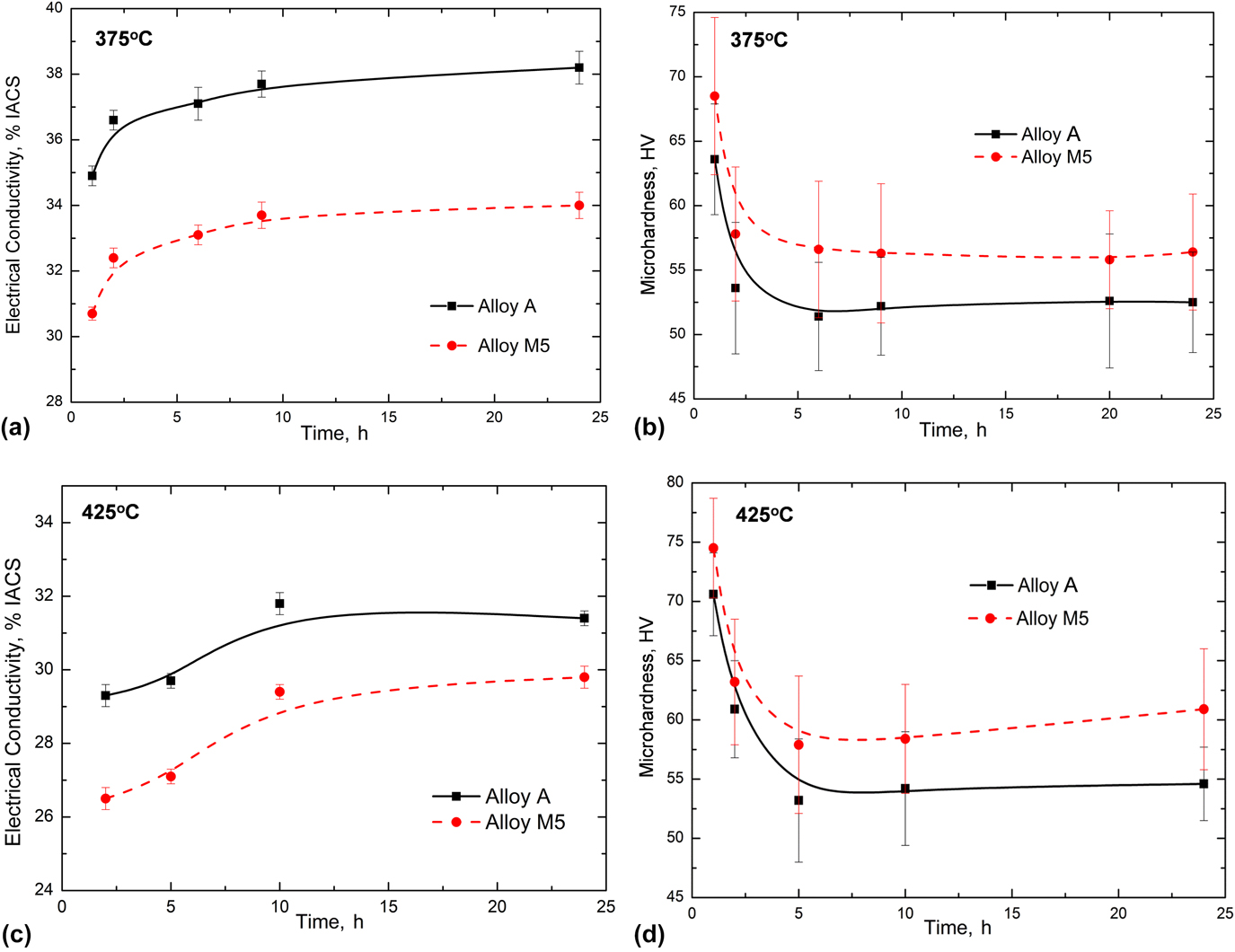
In the present work, EC and microhardness were measured after various heat treatments performed at 375, 425, and 500 °C to investigate the precipitation behavior of dispersoids. Figures 3(a) and 3(b) shows the evolution of EC and microhardness as a function of the holding time at 375 °C. The EC keeps increasing with the time up to 8 h [Fig. 3(a)], while the microhardness decreases up to 8 h followed by a plateau. The tendency of EC and microhardness changes in both alloys is similar. The differences of EC and microhardness between two alloys are derived by the solute Mn in the aluminum matrix.
Evolution of EC and microhardness: (a) EC and (b) microhardness during heat treatment at 375 °C; (c) EC and (d) microhardness during heat treatment at 425 °C.

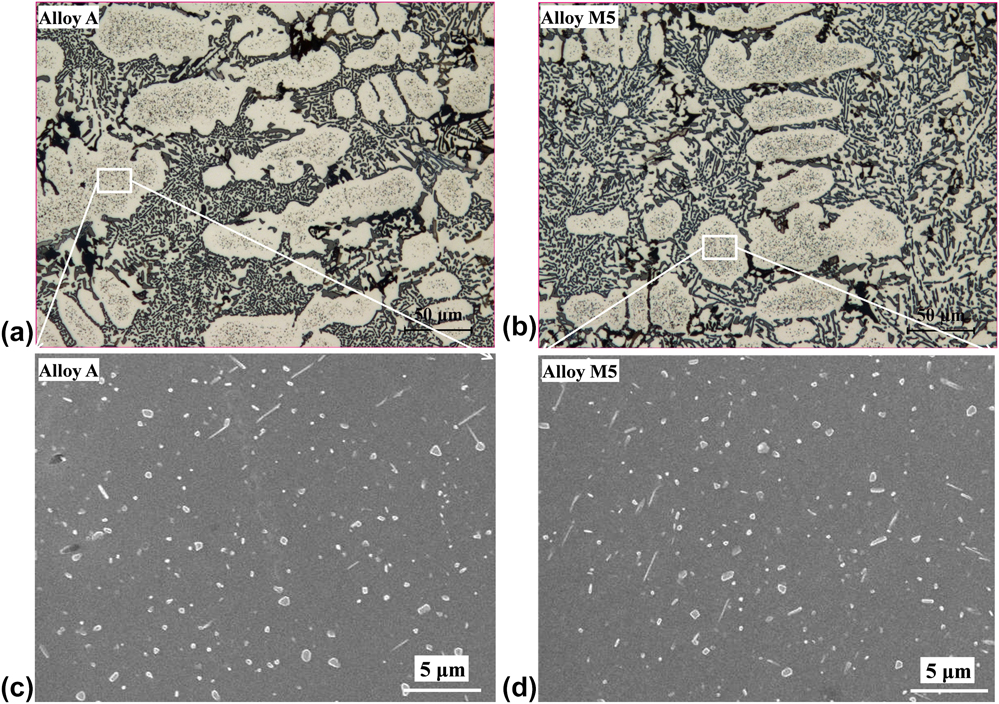
The microstructure after 375 °C/24 h of both alloys is shown in Fig. 4. It can be observed that a number of small dark particles appeared in the core of aluminum dendrites in both alloys [Figs. 4(a) and 4(b)]. Figures 4(c) and 4(d) show the SEM images of these small particles, which have the same morphology and are identified to be β-Mg2Si by SEM–EDS results, which were also reported to precipitate at ∼400 °C in the Al–Si piston alloys.Reference Manasijevic, Pavlovic-Acimovic, Raic, Radisa and Kvrgić17 The continuous precipitation of the equilibrium β-Mg2Si phase from the aluminum matrix leads to the increase of EC.Reference Lodgaard and Ryum18 However, due to the large size (∼500 nm) and low volume fraction of Mg2Si, their contribution to the hardness is weaker than the solid solution effect if they are present as the solute Mg and Si in the matrix,Reference Liu and Chen13 resulting in the decrease of microhardness [Fig. 3(b)]. No Mn-containing dispersoids were observed under this condition although it was reported that the α-Al(Mn,Fe)Si dispersoids could precipitate at 375 °C and reached the peak condition after 24–48 h at 375 °C in Al–Mn–Mg 3004 alloys.Reference Liu and Chen13 The reason is unclear but it is likely contributed to a much higher silicon (13%) in the experimental alloys than that in the 3004 alloy (0.25% Si), which was reported that the precipitation temperature of dispersoids increased with increasing Si content.Reference Lodgaard and Ryum18
Optical (a and b) and SEM (c and d) observation on the microstructure after 375 °C/24 h: (a) and (c) for Alloy A, (b) and (d) for Alloy M5.

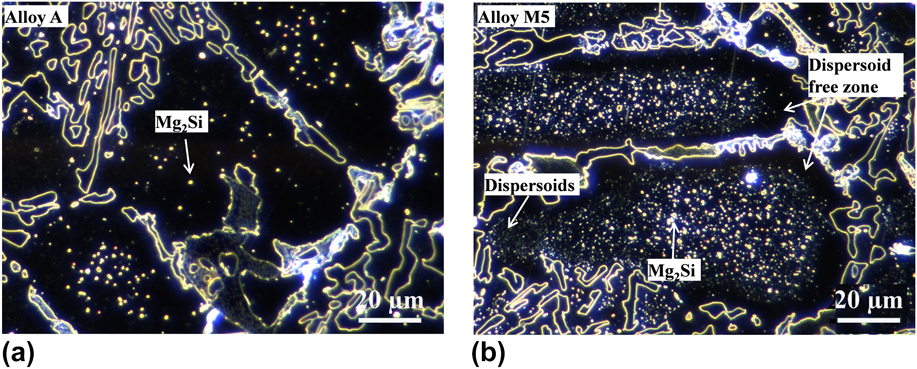
With increasing the heat treatment temperature from 375 to 425 °C, the similar tendency of EC and microhardness changes is observed, which is shown in Figs. 3(c) and 3(d). The EC increases while microhardness decreases with the holding time up to 10 h followed by a plateau [Fig. 3(c)], which is resulted from the precipitation of equilibrium β-Mg2Si from the matrix. However, a slight decrease in EC and a moderate increase in microhardness are observed after 10 h, which can be attributed to the dissolution of Mg2Si particles back in the matrix.Reference Liu, Ma and Chen14,Reference Lodgaard and Ryum18 As shown in Fig. 5(a), only large Mg2Si particles remained in aluminum dendrites while small Mg2Si particles dissolved back to the aluminum matrix. On the other hand, the difference in microhardness after 425 °C/24 h becomes bigger between two alloys [Fig. 3(d)], suggesting the possible decomposition of Mn supersaturated solution and formation of Mn-containing dispersoids. As shown in Fig. 5(b), a number of fine dispersoids appeared in the aluminum matrix in addition to large Mg2Si particles in Alloy M5 after 425 °C/24 h, making an additional contribution to the microhardness in Fig. 3(d). However, the volume fraction of dispersoids is low with high volume fraction of the dispersoid free zone, resulting in a limited contribution to the increase of microhardness in Alloy M5 after 425 °C/24 h.
Dark-field OM microstructure of experimental alloys after 425 °C/24 h: (a) Alloy A and (b) Alloy M5.

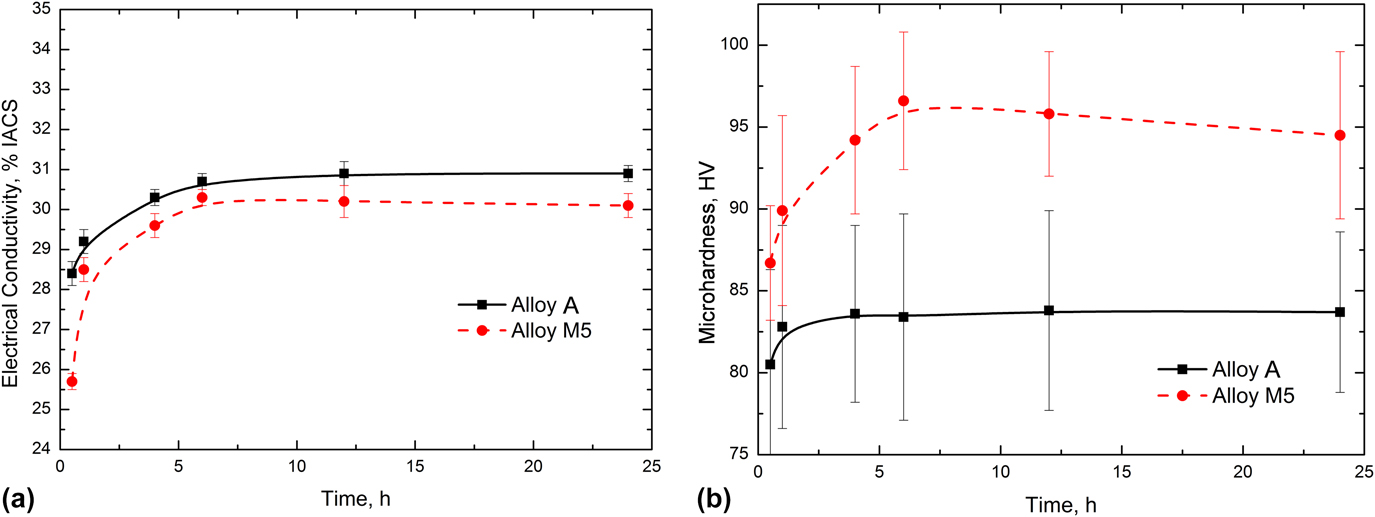
With further increasing heat treatment temperature to 500 °C, both the EC and microhardness generally increase with increasing time in both alloys (Fig. 6). However, significant difference can be observed between Alloys A and M5. As shown in Fig. 6(a), there is a sharp increase in EC in Alloy M5 at first few-hour holding and the difference in EC after 6 h holding between two alloys is much smaller at 500 °C compared with 375 °C and 425 °C (Fig. 3). As shown in Fig. 5, most of the Mg2Si particles have been dissolved into the aluminum matrix at 425 °C for 24 h. Therefore, the sharper increasing EC in Alloy M5 than Alloy A is likely resulted from the rapid decomposition of supersaturated solid solution of Mn in the matrix, while the slight increase of EC in Alloy A is likely due to the fragmentation of Si particles,Reference Cerri, Evangelista, Spigarelli, Cavaliere and DeRiccardis19 which is also shown in Figs. 7(a) and 7(b). In addition, it can be found that the EC of both alloys is very close after 12 h at 500 °C, indicating the full decomposition of Mn supersaturated solid solution. For the evolution of microhardness at 500 °C [Fig. 6(b)], the difference in microhardness between Alloy M5 and Alloy A becomes bigger and the microhardness reaches the peak value after 6 h followed by a slight decrease until 24 h. For instance, the difference in microhardness between two alloys is around 6 HV under the as-cast condition due to the solid solution of Mn in the matrix. However, it increases to maximum 15 HV at 500 °C/6 h and remains 10 HV at 500 °C/24 h, indicating that the optimum condition can be obtained at 500 °C/6 h in Alloy M5 due to the full decomposition of Mn supersaturated solid solution and the precipitation of dispersoids.
Evolution of EC and microhardness during heat treatment at 500 °C: (a) EC and (b) microhardness.

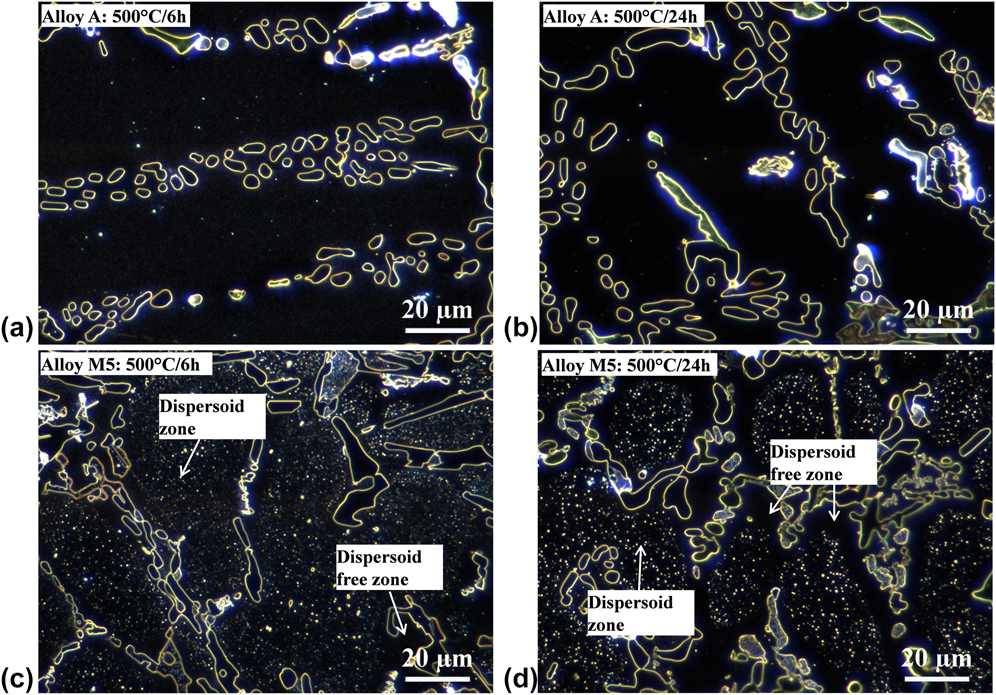
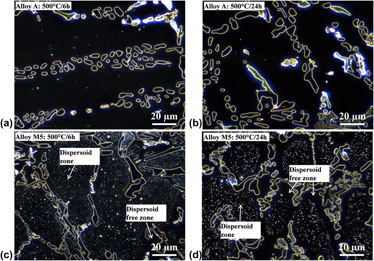
Dark-field OM microstructure of experimental alloys after being treated at 500 °C: (a) Alloy A: 6 h and (b) Alloy A: 24 h; (c) Alloy M5: 6 h, and (d) Alloy M5: 24 h.

Figure 7 shows the microstructure of Alloys A and M5 after 500 °C/6 h and 500 °C/24 h after etching. As shown in Figs. 7(a) and 7(b), the matrix of Alloy A is very clear with little particles in the dendrite cells after both 6 and 24 h holdings. On the other hand, the fine dispersoid zones can be clearly observed in Alloy M5 after 500 °C/6 h [Fig. 7(c)], in which a large number of dispersoids are uniformly distributed in the dendrite cells with surrounding narrow dispersoid-free zones. With increasing time [24 h in Fig. 7(d)], the dispersoids are still uniformly distributed. However, their size becomes larger and the dispersoid-free zone becomes bigger. Therefore, the precipitation of high volume and fine dispersoids at 500 °C/6 h makes a significant contribution to the hardness, leading to the peak value at 500 °C/6 h in Fig. 6(b). With further increasing holding time, the microhardness slightly decreases due to the increasing size of dispersoids and the increasing volume of dispersoid-free zones.
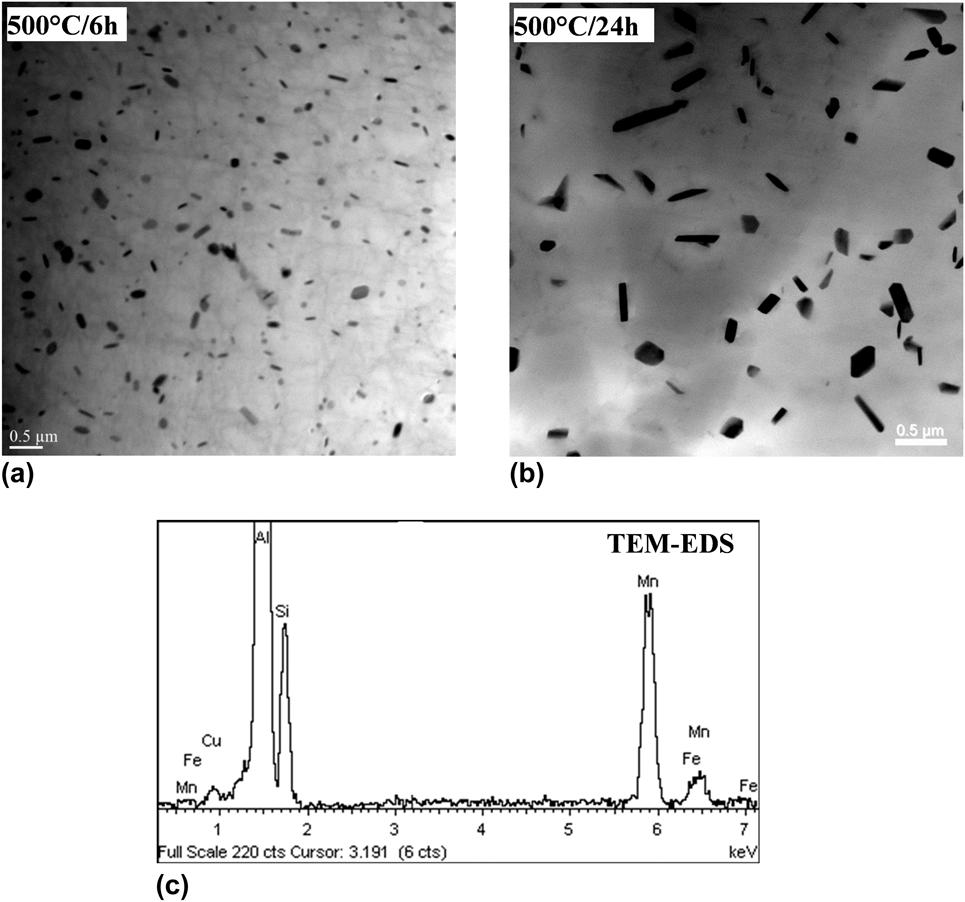
To characterize the dispersoids in detail, TEM observation is performed in the dispersoid zone in Alloy M5. Although the morphology of dispersoids is slightly different [Figs. 8(a) and 8(b)], all the dispersoids are confirmed as Mn-containing dispersoids from TEM–EDS results [Fig. 8(c)], which is similar to the composition of α-Al(Mn,Fe)Si dispersoids reported in the literature studies.Reference Li, Muggerud, Olsen and Furu12,Reference Liu and Chen13,Reference Lodgaard and Ryum18 The dispersoids after heat treatment at 500 °C/6 h are uniformly distributed in the matrix with the average diameter of ∼90 nm [Fig. 8(a)] and with the number density as high as 8 × 10¹² m−2, confirming their remarkable contribution to the microhardness in Fig. 7. However, with increasing time [500 °C/24 h in Fig. 8(b)], the size of α-Al(Mn,Fe)Si dispersoids become larger with the average diameter of ∼150 nm and their number density becomes much lower (2.5 × 10¹² m−2) compared with that in 500 °C/6 h, indicating the coarsening of α-dispersoids that causes a slight decrease of microhardness after 6 h in Fig. 6.
TEM images showing the distribution of dispersoids in Alloy M5: (a) 500 °C/6 h, (b) 500 °C/24 h, and (c) their TEM–EDS result.

C. Elevated-temperature properties of experimental alloys
As shown in Figs. 4 and 5, though the Mg2Si particles could precipitate in the aluminum matrix during heat treatment at lower temperatures (375–425 °C), their contribution to the microhardness is limited due to the large size and low volume fraction [Figs. 4(a) and 5(a)], and often is negative due to the weaker hardening effect than the solid solution strengthening of solutes Mg and Si in the matrix, leading to the decreasing microhardness [Figs. 3(b) and 3(d)]. On the other hand, the Mn-containing α-Al(Mn,Fe)Si dispersoids precipitated during heat treatment at higher temperature (∼500 °C) with fine size and relatively high number density [Fig. 8(a)], leading to a remarkable contribution to the microhardness at RT [Fig. 6(b)]. For the elevated-temperature properties, the YS and creep resistance at 300 °C were measured with the samples treated at 500 °C followed by holding at 300 °C for 100 h. The results obtained from two experimental alloys are shown in Fig. 9.
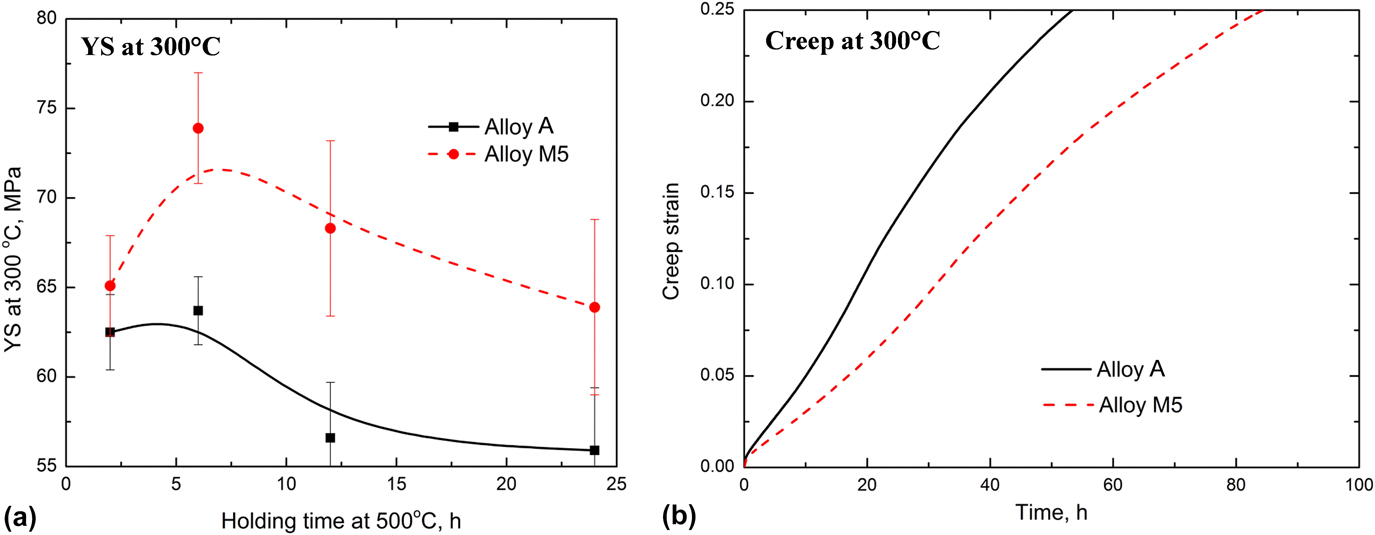
Evolution of properties at 300 °C of experimental alloys: (a) YS as a function of holding time at 500 °C and (b) typical creep curves after 500 °C/6 h, tested under a constant load of 45 MPa.

As shown in Fig. 9(a), different tendencies of YS at 300 °C between Alloys A and M5 can be observed. For Alloy A, the YS begins to decrease after 6 h, which is likely due to a loss of interconnectivity of the networks between Si particles and intermetallic particles caused by the fragmentation and spheroidization of eutectic Si particles with increasing holding time at 500 °C.Reference Asghar, Requena and Boller6,Reference Eidhed11 On the other hand, the YS at 300 °C in Alloy M5 first increases to the peak value after 6 h followed by a slight decrease with time. As shown in Figs. 7(c) and 8(a), fine Mn-containing dispersoids have fully precipitated after 500 °C/6 h, which is the main reason for the increase of YS at 300 °C due to the dispersoid hardening according to the Orowan strengthening mechanism.Reference Liu and Chen13,Reference Muggerud, Mørtsell, Li and Holmestad20 As shown in Fig. 9(a), the peak YS at 300 °C is improved from 63 MPa in Alloy A to 74 MPa in Alloy M5 after 500 °C/6 h, which is 17.5% improvement in the elevated-temperature strength. For the decrease of the YS after 6 h in Alloy M5, two mechanisms can be involved: coarsening of Mn-containing dispersoids and weakening of internal networks between Si particles and intermetallic particles. Although the YS decreases with time after 6 h in Alloy M5, its values at 300 °C are always higher than Alloy A. For instance, the YS of Alloy M5 after 500 °C/24 h is still as high as 64 MPa, which is almost 9 MPa higher than that of Alloy A (55 MPa after 500 °C/24 h), confirming the remarkable contribution of dispersoids on the elevated-temperature strength.
Figure 9(b) is the typical creep curves of Alloys A and M5 after treated at 500 °C/6 h. For Alloy A, it took around 50 h to reach the maximum creep strain of 0.25, which is the limitation of the creep testing machine. However, it took more than 85 h to reach the creep strain of 0.25, indicating the better creep resistance of Alloy M5 at elevated temperature. Due to the creep condition applied in the present work (300 °C, 45 MPa), the creep deformation was principally controlled by the dislocation mechanism.Reference Liu and Chen13 Therefore, the precipitation of dispersoids in Alloy M5 can be the principal reason for the improvement in the creep resistance.
From the evolution of microhardness at RT (Fig. 6) and the YS and creep resistance at 300 °C (Fig. 9), it can be concluded that the properties at both room and elevated temperatures can be optimized in Alloy M5 after 500 °C/6 h due to the precipitation of a high volume of α-Al(Mn,Fe)Si dispersoids (Fig. 8). In the industrial practice, the Al–Si piston alloys are subjected to an artificial aging after solution treatment (T6 and T7) to enhance the RT mechanical properties. Conventionally, the artificial aging treatment is performed at relatively low temperature (160–200 °C) to form the fine precipitates as the main strengthening phases, such as Mg2Si, Al2Cu, and Al2CuMg.Reference Wang, Hui and Chen8,Reference Stadler, Antrekowitsch, Fragner, Kaufmann, Uggowitzer and Suarez21 In the present work, the α-Al(Mn,Fe)Si dispersoids are precipitated during the solution treatment at higher temperature (∼500 °C). After the solution treatment and quench, Mg and Cu solutes are supersaturated in the aluminum matrix, which are ready to form the fine precipitates during the following artificial aging. On the other hand, the formation of α-Al(Mn,Fe)Si dispersoids does not consume any Mg and Cu solutes. Therefore, it is expected that the precipitation of α-Al(Mn,Fe)Si dispersoids during the solution treatment has little influence on the subsequent aging behavior. The heat treatment of the dispersoid precipitation at 500 °C in the present work is completely compatible with the conventional heat treatments (T6 and T7) in Al–Si piston alloys. When the piston alloys are exposed to the working condition at elevated temperature, the fine precipitates obtained by aging become coarse and the mechanical properties drop. As a complementary strengthening mechanism, the dispersoid strengthening in the aluminum matrix provides an alternative approach to improve both the room-temperature and elevated-temperature properties for Al–Si based piston alloys, especially due to their thermal stability of the dispersoids at elevated temperature.
IV. CONCLUSIONS
In the present work, the influence of Mn addition on the evolution of dispersoids and elevated-temperature properties was investigated and the following conclusions can be obtained:
(1) No obvious changes on the as-cast microstructure are observed in the alloy with Mn addition, which is composed of eutectic Si, primary Mg2Si, Al–Fe–Ni, Al–Cu–Ni, and π-Al–Mg–Fe–Si intermetallic phases.
(2) During the heat treatment at low temperature (∼375 °C), β-Mg2Si particles can precipitate in the matrix. However, their contribution to microhardness is negative due to the large size and low number density, resulting in a weaker strengthening effect than solid solution hardening of solute Mg and Si atoms. Almost all the Mg2Si particles can be dissolved in the aluminum matrix at 500 °C.
(3) α-Al(Mn,Fe)Si dispersoids begin to form at 425 °C for 24 h and the full precipitation of dispersoids reaches at 500 °C for 6 h, resulting in a remarkable improvement in the microhardness at RT and the YS and the creep resistance at 300 °C.
(4) The heat treatment of the dispersoid precipitation (500 °C/6 h) in Al–Si piston alloys with Mn addition is completely compatible with the conventional heat treatments (T6 and T7), providing an alternative approach to improve both the room-temperature and elevated-temperature properties of Al–Si piston alloys.
ACKNOWLEDGMENTS
The authors would like to acknowledge the financial support of the Natural Sciences and Engineering Research Council of Canada (NSERC) and Rio Tinto Aluminum through the NSERC Industry Research Chair in the Metallurgy of Aluminum Transformation at University of Québec at Chicoutimi.