Introduction: New Legal Realism and Legal Education
In this article, we combine quantitative and qualitative methods to investigate why post-tenure law professors of color and women law professors within the US legal academy are differentially dissatisfied with their work lives. Our results shed light not only on lingering issues confronting the integration of law faculties, but also on the effects of cultural and structural impediments in professional environments more generally. Law professors have been understudied relative to other professors or legal professionals, yet they have a formative role in training members of the legal profession. At a time when stubborn “glass ceilings” pose problems for many professions, we look to a key moment for legal professionals, investigating the environments in which they are trained and the tenured professors who hold power in shaping those environments. This presentation of our study results is also itself an example of the kind of work advocated by a new movement of empirical legal researchers within law schools, under the aegis of “new legal realism” (NLR).
In recent years, there has been a turn toward empirical research within the US legal academy (Diamond Reference Diamond2002; Eisenberg Reference Eisenberg2011; Macaulay and Mertz Reference Macaulay, Mertz, Banakar and Travers2013). One strand of that turn is NLR, which has stressed the need to draw on the full range of social science methods and disciplines to study the law in action (Erlanger et al. Reference Erlanger, Garth, Larson, Mertz, Nourse and Wilkins2005; Macaulay Reference Macaulay2005, Reference Macaulay2006; Mitchell Reference Mitchell2005, Reference Mitchell, Macaulay, Mertz and Mitchell2016). By contrast with approaches that limit empirical work on law to quantitative approaches, NLR insists that qualitative research offers important empirical information that is not available using numbers alone (see Nourse and Shaffer Reference Nourse and Shaffer2009; Suchman and Mertz Reference Suchman and Mertz2010). A full empirical picture is particularly crucial in an area like law, where decisions can have major human impacts. To achieve that full account, we need both quantitative research, to provide a rough sense of how generalized the patterns located by qualitative research are within societies, and qualitative research, to give a more in-depth understanding of what these patterns mean (see Garth Reference Garth2006 [qualitative]; Gulati and Nielsen Reference Gulati and Nielsen2006 [psychology, anthropology, sociology]; Miles and Sunstein Reference Miles and Sunstein2008 [quantitative]; George, Gulati, and McGinley Reference George, Gulati and McGinley2011 [mixed]). This article demonstrates the value of combining empirical approaches through a mixed-methods study of law professors.
Our article is, therefore, a little different from the usual social science article in a peer-reviewed journal, which can take for granted that its audience accepts the value of empirical research—or even the value of employing multiple kinds of empirical methods (which is necessary to fit the methods used to the questions asked). Not every method can answer every question, as most social scientists would readily agree. In this article, we address a mixed audience of social scientists and legal academics, and so we have to “translate” the presuppositions behind our work overtly for this hybrid audience. NLR scholars have particularly stressed the need for such conscious translation efforts, noting how in the absence of such efforts, interdisciplinary conversations often fail to produce much real enlightenment (see the articles in Mertz, Ford, and Matoesian Reference Mertz, Ford and Matoesian2016). We take the need to translate all the more seriously because legal academics are at once part of our audience, and the subjects of our research. This gives us a chance to demonstrate for a particular legal audience the benefits of using an NLR framework to cast light on their own work lives.
Law professors are, of course, the primary professionals providing law students with their foundational training. From the time of the original realist scholars, some law professors have searched for ways to introduce law students to social science approaches that provide a realistic understanding of the law in action. Practicing lawyers, concerned that law schools do not do enough to prepare students for the actual practice of law, might see this turn as just one more distraction. However, NLR scholars would argue that empirical work on law addresses the actual practice of law more directly than does traditional legal scholarship because empirical researchers can give us systematic information on how law and legal practice really work on the ground (see, e.g., Garth Reference Garth1990; Dinovitzer et al. Reference Dinovitzer, Garth, Sander, Sterling and Wilder2004, Reference Dinovitzer, Garth, Plickert, Sandefur, Sterling and Wilkins2014; Macaulay, Friedman, and Mertz Reference Macaulay, Friedman and Mertz2007; Dinovitzer, Nelson, and Plickert Reference Dinovitzer, Nelson and Plickert2009; Fortney Reference Fortney2009).
Beyond empirical research on the practice of law, studies of the law in action have also shed light on the real-world consequences of legal reforms. It is now common for law texts to incorporate references to social science research pertinent to the legal doctrines under discussion, although lawyers' lack of training in social science is apparent in the sometimes random or uncritical quality of those references. A similar problem emerges in legal proceedings when legislatures or courts seek to draw on relevant empirical research (see, e.g., Ford Reference Ford2013, Reference Ford, Mertz, Ford and Matoesian2016). In response, NLR as a scholarly movement has pushed for more systematic attention to the “translation” issues that arise when lawyers draw on social science (see, e.g., Erlanger et al. Reference Erlanger, Garth, Larson, Mertz, Nourse and Wilkins2005; Mertz, Ford, and Matoesian Reference Mertz, Ford and Matoesian2016)—and that arise if social scientists working on law pay insufficient attention to the inside view of how law works. NLR scholars have also urged legal experts, inside and outside the legal academy, to develop more sophisticated approaches to social science that take account of the underlying theories and intellectual contexts that give meaning to empirical methods (McCann Reference McCann, Macaulay, Mertz and Mitchell2016; Mertz Reference Mertz, Macaulay, Mertz and Mitchell2016).
As we have noted, this article provides an example of the kind of research advocated by NLR. It bridges two very different kinds of social science methods (quantitative and qualitative), showing how the two together yield a better understanding than either could alone. It situates its inquiry in terms of developments in previous social science research. Finally, it speaks directly to an issue in the “real world” of law—in this case, the real world of law schools. Just as in the practice of law more generally, law schools as institutions have opened their doors in recent decades to an influx of legally trained women and professors of color (henceforth referred to as “traditionally excluded” or “traditionally marginalized” groups). While today's formal law purports to prohibit some forms of gender and racial discrimination, the impact of such laws can be quite variable (ranging to nonexistent) even in a workplace setting populated by legally trained professors who are teaching upcoming generations of lawyers. Our study of post-tenure law professors in the United States thus speaks both to questions of whether and how law works in action in a particular (legal) workplace—and of what sort of real-world role model is provided to law students by the professors who are initiating them into their professional lives.
At the same time, our study demonstrates the importance of NLR approaches to unraveling what is actually happening—whether in law schools or in other settings where law is implicated. How are law faculties handling the changes that come with incorporating previously excluded groups? If some forms of gender and racial discrimination have supposedly been addressed by formal law, has that evened the playing field in workplaces such as these? To take one empirical entrée into that broader question, we start with a more specific question: Are all law professors equally satisfied with their situations in law schools? If not, what affects any differences in satisfaction? Having found race- and gender-based differences in reported experiences of law professors—in both qualitative and quantitative analyses—we examine what mediates these differences, using an open framework that considers many possible contributing factors (based on a review of existing pertinent literatures: see below). Our results support sociological and psychological studies that point to implicit bias and institutional structural bias as ongoing sources of difficulty that have not been eradicated by more conscious efforts at reform. We respond to calls in the literature for research that takes issues of workplace culture and subtle differences in values into account.
Job Satisfaction
We begin by investigating existing social science research and frameworks relevant to our specific research question. We examine social science research on job satisfaction pertinent to academic and legal careers, as well as empirical studies of law professors and law schools in particular. From multiple disciplinary and methodological vantages, studies have found that there is differential satisfaction based on race and gender in these occupations, and so we also survey the literatures on race and gender, as well as pertinent scholarship on the intersection of race and gender (“intersectionality” research). Research has also pointed to institutional structural factors as affecting differential satisfaction along lines of race and gender. We pull the threads of these literatures together in formulating our research question.
At a very general level, researchers have examined the importance of “objective” factors, such as higher salary and status, on job satisfaction—as well as of less tangible “subjective” factors, such as office climate or feelings about work (see, e.g., Hagedorn Reference Hagedorn1996; Veenhoven Reference Veenhoven1996; Sousa-Poza and Sousa-Poza Reference Sousa‐Poza and Sousa‐Poza2000). For example, women who are being paid less and occupy lower ranks of a profession nonetheless often report higher satisfaction than men who are paid more and have higher status—a situation that has been described as the paradox of contented women workers (Crosby Reference Crosby1982; Hull Reference Hull1999b). At the same time, women can also have differentially negative experiences in gender-unequal working environments (see generally Krieger and Fiske Reference Krieger and Fiske2006). There are a number of ways that workers' environments or climates can play important roles in overall satisfaction, alongside more objective factors such as salary (Kalleberg Reference Kalleberg1977; Bilimoria et al. Reference Bilimoria, Perry, Liang, Stoller, Higgins and Taylor2006; Callister Reference Callister2006). Thus, when employers create inclusive work climates, for example, through even-handed distribution of resources or careful mentoring practices, a number of positive effects can follow, including higher employee satisfaction and lowered reports of workplace bias (Nishii Reference Nishii2013; Ellemers Reference Ellemers2014). Lack of attention to these kinds of factors can decrease inclusion of traditional outsider groups (McDonald and Westphal Reference McDonald and Westphal2013).
Furthermore, seemingly intangible factors like this can contribute to tangible results. Improved work climates and higher job satisfaction have been associated with lower absenteeism and lower job turnover (Liu et al. Reference Liu, Mitchell, Lee, Holtom and Hinkin2012; Diestel, Wegge, and Schmidt Reference Diestel, Wegge and Schmidt2013). Taking this perspective pushes us to think about structural aspects of workplace environments rather than simply focusing on individual decision making. This requires attention to the structures that affect work climates, mentoring practices, and distribution of resources, as well as to effects of structure on specific groups of employees.
Job Satisfaction in Academia
Many researchers studying job satisfaction in academic careers rely on landmark work by Linda Hagedorn, who laid out a framework in her 2000 article, “Conceptualizing Faculty Job Satisfaction.” Hagedorn identified a number of factors that mediated or triggered faculty satisfaction, which she assessed along a continuum ranging from disengagement, through acceptance/tolerance, to the most positive level of appreciation/engagement (Reference Hagedorn2000, 7). Subsequent research has repeatedly found that women faculty and faculty of color experience challenges that white, male faculty do not, impacting relative satisfaction (see, e.g., Eagan and Garvey Reference Eagan and Garvey2015; Arnold, Crawford, and Khalifa Reference Arnold, Crawford and Khalifa2016). For example, faculty in general tend to experience a letdown immediately after tenure, but “[t]he toll … is heavier on women and faculty of color who, given their fewer numbers at this rank (in many disciplines), are asked to serve more, advise more, show up more” (Mathews Reference Mathews2014, 1).
Hagedorn and Berta Vigil Laden examined satisfaction among faculty of color in the academy and found that the experiences of these professors were two-sided (Laden and Hagedorn Reference Laden and Hagedorn2000). On the positive side, faculty of color found deep satisfaction in teaching and mentoring students (63–65). Opportunities to interact with other faculty of color also aided satisfaction, just as peer networks have created more equitable work experiences for women faculty members (O'Meara and Stromquist Reference O'Meara and Stromquist2015). On the negative side, most faculty of color reported having less time for research than white faculty members (Laden and Hagedorn Reference Laden and Hagedorn2000, 61). For example, minority faculty report frequently being called on to serve as “minority affairs specialists,” an added burden (62). Thus, female and minority faculty frequently wind up with additional work that is not highly rewarded by institutions, simply by virtue of their racial and/or gender identities—a phenomenon also described by participants in our study.
Such largely invisible structural costs of integrating the academy in turn affect how much time traditionally excluded faculty can spend on more highly valued pursuits such as research—and, in an ongoing outward ripple, also can affect a sense of positive climate or work environment, along with a sense of being valued or respected (see Rosser Reference Rosser2004; Bilimoria et al. Reference Bilimoria, Perry, Liang, Stoller, Higgins and Taylor2006). Complicating the picture still further are the often unremarked effects of implicit bias and lingering allegedly benevolent forms of discrimination (Broido et al. Reference Broido, Brown, Stygles and Bronkema2015), which are sometimes harder to identify, but nonetheless have important negative effects.Footnote 1 Unsurprisingly, overall racial climate on campus has a particularly significant effect on satisfaction for faculty of color (Victorino, Nylund-Gibson, and Conley Reference Victorino, Nylund‐Gibson and Conley2013).
A recent landmark volume by women of color within the academy digs deeper into many of these challenges (Gutiérrez y Muhs et al. Reference Gutiérrez y Muhs, Niemann, González and Harris2012). Drawing on critical race theory and other sources, these authors trace the effects of intersectionality, examining how bias can worsen for faculty members managing the intersection of race, gender, class, sexual orientation, and other outsider identities (on intersectionality, see Crenshaw Reference Crenshaw1991). This collection combines personal narratives with interview and survey studies. The authors make clear the importance of climate, relationships, networks, institutional structures, and intersectional identities—themes that emerge from our study as well (Gutiérrez y Muhs et al. Reference Gutiérrez y Muhs, Niemann, González and Harris2012).
Job Satisfaction in Legal Careers
Lawyers' general job satisfaction has been the subject of significant empirical research. Empirical work probing the detailed psychology of lawyers' well-being has demonstrated the importance of “internal” factors (inherently interesting or meaningful work) rather than simply looking at “external” factors (rankings, prestige, money, status) (Krieger and Sheldon Reference Krieger and Sheldon2015, 623). There is a robust literature on lawyer distress, painting a picture of disproportionately unhappy lawyers (Benjamin, Sales, and Darling Reference Benjamin, Sales and Darling1992; Daicoff Reference Daicoff1997; Schlitz Reference Schlitz1999). At the same time—and somewhat confusingly—the majority of studies focusing on lawyers have generally found high levels of job satisfaction overall, averaging in the range of 80 percent satisfied with their jobs (Organ Reference Organ2011, 260; see also Hull Reference Hull1999a; Dinovitzer and Garth Reference Dinovitzer and Garth2007; Monahan and Swanson Reference Monahan and Swanson2009). General satisfaction levels are relatively high for most groups, although salary, work settings, practice type, marital/family status, seniority, race, and gender can affect satisfaction (Dau-Schmidt and Mukhopadhaya Reference Dau‐Schmidt and Mukhopadhaya1999; Lempert, Chambers, and Adams Reference Lempert, Chambers and Adams2000; Richard Reference Richard2002; Harrison Reference Harrison2006).Footnote 2
A thoughtful 2011 review of the literature on lawyer satisfaction cautioned against “attribut[ing] to the entire legal profession data that speaks only to a categorical subset” (Organ Reference Organ2011, 263). Organ concluded that lawyers' situations affect their reported satisfaction levels in many ways, depending on things like amount of experience, private versus public practice, differentially negative effects for women of color, geography, and temporal period (263–70)—a conclusion supported by findings from the After the JD (AJD) study, discussed below.
As noted, studies of traditionally excluded groups in the legal profession have shown relatively high job satisfaction levels despite objectively less advantageous situations for women and minorities (see, e.g., Hagan and Kay Reference Hagan and Kay1995; Wilkins and Gulati Reference Wilkins and Gulati1996; Dau-Schmidt and Mukhopadhaya Reference Dau‐Schmidt and Mukhopadhaya1999; Lempert, Chambers, and Adams Reference Lempert, Chambers and Adams2000; Reichman and Sterling Reference Reichman and Sterling2004)—resulting, for example, in the “paradox of the contented female lawyer” (Hull Reference Hull1999b, 687; see also Mueller and Wallace Reference Mueller and Wallace1996; Dau-Schmidt et al. Reference Dau‐Schmidt, Galanter, Mukhopadhaya and Hull2000). Research on race, gender, and satisfaction in legal careers has indicated a need for better insight on how aspects of institutional setting and culture impact women and minorities. For example, Payne-Pikus, Hagan, and Nelson found that institutional discrimination is a continuing issue within law firms, and suggested that future studies should explore “aspects of firm culture” (Reference Payne‐Pikus, Hagan and Nelson2010, 578) and how they impact women and minorities (see also Heinz et al. Reference Heinz, Nelson, Sandefur and Laumann2005).
In an earlier article, Kathleen Hull noted the need for additional qualitative research to map more accurately what matters to women lawyers: “We need more open-ended questions that allow respondents to explain what job satisfaction means to them. … We think money makes people happy, so we measure income differences. Similarly, we assume that prestige breeds contentment so we measure prestige differences among practice settings. … Are these assumptions about the linkages between traditional stratification measures and subjective experiences of lawyers always warranted?” (Reference Hull1999b, 698).Footnote 3 Here Hull echoes legal feminist scholars such as Carrie Menkel-Meadow, who questioned why sociological measures “of prestige and success serve as the ‘objective’ measure of women's progress,” asking, “What if women defined success and satisfaction differently?” (Reference Menkel‐Meadow1989, 307).
Subsequent research has deepened our understanding of different perspectives on legal careers, aided in part by the AJD project, a national longitudinal study of lawyers combining quantitative and qualitative methods (see Dinovitzer et al. Reference Dinovitzer, Garth, Sander, Sterling and Wilder2004, Reference Dinovitzer, Garth, Plickert, Sandefur, Sterling and Wilkins2014; Dinovitzer, Nelson, and Plickert Reference Dinovitzer, Nelson and Plickert2009). In a 2007 article based on the first AJD wave, Dinovitzer and Garth situated job satisfaction as a mechanism that helps reproduce hierarchy.Footnote 4 Like other researchers, they found that large law firm practice and elite credentials did not produce the highest general satisfaction (Reference Dinovitzer and Garth2007, 23, 29), but, as they point out, the lower satisfaction levels of women and minorities in elite settings merit further scrutiny, as different dynamics seem to be in play for many of them than for their white, male colleagues.Footnote 5
In general, current research is pushing ahead the effort to unpack multiple paradoxes surrounding relatively contented lower status lawyers—which exist alongside persistent findings of disproportionate difficulties faced by members of traditionally excluded groups (see also Reskin Reference Reskin2003; Dinovitzer, Reichman, and Sterling Reference Dinovitzer, Reichman and Sterling2009; Dinovitzer and Hagan Reference Dinovitzer and Hagan2014). Headworth and Nelson underscore the gap between the rhetoric espousing inclusiveness and stubbornly persistent disparities (Reference Headworth, Robert, Headworth, Nelson, Dinovitzer and Wilkins2016, 17–19, 27); they conclude that “barriers to equal opportunity are endemic to the cultures of schools and workplaces, labor market structures, and practices of hiring, promotion, and work assignment” (17–19, 27). Reflecting on over twenty years of research on women lawyers, Joyce Sterling and Nancy Reichman also conclude that “gender disparity persists,” pointing to continued differences in income, promotions, departures from law firms, and implicit bias fueled by structural changes in the market for lawyers (Reference Dinovitzer, Garth and Sterling2013, 535). They stress in particular the need for more subtle research “to directly address the stereotyping of women” (537). F. Kay and Wallace (Reference Kay and Wallace2009) similarly note that women lawyers do not seem to reap the same kinds of “objective” rewards from mentoring as men (e.g., elevated earnings), even though positive mentoring experiences improve women's subjective job satisfaction.
Arguments for subtler analytic frameworks make particular sense when studying professors from marginalized groups, who might have concerns that are not captured in traditional social science frameworks—a point stressed by scholars in the emerging empirical critical race movement (Obasogie Reference Obasogie2013; Carbado and Roithmayr Reference Carbado and Roithmayr2014; Barnes Reference Barnes2016; see also Parks Reference Parks2008). Opening research questions to new, data-based insights from this and allied “outsider” traditions such as legal feminism has allowed less skewed, more objective research on issues such as implicit bias. This scholarship fits well with work in socio-cultural and linguistic anthropology, demonstrating how unreflective imposition of dominant Euro-American perspectives can lead to drastic misinterpretations of data from other cultures and parts of the world.
Law Schools and Law Professors in Particular
But are there characteristics of law schools as particular kinds of legal work settings that bear on the questions at the heart of our study? There have been fewer studies of the work experiences of US law teachers than of the experiences of US lawyers, but there has still been some significant research over the years, tracking, for example, the way elite law schools have dominated the development of US legal education as well as the upsurge of women law professors during the 1970s and 1980s (see Fossum Reference Fossum1980, Reference Fossum1983; Borthwick and Schau Reference Borthwick and Schau1991; Kay Reference Kay1991; Merritt, Reskin, and Fondell Reference Merritt, Reskin and Fondell1993; Merritt Reference Merritt1998; for a more global perspective, see Cownie Reference Cownie, Cane and Kritzer2010). Even after law faculties began to achieve some integration along lines of gender and race, studies have documented stubborn problems within law schools in dynamics surrounding diversity (Chused Reference Chused1988; Delgado and Bell Reference Delgado and Bell1989; Merritt and Reskin Reference Merritt and Reskin1992; Merritt Reference Merritt2000; Barnes and Mertz Reference Barnes and Mertz2012; Deo Reference Deo2014). In 2005, the American Association of Law Schools' Committee on the Recruitment and Retention of Minority Law Teachers issued a report pointing to continuing problems in law schools' structures and cultures that contributed to negative climates for racial minority professors. These included the absence of a critical mass of minority faculty in most law schools; extra “academic housekeeping” demands on minority professors; problems of double standards and inadequate mentoring; and racially hostile environments in some law schools (American Association of Law Schools 2005, 5). In recent years, our own research (Mertz et al. Reference Mertz, Tung, Barnes, Njogu, Heiler and Martin2011; Barnes and Mertz Reference Barnes and Mertz2012; Mertz and Barnes Reference Mertz, Barnes, Macaulay, Mertz and Mitchell2016) has documented different patterns and impacts for traditional outsider law professors, even after tenure. The work of Deo demonstrates that these patterns and impacts have been ongoing and, in many cases, remain stubbornly entrenched (see, e.g., Deo Reference Deo2014, Reference Deo2015).
Law professors of color have been leading figures in the larger critical race theory and related intellectual movements, helping to expand not only legal, but also social science thought about how to conceptualize and study these issues (see, e.g., Matsuda Reference Matsuda1989; Williams Reference Williams1991; Crenshaw Reference Crenshaw1994; Delgado and Stefancic Reference Delgado and Jean2005). Working at the level of both personal narrative and legal analysis, they have begun to expose the kinds of hidden presumptions that permit racism to endure within the legal academy and within US law, despite overt protestations to the contrary (see, e.g., Bell in Delgado and Stefancic Reference Delgado and Jean2005, 177–216). Because of this advantage in seeing beneath the surface factors that can be overtly acknowledged and counted, critical race scholars were able to anticipate NLR's emphasis on the importance of mixed methods—and of including qualitative methods within the mix. As Harris and González explain, “qualitative research is particularly important in the investigation of social hierarchies. As feminist scholars and those in the critical race theory tradition have established, personal stories may bridge the epistemological gap that frequently appears between the lives of people with a particular privilege and those who lack that privilege [citations omitted]. … Qualitative empirical research … creates a frame in which to interpret the quantitative data” (Reference Harris, González, Gutiérrez y Muhs, Niemann, González and Harris2012, 3). Sometimes apparently puzzling quantitative data make better sense when their deeper contexts are revealed through interviews or observation. At times, there are assumptions embedded within social science studies that reflect the researchers' own backgrounds and experiences. Over time, exposing those assumptions to the tests of many methods will clarify which bear up under scrutiny, and which do not. In this sense, true improvements in objectivity—and external validity—can be generated only when multiple methods work together in developing frameworks for empirical research and in interpreting the results. Our study does just that.
Drawing the strands of our literature review together, we see that research on job satisfaction among those working in professions similar to law professors has repeatedly found differentially negative results for traditional outsiders. It has also pointed to the need for subtler, qualitatively informed research to improve the questions we ask and our understanding of the sources of continuing problems. Work cultures that incorporate subtle forms of bias and long-established institutional structures have emerged as important, often unrecognized mediators.
The After Tenure Study Phases 1 and 2
The After Tenure study, which focuses on the post-tenure experiences of US law professors, has to date had two phases: first, a detailed survey examining multiple aspects of professors' job situations (including law school culture, job satisfaction, career trajectory, and personal characteristics); and second, a hundred interviews with a subset of respondents to the Phase 1 survey, providing in-depth explorations of topics relating to how supportive (or not) the workplace was, the general culture and climate of the law school, and issues of equity and fairness. This is a unique data set for studying US law professors, providing the first opportunity to survey a randomly selected national group of these professionals and then to dig down in depth using interviews with a smaller purposive sample selected from that original national study.
The Phase 1 survey was sent to a national random sample of law professors based on the AALS Directory, stratified on gender with an oversample for minority professors; it obtained a response rate of 63.1 percent (for details on survey methodology and analysis, see Appendix A in Supporting Information).Footnote 6 Phase 2 of the project involved a purposive sample of 102 follow-up interviews with a subset of the survey respondents; participants were chosen to provide a range of experiences, with target numbers for satisfaction level (as expressed in survey responses), experience (time in job), gender, race, geography, and relative ranking of law school.Footnote 7 Two coders analyzed transcripts of these interviews using Atlas.ti, tracking themes that emerged from the interviewees' own words and preoccupations. In this article, we discuss qualitative results derived from the “ground-level-up” coding process, examined against the backdrop of respondents' expressed satisfaction.
In light of research on satisfaction in the legal profession and the academy, we paid attention to both “objective” and “subjective” factors. Questions on the survey probed for career history, networks, collegiality, climate and relationships (including classroom, law school, university), satisfaction, institutional structures and values, salary, seniority, age, race, gender, sexual identity, religious affiliation, political affiliation, parents' occupations, cohort, and marital/family status—all issues raised by previous literature on satisfaction. For purposes of the analysis in this article, we excluded professors who were currently deans or holding administrative positions, as this group has a qualitatively different relationship to the institution that could affect job satisfaction (see Appendix A in Supporting Information). Our open-ended interview structure allowed respondents to discuss their situations more freely, and our grounded coding of materials allowed their concerns to take priority in our analysis.
Here we combine results from the two phases of the After Tenure study to shed light on post-tenure US law professors' job satisfaction. Specifically, we use the national survey data to provide an overall view of the relative satisfaction of traditional outsiders to legal academia (male and female professors of color and white female professors) as compared with white, male professors. The interview responses provide context and detail to help us understand the situation in more depth, and they also yield independent evidence about law professors' experiences. In tracking satisfaction, we found that both methods revealed differentially negative experiences for traditional outsider professors. The different methods also converged on the same kinds of factors as key to ongoing differential dissatisfaction on the part of traditionally excluded groups, pointing toward the subtler influences of local culture (especially surrounding respect and voice) that are typical of implicit bias problems.
Job Satisfaction among US Law Professors
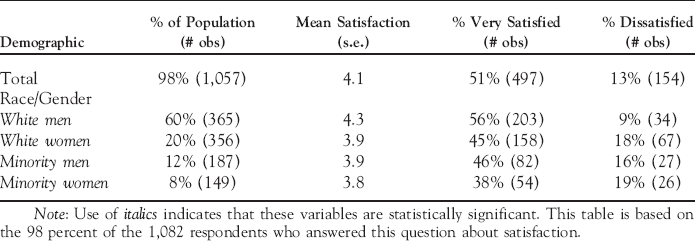
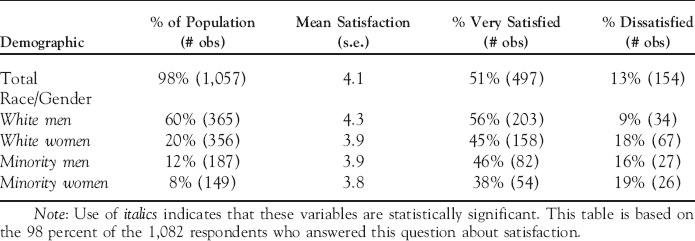
Both survey and interview results reveal a group of professionals who are generally satisfied with their job situations. On a scale of 1 to 5, with 5 being “very satisfied” and 1 being “very dissatisfied,” the mean satisfaction level was 4.1,Footnote 8 and 53 percent of law professors are very satisfied with their jobs. (Table 1 provides detailed information on the distribution of job satisfaction across different demographic groups.) As we will see, law professors from traditionally excluded demographic groups are differentially more dissatisfied—but even so, most of these professors report being satisfied with their personal job situations at their law schools. Thus, while we explore the divergences that our data reveal based on race and gender, it is important also to stress the many commonalities among professors across these divisions. In the qualitative results, we found that professors from all backgrounds and in all kinds of schools shared some common sources of satisfaction (e.g., when they had good library and research resources, support from their deans, collegial work environments) and dissatisfaction (e.g., lack of various forms of support, lack of collegiality or respect, unequal treatment).
In the interview results, although women professors and professors of color differentially included negative descriptions of discriminatory treatment in their work environments, we also found some highly satisfied members of all groups. These respondents shared positive assessments of their job situations. For example, the following white woman could find little to say when asked if there were any things done by her law school that had made her job difficult:
You know, I don't have any major complaints actually. Um, you know, there are certain … there are certain features of law school teaching that are not great, like that professors grade their own exams, for example … which is very time-consuming and very unrewarding for both the students and us. … But you know, it's—it's a hard problem to solve because we don't have graduate students … and I, you know, I really don't have any great complaints about the school. I think it's been great. [4972, 10–19 yrs.' experience]
This respondent did note that senior women had to do more committee work because there were fewer women than men on the faculty, but added that “I don't think the school has a lot of choice about it”—and later in the interview characterized this as a “minor issue.” She also made a point of saying that she felt that the relatively low numbers of women and minorities on the faculty was the result of problems in the pipeline rather than any prejudice on the part of her law school's hiring committee. As she describes her experience at this elite law school, she was “part of an intellectual community from the day I got here, that everybody was rooting for me, and uh, that made a huge difference,” adding also that “the students are great.”
Satisfaction Broken Down by Demographics
| Demographic | % of Population (# obs) | Mean Satisfaction (s.e.) | % Very Satisfied (# obs) | % Dissatisfied (# obs) |
|---|---|---|---|---|
| Total | 98% (1,057) | 4.1 | 51% (497) | 13% (154) |
| Race/Gender | ||||
| White men | 60% (365) | 4.3 | 56% (203) | 9% (34) |
| White women | 20% (356) | 3.9 | 45% (158) | 18% (67) |
| Minority men | 12% (187) | 3.9 | 46% (82) | 16% (27) |
| Minority women | 8% (149) | 3.8 | 38% (54) | 19% (26) |
Note: Use of italics indicates that these variables are statistically significant. This table is based on the 98 percent of the 1,082 respondents who answered this question about satisfaction.
A slightly different kind of story, but also largely positive, tells of some underlying strains of institutional racism that have ameliorated over time:
As far as scholarship is concerned, there are, you know, a number of us who uh do critical scholarship, like critical race theory stuff. … Do all the faculty members respect that kind of stuff? Uh, you know, ten years ago—no. I think there was—there was some tension with respect to that kind of stuff. But I think it's—now it's accepted that, you know, this is a legitimate form of scholarship and … that it's useful. So—so that's changed … as long as you're producing, you—you're producing solid work in that area, … I think people here respect it. [4180, 10–19 yrs.' experience]
This man of color, who had taught at a non-elite law school for over a decade, reports on a phenomenon that several other traditional outsider law professors also discussed: a sense that whatever had been problematic in earlier days had now improved. He characterized his law school as “a supportive environment” and “a very caring community here at the law school,” a “comfortable place to work” in which he has “nearly complete autonomy as far as what I want to do.”
Generally Happy, But …
Underneath this overall happy overview, however, we find that there are still significant differences in job satisfaction between traditional outsider groups and traditional insiders. The differences are stark: white, male professors, on average, have satisfaction levels about 10 percentage points higher than male professors of color or white female professors. Female professors of color are somewhat less satisfied with their jobs than male professors of color or white female professors, but not (on this particular measure) more so than their membership in both groups—professors of color and female professors—would suggest individually.Footnote 9 It bears noting that despite these stark differences, there remains a small but substantial minority of female professors of color who consider themselves to be very satisfied in their personal situation at work (38 percent).
Table 1 provides a snapshot of job satisfaction across demographic groups. To reduce data overload, we focus on three measures of the distribution of job satisfaction: average satisfaction, percentage very satisfied, and percentage who are dissatisfied in some way (moderately or very are the two options). A Pearson's chi-squared test demonstrates that minority status and gender, as a single variable with four possible values (white men, white women, minority men, minority women), maps statistically significantly different job satisfaction distributions across the four values. The full distribution of job satisfaction for these demographic groups as well as other demographic, personal, and institutional variables is reported in Appendix Table 2 (Supporting Information). All results are weighted to control for non-response and the stratified sampling plan. Unfortunately, our quantitative data do not permit us to track subgroups of minority identity meaningfully because of small numbers, but we will be examining them to the extent possible in future publications from our qualitative data.
Our qualitative results range over a wide variety of topics, but we focus here on findings relating to dissatisfaction among professors of color and white women, especially when these professors talk about treatment that they view as having racial and/or gendered aspects. More than any more obvious, overt factors—such as, for example, disparities in remuneration or teaching responsibilities—these professors spoke about subtle facets of institutional culture, and of individual experiences surrounding voice, respect, and inclusion.
Interestingly, our statistical results converge on a similar conclusion. Having found a statistically significant difference in satisfaction between white, male law professors and other groups of professors in our study, we developed a more complex model that could give a deeper picture of this gap in job satisfaction. Our survey asked a large range of questions, grouped into different substantive areas, regarding our subjects' jobs. We combined these questions into a series of exploratory factor analyses to reduce the large number of variables measuring similar aspects of a subject's job to a smaller and more readily interpretable set of factors. As explained in more detail in Appendix B (Supporting Information), we then combined the factors that emerged from those initial analyses with other variables to model the satisfaction gap identified in our results. The other variables included exogenous factors (e.g., aspects of the law schools at which respondents taught) and individual-level control variables such as cohort, salary, and aspects of personal life (e.g., being in a partnered relationship or having children).
The resulting model that came from this exploratory analysis had two parts. The first part was an underlying measurement model of the four factors that emerged as important from the initial exploratory analyses (voice/respect, collegiality, dissonance in diversity vision, and dissonance in standards vision). The second part was a model investigating how the four latent factors, along with other observed exogenous variables, impact job satisfaction.
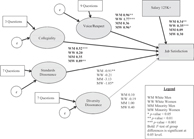
These two models—the latent factors model and the model examining the impact of latent factors and other exogenous variables on job satisfaction—were combined into a single hierarchical model using structural equation modeling (SEM).Footnote 10 As Figure 1 shows (with additional details in Appendix Table 6, Supporting Information), the most powerful influence on the satisfaction gap isolated by this model is the factor of “voice/respect,” followed by “collegiality” as well as “salary”—and then more marginally by divergence in view between respondents' own priorities and those of the institution regarding “standards” (see Appendix A in Supporting Information for an explanation of this variable).
Structural Equation Model

Taken together, the parameters listed under the factor “voice/respect” in Figure 1 are greater in magnitude than those listed under other factors; along with the high significance levels found for this factor with most of the groups, the quantitative results point to issues surrounding voice and respect as having the strongest impact on racial and gendered disparities in job satisfaction.Footnote 11 To a somewhat lesser degree, we can say the same for the factors of “collegiality” and “salary.”
Indeed, when we control for respect/voice, collegiality, salary, and (to a lesser extent) divergence in values over standards, the satisfaction gap between white, male law professors and traditionally excluded groups disappears. As detailed in Appendix Table 6 (Supporting Information), we used a Wald test to test whether the baseline for job satisfaction differs for at least one outsider group, after controlling for the factors listed above. Controlling for salary and for the latent factors identified as important, that gap in job satisfaction becomes statistically insignificant (see Appendix Table 6 in Supporting Information).Footnote 12
Voice and Respect: The Importance of Climate
In the interviews, women of color, men of color, and white women described subtle and continuing ways in which they felt silenced or disrespected in their work settings. These feelings led them to turn, as individuals, to different communities for support:
Well, I'll tell you what—the way I've made things work for me now is I have national colleagues. … And I … think that's what a number of other women have had to do, is to find other kinds of ways to um, deal with the bad situations institutionally. I mean, I cou—I am a very much an institutionally oriented, systemic-oriented person, who tries to be constructive, but um—and I think other women are—many other women that I know are, as well. But uh, for me, it's—my adaptation has been to create um—is to be far less focused here and to try to let whatever's happening here be noise … because the penalties for speaking up, even in a—a trying to help to generate a better situation for all, are huge. [4079, white female professor, 10–19 yrs.' experience, non-elite school]Footnote 13
As we saw in the studies of faculty of color and women faculty in universities generally, peer networks and support matter, and we have numerous quotations in our qualitative results from traditional outsiders who turned outside of their immediate law school environments to find those kinds of supports.
Some outsider professors described being penalized for speaking up. One male scholar of color described the way that attempting to have voice can create a backlash, resulting in being labeled a “disruptor”:
So, there's a lot of hypocrisy, there's a lot of suppression of uh, of uh, of uh, dissent. Uh, there is a lot of marginalization, if not acti—active suppressive—suppres—I mean … you—you can just marginalize people. You can let them speak and then not react and—and just, you know, leave it at that [LAUGHS]. So there's a—there's [inaudible] enormous process of marginalization that happens in law—in my … law school, if you are a person who stands for some values and want to fight for it. Because you are viewed as a—as a disruptor. [4160, 10–19 yrs.' experience, non-elite school]
As we have seen, traditional outsiders turn to colleagues beyond their own law schools—and to support groups—to a greater degree than do white, male professors. An unfortunate result of this is that they cannot develop deeper professional ties within the work settings where they spend their days—and where they are assessed and advanced (or not) in their jobs. These narratives describe subtle, almost invisible incidents in which small acts of inattention do powerful work of marginalization. After outsider colleagues speak up, their colleagues may perceive them as “troublemakers” without realizing that these perceptions are biased by race and/or gender.
A different kind of silencing is described in our final example; rather than becoming visible and being labeled as disruptive, this woman simply disappears from the conversation, her contributions erased:
Um, and like I say, I—I do think that, um, I think that law schools also reflect the broader society. And so that, you know, comes back to what I was describing in sort of the context in which the law school and everything is situated. And I—and I think, um, so, I think society has stereotypes about women—for instance. … So, for instance, um, at meetings, at faculty meetings, I would say that, uh, s—something I have observed is that a woman will make a suggestion and, um, you know, they'll, you know, the other people will talk. And then a man will make the same suggestion and then the man's suggestion will get more recognition—than the—the suggestion, even though it was made by the woman first. That kind of stuff … . [4489, woman of color, 10–19 yrs.' experience, non-elite school]
Of course, this phenomenon is not particular to law schools. However, it is another reason that some law professors stop trying to be heard—turning to colleagues outside of their law school homes for respect, and/or “choosing their battles” because they pay penalties for speaking up.
Thus, we have found a number of ways in which subtle forms of marginalization leave traditional outsiders feeling silenced or disrespected—but in ways that are often unlikely even to be noticed by others. There is little pressure on the “insider” professors to change familiar modes of operating. At the same time, the often-invisible impact of workplace surroundings on “outsider” professors' sense of belonging can have a powerful impact. We saw this both in our qualitative results and in quantitative analyses of the survey results, which indicated that the factor identified as “voice/respect” had the most impact on the satisfaction gap between white, male professors and others.Footnote 14 The kinds of silencing and disrespect indicated in our results were differentially troubling to traditional outsiders in ways that fit well with descriptions of implicit bias in the literatures reviewed above on professors generally, on lingering issues in the legal profession, and on law professors in particular. These sorts of quiet exclusions create the additional need for traditionally marginalized law professors to turn to outside networks, depleting their “local capital” in their immediate work surroundings. Again, to balance our picture of the situation, remember that some traditional outsider professors did speak of an improvement in their situations over time.
Collegiality: Institutional Structures and Cultures
Both qualitative and quantitative results also point to collegiality as another important factor mediating the differential dissatisfaction of traditional outsider law professors, second only to voice/respect in its impact on the satisfaction gap. It bears noting that collegiality matters most to the most satisfied group (white men) and the least satisfied group (women of color)—but they are obviously having different experiences surrounding that collegiality.Footnote 15
Our qualitative data are useful in highlighting the close relationship between voice and respect, on a more individual level, and collegiality, on a more institutional level. A number of faculty members described ways in which law schools' broader institutional cultures contributed to feelings of marginalization:
being a minority faculty, in many cases, certainly African American faculty, you … you live in two worlds where the white faculty member probably… white, male faculty member never has to do that. So, yeah, you do have to be very careful because you're going to be one, in some cases the only one and in other cases, one or two. And, you know, … if there's four Black faculty members on your staff and the four of you are together in one office, people look at it with suspect. But no one would look at that if there were four white, male faculty members.
…
[L]et me say at first that I have always found that there has been a fairness, at least I've perceived a fairness, an equality as it relates to … as related to compensation and teaching assignments. … I think it's more of a social piece … and to some degree an advancement piece. I think … there's a level of [SIGHS] sort of subtle inequality in … who's going to get whatever the next advancement is … [5483, African American male professor, top-20 law school, 10–15 yrs.' experience]
Interestingly, this comment comes from a professor who expressed moderate satisfaction about his work situation in the survey portion of the study. In many respects, he is content with his law school setting. However, underneath, he describes a lingering, subtle sense of exclusion that seems to take its toll on his overall assessment of what would otherwise be a very happy situation. He describes a constant need for vigilance, lest ordinary behavior—behavior that his white colleagues take for granted—be misperceived in negative ways. This is one of a number of extra—but institutionally invisible—burdens he carries by virtue of being a member of a traditionally excluded group in the legal academy.
Even some professors who expressed high satisfaction with their job situations also commented negatively about racism and/or sexism and their effects within institutional culture:
And so my point is that it's—it's—racism is still alive and well and … and it's still alive and well within the—within academia—even though, you know, you might approach a—a white person and that per—person'll say, “Well, I'm not racist.” You know? But that's—that—that's not the point. The point is that, institutionally speaking, there is this in—there's an institutional uh, uh, context and construct of—of racism within which we—we have to work. And so that—that's just something that um, I think we'll have to live with for—for the foreseeable future. [4180, Latino male professor, non-elite law school, 10–19 yrs.' experience, high satisfaction on survey]
Thus, qualitative data shed some eye-opening light on the mix of satisfaction and lack of comfort that some scholars of color and white women experience.
Consider, for example the complex and exclusionary experience reported in qualitative results by this woman professor of color whose survey results (quite accurately, in one sense) indicated “moderate” satisfaction:
Oh, I mean, some—there's some of them [colleagues] who—who have—uh, for whom I am … otherworldly. I'm just from another world. Which I am—I mean, I grew up a working-class black person, in another city, in a segregated environment. And, you can—I don't care how old you are [LAUGHTER]—it's just, you don't get over that. Uh, and so they don't quite—they don't quite know what to make of me … yeah, there's a real failure to recognize how hard we work—a failure to recognize the kinds of contributions that we make. … Law professors can be so stupid about the law … and it's like they teach it, but they don't know it or don't think that it applies to them. Um, so, you know, they can do things that make for a hostile work environment um, and just be oblivious. [4945, African American female professor, elite law school, 20+ yrs.' experience]
Again, this account reveals a daily, taxing burden differentially borne by traditional outsider professors, one that bit by bit chips away at a sense that contributions are valued. A number of traditional outsider professors report that they have had to work harder for recognition; in light of the already grueling workload reported by many respondents, it is not hard to imagine a long-term negative effect on these professors' job experiences.
As we have noted, previous research has highlighted how institutional structures in schools and workplaces tend to recreate existing hierarchies. Here, we see that the practices that recreate those hierarchies are tightly linked to hidden belief systems that cast long shadows over new generations, and that have concrete effects on how work burdens are distributed and assessed.Footnote 16
Effects of Salary Level
Appendix Table 2 in Supporting Information reports results on salary from our survey (under “Individual Characteristics”). With respect to this information, we restrict the sample to respondents who are current professors of law (as of the date of the survey), rather than administrators, emeritus professors, or retired professors. There were 972 law professors who fit this category and responded to the salary question. Not surprisingly, a higher salary does improve professors' personal job satisfaction. Interestingly, controlling for cohort (i.e., controlling for length of time as a tenured law professor) does not impact personal job satisfaction; that is, to the extent that salary is important, it is the absolute level of salary, rather than a relative level of salary compared to one's cohort, that is correlated with job satisfaction. Salary appears to have a threshold effect—once one reaches at least a $125,000 nine-month salary, job satisfaction is both stable, and high.
The impact of salary was not as apparent in the qualitative data as it was in the quantitative results. In a sense this is not a surprise; the in-depth qualitative interviews generate different kinds of data than do the shorter survey responses. The leading edge of complaints about gender or race inequities in the interviews, as noted above, focused on issues of respect, voice, institutional culture, tacit institutional and professional structures, and implicit bias. Sprinkled into these responses were also discussions of explicit bias as well as of values and worldview differences. Pay issues emerged more obliquely and more often as a result of overt prompting about possible inequities in law school workplaces. The bulk of comments about pay in the qualitative interviews focused on structural features of law schools such as favoritism toward in-groups on the faculty on the part of law school deans, unfairness in overall funding for their particular law schools, inequalities caused by differentially high salaries for lateral and new hires, and the unfair results of raising the salaries of faculty who obtain outside offers from other law schools.
On this last point, a few respondents did point out the gendered consequences of the “outside offers” system, but it was as common for respondents to complain that the system was simply unfair in privileging those who “play the game” over those who do not. A handful of professors described overtly discriminatory pay along lines of race or gender but, again, it was common for them to do so in tandem with descriptions of other forms of disrespect rather than to focus primarily on salary itself. Quite a few respondents commented on the lack of transparency about salaries in private institutions, indicating that if there were pay inequities, they would not know. One possible conclusion from this is that salary mediates satisfaction gaps for law professors from traditionally excluded groups as part of a larger institutional structure that manifests itself in ways that are more immediately and keenly felt in perceived atmospheres that convey relative disrespect, a disinterest in hearing these professors' voices, and a lack of collegial feeling.Footnote 17
Conclusion: Stubborn forms of Bias in the Legal Academy
In this article, we have examined tenured law professors' job satisfaction. Overall, law professors, like lawyers, are a pretty satisfied bunch. However, there are significant differences in job satisfaction between white, male tenured professors and all other groups in the legal academy (professors of color, white women professors). Our quantitative and qualitative data shed light on possible contributions to these differences. From our quantitative analysis, we conclude that divergent experiences surrounding voice, respect, and collegiality, along with salary, are the most important contributors to these gaps in satisfaction levels. Our qualitative data indicate that some scholars of color and white women continue to experience subtle and overt forms of bias that undermine their sense of having effective voice, of being respected, or of fitting into the institutional settings of their law schools.
Our results also contribute to a deeper understanding of paradoxical aspects of reported satisfaction levels in some research on minority and/or female lawyers, law professors, and other professionals. Our qualitative data indicate that an overall assessment of the relative benefits of a particular person's professional situation (“moderate satisfaction”) can result from a complicated calculus that includes a sense that things may be overall pretty good despite ongoing implicit bias; that although still problematic, things are improving; or perhaps just a lower set of expectations regarding one's work setting. Digging beneath the numbers helps us identify where lingering problems remain, and what makes those problems worse or better.
In particular, like other researchers, we have located “subjective” but quite palpable factors that contribute to differential dissatisfaction on the part of traditionally excluded law professors. Not only did quantitative measures support the importance to this satisfaction gap of feeling respected and heard, but our qualitative data also provided striking evidence of the crucial role of these factors in the work lives of faculty of color and white women faculty. Responses to feeling disrespected and silenced, as we saw, ranged from disengagement to fighting back. To be sure, some faculty from traditionally excluded groups found comfortable niches in their law schools; moved to new, more congenial law schools; or stayed long enough to experience positive changes in their old law schools. We see these experiences reflected in the accounts presented above. However, there were significant numbers who reported dissatisfaction based on marginalization that they attributed to racialized or gender-based disrespect or silencing. Some looked outside of their home institutions for professional support and acceptance, bearing the accompanying additional costs. Some remained in unsatisfying “troublemaker” roles, or in silent unhappiness with their situations, never fully heard or respected, resting with varying degrees of dissatisfaction at different points along Hagedorn's scale of engagement to disengagement.
Similarly, general collegiality within institutions emerges in our study as playing an important role in the satisfaction gap. In our qualitative responses, we see that collegiality can be differentially perceived in ways that are structured by unequal experiences of traditional outsiders relative to white, male faculty, so that the individual and institutional levels reinforce one another in nontrivial and intertwined ways. Collegiality is often discussed by traditional outsider professors in double-voiced ways.Footnote 18 On the one hand, we hear a professor somewhat wearily acknowledging that “there has been a fairness, at least I've perceived a fairness, an equality as it relates to … as related to compensation and teaching assignments,” while also identifying a “social piece” that quietly hampers advancement and a full sense of belonging or collegiality. Structural aspects of belonging and collegiality in law schools, then, become complex matters in which the necessity of occupying two worlds wears on traditional outsiders who are both fully law professors and yet not full colleagues in many ways and places.
Thus, quiet aspects of institutional culture and structure work together to create continuing, stubborn sources of disparity for traditional outsiders in these professional settings—sources that are magnified for women of color dealing with both gender and racial bias. (As we have seen, this is supported by the work of many researchers in the area, including Reichman and Sterling, Deo, Dinovitzer and Garth, Dinovitzer and her coauthors in numerous AJD publications, Organ, Wilkins and Gulati, and Headworth and Nelson, among others.) Our work demonstrates the critical ongoing role of aspects of implicit bias as it operates both at individual and institutional levels, intertwining in ways that resist overt redress. Our mixed story is one of some improvement and some success stories, but also a warning that problems are unlikely to disappear without significant changes from “business as usual” in many law faculties.
Finally, we note that these more “subjective” or cultural factors do not appear to be wholly separable from impacts of more “objective” factors like salary—although those sorts of factors are likely embedded in a complex matrix from which everyday respect or collegiality cannot be extracted. In other words, our qualitative results fit with other research demonstrating that continued perceived implicit bias can feed quite directly into differential assessment, allocation of resources, and material benefits at more tangible levels. This may account for the conscious priority given to the less tangible factors by respondents from groups that express differential dissatisfaction with their job situations in law schools. Only a combination of qualitative and quantitative research could shed light on this subtle and complicated situation, demonstrating the value of an NLR approach to finding out what is happening with law and legal institutions on the ground.
As the legal academy turns to social science for a more accurate sense of what is going on in settings where law operates, this study offers law professors and others an opportunity to assess what different kinds of social science have to offer—in a setting very close to home. If law and lawyers must balance science and craft, as Hanoch Dagan (Reference Dagan2007) has urged, then it may be particularly important for them also to understand the craft of (social) science in all its nuances and complexities.
Supporting Information
Additional supporting information may be found online in the supporting information tab for this article.