PHENOMENA ANALYZED AND SAMPLES
We analyze real-time language change in Brazilian Portuguese using a trend study based on sociolinguistic interviews (Labov, Reference Labov, Baugh and Sherzer1984) of a random sample of 64 speakers recorded in the 1980s in Rio de Janeiro and another similar random sample of 32 speakers recorded from 1998 to 2000 (Oliveira e Silva, Reference Oliveira e Silva, Oliveira e Silva and Scherre1996; Paiva & Duarte, Reference Paiva and Duarte2003).
We study changes in variable subject/verb concord (S/VC) and noun phrase concord (NPC). These phenomena are exemplified in (1) and (2).
(1) Variable number S/VC:
a. eles ganham (3rd pl.) demais da conta ‘they get much too much'
b. eles ganha (3rd sg.) demais ‘they get too much'
(2) Variable number NPC:
a. os (pl.) fregueses (pl.) ‘the customers'; as (pl.) boas (pl.) ações (pl.) ‘the good actions'
b. as (pl.) codorna (sg.) ‘the game hens'; as (pl.) porta (sg.) aberta (sg.) ‘the open doors'
c. essas (pl.) estradas (pl.) nova (sg.) ‘these new roads'; do (sg.) meus (pl.) pais (pl.) ‘my parents'
Variation in the use of concord in Brazilian Portuguese is very much in the public's consciousness. In 2011, there was much heated debate in the mass media, both printed and spoken, as well as on Internet social network sites, in talk among friends in public places, and in other sorts of social gatherings because a book (Ramos, Reference Ramos2011) officially approved by the government to be used in education for adults and teenagers recognized lack of noun phrase and subject/verb phrase concord as a natural fact of language use (Almeida, Reference Bortoni-Ricardo, Cobucci and Almeida2011; Bagno, Reference Bagno2011; Bortoni-Ricardo, Cobucci, & Almeida, Reference Bortoni-Ricardo, Cobucci and Almeida2011; Faraco, Reference Faraco2011; Scherre & Yacovenco, Reference Scherre and Yacovenco2011a). The book nonetheless warned students that they might be the victims of linguistic prejudice if they used nonagreeing forms in situations where categorical use of concord would be expected (Ramos, Reference Ramos2011:15).
Examples of prejudiced opinions posted on the Internet at the time are: Cartilha aprovada pelo MEC ensina português errado pra crianças, para “incluir” os ignorantes Footnote 1 ‘Primer approved by the Department of Education teaches wrong Portuguese to children in order to “include” the ignorant’ or Livro usado pelo MEC ensina aluno a falar errado Footnote 2 ‘book used by the Department of Education teaches students to speak wrong’.Footnote 3
The data we analyze are separated by approximately 18 to 20 years. Details of our samples are:
• 1980 sample (Oliveira e Silva, Reference Oliveira e Silva, Oliveira e Silva and Scherre1996:67–81): 64 hours recorded at the beginning of the 1980s with 64 speakers, stratified for:
• gender—feminine and masculine;
• education—subdivided into three levels of education in accord with the Brazilian school system: 1 to 4 years of school; 5 to 8 years of school; 9 to 11 years of school (the sample excludes speakers with more than 11 years of school—university level, as well as illiterate speakers);
• age, subdivided into four levels: 7 to 14 years; 15 to 25 years; 26 to 49 years; more than 49 years
• 2000 sample (Paiva & Duarte, Reference Paiva and Duarte2003:24–25): 32 hours recorded in 1999 and 2000 with 32 speakers from the same community as the 1980 sample, with the same characteristics and subdivided in the same way.
The age groups in these two samples were set up based on patterns of participation in the workforce in the Rio de Janeiro community (Oliveira e Silva, Reference Oliveira e Silva, Oliveira e Silva and Scherre1996:59–60). The first group, 7 to 14 years, contains children and adolescents who, for the most part, are still in school and do not participate in the labor market. The next group, 15 to 25 years, contains younger people who are just entering the workforce. The large middle group, 26 to 49 years, is meant to represent adults fully integrated into the labor market, at least potentially. The oldest group, 49 years or older, represents people who may have already reached their maximum potential for professional realization and may either be retired or thinking about retirement. In this connection, it should be recalled that, at the time, the official government social security scheme allowed for retirement for women at around 45 years and for men at around 50 years. Because nonmarked plural forms are subject to strong social stigma and marked plural forms exhibit prestige explicitly recognized in the community, we would expect that social forces in the marketplace would lead the 26-to-49-year-old group to show higher rates of marked agreeing forms.
INITIAL STUDIES AND THE MODEL OF FLOWS AND COUNTERFLOWS
The first quantitative study on variable S/VC in Brazilian Portuguese (Lemle & Naro, Reference Lemle and Naro1977; Naro, Reference Naro1981) was based on a sample of the speech of 20 students in a government literacy program in Rio de Janeiro. Because, in general, older speakers in the sample were more likely to use concord than younger speakers were, it seemed at the time that concord might be on its way toward elimination. Nonetheless, some speakers, both younger and older, showed extremely high rates of use of concord despite the fact that they were effectively illiterate and came from very disadvantaged communities where the standard language is not used in daily life. These apparently contradictory circumstances led Naro (Reference Naro1981) to the conclusion that subject/verb number agreement was involved in an ongoing process of loss in the wider community at the same time as it was being acquired by certain individuals. Because these speakers had no real interaction with parts of the community where the standard forms are prevalent, Naro (Reference Naro1981) postulated the effect of a vicarious social orientation leading to the acquisition of values of socially dominant groups, including standard language features such as concord. The vicarious effect was measured by means of contact with the media, especially television soap operas. Although the increased usage of standard forms was limited to individuals, Naro (Reference Naro1981:88) speculated that “at a certain point in time the resurgence in use of the agreement rule might even spread throughout the younger group, independently of the orientation variable, and produce a reversal in the trend toward elimination of the rule.” The basic idea of conflicting trends in the community and the individual was further developed by Scherre (Reference Scherre1988:436–460) and was termed flows and counterflows in Naro and Scherre (Reference Naro and Scherre1991). More analysis can be found in Naro and Scherre (Reference Naro, Scherre and Mollica2010) and Scherre and Naro (Reference Scherre2010).Footnote 4
ANALYSIS AND RESULTS
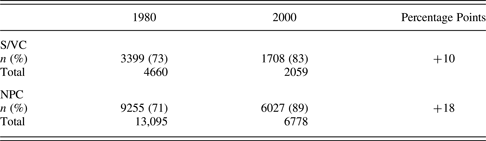
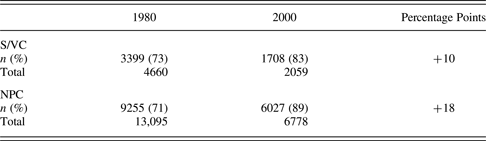
In the period under study here, overall use of marked forms in our random samples of the community increased from 73% to 83% for S/VC, whereas NPC increased from 71% to 89%, as detailed in Table 1.
Overall use of marked forms for NPC and S/VC in 1980 and 2000
We analyzed our data quantitatively with the Goldvarb X (Sankoff, Tagliamonte, & Smith, Reference Sankoff, Tagliamonte and Smith2005) program, using the .05 threshold. We postulated a set of structural and social variables relevant to the variation for both phenomena. The social variables we used are: education, gender, age, and contact with media. In the case of linguistic variables, some are common to both phenomena, whereas others address structural peculiarities of each type of concord. For S/VC, we considered discourse level parallelism, clausal level parallelism, phonic salience of the singular/plural opposition of the verb, distance and position of the subject relative to the verb, animacy of the subject, presence or absence of the relativizer que ‘that’, presence or absence of pause between subject and verb, and number of elements of the subject. For noun phrase agreement, we considered phrase level parallelism, phonic salience of the singular/plural opposition of the nominal constituent, linear and relative position of the constituent within the noun phrase, and following phonological context.Footnote 5
With reference to the effect of education, or years of schooling, we note that a higher level of literacy generally tends to favor more frequent use of concord. We use the range of a variable, that is, the difference between its lowest and highest relative weights, as an indication of relative strength and importance (Tagliamonte, Reference Tagliamonte2006:242–243, 251).Footnote 6 In the 1980 sample, the range of the education variable for S/VC is around 12 (which is the lowest range for any of the 12 statistically significant factor groups, either structural or social, in the analysis), increasing markedly around to 55 (which is the highest range in the analysis) in 2000 (Naro & Scherre, Reference Naro, Scherre and Meira2009:109). For noun phrase agreement, the corresponding results exhibit a range of around 20 in 1980 (which is the third lowest range in the analysis consisting of eight statistically significant structural and social factor groups), increasing to around 65 in 2000 (which is the second highest range in the analysis) (Naro & Scherre, Reference Naro and Scherre2002, Reference Naro and Scherre2003, unpublished results). We view this increased strength of education as due to a high degree of social and economic mobility that has developed during the past 20 years. During this period, the government has succeeded in providing greater access to formal education. Furthermore, social mechanisms favoring greater economic mobility have been created through programs that provide funds for basic sustenance of the family, lifting large sectors of the population out of absolute misery and permitting broader opportunities for advancement. In general, the economy, stimulated both by private enterprise and public initiatives, has provided more prospects for gainful employment of the population, with consequent migration of families to higher socioeconomic ground.
For gender, women generally tend to favor greater use of agreement, although this variable is currently much less polarized than education is. Furthermore, greater contact with mass media such as the press and television tends to favor greater frequency of concord, and media contact in general has increased over the years (Naro & Scherre, Reference Naro and Scherre1996a, Reference Naro and Scherre2002, Reference Naro and Scherre2003, Reference Naro, Scherre and Meira2009:110–111). Although not yet adequately documented in the published sociolinguistic literature, the effect of formality is obvious, with more social coercion and attention to discourse favoring more concord.
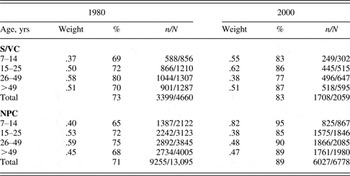
The effect of structural dimensions, such as relative position (within the noun phrase or of subject relative to verb), phonic salience, and linguistic parallelism remains remarkably stable over time despite the increase in overall frequency. This is in accord with the constant rate hypothesis of Kroch (Reference Kroch1989), which posits that structural effects remain fixed in magnitude and direction as change progresses. The same is also true of most social variables, such as education and gender, with direction of effect, as expressed by the hierarchy of factor weights within a factor group, preserved over time. Nonetheless, as already noted, polarization can vary with increased range within some social factor groups. Age, however, is very different. Let us reexamine results similar to those reported by Naro and Scherre (Reference Naro and Scherre2003) at NWAV (New Ways of Analyzing Variation) 32 for the evolution of the behavior of age groups in each type of concord, in Table 2,Footnote 7 using the groupings of the original research projects, over the period that separates our two samples.
Use of marked forms for S/VC and NPC in 1980 and 2000 according to same-age groups (four independent VARBRUL analyses, two for each decade and two for each phenomenon, with four age factors in each analysis)

Note: See note 7 for other factor groups included in the analyses.
In the results in Table 2 it is striking that, in terms of frequency, for seven of the eight age groups, usage of concord in both phenomena has increased, by as much as 30 percentage points (for NPC, from 65% for the 7-to-14-year-old group in 1980 to 95% for the same age group in 2000), in the period between the two samples.
In the later period (around 2000), the configuration changes significantly, with highest usage by the youngest speakers. In fact, for NPC, the youngest group, which earlier showed the lowest concord usage of all the age groups, is now by far the group with the highest usage of agreeing forms, reaching near categoriality at 95% in terms of frequency — a kind of semicategorical rule (Labov, Reference Labov, Paulston and Tucker2003 [1969]:241–242). For S/VC, the two younger groups both favor higher concord, but are still somewhat removed from categoriality. The pattern in 2000 strongly indicates change in the community in the direction of restoration of concord, whereas the results for the earlier period seem consistent with both more usage in midlife and decreasing usage among the young. The most prominent direction of change has gone from loss to restoration.
The apparently conflicting movement toward and away from use of standard marked forms shows that trends in different directions can be found side by side in a pattern typical of real-world usage. Contrary to the image of a change flowing in a given direction along the axis of time consistently in a unique direction, the speech community is split, in the sense that some speakers are in a process of acquisition of a form while others are losing the form. Still other speakers may be stalled, showing patterns typical of stable variation. In other words, what is changing for some people may be stable for others, and what is on the increase for some may be decreasing for others. In our experience, this is an accurate image of the way change proceeds in the short term, especially in the case of socially marked phenomena or forms that involve social identity.
For S/VC, previous, more detailed work shows that stability in patterns of use with respect to age over real time is more characteristic of male speakers than of females (Naro & Scherre, Reference Naro, Scherre and Meira2009; Scherre & Naro, Reference Scherre2010). Furthermore, as shown in Table 2, the overall frequency of use of agreeing forms increases for all age groups except one in the period under study (26 to 49-year-olds in S/VC). Nonetheless, in a bizarre reversal, the middle groups show the lowest relative weights in the second time frame. Note especially the strikingly low relative weights for the 26-to-49-year-old group for S/VC (.38) and the 15-to-25-year-old group for NPC (.38). In short, our comparison of same-age groups at two points in time exhibits radical change in the community, with a reversal of direction of predominant flow of change from less use of concord in 1980 by young speakers to increase in 2000 by the same age group. The about-face by younger speakers in the community results in their exhibiting higher frequency of use of agreeing forms than the older age groups do.
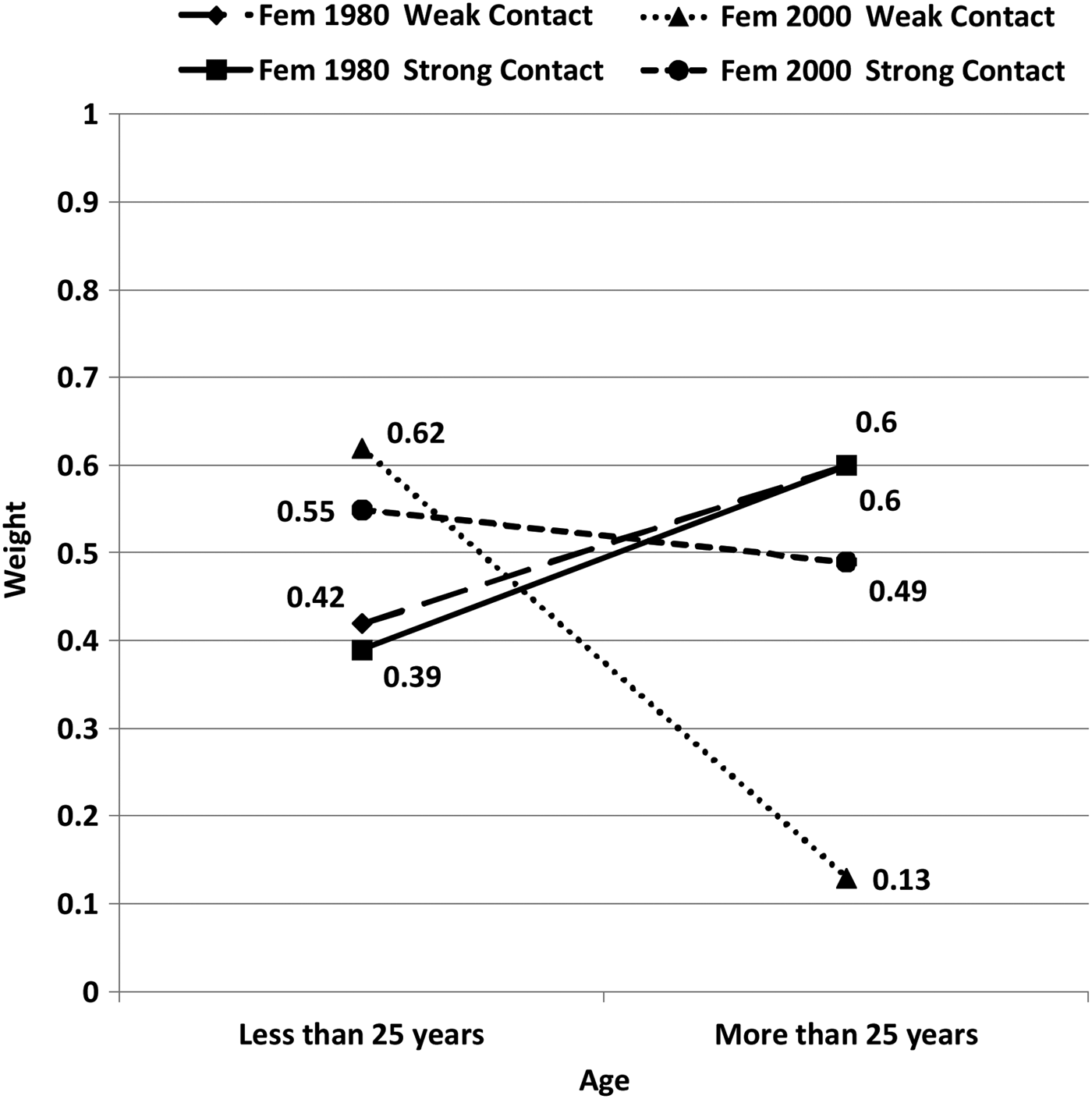
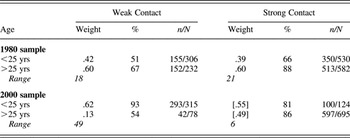
To elucidate where the reversal in direction of change may have originated, we restrict our attention for a moment to female speakers, because earlier work of ours shows that male speakers did not change their age patterns with respect to age for verb concord over the time span in our two samples (Scherre & Naro, Reference Scherre2010:169–170). Recall, in this connection, Naro's (Reference Naro1981) speculation to the effect that resurgence in use of concord might occur independently of social orientation. Because of the reduced number of data, particularly in the 2000 sample, we were able to distinguish only two subgroups of media contact for women: weak contact, with little contact or content not understood,Footnote 8 and strong contact, with frequent contact and a critical attitude. For the same reason, we were able to distinguish only two age groups: younger, <25 years; and older, >25 years. We then carried out four separate analyses for subgroups of women, as shown in Table 3 and Figure 1.
Effect of age group on the presence of verbal concord for the 1980 and 2000 samples from Rio de Janeiro: Results for women divided into groups based on media contact.
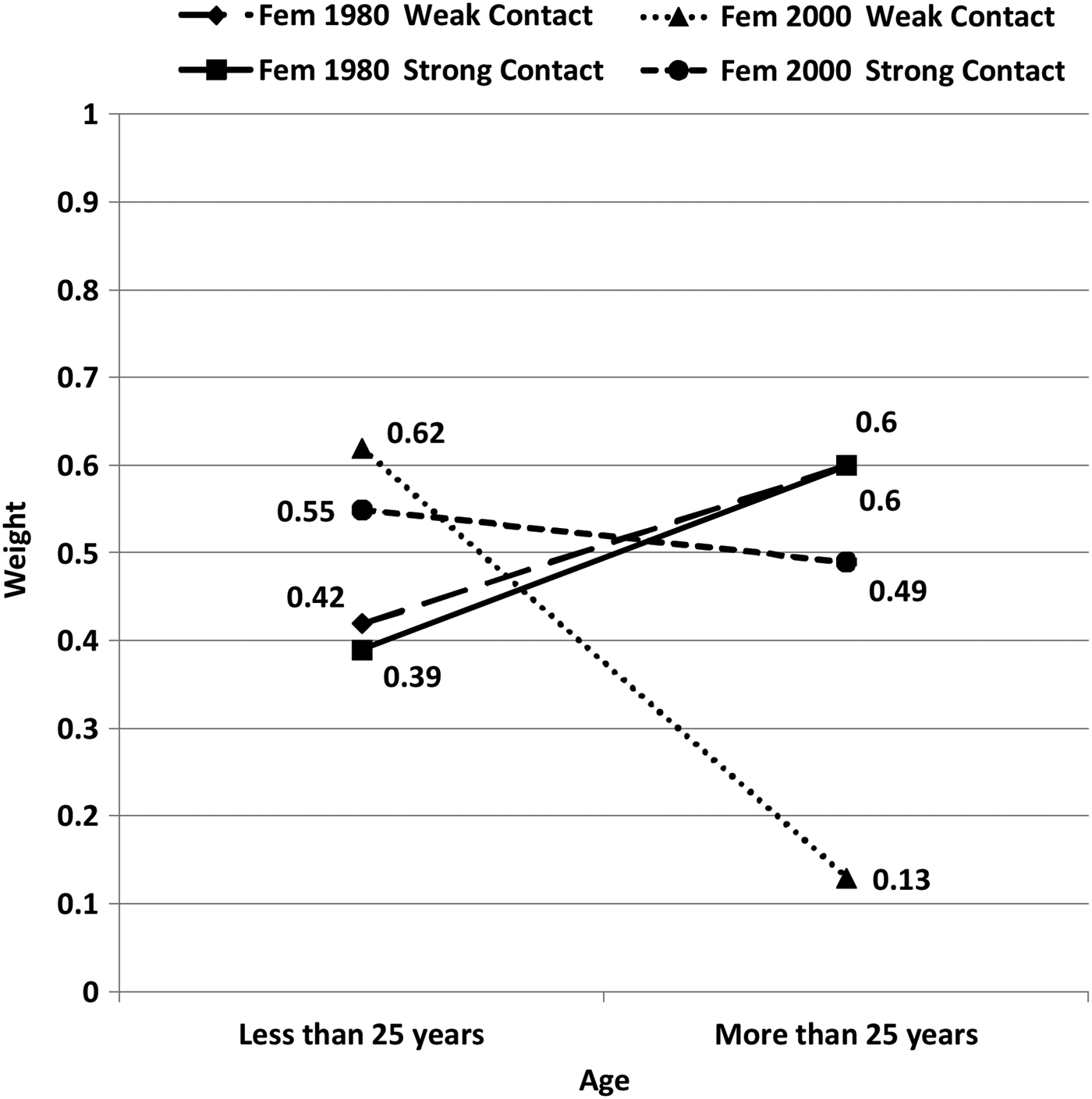
Effect of age group on the presence of verbal concord for the 1980 and 2000 samples from Rio de Janeiro: Results for women divided into groups based on media contact

The results of the 1980 sample are consistent with the tendency toward loss of agreement in the original sample of illiterate speakers (Naro, Reference Naro1981) because, for both the strong and weak media contact groups, older female speakers use concord more frequently than younger female speakers do (lines with squares and diamonds). In the 2000 sample, the weak contact group (line with triangles) exhibits strikingly clear inversion with respect to the 1980 sample (line with squares), with considerably higher relative weights for younger speakers. The situation is similar for the strong media contact speakers (line with circles); although polarization is weaker and statistical significance was not obtained. As shown in Naro and Scherre (Reference Naro, Scherre and Meira2009), the leveling effect seen in female speakers with higher media contact is due to the fact that education, together with age, takes on the role formerly exercised by media as a predictor of use of standard forms.Footnote 9
To better understand the behavior of the community, we return now to our discussion of the role of age in both concord phenomena in our trend study.
Unfortunately, the results presented in Table 2 for conventional age groups do not yield much insight as to how the shift toward greater use of concord may have happened or who, if anybody, may have shifted their patterns of use relative to the other speakers in the community. For this reason, we reanalyze the data with a view toward determining how actual groups of speakers evolve over real time. Comparison of groups of speakers within the same age range at different points in time is not conducive to apprehending patterns of evolution because the strata of the universe sampled are not composed of the same people at each point in time (Omena, Reference Omena, Paiva and Duarte2003:66–67). For example, because the average length of time separating our recordings is about 18 to 20 years, the pool of speakers from which the sample of the youngest speakers was drawn in 1980s falls in the middle range in the second sample. Thus, when we compare, say, the middle age group at our two points in time, we are not sampling universes containing the same speakers. After all, everybody increases in age over time, even though the other social variables generally do not change.
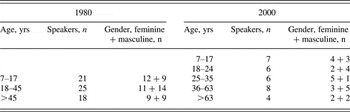
To determine patterns of actual speaker change in the community, we rearrange our age groups so as to be relevant to evolution, or what G. Sankoff has called change across the lifespan (Wagner & Sankoff, Reference Wagner and Sankoff2011). Our aim is to compare age cohorts by sampling groups containing virtually the same universe of speakersFootnote 10 at each point in time and to use age groups that in previous research in other communities have turned out to be significant for patterns of language variation and change. In particular, we note Labov's (Reference Labov2001:448) observation that the reorganization of the vernacular, and its eventual stabilization, occurs up to age 17. Unfortunately, the original research design of our two samples did not foresee this type of comparison. For this reason, the speakers we have at our disposition do not provide an ideal even distribution of age or other social variables such as gender and education. In particular, we do not have matches in 2000 for the oldest speakers in 1980, who were around 70 years old at the time. Nonetheless, by rearranging the original age groups, we were able achieve the distributions and results shown in Tables 4 and 5. In these tables, each line is laid out to show speakers in each age cohort, using an average age difference of 18 years between the two samples. Thus, corresponding to the 7-to-17-year-old group in 1980, we find the group of 25 (= 7 + 18) to 35 (= 17 + 18) year-olds in 2000 on the same line, and so on. The two youngest age groups in the later sample have no corresponding data for the earlier sample because these speakers had not been born yet or were too young to sample.
Distribution of speakers in age cohorts in 1980 and 2000, recategorized from 1980 and 2000 samples

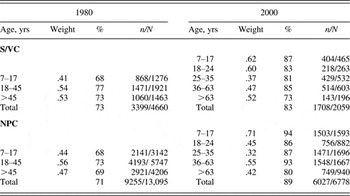
Use of marked forms for S/VC and NPC in 1980 and 2000 according to age cohorts (four VARBRUL runs, two for each decade and two for each phenomenon)

Using the age groups of Table 4, we find results for our two points in time, presented in Table 5.Footnote 11
Examining the three age cohorts that traversed both points of time in Table 5, we see that even though the use of marked forms for each cohort has increased in frequency to varying extents, the original pattern of usage of 1980, in terms of relative weights, is largely preserved in 2000 for each phenomenon.
For S/VC, the lowest usage is found in the youngest of the three equivalent cohorts that exist at both points in time, with a general pattern of loss of agreeing forms in both (.53, .54, .41 for 1980; .52; .47; .37 for 2000). This trend very abruptly changes direction toward increase in 2000 in the two new age groups (.60 and .62) that did not yet exist in 1980.
In the case of NPC, we see age-grading at both points in time, with significantly higher values for the middle cohort, 18 to 45/36 to 63 years (.56 and .55), than for either the younger cohort, 7 to 17/25 to 35 years (.44 and .32), or the older cohort, >45/ > 63 years (.47 and .42). The two youngest groups in 2000 show a tendency toward increased usage of NPC (.45 and .71), especially the youngest group (.71), but this movement is not present in the older speakers of 2000 or 1980 (.42 and .47, respectively).
The general picture that emerges for both concord phenomena is that speakers of all ages are on the move in the upward direction in terms of frequencies over the time interval between our two samples, but they are constrained relative to one another by the social patterns in which they were situated at the outset. The pattern is clearly broken precisely and only by those who were not in it, the unborn of the 1980s, who reverse the direction of flow toward increased usage of both types of concord. This shown in the 2000 results, for S/VC, by weights of .60 and .62 for the two youngest groups, whereas the next oldest group has .37; for NPC, the corresponding weights are .45 and .71, whereas the next oldest group has only .32.
The comparison of same-age groups in the usual apparent time analysis configuration would not reveal the fact that speakers do not significantly change their positions relative to one another within the community as they increase the frequency of their use of standard agreeing forms. This conclusion is the correlate of the fact that the relative order of structural constraints, as well as that of most other social constraints, does not change during the shift to higher levels of concord. In this change, the structural and social systems of language exhibit surface frequency shift rather than deep restructuring.
We have presented evidence that the Brazilian speech community has not followed a unique path in a single direction in ongoing shifts in number concord even though in the past 20 years there is an overall trend toward increased use of marking in terms of general frequency of usage.Footnote 12 At the same moment in time and in the same overall community, there are stable groups, exhibiting age grading, and there are changing groups, showing loss or recuperation of marked forms of plural concord. On this level, male and female speakers, for example, show entirely different patterns of acquisition and loss that change over time for S/VC (Naro & Scherre, Reference Naro, Scherre and Meira2009, Reference Naro, Scherre and Mollica2010; Scherre & Naro, Reference Scherre2010), whereas for NPC, both genders generally show acquisition by the youngest speakers.13 Thus, individual speakers within groups defined by conventional social criteria such as age, gender, education, or residence may accompany, or not, the general trends within the group so determined. Furthermore, an individual's behavior may defy the realities of the speech of the surrounding community in actual face-to-face interaction in the real world to varying extents. In other words, an individual may shift more, or less, in the same direction, or not, as other speakers with similar social characteristics in the same community.
CONCLUSIONS
In the results presented in this paper, we have seen a reversal in the general direction of shift from stability or loss of concord toward the acquisition of the prestige norm of full concord by the youngest speakers of the community still within the critical phase of language acquisition (or, reorganization of the vernacular in the terms of Labov, Reference Labov2001:448), revealing a new community flow. This confirms, once again, Naro's (Reference Naro1981) prediction that acquisition might spread from individuals to the community as a whole. Speakers above the critical age participate in the new flow through a collective shift to higher frequencies of usage at our second point in time while remaining within the same system relative to one another that was in force at the first point in time.
The principal social correlate of this shift to higher grammatical terrain is upward socioeconomic movement by the lower levels of the population, with increased access to formal education in the urban area of Rio de Janeiro under study here.
In sum, using age cohorts instead of same-age groups, we can see shifts within the speech community more clearly, confirming both the model of flows and counterflows proposed since Naro and Scherre (Reference Naro and Scherre1990), and the spread of acquisition of concord from the individual to the urban community foreseen as a possible future development by Naro (Reference Naro1981).