Introduction
Filariosis is a group of parasitic diseases that affects many animal species, including dogs, cats and wild canids, such as foxes, wolves and coyotes. Dogs can be infected by several species of filariae. The species found in Italy are: Dirofilaria immitis, Dirofilaria (syn. Nochtiella) repens, Acanthocheilonema (syn. Dipetalonema) reconditum, Acanthocheilonema (syn. Dipetalonema) dracunculoides, Cercopithifilaria grassi and Cercopithifilaria bainae. Dirofilaria immitis, the aetiological agent of canine heartworm disease, is the most pathogenic species for dogs, because adults live in the right side of the heart and in the pulmonary artery. Adult worms of D. repens live in subcutaneous tissue, causing skin problems (Genchi et al., Reference Genchi, Kramer and Rivasi2011a), while A. reconditum and A. dracunculoides live in the peritoneal cavity and in adipose tissue. All these parasites have blood-circulating microfilariae. Adult worms of Cercopithifilaria spp. live in tissues under the skin with dermal microfilariae (Brianti et al., Reference Brianti, Otranto, Dantas-Torres, Weigl, Latrofa, Gaglio, Napoli, Brucato, Cauquil, Giannetto and Bain2012; Solinas et al., Reference Solinas, Varcasia, Brianti, Giannetto, Pipia, Columbano, Tosciri, Dantas-Torres, Garippa, Otranto and Scala2014).
Dirofilaria immitis and D. repens are the most important zoonotic filariae (Pampiglione et al., Reference Pampiglione, Rivasi and Gustinelli2009). However, all canine filarial species have a zoonotic potential, such as A. reconditum, which can cause ocular infections in dogs and humans (Huynh et al., 2001). Most zoonotic cases of filariosis in Italy are due to D. repens; however, the first known case due to D. immitis was reported by Avellis et al. (Reference Avellis, Kramer, Mora, Bartolino, Benedetti and Rivasi2011).
The aim of the present study is to investigate the prevalence of filarial species in dogs in north-west Italy (Liguria), an area which was traditionally considered free from the disease and where prophylaxis is not carried out.
Materials and methods
Current analysis
A total of 365 dogs (194 males and 171 females) were examined between 2009 and 2012, of which 332 were hunting dogs, 19 were from five kennels in the study area, and 14 were companion dogs. All dogs were born and lived in the provinces of Imperia (n= 275) and Savona (n= 90), in Liguria. For each dog, gender, age, lifestyle and geographical origin were recorded, and no dog had received chemoprophylaxis for filariosis for at least 6 months. Dogs were divided into three age categories, the first including young dogs aged between 6 and 12 months (n= 55 dogs); the second, adult dogs aged between 13 months and 7 years (n= 214); and the third, dogs older than 7 years (n= 96).
For each dog, a blood and a serum sample were taken. Blood was subjected to the following parasitological examinations for the detection and identification of microfilariae: Knott's modified method (Lindsey, Reference Lindsey1965; Magnis et al., Reference Magnis, Lorentz, Guardone, Grimm, Magi, Naucke and Deplazes2013), histochemical staining (Barka's technique) (Chalifoux & Hunt, Reference Chalifoux and Hunt1971), and polymerase chain reaction (PCR) (Rishniw et al., Reference Rishniw, Barr, Simpson, Frongillo, Franz and Dominguez-Alpizar2006). Extracted DNA was amplified using primers DIDR-F1/DIDR-R1 targeting a fragment of 430–664 base pairs of the 5.8S–ITS2–28S genes of filariae, following the conditions described in Rishniw et al. (Reference Rishniw, Barr, Simpson, Frongillo, Franz and Dominguez-Alpizar2006), and then sequenced. Sequences were then submitted to a BLAST analysis on the GenBank database.
Serum samples were subjected to an enzyme-linked immunosorbent assay (ELISA) for the detection of antigens of D. immitis, using the Canine Heartworm Antigen kit (DiroCHEK®, Synbiotics, Kansas City, Missouri, USA) following the manufacturer's instructions.
For the statistical analysis, prevalence and seroprevalence with 95% confidence intervals (CI) were calculated. A Pearson's chi-square test was used to compare the prevalence of filariosis in various groups of dogs, divided according to gender, age and lifestyle (hunting dogs and non-hunting dogs). The significance of the tests was calculated for P values < 0.05.
Retrospective study
Serological data of D. immitis were analysed from samples collected by the Istituto Zooprofilattico Sperimentale of Piedmont, Liguria and Aosta Valley (IZS, Imperia section) between 2004 and 2013, during the annual control for leishmaniasis. A total of 11,363 authochthonous dogs from the four provinces in Liguria (Imperia, Savona, Genoa and La Spezia) were tested with an ELISA test for D. immitis antigens (Witness® Dirofilaria Synbiotics Europe, Lyon Cedex, France). Prevalence with 95% confidence interval (CI) was calculated.
Results and discussion
In the current analysis, using Knott's method, 35 of 365 dogs were positive for microfilariae (9.6%, CI 6.6–12.6), with A. reconditum being the most prevalent species (7.7%, CI 4.9–10.4), followed by D. repens (1.4%, CI 0.2–2.6) and D. immitis (0.6%, CI 0–1.3). Co-infection by D. repens and A. reconditum was observed in one dog.
No significant difference in the prevalence of microfilaraemia was found among the three age classes of dogs considered above (P>0.05). Similarly, the prevalences in the two groups of hunting and non-hunting dogs (kennel and companion dogs) were not significantly different. In contrast, there was a highly significant difference (P< 0.01) in the prevalence of microfilaraemia in females (3.5%) and males (15.0%). These results were confirmed by logistic regression: the only significant predictor was gender (P< 0.01).
Five dogs of the 365 (1.4%, CI 0.2–2.6) were positive for antigens of D. immitis, measured by ELISA. Of these, two were also positive by Knott's test for microfilariae of D. immitis, while three were cases of occult filariosis. Dogs positive for D. repens and A. reconditum did not show clinical signs of illness. Symptoms of fatigue and exercise intolerance were found only in four dogs positive for D. immitis.
In the present study identification of infection with the modified Knott's technique was always confirmed by acid phosphatase histochemical staining and by PCR. Knott's method is an economical technique for identifying the species (Magnis et al., Reference Magnis, Lorentz, Guardone, Grimm, Magi, Naucke and Deplazes2013) and should be the first step in diagnosis of filarial infection. However, in doubtful cases, PCR may be required to confirm the identification or to discriminate between different species in the case of co-infections (Albonico et al., Reference Albonico, Loiacono, Gioia, Genchi, Genchi and Mortarino2014).
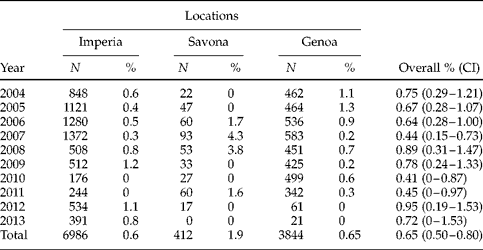
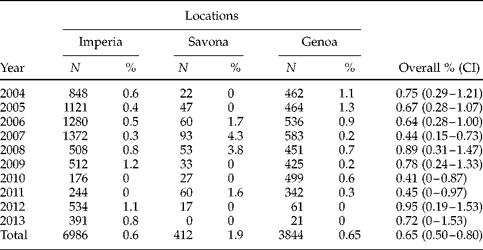
Retrospective analysis of the IZS data on 11,363 canine serum samples showed that the serological prevalence of D. immitis in the studied years (2004–2013) in Liguria was 0.65% (CI 0.50–0.80) (table 1).
The seroprevalence (%) with 95% confidence intervals (CI) of Dirofilaria immitis in the sera of dogs examined from Imperia, Savona and Genoa, Italy between 2004 and 2013 (N= number of samples); in the location of La Spezia, 1/50 sera in 2009 and 1/15 sera in 2011 were also infected.
The present results highlight the presence of filariosis in autochthonous dogs in Liguria. This region was traditionally considered to be free from canine filariosis. In fact, prior to the present study, only a few cases of unidentified microfilaraemia had been reported (Pampiglione et al., Reference Pampiglione, Poglayen and Capelli1986), plus a case of D. repens in one dog in Genoa (Scarzi, Reference Scarzi1995). Due to this epidemiological situation, prophylaxis is not routinely carried out and dog owners in this region are not very aware of filarial diseases.
Our study confirms that canine filarial infections are spreading in Italy, as found in other studies (Magi et al., Reference Magi, Guardone, Prati, Tozzini, Torracca, Monni and Macchioni2012; Rinaldi et al., Reference Rinaldi, Maurelli, Auriemma, Sorrentino, Musella, Pepe and Cringoli2012; Giangaspero et al., Reference Giangaspero, Marangi, Latrofa, Martinelli, Traversa, Otranto and Genchi2013; Pipia et al., Reference Pipia, Varcasia, Tosciri, Seu, Manunta, Mura, Sanna, Tamponi, Brianti and Scala2014). The spread of filarial species has also been observed recently in other countries previously considered free of these parasites, or for which the epidemiological status had not been documented (Traversa et al., Reference Traversa, Di Cesare and Conboy2010; Genchi et al., Reference Genchi, Kramer and Rivasi2011a; Morchón et al., Reference Morchón, Carretón, González-Miguel and Mellado-Hernández2012; Simón et al., Reference Simón, Siles-Lucas, Morchón, González-Miguel, Mellado, Carretón and Montoya-Alonso2012; Masny et al., Reference Masny, Gołąb, Cielecka and Sałamatin2013; Otranto et al., Reference Otranto, Dantas-Torres, Brianti, Traversa, Petrić, Genchi and Capelli2013). The diffusion of these parasites is likely due to global warming (Genchi et al. Reference Genchi, Mortarino, Rinaldi, Cringoli, Traldi and Genchi2011b; Musella et al., Reference Musella, Rinaldi, Marzatico, Mortarino, Cringoli and Genchi2014) and to the spread of competent vectors. In addition, dogs now travel more frequently with their owners, which may play a significant role in the spread of filariosis, as well as that of other parasitic diseases (Deplazes et al., Reference Deplazes, van Knapen, Schweiger and Overgaauw2011). In relation to this last factor, the presence of various species of filarial nematodes in the study area may be of particular concern considering that Liguria represents a destination for tourists from northern Europe (http://www.regione.liguria.it/component/docman/doc_download/10503-il-turismo-in-liguria-negli-ultimi-quarantanni.html).
Financial support
This research received no specific grant from any funding agency, commercial or non-profit sectors.
Conflict of interest
None.