The udder health situation is strongly connected with the economic success of a dairy farm and depends on the amount of quarters infected. Self-cure, therapy or culling may reduce the amount of infected quarters; many more factors tend to increase the rate of new intramammary infection (IMI), particularly during the beginning and the end of the dry period, i.e. involution and colostrogenesis (Bradley & Green, Reference Bradley and Green2001). For more than 60 years, drying animals off using antibiotics has been one of the main actions in combating mastitis, reducing new infection rate (NIR) from 30 to 60% (untreated cows) down to 0–15% (treated cows; Berry, Reference Berry2000). Recently, this routine has been criticised for political reasons, considering increasing resistances towards antibiotics in human patients and only moderate therapeutic success, but no corresponding studies have been conducted (Krömker, Reference Krömker2012). Moreover, epidemiological surveys showed a shift in the mastitis-producing flora in the rest of the cow (i.e. from cow-associated toward environmental pathogens) so therapy during the dry period becomes less important than preventive measures to reduce the risk of new infections (Krömker et al. Reference Krömker, Friedrich, Kleen, Klocke, Paduch, Zinke, Haverkamp, Taffe, Koch, Reinecke and Volling2011). Therapeutical alternatives include vaccination and the application of teat sealants. Although known for decades (Meaney, Reference Meaney1977), teat sealants represent relatively new ways to combat mastitis in the dry period and have been promoted in Germany since 2003.
Teats are sealed by introducing a stable substance which is supposed to avoid the penetration of pathogens; as it does not contain any antibiotics which eventually could stop iatrogenic infections, special attention must be paid to an aseptic application. With OrbeSeal® (Zoetis, Berlin, Germany) the German market has been relying on a similar bismuth-based preparation that has a high degree of biocompatibility and lasts inside the teat canal and teat cistern throughout the entire dry period. While it was initially used in selective dry-off therapy (i.e. antibiotic treatment for infected quarters and teat sealing for uninfected ones) now a combined application of long-lasting antibiotics plus teat sealant has come into practice (Redetzky & Hamann, Reference Redetzky and Hamann2003). Halasa et al. (Reference Halasa, Østerås, Hogeveen, van Werven and Nielen2009) compared several management practices for the dry period, among applying teat sealants. Four studies were included and this meta-analysis confirmed a ‘significant protection against new IMI’. Several studies focused on the protection conveyed by teat sealants, but only few have been published so far regarding the efficacy of commercial bismuth-based internal teat sealants to prevent new infections in comparison with untreated udder quarters (e.g. Woolford et al. Reference Woolford, Williamson, Day and Copeman1998; Berry & Hillerton, Reference Berry and Hillerton2002; Huxley et al. Reference Huxley, Green, Green and Bradley2002; Krömker et al. Reference Krömker, Pfannenschmidt and Friedrich2010; Petrovski et al. Reference Petrovski, Caicedo-Caldas, Williamson, Lopez-Villalobos, Grinberg, Parkinson and Tucker2011). This field study describes the experiences with an internal teat sealant made of bismuth subnitrate suspended in paraffin (OrbeSeal® Zoetis, Berlin, Germany) (ITS) in nine dairy farms in Northern Germany. In contrast to other studies that dealt with OrbeSeal®, this one is based on a very strict selection of animals which permitted the evaluation of any effects on the new infection rate in a way almost devoid of other animal-rated variables (previous udder diseases, teat and udder morphology etc.). The aim of this study was to determine the NIR using ITS and the rate of clinical mastitis cases during the first 100 d of the subsequent lactation in healthy udder quarters at dry-off.
Material and methods
Selection of dairy farms
The field studies were carried out between March and October 2012 on nine dairy farms located in the German states of North-Rhine Westphalia, Lower Saxony and Saxony-Anhalt. All selected farms managed a mean of 411±353 dairy cows (min. 98 to max. 1022). Yield over 305 d varied between 8900 and 11 832 kg (mean 10 252±1072 kg) with a fat content of 4·4±0·1% and a protein content of 3·4±0·1%; the mean intercalving interval was 401±16 d. Bulk tank somatic cell count at the beginning of the study ranged from 98 000 to 264 000 cells/ml (mean 179 000±47 000 cells/ml). The management's willingness to participate, the breed (German Holstein), and the participation in the German Dairy Herd Improvement were the inclusion criteria for this experiment. It was also mandatory that, of all clinical mastitis cases, less than 5% were due to Staphylococcus aureus infections. All of them performed a twice-a-day milking routine and an abrupt dry-off.
Selection of animals
Trial animals had to be scheduled for dry-off during the survey with a planned dry period of 42±4 d. Individual cow milk samples had to present a geometric mean cell count of <50 000 cells/ml milk during the previous three dairy herd improvement tests and a negative record of clinical mastitis in the present lactation.
Number of cows
The tested hypothesis was that treated quarters would have a lower new infection rate (4%) than untreated ones (12%). Based on a one-sided χ 2 test with type I error α=0·05 and type II error ß,=0·10, a total of 194 quarter pairs were needed. If 10–20% of cows drop out of the trial post admission, approximately 120 cows were needed.
A total of n=128 out of 155 preselected dairy cows fulfilled the criteria for inclusion and were rated as ‘normally secreting’ (i.e. cell count <100 000 cells/ml and bacteriologically negative) on all four quarters before dry-off between March and June 2012. Dry-off treatment for these cows was performed using a ‘split-udder design’, i.e. the front right-side and the rear left-side quarters of the animals were treated with OrbeSeal® (ITS), while the opposite quarters were left untreated as control. The 27 excluded cows had 39 infected quarters (31 infected quarters 7 d prior to dry-off excluded 20 cows and 8 infected quarters excluded belatedly 7 cows at dry-off).
Sampling
Quarter foremilk samples were aseptically collected in duplicate at four points in time for cyto-bacteriological analysis: (i) within 7 d prior to dry-off, (ii) at dry-off, (iii) within 5–12 d in milk (DIM) and (iv) 7 d later. Milk samples were transferred immediately after sampling to the microbiological laboratory at the University of Applied Sciences, Hannover and submitted to analysis within 2 h after arrival. Storage time until sample processing was a maximum of 8 h. Sampling as described above was used just before dry-off treatment.
Treatment
At dry-off, teat tips of treated and untreated quarters alike were aseptically prepared. Then, ITS was applied to the corresponding udder quarter using hygienic procedures. The blunt cannula of the injector was introduced into the teat canals only as deep as necessary for a safe administration of the drug. The product administration was done by one of the authors, so that farmer or herdspersons were blinded towards treated and untreated quarters.
Laboratory procedures
Milk samples were cultured according to NMC recommendations (NMC, 1999) as cited by the German Veterinary Association (GVA, 2009).
The somatic cell count of quarter foremilk samples was determined by flow cytometry with the Somascope Smart (DeltaInstruments B.V., Drachten, The Netherlands).
Definitions
A milk sample was termed ‘contaminated’ if more than 3 bacterial species were isolated. IMI was assessed if in duplicate samples >500 cfu/ml of the same bacterial species were cultured, and 1–3 bacterial species could be isolated. Quarters with only one bacteriologically positive sample were termed ‘non-infected’. Quarters were termed ‘newly infected’ if they presented positive results for a pathogen that, previously, was not isolated in those quarters. Animals were examined periodically (twice a day by the milkers) for clinical mastitis until DIM 100.
Statistical analysis
Data were collected and analysed using Excel 2000 (Microsoft Corporation) and SPSS (SPSS 20·0, Chicago, USA). The udder quarter was recognised as the statistical unit. The untreated opposed quarter served as a paired control. New infection (NI) was analysed using a mixed model logistic regression analysis. For the regression model, the linear predictor was given by
 $$\eqalign{{\rm Logit}\left( {{\rm NI}} \right) = \,& {\rm Lactation} + {\rm Front/hind}\,{\rm quarter} \cr & {\rm + Treatment + Herd}\left( {{\rm random}} \right) + {\rm e}} $$
where ‘lactation’ was divided into two categories: ‘1’ and ‘2+’; ‘front/hind quarter’ was two categories; and ‘treatment’ was indicated as ‘internal teat sealant’ or ‘no treatment’. A random herd effect was included in the model. These factors were included as a fixed effect and ‘e’ was a binomial error term. A backward stepwise regression analysis was performed. For all outcome variables, treatment was compared with the control group using significance tests with a 5% significance level (P value). The homogeneity of treatment groups was given due to the paired study design.
Results
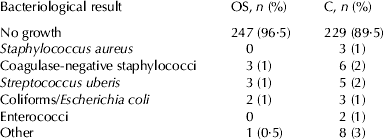
A total of n=256 quarter pairs in n=128 cows was used for the analysis. All quarters displayed low cell counts (i.e. <100 000 cells/ml) and were culture-negative at dry-off. The percentage of new infections differed significantly between treatment groups: 3·5% (9/256) after internal teat sealant and 10·5% (27/256) after no treatment (P<0·001) (Table 1). Of the new infections, 25% were caused by coagulase-negative staphylococci (CNS), 22% by Streptococcus uberis and 14% by Enterobacteriaceae, irrespective of treatment protocol.
Bacteriological distribution post partum in quarters treated with OrbeSeal® (n=256, OS) and in control quarters (n=256, C)

Within the first 100 d after calving, four clinical mastitic quarters were detected, two in each group, thus being non-significant. No clinical case of mastitis occurred during the first 30 d after parturition. The logistic regression proved that ITS was able to protect the udder quarters from new infection during the dry period in a more efficient way than leaving them untreated (OR=0·262 CI 0·092–0·748; Table 2). Random farm effect was not significant (P=0·44).
Final mixed logistic regression model for new infections

Discussion
The periparturient period is a time when external factors can easily affect udder health; they are not only multiple but also vary greatly between herds and locations, leading to changing stages of immunocompetence facing a highly variable array of pathogens (Suriyasathaporn et al. Reference Suriyasathaporn, Heuer, Nordhuizen-Stassen and Schukken2000). Internal teat sealants are one way to support udder health by minimising the risk of pathogens passing through teat canals. The present trial intended to determine the level of efficacy that these sealants achieve under strict conditions.
Methods
As mentioned already, reports on the efficacy of teat sealants are scarce, and study designs varied greatly, making the results difficult to compare. None, however, evaluated the influence of internal teat sealants on ‘truly udder-healthy’ animals [i.e. cell counts below 100 000 cells/ml and no pathogens (not even minor pathogens) encountered, both in all quarter foremilk samples of a given udder]. By using a split-udder design and including only healthy udders, this approach minimised the influence of animal-related confounders (Krömker et al. Reference Krömker, Pfannenschmidt and Friedrich2010). Any possible underestimation of the observed effects may, in the case of split-udder designs, be due to an eventual non-interdependence of the quarters (Lam et al. Reference Lam, DeJong, Schukken and Brand1996). However, as all four quarters were healthy, this issue appears negligible. Still, not matching quarters with treatment groups randomly may possibly create a bias, eventually by teat condition impairments due to hyperkeratosis that tend to affect specific quarters because of e.g. positioning problems at milking. However, animals had to be free from clinical changes in the quarter morphology in order to participate in this study, and so the risk of this error was judged to be low.
Udder pathogens
As can be seen in Table 1, opportunistic (CNS) and environmental pathogens (Str. uberis and coliforms) were the most prominent new infection agents. These results are generally similar to other study results describing the distribution of mastitis pathogens in Northern and Central Germany (Tenhagen et al. Reference Tenhagen, Köster, Wallmann and Heuwieser2006; Grabowski et al. Reference Grabowski, Ahlfeld and Klein2012) but some studies also show presence of coryneform bacteria.
In general terms, the few studies dealing with ITS found that sealing uninfected teats internally provides a comparable (or even better) protection to the udder than found with antibiotic treatment at drying-off. They calculated NIR between 2·0 and 25·5% for ITS and between 16 and 25% for long-term antibiotics. Cell count thresholds were usually higher (200 000 cells/ml or below) than in the present study (Woolford et al. Reference Woolford, Williamson, Day and Copeman1998; Berry & Hillerton, Reference Berry and Hillerton2002; Huxley et al. Reference Huxley, Green, Green and Bradley2002), or challenged sealed teats artificially (Petrovski et al. Reference Petrovski, Caicedo-Caldas, Williamson, Lopez-Villalobos, Grinberg, Parkinson and Tucker2011), so a comparison is possible only on very basic terms.
With a NIR of 3·5% for ITS-treated and of 10·5% for untreated quarters, the present study follows the general tendency observed in others. However, the effect was investigated under very strict conditions (only truly udder-healthy animals, split-udder design). The multivariate analysis that also considered some factors (quarter position, lactation number, herd effect) did not reveal any significant influence on NIR. Therefore, applying the teat sealant in healthy udder quarters alone already provided a protective and significant effect on NIR. The results achieved with this model show that additional systemic factors (which had to be left unaddressed in this paper) clearly influence the incidence rate for a new infection to occur. The model was focused on few variables because its objective was merely to quantify the influence of determining variables (those that were studied here, and in comparison between exposed and non-exposed ones) on the dependent ones, rather than to predict dependent variables.
The array of pathogens and the efficacy of ITS against them also varied. It is thought that some infections with environmental pathogens were even more likely to be avoided when teats were sealed rather than when they were treated with antimicrobials. For Woolford et al. (Reference Woolford, Williamson, Day and Copeman1998) teat sealing led to a marked reduction of new infections with environmental streptococci and coliforms. Huxley et al. (Reference Huxley, Green, Green and Bradley2002) detected significant differences only for quarters with Escherichia coli while environmental streptococci were not considered in that study. According to Berry & Hillerton (Reference Berry and Hillerton2002) the percentage of quarters infected by Str. uberis did not vary, however. Although significantly fewer infections were recorded for the teat-sealed group, the incidence of clinical mastitis within the first 100 d after calving did not differ. So the type of pathogen could be a potential confounder. In fact, infections by coliforms were recorded less frequently than those with other pathogens. The present results did not support this observation, meaning that the reduction in new infections took place independently of the type of pathogen, at least in the case of the pathogens isolated in this study. Still, the influence by the exposure to pathogens as a confounder naturally depends on the selection of animals (definition of udder health and new infection), the housing system (increased exposure to environmental pathogens), climate differences among farm locations and management differences from farm to farm (Pieper et al. Reference Pieper, Hoedemaker and Krömker2013).
With these results, the present survey supports the use of ITS in uninfected quarters at dry-off. Therefore, using ITS as the only dry-off treatment will be successful in those animals with uninfected quarters and no clinical mastitis while using careful application hygiene and hygienic husbandry conditions at the time of dry-off and in the dry period. Teat sealing should be accompanied by periodical monitoring during the dry period in order to recognise milk dropping or the development of clinical mastitis.
We are thankful to the dairy farmers who supported this study. We certify that there is no conflict of interest and disclose any financial or personal relationships with persons or organisations which could have influenced our work.