Introduction
Academic performance in middle and high school is one of the most robust predictors of successful transition to a healthy and economically secure adult life (Layard, Clark, Cornaglia, Powdthavee, & Vernoit, Reference Layard, Clark, Cornaglia, Powdthavee and Vernoit2014). Intimately related to children's school success is their emotional function, the extent to which they can routinely regulate their worry, their anxiety, and sadness. This study focuses on the ways in which children's internalized emotional dysfunction and their academic functioning influence each other over time. Internalizing problems are characterized by over and under control of emotions, resulting in experiences of anxiety and depression, with behavioral manifestations of irritability, social withdrawal, and extreme shyness (Halle & Darling-Churchill, Reference Halle and Darling-Churchill2016). Not surprisingly, these problems can have pernicious effects on academic functioning given that successful students rely on being able to access and activate their cognitive and motivational capacities. Academic functioning is commonly characterized in two ways, both of which are examined in this study: (a) school achievement—typically defined as a teacher's assessment of a student's academic performance through grading and (b) cognitive achievement—a more objective assessment of subject knowledge, measured by standardized assessments of acquired knowledge and reasoning capacity.
Research identifies concurrent and longitudinal associations between internalizing dysfunction and academic functioning such that academic failure predicts future internalizing symptoms, and achievement gains or declines follow respective changes in depressive symptoms (Burt & Roisman, Reference Burt and Roisman2010; Masten et al. Reference Masten, Roisman, Long, Burt, Obradović, Riley, Boelcke-Stennes and Tellegen2005; Moilanen, Shaw, & Maxwell, Reference Moilanen, Shaw and Maxwell2010). Efforts to disentangle the directionality and magnitude of these relationships seek to understand how problems, such as internalizing behaviors, spread from one area of functioning to another area of functioning and accumulate as a sequence of direct and indirect effects culminating over time beyond the contemporaneous associations of functioning and longitudinal persistence of problems. Such relationships pertaining specifically to developmental functions are often referred to as cascade effects, (Masten et al., Reference Masten, Roisman, Long, Burt, Obradović, Riley, Boelcke-Stennes and Tellegen2005), and they are more generally termed indirect, cumulative, or carry-over effects. Three suggested mechanisms may explain these observed effects: (a) internalized distress leads to poor school adjustment by undermining a student's ability to engage with others and with the learning process; (b) low achievement drives negative self-perceptions or judgments that lead to increased anxiety, depression, and social withdrawal behaviors; and (c) changes in either aspect of functioning may be spurious and related to some other cause that is not accounted for (Burt & Roisman, Reference Burt and Roisman2010; Masten et al., Reference Masten, Roisman, Long, Burt, Obradović, Riley, Boelcke-Stennes and Tellegen2005). Because these functions are inter-related, identifying and addressing emerging deficits in one area can prevent later emotional and academic problems. Examination of cascade effects involving internalizing behaviors with both cognitive and school achievement from elementary through high school may identify critical periods in students’ development and enable schools and parents to better target prevention and intervention efforts. Moreover, it is important to rule out alternative developmental influences that are known to affect children's functioning and adaptive capacities.
Prior empirical studies of developmental cascades found negative pathways from externalizing problems in early childhood (Burt & Roisman, Reference Burt and Roisman2010) and childhood (Masten et al., Reference Masten, Roisman, Long, Burt, Obradović, Riley, Boelcke-Stennes and Tellegen2005) that contribute to increased internalizing behaviors in adolescence and young adulthood (Burt & Roisman, Reference Burt and Roisman2010; Masten et al., Reference Masten, Roisman, Long, Burt, Obradović, Riley, Boelcke-Stennes and Tellegen2005). Patterns hold across studies that control for potential common cause variables such as child intelligence, maternal education, and gender. Understanding of how children's internalizing and academic dysfunction interface over development, however, remains limited by long, varied intervals between assessments that limit our ability to identify patterns of when and how particular cascades ensue during periods of developmental transition (Obradivic et al., 2010) and examination of a single aspect of academic functioning (Burt & Roisman, Reference Burt and Roisman2010). Consistent with the bioecological model of development (Bronfenbrenner & Morris, Reference Bronfenbrenner, Morris, Lerner and Damon2006), and building on the stage environment fit theory (Eccles et al. Reference Eccles, Midgley, Wigfield, Buchanan, Reuman and Flanagan1993), Dynamic Systems Theory offers a theoretical rationale for cascade effects. Dynamic Systems Theory posits that children's functioning continually develops within interactive environments in response to internal and external events across multiple social contexts and over time. As such, children's academic and behavioral functioning depends on the demands on them as well as their resources, including their previous histories of functioning, the short and long-term opportunities afforded to them by their schools and families, processes of socialization, and their biological development. From this perspective, patterns of functioning are not fixed by genes, early experiences, or context but remain open to reorganization. Changes in any realm of functioning may trigger a sequence of direct and indirect consequences that change the trajectories in other domains of functioning and that then accumulate over time, potentially recursively affecting the initial domain of functioning. These processes can shift the pathways of development, especially when they coincide with normally stressful developmental transitions such as the beginning of secondary school or the onset of puberty.
It is plausible that the relationship between internalizing dysfunction and academic functioning changes from childhood through adolescence because each functional area and its relationship with others are all influenced by social changes and developmental processes. Youth simultaneously undergo significant gender-specific processes of physical and social maturation as they transition to secondary school; autonomy from parents increases, and several neurobehavioral changes associated with puberty commence (Neild, Reference Neild2009). Failure to adapt to the additional and novel demands associated with these transitions may result in academic disengagement, depression, anxiety, and social withdrawal. In addition, socialization agents for sex-typed behavior intensify with the onset of puberty and may exacerbate risks for emotional and academic dysfunction. In particular, heightened expectations of girls to exhibit emotional, introspective, passive, and feedback-seeking behaviors have been linked to higher school achievement and greater risk for anxiety and depressive symptoms compared with boys, especially among earlier maturing girls (Zahn-Waxler, Shirtcliff, & Marceau, Reference Zahn-Waxler, Shirtcliff and Marceau2008). For example, early transition to secondary school has been shown to be particularly detrimental to girls, especially for those who experience early pubertal development (Eccles, et al, Reference Eccles, Midgley, Wigfield, Buchanan, Reuman and Flanagan1993). To disentangle the timing and mechanisms by which developmental cascades unfold, it is necessary to account for such social and maturational factors and address potential confounders, as previous studies have done, by controlling for early cognitive ability, gender, and family socioeconomic status (SES) (Burt & Roisman, Reference Burt and Roisman2010).
Assessments of academic functioning and internalizing dysfunction are influenced by gender, developmental stage, context, and the validity of raters with the result that it has been difficult to identify and intervene upon the underlying processes by which problems emerge and worsen. By their nature, internalizing problems are not easily detected by outside observers (Collishaw, Goodman, Ford, Rabe-Hesketh, & Pickles, Reference Collishaw, Goodman, Ford, Rabe-Hesketh and Pickles2009) and identification becomes increasingly difficult as children enter adolescence and become more autonomous (Zwaanswijk, Verhaak, Bensing, Van der Ende, & Verhulst, Reference Zwaanswijk, Verhaak, Bensing, Van der Ende and Verhulst2003). As a result, there is a low level of consensus between maternal and adolescent reports of internalizing behaviors (Baldwin & Dadds, Reference Baldwin and Dadds2007; Berg-Nielsen, Vika, & Dahl, Reference Berg-Nielsen, Vika and Dahl2003). Adolescent self-report is therefore important for valid inferences of cascade effects, which is a challenge given that most studies rely on parent report. In addition, relationships between internalizing behaviors and academic functioning are likely to be different depending which of the two standard measures of academic functioning are used, standardized tests or teacher assigned grades. Standardized assessments of cognitive achievement provide more objective evaluations of academic abilities and aptitudes at a point in time and allow interpretation against age-adjusted normative performance, but they do not have the same influence on students’ self-perceptions. Indeed, Burt & Roisman's (Reference Burt and Roisman2010) analysis of cascades involving social competence, internalizing behaviors, externalizing behaviors, and cognitive achievement using the National Institute of Child Health and Development's Study of Early Child Care and Youth Development (NICHD SECCYD) identified no significant cascades between internalizing behaviors and cognitive achievement. In contrast, grades provide regular feedback on students’ academic functioning, are more easily understood, and shape students’ perceptions of their academic abilities. The value that students attribute to learning is influenced by their grades (Durlak, Weissberg, Dymnicki, Taylor, & Schellinger, Reference Durlak, Weissberg, Dymnicki, Taylor and Schellinger2011), with grade failure likely to disrupt student engagement with learning and peers (Halonen, Aunola, Ahonen, & Nurmi, Reference Halonen, Aunola, Ahonen and Nurmi2006). Taken together, differences in methods of assessing internalizing behaviors and academic achievement likely influence the validity of research on these cascade effects, although to date no study has accounted for these issues.
This study advances Burt & Roisman's (Reference Burt and Roisman2010) analysis of cascades and prior studies of developmental cascades more generally in its examination of the potentially different relationships of maternal and adolescent self-report of internalizing behaviors with two assessments of academic functioning during key developmental transitions. Moreover, this study follows students from both fifth and sixth grade through ninth grade, accounting for relevant biological and social maturational factors during these periods. The purpose of this study is to examine longitudinal cascades and contemporaneous associations involving internalizing behaviors with school and cognitive achievement, accounting for adolescent social and maturational processes to test the following hypotheses:
A. Cascade effects involving internalizing behaviors and school achievement are significant in third and fifth grades and persist through sixth and ninth grades, among boys and girls.
B. Significant cascade effects and contemporaneous associations involving internalizing behaviors, school achievement, and cognitive achievement are not confounded by adolescent social and maturational factors such as the timing of the transition to secondary school, parenting quality, and pubertal timing among boys and girls.
B.1 Earlier transition to secondary school, lower parenting quality, and earlier pubertal onset will have a more negative effect on internalizing behaviors among girls, compared with boys.
C. The magnitudes of cascade effects and contemporaneous associations involving internalizing behaviors and school achievement will be greater than those involving internalizing behaviors and cognitive achievement.
Method
Participants and data collection procedures
Using a prospective longitudinal study, we analyzed data from a subset (n = 1,048) of participants enrolled in the NICHD SECCYD from 1991 to 2007. Healthy newborns and families were recruited within 24 hours of birth in 1991 from 31 US hospitals in 10 locations, in urban, suburban, and rural areas, in accordance with a random sampling plan conditioned on several criteria for inclusion. Inclusion criteria ensured that (a) mothers were healthy, older than 18, and spoke conversant English; (b) infants were healthy and delivered as a single birth; and (c) families did not plan to give up the infant for adoption and resided in a neighborhood within a one hour drive of the research site that police deemed safe to visit.
Data collection procedures involved trained observers, interviewers, questionnaires, and direct testing (NICHD ECCRN, 2005). Measures were collected across several settings (home, school, lab) and involved multiple reporters (study participants, teachers, mothers) from birth through ninth grade (NICHD ECCRN, 2005). The institutional review board of the Johns Hopkins Bloomberg School of Public Health determined that this study met criteria for exemption.
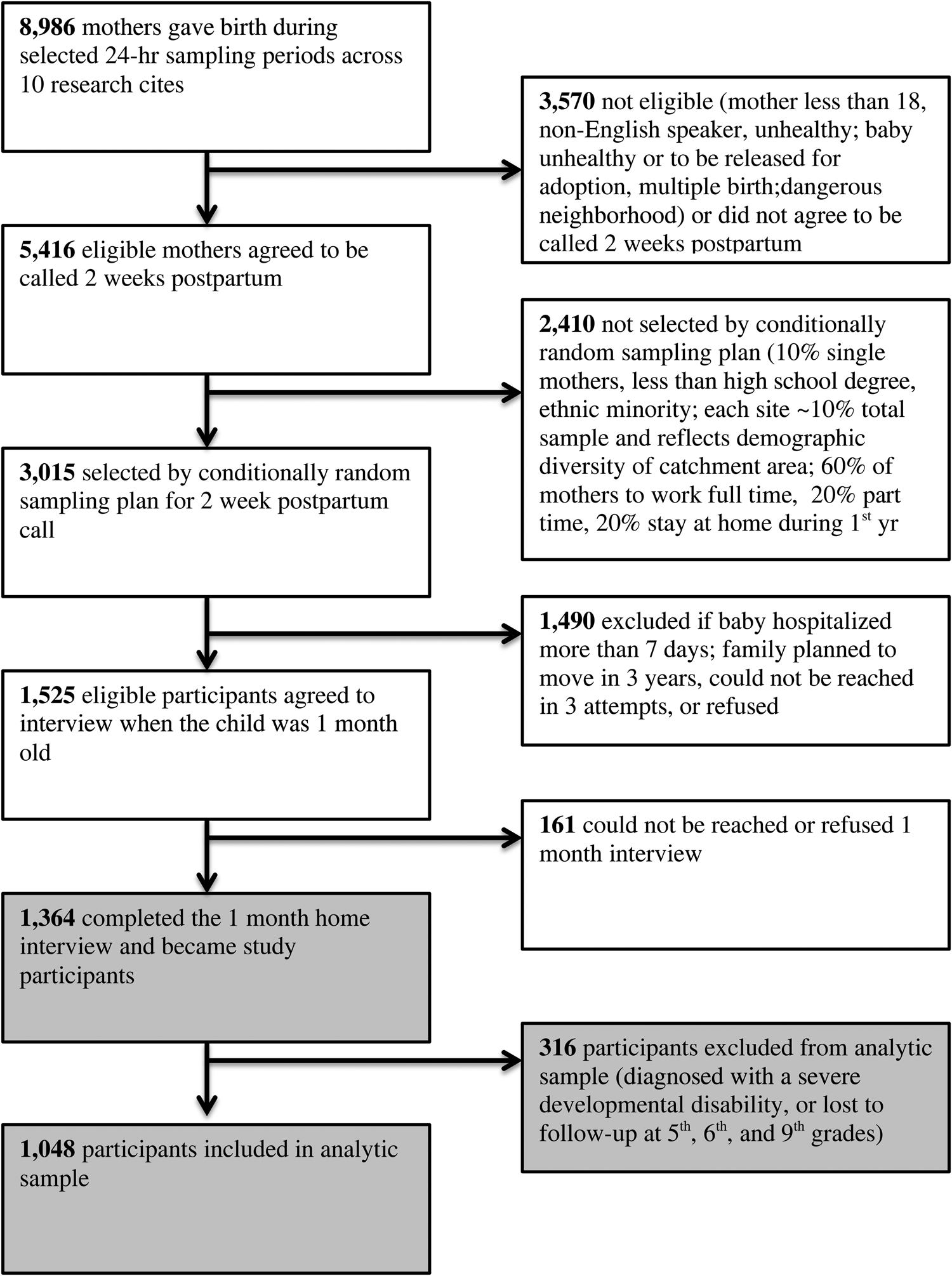
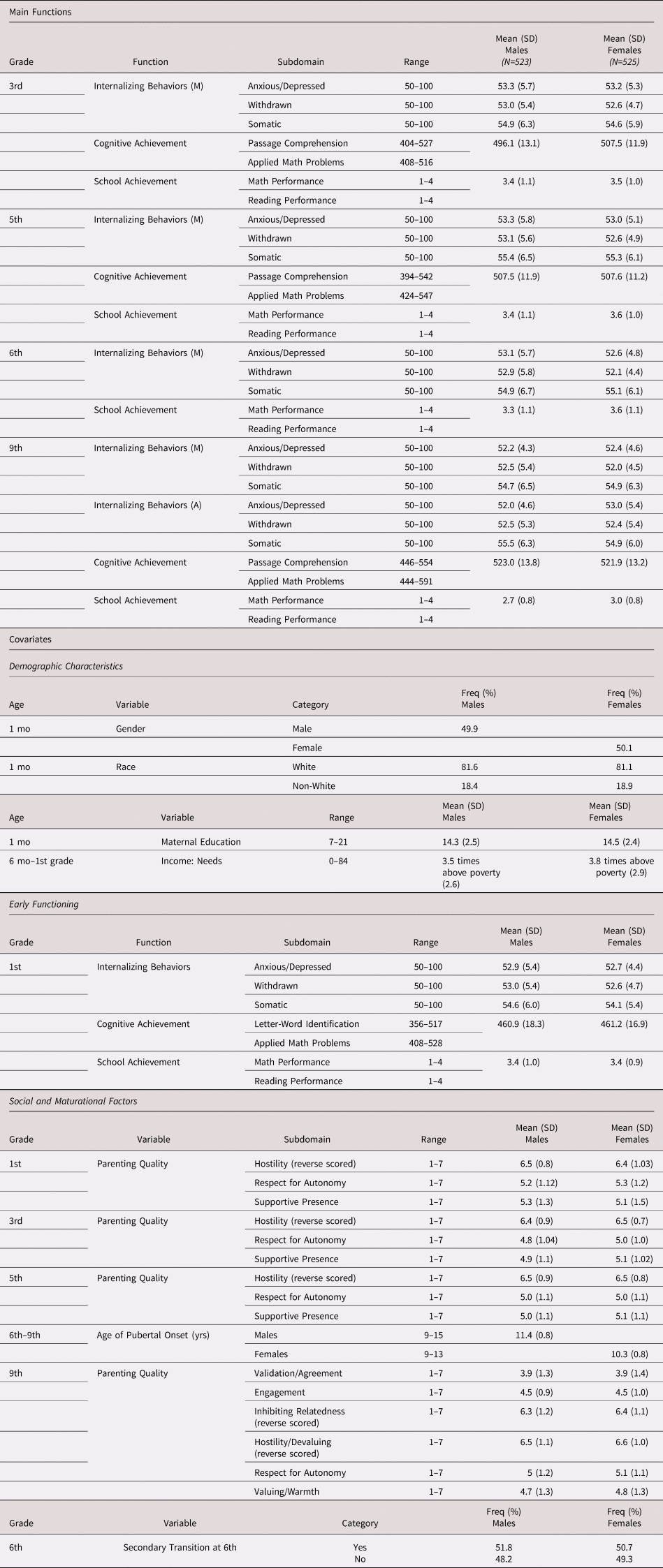
As illustrated in the flow chart (Figure 1), 1,048 of the 1,364 children and families made up the analytic sample. Children did not have a severe developmental disability and had valid data for at least one of the main outcomes of interest (internalizing behavior, school achievement, and cognitive achievement) from at least one time point between fifth and ninth grades. Not all families continued their participation through 2007, at which point the attrition rate was 28.7%. Those families lost to follow-up were more likely to be African American or of a lower income status. Mothers who dropped out of the study were also more likely to be single parents, younger, and less educated compared with those who remained in the study. Attrition was not significantly related to the study site or child's sex (NICHD ECCRN 2005). Descriptive characteristics are provided in Table 1. Although the NICHD SECCYD is a large national study it is not a nationally representative sample.
Flowchart of NICHD SECCYD and analytic sample.

Sample descriptive characteristics

Measures of functioning
The timing for examining functioning focuses on the periods before and during key developmental transitions in third (7–8 years), fifth (10–11 years), sixth (11–12 years), and ninth grades (14–15 years), controlling for children's early functioning in first grade (6–7 years).
Internalizing behaviors
Mothers reported children's internalizing behaviors in first, third, fifth, sixth, and ninth grades on the Child Behavior Checklist (CBCL), and adolescents self-reported their internalizing behaviors in ninth grades on the CBCL Youth Self Report form. Both assessments of internalizing behaviors include a 14-item anxious-depressed subscale (e.g. “child is too fearful or anxious”/“I am fearful or anxious;” α = .80–.85), 9-item somatic complaints subscale (e.g. “child is overtired”/ “I am often overtired;” α = .64–.70), and a 9-item withdrawn subscale (e.g. “child refuses to talk”/“I avoid talking to others;” α = .67–.74). Response categories range from 0 (not at all true/never) to 3 (very true/often). Per NICHD ECCRN (2005) recommendations, we used continuous t-scores truncated at the population mean of t = 50 (range=50–100) in this analysis.
School achievement
Teachers completed the current school performance subscale of the Mock Report Card, to assess school achievement using a five-point scale (1 = “Below Grade Level,” 2 = “Needs Improvement,” 3 = “Satisfactory,” 4 = “Very Good,” and 5 = “Excellent”) for various subjects in first, third, fifth, and sixth grades. The two items assessing children's performance in reading and mathematics were averaged in this study. Children's High School Transcripts provided their cumulative grade point average (0.0–4.0) in English and Mathematics in ninth grade. We used raw scores for interpretability.
Cognitive achievement
Children were administered the Woodcock-Johnson Test of Academic Achievement—Revised (WJ-R) (Woodcock, Johnson, & Mather, Reference Woodcock, Johnson and Mather1990) subtests in mathematics and literacy in first, third, fifth, and ninth grades. The WJ-R provided scores that were age and grade normed, based on a large, representative sample of children. The applied mathematics subtest consisted of 60 items that measured skills in analyzing and solving mathematics problems, and reading comprehension in third through ninth grades was assessed via 43 items. Per NICHD ECCRN recommendations, W scores that were determined by item response theory methods were used to scale each test in equal interval units to ensure that the meaning of the scores was consistent over time (NICHD ECCRN, 2005). The alpha reliabilities of the literacy and mathematics composite scores are as follows: grade one, α = .83; grade three, α = .91; grade five, α = .88; grade nine, α = .89.
Model covariates
Parenting
Structured interactions of mother–child dyads were videotaped to assess parenting quality, and the recordings were examined at first, third, fifth, and ninth grades given the sustained influence of parenting on children's development over time and availability in the SECCYD database. Observations were coded by trained NICHD personnel to rate mothers’ supportive presence, respect for the child's autonomy, and reflected hostility, each on a 7-point scale (1 = low, 7= high) with good internal consistency reliability ((α = .80–.85). The structure of the interactions varied over the course of the study to account for changes in developmental capacities and maturation (Table 1). Often, the structured interactions involved asking mother–child dyads to discuss topics they disagreed on from a predetermined list for a given amount of time. A composite of scores (range = 3–21) combined each aspect of parenting quality at each wave and averaged scores across all waves.
Timing of pubertal onset
A nurse practitioner or pediatric endocrinologist assessed Tanner's stages of pubertal development (Tanner & Whitehouse, Reference Tanner and Whitehouse1976) beginning at age 9.5 and repeated annually. Tanner's stages range from one (prepuberty) to five (full maturation). Age of pubertal onset was documented when the examination indicated pubertal status of Tanner stage two for pubic hair. The age in years at which the child reached Tanner stage two was normed within sex groups such that values reflect deviation from the mean age of onset for one's sex.
Secondary school transition
Principals completed a questionnaire indicating the grade configurations of the child's school. The first transition to secondary school was operationalized as a binary indicator of whether the child experienced a typical transition from an elementary to a secondary educational setting between fifth and sixth grades.
Early functioning
Internalizing behaviors, school achievement, and cognitive achievement in first grade were controlled for in all analyses. Assessments of each function were identical to those used from third through ninth grades, with the exception that the WJ-R literacy subtest was letter-word identification instead of passage comprehension.
Demographic characteristics
Mothers reported their education in years and the child's race and gender during a phone interview when the child was one month old. Mothers reported family income up to four times from six months to first grade. Income ratios were calculated by dividing the total family income by the US Census-based poverty-level income for the family size. An early income needs ratio was the average of all ratios obtained from six months to first grade.
Statistical analyses
We used longitudinal structural equation modeling to quantitatively describe the potentially recursive pathways of academic functioning and internalizing behaviors as well their dynamic interactions over time. This method goes beyond examining the effects of a set of predictors on a set of outcomes to examine the dynamic interplay of the ways in which functioning in one domain influences functioning in others over time. In contrast to longitudinal regression models that can examine a limited set of antecedents to problems that occur during a discreet time period, structural equation modeling accounts for the longitudinal stability of each outcome as well as their cross-sectional associations in order to provide a more conservative estimate of the direct and indirect influences from one area of functioning to another. Further, structural equation modeling accounts for measurement error.
We first defined the analytic sample and examined the descriptive statistics (Table 1) and the correlations among variables (Supplementary Table 1) using Stata version 14 (StataCorp, Reference StataCorp2015). Remaining analyses were conducted in Mplus version 7 (Muthén & Muthén, Reference Muthén and Muthén2012). We used confirmatory factor analyses (CFA) to estimate measurement models for parenting quality and internalizing behaviors. The measurement model for internalizing behaviors included maternal reports from first through ninth grades and an adolescent report at ninth grade. School and cognitive achievement were treated as manifest variables using mean reading and mathematics scores, as these measures are typically operationalized as observed variables in research and practice and they do not meet the requirement of having three or more indicators needed to identify a measurement model.
Prior to testing each hypothesis, we assessed differential item functioning (DIF) of the internalizing behavior indicators to determine whether they measured the latent variable in the same manner for boys and girls, which is necessary to combine their responses for analysis (Clauser & Mazor, Reference Clauser and Mazor1998). This involved adding a covariate for gender to the internalizing behavior latent variable using a single group Multiple Indicator, Multiple Cause (MIMIC) latent variable structural equation model. We evaluated modification indices for direct effects of individual internalizing items on gender, and we sequentially added direct effects of the item with the largest modification index >4.00 to the respective latent variable model of internalizing behaviors. If the path between gender and the item was significant, we performed a Satorra-Bentler scaled chi-square difference test and repeated this process until there were no more modification indices of individual items on gender >4.00. There was no evidence of differential item functioning by gender for the withdrawn and somatic subscales, establishing invariance between girls and boys on these scales. However, there was evidence of differential item functioning for anxiety and depressive symptom, consistent with previous studies (Bares, Andrade, Delva, Grogan-Kaylor, & Kamata, Reference Bares, Andrade, Delva, Grogan-Kaylor and Kamata2012). Given that these core aspects of internalizing behaviors have different meanings for boys and girls, they could not be combined, and the models were fit separately.
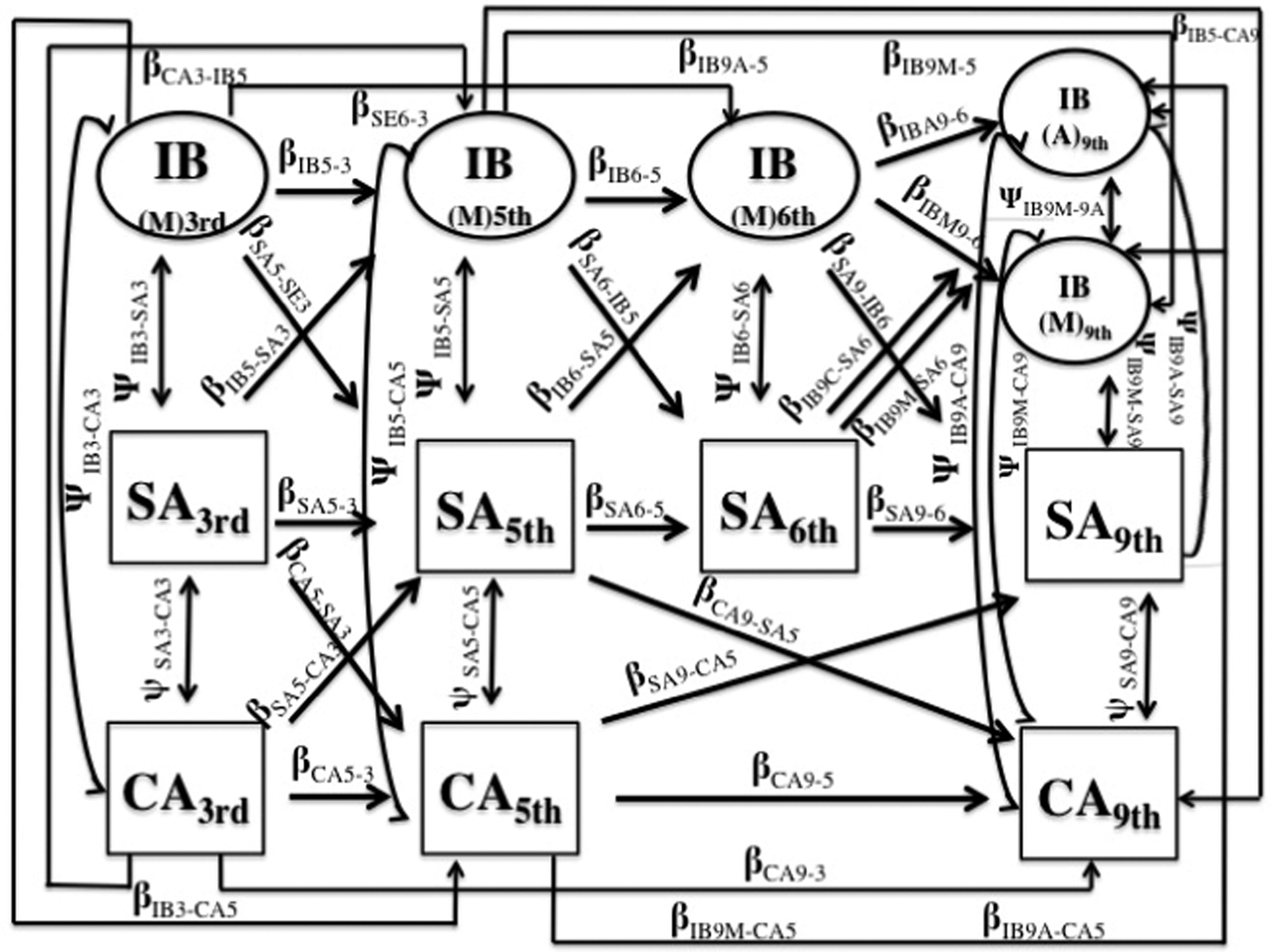
Hypothesis A was evaluated using an autoregressive cross-lagged panel model (Figure 2), which estimated all within-time associations among functions, autoregressive (AR) paths within each function across the first (AR1) and second lags (AR2), and cross-lagged paths between functions. We also estimated all possible indirect effects from each function in third grade to those in ninth grade, using functions in fifth and sixth grades as the bias-corrected products of the direct effects coefficients as recommended by (Hayes, Reference Hayes2009) and (MacKinnon, Reference MacKinnon2008). The measurement models for cognitive achievement and internalizing behaviors were nested in the overall model, and all other paths and associations between functions were otherwise fit simultaneously and retained regardless of significance. Good model fit statistics, as well as the presence of significant direct and indirect cascade effects, assessed whether the observed data fit the hypothesized models of cascade effects involving internalizing behaviors with school and cognitive achievement.
Analytic baseline model estimating all stability paths (β) within function across time, all contemporaneous associations of functions within time (ψ), and all cross-domain cascade effects between lags (β).

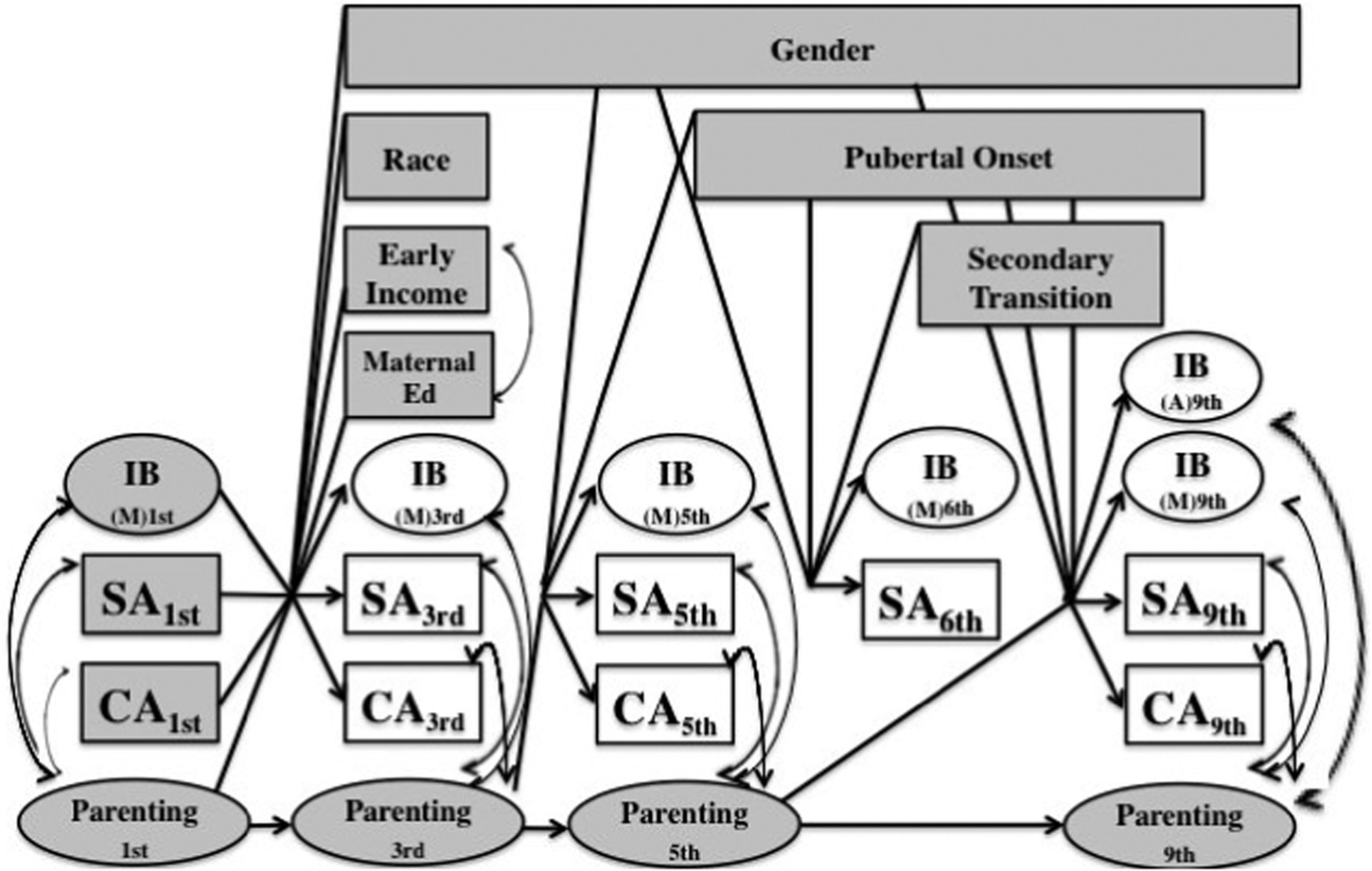
Hypothesis B involved adjusting the baseline model for covariates. Figure 3 presents the analytic model with additional covariate paths; note that all paths estimated in the unadjusted model (Figure 2) were retained regardless of significance but are not pictured for clarity. Early parenting quality, demographic characteristics, and early behavioral and academic functioning were treated as time invariant and controlled for prior to third grade for parsimony and consistency with prior studies of developmental cascades (Burt & Roisman, Reference Burt and Roisman2010). We regressed all functions in fifth through ninth grades on pubertal timing and parenting and the functions in sixth and ninth grades on the sixth grade school transition indicator. The focus on main functions at third, fifth, sixth, and ninth grades allowed us to examine how these functions influence each other across middle elementary, late elementary, and the transitions to middle and high school, accounting for early functioning in first grade.
Analytic model with covariates. All stability paths, contemporaneous associations, and cascade paths retained, but omitted from the figure for clarity.

Hypothesis C compared the relative magnitudes of cascade effects involving school achievement with those involving cognitive achievement by comparing the total effects (direct effects and indirect effects) of paths involving each aspect of achievement. The larger total effect indicates that the effects of the processes that give rise to the observed pathways were stronger for that academic function relative to the other.
The assessment of absolute model fit was guided by two fit indices: smaller values of the root mean square of approximation (RMSEA) suggest better model fit, with good fit values (≤05) and acceptable fit values (≤08); whereas values above 0.90 on the comparative fit index (CFI) indicate good model fit (Little, Reference Little2013). Relative fit of nested models was assessed using the scaled chi-square difference test (Satorra, Reference Satorra2000).
Theoretical and conceptual interpretability, parsimony, and overall fit to the data informed all model comparisons. Missing data on functions and covariates varied across measures from a minimum of 0.77% missing for parenting in first grade to a maximum of 32.21% missing for school achievement in ninth grade. The average percentage missing across all variables was 10.74%. Data were considered missing at random (MAR) based on the large number of unique missing data patterns in the sample, documented changes to data collection protocols for school achievement data in grade nine, and consideration of other variables accounted for in the study related to the propensity of missing data.
Results
Descriptive characteristics
Table 1 presents descriptive statistics for key variables and covariates in this study. Cognitive achievement, income, and parenting data were slightly skewed. All other data were normally distributed. We used the maximum likelihood with robust standard error estimation (MLR) to account for the non-normality of the data.
Measurement models
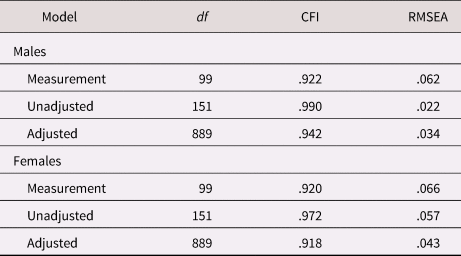
Confirmatory factor analysis results (Table 2) indicated that the observed parenting data fit the latent variable model well (CFI = .978; RMSEA=.04). Factor loadings ranged from .52 to .94 across all parenting items. The observed internalizing behavior data fit the latent variable model adequately for boys (CFI = .922; RMSEA = .061) and girls (CFI = .920; RMSEA = .066). Factor loadings ranged from .46 to .84 across all internalizing behavior items for boys and girls.
Hypothesis A.
Structural model results of cascade effects involving internalizing behaviors, school achievement, and cognitive achievement among boys and girls
Fit statistics for internalizing measurement model and cascade structural equation models

Note: df, degrees of freedom; CFI, comparative fit index; RMSEA, root mean square error of approximation.
The hypothesized, unadjusted model of cascade effects fit the observed data well for boys (CFI = .990; RMSEA = .022) and girls (CFI = .972; RMSEA = .039) (Table 2). The proportion of variance (R 2) in the overall model explained by adolescent self-report of internalizing behaviors in ninth grade was low for boys (.072) and only slightly higher for girls (.116). Otherwise, the model explained an adequate proportion of variance in the main functions, ranging from .36 for school achievement in grade nine to a high of .69 for cognitive achievement in grade five.
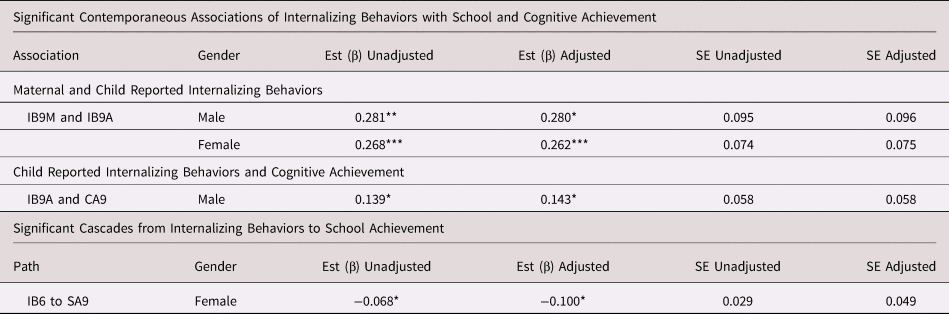
Table 3 presents the unadjusted standardized coefficients (β) of cascade effects and contemporaneous associations (ψ) of internalizing behaviors and academic functioning. There were no significant cascade effects involving internalizing behaviors with either school or cognitive achievement among boys. Maternal report of girls’ internalizing behaviors in grade six significantly and negatively affected school achievement in grade nine, such that each standard deviation increase in girls’ internalizing behaviors resulted in a 0.114 standard deviation decrease in school achievement in grade nine (p < .05). There was also one significant indirect pathway of cascade effects from internalizing behaviors in third through sixth grades to school achievement in ninth grade among girls. This suggests internalizing behavior problems accumulate overtime and result in meaningful and statistically significant total cascade effects involving school achievement among girls (β = −.036, p < .05). While not directly related to the primary study hypotheses, it is worth noting the significant and positive contemporaneous association of boys’ self-reported internalizing behaviors and their cognitive achievement in grade nine (ΨCA9,IB9C = .139, p < .05).
Hypothesis B.
Structural model results of cascade effects involving internalizing behaviors, and academic functioning, accounting for key family factors and adolescent social and maturational factors
Significant contemporaneous associations and cascade effects involving internalizing behaviors and academic functioning (N = 1,048)

Note: IBM, internalizing behaviors, maternal report; IBA, internalizing behaviors, adolescent report; SA, school achievement; CA, cognitive achievement.
* p < .05. ** p < .01. *** p < .001.
When the model was adjusted to account for family and maturational factors, adequate model fit was maintained for both boys (CFI = .942; RMSEA = .034) and girls (CFI = .918; RMSEA = .043) (Table 2). The proportions of variance in the primary functions explained by the model also remained consistent with those R 2 values obtained in the unadjusted model.
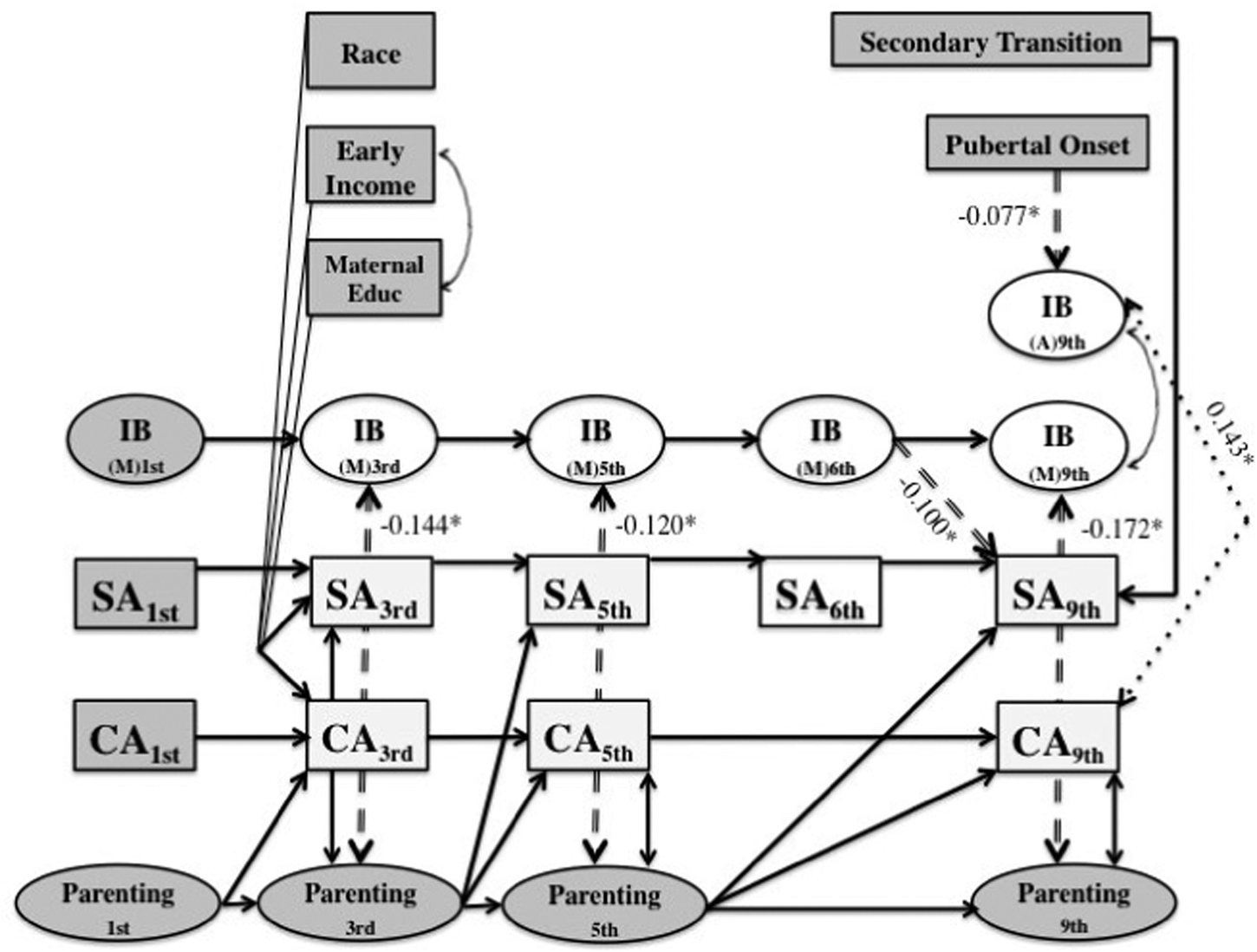
The negative cascade effect from girls’ internalizing behaviors in grade six (maternal report) to their school achievement in grade nine remained significant when adjusting for pubertal onset, parenting quality, the sixth grade transition to secondary school, and demographic characteristics (Table 3). The positive contemporaneous association between boys’ self-reported internalizing behaviors and their cognitive achievement in grade nine also remained significant and similar in magnitude to that in the unadjusted model (ΨCA9,IB9C = .136; p < .05). Figure 4 presents significant cascade and covariate paths obtained from the final structural models with covariates.
Statistically significant relationships of internalizing and academic functioning. Coefficients and significance levels of internalizing estimates are presented in the figure, and all other estimates are reported in Table 2, Table 3, and in the text. Cascade effects and contemporaneous associations of school and cognitive achievement were controlled for, but omitted from the figure. Note: IB(M), internalizing behaviors, maternal report; IB(A), internalizing behaviors, adolescent report; SA, school achievement; CA, cognitive achievement; P, Parenting; dotted lines ( ) denote relationships that were significant for males only, dashed lines (
 ) denote relationships that were significant for females only, and solid lines (
 )denote relationships that were significant for both males and females.

All demographic characteristics significantly influenced school and cognitive achievement in third grade, but they did not significantly influence internalizing behaviors for either boys or girls (Figure 4). Income showed a positive, small effect on achievement, meaning that boys and girls of higher income families achieved higher school achievement (β = .020, p < .05 for boys and β = .018, p <.05 for girls) and cognitive achievement scores (β = .079, p < .001 for boys and β = .071, p < .001 for girls). Maternal education also significantly (p < .05) affected achievement, such that each additional year of mothers’ education was associated with a 0.020- and 0.028-unit increase in boys’ and girls’ school achievement, respectively, and a 0.084- and 0.100-unit increase in boys’ and girls’ cognitive achievement, respectively. Race showed a negative effect that was significant for achievement, suggesting that nonwhite children received lower school achievement (β = -.117, p < .001 for boys and β = -.098, p < 0.001) and cognitive achievement (β = -.133, p < .001 for boys and β = -.077, p < .005 for girls).
Effects of adolescent social and maturational processes on functions varied (Figure 4). Students who transitioned to secondary school between fifth and sixth grades had lower school achievement in ninth grade (β = .063, p < .05 for boys and β = .131, p < 0.001 for girls) compared with those who transitioned at another time, usually later. The age of pubertal onset significantly and negatively influenced girls’ self-reported internalizing behaviors such that each year of increase in the age at which girls began puberty resulted in a 0.130 standard deviation decrease in internalizing behaviors in grade nine (p < .001), indicating better emotional health among girls with a later pubertal transition. Higher parenting quality in third and fifth grades significantly predicted higher school achievement in fifth grade (β = .101, p < .05 for boys and β = .075, p < .05 for girls) and ninth grade (β = .151, p < .001 for boys and β = .114, p < .001 for girls). Parenting in first, third, and fifth grades significantly predicted cognitive achievement in third (β = .158, p < .01 for boys and β = .105, p < .01 for girls), fifth (β = .048, p < .05 for boys and β = .041, p < .05 for girls) and ninth grades (β = .085, p < .01 for boys and β = .0888, p < .001 for girls), respectively. Lastly, the within-time associations involving parenting quality were significant and negative for girls’ internalizing behaviors by maternal report in third, fifth, and ninth grades (p < .05); significant and positive for boys’ and girls’ school achievement in third grade (p < .001) and their cognitive achievement in fifth and ninth grades (p < .05).
Hypothesis C.
Differences in the magnitudes of cascade effects involving internalizing behaviors with school achievement versus cognitive achievement
One direct cascade path involving girls’ internalizing behaviors with school achievement was significant and negative (p < .05), and no cascade paths involving internalizing behaviors with cognitive achievement were significant.
Sensitivity analyses
Examination of the extent to which the 32% of adolescents for whom school achievement data was missing in ninth grade may have biased findings suggests that this proportion of missing data did not bias inferences. Multiple group analyses of the final adjusted model with all paths through sixth grade, and through ninth grade (excluding paths involving school achievement in ninth grade) demonstrate that both models fit the data equally well across samples with and without ninth grade school achievement data, Δχ2 (10) = 7.91, p = .64, and Δχ2 (15) = 11.02, p = .75, respectively, indicating that the missing data did not bias the findings.
Given prior findings of cascades of antisocial behavior to achievement (Burt & Roisman, Reference Burt and Roisman2010; Obradivic et al. 2010), we conducted a sensitivity analysis by controlling for externalizing behaviors at each time point in the full model from first through ninth grade, and a subset of the model from fifth to ninth grades, to improve power in light of the added model complexity. Model fit declined to marginally acceptable for males (CFI = .903, RMSEA = .044) and below acceptable for females (CFI = .888, RMSEA = .05) and yielded slightly attenuated estimates when externalizing behaviors were added to the model. This suggests our original hypothesized models were a better fit to the data than the sensitivity analyses models that included externalizing behaviors.
Discussion
These findings improve scientific understanding of children's academic and emotional functioning by disentangling the timing and mechanisms of relationships involving children's internalizing behaviors, teacher assigned ratings of school achievement, and standardized assessments of cognitive achievement. This study replicated the nonsignificant cascades involving internalizing behaviors and cognitive achievement identified by Burt & Roisman (Reference Burt and Roisman2010) using the SECCYD database and advances this work in its consideration of gender differences in the assessment of internalizing behaviors and corresponding gender-specific analyses, both maternal report of internalizing behaviors during early and middle school years and adolescent self-report of internalizing symptoms in ninth grade, two aspects of achievement, measurement of key adolescent social and maturational processes, and observations of parenting quality over time.
The study hypotheses were fairly well supported for girls, but not for boys. As girls mature from third to ninth grade, the presence of internalizing problems negatively affects their teacher-rated school achievement. In particular, a significant direct cascade effect from internalizing problems in sixth grade reduced school achievement in ninth grade. Additionally, a significant indirect cascade effect involving internalizing problems and school achievement begins in third grade and accumulates through ninth grade among girls. Neither direct nor indirect cascade effects were significant among boys at any time point, but there was a positive contemporaneous association of boys’ self-reported internalizing problems with their cognitive achievement in ninth grade. All relationships remained significant when accounting for demographic characteristics and adolescent social and maturational factors, including timing of transition to secondary school, timing of pubertal onset, and parenting quality. The following sections put these results in the context of measurement approaches used in this study and present implications for future research and practice.
Hypothesis A.
Cascade effects involving internalizing behaviors and school achievement
The significant direct and indirect cascade paths from internalizing behaviors to school achievement among girls provides some support for the first hypothesis. The direct cascade path suggests girls’ academic and emotional experiences and behaviors are interrelated such that internalizing behaviors in early adolescence negatively affect school achievement in mid adolescence. In addition, the indirect pathway from girls’ early internalizing behaviors to their later school achievement provides further evidence that internalizing behaviors accumulate through elementary and middle school and lead to academic problems in high school among girls. These findings are consistent with previous empirical and theoretical work that suggests that internalizing behaviors can lead to poor school adjustment and undermine girls’ engagement in school overall, as well as with peers and teachers (Crockett, Carlo, Wolff, & Hope, Reference Crockett, Carlo, Wolff and Hope2013). Moreover, the null findings of cascade effects among boys may be attributed to their differential susceptibility to internalizing behaviors, with girls being two times more likely to be affected by an internalizing disorder such as depression by age 18 (Merikangas et al., Reference Merikangas, He, Burstein, Swanson, Avenevoli, Cui, Benjet, Georgiades and Swendsen2010).
In contrast to findings by Obradivic et al. (2010), the cascade from girls’ internalizing behaviors to their later school achievement remained significant after accounting for their externalizing behaviors. These discrepancies with our results may be attributable to the authors’ multimethod, multi-informant assessment of achievement and very wide assessment intervals (7–10 years). Our study examined standardized assessments and teacher ratings of achievement independently, as they are routinely used by schools and districts for decision-making and we expected they would be differentially related to children's emotional functioning. In addition, Obradivic et al. (2010) controlled for externalizing behaviors at baseline, while our sensitivity analyses assessed the potential unmeasured effects of externalizing behavior problems on the patterns under study at each time point. Ours is the first study to disentangle the timing and mechanisms of children's emotional and academic dysfunction separately for boys and girls.
These results likely provide a conservative estimate of the cascade effects between emotional problems and academic functioning, as mothers tend to underreport children's internalizing symptoms (Baldwin & Dadds, Reference Baldwin and Dadds2007; Collishaw et al, Reference Collishaw, Goodman, Ford, Rabe-Hesketh and Pickles2009) and they provided the first three assessments of internalizing problems. Given that adolescents are reliable reporters of their own internalizing problems (Berg-Nielsen et al., Reference Berg-Nielsen, Vika and Dahl2003), the low correlation between their self-reports in ninth grade and their mothers’ reports at the same point in time (r = .27; p < .01) and the lack of any relationship between maternal report at sixth grade and adolescent-self report in grade nine underscores the limited ability of maternal reports to fully capture their children's internalizing problems. An additional complication of this measurement challenge is seen in the differences between male and female adolescents’ interpretation of anxiety and depression symptoms, as evidenced by the observed differential item functioning of the internalizing scale, which has also been documented previously (Bares et al., Reference Bares, Andrade, Delva, Grogan-Kaylor and Kamata2012). Lastly, the lack of significant findings involving the adolescent self-reported measure of internalizing problems are somewhat logical given the model did not explain a substantial proportion of variance (R 2 = .076 for boys and R 2 = .132 for girls) in this variable. Nevertheless, the adolescent self-reported measure of internalizing problems strengthens the validity of our study and provides an important source of comparison to the less precisely measured maternal reported measure.
Hypothesis B.
Structural model results of cascade effects involving internalizing behaviors and academic functioning, accounting for key family factors and adolescent social and maturational factors
Adjusting the baseline model for the timing of students’ middle school transition, pubertal onset, and parenting quality did not substantially alter the magnitude or significance of the cascade effects observed among girls or the contemporaneous association of internalizing problems and academic functioning observed among boys. As expected, we confirmed the role of early functioning in first grade and demographic characteristics such as income, maternal education, and race in children's academic functioning from third through ninth grades. These results suggest that these covariates contribute to mean levels of functioning and do account for some variation in the size of relationships, but they do not confound the interrelationships of functioning. It is developmentally plausible that the degree to which a child experiences success or difficulty in their academic or behavioral functioning is influenced by such factors, but the factors themselves do not account for the actual effect that problems in one domain of functioning have on another.
These analyses incorporate rigorous assessments of maternal parenting quality, and they identify parenting, as well as maternal-reported internalizing problems among girls, as important predictors and contemporaneous influences on children's academic functioning. Despite expected declines in parenting quality through adolescence (Steinberg & Morris, Reference Steinberg and Morris2001), these observed relationships of parenting and academic functioning were maintained from elementary through high school. School achievement may be an important vehicle through which parenting influences girls’ internalizing behaviors over time, with current parenting having a greater influence on internalizing than earlier parenting. It is possible that boys’ internalizing behaviors may be affected by the quality of paternal parenting, which was not accounted for in this study. Indeed, prior studies suggest parenting styles of mothers and fathers differ based on children's gender, which in turn differentially influences children's adjustment and adaptive capacities (McKinney & Renk, Reference McKinney and Renk2008). Nevertheless, this finding adds to a large body of research that describes parenting as an important developmental context for emotional problems and the transmission of values and support for educational success (Gutman & Eccles, Reference Gutman and Eccles2007; Steinberg, Reference Steinberg2001), and it also highlights the importance of efforts to promote parenting quality among parents challenged by children with emotional, behavioral or academic problems.
Contrary to expectations, the timing of the middle school transition only influenced ninth grade school achievement among boys and girls who transitioned to a middle school setting before sixth grade. The lack of significant results may not mean that this factor is unimportant; this result may suggest the need for more precise measurement. Although our approach is consistent with previous research on the middle school transition at sixth grade using the SECCYD database (Jacobson, Williford, & Pianta, Reference Jacobson, Williford and Pianta2011), the results may have been attenuated by the timing and nature of data collection. For example, the assessment intervals for internalizing problems and cognitive achievement widened after fifth grade and there was wide variability of grade configurations across the schools that children attended. Nevertheless, the negative influence on ninth grade school achievement among those who had transitioned to middle school before grade six is congruent with previous studies that identify increased behavior problems and achievement loss associated with early school transitions for a proportion of children (Moilanen et al., Reference Moilanen, Shaw and Maxwell2010; Ray & Elliot, Reference Ray and Elliott2006). This finding has been interpreted as evidence that, for some students, early transition to secondary school exceeds their ability to adapt to new instructional formats, with less perceived support, disrupted social networks, and heightened expectations for individual responsibility (Steinberg, Reference Steinberg2005).
Results are congruent with the maturation disparity hypothesis (Ge & Natsuaki, Reference Ge and Natsuaki2009) such that girls who enter puberty earlier may be less prepared to adapt to the biological and psychosocial changes of puberty and more vulnerable to the subsequent stressors of adolescence.
The identification of the negative relationship between girls’ early pubertal onset and increased internalizing problems in this study adds to a large body of research documenting associations of early physical maturation with symptoms of depression and anxiety among girls (Crockett et al., Reference Crockett, Carlo, Wolff and Hope2013; Mendle, Turkheimer, & Emery, Reference Mendle, Turkheimer and Emery2007; Negriff & Sussman, Reference Negriff and Susman2011). Girls’ increased estrogen and progesterone levels are hypothesized to reduce negative feedback mechanisms of cortisol on the hypothalamic pituitary adrenal axis, thereby leaving females more affected by long-term effects of stress and at greater risk for depression than males (Young, Reference Young1998). The gender-intensification hypothesis (Hill & Lynch, Reference Hill and Lynch1983) further contends that cultural reinforcement of feminine ideals or stereotypes increases emotional, introspective, passive, and self-sacrificing behaviors for some girls that create disproportionate risk for depression. Gender roles that were more fluid prior to puberty likely intensify at its onset and may heighten the risk for depression among a subset of girls who strictly conform to these expectations.
Hypothesis C:
The relative contribution of school versus cognitive achievement to cascade effects and contemporaneous associations with internalizing behaviors
Support for hypothesis C was minimal, given the limited number of cascades identified in the first hypothesis. However, examination of both the cross-lagged and contemporaneous associations of internalizing problems with two aspects of achievement highlights important differences in the ways in which boys’ and girls’ internalizing problems are related to their academic functioning. That is, girls’ internalizing problems in early adolescence negatively influence their school achievement over time. On the other hand, boys have significant and positive contemporaneous associations between internalizing problems and cognitive achievement. The combination of anxiety and depressive symptoms in the internalizing scale may mask a full understanding of this relationship. It may be that some boys’ elevated internalizing scores reflect anxiety rather than depression, reflecting their stronger motivation to perform well in school.
Findings are consistent with prior studies of differences in boys’ and girls’ academic functioning. The negative effect of girls’ internalizing problems in grade six on their school achievement in grade nine may be explained girls’ greater propensity for feelings of low self-worth and depressive symptoms during adolescence leading to less persistence and effortful learning in school (Kenney-Benson, Pomerantz, Ryan, & Patrick, Reference Kenney-Benson, Pomerantz, Ryan and Patrick2006). Given that girls are more likely than boys to demonstrate substantial effort and persistence in mastering long-term performance goals (Voyer & Voyer, Reference Voyer and Voyer2014), it is plausible that the consequences of internalizing problems on school achievement are more severe for girls. On the other hand, boys appear to respond more positively to short term stress in the context of a one-time standardized achievement test (Kenney-Benson et al., Reference Kenney-Benson, Pomerantz, Ryan and Patrick2006). The significant contemporaneous association of internalizing problems with cognitive achievement that we observed among boys in grade nine is consistent with the possibility that they are experiencing school performance-related anxiety and the known curvilinear relationship between anxiety and performance on standardized assessments found among boys (Kenney-Benson et al., Reference Kenney-Benson, Pomerantz, Ryan and Patrick2006).
Strengths and limitations
This study contributes novel perspectives to existing literature and theory regarding the interrelationships of internalizing problems and academic achievement from elementary through high school. The inclusion of multiple, repeated assessments of internalizing problems and academic functioning and key social and biological factors are major strengths of this study. Triangulating from the breadth and depth of the multimethod data collection involving observation, direct measurement, clinical assessments, and questionnaires involving multiple informants further strengthens the validity and reliability of study inferences. The rigorous analysis of cascade effects is a unique methodological application to address the intersection between these educational and mental health processes, with the goal of more closely modeling actual development than is possible with longitudinal regression models. The results of this study, however, should be interpreted with consideration of three primary limitations.
First, the data were unavailable to examine the periods between middle and high school and after ninth grade and to account for school quality and peer influences, yielding less precise estimates of the timing and magnitude of cascades. Future research should more closely examine these potential influences on developmental cascades during these time frames and assess whether new cascades emerge after ninth grade, as this is an important period for the onset of internalizing disorders as well as for rapid physical and cognitive maturation. Secondly, as previously discussed, our assessment of children's internalizing problems relied on only maternal report before ninth grade. Lastly, findings are most confidently generalized to non-Hispanic and White families in urban and suburban areas. The SECCYD database was designed to be generally representative of families using various types of childcare in various areas of the United States, but is not nationally representative. Future studies should examine whether differences in the measurement and prevalence of functional problems across sociodemographic subgroups affects the timing of developmental cascades.
Implications
This study has important implications for prevention and intervention in the fields of public health and education. Positive behavioral and academic functioning in school is important for healthy development through adolescence and adulthood (Roorda, Koomen, Spilt, & Oort, Reference Roorda, Koomen, Spilt and Oort2011), and is protective against substance abuse (Atkins, Oman, Vesely, Aspy, & McLeroy, Reference Atkins, Oman, Vesely, Aspy and McLeroy2002), school dropout (Henry, Knight, & Thornberry, Reference Henry, Knight and Thornberry2012), serious behavior problems (Henry et al., Reference Henry, Knight and Thornberry2012) and later health problems (Muennig, Reference Muennig2005). These findings help to motivate and inform efforts to more effectively target the underlying processes by which internalizing problems emerge, persist, and worsen from elementary through high school among girls. Future research should examine these relationships closer to the average age of onset of internalizing disorders in mid adolescence and follow their subsequent effects on other domains of functioning through late adolescence and early adulthood.
Results underscore the importance of considering measurement discrepancies across maternal and child reported assessments when intervening upon transactional relationships of behavioral and academic functioning. In particular, there is a need for improved surveillance of girls’ internalizing symptoms in middle school, especially among those who begin puberty early. Given the weak correspondence of maternal report and adolescent self-report of internalizing problems, such mental health problems are likely to go undetected by mothers who are adolescents’ primary means of referral for mental health services (Green, Clopton, & Pope, Reference Green, Clopton and Pope1996). Early identification and treatment for girls with internalizing symptoms may improve their prognosis and potentially address the underlying processes by which these problems negatively affect their school achievement in high school.
Findings also highlight the need for evidence-based programs that foster socioemotional and academic development tailored to boys’ and girls’ unique developmental needs during early and middle adolescence. For example, the Coping with Middle School Transitions program (Lochman & Wells, Reference Lochman and Wells2002) shows promise, targeting parent involvement, improving teachers’ identification of children with emotional problems, and improving collaboration between parents and teachers to address children's academic, emotional, and emotional problems. Moreover, future research is necessary to identify mechanisms by which gender norms and ideals put adolescent boys and girls at risk of poor behavioral and academic functioning that may be modified by interventions to optimize youth development. Given the foundational importance of academic achievement and the life-long pernicious influence of adolescent anxiety and depressive problems, significant personal, family, and societal returns are likely to be realized from investments in positive youth development efforts in children's family, school, and community contexts.
Lastly, the differential relationships of girls’ and boys’ internalizing symptoms with school and cognitive achievement have implications for learning and assessment. Future research should examine the mechanisms by which boys’ and girls’ emotional responses to learning and evaluation yield optimal or suboptimal performances across different academic and achievement contexts. This may inform efforts to shift from instructional feedback that emphasizes academic deficiency towards feedback that provides informative opportunities for long-term growth. Similarly, facilitating a growth-oriented approach to learning and evaluation may reduce students’ vulnerabilities to internal distress brought about by suboptimal academic performance, particularly among girls.
Supplementary material
The supplementary material for this article can be found at https://doi.org/10.1017/S0954579419000737.
Acknowledgments
We gratefully acknowledge the NICHD Early Child Care Network members who facilitated in the recruitment and follow-up of the Study of Early Child Care and Youth Development, as well as the participants of this study. Through their contributions this work has been possible.
Financial Support
This Study of Early Child Care and Youth Development (the parent study) was supported by the National Institute of Child Health and and Development. Lauren Okano was supported by the NIMH (5 T32 MH 19545-24) in her training.
Financial Disclosure
The authors have indicated they have no financial relationships relevant to this article to disclose.
Conflict of Interest
The authors have indicated they have no potential conflicts of interest to disclose.