Few issues are more important to the future of South African democracy than land. Because it represents a combination of problems, ranging from urban homelessness and squatting to restitution for historical land dispossession, the land question has been referred to as a ‘political time bomb’Footnote 1. Many policy options are currently being debated within South Africa, stretching from abandonment of the ‘willing seller/willing buyer’ policy undergirding land redistribution to the reopening of the process by which claims for restitution for historical land injustices can be lodged. With the spectre of Zimbabwe-style land invasions lurking in the background of the debates, and considering the ruinous consequences of land policies for that country’s prosperity and democracy, most analysts believe that how the land issue is to be negotiated will have much to do with the future of democracy in South Africa.
As in much of South African politics, elite voices – including NGOs, interest groups and policy institutes – are readily heard on issues of land. Yet land is the sort of problem that engages the mass public, making land issues susceptible to mass mobilization efforts by political entrepreneurs. Land is one of the most volatile problems in South African politics today because the issue resonates broadly throughout the country’s mass public.
How supportive are the South African people of the numerous contemporary efforts at redistribution and restitution? How is support distributed across the various groups in South Africa, and to what degree is a preference for redistribution/restitution nothing more than an expression of material self-interest? Do land issues implicate the country’s colonial and apartheid pasts, or is land ‘simply’ a contemporary issue pitting ‘haves’ against ‘have-nots’? Until now, these questions could not be answered owing to the dearth of systematic data on the expectations and preferences of ordinary South Africans on the various issues comprising the country’s ‘land problem’.
However, in a quite different sense, these questions are unanswerable: on many (if not most) political issues, South African ‘public opinion’ as a unitary whole does not exist. Indeed, interracial differences in beliefs, attitudes, values and behaviours on issues of land constitute the very essence of the volatility of the land issue.Footnote 2 To the extent that racial polarization on land issues exists, the likelihood of intense political conflict over land redistribution and restitution is substantial.
The purpose of this article is therefore to investigate the attitudes held by South Africans towards assorted policies of land redistribution and restitution.Footnote 3 Beyond the descriptive purposes of this research, I test various hypotheses about how instrumental and symbolic factors shape land preferences. Regarding instrumentalism, I examine the simple conjecture that those who favour more redistribution are those who would directly profit from such policies. I discover, not surprisingly, that land is much more than an issue of material allocation; land is also a symbol of historical injustice that motivates and mobilizes even those who have no expectation of material benefit from the redistribution of land. Symbolic issues, especially in fragile, transitional polities like South Africa, are laden with explosive political potential, because even people who never directly suffered the injustices of the past can identify with the victims of those institutions and systems.Footnote 4 Because the land issue implicates a variety of deeply rooted values – grounded in concerns over historical injustices – no easy solution to land conflicts seems available or possible.
As Hall and Ntsebeza observe:
What land reform is for, who should benefit and how should it be pursued are often treated as technical economic questions, but at its heart the land question is political – it is about identity and citizenship as well as production and livelihoods – and can be resolved only through political processes.Footnote 5
This is undoubtedly so. Perhaps the most politically significant finding of this research is that extreme racial polarization exists on virtually all aspects of the land issue. Because the issue is so deeply embedded in the injustices of the past, black South Africans are not divided by class or by material interests, even while South Africans in general are deeply divided by race.Footnote 6 Should serious land reform ever come to South Africa, the degree of polarization revealed in these data will undoubtedly shape the politics of the land. Because ‘the land issue’ is about far more than land, it will remain among the most difficult issues to negotiate in contemporary South African politics.Footnote 7
The central focus of this article is on testing hypotheses drawn from theories of symbolic politics and instrumental self-interest. Before explicating this theoretical underpinning, a brief overview of contemporary and historical land politics in South Africa is provided.
Land history in South Africa
One of the central aims of both the English and Afrikaans governments in the twentieth century was to secure for white South Africans the exclusive use of the most valuable land in the country.Footnote 8 The 1913 Natives Land Act limited the areas where black South Africans could live and stripped African cash tenants and sharecroppers of their land, replacing land ownership with labour tenancy, and restricted black land ownership to the 7 per cent of the country designated as ‘homelands’ or native reserves. The South African parliament continued the process by adopting a variety of laws dispossessing blacks of their land.Footnote 9 The 1936 Development Trust and Land Act No. 18 expanded the reserves to a total of 13.6 per cent of the land in South Africa (for 80 per cent of the total South African population). It also authorized the Department of Bantu Administration and Development to eliminate ‘black spots’ (black-owned land surrounded by white-owned land).Footnote 10 Roughly 470,000 black South Africans were relocated due to black-spot cleansing.Footnote 11 These relocation areas later became part of the so-called Bantustans that would constitute the ‘homelands’ for blacks in South Africa. The Surplus People Project (1983) estimates that, between 1960 and 1983, 1.29 million people were evicted from farms, and 614,000 were resettled during the abolition of ‘black spots’ and homeland consolidation processes.Footnote 12 Later, Villa-Vicencio and Ngesi claimed: ‘Between 1963 and 1985, approximately 3.5 million blacks were removed from areas designated for whites and sent to the homelands.’Footnote 13 Even if the methods by which these various estimates are derived are rarely transparent, in the end, the ‘ethnic cleansing’ of vast proportions of both urban and rural land was extremely successful. By the twilight of the apartheid regime, little of South Africa was owned by blacks.
Land Reform under the Post-Apartheid Government
Although land reform began under the final apartheid government (e.g., the Abolition of Racially Based Land Measures Act 108 of 1991), the major pillars of contemporary public policy are found in the new constitution and several pieces of legislation enacted by the post-apartheid government. With majority rule in 1994, the new government passed several laws designed to deal with historical dispossessions, the most important of which is the Restitution of Land Rights Act of 1994.Footnote 14 The principal elements of the policy were: (1) land restitution, the right to restoration or compensation for dispossessions as a result of past racially discriminatory laws or practices; (2) land redistribution, an assistance programme through which the government aids individuals seeking to purchase land (primarily for agricultural purposes);Footnote 15 and (3) land tenure reform, changes in the legal basis of land ownership to provide legal standing and security in land ownership (for example, the formalization of informal land rights, especially in rural areas and the former ‘homelands’).Footnote 16 Particularly important was the establishment of the Commission on Restitution of Land Rights and the Land Claims Court, before which 63,455 claims have been filed.Footnote 17 As of 30 June 2005, 62,127 of these claims had been settled,Footnote 18 and the government had spent millions of rands on land restitution and land compensation.Footnote 19
Land Politics
Politics in South Africa is strongly driven by competition between elites, and the land issue is no exception. Powerful interest groups (such as AgriSA, the interest group for big agriculture in South Africa) have recognized the importance of the land problem. It is therefore reasonable to ask what a study of the views of a representative sample of ordinary South Africans can tell us about the politics of the issue. Several answers to this question can be identified.
Zimbabwe’s land problems differ in many important ways from the land problems of South Africa. However, for many South Africans, Zimbabwe stands as a terrifying example of how ruthless and unprincipled elites can mobilize the mass public in pursuit of a ‘solution’ to the land problem. In South Africa, no effort to mobilize ordinary people has yet been successful, even though political parties have attempted to galvanize the people on land (for example, the Pan Africanist Congress and, more recently, the South African Communist Party).Footnote 20 The mass public can become a form of political capital as elite groups and organizations seek political advantage. Especially as the African National Congress (ANC) increasingly faces challenges to its leadership of the country, it seems quite likely that radical land reform might become a vehicle for challenging the current structure of power in the country.Footnote 21 As Cousins put it:
events in Zimbabwe have catapulted land reform into the headlines. Across the region, a variety of interest groups (including political parties, NGOs, farmers’ unions, trade unions and donors of foreign aid) have responded to the implicit question: does the slow pace of land reform in their own country presage large-scale land invasions supported by powerful political interests?Footnote 22
What are the views of ordinary South Africans on the various land issues?Footnote 23 South Africans do perceive the land issue as important to them and their country. In response to a question about the importance of a variety of social problems, a majority of Africans rate land ownership and redistribution as very important (the highest point on the response set).Footnote 24 However, racial differences on this item are stark: only a quarter to a third of the other racial groups are so concerned about land. Although the land problem is obviously less pressing than the big three – unemployment, HIV/AIDS and crime – survey data reveal that black South Africans are more concerned about the past than others, and that an important instance of historical injustice is land.
Many additional questions remain to be answered, including: given the history of colonialism and apartheid, how legitimate are the vast land holdings of whites in the country? To what degree are proposals for radical land reform (such as expropriation) supported by ordinary South Africans? And perhaps most important, how ‘racialized’ is the land problem? Is land simply one more sub-dimension of the vast interracial conflict characterizing South African politics? Do the positions people adopt on land reflect alternative sets of cultural values, as in a mini-version of the clash of cultures? Have class divisions arisen and how do they intersect with race? To date, little is known about what ordinary South Africans believe about land, and why they hold these beliefs. The purpose of this article is to attempt to fill those important lacunae in our understanding of the politics of land in South Africa.
Theoretical perspectives
Land issues are important because they can teach us something about transitional justice,Footnote 25 and the roles of instrumentalism and symbolism in politics. Attitudes, beliefs and actions regarding land issues are likely to be shaped by at least two major forces. On the one hand, land preferences may reflect individual self-interests.Footnote 26 Those who suffered from the land policies of the past may simply seek restorative justice: the righting of the wrong that they experienced. In addition, those without land today may, whatever their histories, seek redistributive justice: land on which to live and work. Egocentric instrumentalism, therefore, provides one account of why people think and act as they do, even if such an account is not terribly complex (nor interesting). Preferences on land issues reflect individual self-interests, according to this hypothesis.
The egocentric instrumentalism hypothesis has not received much support within the research literature. It is worth quoting at length from a particularly exhaustive review of this literature by Wolpert and Gimpel:
Although it is widely assumed that citizens adopt policy preferences that further their private interests, a vast body of empirical research reveals that self-interest exerts little influence over mass preferences … White parents whose children are affected by a desegregation plan are no more likely than other whites to oppose bussing … those with poor health insurance are no more likely to support national health insurance than the fully insured … those vulnerable to the military draft do not have distinctive preferences on the draft … those with relatives and friends serving in Vietnam were no more likely to oppose the Vietnam War than others … the unemployed do not support job programs more than the employed … parents of children in public schools do not support aid to education more than others … whites adversely affected by affirmative action are no more likely to oppose preferential hiring than other whites … vulnerability to crime does not produce distinctive attitudes on law and order policies … and working women are no more likely than homemakers to support the ERA or affirmative action for women … Similarly, on issues such as bilingual education … immigration … English as an official language … inflation … and the energy crisis …tangible personal interests fail to produce distinctive policy attitudes.Footnote 27
On most political controversies, understanding preferences requires more than understanding whether or not an individual benefits directly from the policy.
Theories of symbolic politics have been developed as an alternative to theories of rational self-interest, and a rich literature on the importance of symbols in politics exists. Largely associated with the work of David Sears, symbolic politics theory asserts that people acquire ‘affective responses to particular symbols’Footnote 28 and that these influence the way people react to the daily flow of political events, issues, individuals and groups. Symbols are thus important because they ‘often evoke and mobilize human emotions’.Footnote 29 Grounded in emotion, attitudes toward political symbols seem to be more stable, more generally applicable, more likely to be readily accessible and, as a consequence, more likely to provide a frame for understanding a variety of political issues. When symbolic attitudes are evoked, political judgement is less likely to be strictly associated with interest maximization: ‘the symbolic politics process is characterized by generally unthinking, reflexive, affective responses to remote attitude objects rather than by calculations of probable costs and benefits (whether personal or not)’.Footnote 30 As Sides and Citrin further explain: ‘Symbolic politics theory emphasizes the potency of values and identities on opinion formation, arguing that the role of these “ideal interests” frequently overrides the influence of material concerns.’Footnote 31
A considerable body of research assesses whether symbolic attitudes or rational self-interests provide the most useful view of policy preference formation. For instance, Sears and many others have juxtaposed these two explanations of citizen preferences and have generally found that symbolic attitudes are more influential.Footnote 32 As a more recent example, Sides and Citrin report an investigation of ‘the empirical validity of “rational” and “symbolic” theories of attitudes towards immigration’, and conclude that the material interests of people have much less influence on immigration attitudes than do their symbolic attitudes (in their case, national identities).Footnote 33 Specifically: ‘Public opinion is not insensitive to the economic consequences of immigration, but more important are deeply held symbolic attitudes, such as beliefs about cultural unity or homogeneity.’Footnote 34 Exceptions to the general finding that self-interest is a poor predictor of political preferences can certainly be found,Footnote 35 but, typically, self-interests are not as influential as symbolic attitudes in shaping land preferences.
In addition, people may be motivated by sociotropic, or group, concerns. Even without direct interests being involved, individuals may care about fairness to their group. Mutz and Mondak refer to this as ‘sociotropic fairness’, defining the concept as ‘people’s concerns with whether economic gains and losses have been distributed equitably among the nation’s many groups’.Footnote 36 One can readily substitute anything of value for their ‘economic gains and losses’; indeed, sociotropic fairness may refer to the distribution of justice, historical and contemporary, among the citizens of a nation (as Mutz and Mondak recognize). Thus, preferences on land issues may be defined by concerns about sociotropic justice: the tendency to judge policy in terms of how it affects one’s group rather than one individually. In this sense, groups matter ‘because identification produces a symbolic interest in the group’s well-being’.Footnote 37
Consequently, a central purpose of this analysis is to test the relative influence of instrumental and symbolic concerns in structuring policy preferences on land redistribution.Footnote 38 At this point, more detailed consideration of these policy preferences is necessary.
Policy attitudes
I have established that land issues are fairly salient in South Africa and constitute a vital political challenge to the country. A variety of policy initiatives has been proposed to address various aspects of these land problems. To what degree do South Africans support such policies?
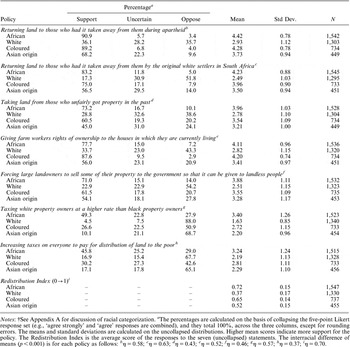
Table 1 reports attitudes toward an array of land policies.Footnote 39 Several general aspects of the table stand out. First, strong interracial differences in attitudes exist (see the eta coefficients, reported in the footnotes to Table 1), especially between blacks and whites. On some policies (like the first two listed in the table), interracial differences are enormous. Secondly, most of these policy ideas are endorsed by a majority of blacks and, by extension, a majority of South Africans. Nonetheless, variability exists within the black majority in the degree of enthusiasm for each of these policies.
Support for Various Land Policies, 2004Footnote †

Notes: † See Appendix A for discussion of racial categorization. aThe percentages are calculated on the basis of collapsing the five-point Likert response set (e.g., ‘agree strongly’ and ‘agree’ responses are combined), and they total 100%, across the three columns, except for rounding errors. The means and standard deviations are calculated on the uncollapsed distributions. Higher mean scores indicate more support for the policy. The Redistribution Index is the average score of the responses to the seven (uncollapsed) statements. The interracial difference of means (p < 0.001) is for each policy as follows: bη = 0.58; cη = 0.63; dη = 0.43; eη = 0.52; fη = 0.46; gη = 0.57; hη = 0.37; iη = 0.70.
Nearly all black South Africans support the idea of returning land to those who had it taken away during apartheid, as do nearly all coloured people, and a large majority of those of Asian origin. Whites, however, are strongly divided on this issue, with a large percentage of whites unable to form an opinion on the matter. Perhaps many white respondents need the concrete details of any such plan to return land in order to form an opinion. Opinions about returning land taken by the original settlers in South Africa are even more polarized, with a majority of whites opposing this idea, but large majorities of Africans and coloured people supporting it. The responses to these two questions reflect fundamentally different views of the land problem in South Africa between blacks and whites.
The fourth item in the table concerns the tenure rights of farm workers. Again, blacks and coloured people strongly support this policy, as do a majority of those of Asian origin, while only one-third of whites would grant ownership rights to farm workers.
Current South African policy on land redistribution is based on the ‘willing seller/willing buyer’ principle. A majority of blacks, coloured people and those of Asian origin support going further than existing policy to force landowners to sell some of their property to the government for purposes of redistribution. A majority of whites oppose expanding the policy. However, as the next two policy statements demonstrate, support for a tax increase, for white property owners or for everyone is not widespread. Nearly all whites oppose taxing white property owners at a higher rate, but so too do a majority of coloured people and those of Asian origin. More support exists for an across-the-board tax increase, but among no group is there a majority favouring increasing taxes to deal with land inequities.Footnote 40
Those favouring redistribution would approve all of these policies, so an index can be created indicating support for the broad redistribution of land in South Africa (see the bottom portion of Table 1).Footnote 41 Interracial differences on the index are enormous (η = 0.70). While 18.9 per cent of the black respondents support all seven policies, practically none of the whites do. Indeed, 30.8 per cent of the whites do not approve of any of the policies. Support for redistribution is strongest among blacks, followed by coloured people, those of Asian origin, and, last by far, whites. Thus, South Africans are deeply divided on policy solutions for the country’s land problem.
Accounting for Variability in Land Policy Preferences
As I have just noted, interracial differences in land policy preferences are substantial. However, as always, race provides a particularly unsatisfying explanation of policy attitudes. What specifically is it about the beliefs, experiences and attitudes of the various racial groups that actually accounts for the differences in policy preferences?
The Instrumental Hypothesis: Experiences under Apartheid
Racial groups in South Africa differ mightily in terms of how they fared under apartheid,Footnote 42 and perhaps these experiences provide some explanation of land policy attitudes. For instance, a rational South African would favour land redistribution if he or she would profit from it and would oppose it if direct or indirect costs were involved. Several indicators of the degree to which the respondent would benefit from land redistribution/restitution are included in this analysis:
— Whether the respondent is a squatter (i.e., living on land owned by others without their permission).
— Whether the respondent (or her/his immediate family) claims to have a historical land grievance. This is a subjective response that has not been verified; it is simply the assertion of the respondent.
— Whether the respondent (or her/his immediate family) has filed a formal claim for land restitution.
— More generally, the degree to which the respondent claims to have suffered injuries under the apartheid system.
— The degree to which the respondent views her or his own land as being currently at risk.
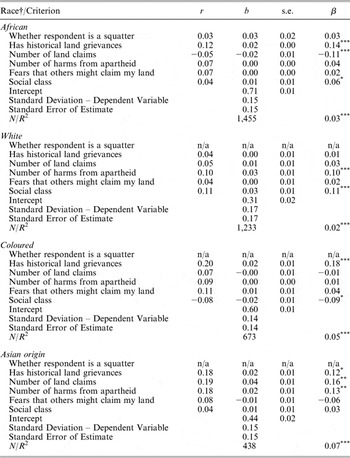
In this analysis, I control for the respondent’s social class, under the hypothesis that redistribution/restitution will be paid for in part from the government treasury, and hence from taxes on the people, with the wealthy paying more.Footnote 43 Table 2 reports the results from this analysis.
The Influence of Instrumental Considerations on Land Policy Preferences

Notes: †See Appendix A for discussion of racial categorization. n/a = coefficient cannot be calculated owing to insufficient variance in the variable. Significance of standardized regression coefficient (β): ***p < 0.001, **p < 0.01, *p < 0.05.
The first thing to note from this table is that historical experiences and grievances provide only a weak explanation of land policy attitudes, especially among black and white South Africans (see the R 2 statistics).Footnote 44 Among blacks, those with historical land grievances are more likely to favour redistribution; however, those who have made claims for land restitution are somewhat less likely to favour redistribution. Perhaps claimants fear that opening up the process of redistribution in general would be harmful to their specific claim. Again, however, I note that these relationships are actually quite marginal, and that self-interestedness is simply not a very useful explanation of policy attitudes. And despite growing class differences among black South Africans, social class provides no predictive power when it comes to the land policy preferences of black South Africans.
Among whites, the relationships are also puny. The positive but small coefficient linking social class with policy preferences indicates that whites of higher social class tend to favour more redistribution, although the relationship really is quite weak. The data also reveal a slight tendency for those claiming greater injuries from apartheid to be more supportive of redistribution. But since few whites claim injuries from apartheid, these relationships are feeble indeed.
Among coloured people, policy attitudes reflect to some degree the extent of land grievances: Those who claim to have been subjected to more historical land injustice are more likely to favour redistribution. A weak social class effect (in the hypothesized direction) is documented in the multivariate equation, but, while statistically significant, the coefficient is nearly trivial.
The greatest purchase on land policy preferences is found among those of Asian origin. Support for redistribution is greatest among those who have lodged a claim to land, who assert greater injuries from apartheid and who claim more historical land grievances. Asian land claimants support redistributive policies, whereas, as was documented above, black land claimants do not. Social class does not differentiate among the policy preferences of South Africans of Asian origin.
The most general conclusion from this analysis is that there appears to be far more to land redistribution attitudes than self-interested instrumentalism. Many black South Africans seem to favour redistribution even though they do not assert injustices from the past; many whites oppose redistribution even though they would not be directly harmed by such policies. South African land politics may have more to do with generalized senses of injustice than specific claims for compensation for injuries from the past.Footnote 45
Historical Versus Contemporary Explanations of Land Attitudes
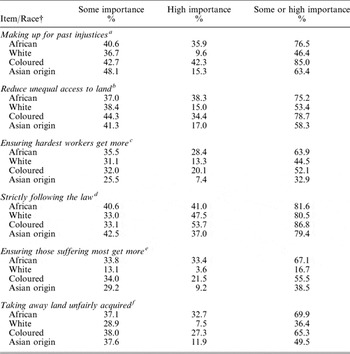
I begin considering alternative explanations of land policy attitudes by investigating the criteria the South Africans believe ought to govern land policy. We asked the respondents: ‘At the moment, there are many different factors that might influence land policy in South Africa. Would you say that land policy should give high importance, some importance, not very much importance, or no importance to making up for land injustices in the past?’ Their responses are reported in Table 3.
Criteria Upon Which Land Policy Ought to be Based

Notes: †See Appendix A for discussion of racial categorization. Entries are the percentages of all respondents answering the question who gave the particular reply. The third column is simply the sum of the first two columns (except for rounding errors). The criteria are: making up for land injustices in the past; making certain that unequal access to land is reduced; making certain that the hardest workers get the greatest amount of land; making certain that land reform strictly follows the law; making certain that those who suffered most under apartheid get the greatest amount of land; making certain that those who acquired land unfairly under apartheid do not get to keep it. Interracial difference of means: ap < 0.001, η = 0.38; bp < 0.001, η = 0.29; cp < 0.001, η = 0.25; dp < 0.001, η = 0.10; ep < 0.001, η = 0.46; fp < 0.001, η = 0.34.
South Africans of every race believe it quite important that land policy should be based strictly on the law. No doubt influenced by the lawless land grabs in Zimbabwe and elsewhere, the percentages of blacks, whites, coloured people and those of Asian origin favouring strictly following the rule of law are 80 per cent or higher. And it is noteworthy that large proportions of respondents rate this as a factor of highest importance.
At the other extreme, South Africans of different races are divided on whether having suffered in the past should influence land policy very much. Two-thirds of blacks think that having suffered should matter, whereas only 17 per cent of whites are so inclined. Coloured people hold views similar to blacks, while those of Asian origin are closer to the views of whites. One can also see this strong racial difference in the orientations towards the past in the first item in the table, although in this general formulation whites are considerably more sympathetic to ensuring that land policy makes up for past injustices.
As shown in the last proposition in the table, black and coloured people are more likely to adopt the view that contemporary land policy ought to be based on retribution for the sins and crimes of the past.Footnote 46 Indeed, one finding that stands out starkly in these data is that black and coloured South Africans are particularly concerned about issues of the past when it comes to formulating contemporary land policies (even if none of the criteria related to the past ever receive the highest importance rating from a majority of these groups).
The views of most South Africans on land policy reflect a mixture of contemporary and historical criteria. In the present, most ascribe great importance to following the rule of law, most applaud the objective of reducing land inequality, and most believe that the greatest benefits ought to go to the hardest workers. As for the past, South Africans are more strongly divided, with whites in particular generally unwilling to assert that past injustices should shape contemporary land policies.
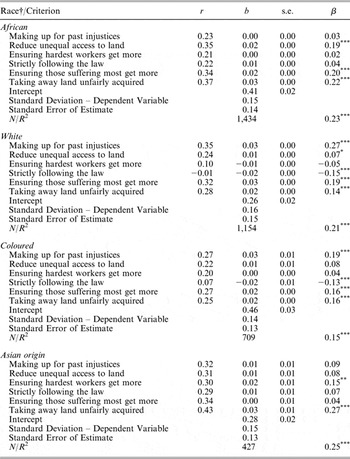
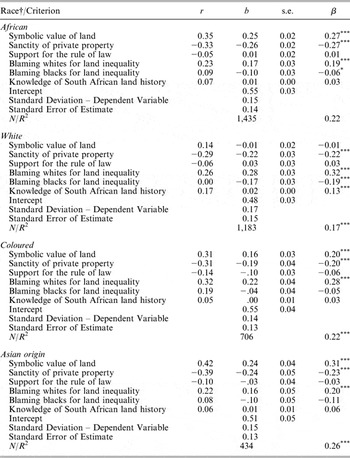
To what degree is support for redistributive land policies a function of these various policy criteria? As expected, these factors fairly strongly predict substantive policy positions, accounting for 15 to 25 per cent of the variance in land attitudes (see Table 4). Among black South Africans, favouring redistributive policy is most closely connected to the belief that land ought to be taken away from those who acquired it unfairly (β = 0.22), the desire to ensure that those suffering most under apartheid get more land (β = 0.20), and the preference for reducing unequal access to land (β = 0.19). Thus, perceptions of past injustices clearly and strongly influence contemporary policy preferences.Footnote 47
The Influence of Present and Past Considerations on Land Policy Preferences

Notes: †See Appendix A for discussion of racial categorization. Significance of standardized regression coefficient (β): ***p < 0.001, **p < 0.01, *p < 0.05.
White policy preferences also reflect concerns about past injustices. The strongest predictor of redistributive policy support is the criterion of making up for past injustices (β = 0.27), and past suffering and having land unfairly taken in the past are also important criteria for whites. In addition, and in contrast to black South Africans, those whites more strongly emphasizing the rule of law are less supportive of redistribution. The rule of law thus seems to be a mechanism by which the inequities of the past are reinforced, at least among white South Africans.
The attitudes of coloured people are shaped by the same factors structuring the attitudes of whites. For instance, coloured people similarly emphasize past injustices, just as commitments to the rule of law undermine redistribution. In nearly all respects, white and coloured South Africans emphasize the same criteria as the basis of contemporary land policy, despite their quite different treatment under apartheid.
South Africans of Asian origin are unique in the emphasis they would give to hard work (β = 0.15), with the tendency to justify land redistribution by the contemporary attributes of the beneficiaries. South Africans of Asian origin also place the strongest priority on restitution for land unfairly confiscated in the past, just as do black people.
The various criteria reported in Table 4 can be classified as largely emphasizing present or past factors in formulating land policy. Three of the criteria about which we asked the respondents concern contemporary considerations: following the rule of law, reducing current land inequality, and rewarding those who work the hardest. These are all criteria upon which land policies might be based with total disregard to the country’s apartheid and colonial past. Citizens emphasizing these factors are relying upon contemporary criteria in formulating land policy in the country. The other criteria directly concern the past, as in basing land policy on making up for past injustices, ensuring that those who suffered most in the past get more land today, and taking land away from those who acquired it unfairly.
On the basis of two simple summated indices representing concern with the present and concern with the past, strong interracial differences exist regarding the importance of the past, and less strong differences regarding the present are found in the data, with eta statistics of 0.49 and 0.26, respectively.Footnote 48 Black South Africans are substantially more likely to assert the importance of criteria grounded in the past (mean = 3.7), followed closely by coloured people (mean = 3.6). Those of Asian origin are less concerned about the past (mean = 3.0), and whites are the least concerned of all (mean = 2.5).
What land policy is supported thus depends to a considerable degree upon whether past injustices are deemed relevant. A basic fact of land politics is that whites do not want to address the past; blacks do.
The larger symbolic and historical context of land
Analysis of the above evidence suggests that land policy preferences are not driven by instrumental concerns; instead, they may have more to do with the larger symbolic issues of historical injustices under colonialism and apartheid. In order to consider the connection between support for redistribution and symbolic concerns, this section of the analysis assesses whether land preferences are connected to more abstract and diffuse values, as well as beliefs about and knowledge of the past. The attitudes I consider are: (1) the valuation one attaches to the symbol of land, (2) whether private property rights are deemed sacrosanct, (3) general support for the rule of law, (4) willingness to blame whites for contemporary land inequality, (5) willingness to blame blacks for contemporary land inequality, and (6) knowledge of South African land history. Before turning to the multivariate analysis, I introduce each of these concepts in turn.
The Symbolic Value of Land
In the South African context, land reform is far more than a simple issue of who has land and who does not. In addition, land implicates the country’s apartheid and colonial past and therefore the issue is strongly tinged with symbolic content.Footnote 49 As an example, we asked the respondents to agree or disagree with the following statement: ‘Land is a symbol of all that has been taken away from Africans.’ The percentages of black South Africans, whites, coloured people, and those of Asian origin, respectively, who agreed with this statement are: 81.3, 22.3, 60.1 and 39.9. Not only do vast majorities of blacks view land as a symbolic issue, but differences between blacks and the three racial minorities in the country – especially whites – are profound. Thus, it seems useful to consider whether land policy preferences are shaped by more general attitudes towards the importance of land in society.
We therefore put six statements regarding the valuation of land to the respondents in the form of five-point agree–disagree Likert items. The statements are:
— Without having a piece of land, one is really not a complete person.
— Land is a symbol of all that has been taken away from Africans.
— I feel a special attachment to the place where my ancestors are buried.
— When times are tough, one can always survive if one owns some land.
— Land is special: having land is more important than having money.
— If I had my choice, I would live on a piece of land that I could farm.
Is land important to South Africans, and do racial differences exist in the significance ascribed to land? The data reveal some dramatic differences in the number of statements endorsed by members of each of the four racial groups: On average, the black respondents agreed with 4.7 of these statements; in contrast, whites agreed with only 2.1. Coloured people expressed relatively strong commitments to land (mean = 4.0), while those of Asian origin were closer to whites in their views (mean = 3.0). The hypothesis that blacks attach unusual value to land is strongly supported by these survey data.Footnote 50
The Sanctity of Private Property Rights
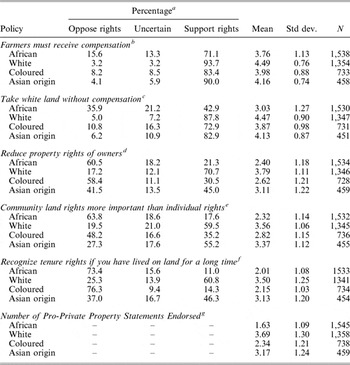
A key issue in the debate over land redistribution has to do with the importance of respecting private property rights. Ntsebeza, for instance, believes that South Africa’s constitutional protections for private property rights – in the context of the country’s colonial and apartheid past – make the redistribution of land virtually impossible.Footnote 51 His argument is as follows: respect for property rights is inevitably tied to market definitions of the value of property; the state seems to have insufficient resources to purchase land at market value prices; current property owners have profited from unjust enrichment and state subsidies, and therefore current market values must be discounted for the unfairness of the past; since agreement between buyers and sellers on these various points is extremely unlikely, the state must confiscate private property; and the property seized can be used not just for public purposes but for private purposes that serve the public good.Footnote 52 Thus, the land issue may simply be a concrete manifestation of more general differences over the sanctity of private property, and, if so, may reflect something of a (mini) ‘clash of cultures’. Consequently, we measured generalized commitments to private property. The various statements shown in Table 5 pit a right to land ownership against some other consideration. Note that the data column labelled ‘Support rights’ shows the percentage of respondents in favour of the right to private property.
Support for Private Property Rights, 2004Footnote †

Notes: † See Appendix A for discussion of racial categorization. aThe percentages are calculated on the basis of collapsing the five-point Likert response set (e.g., ‘agree strongly’ and ‘agree’ responses are combined), and they total 100 per cent, across the three columns, except for rounding errors. The means and standard deviations are calculated on the uncollapsed distributions. Higher mean scores indicate greater support for rights of private property. Interracial difference of means: bη = 0.32, p < 0.001; cη = 0.50, p < 0.001; dη = 0.46, p < 0.001; eη = 0.44, p < 0.001; fη = 0.51, p < .001;g η = 0.60, p < 0.001. The statements read: Farmers must receive fair compensation if their farms are taken away by the government for land reform (Agree). All white-owned land in South Africa ought to be taken away by the government, without any compensation to anyone (Disagree). In a country with so much poverty, the property rights of the wealthy must be reduced (Disagree). When it comes to land, the rights of the community are more important than the rights of individual landowners (Disagree). If someone has lived on a piece of property for a long time – say 10 years – then that person must be recognized as having the right of ownership to the property (Disagree).
First, I note that on most items, quite substantial racial differences exist (as documented by the eta statistics).Footnote 53 Notably, the common pattern is for whites, coloured people and those of Asian origin to hold similar views among themselves, but views that differ considerably from black South Africans.
In general, black South Africans express markedly weaker support for the sanctity of private property than do other South Africans. For example, blacks are much more likely to assert that community rights should trump individual rights when it comes to land (although a plurality of coloured people also assert this view). With no exceptions, blacks are always more weakly committed to private property rights than other racial groups in South Africa. Perhaps most unsettling is the finding that more than a third of the black respondents agree that all white-owned land in South Africa ought to be taken away without compensation by the government.
But at the same time, blacks are not intransigently opposed to private property rights. For instance, a large majority (71.1 per cent) assert that farmers must receive compensation if the government seizes their land for purposes of land reform. A plurality of Africans opposes the expropriation of white-owned property. Just from these frequencies alone, one might conclude that support for private property rights among blacks is not strong, but that several conflicting currents run through black public opinion.
A few surprises can also be seen in the data on white attitudes. For instance, nearly a quarter of whites agree that the tenure rights of people who have lived on a piece of property for a long time ought to be recognized. Thus, whites are not necessarily unswervingly attached to private property rights.
As noted, the opinions of whites and South Africans of Asian origin are frequently similar, although on some issues (such as whether to reduce the rights of wealthy land owners), important differences exist. The views of coloured South Africans are less supportive of private property in general, with a majority of coloured respondents endorsing property rights on only two of the five statements (in contrast to five out of five for whites, and three out of five for those of Asian origin).
The last portion of this table reports the mean number of statements favouring private property rights endorsed by each of the racial groups. Dramatic cross-race differences exist here. For instance, the average black respondent endorsed 1.6 of these statements; the average white respondent favoured private property rights on 3.7 of the statements. As is often the case on land issues, South Africans of Asian origin are relatively closer to whites, while coloured South Africans are relatively closer to blacks. I reiterate, however, that interracial differences in support for rights of private property are substantial indeed.
I have calculated an index of support for private property rights that is simply the mean of the responses to these five items. Not surprisingly, differences across the racial groups are enormous, with the set of racial dummy variables able to explain 43 per cent of the variance in this attitude. These data may not indicate a true ‘clash of cultures’, but without a doubt, different racial groups in South Africa value private property to significantly different degrees.Footnote 54
Support for the Rule of Law
A central issue in the politics of land reform concerns the degree to which policy will be constrained by the rule of law. But measuring attitudes toward the rule of law can be challenging. Few people are likely to reject the rule of law in principle. Survey questions that ask people whether they agree that rulers ought not to act arbitrarily or capriciously or that citizens should be free to ignore the law are unlikely to be of much use in tapping popular commitments to the rule of law.
Instead, the difficult test of support for the rule of law involves the juxtaposition of law and some other valued principle. Questions are most useful when they force people to weigh the relative value of two principles;Footnote 55 only when supporting the rule of law involves some cost can we begin to gauge how valuable the rule of law is to people.Footnote 56
Consequently, the survey asked people to agree or disagree (on a five-point Likert scale, ranging from agree strongly to disagree strongly) with statements pitting the rule of law against another value. In two questions, the other value was expediency. The statements are:
— In times of emergency, the government ought to be able to suspend law in order to solve pressing social problems.
— Sometimes it might be better to ignore the law and solve problems immediately rather than wait for a legal solution.
Some of those who oppose the rule of law do so on grounds of pragmatism, arguing that the rule of law can be unnecessarily rigid and confining. Law must be flexible if it is to be effective. Therefore, we asked the respondents their opinions of the following statement:
— It’s alright to get around the law as long as you don’t actually break it.
Finally, many believe that elections provide legitimacy to governments and the laws they make. Conversely, law made by a government one opposes and did not vote for may not be deemed worthy of support. We tested this idea with the following statement:
— It is not necessary to obey the laws of a government that I did not vote for.
Considerable variability exists in the replies of the respondents to these statements. At one extreme, only a quarter of South Africans disagree with the statement that bending a law is acceptable; the vast majority approve of getting around the law. A similar minority disagrees that emergencies justify the suspension of the rule of law.Footnote 57 On the other extreme, a majority rejects the idea that one is not obliged to follow laws created by an opposition government. Across the set of four statements, the average number of responses favouring the rule of law is 1.6, which seems to indicate fairly limited commitments to legal universalism.Footnote 58
Interracial differences in support for the rule of law in South Africa are substantial (for the difference of means across the races, η = 0.29, p < 0.001). Black South Africans endorse significantly fewer of the rule of law statements, especially compared to white South Africans. Both coloured South Africans and South Africans of Asian origin are also substantially more committed to the rule of law than black South Africans. The data also indicate that whites are significantly more supportive of the rule of law than the other two racial minorities in the country, although the difference is not nearly as great as that between black and white South Africans.
Historically, law has rarely served the interests of black South Africans, so it is perhaps not surprising that support for the rule of law would be so limited. Conversely, whites, as a fairly small minority of the South African population, no doubt look to law as a means of protection from abuse by the majority (and the same may be true of coloured people and those of Asian origin). Whatever the causes of these differences, however, these data provide unsettling evidence of the willingness of a large percentage of the black majority to suspend law in order to achieve other goals.
Blame attributions
Who is to blame for the land problems in South Africa today?Footnote 59 We began our consideration of this issue with the following preface:
Today, most productive land in South Africa is in the hands of white people. Most black people are quite poor and own little land. We are interested in your views about how this came to be. For each of the following factors, please indicate how much you believe this inequality in South Africa today is a result of the following.
Among black South Africans, the most widely accepted factor accounting for land injustice is the advantages whites still hold as a result of the apartheid past: 77 per cent of blacks consider this to be either an important or very important cause of land inequality. Coloured people hold similar views (80 per cent), as do those of Asian origin (63 per cent). Whites, as usual, are the exception: only 34 per cent attribute land inequality to the apartheid past.Footnote 60
But black views are complicated; they see multiple causes of the land problem. A majority of blacks rate the following factors as important causes of land injustice: white advantages from the apartheid past (77 per cent); blacks being unable to recover from colonialism and apartheid (73 per cent); the ruthlessness of whites in terms of being willing to do anything to get what they want (65 per cent); that blacks are captives of traditional ways (62 per cent); that blacks are too divided among themselves (62 per cent); and that black people are less well educated than whites (57 per cent). Thus, black attributions for the causes of land injustice include advantages from the past enjoyed by whites and disadvantages from the past from which blacks still suffer. Indeed, it is stunning to note that 41 per cent of the black respondents lay the blame on the factor that ‘white people are more intelligent than black people’, as do 40 per cent of whites, 46 per cent of coloured people, and 38 per cent of those of Asian origin. It is not precisely clear how to understand the responses to this last statement, but it is plausible that blacks believe that apartheid deprived them of education, making them less ‘intelligent’ today, which accounts in part for the disparities in the ownership of land in contemporary South Africa. In general, blacks see almost four times as many very important causes of land inequality as compared to whites, surely reflecting the greater salience of the issue to them.Footnote 61
Knowledge of South African Land History
As I have noted, most black South Africans attribute contemporary land injustices to the past. But to what degree are South Africans cognizant of their past? To what degree are they knowledgeable about the history of land injustice in the country?
We asked the respondents a series of questions about South African history, including:Footnote 62
— When did the last racially motivated forced removal take place in South Africa?Footnote 63
Nearly half (46 per cent) of all South Africans admitted that they did not know the answer to the query, including 46 per cent of black South Africans and 55 per cent of white South Africans. The correct answer to this question (the 1980s) was selected by 10 per cent of the black Africans, 14 per cent of the whites, 11 per cent of coloured people, and 10 per cent of those of Asian origin. Few in South Africa appreciate how recent forced removals are in their country.
— What is a Bantustan?
Only about a third of each racial group knows what a Bantustan is. Also surprising is that interracial differences are trivial. For South Africans of all races, the turbulent events of the ethnic cleansing of the 1980s seem to have been entirely forgotten.
— What is a ‘black spot’?
In the light of these data, it is not surprising that only 16 per cent of black South Africans can define the term ‘black spot’. The figures for whites, coloured people, and those of Asian origin are 25 per cent, 34 per cent and 25 per cent, respectively.
— How many people were forced to move under apartheid?
Among blacks, 19 per cent answered the question correctly, as did 12 per cent of whites, 21 per cent of coloured people, and 20 per cent of those of Asian origin. As before, very large proportions of respondents (and more than half of the whites) told us that they did not know how many South Africans were forced to move under apartheid.
— When was apartheid first introduced in the country?
The responses are all over the calendar, with only 12.2 per cent of the respondents correctly identifying the 1940s as the era of apartheid’s inception.
According to an index of knowledge about the past based on the responses to these five questions, all four racial groups show similar, and dismal, levels of knowledge of South African history, with, on average, each group getting about one out of five questions correct. Interracial differences are generally small, but coloured South Africans score slightly better than any other group. It is noteworthy that the mean score for blacks is lower than that for any other group. Indeed, 41 per cent of black South Africans got none of these items correct. Only a single black respondent (out of 1,550) answered all five questions correctly. Whatever the sources of perceptions of land injustice, they are clearly not grounded in specific knowledge of the land abuses of the past. South Africans may feel aggrieved about historical land justices, but clearly those views are not grounded in any meaningful understanding of the specifics of South African land history.
Multivariate analysis of land policy preferences
For the multivariate analysis using these independent variables, I hypothesize that greater support for redistributive policy may be associated with:
— greater symbolic valuation attached to land
— the sanctity assigned to private property rights
— willingness to blame whites for contemporary land inequality
— willingness to blame blacks for contemporary land inequality
— general commitments to the rule of law
— historical knowledge of land injustices in South Africa.
Table 6 reports the regression results.
The Influence of Political Values on Land Policy Preferences

Notes: †See Appendix A for discussion of racial categorization. Significance of standardized regression coefficient (β): ***p < 0.001, **p < 0.01, *p < 0.05.
The analysis in this table supports a variety of conclusions. First, as reflected in the R 2 statistics, a considerable portion of the variance in land policy preferences can be accounted for by these attitudes. Secondly, land policy preferences are fairly strongly connected to beliefs about the symbolic value of land and the importance of private property rights. An exception to this general finding is found among whites: How white South Africans feel about land as a symbolic issue is entirely unconnected to policy preferences. Among Africans, coloured people, and those of Asian origin, however, the stronger the symbolic attachment to land, the greater the commitment to redistributive policies. The relationship is particularly noteworthy among those of Asian origin.
Among all four racial groups, the stronger the commitment to private property, the less likely one is to favour redistributive land policies. This finding is not, strictly speaking, a function of beliefs in the rule of law, since the effect of rule of law attitudes is statistically and substantively insignificant for all South Africans. It seems likely that the connection with private property reflects the position that those who currently hold property ought to be secure in their holdings, and therefore land redistribution should not take place. That rule of law attitudes are not important may reflect the assumption of most South Africans that land redistribution will (and should) be implemented in accordance with the rule of law.
The findings regarding attribution of blame are also interesting. Among all racial groups, the more whites are blamed for contemporary inequities in land ownership in South Africa, the more it is that redistribution will be favoured. This is not surprising. But among whites (and to a lesser degree, among those of Asian origin), policy attitudes also reflect the willingness to attribute blame to the blacks themselves. To the extent that white people blame blacks for land inequality, they are unwilling to support redistributive land policies. Among blacks and coloured South Africans, policy preferences are unconnected to beliefs about whether blacks themselves are to blame.
In general, support for redistribution does not require knowledge of South African land history: the relationship between knowledge and policy preferences is trivial for Africans, coloured people, and South Africans of Asian origin. Among whites, however, those who know more about the past are more likely to support redistributive policies. The relationship is weak but is statistically significant.Footnote 64
When the instrumental variables from Table 2 (above) are added to the equation shown in Table 6, none of the coefficients for the symbolic attitudes changes in any substantively meaningful way. However, among black South Africans, coloured people, and South Africans of Asian origin, the coefficient for grievances exceeds 0.10, although for none does the coefficient exceed 0.14 (and the coefficient for whites is trivial, as it should be). Thus, in an equation with both instrumental and symbolic variables, the overwhelming influences on land policy attitudes are the symbolic measures. Instrumentalism provides little explanation of why some South Africans seek land redistribution and others do not.
One final check on the findings reported in this analysis is necessary. When the indices representing the weight the respondent would attribute to past and present criteria in the making of land policy (see discussion of Table 4, above) are added to the equation shown in Table 6, practically no substantive differences emerge in terms of the influence of values on land policy preferences. For example, the coefficients for the two most important symbolic values (symbolic value of land and sanctity of private property) change only marginally, with the substantive conclusions from the testing of the hypothesis changing not at all.Footnote 65 Unfortunately, I have little insight into the causal structure connecting the criteria and policy preference measures: the criteria refer to the basis of public policy; the preference indicates how much redistribution is supported by the respondent. Clearly, additional research is necessary to establish definitely the micro-level processes associating these two constructs, even if this supplemental analysis provides some additional confirmation of the importance of symbolic values in the construction of policy preferences.
Discussion and concluding comments
This research has traversed considerable terrain and conclusions about a variety of issues – theoretical and policy-based – can be drawn. First, one of the principal findings of this research is that support for redistributive land policy is widespread in South Africa. South Africans want land illicitly taken in the past to be returned to its rightful owners. Across the population as a whole, support for virtually any scheme of land redistribution or restitution is widespread.
However, racial differences on land policy preferences are enormous. Nearly a fifth of blacks support all of the policies about which they were queried; almost a third of whites supported none of the policies. Land may well be among the most racially polarized issues in all of contemporary South African politics.
But what does ‘race’ mean in this context? This analysis demonstrates that race is not simply a synonym for individual self-interest. Using a variety of measures of direct self-interestedness in the land problem, I find that expectations of benefits (or costs) from land issues – at least as indicated by the measures included here – exhibit only the weakest connection to policy preferences. One need not expect to benefit from the policy in order to prefer redistribution. This finding is not surprising, inasmuch as self-interest typically provides a terribly incomplete explanation of politics.
Instead, race is important in South Africa because it stands for a variety of symbolic concerns. Indeed, perhaps the most important conclusion of this analysis is that the land issue in South Africa is about far more than land. It is not simply that those dispossessed under apartheid and colonialism want their land back; self-interest provides a remarkably poor explanation of support for redistributive policy preferences. Instead, land is a symbol of the country’s repressive past. Land policy preferences are deeply embedded in race; but what that means is not so much based on interracial differences in the present as it is on interracial differences grounded in the past. Black South Africans stress far more heavily historical criteria as a basis for contemporary land policy; attachments to land as a symbol – especially of the country’s colonial and apartheid pasts – strongly determine support for redistribution. Because policy preferences are inextricably tied to symbolic attitudes, one need not have a direct stake in the redistribution of land in order to favour even fairly radical proposals. Symbolic politics provides a means of linking those without common instrumental interests to each other and to the group’s past. Because that is so, the land issue cannot be easily negotiated (and certainly is unlikely to be resolved through cash payouts to a limited number of claimants), and the issue is likely to remain salient and volatile.
This analysis also documents a vast cultural divide between blacks and whites in South Africa. Consider the issue of support for private property rights. Black South Africans are dramatically less committed to private property rights than are whites. This analysis reveals broad and significant interracial differences on a variety of symbolic values, including the value one attaches to land and support for the rule of law. Perhaps the chasm between blacks and whites could be bridged, but these data suggest that a considerable portion of the disagreement over land policy has to do with more fundamental, and perhaps even obdurate, orientations towards land and property.
The simple truth of land politics in South Africa today is that most believe that past injustices must be rectified by redistribution, whereas the powerful white minority is unwilling to take the past into account. Without addressing historical injustices, most believe the present cannot be fair. Land is thus not an issue of egocentric instrumentalism, but is instead one of sociotropic justice. Whether justice prevails in South Africa could well have much to do with whether the country’s democratic transition will be consolidated.
Appendix A: A note on race in South Africa
It is common in South Africa to divide the total population into four racial categories for the purposes of research or the explanation of demographic realities and/or socio-economic conditions in the country, and I follow this practice throughout the analysis reported in this article.Footnote 66 As James and Lever note: ‘The use of these categories is unavoidable given the fixity that they have come to acquire both in popular consciousness and official business.’Footnote 67 The use of these racial terminologies, however, differs from the way racial categorization may be understood in other societies. Therefore, it is important to understand the historical development of these categories, especially the legal boundaries imposed on racial groups by the apartheid government.Footnote 68
The four racial groups are African, white, coloured, and South Africans of Asian origin (Indian). These groups are also often referred to as population groups, ethnic groups (although this term usually refers to African subcategories such as Xhosa or Zulu), or national groups. The African majority has been known by European settlers by different names over time, such as ‘native’, ‘Bantu’ or ‘Black’, and some of these terminologies were later formalized by apartheid legislation. The Africans were the original inhabitants of the area now called South Africa and were descendants of Iron Age farmers speaking different variants of Bantu languages, spoken in sub-Saharan Africa, east of Cameroon.Footnote 69 Generally, I refer to these people as Africans or blacks.
The white inhabitants of South Africa (also formerly called Europeans) are descendants of Dutch, German, French (Huguenots who fled France due to religious persecution), English, and other European and Jewish settlers. Though South Africa was colonized by the Dutch and the British in different historical periods, the British colonization entrenched English as the most commonly spoken language.
‘Coloured’ is considered a mixed race category, although it was actually a residual category of people with quite divergent descents.Footnote 70 In practice, coloured mainly referred to (a) people descended from the indigenous KhoiKhoi (‘Hottentot’) or San (‘Bushman’) populations, (b) from ‘Malay’ slaves brought to South Africa from Madagascar and Southeast Asia, (c) people descended from inter-‘racial’ marriage or union, and (d) people regarded by officialdom as being in any of the first three groups.Footnote 71
The Indian population largely came to South Africa as indentured labourers to work in the sugar plantations in Natal in the late nineteenth and early twentieth centuries, although, in subsequent years, a number of traders also immigrated to South Africa.Footnote 72 South Africans of Indian descent came from different regions in the Indian subcontinent, adhered to different religions, and spoke different languages, so that they, like coloured people, are not a homogeneous group. I refer to these people as South Africans of Asian origin, despite the fact that some coloured people are technically of Asian origin.
Earlier research has documented enormous differences across South Africa’s groups in terms of a wide variety of political attitudes.Footnote 73 Consequently, it is essential that race be incorporated into the analyses in this article. To ignore race would be akin to failing to recognize that South African politics today continues to be shaped by its racist and colonial history. To incorporate race into this analysis is not to accept anything about apartheid, but instead it is merely to acknowledge that apartheid shaped – and continues to shape – political reality in the country.
Appendix B: The survey methodology
This survey blends probability and quota methods of respondent selection, and therefore requires discussion of the two portions of the research design separately. The samples, however, do begin from a common sampling frame.
The survey firm Markinor first stratified each South African location according to province, community size, individual city, town or rural areas, suburb (within the large cities), and the predominant race of the residents of the area. Strong residential segregation makes the latter variable much less ambiguous than might otherwise be the case. Within each stratum, sampling points were randomly selected. Within each sampling point, either 4 or 6 interviews were conducted.
For the black sub-sample, area probability methods were then used. Households were enumerated and one was randomly selected. Within the chosen household, an adult individual was also chosen randomly. Up to four attempts were made to interview the designated individual. No respondent substitution was allowed. Gender stratification was imposed, however, to ensure against over-representation of females. This means that within each household, the gender of the respondent was pre-determined. Thus, the African sub-sample was drawn via standard area probability methods.
Out of the 1,778 designated individual Africans,Footnote 74 interviews were completed with 1,549, for a raw response rate of 87.1 per cent. Of the 229 households in which no interview was conducted, this was due to the designated respondent being sick, deaf or blind in twenty-one cases, and to a language barrier in another 3 cases. The respondent was not available in seventy-six households (33.2 per cent of the 229 incomplete interviews) and 129 respondents (56.3 per cent) refused to be interviewed (or refused to complete the interview). With such a high response rate, there can be little doubt about the representativeness of the black sub-sample.
Quite different methods were used to select individual white, coloured and Indian respondents. Rather than randomly selecting all households, a mixture of probability and quota methods was employed.Footnote 75 The quota was defined in terms of gender, age and the working status of the individual to be interviewed. Consequently, no response rate for these three sub-samples can be calculated, and, as a result, no response rate for the overall sample can be computed. Sampling error for the three sub-samples and the entire sample also cannot be estimated.
In addition, Markinor fielded a supplementary (and subsequent) probability sample of whites, coloured people, and Asian South Africans. Among the white probability sample, the response rate was 32.1 per cent, with clear evidence of unrepresentativeness in the sample (e.g., the over-representation of Afrikaans speakers). The response rate for the Coloured probability sample was 65.1 per cent, with no obvious evidence of under- or over-representation of any particular group. Among South Africans of Asian origin, the probability sample yielded a response rate of 63.5 per cent, also with little obvious evidence of misrepresentation.Footnote 76
Several tests suggest that it is possible to combine the probability and quota samples among coloured and Asian South Africans. For instance, differences on home language are trivial – 76.6 per cent of the coloured respondents in the quota sample speak Afrikaans as their home language; the comparable figure in the probability sample is 78.5 per cent. (Since virtually all South Africans of Asian origin speak English as their home language, no differences exist across the two sub-samples on this variable.) Other key variables support a similar conclusion that these two sub-samples can be merged. Consequently, for coloured and Asian South Africans, the two sub-samples were joined into a single sample. That sample was subjected to post-stratification to further ensure representativeness. This post-stratification weighting does not change the number of observations. In the weighted data, 79.3 per cent of the coloured respondents speak Afrikaans as their home language. A total of 98.0 per cent of the 459 weighted Asian respondents speak English as their home language. Thus, when I report data on the coloured people and South Africans of Asian origin, I use the weighted, combined dataset.
The white samples raise more difficult methodological challenges. First, the response rate in the probability sample was low, and evidence of misrepresentation exists. Similarly, the quota sample seems to lack representativeness. Obviously, these data can be (and have been) combined and post-stratified so that 57 per cent of the respondents speak Afrikaans as their home language and 42 per cent speak English. The unanswered question is whether post-stratification is appropriate under these circumstances.
With all of these various caveats, a reasonable set of conclusions to be drawn about the results derived from these samples is that: (a) substantial confidence can be vested in the findings about black South Africans; (b) moderate confidence attaches to the conclusions about coloured and Asian South Africans; and (c) relatively low confidence can be claimed for my conclusions about whites.
The interviews were conducted face to face by trained interviewers. The median length of the interview was 85 minutes (mean = 89.7 minutes, standard deviation = 90.0 minutes).Footnote 77 The interview length varied substantially by language, with the longest interviews in Tsonga and Xhosa and the shortest interviews in Afrikaans, English and Zulu.
Generally, nearly all respondents (96 per cent) were interviewed by same-race interviewers. The largest exception to this rule is among coloured respondents, 5 per cent of whom were interviewed by black interviewers and 8 per cent of whom were interviewed by white interviewers.
Respondents were interviewed in their language of choice. In 55 per cent of the interviews, the interview was conducted in a single language, while 27 per cent of the interviews occasionally mixed languages and 18 per cent often switched from one language to another.Footnote 78 Fully 34 per cent of the interviews were conducted in English, followed by 23 per cent in Afrikaans, 15 per cent in Zulu, and 10 per cent in Xhosa.
Most of the respondents (74 per cent) were judged by their interviewer to hold a ‘friendly’ attitude towards the interview, with another 18 per cent being ‘co-operative but not particularly interested’.
Appendix C: Measurement
Social Class
Social class is measured by three indicators: (1) the range of consumer goods the respondent owns, (2) interviewer’s assessments of the respondent’s living standard, and (3) interviewer’s assessments of the respondent’s social class. An index was created via factor analysis.
Land Grieving
The question stem read:
As a result of the history of our country, many South Africans believe that they have been unfairly deprived of land or land rights that is rightfully theirs. We are interested in whether you or your immediate family is involved in any of these issues. Do any of the following apply to you?
Believe land or land rights were unfairly taken from me or my immediate family in the past.
Was subjected to a forced removal.
Believe I have a right to the land on which I live, even though I do not legally own it.
Deprived of benefits, such as water rights, mineral rights, etc.
The response set was:
1. Definitely applies to me 3. Probably does not apply to me
2. Probably applies to me 4. Definitely does not apply to me
Sense of Land Vulnerability
The same stem and response set were used as a preface on the land vulnerability question:
Believe that others might file claim of ownership to my land.
Land Claiming
For assessing land claims, the same stem and response sets were also used:
And do any of the following apply to your circumstances?
Have made a claim before a government agency
Have made a claim before a non-governmental agency (such as church)
Have made a claim to the owner of the land
Have had a dispute with traditional leaders over my rights to land
Harms from Apartheid
Experiences under apartheid were assessed with the following questions (using a simple ‘yes/no’ response set):
Here is a list of things that happened to people under apartheid. Please tell me if you had any of these experiences:
Required to move my residence
Lost my job because of apartheid
Was assaulted by the police
Was imprisoned by the authorities
Was psychologically harmed
Was denied access to education of my choice
Was unable to associate with people of different race and colour
Had to use a pass to move about
Knowledge of South African History
We asked five questions about South Africa’s history of land dispossessions and apartheid.
Now we would like to ask you some questions about South Africa’s history. In which decade did the Nationalist Party government first introduce apartheid as the official policy of South Africa?

Which of the following best defines the term ‘black spot?’
1. ‘black spot’ refers to land of a very high quality that was reserved for white farmers under apartheid [Incorrect]
2. ‘black spot’ refers to pockets of strong black opposition to the apartheid system [Incorrect]
3. ‘black spot’ refers to a non-white community living within an area designated for white people by the apartheid government [Correct]
Which of the following best defines the term ‘Bantustan’?
1. A Bantustan is a form of tribal leadership found in some rural areas of South Africa. [Incorrect]
2. A Bantustan is an area where black people were expected to live under apartheid. [Correct]
3. A Bantustan is a farm owned and managed exclusively by black people. [Incorrect]
Under apartheid, many people were forced to leave their living places and move to other parts of the country. Do you know approximately how many people were forced to move under apartheid?

Do you know approximately when the last racially motivated forced removal took place in South Africa?