


INTRODUCTION
In April 1954, British government forces launched Operation Anvil in the city of Nairobi. More than four thousand British and African troops swept through the city and arrested approximately 10,000 men in a large-scale effort to root out the Mau Mau rebels. The detainees were sent to detention camps throughout Kenya. The camps were hellish: supplied with too little food, rife with disease, and allegations of torture and summary executions circulated widely (Elkins Reference Elkins2005). This 1950s British policy of arresting and interning suspected rebels has been used by a range of governments throughout history. For instance, during the Cuban War of Independence, General Valeriana Weyler of Spain ordered roughly three hundred thousand Cuban individuals into “re-concentration camps.” More recently, the United States detained suspected militants in Guantanamo Bay without trial. In addition to interning suspected rebels, governments execute leaders, torture rebels, and destroy the houses of rebels’ family members. How do these counterinsurgency tactics shape the subsequent behavior of the rebels they are fighting?
I argue that government counterinsurgency tactics can serve as grievance-inducing experiences which shape within-conflict rebel behavior. Counterinsurgency tactics can increase the strength of rebels’ grievances, which increases the likelihood rebels continue fighting as conflicts unfold. I test the argument by focusing on one counterinsurgency tactic in one conflict: the internment of members of the Irish Volunteers and Irish Citizen Army who participated in the 1916 Easter Rising. During the Easter Rising, approximately two thousand rebels seized strategic locations throughout Dublin while attempting to inspire a broader conflict throughout Ireland. When this broader uprising failed to materialize and British soldiers poured into Dublin where the majority of the fighting was taking place, some rebels were captured or surrendered, whereas others successfully evaded capture. Captured rebels were sent to internment camps and prisons in Wales and England. After being held for between several months to a little over a year, all rebels were released.Footnote 1 In this letter, I study the subsequent conflict behavior of rebels who participated in the Easter Rising by comparing those who were interned with those who were not. I show that formerly interned rebels fought at higher rates throughout the Irish War of Independence. The finding highlights a potential counterinsurgency trade-off facing governments: the tactics which might be effective for fighting can potentially further radicalize the rebels they are combating.
HOW COUNTERINSURGENCY TACTICS SHAPE WHO KEEPS FIGHTING
Governments employ a variety of counterinsurgency tactics as they seek to defeat violent rebellions. These can include violent tactics—such as indiscriminate killing (Kalyvas Reference Kalyvas2006, 146–72) and torture (Sullivan Reference Sullivan2014)—or softer “hearts and minds” approaches (Berman, Shapiro, and Felter Reference Berman, Shapiro and Felter2011). Prior research studies how these tactics can affect the probability of victory (Hazelton Reference Hazelton2017), civilian support for the rebels (Condra and Shapiro Reference Condra and Shapiro2012), and the likelihood civilians subsequently join the rebellion (Kalyvas Reference Kalyvas2006, 151–3). I instead focus on how these counterinsurgency measures shape rebel combatant behavior. I build upon prior research theorizing how grievances shape the choice to fight at conflict onset (Cederman, Gleditsch, and Buhaug Reference Cederman, Gleditsch and Buhaug2013; Gurr Reference Gurr1970; Paige Reference Paige1978; Schubiger Reference Schubiger2023; Wood Reference Wood2003) to argue that within-conflict counterinsurgency tactics can act as grievance-inducing experiences which shape rebel behavior as conflicts unfold. Canonical theories of rebellion argue that government actions, such as the exclusionary policies they choose to implement and the violence they employ, generate grievances. These grievance-inducing actions increase anger (Balcells Reference Balcells2017; Gurr Reference Gurr1970), hatred (Petersen Reference Petersen2002; Post Reference Post2005), or rage (Petersen Reference Petersen2002). Increasing anger, hatred, or rage causes individuals to want to lash out and fight back against the actor deemed responsible. The desire to fight back with violence increases the likelihood individuals rebel.
I argue that the actions governments take as they fight can continue to shape rebel grievances as conflicts unfold. This occurs by further increasing rebels’ levels of grievances. As with pre-conflict government actions, the counterinsurgency tactics of governments—such as the use of torture or internment—can further increase anger among rebels who experience these tactics. Angry rebels become angrier; this further increases the desire to fight back. Rebels’ higher levels of grievances can more than offset the within-conflict incentives to stop fighting. These incentives can emerge due to either the ebb and flow of battle or unique moments of opportunity. Battlefield dynamics—such as new government offensives—can increase the expected costs of fighting and reduce the probability of rebel victory (Zartman Reference Zartman2000). Government offers—either in the form of side payments or compromise peace settlements—can create unique moments of opportunity incentivizing rebels to lay down their arms. Since grievances cause rebels to derive value from fighting back against the government, rebels with higher levels of grievances will be more resistant to these new temptations to cease fighting. This leads to the empirical prediction that counterinsurgency tactics increasing rebels’ levels of grievances increase the likelihood rebels continue fighting.
Counterinsurgency tactics can also affect a range of factors aside from rebel grievances. For instance, large-scale violence and destruction can negatively impact local economies (Dell and Querubin Reference Dell and Querubin2017). Changing local economic conditions shape the opportunity costs of joining a rebellion (Olson Reference Olson2009). Counterinsurgency tactics can also increase social cohesion by increasing the bonds between rebels (Schubiger Reference Schubiger2023). This can increase the incentive to remain combatants. Whether and how each of these mechanisms is operative depends on the precise nature of the counterinsurgency tactic employed. While a more complete theoretical accounting is beyond the scope of this letter, Section 9 of the Supplementary Material considers the evidence for and against a variety of alternative mechanisms in the case of historical Ireland.
NEW INDIVIDUAL-LEVEL DATA ON REBEL COMBATANTS
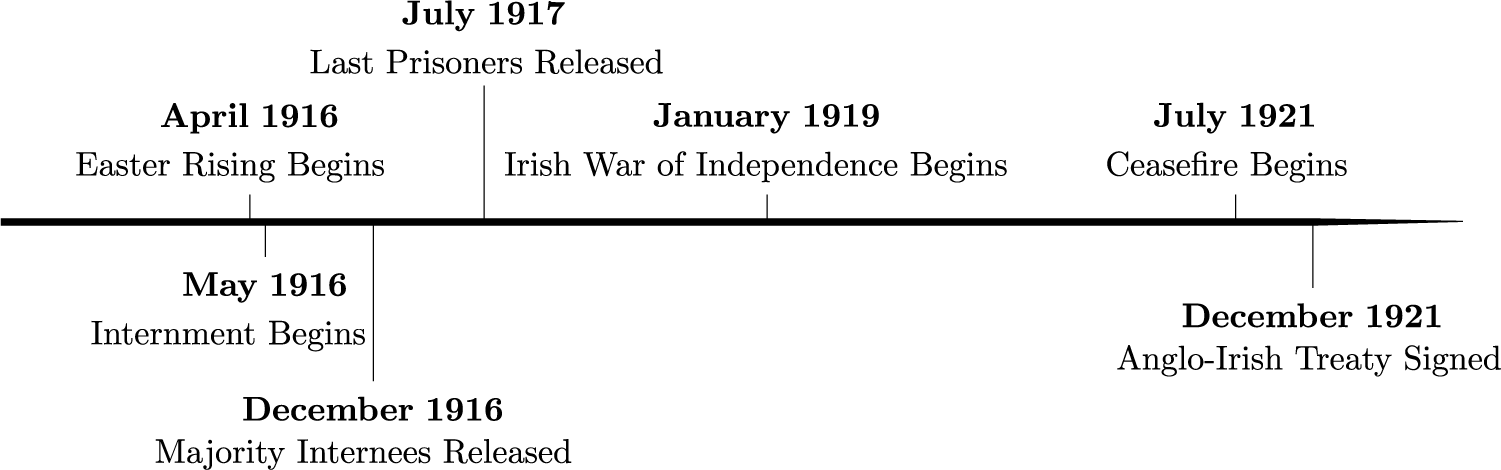
Assessing how counterinsurgency tactics affect rebel behavior necessitates starting with a group of rebels who fought at conflict onset and then learning about their experiences and subsequent behavior. I do so by leveraging the archival information held in the Military Service Pension Collection from the Military Archives of Ireland. In the 1920s and 1930s, the Dáil of the newly formed Irish Free State passed legislation to reward ex-combatants with a military pension.Footnote 2 Through the legislation, all rebels who participated in the 1916 Easter Rising were eligible for a pension. I utilize the paper-trail generated through the pension applications to identify an initial pool of rebels who fought at conflict onset. I next ascertained whether rebels were interned after the uprising and if they fought throughout the Irish War of Independence. Figure 1 presents a timeline of these key events.
Timeline of Key Events in the Conflict

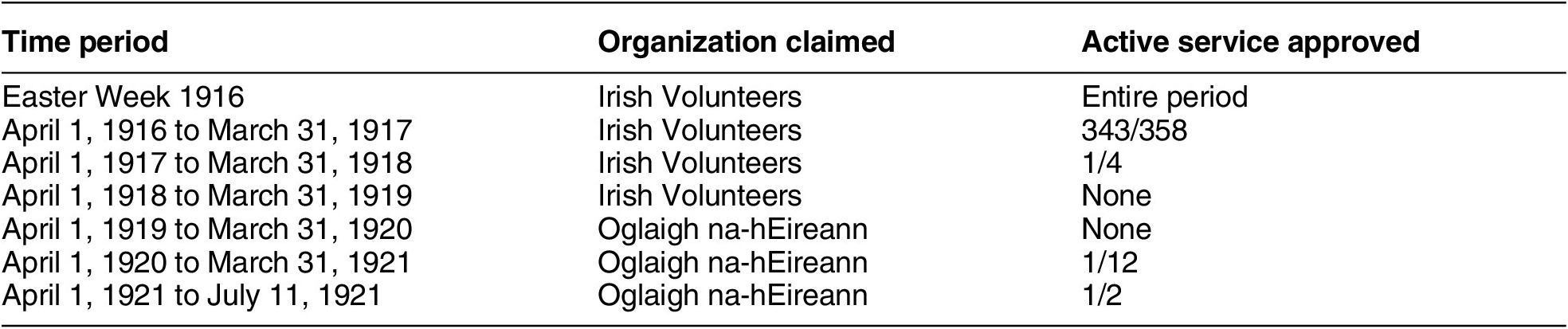
Ex-combatants started the pension process by submitting an application detailing their involvement in distinct periods in the conflict. Fellow rebels, who served as references, next provided supporting information. Finally, the pension board considered the amount of service claimed, the evidence presented by the applicant and their references, and decided whether and how much service to approve for each period. The end result of this process was a Military Service Certificate, which detailed the organization in which an individual claimed service in each conflict period, and the fraction of the period approved. Table 1 presents an abridged example of a Military Service Certificate.
Example Military Service Certificate

Note: The first column denotes the time period for which individuals could plausibly fight between the beginning of the Easter Rising and end of the Irish War of Independence. The second column denotes the organization for which they could have claimed service. The final column denotes the fraction of the period for which the military pension board approved the individual as being engaged in “active service.” Note that Oglaigh na-hEireann was the Irish name for the Irish Republican Army during this time period.
The Sample: Easter Rising Participants
I define my sample to include all males over the age of 18 who the military pension board approved for active service as a member of either the Irish Volunteers or Irish Citizen Army during the Easter Rising. While incomplete, this sample contains a large number of rebels who fought at conflict onset.Footnote 3 Returning to the Military Service Certificate presented in Table 1, an individual enters my sample if they claim to have been either a member of the “Irish Volunteers” or “Irish Citizen Army” (first cell of the second column) and also were approved for service during Easter Week (first cell of the third column).
Focusing on individuals who participated in the Easter Rising has three benefits. First, doing so means that all individuals I am comparing, regardless of whether they were interned, engaged in a violent uprising against the British government with the odds overwhelmingly stacked against them. Focusing exclusively on individuals who fought at conflict onset helps address the potential concern that there was variation in the baseline willingness of individuals to participate in violent conflict which affected both the likelihood of being arrested and of continuing to fight. Second, focusing on participants in the Easter Rising helps ensure that all individuals within the sample could plausibly be arrested following the uprising, and rejoin the conflict in subsequent periods. This ensures that the analyses exclude individuals who joined the conflict during a period when it was not possible to be interned. Finally, requiring that individuals were approved for service helps screen out individuals who might have overclaimed or misrepresented the extent of their service. In order to be approved for service, rebels had to successfully document their participation, have fellow rebels vouch for them, and have all of this documentation vetted by the pension board.
Dependent Variables: Fighting in the Irish War of Independence
The letter uses two dependent variables. The first outcome entails whether individuals fought throughout the duration of the Irish War of Independence. This is measured from whether individuals claimed to serve in each of the four periods comprising the Irish War of Independence. Returning to Table 1, this information is conveyed in rows 4–7 of column 2. The dependent variable is binary, taking a one when individuals claim to have served in all of the periods in the Irish War of Independence, and a zero otherwise. The second dependent variable is a count of the number of periods rebels claimed to fight during the Irish War of Independence. Returning to Table 1, this information is calculated by simply summing the number of periods in rows 4–7 rebels claimed to fight. In Section 7 of the Supplementary Material, I present estimates using alternative specifications for the dependent variable, such as whether rebels were approved for service.
Explanatory Variable: Internment After the Rising
The explanatory variable is whether rebels were interned after the Easter Rising.Footnote 4 This information is collected directly from the pension application in one of two places. The first place is in the sworn statements of rebels. In these statements, rebels provided detailed information about their involvement in the Easter Rising, whether they were arrested and interned after the Rising, and their subsequent conflict participation. For individuals for whom a sworn statement is not on file, the information is then sought in the statements made by applicants’ references. Given that applicants had material incentives to state that they were arrested and interned, I assume that if this information is not discussed, they were not interned. Of the 1,770 rebels about whom I am able to collect comprehensive information, 1,162 individuals were either interned or imprisoned, whereas 608 individuals were not.
Control Variables
Empirically assessing how internment shaped subsequent conflict behavior necessitates first considering the process leading rebels to be interned in the first place. I collected a range of additional individual-level information to control for the factors historical research suggests could confound the relationship between internment and continued fighting. These include rebels’ ages, whether they were members of the Irish Volunteers or Irish Citizen Army, whether they were rank and file or members of the leadership, and whether rebels left early during Easter Week or fought until the end.Footnote 5 Additionally, I control for whether individuals joined in 1913 or 1914 which was either at, or close to, the rebel groups’ foundations. Finally, I include fixed effects for rebels’ last location of fighting during Easter Week. In Sections 6 and 8 of the Supplementary Material, I discuss the inclusion of control variables and how rebels evaded capture.
RESULT: FORMERLY INTERNED REBELS CONTINUED FIGHTING AT HIGHER RATES
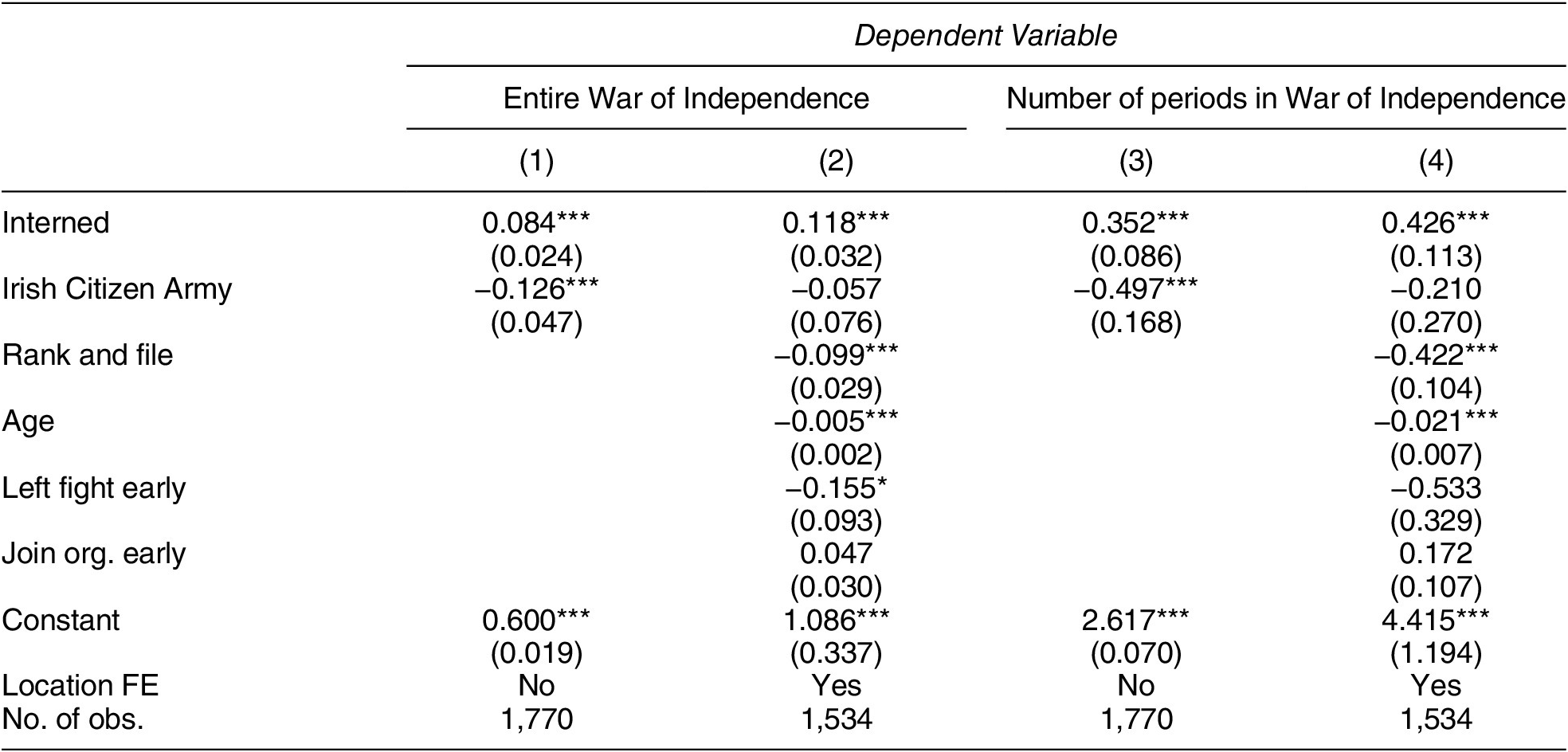
Table 2 presents regression results. All models use OLS. The first column presents results using a minimal set of controls, including whether rebels were members of the Irish Citizen Army. Rebels who were interned were over eight percentage points more likely to continue fighting throughout the duration of the Irish War of Independence when compared with individuals who were not interned. The second column presents results using the full set of control variables. The estimated coefficient is even larger in magnitude and also statistically significant. Columns 3 and 4 present results using the second dependent variable counting the number of periods individuals claimed to fight during the Irish War of Independence. Column 3 shows that rebels who were interned fought for roughly 0.35 additional periods when compared with rebels who were not interned. In Section 7 of the Supplementary Material, I also present sensitivity analyses. I show how a confounder explaining 10 times the residual variance as is explained by Irish rebels’ ages (in internment and the outcome) would still not reduce the implied effect size to zero. Given the strength of the theorized relationship between age and conflict behavior (e.g., Humphreys and Weinstein Reference Humphreys and Weinstein2008), this implies that whether we have fully eliminated confounding or not, a relatively high degree of confounding would be required to change the conclusions. In Section 8 of the Supplementary Material, I present substantively similar regression results focusing only on rebels who fought at Jacob’s Biscuit Factory—a location the qualitative record suggests that commanding officers explicitly told rebels to evade capture if they could. Sections 11, 14, and 15 of the Supplementary Material present additional analyses with alternative specifications for rebels’ ranks, location of fighting, and when they joined the rebel organizations.
Internment and Fighting Through the Irish War of Independence

Note: This table examines the fighting behavior of members of the Irish Volunteers and Irish Citizen Army. Models 1 and 2 use a dependent variable of fighting throughout the entire Irish War of Independence. Models 3 and 4 use a dependent variable counting the number of periods individuals claimed to fight in during the Irish War of Independence. Rebels who were interned fought at higher rates than those who were not interned. OLS regression with standard errors in parentheses. *
 $ p< $
0.1; **
 $ p< $
0.05; ***
$ p< $
0.01.
Historical research provides evidence consistent with the posited mechanism that internment increased rebels’ grievances toward the British. Indeed, the radicalizing nature of internment has led the historical literature to dub the main internment camp “The University of Revolution” (Mahony Reference Mahony1987). Grievance-inducing factors included the overall poor conditions of the camps, the quality and quantity of rations, and British efforts to conscript members of the Irish Volunteers to fight in British forces in WWI (Brennan-Whitmore Reference Brennan-Whitmore2013, 68–9). Both the internment camp conditions and British actions increased anger among the Irish rebel prisoners. For example, in an autobiography describing his experience as an Irish Volunteer in the Frongoch internment camp, William Brennan-Whitmore states that the British efforts to conscript two members of the Irish Volunteers “angered us very much” and the rebels’ “impotence in the matter but added fuel to our fury” (Brennan-Whitmore Reference Brennan-Whitmore2013, 82–3). Rebel grievances eventually led to hunger strikes by the Irish rebel prisoners (Murphy Reference Murphy2014, 64). Ultimately, the qualitative evidence suggests that both the actions of British officials and the overall quality of the internment camps increased grievances, which in turn shaped subsequent rebel behavior. Section 9 of the Supplementary Material provides a more comprehensive discussion of mechanisms.
IMPLICATIONS
In this letter, I argued that government counterinsurgency tactics can increase rebels’ levels of grievances, which increases the likelihood they continue fighting as conflicts unfold. Focusing on the internment of Irish rebels after the 1916 Easter Rising, I showed that formerly interned rebels fought throughout the Irish War of Independence at higher rates when compared with rebels who were not interned. The findings contribute to prior empirical research exploring the consequences of state repression (Hoover and Kowalewski Reference Hoover and Kowalewski1992; Lupu and Peisakhin Reference Lupu and Peisakhin2017) by expanding the analytic purview to include within-conflict rebel behavior. Showing how government actions can affect rebel behavior is important since prior research argues that the relatively more extreme members of rebel organizations are those most likely to undermine peace settlements and continue fighting (Kydd and Walter Reference Kydd and Walter2002; Stedman Reference Stedman1997). This suggests that the actions governments take as they fight can contribute to making conflicts more difficult to resolve. A trade-off exists for those charged with fighting insurgencies in that the tactics that might be most effective for combating rebellions might contribute to the intractability of the conflict in the long term. This dynamic could be present in all cases where rebels’ grievances increase as a result of governments’ counterinsurgency tactics. This is in principle possible during all phases of an insurgency and in insurgencies of any duration.
At least three factors shape the external validity of the findings. The first factor entails the amount of agency rebels have in deciding whether to continue fighting. In the case of historical Ireland, it was relatively costless for rebels to cease their conflict participation.Footnote 6 However, in conflicts where there are costs associated with ceasing to fight—due to public pressure, the organizational structure of rebel organizations, or explicit threats of death or punishment—the influence of within-conflict grievances is diminished. Importantly, this is not because rebels prefer to continue fighting; rather, they are constrained in their ability to stop. Future research should further theorize and empirically assess how differences in the magnitude of the costs associated with remaining a combatant shape rebels’ within-conflict behavior.
The second factor entails whether and how much counterinsurgency tactics affect rebels’ levels of grievances. Other instances where rebels are held for longer or in harsher prison conditions might further raise rebels’ levels of grievances. Similarly, other counterinsurgency tactics—such as torture or summary executions—might even further fuel rebels’ grievances. In such case, the individuals who experience these counterinsurgency tactics are even more in favor of further violence and continued fighting. Qualitative evidence from recent conflicts provides suggestive evidence consistent with these arguments. For instance, research on the leadership of Al-Qaeda argues that the torture many of the leaders experienced in Egyptian prisons “created an appetite for revenge” (Wright Reference Wright2006, 61). Additionally, the magnitude of consequences from other counterinsurgency tactics relative to internment and also each other is still an open question. Future research should continue to theorize when and how rebels’ experiences shape their sense of injustice, levels of anger, and subsequent conflict behavior.
The third factor entails whether and how counterinsurgency tactics affect other mechanisms which might affect the choice to continue fighting. For instance, while indiscriminate state violence might affect rebels’ levels of grievances, this violence could also affect the expected costs of continued fighting.Footnote 7 The former mechanism should make rebels more likely to continue fighting, whereas the latter mechanism would lead to the opposite empirical prediction. Future research should more comprehensively theorize and empirically assess how the various mechanisms affected by rebels’ within-conflict experiences shape their subsequent conflict behavior. At both its theoretical and empirical core, the successful resolution of violent conflict hinges upon individuals deciding to stop fighting. This letter seeks to better understand this decision by highlighting how governments’ counterinsurgency tactics can shape the behavior of the individuals they are combating.
SUPPLEMENTARY MATERIAL
To view supplementary material for this article, please visit http://doi.org/10.1017/S0003055423000059.
DATA AVAILABILITY STATEMENT
Research documentation and data that support the findings of this study are openly available in the American Political Science Review Dataverse at https://doi.org/10.7910/DVN/I2HEVQ.
ACKNOWLEDGMENTS
I thank Muhammet Bas, Matthew Blackwell, Melani Cammett, Thomas Cavanna, Dara Kay Cohen, Jeffry Frieden, Michael Gill, Andrew Hall, Soeren Henn, Jonathan Homola, Hyeran Jo, Joshua Kertzer, Dean Knox, Dominika Kruszewska, Shiro Kuriwaki, Boram Lee, Ashley Leeds, Christopher Lucas, Daniel Moskowitz, Robert Schub, Livia Schubiger, Jacob Shapiro, Anton Strezhnev, Kai Thaler, Dustin Tingley, Michelle Torres, Ariel White, Steven Wilkinson, and Thomas Zeitzoff for invaluable feedback throughout the development of this project. I also thank audience participants at Brown University, the Columbia–Harvard–Princeton–NYU–Yale Politics and History Conference, Harvard International Relations Workshop, Harvard Experiments Working Group, Harvard–MIT–Tufts–Yale Political Violence Conference, NYU Abu Dhabi, Princeton University, Rice University, Rutgers University, UCSD, and Yale University for helpful comments and suggestions. I am grateful to Cécile Gordon, Michael Keane, and the staff at the Military Archives in Dublin for providing invaluable guidance on the complexities of the military pension applications.
CONFLICT OF INTEREST
The author declares no ethical issues or conflicts of interest in this research.
ETHICAL STANDARDS
The author affirms this research did not involve human subjects.




Comments
No Comments have been published for this article.