Surrogate endpoints are attractive in clinical trials when the primary endpoint is difficult to measure because of time, costs, the need to test multiple regimens, ethical considerations, or pressure from patient advocacy groups (Reference Fleming27;Reference Molenberghs, Burzykowski, Alonso and Buyse41). In advanced breast cancer, prolongation of survival and symptom improvement are commonly accepted as evidence of clinical benefit and as appropriate primary endpoints (Reference Fleming27;65). However, a validated surrogate endpoint allows for inferences about a treatment's benefit when primary endpoint data are not available (Reference Baker and Kramer6;Reference Baker7;Reference Fleming and DeMets26). One potential surrogate endpoint for overall survival (OS) in advanced breast cancer is progression-free survival (PFS), a composite endpoint defined by the United States (U.S.) Food and Drug Administration (FDA) as the time from randomization to documented progression or death from any cause (25;65). However, the association between PFS and OS has not been systematically evaluated in advanced breast cancer for anthracycline and taxane-based chemotherapy.
PFS includes death as part of its composite endpoint—and, therefore, differs from other progression-based endpoints. For example, time to progression is defined by the U.S. FDA as the time from randomization until tumor progression (death is censored), and time to treatment failure is a composite endpoint defined as the time from randomization until the patient stops the trial treatment for any reason including progression, toxicity, or preference (death is censored) (25;65). The inclusion of death in PFS may be important in advanced breast cancer because tumor growth, whether or not it is documented, usually precedes death. In other words, background mortality contributes relatively little to the 2-year median survival for advanced breast cancer and death likely reflects the treatment's ability, or lack thereof, to control disease progression (Reference Gennari, Conte and Rosso30;64;65). Therefore, censored deaths may constitute informative censoring and may impact the ability of other progression-based endpoints to predict OS. Because PFS uniquely overcomes this limitation by including death, its ability to predict OS should be evaluated separately from other progression-based endpoints.
PFS has additional benefits as an endpoint because it is measured before postprogression treatments are initiated. Therefore, PFS data is not affected by postprotocol agents. Furthermore, PFS is measured earlier and has a higher event frequency compared to OS. Consequently, PFS results may be available sooner and, potentially, with smaller and less costly trials (Reference Ackland, Anton and Breitbach2;Reference Di Leo, Bleiberg and Buyse22;Reference Hackshaw, Knight, Barrett-Lee and Leonard33).
However, PFS has several potential limitations that it shares with all progression-based endpoints. The need for frequent radiologic studies raises the potential for assessment bias and increases the complexity of data capture and validation (25;65). PFS may be sensitive to differences in the duration between assessments (25;Reference Panageas, Ben-Porat and Dickler47), unprotocolled assessments (25;Reference Panageas, Ben-Porat and Dickler47), variations in censoring (25;Reference Niimi, Yamamoto and Fukuda46), and the use of cytostatic agents (Reference Yu and Holmgren67). Furthermore, variability in PFS measurement may be magnified when it is used to predict OS (Reference De Gruttola, Clax and DeMets20;Reference Fleming and DeMets26). With multiple effective therapies available for advanced breast cancer, the link between PFS and OS may be distorted by nonprotocolled treatments given after the trial regimen (Reference De Gruttola, Fleming, Lin and Coombs19;Reference Di Leo, Bleiberg and Buyse22;Reference Hackshaw, Knight, Barrett-Lee and Leonard33).
Although PFS has not been systematically evaluated in advanced breast cancer for anthracycline- and taxane-based chemotherapy, studies suggest that time to progression and response rate have a statistically significant association with OS (Reference A'Hern, Ebbs and Baum1;Reference Hackshaw, Knight, Barrett-Lee and Leonard33). However, only 34 to 37 percent of OS variability was explained by variability in time to progression and response rate, respectively (Reference A'Hern, Ebbs and Baum1;Reference Hackshaw, Knight, Barrett-Lee and Leonard33). An abstract suggested a similar result (R2 = .44) for PFS for trials comparing taxane and anthracycline chemotherapy (Reference Burzykowski, Piccart and Sledge13). However, cross-validation was not performed for this narrowly defined set of trials. Although there is controversy about the optimal approach for validating surrogate endpoints (Reference Burzykowski, Molenberghs and Buyse12;Reference Buyse and Molenberghs15;Reference Molenberghs, Buyse, Burzykowski, Molenberghs, Buyse and Burzykowski42), one option is to evaluate performance at the trial level (Reference Hackshaw, Knight, Barrett-Lee and Leonard33).
The primary aim of this study was to evaluate the association between the direction and magnitude of the treatment effect on PFS compared with the treatment effect on OS for anthracycline- and taxane-based chemotherapy regimens in advanced breast cancer using a trial-based, meta-analytic approach. We limited our analysis (and the generalization of our results) to anthracycline- and taxane-based chemotherapy for advanced breast cancer because the relationship between PFS and OS may differ for different anti-cancer agents and in different cancers due to underlying biologic factors, the interaction of each anti-cancer agent with each cancer, and differences in the availability of active subsequent line treatments (Reference Fleming and DeMets26).
Methods
Literature Search, Inclusion Criteria, and Data Abstraction
A systematic literature search in Medline (January 2007) based on published search strategies (Reference Ghersi, Wilcken and Simes32;Reference Hackshaw, Knight, Barrett-Lee and Leonard33) was performed to identify English-language publications of randomized controlled advanced breast cancer trials of anthracycline-based (5-fluorouracil, epirubicin, and cyclophosphamide [FEC]; and 5-fluorouracil, adriamycin, and cyclophosphamide [FAC]) or taxane-based (any combination) chemotherapy. Abstract databases for the American Society of Clinical Oncology and the San Antonio Breast Cancer Symposium annual meetings were also searched.
The inclusion criteria were as follows: (i) PFS data and OS endpoint data reported; (ii) evidence of adequate randomization and blinding; (iii) 80 percent of the sample with advanced breast cancer; (iv) at least one trial regimen included anthracycline- (FEC/FAC) or taxane-based chemotherapy (Reference Hackshaw, Knight, Barrett-Lee and Leonard33). To maximize inclusion, all publications reporting any progression-based data were reviewed and endpoints were classified according to U.S. FDA definitions. Any publication reporting a progression-based endpoint that met the “strict” U.S. FDA definition of PFS (time from randomization to progression or death from any cause) (25;65) was included in the analysis, even if terminology in the publication differed.
Publications using PFS terminology but not providing a definition of the progression-based endpoint were included if there was no evidence of deviation from the U.S. FDA definition after careful review of the entire the publication. These trials were excluded from subgroup analysis of trials meeting the “strict” definition of PFS. Those trials whose endpoint consisted of both progression and death but had a minor deviation from the U.S. FDA definition were included in the primary analysis but excluded from the subgroup of trials meeting the “strict” PFS definition.
Classification of progression-based endpoints and data extraction was independently performed by at least two authors. All discrepancies were refereed by two authors (R.M., U.S.). The extracted data were: (i) definition of progression-based endpoint; (ii) deviation from prospectively defined PFS definition; (iii) treatment regimen in each arm; (iv) median OS and PFS for each arm; (v) number of patients used to calculate PFS; (vi) year the last patient was recruited; (vii) line of trial treatment; (viii) published hazard ratios; and (ix) description of censoring technique(s) and therapies received subsequent to trial protocol. For trials with multiple publications, data from the longest follow-up period was used.
Statistical Methods
Calculation of Hazard Ratios
The hazard ratio (HR) for the treatment effect on OS (HROS) and on PFS (HRPFS) was estimated by calculating the median OS and PFS ratios for each pair of trials arms. An exponential distribution was assumed for the survival function. The trial arm containing the chemotherapy of interest (anthracycline or taxane) was designated as Group 2 for that analysis: HROS = Median OS of Group 1/Median OS of Group 2 (Table 1). If a trial compared two different regimens for the chemotherapy of interest, the treatment arm most similar to the current U.S. FDA approved regimen was designated as Group 2. For trials with multiple arms, each pair of arms was evaluated and included in the analysis. The anthracycline and taxane trials were evaluated separately.
Anthracycline (FEC/FAC) and Taxane-Based Chemotherapy Trials Included in Analysis

Note. Data extracted during literature review, assessment of progression-based endpoint definition and calculation of hazard ratio (HR) based on published data. Standardized definitions: PFS, progression free survival, time from randomization to progression or death from any cause; TTP, time to disease progression, time from randomization to progression; OS, overall survival, time from randomization until death from any cause; TTF, time to treatment failure, time from randomization to treatment failure for any cause; HR, hazard ratio; I, first trial-arm pair from study; II, second trial-arm pair from study.
Agreement in Direction of PFS and OS Treatment Effects
For both anthracycline- and taxane-based chemotherapy trials, the level of agreement (kappa coefficient) between the direction of the HRPFS and HROS was calculated along with a p value. Kappa tests the null hypothesis that there is no more agreement between HRs than might occur by chance alone (Reference Altman4;Reference Landis and Koch37).
Prediction of the Magnitude of the Treatment Effect on OS
The explanatory power of the trial-level treatment effect on PFS for the trial-level treatment effect on OS was evaluated using a meta-analytic, fixed-effects weighted linear regression model: log10(HROS) = α + β*log10(HRPFS). The intercept term α was included to avoid spurious associations from forcing the regression through the origin and to facilitate comparison with prior studies (Reference Hackshaw, Knight, Barrett-Lee and Leonard33). Each trial arm pair was weighted by the total number of patients assessed for PFS (usually the intent to treat population). For trials with multiple arms, each arm was downweighted (downweighting factor = number of independent trial arm pairs/number of total trial arm pairs) to adjust for multiple comparisons. The coefficient of determination (R2) was calculated for each model to measure the proportion of variability in HROS explained by variability in HRPFS.
Leave-one-out cross-validation
The validity of the regression model was tested using leave-one-out cross-validation. The regression model was re-fitted with the N th trial arm pair excluded. For each excluded trial arm pair, the observed HRPFS was used in the refitted regression equation to calculate the predicted HROS and 95 percent prediction interval (Reference Armitage, Berry and Matthews5;Reference Efron23). This process was repeated for every trial and each predicted HROS was compared with the respective observed HROS.
Sensitivity Analyses and Subgroup Analyses
The robustness of the regression model was assessed by evaluating key parameters in repeat analyses: (i) when available, the published HR was substituted for the calculated HR; and (ii) only those trials explicitly meeting the strictest definition of PFS were evaluated.
The potential impact of therapies given after the trial regimen was assessed using two proxy measures: year of last patient entry (before versus after 1990) and line of trial therapy (first versus subsequent-line). These proxies were chosen because the numbers of active treatment options available after progression tend to be greater after first-line protocols and after 1990 (Reference Hackshaw, Knight, Barrett-Lee and Leonard33). The regression model was refitted with an interaction term between HRPFS and an indicator variable for the respective proxy.
All statistical analyses were performed using SAS 9.1 (SAS Institute Inc. Cary, NC, USA). A two-sided p value of < .05 was considered statistically significant.
Results
Literature Search and Description of Included Studies
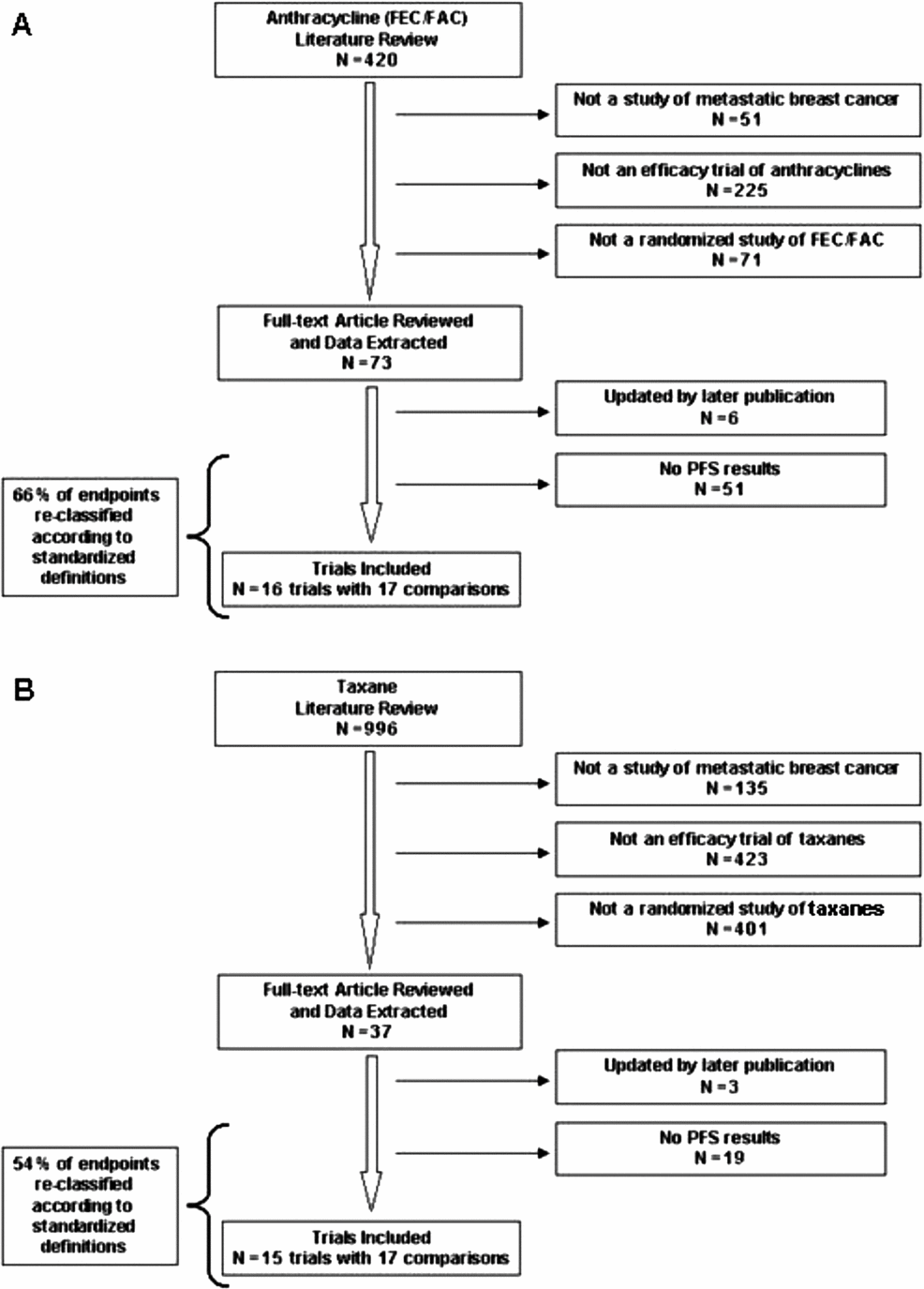
We identified 420 individual publications of anthracycline-based (FEC/FAC) and 996 of taxane-based trials for advanced breast cancer (Figure 1). Seventy-three anthracycline and thirty-seven taxane publications reported a progression-based endpoint and met other inclusion criteria. These publications were reviewed to identify trials with PFS data as defined by the U.S. FDA. Six anthracycline and three taxane publications were excluded because the trial was updated with a later publication included in the review. Forty-two percent (31/73) anthracycline and 30 percent (11/37) taxane publications did not provide a detailed description of how the progression-based endpoint was determined: of these publications 6 anthracycline and no taxane trial arm pairs reported PFS data for which scrutiny of the methods and results did not reveal obvious deviations from the U.S. FDA definition of PFS. (Reference Boccardo, Rubagotti, Rosso and Santi11;Reference Conte, Pronzato and Rubagotti17;Reference Conte, Baldini and Gardin18;Reference Ejlertsen, Pfeiffer and Pedersen24;Reference Namer, Soler-Michel and Turpin45;Reference Speyer, Green and Zeleniuch-Jacquotte61) The majority of these publications (4/6) were published in 1990 or earlier. These six trials were excluded in a sensitivity analysis of trials meeting the “strict” definition of PFS.
Systematic literature review for anthracycline (A) and taxane-based chemotherapy (B) for advanced breast cancer. Results of systematic review of the literature. FEC, 5-fluorouracil, epirubicin and cyclophosphamide; FAC, 5-fluorouracil, adriamycin and cyclophosphamide; N = number.

Of those publications providing a definition of the progression-based endpoint, 66 percent (28/42) of the anthracycline and 54 percent (14/26) of the taxane publications did not have a description consistent with U.S. FDA definitions and terminology. These publications were reclassified according to U.S. FDA endpoint definitions. The majority of re-classifications occurred from time to progression to PFS and from time to treatment failure to time to progression. The most common reason for exclusion from this analysis was that the endpoint did not include all causes of death and, therefore, did not meet the definition of PFS.
To maximize the number of studies in the analysis, four trials were included that reported a composite progression-based endpoint of death and progression but differed from the strict PFS definition in the following ways: (i) all deaths were included except those occurring after a predefined time interval from date of last study treatment (Reference Jones, Erban and Overmoyer36;Reference Sledge, Neuberg and Bernardo58;Reference Zielinski, Beslija and Mrsic-Krmpotic68); (ii) all deaths were included except those not attributed to study drug or breast cancer (Reference Sledge, Neuberg and Bernardo58;Reference Zielinski, Beslija and Mrsic-Krmpotic68); and (iii) the last follow-up visit was defined as a PFS event (Reference Sjostrom, Blomqvist and Mouridsen57). These four trials were excluded in a sensitivity analysis of trials meeting the “strict” definition of PFS.
Ultimately, sixteen anthracycline and fifteen taxane trials reported PFS data and met the other inclusion criteria (Table 1). All included anthracycline trials evaluated first-line therapy and 53 percent (9/17) recruited the last patient after 1990. A total of seventeen trial-arm pairs (n = 4,323) were available to evaluate HROS and HRPFS for anthracycline regimens. All included taxane trials recruited the last patient after 1990 and 47 percent (8/17) were second/subsequent-line regimens. A total of 17 trial-arm pairs (n = 5,893) were available to evaluate HROS and HRPFS for taxane regimens. The majority of trial-arm pairs exactly met the U.S. FDA (strict) definition of PFS: 59 percent (10/17) of anthracycline (FEC/FAC) and 71 percent (12/17) of taxane trial arm pairs.
Information about censoring techniques was presented for less than half of the trial arm pairs: 41 percent (7/17) of anthracycline (FEC/FAC) and 35 percent (6/17) of taxane trial arm pairs. Details about subsequent treatments were provided in 41 percent (7/17) of anthracycline and 53 percent (9/17) of taxane trial arm pairs. An HR estimate for OS and PFS was published for 12 percent (2/17) of anthracycline (Reference Ackland, Anton and Breitbach2;Reference Jassem, Pluzanska and Pienkowski35) and 35 percent (6/17) of taxane trial arm pairs (Reference Biganzoli, Cufer and Bruning9;Reference Chan, Friedrichs and Noel16;Reference Jassem, Pluzanska and Pienkowski35;Reference Jones, Erban and Overmoyer36;Reference Langley, Carmichael and Jones38;Reference Paridaens, Biganzoli and Bruning48).
Agreement in Direction of PFS and OS Treatment Effects
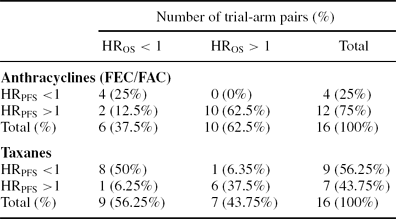
For both regimens, there was good agreement between the direction of PFS and OS (Table 2). The kappa statistic for the anthracycline trial arm pairs was 0.71 (95 percent confidence interval (CI), 0.36–1.00; p = .0029) and was 0.75 (95 percent CI, 0.42–1.00; p = .0028) for taxane trial arm pairs.
Agreement in Direction of the Hazard Ratios (HR) for Progression Free Survival (PFS) and Overall Survival (OS)

Note. One trial was excluded from each analysis because HRPFS(45) or HROS(9) were equal to 1. FEC, 5-fluorouracil, epirubicin and cyclophosphamide; FAC, 5-fluorouracil, adriamycin and cyclophosphamide.
Prediction of the Magnitude of the Treatment Effect on OS
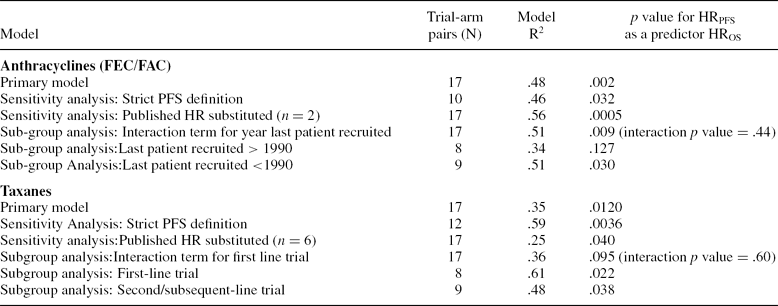
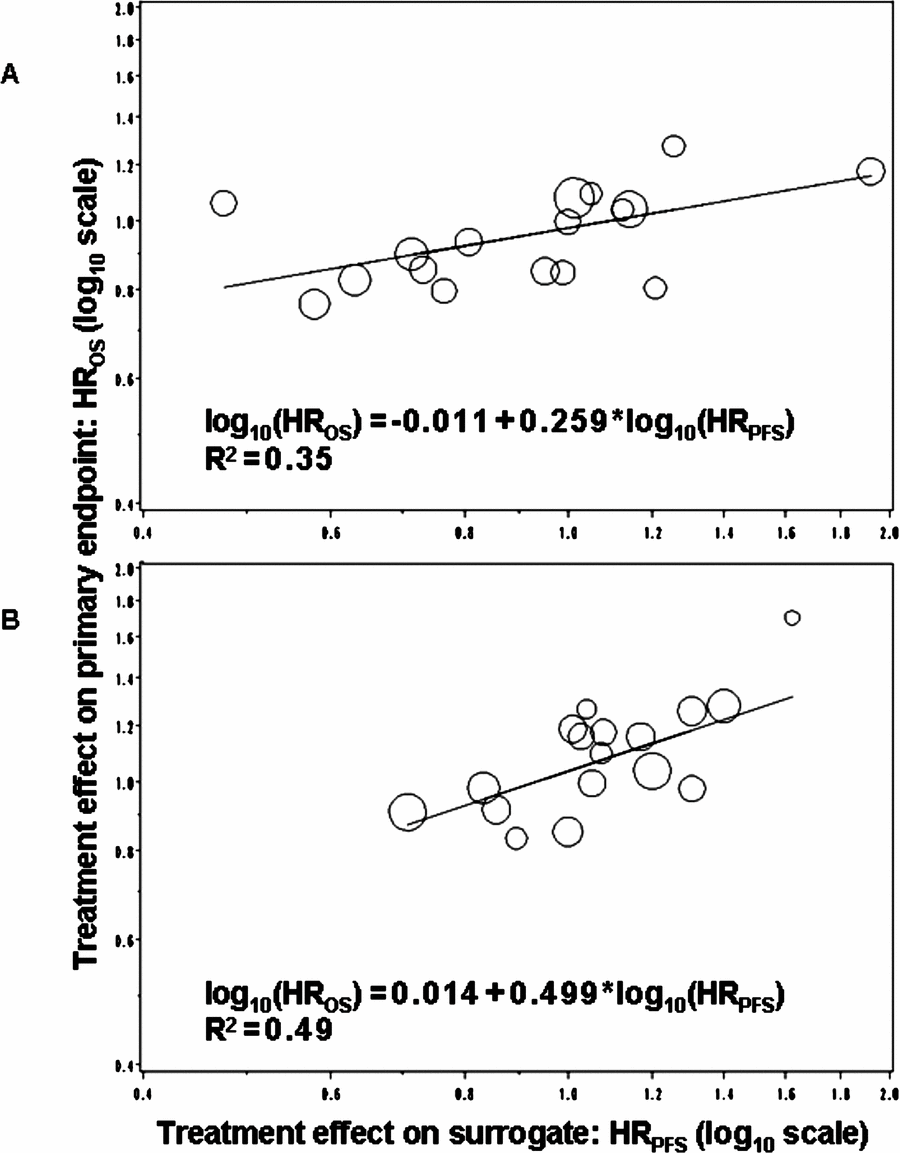
In the primary meta-analytic, fixed-effects regression analysis of anthracycline-based (FEC/FAC) chemotherapy, HRPFS was a significant predictor for HROS (p = .0019), with an explained variance (R2) of .49 (Table 3 and Figure 2). Similarly, HRPFS was a significant predictor for HROS (p = .012) for taxane-based chemotherapy with an R2 of .35. Elimination of a potential outlier (Reference Boccardo, Rubagotti, Rosso and Santi11) did not change results.
Results for Meta-analytic, Fixed-Effects Regression Analysis: Primary Model, Sensitivity Analysis, and Subgroup Analysis

Note. Results of meta-analytic regression analysis, with regression model: log10 HR (OS) = α + β *log 10 HR (PFS). HR, hazard ratio; OS, overall survival; PFS, progression free survival; log, logarithm; FEC, 5-fluorouracil, epirubicin and cyclophosphamide; FAC, 5-fluorouracil, adriamycin and cyclophosphamide.
Primary meta-analytic, fixed-effects regression model for anthracycline (A) and taxane-based chemotherapy (B). Primary, fixed-effects meta-analytic regression analysis assessing the association of HRPFS and HROS. Size of circle indicates relative sample size of each trial-arm pair. Regression equation noted in figure, along with R2 value. HR, hazard ratio; OS, overall survival; PFS, progression free survival; log, logarithm.

Leave-One-Out Cross-Validation
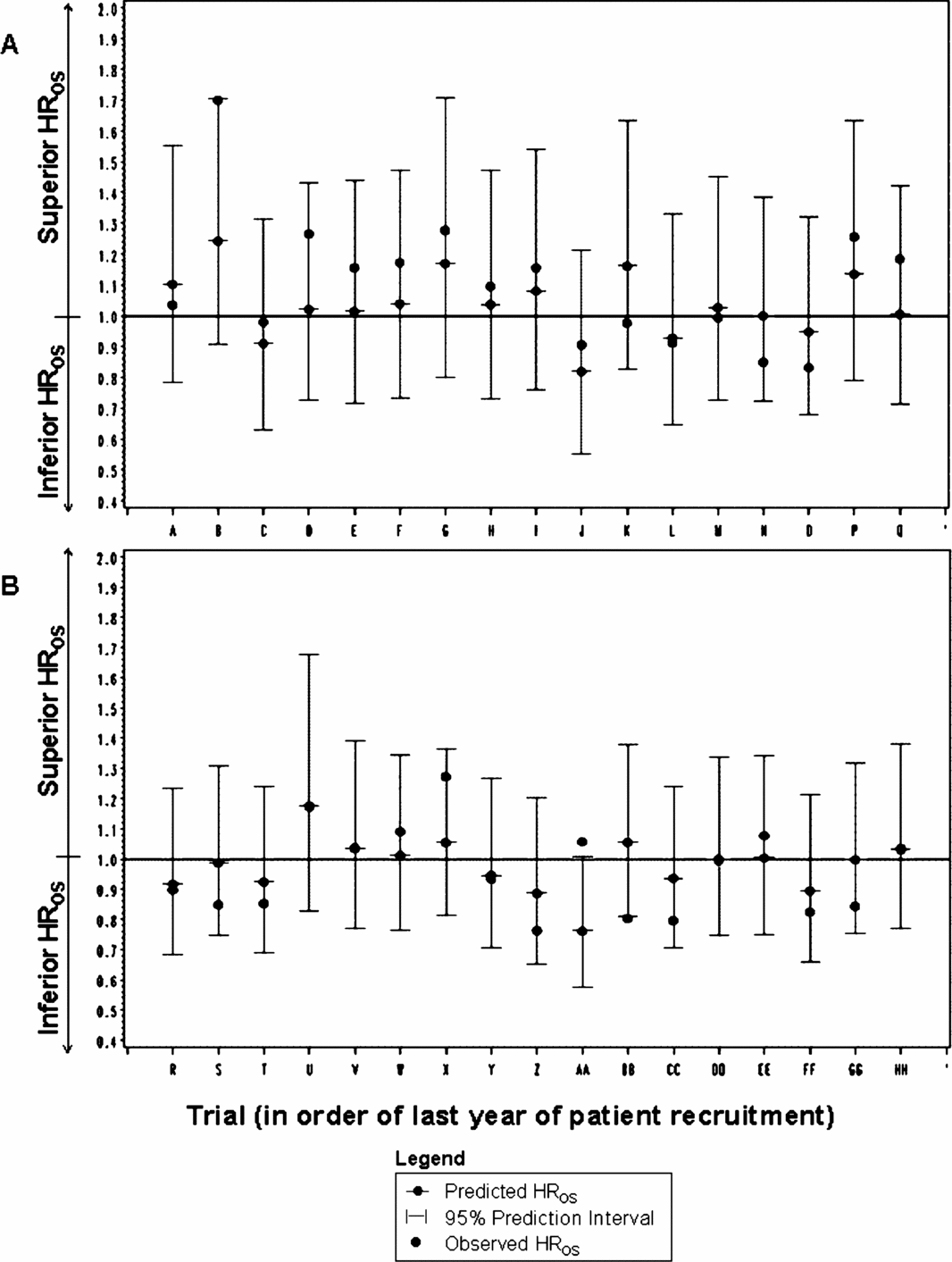
All 95 percent prediction intervals for the predicted HROS based on the observed HRPFS were wide and all but one in the taxane analysis crossed the equivalence (HROS = 1) line (Figure 3). All observed HROS fell within the 95 percent prediction intervals for the anthracyclines (FEC/FAC) trial arm pairs, and 88 percent (15/17) did so for the taxane trial arm pairs. However, the observed and predicted HROS fell on the opposite side of the equivalence (HROS = 1) line for 18 percent (3/17) of anthracycline and 24 percent (4/17) of taxane trial-arm pairs. The majority of the predicted HROS were closer to the equivalence line than the observed HROS: 82 percent (14/17) of taxane and 71 percent (12/17) of anthracycline trial-arm pairs.
Leave-one-out cross-validation: anthracycline- (A) and taxane-based chemotherapy (B). Observed HROS for each trial-arm pair is plotted against the predicted HROS and 95% prediction intervals calculated from the HRPFS in the primary meta-analytic, fixed-effects regression model. HR, hazard ratio; OS, overall survival; PFS, progression free survival.

Sensitivity Analyses and Subgroup Analyses
When two available published HR values for the anthracyclines were substituted for calculated HRs, the primary model R2 increased to .56 and HRPFS remained significant (p = .0005) (Table 3). In contrast, when six available published HR values for taxane trial-arm pairs were substituted, the R2 decreased to .25 and the HRPFS remained significant (p = .040).
To assess the impact of adhering to a strict definition of PFS based on information in the publication, the analysis was repeated after excluding those trial arm pairs that did not provide a definition of PFS or deviated from the strict PFS definition. PFS remained significant in both models, although the R2 decreased to .46 (p = .032) for anthracyclines and increased to .59 for taxanes (p = .0036) (Table 3).
Analysis of the potential impact of subsequent-line treatments for anthracyclines showed a nonsignificant interaction (p = .44) between HRPFS and year of last patient recruitment (before versus after 1990) (Table 3). The anthracycline subgroup of trials recruiting patients after 1990 had a lower R2 (.34) than the primary model and HRPFS was not statistically significant (p = .13). However, the anthracycline subgroup of trials recruiting the last patient before 1990 was similar to the primary model (R2 = .51), and HRPFS remained statistically significant (p = .03).
Similarly, there was a statistically nonsignificant interaction between line of trial treatment and HRPFS for taxanes (p = .60). However, PFS remained a significant predictor in each taxane subgroup (p = .022 and .038 for eight first-line and nine subsequent-line trials, respectively). Each taxane subgroup model had a higher R2 than the primary model: .61 and .48 for first-line and subsequent-line, respectively.
Discussion
Based on our meta-analytic evaluation of anthracycline-(FEC/FAC) and taxane-based chemotherapy trials in advanced breast cancer, there is a statistically significant association between both the direction and the magnitude of the trial-level treatment effect on PFS and the trial-level treatment effect on OS. However, prediction of OS based on PFS is surrounded with uncertainty. Although the direction of the observed HRPFS and the observed HROS showed good agreement by the kappa statistic (Reference Altman4), 18 percent (anthracyclines) to 24 percent (taxanes) of the predicted HROS fell on the opposite side of the equivalence line compared with the observed HROS (i.e., the converse conclusion with respect to which regimen is superior). All of the 95 percent prediction intervals were wide and the majority crossed the HR equivalence line. Approximately half (anthracycline) to one-third (taxanes) of the variance in the treatment effect on OS is explained by the variance in the treatment effect on PFS. In light of our results, the finding of a significant PFS but an insignificant OS in a recent large advanced breast cancer trial (Reference Miller, Wang and Gralow39) published after the conclusion of our study is not unexpected.
The results of this study were robust in cross-validation as well as in sensitivity analyses. Using limited data, heterogeneity of results could not be explained by the constant rate assumption, differences in PFS definition, year of last patient recruitment, or line of therapy. However, exploratory subgroup analyses indicated that PFS may perform better for anthracycline trials that recruited the last patient before 1990 and for taxanes trials stratified by line of treatment.
This study adds to and expands prior work on surrogate endpoint validation (Reference A'Hern, Ebbs and Baum1;Reference Burzykowski, Piccart and Sledge13;Reference Hackshaw, Knight, Barrett-Lee and Leonard33). We (i) systematically classified all published trial-level progression-based endpoints of anthracycline- and taxane-based (FEC/FAC) advanced breast cancer trials according to U.S. FDA and EMEA definitions; (ii) assessed trial-level PFS as a surrogate for taxane-based chemotherapy in advanced breast cancer using meta-analytic, trial-level regression analysis techniques; and (iii) evaluated trial-level PFS for taxane and anthracycline trials with leave-one-out cross-validation and sensitivity analyses. We extended prior work on trial-level PFS for anthracycline-based (FEC/FAC) chemotherapy (Reference Hackshaw, Knight, Barrett-Lee and Leonard33) by including additional trials, verifying endpoint definitions and performing cross-validation. We also enhanced the generalizability of prior work using individual level data (Reference Burzykowski, Buyse and Piccart-Gebhart14) by not limiting our evaluation to those trials with this type of data available. The R2 findings of this study for PFS are consistent with prior studies of other progression-based surrogate endpoints in advanced breast cancer, including the recent individual level analysis with fewer trials (Reference A'Hern, Ebbs and Baum1;Reference Burzykowski, Piccart and Sledge13;Reference Burzykowski, Buyse and Piccart-Gebhart14;Reference Hackshaw, Knight, Barrett-Lee and Leonard33). We extended the prior work by performing a cross-validation to assess the robustness of the results. Our findings for PFS as a surrogate endpoint differ from those found for colon cancer, suggesting that different diseases, and, perhaps, different agent types, need separate evaluation (Reference Sargent, Wieand and Haller54;Reference Sargent, Patiyil and Yothers55;Reference Tang, Bentzen, Chen and Siu62). Future work on surrogate endpoints for different types of chemotherapy agents and different types of cancers may further elucidate the factors influencing the relationship of PFS and OS.
This study also highlights the variability in terminology and definition for progression-based endpoints such as PFS. Although most of the trials without a definition of PFS were published in 1990 or earlier, half of the trials with minor deviations from the U.S. FDA definition were published after 2000. While unique logistical and biologic considerations (and pretrial discussions with regulatory agencies) may have led to the definition choice, we believe it is important that the health-services research and clinical community be aware that these differences exist.
Our study must be considered within the context of its limitations. To focus on PFS as a unique endpoint differing from other progression-based endpoints, only a modest number of trials met eligibility criteria and power was limited. A systematic review of the published literature and abstract databases was performed to maximize the number of eligible trials and to minimize potential publication bias. In addition, publications of all trials with progression-based endpoints were reviewed to determine whether the endpoint met the U.S. FDA definition of PFS, even if this terminology was not used in the publication. Although individual level data were not available and we used median survival and PFS values, we followed the work of Parmer et al. to develop hazard ratios based on summary statistics (Reference Parmar, Torri and Stewart49). A sensitivity analysis was performed to assess the potential limitation of using calculated HRs.
Variability in the definition of and the use of progression-based endpoints in the original trials may have introduced heterogeneity into our analysis. To limit potential heterogeneity, each trial was classified according to the U.S. FDA definitions, which were prospectively established. A sensitivity analysis was performed to determine whether exclusion of trials with differences from the strict definition of PFS changed results. Because some trials did not publish PFS data, the number of trials eligible for inclusion in this trial-level analysis was limited. Although great care was taken to include only trials with PFS data, it was impossible to discern if evaluation for disease progression occurred at similar time points for each arm of the trial. Therefore, variability in evaluation schedules between arms may have altered the observed PFS treatment differences. Insufficient data limited analysis of the impact of censoring, the radiologic standard used to determine progression, and follow-up periods: If the true PFS and OS length was not reached due to short follow-up, the predictive value of PFS may be underestimated. Finally, PFS is not the only potential composite endpoint for breast cancer. In contrast to PFS, other composite endpoints such as QTWiST give differential weights to fatal and nonfatal endpoints and may have a different relationship to OS (Reference Gelber and Goldhirsch28;Reference Gelber and Gelber29).
Some authors argue that the association between PFS and OS may be underestimated because of numerous subsequent-line therapies and cross-over from the control arm to active treatment (Reference Sargent and Hayes56). Nonrandomized use of second-line agents may alter the relationship between PFS and OS by distorting the causal pathway between the intervention and the primary endpoint. If the use of subsequent-line treatments is random with respect to PFS (nondifferential bias), the performance of PFS as a surrogate may be diminished. However, if the use of subsequent-line treatments is not random with respect to PFS or is protocolled conditional on PFS (differential bias), then the relationship between PFS and OS reflects the entire treatment strategy and the potential bias may be in either direction. Therefore, it is possible that differences in the predictive ability of HRPFS are due to differences in the impact of subsequent therapies. Because most trial publications did not directly report the use of subsequent line or cross-over therapies, we used proxy variables for the availability of subsequent-line therapies to explore this issue.
Although prediction of OS from PFS was surrounded by uncertainty, PFS is a statistically significant predictor in our trial-based meta-analytic regression model and progression is also a biologically plausible precursor to death. To reduce uncertainty about PFS as a surrogate, the hypothesis that subsequent-line agents or changes in supportive care over time impact the ability of PFS to reliably predict OS could be directly tested. As suggested by a recent editorial, PFS is a biologically plausible measure of efficacy and a goal of breast cancer treatment is to improve both quality and quantity of life (Reference Sargent and Hayes56). Therefore, PFS may be an appropriate primary endpoint even if is not a formal surrogate endpoint with an ability to predict OS (Reference Sargent and Hayes56). Analyzing the association between PFS and quality-of-life and/or freedom from symptom progression data would further test the value of PFS as an independent, clinically meaningful primary endpoint.
The high percentage of progression-based endpoints that were re-classified to meet U.S. FDA and EMEA definitions and the sensitivity analysis results suggest that the definition of PFS should be universal and carefully detailed in trial protocols and publications. The U.S. FDA and EMEA draft proposals regarding surrogate endpoints have the same PFS definition. However, recommendations for censoring, determination of the date of progression, and missed visits differ (25;65). The Consolidated Standards of Reporting Trials (CONSORT) statement (Reference Moher, Schulz and Altman40) and the Common Terminology Criteria for Adverse Events (Reference Trotti, Colevas and Setser63) may provide a model for standardizing PFS definition, measurement, and reporting.
POLICY IMPLICATIONS
This meta-analytic, trial-based analysis of anthracycline- and taxane-based chemotherapy for advanced breast cancer suggests that while the trial-level treatment effect on PFS is significantly associated with the trial-level treatment effect on OS, predictions based on trial-level PFS are surrounded with uncertainty for these treatments in advanced breast cancer. However, use of standardized endpoint definitions may increase the reliability and validity of surrogate endpoint data in advanced breast cancer.
CONTACT INFORMATION
Rebecca A. Miksad, MD, MPH (rmiksad@bidmc.harvard.edu), Instructor in Medicine, Department of Medicine, Division of Hematology and Oncology, Beth Israel Deaconess Medical Center, Harvard Medical School, Shapiro 9, 330 Brookline Avenue, Boston, MA 02215; Senior Scientist, Institute for Technology Assessment and Department of Radiology, Massachusetts General Hospital, Harvard Medical School, 101 Merrimac Street, Boston, MA 02114
Vera Zietemann, MPH, PhD, Senior Scientist, Raffaella Gothe, Senior Scientist, Ruth Schwarzer, MA, MPH, Research Scientist, Annette Conrads-Frank, PhD, Senior Scientist, Petra Schnell-Inderst, MPH, PhD, Senior Scientist, Björn Stollenwerk, PhD, Senior Scientist (public-health@umit.at), Department of Public Health, Medical Decision Making and Health Technology Assessment, UMIT—University for Health Sciences, Medical Informatics and Technology, Eduard Wallnoefer Center I, Hall i.T., Austria, A-6060
Uwe Siebert, MD, MPH, MSc, ScD (public-health@umit.at), Chair, Professor of Public Health (UMIT), Department of Public Health, Medical Decision Making and Health Technology Assessment, UMIT—University for Health Sciences, Medical Informatics and Technology, Eduard Wallnoefer Center I, Hall i.T., Austria, A-6060; Associate Professor of Radiology (Harvard University), Institute for Technology Assessment and Department of Radiology, Massachusetts General Hospital, Harvard Medical School, 101 Merrimac Street, Boston, MA 02114