Introduction
European eel Anguilla anguilla Linnaeus, 1758 is a critically endangered species (IUCN 2024) of high economic value with limited knowledge of its biology and population structure across its distribution range (Simon Reference Simon2015). It is a migratory and catadromous fish with a complex life cycle. A. anguilla is distributed along the western coasts of Europe and North Africa and is found along all the coasts of the Mediterranean Sea (Dekker Reference Dekker2003). The species is also found in rivers and streams in Türkiye, draining into the Mediterranean, the Aegean Sea, and part of the Black Sea (Geldiay and Balık Reference Geldiay and Balık1996; Yalçın Özdilek Reference Yalçın Özdilek, Turan, Salihoğlu, Özgür Özbek and Öztürk2016). Recruitment of the eel stock has been decreased rapidly throughout Europe and its distribution area (Moriarty and Dekker Reference Moriarty and Dekker1997). Therefore, monitoring and research on eels throughout their distribution area are required (Yalçın Özdilek et al. Reference Yalçın Özdilek, Gümüş and Dekker2006).
Otoliths can describe the entire life cycle of the studied fish (Silm et al. Reference Silm, Bernotas, Haldna, Jarvalt and Noges2017). They serve as crucial biological indicators due to their unique growth patterns, which reflect the environmental conditions experienced by the fish throughout its life. The analysis of otoliths allows researchers to gather vital information regarding age, growth rates, and population dynamics of the European eel, Anguilla anguilla (Bertignac and de Pontual Reference Bertignac and de Pontual2007; Bradford Reference Bradford1991). This is critical, as the European eel’s catadromous life cycle spans both freshwater and marine habitats, each posing distinct ecological challenges. The age determination of eels is primarily based on counting the annual rings; however, accurate age estimation using otoliths poses challenges due to the variability in ring formation related to the fish’s slow growth and the different habitats it occupies at various life stages (ICES 2009).
Despite extensive research on European eels across different regions in Europe (Rossi and Cannas Reference Rossi and Cannas1984; Vøllestad Reference Vøllestad1985; Fernandez-Delgado et al. Reference Fernandez‐Delgado, Hernando, Herrera and Bellido1989; De Leo & Gatto Reference De Leo and Gatto1996; Poole and Reynolds Reference Poole and Reynolds1996; Melia et al. Reference Melia, Bevacqua, Crivelli, De Leo, Panfili and Gatto2006; Kanjuh et al. Reference Kanjuh, Mrdak, Piria, Tomljanović, Joksimović, Talevski and Milošević2018), studies specifically focused on the otolith structure and age growth relationships in Turkish waters remain limited (Yalçın Özdilek et al. Reference Yalçın Özdilek, Gümüş and Dekker2006; Demirci et al. Reference Demirci, Akar, Şimşek, Demirci and Yalçın Özdilek2020; Salman et al. Reference Salman, Özaydin, Akalin and Yokeş2017). This gap in knowledge emphasizes the importance of continuous research within Türkiye to fill the void and contribute to the understanding of A. anguilla biology, particularly in terms of its conservation status. By analysing otoliths, researchers can not only determine the aging profiles of eels but also contribute to better management and conservation strategies, particularly amid growing threats from habitat loss and overfishing.
Moreover, otolith research has implications that extend beyond age and growth; it can also provide insights into the effects of habitat quality on eel populations. Eels from different habitats may exhibit varied growth rates and lifespans, highlighting the need to consider local environmental conditions when devising conservation strategies. Therefore, the main objective of this study is to investigate the age and growth of yellow and silver eel stages of A. anguilla from Lake Bafa.
Materials and methods
Sampling
In total, 128 samples were bought from a local a fisherman in November 2016 (n = 52) and November 2017 (n = 76). Fish were caught overnight in Lake Bafa, with 15-m-long set of fyke nets of 34-mm mesh size. The fish were labelled individually and brought to the laboratory to be kept at −22°C for further analysis. Lake Bafa is eutrophic (Sukatar et al. Reference Sukatar, Ertaş, Gülle and Kızılkaya2020) and features a saline-brackish wetland habitat (Erdoğan Reference Erdoğan2011). The surface area is 6708 ha. Its greatest depth is barely 25 m and its primary water sources are the floods of the Büyük Menderes River and underground waters (Kasparek Reference Kasparek1988).
Length–weight relationship
All samples were assessed for the total length (TL, nearest 0.1 cm) and total weight (TW, nearest 0.1 g), and life stages (yellow and silver) were determined by Durif index (Durif et al. Reference Durif, Guibert and Elie2009). In this index, Durif et al. (Reference Durif, Guibert and Elie2009) categorized females into stages I through V using TL, weight (W), eye diameter (ED), and pectoral fin length (PFL) measurements, while males were categorized as silver using MD, with details shown in Durif et al. (Reference Durif, Guibert and Elie2009). Sexes were determined by visual observation during dissection. Given TL data did not conform with the assumption of normality, the Mann–Whitney U test was used to test for differences in the mean TL between sexes. The TL and the TW relationship was calculated for each sex separately using following formula:
 \begin{equation*}TW = aT{L^b}\end{equation*}
where b and a represent the regression coefficient and the regression constant, respectively. The regression parameters a, b, and coefficient of determination (r 2) were estimated for pooled data as well as when separated by sex, and the allometries in growth were tested by comparing the (b) value with the theoretical value of 3 by the Student t-test (Zar Reference Zar1984).
Age and growth
Sagittal otoliths of eels were extracted and stored in Eppendorf tubes. A randomly selected sagittal otolith of each individual was used. Otoliths were implanted in epoxy resin, placed on a glass slide, and ground to reveal the core (Jones Reference Jones, Stevenson and Campana1992; Miller and Storck Reference Miller and Storck1982; Secor et al. Reference Secor, Dean and Laban1991).
A light microscope was used to count the rings from the inside to the outside (Figure 1). The yearly rings were counted by two independent readers who were not aware of the fish length data. The average percentage error (APE) (Beamish and Fournier Reference Beamish and Fournier1981) and the coefficient of variation (CV) were used to calculate the accuracy of two readers’ growth ring counts (Chang Reference Chang1982).
Image of the annual rings seen in a polished sagittal otolith of an eel, Anguilla anguilla collected from Lake Bafa, Türkiye. This fish was aged at 7 years and had a total length of 40 cm female.

The length at age data were fitted to Von Bertalanffy growth curve by using the following formula (Von Bertalanffy Reference Von Bertalanffy1938):
 \begin{equation*}TL = {L_\infty }[1 - {e^{ - K\left( {t - {t_0}} \right)}}]\end{equation*}
where TL is the fish length (cm) at age t, L∞ the theoretical asymptotic length (cm), K is the growth rate coefficient (per year), and t 0 is the theoretical age (year) when fish length is zero. Separate analyses were carried out for yellow eels, silver eels and for all samples pooled together.
Results
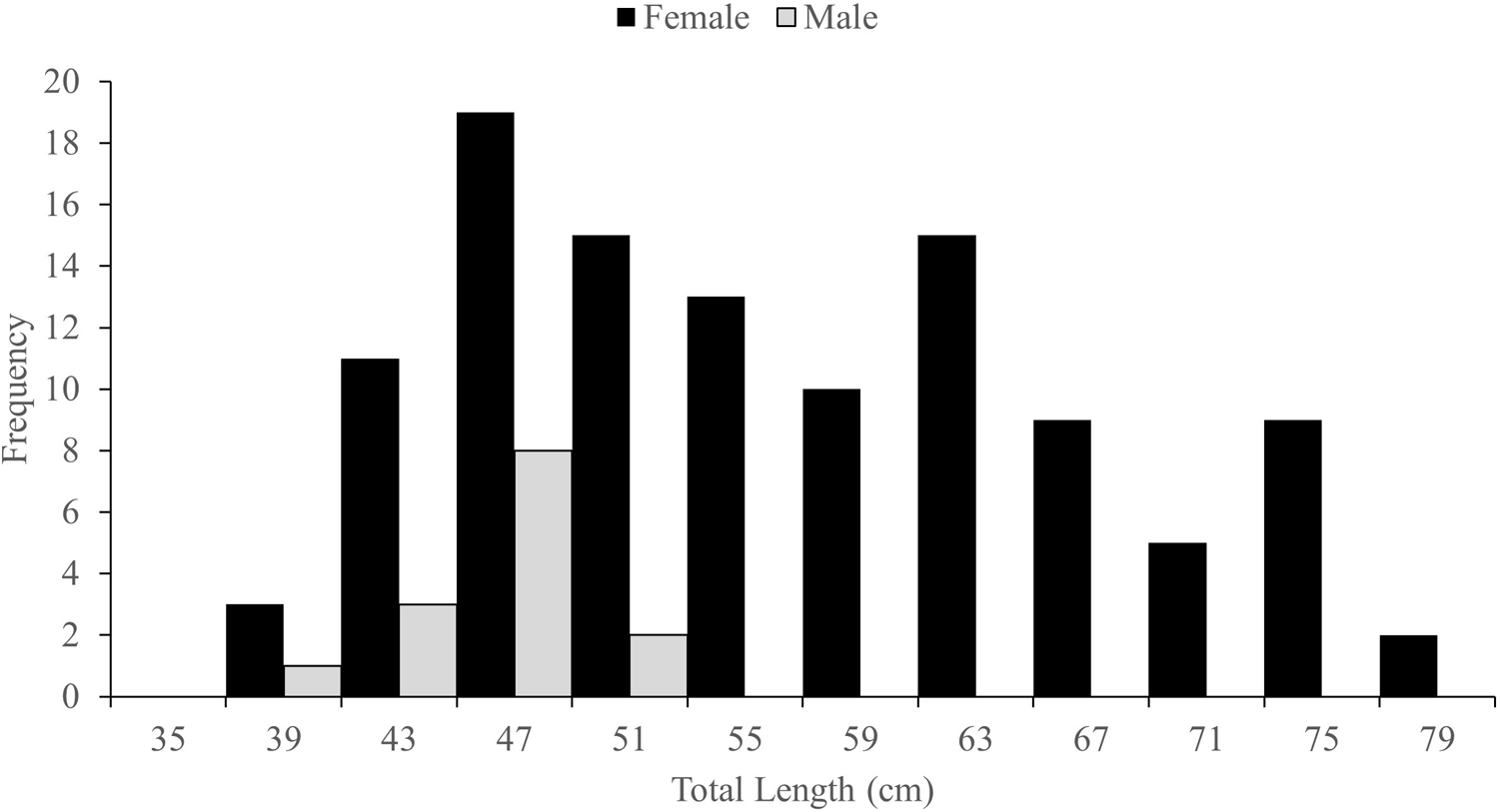
A total of 128 eels were sampled from Lake Bafa. Eels ranged from 35.7 to 77.2 (53.3 ± 10.3) cm in TL and 70.5 to 1000 (308.9 ± 214.1) g in TW (Table 1). The TL of female (n = 112) and male (n = 10) ranged from 36.1 to 76.2 (54.1 ± 10.1) and 35.7 to 47.8 (43.6 ± 3.7) cm, (Figure 2), respectively. The mean TL for yellow and silver eels were 48.9 ± 6.6 (35.7–63.7) and 61.9 ± 10.8 (39.9–77.2) cm, respectively. The body weight of female, male, yellow, silver, and all specimens mean values were 318.3 ± 209.0, 150.5 ± 34.7, 213.4 ± 98.7, 491.2 ± 245.5, and 308.9 ± 214.1 g, respectively (Table 1). The Mann–Whitney test revealed significantly difference between the sexes, regarding TL (U = 200.5, z = – 3.351; P < 0.05). The overall sex ratio (M:F = 1:11.2) was significantly skewed in favour of females.
Length–frequency distribution of males and females of eels collected from Lake Bafa.

Summary of the total lengths (cm) and body weights (g) of eels (Anguilla anguilla) collected from Lake Bafa

The number of specimens (n) and range, mean, and standard deviation of the mean (sd) for total length are provided.
Length–weight relationship
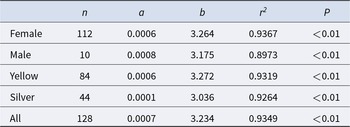
The regression coefficients between fish TL and weight of eels from Lake Bafa (for each sex) are presented in Table 2. The results obtained from the relationship parameters showed positive allometric growth. The highest values of the coefficient of correlation (R 2) were obtained from female individuals. In addition, the parameter b was significantly different from 3 (t = 2.53, df = 3, P < 0.05). Silver eels had the lowest value of a and b.
Parameters of the length–weight relationships for males, females, yellow, silver, and all individuals of eels from Lake Bafa

Age and growth
A total of 115 eels that ranged in size from 35.7 to 77.2 cm TL were aged. The rest of the otoliths were eliminated because they were damaged during processing. The age-classes ranged from 2+ to 9+ years, while the samples were dominated by the 4+ and 6+ years old (617%) (Table 3). The APE and CV were calculated as 5.9% and 4.2%, respectively. In the present study, older that 6+ were represented by females only. The observations on silver eel showed that ages ranged between 4+ to 9+ years, while the yellow eel ages ranged between 2+ to 8+ years.
Age–length key for eels from Lake Bafa, Türkiye

The von Bertalanffy growth curves (Figure 3) were fitted to the length at age data for yellow eel, silver eels and all specimens separately. The estimated parameters of the equation are shown in Table 4.
The Von Bertalanffy growth curves for yellow eels, silver eels and all specimen from the Lake Bafa.

Von Bertalanffy values L ∞, K, and t0 for yellow eels, silver eels, and all specimens from Lake Bafa

Discussion
It is well known that the European eel experiences diverse environmental conditions and anthropogenic pressures across their distribution range, resulting in large variations in biological characteristic at local and regional levels (Tesh Reference Tesh1977; Ardizzone and Corsi Reference Ardizzone and Corsi1985; Dekker Reference Dekker2000). Türkiye’s local population is part of the Mediterranean stock, with numerous eel habitats (Yalçın Özdilek and Özdilek Reference Yalçın Özdilek and Özdilek2020). The previous studies in Türkiye focused only on biometric data or length–weight relationships (Rad Reference Rad2013; Kasımoğlu Reference Kasımoğlu2014; Balkan and Yalçın Özdilek Reference Balkan and Yalçın Özdilek2018, Yalçın Özdilek et al. Reference Yalçın Özdilek, Gümüş and Dekker2006; Salman et al. Reference Salman, Özaydin, Akalin and Yokeş2017; Demirci et al. Reference Demirci, Akar, Şimşek, Demirci and Yalçın Özdilek2020). There are limited studies that provide detailed age and growth data, such as from Asi River (Yalçın Özdilek et al. Reference Yalçın Özdilek, Gümüş and Dekker2006; Demirci et al. Reference Demirci, Akar, Şimşek, Demirci and Yalçın Özdilek2020) and Gediz Delta (Salman et al. Reference Salman, Özaydin, Akalin and Yokeş2017). When the number of habitats in Türkiye is considered, the existing literature is far from reflecting the Türkiye’s local population. Therefore, the findings from Lake Bafa will contribute to the literature on Mediterranean eel populations at the regional level, in addition to giving data on local stocks for Türkiye. These findings could also aid international efforts and add information for the global eel model.
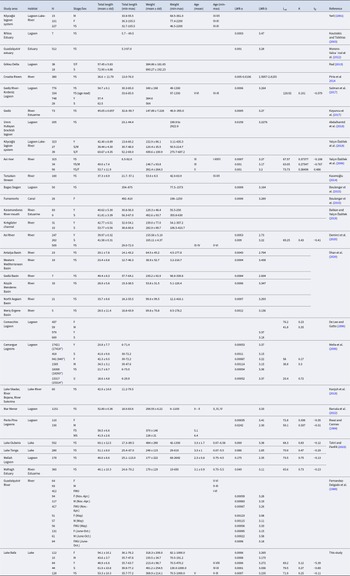
Although a wide range of average weight and length values were found across different studies, eel from similar habitats seem to have similar biological characteristics (Table 5). The length distribution of eels from the literature was similar to the studies with our study for lake habitats such as Gala Lake (Balkan and Yalçın Özdilek Reference Balkan and Yalçın Özdilek2018) and Köyceğiz Lake (Yalçın Özdilek et al. Reference Yalçın Özdilek, Balkan, Yalım, Emre, Küçük, Akın, Güçlü, Yağcı, Kaymak, Kurtoğlu, Toslak and Özbolat2018), while it was larger than stream habitats and smaller than lagoon habitats (Salman et al. Reference Salman, Özaydin, Akalin and Yokeş2017). However, there were records of individuals with extreme values in terms of length and weight in the literature (Asi River – Yalçın Özdilek et al. Reference Yalçın Özdilek, Gümüş and Dekker2006) (Table 5). The wide variety in length distribution might be attributed to differences in stage and sex distribution within or across habitat categories (Tesh Reference Tesh1977; Aprahamian Reference Aprahamian1986; Ardizzone and Corsi Reference Ardizzone and Corsi1985; Melia et al. Reference Melia, Bevacqua, Crivelli, De Leo, Panfili and Gatto2006). Many studies show that females generally grow faster than males (Holmgren and Mosegaard Reference Holmgren and Mosegaard1996; Rossi and Colombo Reference Rossi and Colombo1976; Vøllestad Reference Vøllestad1992; Vøllestad and Jonsson Reference Vøllestad and Jonsson1986). For this reason, it is commonly assumed that females grow faster than males (Holmgren and Mosegaard Reference Holmgren and Mosegaard1996).
The comparison of the biological features of european eels in türkiye’s distribution area

Y: yellow eel; S: silver eel; YS: yellow + silver eel; F: female eel; M: male eel; U: undifferentiated eel; weight are in g; lengths are in cm; std: standard deviation; min: minimum; max: maximum; LWR-a: intercept of linear regression; LWR-b: slope of linear regression; L ∞: theoretical asymptotic length; K: growth rate coefficient; t 0: theoretical age when fish length is zero.
* The specimen numbers for LWR equations.
The wide weight range observed in Lake Bafa eels aligns with findings in the literature. Habitat quality may be the key driver of diverse weight distribution of eel population, which is directly connected to food availability. In long-bodied fish like the European eel, individuals of the same length can vary significantly in weight, with one fish potentially weighing twice as much as another of the same length (Tesh Reference Tesh1977). This variation in weight is likely influenced by habitat quality, which reflects spatial and temporal differences. Habitat quality reflects factors like food availability, feeding success, and migratory dynamics (Tesh Reference Tesh1977; Aprahamian Reference Aprahamian1988; Melia et al. Reference Melia, Bevacqua, Crivelli, De Leo, Panfili and Gatto2006; Panfili et al. Reference Panfili, Ximénès and Crivelli1994; Poole and Reynolds Reference Poole and Reynolds1996).
Regarding the size and body mass of European eels, the large variation in size and stage makes it difficult to understand the growth pattern (Durif et al. Reference Durif, Dufour and Elie2006). In terms of length–weight data, as summarized in Table 5, the negative allometry in some studies might be a result of the stage specificity and low abundance of silver stage eels in the sampling. For example, the low sample size in Gediz River might be a reason for the negative allometry (İlhan et al. Reference İlhan, İlhan and Hammed2020).
It has been emphasized in detail in the literature that the growth characteristics of the European eel are highly variable in the distribution area across the Mediterranean according to sex, stage, and habitat (Aprahamian Reference Aprahamian1988; Daverat et al. Reference Daverat, Beaulaton, Poole, Lambert, Wickström, Andersson, Aprahamian, Hizem, Elie, Yalçın Özdilek and Gumus2012; Moriarty Reference Moriarty1987; Panfili et al. Reference Panfili, Ximénès and Crivelli1994; Poole and Reynolds Reference Poole and Reynolds1998; Tahri and Panfili Reference Tahri and Panfili2023; Vøllestad Reference Vøllestad1992) (Table 5). As previously reported, the results of the prior studies also demonstrated that eel growth rates vary in their geographical distribution at the local level (Moriarty Reference Moriarty1987; Tahri and Panfili Reference Tahri and Panfili2023; Vøllestad Reference Vøllestad1992). Although, it has been noted in several studies that older eels were found in areas close to the upstream (Aprahamian Reference Aprahamian1988).
Many studies have shown that eels grow faster in brackish that in fresh waters, which may be related to salinity, trophic status and food availability (Acou et al. Reference Acou, Lefebvre, Contournet, Poizat, Panfili and Crivelli2003; Melia et al. Reference Melia, Bevacqua, Crivelli, De Leo, Panfili and Gatto2006; Panfili et al. Reference Panfili, Ximénès and Crivelli1994). The cause of faster growth in brackish waters might be salinity, trophic status, and food availability (Tesh Reference Tesh1977; Aprahamian Reference Aprahamian1988; Melia et al. Reference Melia, Bevacqua, Crivelli, De Leo, Panfili and Gatto2006; Poole and Reynolds Reference Poole and Reynolds1996; Tahri and Panfili Reference Tahri and Panfili2023). It is known that growth rates of eels vary with habitat type, in general growth rate decreases from marine areas towards the upper part of the rivers (Daverat et al. Reference Daverat, Beaulaton, Poole, Lambert, Wickström, Andersson, Aprahamian, Hizem, Elie, Yalçın Özdilek and Gumus2012). Whilst a lake, the physical and eutrophic characteristics of Lake Bafa may explain the growth patterns of European eel observed in this study. A saline brackish wetland ecosystem structure formed by regulating inlet and exit water connections (Erdoğan Reference Erdoğan2011) might provide a lagoon-type dwelling for Lake Bafa eels.
There have been many studies with limited information on the biological characteristics of eels at stage level in Türkiye, but when this study is combined with previous research, it is concluded that eels found in Türkiye have similar length distributions, growth rates, and age ranges in similar habitats, but the weight was more variable, indicating that habitat quality is the key driver. For this reason, it is recommended that efforts should be made to protect existing habitats by reducing habitat destruction as well as reducing fishing mortality for eels, which are currently endangered, to continue their generations sustainably.
Highlights
1. Length–age distribution and growth patterns of Lake Bafa eels are within the broad range of worldwide eel populations.
2. While different habitats will have different ranges of eel biometrics, lengths are comparable among habitat categories.
3. This type of study is crucial for understanding the ecological characteristics and population dynamics of European eels, and the data collected can provide valuable insights for conservation efforts, habitat management, and sustainable fisheries practices.
Acknowledgements
The datasets generated and analysed during the current study are available from the corresponding author on reasonable request.
Author contributions
N.P.: Conceptualization, methodology, investigation, data curation, formal analysis, writing—original draft. H.A.: Supervision, methodology, formal analysis, writing – review & editing. E.İ.B.: Methodology, resources, validation. Ş.Y.Ö.: Supervision, project administration, funding acquisition, review & editing. All authors have read and approved the final manuscript.
Funding
The authors declare that they have no conflicts of interest.
Competing interests
This research received no specific grant from any funding agency in the public, commercial, or not-for-profit sectors.