Introduction
Culture change in nursing homes involves comprehensive efforts to redesign nursing home environments and to transform care delivery, so they are less institutional and increasingly more resident centered in more homelike environments (Koren, Reference Koren2010). Several new nursing home models have been developed to implement nursing home culture change. One of these new models focuses on small-scale homes that have a more homelike environment, given that small-scale homes appear to be more natural environments where staff can emphasize normalization of residents’ daily lives (Verbeek et al., Reference Verbeek, Zwakhalen, van Rossum, Ambergen, Kempen and Hamers2014). Small-scale nursing homes attempt to reframe the philosophical view of the person (or resident) as an individual and ensure sufficient support for personal care by respecting each individual's autonomy (Rabig, Reference Rabig2009). Furthermore, small-scale nursing homes are likely to be a place where a group of older adults reside together fulfilling social needs and companionship and performing normal, everyday activities. This trend has been implemented in many countries including group living in Sweden, small-scale living in the Netherlands, and Green House nursing homes in the United States (Verbeek et al., Reference Verbeek, Zwakhalen, van Rossum, Ambergen, Kempen and Hamers2010). Although specific culture change models have been implemented and have evolved differently within the diverse and unique contexts of countries in terms of social and cultural environments and government policies, the initiative toward small-scale nursing homes is becoming quite prevalent internationally.
Although there is insufficient data to generalize the overall effects of small-scale nursing homes, three quasi-experimental studies have examined the effects of these nursing homes in Europe and the United States. However, the findings from these studies are mixed. Green House nursing home residents reported better quality of life than traditional home residents in the United States (Kane et al., Reference Kane, Lum, Cutler, Degenholtz and Yu2007), but no significant effects were found for quality of life, depression, neuropsychiatric symptoms, and agitation between residents with dementia in small-scale nursing homes and traditional nursing units in the Netherlands and Belgium (de Rooij et al., Reference De Rooij, Luijkx, Schaafsma, Declercq, Emmerink and Schols2012; Verbeek et al., Reference Verbeek, Zwakhalen, van Rossum, Ambergen, Kempen and Hamers2014). In addition, three cross-sectional studies have examined organizational factors that influence nursing home residents’ quality of life or psychological well-being. Among the various organizational factors, the scale of the nursing homes was significant, indicating that residents in smaller-scale nursing homes were likely to report less depressed symptoms, and had higher scores for quality of life and life satisfaction (Lucas et al., Reference Lucas2007; Cassie and Cassie, Reference Cassie and Cassie2012; Shippee et al., Reference Shippee, Henning-Smith, Kane and Lewis2015).
Although smaller nursing homes are designed to be more homelike where residents have more opportunities to be socially engaged in daily routine activities and interact with others, few studies have examined the effects of small-scale nursing homes on social engagement (de Rooij et al., Reference De Rooij, Luijkx, Schaafsma, Declercq, Emmerink and Schols2012; Verbeek et al., Reference Verbeek, Zwakhalen, van Rossum, Ambergen, Kempen and Hamers2014). Much research has been done on the significant relationship between social engagement and quality of life and other health outcomes of older adults across settings. Specifically in nursing home settings, decreased social engagement is related to negative health outcomes, including loss of physical function, worsening behavioral symptoms, and depressive symptoms (Lou et al., Reference Lou, Chi, Kwan and Leung2013). Greater levels of social engagement are associated with longer survival, which means social engagement has a protective effect on mortality (Kiely and Flacker, Reference Kiely and Flacker2003). Nursing home residents who engage in meaningful social activities by initiating contact with and accepting invitations from others are likely to have more positive life experiences, generate more positive self-esteem, and have increased self-efficacy, which might positively influence final care outcomes (White et al., Reference White, Kendrick and Yardley2009; Lou et al., Reference Lou, Chi, Kwan and Leung2013). Thus, social engagement may be an important intermediate outcome that sequentially influences final outcomes for nursing home residents. To help improve residents’ health outcomes, it may be useful to consider strategies on how to enhance social engagement for nursing home residents. Recently, many individual-level factors that are negatively related to social engagement have been identified, such as older age, male, lower education, newly admitted, more depressed, poor activities of daily living (ADL), and cognitive function (Kolanowski et al., Reference Kolanowski, Buettner, Litaker and Yu2006; Lou et al., Reference Lou, Chi, Kwan and Leung2013; Shippee et al., Reference Shippee, Henning-Smith, Kane and Lewis2015). However, relatively little attention has been paid to organizational-level factors related to social engagement, particularly whether small-scale nursing homes have a better environment that allows older adults to be more engaged in more meaningful social activities compared to larger-scale nursing homes.
South Korea's cultural context and long-term care (LTC) systems are different from those in North America and Europe. Although South Korea has one of the most rapidly aging populations in the world, it has a short history of formal LTC services and few studies have focused on social engagement for older adults in nursing homes. Furthermore, the older adults who currently reside in nursing homes have typically lived with family-centered, multigenerational environments based on the norms of collectivism and Confucianism (Park, Reference Park2015); thus, it is critical for them to live with others and be socially engaged within their places of residence to find meaning in life. Although no representative small-scale nursing home models exist yet in South Korea, there are various sizes of nursing homes. However, little research has explored the differences based on size.
Given the international trend toward emphasizing small-scale nursing homes to provide more person-centered care within a homelike care environment, research about organizational factors is urgent, particularly focusing on whether the size of the nursing home directly influences nursing home residents’ social engagement. Understanding these organizational factors can guide policy-makers and nursing home providers. This study was designed to (1) describe the levels of social engagement in South Korean nursing homes, and (2) examine how the social engagements are different based on the size of nursing homes in South Korea.
Methods
Data sources and study sample
This is a cross-sectional correlation study to examine the level of social engagement by examining three groups of nursing home by size. In South Korea, there are two types of institutional care facilities to take care of older adults: (1) nursing homes (i.e. long-term care facilities, LTCF; beds ≥ 10), and (2) group homes (5 ≤ beds ≤ 9). However, given that group homes are not yet prevalent in South Korea, only nursing homes were included in this study. This study used two data sources. First, at the individual level, the survey data were based on the interRAI LTCF. A total of 314 residents were randomly selected from rosters provided by ten nursing homes located in Seoul, Incheon, and Gyeonggi province in South Korea. The interRAI LTCF is a part of the interRAI suite, which is an integrated family of 19 assessment instruments developed to assess a variety of vulnerable populations across settings (Hirdes et al., Reference Hirdes2008). The interRAI LTCF includes several domains to assess residents’ health and function status including ADL and cognitive function, mood, problem behaviors, communication, and psychosocial well-being, and the services provided for LTC residents (Mor et al., Reference Mor, Finne-Soveri, Hirdes and Gilgen2009; Kim et al., Reference Kim, Jung, Sung, Lee, Yoon and Yoon2015). The interRAI LTCF assessment form and manual were translated into Korean, and the inter-rater reliability of the items and scales of the Korean interRAI LTCF were excellent (Kim et al., Reference Kim, Jung, Sung, Lee, Yoon and Yoon2015). The second data source for organizational-level data was derived from the database of nursing home information in the National Health Insurance Service. The study was conducted using data that were de-identified at the individual and organizational levels. This study was approved by the institutional review board for human subject research at the institution with which the corresponding author was affiliated.
Measures
Dependent variable
The primary outcome variable of this study is the level of social engagement for nursing home residents. Social engagement was measured using the Revised Index of Social Engagement (RISE), which is a sum score of six dichotomous items including (1) interacting with others, (2) doing planned or structured activities, (3) accepting invitations to most group activities, (4) pursuing involvement in life of facility, (5) initiating interactions with others, and (6) reacting positively to interactions initiated by others. Each item was coded as 0 (not present in the last three days) or as 1 (exhibited in the last three days). We calculated the original RISE score in the descriptive analysis (range: 0–6); however, the RISE variable was dichotomized into zero (RISE = 0) or non-zero (1 ≤ RISE ≤ 6) in the logistic regression model considering the high frequency of a zero RISE score. The RISE was developed in 2008 and has been used in many studies on social engagement in LTC settings (Gerritsen et al., Reference Gerritsen, Steverink, Frijters, Hirdes, Ooms and Ribbe2008; Boekhorst et al., Reference Te Boekhorst, Depla, de Lange, Pot and Eefsting2009; de Rooij et al., Reference De Rooij, Luijkx, Schaafsma, Declercq, Emmerink and Schols2012). The RISE in Korean demonstrated good psychometric properties in terms of validity and reliability regardless of the cognitive function and facility type (Yoon and Kim, Reference Yoon and Kim2016). The Cronbach's α value of this study was 0.85.
Independent variables
The major independent variable is the nursing home scale group, which was measured by the number of beds. Given that staff requirements for nursing homes including personal care assistants (PCAs) and nursing staff of both registered nurses (RNs) and nurse aids (NAs) are different based on the bed size in South Korea, nursing homes were classified into three groups: “Small” (10 ≤ beds < 30), “Medium” (30 ≤ beds < 100), and “Large” (≥ 100 beds). The “medium-scale” nursing home was used as the reference group to compare the level of social engagement with “small-scale” and “large-scale” nursing homes.
Covariates
To control for the other organizational-level factors that influence nursing home residents’ social engagement, ownership, location, and staffing levels including nursing staff (RNs and NAs) and PCAs were identified from the previous literature (Lucas et al., Reference Lucas2007; Cassie and Cassie, Reference Cassie and Cassie2012; Shippee et al., Reference Shippee, Henning-Smith, Kane and Lewis2015). Location and ownership were binary variables measured as rural versus urban, and public versus private, respectively. As for the staffing levels, nursing staff (RNs and NAs) and PCAs were computed into the ratio separately, indicating how many residents were taken care of by one staff member.
Given that individual-level factors are also significantly associated with social engagement in nursing homes, age, gender, ADL function, cognitive function, and depressive symptoms were included based on the literature review of previous studies (Kolanowski et al., Reference Kolanowski, Buettner, Litaker and Yu2006; Lou et al., Reference Lou, Chi, Kwan and Leung2013; Shippee et al., Reference Shippee, Henning-Smith, Kane and Lewis2015). The ADL was measured using the ADL hierarchy scale (ADLHS) in the interRAI LTCF, which is a seven-point scale of functional performance composed of four ADL items. The ADLHS has a range of 0–6, with higher scores indicating greater dependence (Morris et al., Reference Morris, Fries and Morris1999), and the internal consistency measured by Cronbach's α was 0.91 in this study. Cognitive function was measured using the cognitive performance scale (CPS) ranging from 0 (intact) to 6 (very severe impairment) (Morris et al., Reference Morris1994). The depression rating scale (DRS) with seven items was used to measure depressive symptoms. The DRS ranges from 0 to 14, with higher scores indicating that the individual is more depressed (Burrows et al., Reference Burrows, Morris, Simon, Hirdes and Phillips2000) (Cronbach's α = 0.81).
Data analysis
Multilevel logistic regression was applied in this study. Considering a substantial number of zero value RISE scores in this sample (46%), we used RISE as bivariate variable (RISE = 0 vs. 1 ≤ RISE ≤ 6). The logistic regression estimated the probability of the non-zero category (1 ≤ RISE ≤ 6) compared to the zero category (RISE = 0) as a reference group. In addition, residents were nested by nursing homes; thus, a multilevel perspective was applied into the logistic regression model. Individual-level variables including age, gender, length of stay, ADL function, cognitive function, and depressive symptoms were included within the model and organizational variables including ownership, location, and the resident-to-staff ratios of the two types of staff (RNs and NAs) were included in between the model. Descriptive analyses were conducted using SAS 9.4 and the multilevel logistic regression model was conducted using Mplus 7.
Results
Individual and organizational characteristics
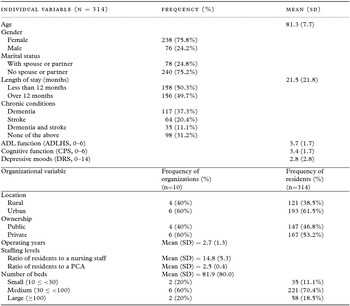
The upper section of Table 1 shows the demographic characteristics of the study subjects (n = 314). The mean age was 81.3 years, primarily female (76%), and only 25% had a spouse or partner. About half of the residents (55%) had stayed in a facility for more than one year, and about 70% had received treatment or management for dementia or stroke. The bottom section of Table 1 indicates the organizational-level information of the ten nursing homes in this study: 60% were in urban areas and 60% were private. The average period of nursing home operation was 2.7 years, and the mean number of beds was about 82. Staffing levels were calculated to determine the resident-to-staff ratios. On average, the nursing staff (either RN or NA)-to-resident ratio was 1:14.8 and the PCA-to-resident ratio was 1:2.5.
Sample characteristics

Note. SD = standard deviation; NH = nursing home; ADLHS = activities of daily living hierarchy scale; CPS = cognitive performance scale; DRS = depression rating scale. Higher scores of ADLHS, CPS, and DRS indicate worse status. Staff ratio was calculated using the ratio of the number of residents per staff.
Levels of social engagement
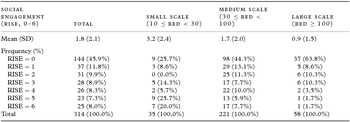
Table 2 demonstrates the levels of social engagement of the South Korean nursing home residents. The mean score of RISE was 1.8, and 46% of the residents had a RISE score of zero, indicating no social engagement in the nursing homes where they resided. In addition, the trend showed that the larger the nursing home, the lower the mean of the RISE score and the higher the frequency of zero RISE scores.
Levels of social engagement

Note. SD = standard deviation; RISE = Revised Index of Social Engagement. Higher scores of RISE indicate higher levels of social engagement.
Results of the multilevel logistic regression model
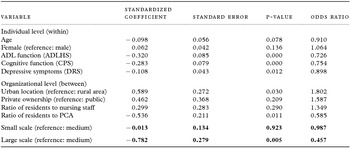
Table 3 shows the main results of the multilevel logistic regression to examine the effect of nursing home size on the likelihood of residents’ social engagement. Controlling for individual- and organizational-level factors, the logistic regression model indicated that residents in large-scale nursing homes (≥ 100 beds) had a lower probability of social engagement compared to those in medium-scale nursing homes (30 ≤ beds < 100; Odds ratio, OR = 0.457; p-value = 0.005) holding other variables constant. However, residents in small-scale nursing homes (10 ≤ beds < 30) had no significant difference in the likelihood of social engagement compared to those in medium-scale nursing homes (30 ≤ beds < 100; OR = 0.987; p-value = 0.923).
Results of the multilevel logistic regression model (n = 313)

Note. All estimates were standardized; RISE = Revised Index of Social Engagement; ADLHS = activities of daily living hierarchy scale; CPS = cognitive performance scale; DRS = depression rating scale. Higher scores of ADLHS, CPS, and DRS indicate worse status, while higher scores of RISE indicate higher levels of social engagement. The ratio of residents to staff indicates how many residents one staff member takes care of in a nursing home. Small (10 ≤ <30 beds), Medium (30 ≤ <100 beds), and Large (≥ 100 beds).
Discussion
To the best of our knowledge, this is the first study in South Korea to describe the levels of social engagement for nursing home residents and to examine how the levels of social engagement are different based on the nursing homes’ size using a validated instrument. Among the 314 older adults from ten nursing homes in this study, about half of the residents were rated as “not socially engaged” (RISE = 0). The multilevel logistic regression model demonstrated that the nursing home facility size was a significant factor to predict the likelihood of residents’ social engagement, which was that the residents in large-scale nursing homes were less likely to be more socially engaged than those in medium-scale nursing homes (OR = 0.457; p-value = 0.005).
A significant finding of this study is the very low RISE scores among nursing home residents in South Korea. The mean of the RISE was 1.8 (SD = 2.1) out of 6, and 144 of the residents (45.9%) were not socially engaged in their nursing homes. This score indicates that there were strikingly low levels of social engagement for nursing home residents compared to other studies, including an average RISE score of 3.27 in the Netherlands (Gerritsen et al., Reference Gerritsen, Steverink, Frijters, Hirdes, Ooms and Ribbe2008) and 2.54–4.28 in Dutch and Belgium nursing homes (de Rooij et al., Reference De Rooij, Luijkx, Schaafsma, Declercq, Emmerink and Schols2012). Although direct comparisons of mean RISE scores across countries without contextual factors should be interpreted with caution, the mean of the RISE score in this study indicates that South Korean nursing home residents appear to be relatively less socially engaged in the facility than those in European countries. This significantly low score might indicate that the South Korean nursing homes do not provide sufficient opportunities for older adults to be engaged in activities. Due to the short history of formal LTC provision in South Korean nursing homes, the majority of nursing home providers and stakeholders heavily focus on assisting residents with daily activities and providing clinical care rather than the psycho-social care needs of nursing home residents (Lee et al., Reference Lee, Cho and Jang2009). A study using the resident assessment instrument-minimum data set (RAI-MDS) and resident assessment protocols (RAPs), with an earlier version of interRAI LTCF and client assessment protocols (CAPs) demonstrated that about 57% of nursing home residents had triggered the RAP of “Activities” indicating that more than half of the residents were identified as at-risk in terms of social activities in the facility, and that “Activities” needed to be more incorporated into the residents’ individualized care plans (Bang and Yun, Reference Bang and Yun2010). In this regard, it is highly probable that nursing home care staff and policy-makers have paid less attention to the importance of social engagement and how to increase residents’ activity involvement.
The low average RISE score in this study might also be from the different measurement processes, particularly the observation period among studies has used the RISE for nursing home residents. The RISE used in previous studies has been an MDS-based measurement scale developed in the Netherlands (Gerritsen et al., Reference Gerritsen, Steverink, Frijters, Hirdes, Ooms and Ribbe2008; de Rooij et al., Reference De Rooij, Luijkx, Schaafsma, Declercq, Emmerink and Schols2012), in which RISE measures have the same six items over seven days of observation to determine whether the resident had engaged in each behavior. However, the Korean RISE used in this study was derived from the interRAI LTCF assessment, which is based on the same six items but the observation period was in the last three days (Yoon and Kim, Reference Yoon and Kim2016). A shorter look-back period might lead to lower mean scores in the current study. However, this finding leaves more to be investigated to determine if South Korean nursing homes provide residents with relatively fewer activities than those in the Western countries, if care staff are less aware of the necessity and importance of residents’ social engagement, or if the different measurement is an issue. More comprehensive and in-depth examination may provide insights into culturally adaptive small-scale nursing home models to enhance residents’ social engagement in South Korea.
This study demonstrated that the residents in larger-scale nursing homes in this study showed a significantly lower probability of social engagement than those in medium-scale nursing homes (OR = 0.457, p-value = 0.005). However, there was no significant difference between residents in small- and medium-scale nursing homes (OR = 0.987, p-value = 0.923). This is consistent with the findings from previous studies in which smaller-scale nursing home residents in Belgium, Dutch, and American nursing homes reported higher levels of engagement (de Rooij et al., Reference De Rooij, Luijkx, Schaafsma, Declercq, Emmerink and Schols2012; Yoon et al., Reference Yoon, Brown, Bowers, Sharkey and Horn2015). In smaller-scale nursing homes, the residents are more likely to become familiar with the small number of staff with consistent assignment, so their relationships are relatively closer than those in larger-scale nursing homes. Residents are likely to be more comfortable expressing their preferences and experiences about the activities in the facilities, and it is easier for staff to identify residents’ feelings about their activity experiences and to incorporate residents’ choices and preferences in the care plans. More frequent and intensive contact between the residents and staff can also increase the opportunities for social engagement for residents (Cohen-Mansfield et al., Reference Cohen-Mansfield, Marx, Thein and Dakheel-Ali2010), which is likely to occur more in smaller-scale nursing homes than larger-scale nursing homes. Therefore, the more person-centered care environment in smaller-scale nursing home facilities may offer a more attractive environment for residents to encounter meaningful stimuli, which could enhance social engagement.
The study findings on the significant relationship between facility size and the probability of social engagement is important because improved social engagement could be a potential mediating factor on the relationship between facility size and nursing home residents’ psychological outcomes. Several studies have already demonstrated that in smaller facilities, residents experience fewer depressive symptoms and aggressive behaviors and have a better quality of life (Kane et al., Reference Kane, Lum, Cutler, Degenholtz and Yu2007; Cassie and Cassie, Reference Cassie and Cassie2012; Shippee et al., Reference Shippee, Henning-Smith, Kane and Lewis2015). The other side of the nursing home literature has shown that higher levels of social engagement have protective effects on psychological outcomes and even on mortality (Kiely and Flacker, Reference Kiely and Flacker2003; Schreiner et al., Reference Schreiner, Yamamoto and Shiotani2005). Although this study did not directly examine the relationship between nursing home size and final psychological outcomes mediated by social engagement, this study may provide insights into the potential mechanisms. Residents’ increased social engagement in smaller-scale nursing home models may play an important role in improving residents’ psychological outcomes. Thus, further research using a larger study sample is needed to examine both direct and indirect effects of nursing home size on social engagement and psychological outcomes in a single model.
Although staffing levels were used as covariates, this study indicated that higher staffing levels of PCAs (a lower PCA-to-resident ratio) were significantly related to higher levels of residents’ social engagement (standardized coefficient = –0.539, p-value = 0.011), but there was no significant influence of the ratio of nursing staff to residents on the probability of social engagement (standardized coefficient = 0.299. p-value = 0.290). Considering that nursing home care is a labor-intensive industry where the majority of the care is provided by direct care staff, rigorous exploration on the relationship between staffing levels and care quality is still important. To date, many nursing home studies have identified the significant relationship between staffing levels and nursing home care quality and residents’ quality of life (Kim et al., Reference Kim, Kovner, Harrington, Greene and Mezey2009; Spilsbury et al., Reference Spilsbury, Hewitt, Stirk and Bowman2011; Backhaus et al., Reference Backhaus, Verbeek, van Rossum, Capezuti and Hamers2014). Due to the short history of the LTC system in South Korea, staffing requirements are quite low and not as strict at the policy level, so the focus can be on increasing the supply of nursing homes. Currently, PCAs make up about 87% of the workforce in nursing homes, and they are the primary providers of personal care, including ADL and other personal care. Some nursing staff, mostly NAs, provide specialized nursing and medical care, as needed, but when it comes to nursing home residents’ social engagement in South Korea, PCAs primarily create the environment for individually meaningful activities and encouraging residents to participate in group activities, since they work most closely with the residents. A lower PCA-to-resident ratio could help PCAs provide more opportunities to know residents’ needs and wishes and to make appropriate activities material available within each individual's physical and cognitive capabilities. In this regard, this study supports evidence that higher PCA staffing levels are still significant to increase residents’ social engagement levels regardless of the nursing home size from an organizational perspective. South Korea's LTC system and policies developed and established dramatically over a short period of time, so more research is needed to clearly describe the status quo of nursing home residents’ activity engagement (e.g. types, duration, and intensity of residents’ engagement activities, and how and who is involved in this process). In addition, South Korea needs to examine and develop multifaceted nursing home models, particularly focused on an organizational-level redesign including a small-scale environment with trained staff who can focus on person-centered care. Thus, researchers can determine the effects on residents’ activity involvement and engagement, which may subsequently improve care quality and quality of life for nursing home residents.
Limitations
One of the limitations of this study is that social engagement was measured by assessing residents’ levels of social engagement through RNs’ reports using the RISE instrument instead of using direct observations of residents’ activity engagement in the facility. In addition, the RISE assessment is based on looking back at residents’ social engagement over the last three days. Although this RISE measure was derived from the interRAI LTCF which is widely used in many countries, a shorter-looking back period may lower the mean score of RISE. Thus, further studies using in-depth observations are needed to examine what type, how frequent, how long, and how intense the activity participation is and how much is needed to significantly enhance residents’ social engagement scores and to provide more objective and practical information to nursing home providers and care workers. Subsequent research is also needed to examine whether residents’ enhanced social engagement in small-scale nursing homes could improve nursing home care outcomes at the individual and organizational levels.
In addition, a larger-scale study including group home residents is needed to obtain more generalizable findings. Although the 314 residents who participated in this study were selected randomly from the rosters of ten nursing homes from three larger metropolitan areas in South Korea, only 11% of the study sample resided in small-scale nursing homes, whereas 70% of the residents in this sample were in medium-scale nursing homes. Thus, a representative sample of nursing homes and group homes would provide more valid findings from an organizational perspective.
Conclusion
This study described the levels of social engagement for nursing home residents and examined the relationship between nursing home size and the probability of social engagement in South Korean nursing homes. About half of the residents were rated as not socially engaged. A multilevel logistic regression model demonstrated that the nursing home facility size was a significant factor to predict the levels of social engagement, indicating that the residents in large-scale nursing homes were less likely to be more socially engaged than those in medium-scale nursing homes. This study supports evidence from previous studies that smaller-scale nursing homes are likely to provide more person-centered care compared to large-scale nursing homes. There has been increasing public attention given to new and innovative nursing home models in South Korea. Subsequent quality studies are needed to examine how smaller-scale nursing homes enhance residents’ social engagement in terms of care delivery processes.
Conflict of interest
None.
Description of authors’ roles
Study concept and design: JYY & HK. Acquisition of data: HK & YIJ. Analysis and interpretation of data: JYY, HK, YIJ, & JHH. Drafting or revising manuscript for important intellectual content: JYY, HK, YIJ, & JHH.
Acknowledgments
This research was supported by a grant of the Korea Health Technology R&D Project through the Korea Health Industry Development Institute (KHIDI), funded by the Ministry of Health & Welfare, Republic of Korea (HI13C2250, PI: HK); and the Basic Science Research Program through the National Research Foundation of Korea(NRF) funded by the Ministry of Science, ICT & Future Planning (NRF-2010-0002802, PI: HK). The funding sources had no role in the study design, data collection and analysis, interpretation of the data, writing the manuscript or the decision to submit the manuscript for publication.