INTRODUCTION
White yam (D. rotundata) is an important root crop for both household income and food security throughout West Africa, but especially in Nigeria, Ghana and Côte d'Ivoire (Asiedu and Sartie, Reference Asiedu and Sartie2010; Onwueme and Charles, Reference Onwueme and Charles1994). West Africa accounts for some 95% of the global production of white yam (48 million tonnes), and Nigeria produces three quarters of the yams in West Africa (Shehu et al., Reference Shehu, Iyortyer, Mshelia and Jongur2010). There are many cultivated varieties of white yam and this provides farmers with flexibility (Baco et al., Reference Baco, Biaou, Pham and Lescure2008) although there is also evidence that diversity is declining as farmers opt for varieties that best suit their local growing conditions and markets (Zannou et al., Reference Zannou, Ahanchede, Struik, Richards, Zoundjihekpon, Tossou and Vodouhe2004). There is much potential for improvement in yam via plant breeding (Ekanayakea and Asiedu, Reference Ekanayakea and Asiedu2003), and there have been attempts to produce improved varieties of white yam (Scarcelli et al., Reference Scarcelli, Tostain, Vigouroux, Agbangla, Dainou and Pham2006) although to date these are not widely available and planted by yam farmers in West Africa. Indeed, despite its importance in West Africa the broad agreement amongst farmers and researchers is that the crop has received nothing like the attention it should from policy makers and funders (Shehu et al., Reference Shehu, Iyortyer, Mshelia and Jongur2010). While government help for yam farmers has often revolved around more generic interventions such as the provision of cheap credit and subsidised fertilizer, pesticides and machinery (Agbaje et al., Reference Agbaje, Ogunsumi, Oluokun and Akinlosotu2005), this may not be sustainable as availability is often poor or non-existent (Oladeji and Oyesola, Reference Oladeji and Oyesola2006).
One of the central limitations to yam production which has received some attention from researchers is the availability of good quality planting material, primarily seed yams (Ekanayakea and Asiedu, Reference Ekanayakea and Asiedu2003; Mignouna et al., Reference Mignouna, Akinola, Suleman, Nweke and Abdoulaye2014; Morse et al., Reference Morse, McNamara and Acholo2009; Okoli, and Akoroda, Reference Okoli and Akoroda1995). These can be very expensive (Korada et al., Reference Korada, Naskara and Edison2010; McNamara et al., Reference McNamara, Morse, Ugbe, Coyne and Claudius-Cole2012; Morse et al., Reference Morse, McNamara and Acholo2009), largely because yam tubers are easily damaged and susceptible to attack from a range of pests and diseases, including nematodes, which continue throughout the cultivation, storage and marketing cycle (Korada et al., Reference Korada, Naskara and Edison2010). The pest and disease problems within planting material have proven to be difficult to address, partly because of the wide range of organisms involved and their persistence through the cultivation, storage and marketing periods (Aboagye-Nuamah et al., Reference Aboagye-Nuamah, Offei, Cornelius and Bancroft2005; Coyne et al., Reference Coyne, Tchabi, Balmey, Labuschagne and Rotifa2006). A number of surveys in Nigeria have explored their perceived limits to ware yam production and availability of seed yam often emerges directly or indirectly, for example as part of a high cost of production, as an important factor (Izekor and Olumese, Reference Izekor and Olumese2010; Ugwumba and Omojola, Reference Ugwumba and Omojola2012).
Various techniques have been developed by both farmers and researchers to try and address this limitation of quality planting material, and many of them are based upon the cutting of healthy ware yam tubers (mother yams) of medium size (~1 kg) into minisetts of various sizes before treating with pesticides and planting. One of these is the AYMT developed via a series of UK Department for International Development (DFID) funded research projects in the early years of this century (Coyne et al., Reference Coyne, Claudius-Cole and Kikuno2010; McNamara et al., Reference McNamara, Morse, Ugbe, Coyne and Claudius-Cole2012; Morse and McNamara, Reference Morse and McNamara2015; Morse et al., Reference Morse, McNamara and Acholo2009). AYMT employs a sett size between 80 and 120 g, although farmers are encouraged to experiment with the best sett size under their local circumstances. In general terms, the larger the sett size then the larger the size of the resulting yam tubers (George, Reference George1990). The setts are treated with a pesticide ‘dip’ before drying and planting directly into the field. This is a critical stage as without such treatment the yam setts are highly vulnerable to attack from pests and diseases.
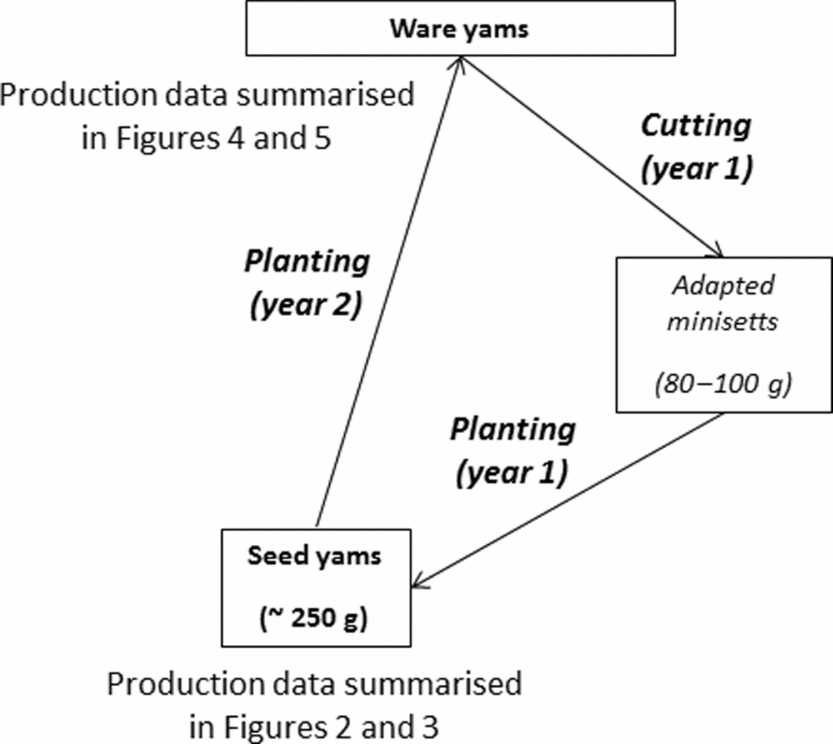
Since 2012, the AYMT has been promoted in both Nigeria and Ghana via a Bill and Melinda Gates funded project called YIIFSWA, and some of the agronomic (germination count, average tuber numbers and weights) and economic results obtained from a series of demonstrations established in 2012 and 2013 were presented in Morse and McNamara (Reference Morse and McNamara2015). The demonstrations were entirely farmer-managed and farmers were encouraged to use a yam variety of their choice. In the Morse and McNamara (Reference Morse and McNamara2015) paper, emphasis was placed on the differences obtained via the use of the pesticide cocktail relative to untreated controls and also, using data from 2013, the differences between two popular yam varieties (Ekpe and Opoko) and the interaction between yam variety and treatment. The results suggested that the use of the pesticide mixture resulted better survival of setts and larger tubers, indeed some of them approached 1 kg in size, but this is seen as a positive as it provides tubers of ware yam size that can be consumed. Thus, the AYMT provides both clean seed yams as well as tubers that can be consumed. There was also a varietal effect evident with regard to the two yam varieties included in the demonstrations, including a significant interaction between variety and pesticide treatment. However, an important limitation of the results presented in Morse and McNamara (Reference Morse and McNamara2015) is that they only refer to the production of seed yams (i.e. sett-to-seed yam). The next logical step, of course, is to see whether the seed yams produced from treated setts do go on to produce better ware yams as shown in Figure 1 (i.e. seed-to-ware yam). After all, there would seem to be little point in producing better-quality seed yams if they do not result in benefits for ware yam production. Yet, and perhaps surprisingly, this has not been explored empirically in any depth under farmer-managed conditions in Africa and for the most part the evidence for a correlation between seed quality and ware yam production is based on data from farmer surveys (see, for example, Ibana et al., Reference Ibana, Odoemena, Akintola, Ihedioha and Paul2009, Reference Ibana, Coyne, Claudius-Cole, McNamara and Morse2012).
The cycle from setts to seed yam and ware yam.

This paper presents the results of YIIFSWA demonstrations designed to use the seed yams produced in 2013 from both treated and untreated setts for ware yam production. It provides the first field evidence of the agronomic impact of growing seed yams produced via AYMT under entirely farmer-managed conditions. The paper presented here has two parts. It will first update the sett-to-seed yam results presented in Morse and McNamara (Reference Morse and McNamara2015) by including data from the 2014 season. While this part of the paper is admittedly somewhat incremental, it will serve to summarise the main findings of the sett-to-seed yam demonstrations. The second, and main, part of the paper will present the results of the seed-to-ware yam demonstrations established in 2014 using seed yams produced via AYMT in the 2013 demonstrations.
METHODOLOGY
Sett-to-seed yam demonstrations
The methodology for the 2014 sett-to-seed yam demonstrations is essentially the same as presented in Morse and McNamara (Reference Morse and McNamara2015) and need only be summarised here. The YIIFSWA project in 2014 involved a number of different types of demonstration plot established in a number of states in Nigeria. These are as follows:
-
1. Kogi State: Mostly the area surrounding the town of Idah, on the eastern bank of the River Niger.
-
2. Benue State: Mostly around the villages of Amoke and Agagbe.
-
3. Edo State: The village of Illushi, a major seed yam supplying centre on the western bank of the River Niger.
-
4. Federal Capital Territory: Various locations in the FCT.
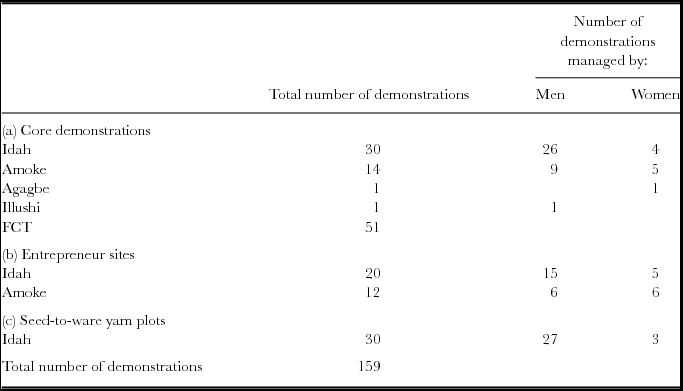
The number of different types of site and their locations are shown in Table 1. Most of the sites were managed by men, but it is noteworthy that women managed a number of the sites. While yam is regarded as essentially a crop cultivated by men this is not always the case. All plots were entirely farmer-managed, and thus they made the decisions over timing of activities, plant spacing etc.
Number and types of AYMT demonstration plots established as part of the YIIFSWA project in 2014.

The majority of demonstrations established in 2014 were of the sett-to-seed type, and here it is only necessary to describe the ‘core’ and ‘entrepreneur’ types established in the Idah area as these are the ones that provided the data for analysis. As in previous years (2012 and 2013), record keeping in the Idah area was much better than in the others and hence there is greater confidence in the quality of the agronomic data. As in previous years, the Idah farmers opted for two varieties – ‘Ekpe’ and ‘Opoko’. Opoko is a relative ‘soft’ tuber that is easily pounded and described by them as ‘sweet’ (i.e. has a good taste). Ekpe on the other hand has a tougher tuber that is not as easily to pound as Opoko but is regarded by farmers as being high yielding.
Treatment of the setts was via the ‘pesticide dip’ method set out in in detail in Morse and McNamara (Reference Morse and McNamara2015). The pesticides employed were Act Force Gold (insecticide; 45% w/w chlorpyrifos) and Z Force (fungicide; 80% w/w mancozeb) and for every 10 litres of water a total of 100 ml of Act Force Gold and 100 g of Z Force were added. Setts were cut to the recommended size (80 to 120 g) and immersed into the pesticide solution for 5 minutes or so before drying in the shade and planting.
As in 2012 and 2013, a record was kept of plant population, germination, number and weight of seeds harvested per sett planted and germinated. Planting typically takes place between March and May of each year using approximately a one-metre spacing between ridges/rows of heaps. The heaps for seed yam production tend to be smaller than those for ware yam, and the within row spacing also tends to be smaller. Seed yams for ware yam production are typically planted at a one-metre spacing within each row (equates to approximately one plant per square metre) while setts for seed yam tend to be planted at a spacing which varies between 25 cm and 50 cm within each row (2 to 4 setts per square metre). Harvesting of seed yam takes place at much the same time as for ware yam, typically between October of the same year and February the following year.
The 2014 core demonstration sites in the Idah area were approximately 20 m by 20 m in size. Five of the rows (approximately 5 m × 20 m) were planted with untreated setts while 15 rows (approximately 15 m × 20 m) were planted with treated setts. Many of the 30 farmers involved in the Idah core sites of 2014 had also been involved in demonstrations in 2012 and 2013 and thus were familiar with the AYMT.
The 2014 entrepreneur sites in Idah comprised plots of 20 m by 20 m but only one row (approximately 1 m × 20 m) was planted to untreated setts. The rest of the site (approximately 19 m × 20 m) was planted to treated setts. The reason for this is that the primary emphasis with the entrepreneur sites is on their economic performance and farmers are understandably anxious to maximise their financial return from the investment of land and labour. Most of the entrepreneurs were the same as those of 2012 and 2013, and thus were also familiar with AYMT.
Seed-to-ware yam demonstrations
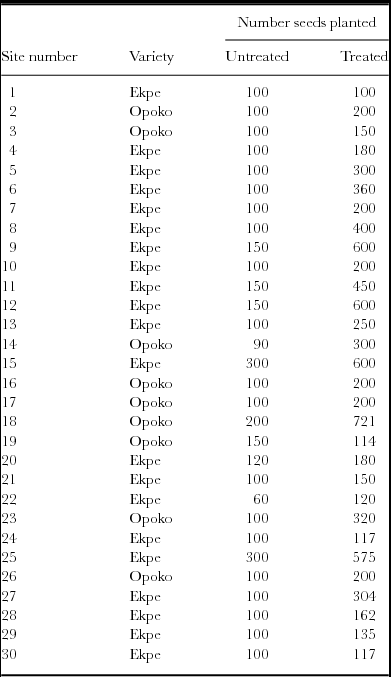
Farmers involved in the 2013 demonstrations were asked to keep some of the seed yam produced from both treated and untreated plots and plant them in adjacent plots in 2014. These demonstrations (30 in number; Table 1) were also farmer-managed with the proviso that no further pesticide was applied to any of the seed yams before planting. Planting for ware yam production tends to take place earlier in the growing season than for seed yam production, but harvesting takes place at much the same time. Demonstrations sizes varied somewhat between farmers and were not as standardised as for the core demonstrations of sett-to-seed. The plot sizes and number of seed yams planted for the 30 sites are summarised as Table 2.
Number of seed yams planted in the seed-to-ware yam demonstrations of 2014.

Selection of seed yams to plant was made by the farmer and the tuber sizes were generally within the typical range for seed yams. It was not possible to record the weights of seed yams planted or indeed their quality in the two parts of each demonstration plot.
The seed-to-ware yam demonstrations had not been attempted in the previous years of the YIIFSWA project and hence were a relatively new enterprise for the farmers, even if they had been involved in the sett-to-seed yam demonstrations. Unfortunately of the 30 demonstrations, the yield results from three of them were not usable as the farmers mixed up some of the outputs between treated and untreated plots. Hence, it was decided to eliminate the yield data from these demonstrations and the sample size was reduced to 27.
Analysis
As in Morse and McNamara (Reference Morse and McNamara2015), analysis of the data was primarily via analysis of variance (General Linear Model), with variety and treatment as the main effects.
RESULTS
Sett-to-seed yam
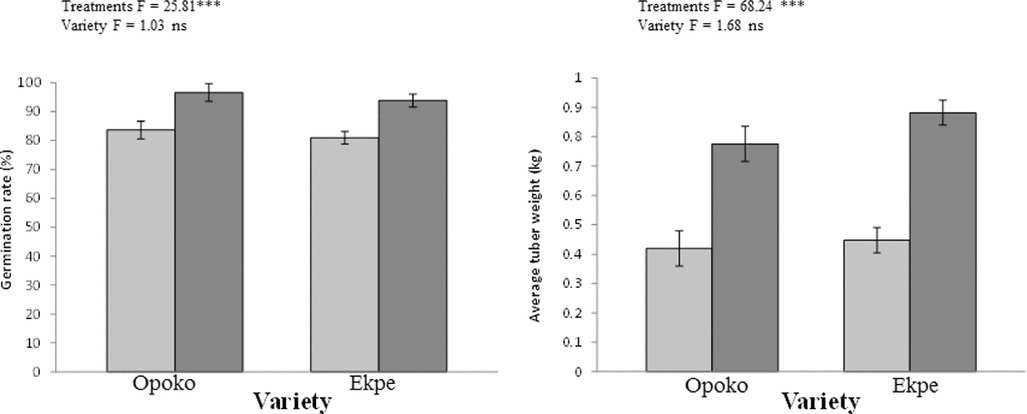
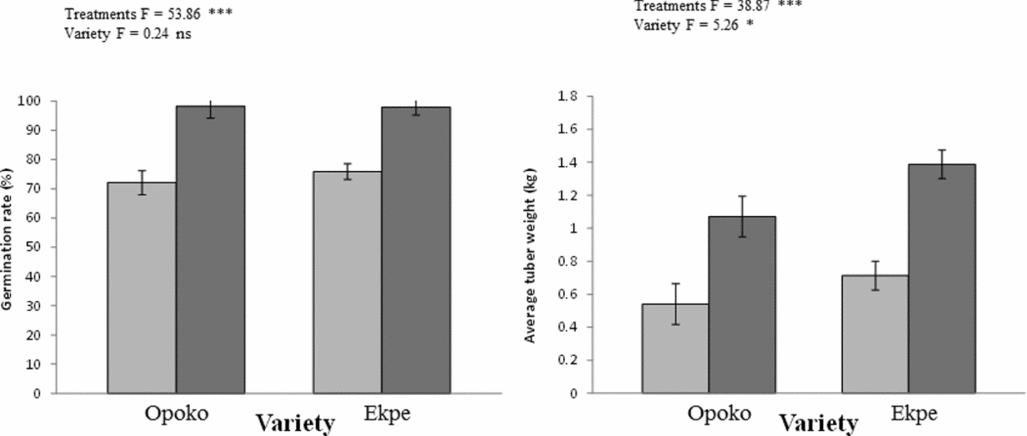
Figures 2 and 3 show the results of the sett-to-seed yam demonstrations established in 2014 for the Idah area. The bars are for untreated (light colour) and treated (darker colour) plots, and the error bars are the standard errors based upon the error mean square of an analysis of variance. Treated setts germinated better than the untreated and as in 2013 there was no apparent difference between the two varieties Opoko and Ekpe in terms of germination rate. As in 2012 and 2013, the difference between the average tuber weight of seed yams from treated and treated setts was statistically significant, with tubers produced from treated setts having a higher average weight than untreated ones. However, in 2014 the average weight for tubers from treated setts was higher than in previous years, 0.78 to 0.88 kg. This contrasts with comparable figures of approximately 0.6 kg in 2013. These are, of course, averages but even so an average tuber size of between 0.78 to 0.88 kg is closer to the typical size (>1 kg) for a ware rather than a seed yam.
Average germination rate (%) for untreated and treated setts along with the average weights of seed yam tubers (kg/tuber) harvested from untreated and treated setts. Bars (± standard error) with the lighter shading are for seed yams produced from untreated setts and the darker shading is for seed yams produced from treated setts.

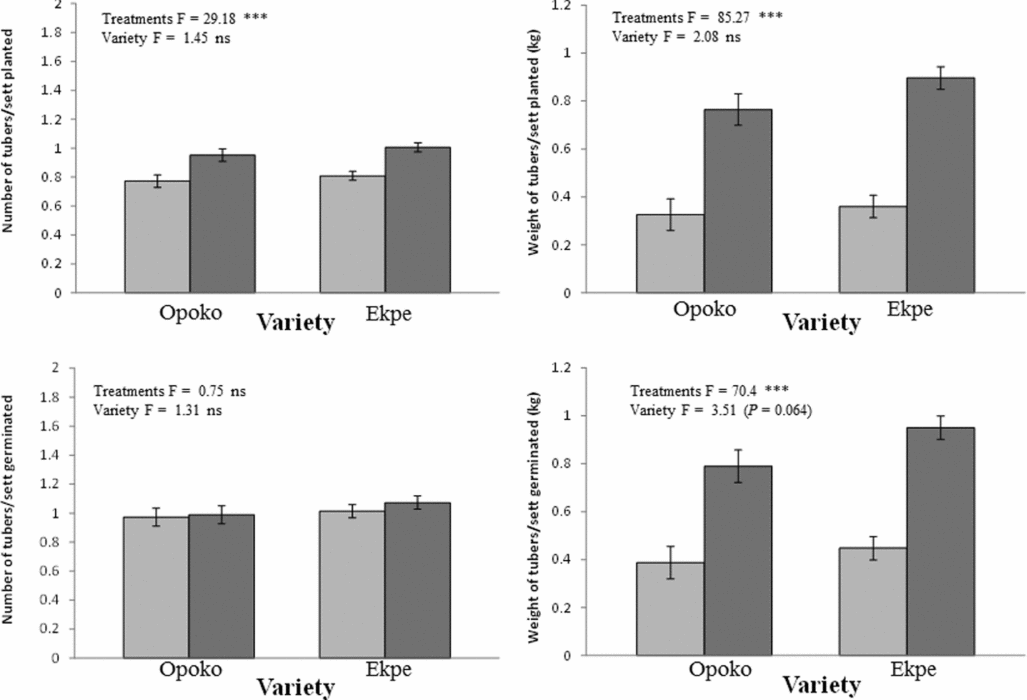
Average number of seed yam tubers and average tuber weight (kg/tuber) per sett planted and germinated. Bars (± standard error) with the lighter shading are for seed yams produced from untreated setts and the darker shading is for seed yams produced from treated setts.

Figure 3 provides the number of tubers harvested and the average tuber weight per sett planted and germinated. The number of tubers harvested per sett planted was higher for treated setts, largely reflecting the better germination rate of treated setts, but in terms of the number of tubers per sett germinated there was no statistically significant (at p < 0.05) difference between treated and untreated setts. In terms of average tuber weight per sett planted and germinated, this was significantly higher for treated setts in both cases. Thus, the pesticide treatment had the effect of aiding sett survival and also boosting the weights of seed yams produced per germinated sett. It is noteworthy that varietal differences were not as marked in the 2014 results as they were in 2013, probably because the sample size (number of demonstrations) was smaller. There were hints of a varietal difference in terms of seed weight per sett planted and germinated but the results were not statistically significant. Unfortunately, no assessment of pest/disease levels or tuber quality was possible within the logistical context of the demonstrations, so it is not possible to say whether the increased yield also resulted in better quality tubers.
Seed-to-ware yam
The results of the seed yam demonstrations are shown in Figures 4 and 5. In Figure 4, it is apparent that planting seed yams produced from treated setts improved both the germination rate (73% for untreated and 98% for treated) and average tuber weight (0.6 kg for untreated and 1.2 kg for treated) relative to the use of seed yams from untreated setts. There was also a significant varietal effect as ware yams from Ekpe seeds had a tuber weight higher, on average, than those for Opoko. The benefits in terms of germination and average tuber weight were indeed quite marked and suggest that the benefits from using sett treatment do carry over into ware yam production.
Average germination rate (%) and harvested tuber weights (kg/tuber) for ware yams produced by seed yams grown from untreated and treated setts. Bars (± standard error) with the lighter shading are for ware yams produced from seed yams grown from untreated setts and the darker shading is for ware yams grown from seed yams produced from treated setts.

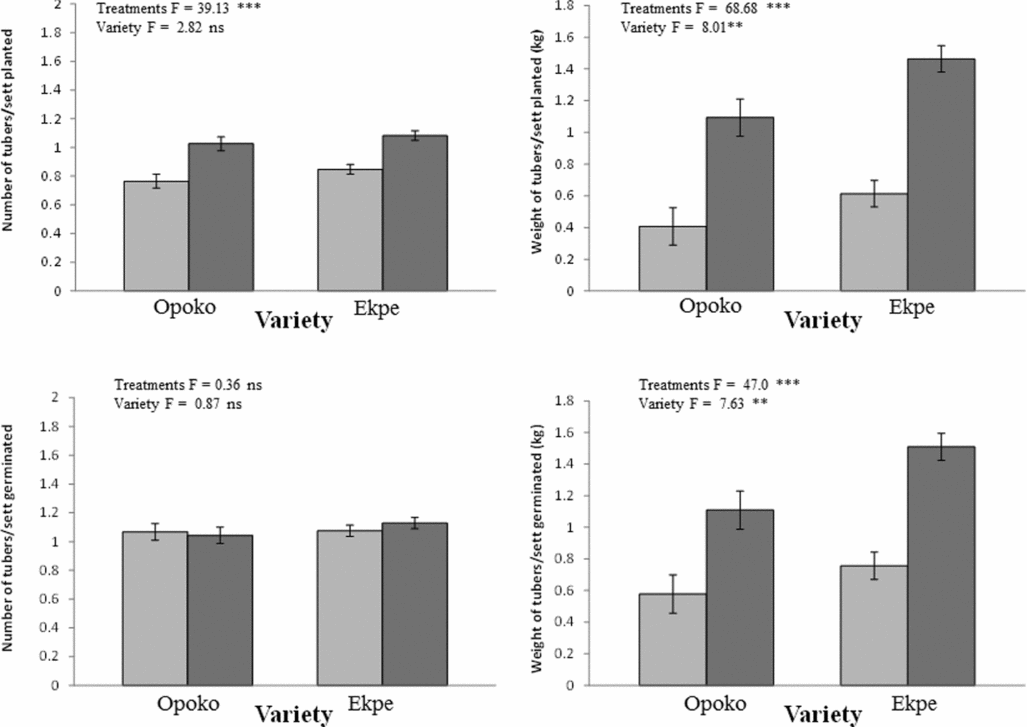
Average number of ware yam tubers and average ware yam tuber weight (kg/tuber) per seed yam planted and germinated. Bars (± standard error) with the lighter shading are for ware yams produced from seed yams generated from untreated setts and the darker shading is for ware yams grown from seed yams generated from treated setts.

In terms of tuber count and weights on a per seed planted and germinated basis (Figure 5), the results also suggest clear benefits from using seed yams produced from treated setts. The number of ware yam tubers per seed planted was greater for those seeds that were produced by treated setts, and was largely a reflection of the better germination rate for those seeds. The latter was reinforced by the results which suggest that the number of tubers per seed germinated was much the same for seeds from treated and untreated setts. In terms of the weight of tubers per seed planted and germinated, it is clear that these were significantly higher for yams grown from seeds produced from treated setts. Indeed, the results suggest that using seed yams produced from treated setts can double the size of ware yam tubers. Also of note is the varietal effect as it would appear that Ekpe produces larger tubers than Opoko, although farmers in the Idah area will often tell you this.
DISCUSSION
The sett-to-seed yam demonstrations of 2014 generated findings that are largely in line with those of 2012 and 2013 (Morse and McNamara, Reference Morse and McNamara2015). Pesticide treatment helped with sett survival and also resulted in larger seed yams. While no data were recorded for pest and disease incidence, it would seem logical to assume that the pesticide provided benefits in terms of reducing these within the setts as well as protection against further infestation once planted. It is of interest that even without the use of pesticide dip treatment the setts were still able to produce a reasonable number of tubers at an average weight that was, if anything, more ideal for seed yams than that obtained from treated setts. The smaller number of demonstrations in 2014 helps explain most of the differences with the 2012 and 2013 findings, most notably the absence of a statistically significant (at p < 0.05) varietal effect for some of the variables. Hence, while the results presented here for the sett-to-seed yam demonstrations in 2014 are arguably incremental they do help to reinforce the main benefits of the pesticide dip treatment for setts in the AYMT. As concluded in Morse and McNamara (Reference Morse and McNamara2015), the AYMT is clearly a technology that can ‘work’ under entirely farmer-managed conditions.
The major novel insights from 2014 were provided by the seed-to-ware yam demonstrations, the first of their type established in Africa. The planting of seed yams produced by treated setts had a significant positive impact in terms of germination (and hence number of tubers harvested) and tuber weight assessed on a per plant basis. This was already well known from informal discussions with farmers since the AYMT was first introduced into the Idah area. Anecdotal evidence has existed for many years that farmers are well aware of the benefits of growing better-quality seed yam and indeed that is why such tubers fetch a greater market price (Ibana et al., Reference Ibana, Odoemena, Akintola, Ihedioha and Paul2009, Reference Ibana, Coyne, Claudius-Cole, McNamara and Morse2012), but the results presented here provide the first empirical field evidence that under farmer-managed conditions the AYMT can ultimately enhance the production of ware yams by farmers. This is an exciting and highly important conclusion as it is ware yam production that the vast majority of farmers are most interested in for both food security and marketing, and availability of good-quality planting material at a reasonable price is an often stated limitation (Izekor and Olumese, Reference Izekor and Olumese2010; Ugwumba and Omojola, Reference Ugwumba and Omojola2012). Some farmers do specialise in seed yam production which they supply to ware yam growers (McNamara et al., Reference McNamara, Morse, Ugbe, Coyne and Claudius-Cole2012; Morse et al., Reference Morse, McNamara and Acholo2009), but it is critical to note that improving the quality of seed yam is not an end in itself. The ‘better’ seed yams must have a positive impact for ware yam production; otherwise, farmers will not go to the trouble, and indeed expense, of growing or buying better-quality seed yams. It is also important to explore all of this under farmer-managed conditions so as to closely mirror the circumstances within which farmers work.
It is a challenge to separate out the causes of the better performance of seed yams produced from treated setts given that the treatment helps to generate seed yams that are larger than those produced from untreated setts. Larger seeds are likely to have better survival and will also generate larger ware yam tubers. It is also likely that seeds from treated setts will have less pest and diseases. Thus, when farmers plant seeds produced from treated setts, they are probably planting larger tubers with less pest and disease. Hence, the question remains as to whether differences in ware yam production are a reflection of larger seed yams or their lower pest/disease burden or a combination of both? These are questions that probably require a dedicated research programme rather than the use of farmer demonstrations as in this study, but the results would be enlightening.
One other dimension that requires further research is the longevity of the pesticide effect. The results presented here show that the treatment of setts with pesticide in 2013 carried over into ware yam production in 2014, but what if those ware yams were in turn used as mother yams for further production of setts and seed yams? Would the positive effect of the pesticide dip continue to provide benefits at the start of another cycle of seed yam production? It is unlikely, given their nature, that the pesticides (chlorpyrifos and mancozeb) would remain in the tubers in any significant concentration but their effects in terms of reducing the pest/disease load might be persistent. Chlorpyrifos, for example, does decay within plant material and yam setts remain in the soil for 270 days or so before harvest. The extent of this decay within planted yam setts is unknown, but a half-life in humid tropical soil has been reported to typically vary between seven and 120 days (Chai et al., Reference Chai, Wong and Hansen2013). Whilst the rate of decline in plant material may be different from that in soil, it is likely that by the time of harvest any chlorpyrifos in the sett at the time of planting would have declined significantly. Also, chlorpyrifos is not translocated in plants and hence it is unlikely that the chemical will find its way from the sett to the new tuber. Mancozeb has an even lower soil persistence than chlorpyrifos with a reported field half-life of 1 to 7 days (Doneche et al., Reference Doneche, Seguin and Ribereau-Gayon1983). But if the benefits of the pesticide treatment do have a long-lasting effect, then maybe it is possible to have two cycles of seed and ware yam production arising from just one application of pesticide and this would clearly have both environmental and economic benefits.
CONCLUSIONS
The results from the YIIFSWA demonstrations in 2014 provide a number of insights. First, it provides further affirmation for many of the sett-to-seed results presented for 2012 and 2013 in Morse and McNamara (Reference Morse and McNamara2015). While this may be an incremental conclusion it nonetheless provides further confirmation that the AYMT is a viable approach to quality seed yam production in Nigeria. However, and far more importantly, the results presented here provide the first agronomic evidence obtained under entirely farmer-managed conditions in Africa that seed yams produced via the AYMT can provide significant benefits for ware yam growers in Nigeria. While the positive contribution of planting good-quality seed yams has often been mentioned by farmers, this is the first time that the statements have been supported by agronomic data obtained in conditions that closely match what farmers do in terms of ware yam production. The results also provide some pointers with regard to future research on the longevity of the benefits through new cycles of sett-seed-ware yam production.
Acknowledgements
We wish to acknowledge the support and encouragement of Dr Ademu Shaibu and the Director of the FCT-MDGs, Alhaji Ari Isa Muhammad; the Focal person at the FCT-MDGs Alhaji Abubakar Sani Pai; the Task Manager, Madam Nancy S. Nathan. A special word of thanks is due to the staff of the Diocesan Development Services (DDS), Idah and in particular Clement Agada, Gerard Obaje, Remigius Ikka and Stephen Okanebu and all staff at DDS for providing the administrative support. The authors would also like to thank Dr Lava Kumar, Dr Robert Asiedu and Dr Norbert Maroya, all of the International Institute of Tropical Agriculture (IITA).
The authors gratefully acknowledged the financial support for this work by the Bill and Melinda Gates Foundation (BMGF) under the Yam Improvement for Income and Food Security in West Africa (YIIFSWA) grant awarded to IITA.