



Introduction
Parenting is a key factor in child development. While inconsistent, over-reactive, controlling, and harsh parenting leads to a variety of negative child outcomes, including lower levels of social competence, academic achievement, and emotion regulation abilities, as well as elevated levels of internalizing and externalizing behavior problems, sensitive and warm parenting has been consistently linked to adaptive child outcomes across these same domains (Belsky & Fearon, Reference Belsky and Fearon2002; Dishion et al., Reference Dishion, Shaw, Connell, Gardner, Weaver and Wilson2008; Leerkes et al., Reference Leerkes, Blankson and O’Brien2009). Especially for children exposed to trauma and adversity, parental behavior seems to play a decisive role in fostering resilience (Betancourt et al., Reference Betancourt, McBain and Brennan2014; Gewirtz et al., Reference Gewirtz, Forgatch and Wieling2008; Klasen et al., Reference Klasen, Oettingen, Daniels, Post, Hoyer and Adam2010; Masten et al., Reference Masten, Hubbard, Gest, Tellegen, Garmezy and Ramirez1999; Masten & Narayan, Reference Masten and Narayan2012). Results from cross-sectional studies in different conflict regions demonstrate that non-punitive, warm, and supportive parenting styles reduce the harmful impact of war and military violence on children’s psychosocial and behavioral development (Dekel & Solomon, Reference Dekel and Solomon2016; Dubow et al., Reference Dubow, Huesmann, Boxer, Landau, Dvir, Shikaki and Ginges2012; Lavi & Slone, Reference Lavi and Slone2012; Qouta et al., Reference Qouta, Punamäki, Miller and El-Sarraj2008; Sriskandarajah, et al., Reference Sriskandarajah, Neuner and Catani2015a; Thabet et al.,Reference Thabet, Ibraheem, Shivram, Winter and Vostanis2009).
However, in these settings parents themselves are also exposed to high levels of violence and adversity which may interfere with their ability to provide the care and protection that their children need. Previous studies in post-conflict settings identified a strong link between traumatic war exposure and children’s experiences of maltreatment in the family (for a review see Montgomery et al., Reference Montgomery, Just-Østergaard and Jervelund2019). With regard to parenting behavior, in a recent meta-analysis, authors found not only increased levels of parental harshness but also reduced parental warmth in parents exposed to war (Eltanamly et al., Reference Eltanamly, Leijten, Jak and Overbeek2021).
Despite these findings, the links between risk and protective factors and parent-child relationships in postwar regions are still insufficiently understood. Moreover, to our knowledge, previous studies on the complex interplay of war-related stressors, family relationships, and children’s development in post-conflict environments are solely based on self-reported and other-reported data. In-depth knowledge of context-specific changes in parenting in postwar settings and their causes is essential for the development of prevention and intervention programs that support parents in creating an environment that promotes the healthy development of their children despite war-related adversities. We believe that using behavioral observations to capture the culture- and context-specific characteristics of parenting behaviors in post-conflict contexts and to analyze their association with potential risk factors is an important complement to previous research. Observational techniques allow for the exploration of behavioral and relational qualities of the parent-child interaction that participants may not be aware of or may have difficulty describing or quantifying (Gardner, Reference Gardner2000). In addition, behavioral observations are considered more objective because the behaviors of interest are rated by an independent observer (Aspland & Gardner, Reference Aspland and Gardner2003). Consequently, they are not subject to the methodological limitations of report measures (e.g., social desirability, retrospective reporting, systematic biases associated with participants judgements, expectations, and/or mood).
The Social Interaction Learning (SIL) model provides a theoretical framework for understanding the particular relationships between (risk) contexts, parenting behaviors, and child outcomes (Patterson & Reid, Reference Patterson and Reid1984; Patterson, Reference Patterson2005). The SIL model posits that contextual factors (e.g., socioeconomic status, culture, children’s temperament, and marital adjustment) influence parent-child interactions and thereby indirectly influence child outcomes. Risk contexts (e.g., poverty, community violence) increase the likelihood of coercive parent-child interactions and contribute to a decrease in positive parenting practices. Longitudinal studies in Western cultures have been able to provide empirical evidence for the SIL model (Patterson et al., Reference Patterson, Forgatch and DeGarmo2010; Patterson, Reference Patterson2005). However, the SIL model does not specify contextual factors that might be responsible for changes in parenting in the postwar context.
For the selection and structuring of relevant contextual factors potentially influencing parenting in post-conflict settings, we drew on the updated process of parenting model (Taraban & Shaw, Reference Taraban and Shaw2018) and the integrative model of parenting in war (Murphy et al., Reference Murphy, Rodrigues, Costigan and Annan2017). Both models build on Belsky’s (Reference Belsky1984) influential process of parenting model which proposes a multifactorial perspective to explain differences in the way parents raise their children. The very comprehensive and widely cited etiological model is based on evidence resulting from developmental and child abuse research (Belsky, Reference Belsky1980, Reference Belsky1984, Reference Belsky1993; Woodward & Fergusson, Reference Woodward and Fergusson2002). Belsky (Reference Belsky1984) presumed that parenting is influenced by the characteristics of the parent, characteristics of the child, and characteristics of the family’s social context. Taraban and Shaw (Reference Taraban and Shaw2018) recently reconsidered the original model in the context of the empirical and theoretical literature that has grown since then and developed an updated version. In adapting the original model, they preserved the three main domains proposed by Belsky (Reference Belsky1984), but added socioeconomic status as an important moderator of parenting. The integrative model of parenting in war is still in the conceptual stage (Murphy et al., Reference Murphy, Rodrigues, Costigan and Annan2017). It illustrates which socioecological factors at the macro-level (e.g., lack of legal protection, violence, instability), the community-level (e.g., community violence, breakdown of social networks and social services), the household-level (e.g., poverty, living environment, family composition, increases in interfamilial tension), partner-level (e.g., intimate partner violence, loss of partner), and individual-level (e.g., caregiver health, personal exposure to violence, personal stressors) may affect parenting in war-affected regions.
In what follows, we will draw on the current literature and the theoretical models presented above to further describe risk factors that may be relevant to changes in parenting behavior in the postwar context. We organize these according to the four categories of the updated process of parenting model (Taraban & Shaw, Reference Taraban and Shaw2018).
Parent characteristics
Factors often studied in the context of ineffective parenting relate to parental stresses and psychological wellbeing as well as parents’ own adverse childhood experiences (e.g., Lovejoy et al., Reference Lovejoy, Graczyk, O'Hare and Neuman2000; Niu et al., Reference Niu, Liu and Wang2018; Van Ee et al., Reference Van Ee, Kleber and Jongmans2016). The extent to which these characteristics play a role in the context of war is still insufficiently understood. However, it may be assumed that the relevance of these factors for parental behavior will increase due to traumatic experiences and stressors associated with war. For instance, in crises regions studies found high prevalence rates for symptoms of posttraumatic stress disorder (PTSD), anxiety, and depression (e.g., Hyland et al., Reference Hyland, Vallières, Shevlin, Karatzias, Ben-Ezra, McElroy, Vang, Lorberg and Martsenkovskyi2023; Lim et al., Reference Lim, Tam, Chudzicka-Czupała, McIntyre, Teopiz, Ho and Ho2022). Meta-analytic reviews based on studies from more stable settings provide evidence for a strong link between reduced parenting quality and both, depressive (Lovejoy et al., Reference Lovejoy, Graczyk, O'Hare and Neuman2000) and posttraumatic stress symptoms (van Ee et al., Reference Van Ee, Kleber and Jongmans2016). Also in the context of political violence, research results indicate that parental posttraumatic stress symptoms contribute to increased levels of coercive parenting (Zamir et al., Reference Zamir, Gewirtz, Dekel, Lavi and Tangir2020). In a qualitative study with Syrian refugee families, parents' psychological difficulties (e.g., feelings of frustration, anger, anxiety, depression, exhaustion) were associated with a lack of motivation for positive interactions with children, a lower ability to regulate emotions, and a greater tendency to take negative emotions out on children, which in turn translated into harsh and less warm parenting (Sim et al., Reference Sim, Fazel, Bowes and Gardner2018). Next to the ongoing current threat in postwar contexts, parents’ aversive childhood experiences also seem to continue to exert a negative influence on their parenting behavior. In particular, parental childhood victimization has been associated with parents’ use of violence against their own children in post-conflict environments (Crombach & Bambonyé, Reference Crombach and Bambonyé2015; Saile et al., Reference Saile, Ertl, Neuner and Catani2014; Sriskandarajah et al., Reference Sriskandarajah, Neuner and Catani2015b) above other proposed risk factors such as psychopathology in guardians as well as their level of war-related traumatic exposure (Saile et al., Reference Saile, Ertl, Neuner and Catani2014).
Child characteristics
In addition to identified associations between age and gender of children and parenting behavior (Jenkins, Rasbash, & O’Connor, Reference Jenkins, Rasbash and O’Connor2003), previous research suggests that children’s noncompliant, hyperactive, and aggressive behavior elicits parental negativity and control (Campbell et al., Reference Campbell, Pierce, March and Ewing1991; Dumas et al., Reference Dumas, LaFrenière, Beaudin and Verlaan1992; O’Connor et al., Reference O’Connor, Dunn, Jenkins and Rasbash2006). Thus, in the context of war, traumatic experiences and stressors may exacerbate behavioral problems in children, possibly leading to more coercive and less sensitive parenting behavior (Rajan et al., Reference Rajan, Neuner and Catani2022). A qualitative study on parenting challenges in war-affected families supports this assumption (El-Khani et al., Reference El-Khani, Ulph, Peters and Calam2016). Reasons cited by Syrian refugee mothers for parenting challenges included war-related changes in their children (e.g., rude and violent behavior, challenging emotions, signs of trauma).
Family social environment
In post-conflict societies, loss of or separation from a partner or close family member due to homicide, imprisonment, armed recruitment, abduction or displacement may negatively affect parents’ and children’s psychological wellbeing potentially leading to aversive parent-child interactions. In addition, studies found direct associations between exposure to political violence and increased rates of domestic violence (Catani, Jacob, Schauer, Kohila, & Neuner, Reference Catani, Jacob, Schauer, Kohila and Neuner2008; Gupta et al., Reference Gupta, Acevedo-Garcia, Hemenway, Decker, Raj and Silverman2009; Kinyanda et al., Reference Kinyanda, Weiss, Mungherera, Onyango-Mangen, Ngabirano, Kajungu, Kagugube, Muhwezi, Muron and Patel2016; Saile et al., Reference Saile, Ertl, Neuner and Catani2014). The level of violence in the family environment, in turn, may diminish parent’s ability to meet the needs of their children (Kohli et al., Reference Kohli, Perrin, Mpanano, Banywesize, Mirindi, Banywesize, Mitima, Binkurhorhwa, Bufole and Glass2015) and may lead to more harsh and coercive parent-child interactions. For instance, in a study with battered women Levendosky and Graham-Bermann (Reference Levendosky and Graham-Bermann2000) found both a direct and indirect (through maternal mental health) impact of partner violence on parenting. In post-conflict northern Uganda the severity of exposure to partner violence proved to be an additional predictor of the level of female guardian-reported perpetration against their children (Saile et al., Reference Saile, Ertl, Neuner and Catani2014). Moreover, higher rates of familiar violence were associated with reduced child-perceived maternal care (Saile et al., Reference Saile, Ertl, Neuner and Catani2016).
Socioeconomic status
As illustrated in the updated process of parenting model (Taraban & Shaw, Reference Taraban and Shaw2018), previous research shows that socioeconomic status has a decisive influence on parenting behavior, affecting characteristics of parents, children and the family social environment. Violent conflicts are likely to have a considerable negative impact on the economic position of families due to the loss of assets, limited access of households to employment and earning, and a state’s reduced capacity to provide essential services such as health care and education (Justino, Reference Justino2006). Poverty is therefore probably of crucial importance in explaining the emergence of ineffective parenting behavior in the context of war. In a qualitative study with Syrian refugee parents and children in Lebanon, for example, economic hardship prevented parents from meeting their children’s basic needs and adaptation strategies developed as a result compromised positive parent-child interactions (e.g., reduced parental monitoring, behavioral problems in children; Sim et al., Reference Sim, Fazel, Bowes and Gardner2018).
The present study
The present study was part of a larger research project examining parenting in post-conflict settings. The study was conducted in 2012. Northern Uganda was chosen as study location, since the entire adult population had been severely affected by about twenty years of civil war (1986-2006) between the Lord’s Resistance Army (LRA), a brutal rebel group, and the Ugandan government forces (Human Rights Watch, 2005). Parents were directly exposed to war violence, abduction and displacement (Vinck et al., Reference Vinck, Pham, Stover and Weinstein2007) and their children still face the daily stressors of the transition phase. These include inadequate health care and education, insufficient access to water, land disputes, landmines and unexploded ordnance (Uganda Humanitarian Profile, 2012), intimate partner violence, alcohol abuse (Saile et al., Reference Saile, Neuner, Ertl and Catani2013) and neglect and maltreatment of children (Ministry of Gender, Labour and Social Development, 2009; Saile et al., Reference Saile, Ertl, Neuner and Catani2014). Consequently, northern Uganda represents a prototypical example of a post-conflict society and thus, provides an ideal surrounding for the investigation of risk factors associated with observed parenting in the context of severe adversities.
The main emphasis of the larger research project was on the implementation and culturally sensitive analysis of behavioral observations of mother-child interactions in post-conflict northern Uganda. Even though fathers become increasingly important, traditionally child-rearing is still a women’s domain in Uganda (Nkwake, Reference Nkwake2009). Thus, we decided to focus on mothers and their children. The behavioral observations used in the present study were based on a problem-solving task. We assumed that observing mothers and children resolving their own disputes would provide a near-naturalistic representation of maternal parenting practices and child behavior. Family problem-solving conversations have been used successfully, with the resulting observational data being among the most reliable predictors (DeGarmo & Forgatch, Reference DeGarmo, Forgatch, Conger, Lorenz and Wickrama2004; Patterson, Reference Patterson2005). The purpose of the current study was to identify risk factors associated with observed parenting. Consistent with the SIL model, we assumed that environmental risk factors would be associated with higher levels of observed coercive parenting and lower levels of observed maternal warmth in post-conflict northern Uganda. Potentially associated factors of parenting in post-conflict northern Uganda were identified on the basis of the above described updated process of parenting model (Taraban & Shaw, Reference Taraban and Shaw2018) and the integrative model of parenting in war (Murphy et al., Reference Murphy, Rodrigues, Costigan and Annan2017) as well as previous research linking these factors to parenting in the context of war. Specifically, we hypothesized that higher levels of maternal psychopathology and previous victimization, children’s behavior problems, family violence and intimate partner violence, the loss of family members, and a low socioeconomic status would be independently associated with more coercion and less warmth of mothers during the problem-solving task.
Method
Sampling
Attention was drawn to the study through the distribution of flyers in public places and information visits to schools, churches, hospitals, women´s groups, and Gulu University. Only Acholi mothers who had a biological child between the ages of six and twelve were recruited. Participants were purposely selected to generate variance in terms of maternal educational level and exposure to war-related stressors.
There were 132 women who expressed interest in participation in the study. However, only 106 mother-child dyads could be included in the study because the other interested women either did not meet the inclusion criteria (not the biological mother, not Acholi, no child in the required age group) or decided not to participate because of discomfort with the videotaping or false expectations regarding study benefits (financial support for the child, school fees).
The final sample of the present study consisted of 101 mothers and their 6–12 year old children. Five mother-child dyads had to be excluded in advance of the analyses because they didn't participate in the problem-solving discussion (mothers did not report any problems or the children were too distressed to continue after the previous structured interaction tasks (SITs)). Mothers were between 20 and 52 years old (M = 33.34, SD = 6.63). The majority of mothers were currently in a partnership or married (57%), 18% were divorced, 15% were widowed, and 10% were single. The educational level of the mothers ranged from no schooling (4%) to having attained a university degree (6%), with a large proportion having gone to either primary school (33%, 4% with a degree) or secondary school (55%, 22% with a degree). Children were on average 8.92 (SD = 1.90) years old and 48% were female. The biological father of 17% of the children was deceased. Almost half of the children lived with both biological parents, 37% of the children had no primary male caregiver, and for the remaining children, either the stepfather (10%), uncle (5%), or grandfather (1%) performed this function.
Procedure
Our team on site consisted of three interpreters and 14 local trauma therapists, who had several years of experience in the diagnostics of mental health symptoms and in the treatment of PTSD in children and adults. Before the study started all team members took part in a two-day workshop on the collection of video-based behavioral observation data. Local trauma therapists additionally received comprehensive training on the set of questionnaires that were used to conduct interviews with mothers and children.
Women who met the inclusion criteria were invited together with their child to the office of a humanitarian organization. After welcoming participants they were given detailed information about the purpose and procedure of the study, potential risks, confidentiality and their right to withdraw at any time. During this initial phase, special care was taken to alleviate anxiety regarding video-based behavioral observations and to give participants time to ask questions and familiarize themselves with the environment. Mothers and children who wanted to participate in the study were each asked to sign a consent form (signature or fingerprints). For the participation of the children in the study, informed consent of the mothers was also obtained.
Interviews with mothers and children were then conducted in separate rooms by different local trauma therapists. Interviews were based on standardized clinical questionnaires. In addition, mothers were asked to indicate problem topics with their child using the culturally adapted Parent Issues Checklist (Rains & Corrigan, Reference Rains and Corrigan2004).
After a short break behavioral observations were conducted in a room equipped with items common in Uganda such as a traditional Ugandan mat for mothers and children to sit on. Mothers and children took part in five SITs, which were conducted in a fixed order and according to standardized instructions. The tasks had been pretested and culturally adapted in a pilot study in 2010 (Wieling et al., Reference Wieling, Mehus, Yumbul, Möllerherm, Ertl, Laura, Forgatch, Neuner and Catani2017). The interaction tasks were comprised of two activity-oriented tasks focusing on cooperation between mothers and children, two emotion-focused discussions of one positive and one negative event from the child’s life, and one problem-solving discussion. Each task took five minutes and was recorded on video. The problem-solving discussion analyzed for the present study was always carried out as the fourth SIT only followed by one activity-oriented task. Apart from the camera and microphone mother-child dyads were left unattended during the time of each interaction activity.
To conduct the study, mothers and their children spent about 2.5– 3 hours in the office of the humanitarian organization. During this time, they were offered drinks and snacks. Travel expenses were refunded. There were no other (financial) incentives for participating in the study. Following study participation, a short debriefing was conducted with each mother-child dyad by the first author, a trained clinical psychologist. Mothers and children were asked how they were feeling and invited to raise any further questions or concerns about their participation in the study. Some of the participants expressed distress due to extremely harsh living circumstances (e.g., severe intimate partner violence) or psychopathological problems (e.g., suicidality, posttraumatic stress symptoms). These mothers and children were offered counseling or trauma therapy by our local team members.
The ethics committee of the German Research Foundation (DFG), the ethics committee of Gulu University in Uganda and the National Council for Science and Technology in Uganda (UNCST) approved the procedure of the present study.
Observational measures
Observational measures were based on the problem-solving discussion. Topics for the problem-solving discussion were identified on the basis of mother’s responses to a culturally adapted version of the Parent Issues Checklist (Rains & Corrigan, Reference Rains and Corrigan2004). The cultural adaptation primarily involved shortening the Parent Issues Checklist to seven issues relevant to the Ugandan context and one open response item (Wieling et al., Reference Wieling, Mehus, Yumbul, Möllerherm, Ertl, Laura, Forgatch, Neuner and Catani2017). The instruction for this SIT was for mother and child to discuss the problem issue and to come up with a solution. The dyads most often discussed the following issues: keeping body clean (26%), helping out around the house/chores (23%), fighting with siblings/friends (12%), getting up in the morning (9%), and school performance (7%). Only two mother-child dyads discussed the problem issue in English; all others spoke in their native language (Luo). English transcripts of the verbal interactions between mothers and children were prepared by three interpreters. We used various methods to ensure the highest possible precision of the transcripts in terms of accuracy of translation as well as attribution of statements to time points and study participants. For example, all transcripts were checked for accuracy by a different interpreter than the one who originally created the transcript. In addition, a guide for transcript preparation was developed and the entire transcription process was supervised by the first author during regular meetings with the interpreters.
Dyadic coding was performed using a culturally adapted version of the Family and Peer Process Code (FPP code; Stubbs et al., Reference Stubbs, Crosby, Forgatch and Capaldi2001). The FPP code combines three closely related behavioral codes developed over a 20-year period by the Oregon Social Learning Center (Stubbs et al., Reference Stubbs, Crosby, Forgatch and Capaldi2001). It has its origins in Patterson’s seminal work on coercive processes in family interactions (Patterson, Reference Patterson1982) and is widely used to capture coercive and harsh as well as affectionate and caring interaction patterns as they unfold in time. Cultural and contextual adaptation of the FPP code was based on in-depth qualitative content analysis of transcripts and videos of the problem-solving discussion and was conducted by four researchers (for a comprehensive description please also see Möllerherm et al., Reference Möllerherm, Wieling, Saile, Forgatch, Neuner and Catani2019). Inductive latent content analysis (Vears & Gillam, Reference Vears and Gillam2022) was used to analyze the observational data and develop initial categories. These developed categories were compared to the definitions of the existing codes and the coding structure of the original FPP coding manual. Based on inductive and deductive methods (Elo & Kyngäs, Reference Elo and Kyngäs2008; Graneheim & Lundman, Reference Graneheim and Lundman2004), multiple coding iterations, regular reconciliation meetings within the research team, consultations with experts in the field of family behavioral observations, and repeated extensive revisions, new codes were developed and existing codes were culturally and contextually adapted. The entire adaptation process was continuously logged. A procedure comparable to member check focus groups was used for content validation (Birt et al., Reference Birt, Scott, Cavers, Campbell and Walter2016; Klinger, Reference Klinger2005). Member checking is a validation technique in qualitative research that uses participant feedback on findings to verify credibility, accuracy, and resonance of findings (Birt et al., Reference Birt, Scott, Cavers, Campbell and Walter2016). However, due to limited resources and logistical and ethical constraints (e.g., confidentiality), the focus groups were conducted with six members of our local Acholi team rather than with study participants. The focus groups discussed excerpts from the videos and statements from the transcripts. The comments and perceptions of our local team members were used to verify the fit of the developed coding system to the unique cultural and contextual characteristics of war-affected families in northern Uganda and, where necessary, to further specify the adapted content and affect codes. Finally guidelines for coder training and data entry procedures were developed and two teams of in total seven graduate students from the Bielefeld University and the University of Minnesota were trained by the first and third author in weekly sessions over a period of two months each.
The adapted version of the coding manual consists of 14 affect codes and 35 exhaustive and mutually exclusive content codes to rate verbal, vocal, and compliance behaviors (for an overview of all codes see Möllerherm et al., Reference Möllerherm, Wieling, Saile, Forgatch, Neuner and Catani2019). Because mothers and children showed almost no affective changes during the 5-min interaction, only content codes were employed in the present study. The level of analysis is an event-based coding system: new codes are entered each time the verbal or vocal content of the participant changes. This allows the interpretation of specified behaviors on the level of frequencies and the aggregation of content codes into broader dimensions.
All 101 problem-solving interactions were coded by the first author who, together with the third author, was primarily responsible for adapting the coding system. One-third of the SITs were additionally coded by at least one other person (third author and/or trained coders) and agreement between the respective codes was checked. In cases where different codes were assigned, the reasons for assigning the respective codes were discussed. Considering the decision rules and examples of the coding manual, it was then jointly agreed on the code that matched best.
Observed maternal parenting
For the assessment of observed maternal behavior, we employed a subset of content codes which can be combined into the broader parenting dimensions of warmth and coercion. With regard to warmth, mothers with high score values make positive evaluations of the child’s behavior, appearance or condition including thanking (positive interpersonal), name positive motivational relational consequences (positive interpersonal consequences), comment on their child in a positive personalized and unqualified manner (endearment), and laugh together with their child during the problem-solving discussion (laughing). Coercion can be seen as a negative counterpart to warmth, both in terms of its meaning and the content codes used. Mothers with high values try to coerce their children into the wanted behavior by making blaming and critizing statements, using insults, and mentioning negative consequences to misbehavior that lead to feelings of guilt or fear in their children. The sumscore of the codes negative interpersonal (e.g., “Here is not the place for you to look angry!”), coercive questions (e.g., “Do I always beat you without you doing any wrong?”), negative interpersonal consequences (e.g., “I just search for money and you don’t want to get things, this makes me so sad.”), verbal attack (e.g., “You are just a dirty child!”), and threats (e.g., “If you continue to behave like that, then there might come a time when I leave you.”) was utilized to reflect the extent of maternal coercion during the interaction with her child.
Observed children’s behavior
In order to assess the behavior shown by children during the interaction with their mother, we employed three sumscores. Socially desired response captures children’s unqualified affirmation to statements by mothers as well as socially desired responses to mothers’ questions and teaching. The two codes self-initiated positive talk and self-initiated negative talk comprise of content codes that reflect free verbal participation by children in the problem-solving process – but with differing connotation.
Self-report measures
Based on recommended practice in transcultural research (Flaherty et al., Reference Flaherty, Gaviria, Pathak, Mitchell, Wintrob, Richman and Birz1988; van Ommeren et al., Reference Van Ommeren, Sharma, Thapa, Makaju, Prasain, Bhattarai and de Jong1999), Luo versions of all instruments had already been developed for previous epidemiological studies in northern Uganda (Ertl et al., Reference Ertl, Pfeiffer, Saile, Schauer, Elbert and Neuner2010; Ertl et al., Reference Ertl, Pfeiffer, Schauer-Kaiser, Elbert and Neuner2014; Saile, Reference Saile2015). Cultural adaptation of the instruments included translation, lexical back translation, blind back translation, and separate focus groups with local translators, bilingual local therapists, and study participants (Saile, Reference Saile2015). All measures, including those originally designed as self-report questionnaires, were administered in the form of a one-on-one interview by local team members with several years of experience in conducting clinical interviews.
Aggressive parenting behavior
Mother-reported aggressive parenting towards the referent child was measured using the Parent-Child Conflict Tactics Scales (CTSPC; Straus et al., Reference Straus, Hamby, Finkelhor, Moore and Runyan1998). The CTSPC differentiates between the subscales psychological aggression, corporal punishment, physical maltreatment, severe physical maltreatment, neglect, sexual maltreatment, and nonviolent discipline. The original version utilizes an 8-point Likert-type scale to assess lifetime and one-year prevalence and chronicity (i.e., frequency of specific acts given the act occurred at least once). In the current study, we restricted the coding to ongoing acts (happened in the past month) and lifetime prevalence (happened ever in life). As suggested by Saile et al. (Reference Saile, Ertl, Neuner and Catani2014) we employed the cumulative number of different types of psychological and physical aggressive parenting behaviors as the most sensitive outcome measure for guardian-reported perpetration against the child excluding items on nonviolent discipline, neglect, and sexual maltreatment. Only items were included that were affirmed as ongoing (α = .76).
Child-reported maternal care
To assess child-perceived maternal care in the previous year we used the 12 care items of the Parental Bonding Instrument (PBI; Parker et al., Reference Parker, Tupling and Brown1979). On a 4-point Likert-type scale children evaluate the likeliness of each parental behavior (range: 0 = very unlike to 3 = very like). The PBI shows generally good indices of validity and reliability (Parker, Reference Parker1998). In the current study, the PBI care scale demonstrated a high internal consistency (α = .89).
PTSD in mothers
The severity of PTSD symptoms in mothers was measured with the Posttraumatic Diagnostic Scale (PDS; Foa, Reference Foa1995). The PDS captures the PTSD symptoms specified in the fourth edition of the Diagnostic and Statistical Manual of Mental Disorders (DSM-IV; American Psychiatric Association, 2000). The frequency of PTSD symptoms is coded on a 4-point Likert-type scale ranging from 0 (never or only once in the past month) to 3 (almost daily in the past month). The Luo version of the PDS has proven good concurrent validity and correspondence with expert diagnoses of PTSD (Ertl et al., Reference Ertl, Pfeiffer, Saile, Schauer, Elbert and Neuner2010). In the present study we calculated PTSD symptom severity level in mothers based on the cumulative frequency of affirmed symptoms. The presence of a PTSD diagnosis was determined by the DSM-IV criteria for PTSD in combination with a symptom severity threshold of 16. The symptom scale exhibited an excellent reliability index (α = .92).
Depression in mothers
Perceived severity of depressive symptoms in the week preceding the interview was recorded on the depression section of the Hopkins Symptom Checklist (DHSCL; Derogatis et al., Reference Derogatis, Lipman, Rickels, Uhlenhuth and Covi1974). The DHSCL comprises 15 items and uses a 4-point Likert scale ranging from 0 (no distress) to 3 (extreme distress). The DHSCL is one of the most extensively used instruments in transcultural research including Uganda (Roberts et al., Reference Roberts, Ocaka, Browne, Oyok and Sondorp2008). A validation study indicates that the Luo version of the DHSCL is a valid instrument to assess depression symptom severity in northern Uganda (Ertl et al., Reference Ertl, Pfeiffer, Saile, Schauer, Elbert and Neuner2010). Following the recommendation of Ertl et al. (Reference Ertl, Pfeiffer, Saile, Schauer, Elbert and Neuner2010) we used a cutoff of 1.65 to verify the presence of a depression diagnosis. The overall sumscore of the scale was used to reflect the severity of depressive symptoms (α = .92).
Exposure to traumatic events
The Violence, War and Abduction Exposure Scale (VWAES; Ertl et al., Reference Ertl, Pfeiffer, Saile, Schauer, Elbert and Neuner2010, Reference Ertl, Pfeiffer, Schauer-Kaiser, Elbert and Neuner2014) was used to assess maternal exposure to traumatic events. For the purpose of the present study, we utilized a 31-item version of the checklist excluding two items that capture traumatic events related to domestic violence. Thus, the level of traumatic exposure comprised of traumatic events related to the rebel army (“Have you ever witnessed somebody being forced to eat human flesh by the LRA?”) and forced perpetration (“Have you ever been forced to beat, injure or mutilate someone by the LRA?”) as well as general traumatic events (“Have you ever experienced a natural disaster?”). Internal consistency was α = .81.
History of childhood family violence
A 31-item checklist served to measure adverse events that mothers experienced at home during their childhood. In retrospect, mothers were asked about their experiences in their familiar environment before the age of 18 years. Items captured experiences of physical abuse (13 items), emotional abuse (4 items), sexual abuse (5 items and 1 item as witness), witnessing violence between family members (5 items), deliberate deprivation of food and water (2 items) and one open question. Reported acts were only coded if they were perpetrated by guardians or other family members, not intimate partners. In the present study, the checklist yielded good internal consistency (α = .83).
Emotional and behavioral symptoms
The assessment of children’s psychosocial adjustment was based on the parent report version of the Strengths and Difficulties Questionnaire (SDQ; Goodman, Reference Goodman1997). The SDQ is one of the most widely used screening instruments to assess children’s emotional and behavioral symptoms as well as prosocial behavior. It consists of 25 items that constitute the subscales emotional symptoms, peer relationship problems, conduct problems, hyperactivity/inattention, and prosocial behavior. Items are recorded on a 3-point Likert-type scale (0 = not true, 1 = somewhat true, 2 = true). A total difficulties score can be calculated by summing up all symptom scores except prosocial behavior scores. In addition, Goodman et al. (Reference Goodman, Lamping and Ploubidis2010) provided empirical support for advantages to using broader internalizing behavior (sum of emotional symptoms and peer relationship problems) and externalizing behavior subscales (sum of conduct problems and hyperactivity/inattention). The SDQ has been employed in post-conflict settings (Panter-Brick et al., Reference Panter-Brick, Eggerman, Gonzalez and Safdar2009; Saile et al., Reference Saile, Ertl, Neuner and Catani2016) and yielded good validity in the assessment of 6- to 13-year-old children in northern Uganda (Hinterding, Reference Hinterding2011). In the present study, we utilized the subscales internalizing behavior (α = .52) and externalizing behavior (α = .58) to capture the differences in the quality of emotional and behavioral problems.
Sociodemographic information
The first part of the interview captured individual and household characteristics as well as abduction history and displacement. For the present study we used two items on family composition (single mother; biological father died) that were dichotomously encoded (0 = no; 1 = yes) and one continuous variable (number of family members who died or disappeared during the war).
Severity of partner violence
The Composite Abuse Scale (CAS; Hegarty, Reference Hegarty2007) was employed to assess one-year prevalence and level of emotional, physical, and sexual partner violence experienced by mothers. The original scale consists of 30 items forming the subscales emotional abuse, physical abuse, harassment and severe combined abuse including sexual violence. Frequencies of abusive acts are coded on a 6-point Likert-type scale ranging from 0 (never) to 5 (daily) and are summed to calculate the overall level of abuse. Following the approach employed in an epidemiological study on prevalence and predictors of partner violence in northern Uganda we a priori omitted the subscale of harassment (Saile et al., Reference Saile, Neuner, Ertl and Catani2013). In addition we dropped one item (“Put foreign objects in my vagina or anus”) that has never been affirmed in that epidemiological study. In the current study, the resulting 25-item version of the scale demonstrated high internal consistency (α = .90).
Severity of family violence
To assess the current level of violence within the family we employed the same 31-item checklist that was used for mothers (α = .72). Children reported on acts from all family members who were in a relationship of responsibility, trust, and power to the child. The questionnaire had previously been employed with children in different cultural contexts (Catani et al., Reference Catani, Schauer, Elbert, Missmahl, Bette and Neuner2008, Reference Crombach and Bambonyé2009; Saile et al., Reference Saile, Ertl, Neuner and Catani2014, Reference Saile, Ertl, Neuner and Catani2016). In an epidemiological study with 6- to 13-year-old children in northern Uganda the family violence checklist yielded good re-test reliability (Saile et al., Reference Saile, Ertl, Neuner and Catani2014). In the current study, the cumulative number of different aversive experiences ever in child’s life was used to estimate the severity of family violence.
Socioeconomic status
We utilized maternal education and income as well as household possession per capita as indicators of socioeconomic status. Mothers’ educational attainment was recoded into a dichotomous variable (0 = no school – completed primary school; 1 = some secondary – completed university) to illustrate differences in the level of education. Mother’s regular monthly income in euro was included as a continuous variable. Household possessions per capita were computed by dividing the sum of family possessions (assessed using an asset checklist of typical items) by the number of family members living in the household.
Statistical analyses
For the description of sample characteristics, mothers’ and children’s mental health status, mothers’ previous victimization as well as risk factors in the family’s environment, we calculated means, standard deviations and frequencies based on self-report data from the final sample of 101 mother-child dyads.
In order to examine correlates of observed maternal parenting practices, we calculated Spearman’s rank correlation coefficients between the above described dimensions of observed maternal behavior (warmth, coercion) and child-reported maternal care (PBI) and mother-reported aggressive maternal parenting behavior (CTSPC).
We conducted two multiple linear regression models to identify maternal, child, and contextual factors which best predicted the observed parenting behavior. The two parenting dimensions warmth and coercion served as dependent variables. To test for multicollinearity, point-biserial correlation coefficients und Spearman’s rank correlation coefficients were calculated. According to Field (Reference Field2018), values greater than .80 indicate multicollinearity. Since our highest correlation coefficient was .52, all potentially associated factors presented in Table 1 were entered as independent variables. Due to the high number of independent variables, we used forward variable selection to determine the best fitting and most parsimonious model. Forward variable selection is a stepwise variable selection procedure in which variables are included in the model one by one. The first variable to be considered is the one with the highest positive or negative correlation with the dependent variable. This variable is only included in the equation if it fulfills the inclusion criterion (in this study: p < 0.05). Once the first variable has been included, the independent variable with the highest partial correlation is considered next. The procedure ends when no remaining variable fulfills the inclusion criterion. Based on this procedure, two core models were identified containing those variables found to significantly (p < 0.05) predict the observed parenting dimensions. To estimate the accuracy of the confidence intervals and thus, the reliability of the significance tests, 95% BCa-confidence intervals were inferred from bootstrapping based on 10,000 bootstrapping samples.
Overview and descriptive statistics of maternal, child, and socio-familial contextual factors used in the regression analyses

Notes. PDS = posttraumatic diagnostic scale; DHSCL = depression section of the hopkins symptom checklist; SDQ = strengths and difficulties questionnaire; CAS = composite abuse scale.
Data analysis was carried out with the SPSS 22 software package (IBM® SPSS® Statistics Version 22).
Results
Estimated prevalence rates and severity of mothers’ and children’s psychological symptoms, mothers’ previous vicitimization, and risk factors in the family’s environment were calculated. The number of mothers who met the cutoff for a probable diagnosis of posttraumatic stress disorder (5%) or depression (13%) was rather low. Based on mothers’ perception, about one out of five children qualified for clinically significant internalizing and externalizing symptom levels (20%). Both, mothers and children, had already experienced a high incidence of adverse events. Virtually all mother-child dyads were exposed to partner (87%) and family violence (95%). One out of four mothers were abducted up to three times by the LRA (M = 1.19, SD = 0.49) for a total average of 138.32 days (SD = 427.46). The large majority of mothers were internally displaced at least once (88%), with some mothers being displaced up to six times (M = 2.33, SD = 1.41). A small proportion of children (5%) also reported being displaced once. In addition, all mothers experienced family violence in their own childhood and reported exposure to at least one traumatic event. In this regard, many mothers reported the exposure to several general traumatic events (e.g., “Have you ever experienced the sudden, unexpected death of someone close to you?” (83%); “Have you ever witnessed somebody being physically assaulted?” (75%)) and war-related traumatic events (e.g., “Have you ever been exposed to combat or a war-zone?” (76%); “Have you ever witnessed somebody being abducted?” (66%)). A smaller proportion had also experienced forced perpetration during the civil war (e.g., “Did you have to attack a village or settlement?” (9%); “Did you have to abduct children/adults?” (8%)).
Observational measures of maternal parenting practices
For construct validation of the developed sum scores of observed parenting, associations were calculated between the two observational measures and mothers’ and children’s reports of parenting behavior. Results offer some evidence for the validity of the developed observational scores. Table 2 provides an overview of means, standard deviations and correlation coefficients of observed and reported parenting behavior.
Means, standard deviations, and correlation coefficients (Spearman’s rho) of observed and reported parenting behavior
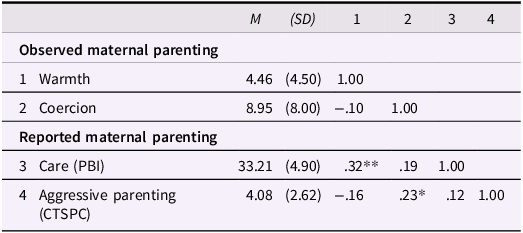
Notes. PBI = parental bonding instrument; CTSPC = parent-child conflict tactics scales. *p < .05. **p < .01.
Associated factors of observed parenting behavior
In order to identify the associations between maternal, child, and contextual factors and observed maternal parenting practices we calculated two multiple linear regression models. Table 1 provides an overview and descriptive statistics of the variables used as predictors in the regression analyses. As shown in Table 3, based on forward variable selection, only some characteristics of the child and severity of family violence became significant.
Standardized (β) and unstandardized (B) beta weights, bootstrap standard errors (SE), significance levels (p), and bias-corrected and accelerated (BCa) bootstrap (10,000) confidence intervals (CI) for the significant predictors of observed maternal parenting behavior

Note.
a Full model’s adjusted R 2 = .33; F(2, 98) = 25.91, p < .001.
b Full model’s adjusted R 2 = .15; F(4, 96) = 5.55, p < .001.
Discussion
The aim of the present study was the exploration of factors linked to observed parenting behaviors displayed by northern Ugandan mothers during a problem-solving discussion with their child. Observed maternal parenting practices were associated with child characteristics and family violence, however we did not find independent associations with maternal variables (exposure to trauma, psychopathology).
Especially with regard to child characteristics, we found distinct associations with maternal parenting behavior. Findings correspond to research indicating that children’s behavior and parenting influence each other (Moore et al., Reference Moore, Whaley and Sigman2004). In line with our expectations mothers in the present study used more coercive statements when children tended to bargain, disagree, or – in very rare cases – insult their mother. Moreover, positive behavior of children was accompanied by more warm and less coercive maternal behavior.
As expected, in addition to observed children’s behavior during the interaction task, mother-reported emotional and behavioral problems of children were also related to observed maternal parenting. Thus, results appear to confirm previous research findings that behavioral problems in children elicit coercive parenting behaviors (Yan et al., Reference Yan, Ansari and Peng2021). This might be particularly true for parents in post-conflict contexts who are themselves highly stressed and often have few financial and emotional resources to raise their children. Dealing appropriately with behavioral problems in their children could therefore overwhelm parents' parenting skills and lead to inept discipline and coercive behavior, which in turn could promote violent escalations in the family. Thus, the transmission of war violence into family violence may be driven by behavioral problems in traumatized children. This assumption is supported by a recent study conducted with institutionalized children in post war Sri Lanka (Rajan et al., Reference Rajan, Neuner and Catani2022). Authors found evidence indicating that the transmission of mass trauma into interpersonal violence can occur independently from parents through children’s psychopathology. Consequently, an important starting point for interrupting this cycle of violence appears to be parenting trainings that include psychoeducation on mental health problems in children, enable parents to understand deviant behaviors, and teach parenting skills in dealing with behavioral problems. It should be noted, however, that the evaluation of externalizing child behavior was based on the mothers' perception and thus may represent biased parental attributions of the child rather than actual child behavior. Johnston and Ohan (Reference Johnston and Ohan2005), for instance, found that parents who engage in harsh discipline are more likely to believe their child has hostile intent. Future research should more closely investigate the connections between children’s behavioral problems, parental perceptions of their child and parenting behavior in postwar contexts in order to identify more specific starting points for breaking coercive interaction patterns.
Consistent with previous studies (Levendosky & Graham-Bermann, Reference Levendosky and Graham-Bermann2000; Saile et al., Reference Saile, Ertl, Neuner and Catani2016), we found that higher rates of family violence were associated with lower maternal warmth during the interaction with the child. Studies on determinants of sensitive parenting show that stressors are associated with emotion regulation deficits (Carreras et al., Reference Carreras, Carter, Heberle, Forbes and Gray2019) and impaired reflective functioning in parents (Stacks et al., Reference Stacks, Muzik, Wong, Beeghly, Huth-Bocks, Irwin and Rosenblum2014), among other factors. Deficits in these areas may possibly explain the associations between family violence and reduced maternal warmth among mothers in the present study. The aspect that this effect is not evident with regard to coercive parenting behavior may lie in the observational setting. Potentially mothers aimed to present themselves at their best and therefore tried to avoid aversive behaviors. Accordingly, they may have exhibited coercive behaviors only when they felt provoked and emotionally overwhelmed by their children’s behavior. However this argumentation underlines the meaningfulness of observable restrictions in positive parenting behavior. Family violence surveyed in the present study consists of violence perpetrated by intimate partners, siblings as well as other members of the family. Therefore, an extension of intervention offers to the family environment seems to be indicated in order to strengthen positive interactions between mothers and children. It seems reasonable that these family interventions address the devastating effects of family violence on interpersonal relationships. In addition, family interventions should involve not only parents but also other family members entrusted with the upbringing of children (e.g., older siblings, grandparents).
Contrary to our expectations, we didn`t find any significant association between maternal characteristics and observed maternal parenting. For instance, general and war-related traumatic events experienced by mothers were unrelated to mothers' expressions of warmth or coercion. This finding is in contrast to previous studies in post-conflict settings that suggest a devastating direct effect of war on parent-child interactions (Boxer et al., Reference Boxer, Huesmann, Dubow, Landau, Gvirsman, Shikaki and Ginges2013; Catani et al., Reference Catani, Schauer, Elbert, Missmahl, Bette and Neuner2008, Reference Crombach and Bambonyé2009; Haj-Yahia & Abdo-Kaloti, Reference Haj-Yahia and Abdo-Kaloti2003). However, these different findings can probably be attributed to the different survey measures and methods. For instance, we focused our behavioral observation exclusively on the mother-child relationship whereas previous studies primarily used a measure for the general level of violence between family members in one household. Moreover, the findings from previous studies are based exclusively on self-reported and other-reported data, whereas the present study used both mother- and child-reported data as well as observational data.
Also, surprisingly, in terms of maternal psychopathology, there were no significant associations between mothers' depressive and posttraumatic symptoms and their parenting behaviors. A possible reason for this finding might be that study conditions led to the selection of a relatively functional group of mothers despite their psychopathological symptoms. Another decisive factor could be the way in which parenting behavior was measured. On the one hand, the clearly structured and time-limited problem-solving task may have provided a supportive external framework that also allowed mothers with depressive or posttraumatic symptoms to adequately engage. On the other hand, it is possible that the SIT was not suitable to capture restrictions in parenting practices resulting from depression and PTSD (e.g., inconsistent discipline, neglect). To clarify these hypotheses, longer and less structured behavioral observations should be carried out at participants’ homes.
In addition to the possible methodological explanations for the lack of associations between maternal characteristics and observed maternal parenting, the results may also indicate that the transmission of war violence to ineffective parenting does not primarily occur via parental psychopathology and traumatization. For instance, Sriskandarajah et al. (Reference Sriskandarajah, Neuner and Catani2015b) discuss in their study with Tamil families that the increased rates of family violence in the context of mass trauma are more likely to be explained by child traumatization and child behavioral problems. In multivariate regression analyses, the authors found that children’s psychopathology was the only significant predictor for children’s victimization by family violence after controlling for maternal traumatization and psychopathology.
Limitations
Despite its strengths (e.g., combination of self-report and observational data, variance in educational level, income and trauma exposure), the present study was also subject to several limitations. We employed convenience sampling instead of a random sample selection procedure and stratified our sample to include varying degrees of mothers’ education. As the study took place in the urban area of Gulu town the generalizability of results may be diminished. However, it is noteworthy that characteristics of an epidemiological study conducted with guardians and children in rural areas in northern Uganda in 2010 were highly comparable to the present sample (Saile et al., Reference Saile, Ertl, Neuner and Catani2013, Reference Saile, Neuner, Ertl and Catani2016).
Another limitation in the context of a collectivist culture is the sole reliance on biological mothers as primary caregivers. In collectivist cultures, apart from biological parents, community and family members play an important role in the socialization of children. In addition, due to the civil war in northern Uganda, many children are orphans and are raised by older siblings or members of the extended family (Ministry of Gender, Labour and Social Development, 2009).
Since the behavioral observation took place in a study setting the artificiality of the situation may have affected the authenticity of behaviors by participants and thus, the quality of the collected data (Gardner, Reference Gardner2000). Although we made extensive efforts to provide a culturally appropriate, natural and comfortable environment, the video setting and the invitation to the office of a humanitarian organization may have made the study appointment highly official. Thus, an unintended focus on good performance evoked by the environment may have influenced the patterns of behavior found in the present study (Grolnick et al., Reference Grolnick, Gurland, DeCourcey and Jacob2002). One way to scrutinize these potentially interfering influences in future would be to directly ask participants’ perception of the authenticity of the setting and their own behaviors. In addition, the conductance of behavioral observations at participants’ homes would be highly valuable.
Another limitation of the present study is the lack of demonstration of inter-rater reliability of the developed coding system.
Further, in the present study we didn't consider potentially important predictors of parenting that fall into the category of parental mental models (Murphy et al., Reference Murphy, Rodrigues, Costigan and Annan2017). Future studies in postwar contexts should address the impact of parental attitudes, perceived social norms and personal agency on parenting.
Finally the current study was based on a cross-sectional design. As a consequence, we were unable to verify that the independent variables causally shaped the observed parenting behavior. Furthermore, based on our current analyses, we are neither able to unravel the bidirectionality of parenting practices and children’s behavior and adaptation nor to identify moderating or mediating variables. Therefore, longitudinal studies using behavioral observations should be conducted in future to assess the long-term impact of war exposure and associated risk and supportive factors on parenting practices. In addition, sequential analyses of behavioral observations could provide valuable insights into mutually reinforcing coercive processes between guardians and their children.
Conclusion
To our knowledge, the present investigation is the first to examine maternal, child, and contextual factors related to parenting behavior in a postwar context using observational data from mother-child dyads and in-depth clinical interviews including psychiatric diagnosis. Of particular note is the use of behavioral observations to capture parenting behavior in a post-conflict region and the in-depth cultural and contextual adaptation of the coding system. The results demonstrate that it is feasible to conduct such elaborate and intensive research with families exposed to the extremely harsh living conditions of a postwar environment. Although we are still at an early stage, the present study provides a valuable foundation for further studies based on direct behavioral observations of (war) traumatized families. The findings from this unique study underscore the implications of previous studies that interventions to promote healthy child development in a post-conflict setting should address risk factors at distal and proximal levels of children’s socioecological context. Interventions should focus on the family environment and include teaching parenting skills for dealing with child behavior problems and promoting positive and loving parent-child relationships.
Moreover, the study raises many new research questions especially in terms of the bidirectionality of parenting practices and children’s behavior, the authenticity of observed parenting behavior, and the role of other family members entrusted with the upbringing of children in post-conflict settings. Despite the effort involved, the conductance of behavioral observations in the home environment including other family members as well appears highly beneficial to answer these questions.
Acknowledgements
We are very grateful to all mothers and children who participated in this study. We would like to thank the Vivo staff in Gulu for their enormous commitment throughout the study and their empathy with participants. Our special thanks are due to Anett Pfeiffer for her continuous and invaluable support on the ground. We acknowledge all students who were involved in the project, in particular Melissa Preusse. We are very grateful to Marion S. Forgatch, who was eminently supportive in her advisory capacity throughout the study.
Funding statement
This study was financially supported by the Deutsche Forschungsgemeinschaft (DFG; CC), Bielefelder Nachwuchsfonds (JM), and Deutscher Akademischer Austauschdienst (DAAD; JM).
Competing interests
The authors declare none.



