1. Introduction
Academies of engineering have been present and active in Europe for many decades: the earliest (IVA) was created in Sweden in 1919, and now 22 European academies of engineering are members of EuroCase, representing some 6000 fellows across Europe.
Curiously, France and Germany were, for different reasons, late in creating their national engineering academies: NATF in 2000 and Acatech in 2001. The German case can easily be explained by the strong activities taking place earlier in the Länder, but the French case is more surprising. Nobody would suspect a country that had developed a powerful nuclear industry, a modern transport network, a world-class oil and gas industry and leaders in the armament industry of showing a late (or lack of) conscience of technology.
More likely, the excellent image of basic science, raised to a high level by the Academy of Sciences since 1666, was accompanied by the idea that Science is the key to the future and should naturally lead to all applications. In addition, not so long ago, scientists were not inclined to collaborate with industry and business: the evaluation of their performance would not value nor even consider such an activity. Research was more popular than innovation, the budgets devoted to basic research grew, but the results obtained did not always contribute to economic growth and business.
On the industrial side, companies were not always inclined to hire PhDs, preferring instead production and development engineers. Until fairly recently, such areas as computer science were not considered scientific enough to join the Academy, and a chemical engineering inventor was elected as an emeritus only after obtaining a Nobel prize, while the initiator of a major innovation (wavelets) never received any recognition, as he was ‘merely’ a geophysicist in an oil company. Yet there was some evolution in this ‘straight line’ concept, and the French Academy of Sciences created in 1982 a committee for the applied sciences (CADAS), with a membership comprising an equal number of scientists and technologists from industry.
2. Creation of the NATF
The creation of NATF in the year 2000 was a major step forward, a national ambition: ‘Une Académie des technologies pour la France’. Coming from industrial technology, and having had the honour of chairing the CADAS committee, with my fellows of CADAS I had been given the mission to prepare for this change and to launch a new Academy, entirely devoted to technology, and its follow-up, separate from the Academy of Sciences. Biologists would call this process a binary fission. The initial ambition was clearly that the ‘daughter’, although 334 years younger, would become a ‘sister’, and cooperate in an equal position to join science and technology for a common national goal. There were interesting discussions about the name of the new Academy, in which one could compare the meaning of words: engineers, engineering, ingénieurs, ingéniérie, techniques, technologies. Indeed, the French word ‘ingénieur’ has a significantly higher standing than ‘engineer’ in English. The latter in the USA can designate a train driver. There is a saying that the ‘engineer’ comes from engine, whereas the ‘ingénieur’ originates from genius, as were indeed the likes of Gustave Eiffel, André Citroën, Louis Blériot or Édouard Michelin.
3. The Initial Project
Based on 18 years of experience of CADAS, a few guidelines were settled upon by a special founding committee.
The main objective was to promote technology for the benefit of mankind, a goal that was formalized a few years later by the motto ‘sharing reasoned, chosen progress’. The ambition was also to develop technological intelligence. It was absolutely clear that the new Academy should definitely not be a group of lobbyists promoting technology for itself, but rather should think in terms of global impact, including the economy, employment, and the environment: members were to be independent from any lobby. A logo was designed, symbolizing the handshake of technology and mankind.
3.1. Membership: the Fellows
These objectives led to a search for a variety of profiles, not limited to CTOs from large companies: NATF would also need – a major difference with the Academy of Sciences – a significant number of economists, architects, medical practitioners, sociologists and philosophers. The aim was to elect a limited group of active Fellows, no more than 250, in addition to Emeriti beyond the age of 70. Different from most academies around the world, it was felt that there should be only one category of Fellow without distinction of citizenship, i.e. foreigners being included in this unique category. The election process should imply competition, as in the Academy of Sciences. Proposals for membership would not originate with candidates themselves. Only proposals from the Fellows were permitted, and should lead to an annual election of, on average, 15 new members. Initially, many members of the Academy of Sciences – those more involved in technological fields – were invited to join, and a few of their associates were submitted to a competitive election process. Members should not only represent the actual profile of industrial activities in the large companies, but also new technologies and small and medium enterprises (SMEs). It was also decided that the Academy working groups should be supported by a number of external experts, who would make themselves available to contribute to the discussions and for the preparation of reports.
3.2. Working Methods
Another difference with the Academy of Sciences was that priority was not given to work in disciplinary divisions (such a mathematics, chemistry, biology) but rather to transdisciplinary and interdisciplinary work on selected global themes of interest for the twenty-first century: specialists of different fields would combine their expertise for a common goal, focusing on a systemic approach.
3.3. Funding
Initially, the main support was to come from the Ministry of Research, but many other minor contributions were expected from organizations, offering experts, meeting rooms, visits, and so on: the ambition and the dynamics of the new academy indeed met with a large and diversified support, through the creation of a ‘partners network’ that contributed an additional financing from industry.
3.4. Regional Objectives
The academy should be present, through its members and its meetings, in different regions of the country where people work, creating technology and wealth, and avoid delivering a message that would have a top-down Parisian view! Interacting with and assisting local actors, it should learn from experiences and innovation successes in Bordeaux, Toulouse, Marseilles, Nice, Brest or Lyon, and aim to understand the specific local problems and challenges.
3.5. International Links
At the international level, cooperation and joint studies on future challenges should be the rule. These guidelines had already been given by CADAS, which was for 18 years a proactive member of EuroCase and was also managing, in Paris, the Secretariat of this active European organization. NATF took over this mission from CADAS, also as a member of CAETS, the world organization of engineering academies, with 27 member countries. Relationships with the European Commission were to be developed, contributing to the building of a technological Europe.
4. Fifteen Years Later: How Far Have We Come?
Born in the twenty-first century, we are still a young academy, still on its learning curve. Indeed, the first 15 years were not an easy trip, but NATF is now increasingly recognized as a natural partner for government and economic circles in France. In mid-2015 we had a membership of 279 Fellows, while 46 others have already passed away. Questions are regularly addressed to us by government ministers and public organizations. In 2006, the Academy became a public establishment and, since 2013, it has been under the protection of the President of the French Republic.
In France, NATF plays a benchmark role for all questions related to technologies and their impact on society. It acts as a mediator between policy decision makers, public opinion, the research communities and socio-economic actors. Before reaching this status, it had already published many significant reports on major challenges for the twenty-first century: energy transition, ICT, transport, robotics, medicine, education, assessment of societal and technological risks. Our communication process with the broader public has improved, a specific television programme has been launched and promoted, and the number of internet followers of our websites and social media has significantly increased, even if the bilingual or multilingual aspect and other issues still have to be developed.
Members have accepted the fact that they do not individually hold the truth and have to listen to others. They are supposed to think beyond technologies, and concentrate on their impact, over the long term, ‘from cradle to grave’, also incorporating the economic and social approaches. Our debates are lively, free of constraints, yet sometimes conflictual, as they should be. Joint study groups have been held with our corresponding German, British, Indian and Chinese academies, and much more is yet to come. Links between EuroCase and the EU have also increased, in connection with other groups of scientists, such as in the recent study about digital privacy and citizen rights, in which Erol Gelenbe was very proactive. EuroCase’s advice is more and more solicited.
4.1. Our Fellows
The arrival of new Fellows has gradually modified the typical profile of our membership, moving from a majority of key CTOs of major companies to a more diversified group, more frequently and better able to analyse the relationship between technology and its public perception. Understanding the public’s reluctance to embrace new technologies is essential to improve future decisions.
The percentage of women among the Fellows has slowly risen from the initial 3% (now emeriti) to 14%, in parallel with their increased participation in industrial operations and R&D. The international profile has also progressed slowly, with only 14 foreign members, but many more (29) holding significant positions abroad. Among them, we are pleased and honoured to have Erol Gelenbe as a proactive fellow.
Fundamentalist scientists, who initially constituted half of our members, still represent one quarter of the Company: three Nobel Prize winners, one Fields Medallist, one Tokyo prize, many medals of the CNRS, top representatives of the Academy of Sciences are, or have been, among our Fellows.
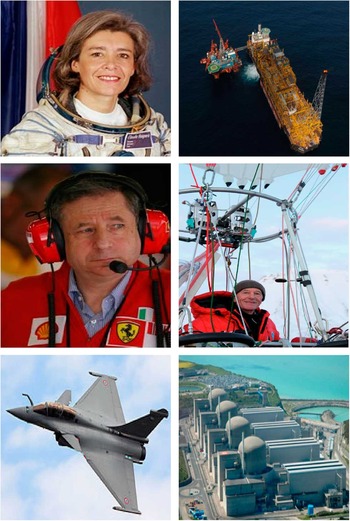
But our main criteria must not only be based on publications: we also appreciate the input of many producers of ‘visible publications’ who are recognized engineers, such as founders of the TGV train or of the French nuclear energy programme, unique chemical plant designers, key architects, famous bridge builders, high-tech surgeons, aeroplane or car designers, creators of new products benefiting mankind. In addition, we are proud to include an explorer, an astronaut, and a famous Formula 1 manager. Indeed, our Academy does not play in the field of basic science, but relies on the trusted results of scientists: in the case of IPCC, we are not participating in debates about climate change, but we are concentrating on how to use technology to combat it, and for its remediation. Our field of expertise is in the different areas in which technologists know more than the basic scientists, and where they may better contribute to preparing for the next, correct, steps.
4.2. Location and Resources
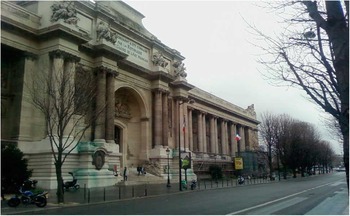
After starting ‘without walls’ and moving its meetings among many different locations, the Academy is now settled in the Grand Palais, in the centre of Paris, an iconic location that also houses a renowned exhibition hall of science and technology. Yet its budget is still far lower than the budgets of other National (or Royal) academies of engineering in other leading countries. In a more constrained financial world, we have indeed to demonstrate our value for money: success will come from the quality of our messages and reports. Thus, we hope to be at the heart of current major debates.
5. Conclusions and Future Work
Many themes are covered in our work, reports and debates, and many of these topics are expected to remain with us for many more years.
This includes most of the important technical challenges for the twenty-first century:
-
∙ Energy for this century, in view of COP 21, the 21st Session of the Conference of the Parties to the UNFCCC (the United Nations Framework Convention on Climate Change) which took place in December 2015 in Paris: thermal regulations, heat networks, deep-lying hydrocarbon reserves, energy vectors, carbon credits, biofuels;
-
∙ The impact of ICT, robotics, 3D printing, Big Data, and the life expectancy of digitized information;
-
∙ Industrial biotechnologies, synthetic biology, pharmaceutical start-ups, GMOs…
-
∙ Education challenges, encouraging scientific and technical education, but also including education and training for industrial jobs, computer science, etc;
-
∙ Innovation and SME creation, adaptation of the French Research & Technology organization, re-industrialization, start-ups;
-
∙ Urbanism, land planning and mobility: connected cities, energy efficiency, impact of digital technologies;
-
∙ A vision of future transport systems.
Another category covers the societal impact of technologies:
-
∙ How to deal with the precautionary principle;
-
∙ How to manage the internet and privacy: societal evolutions with ICTs;
-
∙ Risks and their public perception: chemicals, methane, nuclear energy, antennas, nano particle;
-
∙ Evolving ethics, the impact of progress on ethics, and ethical choices for progress.
One step further, NATF has also the ambition to foster real large-scale experiments on projects areas such as medical help at home, new transportation schemes, educational experiences, fabrication labs, etc. A special fund regarding ‘technology for mankind’ engages actions in these and similar directions.
Such projects are of major interest to members of NATF: for many of us, it is indeed a chance and an opportunity, while getting close to the age of retirement, to start a second life and career in which we feel that we are able to create impact at a more global societal level than in previous assignments, meeting not only engineers and scientists who have had activities similar to ours – yet in different fields – but also high level colleagues coming from a different world: Erol Gelenbe has been one such colleague and we have learnt much from him.
A view of the entrance to the Palais de la Découverte that houses the National Academy of Technologies of France.

A view from one of our plenary public sessions, held in the Great Hall of the Palais de la Découverte, on the Avenue Franklin Roosevelt, 75008 Paris.

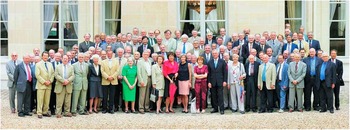
A rare group photograph of the Fellows of the National Academy of Technologies of France.

Some of our Fellows and some of the achievements of our Fellows.

The author (left) together with Erol Gelenbe (right) at a reception after a meeting of the Academy.

Tremendous challenges lie ahead, and we hope we can contribute and cooperate internationally with other think tanks, academies and organizations acting for a better world, thanks to a better understanding of the trends and impacts of technologies.
Pierre Castillon studied at the Lycées Périer, Carnot and Louis-le-Grand and graduated from the Ecole polytechnique (Paris) and the Ecole Nationale Supérieure des Mines de Paris (1960). He also received a degree from Sciences Po (Paris) and trained both as a parachute and cavalry officer. Working in the petrochemical industry, he rose to CTO of Elf Acquitaine (1985–2000) and Chairman of Elf Technologies (1991–2000). He chaired the Scientific Advisory Board of EDF until 2014, and is currently a consultant to the John Deere Company (USA). He was founding President of the French National Academy of Technologies in 2000.