INTRODUCTION
Chronic hepatitis C virus (HCV) infects approximately 2.2% of adults worldwide (“Global burden of disease (GBD) for hepatitis C”, 2004) and 5.4% of U.S. veterans seeking health care through facilities in the Veterans Healthcare Administration (Dominitz et al., Reference Dominitz, Boyko, Koepsell, Heagert, Maynard and Sporleder2004). The majority of individuals with HCV remain asymptomatic or report a range of mild-to moderate symptoms including flu-like symptoms, cognitive difficulty, and psychiatric disorder (Seeff & Hoofnagle, Reference Seeff and Hoofnagle2003). More serious medical complications can occur, however, and an estimated 10–15% of patients with HCV progress to advanced liver disease, including cirrhosis and hepatocellular carcinoma (Seeff & Hoofnagle, Reference Seeff and Hoofnagle2003).
Virological Theories of HCV-Associated Cognitive Impairment
HCV+ patients frequently report cognitive complaints, and several mechanisms leading to HCV-associated cognitive impairment have been previously proposed (Collie, Reference Collie2005; Forton et al., Reference Forton, Taylor-Robinson and Thomas2003, Reference Forton, Taylor-Robinson and Thomas2006; Laskus et al., Reference Laskus, Radkowski, Adair, Wilkinson, Scheck and Rakela2005). Virological theories posit that HCV disease processes alter central nervous system (CNS) function and impair cognition. For example, a “trojan horse” model suggests that HCV infects peripherally circulating monocyte-derived macrophages, which can travel across the blood–brain barrier (BBB). Although not yet conclusive, in support of this theory, several studies have found evidence for HCV replication in the brain (Forton et al., Reference Forton, Karayiannis, Mahmud, Taylor-Robinson and Thomas2004; Laskus et al., Reference Laskus, Radkowski, Bednarska, Wilkinson, Adair, Nowicki, Nikolopoulou, Vargas and Rakela2002; Maggi et al., Reference Maggi, Giorgi, Fornai, Morrica, Vatteroni, Pistello, Siciliano, Nuccorini and Bendinelli1999; Morsica et al., Reference Morsica, Bernardi, Novati, Uberti Foppa, Castagna and Lazzarin1997; Radkowski et al., Reference Radkowski, Wilkinson, Nowicki, Adair, Vargas, Ingui, Rakela and Laskus2002).
Alternatively, although peripheral cytokines are unlikely to passively diffuse through the BBB, HCV-induced peripheral immune activation could trigger central cytokine dysregulation via several mechanisms independent of the presence of HCV within the brain (Maier, Reference Maier2003; Wilson et al., Reference Wilson, Finch and Cohen2002): cytokines may enter through areas of the brain with weak BBB (e.g., circumventricular regions or choroid plexuses); peripheral cytokines may activate central cytokine production by binding to Receptors in the cerebral vasculature; or, through active transport of cytokines across the BBB. In support of virological theories of HCV-associated cognitive impairment, several studies have found cerebral metabolite abnormalities in HCV+ patients using in vivo magnetic resonance spectroscopy (MRS) (Forton et al., Reference Forton, Allsop, Main, Foster, Thomas and Taylor-Robinson2001; McAndrews et al., Reference McAndrews, Farcnik, Carlen, Damyanovich, Mrkonjic, Jones and Heathcote2005; Taylor et al., Reference Taylor, Letendre, Schweinsburg, Alhassoon, Brown, Gongvatana and Grant2004; Weissenborn et al., Reference Weissenborn, Krause, Bokemeyer, Hecker, Schuler, Ennen, Ahl, Manns and Boker2004), as well as downregulation of mitochondrial oxidative phosphorylation genes and some ribosomal protein genes in brain tissue of HCV+ patients (Adair et al., Reference Adair, Radkowski, Jablonska, Pawelczyk, Wilkinson, Rakela and Laskus2005).
Although more specific mechanisms have yet to be confirmed, virological theories of HCV-associated cognitive impairment generally share a hypothesis that central immune activation in part mediates the relationship between chronic HCV infection and cognitive impairment. Because subjective cognitive complaints do not always correlate with objective performance on cognitive tests (Hilsabeck et al., Reference Hilsabeck, Hassanein, Carlson, Ziegler and Perry2003), a critical first step toward validating a virological model is confirmation that HCV+ patients have measurable neuropsychological deficits upon testing.
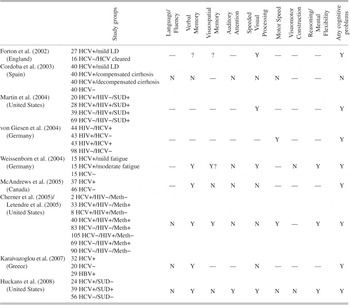
To our knowledge, eight published studies have previously used neuropsychological tests to compare HCV+ adults with HCV− controls without advanced liver disease (Cherner et al., Reference Cherner, Letendre, Heaton, Durelle, Marquie-Beck, Gragg and Grant2005; Cordoba et al., Reference Cordoba, Flavia, Jacas, Sauleda, Esteban, Vargas, Esteban and Guardia2003; Forton et al., Reference Forton, Thomas, Murphy, Allsop, Foster, Main, Wesnes and Taylor-Robinson2002; Karaivazoglou et al., Reference Karaivazoglou, Assimakopoulos, Thomopoulos, Theocharis, Messinis, Sakellaropoulos and Labropoulou-Karatza2007; Letendre et al., Reference Letendre, Cherner, Ellis, Marquie-Beck, Gragg, Marcotte, Heaton, McCutchan and Grant2005; Martin et al., Reference Martin, Novak, Fendrich, Vassileva, Gonzalez, Grbesic, Nunnally and Sworowski2004; McAndrews et al., Reference McAndrews, Farcnik, Carlen, Damyanovich, Mrkonjic, Jones and Heathcote2005; von Giesen et al., Reference von Giesen, Heintges, Abbasi-Boroudjeni, Kucukkoylu, Koller, Haslinger, Oette and Arendt2004; Weissenborn et al., Reference Weissenborn, Krause, Bokemeyer, Hecker, Schuler, Ennen, Ahl, Manns and Boker2004); see Table A1 for a summary of sample characteristics and findings. These studies vary markedly in their inclusion criteria, type of control group, statistical design, and choice and breadth of neuropsychological tests. Methodological differences, therefore, likely contribute to inconsistent findings across studies, particularly in the type and extent of cognitive impairments found. Of these eight studies, seven found that HCV+ patients with mild liver disease performed worse than HCV− controls in at least one cognitive domain. Thus, the preponderance of the evidence suggests that infection with chronic HCV is associated with increased risk for a range of cognitive impairments. Establishing a clear profile of HCV-associated cognitive impairment, however, still requires replication and integration of previous findings.
Nonvirological Theories of HCV-Associated Cognitive Impairment: Addressing Substance Use Disorders and Psychiatric and Medical Comorbidities
In contrast to the seven positive studies cited in Table A1, the remaining negative study found that HCV+ patients performed no differently than HCV− controls; only HCV+ patients with decompensated cirrhosis evidenced worse performance (Cordoba et al., Reference Cordoba, Flavia, Jacas, Sauleda, Esteban, Vargas, Esteban and Guardia2003). Although reasons for this incongruent finding remain unclear, its sample contrasted with other studies in terms of its low proportion of subjects with a history of intravenous drug use (IVDU) and its careful exclusion of patients with currently symptomatic medical comorbidities. This, of course, raises the possibility that HCV-associated cognitive impairment may be related to medical or substance use history rather than HCV itself. Indeed, an earlier study compared 66 HCV+ patients to 14 HCV− controls with other types of liver disease on measures of cognitive functioning (Hilsabeck et al., Reference Hilsabeck, Perry and Hassanein2002). Only the subgroup of HCV+ patients with medical comorbidities exhibited cognitive impairment, while the HCV+ patients with no medical comorbidities did not differ from HCV− controls. While this study suggests that, for patients without medical comorbidities, the severity of HCV-associated cognitive impairment may not exceed the impairment level known to be associated with other types of liver disease (Collie, Reference Collie2005), it remains unclear how the HCV+ patients may have compared to HCV− controls without liver disease.
Despite limitations, these latter two studies highlight the importance of testing nonvirological theories of HCV-associated cognitive impairment, which propose that cognitive difficulties are caused secondarily by other symptoms of HCV or other comorbidities. For example, HCV+ patients have high rates of substance use disorders (SUDs), psychiatric disorders, and medical conditions, each of which can be risk factors for cognitive impairment in normal populations (Huckans et al., Reference Huckans, Blackwell, Harms, Indest and Hauser2005, Reference Huckans, Blackwell, Harms and Hauser2006; Loftis et al., Reference Loftis, Matthews and Hauser2006). Advanced liver disease and hepatic encephalopathy have also been associated with cognitive impairment in both HCV− and HCV+ populations (Collie, Reference Collie2005; Forton et al., Reference Forton, Taylor-Robinson and Thomas2006). Additionally, although few studies have examined the cognitive effects of interferon-alpha therapy for HCV, aspects of neuropsychological functioning may decline during antiviral treatment (Hilsabeck et al., 2005; Kraus et al,. Reference Kraus, Schafer, Wissmann, Reimer and Scheurlen2005; Lieb et al., Reference Lieb, Engelbrecht, Gut, Fiebich, Bauer, Janssen and Schaefer2006). These variables may serve as confounding factors, which could lead to spurious associations between HCV status and cognitive impairment.
Previous studies have inconsistently controlled for aspects of current or recent substance abuse, advanced liver disease, and current or past interferon therapy. However, no published studies have comprehensively ruled out history of alcohol or drug use disorders as a confounding factor, likely in large part due to the difficulty of finding a sample of HCV+ patients with no history of SUD. Indeed, the most common transmission route for HCV is IVDU, accounting for approximately 65–70% of patients with HCV (Seeff & Hoofnagle, Reference Seeff and Hoofnagle2003). In one sample of 11,854 veterans who tested positive for HCV, medical record databases indicated that 64% had a history of SUD, the most common diagnoses including alcohol (58%), polysubstance (44%), cocaine (18%), and opioid (16%) abuse (Huckans et al., Reference Huckans, Blackwell, Harms, Indest and Hauser2005). This indicates that HCV+ populations largely comprise previously addicted adults.
Previous studies examining the relationship between cognitive functioning and HCV status have only partially addressed current or past alcohol or drug abuse, likely because each study was designed with other purposes and strengths in mind. However, given the vast literature on the potentially long-term cognitive effects of SUDs (Moselhy et al., Reference Moselhy, Georgiou and Kahn2001; Verdejo-Garcia et al., Reference Verdejo-Garcia, Lopez-Torrecillas, Gimenez and Perez-Garcia2004; Vik et al., Reference Vik, Cellucci, Jarchow and Hedt2004), the question remains whether HCV-associated cognitive impairment is a spurious association with history of SUD. The primary objective of this study, therefore, was to determine whether HCV+ patients exhibit cognitive impairment in the absence of any history of alcohol or drug use disorder. To our knowledge, our study is the first to specifically include groups of HCV+ patients with and without a history of SUD for this purpose. A secondary objective was to examine cognitive deficits associated with HCV status above and beyond impairments caused by other psychiatric and medical comorbidities.
METHOD
Research Participants
A total of 119 patients were recruited from the Portland Veterans Affairs Medical Center (PVAMC) into three study groups: (1) patients with current HCV and no history of SUD (HCV+/SUD−, n = 24), (2) patients with current HCV as well as a history of SUD, currently in remission for at least 90 days (HCV+/SUD+, n = 39), and (3) patients with no history of HCV or SUD (HCV−/SUD−, n = 56). Patients were deemed to have a history of SUD if they ever met Diagnostic and Statistical Manual of Mental Disorders-Fourth Edition-Tex Revision (DSM-IV-TR) (American Psychiatric Association, 2000) criteria for alcohol or drug abuse or dependence. All patients in the HCV+ groups had evidence in their medical record of a detectable HCV load based on polymerase chain reaction tests.
Participants were excluded for the following criteria: (1) History of a major medical condition, or currently unstable medical condition, that is likely to be associated with severe neurological or immune dysfunction currently [e.g., stroke, seizures, brain tumors, Parkinson’s disease, neurodegenerative dementia, mental retardation, hepatic encephalopathy, human immunodeficiency virus (HIV)]. In the interest of generalizability to typical HCV+ populations, participants with well-controlled or stable conditions were included as long as severe cognitive effects were not currently suspected (e.g., well-controlled diabetes, hypertension, or asthma). (2) History of traumatic brain injury with known loss of consciousness ≥30 min. (3) Use of alcohol, illicit substances, or medications with acute cognitive effects such as sedation or intoxication (e.g., benzodiazepines, opiates, muscle relaxants) on the day of testing. (4) Advanced liver disease as indicated by any of the following: (a) classified as having stage 4 liver disease or grade 4 inflammation upon biopsy, (b) classified by a hepatologist as having probable decompensated cirrhosis based on clinical indicators and standard liver labs, or (c) Aspartate aminotransferase (AST)-to-platelet ratio index (APRI) ≥1.5. The APRI has been previously validated for use in HCV research, and values ≥1.5 reliably predict both liver fibrosis and cirrhosis (Lackner et al., Reference Lackner, Struber, Liegl, Leibl, Ofner, Bankuti, Bauer and Stauber2005; Wai et al., Reference Wai, Greenson, Fontana, Kalbfleisch, Marrero, Conjeevaram and Lok2003). (5) Current pregnancy. (6) History of schizophrenia or schizoaffective disorder, current psychotic or manic episode, or currently unstable and severe psychiatric disorder. In the interest of generalizability to typical HCV+ populations, patients with other current psychiatric diagnoses were included as long as present symptoms did not preclude valid cognitive testing. (7) History of interferon therapy or chemotherapy.
Potential subjects were informed of the study via study advertisements posted throughout the hospital, mailed to patients who participated in previous HCV research, or distributed by providers. Interested patients contacted study coordinators by phone and were screened for eligibility. No data were maintained on patients prior to consent. Following consent, two subjects in the HCV+/SUD+ group were excluded for probable decompensated cirrhosis based on standard liver labs, and nine other subjects were excluded based on an APRI ≥1.5 (seven HCV+/SUD+, one HCV+/SUD−, and one HCV−/SUD−), yielding our final sample of 119 subjects.
Procedures
All research was conducted with permission from PVAMC’s institutional review board and in accordance with the Helsinki Declaration. All patients were paid $30 to complete the following study procedures: clinical interview, comprehensive medical record review, psychological questionnaires, and a comprehensive neuropsychological testing battery. All study procedures were administered by one of four advanced doctoral candidates in clinical psychology; all graduate students (AS, TP, LM, JW) were trained and supervised by a clinical neuropsychologist (MH).
Clinical interviews were conducted using a structured case report form, developed specifically for this study, including prompts to screen patients based on each inclusion criteria, gather relevant demographic data, assess for a full range of current and past Axis I psychiatric disorder and SUD using DSM-IV-TR (American Psychiatric Association, 2000) criteria, evaluate for history of head injuries, and record a comprehensive list of current and previous medical conditions. Study personnel additionally reviewed each participant’s complete electronic medical record to collect recent medical laboratory results and to cross-validate data gathered in the clinical interview.
Patients also completed several psychological questionnaires. The Beck Depression Inventory assessed current depression (Beck et al., Reference Beck, Steer and Brown1996). The Severity of Dependence Scale (SDS) measured substance abuse severity (Gossop et al., Reference Gossop, Marsden and Stewart1995). Patients were also asked to rate their current pain on a 10-point Likert scale from minimal (1) to severe (10).
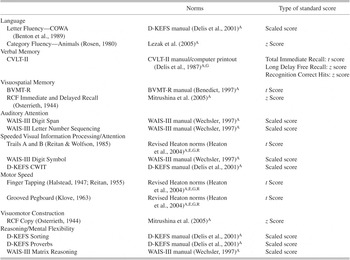
The neuropsychological battery included well-validated and widely available measures testing a full range of cognitive domains. Raw scores were converted to standard scores based on norms that corrected for age, gender, race, and years of education, as appropriate. Table A2 lists subtests by cognitive domain along with the respective normative samples and type of standard score referenced.
Standard neuropsychological scores were then converted to global and domain-specific deficit scores using methods adapted from those previously described for use with HIV+ and HCV+ populations (Carey et al., Reference Carey, Woods, Gonzalez, Conover, Marcotte, Grant and Heaton2004; Cherner et al., Reference Cherner, Letendre, Heaton, Durelle, Marquie-Beck, Gragg and Grant2005; Heaton et al., Reference Heaton, Grant, Butters, White, Kirson, Atkinson, McCutchan, Taylor, Kelly, Ellis, Wolfson, Velin, Marcotte, Hesselink, Jernigan, Chandler, Wallace and Abramson1995; Letendre et al., Reference Letendre, Cherner, Ellis, Marquie-Beck, Gragg, Marcotte, Heaton, McCutchan and Grant2005). In brief, standard subtest scores were assigned a deficit rating as follows: z ≥ −0.5 = 0 points, −1.0 ≤ z < −0.5 = 1 point, −1.5 ≤ z < −1.0 = 2 points, −2.0 ≤ z < −1.5 = 3 points, or z < −2.0 = 4 points. Domain-specific deficit scores were then calculated by summing composite deficit ratings and dividing by the total number of tests within a domain; the global deficit score was calculated as the average deficit rating across tests in the battery. Domain-specific and global deficit scores ≥0.5 were classified as impaired. A deficit score serves as an objective summary of both the number and severity of impaired performances within a domain or battery. Although less weight is given to normal performances, this approach provides a more reliable and conservative measure for between-group comparisons than individual standard scores because each deficit score is based on multiple tests within a domain or battery, enhancing convergent validity and reducing experiment-wise error.
To ensure accuracy, all psychological and neuropsychological tests were scored and entered into databases twice by separate study personnel.
Data Analysis
All analyses were conducted with SPSS (version 15). p Values ≤.05 were considered significant.
Primary analyses
Between-group analyses of demographic variables were conducted using analysis of variance (ANOVA) and post hoc Scheffe tests for continuous variables; for binary responses, we used three-sample Kruskal–Wallis tests because multiple cells contained low frequencies (<5). Between-group analyses of neuropsychological performance were conducted using multivariate analysis of variance (MANOVA) and post hoc Scheffe tests. For each cognitive domain, all relevant standardized subtest scores were entered as multiple dependent variables, and study group was entered as the independent variable. A multivariate effect (Wilks’ Lamda) for each cognitive domain was reported as well as the univariate F and p values for each subtest. An ANOVA, however, was used for the Visuoconstruction domain because it contained only one subtest. Finally, we used Kruskal–Wallis tests to compare groups in terms of rates of impairment based on domain-specific deficit scores.
Post hoc exploratory analyses
Pearson R correlations were used to explore the relationship between several additional variables of interest (estimated cognitive reserve, depression, and pain) and performance on neuropsychological tests. For cognitive domains found to have significant multivariate effects in the primary analyses, these three variables of interest were also entered as covariates in a series of multivariate analyses of covariance (MANCOVAs) with study group entered as the independent variable and relevant subtests entered as the multiple dependent variables.
RESULTS
Demographic and Clinical Characteristics
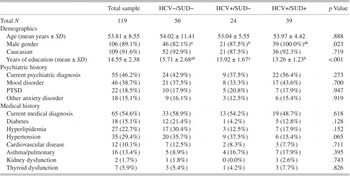
Table 1 summarizes demographic data for the total sample and by group. Groups did not significantly differ in terms of age or race. Although the SUD+ group included a significantly higher percentage of men than the SUD− groups, all groups were composed primarily of men (89.1% male in total sample). The HCV+ groups had completed significantly fewer years of education than the HCV− group. Groups did not significantly differ in rates of current psychiatric diagnoses or medical conditions.
Demographic and clinical characteristics by study group

Note.
Data expressed as n, with (%) in terms of n over total N unless otherwise stated. Variables with the same superscript yielded significant univariate effects (p ≤ .05) using post hoc Scheffe tests. HCV = infected with chronic hepatitis C virus; PTSD = posttraumatic stress disorder; SD = standard deviation; SUD = history of substance use disorder, currently in remission.
The HCV+/SUD+ group (n = 39) included patients with at least 90 days of remission, but most patients reported several years of sobriety (average years since remission = 8.4 ± 7.6). Prior to remission, most patients reported many years of abuse (average years of abuse = 18.2 ± 11.9), at an average level of abuse which could be categorized as moderate (average SDS score = 7/25 ± 3). Patients met criteria for previous abuse of or dependence on the following substances: alcohol (87.2%), stimulants (79.5%), marijuana (55.3%), opiates (51.3%), hallucinogens (7.7%), and other drugs of abuse (7.7%). Because most patients reported polysubstance abuse (89.7%), these categories are not mutually exclusive.
Within the HCV+/SUD− group (n = 24), the following risk factors were reported as the most likely HCV transmission route: blood transfusion (20.8%, n = 5), accidental exposure at work (20.8%, n = 5), blood exposure during combat (8.3%, n = 2), and other or unknown risk factors (37.5%; two plasma or blood donations, one military immunization, one tattoo, and five unknown). Although three (12.5%) remaining individuals in the HCV+/SUD− group reported contracting HCV via remote IVDU, their reported use was described as infrequent and experimental only, and none of these individuals ever met criteria for SUD of any type. Within the HCV+/SUD+ group (n = 39), the following risk factors were reported as the most likely transmission route: IVDU (64.1%, n = 25), accidental exposure at work (10.3%, n = 4), blood transfusion (7.7%, n = 3), blood exposure during combat (7.7%, n = 3), and other or unknown risk factors (10.3%; one military immunization and three unknown).
There were no statistical differences between the HCV+/SUD− or HCV+/SUD+ groups in terms of viral load [HCV RNA(log10 IU/ml) = 6.2 ± 0.6, HCV+/SUD− vs. 6.3 ± 0.9, HCV+/SUD+], serum aspartate aminotransferase levels (AST = 47.9 ± 26.3, HCV+/SUD− vs. 45.9 ± 27.5, HCV+/SUD+), platelet levels (PLT = 238.5 ± 68.6, HCV+/SUD− vs. 235.6 ± 66.4, HCV+/SUD+), or APRI values (APRI = 0.48 ± 0.3, HCV+/SUD− vs. 0.48 ± 0.3, HCV+/SUD+). Within the HCV+/SUD− group, 14/24 subjects had HCV genotypes available in their records (thirteen with genotype 1 and one with genotype 2). Within the HCV+/SUD+ group, 18/39 had available genotypes (nine with genotype 1, six with genotype 2, two with genotype 3, and one with genotype 4). Only 3/24 subjects in the HCV+/SUD− group and 8/39 subjects in the HCV+/SUD+ group had liver biopsy results available in their record; none of these subjects were assessed above stage 2 in terms of fibrosis or grade 2 in terms of cirrhosis.
Primary Analyses: Comparisons of Neuropsychological Performance by Cognitive Domain
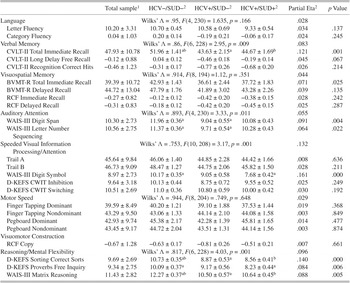
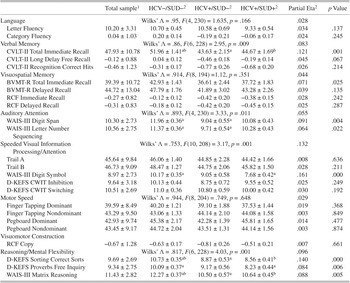
As summarized in Table 2, significant group differences were found in terms of standardized scores in the Verbal Memory, Auditory Attention, Speeded Visual Information Processing, and Reasoning/Mental Flexibility domains (all p values ≤.05). Post hoc comparisons indicated that the HCV+/SUD− group performed significantly worse than HCV−/SUD− controls on subtests measuring verbal learning [California Verbal Learning Test (CVLT)-II Total Immediate Recall], auditory attention [Wechsler Adult Intelligence Scale—third edition (WAIS-III) Digit Span and Letter Number Sequencing], and reasoning/mental flexibility [Delis–Kaplan Executive Functioning Scale (D-KEFS) Sorting and WAIS-III Matrix Reasoning] but not on subtests in the Speeded Visual Information Processing domain. The HCV+/SUD+ group performed significantly worse than HCV−/SUD− controls on subtests measuring verbal learning (CVLT-II Total Immediate Recall), speeded visual information processing (WAIS-III Digit Symbol), and reasoning/mental flexibility (D-KEFS Sorting, D-KEFS Proverbs, and WAIS-III Matrix Reasoning). No other post hoc comparisons yielded significant between-group differences. Thus, the HCV+/SUD− and HCV+/SUD+ groups did not significantly differ in terms of performance on any neuropsychological subtests. MANOVAs revealed no significant group differences in terms of standardized scores in the Language, Visuospatial Memory, Motor Speed, or Visuomotor Construction domains (p values >.05).
Neuropsychological performance by study group and cognitive domain
Note.
Variables with the same superscript yielded significant univariate effects (p ≤ .05) using post hoc Scheffe tests. BVMT-R = Brief Visuospatial Memory Test, revised; CVLT-II = California Verbal Learning Test, second edition; CWIT = Color–Word Interference Test; D-KEFS = Delis-Kaplin Executive Functioning System; HCV = currently infected with chronic hepatits C virus; RCF = Rey Complex Figure; SUD = history of substance use disorder, currently in remission; WAIS-III = Wechsler Adult Intelligence Scale, third edition.
1 Data expressed as the mean ± standard deviation.
2 Data expressed as estimated marginal means ± standard error.
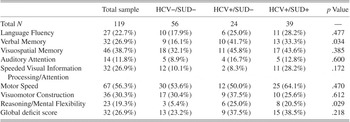
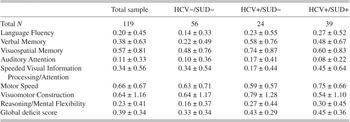
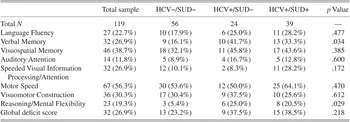
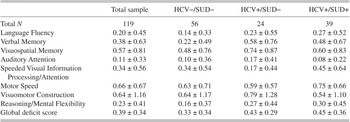
As summarized in Table 3 and 4, groups significantly differed in terms of rates of impairment in the Verbal Memory and Reasoning/Mental Flexibility domains; both HCV+ groups had higher rates of impairment on these domains than did the HCV− controls.
Proportion of global and domain-specific cognitive impairment among groups
Note.
Data expressed as n, with (%) in terms of n over total N. HCV = infected with chronic hepatitis C virus; SUD = history of substance use disorder, currently in remission.
Average total deficit score by cognitive domain
Note.
Data expressed as mean total deficit score ± standard deviation. HCV = infected with chronic hepatitis C virus; SUD = history of substance use disorder, currently in remission.
Post Hoc Exploratory Analyses: Between-Group Comparisons on Other Variables of Interest
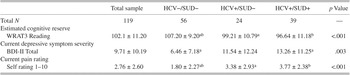
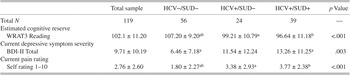
As summarized in Table 5, compared with HCV− controls, the HCV+ groups scored significantly lower on Wide Range Achievement Test, third edition (WRAT3) Reading (Wilkinson (1993). The HCV+ groups also reported significantly higher levels of current pain, and the HCV+/SUD+ group reported significantly more depressive symptoms than HCV− controls. Lower WRAT3 Reading scores, fewer years of education, more depressive symptoms, and higher pain ratings each significantly correlated with poorer performance on a variety of neuropsychological tests. Pearson product moment correlations ranged from −.130 to .428 for WRAT3 Reading, from −.195 to .340 for years of education, from −.363 to .054 for depression, and from −.338 to .079 for pain.
Estimated cognitive reserve, current depressive symptom severity, and current pain rating by group
Note.
Data expressed as the mean ± standard deviation. Variables with the same superscript were significantly different (p ≤ .05) using post hoc Scheffe tests. BDI-II = Beck Depression Inventory-second edition; HCV = infected with chronic hepatitis C virus; SUD = history of substance use disorder, currently in remission; WRAT = Wide Range Achievement Test, third edition.
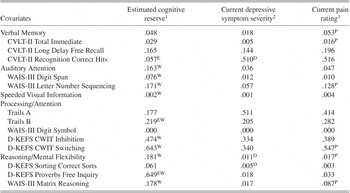
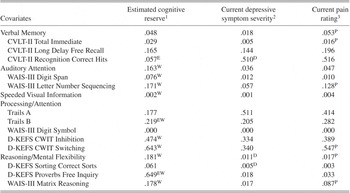
For each cognitive domain, Table 6 lists the p values from a series of MANCOVAs with cognitive reserve, depression, or pain entered as separate covariates and HCV status entered as the independent variable. For each subtest, Table 6 also lists the p values from the univariate F tests. Cognitive reserve was estimated using both WRAT3 Reading and years of education for the purposes of these post hoc covariate analyses. The superscripts in Table 6 indicate the significant covariates for each test (covariates with p values of <.05 are indicated by D = depression, W = WRAT3, E = education, and P = pain.) Consistent with primary analyses, when either depression or pain was entered as a covariate, significant multivariate effects of HCV status on cognition were found for Verbal Memory, Auditory Attention, Speeded Visual Information Processing, and Reasoning/Mental Flexibility. When cognitive reserve was entered as a covariate, multivariate effects for Verbal Memory and Speeded Visual Information Processing remained significant; however, the multivariate effects for Auditory Attention and Reasoning/Mental Flexibility were no longer significant. As summarized in Table 6, all three covariates (pain, depression, and cognitive reserve) were found to have significant effects on a range of cognitive domains and tests.
p Values from multivariate and univariate tests comparing three study groups (HCV−/SUD−, HCV+/SUD−, and HCV+/SUD+) on neuropsychological performance, with estimated cognitive reserve, current depressive symptom severity, and current pain ratings entered as covariates
Note.
p Values are displayed for each test controlling for covariates. Rows with cognitive domain names include multivariate effects (Wilks Λ, MANCOVAs), with the three study groups and covariates entered as independent variables and standardized scores for each relevant subtest within a cognitive domain entered as multiple dependent variables. Rows with subtest names include univariate effects (F tests), with the three study groups and covariates entered as independent variables and individual subtests entered as dependent variables. Covariates with p values of <.05 are indicated by D = depression, W = WRAT3, E = education, and P = pain. CWIT = Color–Word Interference Test.
1 Cognitive reserve was estimated using years of education and standard scores on WRAT3 Reading.
2 Depression was measured using the Beck Depression Inventory, second edition.
3 Pain was measured with a single-item self-rating of current pain on a Likert scale of 1–10, from minimal to severe.
DISCUSSION
The primary objective of the present study was to determine whether chronic infection with HCV is associated with cognitive impairment, particularly in the absence of any history of SUD. To this end, our study specifically recruited a group of HCV+ patients with no history of SUD. Because IVDU is the primary transmission route for HCV, and because the majority of HCV+ patients in the United States have a history of SUD (Huckans et al., Reference Huckans, Blackwell, Harms, Indest and Hauser2005; Seeff & Hoofnagle, Reference Seeff and Hoofnagle2003), our findings are a relevant extension of previous work on HCV-associated cognitive impairment. In selecting patients, we minimized major cognitive risk factors by excluding patients with decompensated cirrhosis; active substance abuse within the past 3 months; and severe or unstable medical and psychiatric disorders such as stroke, traumatic brain injury, and psychosis. However, in order to maximize generalizability to typical HCV+ populations, we included patients with common and reasonably controlled psychiatric and medical diagnoses. Thus, we expanded upon prior research by using a control group with no history of SUD and by carefully controlling for other factors that may be associated with cognitive impairment.
Overall, our results are generally consistent with previous studies that have identified cognitive impairment among HCV+ patients. Specifically, we found that HCV+/SUD− participants performed significantly worse than HCV−/SUD− controls on tests of verbal learning, auditory attention, and reasoning/mental flexibility, indicating that these HCV-associated cognitive impairments are not attributable to history of substance abuse. HCV+/SUD+ participants also performed significantly worse than HCV−/SUD− controls on tests of speeded visual information processing. Since the HCV+/SUD− group performed similarly to the HCV−/SUD− controls on speeded visual information processing tests, lower performance by the HCV+/SUD+ group in this domain may be attributable to history of SUD rather than HCV status.
When comparing our domain-specific cognitive results to results from other positive studies (Table A1), important consistencies as well as variations emerge. All studies that included measures of verbal learning/memory and reasoning/mental flexibility, including our own study, found HCV-associated impairments in these domains, indicating that these impairments are rather robust among HCV+ patients. Neither our study nor any previous study found HCV-associated impairments in language/fluency or visuomotor construction, indicating that HCV is unlikely to produce deficits in these areas. Results in Visuospatial Memory, Auditory Attention, Speeded Visual Information Processing, and Motor Speed domains, however, vary considerably across studies. Although we are unable to definitively confirm reasons for these interstudy domain-specific variations with our current study design, one hypothesis is that these impairments tend to be less robust among HCV+ patients and that the relatively small sample sizes, typically ~20–40 per group, among previously published studies have not provided for adequate power to reliably detect group differences in these domains. Alternatively, because studies vary markedly in terms of sampling characteristics, positive findings in these domains could represent effects of other medical and psychiatric comorbidities or interactions between these comorbidities and HCV.
Regardless, our own results, combined with findings from previous studies, suggest that the most robust impairments among patients with HCV appear to be in the areas of verbal learning and reasoning/mental flexibility. Indeed, we found that within our own sample, 41.7% of HCV+/SUD− patients and 33.3% of HCV+/SUD+ patients evidenced impairments in verbal learning, compared with 16.1% of HCV− patients. Likewise, 25.0% of HCV+/SUD− patients and 20.5% of HCV+/SUD+ patients evidenced impairments in reasoning/mental flexibility, as compared with 5.4% of HCV− patients.
Although we found some evidence for HCV-associated impairments in speeded visual information processing and auditory attention, these findings should be interpreted cautiously for several reasons. First, previous studies (Table A1) have not consistently found impairments in these domains. Second, the HCV+/SUD− group performed similarly to the HCV−/SUD− group on tests of speeded visual information processing. Last, the HCV+ groups did not significantly differ from our HCV− controls in terms of rates of impairments on the Speeded Visual Information Processing or Auditory Attention domain. Thus, future studies are needed to replicate and clarify outcomes in these domains.
One limitation of our current study design is that it is does not allow for direct confirmation of virological mechanisms that could lead to HCV-associated cognitive impairment. For example, although we excluded patients with probable advanced liver disease based on biopsy, liver labs, and APRI scores, we could not definitively rule out hepatic encephalopathy as a contributing cognitive risk factor in our HCV+ groups because, due to prohibitive costs, not all patients underwent liver biopsies and no measure of portal vein hypertension was included. Nevertheless, our results indicate that HCV-associated cognitive impairments, particularly in the areas of verbal learning and reasoning/mental flexibility, are not likely attributable to nonvirological causes such as common medical and psychiatric comorbidities or history of substance abuse. Our cognitive findings appear to be consistent with previous MRS studies that found metabolic abnormalities in frontostriatal regions including the basal ganglia (Forton et al., Reference Forton, Allsop, Main, Foster, Thomas and Taylor-Robinson2001, Reference Forton, Thomas, Murphy, Allsop, Foster, Main, Wesnes and Taylor-Robinson2002) and central white matter (McAndrews et al., Reference McAndrews, Farcnik, Carlen, Damyanovich, Mrkonjic, Jones and Heathcote2005). However, additional imaging studies, such as those using functional magnetic resonance imaging or diffusion tensor imaging (DTI) techniques, are needed to better delineate the anatomical correlates of HCV-associated cognitive impairments. Future studies are also needed to identify mechanisms, particularly the possibility of central inflammatory processes, that could lead to HCV-associated anatomical and functional changes within the CNS.
Another limitation of the present study is that its design precludes meaningful exploration of SUD effects on neuropsychological functioning in an HCV+ population. Indeed, it is not surprising that we found no differences between our HCV+/SUD− and HCV+/SUD+ groups in terms of neuropsychological performance on any test because within the HCV+/SUD+ group, (1) SUD history was rather remote, (2) substances were mixed, and (3) abuse and dependence were combined. These characteristics enabled us to more clearly demonstrate HCV-associated cognitive effects in the absence of an SUD. However, these same characteristics likely explain why we did not find an additive SUD effect in our sample.
One issue that arises when studying HCV-associated cognitive impairment is how to address severity of other current HCV-associated symptoms such as depression, fatigue, and pain. These variables have each been identified as risk factors for cognitive impairment in HCV− populations, but relationships between these factors and cognition may be bidirectional, and etiologies are likely multifactorial and complex (Martelli et al., Reference Martelli, Zasler, Bender and Nicholson2004; Michiels & Cluydts, Reference Michiels and Cluydts2001; Pfennig et al., Reference Pfennig, Littmann and Bauer2007; Porter et al., Reference Porter, Bourke and Gallagher2007; Weissenborn et al., Reference Weissenborn, Krause, Bokemeyer, Hecker, Schuler, Ennen, Ahl, Manns and Boker2004). Moreover, returning to a virological model of HCV-associated cognitive impairment, it may be hypothesized that chronic immune activation in HCV+ patients causes a constellation of symptoms including depression, fatigue, pain, and cognitive dysfunction; intercorrelations between these variables would be expected if they do indeed represent symptoms of the same syndrome. Thus, controlling for these other symptoms could remove common variance resulting from HCV-induced immune activation, masking true significant effects on cognition and producing a type II error.
Despite this dilemma, neuropsychological outcomes before and after controlling for other relevant HCV-associated symptoms remain clinically relevant and theoretically interesting. Typical HCV+ populations have high rates of these other symptoms, and knowledge of the relative risk of cognitive impairment based on other symptoms may be beneficial. Although three studies cited in Table A1 found no significant differences among groups in terms of current depression ratings (Cherner et al., Reference Cherner, Letendre, Heaton, Durelle, Marquie-Beck, Gragg and Grant2005; Cordoba et al., Reference Cordoba, Flavia, Jacas, Sauleda, Esteban, Vargas, Esteban and Guardia2003; Karaivazoglou et al., Reference Karaivazoglou, Assimakopoulos, Thomopoulos, Theocharis, Messinis, Sakellaropoulos and Labropoulou-Karatza2007), three other studies found higher levels of depression among HCV+ patients compared with HCV− controls (Forton et al., Reference Forton, Thomas, Murphy, Allsop, Foster, Main, Wesnes and Taylor-Robinson2002; McAndrews et al., Reference McAndrews, Farcnik, Carlen, Damyanovich, Mrkonjic, Jones and Heathcote2005; Weissenborn et al., Reference Weissenborn, Krause, Bokemeyer, Hecker, Schuler, Ennen, Ahl, Manns and Boker2004). None of these studies statistically controlled for severity of depression when analyzing the relationship between HCV status and cognition. Moreover, although recent findings suggest that HCV+ patients report high rates of pain disorders (Silberbogen et al., Reference Silberbogen, Janke and Hebenstreit2007; Whitehead et al., in press), no published studies have specifically examined the relationship between pain and cognition in HCV+ patients.
While it is beyond the scope of the present study to verify the direction of the relationships between HCV status, cognitive functioning, and severity of other current HCV-associated symptoms, we used post hoc exploratory analyses to examine the extent to which HCV status is associated with cognitive impairment before and after controlling for severity of current depressive symptoms or pain. We found that multivariate and univariate effects of HCV status on cognition remained significant for several tests of verbal learning, auditory attention, speeded visual information processing, and reasoning/mental flexibility, even when pain or depression was entered as a covariate. These results were consistent with our primary analyses and with the conclusions of previous studies (Table A1), suggesting that HCV-associated cognitive impairment exists above and beyond the effects of either current depressive symptoms or pain.
An additional problem that arises when examining neuropsychological functioning within any medical population is how to measure and whether to control for estimates of cognitive reserve. An expanding body of literature reveals that within a variety of medical populations at risk for cognitive impairment (e.g., Alzheimer’s disease, HIV, lead exposure, post-coronary artery bypass surgery), individuals with low cognitive reserve evidence significantly higher rates of cognitive impairment and faster decline than individuals with high cognitive reserve (Bleecker et al., Reference Bleecker, Ford, Celio, Vaughan and Lindgren2007; Pereda et al., Reference Pereda, Ayuso-Mateos, Gomez Del Barrio, Echevarria, Farinas, Garcia Palomo, Gonzalez Macias and Vazquez-Barquero2000; Ropacki et al., Reference Ropacki, Bert, Ropacki, Rogers and Stern2007; Stern, Reference Stern2006; Stern et al., Reference Stern, Silva, Chaisson and Evans1996). In a sample of HCV+ patients with cirrhosis or fibrosis who previously evidenced nonresponse to interferon-alpha therapy, individuals with low cognitive reserve evidenced higher rates of cognitive impairment than those with high cognitive reserve (Bieliauskas et al., Reference Bieliauskas, Back-Madruga, Lindsay, Wright, Kronfol, Lok and Fontana2007). However, similar effects have yet to be confirmed in HCV+ patients without advanced liver disease or with no history of interferon therapy.
A more detailed exploration of potential interactions between cognitive reserve and HCV status is, therefore, warranted but beyond the scope of the present manuscript. We did, however, include post hoc analyses, which begin to explore the relationship of our estimate of cognitive reserve (years of education and WRAT3 Reading combined) to neuropsychological outcomes within our sample. There are several reasons why controlling for WRAT3 Reading and/or years of education in between-group analyses raises the potential for an underestimation of group differences and an overestimation of function in our HCV+ groups: (1) Since WRAT3 Reading scores are highly and significantly correlated with years of education, and since we used standardized scores that already corrected for years of education, additional covariate corrections for WRAT3 Reading and years of education likely violate the statistical assumption of multicollinearity. (2) Although WRAT3 Reading scores correlate highly with measures of IQ, it remains an indirect proxy of baseline intellectual ability, confounded by learning disabilities, educational quality, and psychosocial factors that interfere with achievement. These latter factors may, for example, contribute to our HCV+ groups evidencing significantly fewer years of education and lower WRAT3 Reading scores than our HCV− controls, and group differences may not, therefore, reflect differences in baseline IQ. (3) Although studies suggest that reading is less vulnerable to the effects of brain injury and cognitive disorder than many other cognitive domains, reading is not invulnerable to cognitive effects.
Despite these limitations, we used post hoc exploratory analyses to examine the extent to which HCV status is associated with cognitive impairment before and after controlling for cognitive reserve. After controlling for cognitive reserve, significant multivariate effects for both the Verbal Memory and Speeded Visual Information Processing domains remained. Furthermore, post hoc tests revealed that the HCV+/SUD− group performed significantly worse than HCV− controls on one test of verbal learning (CVLT-II).
CONCLUSIONS
Our overall pattern of results across all primary and post hoc analyses was generally consistent and indicates that HCV is associated with cognitive impairment even in the absence of a history of SUD. Our results converge with previous studies and suggest that the most robust HCV-associated cognitive impairments include problems with aspects of verbal learning and reasoning/mental flexibility. These problems are likely not attributable to nonvirological causes such as common medical or psychiatric comorbidities.
ACKNOWLEDGMENTS
We would like to thank William Hoffman for his editorial comments and for invaluable professional guidance and scientific mentorship over the years; Diane Howieson, Alexander Stevens, and Arthur Vandenbark for their continued mentorship and consultation; Julie Nelligan and Ashlee Whitehead for their initial input in terms of study design and planning; Betsy Zucker, Glen Kenoski, and the other providers within the PVAMC Liver Clinic for their continued collaboration with the Northwest Hepatitis C Resource Center; and Alex Mitchell, Daniel Schwartz, Emily Kizer, Laura Parisi, and Samantha Ruimy for administrative support. This study was supported in part by a Northwest Health Foundation grant and a VA Career Development Award to Dr. Huckans.
APPENDIX
Summary of neuropsychological performance by cognitive domain in published studies comparing HCV+ adults to HCV− controls without liver disease (LD)

Note.
Y = Compared with HCV− controls, HCV+ patients were found to perform worse on cognitive tests. N = HCV+ patients did not perform worse than HCV− controls on cognitive tests. — = Cognitive domain was not measured directly. ? = It is unclear from the published manuscript whether tests within this cognitive domain were used. LD = liver disease; Meth = recent methamphetamine abuse; SUD = history of substance use disorder.
Subtests by cognitive domain and the source of their respective normative samples

Note.
BVMT-R = Brief Visuospatial Memory Test, revised; COWA = Controlled Oral Word Association; CVLT-II = California Verbal Learning Test, second edition; CWIT = Color–Word Interference Test; D-KEFS = Delis-Kaplin Executive Functioning System; RCF = Rey Complex Figure; WAIS-III = Wechsler Adult Intelligence Scale, third edition. Superscripts indicate that norms correct for the following demographic factors: A = age, E = years of education, G = gender, R = race/ethnicity.