


Introduction
Motivational Interviewing (MI) is defined as a “collaborative, person-centered form of guiding to elicit and strengthen motivation for change” (Miller and Rollnick, Reference Miller and Rollnick2009, p. 137). In true MI spirit (Miller and Rollnick, Reference Miller and Rollnick2002), the interview is a collaborative process between the client and therapist, where the resources and motivation to change are assumed to lie within each client and need to be evoked rather than imposed. The autonomy of the client is preserved; that is, the right and responsibility to make choices and to change behaviour remains the client's. MI is regarded as a way of being with people rather than doing a set of specified techniques. To enhance the specificity of practice of MI, four guiding principles have been outlined by Miller and Rollnick (Reference Miller and Rollnick2002): expressing empathy, developing discrepancy, rolling with resistance, and supporting self efficacy.
MI is a unique approach that matches itself to the client's stage of change (DiClemente and Velasquez, Reference DiClemente, Velasquez, Miller and Rollnick2002; Prochaska and DiClemente, Reference Prochaska and DiClemente1982; Prochaska, Reference Prochaska1994) and is typically conceptualized as occurring in two phases (Miller and Rollnick, Reference Miller and Rollnick2002). Phase 1 is aimed at moving people through the early stages of change, as it focuses on building intrinsic motivation for change. When the client signals that they are willing (importance of change) and able (confident in their ability) to change, then this is the optimal time for transition into Phase 2. Phase 2 involves strengthening the client's commitment to change and developing a change plan.
The guiding strategy for resolving ambivalence is Eliciting Change Talk (Miller and Rollnick, Reference Miller and Rollnick2002). Early methods, including open questions, affirmations, reflections, and summaries, are applied with the goal of encouraging and reinforcing the client's own arguments for change, and their ability and intention to change. This point is central to MI and has roots in self-perception theory (Bem, Reference Bem1972), which infers that an individual learns about what they believe by observing their own behaviour and hearing themselves speak.
There are numerous interventions based on the principles of MI (referred to as “adaptations” of motivational interviewing [AMIs], Burke, Arkowitz and Dunn, Reference Burke, Arkowitz, Dunn, Miller and Rollnick2002) including Motivational Enhancement Therapy (MET). MET was originally a four-session, manual-guided intervention based on the principles of MI that also included personalized assessment feedback, and was first employed by Project MATCH (Miller, Zweben, DiClemente and Rychtarik, Reference Miller, Zweben, DiClemente and Rychtarik1992).
The efficacy of AMIs have been supported by numerous reviews and meta-analyses of controlled trials, especially for addictions and health related behaviours (Burke, Arkowitz and Menchola, Reference Burke, Arkowitz and Menchola2003; Burke, Dunn, Atkins and Phelps, Reference Burke, Dunn, Atkins and Phelps2004; Chanut, Brown and Dongier, Reference Chanut, Brown and Dongier2005; Hettema, Steele and Miller, Reference Hettema, Steele and Miller2005; Miller, Zweben and Johnson, Reference Miller, Zweben and Johnson2005; Rubak, Sandbaek, Lauritzen and Christensen, Reference Rubak, Sandbaek, Lauritzen and Christensen2005; Vasilaki, Hoisier and Cox, Reference Vasilaki, Hosier and Cox2006). Furthermore, AMIs have been shown to be as effective as more intensive interventions (Burke et al., Reference Burke, Dunn, Atkins and Phelps2004). For example, in Project MATCH, 4 sessions of MET was as effective in reducing drinking as 12 sessions of cognitive behavioural therapy or Twelve-Step Facilitation (Project MATCH Research Group, 1997). However, the links between the process that was engaged in during MI and outcome are yet to be fully understood (Burke et al., Reference Burke, Dunn, Atkins and Phelps2004; Apodaca and Longabaugh, Reference Apodaca and Longabaugh2009).
The most widely used approach incorporating the principles of MI in the research literature is one where clients were given feedback concerning their level of severity of the target symptoms compared with standardized norms. While this feedback is given in a MI style, it is not a pure measurement of MI (Burke et al., Reference Burke, Arkowitz and Menchola2003). A study by Sellman, Sullivan, Dore, Adamson and MacEwan (Reference Sellman, Sullivan, Dore, Adamson and MacEwan2001) found that clients who received an additional four sessions of MET engaged in less heavy drinking than those who only received feedback, and those who received feedback plus four sessions of non-directive reflective listening (NDRL; based on Rogers’ client-centered therapy). No difference in outcome was found between the latter two. This supports the additional benefit of employing MI guided treatment on top of feedback, and in comparison to a “control psychotherapy” designed to control for therapeutic contact per se. Also, the relative effectiveness of MET to NDRL may indicate the added benefit of the strategic, problem-focused elements of MET on top of the relational components of client-centered therapy (employed in both MET and NDRL).
Based on over two decades of research and practice, an “emergent theory” of the inner workings of MI has been specified (Hettema et al., Reference Hettema, Steele and Miller2005, p. 106; also see Miller, Reference Miller2004). The first two hypotheses predict that therapist behaviours that are consistent with MI spirit and practices will increase Change Talk, and those that are inconsistent will increase client resistance. These hypotheses have generally been supported by research (e.g. Apodaca and Longabaugh, Reference Apodaca and Longabaugh2009; Catley et al., Reference Catley, Harris, Mayo, Hall, Okuyemi, Boardman and Ahluwalia2006; Miller, Benefield and Tonigan, Reference Miller, Benefield and Tonigan1993; Moyers and Martin, Reference Moyers and Martin2003, Reference Moyers and Martin2006; Moyers et al., Reference Moyers, Martin, Christopher, Houck, Tonigan and Amrhein2007; Patterson and Forgatch, Reference Patterson and Forgatch1985). The third hypothesis, predicting that Client resistance is related to negative outcomes has also been supported (e.g. Apodaca and Longabaugh, Reference Apodaca and Longabaugh2009; Miller et al., Reference Miller, Benefield and Tonigan1993). However, the fourth hypothesis that predicts that Change Talk is related to positive outcomes has not been supported by studies investigating the frequency of Change Talk (e.g. Miller et al., Reference Miller, Benefield and Tonigan1993) based on the Motivational Interviewing skills code Version 1 (MISC 1.0; Miller, Reference Miller2000).
An alternative coding system that appears to be more predictive of behavioural outcome was developed by Amrhein (Reference Amrhein1992) and applied to MI (Amrhein, Miller, Yahne, Palmer and Fulcher, Reference Amrhein, Miller, Yahne, Palmer and Fulcher2003) suggesting a different structure for coding client speech. Amrhein and colleagues showed that it was the pattern of the client's language strength across the MI session (especially the end) rather than the frequency that was indicative of efficacy. Furthermore, Commitment Language (statements that “imply agreement, intention, or obligation regarding future TBC [Target Behavior Change]”, Miller, Moyers, Ernst and Amrhein, Reference Miller, Moyers, Ernst and Amrhein2003, p. 55) specifically needs to be attended to rather than generic Change Talk. This led to a reconceptualization of Change Talk (Miller, Moyers, Amrhein and Rollnick, Reference Miller, Moyers, Amrhein and Rollnick2006) and a revision to the way in which Change Talk is measured in the next version of the MISC, the Motivational Interviewing Skill Code Version 2.0 (MISC 2.0; Miller et al., Reference Miller, Moyers, Ernst and Amrhein2003).
The present study intends to replicate and expand on the current understanding of the link between the client language during MI and outcome. Unlike other studies that have only investigated a single session (or portion of), the present study involves three to four sessions of treatment per client. This will allow for analyses of processes involved within each session and across all sessions. Based on the hypotheses proposed in the “emergent theory” of the inner workings of MI (Hettema et al., Reference Hettema, Steele and Miller2005; Miller, Reference Miller2004) and the research of Amrhein and colleagues (Reference Amrhein, Miller, Yahne, Palmer and Fulcher2003), the present study aimed to investigate the following question and related hypotheses:
What is the relationship between the client behaviours within MET and therapeutic outcome? It is hypothesized that:
a. Clients who utter higher levels of Change Talk will have better therapeutic outcomes than those with lower levels of Change Talk.
b. Clients who have higher levels of Resist Change (behaviours that signal dissonance in the therapeutic relationship) and Sustain Talk (status quo/inclination away from change statements) will have worse therapeutic outcomes than those with lower levels of Resist Change and Sustain Talk.
c. Strength of Change Talk will be more important in terms of therapeutic outcome than frequency of Change Talk.
d. Commitment Language will be more important in terms of therapeutic outcome than other language categories.
Methods
Participants
Data used in these analyses were drawn from the audiotapes of 28 participants who were recruited, assessed, and treated at the Community Alcohol and Drug Service of Christchurch, New Zealand. These participants represent a subset of the 42 participants who had been randomly assigned to receive MET within the context of a randomized controlled Brief Treatment Programme (BTP) for mild to moderate alcohol dependence (Sellman et al., Reference Sellman, Sullivan, Dore, Adamson and MacEwan2001). All participants included in the study were between 18 and 60 years of age, had drank over the New Zealand national drinking guidelines (more than 6 standard drinks for men and 4 standard drinks for women on any occasion; MacEwan, Reference MacEwan1995) at least once in the past 4 weeks. Participants met between 3 and 6 of the seven DSM-IV (American Psychiatric Association, 1994) criteria for alcohol dependence (excluding those who had experienced current or past alcohol withdrawal symptoms lasting longer than 24 hours), and alcohol dependence was their principal current disorder. All participants received a two-part comprehensive assessment and a 20-minute feedback/education session. This was followed by four sessions of MET over a 6-week period, a review session at the end of the 6 weeks, and a follow-up session 6 months after the review.
At each assessment/review information was obtained on general adaptive function, drinking within the national guidelines, and unequivocal heavy drinking as these were among those measures chosen a priori in the randomized controlled trial of MET (Sellman et al., Reference Sellman, Sullivan, Dore, Adamson and MacEwan2001). The latter was defined as consuming 10 or more standard drinks on six or more occasions over the 6-month period and set to represent a large departure from the national drinking guidelines (which clients were advised to adhere to). Participants’ drinking pattern over the past 6 months was obtained by self-report utilizing the Timeline Follow Back procedure (Sobell and Sobell, Reference Sobell, Sobell, Litten and Allen1992) and corroborated by a nominated significant other.
Each participant's general functioning was measured by the Global Assessment Scale (GAS; Endicott, Spitzer, Fleiss and Cohen, Reference Endicott, Spitzer, Fleiss and Cohen1976). This was based upon descriptive data of the participants’ general functioning, which included work performance, relationship functioning, and review of any coexisting disorders.
Under informed consent, approved by Canterbury Regional Ethics Committee, each MET session was audiotaped. While it was intended that all treatment be audiotaped, this in fact occurred for only 31 of the 42 clients undertaking MET. The data from the 28 clients who completed at least three audiotaped sessions of MET were used in this study. Each session was planned to be 50 minutes in duration, with the session recorded on one side of a 90-minute audiotape (i.e. 45 minutes recorded per client).
Four therapists were trained in MET, which consisted of an initial 15-hour group training followed by a varying number of individual sessions until therapists reached the standard required on a pilot MET case (Sellman, Sullivan and Dore, Reference Sellman, Sullivan and Dore1996). Audiotaped sessions were used as part of ongoing fortnightly supervision throughout the trial. See Sellman et al., (Reference Sellman, Sullivan and Dore1996) and Sellman and colleagues (Reference Sellman, Sullivan, Dore, Adamson and MacEwan2001) for more information (including treatment integrity).
Treatment outcome measure
For the purpose of the current analyses the participants were categorized into two groups based on the amount and frequency of drinking over the 6-month follow-up period. The two groups were as follows:
Remitted Drinkers: participants who did not exceed the national guidelines and those who abstained from drinking.
Unremitted Drinkers: participants who exceeded the national guidelines during the 6-month follow-up period.
Training for coding
Two postgraduate psychology students were involved in supervised training for coding of the audiotaped sessions. Training consisted of three primary phases:
(1) Familiarization with the clinical methods of MI and coding manuals. This was achieved by attending an introductory workshop in MI, readings, training videos and studying the MISC 1.0 (Miller, Reference Miller2000) and MISC 2.0 (Miller at al., Reference Miller, Moyers, Ernst and Amrhein2003) manuals.
(2) Two days (15 hours) supervised MISC training, including a group review of MISC 1.0 and MISC 2.0; a series of graded coding tasks and discussion of assignment of codes, and comparison against pre-coded transcripts (available at www.casaa.unm.edu). Correspondence was made with one of the MISC 2.0 authors, Teresa Moyers, to clarify issues that arose during the training.
(3) Continued practice using a modified version of the MISC 2.0. This involved the coders initially coding and discussing an audiotaped session together, then coding five audiotaped sessions (two passes for each) independently, assignment of codes were compared. Discrepancies were reconciled by discussion, reviewing the coding manual, or replaying the audiotaped session as necessary. Supervision was employed as needed to resolve any issues.
The training period was concluded after preliminary reliability analyses (of 12 audiotaped sessions; see Reliability of coding section below). This training approach was adapted from that prescribed by Miller and colleagues (Reference Miller, Moyers, Ernst and Amrhein2003).
Coding manuals
The manual used for coding the audiotaped sessions of MET is referred to here as the Modified MISC 2.0 and was primarily based on the MISC 2.0, but important elements of the MISC 1.0 were also incorporated, and some additional adaptations were made that are listed below. Coding involved listening to the entire duration of each audiotaped session twice (i.e. two passes). The first pass was without stopping and the appropriate Global Ratings were made at the end of each tape. During the second pass, every utterance was coded and recorded sequentially. An utterance is defined in the MISC 2.0 as a statement or complete thought that ends either when a new statement begins or when it is interrupted. A Global Rating Scales Form and Behaviour Counts Coding Form were created based on the relevant information in the MISC 1.0 and MISC 2.0 and adapted for the purposes of this study.
The second pass of the MISC 1.0 and MISC 2.0 both involve coding client speech that is relevant and irrelevant to the target behaviour change (TBC). In this study the TBC was defined as any reduction in alcohol consumption. The most significant difference between the MISC 1.0 and MISC 2.0 is with regard to client utterances that are relevant to the TBC. The aim of the Modified MISC 2.0 was to capture both the definition of the MISC 1.0 and MISC 2.0 for relevant TBC speech. Figure 1 shows the difference between the MISC 1.0 and MISC 2.0 classification of TBC relevant client utterances, and what was used in this study (Modified MISC 2.0). Note, the Modified MISC 2.0 classified Desire, Need, and Reason all under the same code (reason for or against change) and each type of client TBC relevant speech was given a strength rating which was simplified to a 3-point scale (qualified, straightforward, or amplified). These changes were made to reduce the cognitive load and increase reliability, based on research (e.g. Moyers, Reference Moyers2006) and personal communication with T. Moyers (20 December 2005) and W. R. Miller (27 November 2006). The latest version of the MISC, MISC 2.1 (Miller, Moyers, Ernst and Amrhein, Reference Miller, Moyers, Ernst and Amrhein2008), which was not available at the time of this study, has made very similar modifications to those employed in the current study, including Reason being an umbrella category that includes Desire, Ability and Need; and strength ratings being reduced to Low, Medium and High.
Evolution of target behaviour change relevant client behavior count categories (and codes) from the MISC 1.0 to the MISC 2.0, and categories employed from the MISC 1.0 and MISC 2.0 in the Modified MISC 2.0

Coding
In total 106 audiotaped sessions (6 participants with 3 sessions and 22 participants with 4 sessions) were coded in random order, with participants divided equally between the two coders. The coders were unaware of the identity, intake, or outcome information of the participant at the time of coding. Each audiotaped session was coded following the procedures described in the Modified MISC 2.0. After the first pass each session was then broken up into 9 equal intervals in order to examine the Behaviour Counts at different points within each session and between each session, and standardize the duration of each session.
Data preparation for analyses
Once the data were entered and checked, the intervals within each session were collapsed into early (first three intervals), mid (middle three intervals), and end (last three intervals). Thus, there were 12 collapsed intervals in total over four sessions of MET.
The Client Behaviour counts were used to generate both summary frequency counts and strength ratings per Interval for each client. Frequency measures included Change Talk frequency and Resist and Sustain Talk frequency, and the frequency of All Client Behaviour Counts. These measures were calculated by summing all of the relevant behaviour counts (regardless of strength or Client Language Category). Strength measures represent a mean value that takes both valence and strength of TBC relevant utterances into account and vary from −3.0 to +3.0 (from strong inclination away from TBC to a strong inclination toward). A strength value was calculated for each Client Language category relevant to TBC (i.e. Ability, Commitment, Reason, and Taking Steps). In addition, a strength value was also calculated that included all TBC relevant categories and was labelled All Change and Sustain Talk strength.
To conduct analyses of change in Client Language strength within a MET session, the strength of the early interval was subtracted from the strength of the end interval for each session and participant. To conduct analyses of change in Client Language strength over MET for every participant, the earliest interval for each participant was subtracted from the end interval of their last audiotaped MET session.
Data analyses
In this preliminary study, an exploratory data analyses approach was employed, where at each stage the data were examined in detail before being analyzed further. However, the differences between Client Behaviours within MET and outcome measures were of primary interest. A significance level of p < .05 was employed, and no corrections for multiple comparisons were made due to the exploratory nature of this research and the small sample size. Any significant differences indicate areas for future research and require replication.
The data were imported into SPSS 13.0 for data analyses. All the participants in the current analyses had been followed-up at 6 months apart from one. For that participant, Outcome Group was determined based on information obtained at the 6-week review.
Characteristics of the sample
Chi-square for contingency tables (independence) and independent samples t-test were used to check baseline variables against Outcome Groups for discrete and continuous data, respectively. Levene's test was employed to test for homogeneity of variance in comparisons involving continuous data.
Reliability of coding
Two measures of reliability were employed: interrater and test-retest reliability. The first 12 audiotapes were independently coded by both of the coders (Time 1) and preliminary reliability statistics were generated to determine whether reliability was at an acceptable level to proceed. Interrater reliability was considered acceptable when there was at least 95% agreement (± one point) on the 7-point Global Rating Scales; and if the Behavioural Counts reliability statistics were comparable with published research (e.g. Moyers, Martin, Catley, Harris and Aluwahlia, Reference Moyers, Martin, Catley, Harris and Ahluwalia2003; de Jonge, Schippers and Schaap, Reference de Jonge, Schippers and Schaap2005). In order to determine test-retest reliability coders recoded the original 12 sessions (from Time 1) more than 4 months later (Time 2), having each coded 47 tapes in between. Detailed interrater reliability analyses were generated with the data at Time 2. During both the interrater reliability phase and the test-retest phase each coder was blind to the other coder's ratings and their coding at Time 1 (respectively).
Intraclass (single measures) correlation coefficients (ICC) were chosen to assess reliability because it is more conservative than the more familiar Pearson's correlation coefficient, as it corrects for chance agreement and systematic bias. Reliability coefficients (ICC) that fell in the poor range (<.40; Cicchetti, Reference Cicchetti1994) on either the interrater or test-retest reliability were considered unacceptably low and were not used for further analyses on their own. In addition to ICCs, percentage of absolute agreement was also calculated for the Global Rating Scales.
Client language within MET and outcome
Repeated measures ANOVAs were performed for each Client Language Category with the frequency/strength per Interval as the dependent variable and Session, Interval, and Outcome Group as independent factors. A Greenhouse and Geisser correction for degrees of freedom was used if the sphericity assumption was violated (Howell, Reference Howell2002). Simple effects involving the differences between the two Outcome Groups were investigated further using an independent t-test only if the relevant interaction was significant.
Since change in strength scores over MET only represented one data point per participant for each language category, a MANOVA was conducted to determine whether the Outcome Groups differed in terms of change in strength over MET (Howell, Reference Howell2002).
In order to determine how well Client Language predicts Outcome Group, Forward and Backward Logistic Regressions were performed, which included all of the Client Language categories within MET (that had been revealed as being significantly different between Outcome Groups in the Repeated Measures ANOVAs) and a baseline drinking measure (proportion of days in which the participant drank over the drinking guidelines during the 6 months prior to MET) as predictors of Outcome Group.
Results
Characteristics of the sample
Client sample demographics and baseline information are summarized in Table 1. There were no significant differences between Outcome Groups in terms of baseline data. The participant's general functioning at baseline as indicated by the mean Global Assessment Scale (GAS) score fell within the range (61–70) described in the GAS as: “some mild symptoms (e.g. depressive mood and mild insomnia) or some difficulty in several areas of functioning, but generally functioning pretty well, has some meaningful interpersonal relationships and most untrained people would not consider him ‘sick’” (Endicott et al., Reference Endicott, Spitzer, Fleiss and Cohen1976, p. 768).
Baseline data in relation to Remitted and Unremitted drinking during the 6-month period after MET

Note: GAS = Global Assessment Scale (Endicott, Spitzer, Fleiss and Cohen, Reference Endicott, Spitzer, Fleiss and Cohen1976).
Reliability of global rating scales
The percentage of agreement on the Global Rating Scales ranged from 33% to 100%. All of the ICCs were in the Poor range on at least one of the reliability conditions apart from on the Collaboration Scale. Given that this scale only achieved an interrater reliability ICC of .41, it was decided not to analyze any of the Global Rating Scales any further due to their unacceptably low reliability.
Reliability of client behaviour
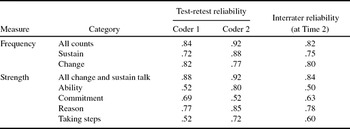
As can be seen in Table 2, the reliability of the Client Behaviour summary measures were all in the fair to excellent range.
Intraclass correlation coefficients of the client behaviour summary measures per interval for the reliability sample, n = 36 (intervals)

Note: Guideline for Intraclass Correlation Coefficients interpretation (Cicchetti, Reference Cicchetti1994): <.40 = poor; .40–.59 = fair; .60–.74 = good; ≥.75 = excellent.
Client language within MET and outcome
Repeated measures ANOVAs revealed differences between Outcome Groups (either significant main effects or interactions) for Sustain frequency, Ability strength, and Commitment strength. Remitted Drinkers had engaged in a significantly lower frequency of Sustain Talk per Interval of MET (M = 7.861 and SE = 1.321) compared with the Unremitted Drinkers (M = 11.795 and SE = 1.099), F (1, 20) = 5.240, p = .033.
With regard to Ability Strength, Remitted Drinkers uttered a higher mean Ability strength (M = .615 and SE = .182) than the Unremitted Drinkers (M = .021 and SE = .151), F (1, 20) = 6.313, p = .021. Furthermore, with Ability Strength as the dependent variable the interaction between Interval and Outcome Groups was significant, F (2, 40) = 3.463, p = .041. As can be seen in Figure 2, Outcomes Groups’ strength of Ability Language differed depending on which Interval it was within MET Sessions. The largest and only significant difference between Remitted and Unremitted Drinkers occurred in the End Interval within MET Sessions, t (26) = 3.237 = p = .003.
Strength of ability during intervals within MET sessions and outcome group

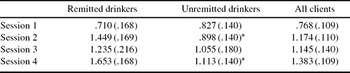
The Repeated measures ANOVA with Commitment strength per Interval of MET as the dependent variable revealed that there was no main effect of outcome group (i.e. over all MET there were no significant differences in Commitment Strength and Outcome Group). However, the interaction between Session and Outcome Group was significant, F (3, 60) = 2.983, p = .038. As can be seen in Table 3, Remitted Drinkers had significantly higher Commitment strength than Unremitted Drinkers during Session 2 and Session 4, t (26) = 2.573, p = .016 and t (24) = 3.913, p = .008 (respectively).
Mean (standard error) commitment strength across sessions of MET

*Significant difference between Remitted and Unremitted drinkers (p < .05).
Commitment strength was the only category in which the strength increased significantly more over the course of MET for the Remitted Drinkers compared with the Unremitted Drinkers, F (1, 26) = 5.222, p = .031). Mean (and Standard Error) change scores are displayed in Table 4. Note, there were no significant differences between Outcome Groups in terms of change in strength within a session of MET for any of the Client Language categories.
Mean (standard error) change in client language strength over MET (from the first interval of MET to the last interval of MET)

*Significant difference between Remitted and Unremitted drinkers (p < .05).
ISignificant increase in strength over MET (p < .05).
Client language categories as predictors of outcome
The Forward Regression indicated that Ability strength during the End Interval of Sessions within MET was the most significant single predictor, with no other variables being able to make a significant contribution once Ability End Interval was already included; χ2(1) = 8.367, p = .004. This variable correctly identified 86.7% of the Unremitted Drinkers and 72.7% of the Remitted Drinkers, and 80.8% overall.
When performing the Backward Regression, Ability End Interval was the last variable to be removed. The final model contained: the frequency of Average Sustain Talk, Commitment strength during Session 2, and change in Commitment strength over MET, χ2(3) = 15.644, p = .001. This model correctly identified 86.7% of the Unremitted Drinkers and 81.8% of the Remitted Drinkers, and 84.6% overall.
Discussion
This study has provided support for the link between client language and subsequent behaviour as outlined in the “emergent theory” of the inner workings of MI (Hettema et al., 2006; Miller, Reference Miller2004). Specifically, Ability and Commitment Language Strength categories and Sustain Frequency were related to drinking outcome and were more predictive of drinking outcome than drinking at baseline in a sample of clients with mild to moderate alcohol dependence.
The results of the current analyses support the hypothesis that clients who uttered higher levels of Change Talk would have better therapeutic outcomes than those with lower levels of Change Talk. However, the term “levels” needs to be qualified. As hypothesized, it was not the frequency of Change Talk that was related to outcome; rather it was the strength of two specific Change Talk Language types (Ability and Commitment) that were most predictive of outcome.
Based on the first study on the strength of Change Talk (Amrhein et al., Reference Amrhein, Miller, Yahne, Palmer and Fulcher2003), it was hypothesized that Commitment Language would be more predictive of outcome than other Client Language Categories; however this was only partially true. While the current study did not find significant differences between Outcome Groups in terms of Commitment strength over all MET, it did find that Commitment Language was the only Client Language category in which change in strength over MET (from first to last interval) related to drinking outcome. Furthermore Remitted Drinkers had significantly higher Commitment strength during those Sessions that represented parts of MET in which the change plan was completed and where MET terminated (Session 2 and 4, respectively, Sellman et al., Reference Sellman, Sullivan and Dore1996). Thus the current findings provide further support for Miller and Rollnick's (Reference Miller and Rollnick2002) emphasis on the enhancement of the strength of a client's commitment to change as central to the efficacy of MI-based interventions.
A recent study of a telephone MI intervention for gambling also found that Commitment language strength predicted outcome (Hodgins, Ching and McEwen, Reference Hodgins, Ching and McEwen2009), and commitment language itself was influenced by ability and readiness. In contrast, Gaume, Gmel and Daeppen's (Reference Gaume, Gmel and Daeppen2008) analyses of a brief alcohol intervention revealed that the average strength of Ability Language was the only client language category that predicted drinking at 12 months. Similarly, in the current study Ability Language strength, particularly during the End Interval within Sessions, was found to be the most significant single predictor of outcome. This illustrates the importance of coding Ability separately, which is optional in the latest version of the MISC (MISC 2.1; Miller et al., Reference Miller, Moyers, Ernst and Amrhein2008). Ability language was defined in the MISC 2.0 (p. 53) as statements that “indicate personal perception of capability or possibility of change”, thus equivalent to the well known concept of self-efficacy (Bandura, Reference Bandura1997). Miller and Rollnick (Reference Miller and Rollnick2002) emphasize that self-efficacy is a key element in motivation for change and supporting self-efficacy is stipulated as a guiding principle in MI. Self-efficacy is also central to other therapies (e.g. Relapse Prevention; Marlatt and Gordon, Reference Marlatt, Gordon, Davidson and Davidson1980) and is consistent with a wider body of research that has found that individuals with higher self-efficacy are healthier, more effective, and generally more successful than individuals with lower self-efficacy (Bandura, Reference Bandura1997). High self-efficacy has also been found to be the most consistent predictor of positive treatment outcome for problem drinkers (Adamson, Sellman and Frampton, Reference Adamson, Sellman and Frampton2009).
As hypothesized, clients who uttered more Sustain Talk (expressions of inability to change; reason, desire, need, and commitment not to change, and taking steps away from change) had worse drinking outcomes than those who uttered a lower frequency of Sustain Talk during MET. While the intention was to code both Sustain Talk and Resistance, no instances of Resistance were identified by the coders. Previous studies have shown that these Resistant Behaviours (such as interrupting, disagreeing with, discounting the therapist, and changing the subject away from change) have been found to be related to worse outcome (e.g. Miller and colleagues, Reference Miller, Benefield and Tonigan1993; Moyers et al, Reference Moyers, Martin, Christopher, Houck, Tonigan and Amrhein2007). In addition to Resistant Behaviour, the current analyses suggest that high frequencies of Sustain Talk may also be an important indicator of outcome and should be monitored along with the strength of Ability and Commitment Language.
Analyses employed in this study do not allow for causation to be inferred. Indeed, Miller and Rollnick (Reference Miller and Rollnick2004, p. 302) caution that a “parsimonious explanation is that MI counsellors directly shape client speech by reinforcing change talk and commitment language, and that this verbalization within an interpersonal context is what triggers change. The causal link between committing speech and behaviour change is speculative. . .”. They believe that the explanation that Client Language causes behaviour change is too simplistic and instead they propose that it is likely that some third variable leads to both Client Language and to behaviour change. Whether Client Language causes behaviour change or acts as a signal of the occurrence of a third variable, it does offer a way of predicting whether behaviour change will occur after the intervention, from which more accurate decisions can be made as to whether additional or alternate therapy is appropriate.
While this study provided the opportunity to examine client language and outcome for clients undergoing a more extensive motivational intervention than previously reported, the difference in treatment places limits on the extent to which present findings can be seen to replicate or challenge earlier findings (e.g. Amrhein et al., Reference Amrhein, Miller, Yahne, Palmer and Fulcher2003). Furthermore, the results in the current study need to be interpreted with caution given that this research consisted of exploratory data analyses with increased chances of Type I and Type II error due to multiple comparisons and the small sample size (respectively). Other limitations concern the reliability and validity of the coding. The primary tool utilized in the study was a modified version of the MISC 2.0, which also included some elements of the MISC 1.0. These tools have limitations of their own, which include only measuring a restricted range of information within the therapy session (Moyers, Miller and Hendrickson, Reference Moyers, Miller and Hendrickson2005), and the lack of reliability and validity data particularly for the MISC 2.0 (Madson and Campbell, Reference Madson and Campbell2006). Similar to other studies, uneven reliability was a limitation in the current analyses (e.g. Boardman, Catley, Grobe, Little and Aluwahlia, Reference Boardman, Catley, Grobe, Little and Aluwahlia2006; Catley et al., Reference Catley, Harris, Mayo, Hall, Okuyemi, Boardman and Ahluwalia2006; de Jonge et al., Reference de Jonge, Schippers and Schaap2005; and Moyers et al., Reference Moyers, Martin, Catley, Harris and Ahluwalia2003, Reference Moyers, Miller and Hendrickson2005).
As is the case with the original study that this analysis was based on (Sellman et al., Reference Sellman, Sullivan, Dore, Adamson and MacEwan2001), one of the major strengths is its generalizability to clinical practice given that it analyzed interactions between real-life clients and therapists from a community outpatient clinic.
Summary
The above limitations notwithstanding, this study has provided strong support for the relationship between Client Language within MI and therapeutic outcome as specified in the “emergent theory” of the inner workings of MI (Hettema et al., Reference Hettema, Steele and Miller2005; Miller, Reference Miller2004). The present analyses have replicated the findings of Amrhein and colleagues (Reference Amrhein, Miller, Yahne, Palmer and Fulcher2003) that emphasized the importance of strength rather than frequency of Client Language, the need to look at different types of Change Talk separately, and the importance of the pattern of Commitment Language strength over the course of MI. This study has also extended these findings to include a New Zealand sample of clients with mild to moderate alcohol dependence from an outpatient clinic. Furthermore, these results have demonstrated the importance of the client's strength of Ability Language and the frequency of Sustain Talk as important predictors of drinking outcome.
This is the first study to investigate the relationship between Client Language within sessions and across multiple sessions of an MI-based intervention (MET), demonstrating that change over sessions and end portions within sessions are particularly important. These findings suggest that MI therapists need to monitor increases in Sustain Talk and/or drops in strength of Ability or Commitment Language as they may signal the need for the therapist to change tack and/or additional treatment may be necessary to enhance outcome. This study has expanded on the current understanding of the relationship between Client Language within MET and therapeutic outcome, and has demonstrated that this is an area that warrants further investigation.
Acknowledgements
The authors acknowledge the contribution of Duncan Edwards, most notably for coding half of the audiotaped sessions; Dr Mark Wallace Bell for providing training in MI and coding; Dr Chris Frampton for his guidance with the design and analyses of this study; and Dr Joel Porter for examining the Master of Science thesis from which this study was based.







Comments
No Comments have been published for this article.