1. Introduction
Aligned with the growth of research into the international spread of English and its influence on international business and education, Global Englishes research, focusing on the use of EIL and a global lingua franca, has continued to expand, to change shape, and to take clear directions towards pedagogical concerns. Influential discussion of the pedagogical impact of the spread of English began with Kachru's (Reference Kachru, Quirk and Widdowson1985) once highly influential circles of English stipulating norm-providing countries (Inner Circle), norm-developing (Outer Circle), and norm-dependent countries (Expanding circle), along with the idea of WE that identifies English use at the country level. With increased global mobility, the field has outgrown this model with English now used fluidly within and across geographic contexts, and ‘native English’ now in minority usage on a global scale. This has given rise to a number of inter-related conceptualizations of English as a global language, including ELF, English as an EIL, and Global Englishes, which is used in this paper as an inclusive term.
Considering the functional use of Global Englishes in international contexts, ELF research has played a pivotal role in challenging assumptions of English language use. ELF research has raised controversial discussions around the importance of focusing on intelligibility and the abandonment of native-speaker norms. While the concept of a lingua franca core may not have been strongly supported with empirical evidence, it is an influential one that continues to challenge the way we view the English language as ‘owned and ruled’ by native speakers. These challenges especially concern grammatical accuracy and native-speaker-defined pragmatics in ELT (Haberland, Reference Haberland2011), as well as ‘English-only’ classrooms. As English is an international language, in many contexts it maintains dissimilar characteristics to the teaching and learning of other foreign languages, changing the way we understand English as a foreign language.
Pedagogical implications are currently gaining attention across the research domains of WE, EIL, ELF and Global Englishes, offering possibilities for breaking free from fixations on native-speaker norms. The field has been driven by a large number of volumes dedicated to implications and recommendations for language teaching (e.g. Kirkpatrick, Reference Kirkpatrick2007; Alsagoff, McKay, Hu, & Renandya, Reference Alsagoff, McKay, Hu and Renandya2012; Matsuda, Reference Matsuda2012; McKay & Brown, Reference McKay and Brown2016). The influence of this movement towards more global approaches to language teaching can also be observed at the nexus of research and pedagogy in teacher education (e.g. Matsuda, Reference Matsuda2017), sparking an increase in research. In this paper, we explore how and why research is taking shape in language classrooms and teacher education programmes to evaluate the effects of proposed innovations in practice, and to offer ideas for future research on this rapidly emergent topic.
1.1 Global Englishes: an inclusive research and teaching paradigm
With increased connectivity, the most common use of English is as a global lingua franca. We have witnessed a shift in usage of English, from being the language of a small minority of native English speakers to one with a global ownership. Today, English functions as a lingua franca among people from diverse lingua-cultural backgrounds, the majority of whom are adding to their multilingual repertoire. It is used for various purposes, in diverse settings and in hybrid ways, where speakers draw on their other languages to communicate successfully. It is a contact language, a lingua franca, and a language in flux. Whatever we call it, what cannot be denied is that it is a language that is used in very different ways to how it is presented in ‘traditional’ teaching English to speakers of other languages (TESOL) curricula.
As English spread beyond its original boundaries and is used on a truly global scale, related fields of research within applied linguistics emerged to document the use of English globally, how it manifests itself, and more recently, how it should be taught. While researchers position their work in different fields, we group these shared endeavours under the broad term of Global Englishes. This is an inclusive paradigm that aims to consolidate the work of WE, ELF, and EIL to explore the linguistic, sociolinguistic, and sociocultural diversity and fluidity of English use and the implications of this diversity of English on multifaceted aspects of society, including TESOL curricula and English language teaching practices. Global Englishes draws on key work from WE scholars (c.f. Kachru, Kachru, & Nelson, Reference Kachru, Kachru and Nelson2006), ELF scholars (c.f. Jenkins, Reference Jenkins2006a; Seidlhofer, Reference Seidlhofer2011), EIL (c.f. Alsagoff et al., Reference Alsagoff, McKay, Hu and Renandya2012; Matsuda, Reference Matsuda2012), and translanguaging (c.f. García, Reference García2009; Canagarajah, Reference Canagarajah2013), given their focus on the global use of English.
Researchers in these fields highlight the pluricentricity of English use and showcase how it is adapted and used alongside other languages. ‘Multilingualism, it seems, is the topic du jour – at least in critical applied linguistics’ (May, Reference May and May2014, p. 1), and Global Englishes research is part of this movement (Rose & Galloway, Reference Rose and Galloway2019), where ‘multilingualism has been at the forefront of recent discussions’ that challenge prevailing conceptualizations of second language acquisition (SLA) within the wider field (Galloway & Numajiri, Reference Galloway and Numajiri2020, p. 121). Thus ‘Global Englishes’ consolidates work in these related fields; it also unites similar movements in SLA, such as translanguaging and the multilingual turn.
1.2 Rationale for innovation in language teaching
The global spread of English and the changing sociolinguistic landscape of the twenty-first century have changed the foundations of how English is taught and learned. The majority of English speakers have been traditionally labelled ‘non-native’ speakers, but these multicompetent speakers (see Cook, Reference Cook, Cook and Wei2016) use English alongside other languages for the purpose of communication in diverse and flexible speech communities. Such changed usage, and the growing research documenting this change, have led scholars to call for a paradigm shift in TESOL curricula to address the mismatch between what is taught in classrooms and how English functions outside of the classroom (Kumaravadivelu, Reference Kumaravadivelu, Alsagoff, McKay, Hu and Renandya2012). The changing sociolinguistic use of English ‘has implications for language learning goals, for language teachers and for the curriculum’ (Kirkpatrick, Reference Kirkpatrick2012, p. 131). Matsuda and Friedrich (Reference Matsuda, Friedrich and Matsuda2012, p. 17) have urged innovation, arguing that the ‘linguistic, cultural and functional diversity associated with English today challenges some of the fundamental assumptions of ELT and requires that we revisit our pedagogical practices’. Clearly the needs of English language learners who are learning the language to use as a global lingua franca have changed. Of course, discussions of the diversity of English and the dominance of ‘native’ English in TESOL are not new: scholars in the field of applied linguistics have long lobbied for more accurate representation of the variation in English in language learning contexts (Gass & Varonis, Reference Gass and Varonis1984). Likewise, in his seminal article in 1976, Larry Smith noted that those working in English language education should showcase how English functions as a global language. In Reference Smith and Nelson1985, Smith and Nelson also critiqued the role of the native speaker in intelligibility assessments.
Global Englishes research provides new perspectives on these issues. With an increasing body of research showcasing how language is constantly in a state of flux – that there are no clear boundaries between languages, that English is used in dynamic and multifaceted ways, that learners will have to use languaging and navigate multilingual encounters – it showcases the irrelevance of curricula based on static native English norms for the majority of English learners today. Such research calls for a new orientation to language in the TESOL curriculum, one that promotes a more flexible view of language, that emancipates non-native speakers from native-speaker norms, that repositions the target interlocutor and where learner agency is central and language creativity is nurtured. Ultimately, it calls for curricula that recognize that multilingualism is the norm, validate learners’ linguistic repertoires and do not measure proficiency and competency with reference to native norms. It also encourages a critical approach, examining the impact of the dominant standard language ideology and native-speakerism in learners’ contexts.
1.3 Proposals for change: Global Englishes Language Teaching
However, despite such increased attention, calls for change have made little headway into TESOL. The evidence is there, yet curricula continue to be misaligned. Global Englishes researchers, particularly ELF researchers, have also faced severe criticism for a theory-practice divide, where scholars have abstractly argued for change, without exploring the effects of such change within classroom practices. To bridge the gap between theory and practice, and to unite the shared agenda of the research fields hosted, the theoretical calls for change to TESOL were summarized as the Global Englishes Language Teaching (GELT) proposals (Galloway, Reference Galloway2011; Galloway & Rose, Reference Galloway and Rose2015; Rose & Galloway, Reference Rose and Galloway2019), which call for:
1. Increasing WE and ELF exposure in language curricula
2. Emphasizing respect for multilingualism in ELT
3. Raising awareness of Global Englishes in ELT
4. Raising awareness of ELF strategies in language curricula
5. Emphasizing respect for diverse culture and identity in ELT
6. Changing English teacher-hiring practices in the ELT industry
The grouping of these proposals aimed to consolidate interconnected themes and to help instigate the paradigm shift. The first proposal focuses on the need to expose students to the diversity of English ‘so that they are better prepared to deal with English interactions in international contexts’ (McKay, Reference McKay and Matsuda2012, p. 73). The second proposal stipulates developing respect for multilingualism in line with movements in translanguaging research and the multilingual turn in SLA, which are challenging the monolingual orientations that underpin ‘traditional’ TESOL curricula, and meet calls for plurilingual pedagogies in TESOL (e.g. Lin, Reference Lin2013). The third proposal relates to the need for a critical approach to ELT and to raise awareness of how English is used as a global language. The fourth proposal stems from ELF research and considers the need for students to develop strategies to adapt to different communities of language users and diverse interlocutors. The fifth proposal concerns the need to respect cultural differences and reconsider what an English-using culture is (c.f. Baker, Reference Baker2009, Reference Baker2012, Reference Baker2015). The final proposal calls for changes to teacher-hiring practices and training to reduce positioning of the native speaker as expert (see McKay, Reference McKay and Matsuda2012). Non-native-speaking teachers do, after all, make up the majority of the profession (Braine, Reference Braine1999) and as such, ‘on a global level, the ELT profession is perhaps the world's only occupation in which the majority faces discrimination’ (Ali, Reference Ali and Sharifian2009, p. 37).
Curriculum innovation is, however, a complex process and a number of barriers to change were also identified alongside the proposals. These include a lack of materials that promote global approaches, strong adherence to standard language ideology in TESOL, traditional perspectives in teacher education, and hiring practices that favour native-speaking teachers (Galloway & Rose, Reference Galloway and Rose2015).
2. Innovations in ELT
Over the past two decades there have been a few notable attempts to theorize innovations in ELT from the various perspectives within the Global Englishes domain. We will first briefly outline the various proposed models for change in ELT, before then exploring models of the innovation process.
2.1 Frameworks for pedagogical change
All of the major schools of scholarship within the Global Englishes domain have lobbied for transformation in language teaching practices, which have culminated in articulated models for change. This section will evaluate four prominent models that underpin most of the classroom-based research reviewed in this paper: WE-informed ELT; the EIL Curriculum Blueprint; ELF-aware pedagogy (including the post-normative approach); and GELT.
Notions of WE-informed ELT have their origins in early applied work from the field. Since the 1980s, WE scholars have called for a paradigm shift in language pedagogy to better reflect the changing function of English globally. Kachru's (Reference Kachru1992a) well-cited ‘Six fallacies about the users and uses of English’ offered a concise critique on the incorrect assumptions underpinning ELT, offering areas where a WE perspective could innovate the field, particularly in terms of challenging the established target interlocutors, cultures, goals, and norms in ELT. Brown's (Reference Brown1993) paper summarizes calls from scholars (e.g. Vavrus, Reference Vavrus1991; Kachru, Reference Kachru1992b) and presents these as eight recommendations for teachers and teacher educators. These recommendations call for greater incorporation of WE perspectives within language teaching and teacher education.
Almost two decades later, Matsuda and Friedrich (Reference Matsuda and Friedrich2011) were critical of discussions still largely remaining at an abstract level regarding the pedagogical implications of WE, criticizing scholars for not yet providing adequate research-informed pedagogical ideas for use in the classroom. In response, they created the EIL Curriculum Blueprint, which provided specific guidance for teachers in their selection of instructional models in the curriculum. The blueprint also encouraged greater exposure to Englishes in the curriculum and focused on a need to teach strategic competence to learners for use with a diverse range of English users. It encouraged the selection of appropriate cultural materials, as well as language learning activities that aimed to increase awareness of the global politics of English. More recently, these ideas were articulated into a framework of Teaching English as an international language – a model built on the theoretical foundations of WE-informed ELT (Matsuda, Reference Matsuda2019).
By the early 2010s, the field of ELF had been very influential in lobbying for change in ELT. Building on influential groundwork from key ELF scholars (Jenkins, Reference Jenkins2006b, Reference Jenkins2007; Seidlhofer, Reference Seidlhofer2011), Dewey (Reference Dewey2012) introduced his post-normative approach to curriculum change. This approach sought to heighten teachers’ awareness of ELF, which he argued was an essential first step instigating ELF-orientated change in pedagogical practice. In a post-methods era of teaching (see Kumaravadivelu, Reference Kumaravadivelu2003), this awareness could then help teachers to inform innovative teaching approaches that are appropriate to each teacher's own unique context. The post-normative approach encouraged teachers to:
• Foreground the sociocultural context in which their students would use English(es)
• Expose students to the diverse varieties of English and the ways it is used
• Have students critically discuss the impact of globalization on English
• Spend less time on standard language forms, and focus instead on intelligible forms
• Teach communicative strategies for students to use in ELF contexts
Most ELF scholarship has since focused predominantly on raising teachers’ awareness through ELF-centred language teacher education (LTE), as illustrated by the work of Bayyurt and Sifakis (Reference Bayyurt, Sifakis and Vettorel2015a, Reference Bayyurt, Sifakis, Bowles and Cogo2015b). Sifakis (Reference Sifakis2019) introduced an ELF Awareness Continuum to conceptualize the gradual processes of raising teachers’ ELF awareness. The concept of a continuum resonates well with similar conceptualizations within the GELT framework. ELF-aware pedagogy within this framework focuses on the teacher, setting this framework apart from the EIL Curriculum Blueprint and the GELT framework, which both focus on curricular change. Sifakis (Reference Sifakis2019) states ELF-aware pedagogy can be operationalized in a similar way as an English for specific purposes approach, which is developed according to contextual needs.
The GELT framework for curriculum innovation was developed by Galloway (Reference Galloway2011) based on her doctoral research in Japan. The framework was underpinned by earlier ELF scholarship comparing English as a foreign language (EFL) and ELF, as well as shifts in pedagogical practice. The framework was further developed and the most recent version (Rose & Galloway, Reference Rose and Galloway2019) includes additional curriculum elements, drawing on Richards' (Reference Richards2001) curriculum development model. In total, there are 13 dimensions within the framework that seek a movement away from traditional teaching practices towards more global teaching practices, encouraging change in: target interlocutor; ownership; target culture; linguistic norms; teachers; role-models; sources of materials; positioning of other languages and cultures; needs; assessment criteria; goals of learning; ideology; and theoretical orientation. The authors state that movement from one category to the next is best visualized on a continuum for each category, and the GELT framework does not embody an ‘all-or-nothing’ position (Rose & Galloway, Reference Rose and Galloway2019).
Whatever the term, whether it be Teaching English as an international language, WE-informed ELT, ELF-aware pedagogy, or Global Englishes Language Teaching, these ‘different names indicate different intellectual history and affiliation, but they are more similar to each other than different in their assumptions, visions and suggested practice’ (Matsuda, Reference Matsuda2019, p. 146). Many of the ideas and values underpinning each movement for change share a central endeavour to challenge the status quo in TESOL and to innovate the ELT industry.
2.2 Innovation processes
In the 1990s, Brown (Reference Brown1993) drew on Rogers’ (Reference Rogers1983) diffusion of innovation model to conceptualize the processes via which WE ideas could be implemented in ELT practices. Brown draws on Rogers’ examination of variables affecting the perceived attributes of an innovation – that is, the aspects that might make an innovation more appealing: compatibility, relative advantage, complexity, trialability, and observability. In more recent work, Rose and Galloway (Reference Rose and Galloway2019) outlined a diffusion model in greater detail, exploring the processes via which an innovation might catch on or fail in various educational contexts. Their innovation model borrows from Rogers' later work (Reference Rogers2003), where he organizes adopters of an innovation into five categories: innovators, early adopters, the early majority, the late majority, and laggards. In the field of technological innovation in language learning, Porter and Graham (Reference Porter and Graham2016) drew on various definitions of these adopters (e.g. Rogers, Reference Rogers2003) to highlight the important role of the innovators and early adopters in leading and creating space for new pedagogical practices. The broader domain of Global Englishes, likewise, requires agents of change to introduce and trial innovations, and then to importantly research and report on the effects of these innovations.
While some scholars focus on teachers as agents of change, other scholars have focused on the importance of teacher educators to plant the seeds of innovation (e.g. Seidlhofer, Reference Seidlhofer2011; Dewey, Reference Dewey2012, Reference Dewey2014; Sifakis, Reference Sifakis2014; Blair, Reference Blair, Bayyurt and Akcan2015; Dewey, Reference Dewey, Bowles and Cogo2015a, Reference Dewey, Bayyurt and Akcan2015b; Sifakis & Bayyurt, Reference Sifakis and Bayyurt2015, Reference Sifakis, Bayyurt, Jenkins, Baker and Dewey2018; Rose & Galloway, Reference Rose and Galloway2019). Teacher education is a powerful context within which to transform the prior expectations and beliefs held by teachers, which can have lasting effects throughout their careers (Borg, Reference Borg, Garrett and Cots2018). Some ELF scholars argue that change must emerge from direct engagement with the teachers themselves (e.g. Dewey, Reference Dewey2012; Widdowson, Reference Widdowson2012), and teacher education is an obvious context where contact between researchers and teachers can easily occur.
2.3 A need to take stock of Global Englishes innovations in practice
While Global Englishes and its adjacent fields of study have long observed a theory–practice divide, in recent years a considerable quantity of classroom-based and LTE-based research has emerged to bridge this divide. Currently, there is a need to take stock of what research has taken place thus far in language classrooms to better understand the effects of Global Englishes innovations practice. Similarly, we need to know what innovations have been researched in teacher education thus far to make recommendations for future practices. Finally, in light of recent disruptions to student mobility and face-to-face teaching due to the COVID-19 pandemic, we see an urgent need to review the uses of technology in curriculum innovation to ensure we meet current and future pedagogical needs. Thus, this paper aims to systematically investigate what innovations have been put forward and what has been researched regarding implementation of these innovations.
2.4 Research questions
Building on the current knowledge gaps in the field, our review aims to answer the following review questions:
1. What Global Englishes (including ELF, EIL, and WE) innovations have been trialled and reported in research on LTE?
2. What Global Englishes (including ELF, EIL, and WE) innovations have been trialled and reported in research within language classrooms?
3. How has technology been used as a facilitator of curricular innovation?
In answering these questions, we intend to ask a number of sub-questions to guide our synthesis of the studies. These are: What is the reported impact of these innovations? Within which theories is research conducted? In what contexts and on what populations has research been conducted? What research methodologies have been used? What suggestions for future research have emerged? What implications for future practice are suggested?
3. Methodology for systematic review
We have elected to conduct this review of research as a systematic review, rather than a traditional narrative review to try to minimize bias. A systematic review is defined as a review which ‘adheres closely to a set of scientific methods that explicitly aim to limit systematic error (bias), mainly by attempting to identify, appraise and synthesize all relevant studies’ (Petticrew & Roberts, Reference Petticrew and Roberts2006, p. 9). As Macaro (Reference Macaro, McKinley and Rose2020, p. 230) observes:
traditional reviews can be affected by bias and lack of systematicity: bias in terms of how many and which previously published studies are selected for inclusion; lack of systematicity with regard to whether these studies are read in any kind of depth, the extent to which they are then described in the review, how they are juxtaposed against other studies, and whether and how they are critiqued.
To reduce individual bias, systematic reviews should always be carried out in teams (Macaro, Reference Macaro, McKinley and Rose2020). As two of the authors are scholars of Global Englishes whose work was likely to be included in the review, a systematic approach allowed these authors to minimize their own biases by applying strict frameworks when reviewing their own work, as well as the work of others. It also facilitated opportunities to uncover new pieces of research via an extensive search protocol. As it is important for systematic review teams to apply different perspectives to the review process (Macaro, Reference Macaro, McKinley and Rose2020), our team intentionally included one researcher who works outside the field of Global Englishes but whose research on global language education would provide an alternative critical perspective.
3.1 Sample
Our sample included all potential empirical studies on Global Englishes innovation in language teaching. Our inclusion criteria for the studies were:
1. Must contain empirical research
2. Must have been published between 2010 and 2019
3. Must be about ELT or teacher education
4. Must be about one or more of our key constructs (Global Englishes, WE, EIL or ELF)
Articles were excluded if they were deemed to be:
1. Theoretical articles or reports on practice with no research methodology
2. Research on topics other than language teaching, but with stated pedagogical implications
3. Studies on attitudes towards our key constructs rather than the pedagogical innovations underpinned by them
We required articles to contain empirical research and excluded theoretical articles and reports to better understand what research was being conducted within the space of theory and practice. As numerous review articles have appeared over time (e.g. Jenkins, Reference Jenkins2006b; Jenkins, Cogo, & Dewey, Reference Jenkins, Cogo and Dewey2011), the aim of this review was to explore actual innovation in practice, rather than re-hashing proposals for change. After an initial search of papers, 2010 was chosen as the cut-off date for inclusion in the review; search results in library databases showed this to be an obvious year when the volume of available research had increased.
Some scholars may find systematic reviews more constrained than traditional reviews. Certainly, in our application of strict inclusion and exclusion criteria, we will have inevitably missed some important work which has appeared in unindexed book chapters, peripheral academic journals, and unindexed dissertations. Nevertheless, ‘a positive result of following these stringent criteria is the limitation of bias, thereby increasing the trustworthiness, and arguably the value, of the results and recommendations of the study’ (Rose, Briggs, Boggs, Sergio, & Ivanova-Slavianskaia, Reference Rose, Briggs, Boggs, Sergio and Ivanova-Slavianskaia2018, p. 153).
3.2 Procedures
The following databases were searched to find potential articles:
• British Education Index
• Education Abstracts
• Education Research Complete
• Education-Line
• ERIC
• Academic Research Complete
• SCOPUS
• MLA International Bibliography
In each of the databases, we conducted the following search: ‘global Englishes’ or ‘English as a lingua franca’ or ‘English as an international language’ or ‘world Englishes’ and ‘teaching’ or ‘pedagogy’ and ‘English’. The search was conducted on 10–12 August 2019. An updated search was conducted on 1 June 2020 to screen more recent articles. The initial searching produced over 1,000 potential papers. While some of the search engines connected to the databases such as EBSCO and ProQuest allowed the searching of multiple databases, which reduced the number of duplicates from the outset, many duplicates still remained. To reduce these, papers were exported as .ris files and then uploaded to EndNote to use its automatic tool to delete duplicates. The list was then manually searched for partial matches in author and titles, and when duplicates were confirmed, these were deleted. While this search took place, other unsuitable articles were removed from screening based on publication source – papers which were published in non-research periodicals, such as The Economist. This left 406 articles which were shortlisted for abstract screening (and 92 further articles were added to this total in the updated search).
The shortlisted articles were then imported into Rayyan (Ouzzani, Hammady, Fedorowicz, & Elmagarmid, Reference Ouzzani, Hammady, Fedorowicz and Elmagarmid2016) – a web application for systematic reviews, which allows remote access and blind reviewing by multiple team members. During the abstract screening, the researchers worked together in the same room to ensure they could check their understanding of the criteria with the other members. Papers were marked as ‘include’, ‘exclude’, or ‘maybe’. Those marked ‘maybe’ were then reviewed by all of the researchers and included if two or more researchers agreed that they should be retained for full-text review.
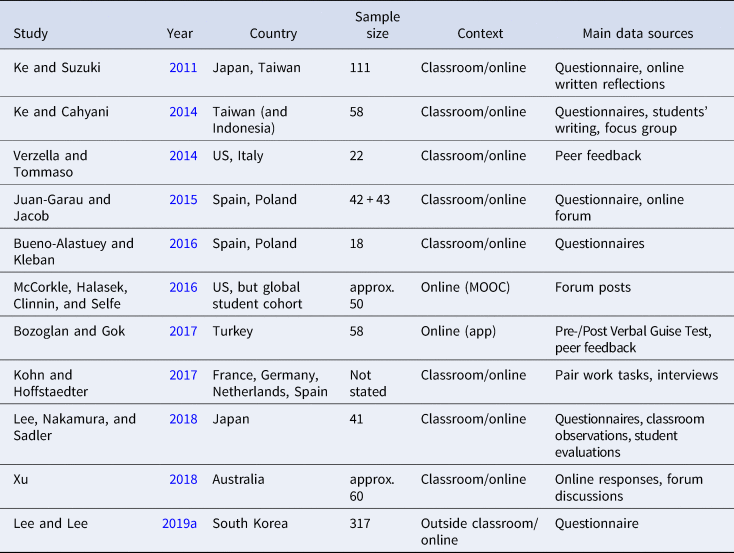
In total, this procedure identified and reviewed in-depth 38 papers: 10 on research of Global Englishes innovations in teacher education; 17 on research of Global Englishes innovations in language classrooms; and 11 on the use of technology to raise awareness of Global Englishes issues.
3.3 Data analysis
After the review process, 68 papers were retained for data extraction in the first phase of the review process. Electronic labels were also attached to the papers in Rayyan to help group them, using inductive coding processes. These included: attitudes, teachers, curriculum change, classroom intervention, teacher education, intelligibility, materials, pronunciation, intercultural communication, assessment, and identity. The papers were then grouped according to our review questions, which were: teacher education; classroom research; and technology. Some studies on materials or attitudes, which did not connect directly research on innovation were not included in the critical in-depth review stage. The full papers were then divided between the researchers maintaining those within their theme, so the same reviewer judgements were made on similar studies. The researchers then extracted key information on topic, sample, context, theory, research methods, and findings and added these to a single-spreadsheet data extraction grid. Weight of evidence scores (high, medium, and low) were given to evaluate the study's relevance to our review, the appropriateness of its methodology, the contribution of its findings to our review questions, and the trustworthiness of its analysis and reporting. One of the key functions of a systematic review is to assess the reliability of research evidence (Gough, Oliver, & Thomas, Reference Gough, Oliver, Thomas, Gough, Oliver and Thomas2017); thus, these evaluation scores help to reveal the most important studies to showcase in our in-depth review so that stakeholders are able to glean the most relevant and important research findings (Macaro, Reference Macaro, McKinley and Rose2020). The extraction grid was then used to produce simplified tables for inclusion in this paper to compare and contrast the studies on key dimensions such as participants, theoretical frameworks, research context, research methodology, and types of analysis.
3.4 Limitations
Our systematic review has several limitations, which must be acknowledged. First, our review did not include grey literature – that is unpublished research, or research that might not be in the form of published papers but available elsewhere, such as in conference presentations, dissertations, blogs, and teacher newsletters. By not including such work, our review has introduced ‘file drawer bias’ by not catering to unpublished work. One of the reasons we did not include such research was an inability to systematically search for them. While we are aware of unpublished masters and doctoral work by our own students and the students of certain other scholars, we felt including this research would introduce the very type of bias we aimed to avoid by adopting a systematic method. A second limitation was papers were not blind reviewed by multiple members (only the ‘maybe’ papers were). This may have impacted the reliability of the first screening process. A final limitation is that our search parameters may have missed relevant papers that did not include our key terms in their abstracts. Nonetheless, by restricting our search to transparent and replicable procedures we have facilitated future extensions and updates to this review.
It is important to note that many studies of teacher education practice and overviews of innovations since 2013 are book chapters, and since they are not indexed, were not captured in searches for the systematic review. Although not included in this paper, we are emphatic that Global Englishes researchers should be aware of the contributions these chapters make to knowledge in the area – especially as important avenues of reporting on action research. For example, Fang and Widodo's (Reference Fang and Widodo2019) edited book discusses how Global Englishes can be transformed into practice and includes chapters that offer empirical evidence in Asian contexts. Sifakis and Tsantila's (Reference Sifakis and Tsantila2019) edited book also includes a mix of conceptual and empirical chapters exploring ELF in classroom curricula, language materials and tests, and teacher education programmes. Rose and Galloway's (Reference Rose and Galloway2019) book on Global Englishes contains three chapters of empirical research. Zein's (Reference Zein2019) edited book on ELF in teacher education in Indonesia, and Hino's (Reference Hino2018) book on Japan are also good examples of research literature targeted to specific regions.
4. What Global Englishes innovations have been trialled and reported in LTE research?
This section aims to answer our first research question, which aimed to explore Global Englishes innovations in LTE research. Even though our initial screening of LTE papers highlighted many studies that discussed innovative practices in LTE, some of which provided a very good overview of instructional activities and modules to inform teacher education curriculum development, these were ultimately excluded from our analysis due to a lack of empirical evidence reporting the effects of the innovations. Our review also revealed a number of excellent studies which focused on in-service and pre-service teachers’ attitudes to innovation, as opposed to reporting on the innovations themselves (Buckingham, Reference Buckingham2015; Lee, Lee, & Drajati, Reference Lee, Lee and Drajati2019). Although these were excluded from our in-depth review, the study by Lee et al. (Reference Lee, Lee and Drajati2019) is worth noting due to its use of an original questionnaire to measure attitudes towards EIL, which could be of potential relevance to future research on changes in attitudes via teacher education.
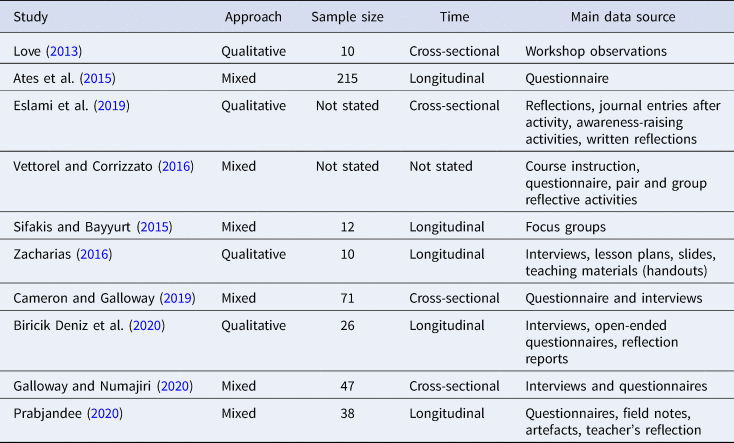
The systematic review ultimately identified ten empirical studies that specifically examined innovation in LTE research, and which our weight of evidence scores highlighted as most relevant to our research question (Table 1). In terms of methodological assessments, two of these studies were described as pilot studies, working with a small dataset, and the data collection and analysis procedures of one article was not well articulated. We conclude that the majority of these papers reflect research-in-progress pieces, which is surprising given that there have been calls for innovations to teacher education for decades.
Studies reporting on curriculum innovation in LTE research

Four of these studies were conducted in Anglophone contexts. Two (Cameron & Galloway, Reference Cameron and Galloway2019; Galloway & Numajiri, Reference Galloway and Numajiri2020) were conducted with pre- and in-service teachers (mostly pre-service) on a UK-based master's programme and the other two Anglophone studies (Ates, Eslami, & Wright, Reference Ates, Eslami and Wright2015; Eslami, Moody, & Pashmforoosh, Reference Eslami, Moody and Pashmforoosh2019) were conducted in the US, responding to the changing demographics in native English-speaking classrooms as a result of increased migration. The only other contexts included in this group are Italy (Vettorel & Corrizzato, Reference Vettorel and Corrizzato2016), Indonesia (Zacharias, Reference Zacharias2016), Korea (Love, Reference Love2013), Thailand (Prabjandee, Reference Prabjandee2020), and Turkey (Sifakis & Bayyurt, Reference Sifakis and Bayyurt2015; Biricik Deniz, Özkan, & Bayyurt, Reference Biricik Deniz, Özkan and Bayyurt2020). The lack of research in other regions of the globe is significant. Zacharias (Reference Zacharias2016) points out that research with pre-service teachers is under-represented, yet only two studies were conducted solely with in-service teachers (Love, Reference Love2013; Sifakis & Bayyurt, Reference Sifakis and Bayyurt2015). However, in some studies, small numbers of participants had teaching experience (e.g. Cameron & Galloway, Reference Cameron and Galloway2019) and in Vettorel and Corrizzato (Reference Vettorel and Corrizzato2016), a quarter of the participants had more than five years of experience. Notably, definitions of pre- and in-service teacher education were not always clear in these studies and length and lack of experience differed greatly.
The studies draw mostly on WE, although we can see that in some studies, ELF and EIL were also drawn upon. Love (Reference Love2013) focuses on critical pedagogy, but the critical pedagogy workshop used in this study included WE content. The studies in this section are reviewed in three groups: those reporting on reflections of short-term innovations (Section 4.1), those reporting on longitudinal innovations and their impact on perceptions (Section 4.2), and those offering frameworks for teacher education (Section 4.3).
4.1 Studies reporting on reflections of short-term innovations
In this review, two studies reported on short-term innovations in teacher education research. The first is Love's (Reference Love2013) study, which focused on critical pedagogy with a two-hour workshop organized for two groups of ten Korean in-service primary and middle school teachers. In this short intervention, WE was only one of several topics, but it highlights the connections between Global Englishes and critical pedagogy. The study also makes important connections with teaching young learners. The focus on reflection and adaptation of TESOL materials also paves the way for future materials development. Clearly not an action research project beyond own-classroom research, this pilot project provided only anecdotal evidence of participant views, leaving the claim that participants were adept at evaluating materials unsupported. The study suggested that participants currently use critical approaches in their classrooms and calls for an approach that aims ‘to work within existing curricula and systems rather than overturn them’ (p. 127), a conclusion that resonates with GELT and ELF-aware pedagogy.
Eslami et al. (Reference Eslami, Moody and Pashmforoosh2019) reported on six activities designed to promote understanding of WE and EIL with undergraduate pre-service teachers in the US. The sample size is unclear, but the aim was to challenge pre-service teachers’ knowledge about WE and heighten their sensitivity towards the cultural and linguistic diversity they will face in American public schools. As with Love (Reference Love2013), there is an overview of the WE unit and an overview of activities. Data were collected via written journal reflections, completed in class after each activity – although with no sample size, it is unclear how many were collected. As such, claims that activities were beneficial for raising participants’ awareness, tolerance, and respect of WE and that they resulted in attitudinal change and enabled participants to challenge their own ideologies about ‘standard’ English are questionable, particularly since pre-intervention data were not collected. Perceptions were noted to be the result of many factors, namely experiences with language learning and professional training background, but it is unclear how these factors were explored.
4.2 Studies reporting on longitudinal interventions
Ates et al. (Reference Ates, Eslami and Wright2015) investigated the effectiveness of incorporating WE perspectives into undergraduate English as a second language education courses in a teacher education programme in the US. Like the two studies in Section 4.1, the study involved those preparing to teach younger learners (Pre-K-6 and grades 4–8), but this was over a full 15-week semester, conducted by researchers not teaching the course, that collected data from multiple classes. The sample size was also much larger, with 215 pre-service teachers. Data were collected via pre- and post-course questionnaires with closed and open-ended questions. The analysis applied statistical methods to compare pre- and post-course data (using multiple t-tests, but without a Bonferroni adjustment). Statistically significant changes in attitudes were revealed, and both students and teachers were found to have benefited from exposure to WE perspectives. Although no follow-up data from the teachers were collected, the researchers called for more observational research on the actual implementation of WE perspectives into classrooms. The researchers conclude that appropriate interventions can foster awareness and acceptance of the diversity of English.
Zacharias's (Reference Zacharias2016) qualitative study explored the formation of teacher identity with 10 pre-service undergraduates on a teacher training programme in Indonesia taking a 15-week microteaching course orienting them to ELF pedagogy. They were interviewed three times to explore their understanding of ELF pedagogy, experiences teaching ELF in mini lessons, and their identity formation influenced by the course (although no pre- and post-course data were collected). Teaching documents for the mini lessons (lesson plans, PowerPoint presentation, and handouts) were also collected, although analysis of these materials was unclear. Participants gained confidence and using ELF pedagogy changed the way they saw their roles in teaching English and how they utilized local cultures in materials; most showed agreement with the importance of constructing a teacher identity independent of native-speaker norms. Although participants had real teaching practice after the course, no follow-up study was reported. Zacharias concluded by pressing for inclusion of more Non-Native English Speaking Teacher (NNEST) issues in teacher education and encouraged the use of mediation tools such as mini lessons to enable pre-service teachers to reflect on their identity formation.
Vettorel and Corrizzato's (Reference Vettorel and Corrizzato2016) study in Italy included the design and implementation of a WE- and ELF-aware teacher education module and investigated how it influenced pre-service teachers’ attitudes towards teaching practices. The two-year mixed-methods study involved two cohorts of students and data collected via questionnaires, reflections in e-learning discussion forums, interviews, and final reports. Because the sample size, research design, and data collection procedures are unclear, and only open-ended data analysis procedures are outlined, replication would be difficult; and although participants were positive about the innovation, conclusions that such innovations can broaden perspectives of ELT are questionable. However, some of the post-course interview comments provide initial insights and as with Ates et al. (Reference Ates, Eslami and Wright2015), the study explored what aspects of WE and ELF should be included in teacher education. The authors also explored potential barriers to incorporating these aspects into curricula in the participants’ context. Citing Love (Reference Love2013), they note that this study also emphasizes critically evaluating ELT materials for adapting rather than abandoning traditional TESOL curricula.
The study reported in Prabjandee (Reference Prabjandee2020) was conducted with 38 Thai lower secondary school English teachers to investigate attitudes towards GELT and provides insights into the activities that could be used for teacher training. Informed by transformative learning theory, the study incorporated a 16-hour teacher development course, collecting data via a pre- and post-course questionnaire, researcher field notes, and artefacts (materials produced by participants). The author acknowledges the descriptive nature of the pre- and post-course questionnaire analysis, yet unlike other studies, participants were also asked to reflect on their experiences and the usefulness of certain activities two weeks after the course, providing insights for curriculum design. Teachers were positive towards the activities, but attitudes towards GELT remained unchanged. The authors note that this reflects Galloway and Rose's (Reference Galloway and Rose2015) point that a paradigm shift in thinking may not occur quickly. The study also highlights the potential of transformative learning theory; the activities did not result in a major change in attitude, yet they did create a willingness to learn new concepts, so the author calls for activities that provoke a strong emotional reaction and ones which enable participants to scrutinize their prior knowledge. However, as with other studies, the author also recognizes the limitation of self-report data, which may not reflect authentic behaviours of implementing GELT in the classroom.
Biricik Deniz et al.'s (Reference Biricik Deniz, Özkan and Bayyurt2020) qualitative study, referred to as a ‘multiple case study’, reports on the implementation and impact of a theoretical ELF-aware teacher education course (‘Globalization in ELT’) on an ELT education programme, which was originally developed for in-service teacher education and was imbued with the syllabus of the ELF-aware teacher education (ELF-Ted) project (Sifakis & Bayyurt, Reference Sifakis and Bayyurt2015). This study was part of a Ph.D. study (Biricik Deniz, Reference Biricik Deniz2017) with 26 pre-service teachers in Turkey. Data were collected via open-ended questionnaires, semi-structured interviews, and other course documents, including portal journals and reflection reports. The questionnaire and short ten-minute interviews were conducted at the start of the semester and also administered at the end, although there is no information on the length of semester or frequency of the course. Data were also collected throughout the course via journals, and at the end of the course participants wrote a reflection report. The pre- and post-course qualitative data comparison is reported to have revealed a change in mindset. The course raised the teachers' awareness of the phenomenon of ELF and ELF-aware pedagogy, although the authors acknowledge that this needs to be further investigated to ‘clarify how this change occurs’. The study also acknowledges that, given the small group of teachers, generalizability of the research findings is limited. The authors call for a follow-up study to explore the impact of the course on the participants’ actual teaching practice.
4.3 Studies reporting on frameworks for teacher education
Sifakis and Bayyurt (Reference Sifakis and Bayyurt2015) describe a ‘transformative’ framework for TESOL practitioner education informed by ELF and WE designed to promote practitioners’ critical engagement with their own teaching practice. The study, conducted in Turkey, offers a thick description of the curriculum. The ELF-TEd project had three broad phases including a theoretical phase, an application phase, and an evaluation phase. Twelve teachers (eleven from Turkey and one from Greece) completed all phases of the project, but the two focus groups included only those from Turkey and the study reports only on the pilot phase. Lessons were audio or video recorded, uploaded to the project website, and self- and peer evaluations were conducted, but these data were not explored. The framework was reported to prompt participants to rethink their teaching practices, but without a pre- and post-course comparison, it is unclear how the course re-orientated beliefs about ‘non-native speakers’ and practices such as their use of error-correction, and whether the course actually increased their self-confidence as teachers. The detailed overview of the framework is nonetheless helpful to inform future LTE interventions.
Another study that promotes the importance of reflecting on context and own-teaching practice is Cameron and Galloway's (Reference Cameron and Galloway2019) study with pre- and in-service TESOL practitioners taking a Global Englishes (GELT) course on a one-year master's programme in Scotland. As with all other studies in this section, it was conducted in a single setting. The focus was on attitudes towards proposing changes in the practitioners' current or future teaching contexts. Interview data were collected from 5 students and triangulated with a survey of 66 students on the wider TESOL masters. It is unclear, however, if any questionnaire participants also took the GELT course, as while the nationality of interviewees is stated, there is no information on the questionnaire respondents. However, the study responds to the need for research exploring the practicalities of GELT and specifically addressed attitudes towards GELT proposals and barriers to implementing innovation. Findings suggest that explicit Global Englishes instruction can increase belief in change, but the claim is weakened by the fact that the data collected were retrospective. The authors call for more research both prior to and after Global Englishes instruction.
Galloway and Numajiri (Reference Galloway and Numajiri2020) investigated pre- and in-service TESOL practitioners taking a GELT elective course in a one-year master's in TESOL programme in the UK. They used interviews (n = 21) and questionnaires (n = 47) at the start of the course to investigate attitudes towards the GELT framework, and GELT proposals for, and barriers to, curriculum innovation, as well as factors influencing such attitudes. The authors did not investigate the influence of the course on attitudes in this study (although this is reported in Rose & Galloway, Reference Rose and Galloway2019), but it does provide insights into the feasibility of GELT-related curriculum innovation and proposals being put forward. Findings revealed GELT was seen to be an important and relevant topic for the TESOL practitioners; however, attitudes remained norm-bound and there were concerns about several possible barriers to innovation and uncertainty over how to overcome them, calling for more clear guidance for curricular innovation. The authors call for more research to explore the feasibility of proposals for curriculum innovation, as well as to examine what happens in the classroom after teacher education courses. The authors also acknowledge that, as this was an elective course, participants may have had more favourable attitudes towards GELT than others.
4.4 Evaluating the research
As noted in Section 1.3, teacher education has been identified as a key avenue to instigate Global Englishes-related innovation in TESOL. Teachers’ attitudes are central to innovation uptake, and while attitudinal studies are certainly important, studies such as Zacharias (Reference Zacharias2016) that focus on teacher identity are also welcome. However, despite increased proposals from scholars to raise teachers’ awareness, and the increased presence of postgraduate TESOL and applied linguistics programmes (Galloway & Numajiri, Reference Galloway and Numajiri2020), it would appear that research on innovation in teacher education research is still in a state of infancy. The amount of published research in this area in indexed journals is scant, although it should be acknowledged that several studies have been reported in book chapters and therefore not included in this review.
Overall, the studies in this category showcase some excellent pedagogical innovations and some provide detailed overviews of the syllabus and activities used, but there are many limitations. The innovations reported here do appear to have been successful, yet there is a lack of evidence to demonstrate the heightened awareness claimed. The research designs are often lacking in direct measures and the data analysis procedures of many studies are unclear, so we have to rely on anecdotal accounts of innovation. Short-term interventions and pilot projects need to be supplemented with studies that include pre- and post-course data collection to explore the influence of such innovations. More longitudinal research is also needed after the innovation to explore how (and if) these changes are implemented in practice when teachers enter, or return to, their respective classrooms.
4.5 Strengths and limitations of current research into innovations in teacher education
Table 2 outlines the methodological approaches utilized in the studies within this section. As can be seen, mixed and qualitative methods dominate, although the vast amount of different types of data collected was also a weakness of several studies, given the lack of systematic data collection and analysis. In summary, many approaches are being taken to introduce innovations in teacher education in relation to Global Englishes. Only Vettorel and Corrizzato (Reference Vettorel and Corrizzato2016) and Ates et al. (Reference Ates, Eslami and Wright2015) utilized pre- and post-course data to examine the influence of the innovation and both used questionnaires to do so. However, data were only robustly reported in Ates et al. (Reference Ates, Eslami and Wright2015).
Methodologies of classroom-based research

In all other studies, attitudinal change was claimed drawing on retrospective data collection instruments. Many used a mixture of tools to explore innovation. These include questionnaires, interviews, focus groups, lesson plans, teaching materials (handouts), journal entries, written reflections, and audio and video recordings of microteaching lessons. The retrospective nature of data collection at the end of many of the courses reported in this research makes it difficult to attribute change to particular aspects of the intervention as no measures are used to account for attitudes before taking the course.
Many of the studies provided a detailed overview of the types of activities that can be used to integrate a Global Englishes perspective. These studies also highlight the need to develop ways to work with teachers’ own curricula and promote reflection. As Sifakis and Bayyurt (Reference Sifakis and Bayyurt2015, p. 482) state, ELF-aware instruction should not ‘prescribe a particular teaching methodology or even a specific curriculum’, and while the study provides a detailed overview of the framework, more robust evidence of teachers’ transformative journeys in teacher education is required.
The lack of reliability of many of these studies is concerning and the unclear designs and analysis procedures of most of the studies makes replication difficult. Four of the studies were teacher-led, and even though Love (Reference Love2013) refers to this as action research, there is no evidence of this beyond collecting data in the researcher's own classroom. For most of the studies reviewed, it was difficult to categorize them according to a particular research design – perhaps an indication of a lack of methodological structure. For Global Englishes innovation to be successfully incorporated into the curriculum, more transparency regarding research design is needed, not only to improve the reliability of the studies but also to enable replication. Thick descriptions of the innovations are certainly helpful, but data collection and analysis procedures also need to be clear; otherwise, the impact of such innovations remain uncertain.
The lack of longitudinal data (with some notable exceptions in the more recent studies) and the lack of follow-up studies with teachers in their own classrooms is also problematic. Ates et al. (Reference Ates, Eslami and Wright2015) call for more longitudinal research, and it is clear that to date, no research has been conducted examining the long-time and real-life impact of innovations. Microteaching was used in Zacharias (Reference Zacharias2016), providing a window into observable practices. We call for follow-up studies of this nature with robust data collection procedures, analysis, and reporting of results to be able to demonstrate the success of these innovations in observable practice, as well as studies exploring long-term change in actual classrooms. The studies indicate that participants, albeit often conflicted, are generally supportive of change (Sifakis & Bayyurt, Reference Sifakis and Bayyurt2015, p. 2018), yet there is no research on what happens when they enter or return to the classroom. In Vettorel and Corrizzato (Reference Vettorel and Corrizzato2016), Cameron and Galloway (Reference Cameron and Galloway2019), and Galloway and Numajiri (Reference Galloway and Numajiri2020), barriers to innovation were explored and it is hoped that more research will explore the feasibility of curricular innovation in a range of teaching contexts.
Nevertheless, the studies are a promising starting point for future research. A degree of scepticism about change is unsurprising and norm-bound attitudes are deeply entrenched. However, in all of these studies, participants were positive about the innovations and they do provide insights into how to implement innovations within teacher education. It is hoped with the increase in Global Englishes courses in TESOL programmes that we will see more studies in different contexts. Teacher education is a key factor in ensuring successful and sustained curriculum innovation and remains central to discussions on the need for change in ELT in relation to ELF (see Dewey & Patsko, Reference Dewey, Patsko, Jenkins, Baker and Dewey2018).
5. What Global Englishes innovations have been trialled and reported in research within language classrooms?
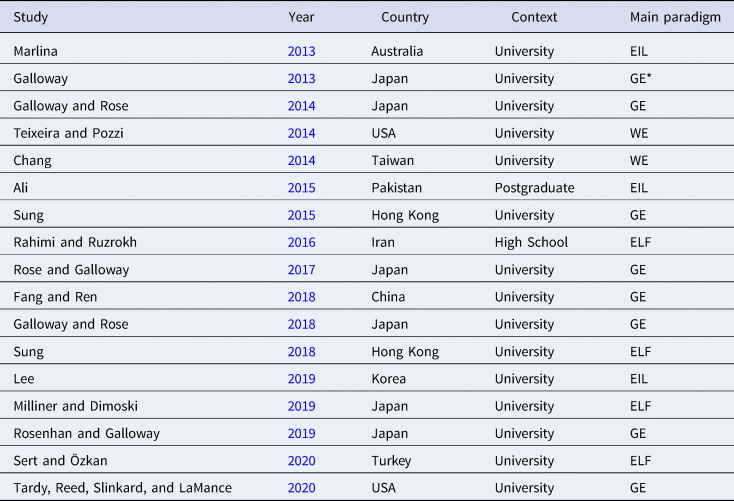
This section explores published research related to Global Englishes innovations within actual classrooms and curricula to answer our second review question. Table 3 includes the 17 studies highlighted in our systematic review as most relevant to this topic. Our review initially revealed a good number of studies which reported on innovative practices, but did not do so within a clear research design. Examples of this included Lwin and Marlina's (Reference Lwin and Marlina2018) interesting article advocating the use of folktales to engage English language students in developing their intercultural communicative competence. Similarly, Rose and Montakantiwong (Reference Rose and Montakantiwong2018) conducted a joint autoethnography (or duoethnography) of their own lived experiences of teaching EIL in Japan and Thailand, offering two very different tales of successful and failed curriculum innovation. However, articles such as these, while relevant to the theme of this review, did not present empirical evidence of innovations in practice and thus were excluded from our in-depth analysis. For different reasons, other papers that made it to the extraction grid stage (e.g. Bokor, Reference Bokor2011; Lanvers, Hultgren, & Gayton, Reference Lanvers, Hultgren and Gayton2019) were excluded during review due to their focus on first language (L1) English speakers, as too were those connected to pure textbook analysis (e.g. Syrbe & Rose, Reference Syrbe and Rose2018) or textbooks in classroom use (e.g. Yu, Reference Yu2018). Our review also revealed a number of excellent studies which focused on students’ and teachers’ attitudes to innovation, rather than research on innovations themselves (He & Zhang, Reference He and Zhang2010; Fang, Reference Fang2011; Sung, Reference Sung2016; Ahn & Kang, Reference Ahn and Kang2017; Takahashi, Reference Takahashi2017). Although these studies have been excluded from our in-depth review, they are worth noting as being potentially important investigations of stakeholders’ readiness for change.
Studies reporting on curriculum innovation
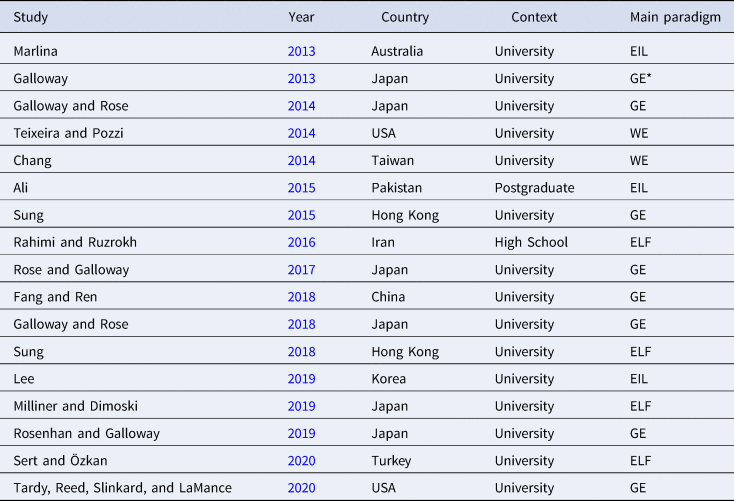
* ‘GE’ denotes ‘Global Englishes’ in this table only.
The earliest studies in our sample were Marlina's (Reference Marlina2013) investigation of teaching EIL in an undergraduate context in Australia, and Galloway's (Reference Galloway2013) investigation of teaching Global Englishes in Japan; however, there is an indication of recent growth in research with over half these studies published since 2018. Innovations have been reported in twelve different countries, with Japan represented in six studies. Undergraduate university learning contexts represent the vast majority of studies, with only two studies at the high-school level, and one at the elementary-school level. Global Englishes is the main paradigm of research in eight of the studies, EIL underpins five of the studies, ELF informs four of the studies, and WE just one. This indicates that classroom-based research is led by Global Englishes and EIL research, with the latter representing a more regionally diverse range of studies. Scholarship from ELF and WE are heavily drawn upon in a majority of papers, but often as a secondary paradigm underpinning the study.
5.1 Studies reporting on classroom activities
Most published studies that reported on classroom innovations were conducted by teacher-researchers, or researchers in collaboration with teachers. Rose and Galloway (Reference Rose and Galloway2017) investigated the impact of a Global Englishes awareness-raising activity with 108 university-level English language students in Japan. The activity involved learning about, and independently researching, the Speak Good English Movement in Singapore, after which students engaged in a debate over the legitimacy of Singaporean English and the need for people to adhere to perceived standards. Data were collected via in-class written reflections from each student and analysed thematically. Findings indicated that the activity helped to raise explicit awareness of non-standard Englishes and to challenge standard language ideologies. Based on these findings, the authors concluded that the activity ‘demonstrates how Global Englishes can be incorporated into an everyday ELT classroom in a country like Japan, where “native” norms prevail’ (p. 300) and helps teachers and learners to realize that language in use sets different standards than the imagined benchmarks. The strength of the study as a report of pedagogical practice is also its weakness as a piece of research, as there is a high risk of bias in the conclusions drawn.
In another study with the same group of 108 Japanese university students, Rosenhan and Galloway (Reference Rosenhan and Galloway2019) analysed poems produced by the students to explore whether creative pedagogies can provide a means to show creative self-reflection regarding the global spread of English. The poems were analysed via corpus and literary analysis to explore metaphors that students used as a means of emancipation from native English norms. The study concludes that the use of poetry for this purpose helped students to develop their own identities by allowing them to subvert the rule-governed nature of English through creative use of the language.
Galloway and Rose (Reference Galloway and Rose2018) used a presentation task to raise awareness of Global Englishes with 19 Japanese university students. In the task, the students were required to research one regional variety of English in terms of its development, features, and use, and then present this information in small groups using PowerPoint slides or posters. Data were collected in the form of handwritten reflections on the task. Data were coded thematically according to reasons for choosing the variety, and their reactions to the information presented in their groups. The authors conclude that the activity facilitated in-depth exposure to a wide variety of Englishes. Implications were that teachers could adapt the activity for their own classrooms to create a more globally orientated and learner-centred curriculum. The trustworthiness of findings of this study were similarly problematic to the debate study (Rose & Galloway, Reference Rose and Galloway2017), where data were collected via a single method in which students might have told the teacher-researchers what they wanted to hear.
Sung (Reference Sung2015) conducted a study on a group of 25 students in Hong Kong, where the curriculum included a number of Global Englishes awareness-raising activities. Thirteen of the students were interviewed in two focus groups after the course concluded. Data were analysed thematically, and findings suggested that the activities were received positively and were successful in raising awareness. The author notes, however, that the course did not result in radical change, and that future innovation might be best spread across language curricula and include both critical activities and out-of-class learning opportunities. Like many of the studies within this group, the study is somewhat limited in its one-shot end-of-course data collection, which affects the reliability of the findings. Pedagogically, however, the study offers a lot to teachers, with its good description of the innovations, including some example tasks in the published study.
Sert and Özkan (Reference Sert and Özkan2020) report on a seven-week intervention with thirty university students in Turkey. The intervention consisted of a series of one-hour long weekly ELF-informed activities, mainly focused on accents, pronunciation, and intelligibility. Data were collected before and after the course via a list of statements about ELF that students had to agree or disagree with. Interviews with five students at the end of the course were also conducted. As the statement list produced binary data, results were somewhat simplistic, but nonetheless showed that the activities led to greater confidence in students’ own variety of English, and less attachment to British and American standards. Interview data attributed these attitudinal changes to the ELF-informed activities. Future research might choose to adapt the statement list to a Likert scale format to produce data with greater sensitivity.
Milliner and Dimoski (Reference Milliner and Dimoski2019) reported on the effects of an innovation comprising 12 ELF-informed listening strategy training activities at Japanese university. The participants were 147 Japanese students, and data were collected via pre- and post-course listening assessments (TOEIC and Listening Vocabulary Levels Test), a listening self-efficacy questionnaire, student diaries, and a post-course questionnaire. Analysis of the pre-and post-course listening assessments revealed no significant change in listening proficiency but seeing as both of these tests do not measure ELF use, this is perhaps unsurprising, and speaks more to the efficacy of the listening training than the ELF-informed aspects of it. The self-efficacy questionnaire descriptively indicated a slight rise in students’ listening confidence, although inferential statistics were not conducted to check if this change was significant. Post-course questionnaires indicated students responded positively to the activities. Overall, due to the adopted measures and analysis embodied in this study, it is difficult to conclude an overall effect of the ELF-informed aspects of the listening training.
Overall, the studies in this category showcase excellent pedagogical innovations in English language classrooms, but all have limitations in embodying one-shot or retrospective explorations of the impact of these activities. In all of these studies, there are no measures to directly capture students’ beliefs before and after the tasks, and thus there is a lack of evidence to demonstrate change. Moreover, data collection methods tend to be confined to written reflections and retrospective interviews. Thus, the validity of the students’ responses may be called into question and it is unknown whether changes in beliefs are sustained over time, beyond completion of the task. As the activities are mostly transparently reported, displaying evidence of pedagogical soundness, future research might wish to trial the same types of task with a different group of students and use a mixed-methods approach to capture beliefs before and after the task, which would increase trustworthiness of the results. The use of multiple data collection instruments would also help to increase the validity of any changes found.
In one of the only truly longitudinal studies in this category, Rahimi and Ruzrokh (Reference Rahimi and Ruzrokh2016) outline a quasi-experimental study examining the effects of teaching a pronunciation course based on the lingua franca core in comparison to a traditional one based on accuracy benchmarked to native norms. Two groups of 28 students in a high school in Tehran were selected from a pool of 120 students and randomly allocated into the experimental and control groups. The experimental group received two 45-minute pronunciation sessions per week for six months based on the lingua franca core, and the control group had a syllabus underpinned by traditional British pronunciation norms. Students were given a receptive and productive intelligibility test, and an attitude questionnaire at the start and end of the course. The findings suggested that attitudes did not change as a result of the intervention, but the experimental group outperformed the control group according to the intelligibility measures. Reasons for differences in intelligibility are discussed, including the notion that the lingua franca core lessens the difficulties of mastering pronunciation and thus eases the task. However, as no qualitative data were collected from students, this could not be confirmed by the participants themselves. The study design was effective in that it offered longitudinal evidence of change, based on a before measure, but reporting was at times unclear, especially surrounding the opaque use of factor analysis on the attitudinal questionnaire. A future study might aim to replicate the methodology of this study, which was very transparent in design, but add qualitative elements to data collection, as well as additional steps into analysis to explore data at a greater depth.
5.2 Studies reporting on out-of-class learning activities
Galloway and Rose (Reference Galloway and Rose2014) used an out-of-class compulsory listening task to expose students to non-standard English varieties and ELF exchanges. The task involved 108 English language students at a Japanese university, who selected 10 audio samples to listen to throughout the term. After listening, the students recorded in a journal what they had listened to, why they had selected it, and their reaction to it. In total, the dataset included 1,092 journal entries, which were thematically analysed for content and frequency counts. Interviews were conducted with a subset of these students. The findings revealed that students were drawn towards English speakers from all of Kachru's three circles, although Expanding Circle speakers were most popular. The reasons for students’ choices predominantly centred on familiarity due to previous contact via teachers, friends, travel, or pop culture. The reflections revealed that the activity raised awareness of the diversity of English, but also reinforced some stereotypes the students had about non-standard English varieties. Overall, this study showed that out-of-class tasks can be used in class to create opportunities for discussion and reflection of Global Englishes. Although the interviews suggested changes in attitudes over the course of the activity, this was not explored within the journal entries; all 1,092 entries were treated as one cross-sectional dataset rather than tracking changes in choices, motivations, and reactions over time. This is one limitation in the analysis, which future replication research should explore.
Sung (Reference Sung2018) trialled an out-of-class learning activity with 18 of his own students in a small liberal arts university in Hong Kong. In the activity, students engaged in a real-life ELF exchange for 10–20 minutes and recorded this interaction in a weekly logbook. Data were drawn from these logbooks and two written reflections of 1,500–2,000 words each on how the activity impacted students’ understanding of using English in a global context. Data indicated that the activity led students to increase their appreciation of diverse forms of English, to question native-speaker norms, and to recognize the importance of communication strategies and multilingual resources as a tool for communication. The study concludes that such out-of-class tasks increase students’ critical awareness of ELF, and lead to their own positive identity development as legitimate users of English. The study does not report on the worksheet data nor changes in students’ awareness from the first critical reflection to the second, meaning that like Galloway and Rose (Reference Galloway and Rose2014), the data are presented cross-sectionally as a one-shot study, and does not explore longitudinal change. Nevertheless, the study has clear pedagogical implications as a report on successful ELF-aware pedagogy put into practice as part of out-of-class learning.
Lee (Reference Lee2019) reports on a classroom activity with 17 Korean students in an English language class at a university in Busan. The activity involved students planning and interviewing international visitors to the Busan International Film Festival and making recordings of the interviews to present in class. Data were collected from students via a reflective essay (n = 17) and semi-structured interviews with a subset of students (n = 13). The researcher concludes that the teacher was a significant agent of change in shaping students’ attitudes regarding EIL, as the activity led to a number of critical events which challenged students’ previously held biases and beliefs about non-native English. However, from the data presented, it is unclear how much this single activity brought about long-term, sustained change.
This study, like the three others in this category, involved data collected via reflection papers in a one-shot data collection design, and thus attitudinal change is only retrospectively reported by the students to the teacher-researcher, eroding the reliability of the findings. Future research into out-of-class learning should try to replicate these types of activity, which showcase innovations in action but aim to collect data within a longitudinal research design. Teachers of English may also need to think critically about the amount of time spent on using EIL when deciding on good activities. The activity in Sung (Reference Sung2018) would require minimal preparation by the teacher to implement, but requires access to a multilingual context. The Galloway and Rose (Reference Galloway and Rose2014) activity requires support from the teacher in finding suitable resources but may be well suited to lower level students in largely monolingual EFL contexts. In Lee's (Reference Lee2019) study, students spent most of their time editing and preparing videos as opposed to using EIL, so teachers may need to weigh the value of the activity against the time required.
5.3 Studies reporting on teaching WE and EIL
This group of studies includes research that explores the effects of teaching WE and EIL to students. These studies are slightly different from the above studies as the aim of the curriculum is to teach sociolinguistic rather than language content, thus blurring the lines between content and language learning.
Fang and Ren's (Reference Fang and Ren2018) study in China explored the influence of teaching a WE course to English language students on their attitudes towards their own English. It also aimed to explore attitudes towards Global Englishes more generally after taking the course. Approximately 50 students took the course over 2 terms, from which 12 student interviews were conducted in the first term, and reflective journals from 13 students were collected in the second term. Data were analysed thematically, and indicated the course helped students to develop an awareness of diversity in English, leading to greater confidence in their own variety of English. The data also suggested students developed a critical perspective of standards in English and tolerance for non-standard (but intelligible) English use. The authors note limitations to their study including the lack of a pre-test/post-test design to capture attitudinal change as the interviews and journals only reported retrospectively on such change. Also, as the whole course focused on Global Englishes, it is unclear from the findings how such content might be best integrated into a language curriculum, or which activities in particular led to the greatest change in attitudes. The authors suggest future studies should include more sources of data to capture the factors that influence changes in student attitudes in response to Global Englishes content.
Chang's (Reference Chang2014) study of the impact of introducing WE topics in an English language class of 22 students in a Taiwanese university suggests that WE content is both valuable and important for inclusion in ELT. The study analysed the students’ writing on WE topics to identify what the students found meaningful about English and learning English, what power the students noticed the English language has, the value of English varieties, and countering hegemony. While the findings are very selective (we do not know what they might have mostly written about), they are effective in showing an example of how WE topics are being introduced in ELT.
Teixeira and Pozzi (Reference Teixeira and Pozzi2014) explored the effects of teaching a WE course on a group of seven international students from a range of L1 backgrounds. Data were collected in the form of accent-recognition quizzes at the start and end of the course, a background questionnaire, student written reflections, recordings of group discussions, an exit questionnaire, and course evaluations. Findings suggest the WE course encouraged contemplation of local and global English use, and improved students’ ability to recognize varieties of English. Unfortunately, despite the healthy pool of data to draw upon, the procedures of data analysis and data presentation were not transparent. It was unclear what the accent-recognition test included, and the use of a ‘two group’ t-test on a paired sample of seven students was problematic, especially as no descriptive statistics from these tests were reported. Overall, the study appeared to report on an innovative curriculum, but readers are left to accept the findings at face value without a rich description via which to either replicate the course content or the data collection procedures.
Marlina (Reference Marlina2013) reports on a case study of three university students who took an EIL elective course in their undergraduate studies at an Australian university. Data were collected by Marlina, who was also the teacher, at the end of the course so as not to influence students’ perceptions. The study found that the course benefited the students in terms of increasing their awareness and theoretical knowledge of variation in English, but the students had difficulties reconciling the political messages underlying EIL with their immediate and contrasting sociopolitical contexts. For example, while the curriculum taught them that their own English was acceptable, the context in which they studied often presented ethnocentric, racist, and native-speakerism behaviours and attitudes. The study points to the importance of EIL curricula to discuss resistance to EIL ideas. A strength of Marline's study is the thick description that it offers of its EIL curriculum including the course outcomes. Marlina also details several limitations to his research design, suggesting future research employ richer data collection throughout the course to avoid the issues surrounding his cross-sectional, and retrospective, examination of the course via one source of data only.
Ali (Reference Ali2015) reports on the effects of teaching a series of 5 workshops on EIL to a group of 15 postgraduate linguistics students in Pakistan. Data were collected during the workshops via fieldwork observational notes and document collection, as well as post-study interviews with the participants. Data were stated to have been analysed via grounded theory, but this process was not entirely transparent in the write-up of the study. The study highlighted the fact that while the intervention did challenge students’ ideas on standards in the language, the students held a deficit perception of their own use of English, surmising that this is reinforced through the Pakistan Army and by teachers who are not enthusiastic about EIL. A strength of the study is that it is one of the few examples of an EIL intervention in an Outer Circle context, where postcolonial ideals may act as a substantial barrier to change. Limitations of this study are that it was conducted only with linguistic majors, who may not represent the majority of learners in this context. Moreover, like Marlina's (Reference Marlina2013) study, the retrospective nature of data collection via interviews at the end of the course makes it difficult to attribute change to particular aspects of the intervention as no before measures are used to capture attitudes before taking the course.
Galloway (Reference Galloway2013) investigated the language attitudes of 52 Japanese English learners towards English and ELT, as well as how these attitudes were influenced by Global Englishes instruction. The quasi-experimental design divided students into an experimental group (taking a Global Englishes content-based course) and a comparison group (taking a tourism content-based course) and attitudes were elicited via pre- and post-course questionnaires at the start and end of semester in addition to interviews. While the study revealed positive orientations towards native English and Native English Speaking Teachers (NESTs), participants were aware of the difficulty and impossibility of the native English model, and many referred to the importance of intelligibility. Post-course data revealed that the Global Englishes group had a decline in preference for NESTs, an increased awareness of non-native English, greater confidence as speakers of a recognizable variety of English and overall improved Global Englishes awareness.
Tardy, Reed, Slinkard, and LaMance (Reference Tardy, Reed, Slinkard and LaMance2020) took a content-based instructional approach to incorporate Global Englishes content within a university-level writing course. This study is significant as it is one of the few studies to investigate the ‘challenges and benefits of a GELT-informed approach to EAL [English as an additional language] academic writing’ (p. 2), and included a detailed overview of the course content, which comprised two units of study, one on language variation and the other on the global spread of English. Data were collected in the form of pre- and post-course surveys with both students and teachers, university course evaluations, and a focus group with three students. They also observed monthly teacher meetings. As the main thrust of the paper was to communicate the innovative approach to a practitioner readership, presentation of empirical data was minimal. Nonetheless, the post-course surveys and focus group data reported enthusiasm from students and teachers regarding course content, with 67 of the 72 students (93%) indicating interest in the topics covered.
5.4 Strengths and limitations of current research into classroom innovations
Table 4 outlines the methodological approaches used in the studies in this section. As can be seen, the studies are predominantly qualitative in their approach, with only one quantitative and one mixed method design present in our sample of classroom studies. The studies are also predominantly action research projects led by teacher-researchers, or case studies conducted on teachers’ own classrooms. However, in reality none of these studies labelled as action research in the table adhere to an action research methodological design in that they do not track modifications to innovations over time, but rather offer snapshots of the effects of innovations based on data collected after the completion of innovative tasks (and not before). As a result, only three studies embody a longitudinal design in their use of a quasi-experimental methodology. Only five of the studies provide evidence of the innovation in multiple classrooms.
Methodologies of classroom-based research

Note. CS = Cross-Sectional; Long = Longitudinal.
Many of the studies purport that their innovations change students’ attitudes and knowledge, but very few have concrete instrumentation to measure this (with the exceptions of Galloway, Reference Galloway2013; Rahimi & Ruzrokh, Reference Rahimi and Ruzrokh2016). A lack of direct measures of change may be hindering our current understanding of the exact impact of interventions. The prominence of self-reported and retrospective data collection instruments such as interviews and written reflections (often as the only source of data) is also problematic in that they do not provide strong evidence of causality. Many of the studies labelled as action research and case studies in Table 4 in fact lacked a concrete research design, thus eroding the reliability of the findings, as much is left to the researchers’ interpretations of the data. It is often difficult to connect the findings to the data because thick descriptions of the methods and procedures are lacking in much of the research. Often when pre-test measures are used in the studies, they are the wrong type of measures (i.e. they do not directly address Global Englishes) or are not subjected to rigorous tests of analysis to show significance or causality.
In summary, all of the studies presented in this section provide powerful pedagogical evidence from the language classroom of the positive benefits of innovations based on Global Englishes, WE, ELF, and EIL proposals for change. Future studies need to match this pedagogical contribution with research rigour, using robust data collection procedures to create a body of undisputable findings of proposals in action.
6. How has technology been used as a facilitator of curricular innovation?
In terms of categorizing the themes of studies, the review process revealed a body of research at the intersection of technology and Global Englishes. Given the increased use of online teaching and technology-mediated pedagogy since the COVID-19 outbreak, this section investigates the research related to technology as a tool to support Global Englishes in language teaching, which might inform future curricular innovation. Table 5 includes the 11 studies highlighted in our systematic review as most relevant to this topic. As many of these studies focus predominantly on investigating the use of technology, rather than specific outcomes of Global Englishes innovations, they are briefly reviewed according their pedagogical, rather than research, contributions. In reviewing the uses of technology at the periphery of Global Englishes research, these studies might highlight ways in which technology could be integrated into future research and practice. Geographically, the studies took place in a variety of wealthier locations in Europe and Asia, and the US and Australia, where the use of technology as an enhancement or intervention in educational contexts may have been more accessible.
Studies reporting on technology in language teaching

6.1 Studies facilitating ELF opportunities using technology
Ke and Suzuki's (Reference Ke and Suzuki2011) early study provides a typical example of a classroom-based online activity designed as a pedagogical intervention to put students in authentic ELF interactions. The study involved the creation of a nine-week long activity requiring Taiwanese and Japanese university students to communicate online. It generates some useful discussion around students’ attitudes towards non-native-speaker involvement in English language education, particularly focusing on ELF and native-speaker norms. Another Taiwan-based study (Ke & Cahyani, Reference Ke and Cahyani2014) challenged 58 Taiwanese students’ predilections towards native English and NESTs by having them interact in an online ELF context, this time paired up with 48 interlocutors with lower English language proficiency in Indonesia over one term. The study was effective in showing how such activities can raise awareness of, and lead to more positive attitudes towards, ELF usage.
Four studies investigated outcomes of projects connecting ELF users via online platforms. Verzella and Tommaso (Reference Verzella and Tommaso2014) used an online platform to connect undergraduates in the US receiving peer feedback on their writing from 11 non-native postgraduate students in Italy. The researchers provide brief anecdotal descriptions of the US students’ reflections, but do not delve deeper into issues surrounding the positioning of non-native English speakers as experts in the language compared to their American juniors. In another study, Kohn and Hoffstaedter (Reference Kohn and Hoffstaedter2017) use English and German as lingua francas in telecollaborative conversations with an unstated number of secondary school students in four European countries. The pedagogical intervention allowed for authentic written and spoken communicative exchanges between students. The main implication was that use of telecollaboration for authentic communication increases learner autonomy and agency.
Two more ELF studies involved connecting learners in Europe – these both with learners in Spain and Poland. Juan-Garau and Jacob (Reference Juan-Garau and Jacob2015) used an online platform with 42 secondary students in Spain and 43 secondary students in Poland, where they worked in a shared third space to complete a project. While the focus of the study was on the development of transcultural understanding, the activity itself clearly facilitated the creation of a space for authentic ELF communication. Bueno-Alastuey and Kleban (Reference Bueno-Alastuey and Kleban2016) used technology to establish an ELF context to connect 18 pre-service teachers in Spain and Poland to build intercultural competence and language skills (for the Spanish participants) and techno-pedagogical skills (for the Polish participants). As this was a pilot study designed to assess the feasibility of the proposed design, it points towards future research and adaptations of this pedagogical framework for longer-term initiatives.
In each of these studies, the researchers did not aim to explore the direct implications of the use of technology for Global Englishes innovation, but rather the global use of English was the platform via which to mediate the benefits of technology for other educational outcomes. Nevertheless, each of these studies highlight the potential for using technology to create unique activities that bring together non-native learners of different L1s in different geographic locations for authentic ELF encounters. Such platforms may open possibilities for more targeted Global Englishes research.
6.2. Studies challenging EIL student perceptions using technology
Technology has also been explored as a platform to raise awareness of Global Englishes. McCorkle, Halasek, Clinnin, and Selfe (Reference McCorkle, Halasek, Clinnin and Selfe2016) reflect on their own MOOC on English composition and WE. Although the limited qualitative data (students’ forum posts), unclear sample (‘approximately 50’ students), and lack of pre- and post-tests do not allow them to explore the explicit effects of the MOOC, there is pedagogical value in this report due to the innovative WE content in the MOOC module, which was created in response to concerns they had about students’ attitudes to language varieties in the original MOOC.
Bozoglan and Gok (Reference Bozoglan and Gok2017) used WhatsApp for dialect awareness training with an experimental group in their mixed-methods study of 58 pre-service English language teachers in Turkey. The training involved 14 weekly sessions, including conducting a contrastive analysis of nine different dialects with ‘standard Englishes’. WhatsApp was used for the teachers to record their own attempts to read texts using the dialects they learned, and to evaluate each other's efforts. Through pre- and post-verbal guise tests, the teachers’ attitudes towards different English varieties were found to become more positive, suggesting that such awareness training could be effective for improving tolerance of non-standard dialects in ELT in Turkey.
Lee, Nakamura, and Sadler (Reference Lee, Nakamura and Sadler2018) investigated EIL pedagogy and students’ attitudes towards EIL in a Japanese university using an intervention involving a videoconference-embedded classroom (VEC). While the questionnaire data were not analysed beyond simple percentages (and no pre-test to measure change), the pedagogical benefits of VECs as an awareness-raising platform are well articulated, including five concluding ‘challenges’ for using VEC, which could inform future research.
Xu (Reference Xu2018) analysed online forum discussions of ‘approximately 60’ students taking an existing undergraduate unit on EIL at an Australian university via qualitative content analysis. While the conclusions and implications stretched beyond the qualitative data presented, the article does provide insights into an existing unit on EIL, and the uses of online discussions to raise awareness outside of the classroom.
Lee and Lee (Reference Lee and Lee2019a) collected questionnaire responses from 317 EFL university students in South Korea to gauge the direct effect of informal digital learning of English (IDLE) practice on EIL perceptions. They conclude that the frequency of practice with digital language learning enhances EIL attitudes. The content of IDLE practices engaged by the students is unclear and appears to be of a general nature. A follow-up study might specifically use IDLE tasks that target Global Englishes content, as well as to collect qualitative data. Further explorations around projects involving these researchers pointed to a useful quantitative tool to measure attitudes, which could be used in future pre-test/post-test research designs: the EIL Perception Scale (EILPS) (see Lee & Lee, Reference Lee and Lee2019b; Lee et al., Reference Lee, Lee and Drajati2019).
Regarding the use of technology in Global Englishes research, a prominent feature is the use of online communication in classroom activities. While connecting ELF learners in different geographic locations is a valuable use of internet technology, it appears that the research is limited to this use. Global Englishes studies on the use of video games, virtual reality simulators, and MOOCs are very few, and given that only one study on MOOCs (McCorkle et al., Reference McCorkle, Halasek, Clinnin and Selfe2016) made it into our systematic review, it seems that much more could be done on the use of technology in different forms. We have much more access and ability for technology to reveal valuable insights, yet these are not appearing in the Global Englishes literature.
In summary, while the implications of the research in this section may be somewhat limited, we found that technology was fundamental for creating ELF opportunities in language classrooms by connecting learners from different L1 contexts. Technology was also fundamental as a platform for innovation in ELT and teacher training to introduce learners to, and challenge their perceptions of, Global Englishes ideologies. Particularly in the wake of the COVID-19 pandemic, as technology is increasingly relied on in response to reduced face-to-face teaching, we expect this area of research to grow exponentially.
7. Setting a future research agenda
Having reviewed a selection of the most relevant studies conducted in the past nine years, we aim to build on this synthesis to outline a future research agenda. Drawing on the findings of our review, and discussed within a larger body of literature, we make suggestions for research topics, methodological approaches, and contexts for future research. In keeping with the suggestions of previous research (e.g. Brown, Reference Brown1993; Rose & Galloway, Reference Rose and Galloway2019; Galloway & Numajiri, Reference Galloway and Numajiri2020), we frame this discussion within Rogers’ (Reference Rogers2003) five factors of innovation diffusion (introduced in Section 2.2) to examine how research currently addresses the needs of successful adoption:
1. Relative advantage: is research demonstrating a perceived benefit of a Global Englishes approach over existing methods?
2. Compatibility: is research exploring the compatibility of new innovations with existing beliefs, practices, and contexts?
3. Complexity: is research highlighting ways to make innovations simpler to implement for adopters?
4. ‘Trialability’: is research exploring the ease which ideas can be put into practice?
5. Observability: are the findings of research easily observable for researcher and practitioner communities?
Although research will be discussed against all five factors, extra focus is placed on relative advantage, because one of the central roles of research is to provide evidence for the advantages of a new innovation over existing practices.
7.1 What areas need to be explored?
A first area of needed investigation is research into the effects of curriculum interventions. Many of the studies outlined in Section 5 reported on single activities in the classroom, which is an important starting point in evaluating small-scale innovation. Future research needs to investigate the effects of greater and sustained curricular innovation. While some research into whole programmes has been reported in recent monographs (e.g. Galloway, Reference Galloway2017; Marlina, Reference Marlina2018), the field of TESOL requires more empirical studies in a greater range of contexts to show how a Global Englishes approach to language teaching is beneficial to learners, teachers, and the curriculum. This research is needed to make convincing arguments as to the relative advantage of the proposed innovations.
A second area of suggested investigation is explicit research into teacher education, which explores changes in teacher beliefs and practices of Global Englishes content in pre-service and in-service TESOL programmes. In keeping with the main ideology of ELF-aware pedagogy, we need to see more studies that position in-service and pre-service practitioners as ‘experts’ in their contexts, and not as passive receivers of an education. Teachers are important agents of change in the curriculum innovation process, and future research should embrace this notion by investigating how new ideas are integrated into practice when teachers return to, or enter, their own classrooms. Such research will help to better investigate the trialability of proposed curricula changes – that is, how effortful new ideas from TESOL programmes can be implemented.
A third area of needed investigation is into attitudes of teachers and learners towards suggested curriculum change. While the field of applied linguistics abounds in studies of language attitudes, more studies like Galloway and Numajiri (Reference Galloway and Numajiri2020) are needed that explore practitioners’ attitudes within the wider context of curriculum innovation. Research into these attitudes can help inform pedagogical innovations in both classroom and teacher education settings. Such research can feed into a better understanding of the compatibility of proposed innovations for various educational contexts.
A fourth area of future research could investigate the use of technology as a platform for sustained innovation both in and out of the classroom. While the technology studies reviewed in this paper tended to be methodologically weak, the platforms via which they introduced Global Englishes content (e.g. the MOOC in McCorkle et al., Reference McCorkle, Halasek, Clinnin and Selfe2016) and ELF opportunities (e.g. Ke & Suzuki, Reference Ke and Suzuki2011) were pedagogically innovative. Scholars have pointed to a lack of materials as a major barrier to introduce Global Englishes in classrooms, and this affects the complexity associated with teachers adopting new practices. The use of technology to both expose learners to speakers of global varieties of English, and to connect them with other L2 users, may be a powerful tool to reduce this complexity. Following from this, we need specific and robust research investigating the effects of these tools on learner attitudes and educational outcomes, as opposed to the use of the technology itself.
Finally, when new ideas are put into classroom practice, we need to ensure that these ideas are shared in research venues and professional domains to increase the observability of Global Englishes in language teaching (discussed further in Section 7.3). Without such sharing, innovations will remain unseen by teachers and researchers who are seeking new ways to globalize their curriculum.
7.2 What contexts and populations need to be explored?
The research reviewed in this paper shows most research emerging from certaincountries, such as Japan, South Korea, Taiwan, and the USA. Table 6 provides an overview of the location of the studies in the first review phase of the study. We suggest that while we still need more research across all regions, that areas such as South East Asia, the Middle East, and Latin America are under-represented in research, especially considering these regions contain large numbers of English language learners, who predominantly acquire the language through formal education. For the same reasons, more research is needed in China.
Location of studies

a Denotes that this country appeared as part of the sample of only one study.
In terms of populations, forty studies were conducted in universities at the undergraduate level, seven at the graduate level, and six at the school level, with the remaining studies capturing participants across a spectrum of contexts. The over-representation of tertiary-level research may be a product of many researchers being based at universities, where they have direct access to learners and teacher education programmes. This trend means there is a danger of drawing conclusions based on convenience samples, which are chosen predominantly due to ease of access, rather than representativeness of typical language learners and teachers. Our review suggests we need more classroom-based studies across the spectrum of educational domains, including many more at the school level, where most compulsory education takes place. We also note an absence of studies in commercial ELT domains. The commercial sector has been noted as one where the ‘native speaker’ is used as a selling point (Seargeant, Reference Seargeant2009), and thus might be more resistant to change. These overlooked segments may be less susceptible to accepting the relative advantage of Global Englishes curricula innovations, especially compared to motivated English majors at the undergraduate level. Studies need to collect attitudinal data from such domains to better understand contextual differences that may create barriers to implementation, and thus erode both compatibility and trialability of new ideas received in teacher education.
7.3 What methodological approaches are needed?
Our synthesis of studies has highlighted an over-abundance of one-shot, cross-sectional data collection methods in classroom research, usually at the end of a course or task. Quasi-experimental designs are clearly needed to conduct research with groups of students engaging in new curriculum changes. Research designs also need to include more pre- and post-intervention data collection methods to measure actual change. Designs that incorporate a comparison group of a matched class, which did not receive the intervention, would also be valuable in attributing observed changes to curriculum innovations, and not to other factors. Mixed-methods approaches to data collection are also essential to highlight specific elements of intervention that worked best.
Action research is another longitudinal research design that could measure the effects of ongoing interventions in real classrooms. Our systematic review has revealed that many studies in the field of TESOL are labelled as action research simply because they have been conducted in a researcher's own classroom, without the inclusion of the requisite cycles of planned innovations and multiple data collection points that can be powerful to pinpoint effect, and demonstrate causality to the innovation. Robustly-designed action research designs were absent, perhaps due to a lack of methodological expertise or time for the teachers reporting on them. McKinley (Reference McKinley2019, p. 876) calls for ‘more TESOL research to be conducted in the teaching-research nexus; specifically, for the research to be more grounded in classroom contexts’. He stipulates that greater collaboration is needed between teachers and researchers, and action research is an ideal design to facilitate such collaboration, with researchers providing methodological expertise, and teachers providing pedagogical expertise to ensure good implementation and reporting on innovations.
Research into teacher education appears to be at a pilot stage and would also benefit from more systematic approaches to data collection, particularly with the inclusion of pre- and post-course data. We need more studies to adopt a longitudinal research design to explore how innovations manifest into actual teaching practices after teacher education programmes conclude. One avenue to explore this would be follow-up studies to those which have already reported the activities of teacher education programmes to see whether the innovations have impacted future practices of the participants. Suzuki (Reference Suzuki2011), in her attempts to raise awareness of linguistic diversity among English language teachers in Japan, revealed that they developed a better understanding of diversity, but expressed reluctance to introduce this in their teaching. She concluded that ‘single-shot instruction’ is not enough to make a difference due to their deeply ingrained beliefs. Thus, there is also a need to explore what type of interventions in teacher training work best to ensure compatibility with existing practices.
Additionally, we need better instruments via which to explore the effect of global approaches to language teaching and teacher education to make more convincing claims about their relative advantage over existing practices. Our review pointed to two such quantitative tools: the EILPS (Lee et al., Reference Lee, Lee and Drajati2019), and the questionnaire in Galloway and Numajiri (Reference Galloway and Numajiri2020), which reported information on their reliability. Use of quantitative instruments also needs to be accompanied with appropriate statistical analysis. Only one study applied advanced statistical methods to show causality via structural equation modelling (Lee & Lee, Reference Lee and Lee2019a). Many of the studies followed either unclear or questionable statistical procedures: for example, they did not check assumptions had been met before applying parametric tests to the data; descriptive statistics did not report basic information like standard deviation; internal reliability of grouped items was not reported; effect sizes were not reported; and multiple t-tests were run without correction.
Future research should be equally cautious with its qualitative methods – many of the studies relied on somewhat unreliable methods to elicit evidence of the impact of an innovation such as reflection papers from students at the end of the course and retrospective interviews with the teacher-researcher. The greatest lack of clarity was in the explanation of data analysis procedures in many of the studies, often loosely referring to some kind of ‘qualitative content analysis’, without support from research methods literature, nor details of the coding procedure or codes. All of this amounts to research that would be impossible to replicate and draws into question the reliability of the findings. Since many of these studies involve investigating participants’ attitudinal changes via particular tasks and awareness-raising activities, the lack of analytical rigour highlights a clear gap in the research.
Finally, there is a need for better reporting of research across all domains to increase observability of good pedagogical and research practices. Some of the studies were unclear in terms of the methodological design underpinning the study, descriptions of interventions, and at times even the number of participants in the study. Sometimes data collection instruments were mentioned in the studies, but little data from them were presented in the findings. Future research should be sure to include thick descriptions of innovations, as well as a clearly articulated research procedure. Ideally, instruments should be appended to published papers or uploaded to a repository like IRIS (Marsden, Mackey, & Plonsky, Reference Marsden, Mackey, Plonsky, Mackey and Marsden2016) so that studies can be replicated in multiple classrooms and contexts, thus increasing trialability. We also urge researchers to report their research in accessible domains: we observe that much research is being buried in book chapters, which are not as widely available, or in unpublished dissertations. Journal articles are, generally, more easily obtainable electronically than books and book chapters, and self-archiving of author versions increases public accessibility. If they are indexed journals, they are easier to find in searches, and thus offer enhanced observability to a research and practitioner community.
7.4 Looking forward
Our intention in this review is not to be overly critical of extant research in the field, but rather point to valuable avenues for future research. Much of the research reviewed has established a concrete platform for sharing innovative practices. At present, the field of Global Englishes – inclusive of ELF, EIL and WE – has a solid theoretical foundation stemming from earlier theoretical work (e.g. Smith, Reference Smith1976), and calls for pedagogical innovation (e.g. Brown, Reference Brown1993; Jenkins, Reference Jenkins2006a), which has helped communicate the relative advantage of innovations from a conceptual standpoint. This has recently been accompanied by initial explorations of what these calls might look like in classroom and teacher education practices, which has helped to increase awareness of this advantage from a professional perspective. What is needed next is greater attention to exploring these innovations in practice from a research perspective via robustly planned studies to ensure that scholars are able to articulate the advantage of these curricula proposals from a conceptual, professional and empirical standpoint. Currently, the rising level of research interest in Global Englishes has not been accompanied by an equal level of research rigour. In the future we hope to see more studies emerge to fill this gap.
Questions arising
1. What are the (measurable) effects of Global Englishes innovations on the students themselves, and educational outcomes?
2. What kind of curricular tasks, materials, and content induce long-lasting effects on students in terms of their beliefs and identity?
3. What are the tangible effects of increased exposure to WE and ELF on students’ abilities to use English a global language?
4. How can Global Englishes innovation be best achieved within TESOL curricula?
5. What are the major barriers to introducing Global Englishes innovations within English language classrooms?
6. What are the (measurable) effects of Global Englishes teacher education on teacher beliefs?
7. How does Global Englishes content within teacher education programmes influence the future pedagogical practices of in-service and pre-service teachers?
8. What kind of teacher education practices induce long-lasting effects on teacher cognition and pedagogical practices?
9. How can Global Englishes attitudes be reliably and validly assessed to measure attitudinal change?
10. How can technology be used to facilitate future innovation?
Heath Rose is an associate professor of applied linguistics at the University of Oxford. At Oxford, he is course director of the M.Sc. in Applied Linguistics for Language Teaching. His current research interests are in Global Englishes, particularly focusing on the impact of the spread of English on second language teaching and learning.
Jim McKinley is an associate professor of applied linguistics at University College London, and Director of Studies for the M.A. TESOL Pre-Service. His research explores implications of globalization for L2 writing, language education, and teaching in higher education. He currently serves as an editor-in-chief for the journal System.
Nicola Galloway is a senior lecturer in TESOL at The University of Glasgow, where she teaches on the M.Sc. TESOL programme. Nicola's main research interests relate to the pedagogical implications of the global spread of English and more recently on English medium instruction in higher education.