Facts do not cease to exist because they are ignored
Aldous Huxley (Proper Studies, 1927)
1. Introduction
Quite a number of studies have drawn attention to and further explored the levels of liberalization provided under regional trade agreements (RTAs). Concerning services, covered by so-called economic integration agreements (EIAs), the focus has been on clarifying the extent to which existing commitments improve on the conditions of market access (MA) and national treatment (NT) as scheduled by participants under the General Agreement on Trade in Services (GATS). The inclusion of WTO-extra obligations, reaching beyond the Agreement's current scope, has also been addressed. By comparison, WTO-minus conditions, i.e. EIA commitments falling below their GATS-scheduled counterparts, have been given far less consideration.Footnote 1 Nevertheless, it seems that the WTO's Transparency Mechanism for Regional Trade Agreements (TMRTA) is increasingly being used by Members also to address such ‘negative departures’ in the agreements under review.Footnote 2
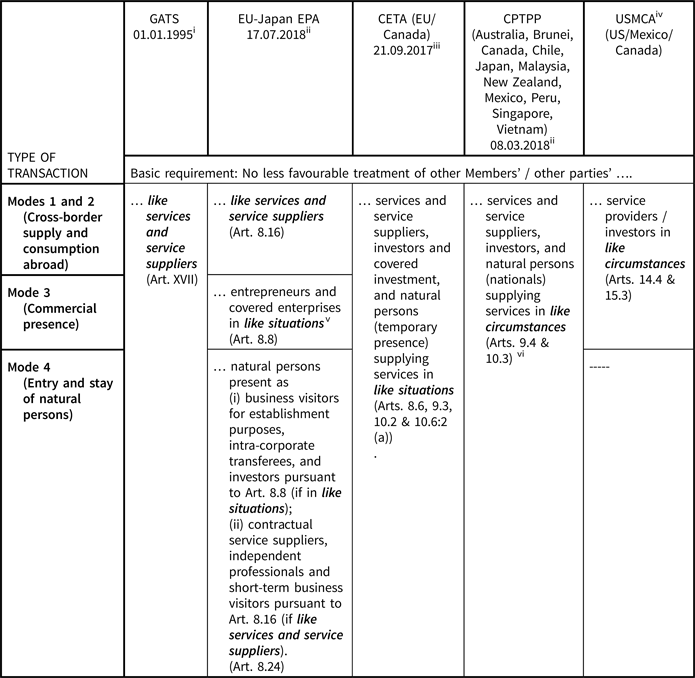
Yet, there are other types of divergences that have been widely ignored to date, whether in research papers or potentially relevant policy fora: resort to WTO/GATS-alien framework conditions, i.e. definitional modifications of existing GATS provisions, in individual EIAs. The current study seeks to fill this gap, focusing in particular on a key requirement for such agreements, i.e. the elimination of ‘substantially all discrimination, in the sense of GATS Article XVII’ between the services and service suppliers of the parties concerned. The concept of NT, as specified in that Article, hinges on treating foreign services and service suppliers no less favourably and, thus, according them the same competitive opportunities, as their like domestic counterparts.Footnote 3 Yet, this definitional benchmark – the treatment of a Member's own like services and service suppliers – has been modified in quite a number of RTAs, including recent large-scale agreements such as the Economic Partnership Agreement (EPA) between the European Union (EU) and Japan, the Comprehensive Economic and Trade Agreement (CETA) between the EU and Canada, and the Comprehensive and Progressive Agreement for Trans-Pacific Partnership (CPTPP) among 11 countries in the Asian-Pacific region (Table 1).
Standards of National Treatment: GATS vs. major Regional Trade Agreements

i Date of entry into force. ii Date of signature. iii Date of provisional application. iv Based on the draft circulated in October 2018 (see https://ustr.gov/trade-agreements/free-trade-agreements/united-states-mexico-canada-agreement. V The definition of entrepreneurs and covered enterprises essentially coincides with the definition of mode 3, commercial presence, in GATS Article XXVII(d). vi A drafters’ note further specifies the intended interpretation of this provision (see www.mfat.govt.nz/assets/Trans-Pacific-Partnership/Other-documents/Interpretation-of-In-Like-Circumstances.pdf).
Note: The Table reflects the current state of an ongoing drafting project and should not be quoted at present. The intention is to indicate the diversity of the national-treatment clauses of individual agreements, rather than providing a precise reflection of the agreements’ actual content.
It is not rare for the same Member to subscribe to different concepts of NT in its trade agreements. In the case of Canada, for example, foreign services and service suppliers qualify for non-discrimination in like situations under CETA and non-discrimination in like circumstances under CPTPP, NAFTA, and a number of additional RTAs. As already indicated, both standards depart from the NT concept under GATS Article XVII, applicable vis-à-vis the country's non-preferential trading partners. While the use of different treaty templates might have facilitated negotiations on individual EIAs, it certainly introduced an additional element of diversity and, possibly, inconsistency into the trading system.
What needs to be kept in mind: Insofar as GATS-alien provisions are of a horizontal (cross-sectoral) nature, modifying the conceptual frameworks of the respective agreements, GATS-alien provisions may prove more difficult to eliminate than GATS-minus commitments. While the latter might simply be replaced by GATS-compatible upgrades of the entries concerned, possibly based on a most-favoured nation (MFN) clause, elimination of a generally applicable GATS-alien framework provision might require careful re-consideration of an agreement's basic structure. This appears particularly challenging in the current international environment, characterized by a deep crisis of multilateralism and a proliferation of regional initiatives with apparently little, if any, attention being paid to ensuring mutual consistency and compatibility. Virtually all agreements reviewed for this study that were found to contain conceptual variations fail to provide an explanation, in broad terms at least, of the actual meaning of these variations and the underlying rationale.
The following discussion starts with an introduction into key disciplines governing economic integration agreements pursuant to GATS Article V. Particular attention is given to the requirement for such agreements to provide for the absence or elimination of substantially all discrimination, in the sense of Article XVII. Based on a sample of 100 EIAs, the third section gives an overview of the likeness criteria underlying the NT and, where these exist, MFN provisions of individual agreements. Inevitably, the widespread use of what appear to be GATS-alien provisions raises the question of how much conceptual variation is permissible under the Agreement. The fourth section then deals with possibilities, hypothetically at least, that MFN clauses and other treaty provisions could eventually help contain diversity across EIAs. The prospects appear quite remote, however. Given the negotiating stalemate at the multilateral level, the concluding section emphasizes the need for Members to make prudent use of the RTA option, ensuring as much conceptual consistency at the drafting stage as reasonably possible. This presupposes, however, that the existence of GATS-alien provisions, in particular in the form of apparently disparate NT standards, and the associated risks are no longer ignored, but addressed head-on in relevant WTO fora.
2. Framework Conditions for RTAs Pursuant to GATS Article V (‘Economic Integration’)
2.1 The Core Parameters
Article V of the General Agreement on Trade in Services (GATS) allows two or more WTO Members to liberalize their mutual trade relations under an economic integration agreement. The key provisions governing the admissibility of such an agreement, regardless of the generally applicable MFN principle, are as follows:
1. This Agreement shall not prevent any of its Members from being a party to or entering into an agreement liberalizing trade in services between or among the parties to such an agreement, provided that such an agreement:
(a) has substantial sectoral coverage [fn], and
(b) provides for the absence or elimination of substantially all discrimination, in the sense of Article XVII, between or among the parties, in the sectors covered under subparagraph (a), through:
(i) elimination of existing discriminatory measures, and/or
(ii) prohibition of new or more discriminatory measures, either at the entry into force of that agreement or on the basis of a reasonable time-frame, except for measures permitted under Articles XI, XII, XIV and XIV bis. (emphasis added)
In turn, GATS Article XVII on national treatment, which, as quoted, sets the benchmark for assessing the absence/elimination of ‘substantially all discrimination’, stipulates:
1. In the sectors inscribed in its Schedule, and subject to any conditions and qualifications set out therein, each Member shall accord to services and service suppliers of any other Member, in respect of all measures affecting the supply of services, treatment no less favourable than that it accords to its own like services and service suppliers.Footnote 4
Articles XVII:2 and 3 further elaborate on the scope of the NT obligation, establishing that what ultimately matters is not the treatment that is formally accorded by a Member, i.e. on a de jure basis, but its impact on the conditions of competition between foreign and like domestic services and service suppliers.
Obviously, there is a lot of interpretative leeway implied by these provisions, possibly even exceeding the uncertainties surrounding GATT Article XXIV concerning customs unions and free trade areas (FTAs) in merchandise trade.Footnote 5 In particular, what is meant by ‘liberalizing trade in services’, ‘substantial sectoral coverage’, and ‘substantially all discrimination’? As has been noted, ‘GATS Article V makes no advance on GATT Article XXIV in terms of clarity or the level of discipline’; it may be even less stringent, reflecting the additional complexities of services transactions compared to goods transactions.Footnote 6 In essence, these complexities are due to at least three factors: the intangible nature of services and related classification and measurement problems; the broad modal scope of the GATS (covering cross-border supplies, consumption of services abroad, commercial presence of the supplier, and the presence of the natural persons involved); and the admissibility of non-tariff measures, including quantitative restrictions and denials of national treatment, as regular policy instruments under the Agreement.Footnote 7
Not surprisingly, RTAs were put on the agenda of the Negotiating Group on Rules, which had been established as part of the Doha Development Agenda (DDA) in late 2001. The Group was mandated, inter alia, to aim at ‘clarifying and improving disciplines and procedures under the existing WTO provisions applying to regional trade agreements’.Footnote 8 Yet, concerning in particular GATS Article V, the discussions have not moved beyond an initial exchange of views prior to the temporary suspension of the DDA negotiations in mid-2006.Footnote 9 Some further attempts in 2011 also remained unsuccessful; the Chairman of the Negotiating Group concluded that unless Members adopted ‘a pragmatic, flexible, and less dogmatic approach’, it was unlikely that the existing impasse would be overcome.Footnote 10
2.2 ‘Liberalizing Trade in Services’
The principle of effective treaty interpretation requires that meaning be given to all criteria that, pursuant to Article V, need to be met in order for an EIA to exempt its signatories from the MFN requirement.Footnote 11 The starting point in the current context is a frequently quoted provision in Article V:1, i.e. the reference to ‘an agreement liberalizing trade in services’. According to the Panel in Canada–Autos, the Article is understood to prescribe ‘a certain minimum level of liberalization which such agreements must attain in order to qualify for the exemption from the general MFN obligation of Article II’. In the Panel's view, the purpose ‘is to allow for ambitious liberalization to take place at a regional level, while at the same time guarding against undermining the MFN obligation by engaging in minor preferential arrangements’.Footnote 12
Yet, the Agreement does not define the meaning of ‘liberalization’. While it certainly consists of the abolition of existing restrictions on MA (Article XVI) and NT (Article XVII), and the renunciation of new restrictions, are there further elements, one might wonder, such as the streamlining of regulatory standards and processes, that are covered as well? According to the Cambridge English Dictionary, this may well be the case; liberalization is defined as ‘the practice of making laws, systems, or opinions less severe’. And, indeed, Article XVIII of the GATS (Additional Commitments) allows for the negotiation of commitments that could make regulatory systems less severe. Accordingly, Members may commit on ‘measures affecting trade in services that are not subject to scheduling under Articles XVI or XVII, including those regarding qualifications, standards or licensing matters’.Footnote 13
Pursuant to its Article V:1 on economic integration, as quoted above, the GATS does not prevent any sub-group of Members from concluding ‘an agreement liberalizing trade in services’ provided that the agreement (a) has substantial sectoral coverage and (b) provides for the absence or elimination of substantially all discrimination among participants in the sense of GATS Article XVII. Apparently, these are basic requirements that a GATS-compatible EIA needs to meet in any event; they may be accompanied, as the case may be, by additional content to be agreed among the parties.Footnote 14 Possible options in this regard are the adoption of measures within the scope of Article XVIII as well as the termination of non-discriminatory MA restrictions covered by Article XVI. Yet, it might prove difficult to find RTAs containing obligations that go as far as that.
In any event, it appears safe to say that all GATS-scheduled commitments, including those on market access and any additional commitments under Article XVIII, are protected from being scaled down in an EIA. This expectation is in tune with the Appellate Body's reading of GATT Article XXIV:4, which refers to customs unions and FTAs as agreements ‘of closer integration’, the purpose of which is ‘to facilitate trade between the constituent territories and not to raise barriers to the trade’ with third countries.Footnote 15 In the AB's view, these references would not be consistent with an interpretation of the Article ‘as a broad defence for measures in FTAs that roll back on Members' rights and obligations under the WTO covered agreements’.Footnote 16 GATT Article XXIV:4 finds its counterpart in GATS Article V:4 which requires EIAs to be ‘designed to facilitate trade between the parties’ and not to ‘raise the overall level of barriers to trade within the respective sectors and subsectors’ vis-à-vis non-participants.
Nevertheless, available studies suggest that ‘GATS-minus commitments’, whether on MA or NT, are a relatively frequent feature of EIAs. A glance over an empirical study covering 66 EIAs, which entered into force prior to 2010, suggests that, overall, the shares of these commitments are roughly of the same magnitude under both MA and NT, alternating between 0% and, in extreme cases, 30% in individual agreements.Footnote 17 Particularly frequent is the complete exclusion of subsidies from the NT obligations on cross-border trade; it can also be found in the four RTAs listed in Table 1 above. Yet the study's focus was on departures of the parties’ RTA commitments from what they had previously scheduled under the GATS. Modifications of the underlying framework conditions, such as the use of GATS-alien NT concepts, were not taken into account.
And there is an additional aspect that needs to be mentioned: enforceability. Imagine that a particular EIA is completely in line with relevant GATS obligations and satisfies the twin conditions of substantial sectoral coverage and absence/elimination of substantially all discrimination, in the sense of Article XVII. However, if such a ‘clean’ agreement does not feature an effective dispute resolution mechanism that the parties are ready to invoke, would it actually contribute to ‘liberalizing trade in services’? This is more than a hypothetical question, since there are clear indications that RTA-based dispute settlement provisions, while growing in number and sophistication, are not used very effectively.Footnote 18 And there are cases, where potentially sensitive obligations are expressly exempt from the scope of an agreement's dispute-settlement mechanism.Footnote 19 It remains to be seen, whether the current crisis of the WTO system will eventually lead to more disputes being launched and completed under RTAs and, if so, whether at least a minimum degree of coherence and consistency can be ensured.
2.3 ‘Substantial Sectoral Coverage’
According to an explanatory footnote to GATS Article V.1, the condition of ‘substantial sectoral coverage’ is to be understood ‘in terms of number of sectors, volume of trade affected and modes of supply’. More specifically, the footnote further stipulates that ‘agreements should not provide for the a priori exclusion of any mode of supply’.
While it is quite obvious that an agreement which covers only a few sectors or completely excludes one or more modes would not qualify as an EIA, a lot of uncertainty remains. Which number of sectors would be deemed to be sufficient, and at which level of the classification system?Footnote 20 How could the affected volume of services trade be established, given the intangibility of the products concerned and the absence of detailed statistics? Concerning modes of supply, is there an expectation not only to avoid GATS-minus conditions, but to add substance in particular cases? Given the poor coverage of mode 4 in many current GATS schedules, their simple repetition in an EIA, possibly with some minor additions, might raise doubts indeed. However, the footnote to Article V only precludes the a priori exclusion of any mode – nothing more. Modest improvements of national-treatment obligations under mode 4, or their mere continuation, might be counterbalanced, it could be argued, by more ambitious strides under other modes.
2.4 ‘Absence or Elimination of Substantially all Discrimination, in the Sense of Article XVII’
A criterion, which has not attracted much attention in the literature or in WTO fora, may prove particularly relevant in the current context. It is the requirement to provide ‘for the absence or elimination of substantially all discrimination, in the sense of Article XVII’. Again, this provision leaves considerable room for interpretation. In particular, what is the precise meaning of the latter terms if compared to potential alternatives, such as ‘pursuant to’ or ‘according to Article XVII’? Are they simply intended to indicate that the relevant benchmark for assessing the absence or elimination of discrimination is the NT concept of this Article, rather than the MFN obligation of Article II? However, this would be quite bizarre since an EIA, by its very nature, is MFN inconsistent. Indeed, there is a more convincing reading of these terms, suggesting that the non-discrimination requirement among EIA participants should not be equated with the NT-standard of Article XVII tel quel, but that there be scope for adjustments.
Two possibilities are conceivable in this regard: (i) Extension to certain types of measures which, though falling under Article XVI on market access, are inconsistent with Article XVII as well; and (ii) definitional modifications of Article XVII to provide for a somewhat different standard of national treatment.
(i) The first option concerns two categories among the six market-access limitations listed in Article XVI:2(e) and (f): joint venture requirements and foreign equity ceilings. The respective provisions are within the definitional scope of Article XVII insofar as they may allow for treatment of foreign suppliers that is less favourable than that accorded to the Member's own like service suppliers. It appears inconceivable indeed that a Member, arguing that foreign-equity limitations fall under Article XVI:2(f) rather than Article XVII, could retain its GATS-scheduled ceilings of, say, less than 50% under an EIA. Both types of measures – joint venture requirements and foreign equity ceilings – may thus be subject to the liberalization mandate of Article V:1. As noted before, the respective provisions are not simply aimed at preventing discrimination pursuant to Article XVII, but discrimination in the sense of this Article.
(ii) In addition, the terms ‘in the sense of’ may also provide for flexibility in specifying the likeness criterion underlying an EIA's national-treatment obligation. Thus, the benchmark might not consist of the treatment that a Member extends to its own ‘like services and service suppliers’, as provided for in Article XVII, but eventually may be based on a modified criterion such as the treatment accorded to domestic services and service suppliers that are ‘in like circumstances’ or in ‘like situations’. In any event, it appears that the Agreement was not intended to allow for free choice and or to leave it completely to the EIA signatories to specify the relevant yardstick(s) for NT. Otherwise, Article V:1 might not have referred to Article XVII at all but, possibly, contained a generally worded requirement to avoid discrimination in favor of domestic services and service suppliers. (Such broad language is typically contained in early bilateral investment treaties.)Footnote 21 The wording ultimately chosen has certainly been conceived to provide for an element of specificity and limit the parties’ flexibility in stipulating their preferred terms of NT. But how broad is the acceptable scope for such definitional or, rather, conceptual variations?
The GATS is not the only WTO Agreement to use cross-references ‘in the sense of’ with a view to expounding on particular provisions. Similar language can also be found in other WTO Agreements.Footnote 22 Yet, to the author's knowledge, there have been no discussions to date in the competent Committees or other potentially relevant fora, such as the Trade Policy Review Body (TPRB) or the Transparency Mechanism for RTAs (TMRTA), in order to further clarify its meaning.
Despite the interpretational uncertainties surrounding GATS Article V, there has been only one dispute relating to this Article to date, Canada–Autos.Footnote 23 The issue at stake, based on a complaint from Japan, concerned the discriminatory application of Canada's import duty exemption for cars under NAFTA, which favoured a small number of US-based manufacturers/wholesalers to the exclusion of all other car suppliers established in the United States or Mexico. The Panel considered this treatment to be incompatible with the requirement of GATS Article V:1(b) to provide for ‘the absence or elimination of substantially all discrimination, in the sense of Article XVII’. The latter requirement, once fulfilled, would also ensure non-discrimination between all service suppliers of the EIA parties.Footnote 24 Given the particular focus of this dispute, however, differences in the likeness concepts underpinning GATS Article XVII and its NAFTA counterpart, Article 1202, were not raised.
2.5 Additional Elements of Flexibility(?)
In assessing the parties’ compliance with the above objective of providing for the absence/elimination of substantially all discrimination, Article V:2 stipulates that ‘consideration may be given to an agreement's relationship to a wider process of economic integration or trade liberalization among the countries concerned’. Obviously, this clause is intended, inter alia, to ensure an additional degree of flexibility for EIAs that coexist with RTAs in merchandise trade – and this applies to virtually all EIAs hitherto notified under relevant provisions.Footnote 25 Other forms of regional integration or cooperation may matter as well, including under recognition agreements or via common standardization bodies. However, while such features might affect an assessment of whether an EIA actually complies with the non-discrimination objective of Article V:1(b), they do not seem to offer leeway with regard to other framework provisions, including the likeness concept of Article XVII.
Article V:3(a) contains an additional flexibility provision concerning the participation of developing countries in EIAs. Accordingly, there shall be flexibility regarding the conditions set out in Article V:1, in particular in the subparagraph dealing with the absence/elimination of substantially all discrimination, in the sense of Article XVII. These conditions are to be met in accordance with the level of development of the countries concerned, both overall and in individual sectors and subsectors. In turn, it appears that these provisions are intended to provide scope for different degrees of liberalization, in this case development-related, rather than for variations of the Agreement's definitional framework provisions. It is simply inconceivable that the same EIA could allow for such variations at country and sector levels.
2.6 Other GATS-Alien Elements in EIAs
A closer look at the broad, and still extending range of RTAs suggests that there is more GATS-alien content than the definitional/conceptual departures mentioned above. The Comprehensive Economic and Trade Agreement (CETA) between the EU and Canada may serve as an example.Footnote 26
(i) An exception clause contained in the GATS Annex on Financial Services, the so-called ‘prudential carve-out’, has been subjected to various modifications.Footnote 27 (According to this carve-out, Members are not prevented, notwithstanding any other GATS provisions, from taking measures for prudential reasons, including measures to ensure the integrity and stability of the financial system.) It appears that, taken together, these modifications may provide more room for interventions than the ‘pure’ version of the carve-out as contained in the Financial-Services Annex. In particular, CETA (Article 13.16) omits a potentially restraining provision which requires that non-conforming measures ‘shall not be used as a means of avoiding the Member's commitments or obligations under the Agreement’.Footnote 28 Other RTAs signed by the EU and Canada are conspicuously more stringent in this regard.Footnote 29 In addition, CETA contains a provision entitling the EU to take temporary safeguard measures if, ‘in exceptional circumstances, capital movements and payment flows … cause or threaten to cause serious difficulties for the operation of the economic and monetary union of the European Union’ (Article 28.4).
(ii) CETA's coverage of new financial services departs from that of the Understanding on Commitments in Financial Services. The Understanding was developed during the Uruguay Round negotiations and forms part of the Round's Final Act, but not of the GATS. Its rules and disciplines are normally integrated into a Member's schedule by way of a headnote in the financial services section; this has been done by virtually all developed countries. Signatories are able to modify the Understanding's content as they see fit. Yet, concerning the admission of new financial services, Canada and the EU have retained the Understanding's initial proviso requiring the respective Members to permit foreign established suppliers of financial services to offer any new financial service in their territory. And both have left unchanged the definition of a new financial service as ‘a service of a financial nature, including services related to existing and new products or the manner in which a product is delivered, that is … supplied in the territory of another Member’. Nevertheless, under CETA (Article 13.14), the two parties are committed only to ‘permit a financial institution of the other Party to supply any new financial service’ that it would ‘permit its own financial institutions, in like situations, to supply under its law’.
(iii) The provisions governing domestic regulation (Chapter 12) point in different directions. On the one hand, the CETA disciplines applying to licensing and qualification requirements and procedures (Article 12.3) are far more detailed and, possibly, commercially meaningful than their rather rudimentary precursors under the GATS (Article VI:5 in conjunction with Article VI:4).Footnote 30 On the other hand, however, one element of the current GATS regime, its application to technical standards on a cross-sectoral basis, has been ignored completely. Also, the range of CETA's regulatory disciplines lacks a necessity clause as contained in GATS Article VI:4(b). (As long as the mandated negotiations on regulatory disciplines are underway, Members are prohibited in scheduled sectors from applying licensing and qualification requirements and technical standards that nullify or impair existing commitments in a manner which is incompatible with certain good-governance principles, such as being ‘not more burdensome than necessary to ensure the quality of the service’, and which could not reasonably have been expected at the time the commitments were made.) Yet CETA is definitely not the only recent agreement that departs from the regulatory disciplines specified in GATS Article VI, while at the same time promoting future regulatory coordination and cooperation among the signatories.Footnote 31
It appears, however, that the scope and potential impact of such modifications are more limited and/or concentrated than that of the GATS-alien provisions, in particular the departures from the likeness criterion of GATS Article XVII, referred to before. The following section thus focuses on the latter provisions which, as already noted, are key determinants of the relationship between domestic and foreign services and service suppliers in a GATS-compatible EIA.
3. Varying National-Treatment Standards in RTAs: Current Scenario
3.1 Overview
Compliance with the national-treatment standard of Article XVII, as quoted before (Section 2.1), requires that a Member accords foreign services and service suppliers treatment no less favourable, in respect of all measures affecting the supply of services, than that accorded to its own like services and service suppliers. However, it appears that a large number of EIAs depart from this particular concept of NT.Footnote 32
To provide a reliable information base, a total of 100 agreements notified between February 2006 and April 2018 have been screened in the current context.Footnote 33 It turned out that close to one-half of these, i.e. 49 agreements, actually used the treatment of like services and service suppliers as a benchmark for NT under modes 1 and 2 (i.e. cross-border trade) and mode 3 (commercial presence).Footnote 34 All other agreements but one conditioned at least the extension of NT to cross-border trade on the existence of like circumstances. In a more limited number of cases, the latter concept was also applied to the treatment of the parties’ investors and investments (Typically, the services chapters of these EIAs have remained confined in coverage to cross-border supplies while a separate investment chapter, comparable to conventional investment treaties, applies across virtually all sectors.) The NT obligation for cross-border trade in about one quarter of these ‘like-circumstances’ EIAs refers only to the treatment of service suppliers, but this is combined with a clarification, typically in form of a footnote, indicating that the term ‘service suppliers’ has the same meaning as that of ‘services and service suppliers’ in Article XVII of GATS. Yet, as alluded to before, there are no indications in almost all of these agreements, with the possible exception of CPTPP (following section), as to how the concept of services and service suppliers that are subject to like circumstances or, more recently, like situations, corresponds to the likeness concept of Article XVII.
Members may well alternate between different standards of national treatment in subsequent RTAs; and Canada is definitely not a special case in this regard (Section 1). For example, concerning cross-border trade, at least ten agreements signed by Korea since early 2006 use the concept of like circumstances, while an additional four agreements refer to the treatment of like services and service suppliers.Footnote 35 Some of these agreements were concluded at about the same time and with what appear to be, given their socio-economic conditions, similar countries. If so, however, what policy considerations could have led to conceptual modifications? While the likeness concept of GATS already raises a range of interpretational problems, due not least to the intangibility of services and the agreement's extension to four modes of supply, these modifications may further complicate the understanding of the respective Members’ preferential trade regimes and their relationship with MFN conditions.Footnote 36
3.2 From ‘like services and service suppliers’ to ‘like circumstances’ …
On various occasions, WTO jurisprudence has further explored the meaning of ‘likeness’ in the context of the MFN and national-treatment obligations under Articles II:1 and XVII:1 of the GATS. A pivotal issue in this context was the existence of a competitive relationship between the services and service suppliers concerned. Accordingly, the Panel in China–Electronic Payment Services considered services to be ‘like’ for purposes of Article XVII if it is determined that these are ‘essentially or generally the same in competitive terms’.Footnote 37 The Appellate Body in Argentina–Financial Services shared this view, calling for a holistic analysis of ‘likeness’, which includes considerations relating to both the service and the service supplier, ‘to varying degrees, depending on each case’.Footnote 38
The concept of ‘like circumstances’, as interpreted in particular by tribunals under the North American Free Trade Agreement (NAFTA), tends to be broader in scope. It may also serve as ‘de facto policy justification mechanism’,Footnote 39 which takes any existing public policy objectives and constraints into account. In turn, these additional features may help counterbalance the effects of a more narrowly defined exception clause under NAFTA (Article 2102:2), which provides less space than its counterpart under GATS Article XIV for the pursuit of overriding public policy objectives.Footnote 40 (In particular, Article 2102:2 only allows for the adoption or enforcement of measures ‘to secure compliance with laws or regulations that are not inconsistent with the provisions of this Agreement’.) In the end, it is from this particular perspective that a modified concept of NT, as compared to a strict reading GATS Article XVII, might still be deemed to provide for treatment ‘in the sense of’ this Article.Footnote 41
While this interpretation may sound pertinent with regard to NAFTA, it appears less convincing in relation to some more recent EIAs. Indeed, in addition to NAFTA, Canada has notified its participation in another six bilateral agreements using the like-circumstances concept for MFN and national treatment.Footnote 42 Once ratified, the recently concluded Comprehensive and Progressive Agreement for Trans-Pacific Partnership (CPTPP), signed in March 2018 with ten other WTO Members (Table 1) would need to be added. Though these agreements are all based on the same definitional concept concerning MFN and national treatment for investment and cross-border services trade, the respective exception clauses do not fit into a consistent picture. In particular, with regard to cross-border trade (covering GATS modes 1 and 2 plus elements of mode 4), only the EIA with Chile replicates the NAFTA approach, while the clauses in the other five bilateral agreements refer, inter alia, to GATS Articles XIV(a) and (b) tel quel.Footnote 43 The same applies to NAFTA's designated replacement, the United States–Mexico–Canada Agreement (USMCA). Compared to the parties’ initial GATS schedules, deeper liberalization and broader sectoral coverage of these RTAs have thus been combined, it appears, with an additional degree of flexibility in administering the respective regimes.
To clarify the definition of like circumstances in CPTPP's investment chapter, a Drafters’ Note has been added.Footnote 44 It explains that the respective obligations, NT and MFN treatment, do not necessarily proscribe measures that result in differential treatment but, rather, are intended to ensure that foreign investors/investments are not treated less favourably because of their nationality. Accordingly, consideration is to be given to ‘the totality of the circumstances’ which, in turn, include ‘not only competition in the relevant business or economic sectors, but also such circumstances as the applicable legal and regulatory frameworks and whether the differential treatment is based on legitimate public welfare objectives’.Footnote 45 A footnote was inserted into the CPTPP chapters on investment and cross-border trade in services to confirm this reading with regard to the agreement's NT and MFN obligations. The underlying considerations appear similar to those surrounding the interpretation of Article III of the GATT (National Treatment on Internal Taxation and Regulation) and, in this context, the significance that might be given to a measure's aims and effects.Footnote 46 Yet, while the Drafters’ Note and the related footnote may be credited for enhancing the CPTPP parties’ policy space compared to traditional investment treaties, to a certain degree,Footnote 47 the point at issue in our case is their compatibility with the conceptual framework of GATS Article V:1. Can it still be claimed that, in the sectors covered, CPTPP bans ‘substantially all discrimination, in the sense of Article XVII’, i.e. between like services and service suppliers?
3.3 … and ‘like situations’
As already indicated, Canada recently signed an agreement with the EU, CETA, that departs from the like-circumstances concepts for MFN and national treatment which normally underpin the investment and services chapters (cross-border trade) of its EIAs. By the same token, CETA is the only case in our sample of 100 WTO-notified EIAs that does not fall into one of the two conceptual baskets – either non-discrimination between like services/service suppliers or between services/service suppliers in like circumstances. Rather, the respective provisions refer to the existence of ‘like situations’. (Pursuant to the NT obligation on cross-border trade, under Article 9.3(1), each Party is required to accord to the other Party's service suppliers and services treatment no less favourable than that accorded, in like situations, to its own service suppliers and services.)Footnote 48 These provisions are subject to essentially the same general exceptions as those contained in GATS Article XIV(a) to (c).
But what are ‘like situations’ and how do they differ from ‘like circumstances’? And, most importantly, how does the treatment of services and service suppliers in such situations compare with the treatment to be accorded to ‘like services and service suppliers’, i.e. the NT standard pursuant to GATS Article XVII? Yet CETA remains silent on this issue. In turn, the absence of any further explanation may instill doubts, similar to those mooted above, concerning the compatibility of the like-situations concept with relevant GATS provisions. As has been noted, a WTO/GATS-based standard would have catered for ‘higher levels of predictability and legal certainty’.Footnote 49
The EU–Japan EPA, signed in July 2018 and currently awaiting ratification, introduces additional elements of diversity (or, rather, complexity). While the MFN and NT provisions governing cross-border trade are based on the GATS-concept of like services and service suppliers, the provisions concerning investment, largely identical with GATS mode 3, refer to the existence of like situations; and either concept applies to the treatment of different categories of natural persons (mode 4), depending on the purpose of their presence (Table 1). This is the only case found in preparing this study where the concepts of NT and MFN treatment vary even within one and the same mode.
In seeking definitional clarification of the term ‘like situations’, it could be tempting to look over the fence and consult decisions under investment treaties for possible guidance. In the current context, Occidental Exploration vs. Ecuador might prove relevant. In this case, the Tribunal opined that the treaty's reference to ‘in like situations’ seemed to differ from the ‘like-products’ concept in GATT/WTO. According to its award, ‘[t]he “situation” can relate to all exporters that share such condition, while the “product” necessarily relates to competitive and substitutable products’.Footnote 50 This implied that in the case of ‘like situations’, a comparison must not necessarily be limited to investors in the same business sector, thus departing from NAFTA's concept of ‘like circumstances’ and the GATS notion of ‘like services and service suppliers’.Footnote 51 However, one might wonder whether and to what extent such findings of investment tribunals are relevant in our case, given the profound verbal, contextual, and systemic differences between conventional investment treaties and the WTO/GATS regime.Footnote 52
4. Possibilities to Eliminate GATS-Alien Provisions in RTAs?
4.1 Role of MFN Clauses
In general terms, MFN clauses serve to ensure, under specified conditions, that products and suppliers from particular countries are not treated less favourably than those from other countries. Such clauses may play an equalizing role across trading partners and could serve, for example, to avoid GATS-minus treatment under RTAs or BITs. In the current context, the question arises whether MFN clauses could also help neutralize existing GATS-alien framework conditions. Accordingly, is it conceivable that NT limitations guaranteeing non-discrimination in like circumstances, could be converted into limitations consonant with the Article-XVII standard of like services and service suppliers, which underpins the respective Member's GATS schedule?
Yet, there are stumbling blocks on the road to multilateralism. First, about one-fifth of the 100 recently notified EIAs do not contain any MFN provisions at all, and many existing clauses are subject to significant exceptions that apply, for example, to commitments undertaken under earlier RTAs. Moreover, virtually all MFN obligations use the same standard of reference, including the treatment in like circumstances in many cases, as the NT clause.Footnote 53 Such obligations might thus help equalize different levels of treatment within an RTAs’ particular framework provisions, but would not bridge a definitional gap vis-à-vis GATS Article XVII.
4.2 References to WTO Obligations
There may be other possibilities to offset WTO-inconsistent RTA provisions. Sweeping cross-references to the WTO Agreement, as contained in certain agreements concluded by Japan, might deserve further attention in this regard.
Concerning its ‘Relation to Other Agreements’, Japan's Economic Partnership Agreement (EPA) with Malaysia stipulates that ‘[i]n the event of any inconsistency between this Agreement and the WTO Agreement, the WTO Agreement shall prevail to the extent of the inconsistency’ (Chapter 1, Article 11(2)). Similar clauses are contained in Japan's EPAs with Brunei Darussalam, Indonesia, Mongolia, Philippines, Thailand, and Vietnam. While such provisions might indeed help prevent departures from basic framework conditions, their impact in the current context appears quite limited. In the end, they may even prove redundant since the NT obligations of the respective chapters, which cover all four modes of supply, closely follows GATS Article XVII, using the concept of ‘like services and service suppliers’.
Other RTAs concluded by Japan post 2006 are less specific in defining their relationship with the WTO Agreements. For example, Japan's EPA with Peru provides that ‘[i]n the event of any inconsistency between this Agreement and the WTO Agreement or any other agreement to which both Parties are parties, the Parties shall immediately consult with each other with a view to finding a mutually satisfactory solution, taking into consideration general principles of international law’ (Chapter 1, Article 2(2)).Footnote 54 Indeed, the national-treatment obligation of this EPA is based on the existence of ‘like circumstances’ (Chapter 7, Article 104).Footnote 55 Yet, it is difficult to see how bilateral consultations could help bridge the conceptual gap vis-à-vis GATS Article XVII.
Comparable to the Japan–Peru EPA, many other RTAs do not establish a clear relationship with regard to potentially conflicting WTO provisions. The parties apparently remain free under such agreements to comply with their contractual obligations even if these are based on WTO-inconsistent framework conditions. It is thus difficult to see any disciplining or harmonizing effects in the current setting.
4.3 Country-Specific Provisions/Clarifications in Individual RTAs
The European Union's EIA with Peru and Colombia incorporates two different likeness criteria. As regards establishment (Chapter 2) and cross-border supply of services (Chapter 3), Colombia and the EU are committed to applying the GATS Article XVII-standard of NT, based on the treatment of their own like investors, services, and service suppliers. In contrast, Peru is obliged to grant treatment no less favourable than that it accords in ‘like circumstances’. (There is no MFN clause in these Chapters.) The respective provisions are combined with two footnotes confirming, ‘[f]or greater certainty, [that] the rights which can be derived for the services and service suppliers of the EU Party from the obligations of Peru under the GATS remain fully enforceable within the framework of the WTO, particularly as concerns the application of principle of “like services and service suppliers” as included in Article XVII of the GATS’.Footnote 56 Interestingly, there are no similar provisions in the EU's recent agreements with Canada (CETA) and Japan.
Yet, would such a clause do more than simply cross-refer to existing GATS obligations and commitments? Indeed, it does not appear to translate the RTA's NT-commitments, couched in terms of treating foreign services and service suppliers in like circumstances, into Article XVII-aligned commitments based on the treatment of like services and service suppliers. In any event, if the RTA parties wanted to depart from the latter concept, they should be expected – ‘for greater certainty’ – at least to explain the differences.
5. Outlook
As noted before, there is a major divergence between many GATS-minus commitments and the type of GATS-alien framework provisions as discussed in Section 2.4. While the former tend to be confined in scope to some clearly identifiable sectors or types of measures, the situation is definitely more complex in the case of framework provisions that affect the definitional structure of an agreement. A few scheduling changes, or the operation of an MFN clause, might no longer suffice in such cases to align an RTA with the respective Members’ GATS obligations.
But who would want to cast a stone and challenge such provisions? A possible scenario: A third-country government, considering the benefits of an RTA to be significant, seeks their extension on an MFN basis. It launches a legal dispute, claiming that the conditions of Article V:1(b), in particular the likeness standard for NT as implied by the reference to Article XVII, are not met. Accordingly, since the RTA fails to provide for the absence/elimination of substantially all discrimination in the sense of this Article, it would not exempt its signatories from their MFN obligation under GATS Article II. In its assessment of such a complaint, would a WTO panel consider a ‘like-circumstances’ or ’like-situations’ concept to ensure, nevertheless, non-discrimination ‘in the sense of Article XVII’?
Had this been the signatories’ intention, however, one might wonder why they departed from the Article-XVII concept in the first place. Indeed, Members that rely exclusively on this concept, apart from Hong Kong (China), the EFTA countries and a handful of smaller economies, are not easy to find among the signatories of the 100 RTAs referred to above. And why did many of those Members that used an alternative concept, mostly based on the existence of like circumstances, not consistently opt for it across their RTAs?Footnote 57
In the absence of any further information, one can only speculate about the underlying motives. From a smaller country's perspective, the interest in negotiating agreements with large trading partners, based on their respective templates, could have prevailed over any consistency-related concerns. Or the attention given to such concerns might have varied within the administrations involved, depending on the participation and collaboration of trade and/or investment experts from different divisions; bilateral investment treaties (BITs) might have provided inspiration, for example. Or the parties might have wanted to depart from the likeness concepts they had used in previous agreements in order to underscore the particular character of a new RTA. And so forth.
As noted before (Section 2.4), it appears that the issue of GATS-alien framework concepts has not been raised in any WTO forum to date. Viewed in a wider context, taking into account the ambiguities surrounding various treaty provisions, this might be attributed to a range of reasons, from simple complacency or domestic coordination problems between relevant industries and agencies to the emergence of a ‘co-operative equilibrium’ where nobody wants to challenge other RTAs for fear of facing such challenges in return.Footnote 58 (Country-internal Information and coordination needs could prove easier to meet in merchandise trade, often within the purview of one single ministry dealing with trade and industry, without requiring further intra-governmental cooperation.) Moreover, the commercial gains involved, in terms of MFN-plus access conditions, might have been too limited in many cases to motivate further action.
Yet, the expectations surrounding RTAs, not least mega-regionals like CPTPP, could well change over time. Given an almost complete stalemate at the WTO and the uncertainties of an increasingly fragile trade-policy environment, such agreements currently constitute the only realistic option to preserve and, possibly, expand autonomous liberalization initiatives undertaken by individual Members. Owing to such initiatives in the past and/or Members’ conservative scheduling practices, there seems to be a lot of ‘water’ in many current commitments.Footnote 59 It might still be available, if not consumed by popular (or populist) politics, to be converted into more ambitious bindings among like-minded countries.
At the same time, new regulatory challenges have emerged that may need to be addressed. There is a growing list of such challenges, from the treatment of cross-border data flows, movements of services professionals, to competition- and transparency-related concerns, and the status of state-owned enterprises. Indeed, agreements that are more recent have focused increasingly on initiatives to facilitate services trade, including via streamlined administrative procedures, mutual recognition or harmonization of relevant standards, and other forms of closer policy coordination and cooperation.Footnote 60 Their trade-promoting effects might well prove less exclusive, for various reasons, than the access concessions exchanged under conventional trade agreements for goods.Footnote 61 Yet, the actual impact of such attempts is difficult to assess at present.
In any event, from a WTO/GATS perspective, there are good reasons to ensure that initiatives at the bilateral or regional level, whether at the market-liberalization or rule-making front, are based on common concepts where these exist, and that they apply consistently across all modes of supply.Footnote 62 Otherwise, it is difficult to see how the integrity of the multilateral system could be preserved if newly emerging bilateral and (mega-)regional agreements departed from key benchmark provisions, including the requirement to provide for non-discrimination ‘in the sense of Article XVII’, and if the signatories did not attempt to explain the reasons for, and the scope of, definitional variations…
The key concern is not that a particular concept would contribute to more or less ambitious levels of liberalization, if applied to otherwise comparable commitments on MA and NT, but that there is no common gravity centre any more that would ensure the consistency of framework provisions across, and facilitate the future integration of, an ever-increasing number of EIAs.
Unfortunately, recent large-scale projects, such as CETA, CPTPP, or the EU's EPA with Japan, rather contribute to what appears to be a longer-term trend of increasing diversity in the use of key policy parameters (Table 1). In other words, the ongoing shift from WTO-focused ‘thick institutionalism’ to RTA-based ‘thin institutionalism’, while inevitably accentuating the flexibility and diversity of trading conditions among Members, has been accompanied (and compounded) by definitional modifications that remain difficult to interpret.Footnote 63 Is there a common dictionary that could be used to translate key obligations into one and the same treaty language? Otherwise, what could (or should) be done to ensure compatibility, based on the respective GATS obligations, across the rapidly growing number of RTAs? And an additional question looming behind: How can consistent interpretation be ensured in the event of disputes? Footnote 64
A WTO forum to further explore such issues exists in principle: the Committee on Regional Trade Agreements (CRTA). It would be available for interested Members to address all types of challenges associated with the proliferation of ‘thin institutions’. Apparently with this in view, the Committee was mandated at the WTO's tenth Ministerial Meeting (December 2015 in Nairobi) to ‘discuss the systemic implications of RTAs for the multilateral trading system and their relationship with WTO rules.’Footnote 65 However, while the ball was sent squarely into the court of the CRTA, it was not taken up there by delegations. Some 16 months later, because of an apparent lack of interest, the Committee's chairman took the issue off the agenda; he expressed the hope, nevertheless, that related discussions could be held under other items.Footnote 66
Yet in order for such discussions to be productive and promote further reflection within and between Members, their focus may need to be adjusted. In particular, the existence of GATS-alien concepts, their legal status under relevant treaty provisions and the ensuing challenges for the WTO/GATS-system ought to be considered as well. To paraphrase Huxley: Risks do not cease to exist because they are ignored.