

Societies require communally determined standards of conduct—i.e., social norms—to function (Sober and Wilson, Reference Sober and Wilson1998; Fehr and Fischbacher, Reference Fehr and Fischbacher2003; Richerson and Boyd, Reference Richerson and Boyd2005), and individuals thus sanction violations of those norms (Boyd and Richerson, Reference Boyd and Richerson1992), even when doing so is costly (Fehr and Gächter, Reference Fehr and Gächter2002; Fehr and Fischbacher, Reference Fehr and Fischbacher2004; Henrich et al., Reference Henrich2006). However, scholars have argued that enforcing social norms is more difficult in ethnically diverse communities because individuals are less willing or able to effectively sanction across ethnic lines (Fearon and Laitin, Reference Fearon and Laitin1996; Miguel and Gugerty, Reference Miguel and Gugerty2005; Shinada et al., Reference Shinada, Yamagishi and Ohmura2004; Habyarimana et al., Reference Habyarimana, Humphreys, Posner and Weinstein2009).
We conduct experiments designed to test this hypothesis directly, among members of two ethnic groups in East Africa, the Luo and the Kuria. Participants in our experiments completed dictator games with third-party punishment and random income games with third-party income adjustment. The latter game is structurally identical to the dictator game except that a randomizing device allocates income to players, thus allowing us to distinguish between the punishment of norm violators and efforts to reduce inequality. Random assignment to groups for each game generated variation in the ethnic make-up of experimental groups, which allowed us to identify shared ethnicity’s role in social sanctioning and inequality aversion.
Furthermore, we conducted the behavioral games among members of the Luo and Kuria ethnolinguistic groups living on both sides of the Kenya–Tanzania border, to assess whether supra-ethnic nationalism can facilitate sanctioning across ethnic lines, ultimately improving cooperation in diverse settings. Because nationalism has been much stronger in Tanzania than Kenya (Barkan, Reference Barkan and Barkan1994; Miguel, Reference Miguel2004), we expect that ethnic differences will be a greater barrier to cooperation and sanctioning in Kenya than in Tanzania.
In general, we find that across all coethnicity treatments in both countries, the degree of norm violation and income inequality are by far the strongest and most robust predictors of costly sanctioning. We also report modest effects of shared ethnicity on sharing and (to a lesser degree) costly sanctioning, but only in Kenya. This suggests that Tanzania’s strong nationalism may indeed alleviate ethnic barriers to cooperation. However, the patterns of play suggest that when punishment is conditioned on ethnicity, it tends to be focused on out-group members who fail to share with the third-party punisher’s coethnic. This is at odds with conventional political science theories of ethnic-based sanctioning, which anticipate that costly sanctioning will be reserved for in-group members who violate social norms of cooperation with other in-group members (Miguel and Gugerty, Reference Miguel and Gugerty2005; Habyarimana et al., Reference Habyarimana, Humphreys, Posner and Weinstein2009).
RESEARCH DESIGN
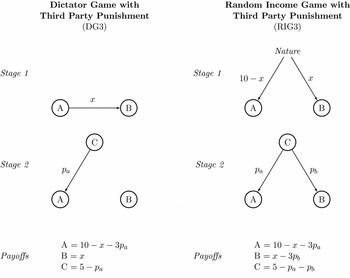
Our research design includes two behavioral economic games designed to separate distinct motivations for social sanctioning. Social sanctioning that is motivated by punishment of a norm violation is captured using a classic dictator game with third-party punishment (DG3) (Fehr and Fischbacher, Reference Fehr and Fischbacher2004), while the desire to rectify inequality is isolated using the random income game with third-party income adjustment (RIG3), a modification of the game employed in Dawes et al. (Reference Dawes, Fowler, Johnson, McElreath and Smirnov2007). Each game has three roles—A, B, and C. The two games are depicted graphically in Figure 1.
Games: Each game is played in two stages. In the first stage of the DG3, player A transferred some amount, x, to player B, keeping 10 − x for herself. player C observed the amount transferred in the first stage, x, and then decided how much, if any, to pay to reduce the income of player A, p a . Whatever punishment paid, p a , was tripled and deducted from player A. RIG3 is structurally equivalent to DG3 except that x was determined randomly and C was allowed to reduce the income of player A (p a ) or player B (p b ).
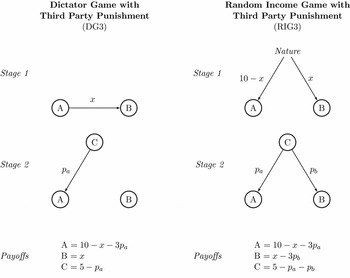
In the first stage of the DG3, A is endowed with 10 tokens and told that she can either keep the 10 tokens or she can divide them—in any manner—between herself and B. After A makes her decision, C is endowed with five tokens, informed of A’s sharing decision, and offered the opportunity to spend some of his five tokens to reduce the final income of A; for every one token C spent, A’s final income is reduced by three tokens. In this game, A’s decision about how much to share with B indicates adherence to a sharing norm, while C’s costly decision to punish indicates a willingness to sanction a norm violation. The RIG3 works exactly the same way except that the initial division of the 10 tokens between A and B is determined randomly rather than by A, and C has the opportunity to reduce the income of either A or B. As a result, in RIG3, C’s costly decision to adjust incomes is an indicator of inequality aversion.
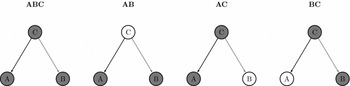
Following the framework of Bernhard et al. (Reference Bernhard, Fehr and Fischbacher2006), we also manipulated the ethnic make-up of the game partners in order to identify the impact of shared ethnicity on cooperation and social sanctioning in DG3 (and on inequality aversion in RIG3). We implemented these games with the Luo and the Kuria, two ethnic groups who reside in southwest Kenya and northwest Tanzania. In this sense, our study is a lab-in-the-field experiment (Grossman, Reference Grossman2011). The four treatment groups, depicted in Figure 2, had the following ethnic compositions:
-
1. ABC: All players A, B, and C are of the same ethnic group.
-
2. AB: Players A and B are of the same group while C is of another group.
-
3. AC: Players A and C are of the same group while B is of another group.
-
4. BC: Players B and C are of one group while A is of another group.
Ethnic Configuration Treatment Groups: Shaded Circles Represent Players from the Same Ethnic Group.
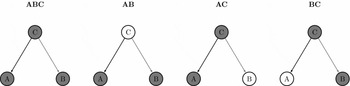
Note that each treatment group could be constituted two different ways given that we have two different ethnic groups.
This design allows us to evaluate not just whether shared ethnicity impacts cooperation and sanctioning, but also competing explanations about how. Miguel and Gugerty (Reference Miguel and Gugerty2005) and Habyarimana et al. (Reference Habyarimana, Humphreys, Posner and Weinstein2009) argue that higher rates of cooperation among coethnics result from costly sanctioning being ethnically bound, with evidence coming from Kenya and Uganda, respectively. These findings suggest that punishment, and thus cooperation, will be more common when A and C are coethnic (conditions ABC and AC), and especially so when B is also a coethnic (ABC > AC > AB = BC = 0). Fearon and Laitin (Reference Fearon and Laitin1996) are motivated instead by the surprisingly high rates of interethnic cooperation, and propose two different strategies that could support cooperation in diverse contexts.Footnote 1 In the in-group policing model, punishment is only targeted at coethnics, and especially when coethnics fail to cooperate with non-coethnics, with the expectation that non-cooperation by non-coethnics will be sanctioned by other non-coethnics (AC > ABC > AB = BC = 0). In the spiral model, by contrast, punishment is directed at both coethnics and non-coethnics who defect against one’s own coethnics (ABC and BC), but not transgressions against non-coethnics (ABC = BC > AB = AC = 0). Finally, Bernhard et al. (Reference Bernhard, Fehr and Fischbacher2006), directly evaluated the role of shared ethnicity in sanctioning behavior among members of two tribes in Papau New Guinea. Contrary to all but one of the theoretical expectations outlined above, they find that punishment is harshest for transgressions against coethnics (ABC and BC), but also some leniency for coethnic transgressors (BC > ABC ≫ AB = AC).
We also evaluate whether the effects of ethnic affiliations are moderated by the presence of a strong, supra-ethnic national identity. To do so, our research design exploits the natural experiment afforded by the political border between Kenya and Tanzania, which was determined by colonial authorities in the 19th century. Miguel (Reference Miguel2004) argues that the arbitrary nature of this border creates laboratory-like conditions to test the effects of nation building on interethnic cleavages domestically, since communities share the same objective cultural differences, geography, and history on both sides of the border, but differ radically in their exposure to nation-building policies. While ethnicity has played a central role in post-independence Kenyan politics, concerted efforts at nation building in Tanzania—including a common national language and public education emphasizing a common Tanzanian history and culture—resulted in a stronger sense of a common Tanzanian identity (Barkan, Reference Barkan and Barkan1994; Miguel, Reference Miguel2004). Thus, implementing the lab-in-the-field experiments with the Kuria and Luo living on each side of the border permits us to examine how different levels of popular nationalism affect sanctioning patterns across an identical set of ethnic divisions.Footnote 2 While the differences in national identification between the two countries was our primary motivation in comparing behavior on each side of the border, we recognize that there are many other differences between the two countries that could also shape behavior (see Dunning (Reference Dunning2012) for a discussion of “bundled treatments” within natural experiments in general, and McCauley and Posner (Reference McCauley and Posner2015) for a specific discussion of the use of African borders as sources of natural experiments). We are thus cautious in interpreting any national differences as resulting solely from differences in nationalism.
While building on past research, our research design is novel in two important ways. First, our study adds to the designs of Habyarimana et al. (Reference Habyarimana, Humphreys, Posner and Weinstein2009) and Bernhard et al. (Reference Bernhard, Fehr and Fischbacher2006) by incorporating the RIG3, which allows us to evaluate the effect of coethnicity on egalitarian motives separately from punishment of non-cooperation. Second, we build on Miguel’s (Reference Miguel2004)) observational finding that interethnic cooperation is more robust in Tanzania than Kenya by experimentally manipulating coethnicity directly among members of the exact same ethnic groups on each side of the border.
EXPERIMENTAL PROTOCOLS AND DATA COLLECTION
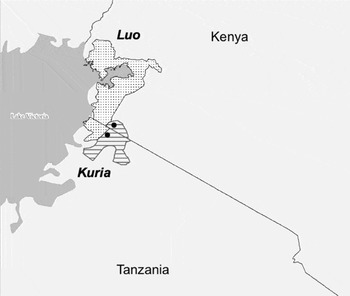
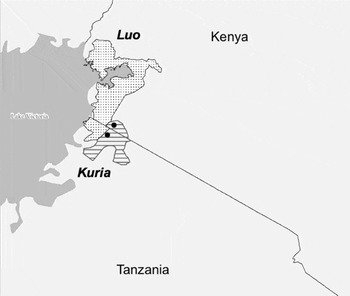
The behavioral economic games were implemented separately on each side of the international border in a rural town—Karamu, Kenya, and Sombanyasoko, Tanzania—near the intersection of the Kuria and Luo homelands (see Figure 3). Participants were recruited using door-to-door canvassing of randomly selected households in 12 largely ethnically homogenous villages near the experiment sites. To generate ethnic diversity in each experimental session, participants were recruited from 1–2 villages Luo villages and 1–2 Kuria villages for each session. Potential participants were informed that they would receive a show-up fee approximately equal to one day’s wages in the informal economy (300 Kenyan Shillings (KES) or 5,000 Tanzanian Shillings (TZS)) and that it would be possible to earn additional money during the study depending on the decisions made by participants. Interested individuals were scheduled to attend one study session and were reminded the day before via text message, when possible. Of the 672 individuals recruited to participate, 596 (89%) showed-up, 558 were randomized into treatment groups, and behavioral decisions from 501 were analyzed. Figure A1 in the appendix shows the CONSORT diagram for the study.
Map of Experiment Sites. Dotted Polygon Shows the Ancestral Homeland of the Luo, and the Striped Polygon Shows the Ancestral Homeland of the Kuria (Gordon, Reference Gordon2005). Black Circles Indicate the Two Experiment Sites.
Research assistants explained both the DG3 and RIG3 games to the 20–30 participants in each session as a group, and worked through examples to ensure comprehension (see the appendix for the exact wording and examples used). To generate the random division of the 10 tokens in the first stage of the RIG3 game, we used a wheel that contained 11 values on its face (in one unit increments from 0 to 10) and a “respin” value (see Figure E3 in the appendix). For each RIG3 game, Player C would spin the wheel once to determine the incomes of A and B in the game. Participants were informed that they would not play with actual Kenyan/Tanzanian shillings but with tokens that would be exchanged at a rate of 1 token equal to 10 Kenyan shillings or 200 Tanzanian shillings.Footnote 3
Participants were then randomized into groups of three and into particular roles within each group by drawing numbers from a hat.Footnote 4 This random assignment of individuals to groups generated the assignment to the four different coethnicity treatments in Figure 2.Footnote 5 To minimize the possibility of spillovers between games, we designed the treatments such that each participant made only one decision across both games (and, thus, each participant was only called into a separate room once). This was done by assigning Player A in DG3 the role of Player B in RIG3, assigning Player B in DG3 the role of Player C in RIG3, and assigning Player C in DG3 the role of Player A in RIG3 (see Figures E1 and E2). Since only Players A and C in DG3 and Player C in RIG3 make experiment decisions (see Figure 1), each participant only made one experiment decision for both games. And because subjects were not informed about the game outcomes until the end of the experiment, participants’ decisions in one game could not have been conditioned on outcomes from the other game.
Subjects did not know the identity of any player during the game and, in keeping with this design feature, made game decisions in a separate room from other participants. To avoid revealing our interest in ethnicity, participants were not given the precise ethnic affiliation of their partners but instead the names of the villages they were from. Because villages are highly homogeneous in this region, home village conveyed a strong signal of partners’ ethnic affiliations without cuing participants in to the intention of our group treatments.Footnote 6 Like the nationalism “treatment,” however, information about a partner’s village is a also bundled treatment, conveying information about the likely ethnicity of that partner along with other information related to village affiliation. However, we recruited from 12 different villages and the effects of shared ethnicity among group members is averaged over lots of different village pairings. In addition, we include village fixed effects for each decision maker in order to capture village level differences in cooperation, sanctioning, and inequality aversion.
After making her decision, each participant completed a brief questionnaire (see Section F of the appendix). After all decisions were made, participants were individually informed of their game outcome and given their earnings in cash based on true game decisions. Survey responses, as well as the experimental decisions, were collected using hand-held mobile devices equipped with Open Data Kit (ODK).
RESULTS
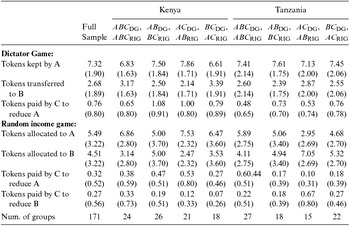
Sharing was common in the DG3 in both Kenya and Tanzania. The median allocation Player A gave to Player B equaled almost three tokens in the overall sample. Costly sanctioning in the DG3 was also common: roughly, 56% of Players C in the DG3 spent at least one token to punish Player A (reducing Player A’s payoff by three tokens), 18% spent two or more tokens, and 2% spent three tokens. Table 1 reports average levels of cooperative sharing and costly sanctioning overall, as well as broken down by country and coethnicity treatment.
Descriptive Statistics of Experiment Outcomes
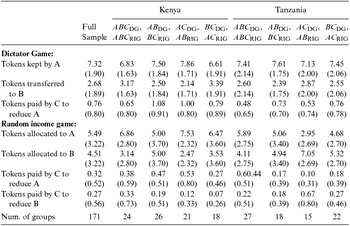
Note. Means with standard deviations in parenthesis. ABC represents treatment groups in which Players A, B, and C are all from the same ethnic group, AB represents treatment groups in which only Players A and B are from the same ethnic group, AC represents treatment groups in which only Players A and C are from the same ethnic group, and BC represents treatment groups in which only Players B and C are from the same ethnic group.
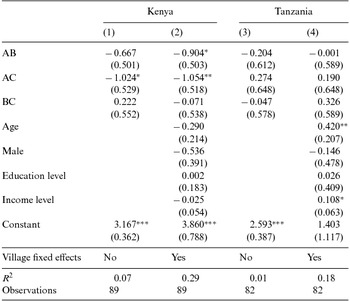
To determine if coethnicity influenced sharing in the DG3, we estimate a simple linear model in which A’s transfer to B serves as the dependent variable and binary indicators of treatment group status serve as the independent variables (with ABC as the omitted category).Footnote 7 After estimating that parsimonious model, we add covariates that condition treatment estimates on Player A’s age, gender, income, education, and village. Estimated coefficients from these models appear in Table 2, with Models 1–2 reporting estimates for the Kenyan subsample and Models 3–4 reporting estimates for the Tanzanian subsample. In Models 1 and 3, which solely contain treatment indicators, we cannot reject the null hypothesis at the 95% confidence level that the coefficient estimates associated with our treatment indicators equal zero. Including covariates in the models increases the variation in sharing that we can explain, but the coefficient estimates for our treatment indicators remain small relative to their standard errors, save for the coefficient estimate associated with the AC indicator in Model 2, which is estimated on data from the Kenyan sample. However, the parameterization of the model reported in Table 2 only presents comparisons between the ABC condition and each of the other conditions. Substantively meaningful differences in sharing might exist, however, when taking into account other comparisons across treatment groups. As a result, we conduct a series of pairwise comparisons presented in Table 3. We present both unadjusted p values and p values adjusted for multiple comparisons using the Duncan method (Duncan, Reference Duncan1955).Footnote 8
Cooperative Sharing Across Coethnicity Treatments
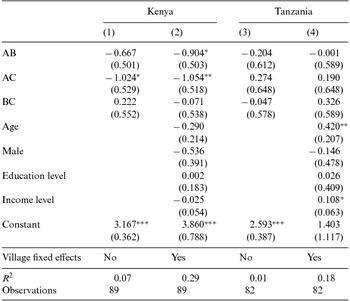
Note. OLS estimates with standard errors in parentheses (*p < 0.10, **p < 0.05, ***p < 0.01). The dependent variable is tokens transferred from Player A to Player B. Village fixed effects are based on A’s village. ABC treatment group omitted. ABC represents treatment groups in which Players A, B, and C are all from the same ethnic group, AB represents treatment groups in which only Players A and B are from the same ethnic group, AC represents treatment groups in which only Players A and C are from the same ethnic group, and BC represents treatment groups in which only Players B and C are from the same ethnic group.
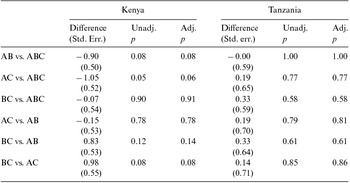
Differences in Cooperative Sharing in DG3 by Coethnicity Treatment
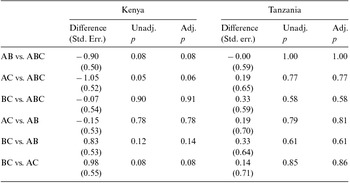
Note. Based on Models 2 and 4 of Table 2. Differences reflect the first treatment minus the second treatment. Adjusted p values are adjusted using the Duncan method. ABC represents treatment groups in which Players A, B, and C are all from the same ethnic group, AB represents treatment groups in which only Players A and B are from the same ethnic group, AC represents treatment groups in which only Players A and C are from the same ethnic group, and BC represents treatment groups in which only Players B and C are from the same ethnic group.
The pairwise comparisons performed in Table 3 indicate significant differences across treatment groups, but only with 90% confidence. In Kenya, participants in AB and AC groups share less than their peers in ABC groups (Table 3, Rows 1 and 2) and participants in AC groups share less than BC groups (Table 3, Row 6). This pattern suggests that the presence of coethnicity between players B and C, which occurs in both BC and ABC groups, yields higher levels of sharing (almost a full token more, on average). The pattern of play in Kenya is thus inconsistent with past political science research showing that cooperation is induced by the threat of sanctioning from an in-group member (e.g., Miguel and Gugerty, Reference Miguel and Gugerty2005; Habyarimana et al., Reference Habyarimana, Humphreys, Posner and Weinstein2009), and is instead in line with the findings from Bernhard et al. (Reference Bernhard, Fehr and Fischbacher2006), which show that pro-social sharing peaks when the potential punisher comes from the same group as the individual who receives the gains from sharing. Moreover, these results support our general expectation that ethnicity would influence behavior in Kenya but not Tanzania; we find no differences in levels of sharing across treatment groups in Tanzania. Thus, albeit with lower confidence (partially due to the limited statistical power of our tests, see Appendix Section C), we find evidence consistent with the proposition that the ethnic composition of a group influences adherence to pro-social sharing norms.
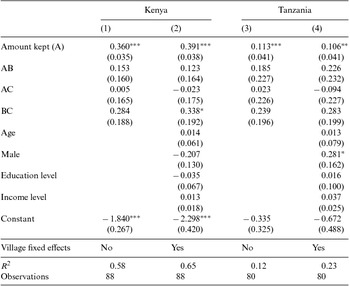
Next, we evaluate the impact of the coethnicity treatments on Player C’s willingness to sanction non-cooperation at a personal cost. OLS coefficient estimates with and without the full set of controls are given in Table 4, again with the ABC treatment group as the omitted category.Footnote 9 In both countries, norm violations—as measured by the amount kept by Player A—positively affect costly sanctioning and are, by far, the strongest predictors of sanctioning. Moreover, the coefficient estimate associated with the amount Player A kept takes a greater value in Kenya than Tanzania (z = 4.63, p < 0.01; Table 4, Models 1 and 3).
Costly Sanctioning Across Coethnicity Treatments
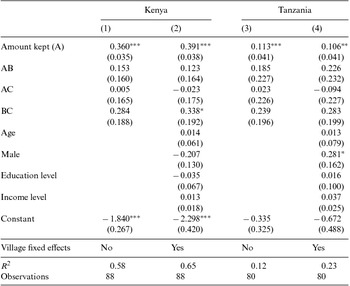
Note. OLS estimates with standard errors in parentheses (*p < 0.10, **p < 0.05, ***p < 0.01). The dependent variable is tokens spent by C to reduce income of A. Village fixed effects are based on C’s village. ABC treatment group omitted. ABC represents treatment groups in which Players A, B, and C are all from the same ethnic group, AB represents treatment groups in which only Players A and B are from the same ethnic group, AC represents treatment groups in which only Players A and C are from the same ethnic group, and BC represents treatment groups in which only Players B and C are from the same ethnic group.
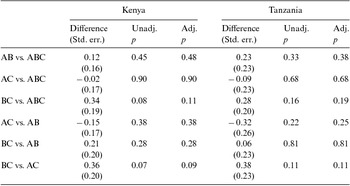
In terms of the effect of coethnicity, the treatment indicators included in the models of Table 4 only focus comparisons on a treatment group’s effect relative to the ABC condition. As a result, we use estimates from Models 2 and 4 of Table 4 to execute all pairwise comparisons across treatment conditions and we present those results in Table 5. Again, if we lower our confidence to the 90% level and focus primarily on unadjusted p values, we note modest effects of coethnicity. In the Kenyan subsample, while controlling for A’s decision in the first stage, sanctioning by C is slightly greater in BC groups than in ABC groups or AC groups, although these effects are estimated with considerable imprecision. Thus, A players in Kenya seem to have correctly anticipated leniency from coethnics in the AC condition and retribution from non-coethnics in the BC condition, but incorrectly anticipated punishment in the ABC condition, which was instead treated much more like AC than BC. These patterns are again most consistent with Bernhard et al.’s (Reference Bernhard, Fehr and Fischbacher2006)) finding that costly sanctioning is greatest in BC, and inconsistent with the general expectation in political science that sanctioning should be greatest in homogenous groups (ABC). In Tanzania, we see the same general pattern of sanctioning across coethnicity treatments (BC ⩾AB >ABC=AC), but the differences across treatments are not statistically significant by any conventional standard.
Differences in Costly Sanctioning in DG3 by Coethnicity Treatment
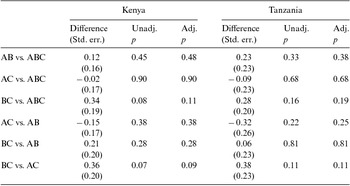
Note. Based on Models 2 and 4 of Table 4. Differences reflect the first treatment minus the second treatment. Adjusted p values are adjusted using the Duncan method. ABC represents treatment groups in which Players A, B, and C are all from the same ethnic group, AB represents treatment groups in which only Players A and B are from the same ethnic group, AC represents treatment groups in which only Players A and C are from the same ethnic group, and BC represents treatment groups in which only Players B and C are from the same ethnic group.
Sanctioning behavior in the DG3 is thus consistent with past research showing that costly punishment is more severe for non-cooperation by a non-coethnic affecting a coethnic, at least in Kenya. However, what appears to be punishment might instead be motivated by a desire to rectify inequality generated by norm violations, rather than punishment of norm violations per se. Within the DG3 game alone, these two very different motivations would produce observationally equivalent behavior. We thus compare these results to the rate of income adjustment by Player C in the RIG3 game, where inequality between Player A and Player B was randomly determined.
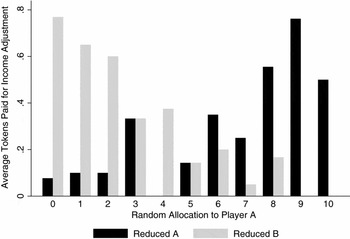
It is clear from Figure 4 that participants were willing to alter incomes, even at a cost to themselves, in order to rectify randomly generated income. The figure shows that both the willingness to alter incomes and the degree of alteration increased with greater inequality. However, Figure 4 also shows that some participants (n = 16) altered incomes to increase inequality rather than decrease it, by reducing the income of the player that received equal to or less than her partner. Such spiteful behavior was not observed even once in the DG3, and is quite surprising given that such income alteration was costly to player C. There was no differences in the rate of spiteful behavior across the two countries (t = 1.04, p > 0.10), but most spiteful income reduction (69%) was targeted at non-coethnics. Because the primary use of the RIG3 is to determine whether the patterns of income reduction in the DG3 game are potentially due to inequality aversion, we focus here on income adjustment patterns excluding the 16 participants who increased inequality.Footnote 10
Player C’s Income Adjustment as a Function of Randomized Inequality.
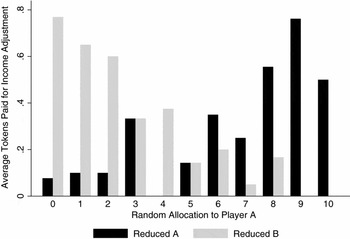
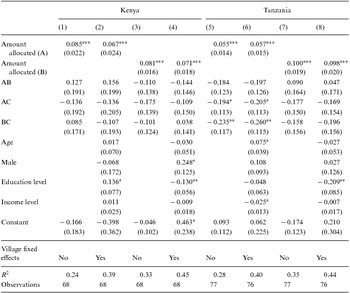
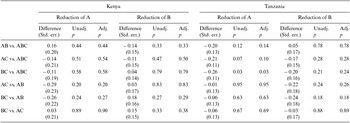
We replicate our analysis of sanctioning behavior in the DG3—conditional on coethnicity treatments—for income adjustment in the RIG3. Patterns of coethnicity are again captured by dummy variables for AB, AC, and BC conditions, with ABC as the omitted category. Unlike in the DG3, Player C in the RIG3 was able to alter the income of either Player A or Player B: we thus model the reduction of Player A’s randomly generated income separately from reduction of Player B’s income. The degree of inequality randomly generated is captured by a variable indicating A or B’s allocation. OLS coefficient estimates with and without the full set of controls are reported separately for Kenya (Models 1–4) and Tanzania (Models 5–8) in Table 6, and pairwise comparisons across treatment groups are presented in Table 7.Footnote 11
Costly Income Adjustment Across Coethnic Treatments
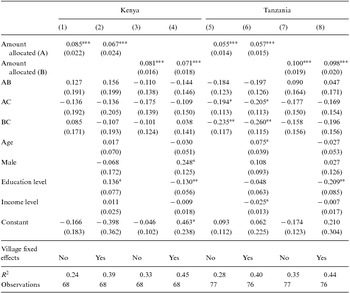
Note. OLS estimates with standard errors in parentheses (*p < 0.10, **p < 0.05, ***p < 0.01). The dependent variable is tokens spent by C to reduce income of A (Models 1–2, 5–6) or B (Models 3–4, 7–8). Village fixed effects are based on C’s village. ABC treatment group omitted. ABC represents treatment groups in which Players A, B, and C are all from the same ethnic group, AB represents treatment groups in which only Players A and B are from the same ethnic group, AC represents treatment groups in which only Players A and C are from the same ethnic group, and BC represents treatment groups in which only Players B and C are from the same ethnic group.
Differences in Income Reduction in RIG3 by Coethnicity Treatment
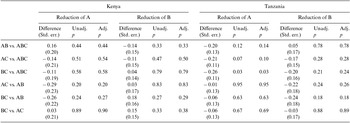
Note. Based on Models 2, 4, 6, and 8 of Table 6. Differences reflect the first treatment minus the second treatment. Adjusted p values are adjusted using the Duncan method. ABC represents treatment groups in which Players A, B, and C are all from the same ethnic group, AB represents treatment groups in which only Players A and B are from the same ethnic group, AC represents treatment groups in which only Players A and C are from the same ethnic group, and BC represents treatment groups in which only Players B and C are from the same ethnic group.
The results in Table 6 show that in both Kenya and Tanzania, the degree of income inequality between Players A and B in the RIG3 is the strongest predictor of income alteration, just as it was in the DG3. Furthermore, the ethnic composition of a participant’s group has no consistent effect on income reduction across models. In models estimated on the Kenyan sample, the coefficients associated with the coethnicity treatment groups appear small relative to their standard errors, thus preventing us from rejecting the null hypothesis that those coefficients equal zero (Table 7). There are similarly no significant effects in the adjustment of B’s income in Tanzania. The only statistically significant patterns we observe are in the adjustment of A’s income in Tanzania, which was significantly higher in ABC groups than either BC or AC groups (Table 7). Given that this pattern of behavior was not apparent in adjusting Player A’s income, and that it is not consistent with behavior in the DG3, we cautiously interpret these findings as spurious. In short, we find very little evidence that income reduction in the RIG3 varies with the ethnic composition of a participant’s group in either country.
The amount by which individuals punished or reduced incomes, due to inequitable allocations, varied across the DG3 and RIG3, respectively. Upon viewing the coefficient estimates associated with the variables relating to the amount Player A kept or the amount randomly allocated, one can note that the amount of costly income reduction in the RIG3 per unit of inequality appeared less than the amount of costly punishment per unit of inequality in the DG3. To understand such differences and to assess if these two games captured different motivations for income adjustment, we examine whether or not feelings of anger toward human-produced inequality and a taste for retributive violence (collected during the attitudinal survey after game play) correlate with income alteration. Following Fehr and Gächter (Reference Fehr and Gächter2002), we asked participants to “imagine that in Activity 1 (the DG3), an individual gave you 1 token and kept 9″ and, then, we asked whether or not the participants would feel “not at all angry,” “a little angry,” “angry,” “quite angry,” or “very angry.” We also asked participants to express, on a five-point scale, the degree to which they agreed that “in order for justice to be served, violence should be repaid with violence.” Both anger at failing to share (t = 7.05, p <0.01) and a taste for retribution (t = 6.58, p <0.01) were significantly stronger in Kenya than in Tanzania. When comparing answers to these questions to real game behavior, we find that decisions about how much to spend to sanction others in the DG3 is positively correlated with both self-reported anger at non-cooperation by Player C (ρ = 0.20, p < 0.01) and support for retribution (ρ = 0.22, p < 0.01). In contrast, there is no correlation between income alteration in RIG3 and feelings of anger toward human-produced inequality (ρ = 0.06, p = 0.42) or taste for retribution (ρ = 0.05, p = 0.54). These correlations are consistent with the view that the costly punishment of norm violations (DG3) does not solely result from aversion toward the material inequality resulting from norm violations.
CONCLUSION
This study examined how the experimental manipulation of a group’s ethnic composition influenced sharing and costly income alteration in norm-laden (DG3) versus norm-free (RIG3) contexts across Kenya and Tanzania. Across both games and in both countries, we found some evidence that the coethnicity of group members influenced game play. We find evidence that cooperative sharing and third-party punishment are conditioned by coethnicity, but these effects are only observed in Kenya. In Kenya, we find that cooperative sharing is greater when the potential victim of non-cooperation and the third-party punisher are coethnics, regardless of the dictator’s own ethnic affiliation. Punishment was indeed harsher for non-coethnics who failed to share with the punisher’s coethnic, but not for coethnics who failed to share in homogenous groups. Thus, in Kenya, we find evidence of parochialism (Bernhard et al., Reference Bernhard, Fehr and Fischbacher2006), characterized by greater punishment of out-group members who fail to share with in-group members, and leniency toward selfish in-group members. However, these results derive from estimates that exhibit considerable imprecision and we can reject the null hypotheses with which they correspond only at confidence levels below the conventional 95% level.
Noting the uncertainty of our estimates, the patterns of ethnic-based sharing and sanctioning we observe are at odds with prominent theories of coethnic cooperation in political science. In particular, Habyarimana et al.’s (Reference Habyarimana, Humphreys, Posner and Weinstein2009)) coethnicity experiments in Uganda, Miguel and Gugerty’s (Reference Miguel and Gugerty2005)) research on diverse communities in Kenya, and Fearon and Laitin’s (Reference Fearon and Laitin1996)) in-group policing model all anticipate that sanctioning will be concentrated on in-group members, since its provision is costly and its benefits are shared among the whole group. In contrast, our findings from Kenya are more consistent with punishment being used to protect in-group members especially against out-group members. Economists and psychologists have documented similar behavior in different contexts (Bernhard et al., Reference Bernhard, Fehr and Fischbacher2006; Baumgartner et al., Reference Baumgartner, Götte, Gügler and Fehr2012), which suggests that theories that assume costly punishment will be reserved for coethnic non-cooperation should be amended to account for mounting evidence to the contrary.
Consistent with our expectation that ethnic affiliation would shape cooperation and sanctioning in Kenya but not Tanzania, we find no statistically significant effects of coethnicity on behavior in Tanzania as compared to the weak evidence of ethnic effects in Kenya. We anticipated this pattern due to stark differences in the degree of pan-ethnic national identification in Tanzania compared to Kenya. However, like many studies that utilize African borders to generate variation in an independent variable of interest (McCauley and Posner, Reference McCauley and Posner2015), we are unable to definitively attribute our findings to differences in nationalism alone. The location of our study—very near the international border and with the same two ethnolinguistic groups—holds constant geographic characteristics and local ethnic considerations that are likely to be similar on each side of the border. Nevertheless, there are other important differences between Kenya and Tanzania in the post-independence period in general, such as the degree of political competitiveness and the nature of their economies, as well as differences in how the locality on each side of the border is situated within the larger national context, including distance to the capital and the relative sizes of the two ethnic groups. Such differences are likely responsible for variation in play across the two countries, including higher rates of punishment, anger at non-cooperation, and support for retribution in Kenya. In addition, the modest difference we see in the role of ethnicity in shaping game play across these national contexts could also result from a combination of these various factors.
We also note that the influence of coethnicity and national context appears limited in comparison to the robust and noteworthy effects of norm violations and inequality. The most robust predictor of costly sanctioning in our DG3 study is the amount that dictators allocated to their game partner, which itself appears to have resulted primarily from factors beyond the ethnic makeup of the group. Similarly, in the RIG3, randomly generated inequality serves as the best predictor of costly income reduction. In sum, our findings suggest that research studying the role of ethnic affiliations and national context may prove relevant at explaining some of the variation in the social behaviors we study, but factors shared across ethnic and national contexts appear to be the primary drivers of both costly sanctioning and the costly rectification of inequality.
SUPPLEMENTARY MATERIALS
The appendix is available online as supplementary material at https://doi.org/10.1017/XPS.2017.10