INTRODUCTION
experimenter: What language do you speak?
monolingual three.year.old: I talk; I just talk.
Newborns prefer their native language to other languages (Moon, Cooper & Fifer, Reference Moon, Cooper and Fifer1993), and can discriminate languages from different rhythmic classes (Nazzi, Bertoncini & Mehler, Reference Nazzi, Bertoncini and Mehler1998). We do not know, however, when children understand that different conventional systems of communication exist. In the current study, we explored preschoolers' ability to learn words from a speaker of a foreign language, and asked if experience with more than one language – being bilingual or simply being exposed to a second language – might facilitate this ability.
Toddlers and preschoolers assume others share knowledge of the words they acquire (Buresh & Woodward, Reference Buresh and Woodward2007; Diesendruck, Reference Diesendruck2005; Henderson & Graham, Reference Henderson and Graham2005). When there is evidence that a given word may not be shared, they do not learn it. Thus, they do not learn novel words from speakers who are ignorant of the relevant conventions (Birch & Bloom, Reference Birch and Bloom2002; Sabbagh & Baldwin, Reference Sabbagh and Baldwin2001: Sabbagh & Shafman, Reference Sabbagh and Shafman2009; Sabbagh, Wdowiak & Ottaway, Reference Sabbagh, Wdowiak and Ottaway2003), or who have not provided conventional labels in the past (Clement, Koenig & Harris, Reference Clement, Koenig and Harris2004; Koenig, Clement & Harris, Reference Koenig, Clement and Harris2004, Koenig & Harris, Reference Koenig and Harris2005; Scofield & Behrend, Reference Scofield and Behrend2008).
Young children's sensitivity to conventionality thus guides them to avoid learning words that are unlikely to be effective communicative tools in their language community (Clark, Reference Clark2007; Sabbagh & Henderson, Reference Sabbagh and Henderson2007); e.g. Henderson and Sabbagh (unpublished observations) found that English-speaking four-year-olds were unlikely to learn a label for a toy they were told was ‘from Japan’. Recent studies suggest that this reliance on conventionality (learning only words that are likely to be shared) may bias children against learning words from foreign languages.
In one study, monolingual English-speaking toddlers saw objects labeled by an English or a Dutch speaker (Koenig & Woodward,Reference Koenig and Woodwardin press). They learned better from the English speaker; only the children with larger vocabularies were able to learn a word from the Dutch speaker. However, these children only evidenced learning when tested by the same Dutch speaker, responding randomly if subsequently tested by an English speaker. This could mean that they understood that the word they learned was Dutch and not shared with the English speaker. However, because they were always tested second by the English speaker, it is possible that they may have simply forgotten the word–object link by the second test. In another study, English-speaking preschoolers were more likely to endorse an English over a Spanish speaker's label for a novel object, even when the English speaker had previously provided unconventional names for familiar objects (Ransom, Behrend & Schwartz, Reference Ransom, Behrend and Schwartz2009).
Children's learning of foreign labels may depend on their understanding that foreign languages (i.e. alternative conventional systems for conveying meaning) exist; this understanding probably depends on exposure to multiple languages (Slobin, Reference Slobin, Sinclair, Jarvella and Levelt1978). To our knowledge, foreign word learning in preschoolers has only been examined in monolinguals. Bilingual children are less likely to adhere to mutual exclusivity than monolingual children (Au & Glusman, Reference Au and Glusman1990; Byers-Heinlein & Werker, Reference Byers-Heinlein and Werker2009), and bilingual adults are better at novel word learning than monolinguals (Papagno & Vallar, Reference Papagno and Vallar1995; Kaushanskaya & Marian, Reference Kaushanskaya and Marian2009; van Hell & Mahn, Reference Van Hell and Mahn1997). We therefore hypothesized that exposure to more than one language may contribute to the ability to learn foreign words. We compared learning across three groups of preschool-aged children – monolingual, bilingual and children who were not bilingual but were regularly exposed to a second language – and expected both bilingual and exposed children to perform better than monolingual children.Footnote 1
In some prior studies (e.g. Ransom et al., Reference Ransom, Behrend and Schwartz2009) it may have been unclear that the goal was to acquire a word in another language because children were asked to endorse one of two labels (‘Is it an X or a Y?’) or to choose an object that had previously been labeled. Children may have interpreted the question as asking what would be true of their own language, leading to an English bias, as all children were monolingual English speakers. In the present study, we therefore asked a test question that clearly asked about the label in the foreign language (i.e. ‘What do you call this in Nordish?’).
We used the paradigm developed by Koenig et al. (Reference Koenig, Clement and Harris2004) to study children's learning from reliable versus unreliable labelers. Children watched a video of an English speaker and a speaker of an artificial language called Nordish. To demonstrate that one spoke English and the other a novel language, the speakers first labeled familiar objects, with the English speaker providing the English label (‘That's a kitty’) and the Nordish speaker providing the Nordish equivalent (‘Etta malja’). Then, using the same sentence frames, they labeled novel objects. On each trial children were asked to endorse one of the two labels. Half of the children in each language group (monolingual, bilingual, exposed) were asked ‘What do you call this?’ (Control condition); the other half were asked ‘What do you call this in Nordish?’ (Foreign condition).
METHOD
Participants
Participants were forty-eight monolingual English-speaking children, forty-eight bilingual (English plus one other language) children, and forty-eight English-speaking children with regular exposure to a language other than English. Children were classified in one of these three groups on the basis of parent report. Parents were asked if their child was bilingual (fluent in two languages); if they answered yes, we considered them bilingual. If they said no, we asked if they had regular (weekly) exposure to a language other than English. If they said no, the children were considered monolingual; if they said yes, we considered them exposed.
Ages ranged from 3 ; 0 to 4 ; 11 in each language group. Mean ages (monolingual M = 4 ; 1; bilingual M = 4 ; 0, exposed M = 4 ; 0) did not differ (F(2,141) = 0·22, p = 0·806), and there were no effects of age in any of the analyses. There were equal numbers of three- and four-year-olds in each condition,Footnote 2 and approximately equal numbers of males and females. The bilingual children were bilingual in English and: Spanish (36 children, 3 of whom were also exposed to a third language), French (4, 2 of whom were also exposed to a third language), Portuguese (1, also exposed to Spanish and French), Hungarian (1, also exposed to Spanish), Russian (1, also exposed to Spanish), Arabic (1), Romanian (1), Bengali (1), Japanese (1) and Mandarin (1). In the Exposed group, the languages children were exposed to included Spanish (30), Spanish plus another language (8), French (2), Mandarin, Bengali, Cantonese, Hebrew, German, Polish, Tamil and Farsi (1 of each).
An on-line database (zipskinny.com) that contains information from the 2000 US Census was used to derive the median income associated with a given zipcode for all but one bilingual participant; this measure is admittedly indirect and not ideal, but it was all we had available to us. The mean median income levels were (in $US): 56,609·25 (monolinguals; SD = 10094·91), 51,450·87 (bilinguals; SD = 9471·79), and 56,419·15 (exposed; SD = 8047·25). There was a significant difference in income across the language groups (F(2, 140) = 4·74, p = 0·01). Post-hoc (LSD) tests revealed reliably lower income in the bilingual compared to the other two groups (ps <0·02) but no difference between the monolingual and exposed groups (p = 0·92).
Design and materials
There were two between-subjects factors: Language Group (Monolingual, Bilingual, Exposed) and Condition (Control, Foreign). All children watched a video in which two female Caucasian actors labeled four familiar objects and four novel objects. One spoke English; the other spoke an artificial language (Nordish) that was phonologically similar to English and used English word order. We purposely made Nordish utilize English phonemes for two reasons: (1) because test trials required children to produce the novel words, they needed to be pronounceable by English speakers; and (2) because we did not want them to ignore the Nordish input simply because it sounded very different. As the experimental script (see Appendix) shows, there was no mistaking Nordish for a variant of English.
Half of the children in each language group were randomly assigned to one of the two conditions. In the Control condition children were asked ‘What do you call this?’; in the Foreign condition they were asked ‘What do you call this in Nordish?’ We counterbalanced which actor spoke first, which spoke English, position of the English speaker (left, right), order of objects, the set of labels used by the English-speaking actor for the novel objects, and the order in which the two novel labels within each pair were presented in test questions.
The familiar objects included a stuffed kitten, hairbrush, plastic pizza slice and a doll. The novel objects included a martini strainer, a wooden object with springs, a wallpaper roller and a metal pastry cutter. Two color photographs of the actors (left–right reversed) were used in the interview, and an Apple laptop presented the video.
Procedure
Children participated in a university laboratory or in their preschool. The experimenter sat next to the child facing a laptop computer, and introduced the video by saying, ‘We're going to watch a video and I'm going to ask you some questions, okay?’ The video began with the two actors introducing themselves, and then labeling four familiar objects and four novel objects (see Appendix). Each trial began and ended with a static close-up image of the object, with moving images of the actors alternately holding up and labeling the object between the static images. Each actor labeled each object twice.
The experimenter paused the video after each trial as a still frame of the object was shown on the screen. She then asked the child to endorse one of the two labels they had just heard. In the Control condition, they heard for example, ‘What do you call this, modi or taiva?’; in the Foreign condition they heard, for example, ‘What do you call this in Nordish, modi or taiva?’ After each response the experimenter said, ‘Okay, let's see what's next’, and resumed the video. The main dependent measure was the number of choices of the Nordish speaker's label on the novel trials, which ranged from 0 to 4. Because some children (three monolinguals, two bilinguals, five exposed) only responded on three trials, this number was converted to a proportion.
After the test trials children were asked ‘What language do you speak?’, and were shown one of the still photos of the two actors (in the positions they were seen on the screen) and asked ‘Can you point to the girl who speaks your language?’
RESULTS
Quantitative data
A (3) language group × (2) condition × (2) gender between-subjects ANCOVA on the proportion of Nordish choicesFootnote 3 on the novel object trials with income as a covariate revealed reliable main effects of condition (F(1,130) = 15·78, p < 0·001, ηp2 = 0·108) and gender (F(1,130) = 6·48, p = 0·012, ηp2 = 0·047), and a significant interaction between language group and condition (F(2,130) = 4·63, p = 0·011, ηp2 = 0·066). Children in the Foreign condition endorsed more Nordish labels (M = 0·48, SD = 0·23) than children in the Control condition (M = 0·34 SD = 0·22), and females endorsed more Nordish labels (M = 0·45, SD = 0·23) than males (M = 0·36, SD = 0·23).
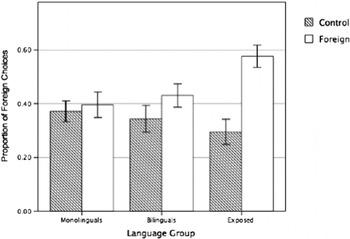
Simple effects tests with income as a covariate demonstrate that the language groups did not differ in the Control condition (F(2,68) = 0·71, p = 0·495, ηp2 = 0·020), but did differ in the Foreign condition (F(2,67) = 4·47, p = 0·015, ηp2 = 0·118) (see Figure 1). Post-hoc (LSD) tests show that the exposed group differed from the monolingual (p = 0·005) and bilingual (p = 0·036) groups, but the monolingual and bilingual children did not differ (p = 0·545). Thus, in the Foreign condition, exposed children were significantly more likely to endorse the Nordish speaker's word than the monolinguals and bilinguals. Exposed children were also the only group more likely to endorse the Nordish labels in the Foreign condition than in the Control condition (t(46) = 4·51, p < 0·001).
Proportion of foreign speaker's labels chosen on the novel object trials in the three language groups and two conditions.

One-sample t-tests comparing each mean in Figure 1 to chance (0·50) showed that in the Control condition, all means were significantly below chance (all ps <0·01), indicating a preference for the English speaker's labels in all three language groups. In the Foreign condition, the monolinguals endorsed significantly more English than Nordish labels (p = 0·016), the bilinguals endorsed marginally more English labels (p = 0·061), and the exposed group endorsed more Nordish than English labels (p = 0·039). Thus, the exposed children were the only group who evidenced learning of the Nordish labels.
Qualitative data
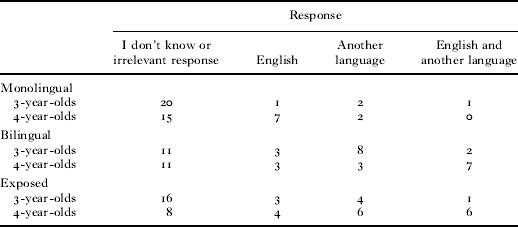
Table 1 displays variability in responses to the question ‘What language do you speak?’ While 53% of four-year-olds responded with the name of an actual language, only 35% of three-year-olds did so (χ2 = 4·77, p < 0·05). Monolingual children (73%) were more likely to say, ‘I don't know’ or to provide an irrelevant response than the bilingual children (46%) or exposed children (50%) (χ2 = 8·30, p < 0·02). Slightly more than half of the bilingual children responded with the name of one or both of the languages they actually spoke. Similarly, half of the exposed children mentioned either English, their other language or both, whereas only 19% of the monolingual children mentioned English (with one saying ‘English, I think’).
Number of three- and four-year-old children in each language group responding in different ways to the question ‘What language do you speak?’
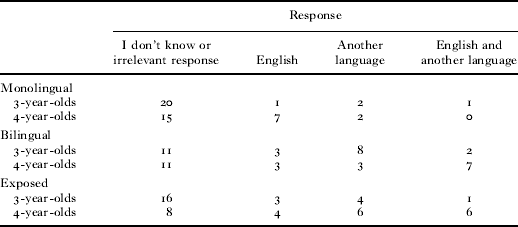
The irrelevant responses included ‘plaster’, ‘radishes’ and names of animals; a few exposed children produced words in the language they were exposed to (‘uno, dos, tres’; ‘vaca’). Some exposed children mentioned the language they were exposed to, but not English (the only language they actually spoke fluently), when asked what language they spoke. Moreover, some of them denied that they knew any other language when asked ‘Have you heard of any other languages?’ after providing only the name of the language they were exposed to.
The word-learning performance of children who provided a language label when asked ‘What language do you speak?’ was compared to the performance of children who said ‘I don't know’ or something irrelevant. Collapsed across language groups, children who mentioned the name of an actual language endorsed more Nordish labels in the Foreign condition (M = 0·55, SD = 0·21) than children who did not provide a language label (M = 0·39, SD = 0·22) (t(70) = 3·25, p = 0·002).
Finally, all children were shown a still photograph of the two speakers from the video and asked to ‘point to the girl who speaks your language’. There was no difference across language groups in the proportion of children correctly pointing to the English speaker: 72% (monolinguals), 69% (bilinguals), and 70% (exposed) (χ2 < 1). All groups performed better than chance (binomial test, ps < 0·05), indicating they were all able to identify the English speaker as the one who spoke ‘their language’.
DISCUSSION
Most children showed a tendency to endorse the English speaker's labels (Ransom et al., Reference Ransom, Behrend and Schwartz2009; Koenig & Woodward,Reference Koenig and Woodwardin press). In the Control condition children were asked ‘What do you call this?’ We expected them to choose the English speaker's words and children in all three language groups tended to do so. But in the Foreign condition, children were asked ‘What do you call this in Nordish?’, so the correct response was to endorse the foreign speaker's labels. We hypothesized that both the bilingual and exposed children would endorse the foreign speaker's labels more in the Foreign condition, but surprisingly only the exposed children did so. Below we discuss both the failure of the monolingual and bilingual groups, and the success of the exposed group, to learn foreign words from a foreign speaker.
Neither the bilingual nor monolingual children endorsed the foreign speaker's labels even when directly asked ‘What do you call this in Nordish?’ This result resonates with findings that children prefer native speakers over foreign speakers (Kinzler, Dupoux & Spelke, Reference Kinzler, Dupoux and Spelke2007; Kinzler, Shutts, DeJesus & Spelke, Reference Kinzler, Shutts, DeJesus and Spelke2009), and replicates recent findings that monolingual English-speaking children are less likely to learn a word from a foreign speaker (Ransom et al., Reference Ransom, Behrend and Schwartz2009; Koenig & Woodward,Reference Koenig and Woodwardin press). The word-learning task we employed may have been difficult because it involved asking children to choose between two speakers, one of whom was speaking a familiar language. That is, a preference for native speakers (Kinzler et al., Reference Kinzler, Dupoux and Spelke2007) may have interfered with children's ability to learn the foreign labels. Similarly, children may have seen the English speaker as a member of their cultural group (and the Nordish speaker to be an out-group member), and this may have biased them to attend to and learn from her (Kinzler, Corriveau & Harris, Reference Kinzler, Corriveau and Harris2011). Likewise, the overall effect of gender (better learning in girls) may be related to the fact that the speakers were female; girls may have attended to them more than boys (Ma & Woolley,Reference Ma and Woolleyin press). Such in-group biases might explain children's preference for the English speaker's labels in the Control condition, but they do not explain the exposed children's ability to overcome these biases in the Foreign condition.
The task may also have been difficult because Nordish used English phonemes and it is possible that the bilingual children in particular may have expected a foreign language to sound more different (if their two languages use very different sound structures). This expectation may have led them to ignore the Nordish input as simply silly English. We cannot rule this out, and future studies will need to examine learning of words of a real foreign language that differs in both phonological and syntactic structure. In any case, we do not believe that monolingual and bilingual preschoolers are incapable of learning foreign labels, as others have shown that monolingual toddlers and preschoolers can do so under some conditions (Au & Glusman, Reference Au and Glusman1990; Ransom et al., Reference Ransom, Behrend and Schwartz2009; Bijeljac-Babic, Nassurally, Havy & Nazzi, Reference Bijeljac-Babic, Nassurally, Havy and Nazzi2009; Koenig & Woodward,Reference Koenig and Woodwardin press). Furthermore, the fact that bilingual adults are better novel word learners than monolingual adults (Kaushanskaya & Marian, Reference Kaushanskaya and Marian2009) suggests that bilingual children eventually gain an advantage over monolinguals. It is an open question whether they also eventually surpass exposed children's ability to learn foreign words. Future studies should compare foreign word learning in older children from these three language groups, and should use tasks that do not involve competition from a familiar language.
If exposure to more than one language expands children's notions of conventionality, then why were our bilingual participants unable to learn the foreign words? One possibility is that, just as young monolingual children seem to believe there is ‘one right label’ for a given object (Markman & Wachtel, Reference Markman and Wachtel1988), young bilinguals (who are simultaneously learning two native languages) may believe there are only ‘two right labels’ (e.g. English and Spanish) for a given object, and may therefore find it difficult to learn a third. Another possibility relates to vocabulary size. Young bilinguals as a group tend to have smaller vocabularies than their monolingual peers (Bialystok, Reference Bialystok2009), and larger vocabulary predicts better novel word learning in monolingual toddlers (Gershkoff-Stowe & Hahn, Reference Gershkoff-Stowe and Hahn2007; Koenig & Woodward,Reference Koenig and Woodwardin press). While it is possible that the exposed children we tested had higher vocabularies than the bilingual children, there is no a priori reason to expect the exposed children to have higher vocabularies than monolinguals. As we did not assess vocabulary, we cannot directly test this hypothesis. However, a recent study conducted on a sample from the same population, using a different paradigm, suggests that exposed children's vocabulary did not predict word learning (Menjivar & Akhtar, Reference Menjivar and Akhtar2011).
A related explanation for the performance of the exposed group concerns SES as a mediator. We know that SES predicts vocabulary size (Hart & Risley, Reference Hart and Risley1995; Hoff, Reference Hoff2003) and it is possible that the exposed children (whose parents have the resources to expose them to a second language on a regular basis) may have come from more privileged backgrounds than the monolinguals. While we found no evidence to support this hypothesis, our measure of SES was admittedly indirect, and there is much variance within zipcodes as to actual household income. Measures of parental education and actual income would be more desirable. Another study on children drawn from the same neighborhoods has found no differences in maternal or paternal education across these language groups (Menjivar & Akhtar, Reference Menjivar and Akhtar2011). Thus, we do not believe that SES differences among the language groups can explain the word-learning advantage of the exposed children.
As this advantage was not expected, however, it is important that it be replicated. Fortunately, a recent study, using a very different procedure, has also demonstrated an advantage in novel word learning in a separate group of exposed preschoolers (Menjivar & Akhtar, Reference Menjivar and Akhtar2011). In this study, four-year-old children were taught several novel words directly by an experimenter, and a subsequent comprehension test showed that exposed children learned significantly more of them than monolinguals of the same age. Thus, we believe the superior performance of the exposed group in the current study is ‘real’. Our preferred explanation for this finding is that a particular type of exposure to a second language expanded exposed children's notion of conventionality and enhanced their metalinguistic awareness, which in turn may have made them more open to learning foreign words. That is, their somewhat restricted experience with a second language may have led to the metalinguistic understanding that ‘there is one way my family and I talk, but other people use different words’. Limited but regular exposure to a second language may have given them a different perspective on language than children who use one or two languages to fluently communicate with others (Slobin, Reference Slobin, Sinclair, Jarvella and Levelt1978). Informal parent reports indicate that the exposed children experienced their second language in various contexts (some in preschools, some with babysitters), but what they have in common is that they are not fluent and do not use the second language to communicate; so one possibility is that to these children the second language may be more of an object than a functional tool.
Our findings are consistent with Levelt, Sinclair and Jarvella's (Reference Levelt, Sinclair, Jarvella, Sinclair, Jarvella and Levelt1978) hypothesis that novice language learners, like novice drivers, may be more prone to the ‘conscious reflection’ that is necessary in early skill acquisition. That is, paradoxically, there may be more metalinguistic awareness in the beginning stages of learning a second language (as in our exposed children) than when one has become fluent (as in our bilingual children). Similarly, Dabrowska and Street (Reference Dabrowska and Street2006) have found greater metalinguistic skill in adult English-as-a-second-language learners than native speakers of English matched on educational attainment. Being more an observer than a user of the second language may have enabled the exposed children to develop an understanding that different people use different conventions to label objects. Thus, it would not have been strange for them to hear a foreign speaker using unusual labels, and they may have been more willing to accept those labels. Exposure to a language through overhearing during childhood helps adults later learn that language with native-like accent (Au, Knightly, Jun & Oh, Reference Au, Knightly, Jun and Oh2002; Knightly, Jun, Oh & Au, Reference Knightly, Jun, Oh and Au2003) and native-like grammatical production (Au, Oh, Knightly, Jun & Romo, Reference Au, Oh, Knightly, Jun and Romo2008). Our results suggest that similar early exposure to a second language (exposure that does not involve communicative immersion) may lead to an earlier understanding that multiple conventional systems exist.
Increased metalinguistic awareness may also play a role in children's ability to name the language(s) they are exposed to. Most monolingual children were unable to name the language they spoke, whereas approximately half of the exposed and bilingual children knew the name of at least one of their languages. We hypothesize that this is due to the frequency with which children hear teachers and/or parents explicitly label one or both languages. This interpretation is supported by the fact that several of the exposed children did not say ‘English’ (the only language their parents reported they were fluent in) when asked what language they spoke, but instead replied with the name of the language they were exposed to. It is likely that these children's parents and teachers frequently label the second language but take English for granted. Labeling (and other talk about the second language) may serve to further highlight for the exposed children that different people use different linguistic conventions. Future research needs to systematically test these hypotheses about the reasons for the exposed children's ability to learn foreign words from a foreign speaker.
To conclude, at this young age we have found an advantage for children merely exposed to a second language over those immersed in one or two languages. While we fully expect the advantage to shift to bilingual children later in development, this finding leads to some interesting hypotheses about the kinds of experiences that might lead to the understanding that there are different conventional systems of communication. As Diesendruck and Markson (Reference Diesendruck and Markson2011) argue, it is important for young children to learn not only conventional cultural knowledge, but also that different communities use different conventions. Our results suggest that limited but regular exposure to more than one language may assist young children in coming to this understanding at an early age.
APPENDIX
Experimental script
[content within square brackets was said only in the Foreign condition]
experimenter: We're going to watch a video and I'm going to ask you some questions. OK? [Did you know there's a country called Nordivia? Nordivia is very far away. In Nordivia people speak a language called Nordish.] I've got these two friends. One is named Sophie, and the other is named Anna. They're going to show you some things and tell you what they're called [in the language Nordish]. Let's see what they say.
english speaker: Hello! My name is Sophie. I like to play games and read stories. I have two brothers and a cat. My best friend is named Mary. She's tall and has brown hair. We like to go to the park together.
nordish speaker: Hey. Mai nunn main on Anna. Ay kween joatta eela koida ja. Kee satt koolua sai leetam. Ay hankia kack on Claire. Harv ja katti mye nunn. Parhaiten ka verry on maine leema.
english speaker: That's a kitty.
nordish speaker: Etta malja.
(repeat)
experimenter: (Name of participant), what do you call this [in Nordish]? Malja or kitty? OK. Let's see what's next.
english speaker: That's a pizza.
nordish speaker: Etta booli.
(repeat)
experimenter: (Name of participant), what do you call this [in Nordish]? Pizza or booli? OK. Let's see what's next.
english speaker: That's a baby.
nordish speaker: Etta roysta.
(repeat)
experimenter: (Name of participant), what do you call this [in Nordish]? Baby or roysta? OK. Let's see what's next.
english speaker: That's a hairbrush.
nordish speaker: Etta poola.
(repeat)
experimenter: (Name of participant), what do you call this [in Nordish]? Hairbrush or poola? OK. So are you ready to learn what some new things are called? Let's see what they say.
english speaker: That's a modi.
nordish speaker: Etta taiva.
(repeat)
experimenter: (Name of participant), what do you call this [in Nordish]? Modi or taiva? OK. Let's see what's next.
english speaker: That's a naaru.
nordish speaker: Etta veeko.
(repeat)
experimenter: (Name of participant), what do you call this [in Nordish]? Naaru or veeko? OK. Let's see what's next.
english speaker: That's a joosto.
nordish speaker: Etta rassva.
(repeat)
experimenter: (Name of participant), what do you call this [in Nordish]? Joosto or rassva? OK. Let's see what's next.
english speaker: That's a navish.
nordish speaker: Etta dackle.
(repeat)
experimenter: (Name of participant), what do you call this [in Nordish]? Navish or dackle? OK. That's it!
What language do you speak?
Do you speak any other languages?
Have you heard of any other languages? Which ones?
Can you point to the girl who speaks your language?
Can you point to the girl who speaks another language?
Can you point to the girl who speaks English?
[Can you point to the girl who speakers Nordish?]