Introduction
Cystic echinococcosis (CE) is a chronic zoonosis caused by the larval stage of Echinococcus granulosus sensu lato (sl). It mainly affects regions with an economy based on agricultural and livestock activities, causing serious health problems in the population and significant economic losses (Eckert et al. Reference Eckert, Gemmell, Fo-X, Pawlowski and World Health2001). This disease is considered a neglected parasitic zoonosis (Havelaar et al. Reference Havelaar, Kirk, Torgerson, Gibb, Hald, Lake, Praet, Bellinger, de Silva, Gargouri, Speybroeck, Cawthorne, Mathers, Stein, Angulo and Devleesschauwer2015; Moro and Schantz Reference Moro and Schantz2009; World Health Organization 2024) and is endemic in Argentina. The province of Neuquén (94078 km2), located in the north of the Argentinean Patagonia region, is one of the provinces with higher hydatid disease endemicity in the country, with a mean annual incidence rate of 8.15 per 100,000 inhabitants in 2023 (Ministerio de Salud de la República Argentina 2024). Different species of livestock (goats, sheep, and cattle) are raised in its rural areas, whereas pigs are more frequently raised in periurban locations.
Echinococcus has an indirect life cycle with two hosts: a carnivorous definitive host that houses the adult stage in its bowel and an herbivorous or omnivorous intermediate host (IH) in whose viscera the larval stage (metacestode) develops (Thompson Reference Thompson2017). Humans constitute an accidental dead-end intermediate host; the hydatid cyst (HC) develops through different stages and grows concentrically, mainly causing compression on neighbouring structures (Casulli et al. Reference Casulli, Siles-Lucas and Tamarozzi2019).
E. granulosus sl is considered an assemblage of cryptic species that comprises E. granulosus sensu stricto (ss) (which includes the genotypes G1 and G3), E. equinus (G4), E. ortleppi (G5), and E. canadensis (G6-8 and G10), based on partial sequencing of mtDNA (Nakao et al. Reference Nakao, McManus, Schantz, Craig and Ito2007; Nakao et al. Reference Nakao, Lavikainen, Yanagida and Ito2013). However, the taxonomy of the latter group is still controversial (Lymbery et al. Reference Lymbery, Jenkins, Schurer and Thompson2015; Nakao et al. Reference Nakao, Lavikainen and Hoberg2015). In this study, we will refer to E. canadensis G6 for practical reasons. These species/genotypes can differ in terms of host specificity, morphology, antigenicity, development rate, and cycles of transmission (Jenkins et al. Reference Jenkins, Romig and Thompson2005; Lymbery and Thompson Reference Lymbery and Thompson2012; Romig et al. Reference Romig, Deplazes, Jenkins, Giraudoux, Massolo, Craig, Wassermann, Takahashi and delaRue2017; Siles-Lucas et al. Reference Siles-Lucas, Casulli, Conraths and Müller2017; Thompson Reference Thompson2008).
Although E. granulosus ss G1 appears to be the most important genotype reported in humans and livestock (Alvarez Rojas et al. Reference Alvarez Rojas, Romig and Lightowlers2014; Andresiuk et al. Reference Andresiuk, Gordo, Saarma, Elissondo, Taraborelli, Casalongue, Denegri and Saarma2013; Tamarozzi et al. Reference Tamarozzi, Legnardi, Fittipaldo, Drigo and Cassini2020), other species/genotypes are also known to be infective to humans. Up to the present, E granulosus ss G1/G3 and E canadensis G6/G7 have been found in Neuquén in both livestock and humans (Debiaggi et al. Reference Debiaggi, Soriano, Pierangeli, Lazzarini, Pianciola, Mazzeo, Moguillansky and Basualdo Farjat2017; Debiaggi et al. Reference Debiaggi, Alvarez Rojas, Lazzarini, Calfunao, Titanti, Calanni, Iacono, Soriano, Deplazes and Pierangeli2023; Soriano et al. Reference Soriano, Pierangeli, Pianciola, Mazzeo, Lazzarini, Saiz, Kossman, Bergagna, Chartier and Basualdo2010; Soriano et al. Reference Soriano, Pierangeli, Pianciola, Mazzeo, Lazzarini, Debiaggi, Bergagna and Basualdo2015). Therefore, it is relevant to differentiate E. granulosus sl species in human HCs from our region. Although DNA sequencing is undoubtedly the most accurate tool to achieve this purpose, sequence-based studies are expensive and less affordable for many research laboratories in endemic areas (Harandi et al. Reference Harandi, Hajialilo and Shokouhi2012; Lymbery and Thompson Reference Lymbery and Thompson2012). The use of simpler and more economical methods to distinguish between species could be of practical value in field epidemiological studies in areas where the two parasitic species coexist (Soriano et al. Reference Soriano, Pierangeli, Pianciola, Mazzeo, Lazzarini, Debiaggi, Bergagna and Basualdo2015).
The morphometry of rostellar hooks (MRH) as the only criterion to differentiate species has been questioned because the dimensions of the hooks could be influenced by host or environmental factors (Hobbs et al. 1990; Lymbery Reference Lymbery1998). Several reports have shown that it is possible to correlate MRH results with the strain or molecular characterization in livestock (Ahmadi et al. Reference Ahmadi2004; Ahmadi and Dalimi Reference Ahmadi and Dalimi2006; Eslami et al. Reference Eslami, Meshgi, Jalousian, Rahmani and Salari2016; Harandi et al. Reference Harandi, Hobbs, Adams, Mobedi, Morgan-Ryan and Thompson2002; Latif et al. Reference Latif, Tanveer, Maqbool, Siddiqi, Kyaw-Tanner and Traub2010; Mowlavi et al. Reference Mowlavi, Salehi, Eshraghian, Rokni, Fasihi-Harandi, Mohajeran and Salahi-Moghaddam2012; Pednekar et al. Reference Pednekar, Gatne, Thompson and Traub2009; Ponce Gordo and Cuesta Bandera Reference Ponce Gordo and Cuesta Bandera1997; Singh et al. Reference Singh, Sharma, Tuli, Sharma, Bal, Aulakh and Gill2014; Soriano et al. Reference Soriano, Pierangeli, Pianciola, Mazzeo, Lazzarini, Debiaggi, Bergagna and Basualdo2015; among others). Moreover, an optimal cut-off value (large hook length=26.5 μm) to differentiate E. granulosus ss from other E. granulosus sl species from HCs of domestic livestock from Neuquén has been defined in a previous study from our research group (Soriano et al. Reference Soriano, Pierangeli, Pianciola, Mazzeo, Lazzarini, Debiaggi, Bergagna and Basualdo2015).
Unfortunately, there are few studies concerning MRH of human origin (Vásquez et al. Reference Vásquez, Rojas and Manterola2022). Several reports that analyze different intermediate hosts show morphometric data from human HCs hooks but lack molecular characterization of the parasite (Ahmadi Reference Ahmadi2004; Halidi et al. Reference Halidi, Yılmaz and Beyhan2023; Ponce Gordo and Cuesta Bandera Reference Ponce Gordo and Cuesta Bandera1997; Sweatman and Williams Reference Sweatman and Williams1963) or include its characterization only by means of restriction fragment length polymorphism patterns (Ahmadi and Dalimi Reference Ahmadi and Dalimi2006; Harandi et al. Reference Harandi, Hobbs, Adams, Mobedi, Morgan-Ryan and Thompson2002). Some studies include a very small number of morphometrically and genotypically characterized human HCs by mitochondrial gene sequencing (Harandi et al. Reference Harandi, Hajialilo and Shokouhi2012; Latif et al. Reference Latif, Tanveer, Maqbool, Siddiqi, Kyaw-Tanner and Traub2010; Salamantin et al. 2017).
Using samples of human HCs from several anatomical locations collected for this study, as well as others included in previous reports of our group (Debiaggi et al. Reference Debiaggi, Soriano, Pierangeli, Lazzarini, Pianciola, Mazzeo, Moguillansky and Basualdo Farjat2017; Debiaggi et al. Reference Debiaggi, Alvarez Rojas, Lazzarini, Calfunao, Titanti, Calanni, Iacono, Soriano, Deplazes and Pierangeli2023; authors’ unpublished data), the aims of the present study were to characterize the morphometry of the rostellar hooks of the E. granulosus sl metacestode of human origin, as well as to define a valid classification criterion to differentiate E. granulosus sl species using MRH in human HCs.
Materials and methods
Study design, collection, and processing of parasite material
A prospective, observational, descriptive, and analytical study design was carried out. Parasite material consisted of E. granulosus sl cysts from humans that underwent surgical treatment for the disease in public and private hospitals of Neuquén, obtained from several anatomical locations: liver (44), lung (25), peritoneum (1), retroperitoneum (2), vertebra (1), paravertebra (1), kidney (1), and spleen (1). Seventy-six human fertile HCs from 70 patients (age range 3–72 years) were included in the study. The samples were collected between 2014 and 2020. Data about cyst location and fertility were recorded for each patient. Fertility was defined as the presence of protoscoleces (PSC). Each individual HC was considered as an isolate. In no cases, several cysts were pooled jointly. Cyst processing was carried out under sterile conditions in a biological safety cabinet. PSC were aspirated from each HC, washed three times with sterile saline, and stored in 10% buffered-formalin at room temperature for morphometric analysis.
Molecular characterization
All the isolates included in this research had already been genetically characterized in our previous studies (Debiaggi et al. Reference Debiaggi, Soriano, Pierangeli, Lazzarini, Pianciola, Mazzeo, Moguillansky and Basualdo Farjat2017; Debiaggi et al. Reference Debiaggi, Alvarez Rojas, Lazzarini, Calfunao, Titanti, Calanni, Iacono, Soriano, Deplazes and Pierangeli2023; authors’ unpublished data) by amplification and sequencing of a 450 base pair fragment of the mitochondrial cytochrome c oxidase subunit 1 (cox 1) gene using the set of primers described by Bowles et al. (Reference Bowles, Blair and McManus1992). The identified sequences were registered in GenBank database under the accession numbers JN176931 (G1nqnA), KT719395 (G1nqnC), JN176930 (G1nqnD), and JN176934 (G6). Due to the few isolates that belong to the G3 genotype, the subsequent analysis was carried out between E. granulosus sl species: E. granulosus ss (G1/G3 and microvariants) and E. canadensis (G6).
Hook morphometry
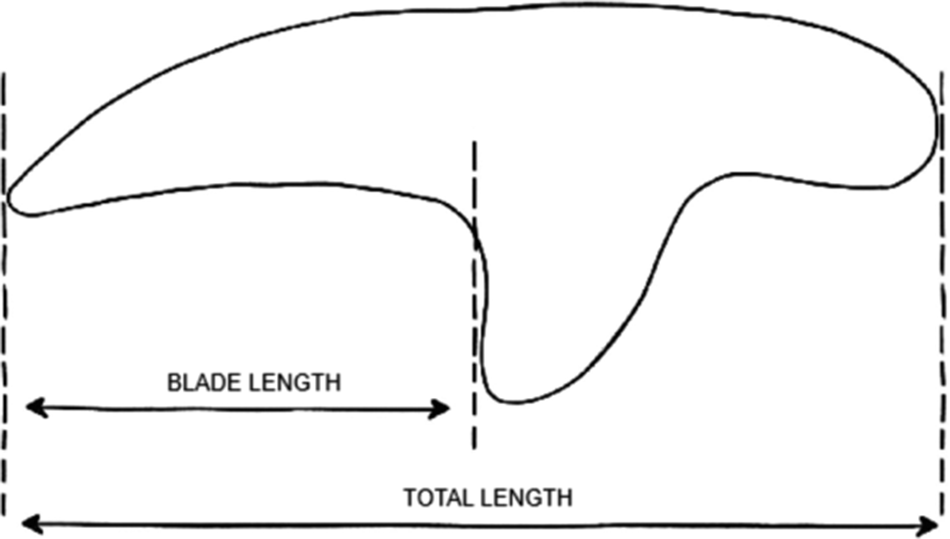
The PSC were mounted in polyvinyl lactophenol on a glass slide, and sufficient pressure was applied to the cover slip in order to flatten but not damage the hooks (Ahmadi Reference Ahmadi2004; Latif et al. Reference Latif, Tanveer, Maqbool, Siddiqi, Kyaw-Tanner and Traub2010; Ponce Gordo and Cuesta Bandera Reference Ponce Gordo and Cuesta Bandera1997). Three large and 3 small hooks of each of 5 PSC from each isolate were measured. The hook parameters were measured according to Hobbs et al. (1990). Total lengths of large (LTL) and small (STL) hooks, as well as the blade length of large (LBL) and small (SBL) hooks, were measured using a calibrated eyepiece micrometer under oil immersion (Figure 1). The average and standard deviation were determined for each HC measurement.
Morphometric parameters of total and blade lengths of larval rostellar hooks of E. granulosus sensu lato.

Data analysis
Variance and covariance matrices as well as vectors of means of the 4 morphometric parameters for each E. granulosus sl species were compared using multivariate inference methods (Royston´s Multivariate Normality Test; MANOVA, Hotelling-Lawley´s Test).
Principal component analysis (PCA), initially described by Pearson and developed by Hotelling (Hotelling Reference Hotelling1933), allows representing by means of a linear model a set of variables using a reduced number of hypothetical variables (principal components). These components are not correlated with each other and therefore are interpreted independently, and each of them contains a part of the total variability of the database. The first component (Comp1) contains the greatest variability of the data. The second component (Comp2) includes the greatest variability between the variables uncorrelated with the first. This continues until all the variability has been differentially distributed among the components. Each component contains information about all the variables but in different proportions (Palacio et al. Reference Palacio, Apodaca and Crisci2020). Selecting the most important components summarizes the information provided by the data with little loss of information. Therefore, PCA was the multivariate analysis technique selected to explore the relationships between variables and grouping the samples.
The supervised classification method chosen was Classification Trees. It is a non-parametric model that is built through recursive segmentation. The tree must be the most general and smallest as possible. This is achieved by selecting at each step the variable that optimizes the division of the data into homogeneous subsets in such a way that the target class is better predicted (Carrasco et al. Reference Carrasco, Bueno, Montero, Fernández-Avilés and Montero2024). The classification variable was the species of E. granulosus sl determined by genotyping, and the predictors were LTL, LBL, STL, and SBL. A Train group was randomly assembled with 80% of the samples to train the algorithm, and a Test group with the remaining 20% to evaluate the final model. Random Forest (RF) was used as an ensemble method to decorrelate the trees and reduce variability. All procedures were carried out using R, version 4.4.1 (R Core Team 2024).
Results
The 76 HCs included in the study had different anatomical locations, and 42% of them were extrahepatic. The distribution of species/genotypes was as follows: E. granulosus ss G1 (45 cysts), E. granulosus ss G3 (3), and E. canadensis G6 (28). The G1 genotype presented 3 microvariants: G1nqnA (40), G1nqnC (4), and G1nqnD (1). The morphometric characteristics of the rostellar hooks of human HCs belonging to different species of E. granulosus sl are shown in Table 1. Overall, 2,280 hooks of 76 isolates were measured and analyzed.
Rostellar hooks characteristics of protoscoleces of E. granulosus ss (G1 y G3) y E. canadensis (G6) from human hydatid cysts (Neuquén, Argentina)

All values of LTL, LBL, STL, and SBL are shown as mean ± SD; (95% CI) and [range]. Lengths in μm.
*Total number of hooks measured: 2280.
There were no significant differences in the variance and covariance matrices between species of E. granulosus sl (U=11.11; p=0.35). The multivariate normal was fulfilled for both species (p-value = 0.87 and 0.07 for E. granulosus ss and E. canadensis, respectively). There were significant differences in the multivariate vector of means of E. granulosus ss and E. canadensis (p < 2.2 x 10⁻¹⁶).
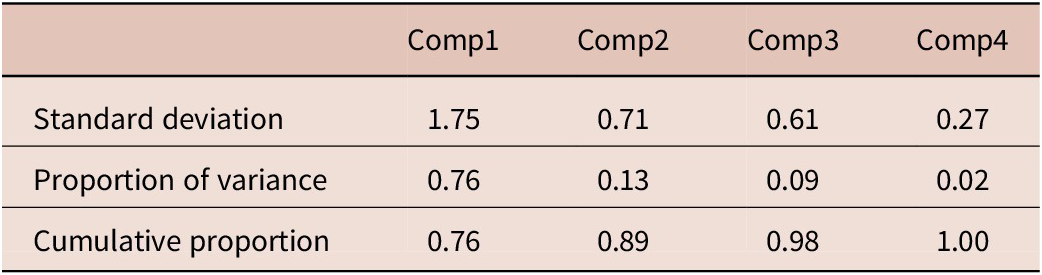
Principal Component Analysis was carried out in 76 samples from HCs. Strong positive correlations were found between LTL, LBL, and STL; SBL showed minor positive correlation with the other variables (Figure 2). The selection of the number of principal components (Comp) was carried out with the criterion of cumulative proportion of total variance >75%. Comp1 and Comp2 represented 89% of the total variance (76.4% and 12.6%, respectively) (Table 2). The correlation between the components and the original variables resulting from the PCA is presented in Figure 3.
Correlation matrix for the 4 variables considered using data of 76 human cysts of Neuquén: a) correlation coefficients in absolute terms; b) circle graph with clustering.

Importance of components according to percentage of the total variance explained

Correlation coefficient of the components resulting from Principal Component Analysis with the original variables.

When samples were plotted with both components, E. granulosus ss y E. canadensis form separated groups according to Comp1, but not according to Comp2 (Figure 4). Significant differences were found between the mean Comp1 of both species of E. granulosus sl (p-value < 2.2 × 10⁻¹⁶), but not between the mean Comp2 (p-value = 0.1694). No groupings were observed according to cyst location for both components (data not shown).
Plot of 76 human cysts of E. granulosus ss y E. canadensis from Neuquén for the 2 components extracted by Principal Components Analysis (Blue= E. granulosus ss; Red= E. canadensis).

A classification tree was created using the 4 predictor variables: LTL, LBL, STL, and SBL. The LTL variable was sufficient to classify a new isolate into the 2 parasitic species: if LTL < 25.3 μm, then the HC corresponds to E. granulosus ss, and if LTL ≥ 25.3 μm, then the HC corresponds to E. canadensis.
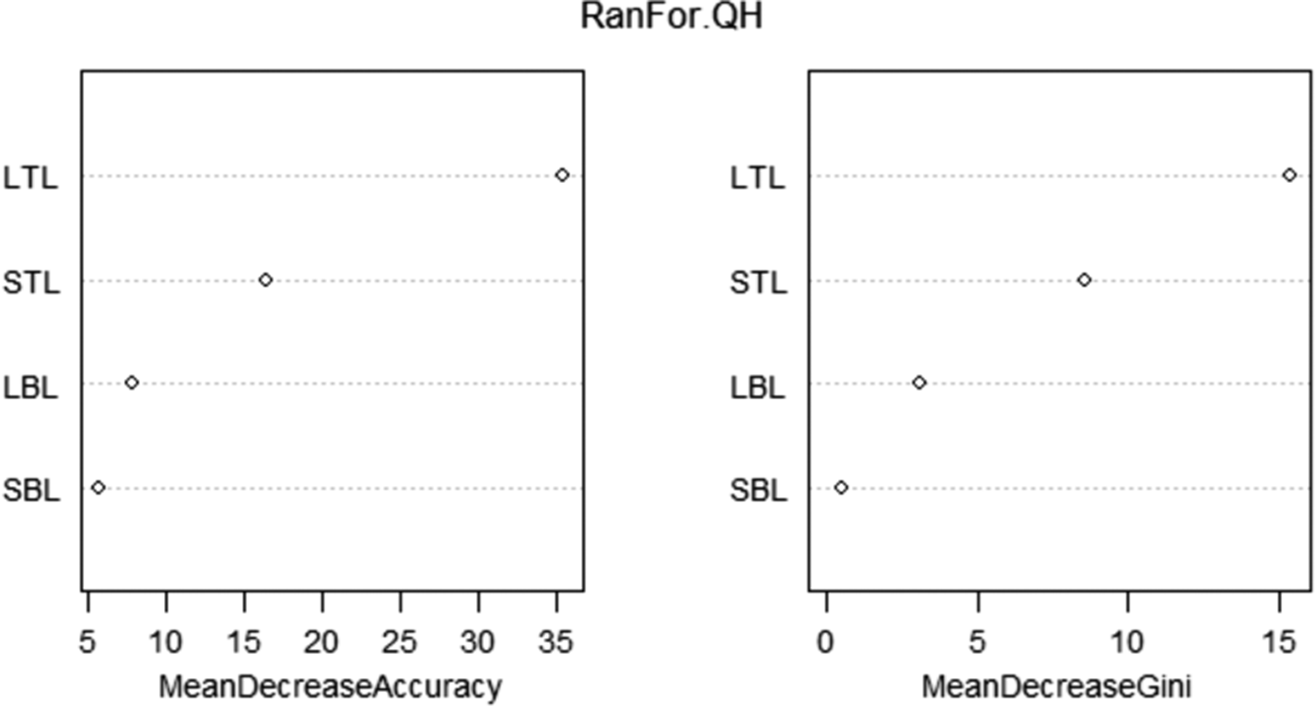
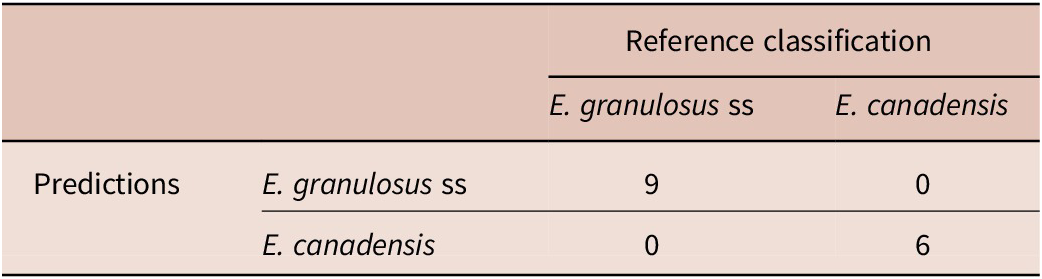
Random Forest was applied to decorrelate the trees using 2 predictors randomly. The LTL and STL variables had the greatest impact on the model’s predictions according to the decrease on the accuracy and in the Gini index (Figure 5). The confusion matrix resulting from applying the model to the Test group is presented in Table 3.
Variable importance scores for variables by Random Forest with corresponding % decrease mean accuracy and % decrease mean Gini index when that variable is randomly permuted.

Confusion matrix resulting from applying the Random Forest model to the Test group (n=15)

The LTL vs STL scatterplot (Figure 6) shows the correct classification of all the isolates of E granulosus ss and E. canadensis characterized in this study, using the cut-off value LTL < 25.3 μm based on the classification tree model.
Scatterplot of large and small hook length from human isolates of E. granulosus sl of Neuquén; proposed cut-off based on large hook total length according to Tree model (25.3 μm).

A bibliographic review was carried out to record published MRH results (LTL and STL) of human HCs from other regions of the world, belonging to different E. granulosus sl species. The cut-off value for LTL determined in this study was then applied to those data in addition to ours, to corroborate that it can be used to distinguish between E. granulosus ss and E. canadensis (Figure 7). Some published morphometric data from other human HCs could not be included in this plot either because they lacked STL measurement or because their values were not discriminated against those from other IH.
Scatterplot of large and small hook length from human isolates of E. granulosus sl characterized in this study as well as previously published by other authors; proposed cut-off based on large hook total length according to Tree model (25.3 μm). a) Mean Human Isolates Spain (Ponce Gordo et al. 1997); b) Mean Human Isolates Iran (Ahmadi et al. Reference Ahmadi2004); c) Mean Human Isolates Iran (Ahmadi and Dalimi Reference Ahmadi and Dalimi2006); d) G7 Mean Human Isolates Poland (Salamatin et al. Reference Salamatin, Kowal, Nosal, Kornaś, Cielecka, Jańczak, Patkowski, Gawor, Kornyushin, Golab and Šnábel2017); e) G7 Mean Human Isolates Ukraine (Salamatin et al. Reference Salamatin, Kowal, Nosal, Kornaś, Cielecka, Jańczak, Patkowski, Gawor, Kornyushin, Golab and Šnábel2017); f) G1 Mean Human Isolates Pakistan (Latif et al. Reference Latif, Tanveer, Maqbool, Siddiqi, Kyaw-Tanner and Traub2010); g) Mean Human Isolates UK (Sweatman and Williams Reference Sweatman and Williams1963); h) Mean Human Isolates Finmark (Sweatman and Williams Reference Sweatman and Williams1963); i) Mean Human Isolates Chile (Vásquez et al. Reference Vásquez, Rojas and Manterola2022); j) Mean Human Isolates Iraq (Hama et al. Reference Hama and Shareef2016); k) Mean Human Isolates Türkiye (Halidi et al. Reference Halidi, Yılmaz and Beyhan2023).

Discussion
The present is the first multivariate study that establishes a morphometric cut-off value to discriminate between 2 species of E. granulosus sl in human CE, using a significant number of cysts of both species identified by sequencing of mitochondrial genes.
Differentiation of Echinococcus species and strains was based on morphological criteria before the molecular methods were used so widely. Later, molecular epidemiological studies based on sequencing of nuclear and mitochondrial DNA confirmed the genetic and morphological differences of the host-adapted strains, and revealed phylogenetic relation-ships which support a robust taxonomy based on a previously documented nomenclature (Bowles et al. Reference Bowles, Blair and McManus1992; Lavikainen et al. Reference Lavikainen, Lehtinen, Meri, Hirvelä-Koski and Meri2003; Nakao et al. Reference Nakao, McManus, Schantz, Craig and Ito2007; Nakao et al. Reference Nakao, Lavikainen, Yanagida and Ito2013; Romig et al. Reference Romig, Ebi and Wassermann2015; Saarma et al. Reference Saarma, Jõgisalu, Moks, Varcasia, Lavikainen, Oksanen, Simsek, Andresiuk, Denegri, Gonzalez, Ferrer, Garate, Rinaldi and Maravilla2009; Thompson Reference Thompson2017). These studies have given confidence to the morphological characters used for species discrimination, which now offer a simple, cost-effective means of parasite identification in endemic foci where the application of molecular tools may not be practical or cost effective (Harandi et al. Reference Harandi, Hobbs, Adams, Mobedi, Morgan-Ryan and Thompson2002; Harandi et al. Reference Harandi, Hajialilo and Shokouhi2012; Lymbery and Thompson Reference Lymbery and Thompson2012).
The Neuquén province is highly endemic for CE despite the existence of a prevention and control program. Some socio-economic and cultural characteristics justify the epidemiological differences of this region. The most frequent livestock is goats, followed by cattle, sheep, and pigs. Goat-raising in Neuquén involves great migrating movements (transhumance) every year. Territorial distribution of human CE in Neuquén is shown to be highly heterogeneous: The eastern plateau is more urbanized, whereas livestock-raising is concentrated at the mountainous areas of the north, south, and west of the province (Pierangeli et al. Reference Pierangeli, Soriano, Roccia, Giménez, Lazzarini, Grenóvero, Menestrina and Basualdo2007). The molecular epidemiology of CE in Neuquén is complex since various species and genotypes of E. granulosus sl coexist in the same geographical area (Soriano et al. Reference Soriano, Pierangeli, Pianciola, Mazzeo, Lazzarini, Saiz, Kossman, Bergagna, Chartier and Basualdo2010). E. granulosus ss G1 and G3 as well as E. canadensis G6 and G7 have been documented in human infections from Neuquén (Debiaggi et al. Reference Debiaggi, Soriano, Pierangeli, Lazzarini, Pianciola, Mazzeo, Moguillansky and Basualdo Farjat2017; Debiaggi et al. Reference Debiaggi, Alvarez Rojas, Lazzarini, Calfunao, Titanti, Calanni, Iacono, Soriano, Deplazes and Pierangeli2023). The high percentage of extrahepatic locations of HCs in this study could be related to the local presence of E. canadensis G6 (Debiaggi et al. Reference Debiaggi, Alvarez Rojas, Lazzarini, Calfunao, Titanti, Calanni, Iacono, Soriano, Deplazes and Pierangeli2023; Sadjjadi et al. Reference Sadjjadi, Mikaeili, Karamian, Maraghi, Sadjjadi, Shariat-Torbaghan and Kia2013; Örsten et al. Reference Örsten, Çiftçi, Azizova, Yüce, Uysal, İmamoğlu, Karaağaoğlu, Akıncı, Akyön, Casulli and Akhan2020; Soriano et al. Reference Soriano, Pierangeli, Pianciola, Mazzeo, Lazzarini, Saiz, Kossman, Bergagna, Chartier and Basualdo2010).
Developed PSC have an invaginated rostellum in which the hooks are arranged in two rows. Both large and small hooks have a handle, a blade, and a promontory in the middle (Hobbs et al. 1990). The projections of the microtriches are precursors of the hook blade, whose formation will be completed with deposition of material in the adult stage (Hobbs et al. 1990). The origin and development of hooks could be influenced by factors related both to the parasite and to the host.
Multivariate analysis allows to operate with a large number of measurements made on each experimental unit in several samples simultaneously. It is useful in scientific research to reduce, organize, and group data, to investigate the dependence between variables, and to formulate hypothesis tests. Based on multivariate inference, there is evidence to believe that the vector of means for the 4 metacestode morphometric variables analyzed in this research differ between E. granulosus ss and E. canadensis in human HCs from Neuquén.
In the present study, all morphometric variables of rostellar hooks correlated positively with each other in agreement with previous reports (Ahmadi Reference Ahmadi2004; Hobbs et al. Reference Hobbs, Lymbery and Thompson1990; Ponce Gordo and Cuesta Bandera Reference Ponce Gordo and Cuesta Bandera1997). A strong correlation was found between LTL, STL, and LBL. The number of hooks per rostellum was not determined since some authors assure that it can be discarded as a classification variable (Ponce Gordo and Cuesta Bandera Reference Ponce Gordo and Cuesta Bandera1997). The fact that in the present work the morphometric variables positively correlated with each other, allowed the PCA to be carried out as an ordering method. Thus, it was possible to reduce the total number of dimensions to 2 Principal Components without considerable loss of information. All morphometric parameters measured (LTL, LBL, STL, and SBL) contributed positively to Comp1, which represented the general size of the hooks. All, except SBL, contributed positively with Comp2, which denoted a relationship between the size of the large hooks and shape of the small ones. Previously, several studies have applied PCA to MRH of HCs from different IHs, although sequencing of mitochondrial genes was not performed in those studies to determine the species/genotypes of E. granulosus sl (Ahmadi Reference Ahmadi2004; Ahmadi and Dalimi Reference Ahmadi and Dalimi2006; Hobbs et al. 1990; Ponce Gordo and Cuesta Bandera Reference Ponce Gordo and Cuesta Bandera1997).
Our results clearly indicate that in the studied area, the rostellar hooks of metacestodes of human origin belonging to E. granulosus ss (G1 and G3) are significantly smaller than those of E. canadensis (G6).
Determination of a specific cut-off value to differentiate species of E. granulosus sl from human HCs is relevant to have a predictive tool for parasitic species in endemic areas where E. granulosus ss and E. canadensis coexist. In this study, a classification tree was created using the 4 predictor MRH variables. Although LTL and STL were the variables that had the greatest impact on the predictions of the Random Forest model, the LTL variable was sufficient to classify a new isolate into the 2 parasitic species: if LTL < 25.3 μm, then the HC corresponds to E. granulosus ss, and if LT L≥ 25.3 μm, then the HC corresponds to E. canadensis. The performance of the model was excellent, as it correctly classified all samples of Test group (Area Under the Curve = 1). This clearly demonstrates that the MRH of E. granulosus sl metacestodes of human origin is influenced by genetic factors of the parasite.
The cut-off value for LTL of human origin determined in this study was applied to published reports of MRH results (LTL and STL) of human HCs from other regions of the world, belonging to E. granulosus ss y E. canadensis. This value allowed to properly discriminate isolates belonging to both species of E. granulosus sl.
Harandi et al. (Reference Harandi, Hobbs, Adams, Mobedi, Morgan-Ryan and Thompson2002) determined that in humans from Iran (from 23 ‘sheep strain’ isolates and only ‘3 camel strain’ isolates), the LTL measurement could be sufficient to discriminate ‘sheep strain’ from ‘camel strain’ in agreement with molecular characterization by RFLP (cut-off point 25μm). Our current study made a substantial contribution in this regard: It included a larger number of human cysts (76) than this previous study to determine the cut-off value (25.3 μm), 48 and 28 HCs belonging to E. granulosus ss and E. canadensis, respectively, and all of them were genotyped by mitochondrial gene sequencing.
The present research suggests that E. granulosus ss G1 and G3 are not distinguishable by MRH from the larval stage in metacestodes from human origin. This result agrees with the findings of Harandi et al. (Reference Harandi, Hajialilo and Shokouhi2012), who studied HCs from several IHs analyzed together and conclude that they cannot be differentiated. We consider that a higher number of G3 cysts of human origin should be analyzed in order to draw valid conclusions about this subject.
Hook development may also be influenced by environmental factors of the host given the variability in hook number and size in the same species of Echinococcus from different hosts (Thompson Reference Thompson2017). Rostellar hooks of human HCs described in the present study were smaller than those of usual IHs (domestic livestock) for each species and genotype of E. granulosus sl described from Neuquén (Soriano et al. Reference Soriano, Pierangeli, Pianciola, Mazzeo, Lazzarini, Debiaggi, Bergagna and Basualdo2015) and from other areas of Argentina (Andresiuk et al. Reference Andresiuk, Gordo, Bandera, Elissondo, Dopchiz and Denegri2009). In Neuquén, the mean LTL (μm) of E. granulosus ss G1 varied from 25.36 ± 0.82 in sheep to 22.33 ± 1.22 in humans, while that of E. canadensis G6 varied from 30.13 ± 1.31 in goats to 27.88 ± 0.93 in humans (Soriano et al. Reference Soriano, Pierangeli, Pianciola, Mazzeo, Lazzarini, Debiaggi, Bergagna and Basualdo2015). Moreover, in a validation of the larval MRH method based on LTL measurements against molecular genotyping as gold standard carried out with livestock isolates, the optimum cut off value to distinguish between E. granulosus ss G1 and E. canadensis isolates was calculated as 26.5 μm (Soriano et al. Reference Soriano, Pierangeli, Pianciola, Mazzeo, Lazzarini, Debiaggi, Bergagna and Basualdo2015). The results of our research agree with other reports in which hooks of human origin were smaller than those of other IH (Ahmadi Reference Ahmadi2004; Hobbs et al. Reference Hobbs, Lymbery and Thompson1990; Ponce Gordo and Cuesta Bandera Reference Ponce Gordo and Cuesta Bandera1997; Vásquez et al. Reference Vásquez, Rojas and Manterola2022).
Molecular interaction mechanisms between Echinococcus larvae and their hosts are highly complex, especially when the parasite grows for a long time in close contact with internal organs of mammals. The differences in cellular and humoral immune responses between humans and other IH, which affect HC growth, must be considered (Gottstein et al. Reference Gottstein, Soboslay, Ortona, Wang, Siracusano and Vuitton2017). Pharmacological treatment could constitute another of the adverse environmental factors for the metacestode in human infections. The chemotherapy treatment of choice for CE are the Benzimidazoles (Cevasco Contreras et al. Reference Cevasco Contreras, Grecco, Celentano, Vaca and Rosenzvit2024), which act by binding to helminth beta-tubulin, inhibiting its polymerization and the formation of microtubules. Consequently, cytoskeleton-dependent functions such as glucose uptake are affected and could influence the size of the rostellar hooks in HCs from treated patients. This factor is not present in infections in usual IHs such as domestic livestock.
The results of the present study also suggest that the implantation organ of the human HC may not influence the size of the rostellar hooks since no clustering was observed in the PCA biplots.
The fact that this study included only the E. granulosus sl species and genotypes of human HCs prevalent in our region is a limitation. Furthermore, we were able to analyze a small number of fertile E. granulosus ss G3 HCs, and no fertile human HCs of E. canadensis G7 were detected.
In conclusion, the results of this research indicate that in the studied area, E. granulosus ss (G1 y G3) and E. canadensis (G6) can be distinguishable by MRH in human fertile HCs. Therefore, MRH has potential use in epidemiological studies of CE in endemic areas as a quick and inexpensive predictive tool to identify the E. granulosus sl species causing human CE where the cycles of both human-infective species overlap.
Acknowledgements
We would like to thank the infectious disease specialists, surgeons, and healthcare personnel at hospitals of Neuquén province. The authors are grateful to Marcos Gómez for his technical assistance in the Microbiology Laboratory, Facultad de Ciencias Médicas, Universidad Nacional del Comahue.
Financial support
This study was supported by Secretaría de Ciencia y Técnica, Universidad Nacional del Comahue under Grant number PIN N029 and PIN N041.
Competing interests
None.
Ethical standard
The Advisory Committee on Human Biomedical Research, from the Ministry of Health in Neuquén, approved the present study (CAIBSH No. file: 4420-138451/2013). All adult subjects and parents/tutors of the patients under 18 years gave their written informed consent to be included in this study and to authorize the anonymous use of their clinical data.