The Annual Meeting of the Australasian Association for Logic (generously sponsored by the Association for Symbolic Logic) was held in Sydney, Australia on 26–28 November 2024, hosted by the University of Sydney. The event was organized by the current presidents of the AAL, Guillermo Badia (Queensland), Sasha Rubin (Sydney) and Shawn Standefer (National Taiwan University). There were three invited addresses.
Annalisa Conversano (Massey University), Applications of o-minimality to groups and rings.
Manfred Droste (Leipzig University), Weighted logics and weighted automata.
Noam Greenberg (Victoria University of Wellington), Effective descriptive set theory and Wadge classes.
The 2025 meeting will be held in November 2025 at the University of Queensland, and will be organized by Guillermo Badia, Sasha Rubin, Tomasz Kowalski and Shawn Standefer. Further information, as well as recordings of the talks, can be found at https://sites.google.com/view/aalogic/past-aal-conferences/aal-conference-2024.
For the Program Committee
Guillermo Badia, Sasha Rubin and Shawn Standefer
Abstracts of invited plenary lectures
▸ANNALISA CONVERSANO, Applications of o-minimality to groups and rings.
School of Mathematical and Computational Sciences, Massey University, Auckland, New Zealand.
E-mail: a.conversano@massey.ac.nz.
An ordered structure
 $(M, <, ...)$
is called o-minimal when the definable subsets of M are finite unions of points and open intervals. That is, no matter the language, the definable sets in one free variable are precisely the sets that can be defined with the order alone. While the definition of o-minimality concerns only the definable subsets of M, there are striking consequences on all the definable sets of the structure. Remarkable applications of o-minimality have been recently found in several areas of mathematics, like algebraic geometric, number theory, probability and even outside mathematics in economics and neural networks. I will give a general introduction to the topic and then focus on some applications to group theory and ring theory.
▸MANFRED DROSTE, Weighted logics and weighted automata.
Institute of Computer Science, Leipzig University, Leipzig, Germany.
E-mail: droste@informatik.uni-leipzig.de.
Quantitative models and quantitative analysis in Computer Science are receiving increased attention. The goal of this talk is to investigate quantitative automata and quantitative logics. Weighted automata on finite words have already been investigated in seminal work of Schützenberger [5]. They consist of classical finite automata in which the transitions carry weights. These weights may model, e.g., the cost, the consumption of resources, or the reliability or probability of the successful execution of the transitions. This concept soon developed a flourishing theory, as is exemplified and presented in several books by Eilenberg, Salomaa-Soittola, Kuich-Salomaa, Berstel-Reutenauer, Sakarovitch, and the Handbook of Weighted Automata [3].
We investigate weighted automata and their relationship to weighted logics. For this, we present syntax and semantics of a quantitative logic; the semantics counts ‘how often’ a formula is true in a given word. Our main result [2], jointly with Paul Gastin, extending classical results of Büchi, Elgot and Trakhtenbrot (1961), shows that if the weights are taken from an arbitrary semiring, then weighted automata and a syntactically defined fragment of our weighted logic are expressively equivalent. A corresponding result holds for infinite words. Moreover, this extends to quantitative automata investigated by Henzinger et al. for modeling limit average-type or discounting behaviors e.g. of power plants. Finally, we consider Fagin’s seminal result [4] characterizing NP in terms of existential second-order logic; this started the field of descriptive complexity theory. In very recent work [1], jointly with Guillermo Badia, Carles Noguera and Erik Paul, we obtained a weighted version of Fagin’s result.
[1] Guillermo Badia, Manfred Droste, Carles Noguera, and Erik Paul, Logical Characterizations of Weighted Complexity Classes, 49th International Symposium on Mathematical Foundations of Computer Science (MFCS 2024) Leibniz International Proceedings in Informatics (LIPIcs), (Rastislav Královič and Antonin Kučera, editors), vol. 306, Schloss Dagstuhl – Liebniz-Zentrum für Informatik, 2024, pp. 14:1–14:16.
[2] Manfred Droste and Paul Gastin, Weighted automata and weighted logics, Theoretical Computer Science , vol. 380 (2007), pp. 69–86.
[3] Manfred Droste, Werner Kuich, and Heiko Vogler, editors. Handbook of Weighted Automata , Monographs in Theoretical Computer Science, Springer-Verlag, Berlin, Heidelberg, 2009.
[4] Ronald Fagin, Generalized first-order spectra and polynomial-time recognizable sets, Complexity of computation (Richard M. Karp, editor), SIAM-AMS Proceedings, vol. 7 (1974), pp. 43–73.
[5] Marcel-Paul Schützenberger, On the definition of a family of automata, Information and Control , vol. 4 (1961), no. 2, pp. 245–270.
▸NOAM GREENBERG, Effective descriptive set theory and Wadge classes.
School of Mathematics and Statistics, Victoria University of Wellington, Wellington, New Zealand.
E-mail: greenberg@sms.vuw.ac.nz.
A function on
 $\mathbb {R}$
is continuous if and only if it is computable relative to some real parameter. This is perhaps the simplest example of the connection between computability and descriptive set theory, resulting in the field of effective descriptive set theory. I will give a general introduction and mention some recent applications of the priority method to descriptive set theory, relying on machinery developed by Maontalbán, and independently by Debs and Saint Raymond.
Abstracts of contributed talks
▸GUILLERMO BADIA, RONALD FAGIN, AND CARLES NOGUERA, Completeness theorems for first-order real-valued logics with multidimensional sentences.
School of Historical and Philosophical Inquiry, University of Queensland, Brisbane, Australia.
E-mail: g.badia@uq.edu.au.
URL Address: https://sites.google.com/site/guillermobadialogic/home.
IBM Research - Almaden, IBM, San José, California, USA.
E-mail: fagin@us.ibm.com.
URL Address: https://researcher.watson.ibm.com/researcher/view.php?person=us-fagin.
Department of Information Engineering and Mathematics, University of Siena, Siena, Italy.
E-mail: carles.noguera@unisi.it.
URL Address: https://sites.google.com/view/carlesnoguera/.
Many-valued logics in general, and real-valued logics in particular, usually focus on a notion of consequence based on preservation of full truth, typically represented by the value
 $1$
in the semantics given in the real unit interval
 $[0,1]$
. In a recent paper [1], Ronald Fagin, Ryan Riegel, and Alexander Gray have introduced a new paradigm that allows to deal with inferences in propositional real-valued logics based on a rich class of sentences, multi-dimensional sentences, that talk about combinations of any possible truth-values of real-valued formulas. They have given a sound and complete axiomatization that tells exactly when a collection of combinations of truth-values of formulas imply another combination of truth-values of formulas. In this talk, we will extend their work to the first-order (as well as modal) logic of multi-dimensional sentences. We will give axiomatic systems and prove corresponding completeness theorems, first assuming that the structures are defined over a fixed domain, and later for the logics of varying domains. As a by-product, we will also obtain a 0-1 law for finitely-valued versions of these logics.
[1] Ronald Fagin, Ryan Riegel, and Alexander Gray, Foundations of reasoning with uncertainty via real-valued logics, Proceedings of the National Academy of Sciences , vol. 121 (2024), article no. 21.
▸GUILLERMO BADIA, CARLES NOGUERA, ALBERTO PAPARELLA, GUIDO SCIAVICCO AND EDUARD IONEL STAN, Reasoning with many-valued interval temporal logic.
School of Historical and Philosophical Inquiry, University of Queensland, Australia.
E-mail: g.badia@uq.edu.au.
URL Address: https://sites.google.com/site/guillermobadialogic.
Department of Information Engineering and Mathematics, University of Siena, Italy.
E-mail: carles.noguera@unisi.it.
URL Address: https://docenti.unisi.it/en/noguera-clofent. Department of Mathematics and Computer Science, University of Ferrara, Italy.
E-mail: alberto.paparella@unife.it.
URL Address: https://alberto-paparella.github.io/. Department of Mathematics and Computer Science, University of Ferrara, Italy.
E-mail: guido.sciavicco@unife.it.
URL Address: https://sites.google.com/unife.it/guido/.
Faculty of Engineering, Free University of Bozen-Bolzano, Italy.
E-mail: ioneleduard.stan@unibz.it.
URL Address: https://eduardstan.github.io/.
Unlike classical logic, which is grounded in the Boolean two-valued algebra, many-valued logics involve a more complex algebraic framework, thereby supporting a richer set of truth values. Such generalization has led to the development of a sophisticated algebraic taxonomy, accommodating different types of underlying domains and the properties of algebraic operators, which in turn influences the interpretation of logical connectives [1]. Noteworthy examples include Gödel algebras (G) [2], MV-algebras [3] on which Łukasiewicz logic is based [4], product algebras (
 $\Pi $
) [5], and Heyting algebras (H) on which intuitionistic logic is based [6].
Standard (i.e., based on algebras whose lattice reduct is the interval
 $[0,1]$
in
 $\mathbb R$
) fuzzy logics (which can be seen as a sub-class of many-valued logics) are crucial in several mathematics and computer science areas, particularly within artificial intelligence. These logics are predominantly employed in rule-based classifier learning [7], to enhance the flexibility and expressive power of classical systems, but also to refine decision-tree classifiers by supporting more granular decision-making processes [8]. In the context of subsymbolic machine learning, they find their use in fuzzy neural networks, aiding in managing the inherent uncertainty in data improving network adaptability and performance [9].
In terms of temporal logic, only a few attempts have been made to study point-based temporal languages in the fuzzy case, with early contributions [10, 11, 12] that limited to the fuzzification of the propositional side of formulas, while [13] provide a generalization of LTL allowing to express uncertainty in both atomic propositions and temporal relations. While standard algebras are relatively common in practical applications, the practical necessity for an infinite set of truth values is often debatable; for example, in the context of machine learning, datasets contain only a finite number of distinct values, giving rise to a finite number of distinct situations. At the same time, the conventional reliance on chain algebras can restrict modeling capabilities, disallowing the possibility of reasoning about different and incomparable experts’ viewpoints. A more general approach to many-valued modal (and therefore temporal) logics is that of Fitting [14]. In the case of interval temporal logic, [15, 16, 17] introduced and studied a many-valued extension of Halpern and Shoham’s interval temporal logic (HS [18]) over a Heyting algebra, providing a tableau system for it in the case of finite algebras.
In this work, we explore a further generalization of HS based on FL
 $_{ew}$
-algebras [1]. An FL
 $_{ew}$
-algebra is defined over a bounded commutative integral residuated lattice and naturally generalizes several common frameworks, including G, MV,
 $\Pi $
, and H. To uniform the terminology, we shall use the term Many-Valued Halpern and Shoham’s interval temporal logic (MVHS). We extend Fitting’s tableau system to deal with MVHS over some finite FL
 $_{ew}$
-algebra, we provide a working implementation for it as a part of our open-source reasoning and learning framework, and we test it to assess its practical usefulness.
[1] P. Cintula, P. Hájek and C. Noguera, Handbook of Mathematical Fuzzy Logic , Studies in Logic. Mathematical Logic and Foundation, College publications, 2011.
[2] M. Baaz, N. Preining and R. Zach, First-order Gödel logics, Annals of Pure and Applied Logic , vol. 147 (2007), pp. 23–47.
[3] C.C. Chang, Algebraic analysis of many valued logics, Transactions of the American Mathematical society , vol. 88 (1958), no. 2, pp. 467–490.
[4] A. Rose, Formalisations of further
 $\aleph _0$
-valued Łukasiewicz propositional calculi,
Journal of Symbolic Logic
, vol. 43 (1978), no. 2, pp. 207–210.
[5] P. Hájek, The Metamathematics of Fuzzy Logic , Kluwer, 1998.
[6] L. Esakia, G. Bezhanishvili, W.H. Holliday and A. Evseev, Heyting Algebras: Duality Theory , Springer, 2019.
[7] L.I. Kuncheva, Fuzzy Classifier Design , Studies in Fuzziness and Soft Computing, Springer, 2000.
[8] Y. Chen, T. Wang, B. Wang and Z. Li, A Survey of Fuzzy Decision Tree Classifier, Fuzzy Information and Engineering , vol. 1 (2009), no. 2, pp. 149–159.
[9] J.J. Buckley and Y. Hayashi, Fuzzy neural networks: A survey, Fuzzy Sets and Systems , vol. 66 (1994), pp. 1–13.
[10] S. Dutta, An event based fuzzy temporal logic, Proc. of the 18th International Symposium on Multiple-Valued Logic 1988, pp. 64–71.
[11] K.B. Lamine and F. Kabanza, Using fuzzy temporal logic for monitoring behavior-based mobile robots, Proc. of the IASTED International Conference, Robotics and Applications 2000, pp. 116–121.
[12] H. Thiele and S. Kalenka, On fuzzy temporal logic, Proc. of the 2nd International Conference on Fuzzy Systems IEEE, 1993, pp. 1027—1032.
[13] A. Frigeri, L. Pasquale and P. Spoletini, Fuzzy Time in Linear Temporal Logic, ACM Transactions on Computational Logic , vol. 15 (2014), no. X, pp. 1–22.
[14] M. Fitting, Many-valued modal logics, Fundamenta Informaticae , vol. 15 (1991), no. 3-4, pp. 235–254.
[15] W. Conradie, D. Della Monica, E. Muñoz-Velasco and G. Sciavicco, An Approach to Fuzzy Modal Logic of Time Intervals, Proc. of the 24th European Conference on Artificial Intelligence (ECAI) , vol. 325, IOS Press, 2020, pp. 696–703.
[16] W. Conradie, D. Della Monica, E. Muñoz-Velasco, G. Sciavicco and I.E. Stan, Fuzzy Halpern and Shoham’s interval temporal logics, Fuzzy Sets and Systems , vol. 456 (2023), pp. 107–124.
[17] W. Conradie, R. Monego, E. Muñoz-Velasco, G. Sciavicco and I.E. Stan, A Sound and Complete Tableau System for Fuzzy Halpern and Shoham’s Interval Temporal Logic, Proc. of the 30th International Symposium on Temporal Representation and Reasoning (TIME) vol. 278, Schloss Dagstuhl, 2023, pp. 9:1–9:14.
[18] J.Y. Halpern and Y. Shoham, A Propositional Modal Logic of Time Intervals, Journal of the ACM , vol. 38 (1991), no. 4, pp. 935–962.
▸NEIL BARTON AND DAVIDE SUTTO
 $^*$
, Axiomatizing the weak iterative conception of set.
Department of Philosophy, National University of Singapore, Singapore.
E-mail: n.barton@nus.edu.sg.
Department of Philosophy, University of Oslo, Oslo, Norway.
E-mail: davide.sutto@ifikk.uio.no.
The iterative conception of set has formed centre-stage for a lot of the discussion of the philosophy of sets: sets are built in a sequence of stages by an iterative process that generates new sets from old ones. For a long time, the “typical” way of thinking of this conception has been to take all possible subsets of sets living at previous stages when moving from one stage to another, thus forming stages by iterating the powerset operation (using union at limit stages). Call this the strong iterative conception of set. This version of the conception is relatively well-understood and has been something of the standard for a very long time, at least since the work of von Neumann and Zermelo on the cumulative hierarchy [16, 17].
Notwithstanding its popularity, the strong conception does not have a monopoly on the idea of iteratively forming sets: recent authors have challenged the idea that one should get all the sets immediately at every successor stage. Call the conception which holds that sets are formed in stages, but takes no stand on whether we get all sets at additional stages the weak iterative conception of set. Although many, nowadays, propose this under countabilism (the view that every set is countable, [1, 4, 11, 13]), this idea goes way back, and was central to the uptake of the iterative conception as a whole. That is, intuitions coming from the weak conception were not only contemporaneous with the strong one, but also constituted an important ingredient in its acceptance. This is the case, described by [9], of Gödel’s “constructible universe” L [8]: beside its huge impact on the acceptance of an iterative picture of the universe of sets, iterating definable (instead of full) powerset is also an example of the weak conception.
Despite this distinguished representative, the weak conception is less studied than its strong sharpening, often rendered in terms of an axiomatic level-theoretic treatment: within
 $\mathcal {L_\in }$
, explicitly (i.e., non recursively) define the levels of the cumulative hierarchy to ground an axiomatic theory able to prove interpretability with standard set-theoretic systems (e.g., ZF) and (quasi-)categoricity results. Contemporary versions of the weak conception [1, 13] are modal in nature and, whilst there are modal versions of the strong conception too [6, 10, 15], a fully level-theoretic analysis of the weak iterative conception is lacking. This work seeks to remedy that deficit.
First, we introduce examples of the strong conception [3, 5, 14]. Then, we propose a Constructible Level Theory (CLT) through a reworking of Gödel operations [8], taken as primitives to render the notion of definable subset in more explicit terms. CLT also sheds new light on the origins of the constructible universe L as rooted in predicativist ideas [7]. This is showcased by a choice concerning the Axiom of Separation:
-
1. full sep:
 $L_\alpha \models $
CLT only for some
$\alpha $
(e.g.,
$\aleph $
-fixed point or a regular limit cardinal);
-
2.
$\Sigma _1$
-sep:
$L_\alpha \models $
CLT for
$\alpha $
an admissible ordinal [2] -
3.
$\Delta _0$
-sep:
$L_\alpha \models $
CLT for all
$\alpha> 0$
.


In the former case the theory – with bolt-ons to accommodate Infinity, Replacement and full Powerset – is then made equivalent to
 $ZF + V=L$
. In the latter two it can derive
 $KP \ (\text {or} \ KP_\omega ) + V=L$
. The interesting point is that only the third option is faithful to the original spirit with which level theories were first formulated [12].
As a last point, we sketch three alternative routes towards a “Countabilist Level Theory”. The Bare Bones Theory passes through the simpler notion of an enumeration. The Forcing Theory uses the tool most familiar to countabilism [13]. Finally, the Arbitrary Theory, combines enumerations, definability and transitive closure to point towards  .
[1] N. Barton, The Iterative Conceptions of Set , Cambridge Elements in the Philosophy of Mathematics, Cambridge University Press, 2024.
[2] J. Barwise, Admissible Sets and Structures: An approach to definability theory , Perspectives in Logic, Volume 7, Springer-Verlag, Berlin-Heidelberg, 1975.
[3] G. Boolos, The Iterative Conception of Set, The Journal of Philosophy , vol. 68 (1971), no. 8, pp. 153–188.
[4] D. Builes and J.M. Wilson, In defense of Countabilism, Philosophical Studies , vol. 179 (2022), no. 7, pp. 2199–2236.
[5] T. Button, Level Theory, Part 1: Axiomatizing the bare idea of a cumulative hierarchy of sets, The Bulletin of Symbolic Logic , vol. 27 (2022), no. 4, pp. 436–460.
[6] T. Button, Level Theory, Part 2: Axiomatizing the bare idea of a potential hierarchy, The Bulletin of Symbolic Logic , vol. 27 (2022), no. 4, pp. 461–484.
[7] S. Feferman, Predicativity, Oxford Handbook of Philosophy of Mathematics and Logic , (S. Shapiro, ed.), Oxford University Press, Oxford, 2005, pp. 590–624.
[8] K. Gödel, The Consistency of the Axiom of Choice and of the Generalized Continuum-Hypothesis with the Axioms of Set Theory , Annals of Mathematical Studies, Vol. 3, 1940, [Lecture notes taken by George W. Brown; reprinted with additional notes in 1951 and with further notes in 1966].
[9] A. Kanamori, Gödel and Set Theory, The Bulletin of Symbolic Logic , vol. 13 (2007), no. 2, pp. 153–188.
[10] Ø. Linnebo, The Potential hierarchy of sets, The Review of Symbolic Logic , vol. 27 (2022), no. 4, pp. 461–484.
[11] T. Meadows, Naive Infinitism: The Case for an Inconsistency Approach to Infinite Collections, Notre Dame Journal of Formal Logic , vol. 6 (2013), no. 2, pp. 205–228.
[12] R. Montague, D. Scott, and A. Tarski, An Axiomatic Approach to Set Theory , North Holland Publishing Co., Unpublished [Archive Copy from the Bancroft Library: Alfred Tarski Papers, circa 1923-1985 (BANC MSS 84/69 c, Carton 4, Folder 29-30)].
[13] C. Scambler, Can All Things be Counted, Journal of Philosophical Logic , vol. 50 (2021), no. 5, pp. 1079–1106.
[14] D. Scott, Axiomatizing Set Theory, Proceedings of Symposia in Pure Mathematics (UCLA, July 10-August 5, 1967), (T. J. Jech, editor), vol. XIII, part II, American Mathematical Society, 1974, pp. 207–214.
[15] J. Studd, The Iterative Conception of Set: A (Bi-)Modal Axiomatisation, Journal of Philosophical Logic , vol. 42 (2013), pp. 697–725.
[16] J. von Neumann, Über eine Widerspruchfreiheitsfrage der Axiomatischen Mengenlehre, Journal für die reine und angewandte Mathematik , no. 160 (1929), pp. 227–241.
[17] E. Zermelo, Über Grenzzahlen und Mengenbereiche: Neue Untersuchungen über die Grundlagen der Mengenlehre, Fundamenta Mathematicae , vol. 16 (1930), no. 1, pp. 29–47.
▸SANKHA S. BASU
 $^*$
AND ESHA JAIN, Paracomplete probabilities.
Department of Mathematics, Indraprastha Institute of Information Technology, Delhi, New Delhi, India.
E-mail: sankha@iiitd.ac.in.
E-mail: eshaj@iiitd.ac.in.
A logic
 $\langle \mathcal {L},\vdash \rangle $
is said to be paracomplete if the law of excluded middle (LEM) fails in it, i.e., there exists
 $\alpha \in \mathcal {L}$
such that
 $\not \vdash \alpha \lor \neg \alpha $
. In a paracomplete logic, two propositions
 $\alpha $
and
 $\neg \alpha $
can both be false. A paracomplete logic is dual to a paraconsistent logic, where the law of explosion ECQ (ex contradictione sequitor quodlibet) fails, i.e., there exists
 $\alpha ,\beta \in \mathcal {L}$
such that
 $\{\alpha ,\neg \alpha \}\nvdash \beta $
. There are more ways of describing paracompleteness (see [6]). Intuitionistic propositional logic (IPC) is an example of a paracomplete logic.
A logic of formal undeterminedness (LFU) is a paracomplete logic that has a primitive or defined unary determinedness operator, usually denoted by
 , that can recover the law of excluded middle in a paracomplete setting. Intuitively speaking, in an LFU
 $\langle \mathcal {L},\vdash \rangle $
,
 is meant to assert that “
 $\alpha $
is determined,” and hence, in the presence of
 , either
 $\alpha $
or
 $\neg \alpha $
will be the case. In other words,
 , for all
 $\alpha \in \mathcal {L}$
. A unary undeterminedness operator, usually denoted by
 , can then be defined as the classical negation of
 , i.e., for any
 $\alpha \in \mathcal {L}$
,
 (‘
 $\sim $
’ being the classical negation operator). Alternatively, an LFU can be described with an undeterminedness operator in the language and the determinedness operator can be defined in terms of it using the classical negation. The interdefinability between the determinedness and undeterminedness operators is, of course, only possible if a classical negation is available. Intuitively speaking, in an LFU
 $\langle \mathcal {L},\vdash \rangle $
,
 is meant to assert that “there is missing evidence about
 $\alpha $
,” or equivalently, “
 $\alpha $
is undetermined”.
LFUs were introduced in [7] as dual to the logics of formal inconsistency (LFIs). However, as mentioned in [4], the idea can be traced back to [6]. An LFI is a paraconsistent logic that has a primitive or defined unary consistency operator, usually denoted by
 $\circ $
, which is used to recover the principle of explosion in a paraconsistent setting. Intuitively speaking, in an LFI
 $\langle \mathcal {L},\vdash \rangle $
, for any
 $\alpha \in \mathcal {L}$
,
 $\circ \alpha $
is meant to assert that “
 $\alpha $
is consistent,” and hence,
 $\{\alpha ,\neg \alpha ,\circ \alpha \}\vdash \beta $
, for all
 $\beta \in \mathcal {L}$
(see [2, 3, 5] for more on LFIs).
In an LFI or LFU, the semantic values
 $T/F$
or
 $1/0$
are not used to convey truth and falsity but rather, the presence and absence of evidence, respectively.
The system
 $\mathbf {Ci}$
is an LFI that is used in [1] to define a generalized notion of probability and prove a theorem of total probability for the contradictory evidence case. In this paper, we explore the dual case of missing evidence using an LFU and follow the work in [1] to generalize the theorem of total probability for this case. In order to do this, we introduce a logic that we call
 with a signature containing a primitive unary undeterminedness operator
 . A semantics for this logic and the soundness and completeness results with respect to this semantics are also presented. The logic
 , however, turns out to be the LFU
 $\mathbf {mbD}$
(see [4]) in disguise. The logic
 $\mathbf {mbD}$
was described on a signature containing a primitive unary determinedness operator
 $\text {{73}}$
.
We next define probability functions that can be used to provide a semantics for
 . The completeness of
 with respect to this probability semantics is then established using the completeness result mentioned above. This work can also be seen in connection with some other work on probability functions relative to intuitionistic logic (not LFUs) that were developed in [8] and [9].
[1] J. Bueno-Soler and W. Carnielli, Paraconsistent probabilities: consistency, contradictions and Bayes’ theorem, Entropy , vol. 18 (2016), no. 9, pp. 1–18.
[2] W. Carnielli and M.E. Coniglio, Paraconsistent logic: consistency, contradiction and negation , Logic, Epistemology, and the Unity of Science, vol. 40, Springer, 2016.
[3] W. Carnielli, M.E. Coniglio and J. Marcos, Logics of Formal Inconsistency, Handbook of Philosophical Logic (D. M. Gabbay and F. Guenthner, editors), Springer, Netherlands, 2007, pp. 1–93.
[4] W. Carnielli, M.E. Coniglio and A. Rodrigues, Recovery operators, paraconsistency and duality, Logic Journal of the IGPL , vol. 28 (2020), no. 5, pp. 624–656.
[5] W. Carnielli and A. Rodrigues, On the Philosophy and Mathematics of the Logics of Formal Inconsistency, New Directions in Paraconsistent Logic (5th WCP, Kolkata, India), (J.Y. Beziau and M. K. Chakraborty and S. Dutta, editors), vol. 152, Springer, New Delhi, 2015, pp. 57–88.
[6] N.C.A. da Costa and D. Marconi, A note on paracomplete logic, Atti della Accademia Nazionale dei Lincei. Classe di Scienze Fisiche, Matematiche e Naturali. Rendiconti Lincei. Matematica e Applicazioni , vol. 80 (1986), no. 7–12, pp. 504–509.
[7] J. Marcos, Nearly every normal modal logic is paranormal, Logique et Analyse. Nouvelle Série , vol. 48 (2005), no. 189–192, pp. 279–300.
[8] C.G. Morgan and H. LeBlanc, Probabilistic semantics for intuitionistic logic, Notre Dame Journal of Formal Logic , vol. 24 (1983), no. 2, pp. 161–180.
[9] B. Weatherson, From classical to intuitionistic probability, Notre Dame Journal of Formal Logic , vol. 44 (2003), no. 2, pp. 111–123.
▸JC BEALL AND JEREMIAH JOVEN JOAQUIN, The classical collapse of weaker logics.
Department of Philosophy, University of Notre Dame, 100 Malloy Hall, Notre Dame, IN 46556 USA.
E-mail: jbeall@nd.edu.
URL Address: https://entailments.net/.
Department of Philosophy, De La Salle University, 2401 Taft Avenue, Manila, NCR 1004 Philippines.
E-mail: jeremiah.joaquin@dlsu.edu.ph.
URL Address: https://sites.google.com/site/jeremiahjovenjoaquin.
The classical collapse thesis implies that certain subclassical logics collapse into classical logic. The thesis has been proven to hold for LP
 $^+$
, K3
 $^+$
, and FDE
 $^+$
, which are the multiple-conclusion (mc-) generalisations of LP, K3, and FDE, respectively [1, 2]. This paper extends the result to their ‘weaker cousins,’ which have become increasingly applied in various philosophical contexts (see, for example, [3, 4]). In particular, we show that WFDE
 $^+$
, the weaker counterpart of FDE
 $^+$
, collapses into classical logic. We show that this collapse result entails the classical collapse of the mc-variants of D.A. Bochvar’s semantics for Weak Kleene (WK3
 $^+$
) [5] and W. S Cooper’s semantics for Ordinary Logic (OL
 $^+$
) [6]. We offer some philosophical reflections on the classical collapse thesis. We note that any virtues that collapse results carry for ‘stronger’ subclassical logics are accordingly virtues of the weaker ones. Finally, we show that these results might be a different way of defining subclassicality, including any would-be empty ‘logic’.
[1] Jc Beall, Multiple-conclusion LP and default classicality, The Review of Symbolic Logic , vol. 4 (2011), no. 2, pp. 326–336.
[2] Jc Beall, LP+, K3+, FDE+, and their ‘classical collapse’ The Review of Symbolic Logic , vol. 6 (2013), no. 4, pp. 742–754.
[3] Bruno Da Ré and Damian Szmuc, Immune logics, The Australasian Journal of Logic , vol. 18 (2021), no. 1, pp. 29–52.
[4] Jeremiah Joven Joaquin, Infectious and transparent emotivism, The Journal of Applied Non-Classical Logics , vol. 32 (2022), no. 1, pp. 1–10.
[5] Dmitri A. Bochvar, On a three-valued logical calculus and its application to the analysis of the paradoxes of the classical extended functional calculus, History and Philosophy of Logic , vol. 2 (1981), no. 1-2, pp. 87–112.
[6] William S. Cooper, The propositional logic of ordinary discourse, Inquiry , vol. 11 (1968), no. 1-4, pp. 295–320.
▸BEN BLUMSON, Three valued conditionals.
Department of Philosophy, National University of Singapore, Singapore.
E-mail: benblumson@gmail.com.
According to the equivalence thesis,
 $A \rightarrow B$
is equivalent to the material conditional
 $A \supset B$
or, equivalently, the disjunction
 $\neg A \vee B$
. The equivalence thesis is famously counterintuitive. But against the background of classical logic, the equivalence thesis has a simple argument in its favour. In this paper we show that in three-valued logics in which the third-value is interpreted, in gappy logics, as neither true nor false or, in glutty logics, as both true and false, the same considerations which support the equivalence thesis in classical logic in fact undermine it in three-valued logics.
The first half of the argument has two premises – disjunctive syllogism and conditional proof. First, according to disjunctive syllogism,
 $\neg A \vee B, A \vdash B$
– if one disjunct is false, the other is true. Second, according to conditional proof, if
 $\Sigma , A \vdash B$
, then
 $\Sigma \vdash A \rightarrow B$
– in other words, if an argument is valid, then so is the argument formed by moving its premise into the antecedent of its conclusion. Applying conditional proof to disjunctive syllogism, it follows that
 $\neg A \vee B \vdash A \rightarrow B$
, which is the first half of the equivalence thesis.
The main premises of the second half of the argument are excluded middle and modus ponens. Assume
 $A \rightarrow B$
. From excluded middle, either A or
 $\neg A$
. In the first case, suppose A is true. Then from modus ponens B follows, and by disjunction introduction so does
 $\neg A \vee B$
. In the second case, suppose
 $\neg A$
is true. Then
 $\neg A \vee B$
follows by disjunction introduction again. Either way, we have
 $\neg A \vee B$
by disjunction elimination. So
 $A \rightarrow B \vdash \neg A \vee B$
, which is the second half of the equivalence thesis.
In this paper, I first show that against the background of gappy three-valued logics, the argument for the first half of the equivalence thesis succeeds, but the argument for the second half of the equivalence thesis fails, due to the failure of excluded middle. I then show that the situation is reversed in the context of glutty three-valued logics, and that there the argument for the second half of the equivalence thesis succeeds, but the argument for the first half of the equivalence thesis fails, due to the failure of disjunctive syllogism.
▸FERNANDO CANO-JORGE, Inconsistent sets and how to compute them.
Philosophy Programme, University of Otago; Department of Philosophy, University of Canterbury; and Facultad de Filosofía, Universidad Panamericana, campus México.
E-mail: fernando.cano-jorge@otago.ac.nz.
Among naïve set theories based on paraconsistent logics, some include inconsistent sets, e.g. Routley’s (Sylvan) DST [4, §6] and Weber’s [5, §5] where one may prove
 $x\in y\wedge x\notin y$
for some x and some y, while others do not, e.g. Brady’s CT [1, §5.1] where one may only prove
 $x\in y\leftrightarrow x\notin y$
. This difference is of great importance for a yet-to-be-developed paraconsistent computability theory. In so far as we can reduce computational properties like recursive enumerability and recursivity to questions about set membership, these two varieties of naïve set theories differ on their accounts of computability. For suppose one is working in Routley’s DST. Consider the characteristic function of Russell’s set R:
 $$ \begin{align*}\chi_R(x)=\begin{cases} 1 & \text{if } x\in R\\ 0 & \text{if } x\notin R \end{cases}\end{align*} $$
Then, since
 $R\in R$
,
 $\chi _R(R)=1$
, and, since
 $R\notin R$
,
 $\chi _R(R)=0$
, whence by transitivity of identity
 $0=1$
—which even dialetheists want to avoid. On the other hand, if one is working with Brady’s CT, this derivation of
 $0=1$
does not go through. This suggests that regular methods from classical computability theory are available for negation consistent naïve set theories and that something entirely different is needed in the case of inconsistent naïve set theories.
Moreover, computability theory is particularly concerned with sets of natural numbers and the relations and functions between them, so the alleged need for a paraconsistent theory of computability is conditional on whether there are inconsistent sets of natural numbers. Again, in theories like Routley’s or Weber’s, where the Routley set
 $\mathcal {Z}=\{x:x\notin \mathcal {Z}\}$
exists—which is both empty and universal [4, p.42]— one may have
 $\mathcal {Z}(\mathbb {N})=\mathbb {N}\cap \mathcal {Z}=\{x:x\in \mathbb {N}\wedge x\in \mathcal {Z}\}$
, i.e. the inconsistent set of natural numbers, where, for each n,
 $n\in \mathcal {Z}(\mathbb {N})$
and
 $n\notin \mathcal {Z}(\mathbb {N})$
. The question then arises as to whether such inconsistent sets of numbers may be represented in some inconsistent theories of arithmetic, like
 $\mathbf {RM3}^{i\sharp }$
[2], where, for each n,
 $\vdash _{\mathbf {RM3}^{i\sharp }}n=n$
and
 $\vdash _{\mathbf {RM3}^{i\sharp }}n\neq n$
.
Answering basic questions about the computability of such sets requires an entirely new framework which tolerates inconsistency and avoids triviality. In this talk we provide the first steps in that direction. To do this, we use two different membership relations,
 $\varepsilon $
and
 $\in $
. The former of these is our main membership relation and is paraconsistent in the sense that one may have
 $x\varepsilon y$
and
 $\sim \!(x\varepsilon y)$
without this leading to triviality. In contrast, the latter of these membership relations demands consistency and is exclusively used to analyze the extensions and antiextensions of the special two-place predicate
 $\varepsilon $
, in analogy with the model theory for first-order LP [3] and related systems. In particular, where
 $den(t)$
is the denotation of a term t and
 $\delta ^+(P)$
and
 $\delta ^-(P)$
are, respectively, the extension and the antiextension of an n-place predicate P, we define
 $$ \begin{align*} x\varepsilon y &\text{ iff } \langle den(x),den(y)\rangle\in \delta^+(\varepsilon)\\ \sim\!(x\varepsilon y) &\text{ iff } \langle den(x),den(y)\rangle\in \delta^-(\varepsilon) \end{align*} $$
We then lay down new definitions for semi-decidability and decidability of sets, based on whether one can compute the extensions and antiextensions of
 $\varepsilon $
, which allows for new kinds of characteristic functions. We show that this new framework recaptures the classical results when applied to consistent sets and we provide examples of computable inconsistent sets as proof of concept. Finally, we point to directions of further development of our theory.
Joint work with Zach Weber.
[1] Ross T. Brady, Universal logic , CSLI Lecture Notes, vol. 109, CSLI Publications, Stanford, 2006.
[2] Robert K. Meyer and Chris Mortensen, Inconsistent models for relevant arithmetics, The Journal of Symbolic Logic , vol. 49 (1984), no. 3, pp. 917–929.
[3] Graham Priest, Inconsistent models of arithmetic part I: Finite models, Journal of Philosophical Logic , vol. 26 (1997), pp. 223-235.
[4] Richard Routley, Ultralogic as universal?, The Sylvan Jungle , Volume 4, (Zach Weber, editor), Synthese Library vol. 396, Springer, 2019, pp. 1–121.
[5] Zach Weber, Paradoxes and inconsistent mathematics , Cambridge University Press, 2021.
▸JAMES CARR, Locality in residuated lattice models.
School of Historical and Philosophical Inquiry, University of Queensland, Brisbane, Australia.
An important limitation of classical first-order logic is its locality. Whether a first-order formula is modelled in a given structure only depends on behaviour of the model at a ‘local’ level, with the consequence that first-order logic cannot express global properties. This is at its most transparent in graphs where the natural notions of distance between points in the graph makes precise the idea of ‘local’, and locality results provide an effective method to show global concepts such as connectivity or acyclicity are inexpressible [6, Chapter 4]. Locality is made precise in arbitrary signatures through the Gaifman graph of a model, a graph on the elements of the model where two points are related iff they both appear in some tuple for a true relation in the signature. This lets one translate the natural notion of distance in a graph to any structure. With distance several notions of locality can be defined; the two most significant being Hanf locality and Gaifman locality [5]. Hanf locality links the equivalence of sentences up to quantifier rank m to the number of local isomorphically identical local substructures, whereas Gaifman locality states that any first-order formula is equivalent to restricted to ‘local quantification’. Whilst this work is carried out on models generally, it has particular importance for finite model theory due to the connection between finite models for relational signatures and finite databases [6].
The utility of locality results in classical (finite) model theory gives motivation to understanding if similar theory can be developed in the many-valued case. Previous work in this vein comes from Biziére, Grädel and Naaf [1] who developed an understanding of locality for models defined over semirings. In this talk we explore locality for models defined over residuated lattices. These structures are the central object in the model theory of first-order fuzzy logic logics, a substantive topic in the nascent study of non-classical predicate logics [2, 3, 4]. Just as in the classical, understanding locality is of particular interest when considering finite models, and continues the development of finite model theory for non-classical logics.
The bulk of the presentation is spent demonstrating and justifying appropriate generalisations of the key concepts - Gaifman graphs, model distance and Hanf & Gaifman locality. We then indicate how with the appropriate concepts one can mimic the classical proofs to establish many-valued variants of locality results, and demonstrate what limitations they place on the expressive power of the corresponding many-valued logics.
[1] C. Biziére, E. Graädel, and M. Naaf, Locality Theorems in Semiring Semantics, arXiv:2303.12627, 2023.
[2] M.P. Dellunde, À. García-Cerdaña, and C. Noguera, Löwenheim–Skolem theorems for non-classical first-order algebraizable logics, Logic Journal of IGPL , vol. 24 (2016), no. 3, pp. 321–3345.
[3] M.P. Dellunde, À. García-Cerdaña, and C. Noguera, Back-and-forth systems for fuzzy first order models, Fuzzy Sets and Systems , vol. 345 (2018), pp. 83–98.
[4] M.P. Dellunde and A. Vidal, Truth-preservation under fuzzy pp-formulas, International Journal of Uncertainty, Fuzziness and Knowledge-Based Systems , vol. 27 (2019), pp. 89–105.
[5] H-D. Ebbinghaus and J. Flum, Finite Model Theory , Springer, 1995.
[6] L. Libkin, Elements of Finite Model Theory , Springer, 2004.
▸SIGFRIDO D. CILETTI, A zero-one law for propositional intuitionistic logic.
Department of Mathematical and Physical Sciences, La Trobe University, Bundoora Victoria, Australia.
E-mail: ciletti@gmx.com.
Zero-one laws are a primary class of results in Finite-model theory. In this context, a zero-one law states that certain properties hold with asymptotic probability of either 0 or 1 in large random finite structures. For classical predicate logic, a zero-one law was first established by Y.Glebskii (et al.) in 1969 [2]. By a different proof method, a re-discovery of this theorem was made by R.Fagin in 1975 [1]. In propositional modal logic S4, a formulation of the property and related proof owes to J.Halpern and B.Kapron (1994) [3].
Using model-theoretic and combinatorial methods, recent work has established a zero-one law for Propositional Intuitionistic Logic. This result demonstrates that, despite its constructive nature and the absence of the law of the excluded middle, intuitionistic logic exhibits a form of probabilistic regularity akin to that seen in predicate classical and modal logics. The key techniques used in this proof involve an adaptation of combinatorial arguments to intuitionistic Kripke models, and draw on known results in the asymptotic enumeration of partial orders [4]. This result broadens the understanding of how probabilistic phenomena manifest in non-classical logics and offers new insights into the behaviour of large random partially ordered structures.
[1] Ronald Fagin, Probabilities on finite models, The Journal of Symbolic Logic , vol. 41 (1976), no. 1, pp. 50–58.
[2] Yuri V. Glebskii, Volume and fraction of satisfiability of formulas of the lower predicate calculus, Otdelenie Matematiki, Mekhaniki i Kibernetiki AkademiiNauk Ukrainskol SSR. Kibernetika , vol. 2 (1969), no. 18, pp. 17–27.
[3] Joseph Y. Halpern and Bruce Kapron, Zero-one laws for modal logic, Annals of Pure and Applied Logic , vol. 69 (1994), no. 2, pp. 157–193.
[4] Daniel Kleitman and Bruce Lee Rothschild, Asymptotic enumeration of partial orders on a finite set, Transactions of the American Mathematical Society , vol. 205 (1975), no. 1, pp. 205–220.
▸JONTE DEAKIN AND IAN SHILLITO, Weak and strong bi-intuitionistic logics from an abstract algebraic logic perspective.
Mathematical Sciences Institute, Australian National University, The Australian National University Canberra ACT 2600, Australia.
E-mail: u7480977@anu.edu.au.
School of Computing, Australian National University, The Australian National University Canberra ACT 2600, Australia.
E-mail: ian.shillito@anu.edu.au.
An elegant symmetry can be found in a fragment of intuitionistic logic: by inter- changing
 $\top $
for
 $\bot $
and
 $\land $
for
 $\lor $
in any equation in the language
 $\{\top , \bot , \land , \lor \}$
which is valid on all lattices, one obtains another valid equation on lattices. Unfortunately, the full fragment of intuitionistic logic breaks this symmetry, as implication lacks a dual operator to interchange with. Naturally, to regain symmetry it suffices to add the dual operator to
 $\rightarrow $
to the language. This operator
 , is variously called exclusion, subtraction or co-implication, and gives birth to bi-intuitionistic logic.
The foundations of this logic were laid by Cecylia Rauszer in the 1970s [14, 15, 16, 17, 18], who studied it from both a semantic point of view, via algebras and Kripke structures, and proof-theoretic point of view, via axiomatic and sequent calculi.Footnote 1 Sadly, these foundations are shaky, as witnessed by contradictory claims about the deduction theorem in Rauszer’s work, the claim of admissibility of cut disproved by Pinto and Uustalu [13], or the completeness with respect to rooted frames shown impossible by Crolard [2].
These errors were traced back by Goré and Shillito [5] to an original sin: behind bi-intuitionistic hide two separate logics, which they called strong and weak bi-intuitionistic logic, hereafter
 $\mathsf {sBIL}$
and
 $\mathsf {wBIL}$
respectively. This situation mirrors a well-known confusion in modal logic, where the logics corresponding to the local and global consequence relations of the Kripke semantics were conflated [6]. In both cases, the two conflated logics share the same set of theorems but are distinct consequence relations with separating properties. One such property is the deduction theorem, which holds for
 $\mathsf {wBIL}$
and the local modal logic, but only holds in a strictly weaker shape in
 $\mathsf {sBIL}$
and the global modal logic.
Following this clarification,
 $\mathsf {wBIL}$
and
 $\mathsf {sBIL}$
have been investigated from both a proof-theoretic and relational semantics perspective [20, 10, 19]. However, the algebraic treatment of these logics has been heretofore unstudied. Our work fills this gap, by describing precisely how
 $\mathsf {wBIL}$
and
 $\mathsf {sBIL}$
differ algebraically and leveraging this perspective to gain new results.
Traditionally, the algebraic approach tends to treat logics as sets of theorems, i.e. the set of formulas always interpreted as the top element in the algebras of a given class. As the logics we are considering are identical as sets of theorems, we cannot hope to distinguish them through the traditional approach. So, for an adequate algebraic study of
 $\mathsf {wBIL}$
and
 $\mathsf {sBIL}$
, we need tools focusing on the treatment of logics as consequence relations.
Abstract algebraic logic (AAL) [3] is an approach to logic which exactly fits our needs. Founded by the work of Blok and Pigozzi [1], this algebraic method defines a general notion of consequence relation via equations: given a class of algebras
 $\mathbb A$
and a set of equations E, we have
 $\Gamma \models \varphi $
if for any interpretation in any algebra of
 $\mathbb A$
the interpretation of
 $\varphi $
satisfies all equations of E whenever all formulas of
 $\Gamma $
also do. The merit of AAL, beyond its generality, lies in the tight connection it can draw between a logic and a class of algebras
 $\mathbb A$
, notably through the notion of algebraizability. This proximity is witnessed by a variety of bridge theorems, equating properties of the logic with properties of
 $\mathbb A$
. For example, Craig interpolation for an algebraizable logic corresponds to the amalgamation property for its class of algebras.
Here again, we find that the situation for bi-intuitionistic logic is very similar to the situation for global and local normal modal logic: while the global modal logic and
 $\mathsf {sBIL}$
are algebraizable, the local modal logic and
 $\mathsf {wBIL}$
are not. Strengthening the mirroring of the modal case, we also find that
 $\mathsf {sBIL}$
is the “strong version” of
 $\mathsf {wBIL}$
in the sense of [4]. Furthermore, we leverage bridge theorems via the algebraizability of
 $\mathsf {sBIL}$
to notably confirm the holding of Craig interpolation [9], and prove the failure of uniform interpolation [8]. To show the value of such an approach we make use of AAL-techniques to study the relationship between bi-intuitionistic logic and classical logic.
[1] Blok W.J. and D. Pigozzi, Algebraizable logics, Memoirs of the American Mathematical Society , vol. 77 (1989), no. 396, pp. 1–77.
[2] Crolard T., Subtractive logic, Theoretical Computer Science , vol. 254 (2001), no. 2, pp. 151–185.
[3] Font J.M., Abstract Algebraic Logic - An Introductory Textbook , Studies in Logic, College Publications London, 2016.
[4] Font J.M. and Jansana R., Leibniz filters and the strong version of a protoalgebraic logic, Archive for Mathematical Logic , vol. 40 (2001), no. 6, pp. 437–465.
[5] Goré R. and Shillito I., Bi-intuitionistic logics: a new instance of an old problem, Advances in Modal Logic , University of Helsinki, (N. Olivetti, R. Verbrugge, Negri. S and G. Sandu, editors), vol. 13, College Publications, 2020, pp. 269–289.
[6] Hakli R. and Negri S., Does the deduction theorem fail for modal logic?, Synthese , vol. 187 (2012), no. 3, pp. 849–867.
[7] Klemke D., Ein Henkin-Beweis für die Vollständigkeit eines Kalküls relativ zur Grzegorczyk-Semantik, Archiv für mathematische Logik und Grundlagenforschung , vol. 14 (1971), pp. 148-151.
[8] Kowalski T. and Metcalfe G., Uniform interpolation and coherence, Annals of Pure and Applied Logic , vol. 170 (2019), no. 7, pp. 825–841.
[9] Lyon T., Tiu A., Goré R. and Clouston R., Syntactic Interpolation for Tense Logics and Bi-Intuitionistic Logic via Nested Sequents, 28th Annual Conference on Computer Science Logic (Barcelona, Spain), (Maribel Fernández and Anca Muscholl, editors), vol. 152, Schloss Dagstuhl - Leibniz-Zentrum für Informatik, 2020, pp. 1–16.
[10] Maffezioli P. and Tranchini L., Equality and apartness in bi-intuitionistic logic, Logical Investigations , vol. 27 (2021), no. 1, pp. 82-106.
[11] Moisil GR. C., Logique modale, Disquisitiones malhematicae et physicae , vol. 2 (1942), pp. 3–98.
[12] Olkhovikov G.K. and Badia G., Craig interpolation theorem fails in bi-intuitionistic predicate logic, The Review of Symbolic Logic , vol. 17 (2022), no. 2, pp. 6110–633.
[13] Pinto L. and Uustalu T., Proof Search and counter-Model Construction for Bi-Intuitionistic Propositional Logic with Labelled Sequents, Automated Reasoning with Analytic Tableaux and Related Methods , (Oslo, Norway), (Giese Martin Last and Giese Martin, editors), vol. 18, Springer, 2009, pp. 295–309.
[14] Rauszer C., A formalization of the propositional calculus of H-B logic, Studia Logica , Vol. 33 (1974), no. 1, pp. 23–34.
[15] On the strong semantical completeness of any extension of the intuitionistic predicate calculus, Bulletin de l’Academie Polonaise des Sciences , vol. 24 (1976), no. 2, pp. 81–87.
[16] Semi-boolean algebras and their application to intuitionistic logic with dual operations, Fundamenta Mathematicae , vol. 83 (1974), no. 3, pp. 219–249.
[17] The Craig interpolation theorem for an extension of intuitionistic logic, de l’Academie Polonaise des Sciences, vol. 25 (1977), pp. 127–135.
[18] An algebraic and Kripke-style approach to a certain extension of intuitionistic logic , Dissertationes Mathematicae, 1980.
[19] Shillito I., New foundations for the proof theory of bi-intuitionistic and provability logics mechanized in Coq, ProQuest Dissertations and Theses Global , 2022.
[20] Shillito I. and Kirst D., A mechanised and constructive reverse analysis of soundness and completeness of bi-intuitionistic logic, Certified Programs and Proofs , Institution of Engineering and Technology, Savoy Place, London, (A. Timany, D. Traytel, B. Pientka and S. Blazy), vol. 13, Association for Computer Machinery, 2024, pp. 218–229.
▸TIM FRENCH, Proof theory for aleatoric logic.
Department of Computer Science, The University of Western Australia.
E-mail: tim.french@uwa.edu.au.
URL Address: https://research-repository.uwa.edu.au/en/persons/tim-french.
Reasoning under uncertainty is different to reasoning about uncertainty. Reasoning about uncertainty will typically quantify the uncertainty (as a probability, or perhaps belief measure) and then make some inference about how that uncertainty will propagate through some deduction [4]. On the other hand, reasoning under uncertainty, does not quantify the uncertainty but treats propositions as elements of chance, so while the interpretation is probabilistic, probabilities are not explicit in the syntax.
Aleatoric Logic is a many-valued logic where atom propositions are interpreted as independent Boolean random variable or Bernoulli tests. It takes an intrinsically probabilistic view of logical propositions, and is therefore quite different to fuzzy logics such as Hájek’s BL [2]. Complex propositions are then built from these variables using Boolean operations, as well as a fixed point operator and a conditional operation, or if-them-else rule. The semantics of these operations describe the likelihood of the proposition being evaluated as true, when the atoms are sampled every time they occur in a formula. Therefore the fixed point operator samples the quantified atom at the likelihood of the scoping proposition, and the conditional operator is essentially the weighted sum of two propositions, given the weight of a third proposition.
In this work we demonstrate the expressive completeness of aleatoric logic showing a correspondence to a set of rational functions over
 $[0,1]$
, and provide a proof theory axiomatising the notion of equivalence among propositions.
The language is given over a set of propositional atoms
 $\mathcal {P}$
:
 $$ \begin{align*}\alpha\ ::=\ \top\ |\ X\ |\ \lnot\alpha\ |\ (\alpha ~ ? ~ \alpha : \alpha)\ |\ \mathbb{F} X.\alpha \end{align*} $$
where
 $X\in P$
and anFootnote
2
interpretation
 $\mathcal {I}:\mathcal {P}\longrightarrow [0,1]$
of the logic is an assignment of atoms to probabilities. The semantics are:
 $$ \begin{align*} \top^{\mathcal{I}} &= 1\\ X^{\mathcal{I}} &= \mathcal{I}(X)\\ (\lnot \alpha)^{\mathcal{I}} &= 1-\alpha^{\mathcal{I}}\\ (\alpha ~ ? ~ \beta : \gamma)^{\mathcal{I}} &= \alpha^{\mathcal{I}}\cdot\beta^{\mathcal{I}} + (1-\alpha^{\mathcal{I}})\cdot\gamma^{\mathcal{I}}\\ (\mathbb{F} X.\alpha)^{\mathcal{I}} &= \left\{\begin{array}{@{}l} 1/2\ \textrm{ if }\alpha^{\mathcal{I}[X\leftarrow1/2]} = 1/2\\ p \textrm{ if }\alpha^{\mathcal{I}[X\leftarrow p]} = p, \textrm{otherwise} \end{array}\right. \end{align*} $$
For the expressive completeness, given a finite set of atoms
 $\mathcal {P}$
, the semantic interpretation of a formula
 $\alpha $
may be see as a function
 $\alpha :[0,1]^{\mathcal {P}}\longrightarrow [0,1]$
. Following work of Mossel and Peres [3], we show the following correspondence.
Theorem 1. The set of functions corresponding to aleatoric propositions are exactly the set of rational functions from
 $f:[0,1]^{\mathcal {P}}\longrightarrow [0,1]$
, where for all points
 $p\in [0,1]^{\mathcal {P}}$
,
 $f(p)\in {0,1}$
, if and only if p belongs to a hyperface of the unit cube,
 $H\subseteq [0,1]^{\mathcal {A}}$
, where for all
 $q\in H$
,
 $f(q) = f(p)$
.
Here, a hyperface is a set of points
 $H\subseteq [0,1]^{\mathcal {A}}$
, where there is a set of dimensions
 $\mathcal {B}\subseteq \mathcal {A}$
such that
-
1. for all
$i,j\in H$
,
$i^{\mathcal {B}} = j^{\mathcal {B}}\in \{0,1\}^{\mathcal {B}}$
. -
2. for all
$\{i^{\mathcal {A}\backslash {\mathcal {B}}}\ |\ i\in H\} = (0,1)^{\mathcal {A}\backslash {\mathcal {B}}}$
.


This result is a generalisation of work presented in [1], and relies on reducing all aleatoric propositions to normal form which can be shown to correspond with the given class of functions.
We then present a sound and complete axiom system for the identity relation over this language, where two propositions are identical if they are functionally equivalent over all interpretations.
Definition 2 (Proof Systems)
-
1. Given two aleatoric propositions
$\alpha $
and
$\beta $
, an identity
$\alpha \simeq \beta $
asserts that
$\alpha $
and
$\beta $
have the same likelihood. -
2. An identity
$\alpha \simeq \beta $
is valid if for all interpretations
$\mathcal {I}$
,
$\alpha ^{\mathcal {I}} = \beta ^{\mathcal {I}}$
. -
3. A sets of identities,
$\mathcal {T}$
is referred to as a theory, and a proof system
$\mathfrak {L}$
derives identities from theories. -
4. A proof system
$\mathfrak {L}$
is sound if
$\mathfrak {L}$
only derives
$\alpha \simeq \beta $
from a theory
$\mathcal {T}$
when every interpretation
$\mathcal {I}$
that validates every identity in
$\mathcal {T}$
we have
$\alpha ^{\mathcal {I}} = \beta ^{\mathcal {I}}$
. -
5. A proof system
$\mathfrak {L}$
is complete for validity if
$\mathfrak {L}$
can derive every valid identity from every theory.


Theorem 3. The proof system
 $\mathfrak {AL}$
of Table 1 is sound and complete for validity.
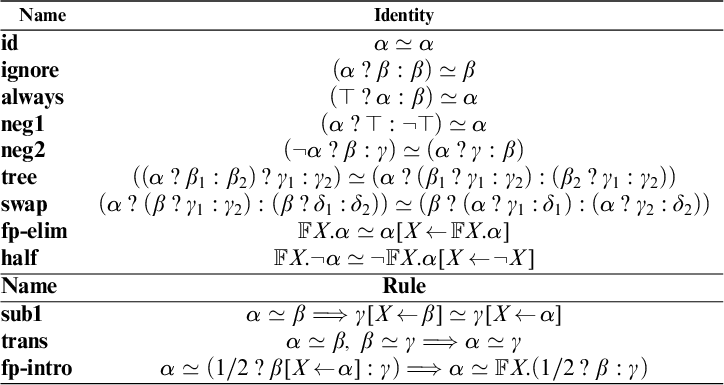
The deductive system
 $\mathfrak {AL}$
, consisting as a set of identity schema and set of rule schema.

The proof of completeness can be shown via a normal form based on the expressive completeness result in Theorem 1.
We are currently investigating first order extensions of this language.
[1] Tim French, Aleatoric Propositions: Reasoning About Coins, Logic, Language, Information, and Computation: 29th International Workshop, WoLLIC 2023 , Helle Hvid Hansen, Andre Scedrov, Ruy J. G. B. de Queiroz (Eds.), Springer Nature Switzerland, 2023, pp. 227–243.
[2] Hájek, Petr, Metamathematics of Fuzzy Logic , Springer Science & Business Media, 2013.
[3] Mossel, Elchanan and Peres, Yuval New coins from old: computing with unknown bias, Combinatorica , vol. 25 (2005), no. 6, pp. 707–724,
[4] Ognjanovi, Zoran and Rakovi, Miodrag and Markovi, Zoran, Probability Logics: Probability-Based Formalization of Uncertain Reasoning, Springer Publishing Company, 2018
▸KAREN GREEN, Some ‘objects of thought’ are not objects.
Historical and Philosophical Studies, University of Melbourne, Australia.
E-mail: karen.green@unimelb.edu.au.
Modern Meinongeans and noneists assume that objects of thought are objects and so, when we think or speak about what does not exist, we are speaking and thinking about non-existent objects. Perhaps surprisingly, Russell suggested that both Meinong and Frege had proposed that some objects of thought, even when they don’t exist, have kind of a Being which is in no way dependent on their being objects of thought. Russell had in mind the fact that, according to Frege, what enables us to think and speak about what does not exist is that we can think about empty concepts and unasserted thoughts. These have a kind of being different from objects, which are identified by their location in space time. Properties, processes, similarities, functions, thoughts, and concepts, as well as objects, can be objects of thought. Frege’s semantics makes them objects of thought, without assuming them to be objects. Arguably, Frege did recognize one non-existent object, the False, and a tweak to his semantics is proposed to eliminate reference to this non-existent object. Finally, it is argued that not only does Frege’s introduction of functions allow him to avoid Meinong’s distinction between bestehen and existieren, what Meinong intended when he spoke of sosein and sein is better captured using Frege’s distinction between instantiation of a concept by an object and the subordination of one concept to another. Ultimately, it is claimed that anything Meinong does, Frege does better, so Fregeans can do everything better than noneists.
▸ARMIN HEYDARI, A points-as-proofs interpretation of Routley-Meyer semantics for relevant logics.
Department of Philosophy, Harvard University, Cambridge, MA 02138, United States.
E-mail: arminheydari@fas.harvard.edu.
Routley and Meyer’s [1, 2] possible worlds semantics for relevant logics employ a ternary relation on a set of points. Much interest has been devoted to three questions: how should we interpret the points, the ternary relation, and the truth of a conditional at a point? It has been suggested that we can interpret the points as sets of proofs; the ternary relation
 $Rabc$
to say that the application of proofs in a to proofs in b produces proofs in c; and the truth of
 $\phi \to \psi $
at a to mean that a contains a construction that takes us from a proof of
 $\phi $
to a proof of
 $\psi $
[3, 4].
I argue that this interpretation is not (quite) adequate because it violates some of Routley and Meyer’s frame conditions, and I develop an interpretation that resolves this issue while maintaining that the points can be interpreted as sets of proofs.
To this end, first, I introduce the positive fragments of the relevant logics B and R and their Routley-Meyer semantics. Second, I argue against the suggested interpretation. The problem lies in a feature that it shares with some other proposed interpretations: coarsity, meaning that the interpretation of
 $Rabc$
does not distinguish between a piece of information M in c being the result of the composition L of information in a and b, on the one hand, and M only carrying the same information as L, on the other hand. Third, I develop an interpretation that is not subject to this issue. Its resolution lies in not requiring for
 $Rabc$
that the applications of proofs in a to proofs in b are strictly contained in c, but only that they stand in a natural equivalence relation to proofs in c: they must be the same up to unnecessary detours. This move will be appropriately formalised in the typed lambda calculus.
[1] Routley, Richard, and Robert K. Meyer, The semantics of entailment, Truth, syntax and modality (Hugues Leblanc, editor), North Holland Publishing Co., Amsterdam, 1973, pp. 199–243.
[2] , The semantics of entailment – III, Journal of Philosophical Logic , vol. 01 (1972), no. 2, pp. 192–208.
[3] Dunn, Jon M., Ternary relational semantics and beyond: programs as arguments (data) and programs as functions (programs), Logical Investigations , vol. 08 (2001), pp. 282–301.
[4] Beall, Jc, Ross Brady, Jon M. Dunn, Allen P. Hazen, Edwin Mares, Robert K. Meyer, Graham Priest, Greg Restall, David Ripley, John Slaney, and Richard Sylvan, On the ternary relation and conditionality, Journal of Philosophical Logic , vol. 41 (2012), no. 3, pp. 595–612.
▸ZOLTAN A. KOCSIS, The probability of excluded middle and the satisfiability gap of classical principles.
The University of New South Wales, Sydney NSW 2052, Australia.
E-mail: z.kocsis@unsw.edu.au.
In classical logic, the law of excluded middle,
 $P \vee \neg P$
holds for any proposition P. In a model of intuitionistic logic we can ask what’s the probability that a randomly chosen proposition P obeys
 $P\vee \neg P$
.
A recent article [2] gives a surprising answer to this question using Heyting algebras: the probability that a randomly chosen element of a Heyting algebra satisfies excluded middle can never exceed
 $\frac {2}{3}$
.
Heyting algebras provide a natural algebraic and order-theoretic semantics for the propositional fragment of intuitionistic logic [1]. A Heyting algebra
 $\langle H, \wedge , \vee , \rightarrow , \bot , \top \rangle $
is a bounded distributive lattice such that for every two elements
 $a, b \in H$
, the set
 $\{c \in H\:|\:a \wedge c \leq b\}$
has a distinguished maximum element denoted
 $a \rightarrow b$
. The connective
 $\neg x$
is a shorthand for
 $x \rightarrow \bot $
. Boolean algebras, familiar from the truth-value semantics of classical propositional logic, are the Heyting algebras in which the equality
 $x \rightarrow y = \neg x \lor y$
obtains for all
 $x, y \in H$
. We may regard the elements of H as truth values: a propositional formula is a classical tautology if and only if it is assigned the truth value
 $\top $
by any truth assignment to its propositional variables in Boolean algebras, and an intuitionistic tautology if every truth value assignment assigns
 $\top $
to it in the non-Boolean Heyting algebras as well.
Theorem. Take a finite Heyting algebra
 $\langle H, \wedge , \vee , \rightarrow , \bot , \top \rangle $
. If more than
 $\frac {2}{3}$
of elements
 $x \in H$
satisfy the equation
 $x \vee \neg x = \top $
then H is a Boolean algebra (and therefore all its elements satisfy
 $x \vee \neg x = \top $
).
Interestingly, excluded middle is the only classical tautology in one variable which admits such a satisfiability gap. For example, one can find Heyting algebras where the weak law of excluded middle, the equation
 $\neg x \vee \neg \neg x = \top $
, holds for an arbitrarily large proportion of elements (say
 $95 \%$
or
 $99.95\%$
of them), yet still fails to hold for all elements. Analogues of this theorem also arise in infinite Heyting algebras. In particular, if the cardinality of the solution set
 $\{x \in H \:|\: x \vee \neg x = \top \}$
exceeds that of its complement in an infinite Heyting algebra H, then H is Boolean.
In this contributed talk, I discuss the classification of equations with respect to satisfiability gap in both finite and infinite Heyting algebras. I present the original classification for one-variable equations and its extensions covering Peirce’s law and other classical principles in multiple variables. I also cover some refinements of the classification that were obtained after the publication of the article. For example, infinite Heyting algebras definable in so-called o-minimal structures admit a notion of dimension [3] which allows for a more fine-grained way of measuring subset sizes than cardinality alone. We now have a complete classification of those equations whose solution set always has dimension zero (i.e. very sparse, this includes
 $x \vee \neg x = \top $
), and whose solution set can have arbitrarily high dimension in such Heyting algebras (very dense, this includes
 $\neg x \vee \neg \neg x = \top $
).
Apart from mathematical applications, the results are motivated by philosophical implications for Williamson’s account of logical anti-exceptionalism [5]. Williamson argues that purported logical laws should be judged, at least in part, based on “the fit between their consequences and what is independently known”. Under this methodology, physical evidence can refute purported logical laws: if a well-confirmed physical theory yields disconfirmed consequences when subjected to the consequence relation of some logic, that counts as evidence against that logic.
The feasibility of identifying physical conditions that could distinguish between classical and intuitionistic logic remains in question [4]. However, were one able to devise a large number of such situations, one would be able to apply Heyting algebras as a semantic model, and use satisfiability gap results to argue that if the classical laws of propositional logic were incorrect, the evidence refuting them would be so overwhelming that it would be impossible to overlook.
[1] Guram Bezhanishvili and Wesley H. Holliday, A semantic hierarchy for intuitionistic logic, Indagationes Mathematicae , vol. 30 (2019), no. 3, pp. 403–469.
[2] Benjamin Merlin Bumpus and Zoltan A. Kocsis, Degree of satisfiability in Heyting algebras, The Journal of Symbolic Logic , (2024).
[3] Lou van den Dries, Definable invariants: Dimension and Euler characteristic, in Tame Topology and O-Minimal Structures , London Mathematical Society Lecture Note Series, Cambridge University Press, Cambridge, UK, 1998, pp. 63–78.
[4] Ole T. Hjortland, What Counts as Evidence for a Logical Theory?, The Australasian Journal of Logic , vol. 16 (2019), no. 7, pp. 250–283.
[5] Timothy Williamson, Modal logic as metaphysics , Oxford University Press, Oxford, UK, 2013.
▸JOSEPH MCDONALD, Canonical completion and duality for cylindric ortholattices.
Department of Philosophy, University of Alberta, Canada.
E-mail: jsmcdon1@ualberta.ca.
A cylindric ortholattice is an algebra
 $\langle A;\wedge ,\vee ,^{\perp },0,1,(\exists _i)_{i\in I},(\delta _{i,k})_{i,k\in I}\rangle $
such that
 $\langle A;\wedge ,\vee ,^{\perp },0,1\rangle $
is an ortholattice,
 $(\exists _i)_{i\in I}\colon A\to A$
is a family of pairwise commuting closure operators, known as quantifiers, and
 $(\delta _{i,k})_{i,k\in I}$
is a family of constants, known as the diagonal elements, satisfying certain conditions. Cylindric ortholattices form non-distributive generalizations of cylindric Boolean algebras - the algebraic models of the classical predicate calculus. Janowitz [3] first considered quantifiers on orthomodular lattices, and Harding [1] studied them, along with cylindric ortholattices, for their connections to von Neumann algebras, in particular, to subfactors.
This talk is based on the results obtained in [5] within the algebraic and topological representation theory of cylindric ortholattices. It is first proven that cylindric ortholattices are closed under canonical completions. This extends the completion results obtained by Harding, McDonald, and Peinado [2] within the setting of monadic ortholattices. The canonical completion of a cylindric ortholattice A arises by first taking the proper filters of A and forming an associated dual space
 $X_A$
that is a cylindric orthoframe. This is a set equipped with an orthogonality relation along with indexed families of binary relations and distinguished subsets satisfying certain conditions. The canonical completion is then obtained by embedding A into the complete cylindric ortholattice of bi-orthogonally closed subsets of
 $X_A$
.
With the introduction of a spectral topology on
 $X_A$
along the lines of McDonald and Yamamoto [4], we then obtain a dual equivalence between the category
 $\mathbf {cOL}$
of cylindric ortholattices and homomorphisms and the category
 $\mathbf {cUVO}$
of cylindric upper Vietoris orthospaces and certain spectral frame morphisms. This duality is obtained in ZF independently of the Axiom of Choice. Time permitting, some applications of the obtained duality results for direct products of cylindric ortholattices will be discussed.
[1] John Harding, Quantum monadic algebras, Journal of Physics A: Mathematical and Theoretical , vol. 55 (2023).
[2] John Harding, Joseph McDonald, and Miguel Peinado, Monadic ortholattices: completions and duality, Under review at Algebra Universalis (2024).
[3] Melvin Janowitz, Quantifiers and orthomodular lattices, Pacific Journal of Mathematics , vol. 13 (1963), pp. 1241–1249.
[4] Joseph McDonald and Kentarô Yamamoto, Choice-free duality for orthocomplemented lattices by means of spectral spaces, Algebra Universalis , vol. 83 (2022).
[5] Joseph McDonald, Canonical completion and duality for cylindric ortholattices, preprint, 2024.
▸LEONARDO PACHECO, Collapsing constructive and intuitionistic modal logics.
Institute of Science Tokyo.
E-mail: leonardovpacheco@gmail.com.
Das and Marin [2] recently (re)discovered that the constructive and intuitionistic variants of
 $\mathsf {K}$
do not prove the same diamond-free formulas. We show that, on the other hand, the constructive and intuitionistic variants of the modal logic
 $\mathsf {KB}$
coincide.
The constructive modal logic
 $\mathsf {CK}$
was first studied by Mendler and de Paiva [6], and the intuitionistic modal logic
 $\mathsf {IK}$
was first studied by Fischer Servi [3]. Both logics consider non-interdefinable
 $\Box $
and
 $\Diamond $
modalities. The main difference between these logics is the classically equivalent variants of the axiom K they consider. While
 $\mathsf {CK}$
only has
 $K_\Box := \Box (\varphi \to \psi ) \to (\Box \varphi \to \Box \psi )$
; and
 $K_\Diamond := \Box (\varphi \to \psi ) \to (\Diamond \varphi \to \Diamond \psi )$
;
 $\mathsf {IK}$
also includes the axioms
 $FS := (\Diamond \varphi \to \Box \psi ) \to \Box (\varphi \to \psi )$
;
 $DP := \Diamond (\varphi \lor \psi ) \to \Diamond \varphi \lor \Diamond \psi $
; and
 $N := \neg \Diamond \bot $
. A semantic characterization of the axioms
 $FS$
,
 $DP$
, and N was recently given by de Groot, Shillito, and Clouston [5]. For more information on
 $\mathsf {CK}$
and
 $\mathsf {IK}$
, see [2, 8].
The logic
 $\mathsf {IKB}$
is obtained by adding the axioms
 $B_\Box := P\to \Box \Diamond P$
and
 $B_\Diamond := \Diamond \Box P \to P$
to
 $\mathsf {IK}$
. It was first studied by Simpson [8], who provided semantics and proved a completeness theorem for
 $\mathsf {IKB}$
. The logic
 $\mathsf {CKB}$
is similarly obtained by adding
 $B_\Box $
and
 $B_\Diamond $
to
 $\mathsf {CK}$
. Its proof theory was studied by Arisaka, Das and Straßburger [1], who provided a complete nested sequent calculus for it. As far as we are aware, there are no semantics for
 $\mathsf {CKB}$
in the literature.
We define semantics
 $\mathsf {CKB}$
and prove the completeness of
 $\mathsf {CKB}$
and
 $\mathsf {IKB}$
with respect to both our
 $\mathsf {CKB}$
semantics and the existing
 $\mathsf {IKB}$
semantics. Our proof is via canonical model arguments; the key fact is that the canonical model for
 $\mathsf {CKB}$
is an
 $\mathsf {IKB}$
-model. We then have:
Theorem. For all modal formula
 $\varphi $
,
 $\mathsf {CKB}\vdash \varphi $
if and only if
 $\mathsf {IKB}\vdash \varphi $
.
That is, the axiom B make both constructive and intuitionistic variants of the logic
 $\mathsf {KB}$
coincide. This is quite different from what happens on variants of
 $\mathsf {K}$
, where
 $\mathsf {IK}$
to prove
 $\Diamond $
-free formulas not provable in
 $\mathsf {CK}$
. This observation on
 $\mathsf {CK}$
and
 $\mathsf {IK}$
was recently proved by Das and Marin [2], but was also proved by Grefe in their unpublished PhD thesis [4].
It should be noted that some of the works mentioned above already pointed to the collapse of
 $\mathsf {CKB}$
and
 $\mathsf {IKB}$
. Arisaka et al. [1] already showed that
 $\mathsf {CKB}$
proves
 $DP$
and N. Furthermore, the results of de Groot et al. [5] imply that the natural semantics for
 $\mathsf {CKB}$
validates
 $FS$
,
 $DP$
, and N.
See [7] for detailed definitions and proofs.
[1] Ryuta Arisaka, Anupam Das, and Lutz Strassburger, On Nested Sequents for Constructive Modal Logics, Logical Methods in Computer Science , vol. 11 (2015), no. 3.
[2] Anupam Das and Sonia Marin, On Intuitionistic Diamonds (and Lack Thereof), Lecture Notes in Computer Science , vol. 14278 (2023), pp. 283–301.
[3] Gisèle Fischer Servi, On Modal Logic with an Intuitionistic Base, Studia Logica , vol. 36 (1977), no. 3, pp. 141–149.
[4] Carsten Grefe, Fischer Servi’s intuitionistic modal logic and its extensions, PhD thesis, 1999.
[5] Jim de Groot, Ian Shillito and Ranald Clouston, Semantical Analysis of Intuitionistic Modal Logics between CK and IK, arXiv:2408.00262, 2024.
[6] Michael Mendler and Valeria de Paiva, Constructive
 $\mathsf {CK}$
for contexts,
Context Representation and Reasoning
, vol. 13 (2005).
[7] Leonardo Pacheco, Collapsing Constructive and Intuitionistic Modal Logics, arXiv:2408.16428, 2024.
[8] Alex K. Simpson, The Proof Theory and Semantics of Intuitionistic Modal Logic, PhD thesis, 1994.
▸GEMMA ROBLES, A connexive 4-valued implication expansion of Belnap-Dunn logic with the variable sharing property I.
Dpto. de Psicología, Sociología y Filosofía, Universidad de León, Campus Vegazana, s/n, 24071, León, Spain. E-mail: gemma.robles@unileon.es.
URL Address: https://gemmarobles.github.io.
The aim of this paper is to define the logic IBD4
 $^{\text {CV}}$
, a relevant strictly connexive 4-valued implication expansion of Belnap-Dunn logic (cf. [1] and references therein) with the variable sharing property (VSP). IBD4
 $^{\text {CV}}$
is a relevant logic in the sense that it enjoys the VSP and is closed under modus ponens and adjunction (cf. [2]). It is a connexive logic since it has a non-symmetric conditional with Aristotle’s thesis and, in addition, Boethius’ thesis in rule form (cf. [3] and references therein). Next, it is strictly connexive in the sense that implication between no matter which formula and its negation is not valid.
It is to be expected that the connection between antecedent and consequent of valid implications will be reinforced in the logic IBD4
 $^{\text {CV}}$
by virtue of the conjoint forces of the VSP and the connexive principles.
This work is funded by the Spanish Ministry of Science and Innovation MCIN/AEI/ 10.13039/501100011033 [Grant PID2020-116502GB-I00].
[1] H. Omori, H. Wansing, 40 years of FDE: An Introductory Overview, Studia Logica , vol. 105 (2017), no. 6, pp. 1021–1049.
[2] S. Standefer, Variable-sharing as relevance, New directions in relevant logics , (A. Tedder, I. Sedlar & S. Standefer, editors), Trends in logic book series, Springer, forthcoming.
[3] H. Wansing, Connexive logic, The Stanford Encyclopedia of Philosophy (Summer 2023 Edition), (E. N. Zalta & U. Nodelman, editors), Metaphysics Research Lab, Stanford University, 2023.
▸JOHN SLANEY, SubDL is dead; long live subDL.
School of Computer Science, Australian National University, Canberra, Australia.
E-mail: john.slaney@anu.edu.au.
The logic subDL was proposed by Badia and Weber [1] as a basis for an ambitious reconstruction of as much of classical mathematics as can be accepted within a paraconsistent framework. It combines a depth-relevant logic of implication and negation (close to DK) with a much stronger theory of positive reasoning featuring another implication satisfying the postulates of the affine logic BCK. There are also conjunction and disjunction connectives of a sort: at the BCK level these behave like multiplicative conjunction (fusion) and additive disjunction respectively, but surprisngly they are, even on the fine-grained DK level, each other’s De Morgan duals, and are fully distributive over each other.
It is essential to the research program for which the logic was designed that it should embody a strong form of paraconsistency: not only should its negation operator not be explosive, but it should support theories including set theory which require its implications to be free from any taint of contraction. Unfortunately, it fails in this goal, as contraction is derivable. Claims that there are models showing contraction to be underivable are therefore incorrect.
The first part of this talk contains an exposition of subDL and its first order extension subDLQ, an examination of the proof of contraction, a suggested revision which succeeds in making it contraction-free, and some algebraic models of the resulting logic. The second part consists of reflections on the nature of logics in the style of subDL and the prospects for a useful and explanatory semantic account of such systems.
[1] Guillermo Badia and Zach Weber, A Substructural Logic for Inconsistent Mathematics, Dialetheism and its Applications , (Adam Rieger and Gareth Young, editors), Springer, Munich, 2019, pp. 155–176.
▸NICHOLAS J.J. SMITH, Proving oneself.
Philosophy, University of Sydney, Main Quadrangle A14, NSW 2006, Australia.
E-mail: nicholas.smith@sydney.edu.au.
URL Address: phi.njjsmith.com.
This paper investigates the question: what is a formal logical proof (in general—as opposed to: what is a formal proof in this or that specific proof system)? I begin by setting out a core conception of formal proof and then spend the remainder of the paper considering whether we should add to it the requirement that proofs be feasibly (polynomial time) checkable. One argument in favour of this addition is that in its absence, the core conception allows each formula of propositional logic to count as its own proof (i.e. a proof of its own unsatisfiability, or satisfiability, or validity, as the case may be). I undermine this argument by showing that adding the requirement of feasible proof-checking does not avoid a proliferation of self-proving formulas. I also counter two other arguments for the feasibility condition. The conclusion is that we do not have good reason to add such a condition to the core conception of formal proof presented at the beginning of the paper.
[1] Beame, P. and Pitassi, T., Propositional proof complexity: Past, present, and future, Current Trends in Theoretical Computer Science: Entering the 21st Century (G. Păun, G. Rozenberg and A. Salomaa, editors), World Scientific, 2001, pp. 42–70.
[2] Burgess, J., Philosophical Logic , Princeton University Press, 2009.
[3] Cook, S. and Reckhow, R., On the lengths of proofs in the propositional calculus: Preliminary version, STOC ’74: Proceedings of the Sixth Annual ACM Symposium on Theory of Computing 1974, pp. 135–148.
[4] Cook, S. and Reckhow, R., The relative efficiency of propositional proof systems, Journal of Symbolic Logic , vol. 44 (1979), no. 1, pp. 36–50.
[5] Hughes, G. and Cresswell, M., A New Introduction to Modal Logic , Routledge, 1996.
[6] Kleene, S., Introduction to Metamathematics , North-Holland Publishing Co., 1952.
[7] Urquhart, A., The complexity of propositional proofs, Bulletin of Symbolic Logic , vol. 1 (1995), no. 4, pp. 425–467.
▸SEBASTIAN G.W. SPEITEL AND S. KAAN TABAKÇI, Semantic universals for moderate inferentialists.
Institute of Philosophy, University of Bonn, Bonn, Germany.
E-mail: sgwspeitel@uni-bonn.de.
Department of Philosophy, Koç University, Istanbul, Turkey.
E-mail: stabakci@ku.edu.tr.
Moderate inferentialists defend the thesis that inferences determine the truth-conditi-onal meanings of the logical operators. An important technical and philosophical challenge to this position is the so-called categoricity problem. Originally discovered by Carnap [2], this is the problem that logics can be soundly interpreted by non-standard models which undermines the idea that inferences lead, unambiguously, to model-theoretic meanings. This means, in particular, that the standard model-theoretic meanings of the logical constants are not uniquely determined by their inferential roles – the issues of underdetermination facing a moderate realist in the case of mathematical theories due to non-standard models already arise at the level of the logical notions needed to formulate such theories.
Several strategies to solve the underdetermination issue and rehabilitate the position of the moderate inferentialist can be found in the literature. One approach consists in strengthening proof-systems in such a way that the logics in question cannot be soundly interpreted by non-standard models (see, e.g., [2], [6], [7], [5], [4]). Another consists in restricting the class of admissible models of a logic by inferentialistically acceptable principles to rule out the non-standard models (see, e.g., [3], [1]). This paper discusses attempts in line with this latter solution strategy to the categoricity problem. In particular, it aims to provide a taxonomy of constraints that have been put forward or that it would be natural to adopt and examine their scope and inferentialist acceptability.
Our goal is to investigate and discuss restrictions on models that are both inferentialistically well-motivated and applicable to a wide variety of logical systems. This is not an easy task, since several inferentially well-motivated restrictions do not generalize beyond particular logical systems, whereas other general and successful principles lack inferentialistically acceptable motivations. The classification ultimately proposed makes a division between two basic types of constraints: (i) those related solely to the components needed to articulate a logic (i.e., its proof- and model-theory), and (ii) those deriving from an understanding or interpretation of (parts of) the logic. In the former category fall requirements such as, e.g., soundness, completeness, compositionality and invariance, in the latter fixing the behaviour of negation, of a privileged truth-value or of a certain relationship between semantic objects. We evaluate these constraints both with respect to their ability to fix the categoricity problem in a wide variety of cases and as to whether they would, alone or in combination, be acceptable to an inferentialist. In the course of doing so we extend results from Bonnay & Westerståhl [1] and Tabakci [8], and establish new ones for the logics K3, LP and FDE. We further introduce several novel possibilities for the moderate inferentialist to achieve categoricity that have so far not received attention in the literature.
[1] D. Bonnay, D. Westerståhl, Compositionality Solves Carnap’s Problem, Erkenntnis , vol. 81 (2016), no. 4, pp. 721–739.
[2] R. Carnap, Formalization of Logic , Harvard University Press, 1943.
[3] A. Church, Review of Carnap 1943, Philosophical Review , vol. 53 (1944), no. 3, pp. 493–498.
[4] J.W. Garson, What Logics Mean: From Proof Theory to Model-Theoretic Semantics , Cambridge University Press, 2013.
[5] I. Rumfitt, ‘Yes’ and ‘No’, Mind , vol. 109 (2000), no. 436, pp. 781–823.
[6] D.J. Shoesmith, T. Smiley, Multiple Conclusion Logic , Cambridge University Press, 1978.
[7] T. Smiley, Rejection, Analysis , vol. 56 (1996), no. 1, pp. 1–9.
[8] S.K. Tabakci, Categoricity Problem for LP and K3, Studia Logica , pp. 1–35.
▸SARA L. UCKELMAN AND BENJAMIN STEER, “Bad grammar as well as bad logic”: Christine Ladd-Franklin on Bertrand Russell.
Department of Philosophy, Durham University, 50 Old Elvet, Durham DH1 4ET, England.
E-mail: s.l.uckelman@durham.ac.uk.
Independent scholar.
E-mail: benjaminsteer03@outlook.com.
For scholars of Bertrand Russell, Christine Ladd-Franklin is probably best known as the object of an oft-repeated anecdote, first recorded by Russell in [1, p. 196], concerning a letter that Ladd-Franklin sent him:
I once received a letter from an eminent logician, Mrs. Christine Ladd Franklin, saying that she was a solipsist, and was surprised that there were no others. Coming from a logician, this surprise surprised me. The fact that I cannot believe something does not prove that it is false, but it does prove that I am insincere and frivolous if I pretend to believe it.
This anecdote is endlessly repeated, often in a manner that dismisses or diminishes Ladd-Franklin as a respectable interlocuter in philosophical debate.
But scholars’ fixation on this anecdote misrepresents the complex relationship between Ladd-Franklin and Russell, a fact which has been little recognized in the literature, either on Russell or on Ladd-Franklin herself. This is due in part to the fact that much of what she has to say about Russell exists in unpublished notes in her archives, rather than in print (though what she has to say about him in print has also received hitherto little attention). The aim of this paper is to provide an overview of what Ladd-Franklin has to say, most of it critical, about Russell and his logic, allowing us not only to understand Ladd-Franklin’s own views on logic and philosophy of logic better, but also to properly reposition her with respect to Russell: Far from being merely the source of an amusing anecdote, Ladd-Franklin provides an insightful criticism of his approach to logic which deserves serious consideration by contemporary scholars.
[1] Bertrand Russell, Human Knowledge: Its Scope and Limits , New York: Simon and Schuster, 1948.