If recent years have seen the rise in heritage advocacy and assertions of ownership over all forms of knowledge, nowhere is this more evident, or cacophonous, than in the realm of TMK. From bioprospecting for natural drugs to patents on traditional remedies, efforts to propertize ethnomedicine have taken the forefront among heritage initiatives worldwide. Indigenous activists and state actors now routinely make cultural claims to possess or repossess medical and botanical knowledge, while global anxiety over cultural appropriation in this field is so widespread that it even has a name: biopiracy. And yet TMK remains one of the most difficult categories to regulate within the intangible cultural heritage discourse. As a concept that straddles bioresources and folkloristic healing, trade discussions and biodiversity conservation, botanical knowledge and indigenous rights, TMK must respond to diverse legal instruments and ethical codes and thus often falls between the cracks in policy and practice.
This paper describes the ambiguities, problems, and unintended consequences in the process of making medical heritage legible. I rely here on James Scott's theoretical framework of state practices in Seeing Like a State, which outlines legibility—“efforts to settle mobile subjects and to simplify complex knowledge”—as the central and perennial problem of statecraft, particularly in the organization of the natural world.1
Scott, Seeing Like a State, 2–3. In Scott's thesis state practices are the perennial efforts to take complex, illegible, mobile, and local social practices and render them legible in the service of classic state functions of taxation, conscription, and prevention of rebellion. Scott claims that these schemes are perennial in part because they rarely succeed and are in fact often disasters waiting to unfold.
Convention on Biological Diversity (CBD), 1992.
Convention for the Safeguarding of the Intangible Cultural Heritage (CSICH), 2003.
Article 2, Section 3 of the 2003 CSICH, which calls for a range of measures “aimed at ensuring the viability of the intangible cultural heritage including the identification, documentation, research, preservation, protection, enhancement, transmission, particularly through formal and non-formal education, as well as the revitalization of various aspects of such heritage.”
As Michael Brown and other anthropologists have noted, however, the very process of making knowledge legible contains inherent paradoxes. Redefining TMK as a proprietary resource often ends up removing it from the public domain in an attempt to return it to its alleged creators. This process relies on globalizing Information Society models to make TMK public, but in effect protects it from globalization or at least from the cultural and information flows that result from globalization.5
See Brown, Heritage Trouble, for an excellent recent review of heritage practice and intangible cultural heritage debates; Hayden, When Nature Goes Public, for an analysis of the making of bioprospecting schemes; and Greene, Indigenous Knowledge, Incorporated. for a review of privatizing indigenous knowledge.
I am grateful to an anonymous reviewer for this last point.
For a recent articulation of cosmopolitan ownership, see Appiah, Cosmopolitanism, 115. See Strathern, Property, Substance and Effect, 167, for a superb discussion on how IPRs re-embed and recontextualize traditional knowledge and culture.
A second paradox of legibility has to do with what legal scholars call the hyperownership of an increasingly contested biological commons: a situation in which state-based systems of ownership push the boundaries of sovereignty so far in unleashing a spiral of enclosures that they risk creating new property claims, new subjects, and the possibility of an anticommons.8
See Safrin, “Hyperownership in a Time of Technological Promise”; Chander and Sunder, “The Romance of the Public Domain”; and Leach, “Owning Creativity.”
For good overviews of biological or genetic citizenship outside the context of TMK, see Rose and Novas, Biological Citizenship; Petryna, Life Exposed; or Rapp, et al., “Genetic Citizenship.”
Das and Poole, Anthropology in the Margins of the State, offers an excellent exposition of this argument. The volume also describes how it is precisely the illegibility of the state that makes the double aspect of rationality and magicality the defining feature of the state in its margins. For the latter argument, see also Taussig, The Magic of the State.
Foucault, Discipline and Punish, in which he distinguishes between sovereign and disciplinary power in surveillance techniques. See also his notion of biopower that he begins to lay out in Birth of the Clinic.
Drawing on a close reading of cultural disputes over a single system of traditional medicine—the South Asian medical tradition of Ayurveda—this paper will illustrate and contextualize these paradoxes of legibility and ownership through a regional lens. The name Ayurveda, which means science of long life in Sanskrit, refers to the complex of humoral diagnostics and healing practices first codified in South Asian classical texts in the sixth century b.c., and later transformed in modern India through a long history of professionalizing reform that was part of the nationalist project of indigenous revival.12
See Zimmermann, Jungle and the Aroma of Meats; and Wujastyk, The Roots of Ayurveda, for more on classical Ayurveda, which relies on humoral diagnostics and a therapeutic armamentarium that involves a combination of internal medicine (kayachikitsa), herbal remedies (dravyaguna), and rejuvenation programs (rasayana). See Leslie and Young, Paths to Asian Medical Knowledge; and Langford, Fluent Bodies, for more on contemporary Ayurvedic practice, which in South Asia reflects a long history of professionalizing reform of this medical tradition as part of a larger nationalist project of indigenous revival. See also Reddy, Reinventing Medical Traditions, and “Asian Medicine in America,” for more recent transformations of Ayurveda in the United States. For more on the nationalist project and its effects on the cultural sphere, see Chatterjee, The Nation and its Fragments.
Don Bates, ed. Knowledge and the Scholarly Medical Traditions.
What these three cases immediately reveal is that even within a single medical tradition, issues of heritage protection, law, and knowledge play out in very different ways. In a way these diverse narratives, each of which carries its own power and cultural anxiety, make it difficult to recognize similar threads of argument or points of convergence or even a common point of reference in the intangible heritage discourse. What these narratives share, however, is how they unfold in response to the law. As I will describe, each of these state-sponsored heritage protection schemes in turn inspired indigenous counterclaims of ownership, such as repatriation on grounds of sacrilege or defamation; secrecy on grounds of restricting heritage within particular groups; or even cultural sovereignty over an idea. Thus, if state schemes attempt to assert control over heritage by publicizing Ayurvedic medical knowledge, the indigenous responses seek to remove heritage from the public domain by further privatizing it. And all these circulating heritage claims and counterclaims, individually and together, raise serious questions about the assumptions underlying cultural ownership of traditional knowledge: questions about collective authorship and original attribution; questions about the primal authenticity of traditional, local, or indigenous knowledge; questions about commensurability with other forms of knowledge or Western science; and questions about community representation.
This, then, is what the paper attempts to map: what Michael Brown calls the “Law of Unintended Consequences” with heritage protection, the as yet uncharted territory of contradictory assumptions and outcomes that the international heritage conventions set into motion, and “the fact that there will always be unforeseen effects, both good and bad, when information enters the public domain.”14
Brown, “Can Culture Be Copyrighted?,” 193–222.
A second goal of the paper is to map medical globalization from the ground up, to locate the contested politics of Ayurvedic knowledge against current understandings of medical exchange that underlie various international UN conventions and national policy documents. At one level viewing the Ayurvedic heritage narratives collectively is thus a useful metaphoric exercise. The progressive complexity of cultural disputes over TMK allows us to trace chronologically, within the context of a single region, the shifting rhetoric underlying intangible heritage discourse over time: for example, the rapid escalation of moral panic around the cultural appropriation of Ayurvedic knowledge from biocolonialism to medical revivalism to bioprospecting and back again.15
Deborah Root, Cannibal Culture, offers an early analysis of the escalation of moral panic with biocolonialism.
Ironically, as scholars have begun to note, the methods, language and strategies used in many of these heritage protection schemes draw directly from the globalizing Information Society practices that they are supposed to counter.16
Brown “Heritage Trouble.”
Brown, “Heritage Trouble”; Sunder, “Intellectual Property and Identity Politics” and “Cultural Dissent”; Coombe, The Cultural Life of Intellectual Properties; and Cowen, Creative Destruction.
See for example, Brown, “Heritage Trouble,” 46; Barsh, How do you Patent a Landscape?; and Posey and Dutfield, Beyond Intellectual Property. For a more general description of the same process with indigenous knowledge, see Agrawal, “Indigenous Knowledge and the Politics of Classification.”
Parry, Trading the Genome, 24.
By entering the realm of information, medical heritage also opens itself to information's unique properties, such as its essential homelessness or the fact that it can simultaneously reside in several places, and thus to increasing claims and counterclaims of ownership. Indeed, disputes over information, when compared to territory or tangible property, can be endlessly and exponentially contested. Protecting TMK as bankable information thus unleashes infinite new possibilities for ownership, new forms of entitlement, and strategies of management. To quote Marilyn Strathern,
At no other moment in history have we seen the world shrinking in terms of actual resources, and yet expanding in terms of new candidates for ownership. New kinds of entities are being created and new claims for property made … and never more so than in the world of biological knowledge or resources.20
Marilyn Strathern, Property, Substance and Effect.
It is against this general background on cultural ownership that I position my paper.
REORIENTING AYURVEDA
At the outset, even before I begin describing the details of ownership disputes over Ayurvedic knowledge, I should acknowledge that this is a topic that has come back to haunt me. My 2000 dissertation on the revival of Ayurveda in America had a short epilogue on the future of ethnomedicine in a globalizing world, which focused on emerging market trends such as Ayurvedic tourism and the sale of proprietary Ayurvedic medications worldwide.21
Reddy, Reinventing Medical Traditions, Chapter 7.
For comprehensive histories of Ayurveda's professionalization, see Leslie and Young, Paths to Asian Medical Knowledge; Leslie, Asian Medical Systems; Bala, Imperialism and Medicine; and Langford, Fluent Bodies. For a longer history of Ayurveda's heterodox origins, see Zimmermann, The Jungle and the Aroma of Meats; Zysk, Asceticism and Medicine; and Wujastyk, The Roots of Ayurveda.
Appadurai, Modernity at Large, 6.
Merryman, “Two Ways of Thinking about Cultural Property,” 836.
Over the last few years, that prediction proved to be only partially right, and therefore partially wrong. I was wrong on two counts. First, I had not foreseen the considerable role that would be played not by the market but by the state in the production of Ayurvedic heritage. Here, I broadly define state to mean “state practices” in James Scott's sense of the term—as the “technologies of state, knowledge practices and law” that include governance by international, national, or subnational entities but also, conversely, indigenous forms of resistance that speak back to the state in the same idiom.25
Scott, Seeing Like a State, 31–32.
For a good overview, see Mitchell, The Rule of Experts. For the process of cultural production through colonialism in South Asia, see Dirks, Castes of Mind.
Needless to say, this production of state-based Ayurvedic heritage schemes did not occur in a policy vacuum. In five short years, transformative shifts in indigenous rights movements and sustainable development strategies have managed to change the international heritage policy environment considerably. Recent UN legal instruments and national laws in an increasing number of signatory nations have helped to redefine medical and genetic heritage as cultural property owned by nation-states and local communities. The 2003 Convention to Safeguard the Intangible Cultural Heritage (CSICH) encourages the creation of inventories and databases of TMK by signatory nations.27
CSICH, 2003.
Watkins, “Cultural Nationalists, Internationalists and ‘Intra-nationalists’.” For an overview of enclosures in the public domain, see Boyle, “The Second Enclosure Movement.” For a description of how enclosures exploit traditional knowledge, see Shiva et al., “The Enclosure and Recovery of the Commons.”
That brings me to the second blind spot in my earlier work on Ayurveda. If I did not foresee the role of state-based systems of ownership since 2000, I completely underestimated how central Ayurveda would become to national heritage protection schemes or indeed to the global heritage discourse. These days cultural disputes waged by the Indian government center not on art, antiquities, and monuments but on ethnobotanical and TMK, whether these are legal disputes over plant and genetic resources or medicinal applications and folkloristic knowledge.29
The shift in global cultural disputes from the protracted dispute over stolen bronze icons in the 1980s is described in Davis, Lives of Indian Images; and Weil, “Who Owns the Nataraja?” The more recent Neem campaign and the turmeric wars is described in Shiva, “The Neem Campaign.”
At one level, this prominence of Ayurvedic knowledge in national and global heritage schemes reflects historical shifts in postcolonial revivalist strategies among healers within India. Professionalizing Ayurvedic advocates have moved from nationalist preoccupations with therapeutic practice—and the reform of this practice through educational standards or credentialization that dominated more than half a century's struggle—to now waging global contests over knowledge itself: the pharmacopeia, texts, the source, origins, taxonomy, and epistemology.30
For a general description of Ayurveda's twentieth-century professionalizing failures based on practice, see Leslie and Young, Paths to Asian Medical Knowledge. See also Langford, Fluent Bodies, for the recent shift to national disputes over Ayurvedic knowledge.
Benjamin, “The Work of Art in the Age of Mechanical Reproduction,” 221.
But above all, disputes over Ayurveda enjoy such attention in the global heritage discourse because of their economic importance and their links with trade, pharmaceuticals, and development. More than other forms of heritage, TMK has enormous global reach in the commercial health arena, with its therapeutic potential for natural drug manufacture. The global market for Ayurvedic proprietary medicines alone is $150 million, expected to grow to $1 billion by 2008. This, in other words, is heritage played at extremely high stakes; holders of traditional knowledge in the biodiversity-rich South often stand much to lose, and often do lose, against powerful pharmaceutical corporations in the North. As various authors have noted, the increasing redefinition of medical heritage as information also magnifies the role of intellectual property rights (IPRs) in cultural disputes, given that the rise of the Information Age has moved the flash point debates in property from land to information.32
Brown, “Heritage Trouble”; Chander and Sunder, “Romance of the Public Domain.”
See Lessig, Free Culture; and Boyle, Shamans, Software and Spleens, for early expositions of this argument.
This is where it becomes necessary to historicize the role of the biological commons and the 1994 Agreement on Trade Related Aspects of Intellectual Property Rights (TRIPS), both of which are critical in global disputes over TMK. In medicine and biotechnology the reliance on the biological commons—which includes medical, natural, and genetic resources—as a resource to be prospected for its commercial potential or as a building block for intellectual property is so routine that it goes by its own name: bioprospecting.34
Hayden, When Nature Goes Public.
Native peoples once stood for the commons … But in the advent of an awareness of the valuable genetic and knowledge resources within native communities and lesser developed nations, the advocates for the public domain—and, in turn, propertization—have flipped. Now, corporations declare the trees and the shaman's lore to be the public domain, while indigenous peoples demand property rights in these resources.35
Chander and Sunder, “Romance of the Public Domain,” 1335.
This increasing propertization of TMK provides precisely the larger context for a detailed examination of the three Ayurvedic heritage schemes with which the paper began.
WHOSE KNOWLEDGE? TEXTS, GARDENS, AND TAXONOMIES
My first case, the translation of the famous herbal Hortus Malabaricus, reads almost like a parable about biopiracy. The story begins in the late seventeenth century, when Hendrik Adriaan van Rheede, the Dutch commander of Malabar in the service of the Dutch East India Company (VOC) at the time, compiled and published this monumental illustrated botanical text. Begun in 1673 and taking more than a decade to complete, this 12-volume masterpiece marked a climax in late seventeenth-century botanical literature as the first definitive history and survey of tropical botany in South Asia. The exquisitely illustrated volumes included wide-ranging information on the medicinal uses of 740 plants, valuable not only because of its detailed descriptions of the flora of Malabar that drove commercial trade routes and colonial exploration, but also because of its seminal influence on the scientific development of botany, tropical medicine, and medicinal gardens in cosmopolitan centers of learning like Leiden and Padua. Van Rheede's conceptualization of Malabar as “the garden of the world” persuaded him to make a more fundamental set of associations between landscape and people, and between forests, medicine, and health, all of which were to have a decisive impact on Dutch colonial responses to deforestation. We also know that Hortus Malabaricus was the main source for Carl Linnaeus's knowledge of Asian tropical flora, which in turn critically influenced the development of species taxonomy in his Species Plantarum.36
For a good historical introduction to Van Rheede and his text, see Heniger, Hendrik Adriaan van Rheede tot.
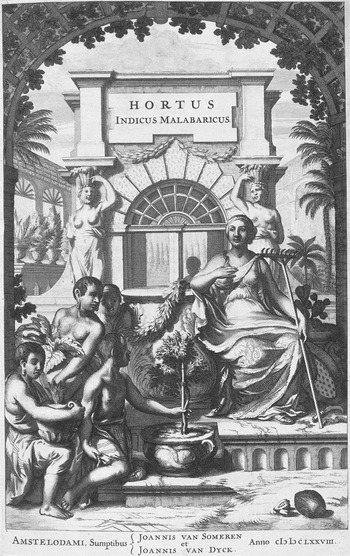
But even more interestingly, the Hortus Malabaricus held tremendous epistemological significance in its reliance on local medical knowledge. Unlike other illustrated herbals compiled at the time, Van Rheede relied almost entirely on indigenous collaborators: three Konkani Brahmin scholars, who provided textual reference, but more importantly, Ayurvedic physicians from the Ezhava or low-caste toddy tappers, who provided the empirical plant knowledge and functional taxonomies of classification (see Figure 1). As historian Richard Grove describes, the main Ezhava informant was the well-known healer, Itty Achudan, who not only shared his community's secret texts but also selected, procured, and classified the plants for inclusion in Hortus Malabaricus.37
For a description of the dominance of low-caste epistemologies in Portuguese botanical texts, see Boxer, “Two Pioneers of Tropical Medicine.” See also Grove, Green Imperialism, Chapter 8; and Grove, “Indigenous Knowledge and the Significance of South-West India.”

Frontispiece of Hortus Malabaricus vol. 1 (1678). Anonymous etching of the Garden of Malabar in which four kneeling indigenous Malayalee children, identified by their elongated earlobes, offer potted plants to the seated figure of Indian Botany. Courtesy of Wellcome Library, London.
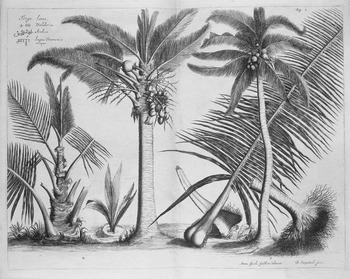
Almost 350 years later, Kerala University set out to reverse this extraordinary history with its new English translation of Hortus Malabaricus in 2003. The famous text had defied translation for centuries, and attempts to bring out Dutch and English translations had all failed. Van Rheede's feat was prodigious in that he brought out the 12 finely illustrated volumes in Latin, the accepted language for scientific work in Europe at that time, but he had also employed three other scripts, the local Malayalam, Arabic and Sanskrit, while plant names also appeared in the Portuguese and Flemish languages (see Figure 2). Thus, the multilingual volumes, with their copious introductions, forewords, dedications, references, and certificates given by Van Rheede to the native physicians, all of which contained extensive social and historical information about India, had largely remained off-limits to serious scholars and analysts.

Engraving of Tenga (coconut palm) from Hortus Malabaricus vol. 1 (1678) by Bastiaan Stoopendael after a drawing by Antoni Jacobsz. Includes multi-lingual inscriptions in Latin, Malayalam, Arabic, and Sanskrit. Courtesy of Wellcome Library, London.
Until October 2003, when Kerala University unveiled the newly translated Hortus Malabaricus volumes, presenting the first set to the president of India as a landmark event.38
Ranjit Devraj, “325-Year-Old Dutch Work on Kerala's Plant Wealth Revived,” Asia Times Online, May 8, 2003 〈http://www.indiasocial.org〉 accessed September 19, 2006; see also Mohan Ram, “On the English Edition of Van Rheede.”
For earlier versions of this argument, see also Manilal, Botany and History of Hortus Malabaricus; Fournier, “The Hortus Malabaricus of Hendrik van Rheede tot Drakenstein”; and Heniger, Hendrik Adriaan Van Rheede.
See Mohan Ram, “On the English Edition of Van Rheede's Hortus Malabaricus.”
But beyond epistemology, the Hortus Malabaricus and its English translation hold a new relevance in today's world where natural drugs are gaining fresh recognition but are plagued by biological patent laws and IPRs. Some patent experts think that translating texts like Hortus Malabaricus into English works as a double-edged sword: It may actually help rather than hinder biopirates and “would hand heritage to them on a platter” especially in the absence of universal acceptance of the Convention Biological Diversity.41
Jayaraman, “Biopiracy Fears Cloud Indian Database,” December 5, 2002, 〈http://www.scidev.net〉 accessed September 24, 2006.
Almost on cue, the digital bioprospecting project at the Mayo Clinic College of Medicine in Rochester, Minnesota, responded to the news of Hortus Malabaricus' English translation with an announcement.42
See for example, The Economist, “Finding drugs in the library,” September 5, 2004.
This is where we must locate the indigenous Ezhava response that arose in May 2004. Spokespersons for the oldest Ezhava association in southern Kerala, the Ezhava Social Reform Movement, a largely subnational caste-based coalition in local Indian politics, used the occasion of their centenary to flood Kerala University with letters arguing that future publication orders for the translated Hortus Malabaricus, which is now available only by special order, be restricted to those placed within state and national borders. Although a weak political group, the movement has managed nonetheless to articulate an argument in terms borrowed right out of the 1993 UN Declaration on Rights of Indigenous Peoples to land, territories, and resources:43
UN Draft Declaration on the Rights of Indigenous Peoples, 1993, 〈http://www.iwgia.org/sw248.asp〉 accessed September 23, 2006.
It is our right to organize over our own biodiversity, our medical knowledge…. With the biopiracy that has occurred over the centuries, we don't need to repeat the mistakes of history. What he (Itty Achudan) offered the Dutch colonials was knowledge that had been in our community for centuries.”44
See Suvarna Kumar, Deccan Herald, 2004. For more on Ezhava political claims, see also Srinivasan, “The Year of Sree Narayana Guru,” August 30, 2004 〈http:www.rediff.com〉 accessed September 24, 2006; and Cherian, Perspectives on Kerala History 〈http://www.keralahistory.ac.in/casteandsocial.htm〉 accessed September 24, 2006.
Unlike Manilal and Kerala University, who argue that the Hortus Malabaricus relied on unacknowledged native heritage which now deserves public recognition, the Ezhavas suggest that they own the text on the grounds that their ancestors were its original authors. This is what Watkins calls a classic “cultural intra-nationalist” claim over heritage: a strategic assertion of rights over knowledge that the Ezhavas make as “cultural citizens” (based on caste) that does not disturb the territorial integrity of the nation state.45
Watkins, “Cultural Nationalists.” For similar views on cultural rights, see Robbins and Stamatopoulou, “Reflections on Culture and Cultural Rights.”
In the Ezhava view, the appropriate response, now that Hortus Malabaricus has been translated and is in the public domain, is what scholars have called the secrecy approach in heritage protection: an inward protective turn intended to restrict the global circulation of information. Another radical nongovernmental organization (NGO) has taken this particular cultural claim even further. They have called for the repatriation of colonial botanical texts like the original Latin Hortus Malabaricus from libraries in the Netherlands, Portugal, and the United Kingdom. This is a bizarre variation on selective Native American Graves Repatriation Act (NAGPRA) policy targeted at libraries, where the preferred strategy chosen by vulnerable groups is the policy of restricting information from archives depending on their perceived utility or sacred and ceremonial content.
Whether or not the Ezhava response grows into a social movement or even a strong political resistance remains to be seen. Meanwhile, the very fact that these heritage claims are made at all is worth noting. If anything, the larger question offered up by this case is the indeterminacy of knowing how to locate or separate local indigenous knowledge in global histories. As the ongoing Hortus Malabaricus dispute so clearly demonstrates, even if we accept that a colonial text or herbal fixes local knowledge at a particular point in space and time, it is not clear at which point they can be (or how they should be) untangled to locate them in heritage policy.
E-TANGIBLE HERITAGE: THE TRADITIONAL MEDICAL DIGITAL KNOWLEDGE DATABASE
My second case of Ayurvedic knowledge documentation is the very different example of a prior art approach to heritage protection. In 1999 the Indian government fought and won a costly legal battle to revoke a U.S. patent for the medicinal use of turmeric (Curcuma longa) to heal wounds, a therapeutic property that had been well known in India for generations. In asserting this TMK as their heritage, the plaintiff, the Center for Science and Industrial Research (CSIR) on behalf of the state, relied heavily on Ayurvedic texts in the legal brief. Soon after, as part of a four-year struggle known as the Neem Campaign in 2001, a transnational consortium of NGOs successfully revoked a similar patent on the properties of neem (Azadirachta indica) as a fungicide, that had been granted by the European Patent and Trademark Office. In the brief, well-known antiglobalization activist Vandana Shiva stated, “The neem tree is India's sacred goddess … our sacred heritage. Neem in Sanskrit is referred to as sarva roga nivarini—a term that means cure for all ailments. To take this ancient knowledge from us is blatant and exploitative biopiracy.”46
Shiva, The Neem Campaign, 4; for more on the Neem Campaign, see Third World Network, A Case of Biopiracy 〈http://www.twnside.org.sg/title/pir-ch.htm〉 accessed September 24, 2006.
Largely to prevent future patent appropriations of medicinal heritage, the Indian government launched an exhaustive electronic database of Ayurvedic knowledge, the Traditional Knowledge Digital Library (TKDL). This, as various interlocutors have described, is an example of defensive publishing, a form of negative protection in the law to prevent the inappropriate exploitation of traditional knowledge by the developed world, similar to the American Association for the Advancement of Science's Traditional Ecological Knowledge Prior Art Database (TEK-PAD). The creation of the TKDL is also directly inspired by the 2003 CSICH, which in Article 12 calls for the preparation of “one or more inventories of the intangible heritage present in [each nation's] territory.”47
Convention to Safeguard the Intangible Cultural Heritage, 2003, Article 12, section 1.
As Chander and Sunder describe, traditional knowledge inventories begin with the premise that one method of avoiding the unequal exploitation of a biological commons is to defeat attempts to propertize it. “Because novelty is one criterion of patentability, the demonstration of prior art (e.g., a published description of the medicinal properties of an herb) should lead to the denial of a requested patent. But in contexts where a patent request deals with information that was already known among indigenous traditional communities, international patent offices often face a practical challenge in assessing novelty.”48
Chander and Sunder, “Romance of the Public Domain,” 1358.
Dirks, Castes of Mind, provides a good historical overview of archive creation in nineteenth-century India.
See Chander and Sunder, “Romance of the Public Domain,” 1357–1358; Mashelkar, “Intellectual Property Rights and the Third World,” 12.
And indeed, the TKDL contains information on 36,000 formulations used in classical Ayurveda. The construction of this database in itself is a fascinating cultural history waiting to be told: Almost 300 Vaidyas, Sanskrit scholars, and analysts were employed for two years to translate verses (Slokas) and aphorisms (Sutras) from the traditional pharmacopeia and Ayurvedic compendia (Samhitas) into structured language using a classification called the Traditional Knowledge Resource Classification; a second group isolated medicinal uses of plants from these to list them in databases; and yet another group of analysts matched these entries with original sources to compare and validate their content.51
Mashelkar, The Story of the TKDL, 16.
Within international and Intellectual Property circles, the TKDL is an unprecedented hit. The database set international standards for registries of traditional knowledge, which were adopted by the intergovernmental committee of WIPO in 2003. Presented in English, French, German, Spanish, and Japanese, the information was created in a format accessible by international patent offices, and its classification of bioresources has even been adopted by the International Patent Classification (IPC).52
Padma, T.V. “Digital Library to Protect Indigenous Knowledge,” January 10, 2005, Science and Development Network 〈http://www.scidev.net〉 accessed September 15, 2006.
See WIPO, Report on Intellectual Property and Traditional Knowledge, 〈http://www.wipo.int/freepublications/en/tk/wipo_pub_920.pdf〉 accessed September 24, 2006.
See Harrison, “Community Biodiversity Registers”; Utkarsh, “Documentation of Traditional Knowledge”; Downes and Laird, “Community Registers of Biodiversity-Related Knowledge.”
But within Ayurvedic practitioner circles, the technocratic, top-down nature of the electronic database has not escaped criticism. In the first instance, Indian library and technology experts suggest that digital media technologies are far more fragile, prone to degradation, and obsolescence than earlier thought; now they wonder if TKDL funds might have been better focused on the preservation or conservation of the texts themselves.55
SARAI's conference on digital technology information and traditions explored many of these issues.
Scholars like Arun Agrawal suggest that there are fundamental epistemological contradictions at the heart of TKDL and, indeed, of indigenous knowledge database creation itself. As an example of ex situ conservation, the instrumental logic of database creation encourages a set of homogenizing processes whereby knowledge is particularized (separated as types and fixed in time), validated (abstracted from context), and generalized (catalogued, archived, and circulated)—processes that strip away all the detailed, contextual aspects that could even potentially mark it as indigenous. Much like Scott's argument about practical knowledge, Agrawal claims that this essentially scientizing process is ultimately untenable; indigenous knowledge can never be thus isolated. When implemented as state practice, indigenous knowledge databases could well be Scott's potential disaster waiting to unfold. More than anything else, they ensure that utility and value become the only operating principles in the archiving of indigenous knowledge—a self-fulfilling circular logic by which only useful or potentially valuable knowledge, however defined, become worthy of protection.
These inherent epistemological tensions within databases are, however, not the only problems that plague the TKDL. The most interesting response and counterclaim has come from the shuddha or pure Ayurvedic practitioners, a subgroup or professionalizing faction among Ayurvedic advocates in postcolonial India who were not consulted during the database creation. Since the 1940s, the politics of professionalizing Ayurveda has been divided into two streams of revivalists: the straights, or the shuddha practitioners, and the integrated practitioners, who believed it was necessary to compete with biomedicine by borrowing its institutional practices, each with their own professional associations, schools, and political lobby groups.56
For a history of this professionalizing schism, see for instance, Leslie, Asian Medical Systems; Leslie and Young, Paths to Asian Medical Knowledge; and Brass, “The Politics of Ayurvedic Education.”
Some of this history is recounted in Shiv Sharma's Ayurvedic Medicine; see also Leslie in Paths to Asian Medical Knowledge, 177–208, for a biographical history of leading Ayurvedic advocates.
See Report of AYUSH, goverment of India, 2003, 〈http://www.indianmedicine.nic.in html/ismh/annual/annual.htm〉 accessed September 24, 2006.
See Brown, “Heritage Troubles” or “Can Culture be Copy-righted?” for a description of this process.
Report of the Department of Ayurveda, Yoga, Unani, Siddha and Homeopathy, on Ayurveda, New Delhi, 2004.
Letter to the editor, Indian Express, September 4, 2004.
See text of speech at the Government Center for Ayurvedic, Siddha and Homeopathic Medicine, 2003. For descriptions of the two court cases, see Weil, “Who Owns the Nataraja”; and Davis, Lives of Indian Images; see also Reddy, “The Memory of Divine Objects.”
Interestingly, the shuddha practitioners within India may have an unlikely ally abroad, particularly in the United States with its semiprofessional centers of alternative healing where some of them regularly lecture and conduct workshops. Given the particular form that New Age Ayurveda has taken, with its neocolonial nostalgia for an authentic East, it is conceivable that this could eventually lead to an unorthodox heritage coalition—a transnational Ayurvedic advocacy network—that could mobilize for the first time on behalf of a medical tradition rather than a nation, community, or tribe.63
CUI BONO? BIOPROSPECTING WOES
The third heritage case I describe is a bioprospecting tale gone awry. It deals with the fallout of a state-sponsored, benefit-sharing scheme during the discovery of an Ayurvedic drug that was developed with tribal medical knowledge. The scheme itself should be seen against the 1992 Convention on Biological Diversity (CBD), which took biological heritage out of the global commons and gave it back to national jurisdictions. In Articles 8, 15, and 16, the CBD sets forth a multilateral framework for the harnessing of pharmaceutical value of biodiversity; but it also ensures that some benefits of this exploitation come back to source nations and source communities in the South in the form of “equitable returns” and “benefit-sharing arrangements” between the providers and users of traditional knowledge.64
CBD, 1992, Article 2.
See Hayden, When Nature Goes Public, for an excellent ethnography of benefit-sharing. See also Hayden's “Benefit-sharing” for an overview of benefit-sharing agreements in relation to IP law.
The case I describe here begins in 1988, when the Tropical Botanical Garden and Research Institute (TBGRI), an important government research institute and the largest botanical garden in Asia, held a large ethnobotanical field study in the Agastyar forests of Southwest India.66
See Gupta, “Value-Addition to Local Kani Tribe Knowledge,” for an in-depth account and evaluation of the benefit-sharing scheme with the Kani tribe.
Because collective ownership or community authorship is often assumed in benefit-sharing agreements, the underlying question in state-sponsored schemes of heritage compensation like this is always: Whose heritage are we compensating? And so the first set of challenges to the Kani benefit-sharing arrangement centered on how to define the community. The problems began with the formation of a trust, the Kani Samudaya Kshema Trust, to administer the benefit-sharing process with the help of other NGOs in the area. As Anil Gupta describes in his report, at first there was enormous suspicion about the trust itself (in 1998, for example, it had only 500 members), which resulted in a general refusal by Kani tribals to attend meetings organized by TBGRI. But the main problem may have been handed down by the CBD itself, which lumps together indigenous and local in its definition of community. This case powerfully demonstrates the dangers of assuming that the indigenous Kani communities, and the local political entities, are isomorphous or even share methods of governance. As Gupta and others have shown, TBGRI failed to recognize that traditional political systems among the Kanis have eroded and been replaced by those of nontribal local communities. Rather than governance by a tribal chief (Mootha Kani), India's current administrative system, referred to as the Pancayati Raj, is based on the principle of devolution of administrative powers to the local village level under the Indian Constitution. Unlike the Kani, the pancayat's forms of goverment and decision-making bodies are democratically elected.67
The Indian Constitution, 73rd Amendment Act, 1992. For more information, see the Goverment of India Ministry of Pancayat Raj's National Pancayati Portal, 〈http://panchayat.nic.in〉 accessed September 24, 2006.
The second set of challenges to the benefit-sharing scheme was even more complicated. It stemmed from the details of the licensing agreement with the drug manufacturer Arya Vaidya Pharmacy; and here the argument was over the procurement of the plant involved (arogyapacha), its sustainability in the tropical forest, and the larger issue of the forest as biological commons. Arogyapacha is a forest-friendly perennial undergrowth that grows under the natural forest canopy; and as part of the arrangement, TBGRI assured the manufacturer of a regular supply of the cultivated raw plant for seven years. But here again the scientists quickly learned that the medicinal qualities of the plant are lost unless grown within natural forest settings. In response, TBGRI organized 50 Kani families living inside the forest to cultivate the plant under the supervision of the scientists. This was also touted as a creative employment-generation program; each Kani family would manage the semiwild crop, cultivating one or two acres and earning about Rs. 30,000 (or $715) per acre, with the yield and production of leaves expected to increase in subsequent years for an anticipated 20 to 30 years. Because the Kani are essentially forest dwellers, they were assumed to be in an effective bargaining position to regulate and control its harvest. But then an unexpected player entered the conversation: the state forest department, which officially controls and regulates the forest area. Although it had contributed no material or finances to the research effort, the forest department demanded a share of the license fee and royalties on the grounds that the plant material collected is endemic to the forest. The TBGRI was forced to renegotiate the terms of the agreement to include the forest department, all of which further cut back into the profit share received by the Kanis.
The main outcome was that even though the original benefit-sharing agreement fell apart, the drug manufacture continued as planned. In other words, this state-sponsored heritage compensation scheme, which relied on tribal medical knowledge without consent from the Kanis, did not ultimately disturb the market production and circulation of this Ayurvedic drug to national and even international markets. Thus, the payments continued to be made into the Trust, but from all accounts, the Trust itself lost any legitimacy to distribute the funds to its constituents. The Kani now seem to want to choose their own future vis-à-vis their medical heritage. Eight years after the benefit-sharing agreement was signed, the manufacturing license expired in August 2006. Fueled by NGO critiques that the benefit-sharing arrangement by TBGRI essentially traded and privatized the common heritage of humanity, Kani pancayat leaders are now aware that they could have denied both access and consent to TBGRI researchers. In a fitting end to the story, Kani pancayat leaders— along with a representative group of all the tribal healers, or Plathis—have announced that they will not renew the license with Arya Vaidya Pharmacy.68
Report of the Tropical Botanic Garden Research Institute, 2005.
The postscript to this story is almost apocryphal. Through the entire decade of research and organization, neither TBGRI nor any other agency of the government thought to secure an international trademark or a product patent that could be valid in international markets. In the interim, a leading U.S. food supplement manufacturer and vitamin store chain, the Great Earth Companies, Inc., managed to seize the opportunity and secure trademark rights for Jeevani (the name under which it had first been marketed in India). Great Earth Companies now uses Jeevani in its widely marketed product Jeevani Jolt 1000 without technically infringing on the IPRs of the original drug.69
See G. Rajiv, “U.S. Firm Patents Kerala Tribe's Jeevani,” January 6, 2006, 〈http://www.indiamonitor.com〉 accessed July 15, 2006.
CODA: WHO OWNS AYURVEDA?
In the end, what big picture can we describe that emerges from these several smaller narratives, this mosaic, of Ayurvedic heritage disputes? How do we begin to sort through this diversity of cultural ownership practices to come up with overarching theories about Ayurvedic knowledge, let alone TMK, or intangible cultural heritage? And who really owns TMK? Is it owned by indigenous groups like the Ezhavas who have been left out of history? Is it owned by elite practitioners who claim exclusive rights of use over Ayurvedic texts? Is it owned by tribals, who provided the medical knowledge in the first place, or the Ayurvedic company that bought the license for those rights? Or is it owned by the forest as the ultimate public domain? If nothing else, these three contrasting tales of cultural ownership over the same medical tradition suggest that even the questions asked by state-based heritage protection schemes can differ widely. Thus, the Hortus Malabaricus case asks whether TMK is owned by history or if it can be rewritten—that is, whether the past itself is a scarce resource, as anthropologists have begun to formulate.70
For other work on the past as heritage resource, see Appadurai, “The Past as a Scarce Resource,” for an early articulation of the argument; see also Harrison, “Identity as a Scarce Resource.” For the past as cultural and intellectual properties, see Nicholas and Bannister, “Copyrighting the Past?”
The larger problem is that if, even within a single medical tradition, heritage protection schemes do not always share similar definitions of what heritage is or who it is supposed to protect, where does one even begin to theorize ownership of TMK or intangible heritage? At the risk of simplifying, perhaps one beginning lies in recognizing the dialectical relationship between culture (or heritage) and the law: that in this case, even if culture needs the law to regulate and protect it, the law in turn, however well intentioned and necessary, produces culture, produces knowledge, and thus produces further claims and counterclaims of ownership over TMK. As has already been suggested, making heritage legible is a double-edged sword: it transforms cultural objects and marginalizes cultural producers, but it also creates new types, categories, and subjectivities to be managed and controlled.
This is not to say that heritage and TMK regulation is unnecessary or even Orwellian in nature. It is merely to note that there may never be universal answers to global heritage disputes. Real-life solutions to heritage crises may in fact emerge slowly, on a case-by-case basis. State practices might inspire indigenous responses and both of them might work with and against the logic of the market; but the most creative, innovative solutions often come from civil society—professionals, NGO advocacy groups, educational institutions, libraries, archives, curators—all of whom, as we know from NAGPRA legislation in the United States, are the ones building the cultural policy edifice slowly, brick by brick.
Nor am I arguing that the effects of cultural ownership over TMK are all negative. The Law of Unintended Consequences in heritage protection after all is precisely that: unintended. Some authors have suggested that even with new indigenous rights legislation in place, disempowered groups are unlikely to benefit much from new laws because powerful interests are simply better positioned to use or evade them.71
See for example Michael Davis, “Some Realism About Indigenism.”
Nonetheless, even if indigenous cultural claims mimic the propertization discourse to turn heritage into a resource to be owned (the commoditization of culture that critics bemoan), they also reveal that propertization itself could, if used well, have emancipatory potential. As these disputes over Ayurvedic knowledge show, indigenous groups can use property, particularly IP, to make themselves subjects and not just objects in the law. Legal scholars have noted that these could well be the new social movements and the new cultural heritage citizens of the twenty-first century. Although it remains to be seen how ownership claims eventually play out, this property turn in cultural identity politics could ultimately be transformative. It could, in fact, lead to a real politics of redistribution, to a redistributive justice between groups that goes well beyond the sterile politics of recognition that has dominated cultural heritage disputes in the past.