




No CrossRef data available.
Article contents
Effects of verbal labeling on memory for hand movements
Published online by Cambridge University Press: 01 May 2004
Abstract
This study examined whether a secondary verbal shadowing task influences recall for hand movements. Descriptive verbal labels associated with hand postures (e.g., “fist”, “palm”) were presented auditorily, concurrent with video presentation of hand postures, and the participant was instructed to shadow the words aloud. In the congruent verbal labels condition, the words were matched with the hand postures shown, and in the incongruent condition, the labels and hand postures were unmatched. In Experiment 1 (N = 18), a computerized version of the Kaufman Hand Movements Test (KHMT), which involves three distinct hand postures, was performed under congruent and incongruent labels conditions, and baseline. For Experiment 2 (N = 18), the same format was applied to a hand movement span task, similar to the KHMT, but based on seven distinct hand postures. For both experiments, shadowing congruent labels enhanced serial recall, whereas shadowing incongruent labels reduced recall when compared to baseline. Thus memory for hand movements was affected by the content of the secondary verbal task, consistent with participants spontaneously using a verbal recoding and rehearsal strategy to support this form of memory, a strategy enhanced through the provision of appropriate labels. (JINS, 2004, 10, 355–361.)
Information
- Type
- Research Article
- Information
- Journal of the International Neuropsychological Society , Volume 10 , Issue 3 , May 2004 , pp. 355 - 361
- Copyright
- © 2004 The International Neuropsychological Society
INTRODUCTION
Dual-task methodology is often employed to determine the cognitive processes that memory tasks involve. Within this field of research, the focus has mainly been on the structure of verbal or visuospatial memory; however, recently there have been investigations of memory for movement sequences and whether “movement memory” is distinct from verbal and visuospatial memory (e.g., Feyereisen & Van der Linden, 1997; Helstrup, 1999; Smyth & Pendleton, 1989). While these recent investigations have attempted to ascertain the cognitive processes involved in memory for movement, tasks used clinically, such as the Kaufman Hand Movements Test (KHMT; Kaufman & Kaufman, 1983), have not been investigated (Frencham et al., 2003), and as such, the processes that they involve remain unclear.
The KHMT was developed from Luria's fist-edge-palm test of motor function, a task in which the individual must mimic a sequence of hand postures (fist, edge, and palm) demonstrated by the examiner. It has been found to be sensitive to cognitive deficits demonstrated in various populations such as individuals with mild traumatic brain injury or alcohol-related brain damage (Fox & Fox, 2001; Fox et al., 1993).
The development and structure of the KHMT may partially explain why it has not been investigated in the working memory literature. The task design does not allow for traditional span analysis, and the overall format is not the same as other commonly used verbal and visuospatial span tasks, such as the Digit Span and Spatial Span subtests from the Wechsler Memory Scale (e.g., Wechsler, 1987). To address this problem and investigate the processes involved in memory for sequential hand movements, Frencham et al. (2003) compared letter and Corsi span tasks with a hand movement task of comparable span structure (span-HMT). The span-HMT was developed from both the KHMT and the movement memory task used by Smyth and Pendleton (1989) and involves recall of sequences of two to nine items selected from an item pool of seven distinct hand postures. Based on an observed detrimental effect of articulatory suppression (repeatedly articulating a digit sequence) on span-HMT performance when compared to visuospatial or movement interference, it was concluded that memory for hand movements involves the phonological loop to an extent. It was proposed that this might occur due to participants spontaneously using a verbal labelling strategy when encoding and recalling hand movement sequences. While Kaufman and Kaufman (1983) presented their task as one that did not depend on language, they also commented that performance could benefit from adopting a mediating strategy, such as using verbal labelling, and that it also relied upon visual short-term memory to an extent.
Other researchers have recognized the role of verbal strategies in the recall of movement sequences. Helstrup (2000) investigated the manner in which strategies of various modalities affected memory for patterned movement, using a primary task that required serial recall of movement sequences within a matrix rather than sequences of different postures. Instructions to participants were quite lenient, directing them to adopt a verbal, spatial, or movement strategy of their choice during stimulus presentation, with general examples provided. In the baseline condition, participants were free to employ strategies according to personal preference. Results showed that, while recall was superior with a verbal than with a visuospatial or movement strategy, there was no significant difference between performance in the verbal strategy condition and baseline. This equivalence between baseline and verbal strategy conditions may indicate that many participants employed a verbal strategy during baseline. Given the lenience of the strategy conditions, it is possible that had participants been instructed more explicitly to use a specific verbal strategy, their performance would have surpassed that obtained in the baseline condition. Under Helstrup's methodology it is plausible that strategies employed under the baseline condition, and perhaps in the verbal strategy condition to a lesser extent, would be less beneficial to recall than predetermined and imposed strategies, due to the added demands with the former of generating and modifying strategies during task performance. Regardless, Helstrup's findings support the hypotheses that (1) movement sequences are coded as verbal strings rather than motorically or visuospatially and (2) when the verbal information attended to during movement task performance is context specific and presented as a strategy that should be consciously employed, it is not detrimental to performance.
Others have acknowledged the supportive role of verbal processes in movement recall more indirectly. In a dual-task study, Woodin and Heil (1996) acknowledged the potential for verbal involvement in their movement task by instructing participants to perform articulatory suppression in all interference conditions, including baseline, “to prevent the use of verbally mediated strategies” (p. 360). Overall, research such as this supports the notion that memory for movements involves a significant verbal component, and that verbal strategies can support movement memory performance.
Despite the reported involvement of verbal processing in memory for movement (e.g., Feyereisen & Van der Linden, 1997; Helstrup, 1999; Remoundou & Humphreys, 2001), evidence for verbal labelling during encoding has not been directly addressed using a primary and secondary task format. The aim of the present study was to further delineate the role of verbal labelling in recall of movements by presenting verbal labels concurrent with hand postures and having the participant shadow them during a computerized version of the KHMT (Experiment 1) and during the span-HMT (Experiment 2). Shadowing is a technique that has been widely used in selective attention research (Banich, 1997), but has also been incorporated as a secondary task in memory research (Orwig, 1979). Shadowing tasks typically involve repeating auditorily presented material aloud, and have been argued as being suitable for determining the degree to which a task involves a verbal component (Klauer & Stegmaier, 1997). Using this design, the intention was to identify the differential effects of verbal labelling on performance, depending on whether the labels did or did not correspond to the hand postures presented.
The KHMT was modified for computerized presentation to make it more comparable with the span-HMT, and so that the overall dual-task structure would be constant across the memory tasks. An additional reason for this modification was to regulate the rate of stimulus presentation by using a dynamic video format, and to determine the comparability of this format relative to the in vivo presentation of the KHMT outlined by Barry and Riley (1987) in their administration of the task in an adult population.
The hypotheses of this study were as follows. A specific hypothesis for Experiment 1 was that performance during the baseline condition of the computerized-KHMT would be comparable to published norms for the KHMT. It was also predicted that instructing participants to shadow verbal labels that were congruent with the hand postures being displayed would improve performance on both the computerized-KHMT and the span-HMT when compared to a baseline condition for at least three reasons; firstly, as participants would not have to generate verbal labels whilst performing the task; secondly, as the relevant information was presented in two modalities rather than one; and thirdly, as the labels provided may be more efficient than those participants would generate spontaneously. Finally, in keeping with the detrimental effect of articulatory suppression on span-HMT performance reported by Frencham et al. (2003), the incongruent verbal labelling condition was hypothesized to result in poorer recall for both memory tasks when compared to a baseline condition.
General Methods
The computerized-KHMT and span-HMT (the latter is described in Frencham et al., 2003) were used in Experiments 1 and 2, respectively. Both tasks involved the participant viewing dynamic video footage of sequences of hand postures (made on a flat surface with the right hand), and then reproducing them with his or her own right hand. The main difference between tasks was that the span-HMT item pool was seven hand postures, while the computerized-KHMT had only three. For both tasks, stimuli and instructions were presented on a computer monitor, and following presentation of the stimuli, a visual cue (the word “recall”) prompted the participant to reproduce the sequence.
For each task, prior to practice and test items, individuals were familiarized with hand posture stimuli. During this familiarization stage the hand postures for each task were presented in random order on the screen as 10 cm × 12 cm still images, positioned so they resembled the orientation of the examiner's right hand if sitting opposite the participant. Stimuli were presented in random order, and the individual was instructed to reproduce each one. The examiner corrected any incorrect imitations before subsequent stimuli were presented. Prior to the presentation of practice and test sequences, the participant was instructed to remember the hand postures presented and then repeat them in the same order using his or her right hand when told. The examiner manually recorded responses and classified each sequence as correct if the items were recalled in their correct ordinal positions.
Computerized-KHMT
Three hand postures made up the stimulus set (see Figure 1), and the sequences presented were reproduced from the original KHMT such that there was one practice item of sequence length two, and then 21 test trials, with sequences ranging in length from two to six. The rate of presentation was one hand posture per second, as in the KHMT. All 21 items were administered to every participant.

Still images of hand postures used in the computerized-KHMT for Experiment 1. Verbal labels assigned to the hand postures are as follows: 1—palm; 2—fist; 3—side.
Span-HMT
Seven hand postures made on a flat surface formed the stimulus set for this task (see Figure 2). After the familiarization phase, four practice trials were given, two each at sequence lengths 2 and 3. For the test proper, sequences involving three to nine hand movements were presented. Four trials were presented at each sequence length, and the task was discontinued when all four sequences at a particular length were not correctly recalled. The stimuli for each test sequence were selected randomly, with replacement, from the pool of seven items. Stimuli were presented with approximately equal frequencies in the test sequences. The rate of stimulus presentation was one hand posture every 1.5 s as in Frencham et al. (2003).

Still images of hand postures used in the span-HMT for Experiment 2. Verbal labels assigned to the hand postures are as follows: 1—curve; 2—fist; 3—side; 4—claw; 5—palm; 6—star; 7—pinch.
Secondary tasks
For both experiments, each participant completed either the computerized-KHMT or the span-HMT under three secondary task conditions: congruent verbal labels, incongruent verbal labels, and baseline. Secondary tasks were performed during the stimulus presentation phase such that under the congruent and incongruent verbal labels conditions, immediately after hearing each verbal label, the participant had to shadow it (i.e., repeat it out aloud). The examiner monitored secondary task performance to ensure that the participant correctly shadowed each verbal label. The verbal labels were presented via computer speakers by a female voice at the same rate and with onsets corresponding to the onset of visually presented stimuli in the memory task (i.e., one per second for the computerized-KHMT and one per 1.5 s for the span-HMT). Participants were instructed not to say the labels aloud while they were recalling the hand position sequences.
Verbal labels were generated to accompany the hand postures used in both tasks, such that there were three for the computerized-KHMT and seven for the span-HMT, as indicated in Figures 1 and 2, respectively. In the congruent labels condition, the word was presented concurrent with the corresponding hand posture, and for the incongruent condition, labels and hand postures were mismatched. For the baseline condition, there was no additional task during the stimulus presentation phase. The participant was familiarized with each secondary task during the practice trials. Prior to both the congruent and incongruent verbal labels conditions for each task, the participant was told, “the most important thing is to watch and remember the hand movements. Just echo the words that are presented”. The participant was then informed that after echoing the labels, he/she would not be asked to recall them. During the familiarization phase under the baseline condition, participants were instructed to watch and remember the hand movements, and were not specifically encouraged to or prevented from generating their own labels.
EXPERIMENT 1
Methods
Research Participants
Eighteen participants were recruited (6 male, 12 female), being undergraduate students in the School of Psychology at the University of Western Australia. All participants were naïve to the nature and hypotheses of the experiment. The mean age was 21.3 years (SD = 3.8), and mean education level was 14.3 years (SD = 0.96). All except one reported being right handed. All participants reported being able to speak English fluently.
Equipment
An IBM compatible computer with a 53-cm color touch-sensitive screen was programmed using MetaCard 2.3 to present all stimuli and control timing of the auditory and visual display presentations.
Procedure
Each participant completed the computerized-KHMT under three conditions; baseline, congruent labels, and incongruent labels. The order of these secondary task conditions was counterbalanced across participants.
Results
The total score for each participant during each condition was the number of correctly recalled test sequences, with a maximum of 21. Baseline condition performance was compared to published KHMT adult normative data (Barry & Riley, 1987) to assess comparability of the tasks and subsequent generalizability of the results to the wider KHMT literature, given the modifications used in this study. Using an alpha level of .05, an independent samples t test demonstrated that there was no significant difference between the mean computerized-KHMT score (M = 17.0, SD = 3.09) and the normative mean published for individuals of comparable age (M = 16.7, SD = 2.62; t (36) = .32, p >.05). The mean number of items recalled for each condition revealed that congruent labels led to increased computerized-KHMT recall when compared to baseline, while incongruent labels led to decreased recall as illustrated in Figure 3.

Mean performance on the computerized-KHMT during the congruent labels, baseline, and incongruent labels conditions (within-subjects 95% confidence intervals shown as error bars).
A significant effect of secondary task condition was observed, F(2,34) = 46.05, p < .001. Paired-samples t tests demonstrated that computerized-KHMT recall during the congruent verbal labels condition was higher than during the baseline condition, t (17) = 2.13, p < .05, while shadowing incongruent labels significantly reduced recall, t (17) = 6.96, p < .001.
Discussion
These results demonstrate that instructing participants to shadow congruent verbal labels enhanced performance, whereas incongruent verbal labels decreased computerized-KHMT performance. It was also shown that the average computerized-KHMT performance was comparable with performance of adults in their twenties on the standard KHMT, thus indicating that the difficulty of the task was not significantly altered by modifying it for computer administration.
Using similar methodology, Experiment 2 investigated whether the previously described interference pattern would be found with the span-HMT. Thus it assessed whether the two target tasks were recruiting similar cognitive processes, and by inference, whether the span-HMT would be clinically useful when assessing similar cognitive domains as the KHMT.
EXPERIMENT 2
Methods
Research Participants
Eighteen participants were recruited (7 male, 11 female), being undergraduate students in the School of Psychology at the University of Western Australia. All participants were naïve to the nature and hypotheses of the experiment. The mean age was 20.4 years (SD = 3.2), and mean education level was 14.0 years (SD = 0.97). Three participants reported being left handed while the rest were right handed. All reported speaking English fluently.
Equipment
This was as for Experiment 1.
Procedure
Each participant completed the span-HMT under three conditions, baseline, congruent labels, and incongruent labels. Again, the order of secondary task presentation was counterbalanced across participants.
Results
The span score for each participant during each condition was calculated using a fractional scoring method similar to that used by Chuah and Maybery (1999); 2 + (number of correctly recalled sequences)/4 (where 4 is the number of trials per sequence length, with two units added as the testing began at sequence length three). The resultant mean spans for each condition revealed that congruent verbal labels led to increased span-HMT performance when compared to baseline, while incongruent verbal labels led to decreased span, as illustrated in Figure 4.

Mean performance on the span-HMT during the congruent labels, baseline, and incongruent labels conditions (within-subjects 95% confidence intervals shown as error bars).
A significant effect of secondary task was observed, F(2,34) = 71.69, p < .001. Paired-samples t tests demonstrated that recall during the congruent labels condition was significantly higher than recall in the baseline condition, t (17) = 3.38, p < .001, and that recall during the baseline condition exceeded that during the incongruent condition, t (17) = 7.65, p < .001.
Discussion
Verbalizing congruent labels while encoding hand postures was found to enhance subsequent recall, whereas concurrent verbalization of incongruent labels decreased span-HMT recall when compared to baseline. These results are in keeping with the self-report of pilot study participants in Frencham et al. (2003) who stated that they used verbal labels to help them remember the hand postures, and with respect to the detrimental effect of incongruent labels on recall, are in keeping with findings in the wider verbal short-term memory literature.
GENERAL DISCUSSION
The results demonstrated that baseline performance on the computerized-KHMT was comparable with published normative data for the KHMT under standardized administration. Experiments 1 and 2 investigated the effects of secondary tasks involving the shadowing of verbal labels upon hand movement memory. For both primary tasks, the computerized-KHMT and span-HMT, recall was enhanced when the verbal labels were congruent and reduced when they were incongruent with the hand postures presented. Thus, the meaning or content of the secondary task, and the relation that this meaning had to the primary task (i.e., match or mismatch), was found to affect recall.
To date, dual-task memory experiments addressing the effects of secondary tasks that are directly congruent or incongruent with the primary task are scarce; however, two studies deserve mention. Buchner et al. (1996) conducted a study of recall of two-digit numbers in which one secondary task condition also involved auditory presentation of two-digit numbers. However, the primary and secondary tasks were not completely congruent, as the order of numbers presented was random for both. In keeping with the wider literature, this interference condition had a detrimental effect on recall. These findings are consistent with the current result that incongruent labels reduced primary task performance. In a study of the role of movement in spatial memory, Quinn and Ralston (1986) incorporated secondary spatial tapping tasks that were either compatible or incompatible with the primary task, the Brooks matrix task. They reported that recall was detrimentally affected by the incompatible task, whereas recall was not significantly reduced in the compatible condition.
It is possible that the learning literature may be more amenable to the approach of the current study. For example, selected results of a larger study of memory for sign language support the current findings. English-speaking individuals with no knowledge of sign language were tested on their recall of cherological (sign language) hand postures. Results demonstrated that when signing stimuli were presented with spoken verbal labels, recall was better than when the signs were presented without verbal labels (Hamilton & Holzman, 1989). It was concluded that this demonstrated that recall of less familiar material was supported when it was associated with more recognizable information.
The role of familiarity with task material has also been discussed in the movement memory literature. Citing the wider problem-solving literature, Helstrup (1996) proposed that verbal codes were easier to rehearse than actions because verbal codes are more familiar. Also, movement memory is a less familiar task for most people than verbal or visuospatial memory. Accordingly, he argued that more verbal than motor support cues would arguably be available at the retrieval stage. Cumulatively, our research has generated evidence for the use of verbal codes in movement memory. For example, in pilot studies, when presented with hand movement stimuli, the majority of participants reported spontaneously using a verbal strategy instead of a kinesthetic or visuospatial one (see Frencham et al., 2003).
This study, by demonstrating that imposing a verbal strategy can improve recall of hand movement sequences, extends upon Helstrup's (2000) findings. Admittedly, the memory tasks used currently differed to that used by Helstrup: in this study, the target tasks involve memory for “configured” movement according to Smyth and Pendleton's (1989) terminology, that is, recalling sequences of different hand postures, whilst Helstrup's memory task involved what he termed “motor-spatial” memory for sequences of movements within a matrix. Yet despite these differences, one possible interpretation of the current results is that strategies that are both imposed and performed (at least via shadowing) are more beneficial to movement recall than the range of individually initiated verbal strategies that may have occurred during baseline performance. It is likely that if labels were spontaneously adopted during baseline, they would have been less specific and less consistent than those imposed in the congruent verbal labels condition. Future research could explore this issue by comparing recall for hand movement sequences in a control group and individuals who are taught labels prior to task performance. Another explanation for superior recall in the congruent labels condition as opposed to baseline is that information was presented via both visual and auditory modalities. Furthermore, participants also generated articulatory codes through shadowing the congruent labels. Useful further research would be to disentangle contributions to recall of presentation modality (visual, auditory) and modality of shadowing (oral, manual) by manipulating these two factors independently.
Turning to the detrimental effect of incongruent labels on primary task performance, one interpretation is that recall of hand movement sequences involved at least some verbal recoding of the hand postures. Shadowing incongruent labels may have reduced the use of spontaneous verbal rehearsal strategies. It is also possible that the detrimental effect of shadowing incongruent labels is partly attributable to the overlap in content with the labels that are applied to the to-be-remembered hand postures. Incompatible serial ordering of these two sets of verbal labels may have contributed to poorer performance (see Jones, 1999). Nevertheless, Frencham et al. (2003) found that repeatedly articulating digit sequences that were unrelated to hand posture labels also had a detrimental effect on span-HMT performance, suggesting that at least a component of the detrimental effect observed in the present study is due to verbal interference.
However shadowing incongruent verbal labels may exert interference on recall of hand movement sequences over and above that of articulating unrelated verbal items, as with vocalizing 1,2,3,4 repeatedly, employed in Frencham et al. (2003). Direct comparison of results across our two studies supports this postulation, indicating that while baseline span-HMT performance was comparable in the two studies, t (32) = .77, p = .45, performance during the incongruent verbal labelling condition was poorer than that under digit articulation, t (32) = 2.36, p < .05. The additional interference incurred in the incongruent labels condition may stem from competition for mental resources or “confusion of like content” between the shadowed labels and verbal labels generated for the to-be-remembered hand postures. Alternatively, the conflict could be between processing the visual movement stimuli and incongruent visuo-motor movement representations deriving from the verbal labels being shadowed. Thus, while interference due to digit articulation demonstrates the involvement of the verbal coding in recall for hand movement sequences, the additional interference under the incongruent labels condition may represent conflict between either verbal or nonverbal codes for hand postures.
The likelihood of an additional executive load stemming from shadowing incongruent labels also warrants discussion. However, shadowing auditory verbal stimuli has been shown not to adversely affect memory for serial spatial material (Klauer & Stegmaier, 1997). Thus, shadowing of words does not appear to involve an executive component that could impact on retention of serial memory for nonverbal material.
The current findings can be interpreted as indicating that (1) application of a verbal labelling strategy through congruent shadowing significantly improves performance on both tasks, and (2) the recall of hand movement sequences involves at least some spontaneous use of verbal recoding, evidenced by the deleterious effect of incongruent labelling. With regard to movement memory in general, this study expands upon the findings of our previous research and demonstrates a differential effect of verbal material of different content on memory for movement sequences.
Importantly, these results expand our understanding of the cognitive processes involved in KHMT and span-HMT performance. In conjunction with the results of our previous study, and taking into account the opposite effects of shadowing incongruent and congruent labels when compared to baseline performance, it is inferred that at least some verbal labelling is taking place during task performance. It is possible that the utility of these verbal labels in aiding movement sequence recall depends upon how well the participant employs them as a recall strategy, and how well he/she can rehearse and subsequently remember the labels and their order.
In the context of a full neuropsychological assessment, it may be possible to obtain a more comprehensive explanation of the individual's performance by administration of these tasks. Individual differences in KHMT performance may reflect not only individual differences in verbal memory capacities, if verbal labels are recalled in order to correctly reproduce movement sequences, but also the extent to which there is spontaneous use of verbal strategies to aid movement sequence recall. Richardson and Barry (1985) reported that memory problems following mild traumatic brain injury might reflect a reduced ability to adopt effective strategies to support memory. Results of the current study are consistent with the possibility that impairments in KHMT performance reflect failure to adopt an effective verbal labelling strategy for hand postures. Additionally, given the reported equivalence of performance on the KHMT and the current computerized-KHMT tasks, the computerized-KHMT could potentially be used as an additional or alternative task. Currently, research is underway into the sensitivity of the span-HMT to the effects of mild traumatic brain injury during the acute and chronic phases postinjury.
ACKNOWLEDGMENTS
We would like to thank Motohide Miyahara for his assistance and helpful comments with regard to the rationale and design of this experiment. We are also grateful for the thoughtful comments provided by Fabrice Parmentier and two anonymous reviewers. Thanks go to Matt Huitson and Herb Jurkiewicz for their assistance with task development. This study was supported by an Australian Postgraduate Award provided to K. Frencham.
References
REFERENCES
Banich, M.T.
(1997).
Neuropsychology: The neural bases of mental function.
New York:
Houghton Mifflin Company.
Barry, P. &
Riley, J.
(1987).
Adult norms for the Kaufman Hand Movements Test and a
single-subject design for acute brain injury rehabilitation.
Journal of Clinical and Experimental Neuropsychology,
9,
449–455.Google Scholar
Buchner, A.,
Irmen, L., &
Erdfelder, E.
(1996).
On the irrelevance of semantic information for the
“irrelevant speech” effect.
Quarterly Journal of Experimental Psychology,
49A,
765–779.Google Scholar
Chuah, Y.M.L. &
Maybery, M.T.
(1999).
Verbal and spatial short-term memory: Common sources of
developmental change?
Journal of Experimental Child Psychology,
73,
7–44.Google Scholar
Feyereisen, P. &
Van der Linden, M.
(1997).
Immediate memory for different kinds of gestures in younger and
older adults.
Cahiers de Psychologie Cognitive,
16,
519–533.Google Scholar
Fox, G. &
Fox, A.M.
(2001).
The effects of brain damage on the performance of hand movement
sequences.
Brain Injury,
2,
140–144.Google Scholar
Fox, G.A.,
Fox, A.M., &
Davenport, T.
(1993).
Neuropsychological assessment of mild head injury.
Paper presented at the 17th Annual Brain Impairment Conference,
Canberra Australia.
Frencham, K.,
Fox, A., &
Maybery, M.
(2003).
The Hand Movement Test as a tool in neuropsychological assessment:
Interpretation within a working memory theoretical framework.
Journal of the International Neuropsychological Society,
9,
633–641.Google Scholar
Hamilton, H. &
Holzman, T.G.
(1989).
Linguistic encoding in short-term memory as a function of stimulus
type.
Memory and Cognition,
17,
541–550.Google Scholar
Helstrup, T.
(1996).
Recall of spatial movement patterns as a function of context and
encoding.
Psychologische Beitrage,
38,
393–403.Google Scholar
Helstrup, T.
(1999).
Visuo-spatial encoding of movement patterns.
European Journal of Cognitive Psychology,
11,
357–371.Google Scholar
Helstrup, T.
(2000).
The effect of strategies and contexts on memory for movement
patterns.
Scandinavian Journal of Psychology,
41,
209–215.Google Scholar
Jones, D.
(1999).
The cognitive psychology of auditory distraction: The 1997 BPS
Broadbent lecture.
British Journal of Psychology,
90,
167–187.Google Scholar
Kaufman, A. &
Kaufman, N.
(1983).
Kaufman Assessment Battery for Children.
Circle Pines, Minnesota:
American Guidance Service.
Klauer, K. &
Stegmaier, R.
(1997).
Interference in immediate spatial memory: Shifts of spatial
attention or central-executive involvement?
Quarterly Journal of Experimental Psychology,
50A,
79–99.Google Scholar
Orwig, G.W.
(1979).
Effects of verbal shadowing on the recognition of visually
presented verbal and nonverbal information.
Education Communication and Technology,
27,
25–30.Google Scholar
Quinn, J.G. &
Ralston, G.E.
(1986).
Movement and attention in working memory.
Quarterly Journal of Experimental Psychology,
38A,
689–703.Google Scholar
Remoundou, M. &
Humphreys, G.
(2001).
Memory span for pantomimed movements.
Paper presented at the 3rd International Conference on Memory,
Valencia, Spain.
Richardson, J. &
Barry, C.
(1985).
The effects of minor closed head injury upon human memory: Further
evidence on the role of mental imagery.
Cognitive Neuropsychology,
2,
149–168.Google Scholar
Smyth, M.M. &
Pendleton, L.
(1989).
Working memory for movements.
Quarterly Journal of Experimental Psychology,
41A,
235–250.Google Scholar
Wechsler, D.
(1987).
Wechsler Memory Scale–Revised manual.
New York:
The Psychological Corporation.
Woodin, M.E. &
Heil, J.
(1996).
Skilled motor performance and working memory in rowers: Body
patterns and spatial positions.
Quarterly Journal of Experimental Psychology,
49A,
357–378.Google Scholar
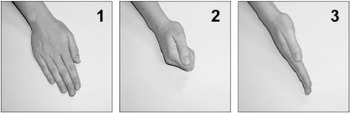
Still images of hand postures used in the computerized-KHMT for Experiment 1. Verbal labels assigned to the hand postures are as follows: 1—palm; 2—fist; 3—side.

Still images of hand postures used in the span-HMT for Experiment 2. Verbal labels assigned to the hand postures are as follows: 1—curve; 2—fist; 3—side; 4—claw; 5—palm; 6—star; 7—pinch.
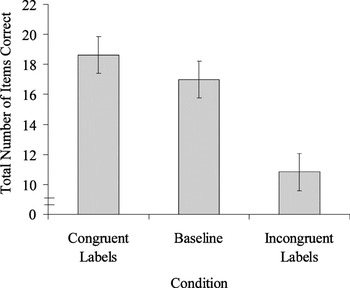
Mean performance on the computerized-KHMT during the congruent labels, baseline, and incongruent labels conditions (within-subjects 95% confidence intervals shown as error bars).
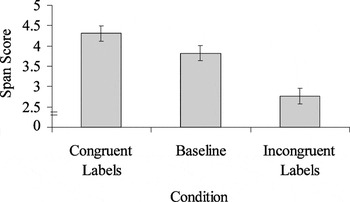
Mean performance on the span-HMT during the congruent labels, baseline, and incongruent labels conditions (within-subjects 95% confidence intervals shown as error bars).
 You have
Access
- 16
- Cited by