Gendered diffusion on gendered issues
The United States (US) federal government set forth a comprehensive three-pronged approach to combating human trafficking (prosecution, prevention and protection) in The Victims of Trafficking and Violence Protection Act (TVPA) of 2000, which was reauthorised in 2003, 2005, 2008 and 2013. However, it took another three years for state legislatures to address the issue. Since 2003, almost all states have passed some type of human trafficking legislation, though these state laws vary significantly in terms of their substance and scope. While a few states have taken a comprehensive approach to legislating on human trafficking, the vast majority of states are moving forward slowly and incrementally.
This paper seeks to understand why some states passed more comprehensive human trafficking legislation than others. We hypothesise that both policy diffusion and female representation in the legislature have significant independent effects on the passage of comprehensive human trafficking legislation. Moreover, we propose that the impact of female representation is heightened by the policy diffusion process.
Methodologically, we test our hypotheses using an original data set that codes every state human trafficking law passed between 2003 and 2008 according to three distinct policy areas – criminalisation, state investment and civil remedies – which we derived by content analysing each state law.Footnote 1 We define the most “comprehensive” human trafficking legislation as that which makes provisions in the law in all three of these policy areas.Footnote 2
We proceed first by reviewing the literature on human trafficking in the US. Next, we develop our theory and hypotheses regarding the impact, both independent and conditional, of policy diffusion and female representation on the comprehensiveness of human trafficking legislation. We then present our empirical approach and findings. Taken together, this paper suggests that, for certain types of new women’s issue areas, the likelihood of passing the most comprehensive legislation is maximised when female diffusion networks are activated.Footnote 3
This finding is important for several reasons. At a basic level, it unites the bodies of scholarship on policy diffusion and descriptive representation. While scholars know that policy diffusion is an important part of the policymaking process, up until now the role of female legislators in this process has been largely overlooked. In addition, although the research clearly shows that female legislators have an independent effect on the passage of women’s issue bills within a state legislature, little attention has been paid to how female legislative networks across states may impact legislation within states. By combining policy diffusion and descriptive representation, we hope that this paper will add to both lines of research. Relatedly, we hope that this paper sheds light on an important mechanism of policy change for novel issues that fall within the “women’s issues” camp. In other words, for “uncrystallised” policy areas (Mansbridge Reference Mansbridge1999), such as human trafficking, female legislative networks can become an important part of the policymaking process; female legislative networks can help to set the legislative agenda, communicate about what differentiates effective laws from ineffective laws and provide a support network for policy entrepreneurs across the states.
While this paper contributes to our understanding of the policymaking process, it is not without its limitations. Among them is the fact that we test this theory on only one policy issue. However, we hypothesise that the findings that we present in this paper will be applicable to other novel women’s issue domains, such as those concerning domestic violence and education. If female diffusion networks were activated for human trafficking, we would expect that they would be activated for other issues that are framed as women’s issues and seen as salient to female constituents. However, it is beyond the scope of this paper to test this. Our hope is that the arguments and findings presented here can be applied to other policy domains in future work.
Human trafficking in the United States
Scope of the problem
The federal definition of human trafficking according to the Trafficking Victims Protection Act of 2000 is:
-
a. sex trafficking in which a commercial sex act is induced by force, fraud or coercion, or in which the person induced to perform such act has not attained 18 years of age; or
-
b. the recruitment, harbouring, transportation, provision or obtaining of a person for labour or services, through the use of force, fraud or coercion for the purpose of subjection to involuntary servitude, peonage, debt bondage or slavery.
Although it is difficult to establish concrete numbers, the Department of Justice estimates that between 18,000 and 20,000 people are trafficked into the US per year for the purpose of forced labour and/or sexual exploitation (US Department of Justice 2005). From the original passage of the TVPA in 2000 to December 2007, 289 human trafficking cases were prosecuted, of which 55% involved forced labour and 43% involved sex (Clawson et al. Reference Clawson, Dutch, Lopez and Tiapula2008). Despite the low number of prosecutions, federally funded task forces opened 2,515 investigations of suspected human trafficking incidents between January 2008 and June 2010, 389 of which have so far been confirmed as human trafficking. Furthermore, although eight in ten of the suspected incidents were classified as sex trafficking, and only one in ten as labour trafficking, federal agencies were much more likely to lead labour trafficking investigations compared with sex trafficking investigations (US Department of Justice 2011). There were 527 victims identified in these cases, with their characteristics varying according to the type of trafficking. Labour trafficking victims tend to be over 25 years old, either Hispanic or Asian and undocumented aliens. Sex trafficking victims are generally younger, white or black, and US citizens (US Department of Justice 2011). In short, despite hazy estimates of the overall scale and scope of the problem in the US (how many victims and what type of trafficking is most prevalent), it is clear from the number of cases that the federal government has investigated and prosecuted in the last 12 years that the trafficking of human beings for both sex and labour is a serious issue within the borders of the US that does not discriminate against any race, age, gender or nationality.
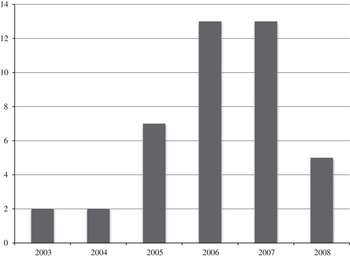
After the passage of the TVPA, the creation of federal task forces and the accompanying increase in federal investigations and prosecutions, the issue of human trafficking began to gain momentum among state legislatures. In 2003, Texas and Washington were the first two states to adopt stand-alone human trafficking criminalisation laws. Another two states followed suit in 2004. In 2005, that number increased to seven states, and the years 2006 and 2007 each saw an additional 13 states criminalise human trafficking (Figure 1).
Number of states adopting human trafficking legislation, 2003–2008.

That state legislatures rapidly criminalised human trafficking is significant for a few reasons. First, the problem is too large for federal law enforcement alone to tackle. To the extent that state law enforcement can bring its resources to bear, more traffickers will be brought to justice and more victims rescued (Reichel Reference Reichel2008; Farrell et al. Reference Farrell, McDevitt and Fahy2010). Second, the mere existence of a state trafficking statute has a major impact on local law enforcements’ awareness and training, as well as the levels of implementation and collaboration with federal authorities (Newton et al. Reference Newton, Mulchahy and Martin2008). In other words, state-level criminalisation is an important variable in an effective countrywide strategy to fight human trafficking, and a number of states have published reports on the scale and scope of the problem in their state in order to craft the most effective legislative, investigative, prosecutorial, victim assistance and public awareness strategies (California 2007; New York 2008; Wisconsin 2008; Ohio 2009; Minnesota 2010).
That being said, state statutes on human trafficking vary significantly and are generally much less comprehensive than the TVPA, especially in terms of protection and prevention, and even in terms of the sentencing guidelines. The lack of comprehensive state legislation, as compared with the federal law, is problematic because it may impact effective implementation of these laws. This is preliminarily evidenced by a national study of federal, state and local prosecutors. All federal prosecutors interviewed believe that the comprehensive nature of the TVPA is a major asset in prosecuting these cases; this is in contrast to the 33% of state and local prosecutors who did not know whether or not their state had even passed anti-trafficking legislation (Clawson et al. Reference Clawson, Dutch, Lopez and Tiapula2008). In other words, although state-level criminalisation is a necessary condition in countering the human trafficking problem in the US, it is not sufficient to successfully prosecute these cases at the state level. While there is a dearth of research examining the effectiveness of anti-trafficking policies (Gozdziak and Bump Reference Gozdziak and Bump2008), the fact that there have been so few prosecutions at the state level may be, in part, owing to the lack of comprehensive legislation (Berger Reference Berger2009).
Women’s issues frame
Despite continued efforts to gauge the relative prevalence of sex and labour trafficking across the US, sex trafficking has garnered the most attention. There are a few reasons for this. First is the role of the media. An analysis of media reports on human trafficking from 1990 to 2006 shows that the media focuses predominantly on sex trafficking and very little on labour trafficking (Fahy et al. Reference Fahy, Farrell and McDevitt2006). Second is the relative voice of anti-trafficking organisations; those organisations focused on commercial sexual exploitation were the most influential in legislative discussions (Weitzer Reference Weitzer2006). Thus, “By the mid-1990s… human trafficking was largely framed as a women’s rights problem” (Farrell and Fahy Reference Farrell and Fahy2009, 620).
Although it misrepresents the totality of the human trafficking problem, a women’s rights frame is not entirely unjustified. First, human trafficking fits well within the UN Convention to Eliminate All Forms of Discrimination Against Women, which Baldez (Reference Baldez2011) argues is a good approach to use when deciphering women’s interests. Second, human trafficking (both sex and labour) has implications for human rights, social welfare, health care and families – all of which have been deemed women’s issues (Saint-Germain Reference Saint-Germain1989; Swers Reference Swers1998, Reference Swers2002a, Reference Swers2002b, Reference Swers2005). Thus, the media and interest group focus on sex trafficking, coupled with the implications that both sex and labour trafficking have for human rights and public health, suggest that it is not unreasonable for human trafficking to be perceived as a women’s issue.
Based on this understanding of the rapid spread of human trafficking statutes across the states, and the way in which human trafficking has been understood as a women’s issue, the next section presents four hypotheses concerning the independent and contingent impact of policy diffusion and descriptive representation on the likelihood of state-level passage of comprehensive human trafficking legislation.
Theoretical considerations
As previously stated, human trafficking policy diffused rapidly across the country from 2003 to 2008.Footnote 4 This should come as no surprise to scholars interested in policy diffusion, for it has been long noted that states serve as laboratories of democracy, whereby one state’s successful policy adoption may be replicated by other states (Brandeis Reference Brandeis1932). In other words, innovative policies tend to spread from one state to another. There are several possible reasons why innovative policies tend to diffuse, including competition and learning (Walker Reference Walker1969).Footnote 5
The competition mechanism has generally been understood in terms of economic policy diffusion, wherein states adopt certain policies to benefit from economic spillovers (Tiebout Reference Tiebout1956; Dye Reference Dye1990; Simmons and Elkins Reference Simmons and Elkins2004; Elkins et al. Reference Elkins, Guzman and Simmons2006; Swank Reference Swank2006; Cao Reference Cao2010). However, Mooney (Reference Mooney2001, 105) argues that “states are understood to compete… to attract good things and repel bad things”. This has proven to be the case with certain social policies with implicit fiscal implications, such as those related to abortion (Mooney and Lee Reference Mooney and Lee1995), anti-smoking policies (Shipan and Volden Reference Shipan and Volden2008), welfare reform (Peterson and Rom Reference Peterson and Rom1989; Volden Reference Volden2006), state lotteries (Berry and Berry Reference Berry and Berry1990; Pierce and Miller Reference Pierce and Miller1999), education policy (Mintrom and Vergari Reference Mintrom and Vergari1998) and health care (Stream Reference Stream1999). In these and other diffusion studies over the last 80 years (e.g. Davis Reference Davis1930; McVoy Reference McVoy1940; Sutherland Reference Sutherland1950; Walker Reference Walker1969; Light Reference Light1978; Lutz Reference Lutz1986; Berry and Berry Reference Berry and Berry1990; Mooney and Lee Reference Mooney and Lee1995), the competition mechanism is understood to be diffusion that takes place across neighbouring states. What has not been examined, however, is whether competition-induced policy diffusion that takes place across neighbouring states occurs in the context of criminal policy. Indeed, the logic that applies when states adopt laws to attract “good” business may be applied to deter “bad” business:
When a particular criminal activity is criminalized in one regime, (unwanted) “business” will be diverted to a nearby jurisdiction where the transaction costs are lower. Not to criminalize a particular kind of economic transaction when other countries do renders the unregulated market more “business friendly.” In both competition and criminalization cases, diversion and policy externalities are key explanations for policy diffusion. (Lloyd et al. Reference Lloyd, Simmons and Stewart2012, 9–10)
In other words, if competition with neighbouring states is for the purpose of “attract[ing] good things and repel[ling] bad things”, then it is reasonable to assume that, when a neighbouring state criminalises a certain activity, the state in question will follow suit so as to repel criminals from migrating across state borders. With respect to international sex trafficking, it has been argued that the best way to tackle the problem is to increase the transaction costs for traffickers to do business, most explicitly by having very tough anti-trafficking laws on the books (Kara Reference Kara2009). Thus, in the context of crafting and passing human trafficking legislation, there may be an element of competition. States with tougher penalties deter traffickers while states with weak or no penalties serve as safe havens. We therefore arrive at our first hypothesis:
(H1) Competition Hypothesis: The higher the proportion of neighbouring states that criminalise human trafficking, the more likely a state is to pass comprehensive human trafficking legislation.
In addition to competition, however, learning is also a central mechanism for the diffusion of policy innovations. As Shipan and Volden state, policymakers “learn more when multiple governments try the policy, and even more when such policies affect larger segments of society” (2008, 842). Thus, learning-based diffusion is most likely to occur as larger proportions of a state, country or region adopt a certain policy. Moreover, some research suggests that learning-based diffusion will be more or less pertinent under certain conditions. For example, learning is more likely to occur for salient policy issues (Shipan and Volden Reference Shipan and Volden2008), but less likely for highly controversial policies (Hays Reference Hays1996). Finally, states that adopt later than others not only learn from the policies passed by early-adopting states, but also take a more comprehensive legislative approach (Glick and Hays Reference Glick and Hays1991; Mooney and Lee Reference Mooney and Lee1995; Hays Reference Hays1996). “Successively adopting states reinvent the policy so that it covers more areas, is stronger and bolder, and moves further in the desired policy direction” (Mooney and Lee Reference Mooney and Lee1999, 82).
The learning mechanism is clearly one that we expect to apply to human trafficking policymaking. First, human trafficking is a highly salient policy issue. Since the initial passage of the TVPA, media reports and NGOs dealing with the issue have proliferated. In addition to its high level of salience, it is also a valence issue. There is very little disagreement that trafficking in human beings is an atrocity that must be combatted. Second, human trafficking policy has evolved considerably over time. While the effort started with stand-alone criminalisation statutes, as the public, private and non-profit sectors have learned more about its causes and effects, their learning has translated into legislative “reinventions”. It took some time to learn about the corollary issues surrounding supply and demand that allow human trafficking to flourish as one of the most profitable criminal enterprises in the world. It also took time to learn about the challenges of prosecuting these cases, as well as the unique needs of the victims. Given all of this, early-adopting states criminalised human trafficking, while later-adopting states not only criminalised it, but also made additional provisions in state investment and civil remedies that make for a more comprehensive and robust human trafficking policy. We therefore arrive at our second hypothesis.
(H2) Learning Hypothesis: As more of the country is covered by human trafficking criminalisation legislation, later-adopting states are more likely to pass comprehensive legislation.
While we expect policy diffusion to play a pivotal role in the passage of comprehensive human trafficking legislation, it is also important to recognise the perceived substance of this policy. As noted previously, although human trafficking involves both sex trafficking and labour trafficking, sex trafficking has garnered the most attention in the media (Fahy et al. Reference Fahy, Farrell and McDevitt2006) and from interest groups (Weitzer Reference Weitzer2006). Consequently, human trafficking became conceptualised as a women’s issue (Farrell and Fahy Reference Farrell and Fahy2009, 620). Given this frame, it is important to consider the role of female legislators in the passage of comprehensive legislation.
A great deal of scholarship indicates that there is a positive relationship between the percentage of female legislators in a chamber and the sponsorship and passage of women’s issue legislation (Thomas Reference Thomas1991; Murphy Reference Murphy1997; Bratton Reference Bratton2002, Reference Bratton2005; MacDonald and O’Brien Reference MacDonald and O’Brien2011; Wittmer and Bouche Reference Wittmer and Bouche2013; but see Cowell-Meyers and Langbein Reference Cowell-Meyers and Langbein2009 and Reingold Reference Reingold2000 for examples that demonstrate the complexities of this relationship). As Jane Mansbridge (Reference Mansbridge2005, 622) explains, “descriptive representation by gender improves substantive outcomes for women in every polity for which we have a measure”. There are at least two mechanisms responsible for this relationship between female legislators and women’s issue bills.
First is the idea that female legislators may have experiences that are unique to their gender. For example, female legislators may be more likely than their male counterparts to have been primary caregivers to children, sexually harassed in the workplace or faced with a difficult reproductive decision. Moreover, even if female legislators have not had these experiences, they may feel an obligation to represent women across the country who have. This feeling may be exacerbated by the fact that female legislators have been historically underrepresented in politics, and as a result there may be a perception that women’s issues have been undervalued. As Carroll (Reference Carroll2003, 54) explains, some female representatives “became advocates for women while serving in Congress. In fact, their sense of responsibility to women often developed as a response to the neglect of women’s interests within the institution”. Given this, it should come as no surprise that a body of scholarship finds that male and female lawmakers have distinct sets of policy priorities, with females more likely to support women’s issue bills.Footnote 6 For example, female legislators are more likely to vote for and sponsor bills pertaining to gender equality, children, health care, education and families (Saint-Germain Reference Saint-Germain1989; Bratton Reference Bratton2002; Gerrity et al. Reference Gerrity, Osborn and Mendez2007; Volden et al. Reference Volden, Wiseman and Wittmer2013).Footnote 7
The second, and related, mechanism relates to a distinct legislative environment that is created when greater numbers of female legislators are present. At the most basic level, as the percentage of women in a legislature increases, so may the overall support given to women’s issues. In other words, “descriptive representation may make a difference not only through the distinctive behavior of female legislators but also through their impact on the behavior of their male colleagues” (Bratton Reference Bratton2005, 122). Reasons that male legislators may be more focused on women’s issues when there are greater numbers of female legislators include such factors as increased exposure to novel ideas, a gendered framing on “uncrystallised issues” (Mansbridge Reference Mansbridge1999) and informal pressure to support policy areas that are of import to women. Evidence of this type of informal pressure is provided in a recent study that found male judges to be significantly more likely to rule in favour of sexual discrimination litigants when a female judge is on their panel (Boyd et al. Reference Boyd, Epstein and Martin2010).
Taken as a whole, there is strong theoretical support for the idea that female legislators are a key variable for passing women’s issue legislation. In addition, given that human trafficking has been framed as a women’s issue, we propose that comprehensive human trafficking legislation is more likely to occur with higher female representation in a state. Hence, we arrive at our third hypothesis:
(H3) Descriptive Representation Hypothesis: The greater percentage of female legislators in the House and Senate, the more likely a state is to have comprehensive human trafficking legislation.
Thus far, we have hypothesised independent effects for both policy diffusion and descriptive representation. Next, we build on this framework by proposing a contingent relationship between these two variables. We are by no means the first to propose a contingent impact of policy diffusion under certain circumstances, but we hope to add to this body of scholarship by considering gendered diffusion networks.Footnote 8
Specifically, we expect that, for a certain subset of legislation – particularly that which falls within the women’s issue domain, female legislators may represent a distinct diffusion network within and across states. As female legislators feel an enhanced pressure to be advocates for women’s issue legislation, and because they represent a minority of legislators in every state, it is possible that they form coalitions or networks around such issues. Formal examples of such interstate networks are the Women’s Legislative Network of the National Conference of State Legislatures and policy programmes created by the Center for Women and Policy studies (e.g. the Contract with Women of the USA State Legislators Initiative and the Foreign Policy Institute for State Legislators). These networks may play a pivotal role not only in creating and sustaining relationships among female state legislators, but also by providing important information on women’s issues. For instance, the Center for Women Policy Studies’ Foreign Policy Institute for State Legislators graduated over 110 female state legislators between 2001 and 2009. In addition, of vital significance for this study, one primary focus of this institute was human trafficking. Not surprisingly, graduates of this programme “have sponsored most of the anti-trafficking legislation that states have enacted” (Center for Women Policy Studies 2009). Thus, interstate gendered diffusion networks may present a unique type of diffusion across states.
While such interstate networks are clearly pivotal for the spread of information related to women’s issues, such as human trafficking, it is also important to recognise that only a small subset of sponsored bills become law. Thus, female legislators may have to use their intrastate networks, such as formal women’s issue caucuses (e.g. the Colorado Legislative Women’s Caucus and the Texas Women’s Political Caucus) or informal legislative groups, to ensure that their bill makes it through the legislative pipeline.Footnote 9
As a result of such gendered diffusion, the impact of female representation on comprehensive human trafficking legislation may be bolstered. Specifically, the interstate female legislative diffusion network would make females in the legislature aware of the salient women’s issues, and then the more women there are in the legislature, the larger (and perhaps stronger) the intra-legislature female diffusion network and the larger the coalition to push for comprehensive legislation. Taking all of this into consideration, we arrive at our final hypothesis:
(H4) Female Diffusion Network Hypothesis: The impact of female representation in the legislature on comprehensive human trafficking legislation will increase after controlling for learning-based diffusion.
Empirical approach
In order to test our central hypotheses, we deconstruct all state human trafficking legislation with an eye towards defining what constitutes a “comprehensive” statute. We determine that there are three prevailing categories comprising a comprehensive human trafficking law: criminalisation, state investment and civil remedies. Footnote 10 Both state investment and civil remedies contain their own more specific provisions, while criminalisation is a binary category.
Dependent variable: legislative comprehensiveness
Before jumping into the empirical results, we provide context for each of these categories, the first being criminalisation. From 2003 to 2008, 39 states criminalised human trafficking. Although we code this variable as whether or not a state criminalised, it is important to note that there is significant variation across states with respect to criminal penalties.Footnote 11 Some states differentiate between sex trafficking and labour trafficking, with specific felony punishments for each. Some states give harsher penalties for the trafficking of a minor versus an adult. Minimum and maximum sentences vary greatly as well, with minimum sentences ranging from 0 to 15 years, and maximum sentences ranging from 8 to 100 years.
The second category is state investment, which is further broken into four specific areas in which a state can invest: victim assistance, task force, training and reporting. A state can opt to invest in all or none of these. For instance, Connecticut, Iowa and New York have adopted legislation that includes state investment in all four of these areas, whereas 19 other states that have criminalised human trafficking have not invested in any of these four areas. In all, 24 states have passed legislation that invests in at least one of these areas.
Victim assistance includes whether the state has allocated funds towards victim shelters, counselling and recovery activities. Only 13 states have made provisions in their laws to assist victims of human trafficking, and these provisions vary greatly, ranging from California, which provides state-funded social services for up to one year, to Wisconsin, which provides emergency services for 60 days.
Task forces can also be statutorily mandated, usually under the auspices of the state attorney general. Task forces often include a cross-section of representatives from all relevant areas of government, law enforcement and the community, and are tasked with producing reports, developing training programmes, identifying protocols and shelters for assisting victims, researching and analysing the pertinent state laws and/or working on prevention and community outreach.
The third area of state investment is mandated training. Many state reports and other studies have identified the lack of training of law enforcement and other first responders as the greatest barrier to identifying and investigating cases of human trafficking (e.g. Farrell Reference Farrell2009). Thus, mandated training for state and local law enforcement is considered among the most important aspects of any state law on human trafficking and serves as a clear signal that the state is taking this issue seriously. Unfortunately, despite training being identified as a key factor in the fight against human trafficking, only five states have mandated state-initiated training programmes.
The final state investment category is reporting. In many cases, those states with task forces also have mandated reports, as reporting is considered a primary responsibility of task forces. On the other hand, states such as Delaware, Indiana and Nebraska have mandated that a state report be prepared on the prevalence of human trafficking without a law that creates a task force. To date, a number of states have already published reports, including California, Florida, Minnesota, Ohio, Texas and Wisconsin.Footnote 12 Overall, 16 states have mandated reporting.
In addition to criminalisation and state investment, the last area of the law that comprises a comprehensive human trafficking statute is civil remedies. This category includes the four following areas: restitution, asset forfeiture, civil action and affirmative defense. Overall, 23 states have adopted at least one of these civil remedies. A restitution provision means that traffickers not only could face prison time (if the state also criminalised), but also could be required to pay a determined sum of money to their victims. In all, 16 states make restitution provisions in their human trafficking laws, and all of these, with the exception of Maine, also criminalise human trafficking. Asset forfeiture is the confiscation of assets by the state that are either proceeds of a crime or instrumentalities of crime. Only six states have included asset forfeiture in their human trafficking law. As opposed to criminal prosecution, civil action is a legal action to compel a civil remedy. Nine states include a civil action provision, and eight of these states also criminalise human trafficking. This means that, in eight states, human traffickers could face both criminal and civil penalties. Finally, an affirmative defense provision allows a victim of human trafficking to avoid or reduce the legal consequences of any crime he or she committed as a direct result of the trafficking without regard to whether anyone was prosecuted or convicted for trafficking. Only five states have affirmative defense provisions.
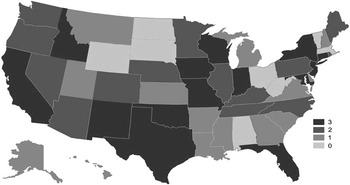
Criminalisation, state investment and civil remedies are three distinct policy domains that could be written into a state’s human trafficking law. If a state passed legislation with provisions in each of these areas, we define that law as being comprehensive. Therefore, in order to generate our legislative comprehensiveness variable, we created dummy variables for each of these three categories. For example, criminalisation takes on a value of 1 if a state criminalised, and a 0 if not. Both the state investment and civil remedies categories take on a value of 1 if the state made provisions in any of the four areas that comprise each category, and a 0 if it did not make provisions in any of the four respective areas. We then summed the three dummy variables from each category to create our dependent variable, legislative comprehensiveness, which is a sliding scale that ranges from 0 to 3 (0=did not adopt anything, 3=adopted state investment, civil remedies and criminalisation). In all, 14 states have made provisions in their human trafficking laws in all three of these areas, 15 states have made provisions in two areas, 14 states have made provisions in one area and, as of 2008, seven states have not passed human trafficking legislation pertaining to state investment, civil remedies or criminalisation.Footnote 13 Figure 2 provides specific information on the states that have the least to the most comprehensive legislation in these three categories.Footnote 14
Legislative comprehensivenss across the United States, 2003–2008.

Independent variables
To reiterate, we hypothesise that both competition- and learning-based policy diffusion, as well as the gender composition of the legislature, will independently impact the comprehensiveness of anti-trafficking legislation passed in the states. Moreover, we anticipate the effect of descriptive representation to be heightened after controlling for policy diffusion for the most comprehensive states.
In order to capture competition, we generated a neighbouring states variable that codes for the proportion of neighbouring states that criminalised human trafficking in the years spanning 2003–2008. Neighbouring states is a well-established measure for capturing competition that often takes place between neighbouring states (e.g. Shipan and Volden Reference Shipan and Volden2008). Unique to this study, however, is the notion that competition between neighbouring states goes beyond attracting economic spillovers; there is also competition to repel criminal activity. Thus, we apply standard practices for testing competition-based diffusion to a policy area in which the effects of diffusion have been understudied: criminal policy.Footnote 15
Following the lead of previous research (e.g. Shipan and Volden Reference Shipan and Volden2008; Bouché and Volden Reference Bouché and Volden2011), we develop a second diffusion variable that captures learning-based diffusion, which we operationalise by coding for the proportion of the country covered by human trafficking legislation every year from 2003 to 2008. Here, rather than passing legislation to compete with neighbouring states to keep crime out, a state is learning from the experiences of the early-adopting states. As the policy area evolves, the later-adopting states are able to craft more comprehensive legislation that includes “promising practices” passed by the earlier-adopting states.
In addition to diffusion, we are interested in how the gender composition of a state legislature may impact the comprehensiveness of human trafficking legislation. Therefore, we include the percentage of women in the House for all states from the years 2003–2008.
We include a number of additional variables in the models, because they may have direct implications for human trafficking policy or they are standard control variables in the context of state policy and politics. The first two are institutional variables, including the majority party in the legislature and whether the legislature is professional or part-time. We measure majority party by percentage of Democrats in the House. Majority party is relevant not only for chamber effects, but also in the context of human trafficking policymaking. On the one hand, we might anticipate that a Democratic majority is more likely to pass comprehensive human trafficking legislation. Democrats are committed to advancing issues of social welfare and civil rights, and human trafficking may be construed as this type of issue. On the other hand, it is equally plausible that a Republican majority would pass more comprehensive legislation, especially if the issue is framed as one of law and order (Gibbs and Bankhead Reference Gibbs and Bankhead2001). Given the different facets of comprehensive human trafficking legislation (i.e. criminalisation, which Republicans are likely to support, and state investment, for which Democrats are likely to advocate) and the different ways the issue can be understood and framed, it is unclear what impact the partisan majority of the legislature will have on comprehensiveness. Indeed, the most comprehensive legislation may actually be the most bipartisan.
The second institutional variable is professional or part-time legislature. This variable is on a scale ranging from 1, for the most professionalised legislatures, to 5, for the most part-time legislatures. This scale captures the amount of time legislators spend on the job, the amount they are compensated and the size of their staffs. More professional legislatures should have more time and resources to devote to human trafficking legislation.
The next set of variables includes state-level control variables that are highly relevant for human trafficking policy. The first of these is illegal immigrants per capita. Whether rightly or wrongly, the issue of human trafficking is often understood in terms of illegal immigration. International law dictates that human trafficking is a subcategory of human smuggling, which is a subcategory of illegal immigration (Väyrynen Reference Väyrynen2003); thus, the line between smuggling and trafficking can become blurred, because both are forms of transporting people across state borders illegally (Salt and Stein Reference Salt and Stein1997; Williams Reference Williams1999). That being said, there are major differences between human trafficking and human smuggling, especially in the context of the US. Generally, the Protocols of the Palermo Convention delineate that trafficking involves coercion in the process of transporting and beyond, whereas smuggling does not. The criminal in the case of trafficking is the trafficker, whereas, in cases of smuggling, the illegal migrant who has wilfully paid to be smuggled across the border is the “criminal”. In the context of the US, there are additional considerations that distinguish smuggling from trafficking. Namely, trafficking (a) does not have to involve movement across any state or national borders, and does not require any transporting at all and (b) can include natural born US citizens. Thus, although there is some overlap between human smuggling and trafficking, which primes the idea of illegal immigration, they are very distinct issues. Nevertheless, given these (mis)perceptions of the human trafficking issue in the US, it is imperative to include the numbers of illegal immigrants per capita in the models, as this could strongly impact how comprehensive a state is in attacking the problem legislatively.
The second state-level control that is important in the context of anti-trafficking policy is violent crime per capita. Experts and practitioners widely describe human trafficking as a type of violent crime (Chuang Reference Chuang2006). The harsh criminal justice approach that has been taken by most states indicates that states view it as such. Thus, the level of other violent crime in the state may impact how a state decides to legislate on this particular violent crime.
A final state-level control relevant to human trafficking legislation is whether or not a state is a border state. Again, the conflation of human smuggling and trafficking may illicit different responses from border versus non-border states.
The final two variables in the model are additional state-level control variables that are important in virtually any policy arena – population and surplus.Footnote 16 The size and economic health of a state play a role in determining what types of policies it adopts (Fellowes et al. Reference Fellowes, Gray and Lowery2006). For example, states with stronger economies may have greater flexibility to focus on post-materialist concerns. Population is also a proxy for whether or not the state has large urban centres, which may be particularly relevant for human trafficking policy.
Each observation in the data set is one state in one year, ranging from 2003 to 2008. We cluster on the state to control for correlation across observations, and include year dummies to account for temporal dependence (Wooldridge Reference Wooldridge2003). All 50 states are included in the data set, which means there are 300 observations in total.Footnote 17 Although our dependent variable is ordinal, ranging from 0 to 3 from least comprehensive policy to most comprehensive, we estimate our models using multinomial logit to avoid violating the parallel regression assumption that often plagues other functional forms for ordered dependent variables. The ordered variable takes on a value of 0 until some aspect of the human trafficking law is passed and some value between 1 and 3 in the year the law was passed (depending on what provisions were made in the law); it could either continue to take on that same value in subsequent years if no other legislation was passed, or it could take on a higher value in subsequent years if additional legislation was passed that made more provisions across the three categories.
Results
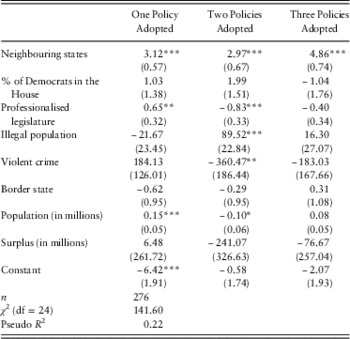
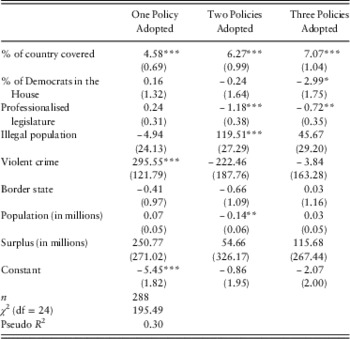
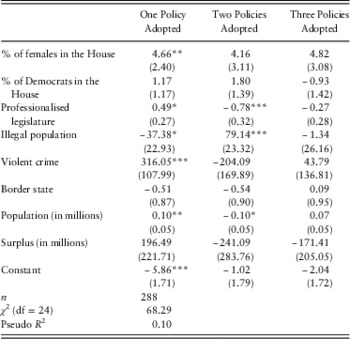
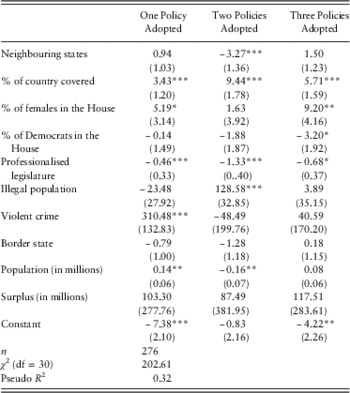
We report the results for the House only.Footnote 18 In Table 1, we control only for competition-based diffusion. Table 2 controls for learning-based diffusion only. Table 3 controls for descriptive representation alone. Finally, Table 4 reports the results for the fully specified model that controls for both the diffusion and descriptive representation variables.
Legislative comprehensiveness controlling for competition-based diffusion

Notes: Robust standard errors in parentheses, clustered by state.
Year dummies not reported owing to space considerations.
***p<0.01, **p<0.05, *p<0.10.
Legislative comprehensiveness controlling for learning-based diffusion

Notes: Robust standard errors in parentheses, clustered by state.
Year dummies not reported owing to space considerations.
***p<0.01, **p<0.05, *p<0.10.
Legislative comprehensiveness controlling for females in legislature

Notes: Robust standard errors in parentheses, clustered by state.
Year dummies not reported owing to space considerations.
***p<0.01, **p<0.05, *p<0.10.
Legislative comprehensiveness controlling for diffusion and female representation

Notes: Robust standard errors in parentheses, clustered by state.
Year dummies not reported owing to space considerations.
***p<0.01, **p<0.05, *p<0.10.
Table 1, therefore, tests the first hypothesis regarding competition-based diffusion, without controlling for learning-based diffusion or females in the legislature. We find that there is an element of competition-based diffusion occurring across the states. Specifically, the higher the proportion of neighbouring states that have criminalised human trafficking, the more likely the state in question will be to pass more comprehensive human trafficking legislation. Put differently, if an earlier-adopting neighbouring state criminalises human trafficking, the later-adopting state will not only criminalise, but also take additional measures in an attempt to deter traffickers from that state by increasing the risk associated with operating there. The coefficients in terms of states adopting one, two or three policies (versus zero policies, which is the base category) are all positive and significant. What is more important, however, is the fact that there is a statistically significant increase in the magnitude of the coefficients from adopting only one or two policies to adopting all three policies (LR χ 2 with three degrees of freedom=80.62, ρ=0.00). In more concrete terms, when no neighbouring states have criminalised human trafficking (and all other variables are held at their means), the predicted probability of the state in question having no human trafficking legislation at all is 82%, and having very comprehensive legislation with provisions for criminalisation, state investment and civil remedies is only 3%.Footnote 19 On the other hand, when all neighbouring states have criminalised human trafficking, the predicted probability of a state not having any trafficking statutes at all decreases to 14%, and the probability of having the most comprehensive legislation increases to 38%. As per the competition hypothesis, it appears that states may compete with one another to repel negative externalities associated with criminal activity. This lends support to our first hypothesis. This finding is also significant for the study of policy diffusion more generally; it is among the first to investigate the nature of diffusion in the context of criminal policy.
The multinomial logit model reported in Table 2 tests the impact of learning-based diffusion on the passage of comprehensive human trafficking legislation. Like competition-based diffusion, learning-based diffusion also has a strong and significant impact on the likelihood of a state passing more comprehensive human trafficking legislation. As more and more states over time criminalise human trafficking (i.e. as more of the country is covered by human trafficking criminalisation statutes), the later-adopting states are significantly more likely not only to criminalise, but also to invest state resources and include civil provisions in the law. The coefficients increase in magnitude from passing only one provision to all three provisions, and these increases are statistically significant (LR χ 2 with three degrees of freedom=133.29, ρ=0.00). The later-adopting states are learning from the legislation passed by earlier-adopting states across the nation; therefore, they are more likely to craft their legislation with an eye on “best practices” across the country. More specifically, the predicted probability of a state not adopting any anti-trafficking legislation is 90% when the minimum proportion (4%) of the country is covered with criminalisation legislation, and the predicted probability of having comprehensive anti-trafficking legislation when only 4% of the country is covered is 1%. On the other hand, when 80% of the country is covered with criminalisation legislation, the predicted probability of a state not having any anti-trafficking legislation is 18% and the predicted probability of a state having the most comprehensive legislation is 28%. Thus, these models lend strong support to the learning-based diffusion hypothesis.
In order to test our third hypothesis regarding the impact of females in the legislature on the passage of comprehensive human trafficking legislation, we include Table 3. We find mixed results. The coefficients for passing the least to most comprehensive policies are all positive; however, only those for states that passed the least comprehensive law are statistically significant. Despite the insignificant results, the predicted probabilities reveal that, when females in the House are set at their lowest (8%), the likelihood of passing comprehensive anti-trafficking legislation is only 8%. When set at their maximum of 40%, the probability of passing comprehensive legislation that criminalises, invests state resources and includes civil remedies increases to 18%. Nevertheless, the insignificance of these results does call into question our third hypothesis. A comparison of the goodness of fit measures among the three models represented in Tables 1 to 3 indicates that the diffusion variables have significantly more explanatory power than descriptive representation in analysing the comprehensiveness of anti-trafficking legislation. This is a surprising finding for a variety of reasons. First, although the issue of human trafficking is by no means an issue disproportionately relevant to women, the issue has been framed by the media as such (Fahy et al. Reference Fahy, Farrell and McDevitt2006). Further, many of the corollary issues surrounding protection from and prevention of human trafficking are generally considered “women’s interest” issues, and previous research has shown that female legislators are leading the legislative charge in sponsoring this anti-trafficking legislation (Wittmer and Bouche Reference Wittmer and Bouche2013). Thus, before we accept the null that there is not a significant relationship between females in the legislature and comprehensive human trafficking legislation, we examine whether this result is actually a function of an omitted variable problem. To do this, we turn to an examination of our fourth hypothesis, which builds a fully specified model.
The fourth hypothesis predicted that controlling for policy diffusion in the context of a women’s policy area heightens the effect of descriptive representation. The results presented in Table 4 strongly support this hypothesis. We first note that, after controlling for learning-based diffusion and female representation, competition-based diffusion is no longer significant in predicting whether a state adopts the most comprehensive legislation.Footnote 20 This indicates that the policy diffusion patterns of the country more broadly, as opposed to those of neighbouring states, are more important in the context of human trafficking. This may be because the issue is both highly salient and a valence issue. It may also be the case that states are learning more than competing, because human trafficking as a specific policy area is considered more a human rights issue than a crime issue – thus, states are most interested in learning from the best practices of other states. On the other hand, it may be that, in the realm of criminal policy more generally, states are less likely to compete, because they are considering the best interest of the nation as opposed to the best interest of the state. Future research should explore whether these results hold for other criminal policy areas. Is learning-based diffusion the primary mechanism for criminal policy in general, or only for specific types of criminal policy?
A second interesting finding is that, for the most comprehensive states, the coefficient on per cent of females in the legislature is substantively larger than the proportion of the country covered. This indicates that, despite the insignificance of this variable in the non-fully specified model in Table 3, per cent of females is more important than learning-based diffusion for adopting comprehensive anti-trafficking policy. A χ 2 test shows that there is a statistically significant difference between these coefficients (LR χ 2 with six degrees of freedom=61.01, ρ=0.00). Thus, per cent of females in the legislature has a substantively larger impact on states passing comprehensive human trafficking legislation than learning-based policy diffusion.
What is perhaps most interesting, however, is that, from the non-fully specified models set forth in the first three Tables to the fully specified model in Table 4, the substantive and statistical impact of females in the legislature increases. This is an odd occurrence given that, generally speaking, controlling for additional variables decreases the substantive significance of variables in the nested model. Yet, the goodness of fit in the fully specified model is much greater than the non-fully specified models, indicating that the fully specified model is indeed a better fit. This large difference in goodness of fit indicates that the impact of per cent of females in the legislature is strongly heightened by the policy diffusion process. It appears that diffusion networks may be particularly important for female legislators dealing with women’s issue areas.
The model represented in Table 4 is an interesting contribution to the policy diffusion literature. It may be the case that the impact of women in the legislature increases after controlling for policy diffusion, because female state legislators represent a unique diffusion network for “women’s interest” issues both within their own legislature, as well as across state networks. Female legislators in the same state legislature may, collectively or individually, pay particular attention to women’s issue areas that have become salient in other states across the country. This intra-legislature diffusion network among female legislators may begin with one female legislator spreading the word among other female legislators in the chamber about the women’s issue of interest in other states; on the other hand, the women’s issue could diffuse among the female legislators within a legislative chamber as a result of some or many of them keeping abreast of women’s issues in other states. Either way, the interstate female legislative diffusion network may have made females in the legislature aware of the salient women’s issue, and then the more women there are in the legislature, the larger the intra-legislature female diffusion network and the larger the coalition to support comprehensive legislation.
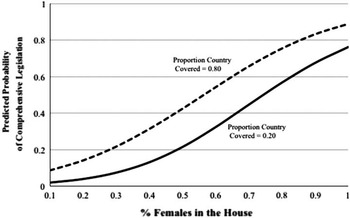
In other words, there is a contingent relationship between female legislators and diffusion networks when it comes to “women’s issues”. The s-shaped curve in Figure 3 depicts the conditional impact of female representation on the predicted probability of comprehensiveness at different levels of learning-based policy diffusion.Footnote 21 Indeed, anti-trafficking policy diffusion appears to have taken place among a descriptive network of female legislators. Not controlling for this network creates an omitted variable bias problem for the model in Table 3; however, not controlling for female representatives in Table 2 overplays the independent effect of learning-based diffusion. Future research should examine this finding in the context of other women’s issue areas to see if the impact of descriptive representation is heightened by learning-based diffusion through unique female diffusion networks both within and among legislatures.
Predicted probability of passing most comprehensive legislation given varying levels of females in the house and proportion of country covered.

Other findings
There are several other interesting results across the models beyond those that directly test our central hypotheses. First is the lack of significant and consistent results for the majority party in the legislature. Generally speaking, this variable lacks significance across the four models; however, there is a significant effect in the negative direction in Table 4 where three policies are adopted. This suggests that, as the percentage of Democrats increases, the likelihood of a state passing comprehensive human trafficking legislation decreases. Given that the Democratic Party generally takes on human rights and women’s issues, this result is counterintuitive. However, in the context of human trafficking, it is not necessarily surprising. The most comprehensive legislation that makes provisions for criminalisation, state investment and civil remedies is likely to be supported by a bipartisan coalition, so we would actually expect inconsistent and insignificant results for this variable. Both Republicans and Democratic majorities support the passage of comprehensive human trafficking legislation, but possibly for different reasons. While Democrats push for state investments and civil remedies, the compromise for Republicans is tough criminal penalties. The bargaining process within and between the two chambers leads to the most comprehensive legislation.
Second, in the fully specified model, there is a significant relationship between passing comprehensive legislation and having a more professional legislature. Professional legislatures convene regularly, have larger staffs and get paid more. In short, they have more time and resources to dedicate to legislating in general.
Discussion
Legislative comprehensiveness
It is important to recognise that there is wide variance in the comprehensiveness of anti-trafficking legislation across the states. The intent of this analysis was to better understand why some states pass more comprehensive legislation than others.
We find overall support for our hypotheses concerning policy diffusion, female representation and gendered diffusion. First, this paper finds significant support for the power of policy diffusion. The substantive implications of this are that later-adopting states are learning from the experiences of earlier-adopting states, which is evidenced by later-adopting states crafting more comprehensive legislation. As states continue to expand their legislation across state investment, civil remedies and criminalisation, there is an increased probability that other states will follow suit; the findings of this paper predict that there is likely to be a ripple effect of legislative comprehensiveness. However, it is important to note that there are clear costs associated with being the vanguard state. It is risky, the policy could fail and/or other states could learn from the failure and craft better legislation.
Second, we find that, generally speaking, as the percentage of women in the House increases, the more likely a state is to have comprehensive legislation. This lends support to the line of research showing that female legislators behave in a manner that is distinct from their male counterparts. We also contribute to this literature, finding that simply increasing gender diversity in legislatures not only leads to more women’s issue bills being introduced, but also leads to more comprehensive legislation on women’s issues being passed. This finding presents an overall optimistic picture for human trafficking legislation as female legislators continue to gain access to state legislatures across the country.
Third, this paper is able to bridge the literatures on policy diffusion and descriptive representation by proposing a process of gendered diffusion. Specifically, we suggest that female state legislators represent a unique diffusion network for women’s interest issues, both within their own legislature and across state networks. Specifically, we find that, after controlling for policy diffusion, the substantive impact of descriptive representation increases. In other words, interstate and intrastate policy diffusion seems to bolster the impact of female representation within a state legislature. As female representation continues to increase, albeit slowly, and the number of interstate networking opportunities expands, there may be a bright future for comprehensive human trafficking legislation across the states.
However, it is also important to recognise that a significant gender gap remains in most state legislatures. In fact, in 2014, women represent only 20.7% of all state senators and 25.3% of all state house members (Center for American Women and Politics 2014). And, even as numbers of female representatives increase, it is critical to examine some of the possible implications of this type of identity-based policymaking for sociolegal theory and practice. In particular, if it is expected that female legislators carry the cause of women’s issues, does this lead to a misperception that these issues are not relevant to males, or that “women’s issues” are “not men’s problem” (Wittmer and Bouche Reference Wittmer and Bouche2013)? Might this further entrench traditional gender stereotypes in legislative and societal contexts? In addition, does this indirectly exonerate male legislators and publics from advancing these causes? Even more problematic is that this intimate relationship between identity politics and public policy may extend to other salient identity groups, such as those based on race, class and religion. On the one hand, a more diverse legislature along a number of identity dimensions may lead to the most comprehensive public policy in support of that identity group; on the other, we must be wary of exonerating the other groups from perceiving that these issues are not their problem.
Future directions
Although this paper presents a concrete picture of the determinants of comprehensive human trafficking legislation, many questions remain unanswered. We will conclude by presenting three future directions for this project. First, it is important to investigate what the implications are of comprehensive legislation. Underlying this paper’s framework is an assumption that comprehensive legislation equates with “good” legislation; however, this assumption has yet to be tested. Taking this as a departure, future work should investigate the impact of comprehensive legislation on the implementation and effectiveness of the law. Does comprehensive legislation serves as a signal to policy implementers (e.g. bureaucrats, task forces, police officers, prosecutors, etc.) that this is an issue to be taken seriously, or is there no significant relationship between a comprehensive law and legislative effectiveness?
Second, we are interested in the implications of human trafficking being framed as a women’s issue. As noted earlier, previous research has demonstrated that there are distinct differences between the legislative portfolios of men and women, with women more likely to sponsor and vote for women’s issue bills. On the surface, this link between descriptive representation and substantive representation is considered normatively positive; the more women that are elected to public office, the more legislation relevant to and beneficial for women will be passed. However, the full impact of the relationship between female legislators and an increase in substantive policy outputs for women has only begun to be tested and may, in fact, be detrimental in the long term (Wittmer and Bouche Reference Wittmer and Bouche2013). Does the label “women’s issue” exonerate male legislators and publics from taking responsibility for these issues?
With respect to human trafficking, issue gendering instills a false perception that this issue disproportionately impacts women, but this is simply not the case. Although the majority of trafficking victims around the globe are women and girls for the purpose of commercial sexual exploitation (US Department of Justice 2004; US Department of State 2007), there are significant numbers of men and boys who are also trafficking victims, especially for the purpose of bonded labour. In addition, recent evidence indicates that the majority of traffickers are women (United Nations 2009), although the underlying power dynamics of this finding need to be explored in greater detail. Finally, men are the primary consumers of trafficked women and girls. Thus, men and women are on both sides of the issue as victims and perpetrators. Given that the overall gender structure of human trafficking is actually quite fluid, why has this issue fallen into the domain of female legislators, and more importantly, what are the consequences of this categorisation? Future work should investigate the sociolegal implications of this type of issue gendering.
Finally, we encourage scholars to further investigate the process of gendered diffusion. This paper has provided initial evidence to support this process, though much is left to learn. For example, how does this process work for women’s issues other than human trafficking? We hypothesise that the findings that we present in this paper will be applicable to other novel women’s issue domains, such as women’s health and childcare, but there is much research to be done. For example, is gendered diffusion much stronger for bipartisan and/or valence issues? And, how are Democratic and Republican interstate diffusion networks different? On a related note, it would be fruitful to unpack the dynamics underlying interstate networks – how often do female legislators speak with one another, and how effective are these formal interstate policy programmes? Furthermore, it would be interesting to uncover how intrastate gendered networks operate. Do female legislators, for example, find it easier to recruit female coalitions for women’s issues? Despite all of the questions that remain, our hope is that, by bridging the literatures on policy diffusion and descriptive representation, and thus introducing the idea of gendered diffusion on gendered issues, this paper has presented a novel way to think about the creation of public policy.
Acknowledgements
Funding for this project was provided by The Critical Difference for Women Professional Development Grant from The Ohio State University. The authors wish to thank Irfan Nooruddin, Craig Volden and Jan Box-Steffensmeier for valuable comments and suggestions.
Supplementary material
To view supplementary material for this article, please visit http://dx.doi.org/10.1017/S0143814X1400021X