Virtually all economic voting studies, and there are hundreds, examine a variant of the classic reward-punishment hypothesis.Footnote 1 That is, voters are assumed to vote with the government when economic times are good, but vote against the government when economic times are bad. In his seminal work, Kiewiet (Reference Kiewiet1983, 7–8) labeled this sort of economic voting as incumbency oriented and identified another kind of economic voting as policy oriented. That is, voters are assumed to vote for the party closest to their economic policy position, regardless of whether it governs. Kiewiet (Reference Kiewiet1983, 13) notes that studies of policy-oriented economic voting are rare. Writing over 25 years later, Lewis-Beck and Nadeau (Reference Lewis-Beck and Nadeau2011, 288–90) observed in their literature review that policy-oriented economic voting studies remain rare. They also clarified that the incumbency-oriented hypothesis views the economy as a valence issue, whereas the policy-oriented hypothesis sees the economy as a positional issue.
Valence connotes an issue with which voters are in wide agreement, while position describes an issue with which voters are in wide disagreement. Pure policy-oriented economic voters, then, select a party closer to their issue position, regardless of its incumbency status. Further, policy-oriented economic voters may continue to select that same party, election after election, if it appears to “own” the issue (Petrocik Reference Petrocik1996). Such issue voters become the “clientele” of the party, continually favoring it at the ballot box, according to Rattinger (Reference Rattinger1991). He gives the empirical example of the link in Germany between unemployment and votes for the Social Democratic Party (SPD). This early study is suggestive for the present investigation, as we will see.
We examine the impact of economic policy-oriented voters in Western European national elections, focusing on the unemployment question. While unemployment has of course been subject to other electoral research, that work has typically been in the context of unemployment as a classic valence issue, or as a trade-off issue vis-à-vis inflation.Footnote 2 However, the notion that unemployment stands as a positional issue along a left-right scale, in the Downsian sense, has been virtually absent from the traditional economic voting literature (Downs Reference Downs1957). Here we expand this limited literature, bringing to it this positional perspective on unemployment. Specifically, we use a large time-series cross-sectional (TSCS) pool to explore the connection between changes in the unemployment rate and left party voting. Below, we examine further the available literature and formulate testable hypotheses. Then we present our data and measures. After explicating our statistical methods, we explain the results and challenge them to different robustness checks. We find that the issue of unemployment shapes vote choice in these advanced democracies. However, perhaps unexpectedly, incumbency-oriented voting intrudes to condition this policy-oriented vote.
Theory and Literature
As Stokes (Reference Stokes1963) observed long ago, the economy is a perfect example of a valence issue. Consensus prevails among voters, as everyone wants economic prosperity. While this clearly stands as a paramount idea, taken alone it limits the potential space of economic issues. In particular, it fails to take into account differing voter positions on economic policy. As Stokes (Reference Stokes1963, 373) himself explained, “Let us call ‘position issues’ those that involve advocacy of government actions from a set of alternatives over which a distribution of voter preferences is defined.” With respect to the economy, these position issues could include questions such as unemployment, regulation, taxation or nationalization.
For example, voter opinion might be distributed along a continuum with respect to taxation, in which those at one extreme favor a highly progressive system and those at the other extreme do not. The political question, then, is whether these different economic policy positions influence vote choice. We know, in fact, that policy views on tax progressivity have shaped the vote in at least two electorates—the United States and the United Kingdom. Lewis-Beck and Nadeau (Reference Lewis-Beck and Nadeau2009) found that the more voters favored progressive taxation, the more likely they were to vote for Obama in the 2008 presidential election. In an investigation of the 2010 British general election, Reference Lewis-Beck, Nadeau and FoucaultLewis-Beck, Nadeau and Foucault (forthcoming) discovered that voters favoring tax progressivity were more likely to support Labour. Moreover, these effects persisted in the face of stringent statistical controls. The implication is that positional economic voting has an impact that is independent of valence economic voting.
What about the positional issue at hand: unemployment policy? Kiewiet (Reference Kiewiet1983, 8) treats voting on the unemployment issue as the archetypal example of policy-oriented economic voting. Using the US case, he identifies voters who always vote Democratic, regardless of the president's party, because they believe that Democrats are more likely to deliver on their policy preference for lower unemployment. In a Western European context, this argument underpins Rattinger's (1991) finding that the SPD generally benefits from rising unemployment; German voters tend to believe that this leftist party will be more likely to solve the problem. A contemporary work from Spain suggests that increasing unemployment helps Socialists at the ballot box, even when they are incumbent (Magalhães, Aguiar and Lewis-Beck Reference Magalhães, Aguiar-Conraria and Lewis-Beck2012). In their investigation of Hungarian legislative elections, Stegmaier and Lewis-Beck (Reference Stegmaier and Lewis-Beck2009) also show that the Socialists, in office or not, always reap votes from rising unemployment. However Dassonneville and Hooghe (Reference Dassonneville and Hooghe2012) find that in Belgium, a Socialist Party incumbent is actually punished for rising unemployment. The results of Pacek and Radcliff (Reference Pacek and Radcliff1999) point in the same direction, with respect to leftist parties in Scandinavia. By way of contrast, Arnesen (Reference Arnesen2012) concludes that the relationship in Norway is conditional, with the left gaining votes from increasing unemployment when in opposition, but losing votes when in government.
Together, the foregoing studies suggest that a change in the unemployment rate can influence the left vote. However the studies vary by country and by time period. Further, they are inconclusive with respect to what form the relationship takes – positive, negative or interactive. To address these questions, we analyze a large number of countries over a long time period. Taking inspiration from Kiewiet's theoretical proposition linking unemployment to the vote, we offer the following hypothesis for testing:
Hypothesis 1: As the unemployment rate worsens, the left vote share increases.
As stated, Hypothesis 1 posits a general monotonic relationship between unemployment rate change and left vote. However some of the above empirical case studies imply that incumbency itself may condition the relationship (Arnesen Reference Arnesen2012; Dassonneville and Hooghe Reference Dassonneville and Hooghe2012; Magalhães, Aguiar and Lewis-Beck Reference Magalhães, Aguiar-Conraria and Lewis-Beck2012; Pacek and Radcliff Reference Pacek and Radcliff1999). In particular, it appears that when the Socialists are in office, they may benefit less electorally from worsening unemployment. Therefore we offer a follow-up hypothesis:
Hypothesis 2: As the unemployment rate worsens, the left vote share increases less under a left incumbent.
Data and Measures
When investigating the electoral success of left parties, the definition of a left party needs to be clear. We use the classification of party families provided in the ParlGov dataset (Döring and Manow Reference Döring and Manow2012), which identifies basic party categories, including Christian Democratic, Communist/Socialist, Conservative, Green/Ecologist, Liberal, Regional, Right-wing, Social Democratic and special issue parties.Footnote 3 To calculate the left vote share, we summed the electoral results of Communist/Socialist and Social Democratic parties,Footnote 4 which focuses on the traditional left vote.
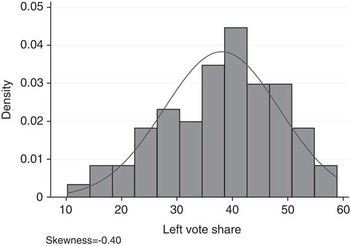
Data on electoral results (for legislative elections only) also come from the ParlGov database. We focus on established Western European democracies, in which parties and voters are accustomed to participating in legislative elections. As the histogram of Figure 1 shows, there is good variation in the dependent variable of left vote share, and the distribution approaches normality. To allow for dynamic modeling, a lagged dependent variable is also included in the dataset: the summed vote share of left parties in the previous legislative elections.
Histogram of dependent variable: left vote share

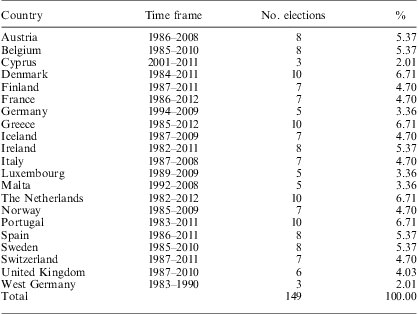
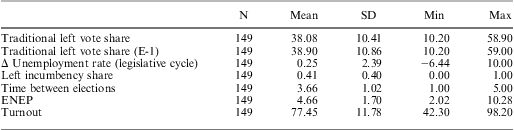
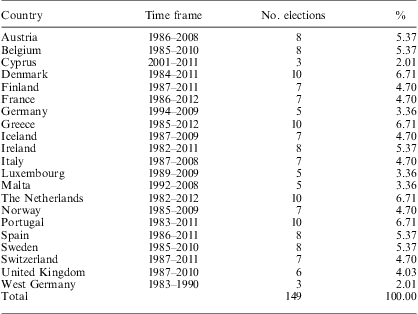
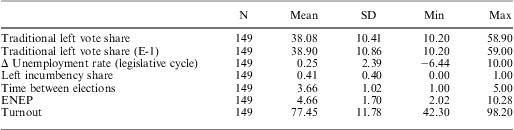
We are interested in the impact of economic policy voting on left parties. We use the change in the unemployment rate to capture this effect.Footnote 5 To calculate changes in unemployment rates, we use the yearly unemployment rates provided in the IMF's World Economic Outlook Database (2012). We also calculate changes in unemployment during the legislative cycle; that is, from the year beginning the term to the year before the election at time t. We include the trend in unemployment rates as observed by t - 1 in the analyses in order to ensure some lead time. Data on unemployment rates are available from the early 1980s onwards. Interestingly, during this period, the change in unemployment rate variable ranges from −6.44 to 10.00, SD = 2.39. Further, this distributional pattern hardly varies under left incumbent versus non-left incumbent governments; that is, SD = 2.19 and 2.67, respectively. Elections in Western Europe from 1982 to 2012 are analyzed, yielding a dataset of 149 elections from 21 countries.Footnote 6 The elections and countries included are listed in Table 1.
Elections Included in the Analysis
Since the mechanisms of left voting may depend on whether leftist parties are part of the ruling coalition, we include a measure of incumbency. One approach is of course to score a dummy variable 1 if a leftist party is in the governing coalition and 0 otherwise. But another, more telling, measure is the percentage of incumbent seats in parliament that are held by members of a left party. We use this measure, which we call Left Incumbency Share.
Some elements of the political context are also taken into account. First, the effective number of parties is controlled for, since the electoral success of leftist parties may be affected by the total number of parties competing in elections. Data on the effective number of parties (ENEP) in the elections analyzed come from Gallagher's (Reference Gallagher2012) database on electoral systems. We conducted experiments to determine if the main results were altered if ENEP was excluded, and/or the least squares index of party disproportionality were included. The disproportionality measure failed to demonstrate significance. Further, if ENEP is excluded, the pivotal result, as reported in Table 3, Model 3, maintains itself virtually intact. Results are available upon request. Secondly, turnout in the elections analyzed is controlled for, since the vote share of left parties may be higher when turnout is higher (Pacek and Radcliff Reference Pacek and Radcliff1995). Data for turnout in the elections analyzed come from the International IDEA online database (International IDEA 2012). Thirdly, a variable measuring time between elections is controlled for, based on the notion that there might be significant erosion of left support as temporal distance from the last contest increases. The maximum score on this variable is five years, while the minimum is one year; the average is 3.66 years. Descriptive statistics on all variables mentioned are provided in Table 2. For both turnout and ENEP, lagged effects are also included in the dynamic models, which refer to turnout and ENEP in previous elections in the countries analyzed.
Descriptive Statistics
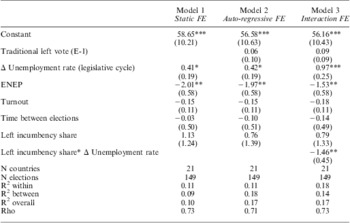
Fixed-effects Regression of Left Voting, Unemployment and Incumbency Effects

Estimates of a fixed-effects regression in Stata. *p < 0.05; **p < 0.01; ***p < 0.001 (two-tailed test)
Methods
TSCS data are analyzed, with multiple elections observed for all countries. Different approaches can be taken to analyze such data (Bell and Jones Reference Bell and Jones2012). Given that our interest is in the causal effect of unemployment on left party voting regardless of contextual differences, we begin with a fixed-effects approach. Thus we control for country-level variance by using country dummies, leaving just the within-country effects to be estimated (Allison Reference Allison2009; Bell and Jones Reference Bell and Jones2012). However to provide robustness checks, we include other approaches as well.
Initial Results
We first investigate the effect of unemployment rate change on left party vote share without controlling for the lagged dependent variable. The results of Model 1 in Table 3 indicate a noteworthy unemployment rate effect. The coefficient, which is significant and in the expected direction, suggests that when the unemployment rate rises 1 percentage point, traditional leftist parties gain 0.41 of a percentage point in vote share. Hence Hypothesis 1 receives preliminary support. What about influence from the control variables? On the one hand, turnout does not seem to significantly affect the electoral success of left parties, contrary to the findings of Pacek and Radcliff (Reference Pacek and Radcliff1995). The effective number of parties, on the other hand, quite logically has a strong and significant impact. Leftist parties obtain fewer voters as the number of parties in an electoral system increases. With respect to the other control variables, no significant effects appear. That is, no net incumbency effect emerges; leftist parties do not attain a significantly larger vote share as left parties gain majority seats in parliament. Finally, while the distance from the last election carries the expected (negative) sign, it falls short of significance. Apparently, no “disillusionment” of the left occurs with this passing of time.
Model 2 goes on to include a lagged dependent variable in order to reduce omitted variable bias. This vote share of leftist parties at t - 1 is actually a strong control, making causality claims more convincing. Clearly, changes in the unemployment rate are still significantly related to left party vote share, with the effect at least as strong, when compared to the static model. Furthermore, the significant negative effect of more parties in an electoral system holds. Lastly, the model fit shows a substantial boost with the addition of this lagged term.
Model 3 adds an interaction effect between changes in unemployment rate and the incumbency dummy. Doing so is a first test of Hypothesis 2, that left parties benefit less from rising unemployment rates when a left party is in government. This hypothesis receives support. The main effect of an increasing unemployment rate remains significantly positive for the left. However the interaction effect shows that, for a left incumbent, that effect diminishes considerably. Indeed, the interaction effect more than cancels out the main effect (0.97 − 1.46 = −0.49), turning electoral benefits for the left into electoral costs.
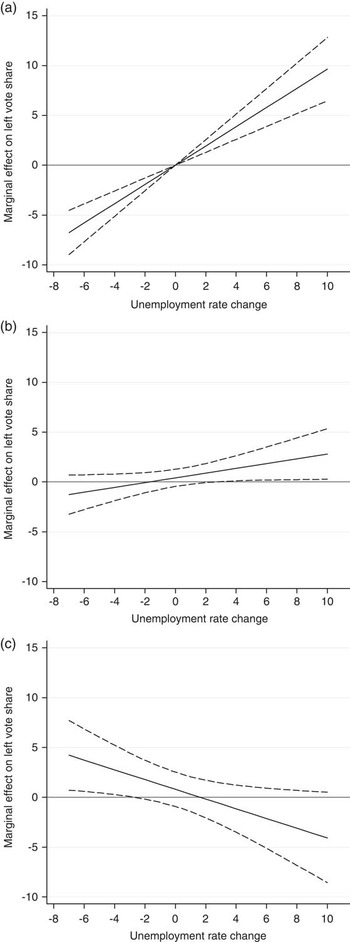
These effects are graphically presented in Figure 2. Initially, growing unemployment rates increase the vote share of leftist parties, if these are all in opposition. Decreasing unemployment rates are associated with a significantly smaller left vote share if all left parties are in opposition (see Figure 2a). However as the left incumbency share increases, the positive effect on the left vote share begins to decline (compare Figures 2a and 2b). By the time the left incumbency share reaches 100 per cent, the trend of left vote impact on rising unemployment is highly negative (see Figure 2c). Taking the confidence bands into account, the left only makes gains in this graph at higher ends of decreasing unemployment, and that effect appears quite small.
Marginal effect of unemployment rate change on left vote share when governing majority is (a) 0 per cent, (b) 50 per cent and (c) 100 per cent left

First Robustness Checks
The estimates of Table 3 support the hypothesis that economic policy-oriented voting may exist. In the face of a worsening unemployment rate, voters may turn leftward. However this benefit to the left appears blunted, even reversed, as the left assumes a larger role in government (see Model 3). Thus when in office, the left cannot depend on winning more support if unemployment rises, despite the fact that it might be perceived by some to “own” that issue. If such a proposition rings true, the finding certainly has implications for left policy strategy in government. Because of these implications, some caution is in order. Therefore we perform additional analyses (on the specification of Model 3, Table 3) in order to ascertain the robustness of these findings: a general random-effects maximum likelihood estimation (MLE), a within-between random effects MLE and a panel-corrected standard errors (PCSE) estimation. These new estimates appear in Table 4.
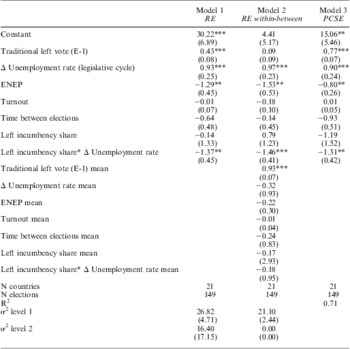
Random Effects and Panel Regressions of Left Voting, Unemployment and Incumbency Effects

Models 1 and 2 are estimated using xtmixed and Model 3 using xtpsce in Stata. First-order autocorrelation is specified for PCSE model. **p < 0.01; ***p < 0.001 (two-tailed test)
Model 1 of Table 4 presents the results of a standard random-effects specification. Instead of including dummies for capturing the country effects, a nested structure of elections within countries is specified. As can be observed, results are robust to this modeling approach. The main effect of unemployment on the vote share of left parties is still positive and significant, while the interaction with the incumbency dummy holds its sign and significance level as well. Substantively, Model 1 says about the same thing as Model 3, Table 3: on net, a left incumbent loses from a rising unemployment rate (0.93 − 1.37 = −0.44). Model 2 also includes the means of all independent variables, thus capturing heterogeneity and transforming the model into a within-between random effects model. This more elaborate specification sustains the Model 1 results regarding unemployment effects. Indeed, the precise estimate of net effects is almost the same: (0.97 − 1.46 = −0.49).
The above multilevel models (Models 1 and 2 in Table 4) indicate that the unemployment rate change does not vary significantly across countries, thereby providing further support for the fixed-effects results of Table 4. One caution with these corroborative multilevel model findings concerns their limited sample base of 21 countries. However the fixed-effects results receive support from yet another approach, that of a PCSE model, which appears in Model 3, Table 4. Such estimation also has further value because of the over-time nature of the dataset. Clearly, these results support the initial fixed-effect results (of Table 3, Model 3), yielding almost the same negative net effect of the changing unemployment rate (0.90 − 1.31 = −0.41). An additional insight gleaned from the PCSE approach is the strength of overall model fit, with an R-squared=0.71.
Second Robustness Checks
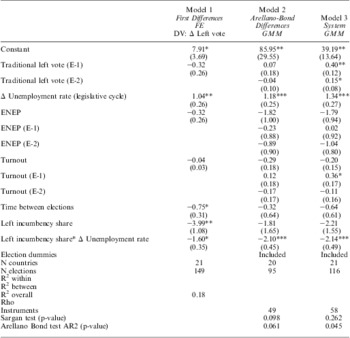
Estimation using the various approaches of Table 4 suggests the soundness of the initial fixed-effects result—under a left incumbency, the impact of rising unemployment on left vote becomes unambiguously negative. Nevertheless, the finding may still be threatened by autocorrelation. Therefore in further testing we examine three difference designs. We begin with a simple first-differenced design, removing country-level differences and autocorrelation at once. In this highly controlled specification, we regress (via ordinary least squares) change in unemployment rate on change in left vote share (reporting cluster-robust standard errors). Again we observe the earlier result: the estimated negative unemployment effect overwhelms the positive unemployment effect under the condition of left incumbency. Moreover, the magnitude of the effect appears at least as strong (1.04 − 1.60 = −0.54).
Besides autocorrelation, there can be concerns regarding the endogeneity of explanatory variables (Roodman Reference Roodman2009). Building on the work of Anderson and Hsiao (Reference Anderson and Hsiao1982), who proposed to eliminate correlated errors in a dynamic specification by means of first differencing, Arellano and Bond (Reference Arellano and Bond1991) suggested a Generalized Method of Moments (GMM) estimator that additionally makes use of a set of lagged variables as instruments. Although Arellano and Bond's GMM differences estimator clearly has some advantages, it has also been found to suffer from a large finite sample bias, with estimates of this method regularly found to be imprecise (Blundell and Bond Reference Blundell and Bond1998). Therefore, elaborating on the GMM differences estimator, Arellano and Bover (Reference Arellano and Bover1995) and Blundell and Bond (Reference Blundell and Bond1998) suggest including additional moment conditions in levels in the estimations. Given the added value of GMM estimators for dynamic modeling, and their popularity within the research literature (Roodman Reference Roodman2009) for validating robustness, we present an Arellano-Bond differences GMM estimation (Model 2) and an additional-levels specification, also called system-GMM (Model 3) (Blundell and Bond Reference Blundell and Bond1998) in Table 5.
Differences Models as Robustness Checks

Model 1 is an OLS run in Stata with cluster robust standard errors (for 21 country-clusters). Model 2 is estimated using xtabond and Model 3 using xtdpdsys in Stata. *p < 0.05; **p < 0.01; ***p < 0.001 (two-tailed test)
These GMM estimation approaches are particularly suited for data that have many panels but few time periods, such as we have (with more countries than time periods for each country). The estimations, however, come with additional assumptions. First, there should be no second-order serial correlation. Secondly, instruments are only valid if they are not correlated with the errors of the first-differenced equation. We test for violations of these assumptions using an Arellano-Bond and a Sargan test, respectively. These estimations permit the inclusion of time effects; consequently the GMM models include election dummies (coefficients not reported). These estimations are based on the use of lagged values of the dependent variable as instruments, with two lags as suggested by Arellano and Bond (Reference Arellano and Bond1991). Further, lagged values of the independent variables can be used. Given that previous values of some of our independent variables (turnout and the effective number of parties) can be expected to have an impact on current values, the estimations also include two lags of these independent variables.
The GMM estimations (Models 2 and 3, Table 5) again show that the direction and significance levels of the unemployment variable, and its interaction variable with the left incumbency share variable, are stable in Models 2 and 3 (when compared to the fixed effects Model 3 in Table 3). The size of the interactive effect, however, is clearly much stronger than the main effect of unemployment. In fact, here the main effect and the interaction effect are very far from canceling out. Instead, their combination (1.18 − 2.10 = −0.92, and 1.34 − 2.14 = −0.80, respectively) suggests a still stronger net negative impact of rising unemployment on left vote, to the degree that left parties govern.
This very strong GMM result may be taken with a grain of salt, given that the method requires looking at somewhat fewer elections, with many instrumental variables. Nevertheless, it does confirm the robustness of the initial, straightforward, fixed-effects finding: when the left governs, rising unemployment costs that government votes. When a left coalition governs, then, it will be punished for rising unemployment. It cannot escape the blame for bad economic policy, even if it “owns” the unemployment issue. Indeed, the electorate appears to hold it accountable to this “ownership,” punishing it for failing to fulfill its promise.
The Left Electoral Strategy Vis-À-Vis Unemployment
The left vote share in these Western European nations responds to the unemployment picture. In particular, changes in the unemployment rate clearly reduce the left vote under a left incumbency. This circumstance raises a strategic question for left governments: what should they do when faced with a rising unemployment rate? If they do nothing, they almost certainly will lose votes. So if they make program changes, or initiate counter-cyclical policies, aimed at cushioning the unemployment shock, will that save votes for the left? We have evidence on two such strategies, one general and one specific. For the former, we distinguish between different types of welfare regimes. Ferrera (Reference Ferrera1996) offers the following Western European typology: Anglo-Saxon, Bismarckian, Scandinavian and Southern.
We assign each country in the sample to this typology, creating a time-invariant variable situated at the country level. Then we explore a hierarchical linear model to investigate the effect of welfare system on left party vote share, adding these variables as main and interactive effects to our general multilevel model (Model 1, Table 4). As expected, countries under certain welfare regimes, as a block, vote significantly more left in general, namely the Southern welfare regimes (Italy, Greece, Portugal, Spain, Cyprus and Malta). However, with respect to the cross-level interactions with the unemployment rate change variable, none are significant. Thus welfare regime differences do not appear to alter the effect of unemployment rate change, with respect to the left vote. Rising unemployment, then, will hurt a left government just as much, regardless of the type of national welfare system it administers.
However, perhaps this finding on welfare regime type fails to be fine grained enough to pick up policy differences. Therefore we analyzed a more direct measure: national public spending on unemployment policies (measured as a percentage of GDP according to OECD data). We include this variable as a main effect, and as an interaction effect with the unemployment rate change, in our baseline fixed-effects model (Model 3, Table 3). Because of missing data, the sample is reduced (121 elections in 19 countries). The interaction term between spending on unemployment policies and change in unemployment rates attains marginal significance, also hinting at a collinearity problem (t = −0.39/0.19 = 2.05). This result, though fragile, does suggest that left government spending on the negative consequences of rising unemployment can mitigate the vote losses they will suffer from this unemployment. Further, although these are macro-data, it does imply that unemployed individuals themselves can make some difference. However in terms of strategies of the left in power, even this weak result sends a message: if it wishes to curb vote loses in the face of increasing unemployment, a government should consider implementing programs targeted at those most directly harmed by unemployment.
Conclusion
The policy-oriented hypothesis of economic voting receives naïve support, according to our initial analysis of this Western European pool. In general, an increase in the unemployment rate appears to lead voters to reward left parties. In particular, a percentage point increase in the unemployment rate is associated with just under a one-half percentage point rise in support for left parties. Thus positional issues on the economy, as well as valence issues, can matter to voters. However, the presence of positional economic voting, as discerned here, remains far from a negation of incumbency-oriented voting.
We observe that when left parties are in office, the left receives much less electoral benefit from rising unemployment. In fact, voters seem to hold the ruling left responsible, to considerable degree, for the deteriorating unemployment rate. At least a faction of them punishes the left by withdrawing their support. Overall, the punishment is severe enough that it largely cancels out any long-term benefit coming from left “ownership” of the unemployment issue. According to our central finding, which was sustained under tough statistical testing, a left government clearly loses votes from hikes in the unemployment rate. They may own the issue, but since they are not displaying “pride of ownership” in the face of growing unemployment under their leadership, they lose support.
Thus they are judged as incumbents, failing in their responsibility to deliver good economic policy, and are thereby held accountable at the ballot box. In this way, incumbency-oriented economic voting continues to operate, even in the face of policy-oriented economic voting undercurrents pulling in the opposite direction. Ultimately, the left parties appear not that special when it comes to unemployment issues. When they are in government, a decreasing unemployment rate benefits them, while an increasing unemployment rates costs them. In this situation, unemployment operates as a valence issue, with incumbency-oriented economic voting trumping policy-oriented economic voting.