The early history of the Riesencodex (D-WI1 2), the twelfth-century manuscript containing most of the works of Hildegard of Bingen (1098–1179), including her three books of visions and her correspondence as well as the most complete collection of her music, is well known and accepted widely by scholars today. Scholars generally agree that it was completed in the late twelfth century, in all likelihood in the scriptorium of Hildegard's Rupertsberg monastery, possibly some of it during her lifetime.Footnote 1 In the seventeenth century, the Rupertsberg nuns took it with them when they fled during the Thirty Years War; they kept it at the daughter house Hildegard had established in about 1165 across the Rhine at Eibingen. When the Eibingen monastery was dissolved during the early nineteenth century, the book was transferred along with Hildegard's twelfth-century Scivias manuscript (D-WI1 1) to the newly founded Öffentliche Landesbibliothek in Wiesbaden (now Hochschul- und Landesbibliothek RheinMain). Also well known is that of these two manuscripts, the Scivias manuscript was lost in Dresden during WWII.
What is little known and has not been documented in print is that the Riesencodex almost suffered the same fate. The Scivias manuscript and the Riesencodex were part of a group of sixteen manuscripts and one incunabulum from the Wiesbaden library that had been sent to Dresden for safe keeping during WWII. After the bombing of Dresden all but the Riesencodex were pillaged. Moreover, because the Riesencodex was in Dresden in the Soviet zone after the war, bringing it back to Wiesbaden in the American zone was not easy, and only occurred after several failed attempts, and through the heroic efforts of a number of people, including Margarete Kühn (1894–1986), a medievalist who worked for the Monumenta Germaniae Historica in Berlin.Footnote 2
For musicologists, the Wiesbaden Riesencodex is a significant historical document, as one of only two large collections of Hildegard of Bingen's music. The other collection is in the Leuven manuscript formerly held in the St-Pieters en Paulusabdij in Dendermonde, Belgium (B-DEa 9) and as of 2017 held at the Katholieke Universiteit in Leuven (B-LVu, no shelf number).Footnote 3 While Hildegard's writings circulated widely during the Middle Ages, her music did not enjoy the same circulation. Without these two manuscripts, we would know from other sources only three of Hildegard's chants out of seventy-seven, and the Ordo virtutum, and if not for this return, musicologists would be relying on a 1913 low-resolution, black and white facsimile edition of Hildegard's music, much reduced in size from the original, to study this primary source.Footnote 4 Also, of the 363 known manuscripts containing the works of Hildegard (her visions, her letters, her saints’ lives and so on), the Wiesbaden manuscript is the most complete single collection of her works. This account of how the manuscript was almost lost, and then returned to the library, is a critical piece of its history.
During WWII millions of historical works of art were looted or displaced, and only some of them (still) have been successfully returned to their original owners, whether private or institutional. The looting itself took on many forms, some systematic and others more opportunistic. The severity of the looting was already well known during WWII, and led to the establishment of the American Commission for the Protection and Salvage of Artistic and Historic Monuments in Europe in August 1943, which in recent years (through a popular book and film) has become known as the ‘Monuments Men’.Footnote 5 The Nazi Party, even before the war began, stole works of art from private Jewish collectors, and from public institutions in Germany. In addition, when fleeing Germany before the war because of Nazi persecution, many Jewish collectors lost their artworks through forced sales to dealers (at criminally low prices), or through abandonment as they sought refuge in other countries; their collections were appropriated by both government officials and local looters. Similarly, Jewish collectors lost cultural property to Nazi officials when they were arrested and sent to concentration camps.Footnote 6
The Nazi Party continued with its looting during the war, through its Reichsleiter Rosenberg Taskforce, systematically appropriating works of art in churches, museums, galleries and other collections in cities and countries under German occupation.Footnote 7 Some of the artworks were auctioned off to raise funds, and some were hidden away, intended for Hitler's planned museums in Linz. Further contributing to post-war displacement, early on in the war, many museums and libraries throughout Europe, Britain and Russia moved their collections to what they hoped were safer locations, to the cellars of the institutions and/or away from larger cities, using salt mines and remote castles.Footnote 8
As the Soviet army advanced from the east and the other allied forces from the west, much in their path was destroyed either by the invading armies themselves or by the retreating Germans, and further looting took place. While some of this looting was carried out by individual soldiers and civilians, the Russians raided as part of a larger, national strategy. In January 1944, they had already established a Trophy Commission with detailed lists of works of art that they planned to take from Germany as restitution for the destruction and theft by the Germans earlier in the war.Footnote 9 The plan was to create in Moscow the finest museum in the world. The Commission set up trophy brigades, which collected and shipped to Moscow thousands of artworks and precious books found in locations all over Germany. While the war was ongoing, items had to be packed up and shipped quickly to avoid bombing raids, and so cataloguing was minimal and records were frequently sloppy or non-existent.Footnote 10
Since the end of WWII, individuals and institutions have searched for lost art, and/or fought to have items returned when their location is known. The Soviet Union received worldwide attention in 1955, when in an act of good will and state propaganda it returned much of the artwork stolen from the Gemäldegalerie in Dresden to East Germany, and several years later also returned the Pergamon altar to Berlin.Footnote 11 Restitution, however, can be rather complicated. Just after the end of the Cold War in the early 1990s, a large number of paintings stolen during WWII ‘mysteriously’ began to surface on the art market, and throughout that decade there were many reports of the Soviet Union agreeing to consider the question of the return of works of art to their original owners.Footnote 12 There was not, however, widespread agreement in Russia that cultural property should be returned to Germany, and all efforts came to a halt on 20 July 1999, when Russia's Constitutional Court issued an eighty-page ruling that ‘sought to block any restitution of trophy art’.Footnote 13 The Russian government, along with its citizens, believed that the appropriation of German cultural property was justified compensation for what had been lost at the hands of the Germans, and so there should be no question of restitution.Footnote 14
Given this context, the return of the Wiesbaden Riesencodex is rather remarkable. The details of its move to Dresden, the attempts to retrieve it and its eventual return offer a unique perspective on the working lives of Germans and the importance of cultural artefacts during WWII and the early days of the Cold War. To reconstruct the events between 1942 and 1950, I draw on original documents (reports, statements, letters and telegrams) kept in a file in the state library in Wiesbaden for decades and recently transferred to the State Archive for Hesse.Footnote 15
WWII and the Wiesbaden library
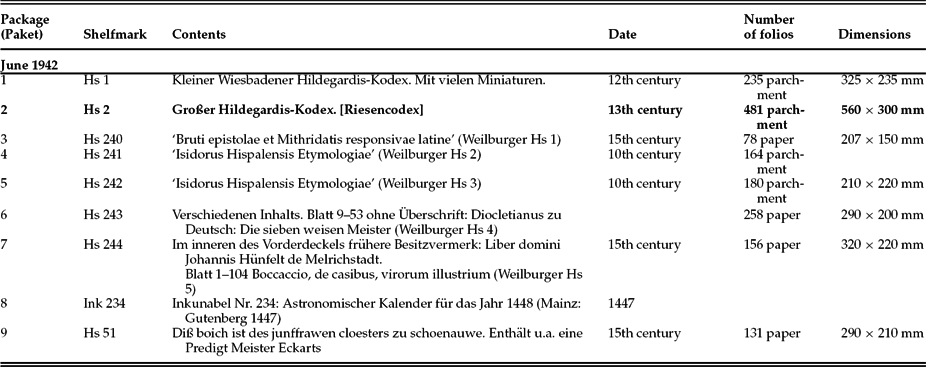
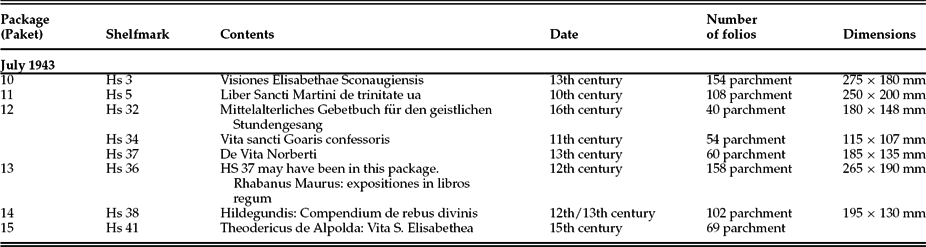
Except for the Wiesbaden air base of the Luftwaffe (German air force), the city itself was not a particular target of allied bombing missions during the war. But by June of 1942, Gustav Struck (1889–1957), director of Wiesbaden's state library, had become concerned enough about stray bombs that he moved a number of items to Dresden for safe keeping.Footnote 16 He sent reference librarian Georg Vogel (1901–77) to store eight manuscripts (including the two Hildegard manuscripts) and one early print – an astronomical calendar printed by Gutenberg – in the vault of the Girozentrale Sachsen in Dresden as outlined in Table 1.Footnote 17 A year later, in July 1943, Struck sent six more packages with eight further manuscripts to the same bank, listed in Table 2.Footnote 18 In light of the bombing of Dresden, this turned out to be a dreadful choice, but at the time, the city had ‘little of strategic importance’ and was not generally considered a likely target for an air raid.Footnote 19 It was odd, however, that another city was selected, especially one that was so far from Wiesbaden, but the location may have been inspired by Nazi Party connections. Struck was a devoted member of the Nazi Party,Footnote 20 and in 1942 the director of the Staatlichen Gemäldegalerie in Dresden was Hans Posse, who was Hitler's special advisor and collector for his planned museums in Linz.Footnote 21 Perhaps Struck had occasion to consult with Posse, who recommended Dresden and maybe even the bank.Footnote 22
Descriptions taken from Enclosures 1 and 2 included with a letter from the Provinzialverband Nassau to the Militär-Regierung, Education Officer [sic], Capt. Kolda, 3 August 1945 (HHStAW 819_285.1) and from two undated lists, Aus der Landesbibliothek Wiesbaden 1942 und 1943 nach Dresden ausgelagert und seit 1945 verschollen (HHStAW 819_285.2) and Folgende Handschriften aus dem Sitz der Nassauischen Landesbibliothek wurden im Tresor der Giro-Zentrale Sachsen, Dresden, Ringstraße 62 zum Schutz gegen Luftangriffe untergebracht (HHStAW 819_285.1).

Descriptions taken from Enclosures 1 and 2 included with a letter from the Provinzialverband Nassau to the Militär-Regierung, Education Officer [sic], Capt. Kolda, 3 August 1945 (HHStAW819_285.1) and from two undated lists, Aus der Landesbibliothek Wiesbaden 1942 und 1943 nach Dresden ausgelagert und seit 1945 verschollen (HHStAW 819_285.2) and Folgende Handschriften aus dem Sitz der Nassauischen Landesbibliothek wurden im Tresor der Giro-Zentrale Sachsen, Dresden, Ringstraße 62 zum Schutz gegen Luftangriffe untergebracht (HHStAW 819_285.1).

The transfer of the manuscripts and the printed calendar proceeded very smoothly, as we know from Georg Vogel's meticulous documentation in a report dated 6 July 1942, shortly after his return.Footnote 23 He explained that on Friday, 26 June, he travelled from Frankfurt to Dresden with two large parcels, containing eight smaller packages of the items listed in Table 1.Footnote 24 By pre-arrangement, he was met at the central railroad station at 9 pm in Dresden by Mr Falke, who was a departmental director at the bank, as well as by the cashier, Mr Lein. Because Falke had a badly injured leg, it was Vogel and Lein who transported the two large parcels (by streetcar) to the building of the Girozentrale Sachsen and deposited them in the vault. The next morning, on Saturday, 27 June, Vogel returned to the bank, and in the presence of Falke opened the smaller packages. As he had agreed with Gustav Struck before leaving Wiesbaden, he opened first the casing of D-WI1 1, the Scivias codex of Hildegard of Bingen and the most valuable of the library's manuscripts. With a special focus on the miniatures in the Scivias manuscript, he briefed the bankers on the significance of these items. He explains in his report that D-WI1 1 was placed in Box 1, and that packages 3–7 were placed in Box 2.Footnote 25 Unfortunately, though, package 2 from Wiesbaden containing the Riesencodex (D-WI1 2), and package 8 containing the calendar would not fit in any of the available boxes; the Riesencodex in particular is a very large book (56 × 30 cm, 461 parchment leaves). The bankers promised to create a new box out of sheet metal and to make it waterproof by soldering its sides together. Meanwhile, the two packed boxes and the two remaining packages were placed in the safe in a lockable steel cabinet. The boxes were numbered on the exterior and a note was placed next to the numbers that provided identification and named the library.Footnote 26 To ensure that both the library and the bank were in agreement about what was in the vault, the contents were certified on the boxes by both Falke's and Vogel's signatures.
Once the business at the bank was taken care of, Vogel took the opportunity to visit a library in Dresden, the Sächsische Landesbibliothek and met with its director, Hermann Neubert (1892–1980).Footnote 27 Vogel explained to Neubert the motives of his visit to Dresden; Neubert expressed surprise that the Wiesbaden library would endanger their valuable cultural goods not only by sending them to a large city, but also by selecting a prime bombing target, because the Girozentrale Sachsen in Dresden was ‘a tall building in the centre of the city, in the neighbourhood of the city hall, not far from the main railway station’.Footnote 28 Neubert doubted that the bank was a safe place to deposit these books, and declared further that most of Dresden's art treasures had been sent out of the city. He acknowledged that his own library's manuscripts were still in Dresden, but that was because, as he explained to Vogel, the building of the State Library was very sturdy and had secure cellars, and that in any case it was on the edge of the newer part of the city, rather hidden away in a large park, and so would not be a target of an air raid. (As it turned out, Neubert was wrong. The Japanese palace where the state library was located was heavily bombed. Two hundred thousand volumes of the Landesbibliothek were destroyed in the resulting fire, and more than 200,000 books were later taken by the Trophy Commission. The most precious books stored in the cellar were damaged completely through seepage, flooding and water from the firefighting efforts.Footnote 29)
Vogel's very careful and detailed description of this conversation reveals a concern about his own library's selection of a safe site for the manuscripts, and his concern seems to have intensified with the next conversation he had with a librarian, this time in Breslau/Wrocław. Early on Monday, two days after visiting Hermann Neubert in Dresden, Vogel travelled from Dresden to Breslau to pick up another book owned by Wiesbaden; D-WI1 51 contained a collection of letters by the medieval German mystic Meister Eckhart.Footnote 30 The manuscript, which had been on loan to Josef Quint, who was editing Eckhart's letters for publication, was packed up in Vogel's presence; once again, however, when he mentioned that the Wiesbaden library stored their valuable books in a bank vault in Dresden, the director of the Staats- und Universitätbibliothek in Breslau, Joseph Deutsch (1885–1966), expressed surprise that they would do such a thing. He had placed his library's manuscripts outside of Breslau in smaller places because of the danger of air raids.Footnote 31 Clearly other librarians had thought through this whole process more carefully than Gustav Struck in Wiesbaden, and Vogel seems to have recorded these conversations in his report as a way of communicating this oversight to his superiors.
Nevertheless, Vogel returned to Dresden at 10 pm of the same day and went straight to the Girozentrale building.Footnote 32 Thanks to special identification, he was authorised to go in after hours, and together with a bank official he brought the Breslau package to a secure room in the vault. The next morning, on Tuesday, 30 June, he met again with Falke to arrange the transfer. The manuscript picked up in Breslau was placed in Box 3, and he was given the key to the box and a receipt. Meeting with Falke and the building manager, he brought up the questions raised by the other librarians about the manuscripts being in a tall building in a large city. Falke assured him that if there was a real danger, they could always send out the packages to a branch of the bank in a smaller centre.Footnote 33 That evening Vogel left Dresden and arrived back in Wiesbaden on the morning of Wednesday, 1 July.Footnote 34
Vogel's report, dated 6 July, must have been enclosed with other correspondence to the governor of the Bezirksverband Nassau, because on 8 July 1942, the governor sent a letter to the Wiesbaden library providing a detailed protocol for the later retrieval of the manuscripts from Dresden. He addressed Vogel's concerns, albeit in a most unsatisfactory way:
Der Girozentrale Sachsen habe ich gleichzeitig mitgeteilt, dass eine Überführung der dort untergebrachten Kulturwerte in ländliche Filialen m.E. nicht notwendig ist. Die bei der Girozentrale Sachsen deponierten Werte sind gegen Feuer-und Einbruchdiebstahl bei der Hessen-Nassauischen Versicherungsanstalt Wiesbaden in den Gesamtverträgen mitversichert.Footnote 35
(I have informed the Girozentrale Sachsen that a transfer of the cultural documents stored there to more rural branches is not necessary. The deposited goods at the Girozentrale Sachsen have been insured against fire and break-ins through the general contracts with the Hesse-Nassau State Insurance in Wiesbaden.)
Unfortunately, the governor did not seem to understand that a financial payout is hardly compensation for irreplaceable medieval manuscripts. The following summer (1943) Struck sent the eight further manuscripts listed in Table 2 to the Girozentrale Sachsen in Dresden (signing his cover letter, ‘Heil Hitler!’).Footnote 36 Until the autumn of 1945 there is no further documentation of the status of any of the manuscripts.
After the War
On 8 May 1945, Germany surrendered unconditionally to the Allies, by which point most of the country was already under the control of occupying allied forces. Although the rules of occupation and the status of post-war Germany were not finalised until the Potsdam Conference (17 July–2 August), reorganisation and removal of Nazi officials had already begun. In June, Nazi Party loyalist Gustav Struck was ‘given time off’ (‘wurde er beurlaubt’),Footnote 37 and towards the end of 1945, the American administration appointed a new director, Franz Götting (1905–73), who had been an archivist and librarian at the Goethe-Museum in Frankfurt am Main.Footnote 38 Among Götting's early projects was the attempt to retrieve the library's manuscripts and the incunabulum sent to Dresden, a process that had begun as early as 3 August. Someone (with an illegible signature) from the Culture Department in Nassau wrote to Capt Kolda in the military government in Wiesbaden in English and German to notify him that a number of manuscripts were ‘dislocated’.Footnote 39 Enclosures 1 and 2 (also in English and German) with the letter provides detailed information about the manuscripts, and in the final paragraph of the English version of Enclosure 1 emphasises their importance to the library:
The total value (amateur value) of the manuscripts which are now in Dresden amount to 5 million Marks at least.
It is entirely impossible to replace the manuscripts as they mostly represent single specimen.Footnote 40
Götting's efforts over several decades to find the manuscripts demonstrate his deep awareness of the value (both monetary and cultural) of the missing items.
On 26 November 1945 he sent out the first of many enquiries to Dresden to try to secure them. At that stage, while he knew that the manuscripts had been sent to the Girozentrale in Dresden, he had not yet seen Vogel's 1942 report, and had no idea whom to contact at the bank. Dresden was damaged so extensively by allied bombing of 13–15 February that it could not be assumed that any particular person or building survived the attack. Thus Götting's first enquiry was to ask a contact in Dresden to find out if the Girozentrale survived the war and whether or not its contents were intact.Footnote 41 Although no response is in the file, a few weeks later he sent a letter to the bank without addressing any individuals, asking about which formalities the library needed to undertake in order to retrieve the items from their safe-deposit boxes.Footnote 42 In a memorandum written on the same day, he mentions that it is an appropriate time to inquire about the manuscripts because postal traffic to Dresden had restarted.Footnote 43
A few weeks later, in a letter dated 5 January 1946, Götting received a reply from two bank officials. Neither Mr Heymann nor Dr Georg Wilhelm Schaarschmidt (1879–1958) were the officials that Vogel had dealt with. They stated that only ‘manuscript 2’ (D-WI1 2, the Riesencodex), from Box 5 was still in their possession, and that they had no information on the location of any of the other Wiesbaden manuscripts stored by the bank.Footnote 44 They were very regretful because ‘our safe survived and was completely untouched by the countless severe attacks on Dresden, which left the building . . . in ruins.’Footnote 45 They acknowledged that the one remaining manuscript belonged to the library in Wiesbaden, but they enclosed a copy of Order No. 124 from the Soviet Administration, which made the situation somewhat delicate. Dated 30 October 1945, the instruction reads in part:
befehle ich:
1. Das Eigentum, das sich auf dem von den Truppen der Roten Armee besetzten Territorium Deutschlands befindet und
a) dem deutschen Staat und seinen zentralen und örtlichen Organen,
b) den Amtsleitern der Nationalsozialistischen Partei, deren führenden Mitgliedern und einflußreichen Anhängern,
c) den deutschen Militärbehörden und Organisationen,
d) den von dem Sowjetischen Militärkommando verbotenen und aufgelösten Gesellschaften, Klubs und Vereinigungen,
e) den Regierungen und Staatsangehörigen (physische und juristische Personen) der auf Seiten Deutschlands am Krieg beteiligten Länder,
f) Personen, die von dem Sowjetischen Militärkommando durch besondere Listen oder auf eine andere Weise bezeichnet werden, gehört, als beschlagnahmt zu erklären.Footnote 46
(I order to declare as seized:
1. The property that is found in German territory occupied by the Red Army that belongs to:
a) the German state and its central and local institutions,
b) the officers of the National Socialist Party, their prominent members and influential supporters;
c) the German military authorities and organisations,
d) the societies, clubs, and unions forbidden by the Soviet military command,
e) the governments and citizens (physical and legal entities) of the countries who took the side of Germany in the war,
f) persons, who are distinguished by the Soviet military command through particular lists or in another way.)
Heymann and Schaarschmidt further said that they would need some documentation in order to give the manuscript back, including a declaration that addressed Order No. 124 directly.Footnote 47 They provided a statement that must be included in the Wiesbaden library's documentation:
Wir erklären, dass die bei der vormaligen Girozentrale Sachsen verwahrte Blechkiste im Eigentum des Bezirksverbandes Nassau steht. Der Eigentümer gehört nicht zu den Personen und Stellung, deren Eigentum nach dem Befehl Nr. 124 des Obersten Chefs der Sowjetischen Militärverwaltung beschlagnahmt ist.Footnote 48
(We declare that the metal box kept by the former Girozentrale of Saxony is the property of the district federation of Nassau. The owner does not belong to the [categories of] persons and positions, whose property is to be seized according to Order No. 124 of the highest chief of the Soviet military administration.)
Götting acted immediately, writing several letters to government officials: to the minister for culture and instruction in Greater Hesse, to the governor of the municipal administration in Wiesbaden, and to the provincial conservator in Marburg/Lahn.Footnote 49 In the first two he says that it would be most appropriate for him to pick up the manuscript personally. On 12 February, however, Götting wrote to the bank in Dresden again and asked if someone there could bring the manuscript to the American zone;Footnote 50 in their reply the officers of the bank stated directly that they did not know anyone who could transport back the manuscript, and they asked that Götting find a suitable person.Footnote 51 Despite his initial suggestion, Götting himself did not travel to Dresden until June 1947. It is not entirely clear why; perhaps he was put off by travel conditions in Germany in early 1946, and/or by border issues between the American and the Soviet zones.
Lindner travels to Dresden
It took Götting several more months before he was able to work out a plan to retrieve the Riesencodex. On 1 June 1946, more than six months after he began his enquiries, he received a visit from Georg Vogel, who explained that he took the manuscripts to Dresden himself, and supplied Götting with the names of Director Falke and a Mr Dammann, as well as the cashier, Lein.Footnote 52 Presumably he also supplied Götting with a copy of his earlier report, or at the very least made him aware of its existence so Götting could locate it himself. By October, things seemed to have progressed. Götting planned for Mr Lindner, minister of culture and education for Greater Hesse, to travel to Dresden.Footnote 53 As Götting explains in a November report, Lindner made the trip, but unfortunately he did not return with the manuscript.Footnote 54 Rudolf Degner, the new director of the Dresden bank, had advised Lindner against taking it; there was a very real concern that the manuscript might be seized by Soviet authorities while he was travelling from Dresden in the Soviet zone to Wiesbaden in the American zone.Footnote 55 Degner explained that mail was being closely monitored and suggested to communicate orally rather than in writing. Lindner took Degner's advice and left the manuscript in Dresden.
Through Lindner's dealings with Degner, however, Götting now had further information about what happened to the manuscripts and incunabulum. His report states that:
Die Handschriften waren in verlöteten Kanistern aufbewahrt. Wie viele es gewesen sind, konnte Herr Degener [sic!] nicht angeben. Es befindet sich jetzt nur noch 1 Kanister von ca 70 cm Länge, 40 cm Breite und 20 cm Höhe in seinem Besitz. Den Inhalt dieses Kanisters kann Herr Degener nicht angeben. Nach dem Schreiben der Girozentrale vom 5.1.46 handelt es sich um die Kassette Nr. 5, in der sich das Paket Nr. 2 mit der Handschrift Nr. 2 (Grosser Hildegardis-Codex) befinden soll.
Nach der Freigabe durch die Russen hat Herr Direktor Falk [sic] zuerst den Tresor betreten. Es sei alles geplündert gewesen bis auf den einen Kanister, der etwas versteckt gestanden habe. Wer den Tresor entleert hat, ob es sich um eine offizielle Beschlagnahme oder eine wilde Plünderung gehandelt habe, kann niemand angeben.Footnote 56
(The manuscripts were kept in boxes that were looted. How many there were Mr Degener [sic] can't say. There is now only one box that is 70 cm long, 40 cm wide, and 20 cm high in his possession. The contents of the box, Mr. Degener can't provide. After receiving the letter of 5.1.46 from the Girozentrale we know now that the box was number 5 and that it contained package 2 with manuscript 2 [D-WI1 2], the large Hildegard book.
After the release by the Russians, Mr Director Falk [sic] was the first to enter the vault, and everything was pillaged, except for one box which was somewhat hidden. Whoever emptied the vault, whether it was in an official capacity or happened as a wild plundering, nobody can say.)
The only good news for Götting was that the other manuscripts were not destroyed in the fire-bombing of Dresden; plundered manuscripts, at least, can perhaps be found, although to this day none of the other manuscripts or incunabulum have resurfaced.
Von Hoyos, and later Götting, travel to Dresden
In early 1947 a new plan developed for the retrieval of the manuscript through contacts in the Benedictine network. Hildegard had been a Benedictine nun, and although the two Hildegard manuscripts belonged to the Wiesbaden library, they were originally at Hildegard's Rupertsberg and Eibingen convents. In the early twentieth century, just a hundred years after the dissolution of the Eibingen convent, a new institution was established in Hildegard's name just up the hill from the original buildings, as a renewal and continuation of that monastic tradition (called the Benediktinerinnenabtei Sankt Hildegard, hereafter referred to as the Hildegard Abbey). The Hildegard Abbey nuns were very much devoted to Hildegard, actively engaging in scholarship relating to her life and works, and were deeply concerned with the status of the manuscripts. On 24 June 1946, Götting wrote to them to tell them that the Scivias manuscript (D-WI1 1) was truly lost.Footnote 57
The Abbey was anxious to help with the retrieval of the Riesencodex, and through one of their Benedictine contacts had come up with a way of removing the manuscript from the Soviet zone without detection. Wilhelm Schröder, who worked for the Landesbank in Wiesbaden, was also a secular oblate of the Benedictine Abbey in Beuron, which was closely tied to the Hildegard Abbey. He had discovered a ‘favourable opportunity’, and wrote to Götting at the request of the Hildegard Abbey nuns.Footnote 58 He knew that some nuns in the Soviet zone were being moved from one Abbey to another, and a group whom he identifies only as a foreign church relief organisation was moving their belongings in its truck; the Riesencodex could be moved in the truck among all the other items and would not draw suspicion. One particular nun, he said, ‘who knows the situation in the Russian zone extremely well is considerably active in this matter’.Footnote 59 The Hildegard Abbey would arrange for one of their own nuns, Pia von Hoyos, to travel to Dresden to collect the manuscript from the bank, and then presumably meet up with the other nuns and the truck.
Acting quickly again, on 21 March 1947, Götting posted two items to von Hoyos: a letter with the signature of the governor of the municipal authorities in Wiesbaden to certify that she was allowed to pick up the manuscript, and a personal letter from Götting to the director of the bank in Dresden, Rudolf Degner.Footnote 60 As Götting's letter three months later to the governor indicates, von Hoyos did travel to Dresden.Footnote 61 Unfortunately, by that time, as Degner explained to her, the existence of the manuscript had come to the attention of the state government in the Soviet zone; it ‘had been taken officially into custody’ (‘den Codex offiziell in Verwahr genommen hatte’), and would not be released to her.Footnote 62 In June 1947 Götting himself travelled to Dresden (finally) to try to bring back the manuscript, but Degner had already surrendered it to the state government, handing it over to another bank, the Sächsische Landesbank for storage.Footnote 63 Götting reported that a Dr Rocholl in the Saxon state government assured him that the government ‘had the wish, through its own initiative, to return the manuscript to its rightful owner’ (‘den Wunsch habe, die Handschrift der rechtmässigen Besitzerin wieder zuzustellen’)’.Footnote 64 There was no indication, however, about how and when this return would take place, although Götting was advised to make a petition to the local cultural ministry. As Götting reported, his petition of August 1947 received a ‘polite but negative’ (‘höflich aber ablehnend’) response from Paul Wandel, president of the Landesverwaltung in the Soviet zone.Footnote 65 Wandel pointed out, moreover, that Soviet ‘cultural property was [also] being held in the western zones’ (‘in den Westzonen ebenfalls Kulturgut zurückgehalten würde’).Footnote 66 Official channels for retrieving the manuscript appeared to be closed.
The manuscript travels to Eibingen
The fourth attempt to retrieve the Riesencodex was finally successful, but it was certainly not because of the various players working through official channels. The manuscript arrived at the Hildegard Abbey on 11 March 1948, more than two years after Götting had begun his enquiries. The paper trail becomes somewhat murky as events are unfolding, but letters continuing several years after the manuscript was returned make it possible to piece together most of what happened. The opaqueness of the documentation at this stage is deliberate. Margarete Kühn, the woman who was responsible for returning the manuscript to the library, was working in the Soviet sector in Berlin, and she was anxious. Kühn was a medievalist, who had received a doctorate from the University of Fribourg in 1929 and worked in the archives at Leipzig University until she was appointed in 1941 to work on the Monumenta Germaniae Historica project in Berlin.Footnote 67 Her distrust of Soviet authorities might have had very personal roots: one of her colleagues, Eckhard Müller-Mertens (1923–2015), mentions in a biographical article that she ‘perhaps would have become the life companion of the writer and editor, Friedo Lampe’ (‘welcher Margarete Kühn vielleicht zum Lebensgefährten geworden wäre’), but he was shot on 2 May 1945 by Soviet soldiers who thought he did not resemble the photo in his identity papers.Footnote 68
This part of the manuscript's story begins again with a letter. On 13 August 1947, months after the failed retrieval of the manuscript in March and June, Marianne Schrader, a nun and scholar at the Hildegard Abbey, wrote to Götting.Footnote 69 She had been approached by the Monumenta Germaniae Historica in Berlin for photographs of the Riesencodex for a facsimile edition. Schrader wanted his help in getting access to the manuscript.Footnote 70 Two days later, Götting replied that he would try to secure access, and wrote immediately to the Dresden division of the Ministry for Education, University and Science to see if this could be arranged.Footnote 71 Shortly thereafter he must have received another letter from Schrader that is not in the file, because he sent a further reply to her on 23 August, making reference to a letter she had forwarded to him from Margarete Kühn of the Monumenta project.Footnote 72 That day he also sent a letter to Kühn, enclosing a letter of authority to borrow the manuscript from Dresden, and similarly sent a letter to the director of the project in the American zone, Friedrich Baethgen (1890–1972), with a copy of the letter of authority.Footnote 73 In his letter to Kühn, however, Götting expressed doubt that she would be given access to the manuscript, but he gave her ‘the desired authority’ and hoped that ‘we will yet succeed in bringing the Codex back’.Footnote 74 In November, despite Götting's doubt, he received a letter from Degner in Dresden affirming that the state government had in fact agreed to lend the book to Kühn in the Soviet sector in Berlin.Footnote 75
Just nine days after Degner's letter to Götting, Marianne Schrader wrote to him with an unusual request, which surely indicates that the Abbey nuns and Götting were aware of Kühn's plans. Schrader explained that Kühn was looking for a manuscript the size of the Riesencodex; they did not have one at the Abbey, because their library was not academic, but perhaps the library in Wiesbaden did.Footnote 76 Replying a few days later, Götting said that he could not find anything of that size.Footnote 77 The only explanation for this odd request is that Kühn was plotting to find a substitute for the Riesencodex so that she could return the original manuscript to Wiesbaden.
Before actually securing some kind of substitute, however, and without telling anyone at the Deutsche Akademie or the Monumenta project in Berlin, Kühn either brought or sent the Riesencodex to the Eibingen nuns with the wife of an American military official in March 1948. Although there is no explicit statement anywhere that Kühn was involved with the actual transport, in April 1950 she mentioned to Götting that she had met him ‘two years ago on Good Friday . . . in Eibingen’ (‘Am Karfreitag vor 2 Jahren . . . in Eibingen’).Footnote 78 Good Friday in 1948 was on 26 March, a couple of weeks after the book arrived in Eibingen, which makes it possible that Kühn was physically involved in its delivery. While Götting no doubt knew about the arrival from the start, its appearance at the Abbey was not documented in any of their correspondence until twenty months later at the end of 1949.
In response to Götting's request for a chronology of events, Adelgundis Führkötter, another nun and scholar at the Hildegard Abbey, sent all the dates of the movement of the manuscript, including an entry for 11 March 1948 written partly in German and partly in English:
11.3.1948: unerwartete Ankunft des C. auf unserer Abtei. Überbringerin: Mrs. Walsher [sic], Gattin des General Chief of Intelligence of the American Army.
11.3.1948: ‘unexpected arrival of the C[odex] at our Abbey. The bringer: Mrs Walsher [sic], spouse of the General Chief of Intelligence of the American Army.Footnote 79
While Margarete Kühn is not mentioned in this account, ‘Mrs Walsher’ must have been Caroline Walsh, who was married to Robert Walsh, a major general with the United States Air Force. No reference to any American military officers at a higher rank called Walsher during this period could be found. There are, however, two officers with the surname Walsh, which makes it almost certain that Adelgundis Führkötter got the name wrong. James Walsh and Robert Walsh both worked in the American Air Force and both worked in Intelligence, but various details make Robert Walsh far more likely the officer that Führkötter is referring to. Robert Walsh had become director of intelligence of the European Command in April 1947, and (unlike James Walsh) was stationed in Berlin from April 1947 to October 1948, coinciding with the time of Margarete Kühn's involvement with the manuscript, which began in August 1947.Footnote 80 By that point after the war, most wives of American military personnel posted in Germany had joined their spouses (a military strategy to reduce the fraternisation between American soldiers and German women), so it would not have been unusual for Caroline Walsh to be in Berlin for this eighteen-month period as well.Footnote 81 Moreover, a direct statement by Robert Walsh from a military oral history project in 1984 confirms that Caroline Walsh was in Berlin with him, and specifically that she was involved in the community with religious organisations:
A [Hugh N. Ahmann]: Were you able to bring your family over to Germany?
W [Robert L. Walsh]: Yes.
A: How was life in Berlin in these days?
W: Very nice [!!!!]. My wife worked a great deal with the Germans and with the religious outfits over there, too.Footnote 82
A reference to Robert Walsh places him in Berlin on 5 March, six days before the manuscript arrived in Eibingen.Footnote 83 What may never be known is how Walsh and Kühn knew each other or how the transport of the manuscript actually took place, but in all probability Caroline Walsh and Margarete Kühn connected through Catholic circles in Berlin, or through the Hildegard Abbey, since Robert and Caroline were certainly Catholic and Caroline was involved with religious organisations in Berlin.Footnote 84 In any event, Caroline Walsh agreed to take the manuscript across the border out of the Soviet zone into the American zone, and brought it herself (perhaps with Kühn) to Eibingen on 11 March. Because her husband was in the Air Force and would have travelled regularly to Wiesbaden where the Office of Military Government, United States (OMGUS) Hesse was based, she may have had the opportunity to fly from the American sector in Berlin to Wiesbaden in the American zone and thereby completely avoid the problem of physically crossing a zone border and risking discovery of the manuscript. Almost a year later, the manuscript travelled to Limburg and then to Maria Laach Abbey for microfilming, returning to Eibingen and Wiesbaden in March 1949.Footnote 85
For the nuns at the Abbey, and for the library, all this was great news. For Kühn, however, by April 1949 there were serious problems, both personally and professionally. Kühn lived in the American sector of Berlin in Zehlendorf and worked in the Soviet sector on Unter den Linden. During the Berlin blockade (24 June 1948–12 May 1949), her life must have been particularly difficult and complicated.Footnote 86 Franz Götting was concerned enough about Kühn that he took the unusual measure of involving his cousin in the affair. Heinrich Götting, who also lived in the American sector in Berlin, visited Kühn (who was in the hospital with a broken leg), and learned much about her current situation personally and in regard to the manuscript. On 3 April he reported that the state government in Dresden had been asking for the manuscript back from the Academy for some time, and was getting more insistent.Footnote 87 By 21 April the situation had worsened: Kühn had learned through her assistant that a current journal had a reference to the Hildegard codex finding itself in Wiesbaden, which was putting her in an ‘untenable situation’ (‘in eine unhaltbare Lage’).Footnote 88 Franz and Heinrich Götting were very worried about Kühn and the terrible pressure that she was under, and for several weeks they corresponded about the possibility of returning the Riesencodex to Berlin, and how it might be accomplished. Götting decided that he would have to take it back himself by flying to Berlin, and worked to secure permission to make the journey, priority for air travel and funds to cover the cost.Footnote 89 He was also considering two other options: (1) moving Kühn from her workplace in the Soviet sector to the university in western Berlin (presumably he is referring to the newly established Freie Universität Berlin), or (2) finding a manuscript to exchange for the Hildegard codex.Footnote 90 The plan became fixed when on 19 May Heinrich sent the following telegram to Götting: ‘An exchange object is sufficient’ (‘Austauschobjekt allein genuegt’).Footnote 91
Acting with characteristic swiftness, Götting chose an incunabulum that resembled the appearance of the manuscript: Vincent of Beauvais's Speculum historiale in Koberger's Nuremberg print of 1483.Footnote 92 To make it look like the Riesencodex, he attached a chain to the book (the Riesencodex is often described as the book ‘with the chain’ (‘mit der Kette’),Footnote 93 and then flew with it to Berlin to give it directly to Kühn sometime just before 11 June.Footnote 94 Götting reported a number of months later that by this point Kühn was fearful.Footnote 95 A week later, after his return to Wiesbaden, in a letter to Kühn he wondered if she had already sent the book on to Dresden.Footnote 96 He added cryptically, ‘The Eibingers are of course very happy that Aunt Hilde [the manuscript] is still in her homeland.’Footnote 97 As it turns out, it would be another five months before the box with the fake manuscript was taken to Dresden; the Academy wanted to deliver the box personally and there was no opportunity to take it there by car until November 1949.Footnote 98 For whatever reason, the box remained unopened in Dresden until two months later, when the fraud became exposed.Footnote 99 A Mr Weber, who worked for the Ministry of Education for the State government of Saxony, wrote to the German Academy in Berlin, and said that the box:
wurde in Anwesenheit von 5 Zeugen am 26. I. 1950 geöffnet. Dabei wurde festgestellt, dass die Kiste nicht den Hildegardis-Codex enthielt, sondern eine Incunabel: speculum historiale, gedruckt 1478 [sic!] bei Anton Koburger [sic] in Nürnberg. Die Incunabel ist nach dem Besitzstempel Eigentum der Nassauischen Landesbibliothek Wiesbaden . . . Wir bitten Sie, zur Klärung der Angelegenheit ausführliche Angaben zu machen.
(was opened on 26 January 1950 in the presence of five witnesses. It was found that the box did not contain the Hildegard manuscript [D-WI1 2] but rather an incunabulum: Speculum historiale, printed in 1478 [sic!] by Anton Koburger [sic!] in Nuremberg. According to the ownership stamp this incunabulum is the property of the Nassau State Library in Wiesbaden . . . We ask you to clarify this matter in a detailed report.)Footnote 100
Kühn clearly was at a loss about what to do. She forwarded the letter to Götting, who in turn wrote to his cousin and suggested that Kühn should reply that she had sent the manuscript to Eibingen for the nuns to use for their research, and that they had packed and sealed the box before sending it on, which would not incriminate her.Footnote 101 He begged Heinrich to talk to Kühn and work out a plan.
Heinrich complied. A week later, he reported to Götting that on 9 November Kühn had undergone surgery to replace her cancerous eye with a glass eye.Footnote 102 They agreed that she would write to Dresden and say that she had sent the box just before having eye surgery, which was actually true, and claim that she accidentally mixed up two packages: the incunabulum had come to her from Wiesbaden during the war and she was returning it to Wiesbaden at the same time that she was returning the Riesencodex to Dresden. Unfortunately, she must have confused the packages due to her poor eyesight. In addition, Kühn indicated that there was some concern in Berlin that pages or initials might have been cut out of the manuscript to make a profit.Footnote 103 She wrote to Götting to ask him to write to Fritz Rörig (1882–1952), the director of the Monumenta project in Berlin, to assure him that the manuscript was intact.Footnote 104
Götting assured Rörig that the manuscript was in excellent condition, and took the opportunity to negotiate. He explained that he had expected the incunabulum from Berlin, but surprisingly received the Riesencodex instead.Footnote 105 Naturally, they were very happy to have it returned. As he argued, of the two Hildegard manuscripts, this one was really not as interesting because it was a later manuscript, and in any case it was only text, with no miniatures or decorated initials. He recommended to find an alternative manuscript, which might be of interest to the East, to exchange with Dresden.Footnote 106 Rörig took this suggestion seriously and negotiated with Dresden on Götting's behalf, and eventually the matter seemed to be resolved.Footnote 107
Unfortunately, Margarete Kühn's situation did not improve immediately. Fritz Rörig had doubts about her story. His first letter to Götting expresses his shock at discovering that the manuscript was in Wiesbaden and at the ‘almost unbelievable high-handedness of an employee’ (‘mit der geradezu unglaublichen Eigenmächtigkeit einer Mitarbeiterin’), referring, of course, to Kühn.Footnote 108 In a later letter to Götting, he interrogated him about his reason for issuing authority to Kühn in his letter of 23 August 1947.Footnote 109 Götting passed this on to Kühn, but earned the terse response: ‘Always these foolish questions’ (‘Immer diese törichten Fragen!’), and was asked to ignore it for the time being.Footnote 110 Meanwhile, Götting also wrote to the president of the Monumenta in Munich, Friedrich Baethgen.Footnote 111 He revealed the whole story and acknowledged that ‘as an employee of the Monumenta, Kühn had handled things incorrectly’; all the while, he insisted that it had been for a good cause.Footnote 112 He indicated that Rörig had been very hard on Kühn, and was unsure of whether or not Rörig believed their story of the mislabelled boxes. He asked for strict confidentiality about their communication, stressing that it would create difficulties for Kühn. Baethgen agreed to keep silent, and stated explicitly that he did not doubt Kühn's motivation.Footnote 113
By August 1950, Kühn was in a rather desperate state. As it emerges from her correspondence, she was hoping to be moved from Berlin (in what had become East Germany) to the head office in Munich, in West Germany.Footnote 114 On 27 August she informed Götting that Baethgen had agreed to meet with her in Munich, and she wanted to do so before the meeting of the Monumenta’s central commission (‘Zentralkommission’) on September 20, 1950.Footnote 115 Baethgen had agreed to provide free accommodation in Munich, and she could afford to travel by train on her East German salary but she was terrified of the border crossing. Rörig had informed her that the East German police (‘Ostpolizei’) had made enquiries about her. She said that the situation was in fact the very opposite: ‘I have him to thank, if the police are paying attention to me.’Footnote 116 Rather than take the train she wanted to fly from West Berlin (where she lived) into Munich, which by air required no border crossing at all, but she could not afford the airfare. She wrote to Götting to see if he could lend her 150–200 Marks, because she did not have the money to buy a plane ticket. She said that she could repay her debt in monthly instalments of 10–15 Marks.Footnote 117 Kühn did travel to Munich, but much to her disappointment, when she met with Baethgen, he said that she had to stay in Berlin.Footnote 118 The difficulty, according to Baethgen, was that if the Berlin office were depleted any further, the Monumenta would lose essential printing subsidies from East Germany. She wrote to Götting that she was ‘a sacrifice for the Institute’ (‘ein Opfer fürs Institut’).Footnote 119 To make matters worse, Baethgen appointed Rörig as her direct supervisor.
Despite Baethgen's declaration that he never questioned Kühn's motivation for sending the manuscript to the Hildegard Abbey nuns, her motivation actually is never clearly spelled out. Presumably what he meant by that statement is that she had not done it for personal financial gain, but rather to right a political wrong: to return a manuscript to its rightful owner. One has to wonder, however, why she risked her job for the sake of returning a manuscript, particularly when millions of people and goods were displaced all over Europe. Kühn had published a short article on Hildegard in 1940, and her devotion to Hildegard and the Hildegard Abbey emerges through numerous clues in her letters, in the obituary written about her for the Deutsches Archiv für Erforschung des Mittelalters, and in two published articles that discuss her work for the Monumenta.Footnote 120 Kühn was described as a ‘devout Catholic’ (‘sie, die gläubige Katholikin’) by her last line manager at the Monumenta, Eckhard Müller-Mertens.Footnote 121 Although born in the Protestant state of Sachsen in Mittweida, a small town southeast of Berlin, she went to the predominantly Catholic city of Freiburg to complete her doctoral dissertation on political life in medieval Genoa, under the supervision of church historian and medievalist Heinrich Finke (1855–1938).Footnote 122 Despite hailing from Saxony, her family may very well have been Catholic: Mittweida opened its first Catholic church since the Reformation in 1906, when she was twelve years old.Footnote 123 Whether or not she was raised a Catholic, most important for thinking about her motivation in returning the Riesencodex to the nuns at Eibingen, Müller-Mertens indicates that at some point she wanted to join the Hildegard Abbey, but had been prevented by her tuberculosis from realising this intention.Footnote 124
Kühn's desire to be at the Benedictine Abbey in Eibingen seems to have been prompted by her specific devotion to Hildegard, which she alludes to in several letters. Writing to Götting in 1950, she declared that her devotion to Hildegard came from her mentor, Abbot Ildefons,Footnote 125 most likely Ildefons Herwegen (1874–1946), Abbot of the Benedictine Abbey of Maria Laach from 1913 to 1946. Herwegen was an active Hildegard scholar, and had direct connections with the Hildegard Abbey (he had authored, for example, forewords to several publications about Hildegard that had come out of the Abbey itself).Footnote 126 In September 1952, Kühn informed Götting of the death of her difficult boss Rörig, implying that Hildegard had through his death thus demonstrated concern for her own well-being, taking her ‘under her veil again’ (‘unter ihren Schleier genommen’).Footnote 127 Kühn's personal devotion must have had a profound influence on her otherwise risky and rash decision to send the Hildegard manuscript to the nuns in Eibingen.
Beyond the small circle of her contemporaries at the Monumenta Germaniae Historica, and of course some of the nuns in Eibingen and the library staff in Wiesbaden, Kühn's role in the return of the Riesencodex appears not to have been widely known. It definitely did not have an adverse effect on her job security in the long term. Her Monumenta obituary makes no mention of the Riesencodex affair.Footnote 128 She died in 1986 at the age of ninety-two, forty years after these events took place. By that point she was the only one of her early colleagues from the 1950s to still be alive and, astonishingly, still working for the Monumenta.Footnote 129 Both Hermann Krause, who wrote her obituary for the Deutsches Archiv für Erforschung des Mittelalters, and Müller-Mertens emphasise her commitment to the completion of the Monumenta's Volumes 9 and 10 (the ‘Constitutiones et acta publica’) under very difficult circumstances. She worked for decades and in poor health after she reached a pensionable age in 1955, receiving a fixed pension in East German currency for thirty years while living in West Berlin during a period of intense inflation.Footnote 130 Krause describes her as leading an ‘almost monastic existence’ (‘fast mönchische Dasein’) as a scholar, an apt description under the circumstances.Footnote 131
As marvellous as it is that the Riesencodex made it back to Wiesbaden, for Götting, for the library, and for Hildegard scholars, there still remains the thorny question of where the missing incunabulum and the rest of the manuscripts ended up, particularly the most valuable and highly illuminated Scivias manuscript (D-WI1 1). In 1970 there was a flurry of letters between Götting and the art historians Rita Otto and Hiltgart Keller, as well as several reports by Götting on telephone conversations about a catalogue entry in a library in Dresden that mentions Scivias.Footnote 132 Unfortunately, it was only a 1948 description of the Riesencodex, which includes a copy of Hildegard's visionary work, Scivias. In 1992, a couple of years after the reunification of Germany, the library again made enquiries, but none of the manuscripts or the incunabulum has ever surfaced.Footnote 133 At the very least, thanks to the persistence of Franz Götting, the helpfulness of his cousin, Heinrich, the initiative of Margerete Kühn, and the bravery of Kühn and Caroline Walsh, the Riesencodex made it home.
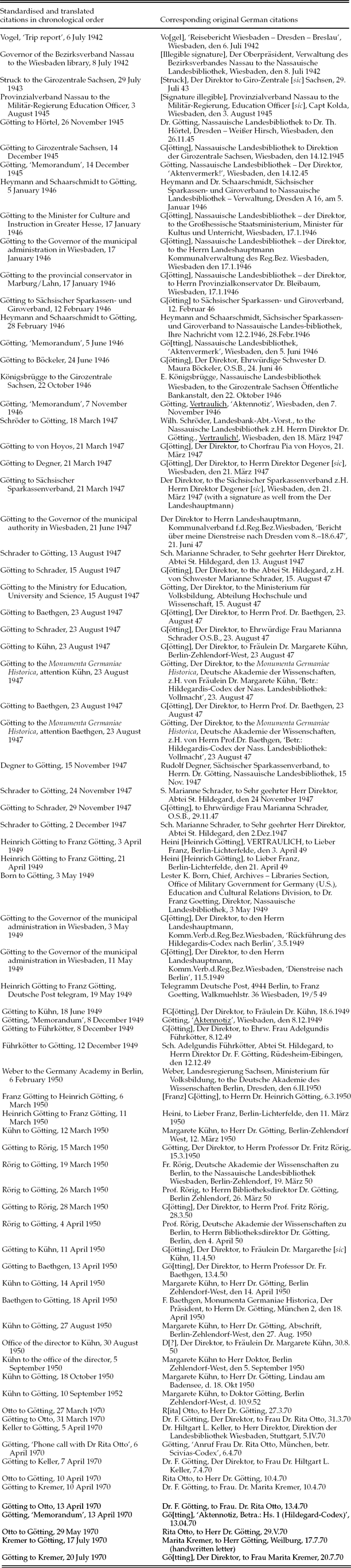
list of archival letters and reports as cited, with original language citations from HHStAW 819_285.1, Hessisches Haputstaatsarchiv in Wiesbaden