Introduction
Haematophagous females of some phlebotomine sandflies are the only natural vectors of Leishmania species (Killick-Kendrick, Reference Killick-Kendrick1990; Ready, Reference Ready2008), the causative agents of leishmaniasis in many parts of the tropics and subtropics, including Iran (Nadim & Seyedi-Rashti, Reference Nadim and Seyedi-Rashti1971). More than 46 sandfly species have been reported from Iran (Seccombe et al., Reference Seccombe, Ready and Huddleston1993; Kasiri, Reference Kasiri2000), but only a few have been incriminated as vectors of Leishmania major Yakimoff & Schokhor, the causative agent of rural zoonotic cutaneous leishmaniasis (ZCL) (Killick-Kendrick, Reference Killick-Kendrick1990). Evidence includes the typing of sandfly infections and the relative abundances of sandfly species in collections from human baits and the burrows of gerbil reservoir hosts (Parvizi & Ready, Reference Parvizi and Ready2008). The principal peridomestic vector in ZCL foci in Iran is Phlebotomus (Phlebotomus) papatasi (Scopoli) (Parvizi et al., Reference Parvizi, Mauricio, Aransay, Miles and Ready2005), but Phlebotomus (Paraphlebotomus) caucasicus Marzinowsky or species with morphologically similar females have frequently been found infected with Leishmania-like leptomonads in Iran (Nadim et al., Reference Nadim, Mesghali and Amini1968a; Nadim & Seyedi-Rashti, Reference Nadim and Seyedi-Rashti1971; Javadian & Seyedi-Rashti, Reference Javadian and Seyedi-Rasti1991) and other Asian countries (Killick-Kendrick, Reference Killick-Kendrick1990). Sometimes, infections found in Iran have been identified to species by isoenzyme electrophoresis (Yaghoobi-Ershadi et al., Reference Yaghoobi-Ershadi, Javadian and Tahvildare-Bidruni1995) or by phylogenetic analysis of the intergenic transcribed spacer of the nuclear ribosomal RNA gene array (ITS rDNA) of Leishmania (Parvizi & Ready, Reference Parvizi and Ready2008).
Phlebotomus caucasicus and Phlebotomus (Paraphlebotomus) mongolensis Sinton are frequently found in the burrows of the great gerbil, Rhombomys opimus (Licht.), and other reservoir hosts in Iran, but the females of these sandflies are not separable morphologically (Theodor & Mesghali, Reference Theodor and Mesghali1964). This prevents a direct investigation of their roles in maintaining transmission of L. major (Killick-Kendrick, Reference Killick-Kendrick1990) and other Leishmania species of gerbils (Parvizi & Ready, Reference Parvizi and Ready2008).
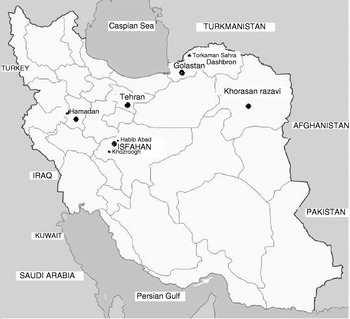
The objective of the present study was to search for diagnostic molecular markers for the females of P. caucausicus and P. mongolensis, by characterizing a mitochondrial gene that has previously proven useful for sandfly taxonomy, namely mitochondrial cytochrome b (cyt b) (Esseghir et al., Reference Esseghir, Ready and Ben-Ismail2000; Testa et al., Reference Testa, Montoya-Lerma, Cadena, Oviedo and Ready2002). Males of both species were used as reference material, because their external genitalia provide the only diagnostic morphological characters (Theodor & Mesghali, Reference Theodor and Mesghali1964). Iranian populations were sampled (fig. 1) from a sympatric region in the northeast province of Golastan and, in order to assist the association of the sexes, from regions where only the more widespread P. caucasicus has been reported, in the northwest province of Hamadan and the central province of Isfahan (Theodor & Mesghali, Reference Theodor and Mesghali1964; Nadim et al., Reference Nadim, Mesghali and Amini1968).
Locations of Iranian provinces, cities and villages where P. caucasicus and P. mongolensis were sampled.

Materials and methods
Insect samples and morphological identification
The collections were carried out in the provinces of Golastan, Hamadan and Isfahan (fig. 1) in 2001 and 2002, during the main summer season of activity of adult sandflies in Iran. Adult sandflies were collected on sticky papers placed at the entrances to gerbil burrows or in manual aspirators from resting sites during the early morning hours (Parvizi et al., Reference Parvizi, Benlarbi and Ready2003), and in Centres for Disease Control (CDC) miniature light traps (Sudia & Chamberland, Reference Sudia and Chamberland1962) set overnight in domestic animal shelters.
Following dissection with sterilized forceps and micro-needles (Testa et al., Reference Testa, Montoya-Lerma, Cadena, Oviedo and Ready2002), the head and abdominal terminalia of both sexes were slide-mounted in Berlese fluid in order to view, by compound microscopy (×400), the morphological characters diagnostic for the subgenus Paraphlebotomus (Lewis, Reference Lewis1982) and most of its species found in Iran (Nadim & Javadian, Reference Nadim and Javadian1976), including the males of P. caucasicus and P. mongolensis (Theodor & Mesghali, Reference Theodor and Mesghali1964; Perfil'ev, Reference Perfil'ev1966). No attempt was made to use the morphometric and meristic characters that might distinguish the males of P. caucasicus s.s. and Phlebotomus (Paraphlebotomus) grimmi Porchinski, as partially explained by Moin-Vaziri et al. (Reference Moin-Vaziri, Depaquit, Yaghoobi-Ershadi, Oshaghi, Derakhshandeh-Peykar, Ferte, Kaltenbach, Bargues, Nadim, Javadian, Rassi and Jafari2007). We treat P. grimmi as a senior synonym of P. caucasicus, as proposed by Lewis (Reference Lewis1982). The females of P. caucasicus and P. mongolensis could not be separated morphologically based on the structure of the spermathecae or the weakly developed pharyngeal armature (Theodor & Mesghali, Reference Theodor and Mesghali1964).
DNA extraction and PCR amplification of cyt b
Total DNA was extracted from the dissected thorax and attached anterior abdomen of individual sandflies using the method of Ish-Horowicz with minor modifications (Ready et al., Reference Ready, Lainson, Shaw and Souza1991).
The 3′ end of cyt b was amplified either as one fragment of 717 base pairs (bp), by using the forward primer CB1-SE with the reverse primer CB-R06 at one annealing temperature of 48°C (Parvizi & Ready, Reference Parvizi and Ready2006), or as two overlapping fragments if the genomic DNA was degraded, by using the primer pairs CB1-SE/CB3-R3A (Esseghir et al., Reference Esseghir, Ready and Ben-Ismail2000) and CB3-PDR/CB-R06 (Parvizi & Ready, Reference Parvizi and Ready2006). General protocols for PCR and amplicon purification followed Parvizi et al. (Reference Parvizi, Benlarbi and Ready2003).
Direct DNA sequencing, DNA sequence editing and alignments and phylogenetic analyses
One-hundred nanograms of each purified DNA sample was cycle-sequenced using an ABI Prism® Big Dye™ Terminator Cycle Sequencing Ready Reaction Kit (version 2.0) and semi-automated sequencing systems AB1 377 or ABI 3730x1 (Applied Biosystems Inc.), with 3.2 pmol of the same primers that were used for PCR, except for primer CB1-SE which was replaced by CB1 (Esseghir et al., Reference Esseghir, Ready and Ben-Ismail2000).
DNA sequences were edited and aligned using Sequencher™ 3.1.1 software (Gene Codes Corporation). The multiple alignments were used to identify the limits of open reading frames (ORFs), based on deduced amino acid sequences, and analysed phylogenetically using PAUP* software (Swofford, Reference Swofford2002).
Results
Distribution of morphotypes
Males of P. caucasicus and P. mongolensis could be separated morphologically, based on the diagnostic characters given by Theodor & Mesghali (Reference Theodor and Mesghali1964), Nadim & Javadian (Reference Nadim and Javadian1976) and Lewis (Reference Lewis1982). The basal lobe of the coxite is large and wide, and its unrounded end has many lateral and ventral setae in P. caucasicus. In comparison, this basal lobe is smaller and narrower, and its rounded end has mainly terminal setae in P. mongolensis. The latter was distinguished from Phlebotomus jacusieli Theodor by its longer style (four times as long as thick) bearing a markedly elongated terminal spine.
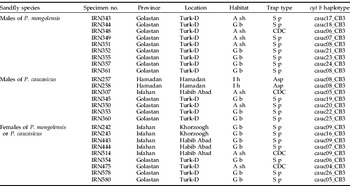
All nine males of P. mongolensis were collected in the northeast province of Golastan, in association with four females, whereas the seven males of P. caucasicus were collected not only in Golastan province but also in the northwest province of Hamadan and with five associated females in the central province of Isfahan (table 1).
DNA haplotypes of cyt b of males of P. mongolensis, males of P. caucasicus and their morphologically indistinguishable females collected in Iran for this report. Only cyt b haplotype cauc08_CB3 was found in males of both species.

A sh, animal shelter; G b, gerbil burrow; I h, inside house; S p, sticky paper; CDC, CDC miniature light trap; Asp, aspirator; Turk, Turkemen Sahara; D, Dashbron.
Distribution and relationships among DNA haplotypes of mitochondrial cyt b
The sequence of the last (3′) 288 bp of cyt b (CB3) was obtained from each of the 25 specimens listed in table 1 (GenBank accessions: FJ217389–FJ217392; GU057903–GU057914), and all these new sequences were aligned with the homologous sequences found in 23 males of P. caucasicus s.s. (C) or the morphotype P. grimmi (G) by Moin-Vaziri et al. (Reference Moin-Vaziri, Depaquit, Yaghoobi-Ershadi, Oshaghi, Derakhshandeh-Peykar, Ferte, Kaltenbach, Bargues, Nadim, Javadian, Rassi and Jafari2007) (GenBank accessions: EF017349–EF017371). There were no amino acid replacements. All sequences were monophyletic with respect to an outgroup of four sequences of Phlebotomus (Paraphlebotomus) sergenti Parrot, as assessed by a maximum parsimony analysis with 1000 heuristic searches and standard defaults in PAUP* (Swofford, Reference Swofford2002).
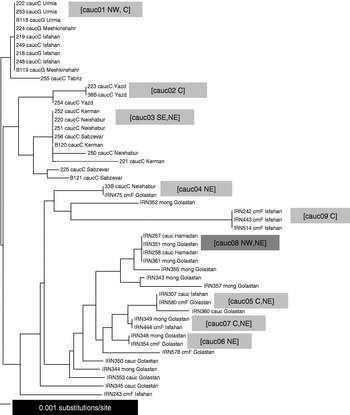
The relationships among all the in-group sequences (fig. 2) were assessed by the neighbour-joining (NJ) algorithm in PAUP* (Swofford, Reference Swofford2002), based on uncorrected pairwise genetic distances (p), with random breaking of ties and, to permit comparisons with the findings of Moin-Vaziri et al. (Reference Moin-Vaziri, Depaquit, Yaghoobi-Ershadi, Oshaghi, Derakhshandeh-Peykar, Ferte, Kaltenbach, Bargues, Nadim, Javadian, Rassi and Jafari2007), with a group of haplotypes from the northwest and centre of Iran designated as the out-group. A bootstrap analysis (1000 replicates) provided significant support (>70%) only for some of the terminal branches joining sequences from the same or nearby locations. The p-values between pairs of sequences were low (0.003–0.038), which is consistent with intra-specific variation. The p-values between any one of these in-group sequences and any one of the out-group sequences of P. sergenti was much higher (0.119–0.148).
Neighbour-joining tree of relationships among all short cyt b (CB3) sequences, including new ones (IRN) and those (other labels) published by Moin-Vaziri et al. (Reference Moin-Vaziri, Depaquit, Yaghoobi-Ershadi, Oshaghi, Derakhshandeh-Peykar, Ferte, Kaltenbach, Bargues, Nadim, Javadian, Rassi and Jafari2007), based on untransformed genetic distances (p). Each sequence is labelled with the (alpha-) numeric specimen code, the species code (caucC, P. caucasicus s.s. male; caucG, P. grimmi male; cauc, P. caucasicus s.l. male; mong, P. mongolensis male; cmF, female of P. caucasicus or P. mongolensis, which are morphologically indistinguishable) and the Iranian province (IRN) or settlement (Moin-Vaziri et al., Reference Moin-Vaziri, Depaquit, Yaghoobi-Ershadi, Oshaghi, Derakhshandeh-Peykar, Ferte, Kaltenbach, Bargues, Nadim, Javadian, Rassi and Jafari2007) of collection. CB3 haplotype codes are given only for sequences found in two or more specimens, (e.g. cauc01 NW, C), contain abbreviations for the geographical regions (NW, northwest; C, centre; SE, southeast; NE, northeast) and the only one shared by males of P. caucasicus and P. mongolensis has darker shading.

Twenty-six haplotypes (=unique sequences) were identified (table 1, fig. 2), and their geographical distributions were restricted. Each of three haplotypes came from two or more specimens of P. caucasicus s.l. from populations characterized only by Moin-Vaziri et al. (Reference Moin-Vaziri, Depaquit, Yaghoobi-Ershadi, Oshaghi, Derakhshandeh-Peykar, Ferte, Kaltenbach, Bargues, Nadim, Javadian, Rassi and Jafari2007) : haplotype cauc01_CB3 was restricted to locations near the northwest settlements of Urmia (W Azerbaijan province) and Meshkinshahr (Ardebil province) as well as the central city of Isfahan (Isfahan province); haplotype cauc02_CB3 was restricted to the location near the central settlement of Yazd (Yazd province); and haplotype cauc03_CB3 was restricted to locations near the southeast settlement of Kerman (Kerman province) and the northeast settlements of Neishabur and Sabzevar (Khorassan-e-Razavi province). Six other haplotypes (cauc10_CB3–cauc15_CB3) were found in single specimens of P. caucasicus s.l. from populations characterized only by Moin-Vaziri et al. (Reference Moin-Vaziri, Depaquit, Yaghoobi-Ershadi, Oshaghi, Derakhshandeh-Peykar, Ferte, Kaltenbach, Bargues, Nadim, Javadian, Rassi and Jafari2007), and their geographical locations matched those of the more abundant haplotype with which each was grouped (fig. 2), e.g. the haplotype of the specimen from the northwest settlement of Tabriz (E Azerbaijan province) grouped with haplotype cauc01_CB3.
Only the haplotype cauc04_CB3 was found both by Moin-Vaziri et al. (Reference Moin-Vaziri, Depaquit, Yaghoobi-Ershadi, Oshaghi, Derakhshandeh-Peykar, Ferte, Kaltenbach, Bargues, Nadim, Javadian, Rassi and Jafari2007) and by us (fig. 2), respectively in single specimens of P. caucasicus s.l. or P. mongolensis collected near the northeast settlements of Neishabur (Khorassan-e-Razavi province) and Dashbron (Golastan province). Three of the haplotypes found only by us could possibly be species-specific: cauc05_CB3 was associated only with the male of P. caucasicus s.l. and, in contrast, cauc06_CB3 and cauc07_CB3 were associated only with the male of P. mongolensis. However, there was no suggestion of any association of each male morphotype with any one of the poorly supported branches of the NJ tree. Indeed, haplotypes cauc05_CB3, cauc06_CB3 and cauc07_CB3 were on the same major branch that contained haplotype cauc08_CB3, which contained two males of P. caucasicus s.l. from the northwest province of Hamadan and two males of P. mongolensis from the northeast province of Golastan. Further evidence against the association of cyt b lineages with each species comes from the mixed geographical origins of the specimens with haplotypes cauc05_CB3 and cauc07_CB3. Each had representatives from the northeast province of Golastan, as well as the central province of Isfahan from where P. mongolensis is unknown. Only one of the haplotypes found by us was on a long branch and represented by specimens from a single province, haplotype cauc09_CB3 from Isfahan (fig. 2), but there was no association with any male morphotype.
Eleven other haplotypes (cauc16_CB3–cauc26_CB3) were found in single specimens of P. caucasicus or P. mongolensis from populations characterized only by us, and there were no clear associations between NJ branches and geographical regions (fig. 2).
Discussion
Interest in P. caucasicus and related species arises mostly because they might have a role in the transmission of L. major in many of the widespread Asian foci of ZCL (Killick-Kendrick, Reference Killick-Kendrick1990; Parvizi & Ready, Reference Parvizi and Ready2008). However, these species are not often abundant in the burrows of the gerbil reservoir hosts, e.g. Parvizi et al. (Reference Parvizi, Benlarbi and Ready2003), and the few typed infections of L. major found in them indicate only that they take blood meals from reservoirs, because no infective forms have been reported. Most of these potential vectors were described as taxonomic species, based on small differences in the setation and form of parts of the external genitalia that show much individual variation, e.g. Moin-Vaziri et al. (Reference Moin-Vaziri, Depaquit, Yaghoobi-Ershadi, Oshaghi, Derakhshandeh-Peykar, Ferte, Kaltenbach, Bargues, Nadim, Javadian, Rassi and Jafari2007). Many such species of the subgenus Paraphlebotomus have been synonymised, including P. grimmi (Lewis, Reference Lewis1982; Seccombe et al., Reference Seccombe, Ready and Huddleston1993), but P. mongolensis is still treated as a species in Iran and some nearby countries.
Mitochondrial cyt b sequences were obtained from males of P. caucasicus and P. mongolensis that could be separated morphologically based on the diagnostic characters given by Theodor & Mesghali (Reference Theodor and Mesghali1964), Nadim & Javadian (Reference Nadim and Javadian1976) and Lewis (Reference Lewis1982), and these were aligned with homologous sequences obtained from males of P. caucasicus and P. grimmi by Moin-Vaziri et al. (Reference Moin-Vaziri, Depaquit, Yaghoobi-Ershadi, Oshaghi, Derakhshandeh-Peykar, Ferte, Kaltenbach, Bargues, Nadim, Javadian, Rassi and Jafari2007). However, this new phylogenetic analysis provided no support for considering P. mongolensis or P. grimmi, as temporarily resurrected by Moin-Vaziri et al. (Reference Moin-Vaziri, Depaquit, Yaghoobi-Ershadi, Oshaghi, Derakhshandeh-Peykar, Ferte, Kaltenbach, Bargues, Nadim, Javadian, Rassi and Jafari2007), to be phylogenetic species distinct from P. caucasicus. Most of the genetic variation in Iran was geographical. Our results confirm the regional distributions of cyt b haplotypes of P. caucasicus s.l. in Iran, as first reported by Moin-Vaziri et al. (Reference Moin-Vaziri, Depaquit, Yaghoobi-Ershadi, Oshaghi, Derakhshandeh-Peykar, Ferte, Kaltenbach, Bargues, Nadim, Javadian, Rassi and Jafari2007).
Mitochondrial cyt b demonstrated an absence of lineage sorting between the male morphotypes of P. caucasicus, P. mongolensis or P. grimmi, indicating that any biological speciation is at best incomplete. All three taxa might be good biological species showing mitochondrial introgression caused by occasional inter-breeding, as has been proposed for other sibling species of sandflies (Testa et al., Reference Testa, Montoya-Lerma, Cadena, Oviedo and Ready2002; Pesson et al., Reference Pesson, Ready, Benabdennbi, Martín-Sánchez, Esseghir, Cadi-Soussi, Morillas-Marquez and Ready2004). This could be tested by a population genetics approach using several polymorphic genes. However, where an absence of lineage sorting is demonstrated, applied biologists should consider carefully the costs of searching for species-specific molecular markers. Perhaps, these should be sought only if there is good evidence for associating specific taxa with phenotypes of epidemiological importance. There is no such evidence for P. caucasicus and its related species, and so there is no reason to give priority to resolving the species status of P. mongolensis or P. grimmi.
Acknowledgements
We are grateful to Julia Llewellyn-Hughes and Claire Griffin for help with DNA sequencing. This work was supported by grant 367 awarded to Dr Parviz Parvizi by the Pasteur Institute of Iran and the Ministry of Health & Medical Education.
Ethical approval: Department of Parasitology, Pasteur Institute of Iran, Tehran, Iran.