Introduction
A preference for sons over daughters, and its causes and consequences, have generated considerable research in India. A particularly troubling consequence of favouring sons is differential treatment of children resulting in boys enjoying an advantage over girls in nutrition and health. Studies on gender bias in food allocation point to differences in the amount and type of food as well as some of the longer term consequences of malnourishment and morbidity (Muhuri & Preston, Reference Muhuri and Preston1991; Pande, Reference Pande2003; Bharati et al., Reference Bharati, Bharati, Pal, Chakrabarty, Som and Gupta2009). Early childhood is a period of rapid growth, and discrimination against female children contributes significantly to excess female mortality in India, which has led to millions of ‘missing’ women (Miller, Reference Miller1981; Kishor, Reference Kishor, Das Gupta, Chen and Krishnan1995; Dreze & Sen, Reference Dreze and Sen1996; Das Gupta, Reference Das Gupta1998; Premi, Reference Premi2001). Excess female mortality in childhood, particularly between the ages of 1 and 5, has been shown to be large enough to explain most of the imbalance in the sex ratio in India (Oster, Reference Oster2009).
While there is widespread recognition that discrimination against female children contributes to the gender differences in mortality, much of the research has concentrated on individual and family characteristics as predictors of such discrimination (Miller, Reference Miller1981; Kishor, Reference Kishor1993; Arnold et al., Reference Arnold, Choe and Roy1996; Pande, Reference Pande2003; Mishra et al., Reference Mishra, Roy and Retherford2004). A key factor that contributes to gender discrimination against daughters is women's status. It has been posited that women with higher status, particularly those with more education, may be less inclined to discriminate against their daughters as a result of having more knowledge and control over resources (Parashar, Reference Parashar2005). While much of the existing research looks at mother's education, there is hardly any that considers the other dimensions of women's status, such as autonomy and local exogamy, which are thought to have an impact on women's position and agency within their families. Additionally, there has been a lack of progress linking these micro-level characteristics with those of groups and larger units of social organization (macro-level). In order to understand how social structure affects the behaviour of individuals, the link between macro- and micro-levels must be investigated. This article focuses on just such a link as it considers the dependence of gender bias in nutrition on social context.
The assumption that shared membership in a neighbourhood or community modifies individual behaviour is central to this investigation of gender bias in food allocation. The extent of differential treatment may vary across families in different social settings. This study is concerned not only with the individual-level characteristics of the mother but also the societal context in which she (or others in her family) makes decisions regarding her child's well-being. In the context of gender bias, individual characteristics such as a lack of education or personal autonomy might inhibit the effective flow of information about gender equality. But community norms and attitudes in the form of village- or neighbourhood-level characteristics can also influence ideas and practices beyond the individual characteristics. Therefore, a key question here is the extent to which there is a contextual effect on discrimination. Do similar women behave differently in different environments?
The Indian background
The existence of son preference is not in dispute in India (Phillip & Bagchi, Reference Phillip and Bagchi1995). It is not unusual that the birth of a son is an occasion for rejoicing while the birth of a daughter often goes unnoticed or is even mourned (Miller, Reference Miller1981; Das Gupta, Reference Das Gupta1995). In many families, the status of the mother falls when she gives birth to a daughter (Ghosh, Reference Ghosh1995). In most families, sons are desired because they raise the power and prestige of a family and carry on the patriline. In particular, sons are desired because they are often the only means available to a woman to gain prestige and legitimize her position in her husband's family (Desai, Reference Desai, Krishnaraj, Sudarshan and Shariff1998). Sons are also critical as a source of influence in a mother's later years.
Given the pervasiveness of son preference, it is not surprising that young girls are at a considerable disadvantage compared with their brothers. When there is inadequate food, women and girls have the larger deficit (Becktell, Reference Becktell1994; Joshi, Reference Joshi1998). However, studies based on food intake data or anthropometric data show mixed results. Several studies have shown that female children receive less food or suffer more from malnutrition (Wyon & Gordon, Reference Wyon and Gordon1971; Cowan & Dhanoa, Reference Cowan, Dhanoa and McLaren1983; Sen & Sen Gupta, Reference Sen and Sen Gupta1983; Pettigrew, Reference Pettigrew1986; Khan et al., Reference Khan, Anker, Ghosh Dastidar, Bairathi, Caldwell and Santow1989; Nag, Reference Nag1991; Ghosh, Reference Ghosh1995). Even in case of similar caloric intake, boys are given more valued foods, such as milk and fats, while girls are given more cereal (Das Gupta, Reference Das Gupta1987, Reference Das Gupta1990). In contrast, a case study using data from selected states shows no evidence of gender bias in allocation of nutrients to young children aged 0–5 years (Lancaster et al., Reference Lancaster, Maitra and Ray2006). Similarly, a case study in a Delhi slum showed that boys received slightly poorer diets than girls as regards some items such as fruits and eggs, even though boys consumed slightly more milk (Basu, Reference Basu1992).
Analytical framework
Explanations of son preference and gender discrimination point to several factors that contribute to the devaluation of daughters. This investigation focuses on a model that expresses food allocation as a function of mother's status and attitude along with the type of community that she is a member of. Factors that are directly related to women's agency are thought to have strong effects on female disadvantage. By increasing women's agency and control over resources, women may be able to improve childcare and may also raise the importance assigned to girls (Dreze & Sen, Reference Dreze and Sen1996). In past research, women's status is most often conceptualized in terms of economic power and access to, and control of, resources (Mason, Reference Mason1984; Sen, Reference Sen and Tinker1990).
Women's employment reduces economic dependence on males and increases their visible contributions toward their families. Work improves women's social standing within the family and society, and they have more voice because they are less dependent on others (Sen, Reference Sen and Tinker1990; Dreze & Sen, Reference Dreze and Sen1996). Increased education can also influence a woman's position in her family and may consequently increase her perceived value of daughters (Caldwell, Reference Caldwell1979). Educated women may have more resources available to them and be better able to make use of existing resources in their childcare practices (Caldwell, Reference Caldwell1986). This causal link appears to be confirmed in studies that show women's education is associated with less discrimination against female children (Das Gupta, Reference Das Gupta1998; Borooah, Reference Borooah2004) and lower female disadvantage in child survival (Murthi et al., Reference Murthi, Guio and Dreze1995; Dreze & Sen, Reference Dreze and Sen1996). However, it is also possible that education increases bias against daughters in cases where the bias is intentional, whether for economic or cultural reasons. In other words, the improved access to knowledge and resources that comes through education may be used to intentionally improve the lives of the preferred sex to the detriment of the other. Confirming this theory is research showing that although educated mothers exhibit higher levels of responsibility in handling children's illnesses than uneducated mothers, the sex differential in health care and eventual mortality is higher among them as well (Basu, Reference Basu1989).
A third and perhaps more direct measure of women's status may be the level of personal autonomy enjoyed by a woman. Woman's autonomy is a broad concept that may be loosely defined as the freedom to act or make decisions on one's own. It may be argued that women with higher autonomy are more able to make better childcare decisions, not only because they have more control over resources, but also because they have more access to people outside their immediate family and may have more knowledge regarding good nutrition for children. Indeed, studies on women's autonomy have linked it to better maternal and child health outcomes (Bloom et al., Reference Bloom, Wypij and Das2001; Moursand & Kravdal, Reference Moursand and Kravdal2003). Higher levels of women's household autonomy have been shown to reduce infant mortality (Hossain et al., Reference Hossain, Phillips and Pence2007).
Among other explanations of son preference and daughter neglect related directly to women's status is that of marriage and kinship patterns. Regional differences in son preference are often tied to differences in women's status (Dyson & Moore, Reference Dyson and Moore1983; Das Gupta, Reference Das Gupta1987; Miller, Reference Miller1997). Strong son preference in the north is thought to be tied to the marginalization of women in the kinship structure (Dyson & Moore, Reference Dyson and Moore1983; Das Gupta, Reference Das Gupta, Kertzer and Fricke1997). Women are transient members of their natal family. Upon marriage, a norm of kin and village exogamy in the north isolates and disadvantages young brides (Karve, Reference Karve1965; Libbee, Reference Libbee and Sopher1980; Das Gupta, Reference Das Gupta1998). Henceforth, women are only allowed to return to her natal family for short visits. Under this structure, young women have limited decision-making authority and must prove her loyalty by bearing children, particularly sons (Basu, Reference Basu1992; Dube, Reference Dube1997).
In the south, the kinship organization is mostly patrilineal and patrilocal but there are some pockets of matrilineal and matrilocal family organizations that have diluted the effect of patrilineal family structure (Libbee, Reference Libbee and Sopher1980). In all of south India there is a bias for marriage within a small kin group, outside of immediate kin. Upon marriage, the young bride often lives quite close to her natal family and continues to visit them regularly (Dyson & Moore, Reference Dyson and Moore1983; Dube, Reference Dube1997). Blood ties as well as affinal ties are important elements of the kinship organization of both men and women. As a result, daughters as well as sons have value in the family of birth. Thus, less male-centred kinship structures tend to increase the value placed upon women and are thought to result in less discrimination against daughters.
While there are numerous studies that consider the effect of these proxies of women's status on selective neglect of daughters, there are few that consider the effect of community norms on individual actions. Yet, in a country like India, it is clear that communities exert great influence on individual behaviour. Non-kin members of a community or neighbourhood are often referred to in kin idiom. Neighbours provide advice or criticism to non-family members, even on personal matters, and social sanctions may be placed against a family that violates community norms. Thus while an individual woman may not always be able to see to her daughter's well-being, it seems reasonable to anticipate that communities with more women of higher status could change traditional norms regarding son preference and daughter neglect.
A few studies that have considered the importance of context have in fact found a significant relation between community and health care outcomes over and above maternal and family characteristics. Community-level indicators of women's education (usually operationalized as female literacy) have been shown to affect children's immunization status (Parashar, Reference Parashar2005) as well as child mortality (Kravdal, Reference Kravdal2004). Thus a woman with little or no education may benefit from higher levels of women's education within her community through her access to a more knowledgeable social network. Similarly, a woman, even one of low status, residing in a community with more autonomous women may be more able to withstand norms about favouring sons because she has the support of her broader social network of women.
Data and Methods
This section provides an overview of the data, methods and research strategy used to study discrimination against female children in India. The data used in this study are from the third National Family Health Survey (NFHS-3) conducted in 2005–06. The NFHS-3, a nationally representative survey of 124,385 women between the ages of 15 and 49 years, includes a child's dataset that provides detailed information on the health and nutritional status of children under 5 years of age and their parental and family characteristics. One advantage of using this dataset for contextual analysis is that it allows individual-level characteristics to be linked to the Primary Sampling Unit (PSU). The PSU consists of the village in rural areas and a city block in urban areas and is thus adequate for measuring community-level variations. The individual-level characteristics are designated as micro-level variables, while the PSU-level characteristics are designated as macro-level variables. Multilevel analysis is used to examine the effects of both the micro and macro components simultaneously, thereby accounting for the dependence of individual behaviour on the social context.
Food allocation and nutritional status
There are several dependent variables used in this study to investigate gender bias in food allocation. The duration of breast-feeding for infants has implications for son preference. Mothers may be inclined to breast-feed daughters for a shorter time in order to hasten the next pregnancy in hopes that the next child will be a son (IIPS & ORC Macro, Reference Dyson and Moore2000). Therefore, the first dependent variable is a continuous variable called duration of breast feeding measured in months for children who are no longer being breast-fed. The age at which supplements to breast milk are introduced has implications for children's health and development. International standards suggest 6–9 months is the age at which solid food should be introduced in combination with breast-feeding. The NFHS-3 asks mothers whether the infant had any solid or semi-solid food in the past 24 hours. Since prior research shows that boys are sometimes given better quality or more valued foods, this investigation focuses on two types of supplemental foods in this research. Supplemental milk products is a dummy variable that is constructed for currently breast-feeding infants up to 2 years of age. This variable is coded 1 for infants who received cheese, yogurt, fats, butter or other milk products in the last 24 hours and 0 for all other infants. A third dependent variable, supplemental meat, fish and eggs, is coded 1 if the child received any meat, fish, poultry or eggs, and 0 otherwise.
The final dependent variable is based on anthropometric data. Data on weight-for-age are used as indicators of nutritional status. Well-nourished children have weight-for-age that is greater than 80% of the median weight for their age (Pelletier, Reference Pelletier1998; Sommerfelt & Arnold, Reference Sommerfelt and Arnold1998). It should be noted that anthropometric data like weight-for-age normally reflect the combined effects of current and past childcare and feeding and morbidity. It does not reflect adequacy of food alone. The fourth and final dependent variable is malnutrition, a dichotomous variable that is coded 1 for malnutrition and 0 for well-nourished children.
Micro-level independent variables
The primary independent variable is child gender, a dichotomous variable that is coded 1 if the child is female and 0 if the child is male. Female children are expected to have lower nutritional status than male children. In addition, the effect of gender is expected to be moderated by women's status, and context. Women with higher status should be more likely to display egalitarian behaviour towards their sons and daughters. Women's status is operationalized through several key variables. In this study, mother's education is a continuous variable that measures the number of completed years of education that the mother has, centred around the mean education for mothers. Mother's work is measured by a dummy variable coded 1 for working mothers and 0 otherwise.
A more direct measure of women's status is provided by the degree of personal autonomy that a woman enjoys. In the NFHS-3, there are seven questions that measure women's autonomy. Four items tap into women's decision-making power and ask who makes the following decisions: decisions about health care for yourself, making major household purchases, making purchases for daily household needs, and visiting family or relatives. Responses are coded 2 if the respondent makes the decision mainly by herself, 1 if it is made jointly with her husband or others in the household, and 0 if someone else makes it. The following three items tap into women's freedom of movement: Are you usually allowed to go to the market, the health facility, places outside the village/community? Responses are coded 2 if she is allowed to go alone, 1 if she has to go with someone else and 0 if she is not allowed to go at all. These seven items have been aggregated to form an autonomy index (Cronbach's alpha=0.73) ranging from 0 to 14 with higher scores indicating higher levels of personal autonomy. For ease of interpretation, this variable is also centred around its mean.
As discussed earlier, male-based marriage and kinship patterns are thought to be a result of local exogamy of brides. Local exogamy leads to the isolation of married women and lowers their status in their husband's household. In this study, local exogamy is a dichotomous variable that is coded 1 for mothers who moved to another village or town after marriage and 0 for those who remained in their natal town or village even after marriage. This variable was constructed by comparing marital duration with the number of years that the respondent has lived continuously in that region. It is hypothesized that local exogamy will strengthen the effect of gender discrimination on nutrition.
Control variables
In addition to the above variables, there are several control variables. Since son preference is often cited as a reason for daughter neglect, mother's stated son preference is controlled for. This variable is coded 1 if the mother stated that the ideal sex composition of children should have more sons than daughters, 0 otherwise. Other factors previously shown to have an impact on nutrition are class, family composition and religion. A review of studies that look at the relationship between class and nutritional status shows that biased food allocation towards sons is often more evident among the propertied or upper strata. While girls from poorer households are at the highest risk of malnutrition, the male/female differential is greater among the wealthier or higher caste Hindu families (Miller, Reference Miller1981; Cowan & Dhanoa, Reference Cowan, Dhanoa and McLaren1983; Basu et al., Reference Basu, Roy, Mukhopadhyay, Bharati, Gupta and Majumdar1986; Das Gupta, Reference Das Gupta1987). Greater son preference and gender discrimination among higher class families could be the result of greater restrictions on women among upper caste families. Social class in India is generally a combination of economics and caste. In this study, it is operationalized by two variables: caste and standard of living index (SLI). The Constitution of India makes special provision for a list of backward castes and tribes (including the formerly untouchables) that are called scheduled castes and scheduled tribes. The NFHS-3 provides information on people belonging to the scheduled castes and tribes. In this study, caste is a dummy variable that is coded 1 for scheduled caste or tribe and 0 otherwise.
The standard of living index (SLI) is an already constructed variable in the NFHS-3 from data on housing characteristics and household possessions. Examples of housing characteristics include building material, toilet facilities and sources of lighting and water. Household possessions include ownership of durable goods such as tractors, cars, bicycles, bullock carts, televisions, beds, tables, clocks, etc. From this index, women with a low standard of living are coded 1 (and 0 if not), those with a medium standard of living are coded 1 (and 0 if not), and the reference category is high standard of living.
Religion is comprised of two dummy variables: Muslim (coded 1 for Muslims and 0 otherwise) and other religions (coded 1 for non-Hindus and non-Muslims and 0 otherwise). Hindu is the reference category. Past research has also shown that the extent of gender bias depends on the family composition or the number and sex of surviving siblings (Das Gupta & Bhat, Reference Basu1997; Pande Reference Pande2003; Mishra et al., Reference Mishra, Roy and Retherford2004). Two continuous variables tap into the sex composition of siblings: number of brothers and number of sisters.
After marriage a young woman typically loses all voice and agency. Particularly in joint families, a woman has limited authority and decision-making capability after marriage since the bond between patrikin marginalizes young women. Joint family (1=joint; 0=otherwise) is a dichotomous variable that takes this household structure into account. Finally, mother's age is a continuous variable that provides the age of the mother at the time of the survey.
Macro-level independent variables
There are several macro-level variables that are used in this study. First, there are regional differences in son preference and gender bias. The cultural and economic factors that promote discrimination against daughters are more diluted in the south than in the north (Miller, Reference Miller1981; Dyson & Moore, Reference Dyson and Moore1983). Therefore, region is expected to have a moderating influence on gender discrimination and on the influence of cultural and economic factors on gender discrimination. India is divided into four regions: north, south, east and north-east. The north comprises the north and north-western part of India. The south includes the far south and Maharashtra. The east consists of the states of West Bengal, Bihar and Orissa and the north-east is composed of the Himalayan states. Although some recent research suggests that gender discrimination is as strong in the south as in the north (Mishra et al., Reference Mishra, Roy and Retherford2004), in general the north is expected to exhibit the highest levels of discrimination; the south to exhibit the least; and the east and north-east to exhibit intermediate levels of discrimination against female children.
Second, a family's location in a rural or urban area should also have an impact on gender discrimination. In this study, location is operationalized through a dummy variable, urban, that is coded 1 for families in urban areas and 0 otherwise. Urban areas receive more exposure to non-traditional ideals and practices, including more egalitarian views about gender roles. This should lead to lower son preference in urban areas, and consequently lower levels of discrimination against female children.
In addition to physical location, the level of women's status in the immediate social environment is expected to impact gender discrimination. General women's status in the neighbourhood is operationalized through the levels of female literacy, paid work, autonomy and locally exogamous females within a PSU. The following macro-variables are calculated by taking individual responses and aggregating them to the PSU level. All aggregations are based on the full sample of women rather than only those in the children's dataset in order to achieve a better representation of women's status in the community. The percentage of literate females in the PSU is used to approximate the level of adult female education in the immediate social environment. It is expected that the higher the general level of female education, the higher the status of women in that area. This should lead to less discrimination against female children regardless of the individual characteristics of the child's family. The percentage of women working for pay in the PSU approximates the amount of economic contribution made to the area by women. Areas with a high proportion of women working should value women more than areas where very few women work. Thus, even if an individual mother does not work for pay, the family should exhibit less discrimination against daughters because socially they are valued. Mean autonomy is the average autonomy score for the community. Girls who reside in communities with higher women's autonomy should be less disadvantaged compared with girls who reside in communities with low women's autonomy. The percentage of locally exogamous women in the PSU approximates the cultural status of women within the community. Areas with high proportions of locally exogamous females should exhibit lower women's status in general since it is normative for women to be cut off from their families and relocate after marriage. Therefore, these communities are expected to discriminate more against daughters. For ease of interpretation, all four community-level variables have been centred around their means.
Analysis
This study uses hierarchical linear modelling (HLM) as the appropriate method to analyse hierarchically structured data (Raudenbush & Bryk, Reference Raudenbush and Bryk2002). The micro-level measurements are at the individual level and the macro-level measurements are at the PSU (village or city bock) level. In multilevel models, separate (level 1) models are fitted for each context. Each group has the same explanatory variables and the same outcome, but with different regression coefficients. The first-level models are linked together by a second-level model in which the regression coefficients of the first-level model are regressed on the second-evel explanatory variables (Kreft & De Leeuw, Reference Kreft and De Leeuw1998). A previous multi-level analysis of nutritional status in Nepal used household as the second level to account for clustering within households since there were at least two children per household in their dataset (Strickland & Tuffrey, Reference Strickland and Tuffrey1997). In contrast, in this study, preliminary investigation showed little to no clustering within households (depending on the dependent variable) and therefore it was not added as an additional level in the models.
There are several reasons for using multilevel models. First, analyses at different levels of hierarchy do not necessarily produce the same results. A relationship that is true at the individual level is not necessarily true at the aggregate level. Thus, it is important to analyse both levels simultaneously since both show important results. Second, people in the same context are more alike than people in different contexts. For example, people within a village may behave more similarly, regardless of their individual attributes, than people outside the village. This is because the immediate social environment has an impact on the individual. The degree of dependence of individuals can be measured by intra-class correlation. The more individuals share experiences due to closeness in space and/or time, the more similar they are and the higher the intra-class correlation.
In this research, the multilevel analyses consist of several separate models for each dependent variable. Model 1, or the main effects model, tests for the existence and extent of gender discrimination. The micro-level model has the following specification:

where yij is the dependent variable for the i th child in the j th PSU, X is the matrix of the following individual-level independent variables: mother's education; mother's work; local exogamy; autonomy; caste (scheduled caste and tribe); standard of living index (medium, high); number of surviving brothers and sisters; religion; mother's age; joint family.
Thus at level 1, variation in the dependent variable is modelled as a function of individual characteristics. At level 2, variation in the dependent variable is modelled as a function of the PSU characteristics. It is hypothesized that the impact of gender varies across PSUs. Therefore, the level 2 specification for the main effects model is as follows:

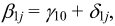
where the mean level of the dependent variable in the j th PSU is represented by β 0j and the gender difference in the dependent variable is represented by β 1j. The level 2 error terms indicate that a separate variance component is estimated for each gender differential. This variation in the dependent variable and the gender differential is partially explained by the characteristics of each of the j PSUs. Combining equations (2) and (3) provides the full main effects model. In subsequent models, adding interaction terms between child's gender and women's status, and context to the main effects model, allows for a test of the expected hypotheses related to the moderating effects of these variables on the gender differential.
Results
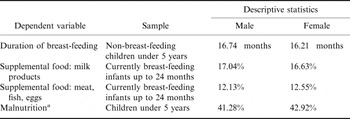
Table 1 provides the descriptive statistics, by gender, for the dependent variables used in this study. The results show that the mean duration of breast-feeding is slightly higher for boys than for girls. However, the percentage of infants receiving supplemental foods is about the same for both boys and girls with a slightly higher percentage of male infants receiving milk products and a slightly higher percentage of female infants receiving meat, fish and eggs. It should be noted that the differences are not statistically significant. On the other hand, the results for malnutrition (based on more objective anthropometric data rather than mother's recall) show that young boys are significantly less likely to suffer from malnutrition than young girls.
Description of dependent variables

a Gender difference is statistically significant.
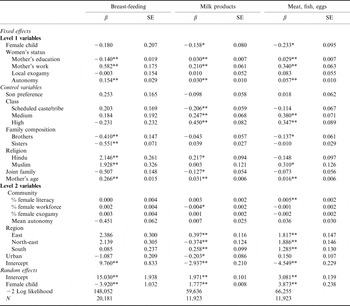
The multilevel analyses were conducted in various stages. In the preliminary stage, the fully unconditional model on each dependent variable confirmed that nutritional status varies across PSUs. Table 2 presents the results from three main effects models, each with a different dependent variable, in order to test whether there is a gender differential in food allocation after controlling for various family and contextual characteristics. Since the estimated coefficients (β) are presented as log odds, they are transformed to odds ratios by taking the exponential of the specified estimates for interpretation from hereon. Model 1 shows that there is no statistically significant gender difference in duration of breast-feeding among children. On the other hand, the fixed effects from Models 2 and 3 show that male infants have a significant advantage over female infants in the allocation of supplemental foods. In particular, among currently breast-feeding infants, girls are only about four-fifths as likely as boys to receive milk products or meat, fish or eggs as supplemental food (e −0.158=0.85; e −0.233=0.79). The random effects show that the gender differential varies across communities. Among the other fixed main effects, mother's status and context have statistically significant effects on food allocation. More educated mothers are more likely to provide supplemental food, maybe as a result of more knowledge about the need for such food. Working mothers are more likely to provide supplemental milk products, possibly as a result of not being at home for sufficient breast-feeding. Among the contextual effects, region appears to be important as infants in the north are far less likely to receive supplemental foods, particularly the more valued meat, fish or eggs, compared with those in other parts of the country. The exception to this is in the north-east where infants receive fewer supplemental milk products than in the north.
Coefficients for contextual analyses of gender discrimination in child nutrition

** p<0.01;
* p<0.05.
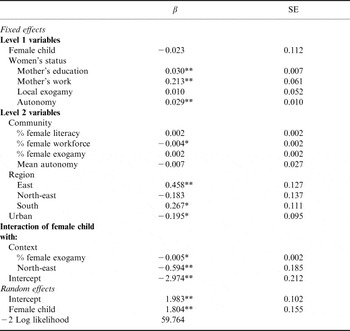
Further investigation of the effects of women's status and context was conducted through models with two-way interactions. In each, terms were included according to the principles of hierarchy, which state that the presence of higher order terms requires the presence of all relevant lower order terms for meaningful interpretation. The results showed that mother's status does not have an impact on the gender differential in allocation of supplemental milk products. Among the contextual effects, both region and community have statistically significant effects on the gender difference (Table 3). Among communities with average levels of women's education, work participation, local exogamy and personal autonomy (i.e. with all these variables set to zero), female infants in the north-east are at a greater disadvantage than male infants compared with the gender differential in the north. Similarly, female infants in communities with higher percentages of locally exogamous women are more disadvantaged than male infants when compared with those in communities with lower percentages of exogamous women. For example, in communities with exogamy rates that are 10 percentage points more than the average, girls are about nine-tenths as likely as boys to get supplemental milk products (e −0.023−0.005(10)=−0.073=0.93) while in communities with rates that are 30 percentage points greater, girls are only about four-fifths as likely as boys to get supplemental milk products (e −0.023−0.005(30)=−0.173=0.84).
Selected interaction effects from contextual analyses of gender differential in supplemental food (milk products) for infants (N=11,923)

Note: coefficients for control variables and non-significant interactions have been omitted from table.
** p<0.01;
* p<0.05.
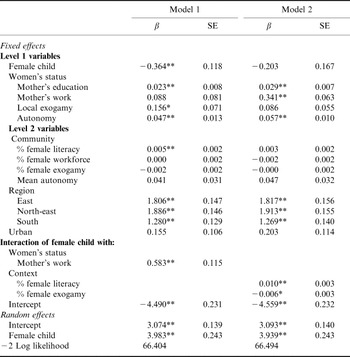
Table 4 shows the significant interaction effects between child's gender and women's status and context for supplemental meat, fish or eggs provided to infants below the age of two years. The results from Model 1 show that the effect of women's status is only partially consistent with the hypothesis that higher maternal status is associated with lower gender bias in food allocation. Since mother's education and autonomy is centred around the mean, the interaction effects should be interpreted as being shown here for a mother with average education and autonomy along with values for the dichotomous variables set to 0, except for the interaction under consideration. As expected, working mothers are less likely to exhibit gender bias in favour of sons in the allocation of meat, fish or eggs compared with non-working mothers. Thus, female infants with non-working mothers are about a third less likely than male infants to receive this supplemental food (e −0.364=0.69). In contrast, those with working mothers are about a quarter more likely than male infants to receive supplemental meat, fish or eggs (e −0.364+0.583=1.24). The interactions effects between context and gender show that, as expected, higher levels of community-level women's status lower the gender difference in supplemental food (Model 2). In particular, higher levels of female literacy and lower levels of exogamous women in the community weaken the gender difference in supplemental meat, fish or eggs.
Coefficients for contextual analyses of gender differential in supplemental food (meat, fish, eggs) for infants (N=11,923)

Note: coefficients for control variables and non-significant interactions have been omitted from table.
** p<0.01;
* p<0.05.
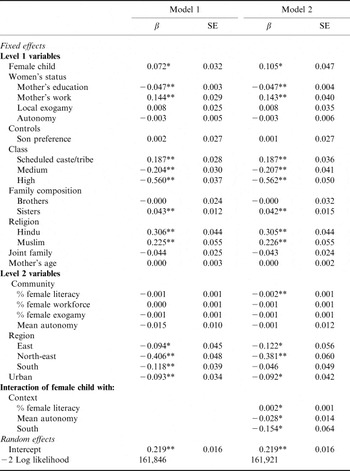
Table 5 shows the results for gender differential in malnutrition among young children. The main effects model shows that girls are 7% more likely than boys to be malnourished (e 0.072=1.07). Among the other main effects, it appears that children of more educated mothers and those with non-working mothers are less likely to be malnourished than those whose mothers have lower levels of education or whose mothers work for pay. Being in the east, north-east or south (compared with north) or from an urban area (compared with rural) is negatively related to the likelihood of malnutrition among children below five years of age. Not surprisingly, the coefficients for the control variables show that class and family composition also have significant effects on the likelihood of malnutrition. Further investigation of interaction effects between child's gender and other variables revealed that none of the individual-level characteristics is significantly associated with the gender differential in malnutrition. However, the results from Model 2 show some significant interaction effects between context and child's gender. Notably, the female disadvantage is reduced in communities with higher mean autonomy for women and in the south (compared with the north). Thus, while girls are about 11% more likely than boys to suffer from malnutrition in a community with average autonomy (e 0.105=1.11; mean autonomy is grand mean centred), they are only 6% more likely than boys to suffer from malnutrition in a community where mean autonomy is one standard deviation higher than the grand mean (e0.105−0.028×1.8=1.06). On the other hand, the gender differential in malnutrition increases in communities with a higher percentage of literate women. This is a counter-intuitive result that poses an interesting question, especially when paired with the main effect of community female literacy on the likelihood of malnutrition. While higher female literacy rates are associated with lower rates of malnutrition, they are also associated with a higher gender difference in malnutrition. If education increases knowledge of better nutrition for their children, are women using that knowledge to selectively favour sons over daughters?
Selected coefficients from contextual analyses of gender differential in malnutrition (N=37,192)

Note: coefficients from non-significant interactions have been omitted from table.
** p<0.01;
* p<0.05.
Discussion and Conclusion
India has a long history of excess female mortality that has persisted despite significant gains in health care and life expectancy (Premi, Reference Premi2001; Oster, Reference Oster2009). However, much of the existing research on the causes of this troubling mortality gap has concentrated on parental or family characteristics as explanations. While parents are the final decision-makers, this focus has neglected the role of the community or neighbourhood as an added influence on the parents. In particular, while higher mother's status has often been shown to have positive effects on a daughter's well-being, the effect of community-level women's status is usually ignored. This study addresses this gap in existing research by examining the effects of women's status at both the individual as well as the community level on the gender gap in nutrition among young children in India. It was hypothesized that communities with higher women's status would be more likely to have norms about more egalitarian treatment of girls than those with lower women's status. These norms would be likely to put pressure on families over and above what their individual characteristics might predict.
In this study, nutrition is operationalized by four variables that look at infant feeding practices and weight-for-age data on children under the age of five. Overall, there is no evidence to support discrimination against female infants in duration of breast-feeding. While the bivariate association shows that male infants have slightly higher duration of breast-feeding, the difference is not statistically significant and remains so once other factors are controlled for in the multivariate analysis. However, there is evidence supporting gender discrimination against female children in the allocation of supplemental foods and the prevalence of malnutrition. The fixed effects show that among currently breast-feeding children below the age of two years, females are 15% less likely than males to receive supplemental milk-based solid foods. They are 21% less likely than males to receive any of the more valued meat, fish or eggs. Girls are also 7% more likely than boys to suffer from malnutrition. Further, the random effects show that the gender differences vary across communities. It should be noted that the data are for surviving children only. It is possible that at least some of the children suffering from the most severe cases of malnutrition are no longer alive and that among these, girls are likely to die at higher rates than boys given the excess female mortality at young ages that is still prevalent in India (Oster, Reference Oster2009). Thus, any investigation of the gender difference is likely to be understated in this study.
Further investigation of the interaction effects shows that community-level women's status, as well as maternal status, affect the gender difference in supplemental foods. In general, it appears that higher women's status within a community as well as higher maternal status has a beneficial effect on a daughter's nutritional status. However, the moderating effects of context appear to be more consistent and stronger than individual-level characteristics. In particular, the levels of local exogamy, education and autonomy within a community impact the gender difference in nutrition. Thus, female infants in communities with higher percentages of locally exogamous women are at a greater disadvantage than those in communities with low percentages of exogamous women. The coefficient for the interaction effect of gender with maternal exogamy is also in the same direction and marginally significant at p<0.07. These results are consistent with the theory that locally exogamous women, isolated from their natal families, have less status and control over resources. As a result they may be more likely to favour sons or at the least may not be able to provide their daughters with adequate supplemental food.
Another important dimension of women's status is the level of personal autonomy that they have. It was hypothesized that women with greater autonomy would have more knowledge as well as control of resources that could affect the well-being of their daughters in a positive way. Additionally, communities with higher autonomy for women should have more gender-egalitarian norms regarding children's nutrition, regardless of the mother's status. While most of the coefficients for the interaction between autonomy and gender are non-significant, it does appear that higher community-level women's autonomy significantly reduces the gender differential in malnutrition. Thus, the results show that not only do higher levels of mother's autonomy and community-level autonomy reduce the likelihood of malnutrition for all children, more autonomous women within a community are able to influence parental behaviour towards egalitarianism regardless of the mother's personal autonomy.
Women's education within a community exhibits another important contextual effect. Regardless of the mother's characteristics, girls in communities with higher levels of female literacy are less disadvantaged compared with boys when it comes to the allocation of supplemental meat, fish or eggs. However, contrary to expectations, the female disadvantage in malnutrition is higher in communities with higher women's literacy. Another interesting finding here is that mother's education does not have a significant effect on the gender differential in malnutrition, although it does have a negative effect on malnutrition itself. Combining these effects one might argue that while maternal education has a beneficial effect on all children, it appears that the benefits to boys outweigh the benefits to girls. The benefits of some education appear to be selectively used to favour sons. It should be noted that the continuing gender differential in malnutrition may result from selective access to medical care as well as the type and quantity of food.
Having a working mother is also shown to be somewhat beneficial to girls. Girls with working mothers are less likely to be discriminated against with regard to the allocation of supplemental meat, fish or eggs. However, the percentage of women working for pay in a community does not have an effect on the gender differential indicating perhaps that paid work does not raise the status of women sufficiently for the community to have an impact on children of non-working mothers. The decrease in the gender differential among children of working mothers could simply be a reflection of the necessity for more supplemental food since the mother is not at home to provide sufficient breast milk.
The above results have some serious policy implications. While it is important to focus on improvements in women's status as a way to reduce daughter neglect, it is also important to take into account the amount and quality of such improvements. Clearly, low levels of female education or work for low pay is not enough to reduce unequal treatment of sons versus daughters. Public policy planners must work to improve the overall status of women within a community through gender empowerment programmes that encourage more education, higher decision-making abilities, and more supplemental income for women. Further research should focus on the process of changing gender norms and the role of a critical mass of community members that are able to perform as the innovators for such a process.