

As is the case in many industrialised countries, visually impaired people experience low employment rates in the UK. The UK employment rate for people with visual impairment is just 33% for those registered as visually impaired in comparison with 75% of the general working-age population (Clements & Douglas, Reference Clements, Douglas and Pavey2011). More specifically, employment rates amongst younger people with visual impairment aged 18–30 years do not fair better, and while this can be partly explained by higher numbers being in education there are still an estimated 40% ‘not in education, employment or training’ (NEET) (Douglas, Pavey, Corcoran & Clements, Reference Douglas, Pavey, Clements and Corcoran2009, 13). Cross-tabulations and regression analyses suggest that there are several factors that contribute positively to people with visual impairment finding a job: educational qualifications, mobility, independent living and learning skills, and social networking (as well as employer attitudes) (e.g. in the UK, Meager & Carta, Reference Meager and Carta2008; Clements & Douglas, Reference Clements, Douglas and Pavey2011; in the US, Capella McDonnall, Reference Capella McDonnall2011).
However, much of the UK research draws upon surveys of adults with visual impairment rather than tracking young people through compulsory education into training and the labour market. This paper draws upon an ongoing five-year longitudinal study which is tracking a cohort of young people with visual impairment (aged between 16 and 19 years at the time of writing) as they leave compulsory education. The focus here is upon the young people's predictions of how prepared they are for employment, and the extent to which their educational experiences have helped with this.
Visual impairment and independence skills
In the UK, the term ‘additional curriculum’ is used in the field of visual impairment education as a term to include areas which would not typically be taught in schools as part of the core curriculum – see, for example, the review by Douglas et al. (Reference Douglas, McLinden, McCall, Pavey, Ware and Farrell2009). Particular areas highlighted in the review were: mobility (e.g. being able to independently navigate around the school and community); low vision and information access (e.g. using technology and strategies to independently access printed material, the use of low vision aids, learning to read through braille, and the use of computers with appropriate access technology); and social skills (e.g. having friendship groups and self-advocacy skills). In the US, the term ‘expanded core curriculum’ (ECC) is used in a similar way (e.g. Hatlen, Reference Hatlen1996; Koenig & Holbrook, Reference Koenig and Holbrook2000) although in the US the ECC appears to have been defined in more detail and vocabulary appears to have been more universally adopted. In a more recent reflection upon the development and adoption of the ECC construct by teachers in the US, Sapp and Hatlen (Reference Sapp and Hatlen2010) defined the ECC as having nine areas: compensatory or access skills, career education, independent living skills, orientation and mobility (O&M) skills and concepts, recreational and leisure skills, self-determination skills, social interaction skills, use of assistive technology and sensory efficiency skills.
Perhaps in contrast to the additional curriculum, and as the term ‘expanded core curriculum’ suggests, Sapp and Hatlen (Reference Sapp and Hatlen2010) argue that many ECC skills can be embedded in the general education curriculum, e.g. ‘Many general education curricula include skills that overlap the ECC, such as working in groups (social skills), learning about different jobs (career education), reading a map (O&M), and managing money (independent living skills)’ (p. 344). Nevertheless, most authors argue that the ECC requires the input of specialist professionals and teaching in addition to general curriculum teaching.
Although the ECC is not an internationally adopted term in the field of visual impairment, it is the term which most commonly and consistently appears in the literature (although generally in the US context). For this reason this is the term used in this article.
ECC is clearly linked with the broad notion of independence. In their article Sapp and Hatlen (Reference Sapp and Hatlen2010) present two case studies of 20-year-old young men who have similar academic achievements but very contrasting levels of independence. It is argued that one had benefitted from sustained ECC intervention throughout his school career which the other had not (rather, the specialist teaching intervention solely focused upon material preparation, support for academic teaching, and explaining his special needs to classroom teachers and other pupils). Similarly, Douglas et al. (Reference Douglas, McLinden, McCall, Pavey, Ware and Farrell2011) observed contrasting teaching approaches of ‘providing children with accessible material in their preferred medium (e.g., large print)’ and ‘teaching children access skills (including the use of technology)’ (p. 25, emphasis added) – the latter approach being linked to the ECC and having longer-term benefits of independence for the young people.
Importantly, there is evidence that the presence of independence skills which are afforded by the ECC are associated with positive employment outcomes for people with visual impairment (e.g. Capella McDonnall, Reference Capella McDonnall2011; Wolffe & Kelly, Reference Wolffe and Kelly2011). Further, the importance of independence is reflected in the design of visual impairment employment services for adults. For example, Wolffe and colleagues (e.g. Wolffe Reference Wolffe, Holbrook and Koenig2000; Reference Wolffe, Corn and Erin2010; Wolffe & Kelly, Reference Wolffe and Kelly2011; Wolffe & Spungin, Reference Wolffe and Spungin2002) have developed a ‘career education model’ which emphasises that job seekers should have independence skills in place: daily living skills, mobility, computer / low vision access skills, work experience (voluntary and paid) and high expectations (including role models). Employment services in the UK (e.g. run by the charity Action for Blind People) typically emphasise many of these independence skills in their assessments and interventions.
In spite of the positive employment outcomes linked with the concept of independence, and the associated importance attached to school-based ECC, there are some concerns that young people with visual impairments do not leave compulsory education with the necessary independence skills in place. For example, Douglas et al. (Reference Douglas, McLinden, McCall, Pavey, Ware and Farrell2011) argue for the longer-term benefits of teaching visually impaired students to be able to independently access written material in preparation for when educational support systems are not in place (e.g. when at university or in work). In spite of this, they present evidence that this approach to teaching is often neglected in the UK (schools often providing enlarged print). Similar evidence is presented by Crudden (Reference Crudden2012) and, in relation to mobility education by Pavey, Douglas, McCall, McLinden and Arter (Reference Pavey, Douglas, McCall, McLinden and Arter2002). Overall, Sapp and Hatlen (Reference Sapp and Hatlen2010) concluded that ‘although teachers consider the Expanded Core Curriculum (ECC) critical for students’ success, they do not provide their students adequate instruction based on principles of the ECC’ (p. 338).
Experiences and views of young people with visual impairment
Critical to this discussion on independence are the views held by the young people themselves. In the context of independent access to print, young people report their reluctance to use low vision devices is linked to peer pressure and not wanting to appear different (Mason Reference Mason1999; Franklin, Keil, Crofts & Cole-Hamilton, Reference Franklin, Keil, Crofts and Cole-Hamilton2001). Similar evidence is provided by Douglas, McLinden and Weston (Reference Douglas, McLinden and Weston2010) in relation to using laptop computers in lessons where some students ‘were anxious about appearing to be treated and looking different’ (p. 20). Lusk and Corn (Reference Lusk and Corn2006), investigating students learning both print and braille, noted that teachers rated student attitude towards print more positively than their attitude towards braille.
Interestingly, the apparent reluctance to engage with (at least some) areas of the ECC amongst young people with visual impairments in schools may contrast with their views having left compulsory education. McBroom (Reference McBroom1997) asked 100 visually impaired college students (18 year olds and older) what advice they would give to incoming students with a visual impairment. Notably, this included reference to aspects of the ECC, for example communication, assertiveness and independence skills, and extracurricular activities. Such changes in opinion illustrate the value of longitudinal studies which give the opportunity to observe change of views over time.
Current study and paper aims
The literature highlights an empirical and philosophical rationale for the importance of schools teaching independence skills to achieve a successful employment outcome. Even so, there is evidence that in the UK there is inconsistency of this provision in schools and uncertainty of the value attached to it by the pupils themselves. The current paper draws upon an ongoing UK-based longitudinal study which is tracking a cohort of young people with visual impairment as they leave compulsory education (the ‘Transitions Project’). Specifically the paper explores:
1) How do young people define independence in relation to their visual impairment?
2) How do they propose solving hypothetical employment-based problems?
3) What do they think has prepared them (or otherwise) to be independent in the workplace?
Method
Longitudinal study
The ‘Transitions Project’ was designed in 2009 by a team from Royal National Institute of Blind people (RNIB) and the University of Birmingham. It is a five-year longitudinal study following a cohort of 80 young people with visual impairment in the UK. They were originally recruited in 2010 when they were aged between 14 and 16 (and in Years 9 and 11 of their compulsory education). The key objectives of the research project as a whole was:
1) To track the process of transition from through various stages of education and training for young people with visual impairment from the age of 14 over an initial five-year period.
2) To identify the roles of professionals involved.
3) To identify the factors that improve or reduce a young person's chance of gaining employment.
At time of writing, most of the participants have been interviewed four or five times over a three-year period (between 2010 and 2012), and interview and case study work is still ongoing (currently planned and funded until 2015).
Prior to commencing recruitment of participants, and prior to each new data capture, ethical approval was obtained from the University of Birmingham Ethics Committee. The research followed the tenets of the World Medical Association Declaration of Helsinki on Ethical Principles for Medical Research Involving Human Subjects. All participants and their parents / carers have provided fully informed consent to be part of the project.
Sample
Recruitment of participants was from across the English Midlands and Wales from a range of service providers: 14 specialist visiting teacher services that provide support to students within mainstream schools; one specialist school for pupils with visual impairment and two specialist units for pupils with visual impairment based within a mainstream school. Service providers were asked to provide demographic details of the students they were supporting in school in years 9 (aged 14) and 11 (aged 16), including specific information about their disability. A total of 312 young people and their parents/carers were sent an information pack inviting them to take part in the project (all of whom were judged by their service to fulfil the entry criteria of being able to complete a questionnaire independently). A total of 88 young people were recruited into the study (80 of which were still active members of the project at time of interview).
Prior to the current interview most of the participants had been interviewed four or five times over a three-year period. Findings from interviews are presented elsewhere (e.g. Hewett and Douglas, Reference Hewett and Douglas2011a; Hewett and Douglas, Reference Hewett and Douglas2011b) and tend to show that the young people in compulsory education felt well supported in their studies, achieving academic grades comparable to their sighted peers, with high aspirations for the future. Most had enjoyed work experience arranged through their schools, although fewer had part-time jobs compared with young people without visual impairment.
Participants
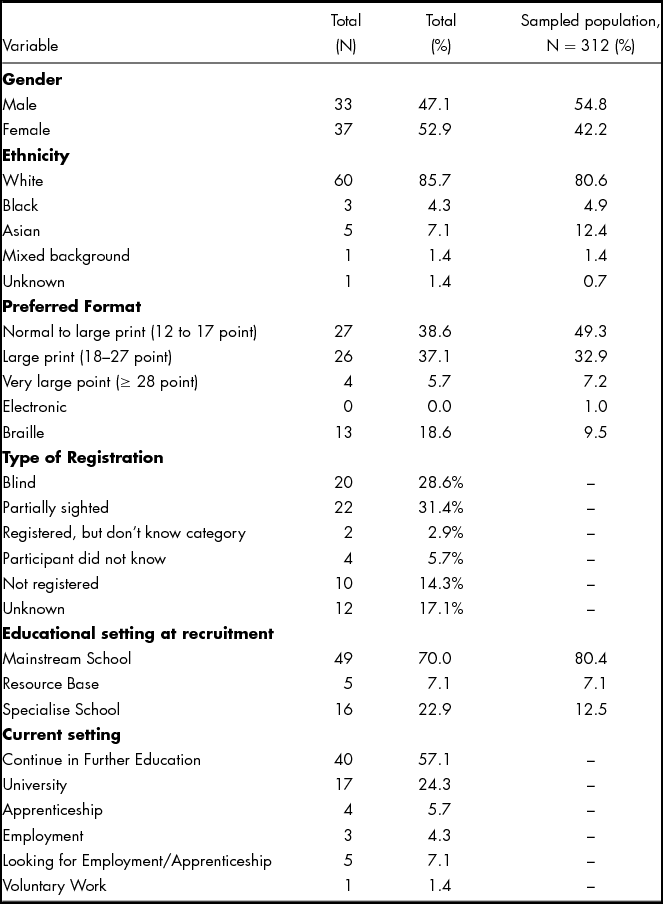
A total of 70 participants took part in the interviews (a mutually convenient time could not be found to interview the other ten participants in this research cycle). Table 1 presents the preferred reading format of the participants, a variable which has been used throughout the course of this longitudinal study as an indicator of the severity of participants’ visual impairment. This is also complimented by the participants’ visual impairment registration type, although not all participants knew whether they are registered as visually impaired or not, an interesting finding in itself. [In the UK if a visual impairment is of sufficient severity a person can ‘register’ with social services as sight impaired (partially sighted) or severely sight impaired (blind). Similar processes exist in other countries (e.g. ‘legal blindness’ in the USA). See, for example, Douglas, Pavey, Corcoran and Eperjesi (Reference Douglas, Pavey, Corcoran and Eperjesi2010) for a fuller explanation.] The third column shows the preferred reading format for the students in the sampled population, as provided by the support services (i.e. all of whom were invited to take part in the project). Those who would use normal to large print are slightly under-represented within our sample, whereas braille users are slightly over-represented.
Demographic characteristics of the sample, N = 70 (and data related to the sampled population where available)

The table also presents demographic characteristics of the sample, and where available, comparative figures for the sampled population as a whole. We note an over-representativeness of white participants, and an under-representativeness of the Asian community. Those from the special school are also over-represented, although these are more commonly made up of the braille users referred to previously.
At the time of interviewing, many of the participants were going through key points of transition, and this was reflected in their given responses. The youngest students (aged 16 or 17 at the time of interview) had completed their compulsory education the previous summer, with all but one choosing to continue in education (for many this has meant changing schools or going to a college). The oldest students (aged 18 or 19 at the time of interview) had chosen a variety of pathways, including university (with several choosing to move away from home), employment and apprenticeships. Nine were having an extended period at college or school (i.e. longer than the typical two years).
Current interview
The data presented in this paper was collected in autumn 2012, and was obtained through semi-structured telephone interviews with 70 of the young people. The primary focus of the interviews was the theme of independence, as well as giving an opportunity to track more of each participant's transition journey. Each interview lasted between 30 minutes and one hour and covered a wide range of topics in relation to aspects of the ECC, but this paper focuses on qualitative data gathered through three open-ended discussion questions – see Box 1.
Section of interview schedule presenting the three discussion questions in relation to independence and employment
1) In this interview we are particularly interested in ‘independence’ and what you feel ‘being independent’ means. Have you any thoughts? (Prompt: in what way does this link with your visual impairment? Probe: There is no right or wrong answer; everyone is different; we will be asking more specific questions later).
2) Scenario 1: If you went in [to work] the following day and they had forgotten about the modifications that you needed, could you tell me how you think you would deal with this? Again, if applicable please share examples from past experiences. [If confident] What do you feel has given you the confidence to deal with situations like this? [If not confident] What do you think could be done to give you more confidence in situations like this?
3) Scenario 2: Evidence suggests many employers assume blind and partially sighted people cannot perform certain employment-related tasks because of their sight loss. Do you feel confident discussing with a potential employer the skills you have which challenge these views? What would you like to say in response to this?
Procedure and analysis
Semi-structured telephone interviews with the participants were conducted by the full-time researcher working on the project between September and December 2012. The interviews were audio recorded and transcribed by the researcher, and then the data combined with existing data in the project database (using IBM SPSS version 20).
Open question responses linked to this paper were analysed using the qualitative analysis tool NVivo 10. The authors followed a three-staged approach similar to that outlined by Straus and Corbin (Reference Straus and Corbin1998). Stage 1 involved ‘open coding’ in which the authors initially worked independently, before coming together to compare and agree the open coding each had identified. Stage 2 involved ‘axial coding’ in which the researchers worked together to rearrange and combine codes. During Stage 2 the researchers drew upon two frameworks to support their analysis. The first was the WHO International Classification of Functioning, Disability and Health (WHO, 2001) which describes social and individually-based enablers and barriers. This approach to analysis is described by Douglas, Pavey, Corcoran and Clements (Reference Douglas, Pavey, Corcoran and Clements2012). The second framework used the areas of the ECC as described above. Finally, Stage 3 involved ‘selective coding’ in which central codes were brought to the fore and this is reflected in the central themes presented in the paper. In terms of reporting the findings, quotes are presented to illustrate the themes. The number of times each theme was coded is presented in brackets, and consistent language is used in reporting (‘many’ refers to over 20 participants, ‘some’ refers to less than 20 participants, otherwise exact numbers are used).
Results
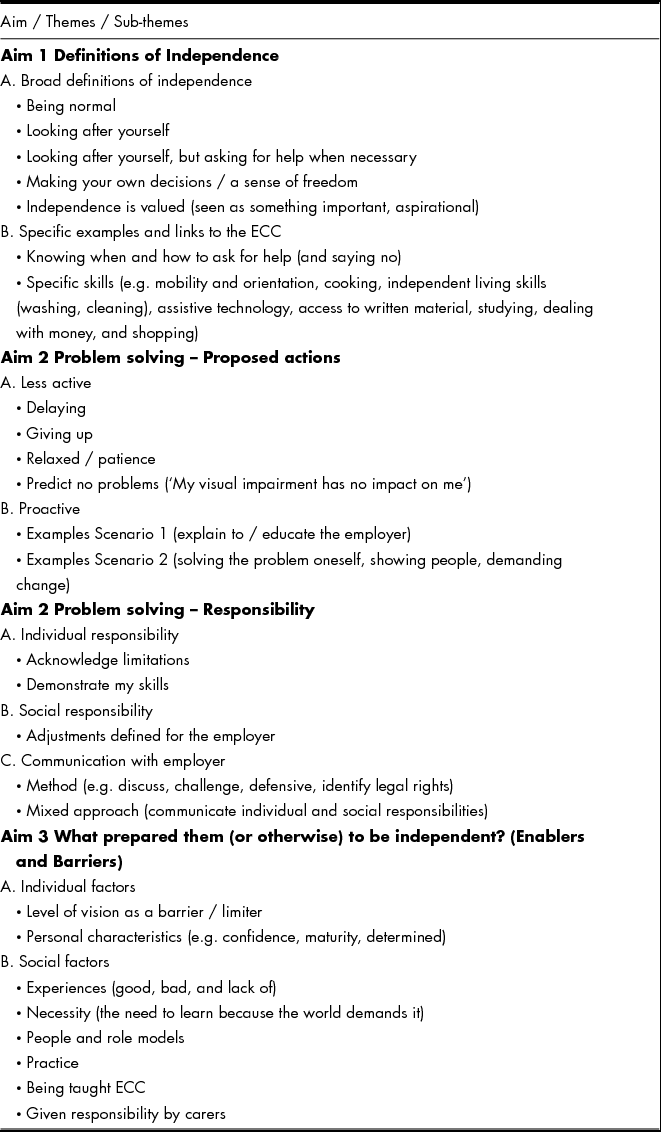
The thematic analysis is presented in relation to the three aims of the paper: 1) definitions of independence, 2) approaches to problem solving, and 3) views on what prepared them (or otherwise) to be independent. Table 2 provides an overview of the key themes identified.
Summary of themes emerging from the analysis (linked to the three aims)
How do young people define independence in relation to their visual impairment?
Broad definitions
Perhaps unsurprisingly, the young people tended to offer rather generic descriptions of their understanding of independence, particularly as part of their initial response. These especially focused upon being able to look after yourself without assistance and doing things on your own (35) (e.g. ‘Being able to look after yourself without assistance’, ‘just being able to look after yourself really’). Some elaborated on this theme by making reference to a sense of freedom (12) which was characterised by not being told what to do and making your own decisions. These broad definitions made little reference to visual impairment. Nevertheless, some young people did describe that it was important to know when to ask for help (11) and made both implicit and explicit links to their vision (e.g. ‘Being able to get what you need to get done, without assistance from other people, or with limited assistance’, ‘I believe independence is good […] but it's not wrong to rely on other people at certain points. There are times, there are limits. In the pitch black for example’). Similarly, independence was explicitly described as valuable and aspirational by some (10) (e.g. ‘I think I believe that I am independent, I am as independent as I can be, I am always pushing to be more independent’, ‘I feel good about myself to get that independence because I have got a visual impairment’).
Perhaps the most explicit reference to visual impairment in these general definitions was that some young people made reference to sighted people as, ‘everyone else’ or ‘normal’ people (9) (e.g. ‘I think it's just like having a normal life really’, ‘doing everyday things like everyone else’). Indeed, some referred to the level of their visual impairment being a factor (e.g. ‘I think because I am blind, it is hard, but I’ve got a guide dog so that's increased my independence’), and some referred to other people with more severe visual impairment who were less independent (e.g. ‘I am lucky enough that I don't need a guide or anything like that, like a more severely visually impaired person might’). However, for the group as a whole the definitions did not appear to be obviously linked to severity of the young people's visual impairment. The semi-structured / open question approach adopted in the research does not lend itself to making comparisons in this way, and future interviews with the young people might helpfully explore this.
Specific examples of independence (and links to the ECC)
Many of the young people elaborated on general definitions by describing specific aspects of independence often associated with the ECC (31). This included mobility and orientation, cooking, independent living skills (washing, cleaning), assistive technology, access to written material, studying, dealing with money, and shopping. For example, ‘in terms of visual impairment, not having to have someone help you cross the road, or […] someone help you read your work’, ‘Being able to cook, clean, get around’.
As will be discussed below, independence was seen by some as a relative term rather than an absolute one. Linked to this, some emphasised self-advocacy skills and the importance of when to ask for help (or say when help was not required) (6) (e.g. ‘being able to go up to a stranger and ask them for help’, ‘it's having the confidence and skills and knowledge to know that ‘I’m stuck, I need help here’, and then knowing who to go to for help’).
How do they propose solving employment-based problems?
The two employment-based problems which were discussed in the interview (scenario one related to access to material in a work setting, scenario two linked to an interview situation, see Box 1) allowed the young people to offer different approaches to dealing with situations; their responses gave an insight into their understanding of the working context. Two strong themes emerged. The first linked to the level of action they would take (proactive or passive), while the second was linked to who had responsibility for the situation and solving it (the young person or the employer).
Proposed actions taken
Many participants proposed taking no action, some describing delaying (7) (e.g. ‘I think I would probably give it a few hours’), while two said they would ‘give up’. Many (28) described a relaxed approach. For some this involved acknowledging that circumstances like this are inevitable and patience was appropriate. Associated action was often low level with an emphasis on politeness and avoiding conflict (e.g. ‘I would probably speak to whoever it was that I had spoken to previously and just remind them politely’). But for some, the relaxed approach seemed to be linked to passivity. Some of these responses indicated a lack of confidence and a probable gap in their understanding of expectations in the workplace (e.g. ‘probably just do my best and everything’).
In the context of scenario 2, some young people suggested that they would avoid discussion regarding their visual impairment (11) as they did not believe that it would affect their ability in the workplace. This lack of openness or willingness to disclose can be dangerous because while performance in the workplace may not be affected by the visual impairment, the way their work is carried out may well be different (and employers may not understand this).
More proactive responses were offered by some participants in relation to both scenarios. In the case of scenario 2, (11) responses tended to centre around improving the employers’ understanding, both of their visual impairment and technology available (e.g. ‘probably tell them exactly what it is that I have, so that they would then gain an understanding of it’, ‘I’d explain to them what my visual impairment means, so that I can't read print and things, and then I’d explain how we could modify by a braille printer and a screenreader on my computer’). In the case of scenario 1 (14), responses included the young person seeking to solve the problem themselves, and showing colleagues what was required / needed (e.g. ‘well, I would tell them to sit down and work it out with me, rather than just leaving it’ and ‘First things first. I would explain to them that I need a modification, and that if it doesn't get done, it just makes it a lot more difficult’). Some of the proactive responses were more assertive and involved conflict (such as complaining, leaving or referring to legal requirements); for example, ‘I would be like ‘well I did tell you – would you be able to do it now and I will stand with you and go through with you how I need it done’’.
Responsibility
The most common responses relating to this theme drew upon socially-based understanding of responsibility; that is, the young people described how the employer was responsible for action. This included describing how they would challenge the employers’ perception of visually impaired people (17) by getting them thinking (e.g. ‘I do challenge that actually! Because then it makes them think that, is that right, is that wrong, can we adjust it, can we not’), and by ‘throwing’ the argument back at them (e.g. ‘If they can prove to me with 100% certainty that I cannot do it, then fair enough. I will not lay down and accept it, I will challenge them […] I don't see why my sight should be held against me’). Others would act defensively (7) (e.g. ‘It's not my fault, is it?’), and take an aggressive stance (6) (e.g. ‘Well, I would probably leave that place, because they probably wouldn't want you to work with them. They don't really understand what you need’). Although the young people suggested they had confidence in advocating for themselves, and take a laudable stance of trying to correct a wrong, a characteristic of many of these responses was that they were not focused upon the job and the task of convincing the employer that they would be able to do it.
In contrast, some responses tended to focus on a self-referential analysis of responsibility. For some this involved speculation that they were limited in terms of suitable jobs because of their visual impairment (8), but a confidence in their ability to work in the right job, for example ‘I would say that I understood their point that it can sometimes be a hindrance, and I am not going to pretend it's not there […] if I can deliver to the same standard that everybody else can deliver, then it's irrelevant.’.
Many seemed able to express approaches which highlighted their own responsibility to discuss solutions with the employer, while still maintaining that the employer had a responsibility. Examples given included: discussions with the employer (20) (e.g. ‘I think I’d just have to explain to them what I can and can't do. And if there's anything that I can't do, then explain what could be put in place’) and giving examples of the types of adjustments that could be utilised (27). Overall, they showed a willingness to work with the employer, and to show how it would be possible for them to function, with assistance and / or adjustments, in that environment.
What do they think has prepared them (or otherwise) to be independent in the workplace?
Enablers
Individually-based enablers identified by the young people included confidence in their ability (7), maturity (7) and positive characteristics of their underlying personality (18). Although these are enablers that could also be identified by people without a visual impairment, reference was often made to their ability in the context of their disability (e.g. ‘the key thing is not to over-emphasise your visual impairment because it's not the most important thing about you. I think what ultimately matters is your ability and not your disability’). For some, advocating for themselves was seen as a necessity and something that they needed to do as part of their independence (13) (e.g. ‘I have to ask for help, and if I don't someone else would, and that would annoy me’).
In terms of socially-based enablers, the young people most frequently mentioned that practice explaining their visual impairment (31) would equip them to do the same in an employment environment (although they had not necessarily seen these experiences as positive at the time). For example, ‘There's been so many of them, I have just come to expect it now. I know what to say’, ‘This happens to me a lot at school. I would just get the worksheet off them and at the beginning of the lesson I would ask them ‘do you have it all enlarged’ and if the teachers doesn’t, I would just remind them, I would remind them nicely, and they will just go and enlarge it for me’.
This is no doubt linked to individuals feeling they had the personal characteristics to speak up for themselves, but many made reference to the social context which helped them develop such skills. Some spoke of often self-advocating in a school environment (e.g. ‘I think it's just the fact that I have done it so many times’). A few (4) described benefitting from having role models and having seen examples of how others spoke on their behalf (e.g. ‘I suppose it helps to see other people do it, some people are more confident than other people. You can take that away and use it’). In some cases (4), they described how they were more confident when they knew the people with whom they were talking (e.g. ‘I guess it's more like being more confident with a particular person, because you have built up a relationship. If it's a complete stranger then you are bit less confident…’). This raises the question of whether they would be able to apply these skills in a less familiar work environment – and this point of caution is returned to later.
There were surprisingly few references to learned independence skills through ECC lessons (6), and those who did tended to be those participants based in a residential specialist school, who described being taught independent living skills (e.g. ‘I would say the school has helped me achieve some levels of independence, because we have independence skills lessons’). Others also described how when trusted with more independence, this in turn gave them increased confidence to deal with new situations (13) (e.g. ‘recently, since I have moved to university I have had to kind of become more independent’). A final enabler was an understanding of the workplace, both as a result of prior employment giving them experience to draw upon (1), and through knowledge of their legal rights (3).
Barriers
The most common individually-based barrier identified was reference to their visual impairment (19). This was either through describing ways in which they thought their visual impairment impacted upon their independence (e.g. ‘I can't use things the same as a sighted person […] I would say it's harder for us in general’) or by describing how their own visual impairment did not pose a significant barrier but speculating it would if it was more severe.
In terms of socially-based barriers, there were occasional references to a lack of confidence as a result of bad experiences (2) (e.g. ‘A lot of places where I tried to get work experience, they [said] “she might not be able to help us because of her sight”’), other people limiting their confidence (2), and a lack of experience in similar situations (3) (e.g. ‘I think after more job interviews I think I would become more confident, but at the minute, I’m not very [confident]’). One participant described overcoming this by attending a workshop which focused on employment skills, ‘I went on a transitions weekend […] we had a workshop on how to approach employers about our disability’. Interestingly, few referred to the teaching of ECC (or lack of it) – perhaps, you don't know what you don't know.
Discussion
The analysis of the young people's responses offers an interesting insight into how they view their lives and the challenge of the transition into employment. In terms of the young people's general understanding of independence, it is encouraging that most discussed independence in broadly positive, and even aspirational, terms. As for more specific aspects of independence, many young people explicitly described skills which are commonly associated with the EEC as important.
An interesting insight is provided by the themes drawn out of young people's descriptions of what they believe has helped them develop their independence. Many young people highlighted the importance of self advocacy and the benefit of having to repeatedly negotiate support and explain their visual impairment in school. Some of the young people suggested that these were sometimes hard lessons, but implied that there were benefits of having to navigate the world in this way, although these benefits were often unrealised at the time. While the development of independence will often take place through informal learning such as this, some aspects of the ECC require a more structured approach. Interestingly, relatively little reference was made to the teaching of the EEC in school as a positive preparation for employment. By design, the interviewer did not directly prompt the participants about teaching at school so this might be expected. Nevertheless, the few young people who did describe the role the school had played tended to be from the same (specialist) school where the EEC is prioritised and the residential nature of the provision allows this more easily. While the contrast between different types of educational provision per se is not of particular relevance here, the contrast does highlight that many young people may be exposed to quite different levels of teaching and support in the area of ECC. This is in line with some of the concerns raised in the literature.
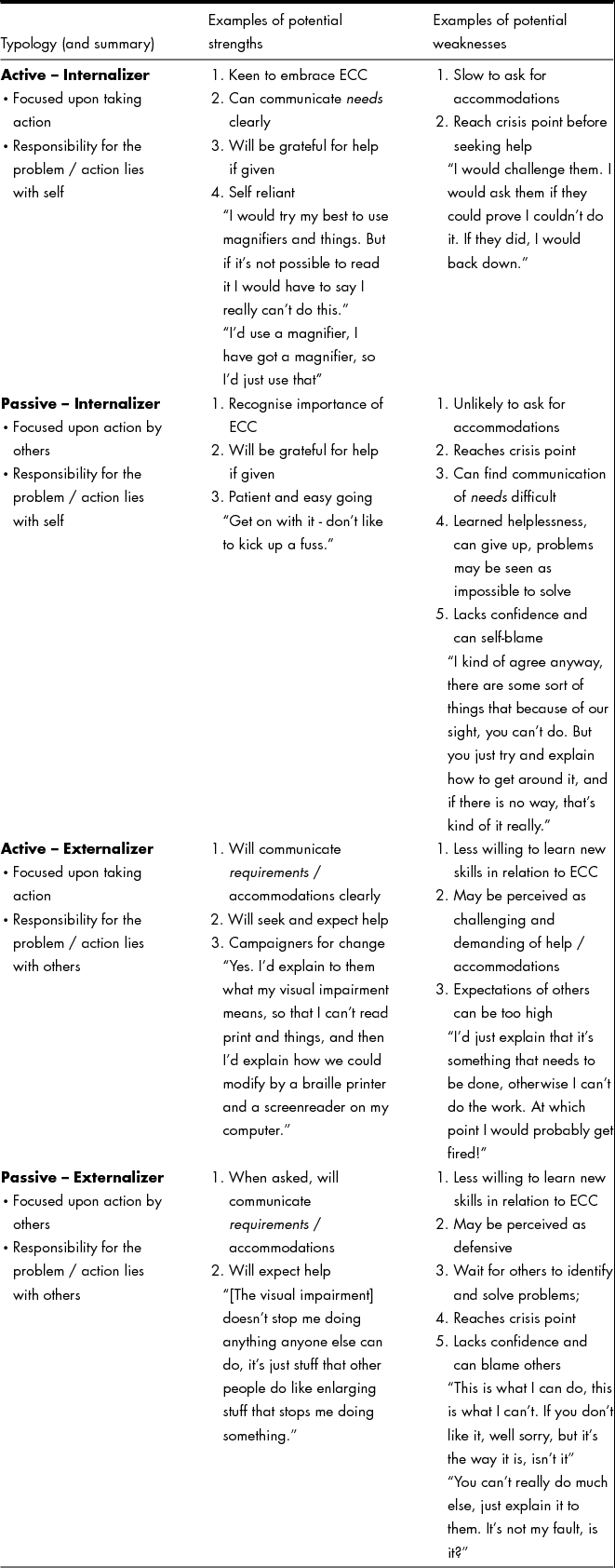
Perhaps of greatest interest and relevance to practice are the young people's responses to the two employment-based scenarios, that is, how they envisaged exercising their independence to address the problems. The analysis of the responses identified two dimensions: the first related to how active/passive the young people felt they should be (or could be) in solving the problem, while the second related to whom the young person attributes the responsibility for the problem and its solution (with themselves or with others). The interaction of these two dimensions provides four typologies of approach, as described in Table 3, each of which has associated strengths and dangers. The emerging model presented in Table 3 has similarities to, and draws upon, the theory of locus of control and attribution style (the theory of the extent to which individuals attribute and predict internal and external causes of events in their lives), and indeed others have usefully applied this theory to visual impairment and rehabilitation (e.g. Dodds et al., Reference Dodds, Ferguson, Ng, Flannigan, Hawes and Yates1994; Douglas et al., Reference Douglas, Travers, McLinden, Robertson, Smith, Macnab, Powers, Guldberg, McGough, O’Donnell and Lacey2012).
Different typologies of approaches to solving employment-based problems (and illustrative quotes)
Interactive approach and preparation
The typologies described in Table 3 are somewhat simplified for purposes of illustration and communication. Even so, features of these typologies can be recognised in the results presented. In actuality, even if an individual has a tendency for a given approach, they are likely to utilise a range of ways of constructing their situation. There was evidence of this in the responses as participants would sometimes identify things that they believed they would need to do and things the employer would need to do. Douglas et al. (Reference Douglas, Travers, McLinden, Robertson, Smith, Macnab, Powers, Guldberg, McGough, O’Donnell and Lacey2012) made a similar observation in relation to visually impaired people's interpretation of their mobility: participants attributed internal barriers (e.g. their poor eye sight) and external barriers (e.g. poor public transport, lack of mobility training) to explain their situation. Of greatest relevance is considering what is the ideal approach a young person with visual impairment might take, and how can teachers and services best prepare them?
Drawing upon Table 3, the ideal approach would be to try to maximise the strengths of all the typologies while minimising the potential weaknesses. The ideal working colleague or potential employee must be proactive, assertive and polite, but at times be patient with working procedures and equipment that must be adjusted and colleagues who must be educated. Such a person should have the independence skills in place and actively seek to develop new ones, while also understanding what support and ‘reasonable adjustments’ (as per, for example, the UK Equality Act, 2010, or ‘reasonable accommodations’ as per the US Americans with Disabilities Act) may be required, expected and demanded.
In terms of the role of education, embedding an appropriate ECC within young people's educational experience is critical. The literature identified concerns about the priority given to this in UK schools and the lack of reference made to school ECC experience by the young people in this study offers little reassurance and is worthy of further investigation. One undoubted challenge facing educators is knowing how to implement the ECC ‘given the time constraints of the school day’ (Wolffe & Kelly, Reference Wolffe and Kelly2011, p. 341). These time constraints may be partly linked to national and state policy which emphasise national assessments of core curriculum areas. Douglas et al. (Reference Douglas, Travers, McLinden, Robertson, Smith, Macnab, Powers, Guldberg, McGough, O’Donnell and Lacey2012) argue that educational systems which emphasise national assessments for the purposes of accountability (as is the case in the US and the UK) are in danger of narrowing the curriculum at the expense of disability-specific curriculum areas. In spite of this, the general concept of the ECC appears to be established in the US; Sapp and Hatlen (Reference Sapp and Hatlen2010) were able to identify a significant amount of US-based literature and research which drew upon the ECC framework and further argued, ‘The Council for Exceptional Children (2009) included all nine areas of the ECC in its list of the knowledge and skills that beginning teachers of students with visual impairments need … thus indicating that the larger educational community recognizes that all areas of the ECC are important for students with visual impairments.’ (p. 342). In contrast, given most of the research literature on the topic is US-based, uptake of the concept in other countries appears to be less clear. In UK-policy terms, the UK quality standards for support services for children and young people with visual impairment (DfES, 2002) make general reference to the need to ‘provide opportunities which maximise independence’ (page 3), but no explicit reference to an ECC (or equivalent). We would argue that more explicit reference to specific areas of instruction and target outcomes in relation to independence will help ensure that young people with visual impairment leave school with the appropriate skills.
As a word of caution, the skills-based approach to independence as encapsulated by the ECC must not be confused with promoting an individualised approach to preparing young people for life after school. In line with the discussion, the responsibilities of employers and society as a whole are part of a balanced solution to improve people with visual impairments’ participation in employment (and clear legislation and its enforcement is part of that). Ideally young people's educational experience should reflect such a balanced approach. The emerging framework presented, and drawing upon psychological constructs such as locus of control and attribution theory, may well prove helpful in supporting young people to navigate this complex area.
Limitations and future work
The analysis in this paper does not present the views of a fully representative sample of visually impaired young people in the UK, and the interview questions presented here only covered a limited range of situations in which the benefits of independence education could be explored. Additionally, the majority of the young people were being asked to speculate about hypothetical situations which they had not directly experienced. The research presented here was partly inspired by previous research findings that negative student attitude affected their engagement in being taught independence skills while at schools (in particular the anxiety of appearing different to peers). It is interesting then to ask young people to consider independence in the work situation. Even so, while the young people did draw upon their own experiences in their responses it must be acknowledged that their expressed attitudes and views do not necessarily predict their eventual behaviour when they enter the workplace in the future. For this reason the findings must be treated cautiously and will benefit from linking with ongoing work as part of the current longitudinal study (in particular as more in this cohort of young people enter the labour market) as well as from other studies. Nevertheless, the range of responses generated through these interviews offers useful pointers to professionals who are trying to improve the employment outcomes of young people with visual impairment.
Acknowledgments
The project is funded by the Royal National Institute of Blind People (RNIB) and the Nuffield Foundation.