INTRODUCTION
The ornamental fishery is a well-established multi-million dollar industry that supports fishermen in developed and developing countries throughout the Americas, Asia, Africa and Oceania. It supplies aquarists in developed countries with a selection of >1400 vertebrate and invertebrate species (Chapman et al., Reference Chapman, Fitz-Coy, Thunberg and Adams1997; Calado et al., Reference Calado, Lin, Rhyne, Araújo and Narciso2003; Bruckner, Reference Bruckner2005; Rhyne et al., Reference Rhyne, Rotjan, Bruckner and Tlusty2009). Although numerous, ornamental fisheries often operate unnoticed due to their niche market, the frequency of product export and the diminutive size of the target organisms. As a result, little attention has been paid to them and they have been managed based on little to no life history information. At low levels of exploitation this situation may not be problematic, but it is critical to have baseline biological information on a species to manage it sustainably as exploitation intensifies.
The marine aquarium trade relies predominantly on wild caught species, with >90% taken from coral reefs and associated habitats (Friedlander, Reference Friedlander2001; Wood, Reference Wood2001; Tlusty, Reference Tlusty2002). The industry has increased dramatically in recent years, with a distinct focus on organisms that provide ‘ecosystem services’ for aquaria, such as detritivores and herbivores (Calado, Reference Calado2008; Rhyne et al., Reference Rhyne, Rotjan, Bruckner and Tlusty2009). For example, many snails, crabs and shrimps are sought by aquarium hobbyists for their ability to control algal growth and eliminate aquarium pests (Calado et al., Reference Calado, Lin, Rhyne, Araújo and Narciso2003; Calado, Reference Calado2008). As these organisms are harvested for the services they can provide in an aquarium, those services are potentially lost from the ecosystem. Such loss of organisms and associated services might have considerable consequences at the community level, as suggested by the relevant role played in structuring communities and promoting biodiversity in temperate subtropical seagrass beds (France & Duffy, Reference France and Duffy2006). Community-level effects resulting from the loss of ‘ecosystem services’ include, but are not limited to, alterations to trophic structure, loss of grazer control of algal production or seagrass epiphyte growth, prey switching by predators and loss of biodiversity (France & Duffy, Reference France and Duffy2006). To address these effects, a baseline understanding of the biology and ecology of the targeted species in both fishery-dependent and -independent contexts must first be established (Bruckner, Reference Bruckner2005).
In the western Atlantic, the south-eastern United States of America (primarily the State of Florida), Puerto Rico and Brazil lead the export of marine invertebrate ornamentals (Bruckner, Reference Bruckner2005). Landings of >9 million ornamental organisms, comprising >600 fish, invertebrate and plant species, are reported yearly from Florida alone (Rhyne et al., Reference Rhyne, Rotjan, Bruckner and Tlusty2009). The extensive seagrass and hard-bottom habitats found around its coastline harbour many ornamental invertebrates highly valued by aquarists. Examples include hermit crabs from the genus Clibanarius, shrimps from the genus Lysmata, boxer shrimps from the genus Stenopus and true crabs from the species complex Mithrax–Mithraculus. Among these ornamental invertebrates, shrimps from the genus Lysmata are one of the most heavily harvested organisms from the ‘marine life’ fishery in Florida (Florida Fish and Wildlife Conservation Commission (FWC), unpublished data). Moreover, immediately after corals, caridean shrimps, mostly from the genus Lysmata, represent the most heavily traded ornamental marine invertebrate worldwide (Calado, Reference Calado2008). However, very little is known about the life history of these shrimps (for exceptions see Baeza, Reference Baeza2009, Reference Baeza2013; Baeza et al., Reference Baeza, Braga, López-Greco, Perez, Negreiros-Fransozo and Fransozo2010 and references therein). Basic life history information critical to manage any fishery with the goal of sustainability is largely absent, yet in 2010 marine life (i.e. ornamental) licensed fishers harvested 1.9 million Lysmata shrimp mostly from two regions in Florida (FWC, unpublished data).
Here we report basic life history information about one of the most intensively traded species in the western Atlantic, the ornamental shrimp Lysmata boggessi. Although misidentification of traded species is rampant in the industry, preliminary barcoding analyses (using both COI and 16S mitochondrial gene markers) indicate that L. boggessi, not L. wurdemanni as originally believed, is the most traded species in Florida (J.A. Baeza, unpublished data). As reported for each species of the genus Lysmata in which sex expression has been studied, L. boggessi is a protandric simultaneous hermaphrodite (see Baeza et al., Reference Baeza2010; Baeza Reference Baeza2013 and references therein). In sequentially simultaneous hermaphroditic species, juveniles first mature as functional males (or male phase (MP) individuals), and later become functional simultaneous hermaphrodites (or euhermaphrodite phase (EH) individuals) capable of reproducing either in the male or female role (Bauer & Holt, Reference Bauer and Holt1998; Fiedler, Reference Fiedler1998). Given their distinct sexual system (Baeza, Reference Baeza2009 and references therein), shrimps from the genus Lysmata are also being used by evolutionary biologists to explore the importance of environmental factors in driving behavioural and morphological innovations (Baeza & Bauer, Reference Baeza and Bauer2004; Baeza, Reference Baeza2006, Reference Baeza2007, Reference Baeza2010, Reference Baeza2013; Wong & Michiels, Reference Wong and Michiels2012).
The aim of this study was to generate information on population and individual reproductive parameters. At the population level, we studied population size (density), size structure (size–frequency distribution), size at sex phase change, and sex phase ratio (males:hermaphrodites). We also studied individual parameters, including size-specific fecundity, reproductive output, and embryo size. This and future studies on the population and reproductive biology of this species will form the baseline for models aimed at assessing the stock condition and sustainability of the fishery.
MATERIALS AND METHODS
Study sites and description
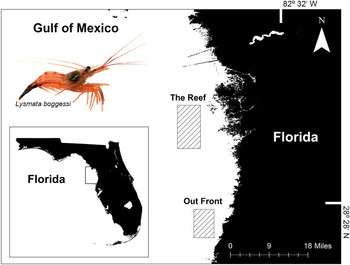
Lysmata boggessi was studied from two different localities (or fishing grounds, named ‘Out Front’ and ‘The Reef’ by local fishermen) from the shallow subtidal zone off the west central coast of Florida (Figure 1) and from one locality within western Florida Bay. The subtidal environment (2–5 m depth) at all three localities is dominated by meadows of the seagrass Thalassia testidinum interspersed with hard-bottom grounds. While seagrass dominates the biota within the meadows, the hard-bottom is composed of a thin (~0–5 cm) layer of sandy–marl often covered by mats of red algae from the genus Laurencia spp. Although hard-bottom in the western Florida Bay harbours a greater diversity of sessile organisms not typically found in west central Florida, including octocorals such as the angular sea whip Pterogorgia anceps and the slimy sea plume Pseudopterogorgia americana, and scleractinian corals Siderastrea sideria and Solenastrea hyades, at all localities sponges such as the loggerhead sponge Spheciospongia vesparium are plentiful and their biomass dominates the sessile fauna.
Map of the central west coast of Florida, USA. The hatched boxes show the primary fishing grounds for roller-frame trawlers operating out of Hernando Beach, Florida. Shrimps Lysmata boggessi are a by-catch in trawls that target food and bait shrimp Farfantepenaeus duorarum. Photograph credit: Arthur Anker.

At the shallow subtidal zone off the west central coast of Florida (Out Front and The Reef), individuals of Lysmata boggessi were collected in November 2011 (Out Front, 14 and 15 November 2011) and between January and February 2012 (The Reef, 27 January 2012 and 3 February 2012) from onboard commercial fishing trawlers operating at night out of Hernando Beach, Florida (28°30.00′N82°39.00′E). The fishing gear used was a roller-frame bottom trawl with a stretched-net mesh size of 25.4 mm. This mesh size is used to capture the pink shrimp Farfantepenaeus duorarum, but also lands L. boggessi as by-catch. An additional sample of shrimp was obtained from an aquarium-trade dealer in Hernando Beach who purchased them directly and non-selectively (i.e. he purchased all they had captured) from a fisherman trawling the Out Front area on 15 May 2011.
Within western Florida Bay, shrimp were also obtained from an aquarium-trade dealer in the Florida Keys on 14 May 2011, but the precise area from which these shrimp were captured is unknown. However, we were informed by the dealer that the shrimp were caught as by-catch in stone crab traps immediately north of the middle Florida Keys. Stone crab traps are constructed of wood, plastic or wire and are no larger than 60 × 60 × 60 cm, reaching a maximum volume of 0.22 m3. An entrance is located on a horizontal side of wire traps and on the top of wood and plastic traps. Lysmata boggessi usually find refuge within the bait cups where they also feed on the bait placed there.
Abundance of Lysmata boggessi
Population abundance and density were measured at Out Front during November 2011 and at The Reef during January–February 2012 from onboard roller-frame trawlers operating out of Hernando Beach, Florida. The roller-frame trawl nets (2) were typically set 7–10 times during each night-long trip within a 2–5 m depth range and towed for approximately 45 min. We used a hand-held GPS (Garmin GPSmap® 60CSx, USA) to track each trawl and recorded trawl duration, speed, location and distance covered. At the end of each set, the trawls were brought onboard where the contents of both nets were sorted and the target species retained. We counted all of the shrimp landed from each trawl set and sampled 20–30 individuals from every other trawl set for measurement of population structure and reproductive biology parameters. Sampled shrimp were immediately fixed in a 10% neutral buffered formalin solution for 48–72 h, then preserved in 70% ethanol for later examination.
Fishery-dependent shrimp abundance (S A) for each trawl was calculated with the formula:
 $$S_{A}=n/\lpar d \times w\rpar$$
where n is the number of shrimp caught in each trawl, d is the distance travelled by the boat during each trawl and w is the width of the trawling net which varied by the fishing vessel (combined trawling width was 8.53 m at Out Front, November 2011 and 9.1 m at The Reef, January–February 2012). Differences in the abundance of L. boggessi among sampling localities (Out Front vs The Reef) were tested with a one-way ANOVA using log–log transformed data. Before conducting the test, assumptions of normality and homogeneity of variances were checked and found to be satisfactory (Zar, Reference Zar1999).
Population structure of Lysmata boggessi
Several population parameters were calculated for L. boggessi at each sampling locality and date (i.e. Out Front (May 2011), Out Front (November 2011), The Reef (January–February 2012), and Florida Bay (May 2011)) including: size structure, sex-ratio, size at sex phase change and proportion of brooding hermaphrodites. Differences in the body size of L. boggessi among localities were tested with a Wilcoxon test because the assumptions of normality and homogeneity of variances were checked and found not to be satisfactory, even after log–log transformation (Zar, Reference Zar1999). Sex-ratio was estimated as the quotient between the number of males and the number of males plus hermaphrodites in the population (Baeza et al., Reference Baeza, Braga, López-Greco, Perez, Negreiros-Fransozo and Fransozo2010). Sex-ratio values greater or less than 0.5 indicate, respectively, skews toward males or hermaphrodites in the population. For each locality we tested for deviations from a 1:1 sex-ratio using the binomial test (Wilson & Hardy, Reference Wilson, Hardy and Hardy2002). Size at sex phase change (L 50) for the different sampled localities was estimated using logistic regression as the size at which the probability of being a hermaphrodite was 0.5 (Wilson & Hardy, Reference Wilson, Hardy and Hardy2002).
Reproductive biology of Lysmata boggessi
A sub-sample of the individuals collected for population structure estimation was used for estimating reproductive parameters. Fecundity, reproductive output, and egg size were estimated for shrimp collected from the Out Front locality in May 2011 and from The Reef locality in January–February 2012. The shrimp were collected during a single night from each locality (Out Front: 14 November 2011; The Reef: 27 January 2012). Hermaphroditic shrimp carrying newly spawned (early stage, with uniformly distributed yolk and no ocular pigments) embryos were selected to cover the full range in body size we observed. The carapace length (CL) of each shrimp was measured under a stereomicroscope (Model M5A, Wild Co., USA) to the nearest 0.1 mm. The embryos were then gently collected with forceps from underneath the abdomen, measured (widest and longest axis for each of ten embryos per shrimp) and then counted under a stereomicroscope. Direct counts of the embryos were performed on hermaphrodites carrying 400 or fewer embryos. In hermaphrodites carrying more than 400 embryos, four sub-samples of 100 embryos were separated from the brood mass and the shrimp, sub-samples, and the remains of the embryo mass were dried for 48 h at 70°C in an oven (LO–201C, Grieve Co., USA) and weighed to the nearest 0.01 mg with an analytical balance (AE163, Mettler, USA). Fecundity in these shrimp was estimated with the formula (Baeza & Thiel, Reference Baeza and Thiel2000):
 $$N=EM/\lpar SS_1+SS_2+SS_3+SS_4\rpar /{\it 400}+{\it 400}\comma \;$$
where N = total number of embryos per hermaphrodite, EM = dry weight of the remaining embryo mass after the four sub-samples (SS1–SS4) were extracted. Egg volume was estimated with the formula for the volume of an ellipsoid (Turner & Lawrence, Reference Turner, Lawrence and Stancik1979):
 $$EV={\it 1}/{\it 6}\lpar LS^{2}\pi\rpar \comma \;$$
where L = long axis and S = short axis.
Reproductive output for the hermaphrodites was estimated as the ratio between dry weight of embryos and dry weight of the hermaphrodite carrying the same embryos. This reproductive output represents the amount of resources that hermaphrodites invest in female reproduction (Baeza, Reference Baeza2006).
We tested whether or not the slope of the curve denoting the relationship between fecundity and body size (CL) of hermaphrodites differed significantly from zero using a general linear model (Zar, Reference Zar1999). We also tested if reproductive output increased linearly with hermaphrodite body size. The relationship between reproductive output and hermaphrodite body dry mass was examined using the allometric model y = ax b (Hartnoll, Reference Hartnoll and Abele1982). The slope b of the log–log least-squares linear regression represents the rate of exponential increase (b > 1) or decrease (b < 1) of the estimate of reproductive allocation with a unit of increase in shrimp dry mass. To determine if the relationship deviated from linearity, an F-test was used to test if the estimated slope b deviated from the expected slope of unity. Before conducting the test, assumptions of normality and homogeneity of variances were checked and found to be satisfactory (Zar, Reference Zar1999).
Lastly, we conducted various analyses of covariance (ANCOVA) to test if the reproductive parameters measured above for hermaphrodites differed by locality (Zar, Reference Zar1999). Both body weight and CW were used as covariates and locality (Out Front (November 2011) vs The Reef (January–February 2012)) as a main factor to estimate differences between localities in brood weight, fecundity, and egg size.
RESULTS
Abundance of Lysmata boggessi
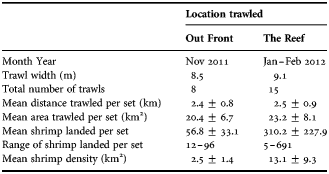
Fishing vessels on the west central coast of Florida (Out Front (November 2011) and The Reef (January–February 2012)) typically set 7–10 trawls per night, travelled at 3.2–3.9 km/h, and each set was trawled for approximately 30–60 min. Taking into account the area covered by each transect during trawling at each locality and the average number of shrimp retrieved per trawl, the density of Lysmata boggessi at Out Front and at The Reef were 2.51 ± 1.39 (mean ± SD) and 13.05 ± 9.30 shrimp per 1000 m2, respectively, during the sampling periods noted. Although the area scanned by the trawl was nearly the same for both localities, the mean number of shrimp landed per trawl set (natural log-transformed) (one-way ANOVA: F = 8.25, df = 1, 22, P = 0.0091), and the mean number of shrimp landed per km2 (natural log-transformed) (one-way ANOVA: F = 12.29, df = 1, 22, P = 0.0021) were significantly greater at The Reef than at Out Front (Table 1).
Location-specific trawling statistics and density of Lysmata boggessi on the west coast of Florida.
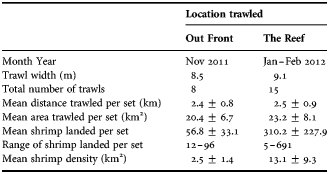
The trawl width is the combined width of both roller frames on each vessel. A ‘set’ is defined as the deployment and trawling of both roller-frame trawls on a vessel. All means are shown ±1 SD.
Population parameters of Lysmata boggessi
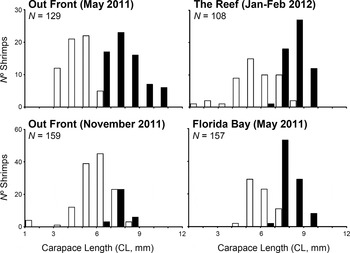
In May 2011, male shrimp from Out Front varied in body size 3.2–6.4 mm CL with an average (±SD) of 4.7 (±0.75) mm CL while hermaphrodites varied in body size 6.0–10.4 mm CL with an average (±SD) of 7.9 (±1.15) mm CL. In November 2011, male shrimp from Out Front (Figure 2) varied in body size 1.5–8.1 mm CL with an average (±SD) of 5.9 (±1.18) mm CL (Figure 2) while hermaphrodites varied in body size 6.3–8.5 mm CL with an average (±SD) of 7.5 (±0.5) mm CL. In January–February 2012, male shrimp from The Reef (Figure 2) varied in body size 1.8–8.8 mm CL with an average (±SD) of 5.7 (±1.51) mm CL while hermaphrodites varied in body size 6.5–9.8 mm CL with an average (±SD) of 8.24 (±0.69) mm (Figure 2). Male shrimp from Florida Bay (May 2011) varied in body size 4.5–7.8 mm CL with an average (±SD) of 6.14 (±0.76) mm CL (Figure 2) while hermaphrodites varied in body size 6.7–9.7 mm CL with an average (±SD) of 7.9 (±0.61) mm CL.
Population structure of Lysmata boggessi at three different locations in Florida during four different times of the year (2011–2012). White and black bars denote males and hermaphrodites, respectively. See text for details.

On average, the body size of hermaphrodites was greater than that of males at each one of the localities and sampling dates (Out Front (May 2011); Wilcoxon test (variances were not homogeneous): W = 4126.5, P < 0.05, Out Front (November 2011); W = 3650.5, P < 0.05, The Reef (January–February 2012): W = 146.5, P < 0.05; Florida Bay (May 2011); W = 5801.5, P < 0.05) (Figure 2).
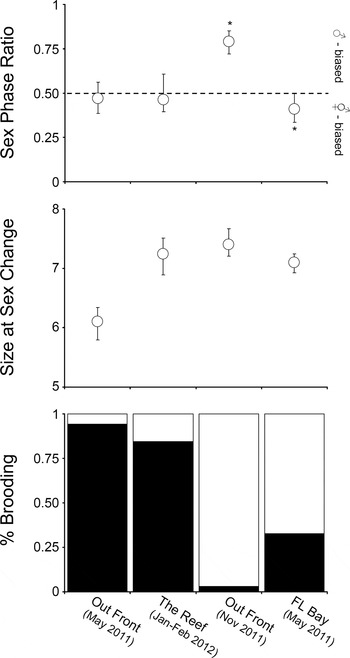
The sex-ratio for L. boggessi was estimated to be 0.47 from Out Front (May 2011), 0.46 from The Reef (January–February 2012), 0.79 from Out Front (November 2011) and 0.41 from Florida Bay (May 2011). At Out Front (May 2011) and The Reef (January–February 2012), the observed sex phase ratio did not differ significantly from a 1:1 sex-ratio (binomial test; Out Front [May 2011]: P = 0.4813; The Reef [January–February 2012]: P = 0.444) (Figure 3). However, hermaphrodites and males dominated the Out Front (November 2011) and the Florida Bay (May 2011) populations, respectively (Out Front (November 2011): P < 0.0001; Florida Bay (May 2011): P = 0.0376) (Figures 2 & 3).
Sex ratio (above), proportion of brooding EHs (middle), and size at sex phase change (bottom) of Lysmata boggessi at three different locations in Florida during four different times of the year (2011–2012). Bars denote standard errors. See text for details.

Size at sex phase change (L 50) occurred at 6.1 mm CL (95% confidence intervals (CI) = 5.79–6.34 mm CL) from Out Front (May 2011), at 7.24 mm CL (CI = 6.89–7.51 mm CL) from The Reef (January–February 2012), at 7.4 mm CL (CI = 7.21–7.67 mm CL) from Out Front (November 2011), and at 7.1 mm CL (CI = 6.93–7.24 mm CL) from Florida Bay (May 2011). Taking into account the confidence intervals of the different estimations, size at sex phase change occurred at a smaller body size at the Out Front locality during May 2011, compared to the rest of the studied localities and dates (Figure 3).
The proportion of brooding hermaphrodites was 0.94 among shrimp from Out Front (May 2011), 0.84 from The Reef (January–February 2012), 0.32 from Florida Bay (May 2011) and 0.03 from Out Front (November 2011) (Figure 3).
Reproductive biology of Lysmata boggessi
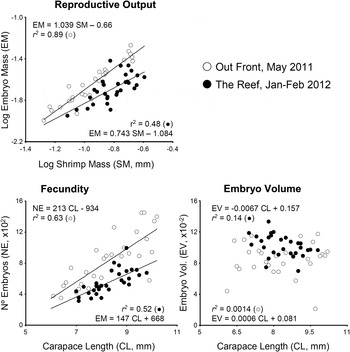
For hermaphrodites collected from Out Front (May 2011), reproductive output represented a mean ± SD of 17.7% (±1.5) of shrimp body dry weight. Reproductive output increased linearly with shrimp body weight as the slope of the line describing the relationship between these two variables (after log-log transformation) was not significantly different from unity (t-test: t = 0.54, df = 1, 29, P = 0.5967) (Figure 4). For hermaphrodites collected from The Reef (January–February 2012), reproductive output represented a mean ± SD of 13.6% ± 3.5 of shrimp body dry weight. Reproductive output did not increase linearly with shrimp body weight at this locality as the slope of the line describing the relationship between these two variables (after log–log transformation) differed (smaller) significantly from unity (t-test: t = 5.09, df = 1, 29, P < 0.001) (Figure 3). An ANCOVA demonstrated that reproductive output in L. boggessi was greater for shrimp collected from Out Front (May 2011), than in shrimp collected from The Reef, (January–February 2012) (locality term, F = 10.09, df = 1, 56, P = 0.0024). The ANCOVA also indicated an effect of shrimp body weight on reproductive output (F = 133.51, df = 1, 56, P < 0.001) and the interaction term was not significant (F = 3.65, df = 1, 56, P = 0.0612).
Reproductive output, fecundity, and embryo volume of Lysmata boggessi collected from the Florida west coast–Out Front during May 2011 and from The Reef during January–February 2012.

Among hermaphrodites collected from Out Front (May 2011), fecundity varied 350–1451 with a mean ± SD of 829 ± 336 eggs per shrimp. Fecundity among shrimp from The Reef (January–February 2012) varied 312–995 with a mean ± SD of 554 ± 157 eggs per shrimp. Embryo number increased significantly with shrimp body size during May 2011 from the Out Front locality (t-test: t = 48.5, df = 1, 29, P < 0.0001) and January–February 2012 from The Reef locality (t-test: t = 30.46, df = 1, 29, P < 0.0001). Visual analysis of the data suggested that fecundity was greater for shrimp collected from Out Front (May 2011), than for shrimp collected from the The Reef (January–February 2012). Nonetheless, an ANCOVA only demonstrated a significant effect of shrimp body size on fecundity (F = 59.16, df = 1,56, P < 0.0001). Locality did not affect shrimp fecundity (F = 0.46, df = 1, 56, P = 0.4984) and the interaction term was not significant (F = 1.98, df = 1, 56, P = 0.1650).
Embryo volume among shrimp from Out Front (May 2011) varied 0.0212–0.1171 with a mean ± SD of 0.0862 ± 0.0215 mm3. No correlation between embryo size and shrimp body size was found (t-test: t = 0.04, df = 1, 29, P = 0.8467; Figure 4). Embryo volume among shrimp from The Reef (January–February 2012) varied 0.0696–0.1331 with a mean ± SD of 0.1017 ± 0.0137 mm3. A slight but significant negative correlation between embryo size and shrimp body size was found (t-test: t = 4.59, df = 1, 29, P = 0.0410). An ANCOVA demonstrated no effect of shrimp body size (F = 1.41, df = 1, 56, P = 0.2395) and the interaction term in the model was not significant (F = 2.07, df = 1, 56, P = 0.1561). Considering the above, we modified the model by subtracting the shrimp body size and interaction terms and conducted a second one-way ANOVA which demonstrated that hermaphrodites from The Reef (January–February 2012) produced embryos that were larger than from Out Front (May 2011) (F = 11.02, df = 1, 58, P = 0.0016) (Figure 4).
DISCUSSION
Based on fishery-dependent sampling, Lysmata boggessi does not appear to be a highly abundant species in the study areas. Observations from daytime dives at our study sites on the west coast of Florida and Florida Bay revealed that small groups (approximately 3–6) of shrimp dwell in crevices or underneath sponges in hard-bottom areas. This indicates that L. boggessi may be patchy due to habitat requirements and natural gregariousness (J.A.B. & D.C.B., personal observations). These anecdotal observations suggest that L. boggessi is a subtropical species that does not engage in strictly symbiotic relationships with other marine vertebrates or invertebrates, adding to the diversity of life histories already reported for this genus (Limbaugh et al., Reference Limbaugh, Pederson and Chace1961; Bauer, Reference Bauer2004; Baeza et al., Reference Baeza, Reitz and Collin2007; Baeza, Reference Baeza2009 and references therein).
Lysmata boggessi was not as common as the penaeid pink shrimp Farfantepenaeus duorarum on the west coast of Florida fishing grounds (Out Front and The Reef) (J. Anderson & M. Dickson, personal observations) but were more abundant at The Reef site than Out Front. Diver observations at the two zones suggest that habitat diversity and benthic coverage vary between the two areas with hard-bottom more common at The Reef and more extensive seagrass meadows at Out Front (M. Dickson, personal observations). Although L. boggessi has been reported to live among seagrass blades (Rhyne & Lin, Reference Rhyne and Lin2006; Baeza, Reference Baeza2009), our observations suggest that L. boggessi also commonly inhabit crevices in hard-bottom environments and their abundance may be associated with microhabitat availability. However, we do not have quantitative information on habitat availability at each of the locations and two months transpired between sampling at Out Front and at The Reef. Thus, we must recognize that the observed differences in abundance could be partly due to natural population variation through time or intensive fishing pressure. Future studies sampling these areas simultaneously and throughout the year are important to determine if seasonal patterns affect measurements of L. boggessi abundance.
Sex phase ratio in L. boggessi did not differ significantly from a 1:1 sex phase ratio at Out Front (May 2011) and The Reef (January–February 2012). Hermaphrodites and males dominated the populations at Out Front (November 2011) and Florida Bay (May 2011), respectively. Sex phase ratio varies considerably in other protandric simultaneous hermaphrodites; some species have male skewed sex-ratios, e.g. L. galapagensis (Baeza, Reference Baeza2009) and other hermaphrodite skewed sex-ratios, e.g. Exhippolysmata oplophoroides (Baeza et al., Reference Baeza, Braga, López-Greco, Perez, Negreiros-Fransozo and Fransozo2010). In other species, the population sex phase ratio may vary considerably during a single reproductive season, e.g. L. wurdemanni (Baeza, Reference Baeza2006). Theoretical considerations suggest that low abundance species should feature hermaphrodite skewed sex-ratios given the limited encounter rates among conspecifics and thus, reproductive opportunities (Charnov, Reference Charnov1982; Baeza et al., Reference Baeza, Braga, López-Greco, Perez, Negreiros-Fransozo and Fransozo2010). Our fishery-dependent results disagree with this theoretical expectation. Although mesh pore diameter might have been too large to sample the small ontogenetic phases in the Florida west coast populations until the nets became full and the mesh largely blocked, this would not have been the case for the Florida Bay samples which were also dominated by males but came from stone crab traps that presumably attract shrimp of all sizes. Fishery-independent studies using different capture methods (e.g. traps or nets with smaller mesh diameter) would help clarify the reasons for the variation in sex-ratio.
Size at sex phase change occurred at a smaller body size at Out Front (May 2011), compared to the other samples. The proportion of brooding hermaphrodites also varied considerably between two sampling dates from the same locality (e.g. 0.94 from Out Front in May 2011 compared to 0.03 from Out Front in November 2011). These results suggest seasonality in the reproductive activity of L. boggessi on the west coast of Florida. However, as with shrimp abundance, differences in sampling date may have driven some of the observed differences in reproductive intensity rather than differences among sites. Future surveys conducted simultaneously at the different areas during one or more years would allow us to determine the effect of season and geographical location on reproductive effort.
The mean reproductive output (RO) for L. boggessi was similar to that reported for L wurdemanni (mean ± SD = 13.89 ± 0.04 (Baeza, Reference Baeza2007)) and smaller than that reported for L. pederseni (34.4 ± 18.6 (Baeza, Reference Baeza2010))—the only two other species for which this parameter has been measured. Lysmata boggessi RO increased linearly with body weight for shrimp from Out Front in May 2011, but scaled negatively with body weight for shrimp from The Reef in January–February 2012. Although not statistically different, mean fecundity was also greater for shrimp from Out Front in May 2011, than for shrimp from The Reef in January–February 2012. Lastly, no correlation between embryo size and shrimp body size was recorded at Out Front in May 2011, but a slight negative correlation between embryo size and shrimp body size was found among shrimp from The Reef in January–February 2012. We interpret these results as hermaphrodites experiencing trade-offs between different reproductive parameters driven by environmental, probably seasonal, conditions during the year. For instance, in January, when water temperature is typically low (approximately 15–18°C) on the central west coast of Florida (National Oceanographic and Atmospheric Administration), conditions may not be optimal for reproduction and shrimp might experience elevated reproductive costs that translate into decreased reproductive output and egg size (in larger females) compared to the increasing water temperatures in spring and summer. Differences in fecundity and brooding effort have been reported before for other decapod crustaceans inhabiting seasonal (e.g. temperate) environments (Baeza & Thiel, Reference Baeza and Thiel2000).
An alternative explanation for the differences in reproductive parameters between the populations and the negative allometric scaling between reproductive output and body size could be differences in food availability. The importance of food availability and quality for brood production is well known for several crustaceans (Hines, Reference Hines1976 and references therein), including other ornamental shrimps, e.g. L. seticaudata (Calado, Reference Calado2008). Also, large hermaphrodites might not have access to enough resources to produce and accumulate yolk in their body cavity. This would explain the negative allometric scaling between reproductive output and female weight during at The Reef (January–February 2012) but not Out Front (May 2011). Unfortunately, nothing is known about the diet of L. boggessi or potential food items on our study sites. Future work needs to address food requirements and availability to determine if it may be limiting for larger hermaphrodites, at least on the west coast of central Florida. Moreover, more detailed information on community composition, also including predators and competitors, is needed to determine what may be driving the observed differences in reproductive parameters.
Here we have shown that a heavily traded ornamental shrimp is not naturally abundant and that abundance varies over relatively short spatial scales (e.g. 100s of kilometres). Reproductive intensity appears to be seasonal and/or location-specific for this species, and individual reproductive parameters including fecundity, reproductive output, and embryo size vary considerably throughout the year and at short spatial scales. We recognize that fishery-dependent data may have biased some of the parameters we estimated and we are in favour of additional fishery-independent estimations of population and individual reproductive parameters. However, fishery-dependent data are far more valuable than none for a heavily-exploited species that we know so little about. All of this information now needs to be used in assessing the stocks of L. boggessi and establishing a sustainable management plan.
ACKNOWLEDGEMENTS
The authors would like to thank numerous people who provided assistance or guidance in collecting shrimps, including M. Helmholtz, J. Hunt, J. McCawley, K. Nedimeyer, A. Podey, B. Sharp, N. Sheridan and the shrimp fishermen of Hernando Beach, Florida. We thank Mark Butler for logistic and material assistance during the study. This is Smithsonian Marine Station at Fort Pierce contribution number 925.
FINANCIAL SUPPORT
This project was funded by the Florida Fish and Wildlife Conservation Commission contract 103232 to D.C.B. and J.A.B. J.A.B. was supported by a postdoctoral fellowship from Old Dominion University during the present study.