INTRODUCTION
Infection of red grouse Lagopus lagopus scoticus by the parasitic threadworm Trichostrongylus tenuis has long been associated with poor breeding success and periodic population crashes in this species (Hudson et al. Reference Hudson, Dobson, Newborn, Rollinson and Anderson1985; Dobson and Hudson, Reference Dobson and Hudson1992). Hudson et al. (Reference Hudson, Dobson and Newborn1998) have shown that parasite burdens in wild red grouse populations can be reduced by anthelmintic treatment using either direct oral dosing of levamisole hydrochloride (Nilverm, Schering Plough) or, indirectly, by the provision of medicated grit incorporating fenbendazole (Panacur, Hoechst). Newborn and Foster (Reference Newborn and Foster2002) achieved a 34% reduction in worm burden in red grouse shot in the autumn following spring treatment with medicated grit. Indirect therapies have the benefit of allowing birds access to treatment over an increased time-span compared with direct dosing, which requires capture of the birds and allows re-infection within 2 days of treatment. However, in wild birds, it is difficult to assess what dose a free-living grouse actually ingests and whether grit is ingested intermittently or regularly, and this remains a problem where self-medication via a food source is used in wild populations (Miller et al. Reference Miller, Vayhinger, Bonden, Roush, Verry, Torres and Jurgens2000; Draycott et al. Reference Draycott, Woodburn, Ling and Sage2006). Adam et al. (Reference Adam, Webster, Mullen, Keller and Johnson2011) have come closest, with an analysis of fenbendazole and its metabolites from red grouse livers using HPCL-MS-MS showing high variability in uptake between birds in a small sample from 3 moors over 2 years. In this study, a grey partridge Perdix perdix model was used in an effort to establish the optimum flubendazole dosage necessary to achieve effective control of T. tenuis when the drug is ingested by a variety of dose sizes and intervals. Partridges are naturally subject to T. tenuis infection (Portal and Collinge, Reference Portal and Collinge1932; Potts, Reference Potts1986; Calvete et al. Reference Calvete, Estrada, Lucientes, Estrada and Telletxea2003) and grey partridges have previously been used experimentally to examine the onset of hypobiosis in T. tenuis (Connan and Wise, Reference Connan and Wise1993a).
MATERIALS AND METHODS
Growth of study cohorts
Flock-housed grey partridges were reared on grass to 12 weeks of age. Each bird was treated with flubendazole for 7 days to remove all intestinal nematodes before being transferred to fresh ground to prevent parasitic re-infection that could affect experimental results. At 14 weeks of age, birds were weighed, individually marked with a numbered leg band and randomly assigned to 11 groups, each of 10 birds. There was no difference in the average weight of birds in each group (F10,99 = 1·09, P = 0·390). An average body weight of 400 g per bird was used to calculate dose levels of flubendazole of 4, 8 and 20 mg/kg body weight.
Establishment and treatment of T. tenuis infection
Caecal faeces, containing the eggs of T. tenuis produced from wild red grouse, were mixed with sawdust and cultured at room temperature for 3 weeks (Connan and Wise, Reference Connan and Wise1993b). Infective larvae (L3) were collected using a Baermann apparatus and the final concentration of 4000 L3 larvae ml−1 prepared. Birds were each infected with 4000 L3 larvae by crop intubation. Uninfected controls received an equivalent volume of water only.
After 14 days, to allow for establishment of infection, all birds were caught and orally treated by gavage. Nine groups received either 4, 8 or 20 mg/kg flubendazole (Flubenvet, Janssen) either as a single dose administered on day 1 of dosing, a split dose administered on days 1, 4 and 7 of the dosing period or, finally, as a split dose on all 9 days of the trial. On each of those 9 days, uninfected controls, untreated controls and birds that did not receive the drug on that particular day were treated with water alone. During the treatment period all birds were held as a flock in a single pen. They were moved to fresh ground on day 21 post-infection to prevent recycling of infective larvae from the infected untreated control group. In this way, all birds experienced identical husbandry and handling procedures throughout the experiment.
Worm count analysis
Following cessation of treatment, birds were maintained as a flock in a single pen for a further 14 days. All birds were then euthanased and the lower ileum, both caeca and the entire colon were removed for worm counts (Connan and Wise, Reference Connan and Wise1993a). Specimens were stored for no more than 14 days at −15 °C in individual sealed and labelled plastic bags. Frozen samples were removed a few at a time and allowed to thaw at room temperature. Each was then opened in water at a similar temperature and left to stand for a few minutes before the mucosa was thoroughly washed and discarded. The total residual material from each bird was then rinsed on a 70-micron Endecott sieve with a jet of cold water, transferred to a dish and the total number of worms counted under a microscope.
Statistical analyses
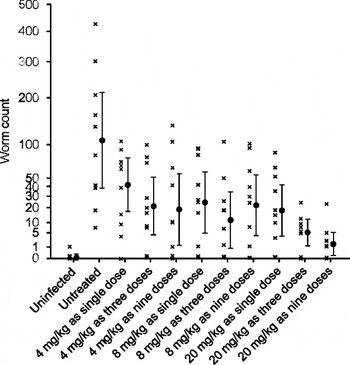
The worm counts were analysed in Genstat 14 (Numerical Algorithms Group, Oxford). Because the data were positively skewed, we considered the distribution of residuals under 4 different approaches: a generalised linear model with overdispersed Poisson error, a generalised linear model with negative binomial error, an analysis of variance after log(x + 1)-transformation, and an analysis of variance after square-root transformation. Normality of the residuals was most closely approximated in the latter case (Shapiro-Wilks W = 0·98, P = 0·120; D'Agostino-Pearson K2 = 2·10, P = 0·350). However, even after square-root transformation, there was heterogeneity in the variances between groups (Fig. 1; Bartlett's test: χ 210 = 56·17, P < 0·001). The level of probability associated with each F-statistic arising from the analysis of variance was therefore determined in relation to its empirical distribution evaluated by 4999 randomization runs (Edgington and Onghena, Reference Edgington and Onghena2007). Subsequent comparisons between groups were carried out by contrast analysis within the analysis of variance, with probabilities again evaluated through randomization. Means and their 95% confidence intervals on the square-root scale were back-transformed by squaring them.
Trichostrongylus tenuis numbers found in the caeca of grey partridges following flubendazole treatment, together with the treatment means and 95% confidence intervals, plotted on a square-root scale. Each cross represents an individual partridge.

RESULTS
Treatment frequency and dose effects on worm counts
Figure 1 shows the T. tenuis numbers found in the caeca of grey partridges following flubendazole treatment, together with the treatment means and 95% confidence intervals. A single T. tenuis was isolated from 1 bird in the uninfected and untreated group, indicating that the attempt to prevent recycling of infection between flock-housed experimental groups was largely successful.
The reductions in average T. tenuis numbers following single-dose treatments at 4, 8 and 20 mg/kg relative to the untreated control were 61%, 77% and 83% respectively. Reductions in average worm burdens fell further to 80%, 89% and 95% respectively when birds were treated on the split 3-dose regime, with split-dose treatment of birds on a daily basis at the same concentrations resulting in 83%, 80% and 98% respective reductions in average parasite numbers.
Dose versus frequency analysis
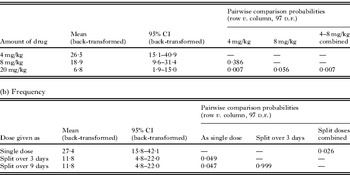
The analysis of variance found no significant interaction between dose rate and frequency (F4,97 = 0·48, P = 0·762 by randomization). When dose rate effects on the clearance of T. tenuis were considered after statistically taking into account the effects of dose frequency, dose rate was significant overall (Table 1). The highest dose rate of 20 mg/kg was significantly more effective than the lowest dose rate of 4 mg/kg, and almost so against the next lowest dose rate of 8 mg/kg; at the lowest dose rates (4 and 8 mg/kg), any apparent improvement in clearance of T. tenuis from the grey partridges was not significant (Table 1).
Average number of Trichostrongylus tenuis per partridge (back-transformed from square-root scale, together with 95% confidence interval) in relation to (a) dose rate and (b) frequency of dosing

Overall test of dose rate effects: F2,97 = 4·19, P = 0·019 by randomization.
Overall test of frequency effects: F2,97 = 2·68, P = 0·077 by randomization.
When frequency of dosing was considered after statistically taking into account the effects of dose rate, there was no overall significant effect of frequency (Table 1). However, an a priori question of interest concerned the effectiveness of split versus single dosing: contrasting split-dosing with single dosing found split-dosing to be significantly more effective at reducing average parasite burdens; indeed, both 3-way and daily split-dose treatments offered significant improvements over the single-dose regime (Table 1). No significant between-treatment differences were observed on worm burden when 3-way and daily split doses were compared.
DISCUSSION
The benefits of controlling parasite numbers in red grouse populations to increase fecundity and chick-rearing success are now well established (Hudson, Reference Hudson1992; Newborn and Foster, Reference Newborn and Foster2002; Hudson et al. Reference Hudson, Dobson and Newborn1998). The present trial was designed to be the first step in establishing an optimum drug dosage for maximum efficacy using medicated grit.
Following grit ingestion by adult red grouse, the birds retain around 8 g of grit in their gizzards, of which around 20% is excreted daily when fed grit ad libitum (Hudson, Reference Hudson1992). This equates to a grouse ingesting a daily dose of around 1·6 mg flubendazole if exclusively utilizing commercially available medicated quartz grit (Owens Nutrition Ltd). Based on an average body weight of 600 g, each adult grouse would receive a daily dose of approximately 2·67 mg/kg, producing an overall dose similar to the highest utilized in this study over an equivalent time-span. However, the individual variation in the usage of medicated grit piles by wild grouse (Adam et al. Reference Adam, Webster, Mullen, Keller and Johnson2011) implies that some birds could ingest considerably less drug. In this trial, doses were chosen to reflect the potential range of variation in the wild.
The mixed statistical results for dose frequency indicate that split-dose treatment regimes were at least as effective at reducing parasite burdens as single-dose ones in a grey partridge-T. tenuis infection model. Moreover, the highest flubendazole dose rate of 20 mg/kg significantly reduced T. tenuis numbers in comparison to the lower dose rates. From this trial, therefore, the best treatment regime was 20 mg/kg split over 3 or 9 days. Nevertheless, all concentrations of flubendazole utilized in the study provided significant clearance of T. tenuis. Even at the lowest concentration, a single dose of 4 mg/kg provided a 61% reduction in average worm burden. In a field setting, such a dose could potentially be ingested by a bird in one or two visits to a medicated grit pile and would significantly improve the overall health status of a wild red grouse, increasing its survival chances and potential breeding success (Hudson, Reference Hudson1992).
With current knowledge on patterns of grit ingestion by wild grouse, it would be beneficial to provide a dose that will achieve satisfactory efficacy (>90%) whether ingested either as a single or a split dose. However, precise estimates of daily uptake of grit by grouse on the moor are lacking and this is where the research goes next.
ACKNOWLEDGEMENTS
The authors would like to thank Clare Turner, Sarah Callegari, Craig Morris and Chris Johnson for their assistance with experimental procedures. We are grateful to Dave Newborn for the supply of red grouse faecal material for T. tenuis culture. This work was completed under Home Office Licence PPL 30/1621.