Ceftriaxone, a parenteral third-generation cephalosporin, is used to treat serious bacterial infections and sexually transmitted diseases.Reference Workowski and Bolan1 Inappropriate ceftriaxone use contributes to resistance to this important antibiotic and threatens patient safety due to antibiotic-associated adverse events and Clostridioides difficile infections.Reference Baxter, Ray and Fireman2 Previous studies of inappropriate antibiotic prescribing in outpatient acute respiratory infections (ARIs) have focused on oral, rather than parenteral, antibiotics.Reference Fleming-Dutra, Hersh and Shapiro3, Reference Hersh, Shapiro, Pavia, Fleming-Dutra and Hicks4 Our objective was to describe ceftriaxone use in adult outpatient ARI visits.
Methods
We identified adult (aged 18–64 years) visits to urgent care, retail health, and physician office settings that occurred between January 1, 2014, and December 31, 2014, in the IBM® MarketScan® Commercial Database (IBM® Watson Health™, Ann Arbor, MI). This database contains insurance claims from a convenience sample of several million individuals aged <65 years with private, employer-sponsored insurance from >260 employers.Reference Hansen5 We identified unique visits by date, enrollee number, and place of service. We excluded records without enrollee numbers or International Classification of Disease, Ninth Revision, Clinical Modification (ICD-9-CM) diagnosis codes. We excluded enrollees without coverage in MarketScan for ≥30 days prior to the outpatient visit. To exclude higher-acuity patients potentially warranting empiric ceftriaxone therapy, we excluded visits with previous (≤30 days) hospital discharges or same-day admissions.
We aggregated all claims for each visit to identify all diagnoses and ceftriaxone injections. We used a previously described tiered-diagnosis systemReference Fleming-Dutra, Hersh and Shapiro3 modified for ceftriaxone indications (Supplementary Table online) to assign a single diagnosis to each visit. We identified ceftriaxone injections using Healthcare Common Procedure Coding System code J0696. We excluded visits with concurrent diagnoses for conditions where ceftriaxone could be permissible (sexually transmitted infections and related diagnoses [eg, cervicitis], pneumonia, urinary tract infection, sickle cell disease, and acute suppurative otitis media). We defined ceftriaxone-inappropriate ARIs as sinusitis, pharyngitis, bronchitis, viral upper respiratory infection, and influenza. We calculated per-visit ceftriaxone rates by dividing the number of outpatient visits with ceftriaxone by total outpatient visits for ceftriaxone-inappropriate ARIs. We estimated confidence intervals using a binomial distribution. The National Center for Emerging and Zoonotic Infectious Diseases human subjects advisor determined this study to be nonhuman subjects research not requiring institutional review board review. Analyses were conducted using DataProbe 5.0 software (IBM® Watson Health™) and SAS version 9.4 software (SAS Institute, Cary, NC). Statistical tests were conducted at α=0.05.
Results
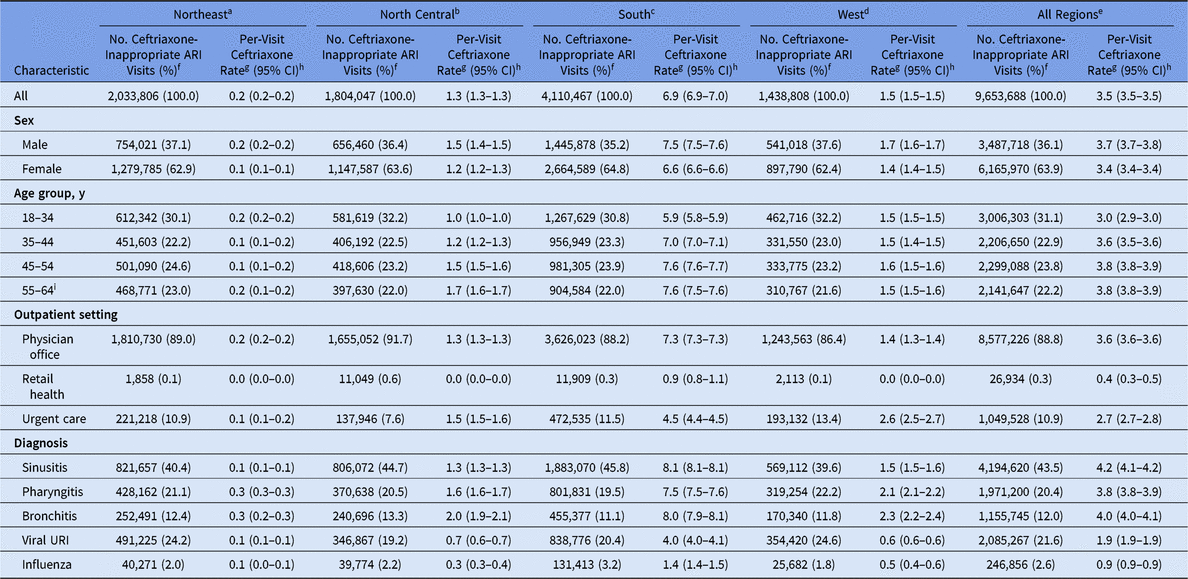
In 2014, there were 9,653,688 adult outpatient visits for ceftriaxone-inappropriate ARIs. Ceftriaxone injections were given in 3.5% (95% CI, 3.5%–3.5%) of these visits (Table 1). The per-visit ceftriaxone rate in the South was 6.9% (95% CI, 6.9%–7.0%), the highest of all regions, and the South accounted for 84.3% of all ceftriaxone injections. In the South, the highest ceftriaxone rate occurred in physician offices (7.3%; 95% CI, 7.3%–7.3%).
Characteristics of and Ceftriaxone Use in Adult (18–64 Years) Outpatient Visits for Ceftriaxone-Inappropriate Acute Respiratory Infections (ARIs) by Region, MarketScan Commercial Database, 2014

Note. ARI, acute respiratory infection; CI, confidence interval; URI, upper respiratory infection.
a Northeast region includes Maine, Vermont, New Hampshire, Massachusetts, Rhode Island, Connecticut, New York, Pennsylvania, and New Jersey.
b North Central region includes Wisconsin, Michigan, Illinois, Indiana, Ohio, North Dakota, Minnesota, South Dakota, Nebraska, Iowa, Kansas, and Missouri.
c South region includes West Virginia, Delaware, Maryland, Washington DC, Virginia, North Carolina, South Carolina, Georgia, Florida, Kentucky, Tennessee, Mississippi, Alabama, Oklahoma, Arkansas, Texas, and Louisiana.
d West region includes Montana, Idaho, Wyoming, Nevada, Utah, Colorado, Arizona, New Mexico, Washington, Oregon, Alaska, Hawaii, and California.
e Includes observations with unknown region.
f Percentages may not sum to 100% due to rounding.
g Calculated as the no. of ceftriaxone-inappropriate ARI visits with ceftriaxone injection divided by the no. of ceftriaxone-inappropriate ARI visits.
h Estimated using a binomial distribution.
i The MarketScan Commercial Database contains information on beneficiaries enrolled in employer group health insurance plans under age 65.
Discussion
Despite being an inappropriate treatment, ceftriaxone injections occurred in 3.5% of adult outpatient ARI visits in this study. More than 80% of inappropriate ceftriaxone injections occurred in the South. In our study, we excluded visits with ceftriaxone-permissible diagnoses and individuals potentially warranting empiric ceftriaxone therapy; therefore, regional differences are likely due to differences in provider behavior rather than clinical factors. Previous studies of oral antibiotics demonstrate higher rates of unnecessaryReference Fleming-Dutra, Hersh and Shapiro3, Reference Roberts, Hicks and Bartoces6 and broad-spectrumReference Alzahrani, Maneno, Daftary, Wingate and Ettienne7, Reference Fleming-Dutra, Demirjian, Bartoces, Roberts, Taylor and Hicks8 prescribing in the South. Although underlying health may be worse in the South,Reference Mokdad and Ballestros9 there may also be a tendency among clinicians in this region to prescribe and/or administer medications, even when not clinically appropriate. Further research on regional differences in clinician behavior is needed.
Our study has limitations. These data were obtained from a convenience sample of privately insured individuals <65 and may not be generalizable to other populations; we were not able to evaluate the representativeness of this sample. Additionally, because claims data were used, we made assumptions to assign a single diagnosis to a visit and were unable to evaluate the dose of ceftriaxone given. A strength of this study is its examination of parenteral antibiotic use in multiple outpatient settings in a large sample.
Although ceftriaxone was used in only 3.5% of adult visits for ceftriaxone-inappropriate ARIs, this translates to 338,394 likely unnecessary exposures in this sample alone. Inappropriate ceftriaxone use in outpatient ARI management puts patients at risk for adverse events, C. difficile, and antibiotic-resistant infections. Stewardship of this important antibiotic is urgently needed, especially in the South.
Supplementary material
To view supplementary material for this article, please visit https://doi.org/10.1017/ice.2019.21.
Author ORCIDs
Laura M. King, 0000-0002-7785-4712
Acknowledgments
The findings and conclusions in this report are those of the authors and do not necessarily represent the official position of the Centers for Disease Control and Prevention.
IBM Watson Health and MarketScan are registered trademarks of IBM Corporation in the United States, other countries, or both.
Financial support
This work was supported by the Centers for Disease Control and Prevention. M.A.K. receives salary support from the Tennessee Department of Health.
Conflicts of interest
All authors report no conflicts of interest relevant to this article.